Articles
In French, there are 3 types of articles:
• Definite articles
• Indefinite articles
• Partitive articles
Definite articles
Definite articles refer to a specific object that
the noun is referring to.
Unlike the English equivalent of “the”, there are
4 types of definite article:
• Le for masculine nouns
• La for feminine nouns
• L’ for any nouns which follow by a vowel or a
silent H.
• Les for plural
There are times where the definite article is used in
French but in English, “the” is omitted:
• Nouns used to generalise
La fumé est mal pour la santé.
• Names of continents, countries, regions and languages
La France - France
• School subjects, sports, illnesses, parts of the body
Les mathématiques - Mathematics
• Meals and drinks
Le coca - coke
• Fractions
La moitié – a half
• Titles
Le président - President
There are also times when le, la, l’ and les are
not required:
• Languages placed after the verb parler
Mon ami peut parler allemand.
• After en or de with feminine place names
En France
Indefinite articles
Indefinite articles can refer to any object that the
noun is referring to.
There are 3 types of indefinite articles:
• Un for masculine nouns (English equivalent –
“a”/“an”)
• Une for feminine nouns (English equivalent –
“a”/“an”)
• Des for plural (English equivalent – “some”/
“any”)
There are also times when un, une and des are
not required:
• After quel, comme, en, en tant que, sans, ni
Je ne vivre pas sans télé.
• Before a person’s occupation
Mon ami veulent devenir vendeur.
• In a list
Tomates, carottes, haricots, bananes et
pommes.
Partitive articles
A partitive article is an article that refers to a noun
indicating a part or a quantity as distinct from a
whole.
There are 4 types of partitive articles which are the
French equivalent of “some” / “any”:
• Du for masculine nouns
• De la for feminine nouns
• De l’ for nouns which follow by a vowel or silent
H
• Des for plural
However, there are times when the forms
change to de/d’:
• After a negative verb (also applies to un/une)
except ne...que
Je ne mange pas de viande.
Je ne regarde que la télé pendant le weekend.
• With plural nouns preceded by an adjective
Dans mon jardin, il y a de belles fleurs.
• In expressions such as bordé de, couvert de,
plein de
Sur la télé, il y a plein d’émissions à regarder.
There are also times when “some” is omitted in
English but not in French.
Il vend des bonbons.
He sells sweets.
With nouns, there can be two different forms for
masculine and feminine which mean the same
thing:
Un ami/une amie
Un italien/une italienne
Un chanteur/une chanteuse
Un acteur/une actrice
Some nouns can refer to either gender:
Un/une élève
Some nouns are masculine even when they refer to
a female:
Un professeur
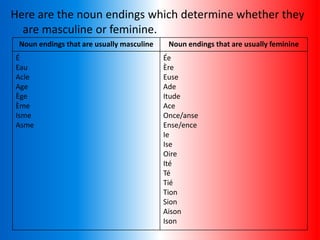
Noun endings that are usually masculine Noun endings that are usually feminine
É
Eau
Acle
Age
Ège
Ème
Isme
Asme
Ée
Ère
Euse
Ade
Itude
Ace
Once/anse
Ense/ence
Ie
Ise
Oire
Ité
Té
Tié
Tion
Sion
Aison
Ison
Here are the noun endings which determine whether they
are masculine or feminine.
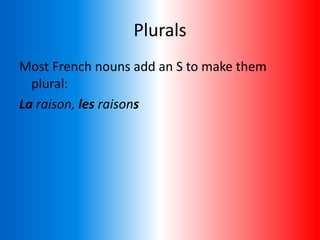
Plurals
Most French nouns add an S to make them
plural:
La raison, les raisons
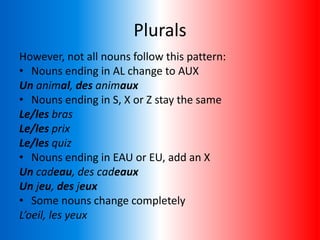
Plurals
However, not all nouns follow this pattern:
• Nouns ending in AL change to AUX
Un animal, des animaux
• Nouns ending in S, X or Z stay the same
Le/les bras
Le/les prix
Le/les quiz
• Nouns ending in EAU or EU, add an X
Un cadeau, des cadeaux
Un jeu, des jeux
• Some nouns change completely
L’oeil, les yeux

Articles

  • 1.
  • 2.
    In French, thereare 3 types of articles: • Definite articles • Indefinite articles • Partitive articles
  • 3.
    Definite articles Definite articlesrefer to a specific object that the noun is referring to. Unlike the English equivalent of “the”, there are 4 types of definite article: • Le for masculine nouns • La for feminine nouns • L’ for any nouns which follow by a vowel or a silent H. • Les for plural
  • 4.
    There are timeswhere the definite article is used in French but in English, “the” is omitted: • Nouns used to generalise La fumé est mal pour la santé. • Names of continents, countries, regions and languages La France - France • School subjects, sports, illnesses, parts of the body Les mathématiques - Mathematics • Meals and drinks Le coca - coke • Fractions La moitié – a half • Titles Le président - President
  • 5.
    There are alsotimes when le, la, l’ and les are not required: • Languages placed after the verb parler Mon ami peut parler allemand. • After en or de with feminine place names En France
  • 6.
    Indefinite articles Indefinite articlescan refer to any object that the noun is referring to. There are 3 types of indefinite articles: • Un for masculine nouns (English equivalent – “a”/“an”) • Une for feminine nouns (English equivalent – “a”/“an”) • Des for plural (English equivalent – “some”/ “any”)
  • 7.
    There are alsotimes when un, une and des are not required: • After quel, comme, en, en tant que, sans, ni Je ne vivre pas sans télé. • Before a person’s occupation Mon ami veulent devenir vendeur. • In a list Tomates, carottes, haricots, bananes et pommes.
  • 8.
    Partitive articles A partitivearticle is an article that refers to a noun indicating a part or a quantity as distinct from a whole. There are 4 types of partitive articles which are the French equivalent of “some” / “any”: • Du for masculine nouns • De la for feminine nouns • De l’ for nouns which follow by a vowel or silent H • Des for plural
  • 9.
    However, there aretimes when the forms change to de/d’: • After a negative verb (also applies to un/une) except ne...que Je ne mange pas de viande. Je ne regarde que la télé pendant le weekend. • With plural nouns preceded by an adjective Dans mon jardin, il y a de belles fleurs. • In expressions such as bordé de, couvert de, plein de Sur la télé, il y a plein d’émissions à regarder.
  • 10.
    There are alsotimes when “some” is omitted in English but not in French. Il vend des bonbons. He sells sweets.
  • 11.
    With nouns, therecan be two different forms for masculine and feminine which mean the same thing: Un ami/une amie Un italien/une italienne Un chanteur/une chanteuse Un acteur/une actrice Some nouns can refer to either gender: Un/une élève Some nouns are masculine even when they refer to a female: Un professeur
  • 12.
    Noun endings thatare usually masculine Noun endings that are usually feminine É Eau Acle Age Ège Ème Isme Asme Ée Ère Euse Ade Itude Ace Once/anse Ense/ence Ie Ise Oire Ité Té Tié Tion Sion Aison Ison Here are the noun endings which determine whether they are masculine or feminine.
  • 13.
    Plurals Most French nounsadd an S to make them plural: La raison, les raisons
  • 14.
    Plurals However, not allnouns follow this pattern: • Nouns ending in AL change to AUX Un animal, des animaux • Nouns ending in S, X or Z stay the same Le/les bras Le/les prix Le/les quiz • Nouns ending in EAU or EU, add an X Un cadeau, des cadeaux Un jeu, des jeux • Some nouns change completely L’oeil, les yeux