Article Marketing Course
By Cody Moya
Copyright 2005
You now own the MASTER RESELL RIGHTS to this
book and it may be re-sold, packaged with
other products, added as bonus, or added to
membership sites as you wish. You may also
sell master resell rights.
YOU MUST NOT CHANGE THE CONTENT IN ANY WAY
Legal Notice:
While all attempts have been made to verify information provided in this publication, neither the Author
nor the Publisher assumes any responsibility for errors, omissions, or contrary interpretation of the subject
matter herein.
This publication is not intended for use as a source of legal or accounting advice. The Publisher wants to
stress that the information contained herein may be subject to varying state and/or local laws or regulations.
All users are advised to retain competent counsel to determine what state and/or local laws or regulations
may apply to the user's particular business.
The Purchaser or Reader of this publication assumes responsibility for the use of these materials and
information. Adherence to all applicable laws and regulations, federal, state, and local, governing
professional licensing, business practices, advertising, and all other aspects of doing business in the United
States or any other jurisdiction is the sole responsibility of the Purchaser or Reader.
The Author and Publisher assume no responsibility or liability whatsoever on the behalf of any Purchaser
or Reader of these materials.
Any perceived slights of specific people or organizations are unintentional.
Earnings Disclaimer
Every effort has been made to accurately represent this product and its potential. Even though this industry
is one of the few where one can write their own check in terms of earnings, there is no guarantee that you
will earn any money using the techniques and ideas in these materials. Examples in these materials are not
to be interpreted as a promise or guarantee of earnings. Earning potential is entirely dependent on the
person using our product, ideas and techniques. We do not purport this as a “get rich scheme.’
Any claims made of actual earnings or examples of actual results can be verified upon request. Your level
of success in attaining the results claimed in our materials depends on the time you devote to the program,
ideas and techniques mentioned, your finances, knowledge and various skills. Since these factors differ
according to individuals, we cannot guarantee your success or income level. Nor are we responsible for any
of your actions.
Materials in our product and our website may contain information that includes or is based upon forward-
looking statements within the meaning of the Securities Litigation Reform Act of 1995. Forward-looking
statements give our expectations or forecasts of future events. You can identify these statements by the fact
that they do not relate strictly to historical or current events. They use words such as ‘anticipate’, estimate’,
‘expect’, ‘project’, ‘intend’, ‘plan’, believe’, and other words and terms of similar meaning in connection
with a description of potential earnings or financial performance.
Any and all forward looking statements here or on any of our sales material are intended to express our
opinion of earnings potential. Many factors will be important in determining your actual results and no
guarantees are made that you will achieve results similar to ours or anybody else’s. In fact, no guarantees
are made that you will achieve any results from our ideas and techniques in our material.
Unadvertised Bonuses
Visit www.NicheProductsPackage.com
and get it free
50 part course on Earn As Affiliate FREE
Visit www.EarnAsAffiliateCourse.com
50 part course on Search Engine Optimization
FREE
Visit www.BigSeoCourse.com
120 part course on Internet Marketing FREE
Visit www.IMcourse.com
eBay Auction Tips Ezine
FREE Internet Magazine
Visit www.AuctionTipsEzine.com
Business and Marketing Tips Ezine
Learn Killer Marketing Secrets and Get FREE Resell Rights
EVERY WEEK
Visit www.BMTezine.com
Overview
There are dozens of methods to advertise your website.
Most don't work.
The one method that has been proven to work consistently
is an approach focused on retaining existing customers while
cultivating new ones by using the search engines and great
content. There are several ways to do this.
Newsletters. Newsletters keep your website fresh in your
customer's minds. Before the Internet, direct mail was the
only way to consistently remind your customers that you're
around and to let them know about sales and specials. Now
emailed newsletters that customers sign up to receive are
cheap to compile and send, and are a proven way to keep
your customers coming back.
Fresh Content. If you consistently have fresh quality
content on your website, your customers will get into the
habit of returning. In addition, new customers finding great
content on your site are more likely to sign up for your
newsletter, and you can use your newsletter to gradually
convert browsers into customers.
Search Engine Results. Research has shown that most
new customers to an online business are generated by
search engines; and most search engine business comes
from the first two or three pages of the search results on a
keyword. By optimizing your site and its content to
maximize your placement on search engines, you also
maximize your new customer pool. It can be the virtual
visibility equivalent of moving from a shed in the back of
your house to a glossy storefront on a major street.
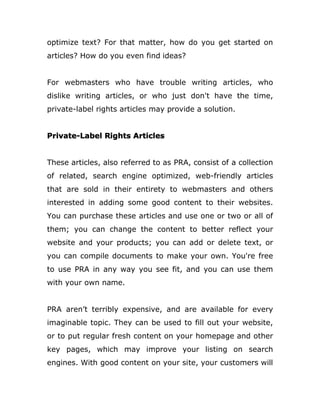
The single key to all these approaches is great fresh articles,
optimized for your website. The problem? Most web
businesspeople don't have the time to write tons of articles
for their websites. The solution: private-label rights articles.
Niche Marketing with Great Articles
One of the most magnificent qualities of the Internet is that,
by bringing the world close together, it enables people who
fill one tiny corner of interest to come together, marketing
to each other, sharing ideas, and growing as a niche
community. For instance, consider antique marble collecting.
I don't know many people who collect antique marbles. But
if I do a search online, I can find dozens of sites that
specialize in it, many with excellent information on their
sites, places to trade and sell my antique marbles, and tools
with which to make my own marbles.
How can you leverage the enormous power of niche
marketing?
The best way is by providing your web site with great
content focused directly at these niche markets. Instead of
selling to the masses who are interested in Bono and Coca-
cola, sell to those who are hungry for information and
resources concerning their special interest.
In order to do this, you must identify yourself as an expert
in the field you're targeting.
Becoming A Guru
Gurus are the wise men who sit on the mountains,
dispensing advice. You don't have to sit on a mountain but
you do need to dispense advice if you're going to be a guru.
This means you should know what you're talking about.
Online, degrees and education don't mean as much as the
information you can prove you have. The way you prove
your knowledge online is by supplying your website, whether
it's a sales website or a networking one, with great, original,
valuable content.
This is great news for anyone who writes well. Despite its
promotion as a great image-based medium, the Internet is
primarily a text-based medium. It delivers pictures, music,
and video very well indeed, but most information today is
contained in text, and the search engines that catalog your
website deal in text as well (even the image-based search
engines focus on the titles and descriptive text you assign to
your pictures and video).
But what if you know your niche market, but don't write
well? There's a solution for that too. You can purchase
content others have written for you, or you can have content
custom-written for your niche market.
Finding Great Content
There are numerous great places to find content online to
add to your website, and – better yet – you can get the
content for free.
Or so it would seem.
Sites like GoArticles and Idea Marketers are known as article
directories. They provide the service of matching well-
written, informative content with webmasters who
desperately need it. The articles are free for the taking, with
the caveat that if you display one on your website, you must
also cite the article's author and link to his or her website.
Well, free isn't always free. And in this case, when you're
trying to establish yourself as a knowledgeable expert in a
niche market, it's likely to undermine your entire purpose.
When you list someone else as the author of an informative
article on your website, you're setting that other person up
as the guru on your website. And you're even providing this
competing guru with the ultimate marketing tool – a link to
his or her website when they've just interested the customer
with an excellent piece of information.
Instead of using article directories, you're better off running
articles on your website that you can claim as your own. You
want articles ghostwritten for you, and the way to obtain
them is to go to article brokers like YourOwnArticles.com.
These companies deal with private label articles, content
that you can claim as your own because all rights to the
article have been sold by the author. Instead of advertising
someone else as the guru, you've just shown your
customers that you, yourself, are the knowledgeable one.
Articles, Newsletters, and Ebooks
Private label articles can be used either as individual articles
or content on your website, or they can be used to build
newsletters that you can send out to subscribers. If you get
a nice collection of articles, you can even create ebooks to
sell or give away to your customers as reference sources. All
of these purposes are valid and intelligent ways to use
private label articles, and any of them will drive business to,
not away from, your website.
Hold On To Your Customers: Using Articles To Keep
Them Coming Back
Everyone's done it – you go to a great website. As you flip
through, you find tons of interesting information, great
things you want to buy, ebooks you want to download. You
vow you'll come back later when you have more time to
check it out.
And you don't ever return. Not only do you never return,
you either don't bookmark it or you forget what name the
bookmark was under. You've lost a potential goldmine of
information, and the site owner has lost at least one, and
probably several, potential future sales.
Don't let this happen to your website. Keep your customers
coming back by giving them what they really want: great
information and service.
Hooking Them the First Time
A customer who comes to your site the first time is usually
curious, or thinks that your site has the resources to give
him or her what they are urgently seeking. If you don't
either fully engage their curiosity or demonstrate that you
are what they're looking for within the first ten seconds,
you'll lose the sale, almost guaranteed. If, on the other
hand, you hook the customer, you just might have a sale.
That crucial first ten seconds is all you have to get their
attention, and the best way to do this is by having a clear,
easy-to-read, content-rich homepage that appears to lead
into website that promises the same qualities. The qualities
you should focus on for your site are:
 Clear, legible, literate text
 Easy navigation
 Good content on the very first page.
Easy navigation is, of course, part of good web site design.
To a certain degree, legible text is also part of design. But
clear, literate text delivering good content falls outside web
design. How many times have you seen a beautifully-
designed web site that has pages filled with jargon or
impossible-to-follow information – or no information at all?
If you can't write well, there are solutions available to you.
The best solution, and one that sets you up as a clear expert
in your field, is to purchase directly from writers or from
content article brokers articles like YourOwnArticles.com
and content that will suit your website. These articles have
the advantage of being well-written by people who know
what they're talking about and who have excellent writing
skills. But because they sell all rights to you, you are able to
put your own name on the article if you like.
Now you have clear, quality content on your page, and
you've established yourself as an expert. But how do you
keep them coming back?
Repeat Customers: "Push" Marketing
If a customer likes your website enough to want to return,
they probably are also interested enough in your information
to sign up for an emailed newsletter. That's your next goal.
If you can send your potential customer pool a newsletter on
a regular basis, you are reminding them that you exist, and
that you have great information as well as good resources
for them to use. In addition, you can sell advertising on your
newsletter to secondary vendors, or you can advertise your
own special bargains and sales.
Fill your newsletters with more content provided to you
through the writer or content article broker, like
YourOwnArticles.com, you already have established a
relationship with. This ensures a couple of things: first, a
consistent voice in your newsletter, instead of one that goes
from formal to informal to chummy, and back to formal. This
isn't something that is immediately obvious to your
customers, but it will make them uncomfortable over time,
and you may lose a significant number of them. Second, you
will be developing a writer or pool of writers who can supply
you with quality information on your topic, and who will be
developing their own expertise in the area without being
potential competitors to you. Third, the longer you work with
a writer or content article broker, the more likely they are to
be able to supply exactly the information you're looking for.
Newsletters are a type of "push" marketing because you're
pushing your information out to your customers, instead of
relying on a hook like a search engine to draw them back to
you. Push marketing is always a better way to go when you
have an identified interested audience; you are more
motivated to sell your service or product than they are to
buy it!
With great content and a newsletter as a tool to keep your
customers coming back, your site has a much better chance
of fulfilling its purpose as an excellent marketing tool.
Higher Rankings Through Private Label Articles
The Internet, above all, is a vast repository of data, and
most data is stored in the form of text. When search engines
prowl the web in search of good sites to rate highly, the only
thing that will register on them is text. If your page is light
on text, chances are you will not rank well. And if your page
has plenty of text but it's put together in the wrong way,
you probably will rank poorly too.
That's where private label articles come in. PRAs are groups
of articles, generally organized into broad categories that
you can purchase in bulk from an article broker like
YourOwnArticles.com. You have a choice between
purchasing a subscription, in which large listings of these
articles are sent to you or made available to you to
download, or making a single purchase of a group of
articles.
These articles are pre-optimized for search engines with
keywords arranged properly, correct grammar and spelling,
and a reasonably generic focus. Best of all, they are yours to
do with as you will. You have purchased all rights to the use
of this article, and you can personalize it in any way you
want, add or delete content, and put your name on it as
author if you like.
After you've chosen the most appropriate keyword for your
website and your sales methodology, you can put private
label articles throughout your website. With their optimized
mention of keywords in appropriate places, your ranking on
the major search engines will start to rise.
Why Not Use Free Articles?
You've probably also seen article directories – large public
databases where you can download as many articles for your
own use as you like, provided you retain the resource box
placed there by the author crediting him or her. Resource
boxes also contain a link to the author's website that you
cannot tamper with.
These articles are free for use, at least financially; however,
they'll cost you in other ways, like loss of prestige, loss of
sales, and loss of customers. One or two of these articles,
particularly if you go for the known experts in the field,
won't hurt you. If you fill your site up with free articles,
you're sending a message you don't want to send.
Specifically, you're telling your customers that you aren't
competent enough in your supposed field of expertise to
write your own information.
You are also giving every person who browses your website
an easy way to get away from your website and onto
someone else's – they just need to click that link in the
reference box. And if the article's good enough to capture
your attention, chances are good it will pique your
customer's attention enough to get them to look for more
from the same author.
In short, the resource boxes steal your customers and your
sales, and you're not even aware of it when it happens.
Other Things To Improve Your Rankings
You can use the article directory system along with private
label articles to boost your search engine ranking, just as
others do. Article directories take most articles submitted to
them, provided they are written with some competence by
people who have not violated their terms of use. You can
donate your private label articles, under your name and with
your resource box, to article directories too.
The first thing this does is set up another link to your
website from the article directory. Every time someone links
to your website, your ranking goes up just a little bit. This
works especially well if the link includes your chosen
keywords as well. Since the resource box is yours to set up,
you can ensure that the keywords used are exactly what you
want.
Now you sit back and wait. Others will come along and, if
your article is a good one and contributes new or necessary
information to someone else's website, they will download
your articles and use them. Each website that uses an article
with your resource box helps boost your search engine
placement a little bit more.
There are dozens of other methods in which you can use
private label articles to boost your ranking: newsletters,
ebooks, viral reports. Experimentation on your website is the
best way to determine which methods are best for you.
How to Use Article Directories to Increase Traffic
SEO. Keywords. Metatags. Metadescriptions. Spiders.
Robots.
Do you feel overwhelmed when you hear people talking
about all these things? Most people do. Here's a quick
glossary, and then the reason you don't have to worry about
these words if you know a couple of web secrets.
 Metatags – Words embedded in your web page that tell
viewers and search engine automatons about the
content on your page.
 Metadescriptions – Same as metatags, but in sentence
form, and with the possibility of being used on search
engines as your site description.
 Keywords – The words you use in your metas and in
the text on your page to describe your product or
service.
 Spiders or Robots – miniprograms or automations sent
out to automatically browse the Web by search
engines, they catalog your site by keywords.
 SEO – Search Engine Optimization, this means your
site has the appropriate keywords and structure to be
properly cataloged by those spiders and robots.
Here's why this information isn't that important: it's archaic.
Metas were devised in the early days of the search engines,
when they weren't terribly powerful, so that your good
content could be properly referenced by the engines. What
they found was that unscrupulous webmasters loaded up the
metas with keywords that were popular and would rank well,
but that really had nothing to do with the content on the
page. This is called search engine spam because it works the
same way and is approximately as useful.
Spiders today don't pay much attention to the metas. They
look for keywords in your content, and the most cutting-
edge ones look for grammatical structure as well. It won't be
long before they can tell whether your site is actually
sensible. And they are looking for web pages that are
frequently updated, not just static sites that contain the
same information year in and year out.
Interestingly, your customers are looking for good content
as well. One simple little trick can satisfy both of them
inexpensively.
Good articles containing information about your product or
service, rotated regularly.
Drive Traffic with Great Content
Not everyone can write well enough to fulfill this
requirement. And not everyone has the time to sit and write
these articles. For those who can't, there are several
options.
You can hire a professional writer to ghostwrite these
articles for you. This is an expensive and time-consuming
prospect. Most writers charge a minimum of $35 per hour,
and web writers often charge much more. And you'll have to
sit with that writer, educate him or her on your product or
service, and ensure they're ready to tackle writing about it
before they start.
You can copy someone else's content without
permission. BAD IDEA. Not only is it illegal, but the search
engines are smarter than that. If they find identical content
on multiple sites (easier than you might think – check out
http://www.copyscape.com/) they simply won't list either
one, or they'll list the one that was original.
You can copy someone else's content with permission.
This is an interesting idea. There are a number of online
databases that provide pre-written articles optimized for
your keywords, for free. The hitch: you must also display a
resource box on your website referencing the original author
of the article and providing a link back to his or her page.
This makes them into the expert, not you.
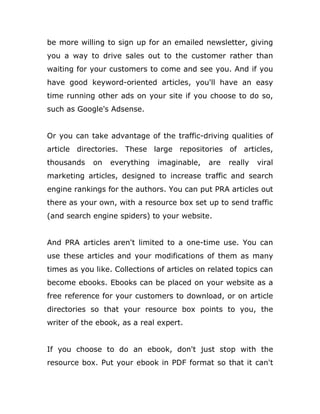
You can purchase keyword-optimized articles from an
article broker like YourOwnArticles.com. This is the
happy medium. You have good optimized articles, created
for you by professional writers, published on your site with
your name, and costing you minimal cash because they are
mass-produced.
Using Article Directories for Your Purposes
But wait, there's more!
After you purchase articles to publish on your website with
your name, you can also buy extras to publish to article
directories. Not everyone's going to be as smart as you
about how they put content on their site. Many will instead
take the easy way, and download those free articles to
publish, with resource boxes, to their own website.
If they download your articles, those resource boxes will
point to your website. In essence, you can direct traffic from
your competitors and from those who provide similar or
complementary products and services to you, straight to
your own website. And you can do it for free, after the cost
of the article.
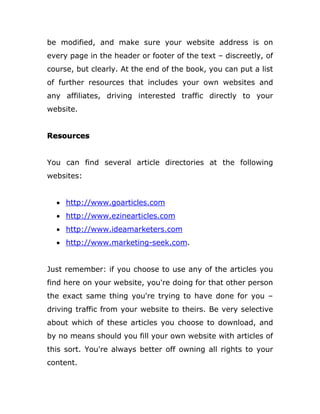
Some article directories online are:
 Go Articles: http://www.goarticles.com
 Ezine Articles: http://www.ezinearticles.com
 Idea Marketers: http://www.ideamarketers.com
 Marketing Seek: http://www.marketing-
seek.com/index.php
You can also do a periodic search at Copyscape, referenced
above, to see who's using your articles and ensure they are
not tampering with your resource box in any way.
Closing The Sale: Articles as a Follow-Up
When you're selling larger-ticket items – distance education,
for instance – you might have a tougher time with the sell.
Anyone will invest $20 in something; it's much harder to get
someone to plunk down $1,000, no matter how useful the
purchase will prove to be.
In person, a hard-sell approach might work. Online, hard
sells are a bad idea. Your customer's not looking you in the
eye; instead, he's a thousand miles away or more, and you
probably don't know who he really is. All he has to do is
leave your site. You can email him; he can delete you.
But soft sells don't work very well either, for most of the
same reasons; you can just be ignored.
What can you do to close a sale?
1. Build up a relationship. Most people don't want to buy
large-ticket items from a faceless online entity. Don't be
one. Instead, be personal, be frank, and be professional.
Develop great online content showing that you are the ideal
person to deliver what your customer wants, either because
you have the proper credentials, you have the product he or
she needs, or because you have the expertise required for
what they need.
For instance, suppose you're running a distance education
website for child therapists. You've gotten the credentials
and recognition from professional organizations to award
CEUs, and this is clearly noted on your website. You have
the education and experience to deliver a quality class
online. But you need to be able to show your potential
students that you are eminently qualified.
Set up a section on your website for your articles. Have
them rotate around the classes you're trying to sell, perhaps
addressing mini-issues that you would like to teach but that
don't fit into the classes for some reason. Create a blog and
post to it regularly so that your site visitors can get to know
you. If you can create a sense of intimacy and trust, you've
set the right atmosphere to make your sale.
2. Create a free tutorial. Online, the best way to get
people to buy your product is to give away information.
Since the hypothetical service offered here is a distance
education program offering CEUs, a free tutorial is perfect
for displaying your abilities.
For other services and products, tutorials may not be so
obvious a method for building trust. But they are. What
about a beginners tutorial in developing a complete model
train layout, from planning the track to cutting the wood,
papier mache to final touches? This sort of tutorial would
make it eminently clear that you know what you're selling.
The care you take with the details in your tutorial will make
it clear that you love your product enough to not sell sub-
par products.
If you're selling firearms, free tutorials in safety, as well as
articles on legality and getting yourself trained, would be a
good choice. For saltwater fish tanks, a thorough tutorial in
caring for the fish and the tank would be ideal.
Another benefit of tutorials like this – you can use them to
clarify the reason behind the high price of your products.
Frequently people don't want to pay lots of money for things
because they don't understand why they are so expensive.
With saltwater fish tanks, descriptions of the complexities
involved in perfect conditions, properly balanced water, and
fish health may help your customers understand.
3. Develop special offers for your favorite clients.
When you think you have someone interested enough in an
item to purchase it, you might start emailing them articles
you keep in reserve for just this sort of closing. The best
approach is generally a fairly casual email along the lines of
"thought you'd be interested in this," with an attached
article. You can use the same articles with every sale, but
you don't have to let them know that you're using stock
articles. What you're doing is building a rapport, expert-to-
expert (or obsessed-person to obsessed-person, in the case
of many niche markets!) to build their confidence in you –
and in themselves. If you treat them like the expert they
may become, they will come to think they deserve the item
they're considering purchasing.
Each niche market is a special case, of course, and you'll
develop your own art to closing sales for your customers.
But the basics will remain the same:
 Establish a relationship and a rapport
 Allow the customer to know you
 Allow the customer to see your expertise (in a non-
flashy way, of course)
 Finally, invite the customer into the "expert" club with
you
For such a distant and technological medium of
communication, the Internet is surprisingly personal. Take
advantage of that fact, and watch your sales grow, your
business flourish, and make your best customers into your
friends and colleagues along the way.
Building a Subscriber List with Articles
Websites generate sales. That's the whole reason they exist
for many people. And mailing lists also generate sales.
Targeted mailing lists, especially, are valuable; the audience
they are directed at have been identified as interested in a
niche item, and are likely to have a higher per-piece sale
ratio than an audience on a list generated from the phone
book.
Did you know you could leverage the power of the targeted
mailing list for your website sales? It's not spam; you will be
asking people to express interest in you mailing them things
before you send them anything. And it's a great way to get a
list of people you can advertise to as well.
What you're doing is building a subscriber list – a group of
people who like what you offer on your web site so much
they're willing to have their email box filled with more
information from the site. And the primary tool you're going
to use to do it is the excellent original article.
Generating the Interest
The first step in this unique method of creating a pool of
targeted customers is to generate enough interest in your
web site to make the customers want to get more. The best
way to do this is by putting content-rich informative articles
on your website. Whether you write them or you hire
someone to write them for you, these articles should whet
your customer's thirst for knowledge enough to get them to
take the second step: signing up for a newsletter.
You can set the signup area as a form that emails the
customer information back to you, where you'll be
responsible for signing the customer up for the newsletter.
You can also set up an automated system using some freely-
available software utilities – in essence, your customer's
emails will bounce to the program sitting on your server,
and the program itself will process the customer's request to
be included on your email list.
No matter how you do it, ensure that the signup process is
as simple, unobtrusive, and quick as possible. Customers
asked to fill out lengthy forms or to jump through multiple
email hoops aren't likely to finish the signup process.
Generating the Subscriber List
The list of emails you now have is your subscriber list. And
those emails are really all you need to run your newsletter
well, provided you have the content to insert into it. You will
need to maintain the list, pruning out dead emails from time
to time, and you should be responsive to any customer
requests to be removed from the list as well.
How you maintain the list and email out the newsletter is up
to you. You can create a group section on Yahoo Groups if
you wish; this is one of the simplest methods of creating
your group, but it also requires that your group emails
include a Yahoo advertisement on each.
You can also create a group email distribution list in your
home or online email as well, and send out your newsletter
by hand when a new issue is ready. The newsletter doesn't
have to be fancier than plain text, though you'll see a few
corporate email newsletters done in HTML; the important
part of the email is that you include good solid content that
the subscribers crave.
Leveraging the Subscriber List
Now that you have a subscriber list, you can do all kinds of
nifty things with it. You can offer subscriber-only sales and
deals; this drives fresh sales to your site, while also making
your subscribers feel special because they've been singled
out to participate in the sale. You can give them special
discount coupons as well.
Or you can sell ad space on your newsletter to other
vendors. Never sell anything inappropriate for your website;
for instance, if you sell sports equipment, gym shoes or
tickets to sporting events would be appropriate, while
information about lawnmowers would not be appropriate and
would probably result in some annoyance among your
customers.
Though you can sell advertising within your newsletter itself,
you should never sell your subscriber's email list. Web
consumers are pretty smart, and it's not hard to figure out
that you've been selling their information to someone
without their consent. This is more likely to drive customers
away than to make them more loyal.
Be A Forum Star With Great Articles
Forums, if you haven't been to one yet, are more or less
what used to be called bulletin boards. They are online
discussion areas where you can post a comment and read
everyone else's comment. Because forums are gathering
places for people who have an interest in the forum topic,
they are an ideal place to pick up new customers. With
intelligent discussion of issues and generous sharing of the
knowledge you have, you can become well-recognized in
your forum community.
Forums are also a great place to work at becoming an
acknowledged guru of your topic. When people read your
comments and either agree with them or learn from them,
you gain the trust and respect that are crucial to having
your expertise recognized. One very good way to become a
star in your forums is by posting links to exceptional articles
you've written and asking for feedback.
Never post an entire article to a forum; this is considered
rude. You can, however, drive traffic to your site from a
forum by synopsizing your article, asking what others think,
and posting a link back to it. Always put your URL in your
signature line, too.
Discussing Articles in Your Own Forum
But forums aren't just places where you go to talk about
things; they're living communities based around a central
theme, and with the free software available today, there is
no reason you couldn't arrange for your own forum for your
customers. It puts you in the position of being a community
leader; it gives you control over at least part of what's being
discussed in your niche market; and it gives your customers
the opportunity to interact with you and with one another.
Forums may be time-consuming, too, so before you start
your own, consider a trial run. Take about ten friends, put a
forum together in the way you plan to run one, and see
what happens when people start talking on it. If it's too
much to handle, you're better off using other forums. If,
however, you enjoy working with it and it doesn't suck up all
your time, it might be worth considering. Be sure to
schedule time to administer it, if you do decide to run with
it.
Anyway, it's not just forums that make you and your articles
discussable.
Using Blogs As Forums
Blogs today are amazingly easy to use, and the programs
that compile them often come with a built-in "comment"
feature. This allows those who have read your blog to post
their own feedback: whether they think you're full of
something, are in awe of your mighty wisdom, or have
something to add or correct, they'll let you know.
And it doesn't matter what the feedback is, as long as not
everyone calls you an idiot. A couple of negative comments
can stir up some controversy. And intelligently stated
negative comments are an invitation to you to either rescind
what you said or to clarify it in a way that makes the
negative positive.
"Ask The Expert" Features
Once you've established yourself as an expert with your
articles and blogging, you might find a lot of questions
coming your way. If so, it's time to establish an FAQ or Ask
the Expert section on your webpage. In either instance, you
can use forum technology to set up a simple question and
answer format. You can also set up an "ask a question" form
on a secondary page, and simply restate the question and
answer it in an FAQ blog.
Ultimately, when you're building an online reputation,
everything works together. Intelligent articles gain you
credibility. Getting others to link to you gives you credibility
as well, plus it gets free eyes to look at your website.
Running an FAQ, a forum, or an interactive blog all give you
the status of expert. You should try to do at least a little of
all these forms of online marketing, and ensure that at least
a short mention of your site shows up in every medium.
Do searches in forums for yourself frequently when you start
publishing articles online. There's a good chance that
eventually you'll find someone who waxes enthusiasm about
your article; at this point, you can seize the moment and
start a conversation about the article, promoting yourself
and your website at the same time in a very soft-sell sort of
way.
Using Articles in Blogs
Blogs are one of the most recent and personal trends in
online marketing. They started out as online web logs,
intimate journals kept by dedicated bloggers about their own
lives, their work, or whatever they were thinking about at
the time. Today they are growing in popularity as marketing
tools; blogs, whether you love them or hate them, are a new
form of communication that is here to stay.
There are several traits to a blog that make it an excellent
marketing tool. It is:
 Immediate and personal.
 Updated regularly.
 Very casual in tone.
 Flexible enough to include just about anything you
want to discuss.
The "immediate and personal" may be the most powerful
feature of a blog. People often mistake the candor and
intimacy of a blog for a personal relationship with the
blogger; it's very tempting to talk back to those who blog.
And when you have a personal relationship with another
person, you tend to trust them.
By keeping (or hiring someone else to keep for you, as
many GM executives have done) a blog of your own, you are
inviting readers to share your personal life and to trust you.
This is a powerful marketing tool.
Information in Blogs
One of the useful side effects of this intimate tool is the
tendency of people to trust what they read in blogs. This
makes it a great place to spread information about your site
and your niche market. For instance, if you say in a blog
that you think a particular herbal remedy for pain has done
you good in treating your arthritis, that's a very personal
statement. Anyone who reads your blog regularly has almost
certainly built up a trust for you, and talking about this
herbal remedy in your blog is going to make them think
about trying it.
Now, if your website sells paper dolls, this will have no effect
on your bottom line (unless you are an affiliate salesperson
for the herbal remedy, which is entirely different). But if
your website sells herbal remedies, you may have made
some sales. And if you've just introduced this remedy, or
you've been talking about it in your blog for a while and
would not sell the remedy until you tried it out yourself, this
increases the level of trust customer have in this item.
Basically, you're bartering built-up trust (saved from long-
term blogging) for sales of this remedy, which, if it works,
will recoup for you the trust that you bartered for it and then
some. Blogs and other intimate sales tools like this are all
about the trust relationship, so be sure before you spend
that trust that you will get it back.
Using Articles in Blogs
Blogs are in general an intimate tool designed for sharing
personal thoughts with the world at large. But sometimes
you might want to include an article in your blog for some
reason – perhaps the information contained will push sales,
or you think the information is something that your readers
should really pay attention to. Or perhaps you just don't
have anything else to say this day and think this would be
some good information to share.
Whatever your reason, there are three basic ways of using
articles in blogs. First, you can just modify the article to read
like your blogs and post it as an original blog. Second, you
can say that you wanted to share the article with your
readers and copy the article wholesale into your blog. Or
finally, you can post a link to the article as your blog entry,
and let your blog readers access it on your website.
There are advantages to each of these methods. If you treat
the article like a blog entry, you should be prepared to
expend some of your stored-up trust for it; if you are
cynically using it to drive sales, you'll pay for it in trust, but
if you really think the information is valuable, you may
receive your trust back when it has proven to be of value to
your customers.
The other two ways – citing the article with a link or posting
it wholesale and noting that it's an article you found – are
much safer as far as using trust. By doing this, your blog
readers are noting that you are not the author of the article
and if the advice in it fails, you won't lose as much trust.
Regardless of how you use articles in your blogs, remember
that your ultimate purpose is to drive sales. You want to do
this with a minimal loss of trust, but you should also be
ready to stick your neck out if necessary.
Using Articles and Affiliate Links
For great placement on search engines, you should use
great content articles, drawing targeted traffic to your
website as well as providing search engine spiders
something they can tell is valuable. The better your content
is, the more likely your customers will become that most
valuable type of customer: a repeat customer. By using
original articles by you, or by purchasing them from article
directories or article brokers like YourOwnArticles.com,
you can keep your website filled with fresh, keyword-rich
information.
Keyword-rich articles are what spiders (the automated
programs used by search engines to catalog websites) look
for when they go to new websites. If a spider can easily tell
that you're selling rubber chickens, it can then catalog you
with the other people selling rubber chickens so that
searches for that term bring up your website as well as
similar ones. People used to do this with metatags –
information in the header of a webpage – but so many sites
were loading the metatags with terms that had nothing to do
with the page the search engines stopped cataloging them
heavily. Now they look for those key words in the text of
your website, particularly with header tags and in the early
part of your site content.
By keeping your content fresh and unique, you can keep the
customers that find your website in these searches. Keeping
your page simple and with few graphics will keep your
customers coming back for more content as often as you can
add new content to the site. Pages should be easy to scan
and laid out well, and the site should be easy to navigate.
Affiliate Links: Another Source of Income and Traffic
By including affiliate links on your website, you can make
extra profit while improving your ranking in the search
engines.
Affiliate links are links from your website to someone else
who's selling something. A good example is a book review
website that includes links back to Amazon for each book
reviewed; if you have an affiliate agreement, Amazon tracks
the click back to the site that referred it – the review site, in
this example – and credits them with the visit. Generally,
click-throughs earn a certain amount of money, and in some
cases a sale earns even more. The affiliate also links to your
website somewhere on theirs, ideally herding even more
traffic back to you.
But how does this improve your ranking? Most people know
that the search engines look for keywords when ranking web
pages. The number of links to your website also influences
your position in the rankings. If you have dozens of links
from affiliates to your site, the search engines will note that
and your position will move up; after all, with dozens of links
you must be an important site!
So how do you get these affiliate links? The most important
thing you can do is make your website valuable to the
affiliate. When you link to another site, it's as if you're
saying, here, look at this website, it's good. It becomes a
personal recommendation. If your site has little or no value,
that looks terrible on the affiliate.
If, however, your site is crammed with excellent
information, you make the affiliate look good; he or she is
providing a valuable service. For instance, you have a recipe
website, from which you want to sell spices, special blends,
and cooking accessories for an affiliate cooking store. If you
have six recipes copied from the back of a Betty Crocker
cake box, you're not likely to have a good reception from the
cooking store. They would not appear very intelligent if they
linked to this sort of website.
If, however, you have hundreds of good original recipes or a
very complete Cajun recipe database or some other
especially valuable content, the cooking store is much more
apt to want to link to you. And there you go: you're selling
the spice mixes you're recommending in your recipes, right
on your website. And the store supplying the mixes is linking
back to you, which increases your level in search engine
rankings.
Better yet, if you use hyperlinks from the recipe, you can
slip the affiliate links directly into the text of your content
articles. Your website isn't cluttered with someone's ads, and
you have supplied an easy way for your site viewers to get a
needed article. And you make money doing it! Thumbnail
graphics – graphics that have been physically shrunk to
postage-stamp size to save space – are another excellent
way to slip links into your page unobtrusively. Make certain
you shrink them in a graphics program, not by resetting
image size in your web design program! This is crucial to
make the graphics worthwhile.
Articles and Link Exchanges
So you've done everything right. You have your site up,
you're constantly putting fresh optimized content on it,
you're registering with the search engines – but not too
often! – and you're even working on a regular newsletter.
But your site still pops up at #124 in the Google rankings.
Seriously, who searches through thirteen pages of links to
find your business? And since you're doing everything right,
why are all these other sites ranking higher than you?
It could be the lack of linking to your page. Search engines
today are getting smarter. They look at keywords, but they
also look at who considers a page important. Get yourself
cited in the New York Times online? If there's a link to your
site, you will see a huge boost in your ranking.
But without committing some sort of massive SEC fraud or
saving sixty-eight babies from a fire, how do you get people
to link to you?
Link Exchanges
The easiest way to get linked is to scratch someone else's
back. Say you sell camping gear. You frequent a website
that sells orienteering maps, and another that sells MREs.
These people aren't direct competitors, but their products
are complementary to yours. You'd love to be associated
with them.
So you put together a simple email, introducing yourself,
citing a link to your website, and telling the webmasters of
these other sites why you think linking to one another would
be beneficial to both of you. Most of the time, the
webmasters of the other sites will be happy to trade links
with you. And now you have another link to your site.
Granted, a link from Land's End is more valuable than a link
from Joe's Maps. But any link is going to help your ranking
in the search engines.
You can find great sites to link to you by going to the search
engines. The higher the site ranks on Google, the more
attention Google will pay to your site when the other site
links to you.
And the best way to link to someone else's site is not to set
up a links page. Instead, write some articles that include a
link to their website. Even better, write or buy a group of
private label articles that would be of interest to THEIR
customers. Perhaps you want to do an article on long-
distance hiking, and one of the tips you're giving is how to
carry ample supplies of food with you. MREs are one item
you're citing – and linking to Joe's MREs gives Joe some
traffic from you while also giving your customers an easy
way to get the item they need. While you’re at it, offer Joe
permission to quote or reprint your articles on his website
with an author’s link back to your website. Now those
articles you bought are doing double duty – they’re
providing content for your website AND generating links that
establish you and your site as an ‘authority’ in your field.
Making Money from Link Exchanges and Affiliate
Linking
Consider this: when you send your customers to Joe's for
those MREs, he may have just had a sudden influx of traffic.
He may even have had the best sales month ever, just
because of your referrals.
Well, getting a commission wasn't part of the deal, and even
though Joe is happy for the business, he may not be happy
with you if you ask for one after the link's been exchanged!
If, however, you have a record of doing this, you may be
able to make money from a type of link exchange called
"affiliate linking." Amazon.com pioneered this system with
people who wanted to sell books relevant to their content.
Instead of just sending people to Amazon to purchase these
books, they used a special type of link that Amazon was able
to track easily. When people clicked these links and
purchased the books, Amazon was able to determine who
had sent the customer there, and paid a commission to the
website for the business.
Affiliate linking is generally not going to be available from
Joe, so just make sure he links back to you. But if you look
around, you can find affiliate linking systems that will not
only raise your rankings in the search engines through
reciprocal links, but also generate revenue for your site by
paying you commissions for sales. While many websites
simply put up a list of ‘our friends and affiliates’ on a
separate page, there is a better way to do it – a way that’s
proven to generate more sales – affiliate links within
articles.
How does that work, you’re wondering? Suppose you’ve set
up an affiliate agreement with Anita’s Fishing Gear, a site
that sells handmade fishing lures. You could just add Anita
to your ‘friends’ page and hope that people click through to
her site. Or you could commission several private label
articles on fishing and handmade fishing lures, and at the
end of each article, drop in a ‘soft-sell’ paragraph saying
that you’ve found a great source of handmade fishing lures
and linking to Anita’s site. The articles establish you as an
expert who is qualified to recommend Anita’s handmade
fishing lures, making people far more likely to click through
than a banner ad or a plain link.
The Internet is a goldmine of marketing opportunity, and not
every profit venture out there is dependent on you making
sales from your site. Keep your eyes and ears open, do your
research, and be ready to seize new opportunities when they
come available, and you'll maximize your web presence as
well as your income.
Getting Directed Traffic with Articles
One of the most valuable things you can get online is traffic
directed from another website with a similar customer base
to your website. This means you can take advantage of the
trust built up by another vendor when he recommends you.
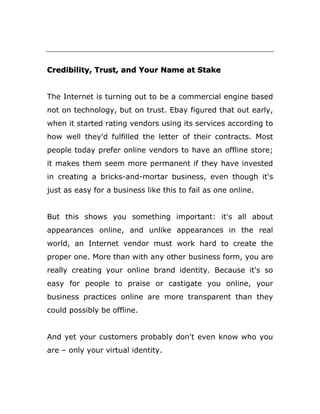
Trust As an Online Commodity
The Internet is a relatively impersonal, completely faceless
entity. You don't know who you're talking to on the other
end, you have no idea what your salespeople look like, and
you can only hope that you're being told the truth about
things. How in the world could something like this work?
The same way business has worked for thousands of years:
it runs on trust. You trust that the person on the other end
is telling the truth, and that they have your best interests at
heart. And you invest a little money in that trust. When the
sales person on the other end rewards that trust by getting
you an excellent product, you're ready to trust them with a
little more. And so on.
Part of gaining trust is establishing a repeat business
relationship with your customers. Those who continue to
come back to you time and again are those who have
decided you are worthy of their trust. But when you are
trying to establish your customer base, or when you're
working on growing your business more rapidly than you
have been, it helps if you can pick up a little extra trust-
commodity on the way.
And that's where directed traffic comes in.
Trust From Other Sites
Trust is a commodity, and you can barter in it. One thing
you can do to get a little extra trust for yourself is have
other webmasters and other vendors give you a little of
theirs. To do this, you must trade for it. And the other major
commodity online (besides actual cash money) is
information.
If you write articles (or have them written for you) with
good and unique information in them, then place them
online as free downloads, people are going to pick them up
and use them. There are dozens of article directories online
today taking advantage of that very fact. You can go to
these directories, browse through thousands of articles, and
take those you want to post to your own website or
newsletter.
The hitch is that you agree, if you use an article, to include
the author's resource box. This is a graphic box containing,
at minimum, the name of the author and a linked URL of the
author's choice.
By giving away articles in this manner, you can get extra
trust that you can leverage into sales.
Using Your Extra Trust
Here's what happens. A webmaster posts your article, with
your resource box. His customers and readers, who trust
him enough to keep coming back for information and to buy
stuff, read your article. Since the other webmaster trusts
your information enough to post it on his own website, this
imbues you with instant temporary trust.
It's temporary because once the customer clicks on your
URL link to see your website, they will be judging your site
on its own merits. If they don't like what they see, they'll
click away and not come back.
But that first click should be all you need to get a new
customer to visit you. Once they're on your site, they'll
spend a little more time here than a casual browser would –
you still have that temporary trust working for you – and
they are likely to start reading other articles you have
written and posted to your website. They may even
download an ebook or report you have up here for free.
At this point, you probably have them hooked. But to make
certain, you should be ready to sign them up to your
newsletter. Make certain, when you've posted an article to
another website that will direct traffic to you, that your site
is in top condition, your signup is working and easily
accessible from every page, and that you have sales and
specials available right away for new customers who may
need that extra hook to stay with you.
Getting them to your website is only the first step. After
that, it's up to you to keep them there.
Becoming Buddha: Make Yourself an Online Guru
Being known as a guru is a wonderful way to make yourself
much more credible to the average visitor to your site. But
how do you obtain guru status? Not everyone can get that
instant recognizability – and then, not everyone with guru
status deserves it.
What the gurus know that you may not is how to sell
themselves.
Step One: Believe You Deserve It
No one is going to give you guru status; you must take it.
Sell yourself as a guru: write authoritatively. Have more
than one website as well on which you address issues in
your area of specialization. And above all, be willing to help
anyone who needs information. A guru is someone to whom
we go for help and knowledge, so be ready to give up a
chunk of your time to do this.
You will be rewarded for that willingness with instant
respect, name recognition, and a much higher likelihood of
selling your product or service than the average vendor.,
Step Two: Deserve It
If you don't really have the knowledge you claim, your guru
status is not going to last long. Explore the websites of
others in your field. Know what's out there, and learn
everything you can about your field and fields closely related
to it. For instance, if you are going to be a model train guru,
know everything possible about model trains, and also learn
something about scale modeling, miniaturization, and
architecture.
Step Three: Don't Bite Off Too Much
Gurus hold sway over relatively focused subjects. If you try
to be guru to a topic that's too broad, you'll find two distinct
problems: it will take up too much of your time to keep up
with the information out there for that topic, and you will
find yourself responding to so many guru seekers that you
won't have time to properly maintain your business.
Instead of adopting a huge area (dolls), determine a smaller
area of specialization (antique Victorian wax-headed dolls)
and focus on it. If it turns out that you've chosen a too-small
slice of pie, you can always add a little more later, but if
your slice is too large, it's fairly difficult to give that extra
part back without destroying all the credibility you've built
up.
Step Four: Publish Stuff for Free
Gurus share their knowledge freely. If you attain guru
status, you should be ready to print articles and ebooks,
freely downloadable, that those seeking your knowledge can
access. This not only shows that you know enough to write
entire books about a subject, it also keeps too many people
from asking you for help. (The maintenance of an FAQ will
free up your time as well.)
But here's where many would-be gurus hit a snag: no
matter how much you know about a subject, you may not be
able to write convincingly about it. That's not really that
much of a problem, though, if you know where to go.
You don't have to write your own information, though you
should have mastered it if you intend to be a guru. Instead,
you can contract with a writer or with an article broker like
YourOwnArticles.com to either have articles custom
written for you, or to buy pre-written articles that you can
then publish as your own. Not only articles can be
contracted in this way, but also ebooks, put together in PDF
format and sharing a large quantity of information with your
customers.
Don't put huge chunks of articles on your site, either;
instead, dole out articles over time, either as regular posts
to your website or as blog entries, or even as emailed
newsletters. Later you can compile article series into ebooks
and special reports which you can then distribute from your
website as well.
The most important part, though, is that even though you
may be paying for this writing, you must give your
information away for free. You are a guru, after all.
Information is of so little value to you that you can afford to
distribute it to those who don't have it. Not only does this
make you look knowledgeable to your customer, but it helps
them get to know you, and makes it even more likely that
they will buy from you.
Flog a Blog: A New Sales Device
Since sometime in 2004, when bloggers scooped major
news organizations in a scandalous faked-document
incident, blogs have been on the radars of most people
interested in the Internet. And the use of blogs as sales
devices has increased over the same time.
Blogs, short for weblogs, are fairly-informal online serials
that often read like personal journals. When you read a blog,
you feel as if you're getting to know someone intimately.
This first-person intimacy is a very old literary technique
dating back about four centuries. By reading their words
written in a manner very close to the way you'd expect them
to think, you feel almost as if you're crawling inside their
heads to share their thoughts.
Because when you give trust, you get trust, trusting a
reader with this intimacy usually results in an instant
rapport, and this can be incredibly valuable in the world of
online sales.
Using Blogs As Sales Tools
Blogs are not for everyone. They take a significant amount
of time to maintain and fill, and if you're not willing or able
to put in the time, you shouldn't start one. But if you think
you can maintain it, there are a few things you should know.
First, blogs are probably the most informally written texts
you'll find online. This means you don't want to take an
authoritative tone when you write them. And you don't want
to worry too much about sounding brilliant. The main crime
committed by bloggers is boringness. Being dumb is often
forgivable, particularly if you admit your stupidity later.
Second, undertaking a blog is a commitment, and if you stop
the blog or if you don't post to it for a long time, your
audience is likely to drift away with a vague sense of
betrayal. When you blog, you're inviting the world inside
your head, and once guests are invited in, they have a hard
time understanding why you want them to leave. You should
be ready to maintain that commitment, or lose everything
your blog has achieved and perhaps more.
Posting Articles to Blogs
In a blog, articles should never feel like articles. Instead,
they should feel like a good friend telling you things you
want and need to know. For this reason, posting an article
just as-is to a blog often does not work. You must, at the
very least, note that it's an article. At best, you can edit it,
or have it edited, so that it reads like a blog posting –
informal, friendly, and to the point.
Blogged articles can be very effective sales conversion tools.
When someone's in your blog, they are probably feeling
significantly more trusting than they would on your website
at large, which means that whatever you tell them at that
point will be met more openly. You should never try to sell
anything through your blog that you yourself don't
intimately believe in; an unhappy customer who's purchased
something in this way will feel much more betrayed than
one who just clicked on an anonymous link.
But what if you don't have the knack for blogs, or for
articles? What if you can't write?
You don’t have to be able to write to use articles and blogs
to convert your ideas into usable information. Did you know
that most CEOs today who are "blogging" are actually
directing a professional writer on what they want written?
You may feel as if you're getting to know the executives at
GM through their blogs – but you're actually having their
ideas and information translated into a blog by a
professional writer.
Hopefully, your impression of GM has not just been
shattered! The point is, you can do the same thing. If you
want to begin and maintain a blog, you can hire a
professional writer to do one for you. If you feel comfortable
with a blog to a certain degree, but you want someone else
to write articles for posting on it from time to time, that's
fine as well. As long as the information on the blog is your
information or information you would have put there if you
had the writing ability, you're not being dishonest.
You can even post articles by other people and note that
these are by other people. Not everyone knows everything,
and your customers will respect your honesty when you tell
them about other ideas that have come to you. The all-
knowing guru is fine as someone to come to when you have
a problem, but when people read blogs, they're looking for
someone more down to earth, someone more like a friend.
Don't be afraid to give them that.
Viral Marketing with Your Articles
You've probably heard of viral marketing. It's a form of
marketing that spreads in a manner similar to real viruses or
email viruses – the idea is that just as it's easy to catch a
cold, it's easy to catch an idea.
Viral marketing uses existing social networks to spread
brand awareness, a new idea, or news about a new product.
And when used properly, the marketed idea spreads more
and more rapidly. It depends heavily on generated
excitement; for instance, when Star Wars fans heard about
the last movie in the series coming out, it took hardly any
time to spread from one end of their gossip networks to the
other.
You can leverage the ideas and principles behind viral
marketing to increase your online sales, particularly if you
are focused on a small niche market that you know well.
First, The Article
The most important part of your strategy is the development
of the viral package. That's your article, and you want it to
spread to as many people as possible. You must make it
exciting. You must make it attractive enough for others to
share it with their friends, and the friends with their friends.
And you must make it available.
The article is just the carrier of your personal information,
don't forget. The package is important, but your personal
information is the one vital piece of the article.
Your article can be about anything that excites your niche
community. If, for instance, you are selling things to dog
breeders, news about a new breed of dog could be very
exciting. Important information about a communicable
doggie disease is also going to spread well, though you must
be certain to end on a caring and positive note. If you're
marketing to submariners, an interview with Tom Clancy
would be a hot item.
Ideally, your article should be a timely and an un-covered
piece of information, but the hot news isn't always there
when you're ready to start viral marketing. What you can do
instead is use an article that has wide interest but addresses
a topic that hasn't been fully covered yet.
Second, Spread The News
Once your article is ready, with your intact name and a
hyperlink to your site at the bottom, you're ready to get it
out to the public. You can start by posting it on your site and
referring to it in your blog; that often generates interest. If
you go to any popular web forums, you can also spread your
news there, with a link back to your site where the article is.
You should definitely place your article on the ultimate viral
marketing tool: an article directory. Article directories are
repositories of free articles webmasters may download and
include on their own websites free of charge; the hitch is
that the article must be unchanged by the person
downloading it, and it must retain the resource box, a
section with the author's name and a URL link back to their
web site. By uploading your article to one of these
databases, you can encourage it to spread to people you
don't even know.
Third, Be Patient
Your viral marketing article is probably a slow-acting virus;
you won't see results right away. Instead, you'll find that
you have to wait, sometimes a significant amount of time,
for anything major to happen to your site. But you may
notice fairly quickly your number of website hits going up.
You may also be told about your own article by someone in
your niche market community; that's always fun!
But the best thing you can do while you're waiting is to
develop another article to build into a viral marketing
package, repeating everything you did with the first one. A
lone virus doesn't spread very well, but if you can send out
several viruses in succession, you may start seeing a
significant boost in the number of customers coming to your
site. Be ready for them; have a working signup link for your
emailing list or your enewsletter, and schedule yourself a
little extra time in case you have work to do from increased
signups or sales. The internet is a great marketing tool.
Internet Automation Is Your Friend: Automated
Submitters
The most powerful marketing tool you have online when you
start your business is your ranking on a search engine. That
does not mean it is the only tool you have, of course; you
should never slow content development down, shun link
exchanges, or ignore the possibilities of submitting to article
directories. However, you absolutely cannot afford to ignore
the search engines.
When you first develop your site, you learned the easy way
or the hard way that you must submit it to the search
engines before they can catalog it properly; and of course
you did. And you learned – again, easy or hard – that there
were automated submitters, free engines that would submit
your site to dozens of search engines for you. This, if you've
ever filled out submission forms by hand, is a godsend,
saving you hours and hours of work.
But after that first round of submission, you may never get
around to it again. That is a mistake. With every new article
you write and post online, you should submit the permanent
URL of that article. After all, each article is going to boost
your ranking. Each article should have a link back to your
home page, which may boost your overall ranking a little.
And each article should have slightly different keywords,
enabling your site to come up on many more searches than
it would have otherwise.
The Right Way To Autosubmit
The first thing you need to do is ensure that your new article
is search-engine optimized, with clear and frequent keyword
use, metatags completed, and headers and subheaders
complete with uses of your keywords. Make certain also that
you've designed your articles in such a way that they link
back to your home page. If you have other sites you want to
promote, putting links to these sites on your article page
wouldn't hurt, as long as the topic is still in the same general
field; this gives you the side advantage of promoting your
other sites as well.
Make certain your name is on the page somewhere, exactly
as you want to be searched for. One of the things you're
trying to achieve with your marketing is personal name
recognition, and that can only happen if you consistently use
the same reasonably-unique name.
Now that your article is optimized for your purposes, go out
to the autosubmitters and submit it with the article's URL.
Ensure that you have the article set up in such a way that
you won't need to move it; there are few things as annoying
as clicking on an interesting article link only to find it dead
or another article sitting in its spot! Make certain that the
keyword for this article is in its title.
You should not use exact same keyword for your articles as
you used for your home page. Keep it similar or at least
related, but give it a unique keyword of its own. That way,
people searching for something a little off your home page
topic but who are still potential customers can find their way
to your article, and trace that path back to your home page,
other articles, and stuff to sell.
What Else You Should Do
In addition to optimizing your autosubmission, watch your
web page statistics. If you are getting 500 hits per week on
your home page but 750 on your newly-submitted article,
you're doing something wrong on your home page. You may
be focusing on the wrong community, or you may not be
updating your home page enough. Compare what you're
doing on the two pages to see if you can figure it out. If you
can't, then try putting more content on your home page
related to the article that's getting high hits.
And if you optimize and submit all your articles in the same
manner (as you should), you can use statistics compared
between the articles to determine whether your customers
are more interested in one area of your topic than the
others. Take advantage of this information. If you can detect
an emerging trend in this way, you'll be in a great position
to exploit it.
Articles and Search Engine Placement
Engines run almost everything today, and the Internet is no
exception. Search engines are the beating heart of online
commerce. If you aren't listed well on the search engines,
you probably will not do well online in general.
Most people don't know how to get their sites listed on the
engines (while others, unfortunately, know too well!). This is
a problem for both vendor and customer. You've had the
experience of searching for something, finding what looks
like a good relevant website on Google, and clicking it – to
find a huge links site masquerading as good content
squatting there instead.
Why do they get ranked high instead of you? Because they
know the secrets of search engine placement.
Search engines look for keywords. These are words placed in
strategic spots on your page that tell the search engines
what your web site is all about. This isn't like the AOL
system of selling keywords; instead, Google and other major
search engines are seeking out content on your website
relevant to the searches that their customers enter. For
instance, if you sell model trains, your keyword would be
"model trains" (okay, it's a phrase, but it works the same
way). You want people looking for "model trains" to come to
your website.
So does Google. They make their money on people being
able to find what they're seeking. And what they've found is
that most people selling "model trains" have that phrase
sprinkled liberally throughout their home page, and often on
subsequent pages of the site. If you ensure that "model
trains" shows up on your page frequently and in appropriate
places, Google will rank you higher than your competitor
who does not.
But back to those obnoxious links sites. At one point, they
placed high because they did something called "search
engine spamming." They would place those coveted
keywords everywhere – having perhaps a 50% mention of
the keywords. It turned out to be text like: "The model
trains of the model trains go through model trains to model
trains." Grammatical, sure. But also utter nonsense.
For this reason, search engines have learned that a really
high keyword mention is a sure sign of search engine spam,
and they won't list these sites. Don't do it.
Text Generators
Other vendors have been turning to text generators. These
are programs that work sort of like Mad Libs – you enter
your keyword, and the computer generates text, placing
your keyword in appropriate places. You can even specify
keyword density. And then you place these articles on your
site.
If you experiment with generators a bit, you can place pretty
high on the search engines. And this gets your page a lot of
hits. But it's every bit as obnoxious as the search engine
spam was. When your customer gets to your website and it's
a lot of nonsense, they will assume that your product is
worth about the same, and click right back to the search
engine to take the next page in line.
Fresh Quality Content
Between search engines getting smarter and customers
being picky about what faceless vendor they trust online, it
may seem impossible to rank well. But the key is fresh
quality content, sprinkled liberally with your keywords. You
can write it yourself, hire someone to write it, download it
for free, or purchase it in bulk from an article broker like
YourOwnArticles.com, but ultimately you need that
quality content to maintain high rankings and keep
customers happy.
The best way to do this is always to write it yourself. But not
everyone has the time or the talent to do this. An option just
barely second to writing it yourself, then, is purchasing it,
pre-written and pre-optimized, for your site.
Why not download it for free? A couple of reasons, besides
the usual "you get what you pay for." While many free
article sites do offer excellent quality, the authors of these
articles don't have your best interests in mind; after all,
you're not paying them. They are writing articles and
posting them for themselves. Whenever you download a free
article, you are required to place a resource box with the
author's name and website on your website along with the
article.
What this does is drive your business to the other person's
website. How much business could you lose by doing this?
And every customer you lose is not just today's profit, but
potentially tomorrow's as well. Instead of setting this trap up
for yourself, purchase your articles, purchase the rights to
put your name on them instead of the original author's
name (or no name at all), and put them on your own
website, no strings attached.
Article Directories Drive Traffic
Today, internet marketing has become the number one
method of advertising a business. The Internet works for
your company 24 hours a day, 7 days a week. It never
sleeps. It never takes a holiday. Everywhere webmasters
are utilizing the incredible marketing potential of the
Internet. Every day, websites are built to help companies
that might never have attracted the right customers instead
reach millions. Profit increases, sales are made, and
everyone is happy.
But a website is completely useless if it doesn't attract
visitors. The way to make money online is by attracting an
audience. And the best way to do this is to have great
content on your website.
Content is the text and images of your website. The text is
the most important for most searches; search engines like
Yahoo! and Google seek out keywords and phrases that can
only be found in text content on websites. And when the
right combination of keywords and phrases are found on
your website, they will move you up in the order that you're
listed when someone searches for those keywords. For
instance, if your site is all about "cat food," then your
keyword phrase should be "cat food."
Depending on how your site compares with other sites on
cat food, your position in a search list may be high or low.
Ideally, you want to be within the first fifty, and higher if
possible; few people look beyond the first fifty keyword
matches.
But this leaves most webmasters with a problem: how to get
that great content on their websites. Few webmasters are
prolific writers, and it takes a lot of writing to come up with
good content. And even if you have the best mousetrap in
the world, if the search engines don't see attractive content,
they'll skip right over you to the guy who uses a string and a
piece of cheese, but can write good keyword content.
Enter Ghostwritten Keyword Articles
You don't have to write your own keyword articles. Instead,
you can purchase keyword articles written by talented
writers. These writers sell all legal rights to their articles,
generally to a broker you work with directly, and you're
allowed to put your own name on these articles as the
author.
The benefits of this are:
 You become recognized as the expert you are.
 You can place this high-quality content on your web
site, improving the ranking of your website on search
engines
 You suddenly gain control over well-written information
you can share with your established customers
 Your new customers keep coming back to your website
seeking fresh content
Placing great content on your website is not a one-time
investment. Web consumers are impatient, looking for
information they can apply to their own lives immediately,
and are always hunger for fresh data. If you're selling cat
food, one article on vitamin-fortified tuna for cats isn't
enough; you'll need to keep placing information online to
keep customers coming back. And article brokers like
YourOwnArticles.com can help you do this, with each
fresh article gradually increasing your search ranking as the
search engine spiders learn that you have frequent fresh
high-quality information.
But that's not all.
In addition to placing these articles on your own web site,
you can register as an author with an online article
directory. These directories are repositories of article content
written for specified keywords by various authors. These
directories allow you to search through hundreds of quality
articles, choosing the ones that best express the ideas
behind your website. And the service is generally free; once
you have registered with the site and chosen articles, you
can add the articles to your website.
So why, you ask, should you hand over the article you just
bought to someone else for free?
The hitch to online article directories is that the user needs
to include the resource box embedded in each article, the
box leading to the author's own website. When someone
uses your article, they're creating a link to your website.
Besides keywords, search engines look for links to your
website when they're ranking your website. The more people
who use your article, the more likely you are to see your
ranking move upward. Everyone wins: the writer is paid, you
have great content on your site, the other person using the
article gets great content as well, and you get a link back to
your website from them – free advertisement and upward
movement again in the search engines.
Some of the most popular Article Directories include
 Go Articles: http://www.goarticles.com
 Ezine Articles: http://www.ezinearticles.com
 Idea Marketers: http://www.ideamarketers.com
 Marketing Seek: http://www.marketing-
seek.com/index.php
Other rules and regulations apply to each directory, so you
should be certain to read everything referring to agreements
carefully.
Increasing Sales Conversion Rates with Articles
Sales conversion online – the rate at which site viewers turn
into customers – is estimated to be about one percent most
of the time. This means if you have a hundred views per day
of your website, only one of them is likely to buy anything
from you.
That's actually not that bad, if you think about it. You have a
site up there that's not costing you much outside of hosting
(since overhead does not exist online), and if you have one
conversion a day, you have a pretty good income from an
unmanned website. Several of these gives you a healthy
business.
But it's always better to convert more of your viewers into
customers. If you have the mentioned 100-views website,
just one more customer per day doubles your rate of sale,
and your income. Tripling it is not unheard of for web sites
that are sales-optimized.
Using Articles to Sell Your Product
The worst thing you can do though, is hard-sell your
product. Like mules, consumers don't like to have their
heads forced to look in any given direction and they are
likely to balk.
However, you can use free information to coax them to look
your way.
Though the Internet is today's most useful and productive
marketing engine, it was originally developed as a method
for sharing information. And that's what it's best at today,
too. Even though millions of people use it for images,
movies, and sound, it's really optimized for text-based data.
And if you share clearly-written, easy to follow information
with your customers on the products you know they want to
buy anyway, you're much more likely to convert viewers into
buyers.
It's the difference between having an online catalog you loan
someone, and taking a friend by the hand to talk to them
about a specific product you personally know and trust.
Trust
Sales and information on the Internet are really all about
trust. You trust that the information you read is correct –
and, interestingly, the Internet tends to be self-correcting.
The information disseminated on it gradually tends toward
being the truth.
This gives you a huge edge. People subconsciously trust the
Internet before they trust a late-night sales pitch. This has
changed from five years ago, when few sales were made
online. Ideally, what you want to do is capture some of that
trust for your own website and convert it into sales.
The best way to do that is to give away truthful, valuable
information in articles on the things your customers are
obsessed with. In addition, these articles should be written
in a friendly, non-pushy way so that your customers can see
that you're just sharing information with them, not trying to
get them to buy stuff.
Articles are NOT sales letters or sales pitches. That's where
a lot of online business owners mess up. Instead, articles on
your website are a method for educating your consumers
while simultaneously building up a bank of trust that will
ultimately be converted into sales.
If You Can't Write
If you can't write, that's okay too. You know your products,
and you know what you want to communicate to your
customers. There are dozens of places online you can go to
hire writers or purchase blocks of well-written articles that
you can post to your website. Once you've evaluated the
article for accuracy and purchased the rights, you can post it
as yours.
Also Remember
When you're sharing articles with your customers, you're
building a relationship. Relationships, by definition, cover a
fair expanse of time. You should never dump a bunch of
articles onto your website and then sit down to wait for the
sales to roll in.
Instead, new articles should be put online over time. You
want your customers to keep returning. Ideally, you should
aim your articles toward your customers' changing needs
and desires. Encourage your customers to talk to you about
what they want to see and change the content of your
website to reflect these needs.
Whether you use articles, a newsletter, blogs, ebooks, or
reports, or a combination to spread the information your
viewers are hungry for, over time your information will start
to convert your viewers into sales. You should be patient
and responsive, building up your trust bank with your
audience and not pushing them until at last, they start to
buy your products on their own.
Articles and SEO
SEO is a big word these days. It stands for "Search Engine
Optimization," and it's the holy grail of web design.
Search engine optimization really refers to the development
of keyword strategies that make your website rank high in
search engine placements – giving you a spot in the top
fifty, rather than in the top thousand. The most effective
advertising technique online today is good placement in the
search engines. If you are #996 instead of #23 in the
primary listing for your product, the likelihood that a
customer will find your site through Google to click on it is
remote. And most traffic to sites these days comes through
search engines.
Without an optimized website, you probably will not make
many sales.
Start at the top. On a web page, before the title and
anything else that appears onscreen, metatags should be
filled in. If you look at the source of any website, (view –
source on most browsers), you'll see where the metatag
description and keywords are placed.
Choosing your keywords wisely, fill in the metatags first.
Make certain your page title (that's the data that shows up
in the blue bar at the top of the browser) uses at least some
of the same keywords. And make sure your first page
header does the same.
Keywords should be carefully sprinkled through your well-
written and edited text as well.
That's it. That's all there is to SEO. But it raises its own
questions.
How do you figure out what keywords to use?
Http://www.nichebot.com is a site that will suggest
keywords for your site. You enter your main site theme
(shoes, for instance, if you sell shoes) and Nichebot will
return a list of keywords and keyword phrases in order of
search popularity that you can then use on your website.
There are several other keyword suggestion engines as well.
How do you get the articles? This is more difficult. Some
people can write their own, particularly those who have
written for the Internet for a long time and have seen the
changes along the way. But not everyone can write well, and
not everyone has the talent for careful placement of
keywords in text. Besides writing them yourself, you can try
to get articles from an article broker like
YourOwnArticles.com, or you can download them for free
from online article directories.
Free, however, isn't always free. Articles you purchase from
an article broker like YourOwnArticles.com are yours to
use as you will, without any strings attached. If you
download from an online article directory, be warned: you
are required to place a resource box referencing the article's
author and his or her website on your page. You may not
mind this. But if the author is a direct competitor, you're
risking the loss of customers.
How do you keep customers at your site, then?
Providing customers with unique, easy-to-use information
will make them happy and keep them with you. Don't
advertise other services on your front page. Don't put up
flashy animations on your website. And don't make it hard
for them to find content. Regular fresh content is the best
way to keep them happy with you. And if you have relevant
content on every page of your website, your customers will
stay longer, and the ranking of your website on search
engines will go up.
You can purchase articles from article brokers like
YourOwnArticles.com instead of using the online article
directories. These articles can be published on your website
as your original work, they aren't duplicated elsewhere on
the web, and if they're good, your customers will continue to
come back, hungry for more.
Increasing Traffic
The best way to sell your product or service is to keep new
customers coming in, and keeping old customers returning.
There are several ways to do this. First, you can provide free
articles to article directories so other people will direct traffic
to your website from theirs via your resource box. Second,
you can ensure you always have fresh, accessible content on
your site.
Ebooks are another tool you can use. Put together a number
of your old articles into an ebook, and provide it to your
customers for free, with your name and web address
embedded in the book's cover and at the end of the book.
You can even use the ebook to direct them to special tools
on your website.
Yet another trick is to provide a free newsletter generated
from your website. Allow customers to sign up to be on your
mailing list, and send them regularly-published newsletters
containing fresh articles not available on your website,
information on sales and special bargains, and other things
you think your customers would be interested in that will
drive sales to your site. Newsletters ensure you have a
constant pool of customers interested enough in your
product to ask you to send them advertising; what better
tool can there be?
Prove you are an Expert in your Field with Articles
How do you identify an expert these days? You can buy a
legitimate-looking PhD. at any number of online "life skills
for credit" phony universities. You don't see the person at
the other end of most web conversations. And though you
may know more about a particular subject, for example car
mechanics, than 99.9% of people, you may not come across
online as knowledgeable. Most car mechanics are known for
fixing cars, not writing.
Simply put, most people don't write well for the Internet.
Though someone might tell you a hundred times to put
content articles on your website, articles that show you
know what you're doing, that doesn't mean you're capable
of writing one that comes across as capable or even literate.
Yet content articles are the key to getting yourself seen on
the Internet; they ensure that your website is picked up by
the search engines, driving traffic to your site. And the
keywords within that article drive the right traffic to your
site – those who are looking for your specific product or
service. The good information contained in the article
ensures your customers remain at your site.
Nothing online is more powerful than your content articles.
Using Content Articles
Content articles relevant to your site, placed carefully where
both search engines and prospective customers can easily
see them, are critical to the success of your website. Make
them more readable by:
 Keeping your page well-organized
 Minimizing graphics, especially fancy animated ones
 Delivering succinct, readable information (preferably
with lots of bullets and headings)
 Eliminating grammar and spelling errors
After this, you should ensure that there are plenty of
keywords in the top part of your document, particularly in
the title and headers. Take care of the customer's needs
first, then the search engine spider's.
But not everyone has the skills to write articles, particularly
not in such a specific way. There are other ways to get your
information. For instance, lots of webmasters have been
using article directories, websites that provide free
downloads of articles containing content optimized for your
website. Others have contracted directly with writers or with
content article brokers like YourOwnArticles.com to
purchase content articles tailored to their needs to put on
their websites as their own.
Both using free downloads and paying for articles have
positives and negatives. Here's a breakdown.
 Free downloads are, by definition, free.
 Articles you buy are not. But they are generally not
outrageously expensive either.
 The free articles require you to place a "resource box"
on your site containing the author's name and,
generally, his or her web site address with a link.
 Articles you buy can generally be placed on your
website with your name on them as author.
Both types are of similar quality as far as content;
purchased articles may be better written, as they're written
by professional writers.
You've heard the old adage that you get what you pay for? If
you use the freebie, it may seem like a great deal. But by
placing the resource box of the other author on your
website, you may be sending a message to customers you
don't intend.
You're saying, "I'm not the expert. But this guy is, and
here's his website."
At the very least, if you use free articles you should ensure
that the author is not selling a competing product to yours.
At best, you're better off not putting his link on your site at
all. It may be better to spend a little money, and get that
perfect article on your website with you as the author –
denoting you as the real expert.
Drive Traffic with Fresh Content
Fresh content – that is the grail of the Internet. Everyone
wants to have it on their site, everyone wants to be able to
access it on other sites. Audiences are hungry for it.
But how do you manage it? And how do you ensure your
traffic keeps coming back for it?
Blogging
One of the most popular new methods of constantly
refreshing content is by maintaining a blog, short for
weblog. This is almost an online personal or public journal
you maintain as often as several times a day. On private or
personal web sites, it may often take the form of a diary. On
a business oriented website, a blog is generally updated
daily or a couple of times a week, and contains information
about your business or your product rather than personal
feelings or thoughts.
One of the best things about blogging is that you can write
all your content for a week and store it on the blog engine,
setting entries to be released to the public blog daily or
whenever you want them released. So you can maintain a
daily blog even though you only work on it once a week.
Blogs, however, are time-intensive and may be too much for
a busy business owner to maintain.
Articles
You can also maintain fresh articles on your site weekly or
monthly. If you do update articles on a regular basis, make
certain that the release date of the current article is
prominently displayed somewhere on the article's page so
that the surfer can see that the article is fresh. You should
also maintain a dated archive of all the articles you've had
on your site with their release dates at the top, so that
casual browsers can also see you have a track record of
maintaining fresh content.
But many web surfers go to your site, click away, and never
return. How can you keep them coming back?
Newsletters
An emailed newsletter can be the most powerful tool you
have to maintain repeat customers. It's a simple concept.
You compose the newsletter in either plain text or in HTML.
Allow your customer to sign up for free to receive your
newsletter in their email every time it's released. Collect the
email addresses, compile them into a database, and send
out your newsletter on at least a monthly basis.
But it is a little more complicated. After all, you want to
drive traffic to your site. Instead of putting entire articles in
your newsletter, consider putting a teaser to certain articles
in the newsletter, with a link to the article in its entirety on
your website. Or insert a special coupon in your newsletter
that the reader can redeem for special bargains or freebies
on your website.
You can include a "what's new" section in your newsletter,
highlighting any new products or developments on your
website and directing the reader to appropriate links. And
you can also allow other people to advertise in your
newsletter, focusing on those with whom you have an
affiliate relationship.
Another idea for your newsletter is to run a contest or
survey. Everyone likes to win stuff, and everyone likes to be
asked what they think. If you have a large email newsletter
list, you can offer a gift certificate as a prize, but require
anyone interested in participating to come to your website to
sign up with their email. This gives you the added advantage
of being able to compare the contest signups with your
email list; are they significantly different? Or is it pretty
clear who your best customers are?
Updating Content Frequently
Regardless of how you run your newsletter, you should
never neglect your main site. Update its content frequently.
Make sure all the information contained on it is correct and
recent. Most importantly (though for a slightly different
reason), make certain your home page has something fresh
on it at least every month.
This isn't for your customers. It's for the web spiders. When
spiders catalog your site, one of the things they've been
looking for recently is differences from the last time they
spidered your site and what's on your site now. If you don't
have any differences this time, or the next time, or the next
time, the spiders will decide you have a static website, and
your ranking will go down. Frequent updates, or even just
shuffling things around, on your home page will prevent this
from happening.
Articles and Keywords
The Internet is driven primarily by content.
Content is driven primarily by keywords.
New websites are designed to attract new visitors, as many
as possible. By going through the steps to make certain that
your content, and then your keywords, are just right, you
can keep your search engine rankings high and maximize
your new visitors. By maintaining fresh content constantly,
your established visitors will keep coming back.
What's Your Theme?
The theme of your website is basically the purpose of it. Are
you here to sell a product? Or are you more interested in
informing people about something, reviewing other
products, or cataloging something?
Most people take their theme and run straight to – graphics.
And why not? Graphics are fun. Create your company logo,
get it just right. Take pictures of your products, toss on
some fancy Flash animations, maybe stick a dancing GIF
email down at the bottom of the page so people will see the
movement and email you. You're done now, right? The intro
page is awesome and forces viewers to go through it, the
bells and whistles are impressive, and the logo says exactly
what you want.
Here's the truth.
Most customers remain on a website for a maximum of ten
seconds before giving up. If it takes your graphics-laden site
more than that to load, they won't wait for it before clicking
the back button and going to the next store on the search
engine list. Animations distract your customers from what
you're selling. Fancy logos are largely a waste of time until
you're a huge company worried about brand recognition
don’t bother with designing a complicated logo. Keep it
simple.
The most important item on your website, and the item
most often ignored, is good solid content. Keyword rich
content. Content that makes the customer go "wow," and
then bookmark your site to come back to later.
Search engines catalog content, not images. Why? Content
is recognizable and categorizable to automated programs
used to map the Internet; images (except in certain cases)
are not. And when customers look for pages for information,
they are generally looking for informative text, not your bells
and whistles or your logo.
Rich descriptive words make your site rise in search engine
rankings. Some fortunate webmasters are also prolific
writers, and can whip up content articles in a jiffy to toss up
on their websites. If you're not one of this fortunate group
though, you can purchase articles and place them on your
website as your own. Or you can use free articles from an
article exchange (beware – there is a hidden pitfall here.
More later.) This unique and fresh content is vital to your
site's success.
The perfect content article delivers easily-understood and
useful information to the reader. It also is keyword-rich –
that is, it focuses on specific words that the search engines
will subsequently catalog and use to rank your site in the
listings it returns to searchers. Your first job before writing
(or hiring someone to write) your articles is to determine
what keywords your customers will likely use to search for
sites like yours. One place you can do this easily is at
http://www.nichebot.com. Nichebot and similar sites can
inform you on what search terms are most often used to find
websites like yours.
Keywords should be listed in the metatags, headings, and
description of your site, as well as sprinkled through at least
the first portion of the article. This tells the search engine
spiders how to catalog your site. Fresh and unique content
keeps the spiders ranking you higher, and it keeps your
customers coming back. Your content should be organized,
easy to scan as well as to read, and user friendly. It should
also be spread among your pages, not just on your index
page. Avoid heavy graphics, and make sure your site is free
of spelling and grammatical errors.
Now, about those article exchanges. Deals that are too good
to be true usually are, and article exchanges offer you free,
well-written content that you can use on your website at
will. What's wrong with that? Article exchanges also require
that you include something called a resource box. This box
contains information about the author of the article,
including his or her website link.
By using this, you're telling your customers: I'm not really
the guru here, but you can click here to get to the site of the
guy who is. What are they going to do?
Well, what would you do? Click to the other guy's site, of
course.
If you must use article exchanges to get your site going,
follow the rules, but try to replace it with content you own
as quickly as you can. This makes you into what you should
have been: the information guru for your site.
Articles: Your Key to Internet Marketing Success
The Internet is primarily two things. It's a huge reference
library with information of varying quality, free to anyone
accessing it. And it's the biggest marketing and advertising
engine ever invented.
You can take advantage of the enormous advertising
potential of the Internet by using well-written and optimized
content articles. Content articles are the key to:
 Delivering good information to your customers
 Showing that you are the master of your topic
 Placing well on search engines
 Keeping your customers happy enough to come back
Good websites, laid out in a friendly way, with excellent and
constantly fresh keyword-optimized content, are the ones
that will wind up at the top of the search engine rankings.
How can you own one of those websites?
First, always have unique, friendly, keyword-rich
content articles on your website.
Spiders, web crawlers, and robots sound icky, but they're
really the tiny little engines that drive the Internet. They are
constantly roaming the Web, looking for changes in pages
they've cataloged, seeking keywords so that they can
determine how to rank your page. If you have articles on the
first and subsequent pages of your website, these electronic
critters will go through them, seek out how often, say,
"feather boa," is mentioned on your website, and then
catalog it according to that (and other variables).
Now, when a customer does a search at Google for "feather
boa," he or she will find your website ranked with others
that offer this keyword. Free advertising, targeted to
customers looking to your product – that's what search
engines really are to businesses.
Always ensure your content is friendly to the
customer, not just the web crawlers.
Here's the number-one mistake made by webmasters: they
think about the web crawlers, but not about the proven fact
that you have ten seconds, tops, to captivate your customer
from the second they click your link. This means your page
must download fast, it must have easy-to-find content, and
it must be easy to read. And that's all before you get to the
quality of the content!
Keep your pages skinny, without huge graphics and moving
pictures. Keep them simple and attractive as well, without
loads of heavy design. And make sure the content is at the
top, with plenty of headers and bullets to make it easy for
your prospective customers to find what they're looking for.
Always keep content fresh.
This may be the second most common mistake made by
webmasters – putting content up, then sitting back and
ignoring it. Web crawlers seek out fresh content, and sites
that are always fresh get ranked higher.
Also, the most valuable customer is a repeat customer. If
you have captivated your customer by providing the perfect
feather boa, and now he or she is looking for items to add to
that boa, you aren't doing yourself a favor if you have the
same old information about using the feather boa as an
everyday accessory. Instead, you should have information
about the shoes you're also selling; or the sequined tops
designed to go with the boas; or how to treat the boa so
feathers don't molt from it. If the customer never sees new
information, they get tired really quickly, and go to the next
person on the search engine listing. You've just lost a sale.
Use reciprocal linking.
Search engines are great, but what do they really do? They
link to your site. An awful lot of web traffic, however, comes
to people laterally – in other words, they find a link on one
website leading to another, and it looks interesting so they
click it.
How do you do this without paying tons of money to
advertise on other people's sites? With reciprocal linking.
You have the feather boa site. Another website you frequent
sells how-to videos on burlesque and bellydancing. Another
is a teen fashion site, and you know feather boas have just
become popular with teens. Yet another is a Phyllis Diller
fansite.
Set up a win-win situation. Email the webmasters of these
other three sites to ask if they are interested in linking to
the content on your site. Offer, in return, to link to their
sites from yours – ideally from inside content articles. You
get three new links to your website, and they get mentions
to your current customer base, from inside your articles.
You all win in a different way, too. Search engines rank by
keyword quality and freshness of articles. They also rank the
number of links other sites have to yours, though. If you
have fifty links to your site from other places and Bob the
Boa Maker has only ten, guess who ranks higher, and thus is
likely to get more traffic directed from search engines?
Search Engine Optimization: Your Page Content
According to SearchEngineWatch.com, a recent survey of
businesses using the Internet as a primary marketing tool
reported that only 11% said SEO gave a lower return on
investment than search advertising. More importantly, 35%
said that SEO was more valuable in terms of return on
investment than paid advertisement.
This means that in 89% of businesses who could determine
the relative value, inexpensive search engine optimization of
page content was as valuable or more valuable than paying
for advertising on Google, Yahoo, or other pages and search
engines. A full third of all businesses found SEO to be the
most valuable advertising tool to use with search engines.
This is remarkable news because, with patience and
attention, anyone can optimize their page content for search
engine placement. This means that your little computer
business, with its tiny marketing budget, can compete in
search engines with international corporations if you do
things properly.
SEO: Making Your Page Work
So how do you harness this incredible tool to make your own
page's ROI higher? By understanding the search engines and
how they work, and by taking steps to ensure your page is
optimized for best usability by these engines.
First, search engines use text-based algorithms. They send
out miniprograms regularly called search engine spiders,
robots, or web crawlers that catalog the data contained in
web pages – data in the form of text – and use that to
determine where to place a page in search engine returns on
keywords.
So when your potential customer types in "butterfly
handkerchief," the placement and frequency of your
keyword phrase "butterfly handkerchief" is one of the main
things a search engine pays attention to when deciding
where to rank your page. If you are the only "butterfly
handkerchief" site that is clearly demonstrating you offer
these by placing the keyword phrase in the header,
metatags, and text of your page, then you'll get first
ranking. If Billy Bob's Hankies does a better job of this, he
will get top ranking, bumping you down.
But that's not all the search engines look for.
Content Has An Expiration Date?
Because there are so many billions of web pages search
engines are trying to organize, some sites are going to do
equivalently good jobs of inserting those keyword phrases.
There has to be a way of organizing pages beyond that
phrase.
One way is cataloging regular fresh content. A website that
delivers different content on a regular basis containing the
same keywords is a site that will rank higher in the search
engines. So if you rotate your "butterfly handkerchief"
articles frequently while Billy Bob gets lazy and leaves the
same one up for a year, you'll regain that top spot you lost.
A second advantage to using continual fresh content is that
it gives your customers something to come back for. Repeat
customers are among the most valuable. If you continue to
provide excellent content to this customer base, you'll find
them returning to – and spending money at – your site on a
regular basis.
Reciprocal Links
A third item the search engines look at when cataloging you
is linking. If you have great content and lots of other web
sites link to you, this will boost your ranking. That's why the
New York Times is placed high in a search for "The New York
Times," even though their name is mentioned infrequently
on any given page; the search engines see other sites
linking to the content contained there. This helps the
engines, which are really big programs with very good logic
and artificial intelligence, determine that the New York Times
website is the primary site for this term.
Your little site will probably never have the name recognition
of the New York Times. But if you make agreements with
complementary websites to link to one another, particularly
if you link within articles or at least not on "My Favorite
Links" pages, you can boost your ranking quite a bit.
And if you offer great information on your site, other sites
will be more eager to link to you. After all, when they link to
you, they're recommending you to their customers. They
wouldn't want to recommend someone who won't reflect
well on them.
If you trade reciprocal links with another webmaster, check
occasionally to ensure that your link is indeed posted, and
posted correctly. And do the same courtesy for them – be
sure you have their link up and active somewhere it will be
noticed on your website.
Finding Articles for Your Newsletters
It's undeniable that one of your most powerful marketing
tools is the emailed newsletter. Customers who want it have
to sign up for it – that's a contact. When you put it together,
you can slant the editorial content toward your products.
You can use it to drive traffic to your site by putting in links
to more complete information. And you can use it as an
advertising tool for yourself or your affiliates, slipping in
subtle little teasers between articles or at the end of the
newsletter.
But maintaining a good emailed newsletter can be difficult,
even nearly impossible. You must publish them regularly
(this is part of setting up a trusting relationship with your
customer – how can you trust someone who doesn't keep a
regular schedule?), you need fresh new information in each
one, and they must all drive your business in some manner.
The hardest part, of course, is supplying it with articles.
The best articles are always the ones you've done yourself,
provided you have some writing skill. You're the expert here,
and you know better than anyone else what your website
needs to accomplish. But you can still use articles from
others if you know exactly what you're looking for.
One of the best ways to keep a pool of fresh, interesting
articles is by using PRA – private-label rights articles. This is
generally a collection of articles sent to you, the subscriber,
on a regular basis. The articles contain information about
the markets you're interested in, or about a variety of
different things, depending on the subscription options you
chose. And though they're written by someone else, they are
completely yours once you have paid for them. This means
you can change the text, add or delete information, add
graphics, and finally sign your name to the articles as the
writer if you choose. The text is yours; you are not required
to retain a resource box or otherwise indicate that you did
not write the article.
Using Private-Label Rights Articles in Your
Newsletters
When you put together a newsletter, you should have a
theme in mind, something that holds the whole thing
together. If you have a collectibles website, perhaps a Star
Wars theme or a doggie collectibles theme would work; or if
you do alternative health, consider themes like acupuncture
and Eastern medicine, touch therapy, herbs native to North
America, or using humor. If you've subscribed to a private-
label rights service, you probably have a stockpile of articles
you've never used. You can mine these articles, either for
ideas on what to put in your newsletter, or for articles to go
in virtually unchanged.
Even if you are using a varied private-label rights service –
one that does not focus narrowly on a field – by focusing on
a theme in your newsletter, you can dramatically change the
number of articles you can use. For instance, with the
doggie collectibles, you can include an article on dog
statuettes (that's from collectibles), an article on vintage
dog collars (also collectibles), and then an article on the
history of dogs in art (that's either art or dogs). By keeping
an open mind, you might be surprised at the ways you can
leverage these articles. And by using a service that is less
focused, you might find that your newsletters are more
interesting and complete than those of other competing
vendors.
Recycling Private-Label Rights Articles
Once you've used private-label rights articles in your
newsletter, you're done with them, right?
Wrong. One of the wonderful things about PRA is that they
are flexible and malleable enough to use in a variety of
different documents. You can use the articles you've
developed for your newsletter to put on your website if you
like; or you can include them as part of a downloadable
ebook or report.
Or you can use them as a viral marketing tool to spread
information about you and your business. Article directories
are repositories of viral documents just like this; you
register and contribute your article, and others download it
to use for free, retaining your resource box with a link to
your website. By using a variety of private-label rights
documents to put together your newsletters, you might find
some surprising cross-marketing.
For example, suppose your "History of Dogs in Art" article
winds up on a website focused on dog breeding. It intrigues
some customers there, and they follow the link in to your
website. Your focus is on collectibles, but you have a nice
stock of dog art and dog statuettes – and the dog breeders
love them. You've just acquired customers you'd never have
marketed to on your own.
That's the beauty of viral marketing with creative articles.
Articles Boost Your Income
You're selling snowboots, and you're doing reasonably well.
Suddenly you notice that the hits to your website are
dropping off, and your sales are following. It's winter; they
should be moving really well! What's happening?
Chances are good that a competitor is siphoning off your
customer pool. If your website isn't search-engine optimized
or if your content is stale, your customers may be going
somewhere else. Here's what happens: your website is
established, providing a nice catalog selection of snowboots
and accessories. Paul's Snowboots springs up out of
nowhere, and determines that the way to get a good
customer base is to make his website better than yours.
So Paul studies you. He figures out what keywords pull up
your site, and he uses those on his site. He figures out who's
linking to you, and he requests reciprocal links from these
vendors. And he discovers that you're not offering anything
to your customers but a nice place to buy snowboots at a
fair price.
Paul starts writing articles, one every month on different
aspects of snowboots. He posts articles on his website. He
submits them to article exchange databases, finding more
URLs to link to his site. He creates a regular newsletter, and
once he's captured a customer's attention with the
newsletter, he can continually remind them that he's there
and waiting whenever they're ready to buy snowboots.
There's a finite customer pool for snowboots; inevitably,
you're going to feel the pinch.
So how do you stop it?
Writing Articles To Capture and Keep Customers
Today's average web consumer is terribly spoiled. He or she
is used to getting a little something free. If your customers
have been coming to your site for months or years and
gotten nothing extra except a nice thank you note and a
good price, then they may be ready for a change.
And the best freebie you can give them is an informative
article. That's what Paul knows that you don't know.
So Paul has been writing articles: how to ensure your
snowboots are waterproof, why you should buy a size larger
than you think, what you can do to keep them smelling fresh
inside, everything he can think of. And customers have been
flocking to him, reading his articles, using his advice – and
buying his boots.
The only way to fight back is to provide your own great
article content, and even a newsletter.
But you don't know how to write.
Finding Articles to Keep the Customers
That's okay, believe it or not. It'll cost you a little extra
money, not much, to buy all rights to web-optimized content
from a professional writer. You can guide the writing of the
articles, or you can purchase them pre-written; whichever
way you go, your main task is going to be ensuring the
articles add value to your customer's trip to your website.
You can find articles to purchase from article brokers like
YourOwnArticles.com, or you can hire writers directly to
write for your website. Either way, be certain you can put
your own byline on the article; this makes it your own, no
matter who wrote it to begin with.
But don't stop there. Go ahead and start a newsletter, and
ask your customers to sign up for more great information.
And post some of your free articles to an article exchange
site; you can get people linking to your website for no more
work than sharing a single article.
And if you really want to one-up Paul, hire someone to write
an ebook for your site. You gain guru status, your customers
who have downloaded the book have a permanent reminder
that you're there, and Paul doesn't know what hit him.
And Another Thing
Articles are useful for income generation in another way. If
you have an emailed newsletter with a decent sized
audience, you can sell advertising space on it to other
vendors or to the companies that provide you with your
brands of snowboots. A one-line ad from Lands End, another
short ad from a startup making custom socks, and an ad
from a site that sells Eskimo-style parkas. If you start selling
advertising on your own newsletter, you can make back
enough to pay for the newsletter at minimum, and you may
even start to make a profit.
Demonstrate Your Expertise with Articles and Ebooks
So you're an expert – so what? In today's world, anyone
with a little money can be an expert too. Websites
everywhere market "life experience PhD.'s" to anyone willing
to pay their fee. And if you're chatting, you really have no
idea who's on the other end of the communication.
There is, however, a simple way to show the Internet
community that you are indeed an expert in your field: by
writing articles and ebooks that show your knowledge in
your niche industry. Anyone can start a website selling
paper dolls, vintage model trains, or used clothing; but only
an expert will be able to talk intelligently about the history
of Victorian paper dolls, how to preserve the paint on the
outside of your model train without destroying the value, or
how you can mix nostalgic clothes with new ones to create
your own fashion look.
Articles for the Non-Writer
But what if you can't write well? This is definitely a
disadvantage. Though you can put together flashy
animations, great catalogs of your merchandise, and an
awesome inventory, if you don't know how to communicate
your expertise correctly, you will lose sales.
Non-writers aren't always just people who can't write,
either. Lots of people who can't write for the Internet have
that problem due to physiological issues like dyslexia, or a
genuine fear of writing instilled by years of public education,
or a focus on numbers or business instead of words. That
doesn't mean you don't know what you're talking about.
But you can identify writing that does know what it's talking
about, and that's where you can fix your problem. All over
the Internet, talented writers who want to write, but who
don't necessarily want to sell things on Ebay, are showing
up. Why not hire one, or contract with an article broker like
YourOwnArticles.com, to get the writing you need done?
Article brokers sell all rights to articles pre-written by
talented writers to people like you who need that content.
These articles are often keyword optimized so that you can
get better placement with search engines. They're well-
researched and informed. And you can either purchase pre-
packaged articles that you can place on your site or in an
emailed newsletter, or you can contract with the broker or
writers to have articles tailored to your specific needs.
It's a new expense, but it can be surprisingly affordable. And
since all rights are sold to you, you have the choice of
recognizing the writer in the byline, placing your own name
in the byline (as many celebrities already do with their
ghostwritten autobiographies), or of just putting it up as
content with no byline at all.
What About Article Directories?
You may have seen other sites online that offer Free Web
Content. I don't know about you, but when I see the word
"free," I always ask what the hitch is.
And article directories do have a hitch. Articles in these
databases are written by people who are often experts in
their field, and often have a website that competes with
yours. You can indeed use their article on your website for
free, but you will have to include a resource box with the
author's name and, if included, website with a clickable link.
This means that you are putting someone else's content on
your site, acknowledging them as an expert, and then giving
them a free link back as well. This allows them to steal
customers from your website, not for you to retain the ones
you have hooked.
Instead of using article directories as sources for free
content, use them as a marketing tool. Purchase batches of
content from a writer or a broker like
YourOwnArticles.com. Use some of the articles you've
purchased to enhance the content on your website or in your
newsletter, but take one or two of them and put them into
the article directories under your own name, with your URL
attached. Then if someone else downloads your article, the
URL from their website will point to you.
What About Ebooks?
Lots of people are looking at ebooks as a great way to self-
publish books and sell them online. But they really make a
much better marketing tool.
If you compile your ebook into a PDF, it can be downloaded
and read, but it can't be changed. That means anything you
put into it will remain there, including the URL for your
website and all the contact information to you and your
business you like. And there are no printing costs for these
documents. Instead of selling an ebook on your website, put
them out there for free, no strings attached. Your customer
may question it, of course, just like you and I question
freebies, but the answer to that is the truth: it's a marketing
tool. With an ebook, you can show your customer you know
what you're talking about, and you can give them
information that they can subsequently use. But since the
book has your information in it, including the URL, the
customer who uses it will be reminded every time that you
exist.
Just like with articles, you can hire outside writers or
contract with article brokers like YourOwnArticles.com to
acquire ebooks, or you can compile a collection of related
articles into an ebook yourself.
If you don't have the capacity yourself of creating a PDF,
you can use the easy PDF creator in the free download
OpenOffice; it's compatible with MS Office, and easy to use
if you're used to Word.
It's All About the Content: Generating Sales with
Articles and Newsletters
Everyone who's online today seems to be interested in
selling something, whether it's a product, a service, or just
information or space for advertising. There's nothing wrong
with that; in many ways, the Internet is the greatest sales
engine ever invented.
What many web designers don't realize is that it's not the
bells and whistles, the fancy Flash animation, or the great
graphics that draw customers to a website. Instead, it's all
about the content.
The Internet is, first and foremost, a text-based technology.
You read it. You may look at the pictures, and you may
laugh at the animations, but the things that compel you to
click on them, to wonder what else is here to inform you, or
to purchase an item are generally the words that are written
on the screen.
Instead of being seduced by the flash and the bang,
consider letting your words do the talking for once, and
generate some sales with articles.
Using Articles To Interest Customers
One of the best ways to get people to buy stuff from you is
to get them to trust and like you. And one of the best ways
to do this on the Internet is to write articles and post them
online for your customers to enjoy and use. Besides this,
once you've written an article, you have instant recognition.
Even if you didn't write it but actually purchased it, your
name on an article instantly transforms you into an expert.
That's not the only secret of the written word. Large
companies like Hewlett-Packard and IBM know something
many small vendors don't: when you get people to write
stuff about you, you're giving yourself instant sales mojo.
When you've written something, that's nice; but when
you've been written about, that's magic.
So here's a new idea: instead of just exchanging links with
other vendors you have a relationship with, why not
exchange mutually-admiring articles? You post an article on
your website referencing the other vendor and talking about
how well his or her products work with yours, and they can
do the same. If you write it in all sincerity, and he does the
same, you're both going to drive extra traffic to each others'
sites.
There are dozens of methods like this you can use to get
your customers more interested. One is using your articles
to inform them about a new product that they may not yet
be aware of. Another is to talk about a nifty item that's just
a slow mover, or to discuss one that is coming up on a
seasonal popularity boost.
Or you can just write plain old informational articles, being
certain to reference items that you sell on your site. For
instance, if you have a gardening site and you want to talk
about the right way to plant bulbs, you can set up links
inside the article or as a sidebar to places your reader can
go on your site to order the bulbs, special measuring tools,
or protective cloths for their newly-planted garden.
Using Newsletters to Sell Your Products
Newsletters are very similar to articles resting out on your
site, with one exception: the customers on your site are
already there and more likely to be in a mood to buy.
Customers reading your newsletter are those who showed
up months or even years ago, filled out a form, and have
been reading your information ever since. The trick here is
to get them to come to your website.
Treat newsletters like you'd treat advertising in a
newspaper. Use coupons to push sales. Talk about special
deals on specific products, or discuss items that can only be
purchased on your website.
Above all, use your newsletter to reference further
information on your website. By pushing your newsletter
readers to your website, you have taken them one step
closer to the "purchase" button, which is what you really
want from them. And once on your website, they may
rediscover everything they liked enough about it to sign up
for the newsletter to begin with.
Finally, don't be afraid to sell a little advertising on your
newsletter. This will generate a little more income for you,
and may result in more sales on your site as well if you're
careful to sell the advertising mostly to vendors who already
work with you.
Using Article Directories to Drive Traffic to Your Site
You measure your website's success in hits – how many
people go and look at the site. There are several ways to get
your link out to customers:
 List well in a search engine
 Advertise on search engines, other sites, or via Link
Xchange or another ad-swapping service
 Get your URL in a news story online or offline
 Spam (very bad idea!)
 Legitimate emails
 Advertising in emailed newsletters
 Advertising in your bricks-and-mortar store or in fliers
to your potential customers.
Most of these methods have a problem that make them
either difficult, a bad idea, or expensive. Search engines
take time to place well in, though this is the number one
best way to drive traffic to you. Advertising online is
expensive, and ad-swapping services drive minimal traffic to
your site while forcing you to accept an ad on your own site.
It's really hard to get enough notice for the news to talk
about you – even for a blogger to talk about you takes some
work.
That, by the way, doesn't mean that you shouldn't send out
press releases; it just means you shouldn't depend on your
website making it into any stories on the basis of them,
though it could happen.
Spam is how you lose your business; just don't do it.
Legitimate emailed advertisements entail purchasing the
rights to a mailing list or becoming an affiliate with a larger
site, something that will almost certainly cost you some
money. Advertising in emailed newsletters or in your own
store and town are the most cost effective and reliable of
these methods, but they won't reliably drive a large amount
of traffic to your site. And you need a lot of traffic; few page
views result in an actual purchase, depending on the
industry as little as one in a hundred.
So what do you do?
Leveraging Article Directories
One great way of driving all kinds of traffic, including traffic
you wouldn't expect, to your site is to write excellent articles
and post them to article directories, encouraging people to
download and use them for free.
Yes, for free. Article directories are huge repositories online
with thousands of articles on every conceivable niche market
and large market, and they'll accept articles from almost
anyone who wants to donate one. Register, set up the byline
you want to use and your URL, and your article goes up, free
to the world to download.
But why would you want to give them away for free?
Because with every download your URL and your name and
often a short bio as well, are required to be set up along
with the article in something called a "resource box." This
means that if a hundred webmasters download your article,
you have just gotten a hundred free links to your website,
many of them from sources you'd never have thought to ask
prior to this. It also means that your name has just received
the status of "recognized expert" to every person who
thereafter reads your article on the other website. You give
away free content, but you get real recognition and status in
return.
It's one of the best forms of free advertising you can find.
What If I Don't Write?
Here's the other secret: you don't have to be a talented
writer. You can hire a writer to create your articles for you,
either to your specifications exactly or with general
guidelines. You can even purchase articles from an article
broker like YourOwnArticles.com, getting content and/or
keyword rich articles that you can share with other
webmasters in exchange for a link to your site.
And another secret: if you include in the article title the
keyword you're trying to capture for your own search engine
optimization purposes, you've just made that keyword more
valuable to you. The search engine spiders seeing these link
backs will apply every one of these keyword links to your
website's ranking. And when people search for that specific
keyword, they'll be that much more likely to pull you up in
the top ten.
One more piece of advice: google yourself. If you see a lot
of people out there with your name, you might want to use
your middle name or even a nickname as your byline to
avoid confusion. You don't need someone else taking credit
for your gurudom.
What's Wrong with Content Generators?
Content generators are programs that create multiple copies
of your website, look for synonyms for the words you used
in your articles, and then posts fresh, each-a-little-different
pages up. It sounds like a great idea: you take advantage of
the way the search engines catalog websites, get several
extra hits per day, and take in the advertising revenue for
each of those hits. The search engines get their views, you
get your money, and it's a win-win, right?
Wrong. First, any time you use the words "take advantage
of," you should know instantly that what you're doing is
ethically wrong. If everyone used content generators to
duplicate their sites, search engines would be unusable in
short order. And though you're maximizing advertiser views,
you're not selling a product, which is what the view system
is set up to do; instead, you're annoying web visitors, and
they will eventually dump your lame site and go somewhere
interesting, like a music download site.
Second, any time a technology threatens the search
engines, they instantly go on the defensive. Rest assured:
somewhere out there a team of web geeks are working on a
language program that will be able to deduce when a site
has been using a content generator. When they are
successful, they'll shut down entire domains, not just
individual sites. Content generator sites will be found in
violation of search engine usage agreements, and they will
not be listed any longer.
Worse, the revenue you've been accumulating through that
same search engine is going to shut off completely, and you
may find lawyers on your doorstep stating that you are in
violation of the advertising agreement you made with the
search engine and thus are liable to pay back all the money
you collected for advertising – plus extra money for legal
fees, taking up the search engines' time, and just being a
nuisance to the engines.
This is not a good end to your experiment with content
generation. The only winners in this situation are the people
who've made money by selling content generators to people
willing to take advantage of them. And these are the people
who will build the next generation of software designed to
take advantage of the search engines – and take your
money while they're at it.
What's the Alternative?
Many people don't use content generators to effectively
spam search engines. Instead, they use content generators
to create lots of pages with links back to their own web site.
There are better, more reliable, and above all completely
legal methods for driving traffic to your web site. The
drawbacks: they're not instantaneous, they do take some
work on your part, and they may cost you a little more
money.
First, add real, valuable content to your website. That's not
the content the generators wanted to add, where the same
article has been reposted in different words. Instead, it's
using actual creative content written by human beings. This
sort of content is not that costly, though it's generally not
free either. You can contract with a professional writer, a
college student, or an article broker like
YourOwnArticles.com to supply your site with content;
and you can either supply the topics to be written on (with
or without guidelines) or you can trust the content producers
to come up with their own.
Second, develop a relationship with your customers and site
viewers. This can be as simple as just setting up community
bulletin boards, an FAQ, or even an email response form
that you actually respond to right away; or it can be as
complex as a blog, real-time chats, emailed newsletter
subscriptions, and special offers for your best customers.
Now you're ready to drive real traffic to your website. Start
exchanging links with sites similar to yours that have
content and information you yourself find useful and
interesting. When you exchange links, try to do it by
mentioning the other sites in articles on your website, or in
your blog. Take some of the articles you have archived or
freshly-written articles and take them out to free article
directories, posting them to share with other sites. These
other sites get your information, but in exchange will post
links crediting you for the information and directing readers
to visit your site. Be certain to give the titles and links
names that reflect the keyword you're focusing your website
around; this increases the value of that keyword to you by
emphasizing to web spiders that it has to do with your site.
And start tweaking your site. Look at other ways to include
content, or to include keywords. Keep up with developments
in the search engine industry, and laugh as you find out that
they've shut down the content generators that you were
smart enough to avoid.
Using Clean Content Design to Improve Your Website
Stickiness
Have you ever watched someone use your website? Do they
seem to find what they want right away and either click it or
start scrolling down?
Or do they get distracted, sidetracked, have trouble and
ultimately get bored?
If your answer is the second, you've got a problem.
Fixing Your Website
Whether your website is hard to read, too wordy, too laden
with images, or just laid out poorly, you can fix it. Website
stickiness is the quality to a website that holds viewers
there, encouraging them with one-more-interesting-item to
remain at your website; the longer they stick to your
website, the better your chances of making some money.
Just like with tape, your website's stickiness is better if it's
not cluttered with other stuff. If you're running other
people's banner ads on your site, now is the time to stop.
Banner ads are distracting and often unpredictable. With
slow computer speeds, the ones with multiple animations
(you know who you are, Low Rates!) will lock up a page so
that it doesn't load at all. Worse, if you're selling ad space
on your website to a service that sends up ads to random
but similar services, you may be advertising competitors on
your website without knowing it – even if the service
promises this won't happen!
So eliminate the banners now. If you have large graphics
(anything that is larger than 50 K is large), animations, or
Flash, lose them now, or move them off your home page.
Use the simplest possible web design: a menu across the
top, a menu across the bottom, and three columns between
the menus, keeping the bulk of your content in the center
column, where most people look. Don't use huge graphics at
the top of the page.
Newspapers have a philosophy called above-the-fold. This
means that the real estate of the paper on the front page
above the fold should hold the best and most important
stories in the paper. Similarly, you should keep your most
important real estate above the fold – in the part of your
page that shows up on the screen after the page has been
downloaded, and before any scrolling happens. This is why
people like banner ads – that's the most valuable part of
your page. Don't give it away.
In that crucial top part of your page, you should have:
 A navigational menu
 Your logo, kept small and preferably in the top left
corner
 A title that will hook your viewer
 The first part of your site's content
Besides this content, you should have – white space. Look at
the bulleted points above. They stand out nicely against the
rest of the text, right? You see them long before the items in
the middle of any given paragraph. That's because bullets
are designed to take advantage of white space.
Your most important points should always be surrounded by
white space.
Color and Design
White space doesn't necessarily mean your site should be
white; in fact, white backgrounds are sometimes harder to
read. Choose light colors for the background of your site,
and make sure your font is legible on more than one
computer with more than one browser.
If you've done everything recommended up to this point,
your home page should consist of:
 A menu at the top of the page
 Content right down the middle
 A second menu or more information down the left side
of the page
 Room for a sidebar or ads down the right side of the
page
 A second menu or room for information about you and
your business along the bottom of the page.
Each of these items should be separated from the others
clearly by significant white space or by a graphic line. You
shouldn't get any fancier than that. If you have items or
sidebars you want to offset from the rest of the site, you can
use a different background color that doesn't contrast
harshly with your main color – yellows often work well for
this. Break up long articles, and if you have big chunks of
paragraphs, try to break them into smaller paragraphs.
Most importantly, you don't need any bells or whistles for
your site at all. Keep it simple.
Once your site's been cleaned up, have someone try to
browse it while you watch. If they have an easier time
finding what they're seeking, you've done your job right.
Reap Traffic from Article Directories
You may have seen them online: vast databases that hold
thousands of different articles written by experts and not-so-
expert individuals on every imaginable topic from lion
droppings to screws on nuclear submarines. And what seems
like the best deal of all: they're free for the taking. All you
have to do is run a small blurb (called a resource box) at the
bottom identifying the writer, with perhaps a short bio, and
a link back to the writer's website.
You may even have decided to download an article that
particularly took your interest, faithfully complying with the
wishes of the article directory as you pointed back to the
writer's web site. And you may have noticed no real
difference in your own website traffic, or maybe even have
reaped some compliments on your discernment at having
downloaded and shared with your customers such a fine
article.
But don't pat yourself on the back yet. Though you didn't
notice a difference in your web traffic, there's a fair chance
that at least some of the readers of this article noticed that
link and clicked on it, and if the author is selling a product
similar to yours, another fair to middling chance that they
chose to purchase items from him instead of you simply
because that's the last place where they landed.
One or two customers from your site – that may not seem
like too much. But if you look at the math, that could pay for
two or three good articles on your site by other talented
writers.
For the lucky author of the article you put on your site, that
means that they got at least a sale or two out of the article
they wrote. If several other people did the same thing you
did, they may have gotten more sales, making that article
they wrote and posted for free very lucrative indeed.
Before getting annoyed at this person for poaching your
customers, unbeknownst to you, consider this: you can do
the same thing.
Posting Articles to Article Directories
Whether you write your own articles or purchase them from
writers and article brokers like YourOwnArticles.com, you
can get articles up with your own resource box, with your
link to your page and your bio. It's simple. You put together
an article you think other webmasters that sell something
similar or identical to what you sell would be interested in
placing on their websites. You can write it, commission it, or
just purchase pre-composed articles from an article broker.
Then you go out to the article directory you like. Register as
an article contributor, and post your article online.
That's it. Or almost it.
Making Sure You Get Yours
Although article directories are supposed to ensure that
anyone using your article also gives you credit for the work
you've done, when you're working with thousands of articles
it's impossible to do this perfectly. Your best bet is to do a
periodic Google search for your articles to ensure you know
where they're posted, and also that they are properly
credited to you.
To do this, select a unique phrase of about five or six words
from the middle of your article. Copy the phrase into the
Google search bar, putting quotes around it, and then
search. Any site that comes up from this search should be
one that is hosting your article. Double check each one and
ensure that they are properly crediting you. If they're not,
report them to the article directory webmaster, and politely
email the transgressors yourself to ask them to credit you or
remove the article from their site.
If they don't comply, you can also try reporting them to
Google.
The most that will probably happen is that they'll be
blacklisted from the Google search engine, and the article
directory will yank their privilege of using articles from the
site. It's notoriously hard to catch criminals online, and for
the crime of plagiarism you're not likely to get much
satisfaction. But at least you'll know who to watch for in the
future.
You'll also have surveyed the sites that are legitimately
using your articles, which is important to know. Even if
someone's copying your information and using it without
your information, chances are good that you're getting some
good traffic directed to your site from everyone else. The
quality of the traffic, not the fact that some people will steal
your information, should determine whether you continue
using article directories.
Targeted Content Can Increase Affiliate Sales
Less than a decade ago, Amazon.com, an upstart little
online bookseller, started a unique new business model:
have other people's websites sell books for you. It made so
much sense that other booksellers started doing it as well:
have fishing websites sell fishing books, and needlepoint
websites sell books on knitting and crochet. Any site that
sells a book, they decided, deserved a piece of the profits
made from the book.
Affiliate sales program today still make up a large chunk of
Amazon's sales, although many other innovative online
business models have come into practice. And with several
years of experience, those affiliates have learned a number
of tricks to maximize their book sales. These tricks don't
work only with books, but with any number of affiliate
programs.
Know Your Customer
Affiliate sales sites that try to sell everything are going to be
a turnoff to the average consumer. Even though the Internet
is an anonymous electronic force, consumers want to feel as
if the website owner knows about and cares about them as
individuals, and a website that tries to be Wal-mart to you is
going to get exactly what it deserves – nothing.
At the same time, if you understand the type of person
coming to your website and you can deliver to them items
that they really want and need, you're going to get a repeat
customer. Ideally, your affiliated sales should take place
within articles or in the right sidebar of your website, and
when your customer sees the item you're selling, they
should instantly want it.
Use Targeted Content
Once you know exactly what you should be selling to your
customer, you can target your content to support those
sales. Consumers, more than anything else, want
information on products they may want to buy. And those
who sell products depend on "buzz," people like you talking
about the product's advantages and disadvantages, to get
those products sold.
Targeted content can be the obvious reviews of books, new
products, etc. But it can also be things like descriptions of
fishing trips where you drop in links to affiliated products
you actually used. For instance, if you caught a huge bass
last weekend using a particular lure, you can drop in a photo
of the lure, linking the photo and a text reference to your
affiliated sales page where you actually allow the consumer
to purchase that lure.
This is a trick that television networks are just catching onto.
While recent fashions may have been largely driven by the
clothes characters wear in popular TV shows, there was no
way to purchase those fashions without searching for
something similar throughout stores. Just this season,
networks are starting websites where you can purchase the
sweater Jennifer Aniston wore, or Tom Welling's jacket, even
funky new glasses frames. It's the ultimate targeted-content
model, if they sell it right.
You probably don't have a network to sell your products on.
But you can develop a dedicated audience that knows your
recommended affiliate products are good, reliable, and
exactly what you say they are.
Develop a Reputation
The largest sales driver online is trust. This is a rare
commodity in today's world of corporate scandal,
downsizing, and sell-it-now trends. If you can develop a
growing loyal customer base who know they can trust you,
you are guaranteed success, no matter who tries to move in
on your territory.
One of the best ways to do this is by writing excellent
reviews. Another is by giving information away on your
website. You must be able to write well to do all this, or at
least contract with others who can write well and to your
specifications.
To grow your customer base, you must expand your
communications outside your own website. You must be able
and willing to distribute articles to other newsletters,
websites, and content distributors who are willing to print
your information and retain your personal name and URL in
a resource box attached to the article.
You also must be honest about the items you write about. If
it's junk, you should be willing to say it's junk. You won't sell
many of the junky things, but you'll gain something
priceless: respect from your customers.
Article Directories: Good Idea, or Dead End?
So you were browsing the Internet and stumbled across this
amazing thing – a huge database filled with articles, many of
them about your very specialty, and all of them free to use!
And now you want to know why on earth you should ever
pay for anyone to write articles for you; after all, you have
access to all the free articles you want.
There's a principle you should remember here: nothing is
ever, truly, free. Even when you give away things for free on
your website, it's with the hope of generating a sale from it.
Article directories are no different.
Finding Article Directories
There are several major article directories online, including
the following:
 http://www.goarticles.com
 http://www.ezinearticles.com
 http://www.ideamarketers.com
 http://www.marketing-seek.com.
It's a great idea to contribute articles to them. In general,
however, it's a bad idea to use articles they want to give
you.
Every article in these directories is a viral marketing
scheme. The idea is that you'll download their article and
place it, for free, on your website. But with each of these
articles, you also have to download what's called a resource
box. This is a graphic box with the name of the author, his
or her URL as a clickable link, and sometimes a bio. You are
barred from deleting this resource box if you're using the
article for free.
Here's what happens: you have a website you've carefully
developed to display your expertise. All over the website,
you've used your knowledge, tastes, and personality to bring
your customers what they want. But now you place an
article with someone else's name on it, and a handy
clickable link. Aha! says the customer. Another expert! And,
because Internet audiences are notoriously fickle, he or she
clicks on the link, taking them away from your website and
into the website belonging to the article author.
The article has done exactly what it was intended to do –
bring someone else more business. And you may lose more
than the customer's momentary attention. If the writer of
the article has a website that competes directly with yours,
then you may have lost that customer entirely.
How To Use These Articles
There may be times, however, when you feel you really
must use an article from an article directory. There is a right
way and a wrong way to do this.
First, never violate the terms of the agreement of the article
directory – in other words, don't remove the resource box
from the article and try to pass it off as your own, and don't
tamper with the link in the box in any way. It's ethically
wrong, and besides, in small niche markets people talk more
than you might realize; if the author catches what you've
done (surprisingly easy to do) and starts talking about it on
bulletin boards and egroups, you could find your reputation
ruined very quickly.
Second, use articles from an article directory sparingly and
with great care for what they say. Ideally, only articles that
contain information or news of major importance should be
used on your website. Articles by recognized experts in the
field are also fine, though, particularly if you know that most
of your customers know who this person is.
You can also use articles from an article directory if you have
an affiliate link with the person who has written the article
anyway. You get the free article from someone who's
sending you traffic, and if you let them know you're running
their article, they'll be flattered and might return the favor.
Look around in the article directory's terms of use. You may
find that the directory allows you to purchase the right to
use articles without the resource box. If you have this
option, you should take advantage of it.
Using Article Directories Yourself
A better use for article directories is to upload your own
articles and allow people to download them on the same
terms as the other authors. It’s viral marketing: you're
giving away something and allowing other people to spread
the virus – your information and the fact you are an expert –
using their own resources. Next to active word-of-mouth
advertising, viral marketing of this sort may be one of the
best tools you'll ever find to publicize your business.
Why Use Keywords and Keyword Phrases?
Keywords are something of a venerable institution on the
web. Long ago, when AOL was one of the lone pioneers
(along with Compuserve – remember them?), they
catalogued websites by using keywords. At first, you told
AOL what you wanted your keyword to be; later, they sold
keywords to you. That keyword, whether it was roses or
dogs or computer software, was the most important search
method on the Internet.
Then Alta Vista, the web's first search engine, came along. It
catalogued pages by the phrases it found in the metatags in
the header of the web page. (Metatags are places you can
put keywords and descriptive phrases and not have them
show up on the web page itself.) This worked pretty well for
a while
Then people found out you could abuse the metatags.
Webmasters who ran adult sites would simply look for the
most popular search terms online and put them in the
metatags. No matter that dolphin, cooking equipment, and
running shoes had little or nothing to do with the content on
their pages – they'd use them simply because it caused their
rankings in search engines to go up.
This was the birth of keywords as we know them.
Keywords and Keyword Phrases
Keywords and keyword phrases are words and/or phrases
the search engines look for when they catalog your site.
Search engines only work if they can return relevant content
to the people who are using them to search, so it's very
much in their interest to find articles that go well with the
search terms people insert in the search box.
Search engines look for keywords in several places:
 In the metatags at the beginning of a web page
 Within the header tags of a web page
 In the body of text on a web page, especially in the
first paragraph and the last paragraph
If your page is about cooking, for instance, you want to look
for keywords like cooking, recipes, utensils, ingredients, etc.
to trigger the search engines to properly catalog the web
page. And you want to put in enough keywords that the
search engine will understand that this is an important page
on that topic, not just mentioning the keyword; yet not so
many keywords that your content is unreadable for the
people who browse to it. Most keyword article writers think
between 3% and 7% of your words being keywords or
keyword phrases is optimal.
But what if you've put these keywords in your site, only to
find that your site is not ranking high at all with the
keywords you want? There are several other variables that
can affect search engines (though the exact recipe they use
to determine where your page falls is a closely-guarded
secret, and it changes periodically anyway).
How Search Engines Work
Search engines use a text-based algorithm to determine
where your site falls in their rankings, part of which depends
on the keywords you use, where in your document you use
them, and how they're used. But they look at keywords in
another place as well: the links that connect to your site.
If you've participated in link exchanges with other
webmasters or if you've donated articles to article
directories, search engines will observe and record these
links. If your main keyword is not in these links, you've
wasted your time developing the links and the content. But
if your keyword is included in the links in some way, it will
strengthen your website's relationship with that keyword.
This is one of the most powerful search engine tools you
have. Use it.
In addition, search engines check to see if you've updated
your content recently, and whether the content you're
providing is very similar or the same as content on another
page. Frequent updates will raise your search engine
ranking. Content that looks like another site, whether you've
been plagiarized or not, can lower your ranking or eliminate
it entirely.
And that's really about all there is to it.
One More Thing
When you optimize your site for the search engines, be
certain you retain its ease of use for humans, too. That's
who it's written for. And a number 1 rated site, no matter
how content-rich or how hard you've worked to improve its
ranking, is absolutely worthless if your viewers look at it and
then click away.
Using Reports to Build Subscription Rates
What do you think your most powerful tool is for selling
products online?
A lot of people answer "a great web site." Others think it's
having a product that sells itself, or good testimonials from
customers.
In reality, your very best tool and guarantee for success
online is the repeat customer.
Businesses everywhere pour money into attracting new
customers to their business – and that's important. New
customers help a new business get established, and an
established business to grow. But the real problem is that
many businesspeople take their current customers for
granted.
It's like getting married. You have the excitement of the
wedding, and then the honeymoon, and then all of a sudden
you just don't really notice the other partner anymore – you
take them for granted. And when the spouse up and leaves
you, you feel betrayed.
Well, it's usually your own fault if you've been taking them
for granted. And the same thing can be said for the
established customer. Reward them! Send them frequent
thank-you's if possible, and when they haven't bought
anything from you for a while, send them a special deal –
discounts, opportunities to buy things on clearance, or
anything else to get them to pull out the credit card.
But what if you don't know who your customers are?
Of course, if someone has purchased an item from you, you
have their name and contact information. But they're not the
only people you should count as customers. The faceless
people who visit your site regularly but haven't bought
anything yet are also customers, or can be converted into
them much more easily than the average consumer.
Yet a lot of web businesses ignore those in-between people
even more thoroughly than they ignore their own customers.
Instead of doing this, take action to get these people to give
you contact information. Try offering a free report in
exchange for registering with you.
Free Reports
A free report is really an informative ebook you've compiled
from articles in your newsletters, articles from your website,
and even original articles. It's a perfect tool to get your
lurking pre-customers to come out of the shadows; these
people are visiting your site for the information they've
found there, and are always happy to get their hands on
more.
What you do is advertise on your home page the free report
you've got available. You can even write a short article or a
blog entry about the report if you like. Then you set up a
download link that can only be accessed by registered site
users, or by entering your email into a text field. Your
customers don't have to agree to let you email them stuff;
all they need to do is let you know they exist. You should
include an opt-out option next to the text field so they
realize that you aren't out to spam them.
Alternatively, you can have your customers fill out a form to
have the report emailed to them. This is generally less
successful; people like to have power over downloads, even
if the file in either case is the same file. It is, however, a
good way to make first email contact with a customer, a sort
of icebreaker.
When they receive your report, they should be impressed
with the quality and quantity of information available in it.
Never give away worthless information. You should always
be striving to impress your customer with the level of your
knowledge, the amount you care about the customer, and
your generosity and honesty. All these things lead to a
trusting relationship, which is the key you'll need to seduce
your customer into eventually buying things from you.
Reports as Viral Marketing
Getting people to register with you is not the only thing you
can do with your report. After a reasonable amount of time
has passed for people to register – maybe a couple of
months – offer the report for free either through your
website or through an article directory service. And
encourage anyone who downloads it to share it with other
people.
Containing your information and knowledge, a report can be
a wonderful marketing tool to draw in new customers
interested in the things you have to offer. And by
distributing it as a viral document, you ensure it will get the
broadest possible spread, and continue working for you long
after you've moved on to other things.
Developing Newsletters with Private Mailing Lists
If you've paid attention to marketing trends, you know that
being able to email information to your customers works
much better overall than counting on them to return to your
website of their own volition. There are far too many
distractions online, for one thing. And people forget.
But you also can’t just spam them; all that generally
achieves is a lot of hard feelings. And if you have a small
niche market, as most young web businesses do, then you
can't afford to annoy many of your customers.
What you can do, however, is offer them a fair trade:
information that can help them out in exchange for their
email addresses. This means developing a newsletter from
your website, and asking people to give you their email
address so that you can send it to them every week. The
most important thing for you to do, then, is to develop
content on your website that convinces your customers that
the information you'll send them in the newsletter is good,
accurate, and something they couldn't get anywhere else.
Developing Online Content
There are webmasters out there who are talented writers,
and who can easily and quickly write excellent content for
their customers. There are others who are less talented, who
hate writing, or who just don't have time. For you, there are
private-label rights article lists,
Private-label rights articles (or PRA) are collections of
articles sent to subscribers. These articles are search-engine
optimized with specific keywords, and they are yours in their
entirety. You don't have to put someone else's name on
them; you can modify them in any way to enhance the
content on your site, including adding or deleting text; and
you can use them as many times as you want.
Better yet, when you have PRA content on your website, its
already-good keyword structure works in your favor,
encouraging search engine spiders to raise your ranking in
searches.
Create Your Newsletter
Once you have good content developed and a steady supply
of content to maintain your website and your newsletter,
you're ready to solicit subscribers for your free newsletter.
You may not have a lot of subscribers at first; if you have
trouble convincing people to subscribe, run a contest or a
special offer that's only disseminated in your newsletter. But
don't let low subscriber rates dissuade you; your mailing list
will only grow.
You don't have to put all your content on your newsletter; in
fact, it's a much better idea to direct your subscribers to
your website instead of having everything delivered to them.
Ideally, you should have full articles on your newsletter as
well as teasers to bring viewers to your website.
Once you have your newsletter set up and mailing out to
your subscribers, check your website statistics the day after
each newsletter is sent out. The pattern of hits over the first
twenty-four hours can tell you a lot about your customer
base, and if they appear to be especially interested in one
topic, you should consider developing it further.
But newsletters aren't just a means to get your subscribers
to come to your website; they are a selling tool. If you have
a special you want to run (a special pre-Christmas sale, for
instance) your newsletter is the perfect place to advertise it.
Or you can sell a limited amount of ad space to your
affiliates and others who share a similar customer dynamic
to yours.
You can also set up newsletter-only specials, treating your
newsletter customers as a special group to reward them for
trusting you with their information. For instance, instead of
going to your regular online customers with overstock or
closeout sales, take it to your newsletter subscribers first.
You'll probably sell it faster, make these loyal customers
happy, and give others even more incentive to sign up for
the newsletter.
Once you have a good body of articles available from old
newsletters and discarded content, you can go through the
best of it and use it to create an ebook, which you can offer
free for download to customers, or disseminate it as a viral
marketing tool to article directories. Once you have good
content developed for any part of your web business, you're
certain to be able to use it over and over again.
Maximize Your Search Engine Traffic With Great
Articles
Article content is crucial to drawing your audience,
particularly with those niche markets hungry for specialized
information. Just as critical as content, however, is making
certain your articles are search engine optimized (SEO).
Search engines have a decade and a half of increasingly
sophisticated technology behind the way they find and rank
web pages. In the very earliest days of the text-based web,
there were few enough pages that ranking wasn't really
important, and the search engines in use at that time –
Archie, Veronica, Jughead – indexed only websites that were
submitted directly to them. When HTML was invented and
the first web browser using this rich and easy-to-use
language came about, the number of web pages online
began to increase exponentially.
Soon, it was necessary to have a search engine like Lycos,
which went out and looked for websites by itself. Search
engine technology grew rapidly, overcoming wave after
wave of attempt to take advantage of them through various
schemes. Today's search engines use sophisticated text-
based algorithms that look at a variety of things on and off
your web page to determine where to rank it in relevance
when someone searches for specific terms.
How Search Engines Work Now
Every search engine works a little differently, but they all
search for keywords, metaterms, and links to your site.
Keywords are terms that are used frequently in the text of
your document, and generally correlate directly with the
words someone searches for. For instance, if you search for
"dogs," the keyword your search engine relates to that is
"dogs." Some search engines are smart enough to use
synonyms (so "canines" and "collies" would also be looked
at), but you can't count on this.
Obviously, there are hundreds of thousands of pages that
would love to get your "dog" traffic, so search engines get a
little more complex. They also look at the frequency and
distribution of that keyword in your web page. Is it common
at the top, but less so at the bottom? Do you use the term in
your headers, your page title, your subheaders, and your
metaterms (the hidden keyword sections in the HTML header
of your page)? A complex algorithm puts all this information
together and rates your page for relevance.
It also looks for spam. If you use the term "dog" as every
other word, then clearly your page is not going to add a lot
of value. If you use the term "dog" frequently in your
metaterms but not once in the body of your text, search
engines are going to rank your page down, or not at all. And
your words must show some sort of grammatical structure.
Next, search engines look outside your page. Do you have a
lot of people linking to you using the term "dog" in the link
text? If you do, this is a huge boost.
What makes all this a challenge is the exact formulas search
engines use is a closely guarded secret. And every search
engine runs its searches in a slightly different way.
How You Can Use Articles To Get Traffic
Understanding how search engines work is a critical first
step to optimizing your articles for search engines. Ensure,
first, that the articles you have are good articles that add
value to your website and are easy to read and understand.
It won't do your business any good to get all the viewers in
the world who read your articles, get bored, and move on.
After this, start optimizing. Make certain your keyword is
present frequently in the headers and subheaders of your
article; and use the H1-H6 hypertext header markup, not
bolding and font size changes, to denote headers. Try to
ensure that you have a 3-7% rate of appearance of your
keyword in your article; the more often the keyword
appears, the more likely the article will rate highly. Don't
overdo it to the point that you ruin your article.
Optimize the search engine text in your page: the page title
and the metatags. Make sure your keywords appear in these
critical sections.
Finally, try to encourage linking to your articles using your
keywords. You can do this by exchanging links with other
webmasters, or you can submit your articles to article
directories, where other webmasters may download them for
free in exchange for retaining a resource box containing
your name, your site, and a URL link set up the way you
want it to appear – ideally, with the keywords appearing in
the link. It's better if you use articles different from the ones
on your site, but equally good quality to draw more
webmasters to use them.
Advertiser-Supported Ezines – From Your Site
A secret that few people know is that the newsstand price on
most mainstream magazines – Reader's Digest,
Mademoiselle, People, Vogue – is all or nearly all profit for
the magazine publishers. All their expenses are covered by
advertisers, who pay hefty fees to reach the market of the
magazine.
Your little website ezine won't have the name recognition of
any of these magazines, but you can use some of the same
strategies.
Keep Your Circulation High
The most important element in advertising is the number of
eyeballs you reach. With a high circulation from your ezine,
you can make a profit selling a limited amount of advertising
space to complementary websites (e.g., seed websites when
you're running a landscaping website). You will have to
maintain accurate counts of the number of subscribers, but
once you have an established ezine running regularly to
customers, you can start offering advertising space to your
affiliates and sites that have traded links with you.
The key to keeping circulation high is to consistently offer
content your customers appreciate. If you maintain the
same high quality in your articles, your customers may not
even notice the addition of advertisements.
Finding Advertisers
If you have an ezine serving a targeted market of a
thousand customers or more, you won't have any trouble
finding advertisers. Potential advertisers are your suppliers,
affiliates, webmasters you've exchanged links with, and
business contacts who maintain websites similar but not
competing with your website.
You can also sell space to people who have published a book
attractive to customers in your niche market, and when you
do this, you can even offer to sell the book on your website
as an affiliate.
The one thing you should not do is write articles designed to
sell items for your advertisers, no matter how much they
offer to pay you. Your ezine is designed to support your site,
so of course it's going to rotate around selling things on your
site; however, when you are writing content designed to sell
your advertiser's products, you may be crossing a line your
readers don't like. It's better if you have your advertisers
contribute their own articles, making it pretty clear that they
are also interested in selling their products.
What About Advertising Your Site?
You don't exist in an ezine vacuum; there are hundreds of
thousands of little websites with ezines they send out to
customers who are eager to get them. Some of those ezines
are going to cross into your niche market. These are the
perfect ezines for you to advertise in.
Advertising can take the shape of block advertisements
similar to what you see in the newspaper want-ad section,
or you can offer to run complete articles in the ezine. If you
find someone with a very different subscriber list from you,
you might even suggest trading articles – you write one in
his ezine, and allow him to write one for yours.
No matter how you acquire advertising space in the other
ezine, the most critical thing is that you ensure your website
and contact information is included along with your article.
Other Ideas
Your ezine can be leveraged into other types of advertising
as well. Many large companies spend a fortune on press
releases, gambling that somewhere, one of the newspapers
or periodicals they've sent the release to will publish an
article about their company, giving them free publicity.
You can do something similar, and you might have a much
better chance of placing your article. Instead of sending out
press releases to magazines that cover the same niche
market you're serving, find your best informational article
and send it to the magazine, asking if they'd like to see
some more of your work. For several years now, magazines
have been picking up articles from ezines and running them,
and in a niche market you have a better chance of selling an
article. Yes, selling. You can not only get free publicity, you
can even get paid standard second-rights article rates for
your article. If you do this, read your contract carefully; you
may lose the rights to reuse the article, or even to archive it
on your site, if you're not careful about what publication
rights you're selling. If you have any questions, ask the
magazine editor to explain it to you.
But even if you are selling your rights, having your name
and URL in a magazine focusing on your target market may
be worth losing one article from your treasury. Consider it
carefully.
Using Private-Label Rights Articles To Enhance Your
Business
Good written content is critical to the success of a website,
and a web-based business can live or die by the quality of its
content. Content adds value to your website by:
 Making it easier for search engines to catalog
 Keeping customers on the site
 Convincing customers to subscribe to a mailing list
 Helping you sell new products
 Encouraging other webmasters to link to you,
increasing traffic and your spot in the search engine
rankings
Though many people seem to think that the bells and
whistles of a website are what interest and impress
customers, nothing could be further from the truth.
Customers want a website run by someone they can trust to
know what they're doing and be able to guide them if they
need help. Websites with fancy flash animations and other
gee-whiz components make a website seem colder and more
distant, while great articles and good blogs can win
customers over with the force of the webmaster's
personality.
But if you're like many webmasters, you don't know how to
do good web content. How do you do search-engine
optimize text? For that matter, how do you get started on
articles? How do you even find ideas?
For webmasters who have trouble writing articles, who
dislike writing articles, or who just don't have the time,
private-label rights articles may provide a solution.
Private-Label Rights Articles
These articles, also referred to as PRA, consist of a collection
of related, search engine optimized, web-friendly articles
that are sold in their entirety to webmasters and others
interested in adding some good content to their websites.
You can purchase these articles and use one or two or all of
them; you can change the content to better reflect your
website and your products; you can add or delete text, or
you can compile documents to make your own. You're free
to use PRA in any way you see fit, and you can use them
with your own name.
PRA aren’t terribly expensive, and are available for every
imaginable topic. They can be used to fill out your website,
or to put regular fresh content on your homepage and other
key pages, which may improve your listing on search
engines. With good content on your site, your customers will
be more willing to sign up for an emailed newsletter, giving
you a way to drive sales out to the customer rather than
waiting for your customers to come and see you. And if you
have good keyword-oriented articles, you'll have an easy
time running other ads on your site if you choose to do so,
such as Google's Adsense.
Or you can take advantage of the traffic-driving qualities of
article directories. These large repositories of articles,
thousands on everything imaginable, are really viral
marketing articles, designed to increase traffic and search
engine rankings for the authors. You can put PRA articles out
there as your own, with a resource box set up to send traffic
(and search engine spiders) to your website.
And PRA articles aren't limited to a one-time use. You can
use these articles and your modifications of them as many
times as you like. Collections of articles on related topics can
become ebooks. Ebooks can be placed on your website as a
free reference for your customers to download, or on article
directories so that your resource box points to you, the
writer of the ebook, as a real expert.
If you choose to do an ebook, don't just stop with the
resource box. Put your ebook in PDF format so that it can't
be modified, and make sure your website address is on
every page in the header or footer of the text – discreetly, of
course, but clearly. At the end of the book, you can put a list
of further resources that includes your own websites and
any affiliates, driving interested traffic directly to your
website.
Resources
You can find several article directories at the following
websites:
 http://www.goarticles.com
 http://www.ezinearticles.com
 http://www.ideamarketers.com
 http://www.marketing-seek.com.
Just remember: if you choose to use any of the articles you
find here on your website, you're doing for that other person
the exact same thing you're trying to have done for you –
driving traffic from your website to theirs. Be very selective
about which of these articles you choose to download, and
by no means should you fill your own website with articles of
this sort. You're always better off owning all rights to your
content.
Credibility, Trust, and Your Name at Stake
The Internet is turning out to be a commercial engine based
not on technology, but on trust. Ebay figured that out early,
when it started rating vendors using its services according to
how well they'd fulfilled the letter of their contracts. Most
people today prefer online vendors to have an offline store;
it makes them seem more permanent if they have invested
in creating a bricks-and-mortar business, even though it's
just as easy for a business like this to fail as one online.
But this shows you something important: it's all about
appearances online, and unlike appearances in the real
world, an Internet vendor must work hard to create the
proper one. More than with any other business form, you are
really creating your online brand identity. Because it's so
easy for people to praise or castigate you online, your
business practices online are more transparent than they
could possibly be offline.
And yet your customers probably don't even know who you
are – only your virtual identity.
The key is convincing your customers that they can trust
that virtual person you show them online. You do this by
demonstrating that you are an expert.
Creating A Guru
It takes time to build up a stock of trust in your customers,
and is just as much an investment as anything you put into
your company. The first thing you must do is show your
expertise. You do this by talking about your product online.
And the medium people talk in online is text.
Ideally, you need to create articles under your name – your
byline – that demonstrate your expertise in your field of
knowledge.
If you can't write, this might pose a problem. And that's not
uncommon. You may know your field inside and out, and
you may be able to talk about it for days, even sell it in
person as if you were Andrew Carnegie. But online, it
doesn't matter if you can't express yourself well in writing,
or at least seem as if you can.
The ideal solution: purchasing articles. PRA (Private-label
rights articles) are a good possibility; you purchase them in
bulk, ten or twenty or fifty articles on your area of expertise
or on a related one, and you own them completely. This
means you can modify them to support your business, you
can put your own name on them, and you can add or delete
any text you like. Another somewhat more expensive
possibility is to hire a writer to create articles to your
specifications, purchasing all rights in a similar manner and
publishing them online under your name.
How Long Does It Take?
Once you've started putting articles up online under your
name, if your customers like them and appreciate the
information they're getting they will start building up trust
right away. The key is to focus on a narrow niche market
and figure out what they really want to read about. You can
do this in part by soliciting feedback on your site – perhaps
putting a response form at the bottom of each article. This
helps you target your articles closer to what your customers
really want to read.
Just like anything else in business, it will take some time. If
you publish a fresh article every week (leaving the old ones
up as well), it could take six months before you start seeing
a real change in your bottom line. But that also depends on
where and how you publish your articles.
Where Do You Publish Your Articles?
This is where you can maximize your guru-building. Most
people will publish articles under their own names on their
own website. But there are dozens of other places you can
publish them. For instance, you can start an ezine and mail
it out to your customers on a regular basis – this can be an
amazingly powerful sales tool. You can compile groups of
articles and put them together into an ebook for some
serious added credibility.
Or you can go off your site entirely. Many experts and gurus
publish articles to article directories, sites where thousands
of articles on every imaginable topic are stored for free
download to any webmaster who needs good content. You
contribute your article; in return, the webmaster retains
your resource box with your name and your keyword-
optimized link back to your own website. This gets your
name out to prospective customers you would not otherwise
reach, and it also gives your website a boost in the search
engine ratings with that link.
You can also look at websites such as about.com,
howto.com, or specialty informational websites covering
your niche industry. Many of these websites are hungry for
information, and will be overjoyed to get your good content.
They will also include your resource box, just as in an article
directory, and you get both a very valuable link back to your
site and byline exposure to a ready audience in your field
through a site with which you are already familiar.
One Last Note
If you have a name that is somewhat common (you can
figure out whether yours is by Googling your own name in
quotes and seeing how many different people come up with
your name), it might be wise to establish your byline identity
with a middle name or even a nickname. The easier it is for
people to Google you and come up with you, the more brand
identity your name will have, even when divorced from your
business name.
Why Should You Have Articles?
Few webmasters relish the thought of writing tons of articles
and posting them to a website, even if the articles are about
personal obsessions. But in today's online marketplace, it's
crucial that you have them. They give you more than an
edge, they give you a whole new sword, and they can set
you apart from the fifty other websites offering exactly the
same product. If you need reasons to write or buy articles
for your website, here they are.
1. They set you apart. If you sell lingerie, have you ever
done a web search to see how many others sell lingerie too?
Let's face it – you're not Wal-mart, and the vendors you get
your products from don't sell to you exclusively. There's a
fair chance that you're competing against dozens of other
lingerie sites that sell exactly the same items on their
website you sell on yours.
Consider putting up content that will draw your customers.
One lingerie site has two things that set them apart from the
rest of the marketplace. First, they sell really nice, sexy
lingerie to plus-size women – bustiers and go-go boots for
the X-crowd. Second, their web content focus is on romantic
erotica for larger-size women. It's a brilliant concept, and it
makes them very hard to forget. Can you come up with a
similarly creative hook that your customers will love?
2. They give you fresh marketing tools to sell to your
customers. Along with products, old-fashioned hardware
stores used to offer good old-fashioned advice – information
on which wood to use for which project, how to get screws
to stay in drywall, and what to get to seal your bathroom
properly. You can still get service like this in some stores,
but most employees today either don't know or don't have
time.
You have an edge here. For your online hardware site, write
(or purchase) articles on how to seal a bathroom perfectly –
and run a special on the products you mention the same
week. Offer special discounts and deals in your emailed
newsletters. Create ebooks on designing and building the
perfect patio, using mostly articles you've already written for
your website. The only limitation you have to the marketing
tools you can create is your imagination.
3. They give you viral marketing capability. Remember
that ebook on designing and building a perfect patio? What if
you could give that book away to a thousand people, and
each one knows your name, where your website is, and that
you sell the kits that go with certain projects in that book?
Or suppose you have a fine spirits site, and you have given
a thousand copies of your ebook on developing a taste for
wine to visitors to your site?
Now suppose you could put this book on a website, freely
downloadable and usable for other webmasters. Suddenly,
people you never marketed to and wouldn't have guessed
existed (where is Eritruria?) are coming to your website for
more information? You suddenly have a whole new customer
base, and you did no extra work to get them. That sort of
spread is viral marketing, and it has a whole different sort of
market power.
4. They give the search engines much more to catalog.
When your site contains good articles, chances are good that
they are search-engine optimized (and if not, you should
learn about that and make sure it's done in the future!).
With good search engine optimization, you get better
placement in the search engine listings. And with constantly-
changing information on your website, many search engines
will give you even more of an edge.
5. Your customers will remember your articles, even if
they forget your inventory. Have you forgotten about the
site mentioned earlier that does lingerie and erotica? And
you only read about it! You can develop similarly
unforgettable content on your website, and if you can get
people to download ebooks you develop, you'll be even more
difficult for them to forget about.
6. With great content, you achieve guru status in your
niche market community. Many, though not all people,
are impressed by those who have written books, even if they
are self-published books like ebooks. When you've published
ebooks and had them disseminated through article
directories, you will receive instant recognition and status in
your niche market simply because you have proven to many
people that you know what you're talking about.
Don't forget to note this in your email sig line – something
like, John Smith, Author of <link>Perfect Patio
Landscaping</link>, with the link taking them straight to a
download site for your ebook.
Convinced?
Using Squeeze Pages to Encourage Registration
It's being seen more often these days: you go to a website,
but before you can do anything an opt-in form page pops
up. All they want is your name and your email address, but
it slows you down and annoys you. Why do these people
persist in serving up these pages?
In the case of these – squeeze pages – it's because,
according to those who use them, you can get as much as a
40% increase on the number of signups in comparison to
the number you get without a squeeze page. This is a
significant change to your newsletter circulation, and can
make a huge difference in customer retention and in your
newsletter circulation.
It works because it gives customers something they perceive
to be of value.
The Trick to Using Squeeze Pages
There are two basic types of squeeze pages, and if you want
to use them on your website, you should experiment with
both to see which gets a better rate of signup. The first is a
small, undersized interstitial. It's often used by newspapers
and magazines to get people to subscribe; but you can turn
it to your own purposes. It can pop up every time, and say
something like: "To get our free monthly newsletter, enter
your name and email address here." This kind of squeeze
page is by its nature optional; it's open in a second window
with your regular website beneath, and it can be easily
bypassed.
The second type of squeeze page is more intrusive, but
according to many it works very well. This is a regular page
that comes up and won't let you bypass it – much like a
required registration page for a newspaper. With this sort of
page, you can put in a short note about what the customer
can expect to get from his or her experience on your
website, and ask them to please register – for free – in order
to use your site.
The second sort is much more intrusive and demands much
more trust from the customer than they may be willing to
give. Though sites promoting squeeze pages claim that they
dramatically increase the number of people registering on
your page, it's probably a good idea to experiment with it,
perhaps on a secondary site, before dropping it on your
page. It's possible that it works for some communities and
not others; it's also possible that sites promoting squeeze
pages are exaggerating the potential for their own purposes.
What you can do with a squeeze page is "personalize" the
visit of your visitor – refer to him by name at the tops of
pages, pre-enter name and email on any forms you'd like
them to fill out past the squeeze page, etc. This, too, is of
dubious universal value. It's possible that certain
communities would eye personalization like this with distrust
and loathing, sort of like the salesman who's too friendly,
pats you on the back too many times, and makes a point of
using your name too much.
Squeeze Pages Versus Building Trust
Squeeze pages are probably an adequate solution if you're
building websites that probably serve one-time customers;
for instance, if you're selling a single piece of software, or if
you're running a quick one-time promotion. However, if
you're planning to have a long-term relationship with your
customers, it's probably better to captivate them with
excellent content and an opt-in signup for your emailed
newsletter.
Great content builds trust, over time. A squeeze page may
force limited trust, but it's so annoying that it may damage
your ability to initiate trust with your customer.
Alternatives
Nevertheless, the concept of a pop-up window trumpeting,
"Sign up here!" is a seductive one. It's easy for your
customers to miss the link to their newsletter page. It's also
easy for them to procrastinate signing up until later – and
then forget, clicking off your page to go elsewhere and never
returning. A happy medium might be a small interstitial or
pop-under that requests your customers to sign up for a free
newsletter.
Or you can have the sign-up form prominently displayed on
your home page. If your customer signs up from there, a
cookie is deposited to tell your site not to generate a pop-up
page. But if they leave your site without signing up, a small
interstitial pops up, asking, "Thank you for visiting Buck's
Popsicles. Did you forget to sign up for our newsletter?"
By popping up at the end, you don't alienate a customer
who just got to your site. And when the pop-up does appear,
your customer has probably done one of two things – not
signed up for your newsletter because he or she is not
interested, or not signed up because they didn't see the
registration form or they simply forgot to. A polite reminder
at the end of your customer's visit is a good way to catch
the absent-minded customers while not irritating anyone at
the beginning of the visit.
Get Link Exchanges with Great Content
Because of the way search engines work, links to your
website from outside websites are crucial to ensuring you
receive a high search engine ranking. Just a couple of links,
properly set up, could make the difference between your
ranking at #23 and your ranking at #500 – and that is the
difference between being seen by searchers and not being
seen at all.
How Linking Improves Your Rank
Search engines catalog your content, looking for keywords
that they then use as criteria for ranking you. But keywords
aren't the only thing that determines your rank. They can't
be, especially with popular keywords; there are too many
pages vying for the same high status on the search engines.
A better way to determine how well a web site matches the
keyword criteria a searcher inputs is examining how they are
linked to other sites.
Part of what search engines look at is how many times a site
is linked to from other sites. Sites that are more frequently
linked are more likely to be good information resources,
which are exactly what people using search engines are
looking for.
Sites that are well-correlated with a search term are more
likely to be linked to from other sites, and the best ones are
probably going to be linked to from sites with identical or
related keywords. For instance, a dog grooming company
may recommend their customers to go to Dogs.com for
more information on how to keep a dog's coat healthy. Both
sites probably have "dogs" as a primary keyword, and
therefore that link gets rated high. Chances are good that a
person searching for "dogs" is going to be looking for
information like that on Dogs.com.
Sites that have the highest degree of correlation with a
keyword are more likely to be linked with that keyword; for
instance, if you want to link to the New York Times, you're
probably going to use the words "New York Times" on the
link itself.
What this means to you is that the perfect link:
 Comes from a site with similar information to yours,
but not competing,
 Uses your keywords in the link term itself, and
 Is one of many similar sites linking to your page.
Now that you know what you're looking for, how do you get
it?
Acquiring Links from Other Sites
Great content is the key to getting links from other sites. Put
yourself in the position of choosing links: what are your
criteria for recommending a website to your customers?
First, the website has to be complementary to yours, not a
direct competitor. Second, it has to look professional – this
reflects on you. Third, it has to have great content that you
cannot duplicate.
The third criterion is the most difficult to achieve. You can
rewrite information on other websites; if it's been picked up
from an article directory (more on these in a moment), you
can go out and put the same information yourself. The key
to great content other sites cannot duplicate is continually-
fresh, quality articles. You would send your customers to
someone else who always had the latest news, right?
This is what you want your site to achieve: professionalism
and an article bank that is continually updated with new
articles, corrections and updates to old articles, and similar
items. Blogs are good, as are newsletters. Once you're ready
with your content, you can approach other webmasters.
You already should have a pool of potential trades; they're
the websites in your niche market (outside your direct
competitors) that you already visit. All you have to do is
email the webmaster of the site politely, sending a link to
your site and asking if he or she would like to trade links. In
certain informational sites, you can instead ask if they would
like you to donate an article to their collection; most will
happily take good-quality articles, leaving your name and
URL intact in a resource box at the end.
Article Directories: Another Way to Link
Donating articles, in fact, is a great way to get links in
exchange. There are several article directories online with
thousands of quality articles free to the public; the only
thing the authors require in exchange is that nothing in the
article or in the resource box be changed. If you have a
great article you think others would like to pick up and put
on their own websites, submit it to an article directory. Be
certain you set up the URL link with your keywords so that it
gets those bonus search engine points.
Now you're done, right? Nope. To keep your links fresh and
growing, you must do this regularly. Schedule time for
yourself every week or month to grow more links for your
site, and to review everything you have right now. And
watch your ranking in the search engines rise.
Why Do I Need Private Label Rights?
When most people think about the Internet, they think
about music downloads, images, streaming video movies,
games, all the neat bells and whistles. The truth is, the
Internet was first developed as a way to share information in
text format between people, and it's never really lost that
focus. Search engines need good focused text in order to tell
what your site is about. Even when you see image or audio
search engines, they're not really searching for images and
audio – they are searching for the text labels behind those
things.
No matter how you look at it, the Internet is first and
foremost a text-based tool. If you can't write well, if you
write slowly, or if you just don't have the time or energy to
write articles and other information for your website, you
might have a problem.
Search engines catalog text. They do not look at your lovely
Flash animations, your interactive games, or your beautifully
laid out catalog. They are interested only in text.
So how can you get it?
Private Label Rights Articles – Your Best Option
Private label rights articles, also called PRAs, are articles
that are sold to you in their entirety, with the copyright in
your name alone. The original writer of these articles has
agreed to give up any right to them he or she might have.
Basically, you can do anything you want with these articles:
you can edit them to be more pertinent to your own website,
you can add or delete text, and you can publish them on
your own website or anywhere you want under your own
name.
They can be a remarkably powerful tool. With good PRA, you
can show your customers that you are an expert. You can
give them information and news they're hungry for, and you
can develop a real online relationship with them, that of a
mentor and a friend.
In short, good PRAs can make you into an Internet guru.
Other Options
Of course, PRAs aren't the only way to get articles for your
website. You also have the option of taking advantage of
article directories. These are large online repositories of
thousands of well-written articles, many by experts in their
fields, that webmasters can download free of charge and use
on their own websites.
So if these articles are good, they're free, and you can get
them, why aren't they the best option?
First, they don't belong to you. You cannot change anything
in the text, and you are required to duplicate the resource
box at the bottom of each article that contains the name of
the writer and, usually, a link to their website. This means
that anyone coming to your site isn't going to see you as the
expert; instead, they are going to put their trust into the
writer of the article you used, and eventually they're
probably going to visit the other website. In short, you're
advertising for the competition.
Second, you don't have exclusive rights to these articles.
They can be downloaded and used by thousands of
webmasters. When you offer these articles to your users,
you're not offering them something they can't get
elsewhere, and they will know it.
Free isn't free; there's almost always a catch.
How To Leverage Your PRAs
With PRAs, you're not limited to using them as articles.
Instead, you can feel free to compile them into ebooks and
reports, which you can distribute free to your customers.
Again, of course, there's a catch, but not for you. Ebooks
have a surprisingly high perceived value, and your
customers will respect the fact that you can not only write
an ebook for your area of expertise, but also afford to give it
away for free. Basically, you're trading the books for an
elevated level of respect from your customers, and that's
going to translate into trust.
And trust, today, is how business is really done on the web.
Your customers must trust that you know what you're
talking about, that you are selling them a product that you
really care about (and therefore will sell them only the best
and most cost-effective), and that you will take care of any
problems they have.
All these intangible qualities are tied up in your
demonstrating to them that you are, indeed, a guru.
And gurus are made online by great content. Maximize your
sales potential. Show your customers that you're a guru with
the help of PRAs.
Articles and Ebooks
Relevant, unique content is the key to obtaining and
retaining targeted traffic.
Dissecting that sentence:
 Targeted traffic is the specific audience you are trying
to reach – usually your customers.
 Unique content is content that no one else can provide.
 Relevant content is content that has meaning to the
targeted traffic audience.
And if you have that relevant, unique content, your
customers will be happy and keep returning.
But good content is more than just relevant and unique; it is
rich in keywords. These are the Reeses Pieces that keep the
spiders happy; if you have lots of keywords placed
intelligently in your text, the search engine spiders
(cataloging programs that look for and list websites) will
rank your site higher than they would a similar site poorer in
keywords.
The importance of this cannot be underestimated. Most
customers reach a site for the first time by using a search
engine. They feed the engine search terms, and the engine
looks up and spits out the relevant websites – that is, the
ones that rank highest with those keyword search terms.
That's a hard task, but the harder one is this: if you don't
capture your customer's attention within about ten seconds,
they will click onto a different site. Yes, they will leave you.
Web surfers are fickle creatures; if you don't believe it, pay
attention to your own behavior when browsing the web.
But you can captivate them with excellent content, the sort
that captures their attention and gets them focused on your
site. Ideally, it should also sell to them whatever it is you
have to sell, while also keeping them interested and
informed. And the best way to have excellent content is to
provide informational articles.
In today's electronic world, every website may be its own
publisher, its own newsletter or magazine, its own
advertising agent. Every website may be in the business of
providing the information that has, until now, mostly been
delivered by commercial magazines.
More than just providing information, articles can give you
guru status. If your website's articles are well-written and
provide intelligent advice, your customers will know that you
are an expert in your field. Answering their main questions
ensures that they will come back with followup questions.
And you can even get interactive, with a FAQ where you can
provide the answers to questions posed.
Some people are confident enough in their own writing
ability to go ahead and write their own content articles. More
often, though, webmasters either don't have the time or the
skills to write articles to load online. This is where article
brokers like YourOwnArticles.com can come in handy.
An article broker sells all rights to articles to webmasters.
Say you run a website on how to care for anacondas. A good
article broker can find you keyword-optimized articles
written by a professional that will work perfectly on your
website. And you put your own name on the article.
Suddenly, you're the author of "Top Ten Reasons You Should
Never Feed Alligators to Anacondas." It's keyword optimized,
so that when web searchers type "anaconda" into a search
engine, it returns your article near the top. And it's well-
written and informative, so your viewers see you as an
expert and are more likely to bookmark and return to your
website than they would otherwise.
If you want to crank it up a notch, you can buy a whole
ebook, not just an article. Ebooks offered for free on your
website show your customers that you are not only an
expert, you know enough to write a book on the subject. If
you offer this informative ebook this is an impressive thing.
Better yet, included in the ebook is your URL, so that the
reader can click and open your website right up, enabling
them to access any new information on your site and not
incidentally supporting your site by viewing advertising,
purchasing things from affiliates, or purchasing items from
you.
Ebooks can generally be purchased from the same article
brokers you purchase articles from. They are simply
documents created in MS Word and saved to PDF via Adobe
Acrobat or OpenOffice (a freely downloadable program
compatible with MS Word). You can write your own if you
feel confident in your abilities, but most webmasters choose
to purchase them from professionals.
Enhancing Site Traffic with Easy Ebooks
It seems like free ebooks are everywhere on the web today,
so much so that it will soon be a waste of time to go to the
bookstore or even to the library. If you know where to look,
you'll find ebooks on every conceivable subject: search
engine optimization, herbal medicine, pet food, collectibles,
practical law, building miniatures, travel – the list goes on
and on.
It's an impressive thing to have an ebook downloadable
from your site. The secret here: you can do the same thing,
even if you don't have any real writing talent.
Creating Special Reports
If you already run articles on your website or within your
emailed newsletter, you already have most of the content
for an ebook. If not, you can purchase articles from article
brokers like YourOwnArticles.com that you can compile
into an ebook, or you can even have a book written for you
by a professional writer for surprisingly reasonable rates.
The key is that you want to have easily-accessible, useful
information that your customer can't get any other way. This
starts with the best content you already have on your site.
Compile that, put a good table of contents on it, index it if
you know how (pretty simple in MS Word), give it a nice
cover and put in a copyright page, then PDF the whole thing.
The PDF is the hardest part; most people don't keep full
copies of Adobe Acrobat lying around. If you want to create
PDFs for free, download a free copy of OpenOffice; it's fully
compatible with MS Word and will create PDFs for you with
its own software.
Give Away Ebooks and Reports
Now you're ready to give away your ebook. Why give it
away? Because it's a marketing tool. If you've created your
report properly, it's composed of articles that are on your
website anyway; you've just repackaged it into an easy-to-
use format. What you're really doing is giving away recycled
information – information that costs you nothing because
you already own it. In addition, the information you're giving
away should have your information everywhere inside the
book. In particular, your name and the name of your
website should be on the front cover.
But don't just give it away to your own customers; they've
already read most of the articles anyway. Instead, give it
away to people who have never been to your site. Better
yet, put it where other people can give it away to people
who've never been to your site. This is a form of viral
marketing.
Upload your ebook to an article directory. These are large
repositories of articles and ebooks, free for anyone to use
provided they include a resource box with your name and
web address along with the free item. Every time someone
downloads your book and puts it on a website, you get a
free link back to your website from someone you've never
met. And every time one of this person's site visitors sees
your book, they also see your name and web address.
Link Back To Your Site
You should also link back to your site frequently throughout
the book. Don't cheat and leave important information out
so that the reader has to click to read it all; instead, give
them a full dose and a teaser: "For more information about
XXXX, go to www.mywebsite.com."
This is especially important for people who've downloaded it
from other sites besides yours; it gives them a real incentive
to go to your site.
You should also place a resources list at the end of the book,
just before the index. Don't be greedy here; give the reader
good resources that you use yourself, as long as they aren't
direct competitors or otherwise could impact your sales. But
include your own website as well, noting that it is your
website and you have much more information on this topic
there.
Instant Guru Status
Once your book has been included on someone else's
website, you are accorded Instant Guru Status. That is,
other people in your niche industry (particularly if it's a very
focused one) will start noticing and recognizing your name.
You may start getting odd emails asking you questions
about your specialty. Always answer them. A guru is there
to impart wisdom and knowledge. But gurus also make
much more money in the long run than people who are in
your niche just to make a buck.
Automated Web Publishing: Fresh Content Every Day
As the Internet grows ever larger, a few things keep your
customers returning to you day after day. One, of course, is
the excellent product or service you provide. But with many
products, you're only one of perhaps dozens of vendors
online offering identical items at identical prices. Once your
customer figures this out, you may lose him.
The key to keeping them at your site, though, is to offer a
little more. And the best extra you can offer is continually
fresh content. People browsing are hungry for information,
and they'll stay with you as long as you can provide it.
It's hard work to keep fresh content up all the time. But
there are several emerging technologies that can help
automate this task by allowing you to assembly-line your
web production: writing or preparing all your information
perhaps one day a week, then releasing it gradually to the
Internet for you.
It's web automation, and it's going to be very important to
your business in the future.
Blogs: The Easiest Way To Keep Content Fresh
More and more businesses online are discovering the miracle
of blogs, daily or at least regular web journals that share all
manner of information with their readers. From your
personal life to pictures to crucial business information,
blogs are a great and simple way to provide your website
with content.
If you have ever used a blog, you know that most of them
have a time-release function. You can tell your blog when to
release a new post. You don't have to be at home or even in
the country in order to update your website; you can have
your blog do it for you.
And you don't have to just use blogs as blogs. Instead, you
can set them up to use as continually-refreshing article-
publishing engines.
XML
Despite the hype of a few years ago, most small businesses
have not yet discovered the power of XML. Based on HTML
and related markup languages, XML allows you to create
documents that behave like database entries, or databases
that create documents for you. You note title, content,
author, and other pertinent data, set up an XML template,
and when you combine them you have a web page set up
cleanly and efficiently.
If you maintain your articles in this manner, one of your
fields can be a release day. Your XML engine, residing on
your web server, would check your XML markup before
creating a page. If the date is later than today's date, it
would not create that page. In this manner, XML can provide
you with a quick and convenient method for setting web
pages up to release on specified days – again, with little or
no interference from you.
Today you can find several XML programs that can perform
these functions for you.
Professional Web Publishing Automaters
If you use a large server to upload your web pages, you can
use a professionally packaged web publishing automater to
upload web pages in a timed-release manner. These
packages tend to be expensive and may be more powerful
than you need them to be, but they will do the job.
Overall
Your best bet overall is to use an XML package to create and
publish your website. Why? Because the expense isn't
outrageous, the web pages created are clean, and XML is an
emerging technology with vast potential. For instance,
because most online bookstores and libraries use matching
XML code, it's very easy for them to trade information. XML
is designed to put database information on the Internet,
plain and simple. Most businesses selling anything today use
databases to track their inventories and most of their
accounting. Take advantage of using XML for your business
website. Ultimately, you can use the same system for your
web publishing and online catalog creation as you do for
your inventory and ordering.
But for now, if you have all your articles in an XML system,
you'll be ahead of the game. It will be easy for you to
automate publishing, and when the search engines make the
(probably inevitable) move to preferential treatment for XML
tags, you'll be ready for them with your already-coded
pages.
Viral E-Books
Are you looking for a way to make the private label articles
that you bought do even more work for you? Here’s a
suggestion for a new way to use those articles in a tool that
can increase your market share exponentially. It’s called
viral marketing, and it works on the principle that people
enjoy sharing good information and products with each
other.
Viral marketing is a relatively new concept in sales that can
be used with private label articles. The idea is that, like a
virus, one site or individual can "catch" it from another. It's
the ultimate in word-of-mouth sales, and consists of six
simple principles:
First, it gives products or services away. It's usually pretty
easy to give away things, no strings attached. The hitch is
that this item you're giving away is going to encourage
people to spend money with you. For instance, if you are a
massage therapist, gather up those private label articles you
bought on alternative health and relaxation techniques and
compile them into an ebook. At the end of the book, or on
each of your private label articles, include your contact
information in some way that it can't be deleted from the
main book – for example, you could save your book in PDF
format. You might even go so far as to put your email
address on the bottom or inside margin of each page.
Second, it is easy to transmit to other people. Electronic
documents are particularly good for this principle because
you can duplicate them an infinite amount of times and
email them or transfer files to anyone who can receive them
– and every ebook that you give away makes the sets of
private label articles that you purchased even more of a
bargain – you pay for your source once, and then pass it on,
and on and on.. What’s more – an ebook of your private
label articles is easy for your customers to copy and pass on
to friends.
Third, it's very scalable. Again, electronic documents are
ideal. Back to the massage therapist example, the therapist
might think about giving away coupons for free ten-minute
massages instead of an ebook. If he or she has an
overwhelming response, there's no way they can make good
on all those massages. However, with the ebook compilation
of private label articles, he or she would be able to give
away as many as were requested – instead of being
distributed on a small scale, ebooks can be given away to an
infinite number of customers, and a newsletter mailing list
for articles is infinitely expandable.
Like a virus, viral marketing exploits everyday behaviors of
people. When they find a great idea, people naturally want
to share it with their friends. If they're offered something of
value for free, they are more likely than not going to take
advantage of it.
It utilizes existing transmission methods. Viral marketing
may take advantage of the gossip chain or email, of the
Internet download system or even of postal mail (though
that can get expensive) to get more use out of those private
label articles that you bought. Really, viral marketing uses
the same avenues of transmission as a chain letter – but it's
not trying to sell anything or overtly get you to do anything.
Instead, it's working on getting information about a person,
a product, or a service out to the public.
And lastly, it takes advantages of resources that belong to
other people. This does not make it a bad thing; rather,
that's the single tradeoff for your free gift. If it's an ebook,
your downloader is using his or her own computer memory
to get it, or they may be using their own email resources to
receive it from or email it to someone else.
As you can see, viral marketing is a powerful new concept.
So how can you take advantage of that for your business?
Creating Viral Ebooks
If you have an existing body of published articles on your
website, they should not be static; instead, you should use
them as an active marketing tool. If you don’t already have
a body of articles that can be converted, you can buy an
entire set of private label articles from a web content service
– or even a fully completed ebook. To be worth
downloading, though, it should at least the equivalent of 20
articles around one subject. Once you have a good
collection, whether your own articles or articles purchased
from a content service, compile them into a viral ebook that
you can disseminate to your customers and anyone
interested in your products or services.
Think about it: if your business centers around selling herbal
products and natural foods, then a viral ebook of private
label articles that tell consumers how to best implement
nutritional supplements for weight loss could be an ideal
marketing tool as well as a valuable source of information. If
you sell Beanie Baby collectibles, a compilation of the
articles you've written (or hired others to write) detailing the
most valuable collectibles along with good-quality
photographs will be valuable to your customers and might
also encourage them to purchase some of the collectibles
you're selling.
But viral ebooks extend beyond your own customer base.
Hardly anyone's customers exist in a vacuum; most people
have friends interested in the same things they like. With a
viral ebook, you don't have to depend on someone emailing
a link to your site to a friend; instead, they can email the
ebook to their friends. And since the ebook includes your
contact information and website with each and every article,
you have instantly made a new customer contact, just from
compiling your existing information into a more easily usable
tool.
How Do Spiders Register Content?
Creating a body of articles on your web site is one of the
best ways to get your site noticed by search engine spiders -
and getting the search engine spiders to notice your web
site is the best way to get it seen by your prospective
customers. Ideally, if you can get your web site into the first
five pages of search results on the major search engines,
you’ve got a steady stream of traffic to your web site – and
a steady stream of traffic is what you need to market your
products. The closer to the first page you register, the more
likely you are to get visitors to your site. If you don't
register on the first page, chances that you will get visitors
from search engine results drop off quickly, and after five
pages, you can probably forget it.
So how do you get your web site up into those crucial first
five – or better yet, first two – pages? Understanding how
search engine spiders read and register the content in your
articles will help you choose and place your private label
articles to best effect.
Internet Spiders
Search engines are built around the technology of spiders –
little software programs that follow links throughout a
website, and take note of several factors. The way that your
articles are structured, what keywords appear in them,
where they appear and how often they appear throughout
your web site are all key factors that get recorded when a
search engine spider crawls through your web site. Other
factors include which sites you link to, and what other web
sites link to your pages. All this information, plus historical
data about your page, is put together to determine how high
your page ranks in a given keyword search.
To properly take advantage of what internet spiders can do
for you, you need to select your articles with the search
engine spiders in mind. It’s important to select the proper
keywords – the ones that customers would naturally choose
to use to find you and your site specifically. For instance, if
you're a florist in the Bronx who focuses on weddings, the
articles that you choose to publish on your web site could
include “Bronx florist”, “wedding flowers”, “bridal bouquets”
and “Bronx wedding florist”. The idea is to use key words
and phrases in your articles that your customers would use
in searching for someone that sells what you do.
Once you've determined what your keywords are, you need
to place them properly. In your web page, there are specific
places where a spider will give your keywords most weight.
For Google search spiders (and for most of the rest of the
industry), spiders focus on words in:
 Titles
 Subtitles
 Metatags (including keywords and description)
 Linked text
Google spiders look at other things as well (we think
including bullets, table headings, and image text tags) but
the specifics of what they look for are a closely-guarded
secret. After the four we're certain of, most webmasters
experiment with different methods. Every SEO-optimization
expert uses a slightly different method.
We also know that Google spiders seek out keywords in text
like articles, and pay attention to where those keywords are.
If you put all your keywords in your first paragraph, for
instance, you'll get a lower ranking than if you had put the
same number of keywords throughout your text; but
keywords in the first and last paragraph of text seem to
have a little more weight than those in the middle.
Clearly, optimizing keywords is a complex and confusing
topic. But you don't have to get it perfect if you have the
right keywords and if you're focusing on a niche market like
you should.
Optimizing Your Site
Outside your website, we know that the number of links to
you from other websites does raise your ranking, and the
frequency with which you put fresh content on your site
(especially the home page) also affects it. Sites that update
at least once a month seem to perform better in the Google
listings dance, so it’s evident that having a body of relevant
articles to which other webmasters will link, and updating
that content with new articles frequently is a key factor in
getting your web site noticed by the Google spiders.
Inside the website, there are a several things you can do to
ensure that your website gets the best ranking possible. The
most important of these is the placement of the keywords
you’ve selected. Your keywords should be used in metatags
on EVERY page in your web site – specifically in the title,
description and keywords. In addition, be certain to use your
keywords naturally in ALT tags on your images. You might,
for example, use the ALT text “Bridal bouquet designed by
Bronx wedding florist” for a photo of a bride carrying a
bouquet. Use headings in your articles rather than simply
bolding text – it appears that spiders pay attention to H1-H6
tags. Including a site map linked to your first page – and
linking to every other page on your site – will ensure that
the spider finds all of your pages and articles with keywords
in them.
Be certain with a new website that you submit it to the
search engines. If you don't, and if no one else has linked to
your website, the search engines can't find it! They must
have either a submission request or a link from another site
to you in order to find you online. Obviously, the more links
to your web site from others, the better the chances of your
site being found. The best way to make sure that you have
plenty of incoming links is to provide up-to-date, frequently
updated articles that are relevant to your web site’s
purpose. By providing a healthy body of private label articles
that offer information that people want, you’ll be
encouraging other webmasters to point their readers at your
web site with links to your articles – and waving a big flag at
the spiders to stop here and read!
Special Offer
Here is special offer for readers.
Get PLR clone of my five-figure month site
www.OwnYourOwnInternetBusiness.com
Because you are reader you can get it at $200 discount.
In short you can have branded clone of my five-figure per
month www.PrivateLabelBooks.com which you can host under
your own domain name, your own name, customer pay directly
to you.
This is both for somebody who wants to capitalize better
current resources and for those just starting out and do
not have proven product which brings steady monthly income
this offer is for you too.
You should not expect five-figure from this site monthly. I
would say reasonable is additional $1k-$3k monthly from
this site.
It could be used to up sell to current list, current
customers and add to current websites too. Just to not
leave money on the table.
You can use this as your first money making site as well.
You will get admin access to hosted shopping cart software
which has build in affiliate program too. So you can
recruit affiliates to help you promoting your own
membership site.
Here is link to get this with $200 discount.
www.OwnYourOwnInternetBusiness.com/spec/
Regular price is $497 but for reader price is $297.
Resources
Discover the Incredible Internet
Opportunity That Delivers on a
Silver Platter Not One, Not Two,
But Three Money-Producing
Online Businesses Each & Every
Month That You Can Put Your
Name On & Immediately Start
Earning Big Cash Profits
With - 24/7
Click here to find out more ...
Create Software Without
Programming. Make Software in
Hours ...and Money in Days
Click here to find out more ...
Are you following up with the people that WANT to give you
money?
If you're not, then you might as well forget about
getting it!
Did you know that it takes an average of 7 times
contacting people before they'll make a purchase?
It's true! The Pros know and so do your competitors. Let us
help you today. Our lightning-fast email servers will contact
your potential buying customers as many times as it takes
to get them to buy your product. Signup for FREE.
Click here for details
Step by Step coaching and training on how to be an affiliate
marketer
Completely revolutionary training system.
Learn from a team of dedicated expert teachers - they will
hold your hand until you're a top earner.
We need a few dedicated students ready to learn from those
who have done it.
Click here to read more ...
If you're ready to dramatically grow your opt-in lists and web site traffic
without blowing your budget and without gimmicky "tricks"...
If You Had The Chance - Right Now, Today -
Would You Trade In One Medium Cheese Pizza
For A Flood Of Hungry Traffic And Subscribers?
ATTENTION: Read on to find out how a measly ten bucks will get you access
to proven strategies for generating as many new subscribers and web site
visitors as you want- and why "nice guy" would share his secrets for only a
fraction of their real value.
Click here to find out more ...
A revolutionary web hosting
service that gives you all the tools
you need to design, automate and
promote!
Click here to find out more ...
Automate Your Online Business…
We help to make it simple
All the shopping cart and
Marketing Tools you NEED to
Automate Your Success Online!
Click here to find out more ...
Do you want your product
promoted by top-level marketers?
Click here to find out how …
If You've Got 5 Minutes, I Will
Show You How To Plug Into
Hundreds of Products That Will
Pay You Commissions of up to
50% or more - and the best part...
Click here to find out more ...
If I Told You That I Knew How
You Could Quickly & Easily Get
Your Hands on 20 Ready-to-Use,
Instantly Profitable Online
Businesses, Plus 5 More Each
Month From Now On … Would You
Be Interested In Learning More?
Click here to find learn more ...

Article marketing course

  • 1.
    Article Marketing Course ByCody Moya Copyright 2005 You now own the MASTER RESELL RIGHTS to this book and it may be re-sold, packaged with other products, added as bonus, or added to membership sites as you wish. You may also sell master resell rights. YOU MUST NOT CHANGE THE CONTENT IN ANY WAY
  • 2.
    Legal Notice: While allattempts have been made to verify information provided in this publication, neither the Author nor the Publisher assumes any responsibility for errors, omissions, or contrary interpretation of the subject matter herein. This publication is not intended for use as a source of legal or accounting advice. The Publisher wants to stress that the information contained herein may be subject to varying state and/or local laws or regulations. All users are advised to retain competent counsel to determine what state and/or local laws or regulations may apply to the user's particular business. The Purchaser or Reader of this publication assumes responsibility for the use of these materials and information. Adherence to all applicable laws and regulations, federal, state, and local, governing professional licensing, business practices, advertising, and all other aspects of doing business in the United States or any other jurisdiction is the sole responsibility of the Purchaser or Reader. The Author and Publisher assume no responsibility or liability whatsoever on the behalf of any Purchaser or Reader of these materials. Any perceived slights of specific people or organizations are unintentional. Earnings Disclaimer Every effort has been made to accurately represent this product and its potential. Even though this industry is one of the few where one can write their own check in terms of earnings, there is no guarantee that you will earn any money using the techniques and ideas in these materials. Examples in these materials are not to be interpreted as a promise or guarantee of earnings. Earning potential is entirely dependent on the person using our product, ideas and techniques. We do not purport this as a “get rich scheme.’ Any claims made of actual earnings or examples of actual results can be verified upon request. Your level of success in attaining the results claimed in our materials depends on the time you devote to the program, ideas and techniques mentioned, your finances, knowledge and various skills. Since these factors differ according to individuals, we cannot guarantee your success or income level. Nor are we responsible for any of your actions. Materials in our product and our website may contain information that includes or is based upon forward- looking statements within the meaning of the Securities Litigation Reform Act of 1995. Forward-looking statements give our expectations or forecasts of future events. You can identify these statements by the fact that they do not relate strictly to historical or current events. They use words such as ‘anticipate’, estimate’, ‘expect’, ‘project’, ‘intend’, ‘plan’, believe’, and other words and terms of similar meaning in connection with a description of potential earnings or financial performance. Any and all forward looking statements here or on any of our sales material are intended to express our opinion of earnings potential. Many factors will be important in determining your actual results and no guarantees are made that you will achieve results similar to ours or anybody else’s. In fact, no guarantees are made that you will achieve any results from our ideas and techniques in our material.
  • 3.
    Unadvertised Bonuses Visit www.NicheProductsPackage.com andget it free 50 part course on Earn As Affiliate FREE Visit www.EarnAsAffiliateCourse.com
  • 4.
    50 part courseon Search Engine Optimization FREE Visit www.BigSeoCourse.com 120 part course on Internet Marketing FREE Visit www.IMcourse.com eBay Auction Tips Ezine FREE Internet Magazine Visit www.AuctionTipsEzine.com Business and Marketing Tips Ezine Learn Killer Marketing Secrets and Get FREE Resell Rights EVERY WEEK Visit www.BMTezine.com
  • 5.
    Overview There are dozensof methods to advertise your website. Most don't work. The one method that has been proven to work consistently is an approach focused on retaining existing customers while cultivating new ones by using the search engines and great content. There are several ways to do this. Newsletters. Newsletters keep your website fresh in your customer's minds. Before the Internet, direct mail was the only way to consistently remind your customers that you're around and to let them know about sales and specials. Now emailed newsletters that customers sign up to receive are cheap to compile and send, and are a proven way to keep your customers coming back. Fresh Content. If you consistently have fresh quality content on your website, your customers will get into the habit of returning. In addition, new customers finding great content on your site are more likely to sign up for your newsletter, and you can use your newsletter to gradually convert browsers into customers.
  • 6.
    Search Engine Results.Research has shown that most new customers to an online business are generated by search engines; and most search engine business comes from the first two or three pages of the search results on a keyword. By optimizing your site and its content to maximize your placement on search engines, you also maximize your new customer pool. It can be the virtual visibility equivalent of moving from a shed in the back of your house to a glossy storefront on a major street. The single key to all these approaches is great fresh articles, optimized for your website. The problem? Most web businesspeople don't have the time to write tons of articles for their websites. The solution: private-label rights articles. Niche Marketing with Great Articles One of the most magnificent qualities of the Internet is that, by bringing the world close together, it enables people who fill one tiny corner of interest to come together, marketing to each other, sharing ideas, and growing as a niche community. For instance, consider antique marble collecting. I don't know many people who collect antique marbles. But if I do a search online, I can find dozens of sites that
  • 7.
    specialize in it,many with excellent information on their sites, places to trade and sell my antique marbles, and tools with which to make my own marbles. How can you leverage the enormous power of niche marketing? The best way is by providing your web site with great content focused directly at these niche markets. Instead of selling to the masses who are interested in Bono and Coca- cola, sell to those who are hungry for information and resources concerning their special interest. In order to do this, you must identify yourself as an expert in the field you're targeting. Becoming A Guru Gurus are the wise men who sit on the mountains, dispensing advice. You don't have to sit on a mountain but you do need to dispense advice if you're going to be a guru. This means you should know what you're talking about. Online, degrees and education don't mean as much as the information you can prove you have. The way you prove
  • 8.
    your knowledge onlineis by supplying your website, whether it's a sales website or a networking one, with great, original, valuable content. This is great news for anyone who writes well. Despite its promotion as a great image-based medium, the Internet is primarily a text-based medium. It delivers pictures, music, and video very well indeed, but most information today is contained in text, and the search engines that catalog your website deal in text as well (even the image-based search engines focus on the titles and descriptive text you assign to your pictures and video). But what if you know your niche market, but don't write well? There's a solution for that too. You can purchase content others have written for you, or you can have content custom-written for your niche market. Finding Great Content There are numerous great places to find content online to add to your website, and – better yet – you can get the content for free. Or so it would seem.
  • 9.
    Sites like GoArticlesand Idea Marketers are known as article directories. They provide the service of matching well- written, informative content with webmasters who desperately need it. The articles are free for the taking, with the caveat that if you display one on your website, you must also cite the article's author and link to his or her website. Well, free isn't always free. And in this case, when you're trying to establish yourself as a knowledgeable expert in a niche market, it's likely to undermine your entire purpose. When you list someone else as the author of an informative article on your website, you're setting that other person up as the guru on your website. And you're even providing this competing guru with the ultimate marketing tool – a link to his or her website when they've just interested the customer with an excellent piece of information. Instead of using article directories, you're better off running articles on your website that you can claim as your own. You want articles ghostwritten for you, and the way to obtain them is to go to article brokers like YourOwnArticles.com. These companies deal with private label articles, content that you can claim as your own because all rights to the article have been sold by the author. Instead of advertising
  • 10.
    someone else asthe guru, you've just shown your customers that you, yourself, are the knowledgeable one. Articles, Newsletters, and Ebooks Private label articles can be used either as individual articles or content on your website, or they can be used to build newsletters that you can send out to subscribers. If you get a nice collection of articles, you can even create ebooks to sell or give away to your customers as reference sources. All of these purposes are valid and intelligent ways to use private label articles, and any of them will drive business to, not away from, your website. Hold On To Your Customers: Using Articles To Keep Them Coming Back Everyone's done it – you go to a great website. As you flip through, you find tons of interesting information, great things you want to buy, ebooks you want to download. You vow you'll come back later when you have more time to check it out.
  • 11.
    And you don'tever return. Not only do you never return, you either don't bookmark it or you forget what name the bookmark was under. You've lost a potential goldmine of information, and the site owner has lost at least one, and probably several, potential future sales. Don't let this happen to your website. Keep your customers coming back by giving them what they really want: great information and service. Hooking Them the First Time A customer who comes to your site the first time is usually curious, or thinks that your site has the resources to give him or her what they are urgently seeking. If you don't either fully engage their curiosity or demonstrate that you are what they're looking for within the first ten seconds, you'll lose the sale, almost guaranteed. If, on the other hand, you hook the customer, you just might have a sale. That crucial first ten seconds is all you have to get their attention, and the best way to do this is by having a clear, easy-to-read, content-rich homepage that appears to lead into website that promises the same qualities. The qualities you should focus on for your site are:
  • 12.
     Clear, legible,literate text  Easy navigation  Good content on the very first page. Easy navigation is, of course, part of good web site design. To a certain degree, legible text is also part of design. But clear, literate text delivering good content falls outside web design. How many times have you seen a beautifully- designed web site that has pages filled with jargon or impossible-to-follow information – or no information at all? If you can't write well, there are solutions available to you. The best solution, and one that sets you up as a clear expert in your field, is to purchase directly from writers or from content article brokers articles like YourOwnArticles.com and content that will suit your website. These articles have the advantage of being well-written by people who know what they're talking about and who have excellent writing skills. But because they sell all rights to you, you are able to put your own name on the article if you like. Now you have clear, quality content on your page, and you've established yourself as an expert. But how do you keep them coming back?
  • 13.
    Repeat Customers: "Push"Marketing If a customer likes your website enough to want to return, they probably are also interested enough in your information to sign up for an emailed newsletter. That's your next goal. If you can send your potential customer pool a newsletter on a regular basis, you are reminding them that you exist, and that you have great information as well as good resources for them to use. In addition, you can sell advertising on your newsletter to secondary vendors, or you can advertise your own special bargains and sales. Fill your newsletters with more content provided to you through the writer or content article broker, like YourOwnArticles.com, you already have established a relationship with. This ensures a couple of things: first, a consistent voice in your newsletter, instead of one that goes from formal to informal to chummy, and back to formal. This isn't something that is immediately obvious to your customers, but it will make them uncomfortable over time, and you may lose a significant number of them. Second, you will be developing a writer or pool of writers who can supply you with quality information on your topic, and who will be
  • 14.
    developing their ownexpertise in the area without being potential competitors to you. Third, the longer you work with a writer or content article broker, the more likely they are to be able to supply exactly the information you're looking for. Newsletters are a type of "push" marketing because you're pushing your information out to your customers, instead of relying on a hook like a search engine to draw them back to you. Push marketing is always a better way to go when you have an identified interested audience; you are more motivated to sell your service or product than they are to buy it! With great content and a newsletter as a tool to keep your customers coming back, your site has a much better chance of fulfilling its purpose as an excellent marketing tool. Higher Rankings Through Private Label Articles The Internet, above all, is a vast repository of data, and most data is stored in the form of text. When search engines prowl the web in search of good sites to rate highly, the only thing that will register on them is text. If your page is light
  • 15.
    on text, chancesare you will not rank well. And if your page has plenty of text but it's put together in the wrong way, you probably will rank poorly too. That's where private label articles come in. PRAs are groups of articles, generally organized into broad categories that you can purchase in bulk from an article broker like YourOwnArticles.com. You have a choice between purchasing a subscription, in which large listings of these articles are sent to you or made available to you to download, or making a single purchase of a group of articles. These articles are pre-optimized for search engines with keywords arranged properly, correct grammar and spelling, and a reasonably generic focus. Best of all, they are yours to do with as you will. You have purchased all rights to the use of this article, and you can personalize it in any way you want, add or delete content, and put your name on it as author if you like. After you've chosen the most appropriate keyword for your website and your sales methodology, you can put private label articles throughout your website. With their optimized
  • 16.
    mention of keywordsin appropriate places, your ranking on the major search engines will start to rise. Why Not Use Free Articles? You've probably also seen article directories – large public databases where you can download as many articles for your own use as you like, provided you retain the resource box placed there by the author crediting him or her. Resource boxes also contain a link to the author's website that you cannot tamper with. These articles are free for use, at least financially; however, they'll cost you in other ways, like loss of prestige, loss of sales, and loss of customers. One or two of these articles, particularly if you go for the known experts in the field, won't hurt you. If you fill your site up with free articles, you're sending a message you don't want to send. Specifically, you're telling your customers that you aren't competent enough in your supposed field of expertise to write your own information. You are also giving every person who browses your website an easy way to get away from your website and onto someone else's – they just need to click that link in the
  • 17.
    reference box. Andif the article's good enough to capture your attention, chances are good it will pique your customer's attention enough to get them to look for more from the same author. In short, the resource boxes steal your customers and your sales, and you're not even aware of it when it happens. Other Things To Improve Your Rankings You can use the article directory system along with private label articles to boost your search engine ranking, just as others do. Article directories take most articles submitted to them, provided they are written with some competence by people who have not violated their terms of use. You can donate your private label articles, under your name and with your resource box, to article directories too. The first thing this does is set up another link to your website from the article directory. Every time someone links to your website, your ranking goes up just a little bit. This works especially well if the link includes your chosen keywords as well. Since the resource box is yours to set up, you can ensure that the keywords used are exactly what you want.
  • 18.
    Now you sitback and wait. Others will come along and, if your article is a good one and contributes new or necessary information to someone else's website, they will download your articles and use them. Each website that uses an article with your resource box helps boost your search engine placement a little bit more. There are dozens of other methods in which you can use private label articles to boost your ranking: newsletters, ebooks, viral reports. Experimentation on your website is the best way to determine which methods are best for you. How to Use Article Directories to Increase Traffic SEO. Keywords. Metatags. Metadescriptions. Spiders. Robots. Do you feel overwhelmed when you hear people talking about all these things? Most people do. Here's a quick glossary, and then the reason you don't have to worry about these words if you know a couple of web secrets.
  • 19.
     Metatags –Words embedded in your web page that tell viewers and search engine automatons about the content on your page.  Metadescriptions – Same as metatags, but in sentence form, and with the possibility of being used on search engines as your site description.  Keywords – The words you use in your metas and in the text on your page to describe your product or service.  Spiders or Robots – miniprograms or automations sent out to automatically browse the Web by search engines, they catalog your site by keywords.  SEO – Search Engine Optimization, this means your site has the appropriate keywords and structure to be properly cataloged by those spiders and robots. Here's why this information isn't that important: it's archaic. Metas were devised in the early days of the search engines, when they weren't terribly powerful, so that your good content could be properly referenced by the engines. What they found was that unscrupulous webmasters loaded up the metas with keywords that were popular and would rank well, but that really had nothing to do with the content on the page. This is called search engine spam because it works the same way and is approximately as useful.
  • 20.
    Spiders today don'tpay much attention to the metas. They look for keywords in your content, and the most cutting- edge ones look for grammatical structure as well. It won't be long before they can tell whether your site is actually sensible. And they are looking for web pages that are frequently updated, not just static sites that contain the same information year in and year out. Interestingly, your customers are looking for good content as well. One simple little trick can satisfy both of them inexpensively. Good articles containing information about your product or service, rotated regularly. Drive Traffic with Great Content Not everyone can write well enough to fulfill this requirement. And not everyone has the time to sit and write these articles. For those who can't, there are several options. You can hire a professional writer to ghostwrite these articles for you. This is an expensive and time-consuming
  • 21.
    prospect. Most writerscharge a minimum of $35 per hour, and web writers often charge much more. And you'll have to sit with that writer, educate him or her on your product or service, and ensure they're ready to tackle writing about it before they start. You can copy someone else's content without permission. BAD IDEA. Not only is it illegal, but the search engines are smarter than that. If they find identical content on multiple sites (easier than you might think – check out http://www.copyscape.com/) they simply won't list either one, or they'll list the one that was original. You can copy someone else's content with permission. This is an interesting idea. There are a number of online databases that provide pre-written articles optimized for your keywords, for free. The hitch: you must also display a resource box on your website referencing the original author of the article and providing a link back to his or her page. This makes them into the expert, not you. You can purchase keyword-optimized articles from an article broker like YourOwnArticles.com. This is the happy medium. You have good optimized articles, created for you by professional writers, published on your site with
  • 22.
    your name, andcosting you minimal cash because they are mass-produced. Using Article Directories for Your Purposes But wait, there's more! After you purchase articles to publish on your website with your name, you can also buy extras to publish to article directories. Not everyone's going to be as smart as you about how they put content on their site. Many will instead take the easy way, and download those free articles to publish, with resource boxes, to their own website. If they download your articles, those resource boxes will point to your website. In essence, you can direct traffic from your competitors and from those who provide similar or complementary products and services to you, straight to your own website. And you can do it for free, after the cost of the article. Some article directories online are:  Go Articles: http://www.goarticles.com  Ezine Articles: http://www.ezinearticles.com
  • 23.
     Idea Marketers:http://www.ideamarketers.com  Marketing Seek: http://www.marketing- seek.com/index.php You can also do a periodic search at Copyscape, referenced above, to see who's using your articles and ensure they are not tampering with your resource box in any way. Closing The Sale: Articles as a Follow-Up When you're selling larger-ticket items – distance education, for instance – you might have a tougher time with the sell. Anyone will invest $20 in something; it's much harder to get someone to plunk down $1,000, no matter how useful the purchase will prove to be. In person, a hard-sell approach might work. Online, hard sells are a bad idea. Your customer's not looking you in the eye; instead, he's a thousand miles away or more, and you probably don't know who he really is. All he has to do is leave your site. You can email him; he can delete you.
  • 24.
    But soft sellsdon't work very well either, for most of the same reasons; you can just be ignored. What can you do to close a sale? 1. Build up a relationship. Most people don't want to buy large-ticket items from a faceless online entity. Don't be one. Instead, be personal, be frank, and be professional. Develop great online content showing that you are the ideal person to deliver what your customer wants, either because you have the proper credentials, you have the product he or she needs, or because you have the expertise required for what they need. For instance, suppose you're running a distance education website for child therapists. You've gotten the credentials and recognition from professional organizations to award CEUs, and this is clearly noted on your website. You have the education and experience to deliver a quality class online. But you need to be able to show your potential students that you are eminently qualified. Set up a section on your website for your articles. Have them rotate around the classes you're trying to sell, perhaps addressing mini-issues that you would like to teach but that
  • 25.
    don't fit intothe classes for some reason. Create a blog and post to it regularly so that your site visitors can get to know you. If you can create a sense of intimacy and trust, you've set the right atmosphere to make your sale. 2. Create a free tutorial. Online, the best way to get people to buy your product is to give away information. Since the hypothetical service offered here is a distance education program offering CEUs, a free tutorial is perfect for displaying your abilities. For other services and products, tutorials may not be so obvious a method for building trust. But they are. What about a beginners tutorial in developing a complete model train layout, from planning the track to cutting the wood, papier mache to final touches? This sort of tutorial would make it eminently clear that you know what you're selling. The care you take with the details in your tutorial will make it clear that you love your product enough to not sell sub- par products. If you're selling firearms, free tutorials in safety, as well as articles on legality and getting yourself trained, would be a good choice. For saltwater fish tanks, a thorough tutorial in caring for the fish and the tank would be ideal.
  • 26.
    Another benefit oftutorials like this – you can use them to clarify the reason behind the high price of your products. Frequently people don't want to pay lots of money for things because they don't understand why they are so expensive. With saltwater fish tanks, descriptions of the complexities involved in perfect conditions, properly balanced water, and fish health may help your customers understand. 3. Develop special offers for your favorite clients. When you think you have someone interested enough in an item to purchase it, you might start emailing them articles you keep in reserve for just this sort of closing. The best approach is generally a fairly casual email along the lines of "thought you'd be interested in this," with an attached article. You can use the same articles with every sale, but you don't have to let them know that you're using stock articles. What you're doing is building a rapport, expert-to- expert (or obsessed-person to obsessed-person, in the case of many niche markets!) to build their confidence in you – and in themselves. If you treat them like the expert they may become, they will come to think they deserve the item they're considering purchasing.
  • 27.
    Each niche marketis a special case, of course, and you'll develop your own art to closing sales for your customers. But the basics will remain the same:  Establish a relationship and a rapport  Allow the customer to know you  Allow the customer to see your expertise (in a non- flashy way, of course)  Finally, invite the customer into the "expert" club with you For such a distant and technological medium of communication, the Internet is surprisingly personal. Take advantage of that fact, and watch your sales grow, your business flourish, and make your best customers into your friends and colleagues along the way. Building a Subscriber List with Articles Websites generate sales. That's the whole reason they exist for many people. And mailing lists also generate sales. Targeted mailing lists, especially, are valuable; the audience they are directed at have been identified as interested in a niche item, and are likely to have a higher per-piece sale ratio than an audience on a list generated from the phone book.
  • 28.
    Did you knowyou could leverage the power of the targeted mailing list for your website sales? It's not spam; you will be asking people to express interest in you mailing them things before you send them anything. And it's a great way to get a list of people you can advertise to as well. What you're doing is building a subscriber list – a group of people who like what you offer on your web site so much they're willing to have their email box filled with more information from the site. And the primary tool you're going to use to do it is the excellent original article. Generating the Interest The first step in this unique method of creating a pool of targeted customers is to generate enough interest in your web site to make the customers want to get more. The best way to do this is by putting content-rich informative articles on your website. Whether you write them or you hire someone to write them for you, these articles should whet your customer's thirst for knowledge enough to get them to take the second step: signing up for a newsletter.
  • 29.
    You can setthe signup area as a form that emails the customer information back to you, where you'll be responsible for signing the customer up for the newsletter. You can also set up an automated system using some freely- available software utilities – in essence, your customer's emails will bounce to the program sitting on your server, and the program itself will process the customer's request to be included on your email list. No matter how you do it, ensure that the signup process is as simple, unobtrusive, and quick as possible. Customers asked to fill out lengthy forms or to jump through multiple email hoops aren't likely to finish the signup process. Generating the Subscriber List The list of emails you now have is your subscriber list. And those emails are really all you need to run your newsletter well, provided you have the content to insert into it. You will need to maintain the list, pruning out dead emails from time to time, and you should be responsive to any customer requests to be removed from the list as well. How you maintain the list and email out the newsletter is up to you. You can create a group section on Yahoo Groups if
  • 30.
    you wish; thisis one of the simplest methods of creating your group, but it also requires that your group emails include a Yahoo advertisement on each. You can also create a group email distribution list in your home or online email as well, and send out your newsletter by hand when a new issue is ready. The newsletter doesn't have to be fancier than plain text, though you'll see a few corporate email newsletters done in HTML; the important part of the email is that you include good solid content that the subscribers crave. Leveraging the Subscriber List Now that you have a subscriber list, you can do all kinds of nifty things with it. You can offer subscriber-only sales and deals; this drives fresh sales to your site, while also making your subscribers feel special because they've been singled out to participate in the sale. You can give them special discount coupons as well. Or you can sell ad space on your newsletter to other vendors. Never sell anything inappropriate for your website; for instance, if you sell sports equipment, gym shoes or tickets to sporting events would be appropriate, while
  • 31.
    information about lawnmowerswould not be appropriate and would probably result in some annoyance among your customers. Though you can sell advertising within your newsletter itself, you should never sell your subscriber's email list. Web consumers are pretty smart, and it's not hard to figure out that you've been selling their information to someone without their consent. This is more likely to drive customers away than to make them more loyal. Be A Forum Star With Great Articles Forums, if you haven't been to one yet, are more or less what used to be called bulletin boards. They are online discussion areas where you can post a comment and read everyone else's comment. Because forums are gathering places for people who have an interest in the forum topic, they are an ideal place to pick up new customers. With intelligent discussion of issues and generous sharing of the knowledge you have, you can become well-recognized in your forum community.
  • 32.
    Forums are alsoa great place to work at becoming an acknowledged guru of your topic. When people read your comments and either agree with them or learn from them, you gain the trust and respect that are crucial to having your expertise recognized. One very good way to become a star in your forums is by posting links to exceptional articles you've written and asking for feedback. Never post an entire article to a forum; this is considered rude. You can, however, drive traffic to your site from a forum by synopsizing your article, asking what others think, and posting a link back to it. Always put your URL in your signature line, too. Discussing Articles in Your Own Forum But forums aren't just places where you go to talk about things; they're living communities based around a central theme, and with the free software available today, there is no reason you couldn't arrange for your own forum for your customers. It puts you in the position of being a community leader; it gives you control over at least part of what's being discussed in your niche market; and it gives your customers the opportunity to interact with you and with one another.
  • 33.
    Forums may betime-consuming, too, so before you start your own, consider a trial run. Take about ten friends, put a forum together in the way you plan to run one, and see what happens when people start talking on it. If it's too much to handle, you're better off using other forums. If, however, you enjoy working with it and it doesn't suck up all your time, it might be worth considering. Be sure to schedule time to administer it, if you do decide to run with it. Anyway, it's not just forums that make you and your articles discussable. Using Blogs As Forums Blogs today are amazingly easy to use, and the programs that compile them often come with a built-in "comment" feature. This allows those who have read your blog to post their own feedback: whether they think you're full of something, are in awe of your mighty wisdom, or have something to add or correct, they'll let you know. And it doesn't matter what the feedback is, as long as not everyone calls you an idiot. A couple of negative comments can stir up some controversy. And intelligently stated
  • 34.
    negative comments arean invitation to you to either rescind what you said or to clarify it in a way that makes the negative positive. "Ask The Expert" Features Once you've established yourself as an expert with your articles and blogging, you might find a lot of questions coming your way. If so, it's time to establish an FAQ or Ask the Expert section on your webpage. In either instance, you can use forum technology to set up a simple question and answer format. You can also set up an "ask a question" form on a secondary page, and simply restate the question and answer it in an FAQ blog. Ultimately, when you're building an online reputation, everything works together. Intelligent articles gain you credibility. Getting others to link to you gives you credibility as well, plus it gets free eyes to look at your website. Running an FAQ, a forum, or an interactive blog all give you the status of expert. You should try to do at least a little of all these forms of online marketing, and ensure that at least a short mention of your site shows up in every medium.
  • 35.
    Do searches inforums for yourself frequently when you start publishing articles online. There's a good chance that eventually you'll find someone who waxes enthusiasm about your article; at this point, you can seize the moment and start a conversation about the article, promoting yourself and your website at the same time in a very soft-sell sort of way. Using Articles in Blogs Blogs are one of the most recent and personal trends in online marketing. They started out as online web logs, intimate journals kept by dedicated bloggers about their own lives, their work, or whatever they were thinking about at the time. Today they are growing in popularity as marketing tools; blogs, whether you love them or hate them, are a new form of communication that is here to stay. There are several traits to a blog that make it an excellent marketing tool. It is:  Immediate and personal.  Updated regularly.  Very casual in tone.
  • 36.
     Flexible enoughto include just about anything you want to discuss. The "immediate and personal" may be the most powerful feature of a blog. People often mistake the candor and intimacy of a blog for a personal relationship with the blogger; it's very tempting to talk back to those who blog. And when you have a personal relationship with another person, you tend to trust them. By keeping (or hiring someone else to keep for you, as many GM executives have done) a blog of your own, you are inviting readers to share your personal life and to trust you. This is a powerful marketing tool. Information in Blogs One of the useful side effects of this intimate tool is the tendency of people to trust what they read in blogs. This makes it a great place to spread information about your site and your niche market. For instance, if you say in a blog that you think a particular herbal remedy for pain has done you good in treating your arthritis, that's a very personal statement. Anyone who reads your blog regularly has almost certainly built up a trust for you, and talking about this
  • 37.
    herbal remedy inyour blog is going to make them think about trying it. Now, if your website sells paper dolls, this will have no effect on your bottom line (unless you are an affiliate salesperson for the herbal remedy, which is entirely different). But if your website sells herbal remedies, you may have made some sales. And if you've just introduced this remedy, or you've been talking about it in your blog for a while and would not sell the remedy until you tried it out yourself, this increases the level of trust customer have in this item. Basically, you're bartering built-up trust (saved from long- term blogging) for sales of this remedy, which, if it works, will recoup for you the trust that you bartered for it and then some. Blogs and other intimate sales tools like this are all about the trust relationship, so be sure before you spend that trust that you will get it back. Using Articles in Blogs Blogs are in general an intimate tool designed for sharing personal thoughts with the world at large. But sometimes you might want to include an article in your blog for some reason – perhaps the information contained will push sales,
  • 38.
    or you thinkthe information is something that your readers should really pay attention to. Or perhaps you just don't have anything else to say this day and think this would be some good information to share. Whatever your reason, there are three basic ways of using articles in blogs. First, you can just modify the article to read like your blogs and post it as an original blog. Second, you can say that you wanted to share the article with your readers and copy the article wholesale into your blog. Or finally, you can post a link to the article as your blog entry, and let your blog readers access it on your website. There are advantages to each of these methods. If you treat the article like a blog entry, you should be prepared to expend some of your stored-up trust for it; if you are cynically using it to drive sales, you'll pay for it in trust, but if you really think the information is valuable, you may receive your trust back when it has proven to be of value to your customers. The other two ways – citing the article with a link or posting it wholesale and noting that it's an article you found – are much safer as far as using trust. By doing this, your blog
  • 39.
    readers are notingthat you are not the author of the article and if the advice in it fails, you won't lose as much trust. Regardless of how you use articles in your blogs, remember that your ultimate purpose is to drive sales. You want to do this with a minimal loss of trust, but you should also be ready to stick your neck out if necessary. Using Articles and Affiliate Links For great placement on search engines, you should use great content articles, drawing targeted traffic to your website as well as providing search engine spiders something they can tell is valuable. The better your content is, the more likely your customers will become that most valuable type of customer: a repeat customer. By using original articles by you, or by purchasing them from article directories or article brokers like YourOwnArticles.com, you can keep your website filled with fresh, keyword-rich information. Keyword-rich articles are what spiders (the automated programs used by search engines to catalog websites) look for when they go to new websites. If a spider can easily tell that you're selling rubber chickens, it can then catalog you
  • 40.
    with the otherpeople selling rubber chickens so that searches for that term bring up your website as well as similar ones. People used to do this with metatags – information in the header of a webpage – but so many sites were loading the metatags with terms that had nothing to do with the page the search engines stopped cataloging them heavily. Now they look for those key words in the text of your website, particularly with header tags and in the early part of your site content. By keeping your content fresh and unique, you can keep the customers that find your website in these searches. Keeping your page simple and with few graphics will keep your customers coming back for more content as often as you can add new content to the site. Pages should be easy to scan and laid out well, and the site should be easy to navigate. Affiliate Links: Another Source of Income and Traffic By including affiliate links on your website, you can make extra profit while improving your ranking in the search engines. Affiliate links are links from your website to someone else who's selling something. A good example is a book review
  • 41.
    website that includeslinks back to Amazon for each book reviewed; if you have an affiliate agreement, Amazon tracks the click back to the site that referred it – the review site, in this example – and credits them with the visit. Generally, click-throughs earn a certain amount of money, and in some cases a sale earns even more. The affiliate also links to your website somewhere on theirs, ideally herding even more traffic back to you. But how does this improve your ranking? Most people know that the search engines look for keywords when ranking web pages. The number of links to your website also influences your position in the rankings. If you have dozens of links from affiliates to your site, the search engines will note that and your position will move up; after all, with dozens of links you must be an important site! So how do you get these affiliate links? The most important thing you can do is make your website valuable to the affiliate. When you link to another site, it's as if you're saying, here, look at this website, it's good. It becomes a personal recommendation. If your site has little or no value, that looks terrible on the affiliate.
  • 42.
    If, however, yoursite is crammed with excellent information, you make the affiliate look good; he or she is providing a valuable service. For instance, you have a recipe website, from which you want to sell spices, special blends, and cooking accessories for an affiliate cooking store. If you have six recipes copied from the back of a Betty Crocker cake box, you're not likely to have a good reception from the cooking store. They would not appear very intelligent if they linked to this sort of website. If, however, you have hundreds of good original recipes or a very complete Cajun recipe database or some other especially valuable content, the cooking store is much more apt to want to link to you. And there you go: you're selling the spice mixes you're recommending in your recipes, right on your website. And the store supplying the mixes is linking back to you, which increases your level in search engine rankings. Better yet, if you use hyperlinks from the recipe, you can slip the affiliate links directly into the text of your content articles. Your website isn't cluttered with someone's ads, and you have supplied an easy way for your site viewers to get a needed article. And you make money doing it! Thumbnail graphics – graphics that have been physically shrunk to
  • 43.
    postage-stamp size tosave space – are another excellent way to slip links into your page unobtrusively. Make certain you shrink them in a graphics program, not by resetting image size in your web design program! This is crucial to make the graphics worthwhile. Articles and Link Exchanges So you've done everything right. You have your site up, you're constantly putting fresh optimized content on it, you're registering with the search engines – but not too often! – and you're even working on a regular newsletter. But your site still pops up at #124 in the Google rankings. Seriously, who searches through thirteen pages of links to find your business? And since you're doing everything right, why are all these other sites ranking higher than you? It could be the lack of linking to your page. Search engines today are getting smarter. They look at keywords, but they also look at who considers a page important. Get yourself cited in the New York Times online? If there's a link to your site, you will see a huge boost in your ranking.
  • 44.
    But without committingsome sort of massive SEC fraud or saving sixty-eight babies from a fire, how do you get people to link to you? Link Exchanges The easiest way to get linked is to scratch someone else's back. Say you sell camping gear. You frequent a website that sells orienteering maps, and another that sells MREs. These people aren't direct competitors, but their products are complementary to yours. You'd love to be associated with them. So you put together a simple email, introducing yourself, citing a link to your website, and telling the webmasters of these other sites why you think linking to one another would be beneficial to both of you. Most of the time, the webmasters of the other sites will be happy to trade links with you. And now you have another link to your site. Granted, a link from Land's End is more valuable than a link from Joe's Maps. But any link is going to help your ranking in the search engines.
  • 45.
    You can findgreat sites to link to you by going to the search engines. The higher the site ranks on Google, the more attention Google will pay to your site when the other site links to you. And the best way to link to someone else's site is not to set up a links page. Instead, write some articles that include a link to their website. Even better, write or buy a group of private label articles that would be of interest to THEIR customers. Perhaps you want to do an article on long- distance hiking, and one of the tips you're giving is how to carry ample supplies of food with you. MREs are one item you're citing – and linking to Joe's MREs gives Joe some traffic from you while also giving your customers an easy way to get the item they need. While you’re at it, offer Joe permission to quote or reprint your articles on his website with an author’s link back to your website. Now those articles you bought are doing double duty – they’re providing content for your website AND generating links that establish you and your site as an ‘authority’ in your field. Making Money from Link Exchanges and Affiliate Linking
  • 46.
    Consider this: whenyou send your customers to Joe's for those MREs, he may have just had a sudden influx of traffic. He may even have had the best sales month ever, just because of your referrals. Well, getting a commission wasn't part of the deal, and even though Joe is happy for the business, he may not be happy with you if you ask for one after the link's been exchanged! If, however, you have a record of doing this, you may be able to make money from a type of link exchange called "affiliate linking." Amazon.com pioneered this system with people who wanted to sell books relevant to their content. Instead of just sending people to Amazon to purchase these books, they used a special type of link that Amazon was able to track easily. When people clicked these links and purchased the books, Amazon was able to determine who had sent the customer there, and paid a commission to the website for the business. Affiliate linking is generally not going to be available from Joe, so just make sure he links back to you. But if you look around, you can find affiliate linking systems that will not only raise your rankings in the search engines through reciprocal links, but also generate revenue for your site by
  • 47.
    paying you commissionsfor sales. While many websites simply put up a list of ‘our friends and affiliates’ on a separate page, there is a better way to do it – a way that’s proven to generate more sales – affiliate links within articles. How does that work, you’re wondering? Suppose you’ve set up an affiliate agreement with Anita’s Fishing Gear, a site that sells handmade fishing lures. You could just add Anita to your ‘friends’ page and hope that people click through to her site. Or you could commission several private label articles on fishing and handmade fishing lures, and at the end of each article, drop in a ‘soft-sell’ paragraph saying that you’ve found a great source of handmade fishing lures and linking to Anita’s site. The articles establish you as an expert who is qualified to recommend Anita’s handmade fishing lures, making people far more likely to click through than a banner ad or a plain link. The Internet is a goldmine of marketing opportunity, and not every profit venture out there is dependent on you making sales from your site. Keep your eyes and ears open, do your research, and be ready to seize new opportunities when they come available, and you'll maximize your web presence as well as your income.
  • 48.
    Getting Directed Trafficwith Articles One of the most valuable things you can get online is traffic directed from another website with a similar customer base to your website. This means you can take advantage of the trust built up by another vendor when he recommends you. Trust As an Online Commodity The Internet is a relatively impersonal, completely faceless entity. You don't know who you're talking to on the other end, you have no idea what your salespeople look like, and you can only hope that you're being told the truth about things. How in the world could something like this work? The same way business has worked for thousands of years: it runs on trust. You trust that the person on the other end is telling the truth, and that they have your best interests at heart. And you invest a little money in that trust. When the sales person on the other end rewards that trust by getting you an excellent product, you're ready to trust them with a little more. And so on.
  • 49.
    Part of gainingtrust is establishing a repeat business relationship with your customers. Those who continue to come back to you time and again are those who have decided you are worthy of their trust. But when you are trying to establish your customer base, or when you're working on growing your business more rapidly than you have been, it helps if you can pick up a little extra trust- commodity on the way. And that's where directed traffic comes in. Trust From Other Sites Trust is a commodity, and you can barter in it. One thing you can do to get a little extra trust for yourself is have other webmasters and other vendors give you a little of theirs. To do this, you must trade for it. And the other major commodity online (besides actual cash money) is information. If you write articles (or have them written for you) with good and unique information in them, then place them online as free downloads, people are going to pick them up and use them. There are dozens of article directories online
  • 50.
    today taking advantageof that very fact. You can go to these directories, browse through thousands of articles, and take those you want to post to your own website or newsletter. The hitch is that you agree, if you use an article, to include the author's resource box. This is a graphic box containing, at minimum, the name of the author and a linked URL of the author's choice. By giving away articles in this manner, you can get extra trust that you can leverage into sales. Using Your Extra Trust Here's what happens. A webmaster posts your article, with your resource box. His customers and readers, who trust him enough to keep coming back for information and to buy stuff, read your article. Since the other webmaster trusts your information enough to post it on his own website, this imbues you with instant temporary trust. It's temporary because once the customer clicks on your URL link to see your website, they will be judging your site
  • 51.
    on its ownmerits. If they don't like what they see, they'll click away and not come back. But that first click should be all you need to get a new customer to visit you. Once they're on your site, they'll spend a little more time here than a casual browser would – you still have that temporary trust working for you – and they are likely to start reading other articles you have written and posted to your website. They may even download an ebook or report you have up here for free. At this point, you probably have them hooked. But to make certain, you should be ready to sign them up to your newsletter. Make certain, when you've posted an article to another website that will direct traffic to you, that your site is in top condition, your signup is working and easily accessible from every page, and that you have sales and specials available right away for new customers who may need that extra hook to stay with you. Getting them to your website is only the first step. After that, it's up to you to keep them there. Becoming Buddha: Make Yourself an Online Guru
  • 52.
    Being known asa guru is a wonderful way to make yourself much more credible to the average visitor to your site. But how do you obtain guru status? Not everyone can get that instant recognizability – and then, not everyone with guru status deserves it. What the gurus know that you may not is how to sell themselves. Step One: Believe You Deserve It No one is going to give you guru status; you must take it. Sell yourself as a guru: write authoritatively. Have more than one website as well on which you address issues in your area of specialization. And above all, be willing to help anyone who needs information. A guru is someone to whom we go for help and knowledge, so be ready to give up a chunk of your time to do this. You will be rewarded for that willingness with instant respect, name recognition, and a much higher likelihood of selling your product or service than the average vendor., Step Two: Deserve It
  • 53.
    If you don'treally have the knowledge you claim, your guru status is not going to last long. Explore the websites of others in your field. Know what's out there, and learn everything you can about your field and fields closely related to it. For instance, if you are going to be a model train guru, know everything possible about model trains, and also learn something about scale modeling, miniaturization, and architecture. Step Three: Don't Bite Off Too Much Gurus hold sway over relatively focused subjects. If you try to be guru to a topic that's too broad, you'll find two distinct problems: it will take up too much of your time to keep up with the information out there for that topic, and you will find yourself responding to so many guru seekers that you won't have time to properly maintain your business. Instead of adopting a huge area (dolls), determine a smaller area of specialization (antique Victorian wax-headed dolls) and focus on it. If it turns out that you've chosen a too-small slice of pie, you can always add a little more later, but if your slice is too large, it's fairly difficult to give that extra part back without destroying all the credibility you've built up.
  • 54.
    Step Four: PublishStuff for Free Gurus share their knowledge freely. If you attain guru status, you should be ready to print articles and ebooks, freely downloadable, that those seeking your knowledge can access. This not only shows that you know enough to write entire books about a subject, it also keeps too many people from asking you for help. (The maintenance of an FAQ will free up your time as well.) But here's where many would-be gurus hit a snag: no matter how much you know about a subject, you may not be able to write convincingly about it. That's not really that much of a problem, though, if you know where to go. You don't have to write your own information, though you should have mastered it if you intend to be a guru. Instead, you can contract with a writer or with an article broker like YourOwnArticles.com to either have articles custom written for you, or to buy pre-written articles that you can then publish as your own. Not only articles can be contracted in this way, but also ebooks, put together in PDF format and sharing a large quantity of information with your customers.
  • 55.
    Don't put hugechunks of articles on your site, either; instead, dole out articles over time, either as regular posts to your website or as blog entries, or even as emailed newsletters. Later you can compile article series into ebooks and special reports which you can then distribute from your website as well. The most important part, though, is that even though you may be paying for this writing, you must give your information away for free. You are a guru, after all. Information is of so little value to you that you can afford to distribute it to those who don't have it. Not only does this make you look knowledgeable to your customer, but it helps them get to know you, and makes it even more likely that they will buy from you. Flog a Blog: A New Sales Device Since sometime in 2004, when bloggers scooped major news organizations in a scandalous faked-document incident, blogs have been on the radars of most people interested in the Internet. And the use of blogs as sales devices has increased over the same time.
  • 56.
    Blogs, short forweblogs, are fairly-informal online serials that often read like personal journals. When you read a blog, you feel as if you're getting to know someone intimately. This first-person intimacy is a very old literary technique dating back about four centuries. By reading their words written in a manner very close to the way you'd expect them to think, you feel almost as if you're crawling inside their heads to share their thoughts. Because when you give trust, you get trust, trusting a reader with this intimacy usually results in an instant rapport, and this can be incredibly valuable in the world of online sales. Using Blogs As Sales Tools Blogs are not for everyone. They take a significant amount of time to maintain and fill, and if you're not willing or able to put in the time, you shouldn't start one. But if you think you can maintain it, there are a few things you should know. First, blogs are probably the most informally written texts you'll find online. This means you don't want to take an authoritative tone when you write them. And you don't want to worry too much about sounding brilliant. The main crime
  • 57.
    committed by bloggersis boringness. Being dumb is often forgivable, particularly if you admit your stupidity later. Second, undertaking a blog is a commitment, and if you stop the blog or if you don't post to it for a long time, your audience is likely to drift away with a vague sense of betrayal. When you blog, you're inviting the world inside your head, and once guests are invited in, they have a hard time understanding why you want them to leave. You should be ready to maintain that commitment, or lose everything your blog has achieved and perhaps more. Posting Articles to Blogs In a blog, articles should never feel like articles. Instead, they should feel like a good friend telling you things you want and need to know. For this reason, posting an article just as-is to a blog often does not work. You must, at the very least, note that it's an article. At best, you can edit it, or have it edited, so that it reads like a blog posting – informal, friendly, and to the point. Blogged articles can be very effective sales conversion tools. When someone's in your blog, they are probably feeling significantly more trusting than they would on your website
  • 58.
    at large, whichmeans that whatever you tell them at that point will be met more openly. You should never try to sell anything through your blog that you yourself don't intimately believe in; an unhappy customer who's purchased something in this way will feel much more betrayed than one who just clicked on an anonymous link. But what if you don't have the knack for blogs, or for articles? What if you can't write? You don’t have to be able to write to use articles and blogs to convert your ideas into usable information. Did you know that most CEOs today who are "blogging" are actually directing a professional writer on what they want written? You may feel as if you're getting to know the executives at GM through their blogs – but you're actually having their ideas and information translated into a blog by a professional writer. Hopefully, your impression of GM has not just been shattered! The point is, you can do the same thing. If you want to begin and maintain a blog, you can hire a professional writer to do one for you. If you feel comfortable with a blog to a certain degree, but you want someone else to write articles for posting on it from time to time, that's
  • 59.
    fine as well.As long as the information on the blog is your information or information you would have put there if you had the writing ability, you're not being dishonest. You can even post articles by other people and note that these are by other people. Not everyone knows everything, and your customers will respect your honesty when you tell them about other ideas that have come to you. The all- knowing guru is fine as someone to come to when you have a problem, but when people read blogs, they're looking for someone more down to earth, someone more like a friend. Don't be afraid to give them that. Viral Marketing with Your Articles You've probably heard of viral marketing. It's a form of marketing that spreads in a manner similar to real viruses or email viruses – the idea is that just as it's easy to catch a cold, it's easy to catch an idea. Viral marketing uses existing social networks to spread brand awareness, a new idea, or news about a new product. And when used properly, the marketed idea spreads more and more rapidly. It depends heavily on generated
  • 60.
    excitement; for instance,when Star Wars fans heard about the last movie in the series coming out, it took hardly any time to spread from one end of their gossip networks to the other. You can leverage the ideas and principles behind viral marketing to increase your online sales, particularly if you are focused on a small niche market that you know well. First, The Article The most important part of your strategy is the development of the viral package. That's your article, and you want it to spread to as many people as possible. You must make it exciting. You must make it attractive enough for others to share it with their friends, and the friends with their friends. And you must make it available. The article is just the carrier of your personal information, don't forget. The package is important, but your personal information is the one vital piece of the article. Your article can be about anything that excites your niche community. If, for instance, you are selling things to dog breeders, news about a new breed of dog could be very
  • 61.
    exciting. Important informationabout a communicable doggie disease is also going to spread well, though you must be certain to end on a caring and positive note. If you're marketing to submariners, an interview with Tom Clancy would be a hot item. Ideally, your article should be a timely and an un-covered piece of information, but the hot news isn't always there when you're ready to start viral marketing. What you can do instead is use an article that has wide interest but addresses a topic that hasn't been fully covered yet. Second, Spread The News Once your article is ready, with your intact name and a hyperlink to your site at the bottom, you're ready to get it out to the public. You can start by posting it on your site and referring to it in your blog; that often generates interest. If you go to any popular web forums, you can also spread your news there, with a link back to your site where the article is. You should definitely place your article on the ultimate viral marketing tool: an article directory. Article directories are repositories of free articles webmasters may download and include on their own websites free of charge; the hitch is
  • 62.
    that the articlemust be unchanged by the person downloading it, and it must retain the resource box, a section with the author's name and a URL link back to their web site. By uploading your article to one of these databases, you can encourage it to spread to people you don't even know. Third, Be Patient Your viral marketing article is probably a slow-acting virus; you won't see results right away. Instead, you'll find that you have to wait, sometimes a significant amount of time, for anything major to happen to your site. But you may notice fairly quickly your number of website hits going up. You may also be told about your own article by someone in your niche market community; that's always fun! But the best thing you can do while you're waiting is to develop another article to build into a viral marketing package, repeating everything you did with the first one. A lone virus doesn't spread very well, but if you can send out several viruses in succession, you may start seeing a significant boost in the number of customers coming to your site. Be ready for them; have a working signup link for your emailing list or your enewsletter, and schedule yourself a
  • 63.
    little extra timein case you have work to do from increased signups or sales. The internet is a great marketing tool. Internet Automation Is Your Friend: Automated Submitters The most powerful marketing tool you have online when you start your business is your ranking on a search engine. That does not mean it is the only tool you have, of course; you should never slow content development down, shun link exchanges, or ignore the possibilities of submitting to article directories. However, you absolutely cannot afford to ignore the search engines. When you first develop your site, you learned the easy way or the hard way that you must submit it to the search engines before they can catalog it properly; and of course you did. And you learned – again, easy or hard – that there were automated submitters, free engines that would submit your site to dozens of search engines for you. This, if you've ever filled out submission forms by hand, is a godsend, saving you hours and hours of work. But after that first round of submission, you may never get around to it again. That is a mistake. With every new article
  • 64.
    you write andpost online, you should submit the permanent URL of that article. After all, each article is going to boost your ranking. Each article should have a link back to your home page, which may boost your overall ranking a little. And each article should have slightly different keywords, enabling your site to come up on many more searches than it would have otherwise. The Right Way To Autosubmit The first thing you need to do is ensure that your new article is search-engine optimized, with clear and frequent keyword use, metatags completed, and headers and subheaders complete with uses of your keywords. Make certain also that you've designed your articles in such a way that they link back to your home page. If you have other sites you want to promote, putting links to these sites on your article page wouldn't hurt, as long as the topic is still in the same general field; this gives you the side advantage of promoting your other sites as well. Make certain your name is on the page somewhere, exactly as you want to be searched for. One of the things you're trying to achieve with your marketing is personal name
  • 65.
    recognition, and thatcan only happen if you consistently use the same reasonably-unique name. Now that your article is optimized for your purposes, go out to the autosubmitters and submit it with the article's URL. Ensure that you have the article set up in such a way that you won't need to move it; there are few things as annoying as clicking on an interesting article link only to find it dead or another article sitting in its spot! Make certain that the keyword for this article is in its title. You should not use exact same keyword for your articles as you used for your home page. Keep it similar or at least related, but give it a unique keyword of its own. That way, people searching for something a little off your home page topic but who are still potential customers can find their way to your article, and trace that path back to your home page, other articles, and stuff to sell. What Else You Should Do In addition to optimizing your autosubmission, watch your web page statistics. If you are getting 500 hits per week on your home page but 750 on your newly-submitted article, you're doing something wrong on your home page. You may
  • 66.
    be focusing onthe wrong community, or you may not be updating your home page enough. Compare what you're doing on the two pages to see if you can figure it out. If you can't, then try putting more content on your home page related to the article that's getting high hits. And if you optimize and submit all your articles in the same manner (as you should), you can use statistics compared between the articles to determine whether your customers are more interested in one area of your topic than the others. Take advantage of this information. If you can detect an emerging trend in this way, you'll be in a great position to exploit it. Articles and Search Engine Placement Engines run almost everything today, and the Internet is no exception. Search engines are the beating heart of online commerce. If you aren't listed well on the search engines, you probably will not do well online in general. Most people don't know how to get their sites listed on the engines (while others, unfortunately, know too well!). This is a problem for both vendor and customer. You've had the
  • 67.
    experience of searchingfor something, finding what looks like a good relevant website on Google, and clicking it – to find a huge links site masquerading as good content squatting there instead. Why do they get ranked high instead of you? Because they know the secrets of search engine placement. Search engines look for keywords. These are words placed in strategic spots on your page that tell the search engines what your web site is all about. This isn't like the AOL system of selling keywords; instead, Google and other major search engines are seeking out content on your website relevant to the searches that their customers enter. For instance, if you sell model trains, your keyword would be "model trains" (okay, it's a phrase, but it works the same way). You want people looking for "model trains" to come to your website. So does Google. They make their money on people being able to find what they're seeking. And what they've found is that most people selling "model trains" have that phrase sprinkled liberally throughout their home page, and often on subsequent pages of the site. If you ensure that "model trains" shows up on your page frequently and in appropriate
  • 68.
    places, Google willrank you higher than your competitor who does not. But back to those obnoxious links sites. At one point, they placed high because they did something called "search engine spamming." They would place those coveted keywords everywhere – having perhaps a 50% mention of the keywords. It turned out to be text like: "The model trains of the model trains go through model trains to model trains." Grammatical, sure. But also utter nonsense. For this reason, search engines have learned that a really high keyword mention is a sure sign of search engine spam, and they won't list these sites. Don't do it. Text Generators Other vendors have been turning to text generators. These are programs that work sort of like Mad Libs – you enter your keyword, and the computer generates text, placing your keyword in appropriate places. You can even specify keyword density. And then you place these articles on your site.
  • 69.
    If you experimentwith generators a bit, you can place pretty high on the search engines. And this gets your page a lot of hits. But it's every bit as obnoxious as the search engine spam was. When your customer gets to your website and it's a lot of nonsense, they will assume that your product is worth about the same, and click right back to the search engine to take the next page in line. Fresh Quality Content Between search engines getting smarter and customers being picky about what faceless vendor they trust online, it may seem impossible to rank well. But the key is fresh quality content, sprinkled liberally with your keywords. You can write it yourself, hire someone to write it, download it for free, or purchase it in bulk from an article broker like YourOwnArticles.com, but ultimately you need that quality content to maintain high rankings and keep customers happy. The best way to do this is always to write it yourself. But not everyone has the time or the talent to do this. An option just barely second to writing it yourself, then, is purchasing it, pre-written and pre-optimized, for your site.
  • 70.
    Why not downloadit for free? A couple of reasons, besides the usual "you get what you pay for." While many free article sites do offer excellent quality, the authors of these articles don't have your best interests in mind; after all, you're not paying them. They are writing articles and posting them for themselves. Whenever you download a free article, you are required to place a resource box with the author's name and website on your website along with the article. What this does is drive your business to the other person's website. How much business could you lose by doing this? And every customer you lose is not just today's profit, but potentially tomorrow's as well. Instead of setting this trap up for yourself, purchase your articles, purchase the rights to put your name on them instead of the original author's name (or no name at all), and put them on your own website, no strings attached. Article Directories Drive Traffic Today, internet marketing has become the number one method of advertising a business. The Internet works for your company 24 hours a day, 7 days a week. It never
  • 71.
    sleeps. It nevertakes a holiday. Everywhere webmasters are utilizing the incredible marketing potential of the Internet. Every day, websites are built to help companies that might never have attracted the right customers instead reach millions. Profit increases, sales are made, and everyone is happy. But a website is completely useless if it doesn't attract visitors. The way to make money online is by attracting an audience. And the best way to do this is to have great content on your website. Content is the text and images of your website. The text is the most important for most searches; search engines like Yahoo! and Google seek out keywords and phrases that can only be found in text content on websites. And when the right combination of keywords and phrases are found on your website, they will move you up in the order that you're listed when someone searches for those keywords. For instance, if your site is all about "cat food," then your keyword phrase should be "cat food." Depending on how your site compares with other sites on cat food, your position in a search list may be high or low. Ideally, you want to be within the first fifty, and higher if
  • 72.
    possible; few peoplelook beyond the first fifty keyword matches. But this leaves most webmasters with a problem: how to get that great content on their websites. Few webmasters are prolific writers, and it takes a lot of writing to come up with good content. And even if you have the best mousetrap in the world, if the search engines don't see attractive content, they'll skip right over you to the guy who uses a string and a piece of cheese, but can write good keyword content. Enter Ghostwritten Keyword Articles You don't have to write your own keyword articles. Instead, you can purchase keyword articles written by talented writers. These writers sell all legal rights to their articles, generally to a broker you work with directly, and you're allowed to put your own name on these articles as the author. The benefits of this are:  You become recognized as the expert you are.
  • 73.
     You canplace this high-quality content on your web site, improving the ranking of your website on search engines  You suddenly gain control over well-written information you can share with your established customers  Your new customers keep coming back to your website seeking fresh content Placing great content on your website is not a one-time investment. Web consumers are impatient, looking for information they can apply to their own lives immediately, and are always hunger for fresh data. If you're selling cat food, one article on vitamin-fortified tuna for cats isn't enough; you'll need to keep placing information online to keep customers coming back. And article brokers like YourOwnArticles.com can help you do this, with each fresh article gradually increasing your search ranking as the search engine spiders learn that you have frequent fresh high-quality information. But that's not all. In addition to placing these articles on your own web site, you can register as an author with an online article directory. These directories are repositories of article content
  • 74.
    written for specifiedkeywords by various authors. These directories allow you to search through hundreds of quality articles, choosing the ones that best express the ideas behind your website. And the service is generally free; once you have registered with the site and chosen articles, you can add the articles to your website. So why, you ask, should you hand over the article you just bought to someone else for free? The hitch to online article directories is that the user needs to include the resource box embedded in each article, the box leading to the author's own website. When someone uses your article, they're creating a link to your website. Besides keywords, search engines look for links to your website when they're ranking your website. The more people who use your article, the more likely you are to see your ranking move upward. Everyone wins: the writer is paid, you have great content on your site, the other person using the article gets great content as well, and you get a link back to your website from them – free advertisement and upward movement again in the search engines. Some of the most popular Article Directories include
  • 75.
     Go Articles:http://www.goarticles.com  Ezine Articles: http://www.ezinearticles.com  Idea Marketers: http://www.ideamarketers.com  Marketing Seek: http://www.marketing- seek.com/index.php Other rules and regulations apply to each directory, so you should be certain to read everything referring to agreements carefully. Increasing Sales Conversion Rates with Articles Sales conversion online – the rate at which site viewers turn into customers – is estimated to be about one percent most of the time. This means if you have a hundred views per day of your website, only one of them is likely to buy anything from you. That's actually not that bad, if you think about it. You have a site up there that's not costing you much outside of hosting (since overhead does not exist online), and if you have one conversion a day, you have a pretty good income from an
  • 76.
    unmanned website. Severalof these gives you a healthy business. But it's always better to convert more of your viewers into customers. If you have the mentioned 100-views website, just one more customer per day doubles your rate of sale, and your income. Tripling it is not unheard of for web sites that are sales-optimized. Using Articles to Sell Your Product The worst thing you can do though, is hard-sell your product. Like mules, consumers don't like to have their heads forced to look in any given direction and they are likely to balk. However, you can use free information to coax them to look your way. Though the Internet is today's most useful and productive marketing engine, it was originally developed as a method for sharing information. And that's what it's best at today, too. Even though millions of people use it for images, movies, and sound, it's really optimized for text-based data. And if you share clearly-written, easy to follow information
  • 77.
    with your customerson the products you know they want to buy anyway, you're much more likely to convert viewers into buyers. It's the difference between having an online catalog you loan someone, and taking a friend by the hand to talk to them about a specific product you personally know and trust. Trust Sales and information on the Internet are really all about trust. You trust that the information you read is correct – and, interestingly, the Internet tends to be self-correcting. The information disseminated on it gradually tends toward being the truth. This gives you a huge edge. People subconsciously trust the Internet before they trust a late-night sales pitch. This has changed from five years ago, when few sales were made online. Ideally, what you want to do is capture some of that trust for your own website and convert it into sales. The best way to do that is to give away truthful, valuable information in articles on the things your customers are obsessed with. In addition, these articles should be written
  • 78.
    in a friendly,non-pushy way so that your customers can see that you're just sharing information with them, not trying to get them to buy stuff. Articles are NOT sales letters or sales pitches. That's where a lot of online business owners mess up. Instead, articles on your website are a method for educating your consumers while simultaneously building up a bank of trust that will ultimately be converted into sales. If You Can't Write If you can't write, that's okay too. You know your products, and you know what you want to communicate to your customers. There are dozens of places online you can go to hire writers or purchase blocks of well-written articles that you can post to your website. Once you've evaluated the article for accuracy and purchased the rights, you can post it as yours. Also Remember When you're sharing articles with your customers, you're building a relationship. Relationships, by definition, cover a fair expanse of time. You should never dump a bunch of
  • 79.
    articles onto yourwebsite and then sit down to wait for the sales to roll in. Instead, new articles should be put online over time. You want your customers to keep returning. Ideally, you should aim your articles toward your customers' changing needs and desires. Encourage your customers to talk to you about what they want to see and change the content of your website to reflect these needs. Whether you use articles, a newsletter, blogs, ebooks, or reports, or a combination to spread the information your viewers are hungry for, over time your information will start to convert your viewers into sales. You should be patient and responsive, building up your trust bank with your audience and not pushing them until at last, they start to buy your products on their own. Articles and SEO SEO is a big word these days. It stands for "Search Engine Optimization," and it's the holy grail of web design. Search engine optimization really refers to the development of keyword strategies that make your website rank high in
  • 80.
    search engine placements– giving you a spot in the top fifty, rather than in the top thousand. The most effective advertising technique online today is good placement in the search engines. If you are #996 instead of #23 in the primary listing for your product, the likelihood that a customer will find your site through Google to click on it is remote. And most traffic to sites these days comes through search engines. Without an optimized website, you probably will not make many sales. Start at the top. On a web page, before the title and anything else that appears onscreen, metatags should be filled in. If you look at the source of any website, (view – source on most browsers), you'll see where the metatag description and keywords are placed. Choosing your keywords wisely, fill in the metatags first. Make certain your page title (that's the data that shows up in the blue bar at the top of the browser) uses at least some of the same keywords. And make sure your first page header does the same.
  • 81.
    Keywords should becarefully sprinkled through your well- written and edited text as well. That's it. That's all there is to SEO. But it raises its own questions. How do you figure out what keywords to use? Http://www.nichebot.com is a site that will suggest keywords for your site. You enter your main site theme (shoes, for instance, if you sell shoes) and Nichebot will return a list of keywords and keyword phrases in order of search popularity that you can then use on your website. There are several other keyword suggestion engines as well. How do you get the articles? This is more difficult. Some people can write their own, particularly those who have written for the Internet for a long time and have seen the changes along the way. But not everyone can write well, and not everyone has the talent for careful placement of keywords in text. Besides writing them yourself, you can try to get articles from an article broker like YourOwnArticles.com, or you can download them for free from online article directories.
  • 82.
    Free, however, isn'talways free. Articles you purchase from an article broker like YourOwnArticles.com are yours to use as you will, without any strings attached. If you download from an online article directory, be warned: you are required to place a resource box referencing the article's author and his or her website on your page. You may not mind this. But if the author is a direct competitor, you're risking the loss of customers. How do you keep customers at your site, then? Providing customers with unique, easy-to-use information will make them happy and keep them with you. Don't advertise other services on your front page. Don't put up flashy animations on your website. And don't make it hard for them to find content. Regular fresh content is the best way to keep them happy with you. And if you have relevant content on every page of your website, your customers will stay longer, and the ranking of your website on search engines will go up. You can purchase articles from article brokers like YourOwnArticles.com instead of using the online article directories. These articles can be published on your website as your original work, they aren't duplicated elsewhere on the web, and if they're good, your customers will continue to come back, hungry for more.
  • 83.
    Increasing Traffic The bestway to sell your product or service is to keep new customers coming in, and keeping old customers returning. There are several ways to do this. First, you can provide free articles to article directories so other people will direct traffic to your website from theirs via your resource box. Second, you can ensure you always have fresh, accessible content on your site. Ebooks are another tool you can use. Put together a number of your old articles into an ebook, and provide it to your customers for free, with your name and web address embedded in the book's cover and at the end of the book. You can even use the ebook to direct them to special tools on your website. Yet another trick is to provide a free newsletter generated from your website. Allow customers to sign up to be on your mailing list, and send them regularly-published newsletters containing fresh articles not available on your website, information on sales and special bargains, and other things you think your customers would be interested in that will drive sales to your site. Newsletters ensure you have a
  • 84.
    constant pool ofcustomers interested enough in your product to ask you to send them advertising; what better tool can there be? Prove you are an Expert in your Field with Articles How do you identify an expert these days? You can buy a legitimate-looking PhD. at any number of online "life skills for credit" phony universities. You don't see the person at the other end of most web conversations. And though you may know more about a particular subject, for example car mechanics, than 99.9% of people, you may not come across online as knowledgeable. Most car mechanics are known for fixing cars, not writing. Simply put, most people don't write well for the Internet. Though someone might tell you a hundred times to put content articles on your website, articles that show you know what you're doing, that doesn't mean you're capable of writing one that comes across as capable or even literate. Yet content articles are the key to getting yourself seen on the Internet; they ensure that your website is picked up by the search engines, driving traffic to your site. And the
  • 85.
    keywords within thatarticle drive the right traffic to your site – those who are looking for your specific product or service. The good information contained in the article ensures your customers remain at your site. Nothing online is more powerful than your content articles. Using Content Articles Content articles relevant to your site, placed carefully where both search engines and prospective customers can easily see them, are critical to the success of your website. Make them more readable by:  Keeping your page well-organized  Minimizing graphics, especially fancy animated ones  Delivering succinct, readable information (preferably with lots of bullets and headings)  Eliminating grammar and spelling errors After this, you should ensure that there are plenty of keywords in the top part of your document, particularly in the title and headers. Take care of the customer's needs first, then the search engine spider's.
  • 86.
    But not everyonehas the skills to write articles, particularly not in such a specific way. There are other ways to get your information. For instance, lots of webmasters have been using article directories, websites that provide free downloads of articles containing content optimized for your website. Others have contracted directly with writers or with content article brokers like YourOwnArticles.com to purchase content articles tailored to their needs to put on their websites as their own. Both using free downloads and paying for articles have positives and negatives. Here's a breakdown.  Free downloads are, by definition, free.  Articles you buy are not. But they are generally not outrageously expensive either.  The free articles require you to place a "resource box" on your site containing the author's name and, generally, his or her web site address with a link.  Articles you buy can generally be placed on your website with your name on them as author. Both types are of similar quality as far as content; purchased articles may be better written, as they're written by professional writers.
  • 87.
    You've heard theold adage that you get what you pay for? If you use the freebie, it may seem like a great deal. But by placing the resource box of the other author on your website, you may be sending a message to customers you don't intend. You're saying, "I'm not the expert. But this guy is, and here's his website." At the very least, if you use free articles you should ensure that the author is not selling a competing product to yours. At best, you're better off not putting his link on your site at all. It may be better to spend a little money, and get that perfect article on your website with you as the author – denoting you as the real expert. Drive Traffic with Fresh Content Fresh content – that is the grail of the Internet. Everyone wants to have it on their site, everyone wants to be able to access it on other sites. Audiences are hungry for it.
  • 88.
    But how doyou manage it? And how do you ensure your traffic keeps coming back for it? Blogging One of the most popular new methods of constantly refreshing content is by maintaining a blog, short for weblog. This is almost an online personal or public journal you maintain as often as several times a day. On private or personal web sites, it may often take the form of a diary. On a business oriented website, a blog is generally updated daily or a couple of times a week, and contains information about your business or your product rather than personal feelings or thoughts. One of the best things about blogging is that you can write all your content for a week and store it on the blog engine, setting entries to be released to the public blog daily or whenever you want them released. So you can maintain a daily blog even though you only work on it once a week. Blogs, however, are time-intensive and may be too much for a busy business owner to maintain. Articles
  • 89.
    You can alsomaintain fresh articles on your site weekly or monthly. If you do update articles on a regular basis, make certain that the release date of the current article is prominently displayed somewhere on the article's page so that the surfer can see that the article is fresh. You should also maintain a dated archive of all the articles you've had on your site with their release dates at the top, so that casual browsers can also see you have a track record of maintaining fresh content. But many web surfers go to your site, click away, and never return. How can you keep them coming back? Newsletters An emailed newsletter can be the most powerful tool you have to maintain repeat customers. It's a simple concept. You compose the newsletter in either plain text or in HTML. Allow your customer to sign up for free to receive your newsletter in their email every time it's released. Collect the email addresses, compile them into a database, and send out your newsletter on at least a monthly basis.
  • 90.
    But it isa little more complicated. After all, you want to drive traffic to your site. Instead of putting entire articles in your newsletter, consider putting a teaser to certain articles in the newsletter, with a link to the article in its entirety on your website. Or insert a special coupon in your newsletter that the reader can redeem for special bargains or freebies on your website. You can include a "what's new" section in your newsletter, highlighting any new products or developments on your website and directing the reader to appropriate links. And you can also allow other people to advertise in your newsletter, focusing on those with whom you have an affiliate relationship. Another idea for your newsletter is to run a contest or survey. Everyone likes to win stuff, and everyone likes to be asked what they think. If you have a large email newsletter list, you can offer a gift certificate as a prize, but require anyone interested in participating to come to your website to sign up with their email. This gives you the added advantage of being able to compare the contest signups with your email list; are they significantly different? Or is it pretty clear who your best customers are?
  • 91.
    Updating Content Frequently Regardlessof how you run your newsletter, you should never neglect your main site. Update its content frequently. Make sure all the information contained on it is correct and recent. Most importantly (though for a slightly different reason), make certain your home page has something fresh on it at least every month. This isn't for your customers. It's for the web spiders. When spiders catalog your site, one of the things they've been looking for recently is differences from the last time they spidered your site and what's on your site now. If you don't have any differences this time, or the next time, or the next time, the spiders will decide you have a static website, and your ranking will go down. Frequent updates, or even just shuffling things around, on your home page will prevent this from happening. Articles and Keywords The Internet is driven primarily by content. Content is driven primarily by keywords.
  • 92.
    New websites aredesigned to attract new visitors, as many as possible. By going through the steps to make certain that your content, and then your keywords, are just right, you can keep your search engine rankings high and maximize your new visitors. By maintaining fresh content constantly, your established visitors will keep coming back. What's Your Theme? The theme of your website is basically the purpose of it. Are you here to sell a product? Or are you more interested in informing people about something, reviewing other products, or cataloging something? Most people take their theme and run straight to – graphics. And why not? Graphics are fun. Create your company logo, get it just right. Take pictures of your products, toss on some fancy Flash animations, maybe stick a dancing GIF email down at the bottom of the page so people will see the movement and email you. You're done now, right? The intro page is awesome and forces viewers to go through it, the bells and whistles are impressive, and the logo says exactly what you want.
  • 93.
    Here's the truth. Mostcustomers remain on a website for a maximum of ten seconds before giving up. If it takes your graphics-laden site more than that to load, they won't wait for it before clicking the back button and going to the next store on the search engine list. Animations distract your customers from what you're selling. Fancy logos are largely a waste of time until you're a huge company worried about brand recognition don’t bother with designing a complicated logo. Keep it simple. The most important item on your website, and the item most often ignored, is good solid content. Keyword rich content. Content that makes the customer go "wow," and then bookmark your site to come back to later. Search engines catalog content, not images. Why? Content is recognizable and categorizable to automated programs used to map the Internet; images (except in certain cases) are not. And when customers look for pages for information, they are generally looking for informative text, not your bells and whistles or your logo.
  • 94.
    Rich descriptive wordsmake your site rise in search engine rankings. Some fortunate webmasters are also prolific writers, and can whip up content articles in a jiffy to toss up on their websites. If you're not one of this fortunate group though, you can purchase articles and place them on your website as your own. Or you can use free articles from an article exchange (beware – there is a hidden pitfall here. More later.) This unique and fresh content is vital to your site's success. The perfect content article delivers easily-understood and useful information to the reader. It also is keyword-rich – that is, it focuses on specific words that the search engines will subsequently catalog and use to rank your site in the listings it returns to searchers. Your first job before writing (or hiring someone to write) your articles is to determine what keywords your customers will likely use to search for sites like yours. One place you can do this easily is at http://www.nichebot.com. Nichebot and similar sites can inform you on what search terms are most often used to find websites like yours. Keywords should be listed in the metatags, headings, and description of your site, as well as sprinkled through at least the first portion of the article. This tells the search engine
  • 95.
    spiders how tocatalog your site. Fresh and unique content keeps the spiders ranking you higher, and it keeps your customers coming back. Your content should be organized, easy to scan as well as to read, and user friendly. It should also be spread among your pages, not just on your index page. Avoid heavy graphics, and make sure your site is free of spelling and grammatical errors. Now, about those article exchanges. Deals that are too good to be true usually are, and article exchanges offer you free, well-written content that you can use on your website at will. What's wrong with that? Article exchanges also require that you include something called a resource box. This box contains information about the author of the article, including his or her website link. By using this, you're telling your customers: I'm not really the guru here, but you can click here to get to the site of the guy who is. What are they going to do? Well, what would you do? Click to the other guy's site, of course. If you must use article exchanges to get your site going, follow the rules, but try to replace it with content you own
  • 96.
    as quickly asyou can. This makes you into what you should have been: the information guru for your site. Articles: Your Key to Internet Marketing Success The Internet is primarily two things. It's a huge reference library with information of varying quality, free to anyone accessing it. And it's the biggest marketing and advertising engine ever invented. You can take advantage of the enormous advertising potential of the Internet by using well-written and optimized content articles. Content articles are the key to:  Delivering good information to your customers  Showing that you are the master of your topic  Placing well on search engines  Keeping your customers happy enough to come back Good websites, laid out in a friendly way, with excellent and constantly fresh keyword-optimized content, are the ones that will wind up at the top of the search engine rankings. How can you own one of those websites?
  • 97.
    First, always haveunique, friendly, keyword-rich content articles on your website. Spiders, web crawlers, and robots sound icky, but they're really the tiny little engines that drive the Internet. They are constantly roaming the Web, looking for changes in pages they've cataloged, seeking keywords so that they can determine how to rank your page. If you have articles on the first and subsequent pages of your website, these electronic critters will go through them, seek out how often, say, "feather boa," is mentioned on your website, and then catalog it according to that (and other variables). Now, when a customer does a search at Google for "feather boa," he or she will find your website ranked with others that offer this keyword. Free advertising, targeted to customers looking to your product – that's what search engines really are to businesses. Always ensure your content is friendly to the customer, not just the web crawlers. Here's the number-one mistake made by webmasters: they think about the web crawlers, but not about the proven fact that you have ten seconds, tops, to captivate your customer
  • 98.
    from the secondthey click your link. This means your page must download fast, it must have easy-to-find content, and it must be easy to read. And that's all before you get to the quality of the content! Keep your pages skinny, without huge graphics and moving pictures. Keep them simple and attractive as well, without loads of heavy design. And make sure the content is at the top, with plenty of headers and bullets to make it easy for your prospective customers to find what they're looking for. Always keep content fresh. This may be the second most common mistake made by webmasters – putting content up, then sitting back and ignoring it. Web crawlers seek out fresh content, and sites that are always fresh get ranked higher. Also, the most valuable customer is a repeat customer. If you have captivated your customer by providing the perfect feather boa, and now he or she is looking for items to add to that boa, you aren't doing yourself a favor if you have the same old information about using the feather boa as an everyday accessory. Instead, you should have information about the shoes you're also selling; or the sequined tops
  • 99.
    designed to gowith the boas; or how to treat the boa so feathers don't molt from it. If the customer never sees new information, they get tired really quickly, and go to the next person on the search engine listing. You've just lost a sale. Use reciprocal linking. Search engines are great, but what do they really do? They link to your site. An awful lot of web traffic, however, comes to people laterally – in other words, they find a link on one website leading to another, and it looks interesting so they click it. How do you do this without paying tons of money to advertise on other people's sites? With reciprocal linking. You have the feather boa site. Another website you frequent sells how-to videos on burlesque and bellydancing. Another is a teen fashion site, and you know feather boas have just become popular with teens. Yet another is a Phyllis Diller fansite. Set up a win-win situation. Email the webmasters of these other three sites to ask if they are interested in linking to the content on your site. Offer, in return, to link to their
  • 100.
    sites from yours– ideally from inside content articles. You get three new links to your website, and they get mentions to your current customer base, from inside your articles. You all win in a different way, too. Search engines rank by keyword quality and freshness of articles. They also rank the number of links other sites have to yours, though. If you have fifty links to your site from other places and Bob the Boa Maker has only ten, guess who ranks higher, and thus is likely to get more traffic directed from search engines? Search Engine Optimization: Your Page Content According to SearchEngineWatch.com, a recent survey of businesses using the Internet as a primary marketing tool reported that only 11% said SEO gave a lower return on investment than search advertising. More importantly, 35% said that SEO was more valuable in terms of return on investment than paid advertisement. This means that in 89% of businesses who could determine the relative value, inexpensive search engine optimization of page content was as valuable or more valuable than paying for advertising on Google, Yahoo, or other pages and search
  • 101.
    engines. A fullthird of all businesses found SEO to be the most valuable advertising tool to use with search engines. This is remarkable news because, with patience and attention, anyone can optimize their page content for search engine placement. This means that your little computer business, with its tiny marketing budget, can compete in search engines with international corporations if you do things properly. SEO: Making Your Page Work So how do you harness this incredible tool to make your own page's ROI higher? By understanding the search engines and how they work, and by taking steps to ensure your page is optimized for best usability by these engines. First, search engines use text-based algorithms. They send out miniprograms regularly called search engine spiders, robots, or web crawlers that catalog the data contained in web pages – data in the form of text – and use that to determine where to place a page in search engine returns on keywords.
  • 102.
    So when yourpotential customer types in "butterfly handkerchief," the placement and frequency of your keyword phrase "butterfly handkerchief" is one of the main things a search engine pays attention to when deciding where to rank your page. If you are the only "butterfly handkerchief" site that is clearly demonstrating you offer these by placing the keyword phrase in the header, metatags, and text of your page, then you'll get first ranking. If Billy Bob's Hankies does a better job of this, he will get top ranking, bumping you down. But that's not all the search engines look for. Content Has An Expiration Date? Because there are so many billions of web pages search engines are trying to organize, some sites are going to do equivalently good jobs of inserting those keyword phrases. There has to be a way of organizing pages beyond that phrase. One way is cataloging regular fresh content. A website that delivers different content on a regular basis containing the same keywords is a site that will rank higher in the search engines. So if you rotate your "butterfly handkerchief"
  • 103.
    articles frequently whileBilly Bob gets lazy and leaves the same one up for a year, you'll regain that top spot you lost. A second advantage to using continual fresh content is that it gives your customers something to come back for. Repeat customers are among the most valuable. If you continue to provide excellent content to this customer base, you'll find them returning to – and spending money at – your site on a regular basis. Reciprocal Links A third item the search engines look at when cataloging you is linking. If you have great content and lots of other web sites link to you, this will boost your ranking. That's why the New York Times is placed high in a search for "The New York Times," even though their name is mentioned infrequently on any given page; the search engines see other sites linking to the content contained there. This helps the engines, which are really big programs with very good logic and artificial intelligence, determine that the New York Times website is the primary site for this term. Your little site will probably never have the name recognition of the New York Times. But if you make agreements with
  • 104.
    complementary websites tolink to one another, particularly if you link within articles or at least not on "My Favorite Links" pages, you can boost your ranking quite a bit. And if you offer great information on your site, other sites will be more eager to link to you. After all, when they link to you, they're recommending you to their customers. They wouldn't want to recommend someone who won't reflect well on them. If you trade reciprocal links with another webmaster, check occasionally to ensure that your link is indeed posted, and posted correctly. And do the same courtesy for them – be sure you have their link up and active somewhere it will be noticed on your website. Finding Articles for Your Newsletters It's undeniable that one of your most powerful marketing tools is the emailed newsletter. Customers who want it have to sign up for it – that's a contact. When you put it together, you can slant the editorial content toward your products. You can use it to drive traffic to your site by putting in links
  • 105.
    to more completeinformation. And you can use it as an advertising tool for yourself or your affiliates, slipping in subtle little teasers between articles or at the end of the newsletter. But maintaining a good emailed newsletter can be difficult, even nearly impossible. You must publish them regularly (this is part of setting up a trusting relationship with your customer – how can you trust someone who doesn't keep a regular schedule?), you need fresh new information in each one, and they must all drive your business in some manner. The hardest part, of course, is supplying it with articles. The best articles are always the ones you've done yourself, provided you have some writing skill. You're the expert here, and you know better than anyone else what your website needs to accomplish. But you can still use articles from others if you know exactly what you're looking for. One of the best ways to keep a pool of fresh, interesting articles is by using PRA – private-label rights articles. This is generally a collection of articles sent to you, the subscriber, on a regular basis. The articles contain information about the markets you're interested in, or about a variety of different things, depending on the subscription options you
  • 106.
    chose. And thoughthey're written by someone else, they are completely yours once you have paid for them. This means you can change the text, add or delete information, add graphics, and finally sign your name to the articles as the writer if you choose. The text is yours; you are not required to retain a resource box or otherwise indicate that you did not write the article. Using Private-Label Rights Articles in Your Newsletters When you put together a newsletter, you should have a theme in mind, something that holds the whole thing together. If you have a collectibles website, perhaps a Star Wars theme or a doggie collectibles theme would work; or if you do alternative health, consider themes like acupuncture and Eastern medicine, touch therapy, herbs native to North America, or using humor. If you've subscribed to a private- label rights service, you probably have a stockpile of articles you've never used. You can mine these articles, either for ideas on what to put in your newsletter, or for articles to go in virtually unchanged. Even if you are using a varied private-label rights service – one that does not focus narrowly on a field – by focusing on
  • 107.
    a theme inyour newsletter, you can dramatically change the number of articles you can use. For instance, with the doggie collectibles, you can include an article on dog statuettes (that's from collectibles), an article on vintage dog collars (also collectibles), and then an article on the history of dogs in art (that's either art or dogs). By keeping an open mind, you might be surprised at the ways you can leverage these articles. And by using a service that is less focused, you might find that your newsletters are more interesting and complete than those of other competing vendors. Recycling Private-Label Rights Articles Once you've used private-label rights articles in your newsletter, you're done with them, right? Wrong. One of the wonderful things about PRA is that they are flexible and malleable enough to use in a variety of different documents. You can use the articles you've developed for your newsletter to put on your website if you like; or you can include them as part of a downloadable ebook or report.
  • 108.
    Or you canuse them as a viral marketing tool to spread information about you and your business. Article directories are repositories of viral documents just like this; you register and contribute your article, and others download it to use for free, retaining your resource box with a link to your website. By using a variety of private-label rights documents to put together your newsletters, you might find some surprising cross-marketing. For example, suppose your "History of Dogs in Art" article winds up on a website focused on dog breeding. It intrigues some customers there, and they follow the link in to your website. Your focus is on collectibles, but you have a nice stock of dog art and dog statuettes – and the dog breeders love them. You've just acquired customers you'd never have marketed to on your own. That's the beauty of viral marketing with creative articles. Articles Boost Your Income You're selling snowboots, and you're doing reasonably well. Suddenly you notice that the hits to your website are dropping off, and your sales are following. It's winter; they should be moving really well! What's happening?
  • 109.
    Chances are goodthat a competitor is siphoning off your customer pool. If your website isn't search-engine optimized or if your content is stale, your customers may be going somewhere else. Here's what happens: your website is established, providing a nice catalog selection of snowboots and accessories. Paul's Snowboots springs up out of nowhere, and determines that the way to get a good customer base is to make his website better than yours. So Paul studies you. He figures out what keywords pull up your site, and he uses those on his site. He figures out who's linking to you, and he requests reciprocal links from these vendors. And he discovers that you're not offering anything to your customers but a nice place to buy snowboots at a fair price. Paul starts writing articles, one every month on different aspects of snowboots. He posts articles on his website. He submits them to article exchange databases, finding more URLs to link to his site. He creates a regular newsletter, and once he's captured a customer's attention with the newsletter, he can continually remind them that he's there and waiting whenever they're ready to buy snowboots.
  • 110.
    There's a finitecustomer pool for snowboots; inevitably, you're going to feel the pinch. So how do you stop it? Writing Articles To Capture and Keep Customers Today's average web consumer is terribly spoiled. He or she is used to getting a little something free. If your customers have been coming to your site for months or years and gotten nothing extra except a nice thank you note and a good price, then they may be ready for a change. And the best freebie you can give them is an informative article. That's what Paul knows that you don't know. So Paul has been writing articles: how to ensure your snowboots are waterproof, why you should buy a size larger than you think, what you can do to keep them smelling fresh inside, everything he can think of. And customers have been flocking to him, reading his articles, using his advice – and buying his boots. The only way to fight back is to provide your own great article content, and even a newsletter.
  • 111.
    But you don'tknow how to write. Finding Articles to Keep the Customers That's okay, believe it or not. It'll cost you a little extra money, not much, to buy all rights to web-optimized content from a professional writer. You can guide the writing of the articles, or you can purchase them pre-written; whichever way you go, your main task is going to be ensuring the articles add value to your customer's trip to your website. You can find articles to purchase from article brokers like YourOwnArticles.com, or you can hire writers directly to write for your website. Either way, be certain you can put your own byline on the article; this makes it your own, no matter who wrote it to begin with. But don't stop there. Go ahead and start a newsletter, and ask your customers to sign up for more great information. And post some of your free articles to an article exchange site; you can get people linking to your website for no more work than sharing a single article.
  • 112.
    And if youreally want to one-up Paul, hire someone to write an ebook for your site. You gain guru status, your customers who have downloaded the book have a permanent reminder that you're there, and Paul doesn't know what hit him. And Another Thing Articles are useful for income generation in another way. If you have an emailed newsletter with a decent sized audience, you can sell advertising space on it to other vendors or to the companies that provide you with your brands of snowboots. A one-line ad from Lands End, another short ad from a startup making custom socks, and an ad from a site that sells Eskimo-style parkas. If you start selling advertising on your own newsletter, you can make back enough to pay for the newsletter at minimum, and you may even start to make a profit. Demonstrate Your Expertise with Articles and Ebooks So you're an expert – so what? In today's world, anyone with a little money can be an expert too. Websites everywhere market "life experience PhD.'s" to anyone willing
  • 113.
    to pay theirfee. And if you're chatting, you really have no idea who's on the other end of the communication. There is, however, a simple way to show the Internet community that you are indeed an expert in your field: by writing articles and ebooks that show your knowledge in your niche industry. Anyone can start a website selling paper dolls, vintage model trains, or used clothing; but only an expert will be able to talk intelligently about the history of Victorian paper dolls, how to preserve the paint on the outside of your model train without destroying the value, or how you can mix nostalgic clothes with new ones to create your own fashion look. Articles for the Non-Writer But what if you can't write well? This is definitely a disadvantage. Though you can put together flashy animations, great catalogs of your merchandise, and an awesome inventory, if you don't know how to communicate your expertise correctly, you will lose sales. Non-writers aren't always just people who can't write, either. Lots of people who can't write for the Internet have that problem due to physiological issues like dyslexia, or a
  • 114.
    genuine fear ofwriting instilled by years of public education, or a focus on numbers or business instead of words. That doesn't mean you don't know what you're talking about. But you can identify writing that does know what it's talking about, and that's where you can fix your problem. All over the Internet, talented writers who want to write, but who don't necessarily want to sell things on Ebay, are showing up. Why not hire one, or contract with an article broker like YourOwnArticles.com, to get the writing you need done? Article brokers sell all rights to articles pre-written by talented writers to people like you who need that content. These articles are often keyword optimized so that you can get better placement with search engines. They're well- researched and informed. And you can either purchase pre- packaged articles that you can place on your site or in an emailed newsletter, or you can contract with the broker or writers to have articles tailored to your specific needs. It's a new expense, but it can be surprisingly affordable. And since all rights are sold to you, you have the choice of recognizing the writer in the byline, placing your own name in the byline (as many celebrities already do with their
  • 115.
    ghostwritten autobiographies), orof just putting it up as content with no byline at all. What About Article Directories? You may have seen other sites online that offer Free Web Content. I don't know about you, but when I see the word "free," I always ask what the hitch is. And article directories do have a hitch. Articles in these databases are written by people who are often experts in their field, and often have a website that competes with yours. You can indeed use their article on your website for free, but you will have to include a resource box with the author's name and, if included, website with a clickable link. This means that you are putting someone else's content on your site, acknowledging them as an expert, and then giving them a free link back as well. This allows them to steal customers from your website, not for you to retain the ones you have hooked. Instead of using article directories as sources for free content, use them as a marketing tool. Purchase batches of content from a writer or a broker like YourOwnArticles.com. Use some of the articles you've
  • 116.
    purchased to enhancethe content on your website or in your newsletter, but take one or two of them and put them into the article directories under your own name, with your URL attached. Then if someone else downloads your article, the URL from their website will point to you. What About Ebooks? Lots of people are looking at ebooks as a great way to self- publish books and sell them online. But they really make a much better marketing tool. If you compile your ebook into a PDF, it can be downloaded and read, but it can't be changed. That means anything you put into it will remain there, including the URL for your website and all the contact information to you and your business you like. And there are no printing costs for these documents. Instead of selling an ebook on your website, put them out there for free, no strings attached. Your customer may question it, of course, just like you and I question freebies, but the answer to that is the truth: it's a marketing tool. With an ebook, you can show your customer you know what you're talking about, and you can give them information that they can subsequently use. But since the book has your information in it, including the URL, the
  • 117.
    customer who usesit will be reminded every time that you exist. Just like with articles, you can hire outside writers or contract with article brokers like YourOwnArticles.com to acquire ebooks, or you can compile a collection of related articles into an ebook yourself. If you don't have the capacity yourself of creating a PDF, you can use the easy PDF creator in the free download OpenOffice; it's compatible with MS Office, and easy to use if you're used to Word. It's All About the Content: Generating Sales with Articles and Newsletters Everyone who's online today seems to be interested in selling something, whether it's a product, a service, or just information or space for advertising. There's nothing wrong with that; in many ways, the Internet is the greatest sales engine ever invented. What many web designers don't realize is that it's not the bells and whistles, the fancy Flash animation, or the great
  • 118.
    graphics that drawcustomers to a website. Instead, it's all about the content. The Internet is, first and foremost, a text-based technology. You read it. You may look at the pictures, and you may laugh at the animations, but the things that compel you to click on them, to wonder what else is here to inform you, or to purchase an item are generally the words that are written on the screen. Instead of being seduced by the flash and the bang, consider letting your words do the talking for once, and generate some sales with articles. Using Articles To Interest Customers One of the best ways to get people to buy stuff from you is to get them to trust and like you. And one of the best ways to do this on the Internet is to write articles and post them online for your customers to enjoy and use. Besides this, once you've written an article, you have instant recognition. Even if you didn't write it but actually purchased it, your name on an article instantly transforms you into an expert.
  • 119.
    That's not theonly secret of the written word. Large companies like Hewlett-Packard and IBM know something many small vendors don't: when you get people to write stuff about you, you're giving yourself instant sales mojo. When you've written something, that's nice; but when you've been written about, that's magic. So here's a new idea: instead of just exchanging links with other vendors you have a relationship with, why not exchange mutually-admiring articles? You post an article on your website referencing the other vendor and talking about how well his or her products work with yours, and they can do the same. If you write it in all sincerity, and he does the same, you're both going to drive extra traffic to each others' sites. There are dozens of methods like this you can use to get your customers more interested. One is using your articles to inform them about a new product that they may not yet be aware of. Another is to talk about a nifty item that's just a slow mover, or to discuss one that is coming up on a seasonal popularity boost. Or you can just write plain old informational articles, being certain to reference items that you sell on your site. For
  • 120.
    instance, if youhave a gardening site and you want to talk about the right way to plant bulbs, you can set up links inside the article or as a sidebar to places your reader can go on your site to order the bulbs, special measuring tools, or protective cloths for their newly-planted garden. Using Newsletters to Sell Your Products Newsletters are very similar to articles resting out on your site, with one exception: the customers on your site are already there and more likely to be in a mood to buy. Customers reading your newsletter are those who showed up months or even years ago, filled out a form, and have been reading your information ever since. The trick here is to get them to come to your website. Treat newsletters like you'd treat advertising in a newspaper. Use coupons to push sales. Talk about special deals on specific products, or discuss items that can only be purchased on your website. Above all, use your newsletter to reference further information on your website. By pushing your newsletter readers to your website, you have taken them one step closer to the "purchase" button, which is what you really
  • 121.
    want from them.And once on your website, they may rediscover everything they liked enough about it to sign up for the newsletter to begin with. Finally, don't be afraid to sell a little advertising on your newsletter. This will generate a little more income for you, and may result in more sales on your site as well if you're careful to sell the advertising mostly to vendors who already work with you. Using Article Directories to Drive Traffic to Your Site You measure your website's success in hits – how many people go and look at the site. There are several ways to get your link out to customers:  List well in a search engine  Advertise on search engines, other sites, or via Link Xchange or another ad-swapping service  Get your URL in a news story online or offline  Spam (very bad idea!)  Legitimate emails  Advertising in emailed newsletters
  • 122.
     Advertising inyour bricks-and-mortar store or in fliers to your potential customers. Most of these methods have a problem that make them either difficult, a bad idea, or expensive. Search engines take time to place well in, though this is the number one best way to drive traffic to you. Advertising online is expensive, and ad-swapping services drive minimal traffic to your site while forcing you to accept an ad on your own site. It's really hard to get enough notice for the news to talk about you – even for a blogger to talk about you takes some work. That, by the way, doesn't mean that you shouldn't send out press releases; it just means you shouldn't depend on your website making it into any stories on the basis of them, though it could happen. Spam is how you lose your business; just don't do it. Legitimate emailed advertisements entail purchasing the rights to a mailing list or becoming an affiliate with a larger site, something that will almost certainly cost you some money. Advertising in emailed newsletters or in your own store and town are the most cost effective and reliable of these methods, but they won't reliably drive a large amount
  • 123.
    of traffic toyour site. And you need a lot of traffic; few page views result in an actual purchase, depending on the industry as little as one in a hundred. So what do you do? Leveraging Article Directories One great way of driving all kinds of traffic, including traffic you wouldn't expect, to your site is to write excellent articles and post them to article directories, encouraging people to download and use them for free. Yes, for free. Article directories are huge repositories online with thousands of articles on every conceivable niche market and large market, and they'll accept articles from almost anyone who wants to donate one. Register, set up the byline you want to use and your URL, and your article goes up, free to the world to download. But why would you want to give them away for free? Because with every download your URL and your name and often a short bio as well, are required to be set up along with the article in something called a "resource box." This means that if a hundred webmasters download your article,
  • 124.
    you have justgotten a hundred free links to your website, many of them from sources you'd never have thought to ask prior to this. It also means that your name has just received the status of "recognized expert" to every person who thereafter reads your article on the other website. You give away free content, but you get real recognition and status in return. It's one of the best forms of free advertising you can find. What If I Don't Write? Here's the other secret: you don't have to be a talented writer. You can hire a writer to create your articles for you, either to your specifications exactly or with general guidelines. You can even purchase articles from an article broker like YourOwnArticles.com, getting content and/or keyword rich articles that you can share with other webmasters in exchange for a link to your site. And another secret: if you include in the article title the keyword you're trying to capture for your own search engine optimization purposes, you've just made that keyword more valuable to you. The search engine spiders seeing these link backs will apply every one of these keyword links to your
  • 125.
    website's ranking. Andwhen people search for that specific keyword, they'll be that much more likely to pull you up in the top ten. One more piece of advice: google yourself. If you see a lot of people out there with your name, you might want to use your middle name or even a nickname as your byline to avoid confusion. You don't need someone else taking credit for your gurudom. What's Wrong with Content Generators? Content generators are programs that create multiple copies of your website, look for synonyms for the words you used in your articles, and then posts fresh, each-a-little-different pages up. It sounds like a great idea: you take advantage of the way the search engines catalog websites, get several extra hits per day, and take in the advertising revenue for each of those hits. The search engines get their views, you get your money, and it's a win-win, right? Wrong. First, any time you use the words "take advantage of," you should know instantly that what you're doing is ethically wrong. If everyone used content generators to
  • 126.
    duplicate their sites,search engines would be unusable in short order. And though you're maximizing advertiser views, you're not selling a product, which is what the view system is set up to do; instead, you're annoying web visitors, and they will eventually dump your lame site and go somewhere interesting, like a music download site. Second, any time a technology threatens the search engines, they instantly go on the defensive. Rest assured: somewhere out there a team of web geeks are working on a language program that will be able to deduce when a site has been using a content generator. When they are successful, they'll shut down entire domains, not just individual sites. Content generator sites will be found in violation of search engine usage agreements, and they will not be listed any longer. Worse, the revenue you've been accumulating through that same search engine is going to shut off completely, and you may find lawyers on your doorstep stating that you are in violation of the advertising agreement you made with the search engine and thus are liable to pay back all the money you collected for advertising – plus extra money for legal fees, taking up the search engines' time, and just being a nuisance to the engines.
  • 127.
    This is nota good end to your experiment with content generation. The only winners in this situation are the people who've made money by selling content generators to people willing to take advantage of them. And these are the people who will build the next generation of software designed to take advantage of the search engines – and take your money while they're at it. What's the Alternative? Many people don't use content generators to effectively spam search engines. Instead, they use content generators to create lots of pages with links back to their own web site. There are better, more reliable, and above all completely legal methods for driving traffic to your web site. The drawbacks: they're not instantaneous, they do take some work on your part, and they may cost you a little more money. First, add real, valuable content to your website. That's not the content the generators wanted to add, where the same article has been reposted in different words. Instead, it's using actual creative content written by human beings. This sort of content is not that costly, though it's generally not
  • 128.
    free either. Youcan contract with a professional writer, a college student, or an article broker like YourOwnArticles.com to supply your site with content; and you can either supply the topics to be written on (with or without guidelines) or you can trust the content producers to come up with their own. Second, develop a relationship with your customers and site viewers. This can be as simple as just setting up community bulletin boards, an FAQ, or even an email response form that you actually respond to right away; or it can be as complex as a blog, real-time chats, emailed newsletter subscriptions, and special offers for your best customers. Now you're ready to drive real traffic to your website. Start exchanging links with sites similar to yours that have content and information you yourself find useful and interesting. When you exchange links, try to do it by mentioning the other sites in articles on your website, or in your blog. Take some of the articles you have archived or freshly-written articles and take them out to free article directories, posting them to share with other sites. These other sites get your information, but in exchange will post links crediting you for the information and directing readers to visit your site. Be certain to give the titles and links
  • 129.
    names that reflectthe keyword you're focusing your website around; this increases the value of that keyword to you by emphasizing to web spiders that it has to do with your site. And start tweaking your site. Look at other ways to include content, or to include keywords. Keep up with developments in the search engine industry, and laugh as you find out that they've shut down the content generators that you were smart enough to avoid. Using Clean Content Design to Improve Your Website Stickiness Have you ever watched someone use your website? Do they seem to find what they want right away and either click it or start scrolling down? Or do they get distracted, sidetracked, have trouble and ultimately get bored? If your answer is the second, you've got a problem. Fixing Your Website
  • 130.
    Whether your websiteis hard to read, too wordy, too laden with images, or just laid out poorly, you can fix it. Website stickiness is the quality to a website that holds viewers there, encouraging them with one-more-interesting-item to remain at your website; the longer they stick to your website, the better your chances of making some money. Just like with tape, your website's stickiness is better if it's not cluttered with other stuff. If you're running other people's banner ads on your site, now is the time to stop. Banner ads are distracting and often unpredictable. With slow computer speeds, the ones with multiple animations (you know who you are, Low Rates!) will lock up a page so that it doesn't load at all. Worse, if you're selling ad space on your website to a service that sends up ads to random but similar services, you may be advertising competitors on your website without knowing it – even if the service promises this won't happen! So eliminate the banners now. If you have large graphics (anything that is larger than 50 K is large), animations, or Flash, lose them now, or move them off your home page. Use the simplest possible web design: a menu across the top, a menu across the bottom, and three columns between
  • 131.
    the menus, keepingthe bulk of your content in the center column, where most people look. Don't use huge graphics at the top of the page. Newspapers have a philosophy called above-the-fold. This means that the real estate of the paper on the front page above the fold should hold the best and most important stories in the paper. Similarly, you should keep your most important real estate above the fold – in the part of your page that shows up on the screen after the page has been downloaded, and before any scrolling happens. This is why people like banner ads – that's the most valuable part of your page. Don't give it away. In that crucial top part of your page, you should have:  A navigational menu  Your logo, kept small and preferably in the top left corner  A title that will hook your viewer  The first part of your site's content Besides this content, you should have – white space. Look at the bulleted points above. They stand out nicely against the rest of the text, right? You see them long before the items in
  • 132.
    the middle ofany given paragraph. That's because bullets are designed to take advantage of white space. Your most important points should always be surrounded by white space. Color and Design White space doesn't necessarily mean your site should be white; in fact, white backgrounds are sometimes harder to read. Choose light colors for the background of your site, and make sure your font is legible on more than one computer with more than one browser. If you've done everything recommended up to this point, your home page should consist of:  A menu at the top of the page  Content right down the middle  A second menu or more information down the left side of the page  Room for a sidebar or ads down the right side of the page  A second menu or room for information about you and your business along the bottom of the page.
  • 133.
    Each of theseitems should be separated from the others clearly by significant white space or by a graphic line. You shouldn't get any fancier than that. If you have items or sidebars you want to offset from the rest of the site, you can use a different background color that doesn't contrast harshly with your main color – yellows often work well for this. Break up long articles, and if you have big chunks of paragraphs, try to break them into smaller paragraphs. Most importantly, you don't need any bells or whistles for your site at all. Keep it simple. Once your site's been cleaned up, have someone try to browse it while you watch. If they have an easier time finding what they're seeking, you've done your job right. Reap Traffic from Article Directories You may have seen them online: vast databases that hold thousands of different articles written by experts and not-so- expert individuals on every imaginable topic from lion droppings to screws on nuclear submarines. And what seems like the best deal of all: they're free for the taking. All you
  • 134.
    have to dois run a small blurb (called a resource box) at the bottom identifying the writer, with perhaps a short bio, and a link back to the writer's website. You may even have decided to download an article that particularly took your interest, faithfully complying with the wishes of the article directory as you pointed back to the writer's web site. And you may have noticed no real difference in your own website traffic, or maybe even have reaped some compliments on your discernment at having downloaded and shared with your customers such a fine article. But don't pat yourself on the back yet. Though you didn't notice a difference in your web traffic, there's a fair chance that at least some of the readers of this article noticed that link and clicked on it, and if the author is selling a product similar to yours, another fair to middling chance that they chose to purchase items from him instead of you simply because that's the last place where they landed. One or two customers from your site – that may not seem like too much. But if you look at the math, that could pay for two or three good articles on your site by other talented writers.
  • 135.
    For the luckyauthor of the article you put on your site, that means that they got at least a sale or two out of the article they wrote. If several other people did the same thing you did, they may have gotten more sales, making that article they wrote and posted for free very lucrative indeed. Before getting annoyed at this person for poaching your customers, unbeknownst to you, consider this: you can do the same thing. Posting Articles to Article Directories Whether you write your own articles or purchase them from writers and article brokers like YourOwnArticles.com, you can get articles up with your own resource box, with your link to your page and your bio. It's simple. You put together an article you think other webmasters that sell something similar or identical to what you sell would be interested in placing on their websites. You can write it, commission it, or just purchase pre-composed articles from an article broker. Then you go out to the article directory you like. Register as an article contributor, and post your article online.
  • 136.
    That's it. Oralmost it. Making Sure You Get Yours Although article directories are supposed to ensure that anyone using your article also gives you credit for the work you've done, when you're working with thousands of articles it's impossible to do this perfectly. Your best bet is to do a periodic Google search for your articles to ensure you know where they're posted, and also that they are properly credited to you. To do this, select a unique phrase of about five or six words from the middle of your article. Copy the phrase into the Google search bar, putting quotes around it, and then search. Any site that comes up from this search should be one that is hosting your article. Double check each one and ensure that they are properly crediting you. If they're not, report them to the article directory webmaster, and politely email the transgressors yourself to ask them to credit you or remove the article from their site. If they don't comply, you can also try reporting them to Google.
  • 137.
    The most thatwill probably happen is that they'll be blacklisted from the Google search engine, and the article directory will yank their privilege of using articles from the site. It's notoriously hard to catch criminals online, and for the crime of plagiarism you're not likely to get much satisfaction. But at least you'll know who to watch for in the future. You'll also have surveyed the sites that are legitimately using your articles, which is important to know. Even if someone's copying your information and using it without your information, chances are good that you're getting some good traffic directed to your site from everyone else. The quality of the traffic, not the fact that some people will steal your information, should determine whether you continue using article directories. Targeted Content Can Increase Affiliate Sales Less than a decade ago, Amazon.com, an upstart little online bookseller, started a unique new business model: have other people's websites sell books for you. It made so much sense that other booksellers started doing it as well: have fishing websites sell fishing books, and needlepoint
  • 138.
    websites sell bookson knitting and crochet. Any site that sells a book, they decided, deserved a piece of the profits made from the book. Affiliate sales program today still make up a large chunk of Amazon's sales, although many other innovative online business models have come into practice. And with several years of experience, those affiliates have learned a number of tricks to maximize their book sales. These tricks don't work only with books, but with any number of affiliate programs. Know Your Customer Affiliate sales sites that try to sell everything are going to be a turnoff to the average consumer. Even though the Internet is an anonymous electronic force, consumers want to feel as if the website owner knows about and cares about them as individuals, and a website that tries to be Wal-mart to you is going to get exactly what it deserves – nothing. At the same time, if you understand the type of person coming to your website and you can deliver to them items that they really want and need, you're going to get a repeat customer. Ideally, your affiliated sales should take place
  • 139.
    within articles orin the right sidebar of your website, and when your customer sees the item you're selling, they should instantly want it. Use Targeted Content Once you know exactly what you should be selling to your customer, you can target your content to support those sales. Consumers, more than anything else, want information on products they may want to buy. And those who sell products depend on "buzz," people like you talking about the product's advantages and disadvantages, to get those products sold. Targeted content can be the obvious reviews of books, new products, etc. But it can also be things like descriptions of fishing trips where you drop in links to affiliated products you actually used. For instance, if you caught a huge bass last weekend using a particular lure, you can drop in a photo of the lure, linking the photo and a text reference to your affiliated sales page where you actually allow the consumer to purchase that lure. This is a trick that television networks are just catching onto. While recent fashions may have been largely driven by the
  • 140.
    clothes characters wearin popular TV shows, there was no way to purchase those fashions without searching for something similar throughout stores. Just this season, networks are starting websites where you can purchase the sweater Jennifer Aniston wore, or Tom Welling's jacket, even funky new glasses frames. It's the ultimate targeted-content model, if they sell it right. You probably don't have a network to sell your products on. But you can develop a dedicated audience that knows your recommended affiliate products are good, reliable, and exactly what you say they are. Develop a Reputation The largest sales driver online is trust. This is a rare commodity in today's world of corporate scandal, downsizing, and sell-it-now trends. If you can develop a growing loyal customer base who know they can trust you, you are guaranteed success, no matter who tries to move in on your territory. One of the best ways to do this is by writing excellent reviews. Another is by giving information away on your website. You must be able to write well to do all this, or at
  • 141.
    least contract withothers who can write well and to your specifications. To grow your customer base, you must expand your communications outside your own website. You must be able and willing to distribute articles to other newsletters, websites, and content distributors who are willing to print your information and retain your personal name and URL in a resource box attached to the article. You also must be honest about the items you write about. If it's junk, you should be willing to say it's junk. You won't sell many of the junky things, but you'll gain something priceless: respect from your customers. Article Directories: Good Idea, or Dead End? So you were browsing the Internet and stumbled across this amazing thing – a huge database filled with articles, many of them about your very specialty, and all of them free to use! And now you want to know why on earth you should ever pay for anyone to write articles for you; after all, you have access to all the free articles you want.
  • 142.
    There's a principleyou should remember here: nothing is ever, truly, free. Even when you give away things for free on your website, it's with the hope of generating a sale from it. Article directories are no different. Finding Article Directories There are several major article directories online, including the following:  http://www.goarticles.com  http://www.ezinearticles.com  http://www.ideamarketers.com  http://www.marketing-seek.com. It's a great idea to contribute articles to them. In general, however, it's a bad idea to use articles they want to give you. Every article in these directories is a viral marketing scheme. The idea is that you'll download their article and place it, for free, on your website. But with each of these articles, you also have to download what's called a resource box. This is a graphic box with the name of the author, his or her URL as a clickable link, and sometimes a bio. You are
  • 143.
    barred from deletingthis resource box if you're using the article for free. Here's what happens: you have a website you've carefully developed to display your expertise. All over the website, you've used your knowledge, tastes, and personality to bring your customers what they want. But now you place an article with someone else's name on it, and a handy clickable link. Aha! says the customer. Another expert! And, because Internet audiences are notoriously fickle, he or she clicks on the link, taking them away from your website and into the website belonging to the article author. The article has done exactly what it was intended to do – bring someone else more business. And you may lose more than the customer's momentary attention. If the writer of the article has a website that competes directly with yours, then you may have lost that customer entirely. How To Use These Articles There may be times, however, when you feel you really must use an article from an article directory. There is a right way and a wrong way to do this.
  • 144.
    First, never violatethe terms of the agreement of the article directory – in other words, don't remove the resource box from the article and try to pass it off as your own, and don't tamper with the link in the box in any way. It's ethically wrong, and besides, in small niche markets people talk more than you might realize; if the author catches what you've done (surprisingly easy to do) and starts talking about it on bulletin boards and egroups, you could find your reputation ruined very quickly. Second, use articles from an article directory sparingly and with great care for what they say. Ideally, only articles that contain information or news of major importance should be used on your website. Articles by recognized experts in the field are also fine, though, particularly if you know that most of your customers know who this person is. You can also use articles from an article directory if you have an affiliate link with the person who has written the article anyway. You get the free article from someone who's sending you traffic, and if you let them know you're running their article, they'll be flattered and might return the favor. Look around in the article directory's terms of use. You may find that the directory allows you to purchase the right to
  • 145.
    use articles withoutthe resource box. If you have this option, you should take advantage of it. Using Article Directories Yourself A better use for article directories is to upload your own articles and allow people to download them on the same terms as the other authors. It’s viral marketing: you're giving away something and allowing other people to spread the virus – your information and the fact you are an expert – using their own resources. Next to active word-of-mouth advertising, viral marketing of this sort may be one of the best tools you'll ever find to publicize your business. Why Use Keywords and Keyword Phrases? Keywords are something of a venerable institution on the web. Long ago, when AOL was one of the lone pioneers (along with Compuserve – remember them?), they catalogued websites by using keywords. At first, you told AOL what you wanted your keyword to be; later, they sold keywords to you. That keyword, whether it was roses or dogs or computer software, was the most important search method on the Internet.
  • 146.
    Then Alta Vista,the web's first search engine, came along. It catalogued pages by the phrases it found in the metatags in the header of the web page. (Metatags are places you can put keywords and descriptive phrases and not have them show up on the web page itself.) This worked pretty well for a while Then people found out you could abuse the metatags. Webmasters who ran adult sites would simply look for the most popular search terms online and put them in the metatags. No matter that dolphin, cooking equipment, and running shoes had little or nothing to do with the content on their pages – they'd use them simply because it caused their rankings in search engines to go up. This was the birth of keywords as we know them. Keywords and Keyword Phrases Keywords and keyword phrases are words and/or phrases the search engines look for when they catalog your site. Search engines only work if they can return relevant content to the people who are using them to search, so it's very
  • 147.
    much in theirinterest to find articles that go well with the search terms people insert in the search box. Search engines look for keywords in several places:  In the metatags at the beginning of a web page  Within the header tags of a web page  In the body of text on a web page, especially in the first paragraph and the last paragraph If your page is about cooking, for instance, you want to look for keywords like cooking, recipes, utensils, ingredients, etc. to trigger the search engines to properly catalog the web page. And you want to put in enough keywords that the search engine will understand that this is an important page on that topic, not just mentioning the keyword; yet not so many keywords that your content is unreadable for the people who browse to it. Most keyword article writers think between 3% and 7% of your words being keywords or keyword phrases is optimal. But what if you've put these keywords in your site, only to find that your site is not ranking high at all with the keywords you want? There are several other variables that can affect search engines (though the exact recipe they use
  • 148.
    to determine whereyour page falls is a closely-guarded secret, and it changes periodically anyway). How Search Engines Work Search engines use a text-based algorithm to determine where your site falls in their rankings, part of which depends on the keywords you use, where in your document you use them, and how they're used. But they look at keywords in another place as well: the links that connect to your site. If you've participated in link exchanges with other webmasters or if you've donated articles to article directories, search engines will observe and record these links. If your main keyword is not in these links, you've wasted your time developing the links and the content. But if your keyword is included in the links in some way, it will strengthen your website's relationship with that keyword. This is one of the most powerful search engine tools you have. Use it. In addition, search engines check to see if you've updated your content recently, and whether the content you're providing is very similar or the same as content on another
  • 149.
    page. Frequent updateswill raise your search engine ranking. Content that looks like another site, whether you've been plagiarized or not, can lower your ranking or eliminate it entirely. And that's really about all there is to it. One More Thing When you optimize your site for the search engines, be certain you retain its ease of use for humans, too. That's who it's written for. And a number 1 rated site, no matter how content-rich or how hard you've worked to improve its ranking, is absolutely worthless if your viewers look at it and then click away. Using Reports to Build Subscription Rates What do you think your most powerful tool is for selling products online? A lot of people answer "a great web site." Others think it's having a product that sells itself, or good testimonials from customers.
  • 150.
    In reality, yourvery best tool and guarantee for success online is the repeat customer. Businesses everywhere pour money into attracting new customers to their business – and that's important. New customers help a new business get established, and an established business to grow. But the real problem is that many businesspeople take their current customers for granted. It's like getting married. You have the excitement of the wedding, and then the honeymoon, and then all of a sudden you just don't really notice the other partner anymore – you take them for granted. And when the spouse up and leaves you, you feel betrayed. Well, it's usually your own fault if you've been taking them for granted. And the same thing can be said for the established customer. Reward them! Send them frequent thank-you's if possible, and when they haven't bought anything from you for a while, send them a special deal – discounts, opportunities to buy things on clearance, or anything else to get them to pull out the credit card.
  • 151.
    But what ifyou don't know who your customers are? Of course, if someone has purchased an item from you, you have their name and contact information. But they're not the only people you should count as customers. The faceless people who visit your site regularly but haven't bought anything yet are also customers, or can be converted into them much more easily than the average consumer. Yet a lot of web businesses ignore those in-between people even more thoroughly than they ignore their own customers. Instead of doing this, take action to get these people to give you contact information. Try offering a free report in exchange for registering with you. Free Reports A free report is really an informative ebook you've compiled from articles in your newsletters, articles from your website, and even original articles. It's a perfect tool to get your lurking pre-customers to come out of the shadows; these people are visiting your site for the information they've found there, and are always happy to get their hands on more.
  • 152.
    What you dois advertise on your home page the free report you've got available. You can even write a short article or a blog entry about the report if you like. Then you set up a download link that can only be accessed by registered site users, or by entering your email into a text field. Your customers don't have to agree to let you email them stuff; all they need to do is let you know they exist. You should include an opt-out option next to the text field so they realize that you aren't out to spam them. Alternatively, you can have your customers fill out a form to have the report emailed to them. This is generally less successful; people like to have power over downloads, even if the file in either case is the same file. It is, however, a good way to make first email contact with a customer, a sort of icebreaker. When they receive your report, they should be impressed with the quality and quantity of information available in it. Never give away worthless information. You should always be striving to impress your customer with the level of your knowledge, the amount you care about the customer, and your generosity and honesty. All these things lead to a
  • 153.
    trusting relationship, whichis the key you'll need to seduce your customer into eventually buying things from you. Reports as Viral Marketing Getting people to register with you is not the only thing you can do with your report. After a reasonable amount of time has passed for people to register – maybe a couple of months – offer the report for free either through your website or through an article directory service. And encourage anyone who downloads it to share it with other people. Containing your information and knowledge, a report can be a wonderful marketing tool to draw in new customers interested in the things you have to offer. And by distributing it as a viral document, you ensure it will get the broadest possible spread, and continue working for you long after you've moved on to other things. Developing Newsletters with Private Mailing Lists If you've paid attention to marketing trends, you know that being able to email information to your customers works
  • 154.
    much better overallthan counting on them to return to your website of their own volition. There are far too many distractions online, for one thing. And people forget. But you also can’t just spam them; all that generally achieves is a lot of hard feelings. And if you have a small niche market, as most young web businesses do, then you can't afford to annoy many of your customers. What you can do, however, is offer them a fair trade: information that can help them out in exchange for their email addresses. This means developing a newsletter from your website, and asking people to give you their email address so that you can send it to them every week. The most important thing for you to do, then, is to develop content on your website that convinces your customers that the information you'll send them in the newsletter is good, accurate, and something they couldn't get anywhere else. Developing Online Content There are webmasters out there who are talented writers, and who can easily and quickly write excellent content for their customers. There are others who are less talented, who
  • 155.
    hate writing, orwho just don't have time. For you, there are private-label rights article lists, Private-label rights articles (or PRA) are collections of articles sent to subscribers. These articles are search-engine optimized with specific keywords, and they are yours in their entirety. You don't have to put someone else's name on them; you can modify them in any way to enhance the content on your site, including adding or deleting text; and you can use them as many times as you want. Better yet, when you have PRA content on your website, its already-good keyword structure works in your favor, encouraging search engine spiders to raise your ranking in searches. Create Your Newsletter Once you have good content developed and a steady supply of content to maintain your website and your newsletter, you're ready to solicit subscribers for your free newsletter. You may not have a lot of subscribers at first; if you have trouble convincing people to subscribe, run a contest or a special offer that's only disseminated in your newsletter. But
  • 156.
    don't let lowsubscriber rates dissuade you; your mailing list will only grow. You don't have to put all your content on your newsletter; in fact, it's a much better idea to direct your subscribers to your website instead of having everything delivered to them. Ideally, you should have full articles on your newsletter as well as teasers to bring viewers to your website. Once you have your newsletter set up and mailing out to your subscribers, check your website statistics the day after each newsletter is sent out. The pattern of hits over the first twenty-four hours can tell you a lot about your customer base, and if they appear to be especially interested in one topic, you should consider developing it further. But newsletters aren't just a means to get your subscribers to come to your website; they are a selling tool. If you have a special you want to run (a special pre-Christmas sale, for instance) your newsletter is the perfect place to advertise it. Or you can sell a limited amount of ad space to your affiliates and others who share a similar customer dynamic to yours.
  • 157.
    You can alsoset up newsletter-only specials, treating your newsletter customers as a special group to reward them for trusting you with their information. For instance, instead of going to your regular online customers with overstock or closeout sales, take it to your newsletter subscribers first. You'll probably sell it faster, make these loyal customers happy, and give others even more incentive to sign up for the newsletter. Once you have a good body of articles available from old newsletters and discarded content, you can go through the best of it and use it to create an ebook, which you can offer free for download to customers, or disseminate it as a viral marketing tool to article directories. Once you have good content developed for any part of your web business, you're certain to be able to use it over and over again. Maximize Your Search Engine Traffic With Great Articles Article content is crucial to drawing your audience, particularly with those niche markets hungry for specialized information. Just as critical as content, however, is making certain your articles are search engine optimized (SEO).
  • 158.
    Search engines havea decade and a half of increasingly sophisticated technology behind the way they find and rank web pages. In the very earliest days of the text-based web, there were few enough pages that ranking wasn't really important, and the search engines in use at that time – Archie, Veronica, Jughead – indexed only websites that were submitted directly to them. When HTML was invented and the first web browser using this rich and easy-to-use language came about, the number of web pages online began to increase exponentially. Soon, it was necessary to have a search engine like Lycos, which went out and looked for websites by itself. Search engine technology grew rapidly, overcoming wave after wave of attempt to take advantage of them through various schemes. Today's search engines use sophisticated text- based algorithms that look at a variety of things on and off your web page to determine where to rank it in relevance when someone searches for specific terms. How Search Engines Work Now Every search engine works a little differently, but they all search for keywords, metaterms, and links to your site.
  • 159.
    Keywords are termsthat are used frequently in the text of your document, and generally correlate directly with the words someone searches for. For instance, if you search for "dogs," the keyword your search engine relates to that is "dogs." Some search engines are smart enough to use synonyms (so "canines" and "collies" would also be looked at), but you can't count on this. Obviously, there are hundreds of thousands of pages that would love to get your "dog" traffic, so search engines get a little more complex. They also look at the frequency and distribution of that keyword in your web page. Is it common at the top, but less so at the bottom? Do you use the term in your headers, your page title, your subheaders, and your metaterms (the hidden keyword sections in the HTML header of your page)? A complex algorithm puts all this information together and rates your page for relevance. It also looks for spam. If you use the term "dog" as every other word, then clearly your page is not going to add a lot of value. If you use the term "dog" frequently in your metaterms but not once in the body of your text, search engines are going to rank your page down, or not at all. And your words must show some sort of grammatical structure.
  • 160.
    Next, search engineslook outside your page. Do you have a lot of people linking to you using the term "dog" in the link text? If you do, this is a huge boost. What makes all this a challenge is the exact formulas search engines use is a closely guarded secret. And every search engine runs its searches in a slightly different way. How You Can Use Articles To Get Traffic Understanding how search engines work is a critical first step to optimizing your articles for search engines. Ensure, first, that the articles you have are good articles that add value to your website and are easy to read and understand. It won't do your business any good to get all the viewers in the world who read your articles, get bored, and move on. After this, start optimizing. Make certain your keyword is present frequently in the headers and subheaders of your article; and use the H1-H6 hypertext header markup, not bolding and font size changes, to denote headers. Try to ensure that you have a 3-7% rate of appearance of your keyword in your article; the more often the keyword appears, the more likely the article will rate highly. Don't overdo it to the point that you ruin your article.
  • 161.
    Optimize the searchengine text in your page: the page title and the metatags. Make sure your keywords appear in these critical sections. Finally, try to encourage linking to your articles using your keywords. You can do this by exchanging links with other webmasters, or you can submit your articles to article directories, where other webmasters may download them for free in exchange for retaining a resource box containing your name, your site, and a URL link set up the way you want it to appear – ideally, with the keywords appearing in the link. It's better if you use articles different from the ones on your site, but equally good quality to draw more webmasters to use them. Advertiser-Supported Ezines – From Your Site A secret that few people know is that the newsstand price on most mainstream magazines – Reader's Digest, Mademoiselle, People, Vogue – is all or nearly all profit for the magazine publishers. All their expenses are covered by advertisers, who pay hefty fees to reach the market of the magazine.
  • 162.
    Your little websiteezine won't have the name recognition of any of these magazines, but you can use some of the same strategies. Keep Your Circulation High The most important element in advertising is the number of eyeballs you reach. With a high circulation from your ezine, you can make a profit selling a limited amount of advertising space to complementary websites (e.g., seed websites when you're running a landscaping website). You will have to maintain accurate counts of the number of subscribers, but once you have an established ezine running regularly to customers, you can start offering advertising space to your affiliates and sites that have traded links with you. The key to keeping circulation high is to consistently offer content your customers appreciate. If you maintain the same high quality in your articles, your customers may not even notice the addition of advertisements. Finding Advertisers
  • 163.
    If you havean ezine serving a targeted market of a thousand customers or more, you won't have any trouble finding advertisers. Potential advertisers are your suppliers, affiliates, webmasters you've exchanged links with, and business contacts who maintain websites similar but not competing with your website. You can also sell space to people who have published a book attractive to customers in your niche market, and when you do this, you can even offer to sell the book on your website as an affiliate. The one thing you should not do is write articles designed to sell items for your advertisers, no matter how much they offer to pay you. Your ezine is designed to support your site, so of course it's going to rotate around selling things on your site; however, when you are writing content designed to sell your advertiser's products, you may be crossing a line your readers don't like. It's better if you have your advertisers contribute their own articles, making it pretty clear that they are also interested in selling their products. What About Advertising Your Site?
  • 164.
    You don't existin an ezine vacuum; there are hundreds of thousands of little websites with ezines they send out to customers who are eager to get them. Some of those ezines are going to cross into your niche market. These are the perfect ezines for you to advertise in. Advertising can take the shape of block advertisements similar to what you see in the newspaper want-ad section, or you can offer to run complete articles in the ezine. If you find someone with a very different subscriber list from you, you might even suggest trading articles – you write one in his ezine, and allow him to write one for yours. No matter how you acquire advertising space in the other ezine, the most critical thing is that you ensure your website and contact information is included along with your article. Other Ideas Your ezine can be leveraged into other types of advertising as well. Many large companies spend a fortune on press releases, gambling that somewhere, one of the newspapers or periodicals they've sent the release to will publish an article about their company, giving them free publicity.
  • 165.
    You can dosomething similar, and you might have a much better chance of placing your article. Instead of sending out press releases to magazines that cover the same niche market you're serving, find your best informational article and send it to the magazine, asking if they'd like to see some more of your work. For several years now, magazines have been picking up articles from ezines and running them, and in a niche market you have a better chance of selling an article. Yes, selling. You can not only get free publicity, you can even get paid standard second-rights article rates for your article. If you do this, read your contract carefully; you may lose the rights to reuse the article, or even to archive it on your site, if you're not careful about what publication rights you're selling. If you have any questions, ask the magazine editor to explain it to you. But even if you are selling your rights, having your name and URL in a magazine focusing on your target market may be worth losing one article from your treasury. Consider it carefully. Using Private-Label Rights Articles To Enhance Your Business
  • 166.
    Good written contentis critical to the success of a website, and a web-based business can live or die by the quality of its content. Content adds value to your website by:  Making it easier for search engines to catalog  Keeping customers on the site  Convincing customers to subscribe to a mailing list  Helping you sell new products  Encouraging other webmasters to link to you, increasing traffic and your spot in the search engine rankings Though many people seem to think that the bells and whistles of a website are what interest and impress customers, nothing could be further from the truth. Customers want a website run by someone they can trust to know what they're doing and be able to guide them if they need help. Websites with fancy flash animations and other gee-whiz components make a website seem colder and more distant, while great articles and good blogs can win customers over with the force of the webmaster's personality. But if you're like many webmasters, you don't know how to do good web content. How do you do search-engine
  • 167.
    optimize text? Forthat matter, how do you get started on articles? How do you even find ideas? For webmasters who have trouble writing articles, who dislike writing articles, or who just don't have the time, private-label rights articles may provide a solution. Private-Label Rights Articles These articles, also referred to as PRA, consist of a collection of related, search engine optimized, web-friendly articles that are sold in their entirety to webmasters and others interested in adding some good content to their websites. You can purchase these articles and use one or two or all of them; you can change the content to better reflect your website and your products; you can add or delete text, or you can compile documents to make your own. You're free to use PRA in any way you see fit, and you can use them with your own name. PRA aren’t terribly expensive, and are available for every imaginable topic. They can be used to fill out your website, or to put regular fresh content on your homepage and other key pages, which may improve your listing on search engines. With good content on your site, your customers will
  • 168.
    be more willingto sign up for an emailed newsletter, giving you a way to drive sales out to the customer rather than waiting for your customers to come and see you. And if you have good keyword-oriented articles, you'll have an easy time running other ads on your site if you choose to do so, such as Google's Adsense. Or you can take advantage of the traffic-driving qualities of article directories. These large repositories of articles, thousands on everything imaginable, are really viral marketing articles, designed to increase traffic and search engine rankings for the authors. You can put PRA articles out there as your own, with a resource box set up to send traffic (and search engine spiders) to your website. And PRA articles aren't limited to a one-time use. You can use these articles and your modifications of them as many times as you like. Collections of articles on related topics can become ebooks. Ebooks can be placed on your website as a free reference for your customers to download, or on article directories so that your resource box points to you, the writer of the ebook, as a real expert. If you choose to do an ebook, don't just stop with the resource box. Put your ebook in PDF format so that it can't
  • 169.
    be modified, andmake sure your website address is on every page in the header or footer of the text – discreetly, of course, but clearly. At the end of the book, you can put a list of further resources that includes your own websites and any affiliates, driving interested traffic directly to your website. Resources You can find several article directories at the following websites:  http://www.goarticles.com  http://www.ezinearticles.com  http://www.ideamarketers.com  http://www.marketing-seek.com. Just remember: if you choose to use any of the articles you find here on your website, you're doing for that other person the exact same thing you're trying to have done for you – driving traffic from your website to theirs. Be very selective about which of these articles you choose to download, and by no means should you fill your own website with articles of this sort. You're always better off owning all rights to your content.
  • 170.
    Credibility, Trust, andYour Name at Stake The Internet is turning out to be a commercial engine based not on technology, but on trust. Ebay figured that out early, when it started rating vendors using its services according to how well they'd fulfilled the letter of their contracts. Most people today prefer online vendors to have an offline store; it makes them seem more permanent if they have invested in creating a bricks-and-mortar business, even though it's just as easy for a business like this to fail as one online. But this shows you something important: it's all about appearances online, and unlike appearances in the real world, an Internet vendor must work hard to create the proper one. More than with any other business form, you are really creating your online brand identity. Because it's so easy for people to praise or castigate you online, your business practices online are more transparent than they could possibly be offline. And yet your customers probably don't even know who you are – only your virtual identity.
  • 171.
    The key isconvincing your customers that they can trust that virtual person you show them online. You do this by demonstrating that you are an expert. Creating A Guru It takes time to build up a stock of trust in your customers, and is just as much an investment as anything you put into your company. The first thing you must do is show your expertise. You do this by talking about your product online. And the medium people talk in online is text. Ideally, you need to create articles under your name – your byline – that demonstrate your expertise in your field of knowledge. If you can't write, this might pose a problem. And that's not uncommon. You may know your field inside and out, and you may be able to talk about it for days, even sell it in person as if you were Andrew Carnegie. But online, it doesn't matter if you can't express yourself well in writing, or at least seem as if you can. The ideal solution: purchasing articles. PRA (Private-label rights articles) are a good possibility; you purchase them in
  • 172.
    bulk, ten ortwenty or fifty articles on your area of expertise or on a related one, and you own them completely. This means you can modify them to support your business, you can put your own name on them, and you can add or delete any text you like. Another somewhat more expensive possibility is to hire a writer to create articles to your specifications, purchasing all rights in a similar manner and publishing them online under your name. How Long Does It Take? Once you've started putting articles up online under your name, if your customers like them and appreciate the information they're getting they will start building up trust right away. The key is to focus on a narrow niche market and figure out what they really want to read about. You can do this in part by soliciting feedback on your site – perhaps putting a response form at the bottom of each article. This helps you target your articles closer to what your customers really want to read. Just like anything else in business, it will take some time. If you publish a fresh article every week (leaving the old ones up as well), it could take six months before you start seeing
  • 173.
    a real changein your bottom line. But that also depends on where and how you publish your articles. Where Do You Publish Your Articles? This is where you can maximize your guru-building. Most people will publish articles under their own names on their own website. But there are dozens of other places you can publish them. For instance, you can start an ezine and mail it out to your customers on a regular basis – this can be an amazingly powerful sales tool. You can compile groups of articles and put them together into an ebook for some serious added credibility. Or you can go off your site entirely. Many experts and gurus publish articles to article directories, sites where thousands of articles on every imaginable topic are stored for free download to any webmaster who needs good content. You contribute your article; in return, the webmaster retains your resource box with your name and your keyword- optimized link back to your own website. This gets your name out to prospective customers you would not otherwise reach, and it also gives your website a boost in the search engine ratings with that link.
  • 174.
    You can alsolook at websites such as about.com, howto.com, or specialty informational websites covering your niche industry. Many of these websites are hungry for information, and will be overjoyed to get your good content. They will also include your resource box, just as in an article directory, and you get both a very valuable link back to your site and byline exposure to a ready audience in your field through a site with which you are already familiar. One Last Note If you have a name that is somewhat common (you can figure out whether yours is by Googling your own name in quotes and seeing how many different people come up with your name), it might be wise to establish your byline identity with a middle name or even a nickname. The easier it is for people to Google you and come up with you, the more brand identity your name will have, even when divorced from your business name. Why Should You Have Articles? Few webmasters relish the thought of writing tons of articles and posting them to a website, even if the articles are about
  • 175.
    personal obsessions. Butin today's online marketplace, it's crucial that you have them. They give you more than an edge, they give you a whole new sword, and they can set you apart from the fifty other websites offering exactly the same product. If you need reasons to write or buy articles for your website, here they are. 1. They set you apart. If you sell lingerie, have you ever done a web search to see how many others sell lingerie too? Let's face it – you're not Wal-mart, and the vendors you get your products from don't sell to you exclusively. There's a fair chance that you're competing against dozens of other lingerie sites that sell exactly the same items on their website you sell on yours. Consider putting up content that will draw your customers. One lingerie site has two things that set them apart from the rest of the marketplace. First, they sell really nice, sexy lingerie to plus-size women – bustiers and go-go boots for the X-crowd. Second, their web content focus is on romantic erotica for larger-size women. It's a brilliant concept, and it makes them very hard to forget. Can you come up with a similarly creative hook that your customers will love?
  • 176.
    2. They giveyou fresh marketing tools to sell to your customers. Along with products, old-fashioned hardware stores used to offer good old-fashioned advice – information on which wood to use for which project, how to get screws to stay in drywall, and what to get to seal your bathroom properly. You can still get service like this in some stores, but most employees today either don't know or don't have time. You have an edge here. For your online hardware site, write (or purchase) articles on how to seal a bathroom perfectly – and run a special on the products you mention the same week. Offer special discounts and deals in your emailed newsletters. Create ebooks on designing and building the perfect patio, using mostly articles you've already written for your website. The only limitation you have to the marketing tools you can create is your imagination. 3. They give you viral marketing capability. Remember that ebook on designing and building a perfect patio? What if you could give that book away to a thousand people, and each one knows your name, where your website is, and that you sell the kits that go with certain projects in that book? Or suppose you have a fine spirits site, and you have given
  • 177.
    a thousand copiesof your ebook on developing a taste for wine to visitors to your site? Now suppose you could put this book on a website, freely downloadable and usable for other webmasters. Suddenly, people you never marketed to and wouldn't have guessed existed (where is Eritruria?) are coming to your website for more information? You suddenly have a whole new customer base, and you did no extra work to get them. That sort of spread is viral marketing, and it has a whole different sort of market power. 4. They give the search engines much more to catalog. When your site contains good articles, chances are good that they are search-engine optimized (and if not, you should learn about that and make sure it's done in the future!). With good search engine optimization, you get better placement in the search engine listings. And with constantly- changing information on your website, many search engines will give you even more of an edge. 5. Your customers will remember your articles, even if they forget your inventory. Have you forgotten about the site mentioned earlier that does lingerie and erotica? And you only read about it! You can develop similarly
  • 178.
    unforgettable content onyour website, and if you can get people to download ebooks you develop, you'll be even more difficult for them to forget about. 6. With great content, you achieve guru status in your niche market community. Many, though not all people, are impressed by those who have written books, even if they are self-published books like ebooks. When you've published ebooks and had them disseminated through article directories, you will receive instant recognition and status in your niche market simply because you have proven to many people that you know what you're talking about. Don't forget to note this in your email sig line – something like, John Smith, Author of <link>Perfect Patio Landscaping</link>, with the link taking them straight to a download site for your ebook. Convinced? Using Squeeze Pages to Encourage Registration It's being seen more often these days: you go to a website, but before you can do anything an opt-in form page pops up. All they want is your name and your email address, but
  • 179.
    it slows youdown and annoys you. Why do these people persist in serving up these pages? In the case of these – squeeze pages – it's because, according to those who use them, you can get as much as a 40% increase on the number of signups in comparison to the number you get without a squeeze page. This is a significant change to your newsletter circulation, and can make a huge difference in customer retention and in your newsletter circulation. It works because it gives customers something they perceive to be of value. The Trick to Using Squeeze Pages There are two basic types of squeeze pages, and if you want to use them on your website, you should experiment with both to see which gets a better rate of signup. The first is a small, undersized interstitial. It's often used by newspapers and magazines to get people to subscribe; but you can turn it to your own purposes. It can pop up every time, and say something like: "To get our free monthly newsletter, enter your name and email address here." This kind of squeeze page is by its nature optional; it's open in a second window
  • 180.
    with your regularwebsite beneath, and it can be easily bypassed. The second type of squeeze page is more intrusive, but according to many it works very well. This is a regular page that comes up and won't let you bypass it – much like a required registration page for a newspaper. With this sort of page, you can put in a short note about what the customer can expect to get from his or her experience on your website, and ask them to please register – for free – in order to use your site. The second sort is much more intrusive and demands much more trust from the customer than they may be willing to give. Though sites promoting squeeze pages claim that they dramatically increase the number of people registering on your page, it's probably a good idea to experiment with it, perhaps on a secondary site, before dropping it on your page. It's possible that it works for some communities and not others; it's also possible that sites promoting squeeze pages are exaggerating the potential for their own purposes. What you can do with a squeeze page is "personalize" the visit of your visitor – refer to him by name at the tops of pages, pre-enter name and email on any forms you'd like
  • 181.
    them to fillout past the squeeze page, etc. This, too, is of dubious universal value. It's possible that certain communities would eye personalization like this with distrust and loathing, sort of like the salesman who's too friendly, pats you on the back too many times, and makes a point of using your name too much. Squeeze Pages Versus Building Trust Squeeze pages are probably an adequate solution if you're building websites that probably serve one-time customers; for instance, if you're selling a single piece of software, or if you're running a quick one-time promotion. However, if you're planning to have a long-term relationship with your customers, it's probably better to captivate them with excellent content and an opt-in signup for your emailed newsletter. Great content builds trust, over time. A squeeze page may force limited trust, but it's so annoying that it may damage your ability to initiate trust with your customer. Alternatives
  • 182.
    Nevertheless, the conceptof a pop-up window trumpeting, "Sign up here!" is a seductive one. It's easy for your customers to miss the link to their newsletter page. It's also easy for them to procrastinate signing up until later – and then forget, clicking off your page to go elsewhere and never returning. A happy medium might be a small interstitial or pop-under that requests your customers to sign up for a free newsletter. Or you can have the sign-up form prominently displayed on your home page. If your customer signs up from there, a cookie is deposited to tell your site not to generate a pop-up page. But if they leave your site without signing up, a small interstitial pops up, asking, "Thank you for visiting Buck's Popsicles. Did you forget to sign up for our newsletter?" By popping up at the end, you don't alienate a customer who just got to your site. And when the pop-up does appear, your customer has probably done one of two things – not signed up for your newsletter because he or she is not interested, or not signed up because they didn't see the registration form or they simply forgot to. A polite reminder at the end of your customer's visit is a good way to catch the absent-minded customers while not irritating anyone at the beginning of the visit.
  • 183.
    Get Link Exchangeswith Great Content Because of the way search engines work, links to your website from outside websites are crucial to ensuring you receive a high search engine ranking. Just a couple of links, properly set up, could make the difference between your ranking at #23 and your ranking at #500 – and that is the difference between being seen by searchers and not being seen at all. How Linking Improves Your Rank Search engines catalog your content, looking for keywords that they then use as criteria for ranking you. But keywords aren't the only thing that determines your rank. They can't be, especially with popular keywords; there are too many pages vying for the same high status on the search engines. A better way to determine how well a web site matches the keyword criteria a searcher inputs is examining how they are linked to other sites. Part of what search engines look at is how many times a site is linked to from other sites. Sites that are more frequently
  • 184.
    linked are morelikely to be good information resources, which are exactly what people using search engines are looking for. Sites that are well-correlated with a search term are more likely to be linked to from other sites, and the best ones are probably going to be linked to from sites with identical or related keywords. For instance, a dog grooming company may recommend their customers to go to Dogs.com for more information on how to keep a dog's coat healthy. Both sites probably have "dogs" as a primary keyword, and therefore that link gets rated high. Chances are good that a person searching for "dogs" is going to be looking for information like that on Dogs.com. Sites that have the highest degree of correlation with a keyword are more likely to be linked with that keyword; for instance, if you want to link to the New York Times, you're probably going to use the words "New York Times" on the link itself. What this means to you is that the perfect link:  Comes from a site with similar information to yours, but not competing,
  • 185.
     Uses yourkeywords in the link term itself, and  Is one of many similar sites linking to your page. Now that you know what you're looking for, how do you get it? Acquiring Links from Other Sites Great content is the key to getting links from other sites. Put yourself in the position of choosing links: what are your criteria for recommending a website to your customers? First, the website has to be complementary to yours, not a direct competitor. Second, it has to look professional – this reflects on you. Third, it has to have great content that you cannot duplicate. The third criterion is the most difficult to achieve. You can rewrite information on other websites; if it's been picked up from an article directory (more on these in a moment), you can go out and put the same information yourself. The key to great content other sites cannot duplicate is continually- fresh, quality articles. You would send your customers to someone else who always had the latest news, right?
  • 186.
    This is whatyou want your site to achieve: professionalism and an article bank that is continually updated with new articles, corrections and updates to old articles, and similar items. Blogs are good, as are newsletters. Once you're ready with your content, you can approach other webmasters. You already should have a pool of potential trades; they're the websites in your niche market (outside your direct competitors) that you already visit. All you have to do is email the webmaster of the site politely, sending a link to your site and asking if he or she would like to trade links. In certain informational sites, you can instead ask if they would like you to donate an article to their collection; most will happily take good-quality articles, leaving your name and URL intact in a resource box at the end. Article Directories: Another Way to Link Donating articles, in fact, is a great way to get links in exchange. There are several article directories online with thousands of quality articles free to the public; the only thing the authors require in exchange is that nothing in the article or in the resource box be changed. If you have a great article you think others would like to pick up and put on their own websites, submit it to an article directory. Be
  • 187.
    certain you setup the URL link with your keywords so that it gets those bonus search engine points. Now you're done, right? Nope. To keep your links fresh and growing, you must do this regularly. Schedule time for yourself every week or month to grow more links for your site, and to review everything you have right now. And watch your ranking in the search engines rise. Why Do I Need Private Label Rights? When most people think about the Internet, they think about music downloads, images, streaming video movies, games, all the neat bells and whistles. The truth is, the Internet was first developed as a way to share information in text format between people, and it's never really lost that focus. Search engines need good focused text in order to tell what your site is about. Even when you see image or audio search engines, they're not really searching for images and audio – they are searching for the text labels behind those things. No matter how you look at it, the Internet is first and foremost a text-based tool. If you can't write well, if you
  • 188.
    write slowly, orif you just don't have the time or energy to write articles and other information for your website, you might have a problem. Search engines catalog text. They do not look at your lovely Flash animations, your interactive games, or your beautifully laid out catalog. They are interested only in text. So how can you get it? Private Label Rights Articles – Your Best Option Private label rights articles, also called PRAs, are articles that are sold to you in their entirety, with the copyright in your name alone. The original writer of these articles has agreed to give up any right to them he or she might have. Basically, you can do anything you want with these articles: you can edit them to be more pertinent to your own website, you can add or delete text, and you can publish them on your own website or anywhere you want under your own name. They can be a remarkably powerful tool. With good PRA, you can show your customers that you are an expert. You can give them information and news they're hungry for, and you
  • 189.
    can develop areal online relationship with them, that of a mentor and a friend. In short, good PRAs can make you into an Internet guru. Other Options Of course, PRAs aren't the only way to get articles for your website. You also have the option of taking advantage of article directories. These are large online repositories of thousands of well-written articles, many by experts in their fields, that webmasters can download free of charge and use on their own websites. So if these articles are good, they're free, and you can get them, why aren't they the best option? First, they don't belong to you. You cannot change anything in the text, and you are required to duplicate the resource box at the bottom of each article that contains the name of the writer and, usually, a link to their website. This means that anyone coming to your site isn't going to see you as the expert; instead, they are going to put their trust into the writer of the article you used, and eventually they're
  • 190.
    probably going tovisit the other website. In short, you're advertising for the competition. Second, you don't have exclusive rights to these articles. They can be downloaded and used by thousands of webmasters. When you offer these articles to your users, you're not offering them something they can't get elsewhere, and they will know it. Free isn't free; there's almost always a catch. How To Leverage Your PRAs With PRAs, you're not limited to using them as articles. Instead, you can feel free to compile them into ebooks and reports, which you can distribute free to your customers. Again, of course, there's a catch, but not for you. Ebooks have a surprisingly high perceived value, and your customers will respect the fact that you can not only write an ebook for your area of expertise, but also afford to give it away for free. Basically, you're trading the books for an elevated level of respect from your customers, and that's going to translate into trust.
  • 191.
    And trust, today,is how business is really done on the web. Your customers must trust that you know what you're talking about, that you are selling them a product that you really care about (and therefore will sell them only the best and most cost-effective), and that you will take care of any problems they have. All these intangible qualities are tied up in your demonstrating to them that you are, indeed, a guru. And gurus are made online by great content. Maximize your sales potential. Show your customers that you're a guru with the help of PRAs. Articles and Ebooks Relevant, unique content is the key to obtaining and retaining targeted traffic. Dissecting that sentence:  Targeted traffic is the specific audience you are trying to reach – usually your customers.
  • 192.
     Unique contentis content that no one else can provide.  Relevant content is content that has meaning to the targeted traffic audience. And if you have that relevant, unique content, your customers will be happy and keep returning. But good content is more than just relevant and unique; it is rich in keywords. These are the Reeses Pieces that keep the spiders happy; if you have lots of keywords placed intelligently in your text, the search engine spiders (cataloging programs that look for and list websites) will rank your site higher than they would a similar site poorer in keywords. The importance of this cannot be underestimated. Most customers reach a site for the first time by using a search engine. They feed the engine search terms, and the engine looks up and spits out the relevant websites – that is, the ones that rank highest with those keyword search terms. That's a hard task, but the harder one is this: if you don't capture your customer's attention within about ten seconds, they will click onto a different site. Yes, they will leave you.
  • 193.
    Web surfers arefickle creatures; if you don't believe it, pay attention to your own behavior when browsing the web. But you can captivate them with excellent content, the sort that captures their attention and gets them focused on your site. Ideally, it should also sell to them whatever it is you have to sell, while also keeping them interested and informed. And the best way to have excellent content is to provide informational articles. In today's electronic world, every website may be its own publisher, its own newsletter or magazine, its own advertising agent. Every website may be in the business of providing the information that has, until now, mostly been delivered by commercial magazines. More than just providing information, articles can give you guru status. If your website's articles are well-written and provide intelligent advice, your customers will know that you are an expert in your field. Answering their main questions ensures that they will come back with followup questions. And you can even get interactive, with a FAQ where you can provide the answers to questions posed.
  • 194.
    Some people areconfident enough in their own writing ability to go ahead and write their own content articles. More often, though, webmasters either don't have the time or the skills to write articles to load online. This is where article brokers like YourOwnArticles.com can come in handy. An article broker sells all rights to articles to webmasters. Say you run a website on how to care for anacondas. A good article broker can find you keyword-optimized articles written by a professional that will work perfectly on your website. And you put your own name on the article. Suddenly, you're the author of "Top Ten Reasons You Should Never Feed Alligators to Anacondas." It's keyword optimized, so that when web searchers type "anaconda" into a search engine, it returns your article near the top. And it's well- written and informative, so your viewers see you as an expert and are more likely to bookmark and return to your website than they would otherwise. If you want to crank it up a notch, you can buy a whole ebook, not just an article. Ebooks offered for free on your website show your customers that you are not only an expert, you know enough to write a book on the subject. If you offer this informative ebook this is an impressive thing.
  • 195.
    Better yet, includedin the ebook is your URL, so that the reader can click and open your website right up, enabling them to access any new information on your site and not incidentally supporting your site by viewing advertising, purchasing things from affiliates, or purchasing items from you. Ebooks can generally be purchased from the same article brokers you purchase articles from. They are simply documents created in MS Word and saved to PDF via Adobe Acrobat or OpenOffice (a freely downloadable program compatible with MS Word). You can write your own if you feel confident in your abilities, but most webmasters choose to purchase them from professionals. Enhancing Site Traffic with Easy Ebooks It seems like free ebooks are everywhere on the web today, so much so that it will soon be a waste of time to go to the bookstore or even to the library. If you know where to look, you'll find ebooks on every conceivable subject: search engine optimization, herbal medicine, pet food, collectibles, practical law, building miniatures, travel – the list goes on and on.
  • 196.
    It's an impressivething to have an ebook downloadable from your site. The secret here: you can do the same thing, even if you don't have any real writing talent. Creating Special Reports If you already run articles on your website or within your emailed newsletter, you already have most of the content for an ebook. If not, you can purchase articles from article brokers like YourOwnArticles.com that you can compile into an ebook, or you can even have a book written for you by a professional writer for surprisingly reasonable rates. The key is that you want to have easily-accessible, useful information that your customer can't get any other way. This starts with the best content you already have on your site. Compile that, put a good table of contents on it, index it if you know how (pretty simple in MS Word), give it a nice cover and put in a copyright page, then PDF the whole thing. The PDF is the hardest part; most people don't keep full copies of Adobe Acrobat lying around. If you want to create PDFs for free, download a free copy of OpenOffice; it's fully
  • 197.
    compatible with MSWord and will create PDFs for you with its own software. Give Away Ebooks and Reports Now you're ready to give away your ebook. Why give it away? Because it's a marketing tool. If you've created your report properly, it's composed of articles that are on your website anyway; you've just repackaged it into an easy-to- use format. What you're really doing is giving away recycled information – information that costs you nothing because you already own it. In addition, the information you're giving away should have your information everywhere inside the book. In particular, your name and the name of your website should be on the front cover. But don't just give it away to your own customers; they've already read most of the articles anyway. Instead, give it away to people who have never been to your site. Better yet, put it where other people can give it away to people who've never been to your site. This is a form of viral marketing. Upload your ebook to an article directory. These are large repositories of articles and ebooks, free for anyone to use
  • 198.
    provided they includea resource box with your name and web address along with the free item. Every time someone downloads your book and puts it on a website, you get a free link back to your website from someone you've never met. And every time one of this person's site visitors sees your book, they also see your name and web address. Link Back To Your Site You should also link back to your site frequently throughout the book. Don't cheat and leave important information out so that the reader has to click to read it all; instead, give them a full dose and a teaser: "For more information about XXXX, go to www.mywebsite.com." This is especially important for people who've downloaded it from other sites besides yours; it gives them a real incentive to go to your site. You should also place a resources list at the end of the book, just before the index. Don't be greedy here; give the reader good resources that you use yourself, as long as they aren't direct competitors or otherwise could impact your sales. But include your own website as well, noting that it is your
  • 199.
    website and youhave much more information on this topic there. Instant Guru Status Once your book has been included on someone else's website, you are accorded Instant Guru Status. That is, other people in your niche industry (particularly if it's a very focused one) will start noticing and recognizing your name. You may start getting odd emails asking you questions about your specialty. Always answer them. A guru is there to impart wisdom and knowledge. But gurus also make much more money in the long run than people who are in your niche just to make a buck. Automated Web Publishing: Fresh Content Every Day As the Internet grows ever larger, a few things keep your customers returning to you day after day. One, of course, is the excellent product or service you provide. But with many products, you're only one of perhaps dozens of vendors online offering identical items at identical prices. Once your customer figures this out, you may lose him.
  • 200.
    The key tokeeping them at your site, though, is to offer a little more. And the best extra you can offer is continually fresh content. People browsing are hungry for information, and they'll stay with you as long as you can provide it. It's hard work to keep fresh content up all the time. But there are several emerging technologies that can help automate this task by allowing you to assembly-line your web production: writing or preparing all your information perhaps one day a week, then releasing it gradually to the Internet for you. It's web automation, and it's going to be very important to your business in the future. Blogs: The Easiest Way To Keep Content Fresh More and more businesses online are discovering the miracle of blogs, daily or at least regular web journals that share all manner of information with their readers. From your personal life to pictures to crucial business information, blogs are a great and simple way to provide your website with content.
  • 201.
    If you haveever used a blog, you know that most of them have a time-release function. You can tell your blog when to release a new post. You don't have to be at home or even in the country in order to update your website; you can have your blog do it for you. And you don't have to just use blogs as blogs. Instead, you can set them up to use as continually-refreshing article- publishing engines. XML Despite the hype of a few years ago, most small businesses have not yet discovered the power of XML. Based on HTML and related markup languages, XML allows you to create documents that behave like database entries, or databases that create documents for you. You note title, content, author, and other pertinent data, set up an XML template, and when you combine them you have a web page set up cleanly and efficiently. If you maintain your articles in this manner, one of your fields can be a release day. Your XML engine, residing on your web server, would check your XML markup before creating a page. If the date is later than today's date, it
  • 202.
    would not createthat page. In this manner, XML can provide you with a quick and convenient method for setting web pages up to release on specified days – again, with little or no interference from you. Today you can find several XML programs that can perform these functions for you. Professional Web Publishing Automaters If you use a large server to upload your web pages, you can use a professionally packaged web publishing automater to upload web pages in a timed-release manner. These packages tend to be expensive and may be more powerful than you need them to be, but they will do the job. Overall Your best bet overall is to use an XML package to create and publish your website. Why? Because the expense isn't outrageous, the web pages created are clean, and XML is an emerging technology with vast potential. For instance, because most online bookstores and libraries use matching XML code, it's very easy for them to trade information. XML is designed to put database information on the Internet,
  • 203.
    plain and simple.Most businesses selling anything today use databases to track their inventories and most of their accounting. Take advantage of using XML for your business website. Ultimately, you can use the same system for your web publishing and online catalog creation as you do for your inventory and ordering. But for now, if you have all your articles in an XML system, you'll be ahead of the game. It will be easy for you to automate publishing, and when the search engines make the (probably inevitable) move to preferential treatment for XML tags, you'll be ready for them with your already-coded pages. Viral E-Books Are you looking for a way to make the private label articles that you bought do even more work for you? Here’s a suggestion for a new way to use those articles in a tool that can increase your market share exponentially. It’s called viral marketing, and it works on the principle that people enjoy sharing good information and products with each other.
  • 204.
    Viral marketing isa relatively new concept in sales that can be used with private label articles. The idea is that, like a virus, one site or individual can "catch" it from another. It's the ultimate in word-of-mouth sales, and consists of six simple principles: First, it gives products or services away. It's usually pretty easy to give away things, no strings attached. The hitch is that this item you're giving away is going to encourage people to spend money with you. For instance, if you are a massage therapist, gather up those private label articles you bought on alternative health and relaxation techniques and compile them into an ebook. At the end of the book, or on each of your private label articles, include your contact information in some way that it can't be deleted from the main book – for example, you could save your book in PDF format. You might even go so far as to put your email address on the bottom or inside margin of each page. Second, it is easy to transmit to other people. Electronic documents are particularly good for this principle because you can duplicate them an infinite amount of times and email them or transfer files to anyone who can receive them – and every ebook that you give away makes the sets of private label articles that you purchased even more of a
  • 205.
    bargain – youpay for your source once, and then pass it on, and on and on.. What’s more – an ebook of your private label articles is easy for your customers to copy and pass on to friends. Third, it's very scalable. Again, electronic documents are ideal. Back to the massage therapist example, the therapist might think about giving away coupons for free ten-minute massages instead of an ebook. If he or she has an overwhelming response, there's no way they can make good on all those massages. However, with the ebook compilation of private label articles, he or she would be able to give away as many as were requested – instead of being distributed on a small scale, ebooks can be given away to an infinite number of customers, and a newsletter mailing list for articles is infinitely expandable. Like a virus, viral marketing exploits everyday behaviors of people. When they find a great idea, people naturally want to share it with their friends. If they're offered something of value for free, they are more likely than not going to take advantage of it. It utilizes existing transmission methods. Viral marketing may take advantage of the gossip chain or email, of the
  • 206.
    Internet download systemor even of postal mail (though that can get expensive) to get more use out of those private label articles that you bought. Really, viral marketing uses the same avenues of transmission as a chain letter – but it's not trying to sell anything or overtly get you to do anything. Instead, it's working on getting information about a person, a product, or a service out to the public. And lastly, it takes advantages of resources that belong to other people. This does not make it a bad thing; rather, that's the single tradeoff for your free gift. If it's an ebook, your downloader is using his or her own computer memory to get it, or they may be using their own email resources to receive it from or email it to someone else. As you can see, viral marketing is a powerful new concept. So how can you take advantage of that for your business? Creating Viral Ebooks If you have an existing body of published articles on your website, they should not be static; instead, you should use them as an active marketing tool. If you don’t already have a body of articles that can be converted, you can buy an entire set of private label articles from a web content service
  • 207.
    – or evena fully completed ebook. To be worth downloading, though, it should at least the equivalent of 20 articles around one subject. Once you have a good collection, whether your own articles or articles purchased from a content service, compile them into a viral ebook that you can disseminate to your customers and anyone interested in your products or services. Think about it: if your business centers around selling herbal products and natural foods, then a viral ebook of private label articles that tell consumers how to best implement nutritional supplements for weight loss could be an ideal marketing tool as well as a valuable source of information. If you sell Beanie Baby collectibles, a compilation of the articles you've written (or hired others to write) detailing the most valuable collectibles along with good-quality photographs will be valuable to your customers and might also encourage them to purchase some of the collectibles you're selling. But viral ebooks extend beyond your own customer base. Hardly anyone's customers exist in a vacuum; most people have friends interested in the same things they like. With a viral ebook, you don't have to depend on someone emailing a link to your site to a friend; instead, they can email the
  • 208.
    ebook to theirfriends. And since the ebook includes your contact information and website with each and every article, you have instantly made a new customer contact, just from compiling your existing information into a more easily usable tool. How Do Spiders Register Content? Creating a body of articles on your web site is one of the best ways to get your site noticed by search engine spiders - and getting the search engine spiders to notice your web site is the best way to get it seen by your prospective customers. Ideally, if you can get your web site into the first five pages of search results on the major search engines, you’ve got a steady stream of traffic to your web site – and a steady stream of traffic is what you need to market your products. The closer to the first page you register, the more likely you are to get visitors to your site. If you don't register on the first page, chances that you will get visitors from search engine results drop off quickly, and after five pages, you can probably forget it. So how do you get your web site up into those crucial first five – or better yet, first two – pages? Understanding how
  • 209.
    search engine spidersread and register the content in your articles will help you choose and place your private label articles to best effect. Internet Spiders Search engines are built around the technology of spiders – little software programs that follow links throughout a website, and take note of several factors. The way that your articles are structured, what keywords appear in them, where they appear and how often they appear throughout your web site are all key factors that get recorded when a search engine spider crawls through your web site. Other factors include which sites you link to, and what other web sites link to your pages. All this information, plus historical data about your page, is put together to determine how high your page ranks in a given keyword search. To properly take advantage of what internet spiders can do for you, you need to select your articles with the search engine spiders in mind. It’s important to select the proper keywords – the ones that customers would naturally choose to use to find you and your site specifically. For instance, if you're a florist in the Bronx who focuses on weddings, the articles that you choose to publish on your web site could
  • 210.
    include “Bronx florist”,“wedding flowers”, “bridal bouquets” and “Bronx wedding florist”. The idea is to use key words and phrases in your articles that your customers would use in searching for someone that sells what you do. Once you've determined what your keywords are, you need to place them properly. In your web page, there are specific places where a spider will give your keywords most weight. For Google search spiders (and for most of the rest of the industry), spiders focus on words in:  Titles  Subtitles  Metatags (including keywords and description)  Linked text Google spiders look at other things as well (we think including bullets, table headings, and image text tags) but the specifics of what they look for are a closely-guarded secret. After the four we're certain of, most webmasters experiment with different methods. Every SEO-optimization expert uses a slightly different method. We also know that Google spiders seek out keywords in text like articles, and pay attention to where those keywords are.
  • 211.
    If you putall your keywords in your first paragraph, for instance, you'll get a lower ranking than if you had put the same number of keywords throughout your text; but keywords in the first and last paragraph of text seem to have a little more weight than those in the middle. Clearly, optimizing keywords is a complex and confusing topic. But you don't have to get it perfect if you have the right keywords and if you're focusing on a niche market like you should. Optimizing Your Site Outside your website, we know that the number of links to you from other websites does raise your ranking, and the frequency with which you put fresh content on your site (especially the home page) also affects it. Sites that update at least once a month seem to perform better in the Google listings dance, so it’s evident that having a body of relevant articles to which other webmasters will link, and updating that content with new articles frequently is a key factor in getting your web site noticed by the Google spiders. Inside the website, there are a several things you can do to ensure that your website gets the best ranking possible. The
  • 212.
    most important ofthese is the placement of the keywords you’ve selected. Your keywords should be used in metatags on EVERY page in your web site – specifically in the title, description and keywords. In addition, be certain to use your keywords naturally in ALT tags on your images. You might, for example, use the ALT text “Bridal bouquet designed by Bronx wedding florist” for a photo of a bride carrying a bouquet. Use headings in your articles rather than simply bolding text – it appears that spiders pay attention to H1-H6 tags. Including a site map linked to your first page – and linking to every other page on your site – will ensure that the spider finds all of your pages and articles with keywords in them. Be certain with a new website that you submit it to the search engines. If you don't, and if no one else has linked to your website, the search engines can't find it! They must have either a submission request or a link from another site to you in order to find you online. Obviously, the more links to your web site from others, the better the chances of your site being found. The best way to make sure that you have plenty of incoming links is to provide up-to-date, frequently updated articles that are relevant to your web site’s purpose. By providing a healthy body of private label articles that offer information that people want, you’ll be
  • 213.
    encouraging other webmastersto point their readers at your web site with links to your articles – and waving a big flag at the spiders to stop here and read!
  • 214.
    Special Offer Here isspecial offer for readers. Get PLR clone of my five-figure month site www.OwnYourOwnInternetBusiness.com Because you are reader you can get it at $200 discount. In short you can have branded clone of my five-figure per month www.PrivateLabelBooks.com which you can host under your own domain name, your own name, customer pay directly to you. This is both for somebody who wants to capitalize better current resources and for those just starting out and do not have proven product which brings steady monthly income this offer is for you too. You should not expect five-figure from this site monthly. I would say reasonable is additional $1k-$3k monthly from this site. It could be used to up sell to current list, current customers and add to current websites too. Just to not leave money on the table. You can use this as your first money making site as well. You will get admin access to hosted shopping cart software which has build in affiliate program too. So you can recruit affiliates to help you promoting your own membership site. Here is link to get this with $200 discount. www.OwnYourOwnInternetBusiness.com/spec/ Regular price is $497 but for reader price is $297.
  • 215.
    Resources Discover the IncredibleInternet Opportunity That Delivers on a Silver Platter Not One, Not Two, But Three Money-Producing Online Businesses Each & Every Month That You Can Put Your Name On & Immediately Start Earning Big Cash Profits With - 24/7 Click here to find out more ... Create Software Without Programming. Make Software in Hours ...and Money in Days Click here to find out more ...
  • 216.
    Are you followingup with the people that WANT to give you money? If you're not, then you might as well forget about getting it! Did you know that it takes an average of 7 times contacting people before they'll make a purchase? It's true! The Pros know and so do your competitors. Let us help you today. Our lightning-fast email servers will contact your potential buying customers as many times as it takes to get them to buy your product. Signup for FREE. Click here for details Step by Step coaching and training on how to be an affiliate marketer Completely revolutionary training system. Learn from a team of dedicated expert teachers - they will hold your hand until you're a top earner. We need a few dedicated students ready to learn from those who have done it. Click here to read more ...
  • 217.
    If you're readyto dramatically grow your opt-in lists and web site traffic without blowing your budget and without gimmicky "tricks"... If You Had The Chance - Right Now, Today - Would You Trade In One Medium Cheese Pizza For A Flood Of Hungry Traffic And Subscribers? ATTENTION: Read on to find out how a measly ten bucks will get you access to proven strategies for generating as many new subscribers and web site visitors as you want- and why "nice guy" would share his secrets for only a fraction of their real value. Click here to find out more ... A revolutionary web hosting service that gives you all the tools you need to design, automate and promote! Click here to find out more ...
  • 218.
    Automate Your OnlineBusiness… We help to make it simple All the shopping cart and Marketing Tools you NEED to Automate Your Success Online! Click here to find out more ... Do you want your product promoted by top-level marketers? Click here to find out how …
  • 219.
    If You've Got5 Minutes, I Will Show You How To Plug Into Hundreds of Products That Will Pay You Commissions of up to 50% or more - and the best part... Click here to find out more ... If I Told You That I Knew How You Could Quickly & Easily Get Your Hands on 20 Ready-to-Use, Instantly Profitable Online Businesses, Plus 5 More Each Month From Now On … Would You Be Interested In Learning More? Click here to find learn more ...