Novel Liquid Equilibrium Valving on
Centrifugal Microfluidic CD
Platform
MUHAMMAD ALI AIZAT BIN ABU BAKAR
BIOMEDICAL ENGINEER
6th February 2022
What is
Centrifugal
Microfluidic CD
platform?
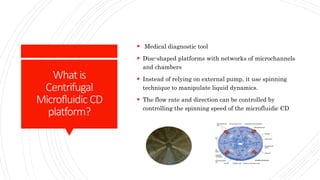
 Medical diagnostic tool
 Disc-shaped platforms with networks of microchannels
and chambers
 Instead of relying on external pump, it use spinning
technique to manipulate liquid dynamics.
 The flow rate and direction can be controlled by
controlling the spinning speed of the microfluidic CD
Application
 Enzyme-Linked Immunosorbent Assay (ELISA) for
dengue detection
 DNA purification
 Polymerase chain reactions (PCR)
 Plasma separation
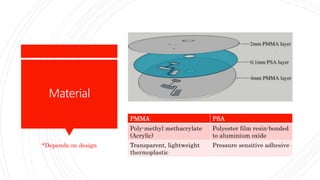
Material
PMMA PSA
Poly-methyl methacrylate
(Acrylic)
Polyester film resin-bonded
to aluminium oxide
Transparent, lightweight
thermoplastic
Pressure sensitive adhesive
*Depends on design
Typeof force
 Centrifugal force
 Capillary force
Responsible for pumping and stopping liquid flow in
microfluidic CD.
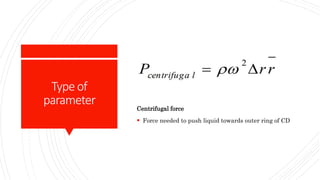
Typeof
parameter Centrifugal force
 Force needed to push liquid towards outer ring of CD
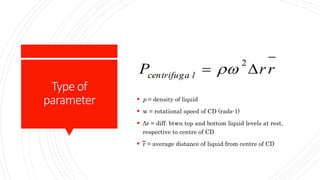
Typeof
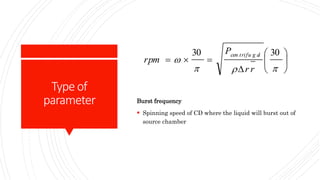
parameter  p = density of liquid
 w = rotational speed of CD (rads-1)
 Δr = diff. btwn top and bottom liquid levels at rest,
respective to centre of CD
 r = average distance of liquid from centre of CD
Typeof
parameter Burst frequency
 Spinning speed of CD where the liquid will burst out of
source chamber
Typeof valve
Passive valve
 Valves that control liquid movement without involving
movable part
 Example: capillary valves, siphon valves
Advantages:
 No external trigger/force is required to start/stop liquid
movement
Disadvantages:
 Moderate precision in control of liquid movement on
the CD
Typeof valve
Active valve
 Valves that control liquid movement using external
actuations
 Example: wax valves, ice valves
Advantages:
 Sealing of liquid on the microfluidic CD during long
period of storage
 Accurate control of liquid movement on the CD
Disadvantages:
 Requires external trigger for activation
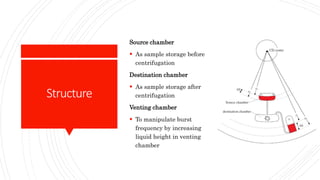
Structure
Source chamber
 As sample storage before
centrifugation
Destination chamber
 As sample storage after
centrifugation
Venting chamber
 To manipulate burst
frequency by increasing
liquid height in venting
chamber
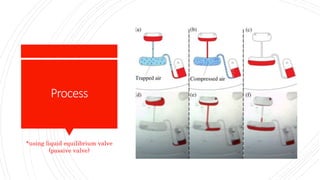
Process
*using liquid equilibrium valve
(passive valve)
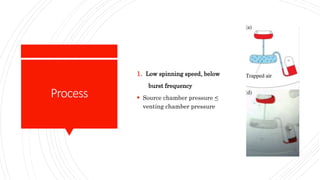
Process
1. Low spinning speed, below
burst frequency
 Source chamber pressure <
venting chamber pressure
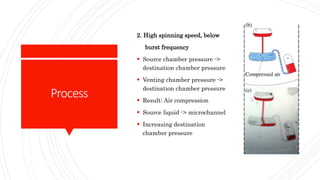
Process
2. High spinning speed, below
burst frequency
 Source chamber pressure ->
destination chamber pressure
 Venting chamber pressure ->
destination chamber pressure
 Result: Air compression
 Source liquid -> microchannel
 Increasing destination
chamber pressure
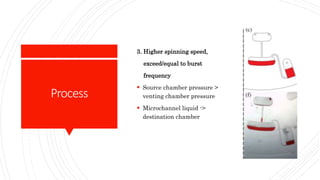
Process
3. Higher spinning speed,
exceed/equal to burst
frequency
 Source chamber pressure >
venting chamber pressure
 Microchannel liquid ->
destination chamber
Advantage
By implementing this valving method;
 Only a compact and accurately-controlled motor is
required
 Without the need for external syringe pump
 Eliminate environmental contamination from external
pumping
 Minimize air bubbles from external pumping
mechanisms
Disadvantage
The permanent radial outward direction of the
centrifugal force can;
 limit the range of applicable processes
 limit complexity of applicable processes
Reference
 Al-Halhouli, A., Far, B. E., Albagdady, A., & Al-Faqheri, W.
(2020). Development of Active Centrifugal Pump for
Microfluidic CD Platforms. Micromachines, 11(2), 140.
https://doi.org/10.3390/mi11020140
 Al-Faqheri W, Ibrahim F, Thio TH, Arof H, Madou M. Novel
liquid equilibrium valving on centrifugal microfluidic CD
platform. Annu Int Conf IEEE Eng Med Biol Soc.
2013;2013:5509-12. doi: 10.1109/EMBC.2013.6610797.
PMID: 24110984.

Article dissection: Novel Liquid Equilibrium Valving on Centrifugal Microfluidic CD Platform

  • 1.
    Novel Liquid EquilibriumValving on Centrifugal Microfluidic CD Platform MUHAMMAD ALI AIZAT BIN ABU BAKAR BIOMEDICAL ENGINEER 6th February 2022
  • 2.
    What is Centrifugal Microfluidic CD platform? Medical diagnostic tool  Disc-shaped platforms with networks of microchannels and chambers  Instead of relying on external pump, it use spinning technique to manipulate liquid dynamics.  The flow rate and direction can be controlled by controlling the spinning speed of the microfluidic CD
  • 3.
    Application  Enzyme-Linked ImmunosorbentAssay (ELISA) for dengue detection  DNA purification  Polymerase chain reactions (PCR)  Plasma separation
  • 4.
    Material PMMA PSA Poly-methyl methacrylate (Acrylic) Polyesterfilm resin-bonded to aluminium oxide Transparent, lightweight thermoplastic Pressure sensitive adhesive *Depends on design
  • 5.
    Typeof force  Centrifugalforce  Capillary force Responsible for pumping and stopping liquid flow in microfluidic CD.
  • 6.
    Typeof parameter Centrifugal force Force needed to push liquid towards outer ring of CD
  • 7.
    Typeof parameter  p= density of liquid  w = rotational speed of CD (rads-1)  Δr = diff. btwn top and bottom liquid levels at rest, respective to centre of CD  r = average distance of liquid from centre of CD
  • 8.
    Typeof parameter Burst frequency Spinning speed of CD where the liquid will burst out of source chamber
  • 9.
    Typeof valve Passive valve Valves that control liquid movement without involving movable part  Example: capillary valves, siphon valves Advantages:  No external trigger/force is required to start/stop liquid movement Disadvantages:  Moderate precision in control of liquid movement on the CD
  • 10.
    Typeof valve Active valve Valves that control liquid movement using external actuations  Example: wax valves, ice valves Advantages:  Sealing of liquid on the microfluidic CD during long period of storage  Accurate control of liquid movement on the CD Disadvantages:  Requires external trigger for activation
  • 11.
    Structure Source chamber  Assample storage before centrifugation Destination chamber  As sample storage after centrifugation Venting chamber  To manipulate burst frequency by increasing liquid height in venting chamber
  • 12.
    Process *using liquid equilibriumvalve (passive valve)
  • 13.
    Process 1. Low spinningspeed, below burst frequency  Source chamber pressure < venting chamber pressure
  • 14.
    Process 2. High spinningspeed, below burst frequency  Source chamber pressure -> destination chamber pressure  Venting chamber pressure -> destination chamber pressure  Result: Air compression  Source liquid -> microchannel  Increasing destination chamber pressure
  • 15.
    Process 3. Higher spinningspeed, exceed/equal to burst frequency  Source chamber pressure > venting chamber pressure  Microchannel liquid -> destination chamber
  • 16.
    Advantage By implementing thisvalving method;  Only a compact and accurately-controlled motor is required  Without the need for external syringe pump  Eliminate environmental contamination from external pumping  Minimize air bubbles from external pumping mechanisms
  • 17.
    Disadvantage The permanent radialoutward direction of the centrifugal force can;  limit the range of applicable processes  limit complexity of applicable processes
  • 18.
    Reference  Al-Halhouli, A.,Far, B. E., Albagdady, A., & Al-Faqheri, W. (2020). Development of Active Centrifugal Pump for Microfluidic CD Platforms. Micromachines, 11(2), 140. https://doi.org/10.3390/mi11020140  Al-Faqheri W, Ibrahim F, Thio TH, Arof H, Madou M. Novel liquid equilibrium valving on centrifugal microfluidic CD platform. Annu Int Conf IEEE Eng Med Biol Soc. 2013;2013:5509-12. doi: 10.1109/EMBC.2013.6610797. PMID: 24110984.