
Article 9: A Primer on Attachment,
           Perfection, and Priority

                                  October 4, 2012

                                  Presented by
                               John H. Strock, Esq.


Article 9: A Primer on Attachment, Perfection, and Priority
© 2012 Fox Rothschild
Introduction
Secured transactions are a part of our
professional and personal daily lives. This
program will provide the basics to help you
understand how secured transactions are
created and made enforceable.


Article 9: A Primer on Attachment, Perfection, and Priority
© 2012 Fox Rothschild
Roadmap
      1.       Article 9 overview
      2.       What is collateral?
      3.       How does a security interest attach?
      4.       How is a security interest perfected?
      5.       Important changes in 2013


Article 9: A Primer on Attachment, Perfection, and Priority
© 2012 Fox Rothschild
The UCC
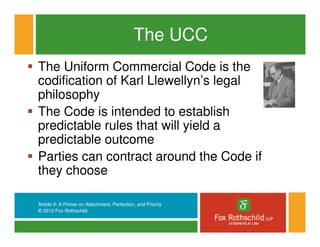
The Uniform Commercial Code is the
codification of Karl Llewellyn’s legal
philosophy
The Code is intended to establish
predictable rules that will yield a
predictable outcome
Parties can contract around the Code if
they choose

Article 9: A Primer on Attachment, Perfection, and Priority
© 2012 Fox Rothschild
The UCC
      The UCC is comprised of 11 articles that
      address different types of commercial
      transactions
      Most important for today are:
       -    Article 1
       -    Article 9


Article 9: A Primer on Attachment, Perfection, and Priority
© 2012 Fox Rothschild
The UCC
      Article 1 – General Provisions
       -    Sets forth general provisions, definitions,
            and rules that apply to entire UCC
       -    Most important section is 1-201, the general
            definitions
      Article 9 – Secured Transactions
       -    Governs how a security interest is created in
            personal property to secure a debt

Article 9: A Primer on Attachment, Perfection, and Priority
© 2012 Fox Rothschild
Article 9 – Key Parties
      Obligor – Party who receives loan/credit (9-102(a)(59))
      Debtor – Party who has ownership interest in collateral
      (9-102(a)(28))
      Creditor – Party giving loan/credit (1-201(b)(13))
      Secured Party – Party in whose favor a security
      interest is created, whether or not obligation to be
      secured is outstanding (9-102(a)(72))


Article 9: A Primer on Attachment, Perfection, and Priority
© 2012 Fox Rothschild
What is the Collateral?
      First, classify collateral to determine how
      to describe it in security agreement and
      how to perfect the security interest


Article 9: A Primer on Attachment, Perfection, and Priority
© 2012 Fox Rothschild
Collateral Classification
1. Identify collateral and describe as
   precisely as possible
2. Determine how the collateral is
   categorized by Article 9 for filing
   purposes


Article 9: A Primer on Attachment, Perfection, and Priority
© 2012 Fox Rothschild
Collateral Classification – Which
                 Law Controls?
      Is collateral real estate?
       -    If yes, local law governs
      Check UCC 9-109 for the scope of an
      Article 9 secured transaction
      If transaction falls within scope of 9-109,
      then Article 9 controls


Article 9: A Primer on Attachment, Perfection, and Priority
© 2012 Fox Rothschild
Quick Guide to Collateral
                         Classification
1. Is it sui generis (unique)?
                If yes, describe as accurately as possible
2. If no, is the collateral a good or a right?
                See 9-102(a)(44) for definition of “goods”
                If 9-102(a)(44) does not provide
                classification for goods, “equipment” is
                catch all classification for goods (9-
                102(a)(33))

Article 9: A Primer on Attachment, Perfection, and Priority
© 2012 Fox Rothschild
Quick Guide to Collateral
                         Classification
3. If collateral is a right, is it a right to:
                Goods
                Payment, or
                Something else?


Article 9: A Primer on Attachment, Perfection, and Priority
© 2012 Fox Rothschild
Quick Guide to Collateral
                         Classification
4. If collateral is a right to goods, it is
   either:
       a.       Document of title, or
       b.       General Intangible (catch all)


Article 9: A Primer on Attachment, Perfection, and Priority
© 2012 Fox Rothschild
Quick Guide to Collateral
                         Classification
5. If collateral is a right to payment it is:
       a.       Chattel Paper (9-102(a)(11));
       b.       An Instrument (9-102(a)(47));
       c.       An Account (9-102(a)(2)); or
       d.       A General Intangible (9-102(a)(42))
                    General Intangible is catch all collateral
                    classification


Article 9: A Primer on Attachment, Perfection, and Priority
© 2012 Fox Rothschild
A Security Interest Created
      A security interest is an interest in
      personal property or fixtures which
      secures payment of an obligation . . .
      (1-201(35))
      Must have an agreement between
      obligor/debtor and creditor/secured party
      that identifies the collateral

Article 9: A Primer on Attachment, Perfection, and Priority
© 2012 Fox Rothschild
Attachment
      Attachment is when a security interest
      becomes enforceable between
      Obligor/Debtor and Creditor/Secured
      Party (9-203)
      Knowledge only between these parties
      needed for attachment – no third party
      notice required

Article 9: A Primer on Attachment, Perfection, and Priority
© 2012 Fox Rothschild
Attachment
1. Agreement to create security reached
   between parties
2. “Value” must be given (1-204)
3. Debtor has rights in the collateral


Article 9: A Primer on Attachment, Perfection, and Priority
© 2012 Fox Rothschild
Perfection
      Puts third parties on notice that security
      interest attached to collateral
      Perfection of security interest is only
      relevant if there is more than one creditor
       -    Remember – a trustee in bankruptcy is a
            third party


Article 9: A Primer on Attachment, Perfection, and Priority
© 2012 Fox Rothschild
Automatic Perfection
      Perfection only occurs when a security
      interest attaches to collateral and a
      secured party takes the steps necessary
      to perfect/protect its interest (9-308(a))
      Automatic Perfection (9-309)
       -    Purchase Money Security Interest in
            consumer goods is most common automatic
            perfection

Article 9: A Primer on Attachment, Perfection, and Priority
© 2012 Fox Rothschild
Where to File?
      If no automatic perfection, secured party
      must then look to 9-310(a) and default is
      to file a UCC-1 financing statement
      Check 9-310(b) for exceptions to filing
      requirements


Article 9: A Primer on Attachment, Perfection, and Priority
© 2012 Fox Rothschild
Common Filing Exceptions
      9-311 – Collateral required filing under
      separate federal or state notice system
      (e.g. automobiles and airplanes)


Article 9: A Primer on Attachment, Perfection, and Priority
© 2012 Fox Rothschild
Common Filing Exceptions
      9-312(a) – Permissive filing to perfect
      interest in chattel paper, negotiable
      documents, instruments, or investment
      property
      9-312(b) – Control or possession of
      certain collateral required


Article 9: A Primer on Attachment, Perfection, and Priority
© 2012 Fox Rothschild
Common Filing Exceptions
      9-312(c) – Controls perfection of goods
      covered by negotiable document
      9-312(d) – Controls perfection of goods
      when covered by non-negotiable
      document


Article 9: A Primer on Attachment, Perfection, and Priority
© 2012 Fox Rothschild
Common Filing Exceptions
      9-313 – When possession or delivery to
      secured party perfects without filing
       -    Must be tangible collateral
      9-314 – Perfection by control
       -    Investment property is most common


Article 9: A Primer on Attachment, Perfection, and Priority
© 2012 Fox Rothschild
Perfection – Choice of Law
      Need to know which state governs:
       -    Perfection
       -    Effects of perfection/non-perfection
       -    Priority
      Sections 9-301 through 9-307 show us
      how to select to correct jurisdiction


Article 9: A Primer on Attachment, Perfection, and Priority
© 2012 Fox Rothschild
Perfection – Choice of Law
      9-301 is catch all, but look to 9-302
      through 9-306 first to determine choice of
      law for specific collateral
       -    9-302 – Agricultural Liens
       -    9-303 – Certificate of Title
       -    9-304 – Deposit Accounts
       -    9-305 – Investment Property
       -    9-306 – Letter of Credit Rights

Article 9: A Primer on Attachment, Perfection, and Priority
© 2012 Fox Rothschild
Choice of Law – General Rule
      9-301 – Default rules for choice of law
       -    9-301(1) – Debtor’s location controls
            perfection (default rule)
       -    9-301(2) – If creditor has possession of
            collateral then location of collateral controls
            perfection, must be tangible or semi-tangible
            collateral
       -    9-301(3) – Limited to fixtures, timber to be
            cut, location of collateral governs (real estate
            filing)

Article 9: A Primer on Attachment, Perfection, and Priority
© 2012 Fox Rothschild
Debtor’s Location
      9-307 – Debtor’s location
      General rules for organizations (9-
      307(b)(2))
       -    Registered organization – state of
            organization
       -    Unregistered organization (general
            partnership) – place of business or chief
            executive office

Article 9: A Primer on Attachment, Perfection, and Priority
© 2012 Fox Rothschild
Debtor’s Name
                                                 Most important information
                                                 on financing statement is
                                                 getting the Debtor’s name
                                                 right!
                                                 If the name is not correct, it
                                                 could be seriously
                                                 misleading and subordinate
                                                 security interest (9-506)


Article 9: A Primer on Attachment, Perfection, and Priority
© 2012 Fox Rothschild
Priority
      “Except as otherwise provided in [the
      UCC], a security agreement is effective
      according to its terms between the
      parties, against purchasers, and against
      creditors” 9-201(a)


Article 9: A Primer on Attachment, Perfection, and Priority
© 2012 Fox Rothschild
Priority
      General rule is first to perfect is first in
      line (9-317(a)(1) and 9-322(a)(1))


Article 9: A Primer on Attachment, Perfection, and Priority
© 2012 Fox Rothschild
Priority
      Buyer in ordinary course take free of
      security interest, but security interest
      attaches to proceeds (See, e.g., 9-320(a)
      and 9-315(a))
      Proceeds must be segregated, or swept
      into an account subject to a security
      interest

Article 9: A Primer on Attachment, Perfection, and Priority
© 2012 Fox Rothschild
Priority
                                Purchase Money Security
                                Interest (“PMSI”)
                                PMSI lender gets automatic first
                                priority lien in consumer goods
                                PMSI lender gets first priority
                                lien in goods commercial
                                borrower if perfected within 20
                                days

Article 9: A Primer on Attachment, Perfection, and Priority
© 2012 Fox Rothschild
2013 Amendments
      Most important change is to Debtor name
      provisions (9-503)
       -    For registered organizations – look to
            formation documents


Article 9: A Primer on Attachment, Perfection, and Priority
© 2012 Fox Rothschild
2013 Amendments
       -    Debtor name chance provisions – con’t
       -    For individuals states have two choices
                  “Only if” – Use name on state issued ID, if and
                  only if no ID, may use debtor’s first personal
                  name and surname
                  “Safe Harbor” – financing statement is sufficiently
                  names debtor by providing:
                    – Debtor’s individual name determined by state law;
                    – Debtor’s surname and first personal name; or
                    – Name on unexpired state issued ID


Article 9: A Primer on Attachment, Perfection, and Priority
© 2012 Fox Rothschild
2013 Amendments
      Continued Perfection after Change of
      Law (9-316)
       -    Current code provides secured party four
            months to refile in new jurisdiction to
            preserve priority


Article 9: A Primer on Attachment, Perfection, and Priority
© 2012 Fox Rothschild
2013 Amendments
      9-316 Changes con’t
       -    New 9-316(h) provides for continued
            perfection of newly acquired security
            interests that attach within four months of
            move
       -    New 9-316(i) provides for automatic
            perfection within four months after new
            debtor in new state becomes bound by
            existing security agreement (e.g. merger)

Article 9: A Primer on Attachment, Perfection, and Priority
© 2012 Fox Rothschild
2013 Amendments
      Changes to Information on Financing
      Statement (9-516)
      Financing statement can be rejected if it
      fails to state:
       -    Type of organization;
       -    Jurisdiction of organization; and
       -    Organization's identification number


Article 9: A Primer on Attachment, Perfection, and Priority
© 2012 Fox Rothschild
2013 Amendments
      Change of definition of “public records” to
      “public organic records” (9-102(a)(68))
      Means records available for public
      inspection


Article 9: A Primer on Attachment, Perfection, and Priority
© 2012 Fox Rothschild
2013 Amendments
      “Control” of electronic chattel paper is
      amended to evidence that “reliably
      establish the secured party as the person
      to which chattel paper was assigned” (9-
      105)
       -    Old six factor test is now safe harbor


Article 9: A Primer on Attachment, Perfection, and Priority
© 2012 Fox Rothschild
2013 Amendments
      Debtors location for entities organized
      under federal law (e.g. banks) is location
      of “home office” or “main office”


Article 9: A Primer on Attachment, Perfection, and Priority
© 2012 Fox Rothschild
2013 Amendments
      UCC-5 “Correction Statement” now
      “Information Statement”
       -    Under amendments, debtor or secured party
            may file an Information Statement to clarify
            previous filing
       -    No legal effect


Article 9: A Primer on Attachment, Perfection, and Priority
© 2012 Fox Rothschild
2013 Amendments
      New UCC-1 and UCC-3 forms


Article 9: A Primer on Attachment, Perfection, and Priority
© 2012 Fox Rothschild
Article 9
      Questions?


Article 9: A Primer on Attachment, Perfection, and Priority
© 2012 Fox Rothschild
Contact Information


                  John H. Strock, Esq.
                     215.299.2922
              jstrock@foxrothschild.com


Article 9: A Primer on Attachment, Perfection, and Priority
© 2012 Fox Rothschild

Article 9 basics

  • 1.
    Article 9: APrimer on Attachment, Perfection, and Priority October 4, 2012 Presented by John H. Strock, Esq. Article 9: A Primer on Attachment, Perfection, and Priority © 2012 Fox Rothschild
  • 2.
    Introduction Secured transactions area part of our professional and personal daily lives. This program will provide the basics to help you understand how secured transactions are created and made enforceable. Article 9: A Primer on Attachment, Perfection, and Priority © 2012 Fox Rothschild
  • 3.
    Roadmap 1. Article 9 overview 2. What is collateral? 3. How does a security interest attach? 4. How is a security interest perfected? 5. Important changes in 2013 Article 9: A Primer on Attachment, Perfection, and Priority © 2012 Fox Rothschild
  • 4.
    The UCC The UniformCommercial Code is the codification of Karl Llewellyn’s legal philosophy The Code is intended to establish predictable rules that will yield a predictable outcome Parties can contract around the Code if they choose Article 9: A Primer on Attachment, Perfection, and Priority © 2012 Fox Rothschild
  • 5.
    The UCC The UCC is comprised of 11 articles that address different types of commercial transactions Most important for today are: - Article 1 - Article 9 Article 9: A Primer on Attachment, Perfection, and Priority © 2012 Fox Rothschild
  • 6.
    The UCC Article 1 – General Provisions - Sets forth general provisions, definitions, and rules that apply to entire UCC - Most important section is 1-201, the general definitions Article 9 – Secured Transactions - Governs how a security interest is created in personal property to secure a debt Article 9: A Primer on Attachment, Perfection, and Priority © 2012 Fox Rothschild
  • 7.
    Article 9 –Key Parties Obligor – Party who receives loan/credit (9-102(a)(59)) Debtor – Party who has ownership interest in collateral (9-102(a)(28)) Creditor – Party giving loan/credit (1-201(b)(13)) Secured Party – Party in whose favor a security interest is created, whether or not obligation to be secured is outstanding (9-102(a)(72)) Article 9: A Primer on Attachment, Perfection, and Priority © 2012 Fox Rothschild
  • 8.
    What is theCollateral? First, classify collateral to determine how to describe it in security agreement and how to perfect the security interest Article 9: A Primer on Attachment, Perfection, and Priority © 2012 Fox Rothschild
  • 9.
    Collateral Classification 1. Identifycollateral and describe as precisely as possible 2. Determine how the collateral is categorized by Article 9 for filing purposes Article 9: A Primer on Attachment, Perfection, and Priority © 2012 Fox Rothschild
  • 10.
    Collateral Classification –Which Law Controls? Is collateral real estate? - If yes, local law governs Check UCC 9-109 for the scope of an Article 9 secured transaction If transaction falls within scope of 9-109, then Article 9 controls Article 9: A Primer on Attachment, Perfection, and Priority © 2012 Fox Rothschild
  • 11.
    Quick Guide toCollateral Classification 1. Is it sui generis (unique)? If yes, describe as accurately as possible 2. If no, is the collateral a good or a right? See 9-102(a)(44) for definition of “goods” If 9-102(a)(44) does not provide classification for goods, “equipment” is catch all classification for goods (9- 102(a)(33)) Article 9: A Primer on Attachment, Perfection, and Priority © 2012 Fox Rothschild
  • 12.
    Quick Guide toCollateral Classification 3. If collateral is a right, is it a right to: Goods Payment, or Something else? Article 9: A Primer on Attachment, Perfection, and Priority © 2012 Fox Rothschild
  • 13.
    Quick Guide toCollateral Classification 4. If collateral is a right to goods, it is either: a. Document of title, or b. General Intangible (catch all) Article 9: A Primer on Attachment, Perfection, and Priority © 2012 Fox Rothschild
  • 14.
    Quick Guide toCollateral Classification 5. If collateral is a right to payment it is: a. Chattel Paper (9-102(a)(11)); b. An Instrument (9-102(a)(47)); c. An Account (9-102(a)(2)); or d. A General Intangible (9-102(a)(42)) General Intangible is catch all collateral classification Article 9: A Primer on Attachment, Perfection, and Priority © 2012 Fox Rothschild
  • 15.
    A Security InterestCreated A security interest is an interest in personal property or fixtures which secures payment of an obligation . . . (1-201(35)) Must have an agreement between obligor/debtor and creditor/secured party that identifies the collateral Article 9: A Primer on Attachment, Perfection, and Priority © 2012 Fox Rothschild
  • 16.
    Attachment Attachment is when a security interest becomes enforceable between Obligor/Debtor and Creditor/Secured Party (9-203) Knowledge only between these parties needed for attachment – no third party notice required Article 9: A Primer on Attachment, Perfection, and Priority © 2012 Fox Rothschild
  • 17.
    Attachment 1. Agreement tocreate security reached between parties 2. “Value” must be given (1-204) 3. Debtor has rights in the collateral Article 9: A Primer on Attachment, Perfection, and Priority © 2012 Fox Rothschild
  • 18.
    Perfection Puts third parties on notice that security interest attached to collateral Perfection of security interest is only relevant if there is more than one creditor - Remember – a trustee in bankruptcy is a third party Article 9: A Primer on Attachment, Perfection, and Priority © 2012 Fox Rothschild
  • 19.
    Automatic Perfection Perfection only occurs when a security interest attaches to collateral and a secured party takes the steps necessary to perfect/protect its interest (9-308(a)) Automatic Perfection (9-309) - Purchase Money Security Interest in consumer goods is most common automatic perfection Article 9: A Primer on Attachment, Perfection, and Priority © 2012 Fox Rothschild
  • 20.
    Where to File? If no automatic perfection, secured party must then look to 9-310(a) and default is to file a UCC-1 financing statement Check 9-310(b) for exceptions to filing requirements Article 9: A Primer on Attachment, Perfection, and Priority © 2012 Fox Rothschild
  • 21.
    Common Filing Exceptions 9-311 – Collateral required filing under separate federal or state notice system (e.g. automobiles and airplanes) Article 9: A Primer on Attachment, Perfection, and Priority © 2012 Fox Rothschild
  • 22.
    Common Filing Exceptions 9-312(a) – Permissive filing to perfect interest in chattel paper, negotiable documents, instruments, or investment property 9-312(b) – Control or possession of certain collateral required Article 9: A Primer on Attachment, Perfection, and Priority © 2012 Fox Rothschild
  • 23.
    Common Filing Exceptions 9-312(c) – Controls perfection of goods covered by negotiable document 9-312(d) – Controls perfection of goods when covered by non-negotiable document Article 9: A Primer on Attachment, Perfection, and Priority © 2012 Fox Rothschild
  • 24.
    Common Filing Exceptions 9-313 – When possession or delivery to secured party perfects without filing - Must be tangible collateral 9-314 – Perfection by control - Investment property is most common Article 9: A Primer on Attachment, Perfection, and Priority © 2012 Fox Rothschild
  • 25.
    Perfection – Choiceof Law Need to know which state governs: - Perfection - Effects of perfection/non-perfection - Priority Sections 9-301 through 9-307 show us how to select to correct jurisdiction Article 9: A Primer on Attachment, Perfection, and Priority © 2012 Fox Rothschild
  • 26.
    Perfection – Choiceof Law 9-301 is catch all, but look to 9-302 through 9-306 first to determine choice of law for specific collateral - 9-302 – Agricultural Liens - 9-303 – Certificate of Title - 9-304 – Deposit Accounts - 9-305 – Investment Property - 9-306 – Letter of Credit Rights Article 9: A Primer on Attachment, Perfection, and Priority © 2012 Fox Rothschild
  • 27.
    Choice of Law– General Rule 9-301 – Default rules for choice of law - 9-301(1) – Debtor’s location controls perfection (default rule) - 9-301(2) – If creditor has possession of collateral then location of collateral controls perfection, must be tangible or semi-tangible collateral - 9-301(3) – Limited to fixtures, timber to be cut, location of collateral governs (real estate filing) Article 9: A Primer on Attachment, Perfection, and Priority © 2012 Fox Rothschild
  • 28.
    Debtor’s Location 9-307 – Debtor’s location General rules for organizations (9- 307(b)(2)) - Registered organization – state of organization - Unregistered organization (general partnership) – place of business or chief executive office Article 9: A Primer on Attachment, Perfection, and Priority © 2012 Fox Rothschild
  • 29.
    Debtor’s Name Most important information on financing statement is getting the Debtor’s name right! If the name is not correct, it could be seriously misleading and subordinate security interest (9-506) Article 9: A Primer on Attachment, Perfection, and Priority © 2012 Fox Rothschild
  • 30.
    Priority “Except as otherwise provided in [the UCC], a security agreement is effective according to its terms between the parties, against purchasers, and against creditors” 9-201(a) Article 9: A Primer on Attachment, Perfection, and Priority © 2012 Fox Rothschild
  • 31.
    Priority General rule is first to perfect is first in line (9-317(a)(1) and 9-322(a)(1)) Article 9: A Primer on Attachment, Perfection, and Priority © 2012 Fox Rothschild
  • 32.
    Priority Buyer in ordinary course take free of security interest, but security interest attaches to proceeds (See, e.g., 9-320(a) and 9-315(a)) Proceeds must be segregated, or swept into an account subject to a security interest Article 9: A Primer on Attachment, Perfection, and Priority © 2012 Fox Rothschild
  • 33.
    Priority Purchase Money Security Interest (“PMSI”) PMSI lender gets automatic first priority lien in consumer goods PMSI lender gets first priority lien in goods commercial borrower if perfected within 20 days Article 9: A Primer on Attachment, Perfection, and Priority © 2012 Fox Rothschild
  • 34.
    2013 Amendments Most important change is to Debtor name provisions (9-503) - For registered organizations – look to formation documents Article 9: A Primer on Attachment, Perfection, and Priority © 2012 Fox Rothschild
  • 35.
    2013 Amendments - Debtor name chance provisions – con’t - For individuals states have two choices “Only if” – Use name on state issued ID, if and only if no ID, may use debtor’s first personal name and surname “Safe Harbor” – financing statement is sufficiently names debtor by providing: – Debtor’s individual name determined by state law; – Debtor’s surname and first personal name; or – Name on unexpired state issued ID Article 9: A Primer on Attachment, Perfection, and Priority © 2012 Fox Rothschild
  • 36.
    2013 Amendments Continued Perfection after Change of Law (9-316) - Current code provides secured party four months to refile in new jurisdiction to preserve priority Article 9: A Primer on Attachment, Perfection, and Priority © 2012 Fox Rothschild
  • 37.
    2013 Amendments 9-316 Changes con’t - New 9-316(h) provides for continued perfection of newly acquired security interests that attach within four months of move - New 9-316(i) provides for automatic perfection within four months after new debtor in new state becomes bound by existing security agreement (e.g. merger) Article 9: A Primer on Attachment, Perfection, and Priority © 2012 Fox Rothschild
  • 38.
    2013 Amendments Changes to Information on Financing Statement (9-516) Financing statement can be rejected if it fails to state: - Type of organization; - Jurisdiction of organization; and - Organization's identification number Article 9: A Primer on Attachment, Perfection, and Priority © 2012 Fox Rothschild
  • 39.
    2013 Amendments Change of definition of “public records” to “public organic records” (9-102(a)(68)) Means records available for public inspection Article 9: A Primer on Attachment, Perfection, and Priority © 2012 Fox Rothschild
  • 40.
    2013 Amendments “Control” of electronic chattel paper is amended to evidence that “reliably establish the secured party as the person to which chattel paper was assigned” (9- 105) - Old six factor test is now safe harbor Article 9: A Primer on Attachment, Perfection, and Priority © 2012 Fox Rothschild
  • 41.
    2013 Amendments Debtors location for entities organized under federal law (e.g. banks) is location of “home office” or “main office” Article 9: A Primer on Attachment, Perfection, and Priority © 2012 Fox Rothschild
  • 42.
    2013 Amendments UCC-5 “Correction Statement” now “Information Statement” - Under amendments, debtor or secured party may file an Information Statement to clarify previous filing - No legal effect Article 9: A Primer on Attachment, Perfection, and Priority © 2012 Fox Rothschild
  • 43.
    2013 Amendments New UCC-1 and UCC-3 forms Article 9: A Primer on Attachment, Perfection, and Priority © 2012 Fox Rothschild
  • 44.
    Article 9 Questions? Article 9: A Primer on Attachment, Perfection, and Priority © 2012 Fox Rothschild
  • 45.
    Contact Information John H. Strock, Esq. 215.299.2922 jstrock@foxrothschild.com Article 9: A Primer on Attachment, Perfection, and Priority © 2012 Fox Rothschild