The Discovery of Artificial Light
Presented by
Arpan Mandal
Ankita Chakrawarti
Moumita Sadhukhan
Koustabh Sengupta
Anal Mandal
Index
 Introduction to light sources
 History of artificial light types
 Evolution of light
 BULB
 Fluorescent Light
 CFL
 Discharge Lamp
 LED
 Conclusion
Light Sources
Light Sources
Natural
Sunlight
Moonlight
and
Lightning
Artificial
Incandescent
Bulbs
Fluorescent
lamps, LED
lamps, etc.
What is Artificial lighting?
 Man made lighting
 For human to function properly
 All artificial light can be turned
on and off with a switch
Evolution of Artificial Light
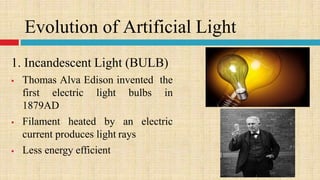
1. Incandescent Light (BULB)
 Thomas Alva Edison invented the
first electric light bulbs in
1879AD
 Filament heated by an electric
current produces light rays
 Less energy efficient
Evolution of Artificial Light
1. Incandescent Light (BULB)
 Contains Nitrogen or Argon gas
 Tungsten filament with lead wires burns when
electricity is passed
 Also called as tungsten filament bulb
 Advantage-light quality and color are very
consistent
 Disadvantage- requires lot of energy and faster
degradation of filament leading to shorter
lifespan
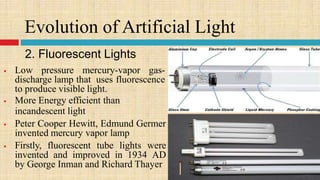
2. Fluorescent Lights
 Low pressure mercury-vapor gas-
discharge lamp that uses fluorescence
to produce visible light.
 More Energy efficient than
incandescent light
 Peter Cooper Hewitt, Edmund Germer
invented mercury vapor lamp
 Firstly, fluorescent tube lights were
invented and improved in 1934 AD
by George Inman and Richard Thayer
Evolution of Artificial Light
 In a CFL, an electric current is driven
through a tube containing Argon and a
small amount of Mercury vapor. This
generates invisible ultraviolet light that
excites a fluorescent coating
(called phosphor) on the inside of the
tube, which then emits visible light.
3. Compact Fluorescent Lights
Evolution of Artificial Light
4. Discharge Lamps
 Discharge lamps provide high luminous efficiency combined with long
life, resulting in the most economical light source available
Types of gas-discharge lamps:
A- Low pressure discharge lamps
B- High pressure discharge lamps
C- High-intensity discharge lamp
Evolution of Artificial Light
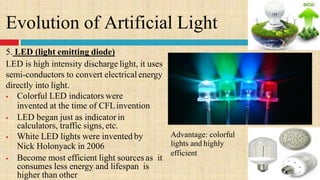
5. LED (light emitting diode)
LED is high intensity discharge light, it uses
semi-conductors to convert electrical energy
directly into light.
 Colorful LED indicators were
invented at the time of CFLinvention
 LED began just as indicator in
calculators, traffic signs, etc.
 White LED lights were invented by
Nick Holonyack in 2006
 Become most efficient light sources as it
consumes less energy and lifespan is
higher than other
Advantage: colorful
lights and highly
efficient
Conclusion
 Natural and artificial lights both are important for daily life
 There are different types of artificial light and basic lighting types
 Artificial Lighting properties can vary the use of light in different
areas
 Energy consumptions of artificial lights are reduced by evolution
 In the end artificial lights are useful in any purpose
References
• Thomas Edison facts. (n.d.). Retrieved from
http://thomasedisonfacts.com/
• Lebednik, C. (2009, November 11). How has the Light bulb changed over the years?
https://sciencing.com/lightbulb-changed-over-years-5631574.html
• Enchanted Learning. (2010). The Invention of the Light Bulb: Davy, Swan and Edison
https://www.enchantedlearning.com/inventors/edison/lightbulb.shtml
• Blank, C. (2009, August 13). What Elements Are in Light Bulbs?
https://sciencing.com/elements-light-bulbs-7615670.html
THANK YOU !

Artf lightppt 2

  • 1.
    The Discovery ofArtificial Light Presented by Arpan Mandal Ankita Chakrawarti Moumita Sadhukhan Koustabh Sengupta Anal Mandal
  • 2.
    Index  Introduction tolight sources  History of artificial light types  Evolution of light  BULB  Fluorescent Light  CFL  Discharge Lamp  LED  Conclusion
  • 3.
  • 4.
    What is Artificiallighting?  Man made lighting  For human to function properly  All artificial light can be turned on and off with a switch
  • 6.
    Evolution of ArtificialLight 1. Incandescent Light (BULB)  Thomas Alva Edison invented the first electric light bulbs in 1879AD  Filament heated by an electric current produces light rays  Less energy efficient
  • 7.
    Evolution of ArtificialLight 1. Incandescent Light (BULB)  Contains Nitrogen or Argon gas  Tungsten filament with lead wires burns when electricity is passed  Also called as tungsten filament bulb  Advantage-light quality and color are very consistent  Disadvantage- requires lot of energy and faster degradation of filament leading to shorter lifespan
  • 8.
    2. Fluorescent Lights Low pressure mercury-vapor gas- discharge lamp that uses fluorescence to produce visible light.  More Energy efficient than incandescent light  Peter Cooper Hewitt, Edmund Germer invented mercury vapor lamp  Firstly, fluorescent tube lights were invented and improved in 1934 AD by George Inman and Richard Thayer Evolution of Artificial Light
  • 9.
    Evolution of ArtificialLight  In a CFL, an electric current is driven through a tube containing Argon and a small amount of Mercury vapor. This generates invisible ultraviolet light that excites a fluorescent coating (called phosphor) on the inside of the tube, which then emits visible light. 3. Compact Fluorescent Lights
  • 10.
    Evolution of ArtificialLight 4. Discharge Lamps  Discharge lamps provide high luminous efficiency combined with long life, resulting in the most economical light source available Types of gas-discharge lamps: A- Low pressure discharge lamps B- High pressure discharge lamps C- High-intensity discharge lamp
  • 11.
    Evolution of ArtificialLight 5. LED (light emitting diode) LED is high intensity discharge light, it uses semi-conductors to convert electrical energy directly into light.  Colorful LED indicators were invented at the time of CFLinvention  LED began just as indicator in calculators, traffic signs, etc.  White LED lights were invented by Nick Holonyack in 2006  Become most efficient light sources as it consumes less energy and lifespan is higher than other Advantage: colorful lights and highly efficient
  • 12.
    Conclusion  Natural andartificial lights both are important for daily life  There are different types of artificial light and basic lighting types  Artificial Lighting properties can vary the use of light in different areas  Energy consumptions of artificial lights are reduced by evolution  In the end artificial lights are useful in any purpose
  • 13.
    References • Thomas Edisonfacts. (n.d.). Retrieved from http://thomasedisonfacts.com/ • Lebednik, C. (2009, November 11). How has the Light bulb changed over the years? https://sciencing.com/lightbulb-changed-over-years-5631574.html • Enchanted Learning. (2010). The Invention of the Light Bulb: Davy, Swan and Edison https://www.enchantedlearning.com/inventors/edison/lightbulb.shtml • Blank, C. (2009, August 13). What Elements Are in Light Bulbs? https://sciencing.com/elements-light-bulbs-7615670.html
  • 14.