LEAD TIME & INVENTORY REDUCTION
IN APPAREL SUPPLY CHAIN
Team Synergy
Abhishek Kumar
Mangala M
Rashmi Rao
Jisna P Gopi
ABOUT THE COMPANY
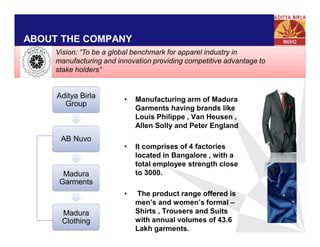
• Manufacturing arm of Madura
Garments having brands like
Louis Philippe , Van Heusen ,
Allen Solly and Peter England
• It comprises of 4 factories
located in Bangalore , with a
total employee strength close
to 3000.
• The product range offered is
men’s and women’s formal –
Shirts , Trousers and Suits
with annual volumes of 43.6
Lakh garments.
Aditya Birla
Group
AB Nuvo
Madura
Garments
Madura
Clothing
Vision: “To be a global benchmark for apparel industry in
manufacturing and innovation providing competitive advantage to
stake holders”
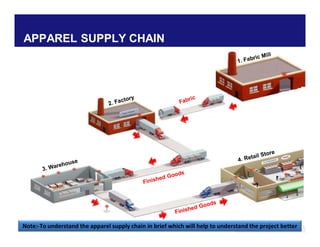
Note:-To understand the apparel supply chain in brief which will help to understand the project better
APPAREL SUPPLY CHAIN
NEED FOR PROJECT
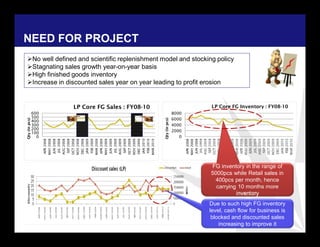
No well defined and scientific replenishment model and stocking policy
Stagnating sales growth year-on-year basis
High finished goods inventory
Increase in discounted sales year on year leading to profit erosion
0
100
200
300
400
500
600
APR2008
MAY2008
JUN2008
JUL2008
AUG2008
SEP2008
OCT2008
NOV2008
DEC2008
JAN2009
FEB2009
MAR2009
APR2009
MAY2009
JUN2009
JUL2009
AUG2009
SEP2009
OCT2009
NOV2009
DEC2009
JAN2010
FEB2010
MAR2010
Qty(inpcs)
LP Core FG Sales : FY08-10
0
2000
4000
6000
8000
APR2008
MAY2008
JUN2008
JUL2008
AUG2008
SEP2008
OCT2008
NOV2008
DEC2008
JAN2009
FEB2009
MAR2009
APR2009
MAY2009
JUN2009
JUL2009
AUG2009
SEP2009
OCT2009
NOV2009
DEC2009
JAN2010
FEB2010
MAR2010
Qty(inpcs)
LP Core FG Inventory : FY08-10
FG inventory in the range of
5000pcs while Retail sales in
400pcs per month, hence
carrying 10 months more
inventory
Due to such high FG inventory
level, cash flow for business is
blocked and discounted sales
increasing to improve it
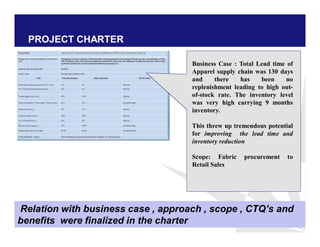
PROJECT CHARTER
Business Case : Total Lead time of
Apparel supply chain was 130 days
and there has been no
replenishment leading to high out-
of-stock rate. The inventory level
was very high carrying 9 months
inventory.
This threw up tremendous potential
for improving the lead time and
inventory reduction
Scope: Fabric procurement to
Retail Sales
Relation with business case , approach , scope , CTQ’s and
benefits were finalized in the charter
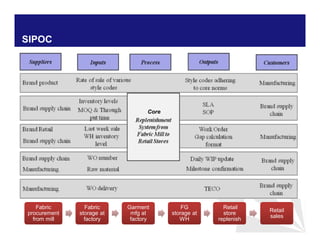
SIPOC
Fabric
procurement
from mill
Fabric
procurement
from mill
Fabric
storage at
factory
Fabric
storage at
factory
Garment
mfg at
factory
Garment
mfg at
factory
FG
storage at
WH
FG
storage at
WH
Retail
store
replenish
Retail
store
replenish
Retail
sales
Retail
sales
Core
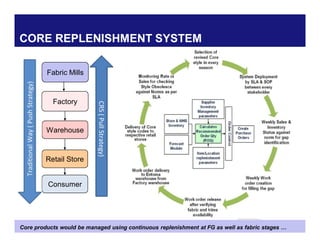
CORE REPLENISHMENT SYSTEM
Factory
Warehouse
Retail Store
Consumer
CRS(PullStrategy)
Fabric Mills
Core products would be managed using continuous replenishment at FG as well as fabric stages …
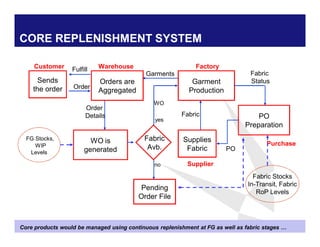
CORE REPLENISHMENT SYSTEM
Core products would be managed using continuous replenishment at FG as well as fabric stages …
Orders are
Aggregated
Order
Garment
Production
PO
Preparation
Sends
the order
WO is
generated
WO
Supplies
Fabric PO
Fabric
Order
Details
Fabric
Status
Garments
Pending
Order File
Warehouse Factory
Purchase
Supplier
Customer
FG Stocks,
WIP
Levels
Fabric Stocks
In-Transit, Fabric
RoP Levels
Fabric
Avb.
yes
no
Fulfill
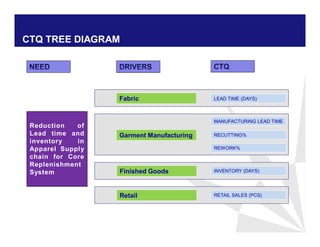
CTQ TREE DIAGRAM
Reduction of
Lead time and
inventory in
Apparel Supply
chain for Core
Replenishment
System
Garment Manufacturing
REWORK%
RECUTTING%
MANUFACTURING LEAD TIME
Finished Goods INVENTORY (DAYS)
Fabric LEAD TIME (DAYS)
Retail RETAIL SALES (PCS)
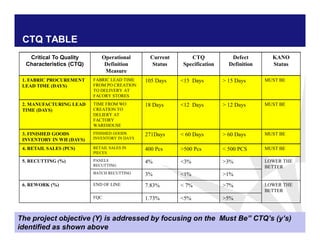
Critical To Quality
Characteristics (CTQ)
Operational
Definition
Measure
Current
Status
CTQ
Specification
Defect
Definition
KANO
Status
1. FABRIC PROCUREMENT
LEAD TIME (DAYS)
FABRIC LEAD TIME
FROM PO CREATION
TO DELIVERY AT
FACORY STORES
105 Days <15 Days > 15 Days MUST BE
2. MANUFACTURING LEAD
TIME (DAYS)
TIME FROM WO
CREATION TO
DELIERY AT
FACTORY
WAREHOUSE
18 Days <12 Days > 12 Days MUST BE
3. FINISHED GOODS
INVENTORY IN WH (DAYS)
FINISHED GOODS
INVENTORY IN DAYS
271Days < 60 Days > 60 Days MUST BE
4. RETAIL SALES (PCS) RETAIL SALES IN
PIECES
400 Pcs >500 Pcs < 500 PCS MUST BE
5. RECUTTING (%) PANELS
RECUTTING
4% <3% >3% LOWER THE
BETTER
BATCH RECUTTING 3% <1% >1%
6. REWORK (%) END OF LINE 7.83% < 7% >7% LOWER THE
BETTER
FQC 1.73% <5% >5%
The project objective (Y) is addressed by focusing on the Must Be” CTQ’s (y’s)
identified as shown above
CTQ TABLE
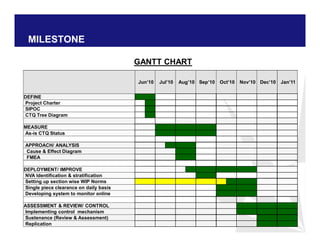
MILESTONE
GANTT CHART
Jun’10 Jul’10 Aug’10 Sep’10 Oct’10 Nov’10 Dec’10 Jan’11
DEFINE
Project Charter
SIPOC
CTQ Tree Diagram
MEASURE
As-is CTQ Status
APPROACH/ ANALYSIS
Cause & Effect Diagram
FMEA
DEPLOYMENT/ IMPROVE
NVA Identification & stratification
Setting up section wise WIP Norms
Single piece clearance on daily basis
Developing system to monitor online
ASSESSMENT & REVIEW/ CONTROL
Implementing control mechanism
Sustenance (Review & Assessment)
Replication
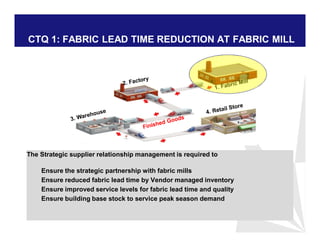
CTQ 1: FABRIC LEAD TIME REDUCTION AT FABRIC MILL
The Strategic supplier relationship management is required to
Ensure the strategic partnership with fabric mills
Ensure reduced fabric lead time by Vendor managed inventory
Ensure improved service levels for fabric lead time and quality
Ensure building base stock to service peak season demand
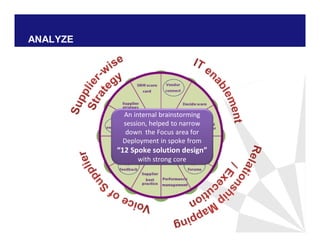
ANALYZE
An internal brainstorming
session, helped to narrow
down the Focus area for
Deployment in spoke from
“12 Spoke solution design”
with strong core
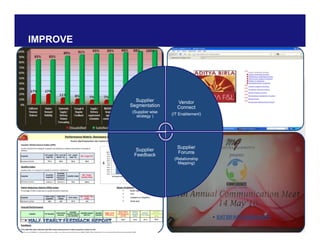
IMPROVE
• SATISFACTIONSURVEY
• HALF YEARLY FEEDBACK REPORT
Supplier
Segmentation
(Supplier wise
strategy )
Vendor
Connect
(IT Enablement)
Supplier
Forums
(Relationship
Mapping)
Supplier
Feedback
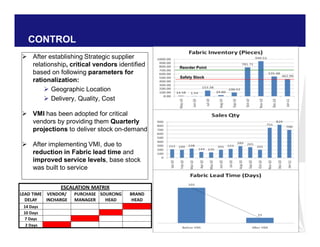
CONTROL
 After establishing Strategic supplier
relationship, critical vendors identified
based on following parameters for
rationalization:
 Geographic Location
 Delivery, Quality, Cost
 VMI has been adopted for critical
vendors by providing them Quarterly
projections to deliver stock on-demand
 After implementing VMI, due to
reduction in Fabric lead time and
improved service levels, base stock
was built to service
ESCALATION MATRIX
LEAD TIME
DELAY
VENDOR/
INCHARGE
PURCHASE
MANAGER
SOURCING
HEAD
BRAND
HEAD
14 Days
10 Days
7 Days
2 Days
Safety Stock
Reorder Point
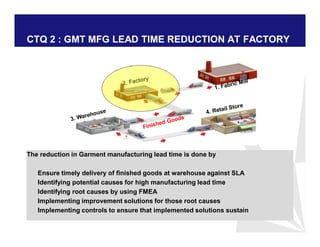
CTQ 2 : GMT MFG LEAD TIME REDUCTION AT FACTORY
The reduction in Garment manufacturing lead time is done by
Ensure timely delivery of finished goods at warehouse against SLA
Identifying potential causes for high manufacturing lead time
Identifying root causes by using FMEA
Implementing improvement solutions for those root causes
Implementing controls to ensure that implemented solutions sustain
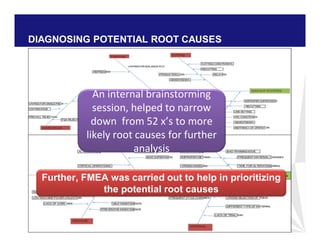
DIAGNOSING POTENTIAL ROOT CAUSES
An internal brainstorming
session, helped to narrow
down from 52 x’s to more
likely root causes for further
analysis
Single pc clearance
Further, FMEA was carried out to help in prioritizing
the potential root causes
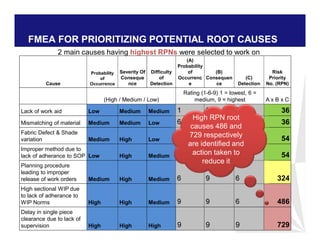
FMEA FOR PRIORITIZING POTENTIAL ROOT CAUSES
Cause
Probability
of
Occurrence
Severity Of
Conseque
nce
Difficulty
of
Detection
(A)
Probability
of
Occurrenc
e
(B)
Consequen
ce
(C)
Detection
Risk
Priority
No. (RPN)
(High / Medium / Low)
Rating (1-6-9) 1 = lowest, 6 =
medium, 9 = highest A x B x C
Lack of work aid Low Medium Medium 1 6 6 36
Mismatching of material Medium Medium Low 6 6 1 36
Fabric Defect & Shade
variation Medium High Low 6 9 1 54
Improper method due to
lack of adherance to SOP Low High Medium 1 9 6 54
Planning procedure
leading to improper
release of work orders Medium High Medium 6 9 6 324
High sectional WIP due
to lack of adherance to
WIP Norms High High Medium 9 9 6 486
Delay in single piece
clearance due to lack of
supervision High High High 9 9 9 729
2 main causes having highest RPNs were selected to work on
High RPN root
causes 486 and
729 respectively
are identified and
action taken to
reduce it
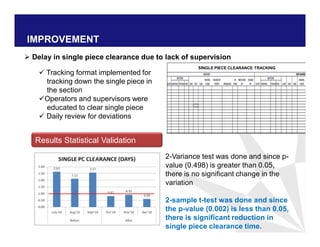
IMPROVEMENT
 Delay in single piece clearance due to lack of supervision
 Tracking format implemented for
tracking down the single piece in
the section
Operators and supervisors were
educated to clear single piece
 Daily review for deviations
Results Statistical Validation
SINGLE PIECE CLEARANCE TRACKING
2-Variance test was done and since p-
value (0.498) is greater than 0.05,
there is no significant change in the
variation
2-sample t-test was done and since
the p-value (0.002) is less than 0.05,
there is significant reduction in
single piece clearance time.
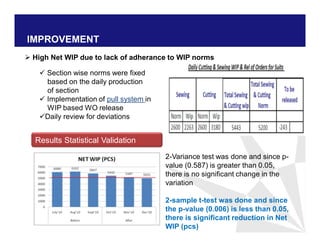
IMPROVEMENT
 High Net WIP due to lack of adherance to WIP norms
 Section wise norms were fixed
based on the daily production
of section
 Implementation of pull system in
WIP based WO release
Daily review for deviations
2-Variance test was done and since p-
value (0.587) is greater than 0.05,
there is no significant change in the
variation
2-sample t-test was done and since
the p-value (0.006) is less than 0.05,
there is significant reduction in Net
WIP (pcs)
Results Statistical Validation
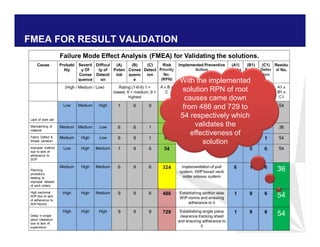
FMEA FOR RESULT VALIDATION
Failure Mode Effect Analysis (FMEA) for Validating the solutions.
Cause Probabi
lity
Severit
y Of
Conse
quence
Difficul
ty of
Detecti
on
(A)
Poten
tial
(B)
Conse
quenc
e
(C)
Detect
ion
Risk
Priority
No.
(RPN)
Implemented Preventive
Action
(A1)
Proba
bility
(B1)
Severi
ty
(C1)
Detec
tion
Residu
al No.
(High / Medium / Low) Rating (1-6-9) 1 =
lowest, 6 = medium, 9 =
highest
A x B x
C
Rating (1-6-9) 1 =
lowest, 6 = medium, 9
= highest
A1 x
B1 x
C1
Lack of work aid
Low Medium High 1 6 9 54 1 6 9 54
Mismatching of
material
Medium Medium Low 6 6 1 36 6 6 1 36
Fabric Defect &
Shade variation
Medium High Low 6 9 1 54 6 9 1 54
Improper method
due to lack of
adherance to
SOP
Low High Medium 1 9 6 54 1 9 6 54
Planning
procedure
leading to
improper release
of work orders
Medium High Medium 6 9 6 324 Implementation of pull
system, WIP based work
order release system
6 1 6 36
High sectional
WIP due to lack
of adherance to
WIP Norms
High High Medium 9 9 6 486 Establishing section wise
WIP norms and ensuring
adherance to it
1 9 6 54
Delay in single
piece clearance
due to lack of
supervision
High High High 9 9 9 729 Establishing single piece
clearance tracking sheet
and ensuring adherance to
it
1 9 6 54
With the implemented
solution RPN of root
causes came down
from 486 and 729 to
54 respectively which
validates the
effectiveness of
solution
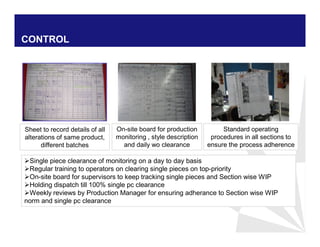
Sheet to record details of all
alterations of same product,
different batches
Single piece clearance of monitoring on a day to day basis
Regular training to operators on clearing single pieces on top-priority
On-site board for supervisors to keep tracking single pieces and Section wise WIP
Holding dispatch till 100% single pc clearance
Weekly reviews by Production Manager for ensuring adherance to Section wise WIP
norm and single pc clearance
CONTROL
On-site board for production
monitoring , style description
and daily wo clearance
Standard operating
procedures in all sections to
ensure the process adherence
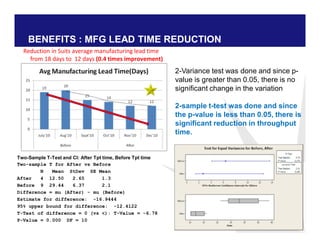
BENEFITS : MFG LEAD TIME REDUCTION
Two-Sample T-Test and CI: After Tpt time, Before Tpt time
Two-sample T for After vs Before
N Mean StDev SE Mean
After 4 12.50 2.65 1.3
Before 9 29.44 6.37 2.1
Difference = mu (After) - mu (Before)
Estimate for difference: -16.9444
95% upper bound for difference: -12.4122
T-Test of difference = 0 (vs <): T-Value = -6.78
P-Value = 0.000 DF = 10
2-Variance test was done and since p-
value is greater than 0.05, there is no
significant change in the variation
2-sample t-test was done and since
the p-value is less than 0.05, there is
significant reduction in throughput
time.
Reduction in Suits average manufacturing lead time
from 18 days to 12 days (0.4 times improvement)
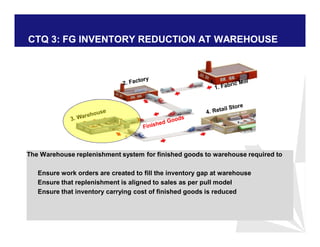
CTQ 3: FG INVENTORY REDUCTION AT WAREHOUSE
The Warehouse replenishment system for finished goods to warehouse required to
Ensure work orders are created to fill the inventory gap at warehouse
Ensure that replenishment is aligned to sales as per pull model
Ensure that inventory carrying cost of finished goods is reduced
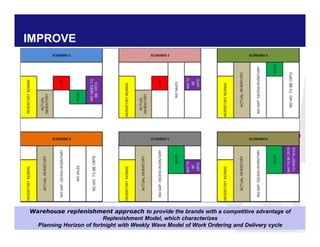
Warehouse replenishment approach to provide the brands with a competitive advantage of
Replenishment Model, which characterizes
Planning Horizon of fortnight with Weekly Wave Model of Work Ordering and Delivery cycle
IMPROVE
Factory
Warehouse
Wo Creation
Pre-production
activity (1
Days)
11 Days
against
SLA
Wo Release
Forecasting/
WH Stock Gap
against Norm
Every
Monday
Productio
n Plan for
filling Gap Fabrics &
Trims in-stock
Every
Tuesday
1 Day Every
Tuesday
Entoma
Warehouse
(Retail)
2 DaysRetail
Store
1 Day
IMPROVE (Contd)
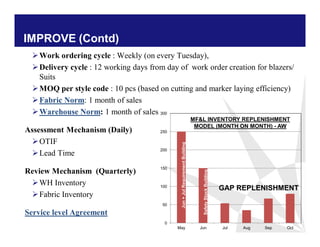
Work ordering cycle : Weekly (on every Tuesday),
Delivery cycle : 12 working days from day of work order creation for blazers/
Suits
MOQ per style code : 10 pcs (based on cutting and marker laying efficiency)
Fabric Norm: 1 month of sales
Warehouse Norm: 1 month of sales
Assessment Mechanism (Daily)
OTIF
Lead Time
Review Mechanism (Quarterly)
WH Inventory
Fabric Inventory
Service level Agreement
0
50
100
150
200
250
300
May Jun Jul Aug Sep Oct
Jun+JulRequirementBuilding
SafetyStockBuilding
MF&L INVENTORY REPLENISHMENT
MODEL (MONTH ON MONTH) - AW
GAP REPLENISHMENT
CONTROL
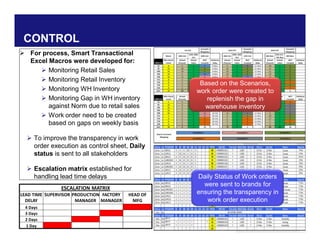
Based on the Scenarios,
work order were created to
replenish the gap in
warehouse inventory
Daily Status of Work orders
were sent to brands for
ensuring the transparency in
work order execution
ESCALATION MATRIX
LEAD TIME
DELAY
SUPERVISOR PRODUCTION
MANAGER
FACTORY
MANAGER
HEAD OF
MFG
4 Days
3 Days
2 Days
1 Day
 For process, Smart Transactional
Excel Macros were developed for:
 Monitoring Retail Sales
 Monitoring Retail Inventory
 Monitoring WH Inventory
 Monitoring Gap in WH inventory
against Norm due to retail sales
 Work order need to be created
based on gaps on weekly basis
 To improve the transparency in work
order execution as control sheet, Daily
status is sent to all stakeholders
 Escalation matrix established for
handling lead time delays
BENEFITS : FG INVENTORY REDUCTION
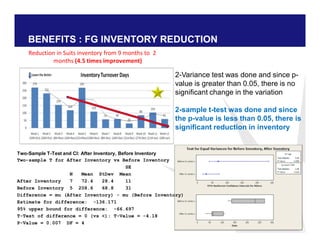
Two-Sample T-Test and CI: After Inventory, Before Inventory
Two-sample T for After Inventory vs Before Inventory
SE
N Mean StDev Mean
After Inventory 7 72.4 28.4 11
Before Inventory 5 208.6 68.8 31
Difference = mu (After Inventory) - mu (Before Inventory)
Estimate for difference: -136.171
95% upper bound for difference: -66.697
T-Test of difference = 0 (vs <): T-Value = -4.18
P-Value = 0.007 DF = 4
2-Variance test was done and since p-
value is greater than 0.05, there is no
significant change in the variation
2-sample t-test was done and since
the p-value is less than 0.05, there is
significant reduction in inventory
Reduction in Suits inventory from 9 months to 2
months (4.5 times improvement)
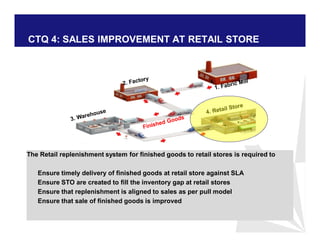
CTQ 4: SALES IMPROVEMENT AT RETAIL STORE
The Retail replenishment system for finished goods to retail stores is required to
Ensure timely delivery of finished goods at retail store against SLA
Ensure STO are created to fill the inventory gap at retail stores
Ensure that replenishment is aligned to sales as per pull model
Ensure that sale of finished goods is improved
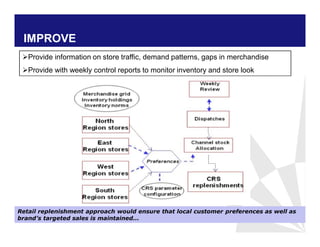
Retail replenishment approach would ensure that local customer preferences as well as
brand’s targeted sales is maintained...
IMPROVE
Provide information on store traffic, demand patterns, gaps in merchandise
Provide with weekly control reports to monitor inventory and store look
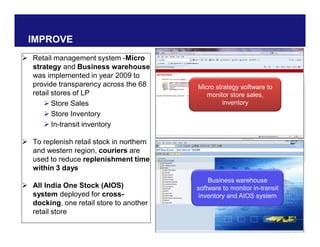
IMPROVE
 Retail management system -Micro
strategy and Business warehouse
was implemented in year 2009 to
provide transparency across the 68
retail stores of LP
 Store Sales
 Store Inventory
 In-transit inventory
 To replenish retail stock in northern
and western region, couriers are
used to reduce replenishment time
within 3 days
 All India One Stock (AIOS)
system deployed for cross-
docking, one retail store to another
retail store
Micro strategy software to
monitor store sales,
inventory
Business warehouse
software to monitor in-transit
inventory and AIOS system
CONTROL
ESCALATION MATRIX
OUT OF
STOCK
VENDOR/
INCHARGE
RETAIL
MERCHANT
RETAIL
HEAD
BRAND
HEAD
4 Days
3 Days
2 Days
1 Day
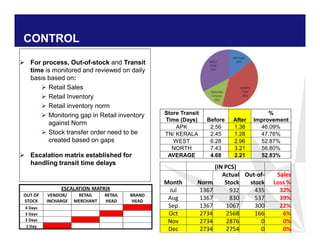
 For process, Out-of-stock and Transit
time is monitored and reviewed on daily
basis based on:
 Retail Sales
 Retail Inventory
 Retail inventory norm
 Monitoring gap in Retail inventory
against Norm
 Stock transfer order need to be
created based on gaps
 Escalation matrix established for
handling transit time delays
Store Transit
Time (Days) Before After
%
Improvement
APK 2.56 1.38 46.09%
TN/ KERALA 2.45 1.28 47.76%
WEST 6.28 2.96 52.87%
NORTH 7.43 3.21 56.80%
AVERAGE 4.68 2.21 52.83%
(IN PCS)
Month Norm
Actual
Stock
Out-of-
stock
Sales
Loss %
Jul 1367 932 435 32%
Aug 1367 830 537 39%
Sep 1367 1067 300 22%
Oct 2734 2568 166 6%
Nov 2734 2876 0 0%
Dec 2734 2754 0 0%
BENEFITS : SALES IMPROVEMENT
Two-Sample T-Test and CI: Before Sale, After Sale
Two-sample T for Before Sale vs After Sale
SE
N Mean StDev Mean
Before Sale 12 174.7 43.0 12
After Sale 3 717.7 38.7 22
Difference = mu (Before Sale) - mu (After Sale)
Estimate for difference: -543.000
95% upper bound for difference: -482.904
T-Test of difference = 0 (vs <): T-Value = -21.26
P-Value = 0.000 DF = 3
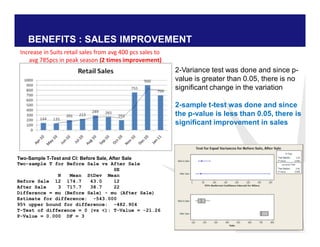
2-Variance test was done and since p-
value is greater than 0.05, there is no
significant change in the variation
2-sample t-test was done and since
the p-value is less than 0.05, there is
significant improvement in sales
Increase in Suits retail sales from avg 400 pcs sales to
avg 785pcs in peak season (2 times improvement)
OVERALL BENEFIT
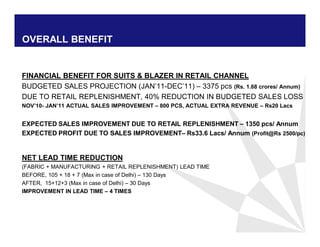
FINANCIAL BENEFIT FOR SUITS & BLAZER IN RETAIL CHANNEL
BUDGETED SALES PROJECTION (JAN’11-DEC’11) – 3375 pcs (Rs. 1.68 crores/ Annum)
DUE TO RETAIL REPLENISHMENT, 40% REDUCTION IN BUDGETED SALES LOSS
NOV’10- JAN’11 ACTUAL SALES IMPROVEMENT – 800 PCS, ACTUAL EXTRA REVENUE – Rs20 Lacs
EXPECTED SALES IMPROVEMENT DUE TO RETAIL REPLENISHMENT – 1350 pcs/ Annum
EXPECTED PROFIT DUE TO SALES IMPROVEMENT– Rs33.6 Lacs/ Annum (Profit@Rs 2500/pc)
NET LEAD TIME REDUCTION
(FABRIC + MANUFACTURING + RETAIL REPLENISHMENT) LEAD TIME
BEFORE, 105 + 18 + 7 (Max in case of Delhi) – 130 Days
AFTER, 15+12+3 (Max in case of Delhi) – 30 Days
IMPROVEMENT IN LEAD TIME – 4 TIMES
FUTURE ROADMAP
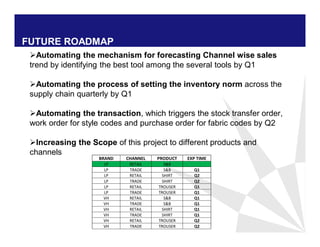
Automating the mechanism for forecasting Channel wise sales
trend by identifying the best tool among the several tools by Q1
Automating the process of setting the inventory norm across the
supply chain quarterly by Q1
Automating the transaction, which triggers the stock transfer order,
work order for style codes and purchase order for fabric codes by Q2
Increasing the Scope of this project to different products and
channels
BRAND CHANNEL PRODUCT EXP TIME
LP RETAIL S&B
LP TRADE S&B Q1
LP RETAIL SHIRT Q2
LP TRADE SHIRT Q2
LP RETAIL TROUSER Q1
LP TRADE TROUSER Q1
VH RETAIL S&B Q1
VH TRADE S&B Q1
VH RETAIL SHIRT Q1
VH TRADE SHIRT Q1
VH RETAIL TROUSER Q2
VH TRADE TROUSER Q2
THANK YOU

ARS

  • 1.
    LEAD TIME &INVENTORY REDUCTION IN APPAREL SUPPLY CHAIN Team Synergy Abhishek Kumar Mangala M Rashmi Rao Jisna P Gopi
  • 2.
    ABOUT THE COMPANY •Manufacturing arm of Madura Garments having brands like Louis Philippe , Van Heusen , Allen Solly and Peter England • It comprises of 4 factories located in Bangalore , with a total employee strength close to 3000. • The product range offered is men’s and women’s formal – Shirts , Trousers and Suits with annual volumes of 43.6 Lakh garments. Aditya Birla Group AB Nuvo Madura Garments Madura Clothing Vision: “To be a global benchmark for apparel industry in manufacturing and innovation providing competitive advantage to stake holders”
  • 3.
    Note:-To understand theapparel supply chain in brief which will help to understand the project better APPAREL SUPPLY CHAIN
  • 4.
    NEED FOR PROJECT Nowell defined and scientific replenishment model and stocking policy Stagnating sales growth year-on-year basis High finished goods inventory Increase in discounted sales year on year leading to profit erosion 0 100 200 300 400 500 600 APR2008 MAY2008 JUN2008 JUL2008 AUG2008 SEP2008 OCT2008 NOV2008 DEC2008 JAN2009 FEB2009 MAR2009 APR2009 MAY2009 JUN2009 JUL2009 AUG2009 SEP2009 OCT2009 NOV2009 DEC2009 JAN2010 FEB2010 MAR2010 Qty(inpcs) LP Core FG Sales : FY08-10 0 2000 4000 6000 8000 APR2008 MAY2008 JUN2008 JUL2008 AUG2008 SEP2008 OCT2008 NOV2008 DEC2008 JAN2009 FEB2009 MAR2009 APR2009 MAY2009 JUN2009 JUL2009 AUG2009 SEP2009 OCT2009 NOV2009 DEC2009 JAN2010 FEB2010 MAR2010 Qty(inpcs) LP Core FG Inventory : FY08-10 FG inventory in the range of 5000pcs while Retail sales in 400pcs per month, hence carrying 10 months more inventory Due to such high FG inventory level, cash flow for business is blocked and discounted sales increasing to improve it
  • 5.
    PROJECT CHARTER Business Case: Total Lead time of Apparel supply chain was 130 days and there has been no replenishment leading to high out- of-stock rate. The inventory level was very high carrying 9 months inventory. This threw up tremendous potential for improving the lead time and inventory reduction Scope: Fabric procurement to Retail Sales Relation with business case , approach , scope , CTQ’s and benefits were finalized in the charter
  • 6.
    SIPOC Fabric procurement from mill Fabric procurement from mill Fabric storageat factory Fabric storage at factory Garment mfg at factory Garment mfg at factory FG storage at WH FG storage at WH Retail store replenish Retail store replenish Retail sales Retail sales Core
  • 7.
    CORE REPLENISHMENT SYSTEM Factory Warehouse RetailStore Consumer CRS(PullStrategy) Fabric Mills Core products would be managed using continuous replenishment at FG as well as fabric stages …
  • 8.
    CORE REPLENISHMENT SYSTEM Coreproducts would be managed using continuous replenishment at FG as well as fabric stages … Orders are Aggregated Order Garment Production PO Preparation Sends the order WO is generated WO Supplies Fabric PO Fabric Order Details Fabric Status Garments Pending Order File Warehouse Factory Purchase Supplier Customer FG Stocks, WIP Levels Fabric Stocks In-Transit, Fabric RoP Levels Fabric Avb. yes no Fulfill
  • 9.
    CTQ TREE DIAGRAM Reductionof Lead time and inventory in Apparel Supply chain for Core Replenishment System Garment Manufacturing REWORK% RECUTTING% MANUFACTURING LEAD TIME Finished Goods INVENTORY (DAYS) Fabric LEAD TIME (DAYS) Retail RETAIL SALES (PCS)
  • 10.
    Critical To Quality Characteristics(CTQ) Operational Definition Measure Current Status CTQ Specification Defect Definition KANO Status 1. FABRIC PROCUREMENT LEAD TIME (DAYS) FABRIC LEAD TIME FROM PO CREATION TO DELIVERY AT FACORY STORES 105 Days <15 Days > 15 Days MUST BE 2. MANUFACTURING LEAD TIME (DAYS) TIME FROM WO CREATION TO DELIERY AT FACTORY WAREHOUSE 18 Days <12 Days > 12 Days MUST BE 3. FINISHED GOODS INVENTORY IN WH (DAYS) FINISHED GOODS INVENTORY IN DAYS 271Days < 60 Days > 60 Days MUST BE 4. RETAIL SALES (PCS) RETAIL SALES IN PIECES 400 Pcs >500 Pcs < 500 PCS MUST BE 5. RECUTTING (%) PANELS RECUTTING 4% <3% >3% LOWER THE BETTER BATCH RECUTTING 3% <1% >1% 6. REWORK (%) END OF LINE 7.83% < 7% >7% LOWER THE BETTER FQC 1.73% <5% >5% The project objective (Y) is addressed by focusing on the Must Be” CTQ’s (y’s) identified as shown above CTQ TABLE
  • 11.
    MILESTONE GANTT CHART Jun’10 Jul’10Aug’10 Sep’10 Oct’10 Nov’10 Dec’10 Jan’11 DEFINE Project Charter SIPOC CTQ Tree Diagram MEASURE As-is CTQ Status APPROACH/ ANALYSIS Cause & Effect Diagram FMEA DEPLOYMENT/ IMPROVE NVA Identification & stratification Setting up section wise WIP Norms Single piece clearance on daily basis Developing system to monitor online ASSESSMENT & REVIEW/ CONTROL Implementing control mechanism Sustenance (Review & Assessment) Replication
  • 12.
    CTQ 1: FABRICLEAD TIME REDUCTION AT FABRIC MILL The Strategic supplier relationship management is required to Ensure the strategic partnership with fabric mills Ensure reduced fabric lead time by Vendor managed inventory Ensure improved service levels for fabric lead time and quality Ensure building base stock to service peak season demand
  • 13.
    ANALYZE An internal brainstorming session,helped to narrow down the Focus area for Deployment in spoke from “12 Spoke solution design” with strong core
  • 14.
    IMPROVE • SATISFACTIONSURVEY • HALFYEARLY FEEDBACK REPORT Supplier Segmentation (Supplier wise strategy ) Vendor Connect (IT Enablement) Supplier Forums (Relationship Mapping) Supplier Feedback
  • 15.
    CONTROL  After establishingStrategic supplier relationship, critical vendors identified based on following parameters for rationalization:  Geographic Location  Delivery, Quality, Cost  VMI has been adopted for critical vendors by providing them Quarterly projections to deliver stock on-demand  After implementing VMI, due to reduction in Fabric lead time and improved service levels, base stock was built to service ESCALATION MATRIX LEAD TIME DELAY VENDOR/ INCHARGE PURCHASE MANAGER SOURCING HEAD BRAND HEAD 14 Days 10 Days 7 Days 2 Days Safety Stock Reorder Point
  • 16.
    CTQ 2 :GMT MFG LEAD TIME REDUCTION AT FACTORY The reduction in Garment manufacturing lead time is done by Ensure timely delivery of finished goods at warehouse against SLA Identifying potential causes for high manufacturing lead time Identifying root causes by using FMEA Implementing improvement solutions for those root causes Implementing controls to ensure that implemented solutions sustain
  • 17.
    DIAGNOSING POTENTIAL ROOTCAUSES An internal brainstorming session, helped to narrow down from 52 x’s to more likely root causes for further analysis Single pc clearance Further, FMEA was carried out to help in prioritizing the potential root causes
  • 18.
    FMEA FOR PRIORITIZINGPOTENTIAL ROOT CAUSES Cause Probability of Occurrence Severity Of Conseque nce Difficulty of Detection (A) Probability of Occurrenc e (B) Consequen ce (C) Detection Risk Priority No. (RPN) (High / Medium / Low) Rating (1-6-9) 1 = lowest, 6 = medium, 9 = highest A x B x C Lack of work aid Low Medium Medium 1 6 6 36 Mismatching of material Medium Medium Low 6 6 1 36 Fabric Defect & Shade variation Medium High Low 6 9 1 54 Improper method due to lack of adherance to SOP Low High Medium 1 9 6 54 Planning procedure leading to improper release of work orders Medium High Medium 6 9 6 324 High sectional WIP due to lack of adherance to WIP Norms High High Medium 9 9 6 486 Delay in single piece clearance due to lack of supervision High High High 9 9 9 729 2 main causes having highest RPNs were selected to work on High RPN root causes 486 and 729 respectively are identified and action taken to reduce it
  • 19.
    IMPROVEMENT  Delay insingle piece clearance due to lack of supervision  Tracking format implemented for tracking down the single piece in the section Operators and supervisors were educated to clear single piece  Daily review for deviations Results Statistical Validation SINGLE PIECE CLEARANCE TRACKING 2-Variance test was done and since p- value (0.498) is greater than 0.05, there is no significant change in the variation 2-sample t-test was done and since the p-value (0.002) is less than 0.05, there is significant reduction in single piece clearance time.
  • 20.
    IMPROVEMENT  High NetWIP due to lack of adherance to WIP norms  Section wise norms were fixed based on the daily production of section  Implementation of pull system in WIP based WO release Daily review for deviations 2-Variance test was done and since p- value (0.587) is greater than 0.05, there is no significant change in the variation 2-sample t-test was done and since the p-value (0.006) is less than 0.05, there is significant reduction in Net WIP (pcs) Results Statistical Validation
  • 21.
    FMEA FOR RESULTVALIDATION Failure Mode Effect Analysis (FMEA) for Validating the solutions. Cause Probabi lity Severit y Of Conse quence Difficul ty of Detecti on (A) Poten tial (B) Conse quenc e (C) Detect ion Risk Priority No. (RPN) Implemented Preventive Action (A1) Proba bility (B1) Severi ty (C1) Detec tion Residu al No. (High / Medium / Low) Rating (1-6-9) 1 = lowest, 6 = medium, 9 = highest A x B x C Rating (1-6-9) 1 = lowest, 6 = medium, 9 = highest A1 x B1 x C1 Lack of work aid Low Medium High 1 6 9 54 1 6 9 54 Mismatching of material Medium Medium Low 6 6 1 36 6 6 1 36 Fabric Defect & Shade variation Medium High Low 6 9 1 54 6 9 1 54 Improper method due to lack of adherance to SOP Low High Medium 1 9 6 54 1 9 6 54 Planning procedure leading to improper release of work orders Medium High Medium 6 9 6 324 Implementation of pull system, WIP based work order release system 6 1 6 36 High sectional WIP due to lack of adherance to WIP Norms High High Medium 9 9 6 486 Establishing section wise WIP norms and ensuring adherance to it 1 9 6 54 Delay in single piece clearance due to lack of supervision High High High 9 9 9 729 Establishing single piece clearance tracking sheet and ensuring adherance to it 1 9 6 54 With the implemented solution RPN of root causes came down from 486 and 729 to 54 respectively which validates the effectiveness of solution
  • 22.
    Sheet to recorddetails of all alterations of same product, different batches Single piece clearance of monitoring on a day to day basis Regular training to operators on clearing single pieces on top-priority On-site board for supervisors to keep tracking single pieces and Section wise WIP Holding dispatch till 100% single pc clearance Weekly reviews by Production Manager for ensuring adherance to Section wise WIP norm and single pc clearance CONTROL On-site board for production monitoring , style description and daily wo clearance Standard operating procedures in all sections to ensure the process adherence
  • 23.
    BENEFITS : MFGLEAD TIME REDUCTION Two-Sample T-Test and CI: After Tpt time, Before Tpt time Two-sample T for After vs Before N Mean StDev SE Mean After 4 12.50 2.65 1.3 Before 9 29.44 6.37 2.1 Difference = mu (After) - mu (Before) Estimate for difference: -16.9444 95% upper bound for difference: -12.4122 T-Test of difference = 0 (vs <): T-Value = -6.78 P-Value = 0.000 DF = 10 2-Variance test was done and since p- value is greater than 0.05, there is no significant change in the variation 2-sample t-test was done and since the p-value is less than 0.05, there is significant reduction in throughput time. Reduction in Suits average manufacturing lead time from 18 days to 12 days (0.4 times improvement)
  • 24.
    CTQ 3: FGINVENTORY REDUCTION AT WAREHOUSE The Warehouse replenishment system for finished goods to warehouse required to Ensure work orders are created to fill the inventory gap at warehouse Ensure that replenishment is aligned to sales as per pull model Ensure that inventory carrying cost of finished goods is reduced
  • 25.
    Warehouse replenishment approachto provide the brands with a competitive advantage of Replenishment Model, which characterizes Planning Horizon of fortnight with Weekly Wave Model of Work Ordering and Delivery cycle IMPROVE Factory Warehouse Wo Creation Pre-production activity (1 Days) 11 Days against SLA Wo Release Forecasting/ WH Stock Gap against Norm Every Monday Productio n Plan for filling Gap Fabrics & Trims in-stock Every Tuesday 1 Day Every Tuesday Entoma Warehouse (Retail) 2 DaysRetail Store 1 Day
  • 26.
    IMPROVE (Contd) Work orderingcycle : Weekly (on every Tuesday), Delivery cycle : 12 working days from day of work order creation for blazers/ Suits MOQ per style code : 10 pcs (based on cutting and marker laying efficiency) Fabric Norm: 1 month of sales Warehouse Norm: 1 month of sales Assessment Mechanism (Daily) OTIF Lead Time Review Mechanism (Quarterly) WH Inventory Fabric Inventory Service level Agreement 0 50 100 150 200 250 300 May Jun Jul Aug Sep Oct Jun+JulRequirementBuilding SafetyStockBuilding MF&L INVENTORY REPLENISHMENT MODEL (MONTH ON MONTH) - AW GAP REPLENISHMENT
  • 27.
    CONTROL Based on theScenarios, work order were created to replenish the gap in warehouse inventory Daily Status of Work orders were sent to brands for ensuring the transparency in work order execution ESCALATION MATRIX LEAD TIME DELAY SUPERVISOR PRODUCTION MANAGER FACTORY MANAGER HEAD OF MFG 4 Days 3 Days 2 Days 1 Day  For process, Smart Transactional Excel Macros were developed for:  Monitoring Retail Sales  Monitoring Retail Inventory  Monitoring WH Inventory  Monitoring Gap in WH inventory against Norm due to retail sales  Work order need to be created based on gaps on weekly basis  To improve the transparency in work order execution as control sheet, Daily status is sent to all stakeholders  Escalation matrix established for handling lead time delays
  • 28.
    BENEFITS : FGINVENTORY REDUCTION Two-Sample T-Test and CI: After Inventory, Before Inventory Two-sample T for After Inventory vs Before Inventory SE N Mean StDev Mean After Inventory 7 72.4 28.4 11 Before Inventory 5 208.6 68.8 31 Difference = mu (After Inventory) - mu (Before Inventory) Estimate for difference: -136.171 95% upper bound for difference: -66.697 T-Test of difference = 0 (vs <): T-Value = -4.18 P-Value = 0.007 DF = 4 2-Variance test was done and since p- value is greater than 0.05, there is no significant change in the variation 2-sample t-test was done and since the p-value is less than 0.05, there is significant reduction in inventory Reduction in Suits inventory from 9 months to 2 months (4.5 times improvement)
  • 29.
    CTQ 4: SALESIMPROVEMENT AT RETAIL STORE The Retail replenishment system for finished goods to retail stores is required to Ensure timely delivery of finished goods at retail store against SLA Ensure STO are created to fill the inventory gap at retail stores Ensure that replenishment is aligned to sales as per pull model Ensure that sale of finished goods is improved
  • 30.
    Retail replenishment approachwould ensure that local customer preferences as well as brand’s targeted sales is maintained... IMPROVE Provide information on store traffic, demand patterns, gaps in merchandise Provide with weekly control reports to monitor inventory and store look
  • 31.
    IMPROVE  Retail managementsystem -Micro strategy and Business warehouse was implemented in year 2009 to provide transparency across the 68 retail stores of LP  Store Sales  Store Inventory  In-transit inventory  To replenish retail stock in northern and western region, couriers are used to reduce replenishment time within 3 days  All India One Stock (AIOS) system deployed for cross- docking, one retail store to another retail store Micro strategy software to monitor store sales, inventory Business warehouse software to monitor in-transit inventory and AIOS system
  • 32.
    CONTROL ESCALATION MATRIX OUT OF STOCK VENDOR/ INCHARGE RETAIL MERCHANT RETAIL HEAD BRAND HEAD 4Days 3 Days 2 Days 1 Day  For process, Out-of-stock and Transit time is monitored and reviewed on daily basis based on:  Retail Sales  Retail Inventory  Retail inventory norm  Monitoring gap in Retail inventory against Norm  Stock transfer order need to be created based on gaps  Escalation matrix established for handling transit time delays Store Transit Time (Days) Before After % Improvement APK 2.56 1.38 46.09% TN/ KERALA 2.45 1.28 47.76% WEST 6.28 2.96 52.87% NORTH 7.43 3.21 56.80% AVERAGE 4.68 2.21 52.83% (IN PCS) Month Norm Actual Stock Out-of- stock Sales Loss % Jul 1367 932 435 32% Aug 1367 830 537 39% Sep 1367 1067 300 22% Oct 2734 2568 166 6% Nov 2734 2876 0 0% Dec 2734 2754 0 0%
  • 33.
    BENEFITS : SALESIMPROVEMENT Two-Sample T-Test and CI: Before Sale, After Sale Two-sample T for Before Sale vs After Sale SE N Mean StDev Mean Before Sale 12 174.7 43.0 12 After Sale 3 717.7 38.7 22 Difference = mu (Before Sale) - mu (After Sale) Estimate for difference: -543.000 95% upper bound for difference: -482.904 T-Test of difference = 0 (vs <): T-Value = -21.26 P-Value = 0.000 DF = 3 2-Variance test was done and since p- value is greater than 0.05, there is no significant change in the variation 2-sample t-test was done and since the p-value is less than 0.05, there is significant improvement in sales Increase in Suits retail sales from avg 400 pcs sales to avg 785pcs in peak season (2 times improvement)
  • 34.
    OVERALL BENEFIT FINANCIAL BENEFITFOR SUITS & BLAZER IN RETAIL CHANNEL BUDGETED SALES PROJECTION (JAN’11-DEC’11) – 3375 pcs (Rs. 1.68 crores/ Annum) DUE TO RETAIL REPLENISHMENT, 40% REDUCTION IN BUDGETED SALES LOSS NOV’10- JAN’11 ACTUAL SALES IMPROVEMENT – 800 PCS, ACTUAL EXTRA REVENUE – Rs20 Lacs EXPECTED SALES IMPROVEMENT DUE TO RETAIL REPLENISHMENT – 1350 pcs/ Annum EXPECTED PROFIT DUE TO SALES IMPROVEMENT– Rs33.6 Lacs/ Annum (Profit@Rs 2500/pc) NET LEAD TIME REDUCTION (FABRIC + MANUFACTURING + RETAIL REPLENISHMENT) LEAD TIME BEFORE, 105 + 18 + 7 (Max in case of Delhi) – 130 Days AFTER, 15+12+3 (Max in case of Delhi) – 30 Days IMPROVEMENT IN LEAD TIME – 4 TIMES
  • 35.
    FUTURE ROADMAP Automating themechanism for forecasting Channel wise sales trend by identifying the best tool among the several tools by Q1 Automating the process of setting the inventory norm across the supply chain quarterly by Q1 Automating the transaction, which triggers the stock transfer order, work order for style codes and purchase order for fabric codes by Q2 Increasing the Scope of this project to different products and channels BRAND CHANNEL PRODUCT EXP TIME LP RETAIL S&B LP TRADE S&B Q1 LP RETAIL SHIRT Q2 LP TRADE SHIRT Q2 LP RETAIL TROUSER Q1 LP TRADE TROUSER Q1 VH RETAIL S&B Q1 VH TRADE S&B Q1 VH RETAIL SHIRT Q1 VH TRADE SHIRT Q1 VH RETAIL TROUSER Q2 VH TRADE TROUSER Q2
  • 36.