0Copyright © 2013 Tata Consultancy Services Limited u-World 2013, 22nd June 2013
Distributed Edge-Computing for Internet-
of-Things
Dr. Arpan Pal
Principal Scientist and Research Head
Innovation Lab, Kolkata
Tata Consultancy Services
With Arijit Mukherjee and Soma Bandyopadhyay
Innovation Lab, Kolkata
Outline
Analytics in Internet of Things
Requirements and Challenges
Challenges and Solution Approach
Innovation@TCS
Analytics in Internet-of-Things
3
Signal
Processing
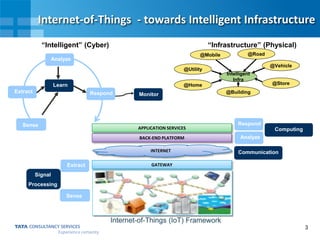
Internet-of-Things - towards Intelligent Infrastructure
Sense
Extract
Analyze
Respond
Learn
Monitor
Intelligent
Infra
@Home
@Building
@Vehicle
@Utility
@Mobile
@Store
@Road
“Intelligent” (Cyber) “Infrastructure” (Physical)
APPLICATION SERVICES
BACK-END PLATFORM
INTERNET
GATEWAY
Sense
Extract
Analyze
Respond
Communication
Computing
4
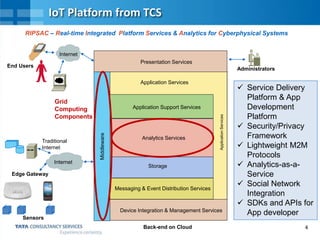
IoT Platform from TCS
Internet
End Users
Administrators
Device Integration & Management Services
Analytics Services
Application Services
Storage
Messaging & Event Distribution Services
ApplicationServices
Presentation Services
Application Support Services
Middleware
Edge Gateway
Sensors
Internet
Back-end on Cloud
RIPSAC – Real-time Integrated Platform Services & Analytics for Cyberphysical Systems
Traditional
Internet
 Service Delivery
Platform & App
Development
Platform
 Security/Privacy
Framework
 Lightweight M2M
Protocols
 Analytics-as-a-
Service
 Social Network
Integration
 SDKs and APIs for
App developer
Grid
Computing
Components
5
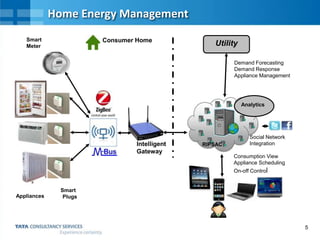
Utility
Appliances
Smart
Plugs
Intelligent
Gateway
Smart
Meter
Demand Forecasting
Demand Response
Appliance Management
Consumption View
Appliance Scheduling
On-off Control
Social Network
Integration
Consumer Home
Analytics
Home Energy Management
RIPSAC
6
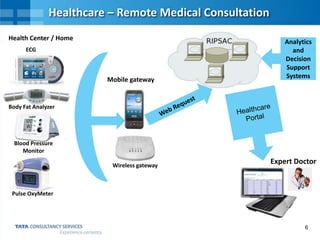
Healthcare – Remote Medical Consultation
ECG
Body Fat Analyzer
Blood Pressure
Monitor
Pulse OxyMeter
Mobile gateway
Patient
Records
Health Center / Home
Expert Doctor
Analytics
and
Decision
Support
Systems
Wireless gateway
7
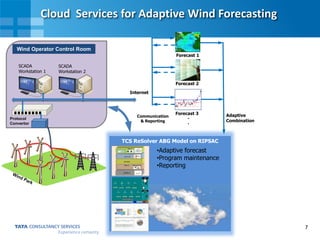
Communication
& Reporting
Forecast 1
Forecast 2
Adaptive
Combination
Forecast 3
.
.
Cloud Services for Adaptive Wind Forecasting
Protocol
Convertor
SCADA
Workstation 2
SCADA
Workstation 1
Wind Operator Control Room
Internet
TCS ReSolver ABG Model on RIPSAC
•Adaptive forecast
•Program maintenance
•Reporting
Requirements and Challenges
9
Grid Computing and IoT
 It is all about Intelligent Systems
 Intelligence comes from Analytics
 Need for crunching huge amount of sensor data and
respond in real-time
 Needs huge computing infrastructure in cloud
 Another option is to distribute computing load to the edge
devices
10
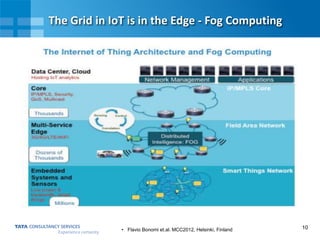
The Grid in IoT is in the Edge - Fog Computing
• Flavio Bonomi et.al. MCC2012, Helsinki, Finland
11
Advantages
 Edge Devices computing power remain unused most of the
time
o Free Computing resource for the grid
o Potentially millions of ~1GHz Processors on the grid depending upon
use case
 Energy cost at edge is typically at consumer rates <<
Energy cost at cloud which is at Enterprise rates
o Energy cost account for 50% of Data Center Opex
12
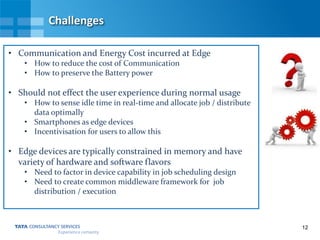
Challenges
• Communication and Energy Cost incurred at Edge
• How to reduce the cost of Communication
• How to preserve the Battery power
• Should not effect the user experience during normal usage
• How to sense idle time in real-time and allocate job / distribute
data optimally
• Smartphones as edge devices
• Incentivisation for users to allow this
• Edge devices are typically constrained in memory and have
variety of hardware and software flavors
• Need to factor in device capability in job scheduling design
• Need to create common middleware framework for job
distribution / execution
Solution Approach
14
Solution Approach
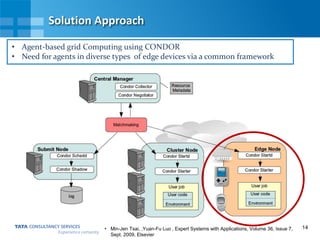
• Agent-based grid Computing using CONDOR
• Need for agents in diverse types of edge devices via a common framework
• Min-Jen Tsai, ,Yuan-Fu Luo , Expert Systems with Applications, Volume 36, Issue 7,
Sept. 2009, Elsevier
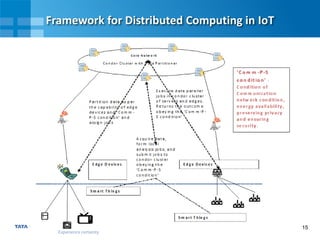
15
Framework for Distributed Computing in IoT
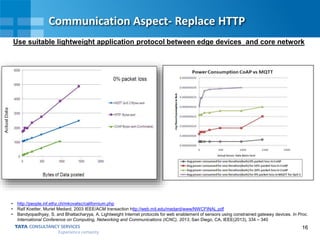
16
Communication Aspect- Replace HTTP
• http://people.inf.ethz.ch/mkovatsc/californium.php
• Ralf Koetter, Muriel Medard, 2003 IEEE/ACM transaction http://web.mit.edu/medard/www/NWCFINAL.pdf
• Bandyopadhyay, S. and Bhattacharyya, A. Lightweight Internet protocols for web enablement of sensors using constrained gateway devices. In Proc.
International Conference on Computing, Networking and Communications (ICNC), 2013, San Diego, CA, IEEE(2013), 334 – 340
Use suitable lightweight application protocol between edge devices and core network
17
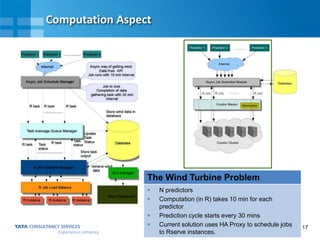
Computation Aspect
The Wind Turbine Problem
 N predictors
 Computation (in R) takes 10 min for each
predictor
 Prediction cycle starts every 30 mins
 Current solution uses HA Proxy to schedule jobs
to Rserve instances.
18
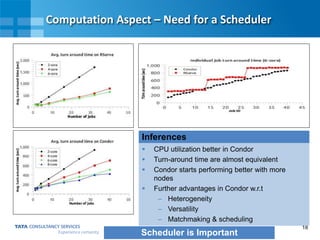
Inferences
 CPU utilization better in Condor
 Turn-around time are almost equivalent
 Condor starts performing better with more
nodes
 Further advantages in Condor w.r.t
– Heterogeneity
– Versatility
– Matchmaking & scheduling
Computation Aspect – Need for a Scheduler
Scheduler is Important
Innovation @TCS
20
Tata Consultancy Services Ltd. (TCS)
 Pioneer & Leader in Indian IT
TCS was established in 1968
 One of the top ranked global software service provider
 Largest Software service provider in Asia
 260,000+ associates
 USD 11B + annual revenue
 Global presence
 First Software R&D Center in India
- 20 -
21
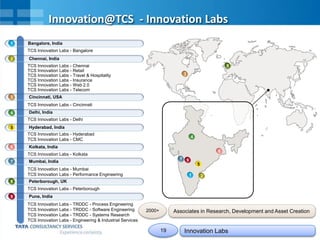
Innovation@TCS - Innovation Labs
Bangalore, India1
TCS Innovation Labs - Bangalore
Chennai, India2
TCS Innovation Labs - Chennai
TCS Innovation Labs - Retail
TCS Innovation Labs - Travel & Hospitality
TCS Innovation Labs - Insurance
TCS Innovation Labs - Web 2.0
TCS Innovation Labs - Telecom
Cincinnati, USA3
TCS Innovation Labs - Cincinnati
Delhi, India4
TCS Innovation Labs - Delhi
Hyderabad, India5
TCS Innovation Labs - Hyderabad
TCS Innovation Labs - CMC
Kolkata, India6
TCS Innovation Labs - Kolkata
Mumbai, India7
TCS Innovation Labs - Mumbai
TCS Innovation Labs - Performance Engineering
Peterborough, UK8
TCS Innovation Labs - Peterborough
Pune, India9
TCS Innovation Labs - TRDDC - Process Engineering
TCS Innovation Labs - TRDDC - Software Engineering
TCS Innovation Labs - TRDDC - Systems Research
TCS Innovation Labs - Engineering & Industrial Services
1 2
3
4
5
97
6
8
2000+ Associates in Research, Development and Asset Creation
19 Innovation Labs
Thank You
arpan.pal@tcs.com
23
Why CONDOR?
• Provides a framework for running any kind of application
• Batch jobs
• Distributed tasks with dependencies, workflows (DAG)
• Executables, scripts, …
• Allows seamless scaling of infrastructure
• Flocking: Inter-operation of different condor installations
• Automatic discovery of resources matching the requirement of a job
• ClassAd : Capability announcement by resources
• Job Descriptor describes job’s requirement
• Matchmaker : resource discovery and matching
• Renowned in scientific/Grid computing world, more than 25 years of
effort

Arpan pal gridcomputing_iot_uworld2013

  • 1.
    0Copyright © 2013Tata Consultancy Services Limited u-World 2013, 22nd June 2013 Distributed Edge-Computing for Internet- of-Things Dr. Arpan Pal Principal Scientist and Research Head Innovation Lab, Kolkata Tata Consultancy Services With Arijit Mukherjee and Soma Bandyopadhyay Innovation Lab, Kolkata
  • 2.
    Outline Analytics in Internetof Things Requirements and Challenges Challenges and Solution Approach Innovation@TCS
  • 3.
  • 4.
    3 Signal Processing Internet-of-Things - towardsIntelligent Infrastructure Sense Extract Analyze Respond Learn Monitor Intelligent Infra @Home @Building @Vehicle @Utility @Mobile @Store @Road “Intelligent” (Cyber) “Infrastructure” (Physical) APPLICATION SERVICES BACK-END PLATFORM INTERNET GATEWAY Sense Extract Analyze Respond Communication Computing
  • 5.
    4 IoT Platform fromTCS Internet End Users Administrators Device Integration & Management Services Analytics Services Application Services Storage Messaging & Event Distribution Services ApplicationServices Presentation Services Application Support Services Middleware Edge Gateway Sensors Internet Back-end on Cloud RIPSAC – Real-time Integrated Platform Services & Analytics for Cyberphysical Systems Traditional Internet  Service Delivery Platform & App Development Platform  Security/Privacy Framework  Lightweight M2M Protocols  Analytics-as-a- Service  Social Network Integration  SDKs and APIs for App developer Grid Computing Components
  • 6.
    5 Utility Appliances Smart Plugs Intelligent Gateway Smart Meter Demand Forecasting Demand Response ApplianceManagement Consumption View Appliance Scheduling On-off Control Social Network Integration Consumer Home Analytics Home Energy Management RIPSAC
  • 7.
    6 Healthcare – RemoteMedical Consultation ECG Body Fat Analyzer Blood Pressure Monitor Pulse OxyMeter Mobile gateway Patient Records Health Center / Home Expert Doctor Analytics and Decision Support Systems Wireless gateway
  • 8.
    7 Communication & Reporting Forecast 1 Forecast2 Adaptive Combination Forecast 3 . . Cloud Services for Adaptive Wind Forecasting Protocol Convertor SCADA Workstation 2 SCADA Workstation 1 Wind Operator Control Room Internet TCS ReSolver ABG Model on RIPSAC •Adaptive forecast •Program maintenance •Reporting
  • 9.
  • 10.
    9 Grid Computing andIoT  It is all about Intelligent Systems  Intelligence comes from Analytics  Need for crunching huge amount of sensor data and respond in real-time  Needs huge computing infrastructure in cloud  Another option is to distribute computing load to the edge devices
  • 11.
    10 The Grid inIoT is in the Edge - Fog Computing • Flavio Bonomi et.al. MCC2012, Helsinki, Finland
  • 12.
    11 Advantages  Edge Devicescomputing power remain unused most of the time o Free Computing resource for the grid o Potentially millions of ~1GHz Processors on the grid depending upon use case  Energy cost at edge is typically at consumer rates << Energy cost at cloud which is at Enterprise rates o Energy cost account for 50% of Data Center Opex
  • 13.
    12 Challenges • Communication andEnergy Cost incurred at Edge • How to reduce the cost of Communication • How to preserve the Battery power • Should not effect the user experience during normal usage • How to sense idle time in real-time and allocate job / distribute data optimally • Smartphones as edge devices • Incentivisation for users to allow this • Edge devices are typically constrained in memory and have variety of hardware and software flavors • Need to factor in device capability in job scheduling design • Need to create common middleware framework for job distribution / execution
  • 14.
  • 15.
    14 Solution Approach • Agent-basedgrid Computing using CONDOR • Need for agents in diverse types of edge devices via a common framework • Min-Jen Tsai, ,Yuan-Fu Luo , Expert Systems with Applications, Volume 36, Issue 7, Sept. 2009, Elsevier
  • 16.
  • 17.
    16 Communication Aspect- ReplaceHTTP • http://people.inf.ethz.ch/mkovatsc/californium.php • Ralf Koetter, Muriel Medard, 2003 IEEE/ACM transaction http://web.mit.edu/medard/www/NWCFINAL.pdf • Bandyopadhyay, S. and Bhattacharyya, A. Lightweight Internet protocols for web enablement of sensors using constrained gateway devices. In Proc. International Conference on Computing, Networking and Communications (ICNC), 2013, San Diego, CA, IEEE(2013), 334 – 340 Use suitable lightweight application protocol between edge devices and core network
  • 18.
    17 Computation Aspect The WindTurbine Problem  N predictors  Computation (in R) takes 10 min for each predictor  Prediction cycle starts every 30 mins  Current solution uses HA Proxy to schedule jobs to Rserve instances.
  • 19.
    18 Inferences  CPU utilizationbetter in Condor  Turn-around time are almost equivalent  Condor starts performing better with more nodes  Further advantages in Condor w.r.t – Heterogeneity – Versatility – Matchmaking & scheduling Computation Aspect – Need for a Scheduler Scheduler is Important
  • 20.
  • 21.
    20 Tata Consultancy ServicesLtd. (TCS)  Pioneer & Leader in Indian IT TCS was established in 1968  One of the top ranked global software service provider  Largest Software service provider in Asia  260,000+ associates  USD 11B + annual revenue  Global presence  First Software R&D Center in India - 20 -
  • 22.
    21 Innovation@TCS - InnovationLabs Bangalore, India1 TCS Innovation Labs - Bangalore Chennai, India2 TCS Innovation Labs - Chennai TCS Innovation Labs - Retail TCS Innovation Labs - Travel & Hospitality TCS Innovation Labs - Insurance TCS Innovation Labs - Web 2.0 TCS Innovation Labs - Telecom Cincinnati, USA3 TCS Innovation Labs - Cincinnati Delhi, India4 TCS Innovation Labs - Delhi Hyderabad, India5 TCS Innovation Labs - Hyderabad TCS Innovation Labs - CMC Kolkata, India6 TCS Innovation Labs - Kolkata Mumbai, India7 TCS Innovation Labs - Mumbai TCS Innovation Labs - Performance Engineering Peterborough, UK8 TCS Innovation Labs - Peterborough Pune, India9 TCS Innovation Labs - TRDDC - Process Engineering TCS Innovation Labs - TRDDC - Software Engineering TCS Innovation Labs - TRDDC - Systems Research TCS Innovation Labs - Engineering & Industrial Services 1 2 3 4 5 97 6 8 2000+ Associates in Research, Development and Asset Creation 19 Innovation Labs
  • 23.
  • 24.
    23 Why CONDOR? • Providesa framework for running any kind of application • Batch jobs • Distributed tasks with dependencies, workflows (DAG) • Executables, scripts, … • Allows seamless scaling of infrastructure • Flocking: Inter-operation of different condor installations • Automatic discovery of resources matching the requirement of a job • ClassAd : Capability announcement by resources • Job Descriptor describes job’s requirement • Matchmaker : resource discovery and matching • Renowned in scientific/Grid computing world, more than 25 years of effort