ARNIS
Arnis, also known as kali or eskrima, refers to a
category of Filipino martial arts that emphasizes the
use of weapons – whether it be fighting sticks, blades
or improvised weapons. In arnis, the weapons are
used as an extension of the body. Thus, some body
movement techniques are basic to the sport.
There are no exact references as to the origins of arnis
because of lack of proper documentation.
One theory was that it was started when the
Spaniards arrived. During the Spanish colonial period,
weapons had been banned in Luzon and Visayas.
• Indios used sticks to practice wielding their swords
and bolos which they disguised as a folk dance.
This is one possible reference as to how arnis
developed into an actual martial art.
However, because of the new culture brought by
our colonizers, arnis was overshadowed and almost
went out of the spotlight.
• Luckily, with the rise of martial arts as a popular
sport during the 1980s, arnis was able to recapture
the interest not of the Filipinos, but also of the
whole world in general.
Code of Ethics:
1. Arnis is an event that aims to bond and
develop friendship and brotherhood.
2. It is never a sport to hurt and defeat the
opponent but to improve the skills of the
players.
3. It aims to develop the mind, the physique and
the character of the player.
4. Arnis is played to develop the social aspect
that will lead to the close bonding of all
practitioners.
5. All the practitioners respect each other. They
salute each other when they meet and from a
meeting before they depart. The juniors must
salute first and maintain the position until the
seniors answer their salute.
6. The juniors do not have the right to challenge
to fight the seniors unless in the program set
by their association to fulfill an objective.
7. All the practitioners continue to move on as
there is room for improvement or
advancement.
8. Each practitioner must share with other
beginners or practitioners the advancement
attained.
9. Practitioners must desire to strengthen the
Arnis family he belongs to by sharing love,
knowledge and understanding.
10. Practitioners must remember that Arnis is
not a means to fight people but to bond with
them for life improvement.
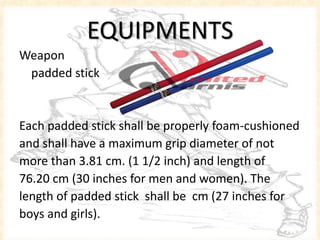
EQUIPMENTS
Weapon
padded stick
Each padded stick shall be properly foam-cushioned
and shall have a maximum grip diameter of not
more than 3.81 cm. (1 1/2 inch) and length of
76.20 cm (30 inches for men and women). The
length of padded stick shall be cm (27 inches for
boys and girls).
Head Protector
head gear
Body Protector
Groin protector
Forearm and shin guard
Competition area
Dimensions
The playing area is a square measuring 8.0
meters by 8.0 meters with a two (2) meters
minimum free zone around it, and a clear
space without any obstruction up to a height
of not less than 5 meters from the playing
surface.
Lines of the Playing Area
All lines of the playing surface are 5.08 cm.
(2inches) and must be of different color from
that of the floor and other lines previously
drawn for other purposes.
Boundary Lines
Four lines mark the boundary of the playing
area. The free zone distance measuring 2.0
meters are drawn outside of the playing area.
Referee Line
A straight line of 1.0 meter long is drawn
2.5meters from the farthest boundary line
parallel to the official’s table.
Warning Lines
A broken straight line is drawn one (1) meter
before each boundary line to serve as a
marker before the outside zone.
Neutral Corner
The corner of the playing area farthest to the
official’s table and in between the two (2)
judges within the free zone shall be
designated as the neutral corner. This shall be
the consultation area for the referee and
judges.
12 Basic Strikes
Kinds of Stances
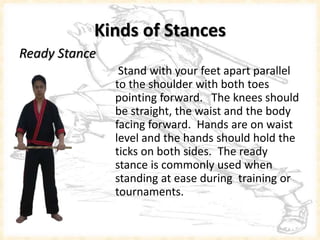
Ready Stance
Stand with your feet apart parallel
to the shoulder with both toes
pointing forward. The knees should
be straight, the waist and the body
facing forward. Hands are on waist
level and the hands should hold the
s ticks on both sides. The ready
stance is commonly used when
standing at ease during training or
tournaments.
Attention Stance
Stand with your feet forming a 45 degrees
angle. Heels should be close to each other,
knees should be straight, the waist and body
facing forward. Shoulders are dropped to the
side and both hands are at waist level. The
Attention Stance is commonly used in
preparation for courtesy or “bowing” at
commencement of sparring.
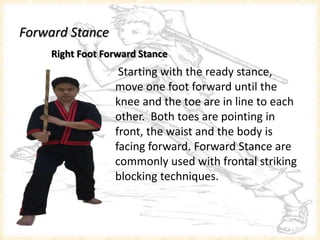
Forward Stance
Right Foot Forward Stance
Starting with the ready stance,
move one foot forward until the
knee and the toe are in line to each
other. Both toes are pointing in
front, the waist and the body is
facing forward. Forward Stance are
commonly used with frontal striking
or blocking techniques.
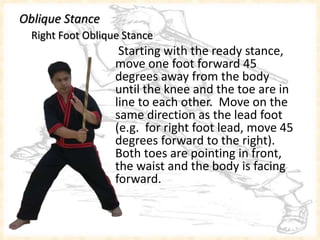
Oblique Stance
Right Foot Oblique Stance
Starting with the ready stance,
move one foot forward 45
degrees away from the body
until the knee and the toe are in
line to each other. Move on the
same direction as the lead foot
(e.g. for right foot lead, move 45
degrees forward to the right).
Both toes are pointing in front,
the waist and the body is facing
forward.
Straddle Stance
Starting with the ready stance,
move one foot about two feet
(2’) to the left or the right
direction until both lower legs
are almost perpendicular to the
ground. Straddle stances are
commonly used for blocking the
strikes to the side of the body
Side Stance
Left Side Stance
Starting with the ready stance, move
one foot about two feet (2’) to the
left or right direction. Moving foot
will be perpendicular to the ground
while the other leg is extended
thereby creating a position like that
of a side kick. Both toes are
pointing in front, the waist and the
body is facing forward.
Back Stance
Right Foot Back Stance
Starting with the ready stance,
move one foot backward 45
degrees away from the body.
The heels of the foot should
form an imaginary “L” shape
while the legs are in a straddle
position. The body should not
be too low or extended
otherwise it will be hard to
maneuver. Distribute the
weight or center of gravity to
both legs.
Pearnis7 150122065041-conversion-gate01

Pearnis7 150122065041-conversion-gate01

  • 2.
  • 3.
    Arnis, also knownas kali or eskrima, refers to a category of Filipino martial arts that emphasizes the use of weapons – whether it be fighting sticks, blades or improvised weapons. In arnis, the weapons are used as an extension of the body. Thus, some body movement techniques are basic to the sport. There are no exact references as to the origins of arnis because of lack of proper documentation. One theory was that it was started when the Spaniards arrived. During the Spanish colonial period, weapons had been banned in Luzon and Visayas.
  • 4.
    • Indios usedsticks to practice wielding their swords and bolos which they disguised as a folk dance. This is one possible reference as to how arnis developed into an actual martial art. However, because of the new culture brought by our colonizers, arnis was overshadowed and almost went out of the spotlight. • Luckily, with the rise of martial arts as a popular sport during the 1980s, arnis was able to recapture the interest not of the Filipinos, but also of the whole world in general.
  • 5.
    Code of Ethics: 1.Arnis is an event that aims to bond and develop friendship and brotherhood. 2. It is never a sport to hurt and defeat the opponent but to improve the skills of the players. 3. It aims to develop the mind, the physique and the character of the player.
  • 6.
    4. Arnis isplayed to develop the social aspect that will lead to the close bonding of all practitioners. 5. All the practitioners respect each other. They salute each other when they meet and from a meeting before they depart. The juniors must salute first and maintain the position until the seniors answer their salute.
  • 7.
    6. The juniorsdo not have the right to challenge to fight the seniors unless in the program set by their association to fulfill an objective. 7. All the practitioners continue to move on as there is room for improvement or advancement. 8. Each practitioner must share with other beginners or practitioners the advancement attained.
  • 8.
    9. Practitioners mustdesire to strengthen the Arnis family he belongs to by sharing love, knowledge and understanding. 10. Practitioners must remember that Arnis is not a means to fight people but to bond with them for life improvement.
  • 9.
    EQUIPMENTS Weapon padded stick Each paddedstick shall be properly foam-cushioned and shall have a maximum grip diameter of not more than 3.81 cm. (1 1/2 inch) and length of 76.20 cm (30 inches for men and women). The length of padded stick shall be cm (27 inches for boys and girls).
  • 10.
  • 11.
  • 12.
    Competition area Dimensions The playingarea is a square measuring 8.0 meters by 8.0 meters with a two (2) meters minimum free zone around it, and a clear space without any obstruction up to a height of not less than 5 meters from the playing surface.
  • 13.
    Lines of thePlaying Area All lines of the playing surface are 5.08 cm. (2inches) and must be of different color from that of the floor and other lines previously drawn for other purposes. Boundary Lines Four lines mark the boundary of the playing area. The free zone distance measuring 2.0 meters are drawn outside of the playing area.
  • 14.
    Referee Line A straightline of 1.0 meter long is drawn 2.5meters from the farthest boundary line parallel to the official’s table. Warning Lines A broken straight line is drawn one (1) meter before each boundary line to serve as a marker before the outside zone.
  • 15.
    Neutral Corner The cornerof the playing area farthest to the official’s table and in between the two (2) judges within the free zone shall be designated as the neutral corner. This shall be the consultation area for the referee and judges.
  • 16.
  • 17.
    Kinds of Stances ReadyStance Stand with your feet apart parallel to the shoulder with both toes pointing forward. The knees should be straight, the waist and the body facing forward. Hands are on waist level and the hands should hold the s ticks on both sides. The ready stance is commonly used when standing at ease during training or tournaments.
  • 18.
    Attention Stance Stand withyour feet forming a 45 degrees angle. Heels should be close to each other, knees should be straight, the waist and body facing forward. Shoulders are dropped to the side and both hands are at waist level. The Attention Stance is commonly used in preparation for courtesy or “bowing” at commencement of sparring.
  • 19.
    Forward Stance Right FootForward Stance Starting with the ready stance, move one foot forward until the knee and the toe are in line to each other. Both toes are pointing in front, the waist and the body is facing forward. Forward Stance are commonly used with frontal striking or blocking techniques.
  • 20.
    Oblique Stance Right FootOblique Stance Starting with the ready stance, move one foot forward 45 degrees away from the body until the knee and the toe are in line to each other. Move on the same direction as the lead foot (e.g. for right foot lead, move 45 degrees forward to the right). Both toes are pointing in front, the waist and the body is facing forward.
  • 21.
    Straddle Stance Starting withthe ready stance, move one foot about two feet (2’) to the left or the right direction until both lower legs are almost perpendicular to the ground. Straddle stances are commonly used for blocking the strikes to the side of the body
  • 22.
    Side Stance Left SideStance Starting with the ready stance, move one foot about two feet (2’) to the left or right direction. Moving foot will be perpendicular to the ground while the other leg is extended thereby creating a position like that of a side kick. Both toes are pointing in front, the waist and the body is facing forward.
  • 23.
    Back Stance Right FootBack Stance Starting with the ready stance, move one foot backward 45 degrees away from the body. The heels of the foot should form an imaginary “L” shape while the legs are in a straddle position. The body should not be too low or extended otherwise it will be hard to maneuver. Distribute the weight or center of gravity to both legs.