CEIP EMILI CARLES-TOLRÀ
    Castellar del Vallès


 ARION STUDY VISIT
      11th. May, 2004
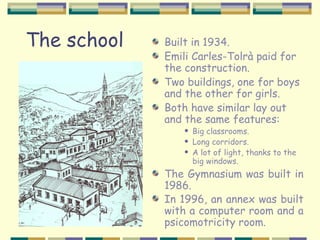
The school   Built in 1934.
             Emili Carles-Tolrà paid for
             the construction.
             Two buildings, one for boys
             and the other for girls.
             Both have similar lay out
             and the same features:
                   Big classrooms.
                   Long corridors.
                   A lot of light, thanks to the
                    big windows.
             The Gymnasium was built in
             1986.
             In 1996, an annex was built
             with a computer room and a
             psicomotricity room.
School facilities
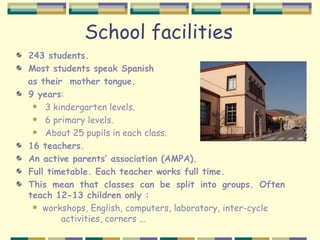
243 students.
Most students speak Spanish
as their mother tongue.
9 years:
  3 kindergarten levels.

  6 primary levels.

  About 25 pupils in each class.

16 teachers.
An active parents’ association (AMPA).
Full timetable. Each teacher works full time.
This mean that classes can be split into groups. Often
teach 12-13 children only :
  workshops, English, computers, laboratory, inter-cycle
        activities, corners ...
English organisation

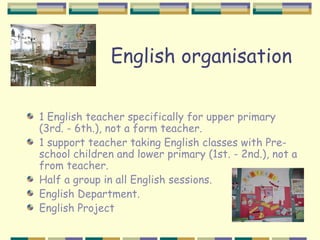
1 English teacher specifically for upper primary
(3rd. - 6th.), not a form teacher.
1 support teacher taking English classes with Pre-
school children and lower primary (1st. - 2nd.), not a
from teacher.
Half a group in all English sessions.
English Department.
English Project
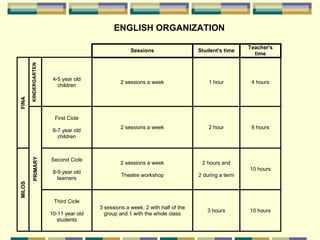
ENGLISH ORGANIZATION

                                                                                                  Teacher's
                                                     Sessions                   Student's time
                                                                                                    time
        KINDERGARTEN


                        4-5 year old
                                                 2 sessions a week                  1 hour         4 hours
                          children
FINA


                         First Cicle
                                                 2 sessions a week                  2 hour         8 hours
                        6-7 year old
                          children
         PRIMARY


                       Second Cicle
                                                 2 sessions a week               2 hours and
                                                                                                  10 hours
                        8-9 year old
                                                 Theatre workshop               2 during a term
                          learners
MILOS


                        Third Cicle
                                        3 sessions a week: 2 with half of the
                                                                                   3 hours        10 hours
                       10-11 year old     group and 1 with the whole class
                          students
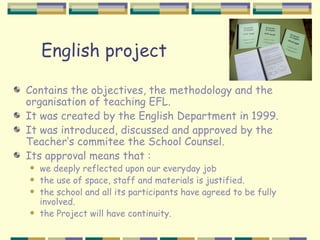
English project

Contains the objectives, the methodology and the
organisation of teaching EFL.
It was created by the English Department in 1999.
It was introduced, discussed and approved by the
Teacher’s commitee the School Counsel.
Its approval means that :
   we deeply reflected upon our everyday job
   the use of space, staff and materials is justified.
   the school and all its participants have agreed to be fully
    involved.
   the Project will have continuity.
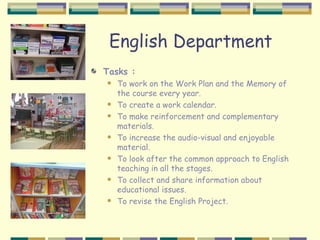
English Department
Tasks :
   To work on the Work Plan and the Memory of
    the course every year.
   To create a work calendar.
   To make reinforcement and complementary
    materials.
   To increase the audio-visual and enjoyable
    material.
   To look after the common approach to English
    teaching in all the stages.
   To collect and share information about
    educational issues.
   To revise the English Project.
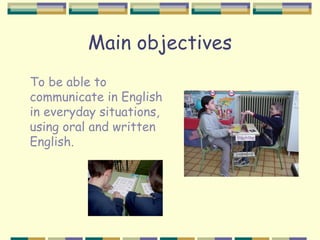
Main objectives
To be able to
communicate in English
in everyday situations,
using oral and written
English.
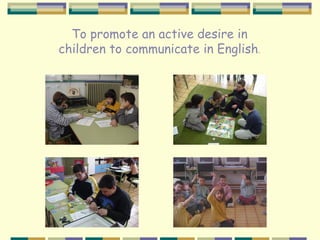
To promote an active desire in
children to communicate in English.
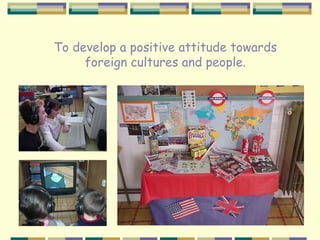
To develop a positive attitude towards
     foreign cultures and people.
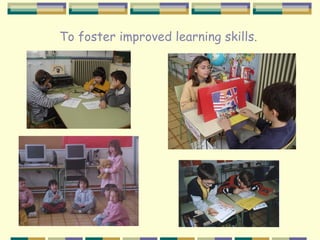
To foster improved learning skills.
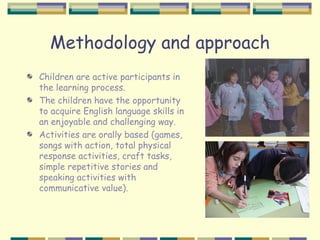
Methodology and approach
Children are active participants in
the learning process.
The children have the opportunity
to acquire English language skills in
an enjoyable and challenging way.
Activities are orally based (games,
songs with action, total physical
response activities, craft tasks,
simple repetitive stories and
speaking activities with
communicative value).
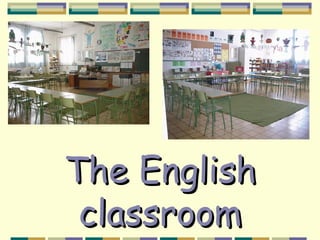
The English
 classroom
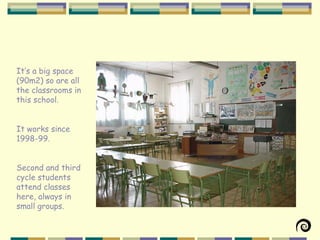
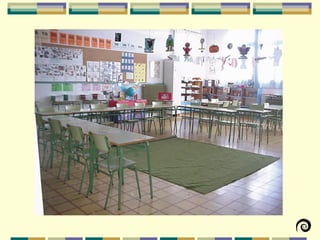
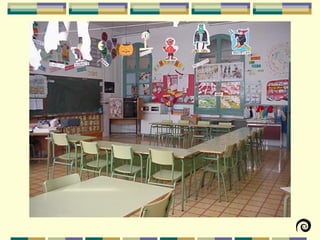
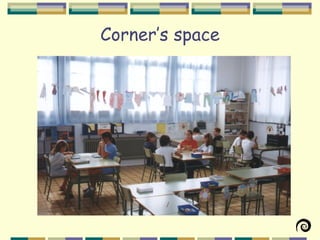
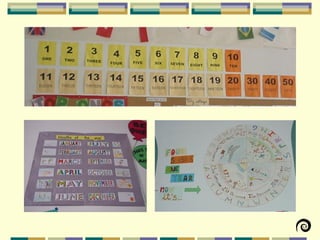
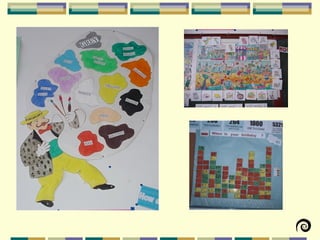
It’s a big space
(90m2) so are all
the classrooms in
this school.


It works since
1998-99.


Second and third
cycle students
attend classes
here, always in
small groups.
Corner’s space
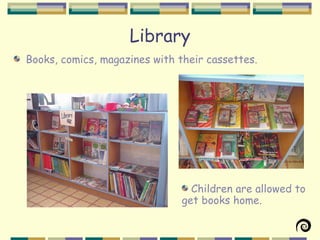
Library
Books, comics, magazines with their cassettes.


                                 Children are allowed to
                               get books home.
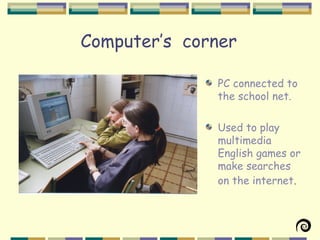
Computer’s corner

              PC connected to
              the school net.

              Used to play
              multimedia
              English games or
              make searches
              on the internet.
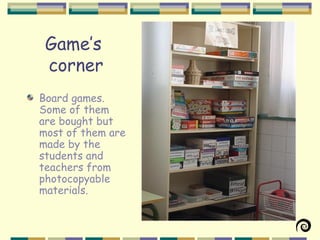
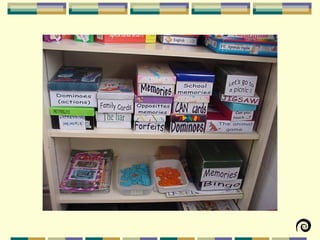
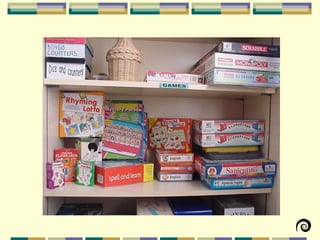
Game’s
 corner
Board games.
Some of them
are bought but
most of them are
made by the
students and
teachers from
photocopyable
materials.
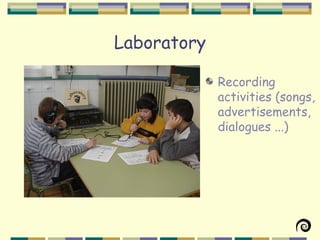
Laboratory

             Recording
             activities (songs,
             advertisements,
             dialogues ...)
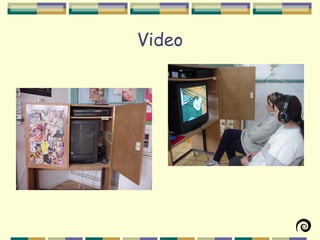
Video
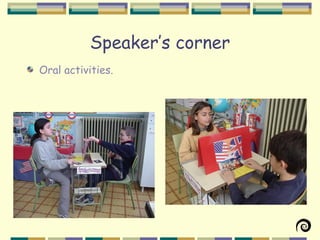
Speaker’s corner
Oral activities.
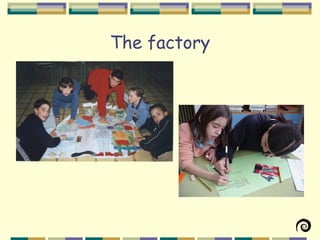
The factory
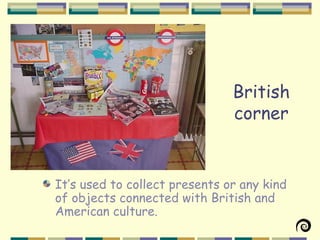
British
                               corner


It’s used to collect presents or any kind
of objects connected with British and
American culture.
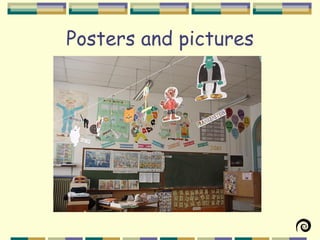
Posters and pictures
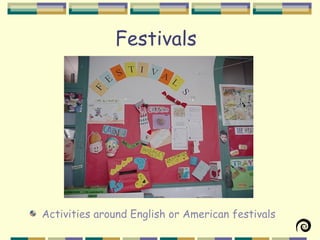
Festivals


Activities around English or American festivals
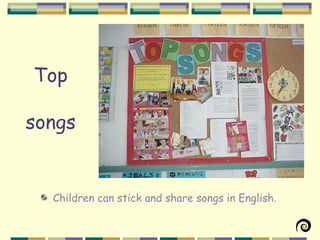
Top

songs


  Children can stick and share songs in English.
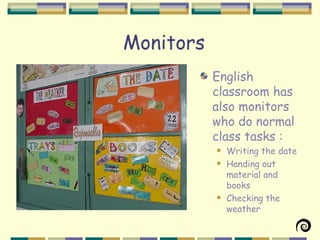
Monitors
           English
           classroom has
           also monitors
           who do normal
           class tasks :
              Writing the date
              Handing out
               material and
               books
              Checking the
               weather
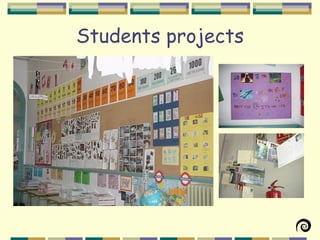
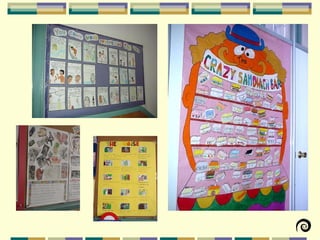
Students projects
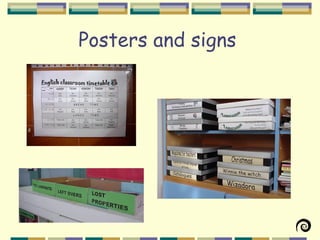
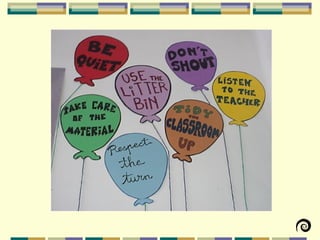
Posters and signs
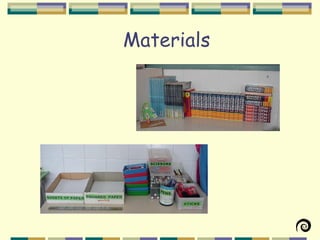
Materials
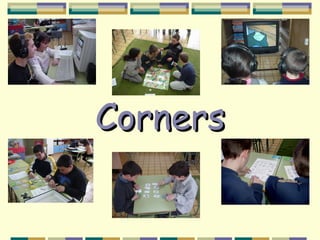
Corners
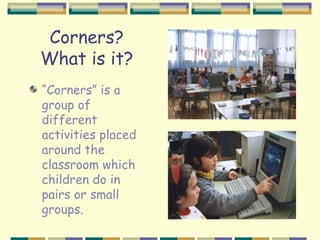
Corners?
What is it?
“Corners” is a
group of
different
activities placed
around the
classroom which
children do in
pairs or small
groups.
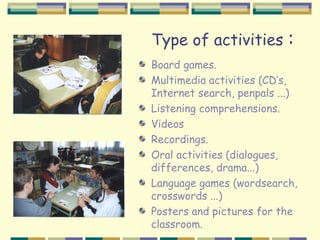
Type of activities         :
Board games.
Multimedia activities (CD’s,
Internet search, penpals ...)
Listening comprehensions.
Videos
Recordings.
Oral activities (dialogues,
differences, drama...)
Language games (wordsearch,
crosswords ...)
Posters and pictures for the
classroom.
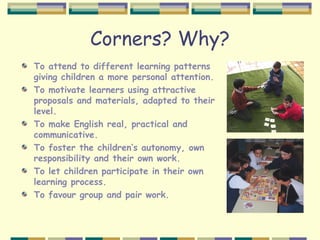
Corners? Why?
To attend to different learning patterns
giving children a more personal attention.
To motivate learners using attractive
proposals and materials, adapted to their
level.
To make English real, practical and
communicative.
To foster the children’s autonomy, own
responsibility and their own work.
To let children participate in their own
learning process.
To favour group and pair work.
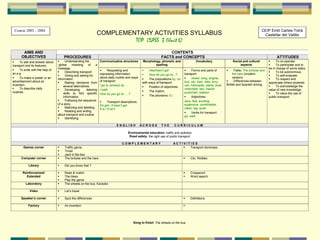
Course 2003 - 2004                                                                                                                                                                      CEIP Emili Carles-Tolrà
                                                              COMPLEMENTARY ACTIVITIES SYLLABUS                                                                                           Castellar del Vallès
                                                                       TOP CLASS 3 (Unit 6)
       AIMS AND                                                                                                   CONTENTS
      OBJECTIVES                    PROCEDURES                                                                FACTS and CONCEPTS                                                                   ATTITUDES
 To ask and answer about      Understanding the               Communicative structures        Morphology, phonetic and              Vocabulary                 Social and cultural         To co-operate.
transport and its features.     global     meaning      of    a                                           spelling                                                      aspects                To participate and to
                               message.                                                                                                                                                       be in charge of some tasks.
 To write with the help of                                       Requesting and               Has/hasn’t got              Forms and parts of            Fable: The tortoise and
                                Describing transport.                                                                                                                                        To be autonomous.
an e.g.                                                           expressing information          How do you go to...?       transport:                           the hare (modern
                                Giving and asking for                                                                                                                                        To self-evaluate.
 To make a poster or an                                         about daily routine and ways                                  wheel, wing, engine,              version).
                               information.                                                       The prepositions by, on                                                                    To respect and
advertisement about an                                            of transport.                                                bus, car, train, bike, lorry,    Differences between
                                Making decisions from                                          with ways of transport.                                                                      appreciate others students.
invention.                                                        I go to (school) by …                                        van, helicopter, plane, boat,   British and Spanish driving.
                                    several alternatives.                                         Position of adjectives.                                                                    To acknowledge the
 To describe daily            Developing          listening   I walk                                                       motorbike, taxi, tractor,                                      value of new knowledge.
routines.                                                                                         The rhythm.                pushchair, balloon
                                    skills to find specific       How do you go to … ?                                                                                                         To value the use of
                                    information.                                                  The phoneme /3:/.           Adjectives:                                                 public transport.
                                Following the sequence           Transport descriptions.                                   slow, fast, exciting,
                               of a story.                        It’s got / It hasn’t got                                     expensive, comfortable,
                                Matching and labelling          It is / It isn’t                                             clean, big, quiet
                                Reading and writing                                                                           Verbs for transport:
                               about transport and routine.                                                                    go, walk
                                Identifying.

                                                                              ENGLISH            ACROSS       THE       CURRICULUM

                                                                                      Environmental education: traffic and pollution
                                                                                       Road safety: the right use of public transport

                                                                                  COMPLEMENTARY                        ACTIVITIES
       Games corner               Traffic game                                                                            Transport dominoes
                                  Trivial
                                  Jack in the box
      Computer corner             The tortoise and the hare                                                                   Clic: Riddles

          Library               Did you know that ?

      Reinforcement/              Read & match                                                                                Crossword
        Extended                  The bikes                                                                                   Word search
                                  Play the game
         Laboratory               The wheels on the bus. Karaoke

           Video                Let’s travel

     Speaker’s corner           Spot the differences                                                                          Definitions

          Factory               An invention                                                                                 


                                                                                          Song to finish: The wheels on the bus
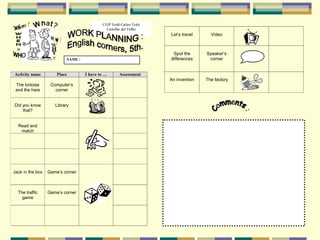
CEIP Emili Carles-Tolrà
                                             Castellar del Vallès
                                                                     Let’s travel     Video


                                                                      Spot the      Speaker’s
                          NAME :                                     differences     corner


Activity name         Place        I have to …       Assessment
                                                                     An invention   The factory
 The tortoise      Computer’s
 and the hare        corner


Did you know         Library
    that?


  Read and
   match


Jack in the box   Game’s corner


  The traffic     Game’s corner
    game
A corner session
Students set-up the activity corners.
Before starting the session, students plan which
activities they want to do.
Work in corners.
Finish with a song.
Tidy the classroom.
Individual comments.
Evaluation of the session with the whole group.
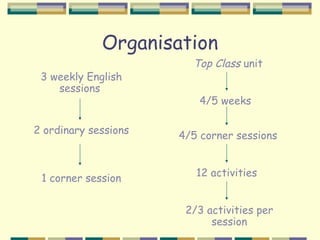
Organisation
                        Top Class unit
 3 weekly English
    sessions
                          4/5 weeks

2 ordinary sessions   4/5 corner sessions


                         12 activities
 1 corner session


                       2/3 activities per
                            session
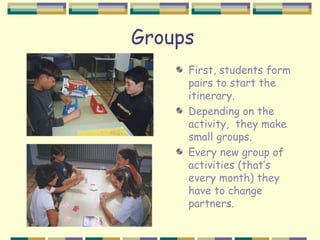
Groups
     First, students form
     pairs to start the
     itinerary.
     Depending on the
     activity, they make
     small groups.
     Every new group of
     activities (that’s
     every month) they
     have to change
     partners.
Criteria to select activities
They must :
   Work the basic learning skills.
   Be clear and understandable, in order to favour
    the autonomy.
   Bear diversity in mind.
   Be varied, using different formats.
   Link with the unit and course contents.
   Work co-operatively.
   Be self-corrective.
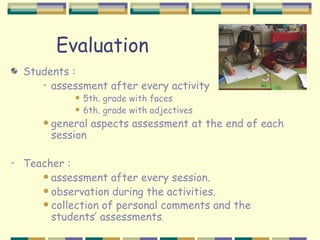
Evaluation
    Students :
       • assessment after every activity
                  5th. grade with faces
                  6th. grade with adjectives
          general aspects assessment at the end of each
           session

•   Teacher :
        assessment after every session.
        observation during the activities.
        collection of personal comments and the
         students’ assessments.
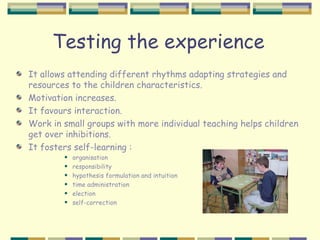
Testing the experience
It allows attending different rhythms adapting strategies and
resources to the children characteristics.
Motivation increases.
It favours interaction.
Work in small groups with more individual teaching helps children
get over inhibitions.
It fosters self-learning :
           organisation
           responsibility
           hypothesis formulation and intuition
           time administration
           election
           self-correction
CEIP EMILI CARLES-TOLRÀ
       -Castellar   del Vallès –


http://www.xtec.es/ceip-emilicarles/
 ceip-emilicarles@centres.xtec.es


            May, 2004

Arion2005

  • 1.
    CEIP EMILI CARLES-TOLRÀ Castellar del Vallès ARION STUDY VISIT 11th. May, 2004
  • 2.
    The school Built in 1934. Emili Carles-Tolrà paid for the construction. Two buildings, one for boys and the other for girls. Both have similar lay out and the same features:  Big classrooms.  Long corridors.  A lot of light, thanks to the big windows. The Gymnasium was built in 1986. In 1996, an annex was built with a computer room and a psicomotricity room.
  • 3.
    School facilities 243 students. Moststudents speak Spanish as their mother tongue. 9 years:  3 kindergarten levels.  6 primary levels.  About 25 pupils in each class. 16 teachers. An active parents’ association (AMPA). Full timetable. Each teacher works full time. This mean that classes can be split into groups. Often teach 12-13 children only :  workshops, English, computers, laboratory, inter-cycle activities, corners ...
  • 4.
    English organisation 1 Englishteacher specifically for upper primary (3rd. - 6th.), not a form teacher. 1 support teacher taking English classes with Pre- school children and lower primary (1st. - 2nd.), not a from teacher. Half a group in all English sessions. English Department. English Project
  • 5.
    ENGLISH ORGANIZATION Teacher's Sessions Student's time time KINDERGARTEN 4-5 year old 2 sessions a week 1 hour 4 hours children FINA First Cicle 2 sessions a week 2 hour 8 hours 6-7 year old children PRIMARY Second Cicle 2 sessions a week 2 hours and 10 hours 8-9 year old Theatre workshop 2 during a term learners MILOS Third Cicle 3 sessions a week: 2 with half of the 3 hours 10 hours 10-11 year old group and 1 with the whole class students
  • 6.
    English project Contains theobjectives, the methodology and the organisation of teaching EFL. It was created by the English Department in 1999. It was introduced, discussed and approved by the Teacher’s commitee the School Counsel. Its approval means that :  we deeply reflected upon our everyday job  the use of space, staff and materials is justified.  the school and all its participants have agreed to be fully involved.  the Project will have continuity.
  • 7.
    English Department Tasks :  To work on the Work Plan and the Memory of the course every year.  To create a work calendar.  To make reinforcement and complementary materials.  To increase the audio-visual and enjoyable material.  To look after the common approach to English teaching in all the stages.  To collect and share information about educational issues.  To revise the English Project.
  • 8.
    Main objectives To beable to communicate in English in everyday situations, using oral and written English.
  • 9.
    To promote anactive desire in children to communicate in English.
  • 10.
    To develop apositive attitude towards foreign cultures and people.
  • 11.
    To foster improvedlearning skills.
  • 12.
    Methodology and approach Childrenare active participants in the learning process. The children have the opportunity to acquire English language skills in an enjoyable and challenging way. Activities are orally based (games, songs with action, total physical response activities, craft tasks, simple repetitive stories and speaking activities with communicative value).
  • 13.
  • 14.
    It’s a bigspace (90m2) so are all the classrooms in this school. It works since 1998-99. Second and third cycle students attend classes here, always in small groups.
  • 17.
  • 18.
    Library Books, comics, magazineswith their cassettes. Children are allowed to get books home.
  • 19.
    Computer’s corner PC connected to the school net. Used to play multimedia English games or make searches on the internet.
  • 20.
    Game’s corner Board games. Someof them are bought but most of them are made by the students and teachers from photocopyable materials.
  • 23.
    Laboratory Recording activities (songs, advertisements, dialogues ...)
  • 24.
  • 25.
  • 26.
  • 27.
    British corner It’s used to collect presents or any kind of objects connected with British and American culture.
  • 28.
  • 31.
  • 32.
    Top songs Childrencan stick and share songs in English.
  • 33.
    Monitors English classroom has also monitors who do normal class tasks :  Writing the date  Handing out material and books  Checking the weather
  • 34.
  • 36.
  • 38.
  • 40.
  • 41.
    Corners? What is it? “Corners”is a group of different activities placed around the classroom which children do in pairs or small groups.
  • 42.
    Type of activities : Board games. Multimedia activities (CD’s, Internet search, penpals ...) Listening comprehensions. Videos Recordings. Oral activities (dialogues, differences, drama...) Language games (wordsearch, crosswords ...) Posters and pictures for the classroom.
  • 43.
    Corners? Why? To attendto different learning patterns giving children a more personal attention. To motivate learners using attractive proposals and materials, adapted to their level. To make English real, practical and communicative. To foster the children’s autonomy, own responsibility and their own work. To let children participate in their own learning process. To favour group and pair work.
  • 44.
    Course 2003 -2004 CEIP Emili Carles-Tolrà COMPLEMENTARY ACTIVITIES SYLLABUS Castellar del Vallès TOP CLASS 3 (Unit 6) AIMS AND CONTENTS OBJECTIVES PROCEDURES FACTS and CONCEPTS ATTITUDES  To ask and answer about  Understanding the Communicative structures Morphology, phonetic and Vocabulary Social and cultural  To co-operate. transport and its features. global meaning of a spelling aspects  To participate and to message. be in charge of some tasks.  To write with the help of  Requesting and  Has/hasn’t got  Forms and parts of  Fable: The tortoise and  Describing transport.  To be autonomous. an e.g. expressing information  How do you go to...? transport: the hare (modern  Giving and asking for  To self-evaluate.  To make a poster or an about daily routine and ways  wheel, wing, engine, version). information.  The prepositions by, on  To respect and advertisement about an of transport. bus, car, train, bike, lorry,  Differences between  Making decisions from with ways of transport. appreciate others students. invention. I go to (school) by … van, helicopter, plane, boat, British and Spanish driving. several alternatives.  Position of adjectives.  To acknowledge the  To describe daily  Developing listening I walk motorbike, taxi, tractor, value of new knowledge. routines.  The rhythm. pushchair, balloon skills to find specific How do you go to … ?  To value the use of information.  The phoneme /3:/.  Adjectives: public transport.  Following the sequence  Transport descriptions. slow, fast, exciting, of a story. It’s got / It hasn’t got expensive, comfortable,  Matching and labelling It is / It isn’t clean, big, quiet  Reading and writing  Verbs for transport: about transport and routine. go, walk  Identifying. ENGLISH ACROSS THE CURRICULUM Environmental education: traffic and pollution Road safety: the right use of public transport COMPLEMENTARY ACTIVITIES Games corner  Traffic game  Transport dominoes  Trivial  Jack in the box Computer corner  The tortoise and the hare  Clic: Riddles Library  Did you know that ? Reinforcement/  Read & match  Crossword Extended  The bikes  Word search  Play the game Laboratory  The wheels on the bus. Karaoke Video  Let’s travel Speaker’s corner  Spot the differences  Definitions Factory  An invention  Song to finish: The wheels on the bus
  • 45.
    CEIP Emili Carles-Tolrà Castellar del Vallès Let’s travel Video Spot the Speaker’s NAME : differences corner Activity name Place I have to … Assessment An invention The factory The tortoise Computer’s and the hare corner Did you know Library that? Read and match Jack in the box Game’s corner The traffic Game’s corner game
  • 46.
    A corner session Studentsset-up the activity corners. Before starting the session, students plan which activities they want to do. Work in corners. Finish with a song. Tidy the classroom. Individual comments. Evaluation of the session with the whole group.
  • 47.
    Organisation Top Class unit 3 weekly English sessions 4/5 weeks 2 ordinary sessions 4/5 corner sessions 12 activities 1 corner session 2/3 activities per session
  • 48.
    Groups First, students form pairs to start the itinerary. Depending on the activity, they make small groups. Every new group of activities (that’s every month) they have to change partners.
  • 49.
    Criteria to selectactivities They must :  Work the basic learning skills.  Be clear and understandable, in order to favour the autonomy.  Bear diversity in mind.  Be varied, using different formats.  Link with the unit and course contents.  Work co-operatively.  Be self-corrective.
  • 50.
    Evaluation Students : • assessment after every activity  5th. grade with faces  6th. grade with adjectives  general aspects assessment at the end of each session • Teacher :  assessment after every session.  observation during the activities.  collection of personal comments and the students’ assessments.
  • 51.
    Testing the experience Itallows attending different rhythms adapting strategies and resources to the children characteristics. Motivation increases. It favours interaction. Work in small groups with more individual teaching helps children get over inhibitions. It fosters self-learning :  organisation  responsibility  hypothesis formulation and intuition  time administration  election  self-correction
  • 52.
    CEIP EMILI CARLES-TOLRÀ -Castellar del Vallès – http://www.xtec.es/ceip-emilicarles/ ceip-emilicarles@centres.xtec.es May, 2004