ARE YOU READY FOR PREDICTIVE
ANALYTICS?
Setting you up for success
Anita Wood, Anita.Lauper.Wood@gmail.com
©2021 Anita Lauper Wood LLC
“…35% of what consumers purchase on
Amazon and 75% of what they watch on
Netflix come from product
recommendations based on such
algorithms.”
– McKinsey 2013
FIRST… WHAT IS IT?
Predictive analytics uses machine-learning,
statistics, and data mining to identify
patterns and trends in data
“Information is the oil of the 21st
century, and analytics is the combustion
engine.”
– Peter Sondergaard
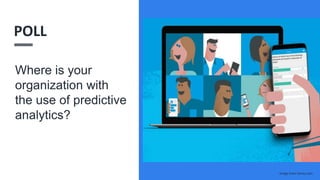
Where is your
organization with
the use of predictive
analytics?
POLL
Image from Vevox.com
WHAT I’LL SHARE
Do you know the “why” for
your product(s) and
organization?
01
What’s the worst that can
happen?
02
Foundations and practices to
help you avoid the common
pitfalls
03
SUCCESSFUL
CASES
USING
PREDICTIVE
ANALYTICS
Energy companies can dynamically adjust
energy grid loads
01
Insurance companies have automated the
risk assessment of applicants
02
Marketers can identify how consumers react
to a plethora of external factors, such as
economy and weather
03
Manufacturers can predict the likelihood of
bottlenecks in the supply chain and
proactively eliminate them
04
“Intellectuals solve problems, geniuses
prevent them.”
– Albert Einstein
Do you know the “why” for
your product(s) and
organization?
01
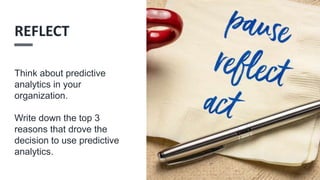
Think about predictive
analytics in your
organization.
Write down the top 3
reasons that drove the
decision to use predictive
analytics.
REFLECT
Strategy and delivering successful
products are about one thing --
PROBLEM DIAGNOSIS.
PROBLEM
Check your list. Does it include
problems to be solved?
01.
02. MARKET VALIDATION
Validating what you learned
is the best way to ensure
you are addressing the
correct “why”
REWIND: BACK TO BASICS
MARKET DISCOVERY
Primary market research is
the best way to identify
pervasive problems… the
correct “what”
“No matter how good the team or how
efficient the methodology, if we’re not
solving the right problem, the project
fails.”
– Woody Williams
What’s the worst that can
happen?
02
OUR CHALLENGE:
Jumping into predictive analytics
without solid foundational
practices puts your organization,
your product, and your career at
great risk
THREE RISKS
To Consider, Assess, and Plan Around Early
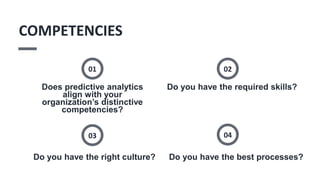
Does predictive analytics
align with your
organization’s distinctive
competencies?
01
Do you have the required skills?
02
Do you have the right culture?
03
Do you have the best processes?
04
COMPETENCIES
“Perhaps the biggest myth that gets in
the way of innovation is that it is all
about the big idea… Nothing could be
further from the truth.”
–Seeing Around Corners, Rita McGrath
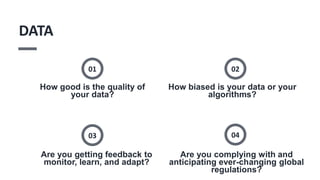
How good is the quality of
your data?
01
How biased is your data or your
algorithms?
02
Are you getting feedback to
monitor, learn, and adapt?
03
Are you complying with and
anticipating ever-changing global
regulations?
04
DATA
“The math-powered applications powering
the data economy (are) based on choices
made by fallible human beings… Many of
these models encode human prejudice,
misunderstanding, and bias into the
software systems that increasingly manage
our lives”
–Weapons of Math Destruction: How Big Data Increases Inequality and
Threatens Democracy, Cathy O’Neil
Think about the recent controversy
around Sky Bet, a gambling app
company in Britain
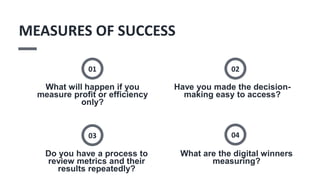
What will happen if you
measure profit or efficiency
only?
01
Have you made the decision-
making easy to access?
02
Do you have a process to
review metrics and their
results repeatedly?
03
What are the digital winners
measuring?
04
MEASURES OF SUCCESS
“Know where to find information and
how to use it; that is the secret of
success.”
– Albert Einstein
Foundations and practices to
help you avoid the common
pitfalls
03
Learn continuously and adaptively
CREATE A STRONG FOUNDATION WITH A GROWTH
MINDSET
“Because growth is shifting and
disruption is accelerating, we have to be
the fastest learners, and the fastest at
applying that learning to drive the
business.”
– F.D. Wilder, former senior VP at P&G
Align your tools and processes to fast
learning
“In a technology-fueled world where
disruption is the norm, adaptive
learning is the winning currency
because every new insight is a chance
for renewal and reinvention.”
– “Fast Times: How digital winners set direction, learn, and adapt”, McKinsey
Don’t become dependent on the
predictive analytics
IT’S BASED ON HISTORY, NOT ON DISRUPTIVE
FUTURE OPPORTUNITIES
Predictive analytics is only as
good as you are
Empower many to move quickly
MAKE IT EASY FOR DECISIONS TO BE MADE
“This means getting to a point where
you trust almost anyone to make
decisions on their own because you
believe they have the same
information and objectives you do.”
–General Stanley McChrystal
When it comes to managing knowledge,
“winners outperform peers by 70% in
terms of total return to shareholders,
and 138% in return on revenues.”
– “Fast Times: How digital winners set direction, learn, and adapt”,
McKinsey
Ask the right questions!
ALIGN THE ORGANIZATION… IT’S NOT JUST ABOUT
YOU!
BE TRANSPARENT
Predictive analytics can be extremely
powerful, valuable, and risky.
Transparency in your leadership and decision-
making is essential in avoiding the pitfalls
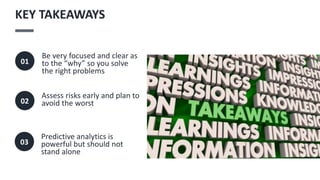
Be very focused and clear as
to the “why” so you solve
the right problems
01
Assess risks early and plan to
avoid the worst
02
KEY TAKEAWAYS
Predictive analytics is
powerful but should not
stand alone
03
THANK YOU!
Anita.Lauper.Wood@gmail.com
Anita Lauper Wood, MBA, PMP®, CSM®, PMC VI
Lifelong learner, adventurer, educator, and technology
product strategist and leader
Are You Ready For Predictive Analytics?

Are You Ready For Predictive Analytics?

  • 5.
    ARE YOU READYFOR PREDICTIVE ANALYTICS? Setting you up for success Anita Wood, Anita.Lauper.Wood@gmail.com ©2021 Anita Lauper Wood LLC
  • 6.
    “…35% of whatconsumers purchase on Amazon and 75% of what they watch on Netflix come from product recommendations based on such algorithms.” – McKinsey 2013
  • 7.
    FIRST… WHAT ISIT? Predictive analytics uses machine-learning, statistics, and data mining to identify patterns and trends in data
  • 8.
    “Information is theoil of the 21st century, and analytics is the combustion engine.” – Peter Sondergaard
  • 9.
    Where is your organizationwith the use of predictive analytics? POLL Image from Vevox.com
  • 10.
  • 11.
    Do you knowthe “why” for your product(s) and organization? 01
  • 12.
    What’s the worstthat can happen? 02
  • 13.
    Foundations and practicesto help you avoid the common pitfalls 03
  • 14.
    SUCCESSFUL CASES USING PREDICTIVE ANALYTICS Energy companies candynamically adjust energy grid loads 01 Insurance companies have automated the risk assessment of applicants 02 Marketers can identify how consumers react to a plethora of external factors, such as economy and weather 03 Manufacturers can predict the likelihood of bottlenecks in the supply chain and proactively eliminate them 04
  • 15.
    “Intellectuals solve problems,geniuses prevent them.” – Albert Einstein
  • 16.
    Do you knowthe “why” for your product(s) and organization? 01
  • 17.
    Think about predictive analyticsin your organization. Write down the top 3 reasons that drove the decision to use predictive analytics. REFLECT
  • 18.
    Strategy and deliveringsuccessful products are about one thing -- PROBLEM DIAGNOSIS.
  • 19.
    PROBLEM Check your list.Does it include problems to be solved?
  • 20.
    01. 02. MARKET VALIDATION Validatingwhat you learned is the best way to ensure you are addressing the correct “why” REWIND: BACK TO BASICS MARKET DISCOVERY Primary market research is the best way to identify pervasive problems… the correct “what”
  • 21.
    “No matter howgood the team or how efficient the methodology, if we’re not solving the right problem, the project fails.” – Woody Williams
  • 22.
    What’s the worstthat can happen? 02
  • 23.
    OUR CHALLENGE: Jumping intopredictive analytics without solid foundational practices puts your organization, your product, and your career at great risk
  • 24.
    THREE RISKS To Consider,Assess, and Plan Around Early
  • 25.
    Does predictive analytics alignwith your organization’s distinctive competencies? 01 Do you have the required skills? 02 Do you have the right culture? 03 Do you have the best processes? 04 COMPETENCIES
  • 26.
    “Perhaps the biggestmyth that gets in the way of innovation is that it is all about the big idea… Nothing could be further from the truth.” –Seeing Around Corners, Rita McGrath
  • 27.
    How good isthe quality of your data? 01 How biased is your data or your algorithms? 02 Are you getting feedback to monitor, learn, and adapt? 03 Are you complying with and anticipating ever-changing global regulations? 04 DATA
  • 28.
    “The math-powered applicationspowering the data economy (are) based on choices made by fallible human beings… Many of these models encode human prejudice, misunderstanding, and bias into the software systems that increasingly manage our lives” –Weapons of Math Destruction: How Big Data Increases Inequality and Threatens Democracy, Cathy O’Neil
  • 29.
    Think about therecent controversy around Sky Bet, a gambling app company in Britain
  • 30.
    What will happenif you measure profit or efficiency only? 01 Have you made the decision- making easy to access? 02 Do you have a process to review metrics and their results repeatedly? 03 What are the digital winners measuring? 04 MEASURES OF SUCCESS
  • 31.
    “Know where tofind information and how to use it; that is the secret of success.” – Albert Einstein
  • 32.
    Foundations and practicesto help you avoid the common pitfalls 03
  • 33.
    Learn continuously andadaptively CREATE A STRONG FOUNDATION WITH A GROWTH MINDSET
  • 34.
    “Because growth isshifting and disruption is accelerating, we have to be the fastest learners, and the fastest at applying that learning to drive the business.” – F.D. Wilder, former senior VP at P&G
  • 35.
    Align your toolsand processes to fast learning
  • 36.
    “In a technology-fueledworld where disruption is the norm, adaptive learning is the winning currency because every new insight is a chance for renewal and reinvention.” – “Fast Times: How digital winners set direction, learn, and adapt”, McKinsey
  • 37.
    Don’t become dependenton the predictive analytics IT’S BASED ON HISTORY, NOT ON DISRUPTIVE FUTURE OPPORTUNITIES
  • 38.
    Predictive analytics isonly as good as you are
  • 39.
    Empower many tomove quickly MAKE IT EASY FOR DECISIONS TO BE MADE
  • 40.
    “This means gettingto a point where you trust almost anyone to make decisions on their own because you believe they have the same information and objectives you do.” –General Stanley McChrystal
  • 41.
    When it comesto managing knowledge, “winners outperform peers by 70% in terms of total return to shareholders, and 138% in return on revenues.” – “Fast Times: How digital winners set direction, learn, and adapt”, McKinsey
  • 42.
    Ask the rightquestions! ALIGN THE ORGANIZATION… IT’S NOT JUST ABOUT YOU!
  • 43.
    BE TRANSPARENT Predictive analyticscan be extremely powerful, valuable, and risky. Transparency in your leadership and decision- making is essential in avoiding the pitfalls
  • 44.
    Be very focusedand clear as to the “why” so you solve the right problems 01 Assess risks early and plan to avoid the worst 02 KEY TAKEAWAYS Predictive analytics is powerful but should not stand alone 03
  • 45.
    THANK YOU! Anita.Lauper.Wood@gmail.com Anita LauperWood, MBA, PMP®, CSM®, PMC VI Lifelong learner, adventurer, educator, and technology product strategist and leader

Editor's Notes

  • #6 Once upon a time, there was a company that decided to try to sell books online. No one thought it could be done successfully nor paid much attention. What started out as a story about books became a story about the power of data. This company quickly understood the value of using the growing volumes of data to better understand and cater to its customers, resulting in rapid growth…. This company now uses extensive data analytics, backed by complex algorithms, to actually predict your behavior and nudge you to pull the trigger on your purchase. We all know this story at least indirectly.
  • #7 That’s right. It’s Amazon. (read) Amazon is a leader in using predictive analytics for a personalized customer experience and powerful suggestions driving impulse buying. Fun fact: Did you know that Amazon can predict what you will order and moves those products to a distribution center closer to you? So when you do buy that product, it’s already near you and ready to be delivered quickly. But we have come a long way. The power of predictive analytics is no longer reserved for the high-tech giants; it has permeated every industry.
  • #8 (read) It helps an organization to better predict future outcomes based on historical behavior, from more agile decision-making, to identifying new markets for your product, to better understanding your customer’s buying journey, to better managing risk
  • #9 Like I mentioned, we are in a world where data analytics is no longer reserved for the high-tech industries. Valuable information is everywhere. Here’s a good analogy by Peter Sondergaard (read)
  • #10 Answer options: We don’t use predictive analytics We are in the early stages of implementing predictive analytics We implemented predictive analytics but are not yet using it in decision-making We are regularly using predictive analytics in decision-making
  • #12 (read) Identifying the right targets for your predictive analytics initiative is essential for success.
  • #13 I’ll talk about just a few of the risks that could impact your success.
  • #14 And I’ll share keys to successfully implementing predictive analytics.
  • #15 Before we dive in, I want to help you visualize the application of predictive analytics. We’ve already defined it, but here are just a few of many fascinating examples to keep in mind as we talk today. (click) In the area of energy and agriculture, many applications enable preventative decisions, such as adjusting energy grid loads to avoid blackouts or predicting crop stress early to allow for more environmentally friendly solutions (click) When you apply for an insurance policy or even bank product, your information is compared to a mountain of data about other people and the insurance company’s statistics on likelihood of payout. They are predicting your behavior and your risk before you are even a customer (click) Marketing is the case you are likely most familiar with. Campaigns have become extremely accurate and timely, thanks to predictive analytics. (click) Supply chain optimization is another common win with predictive analytics. If we go back to Amazon as an example… It has a patented model that anticipates what, when, and where you will buy products. Amazon can proactively have those products ready at a distribution center closest to you
  • #16 Notice that predictive analytics is not just about selling more products but about preventing costly problems for your organization but also all stakeholders, like the environment. I can’t go without a quote from one of my favorites – Albert Einstein (read)
  • #17 One of the keys to successful use of predictive analytics is to find your focus amongst the plethora of data and opportunities. You need to be crystal clear about why and how you will use predictive analytics. The “why” will impact everything you do, measure, and improve.
  • #18 Whether you have already implemented predictive analytics or are planning to do so, I want you to take a minute to think about what drove that decision. Write down the top 3 reasons and keep this list and your thoughts in mind as we move through the next slides.
  • #19 Often, predictive analytics are part of a bigger digital transformation initiative or strategy. Whether at the product level or organizational level, (read). I’m a fan of Richard Rummelt’s book, “Good Strategy, Bad Strategy”, where he talks about the kernel of good strategy, including the diagnosis of the problem or challenge. Problem should not be a bad word. What’s bad is when your strategy doesn’t have a problem diagnosis. This is the “why”…. What problems are you trying to solve with predictive analytics.
  • #20 (read)
  • #21 Let’s review some of the basics around the “why” or the problem. (click and read each) Even if the directive to implement predictive analytics came down from the executive level, your product team should still conduct market discovery and market validation to identify and define the why. This is true whether your customers are internal or external. Discovery and validation of the “why” will increase your likelihood of success because you will be more likely to solve the problems that really matter. These steps will also help you to gain and sustain organization-wide buy-in and passion. And remember… discovery and validation are not a one-time activity – they should be ongoing. Predictive analytics can be applied to almost anything, so it is critical to have focus and prioritization when it comes to the “why”. Your risks will be lower, the value you deliver will be greater, as will your returns.
  • #22 (read) Woody Williams is one of only two living Medal of Honor recipients from the Battle of Iwo Jima and the only surviving Marine to have received the Medal of Honor during WWII.
  • #23 To talk about success, we cannot avoid talking about the potential for failure. So let’s talk about some of the risks involved.
  • #24 These risks are significant with significant potential impact. They can make or break your predictive analytics initiative. So… (read)
  • #25 There are many risks related to something as big and important as adding predictive analytics to your decision-making, but I want to focus on just three.
  • #26 The first area of risk is about competencies. (click and read) This means you need to review your distinctive competencies, be objective, and understand the competencies required for implementing predictive analytics successfully. For example, is your data one of your core competencies? If not, you will benefit from a decision around options like pivoting your strategy, building those competencies, or partnering with experts. There are different ways you can assess your competencies, including reaching out to your network and learning from those who have implemented predictive analytics. (click and read) Understanding the business side but also the technical side of predictive analytics is a big task. If this is new to your organization, you need to assess the skills you have against the skills you need. The gaps are where your risks are, and you need to manage this risk very early on, whether that means upskilling your existing teams or getting external help. (click and read) One of the promises of predictive analytics is that you can quickly learn and dynamically adjust. Can your organization currently quickly pivot to new information and new learning? If not, you will likely learn a great deal but see no results if you are not able to do something with what you learn. Where will you experience resistance to change? Where will you experience bottlenecks in decision-making? How will your organization react to potentially unethical or illegal results? (click and read) If you haven’t noticed, predictive analytics is fast-moving, requiring fast learning and readiness to use that learning. Not only is the right culture important, but the processes need to align with this new reality. For example, does your product development process allow for dynamically adjusting to the frequent discovery and validation offered by predictive analytics? These questions not only apply during planning and initial implementation, but they are important across the entire product lifecycle. For example, in the U.S. mortgage crisis of 2008, one of the major failures regarding the math and the algorithms in the predictive models was that very few people were actually skilled enough to understand what was going wrong in the algorithms and statistics. And those who were skilled did not have the right support to react to the mistakes. The organizations implemented powerful predictive analytics, but the skills, culture, and processes were not anywhere near what was required to adequately avert the disaster.
  • #27 (read)… Predictive analytics is no different. It’s a big idea, but it requires a process, the right culture, and clear direction. Product leaders are in a great position to drive these areas and foundational factors. This also means being transparent about the goals vs tradeoffs, the objectives vs the unintended effects.
  • #28 The second area of risk is around the data itself. (click and read) I started working with data software products over two decades ago, and the problem around data quality has persisted through that time. Most leaders I’ve worked with are surprised to learn that the quality of their data is worse than they thought. Assess the quality of your data and use it as a baseline going forward to eliminate the garbage and the noise. (click and read) More likely than not, there is bias in your data. It amazes and concerns me when I read or hear someone state that predictive analytics and the algorithms remove all bias and subjectivity. That is a dangerous mindset. All data is biased because it comes from humans and our existing biases. Those biases often violate existing regulations, such as anti-discrimination laws. For example, if an organization has historically been biased towards a higher likelihood of approving loans for white, upper class customers, your algorithms will be based on that historical, biased trend. Discrimination is illegal, whether you do it manually or via automated analytics. I anticipate that existing laws will increasingly be enforced in the area of predictive analytics, so it is not something you should take lightly. The best case scenario is that you negatively impact your reputation, worst case is that you have a lawsuit on your hands. Just like we should be conducting security audits of software products, we should also be auditing the algorithms used in predictive analytics. There are third parties that can conduct such audits for you. And speaking of audits, you want to be sure to keep records of your algorithms in case you get audited. But don’t let this risk scare you – predictive analytics can clearly show you those biases and give you an opportunity to correct them (click and read) I’m going to emphasize learning again. In your predictive analytics, if you aren’t using feedback to gauge accuracy of the algorithms, you won’t catch when you need to make corrections or pivot your approach. This can be helpful, for example, if your feedback loop indicates that you inaccurately excluded a group of people from your promotion and allow you to quickly correct that discrimination or lost opportunity (click and read) Not only do you need to be aware of existing laws, but you need to scan for proposed changes and new laws. This is an on-going risk and responsibility for you, as a product leader or product manager
  • #29 Understand your data, its biases, and your algorithms (read) She coins these dangerous models and algorithms as Weapons of Math Destruction. O’Neil goes on to compare WMDs to issues like racism, which she calls a predictive model powered by haphazard data gathering and questionable correlations, reinforced by institutional inequities and polluted by confirmation bias. I’m not trying to be dramatic, but these are real possibilities related to the data you use. Sometimes the WMD is not so easily identifiable.
  • #30 (read) Sky Bet is owned by the same company as Fan Duel. Sky Bet isn’t the first gambling technology that has been criticized for drawing back recovering gamblers, even when it is harmful to their lives. Whether it’s legal issues or controversial reactions to how you are using the data, you need to be on top of this risk. The use of data still varies around the world, but increased focus on data collaboration and policy-making across borders will certainly impact how we are allowed to use data.
  • #31 The third risk is related to how you measure success of your predictive analytics initiative. (click and read) Focusing only on profit or increased efficiencies can lead you down the wrong path. For example, an organization that uses predictive analytics to increase the efficiency at which water is used in irrigation can easily miss the importance of making that water equally accessible to all stakeholders and the environmental impacts. (click and read) Whether your predictive analytics is for internal or external stakeholder use, if it’s not easy to access, understand, and validate for credibility, you will struggle to succeed because you won’t have buy-in or good user experience. Think of a simple example of any app or interface you have used… no matter how cool or powerful, if it was too difficult or annoying to use, I bet you stopped using it (click and read) If you don’t review the metrics you are using, you won’t be able to adjust them to what you are learning. For example, if you are doing great at increased profit but don’t reflect on other aspects, such as the decreased customer satisfaction, the fantastic profit metrics are likely short-lived (click and read) Do your research. The digital winners have learned from experience. A healthcare related organization learned that they were listening to the wrong persona when predicting pain levels in patients. By instead listening to the patients rather than the doctors, their predictions became much more valuable and accurate… and without bias
  • #33 (read) Predictive analytics is a tremendous change that impacts the entire organization, whether your own or that of your customers. As a product leader, you are in a powerful position to help stakeholders learn and navigate throughout the journey…. And you must embrace this role, regardless of your level of authority
  • #34 The first key is to (read) This is the perfect time to objectively assess your organization’s product mindset and methodologies. A strong product mindset is focused on market-driven decisions – listening to the market and the data - which will set you up for success with predictive analytics. If you are honest and identify some gaps, it would be worth investing in refresher training or coaching to assess your readiness. A trusted vendor might also be a good source for feedback and guidance. And if the processes across the organization do not support fast learning, you should address that in your planning. For example, does your budget approval process allow for quick pivots of strategy based on what you learn? Also, fast learning should always include validating your predictions. Remember the risks around the data? If your predictions are wrong and go unchecked, you may even go so far as to break the law.
  • #35 (read) New technologies like predictive analytics require us to be even faster learners so that we can apply our learning to the business quickly. And that requires planning on how the learning and knowledge will be made accessible to everyone, not just a few people. If you don’t address competencies…. if you don’t plan around the learning and applying, your investment can be lost.
  • #36 There is more than one methodology to help you, but I particularly like Quartz because it is an open source framework and is very conducive to fast learning while integrating with processes already in place, like scrum. It was created and is backed by former Pragmatic Institute instructors and leaders, so you know you have a quality approach.
  • #38 Another best practice is (read) It might be tempting to let the analytics do the work, but don’t become complacent. People are still crucial in this process. Predictive analytics should enhance your decision-making and critical thinking, not replace it. Yes, some of the corrective actions are increasingly automated, but in the end, you are the decision maker. You, the product leader or manager, are the one who must gather all the input to identify disruptive events and opportunities. Think about when the iPod was introduced. There was no previous data available that could help predict people’s behavior around that disruptive product.
  • #40 Another practice to aim for is to (read) As you plan to implement predictive analytics, don’t forget to design for experience. For example, if the results of the predictive analytics are not easy to access or interpret, you will not have happy nor effective users and decision-makers. Also, incorporate training, upskilling, and reskilling in your plans; you don’t want the risk of only a few people understanding the algorithms and data like what happened in the mortgage crisis of 2008. Your goal should be to make the power of predictive analytics accessible to more and more people.
  • #41 (read) Trust is a qualitative foundation, but there are also quantitative benefits to gain in empowering many to move quickly.
  • #42 (read) Don’t take the risks around competencies lightly. You need to take a wholistic, systematic approach in managing competencies across your organization.
  • #43 We, as product leaders, should always (read) As you consider and plan around predictive analytics, don’t ignore the needs outside of the product. It is easy to be absorbed in the grand initiative and significant effort specific to the product, but to those further removed it is not just about the product. There are learning curves and obstacles within your own organization as well as in your customers’ organizations that, if you address in conjunction with what you’re doing in the product itself, will increase the likelihood of success. As you are working across the organization, learning, and adjusting, make sure you are asking the right questions. You, as the product leader, are the expert in the problems to be solved, and success requires that you have clear communication with the data experts to make sure the right questions are being answered.
  • #44 Finally, and possibly my favorite piece of advice… (read)