Are Java Programmers Transitioning to
                         Multicore?
             A Large Scale Study of Java FLOSS

      Weslley Torres Gustavo Pinto Benito Fernandes
    Jo˜o Paulo Oliveira
      a                 Filipe Ximenes Fernando Castor

                    Informatics Center - Federal University of Pernambuco


                                            October 23, 2011


SPLASH’2011 Workshop on Transitioning to Multicore. Portland, USA, October 23nd 2011.
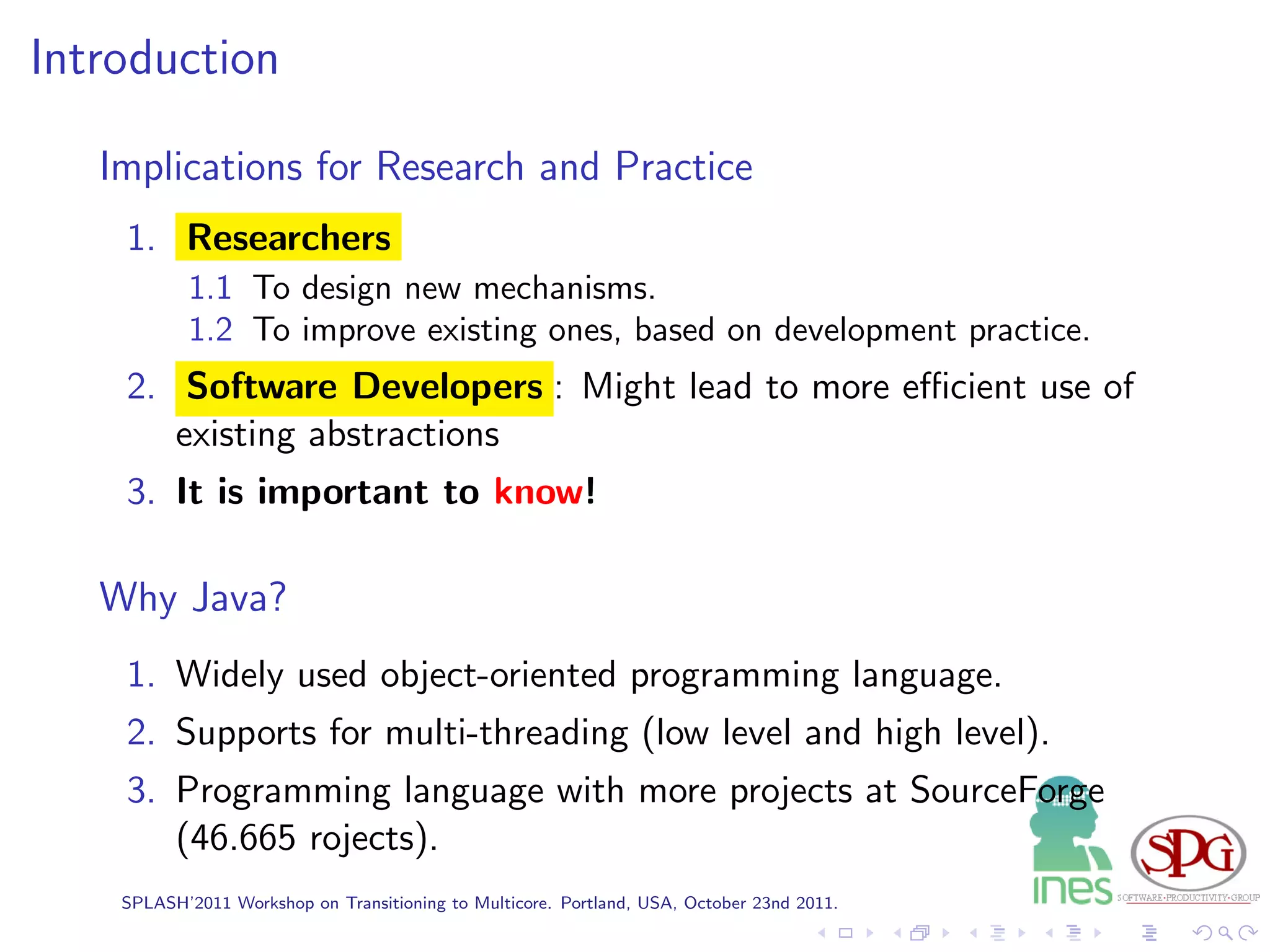
Introduction

   Problem
    1. In spite of multicore and...
    2. many languages providing constructs for concurrent
       programming...
    3. we have no idea about how developers use these constructs in
       practice.


    SPLASH’2011 Workshop on Transitioning to Multicore. Portland, USA, October 23nd 2011.
Introduction

   Problem
    1. In spite of multicore and...
    2. many languages providing constructs for concurrent
       programming...
    3. we have no idea about how developers use these constructs in
       practice.

   Our Study
    1. A study targeting a large-scale FLOSS repository
    2. To discover what concurrency mechanisms programmers use.
    3. The frequency of use and system evolution along time.

    SPLASH’2011 Workshop on Transitioning to Multicore. Portland, USA, October 23nd 2011.
Introduction

   Implications for Research and Practice
    1. Researchers
           1.1 To design new mechanisms.
           1.2 To improve existing ones, based on development practice.
    2. Software Developers : Might lead to more efficient use of
       existing abstractions
    3. It is important to know!


    SPLASH’2011 Workshop on Transitioning to Multicore. Portland, USA, October 23nd 2011.
Introduction

   Implications for Research and Practice
    1. Researchers
           1.1 To design new mechanisms.
           1.2 To improve existing ones, based on development practice.
    2. Software Developers : Might lead to more efficient use of
       existing abstractions
    3. It is important to know!

   Why Java?
    1. Widely used object-oriented programming language.
    2. Supports for multi-threading (low level and high level).
    3. Programming language with more projects at SourceForge
       (46.665 rojects).
    SPLASH’2011 Workshop on Transitioning to Multicore. Portland, USA, October 23nd 2011.
Research Questions


          Two dimensions: Spatial and Temporal


           RQ1 - How often are the Java concurrency constructs
          employed in real applications?

           RQ2 - Are programmers aware about the transition from
          singlecore to multicore?


    SPLASH’2011 Workshop on Transitioning to Multicore. Portland, USA, October 23nd 2011.
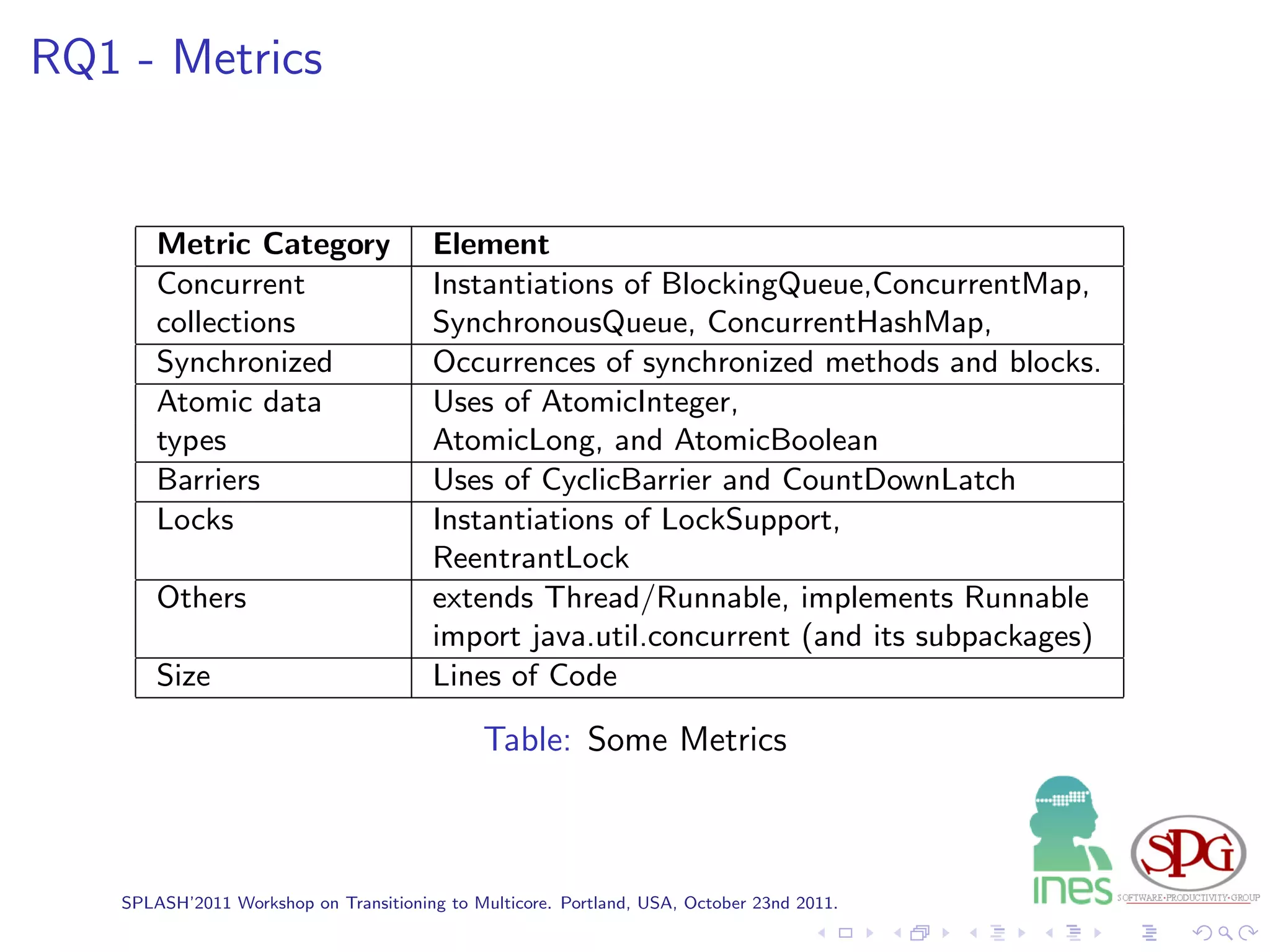
RQ1 - Metrics


        Metric Category                 Element
        Concurrent                      Instantiations of BlockingQueue,ConcurrentMap,
        collections                     SynchronousQueue, ConcurrentHashMap,
        Synchronized                    Occurrences of synchronized methods and blocks.
        Atomic data                     Uses of AtomicInteger,
        types                           AtomicLong, and AtomicBoolean
        Barriers                        Uses of CyclicBarrier and CountDownLatch
        Locks                           Instantiations of LockSupport,
                                        ReentrantLock
        Others                          extends Thread/Runnable, implements Runnable
                                        import java.util.concurrent (and its subpackages)
        Size                            Lines of Code

                                              Table: Some Metrics


    SPLASH’2011 Workshop on Transitioning to Multicore. Portland, USA, October 23nd 2011.
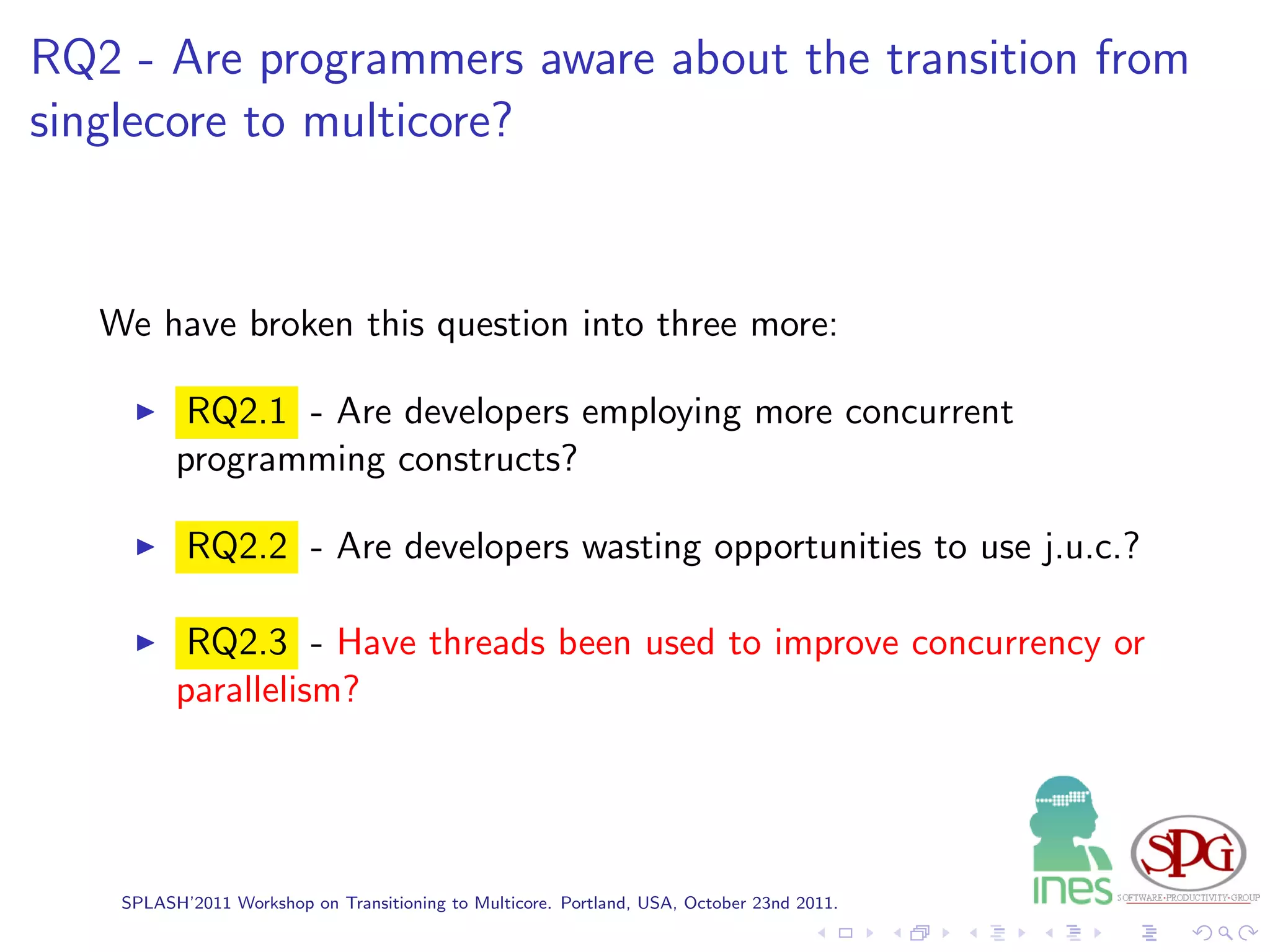
RQ2 - Are programmers aware about the transition from
singlecore to multicore?


   We have broken this question into three more:

           RQ2.1 - Are developers employing more concurrent
          programming constructs?

           RQ2.2 - Are developers wasting opportunities to use j.u.c.?

           RQ2.3 - Have threads been used to improve concurrency or
          parallelism?


    SPLASH’2011 Workshop on Transitioning to Multicore. Portland, USA, October 23nd 2011.
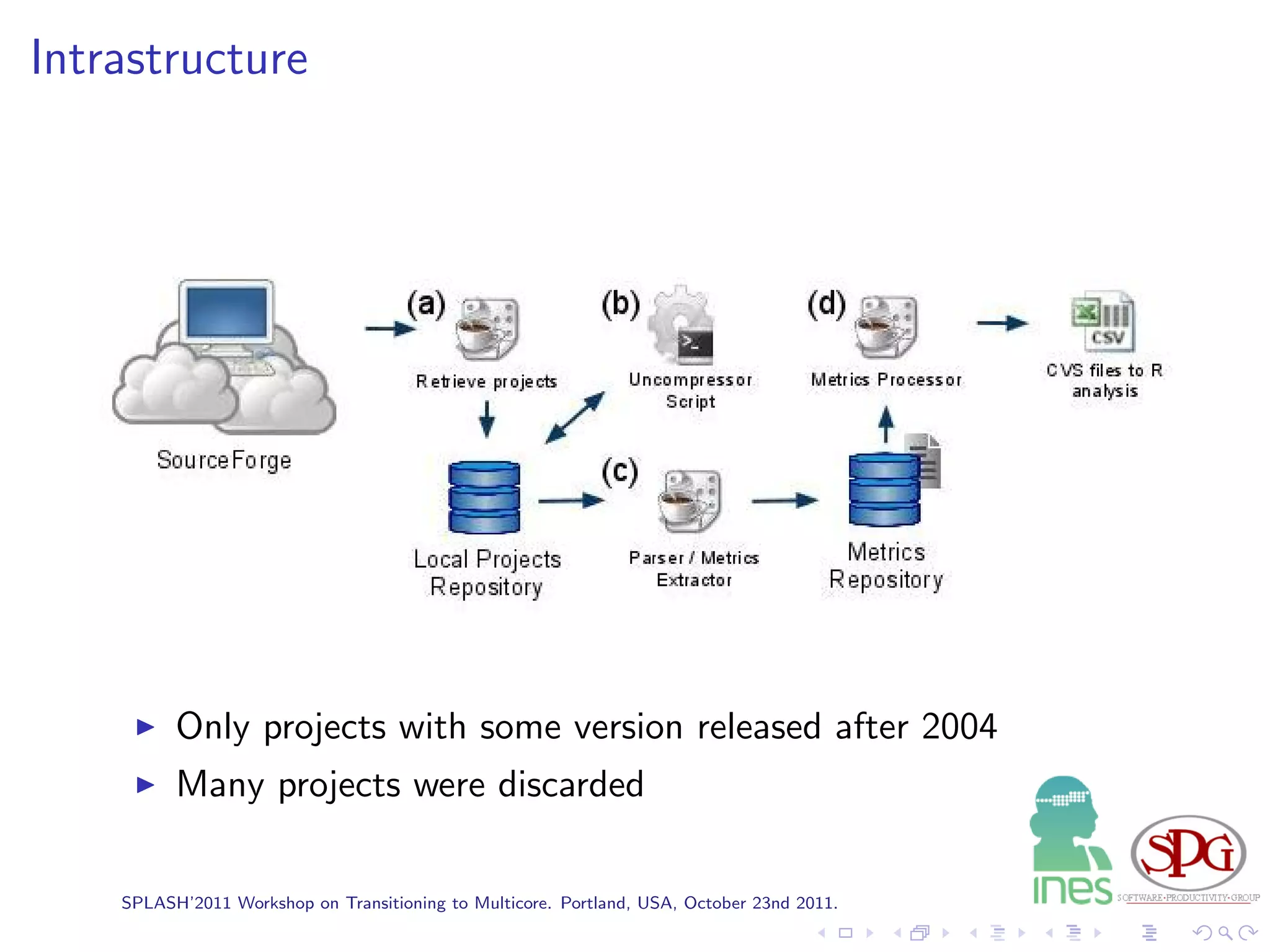
Intrastructure


          Only projects with some version released after 2004
          Many projects were discarded

    SPLASH’2011 Workshop on Transitioning to Multicore. Portland, USA, October 23nd 2011.
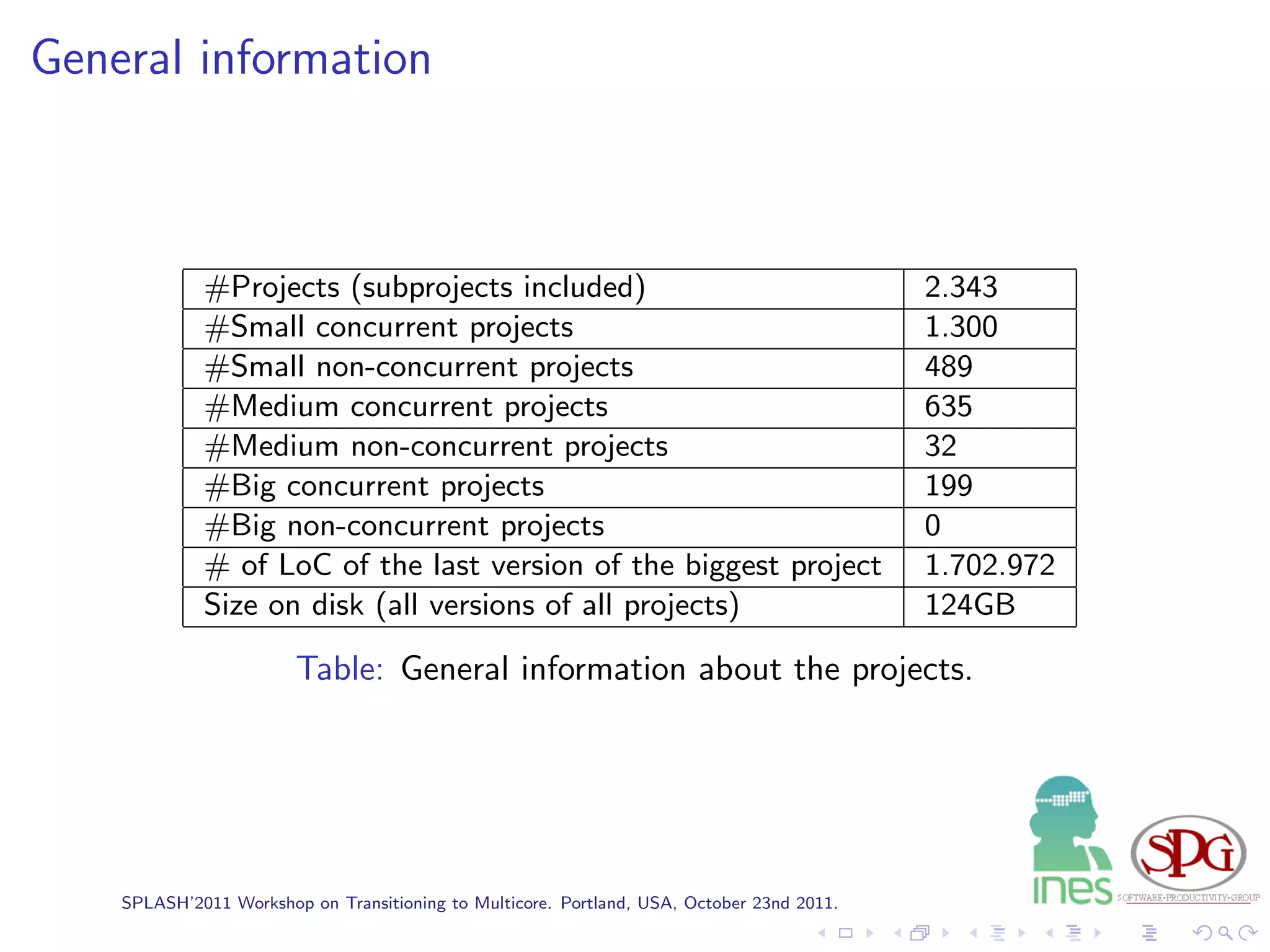
General information


             #Projects (subprojects included)                                               2.343
             #Small concurrent projects                                                     1.300
             #Small non-concurrent projects                                                 489
             #Medium concurrent projects                                                    635
             #Medium non-concurrent projects                                                32
             #Big concurrent projects                                                       199
             #Big non-concurrent projects                                                   0
             # of LoC of the last version of the biggest project                            1.702.972
             Size on disk (all versions of all projects)                                    124GB

                        Table: General information about the projects.


    SPLASH’2011 Workshop on Transitioning to Multicore. Portland, USA, October 23nd 2011.
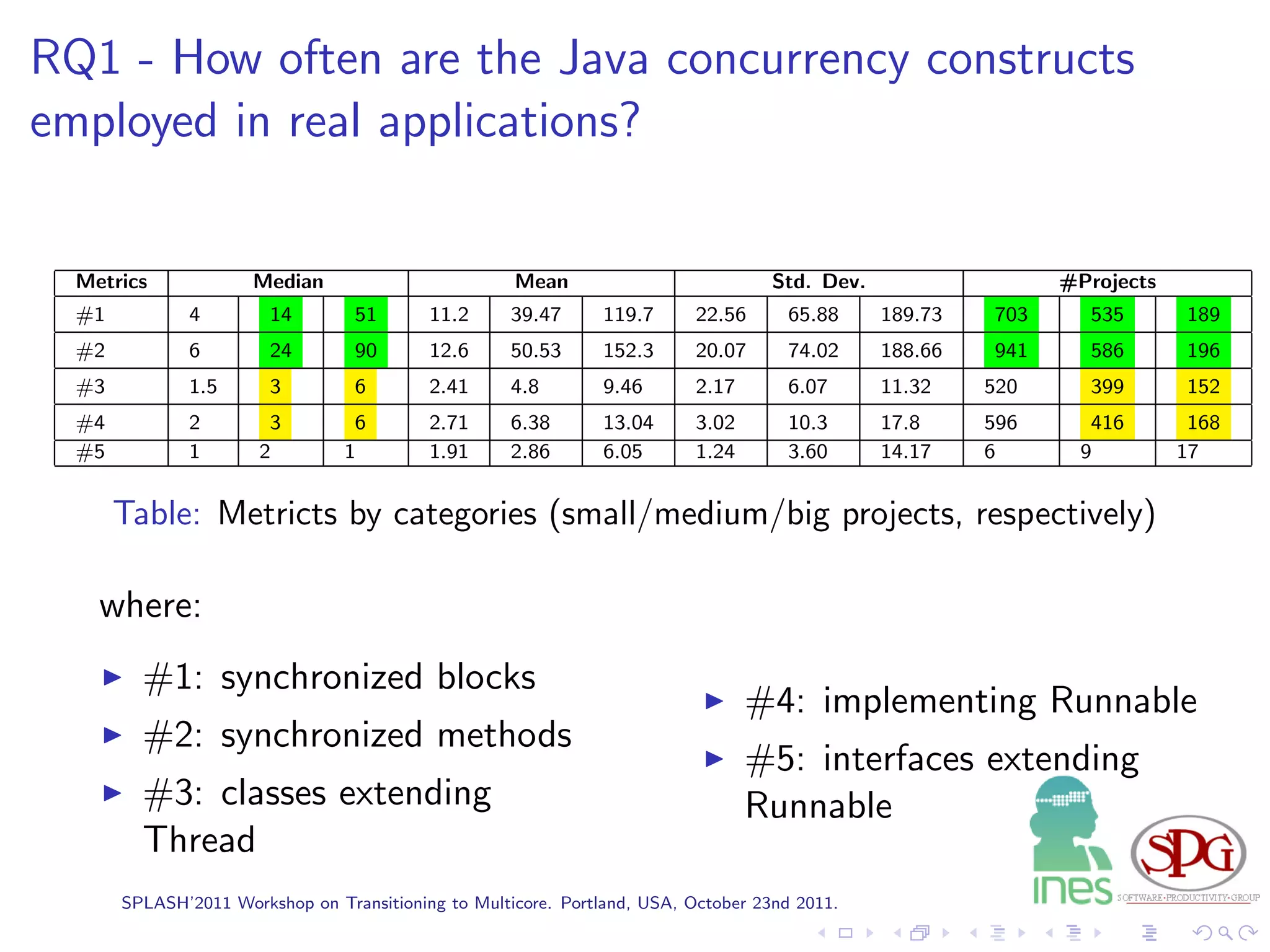
RQ1 - How often are the Java concurrency constructs
employed in real applications?


  Metrics             Median                         Mean                           Std. Dev.                  #Projects
  #1           4        14        51       11.2      39.47      119.7      22.56     65.88      189.73   703     535       189
  #2           6        24        90       12.6      50.53      152.3      20.07     74.02      188.66   941     586       196
  #3           1.5      3         6        2.41      4.8        9.46       2.17      6.07       11.32    520     399       152
  #4           2        3         6        2.71      6.38       13.04      3.02      10.3       17.8     596     416        168
  #5           1       2         1         1.91      2.86       6.05       1.24      3.60       14.17    6      9          17


       Table: Metricts by categories (small/medium/big projects, respectively)

    where:
         #1: synchronized blocks
                                                                                  #4: implementing Runnable
         #2: synchronized methods
                                                                                  #5: interfaces extending
         #3: classes extending                                                    Runnable
         Thread
       SPLASH’2011 Workshop on Transitioning to Multicore. Portland, USA, October 23nd 2011.
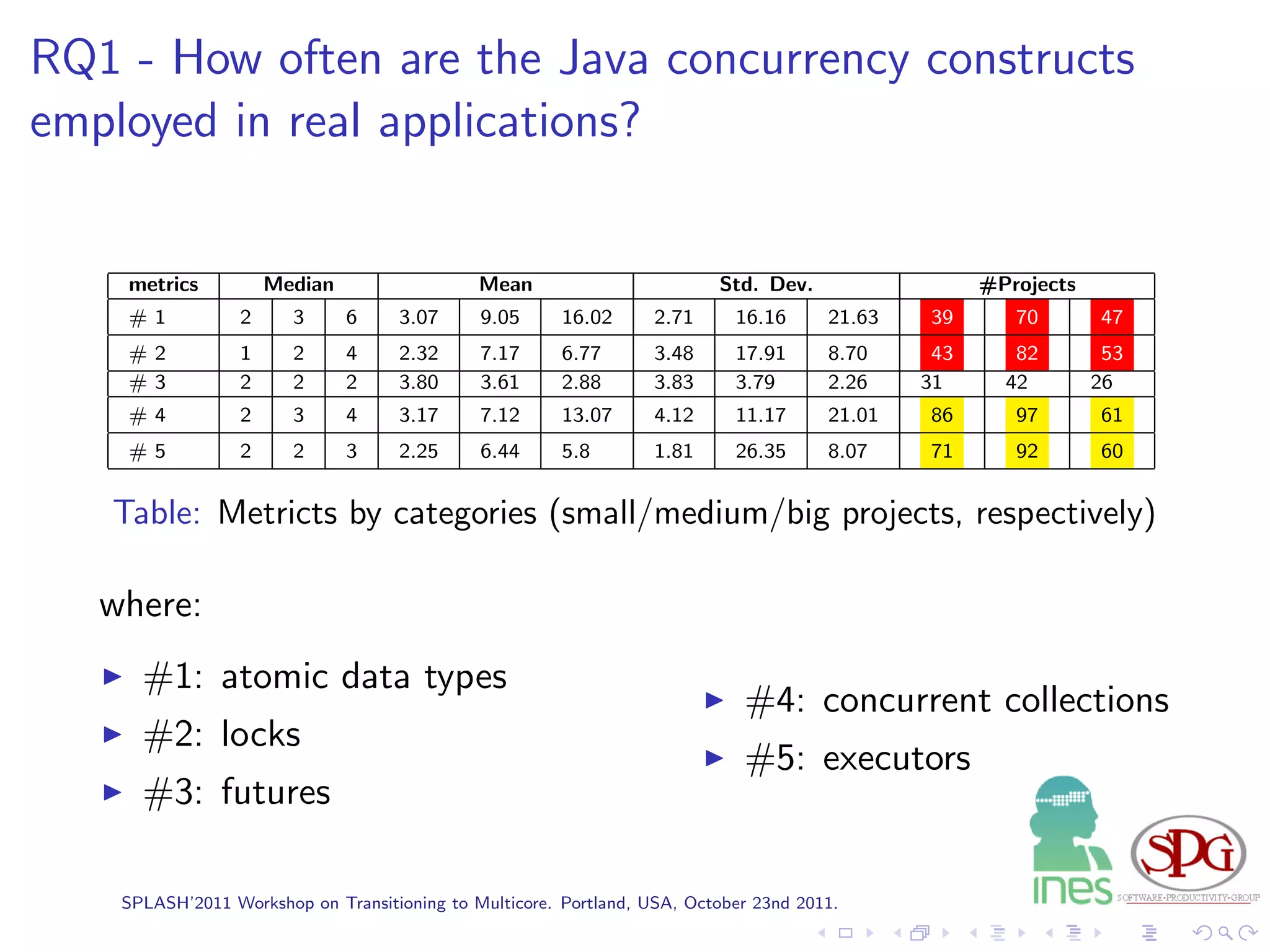
RQ1 - How often are the Java concurrency constructs
employed in real applications?


    metrics           Median                  Mean                        Std. Dev.                  #Projects
    #1            2     3      6    3.07      9.05      16.02      2.71     16.16      21.63   39       70       47
    #2            1     2      4    2.32      7.17      6.77       3.48     17.91      8.70     43      82        53
    #3            2     2      2    3.80      3.61      2.88       3.83     3.79       2.26    31      42        26
    #4            2     3      4    3.17      7.12      13.07      4.12     11.17      21.01   86       97       61
    #5            2     2      3    2.25      6.44      5.8        1.81     26.35      8.07    71       92       60


   Table: Metricts by categories (small/medium/big projects, respectively)

   where:
      #1: atomic data types
                                                                             #4: concurrent collections
      #2: locks
                                                                             #5: executors
      #3: futures

    SPLASH’2011 Workshop on Transitioning to Multicore. Portland, USA, October 23nd 2011.
Some facts

          49% of the big concurrent projects, 32.4% of the medium
          ones, and only 15.5% of the small ones employ
          java.util.concurrent
                   For synchronized blocks, the percentages are 94.97%,
                   84.64%, and 54.07%, respectively


    SPLASH’2011 Workshop on Transitioning to Multicore. Portland, USA, October 23nd 2011.
Some facts

          49% of the big concurrent projects, 32.4% of the medium
          ones, and only 15.5% of the small ones employ
          java.util.concurrent
                   For synchronized blocks, the percentages are 94.97%,
                   84.64%, and 54.07%, respectively

          139 projects define threads but do not use synchronized
                   Often worker threads in small (< 10KLoC) projects


    SPLASH’2011 Workshop on Transitioning to Multicore. Portland, USA, October 23nd 2011.
Some facts

          49% of the big concurrent projects, 32.4% of the medium
          ones, and only 15.5% of the small ones employ
          java.util.concurrent
                   For synchronized blocks, the percentages are 94.97%,
                   84.64%, and 54.07%, respectively

          139 projects define threads but do not use synchronized
                   Often worker threads in small (< 10KLoC) projects

          44 projects employ the java.util.concurrent library but
          not the synchronized keyword

          10% of the analyzed projects employ concurrent collections,
          particularly ConcurrentHashMap

    SPLASH’2011 Workshop on Transitioning to Multicore. Portland, USA, October 23nd 2011.
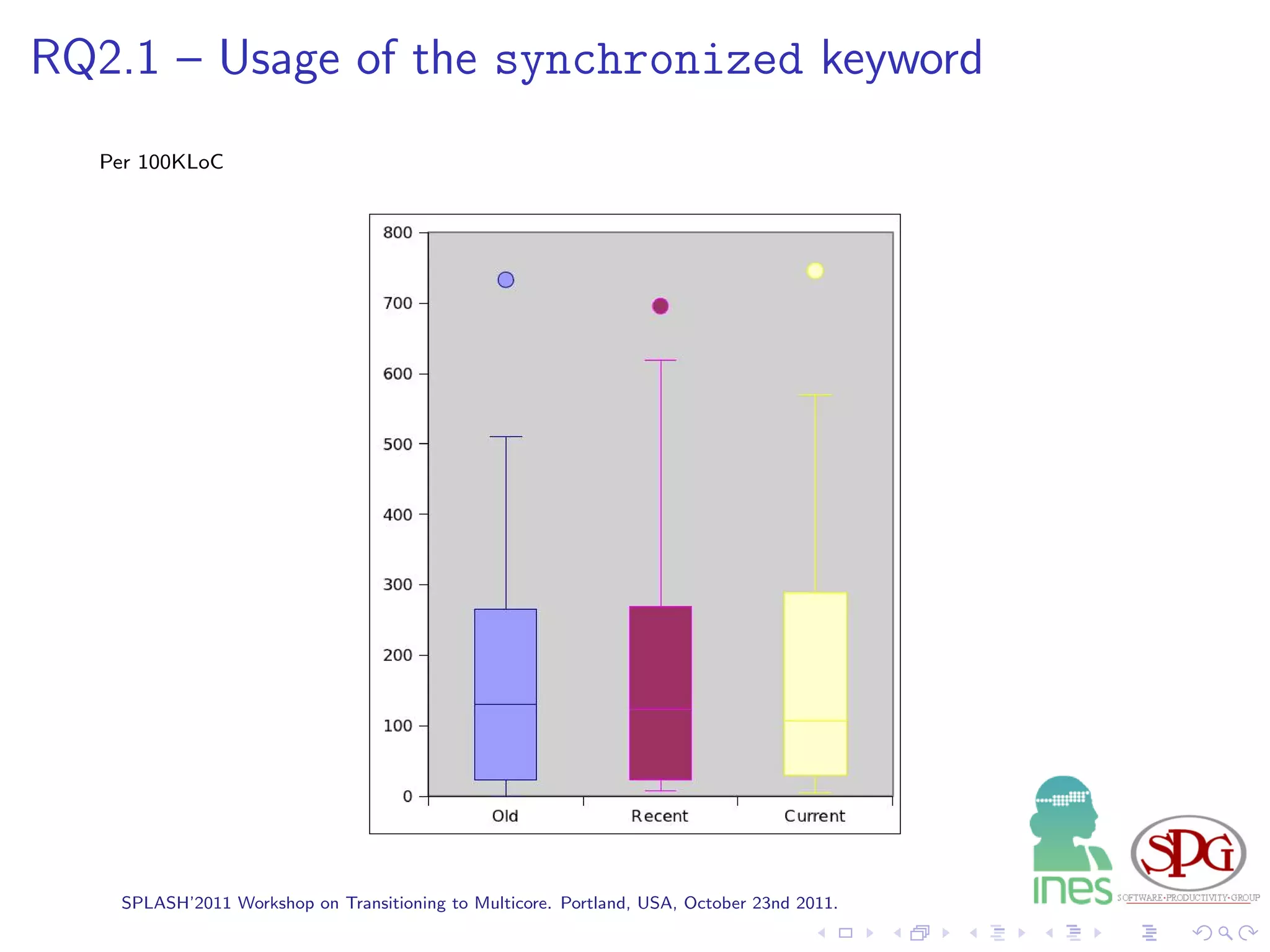
RQ2.1 – Usage of the synchronized keyword
  Per 100KLoC


   SPLASH’2011 Workshop on Transitioning to Multicore. Portland, USA, October 23nd 2011.
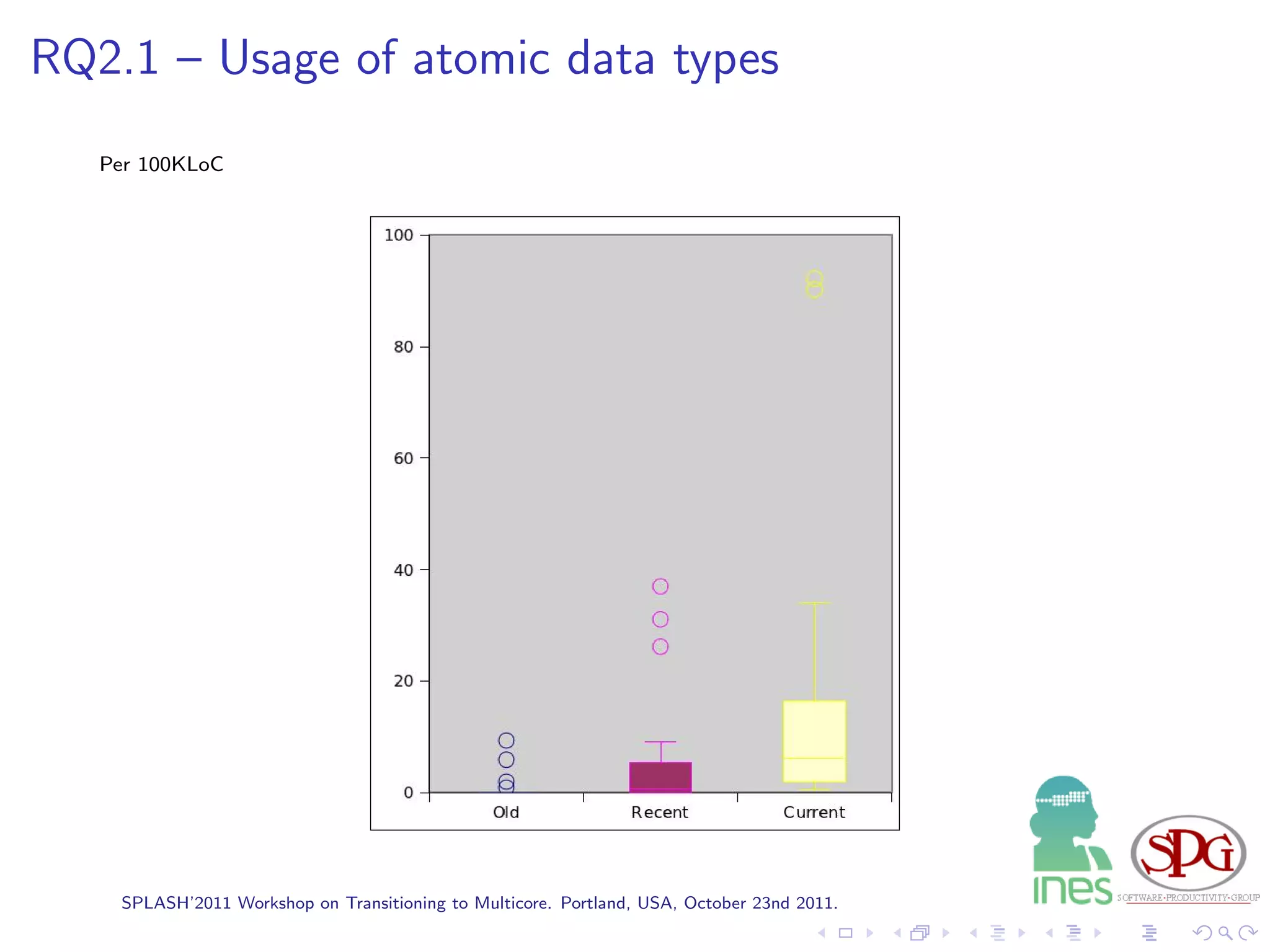
RQ2.1 – Usage of atomic data types
   Per 100KLoC


    SPLASH’2011 Workshop on Transitioning to Multicore. Portland, USA, October 23nd 2011.
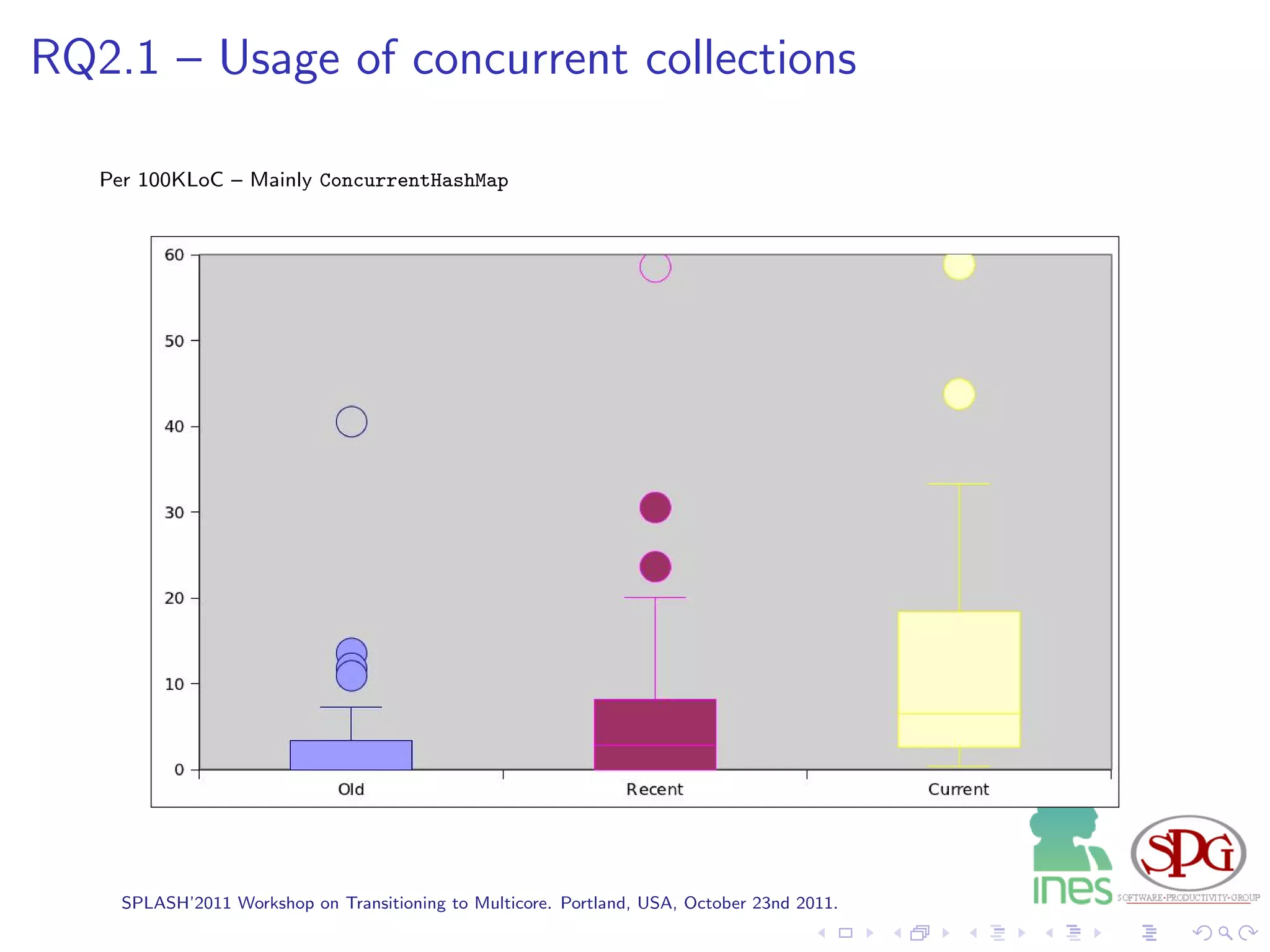
RQ2.1 – Usage of concurrent collections

   Per 100KLoC – Mainly ConcurrentHashMap


     SPLASH’2011 Workshop on Transitioning to Multicore. Portland, USA, October 23nd 2011.
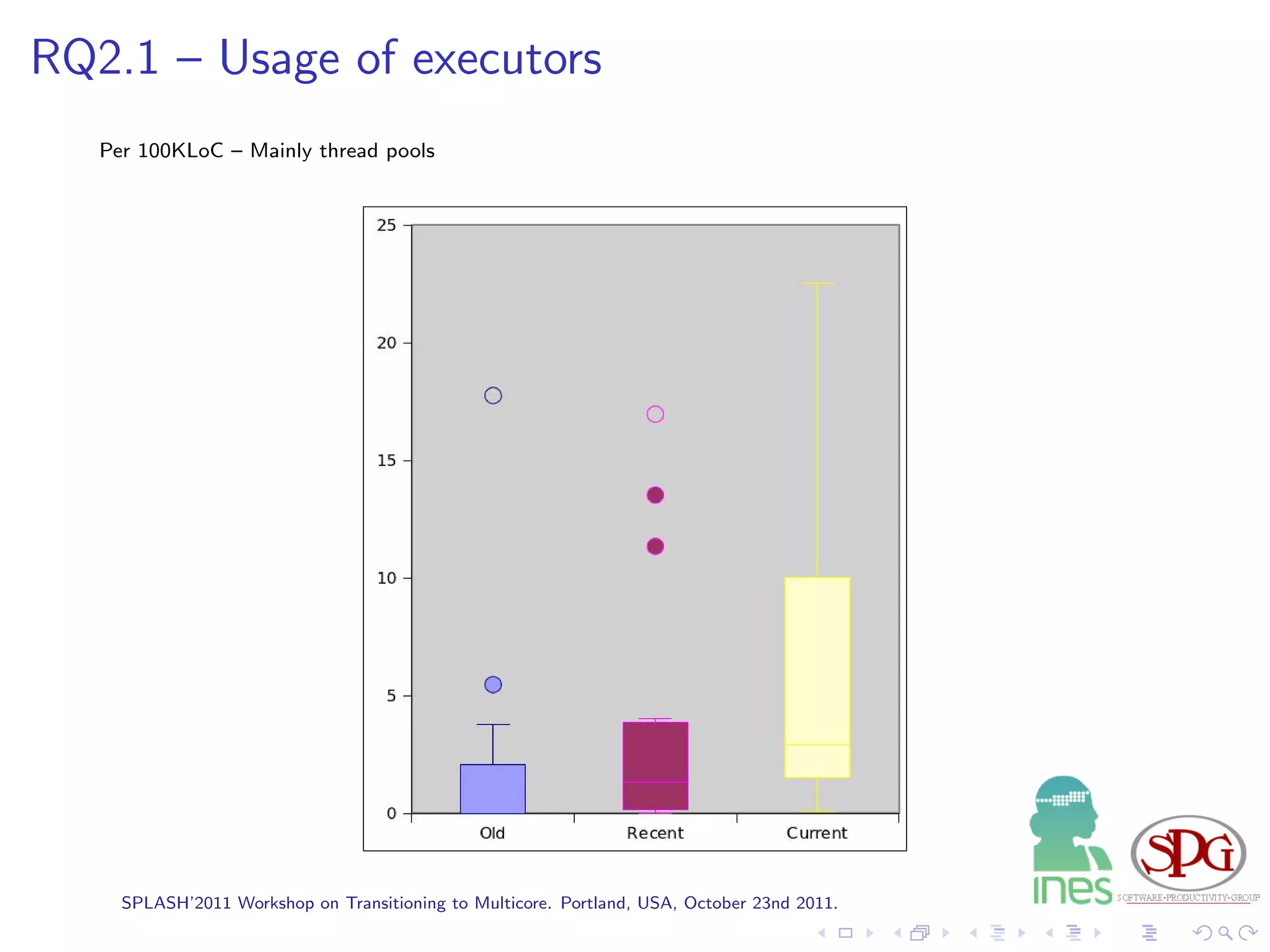
RQ2.1 – Usage of executors
   Per 100KLoC – Mainly thread pools


     SPLASH’2011 Workshop on Transitioning to Multicore. Portland, USA, October 23nd 2011.
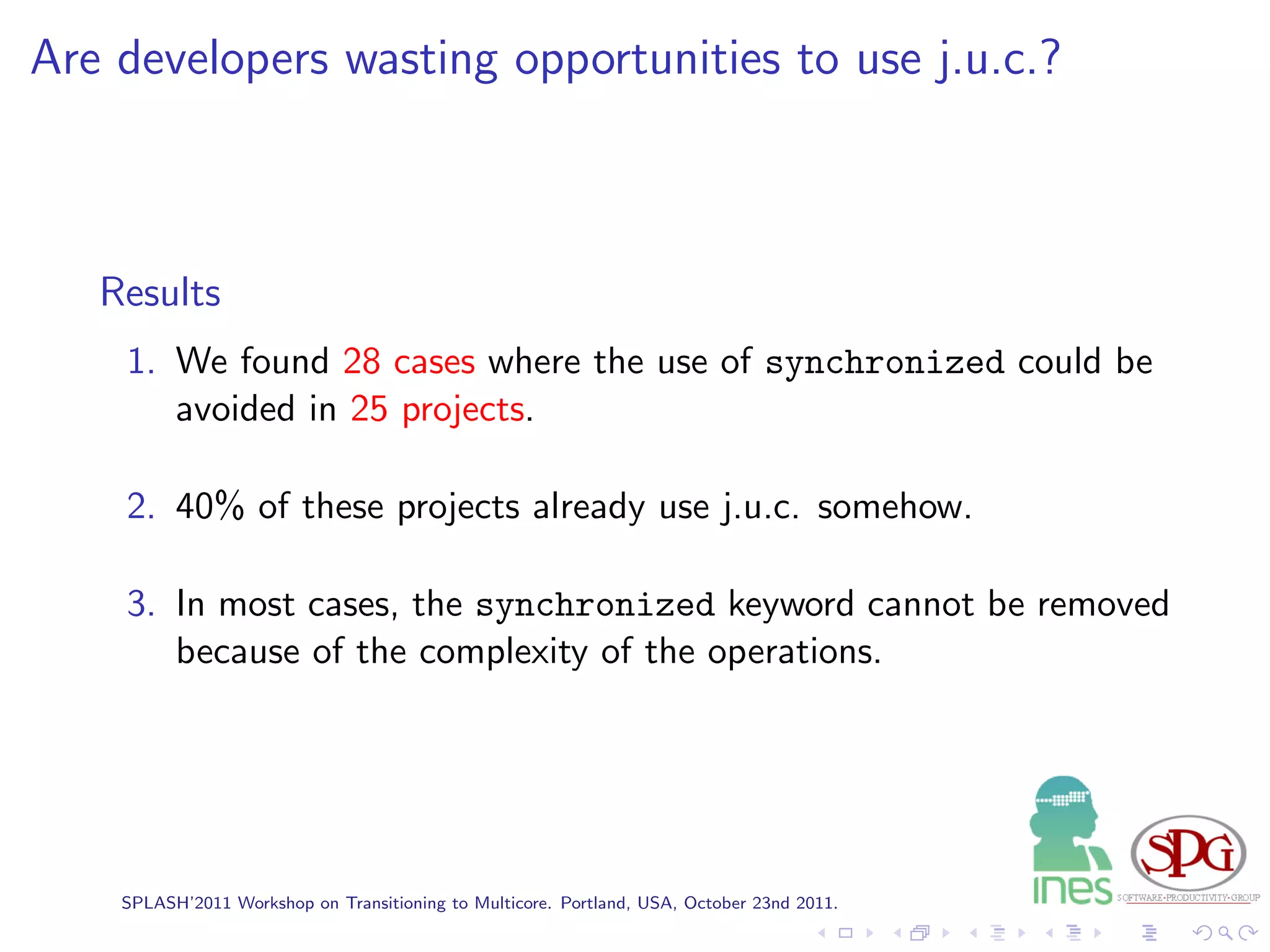
Are developers wasting opportunities to use j.u.c.?


   Methodology
    1. Randomly chosen 100 projects out of all the 1830 concurrent
       projects.

    2. Randomly collected 1–3 examples of the use of the
       synchronized keyword in these projects.

    3. Analyzed 276 examples of synchronized usage.
                   Some systems had fewer than 3 occurrences of synchronized.


    SPLASH’2011 Workshop on Transitioning to Multicore. Portland, USA, October 23nd 2011.
Are developers wasting opportunities to use j.u.c.?


   Results
    1. We found 28 cases where the use of synchronized could be
       avoided in 25 projects.

    2. 40% of these projects already use j.u.c. somehow.

    3. In most cases, the synchronized keyword cannot be removed
       because of the complexity of the operations.


    SPLASH’2011 Workshop on Transitioning to Multicore. Portland, USA, October 23nd 2011.
RQ2.3: Concurrency vs. Parallelism


          Still much work to do.

          Existing systems seem to be getting more concurrent
                   But not much...

          Some (e.g., Lucene) are also getting more parallel


    SPLASH’2011 Workshop on Transitioning to Multicore. Portland, USA, October 23nd 2011.
RQ2.3: Concurrency vs. Parallelism


          Still much work to do.

          Existing systems seem to be getting more concurrent
                   But not much...

          Some (e.g., Lucene) are also getting more parallel

          How can we know for sure?


    SPLASH’2011 Workshop on Transitioning to Multicore. Portland, USA, October 23nd 2011.
RQ2.3: Concurrency vs. Parallelism


          Still much work to do.

          Existing systems seem to be getting more concurrent
                   But not much...

          Some (e.g., Lucene) are also getting more parallel

          How can we know for sure?

          Suggestions?


    SPLASH’2011 Workshop on Transitioning to Multicore. Portland, USA, October 23nd 2011.
Future Work


         Threads for Concurrency vs. Threads for Parallelism


   SPLASH’2011 Workshop on Transitioning to Multicore. Portland, USA, October 23nd 2011.
Future Work


         Threads for Concurrency vs. Threads for Parallelism

         Atomic Data Types for actual variables instead of specific
         pieces of code.


   SPLASH’2011 Workshop on Transitioning to Multicore. Portland, USA, October 23nd 2011.
Future Work


         Threads for Concurrency vs. Threads for Parallelism

         Atomic Data Types for actual variables instead of specific
         pieces of code.

         To investigate the organization of concurrency code in the
         analyzed projects.


   SPLASH’2011 Workshop on Transitioning to Multicore. Portland, USA, October 23nd 2011.
Thank you


   SPLASH’2011 Workshop on Transitioning to Multicore. Portland, USA, October 23nd 2011.
Why the Web and not a version control system?


          SourceForge’s SVN repositories do not have a fixed structure

          It is difficult to know whether a given version is a release or a
          development version
                   Difficult to know what is an actual version


          SourceForge projects employ more than one kind of repository

          On the other hand, SourceForge’s Web site organizes things
          somewhat


    SPLASH’2011 Workshop on Transitioning to Multicore. Portland, USA, October 23nd 2011.
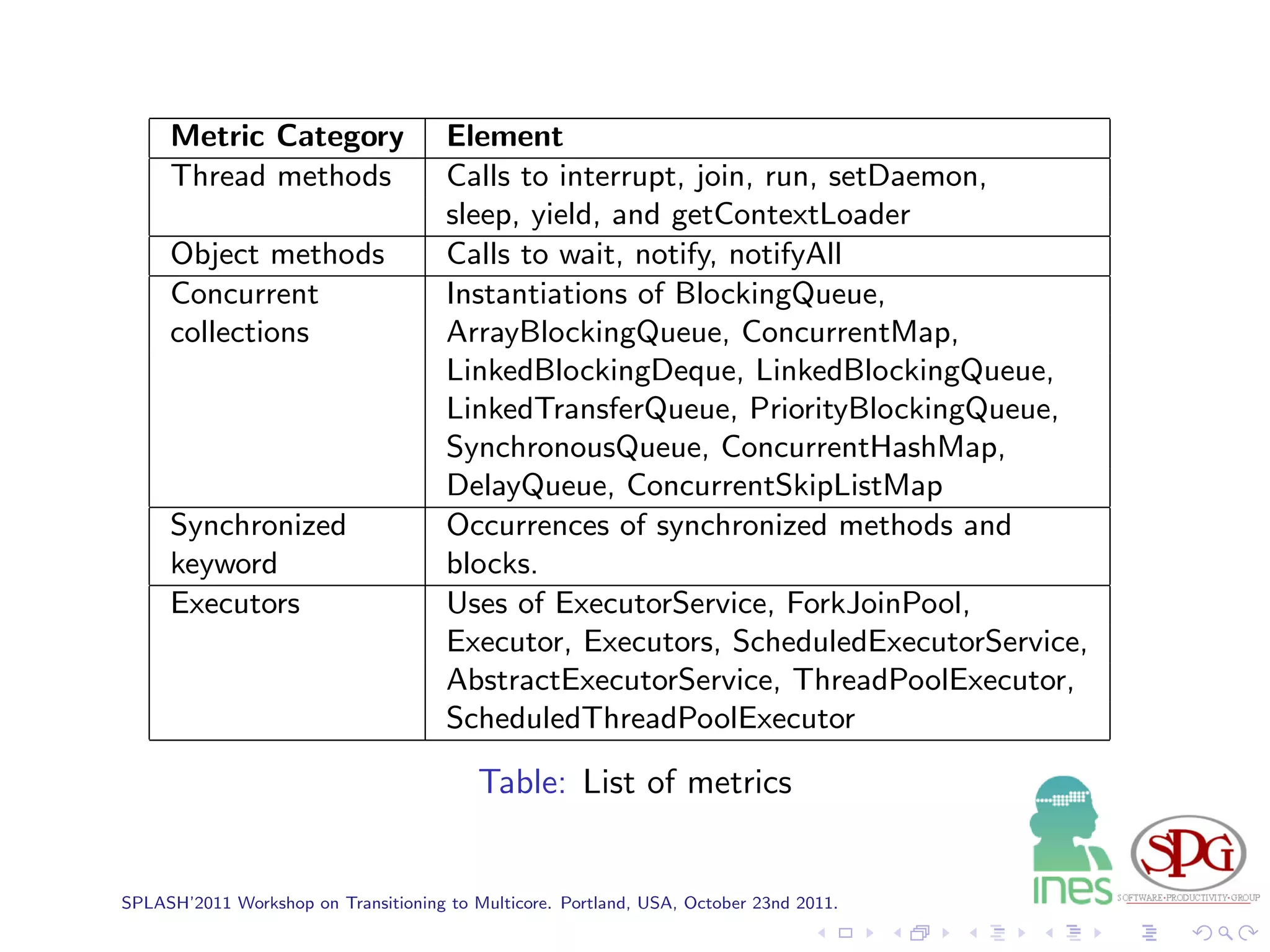
Metric Category                  Element
     Thread methods                   Calls to interrupt, join, run, setDaemon,
                                      sleep, yield, and getContextLoader
     Object methods                   Calls to wait, notify, notifyAll
     Concurrent                       Instantiations of BlockingQueue,
     collections                      ArrayBlockingQueue, ConcurrentMap,
                                      LinkedBlockingDeque, LinkedBlockingQueue,
                                      LinkedTransferQueue, PriorityBlockingQueue,
                                      SynchronousQueue, ConcurrentHashMap,
                                      DelayQueue, ConcurrentSkipListMap
     Synchronized                     Occurrences of synchronized methods and
     keyword                          blocks.
     Executors                        Uses of ExecutorService, ForkJoinPool,
                                      Executor, Executors, ScheduledExecutorService,
                                      AbstractExecutorService, ThreadPoolExecutor,
                                      ScheduledThreadPoolExecutor

                                          Table: List of metrics


SPLASH’2011 Workshop on Transitioning to Multicore. Portland, USA, October 23nd 2011.
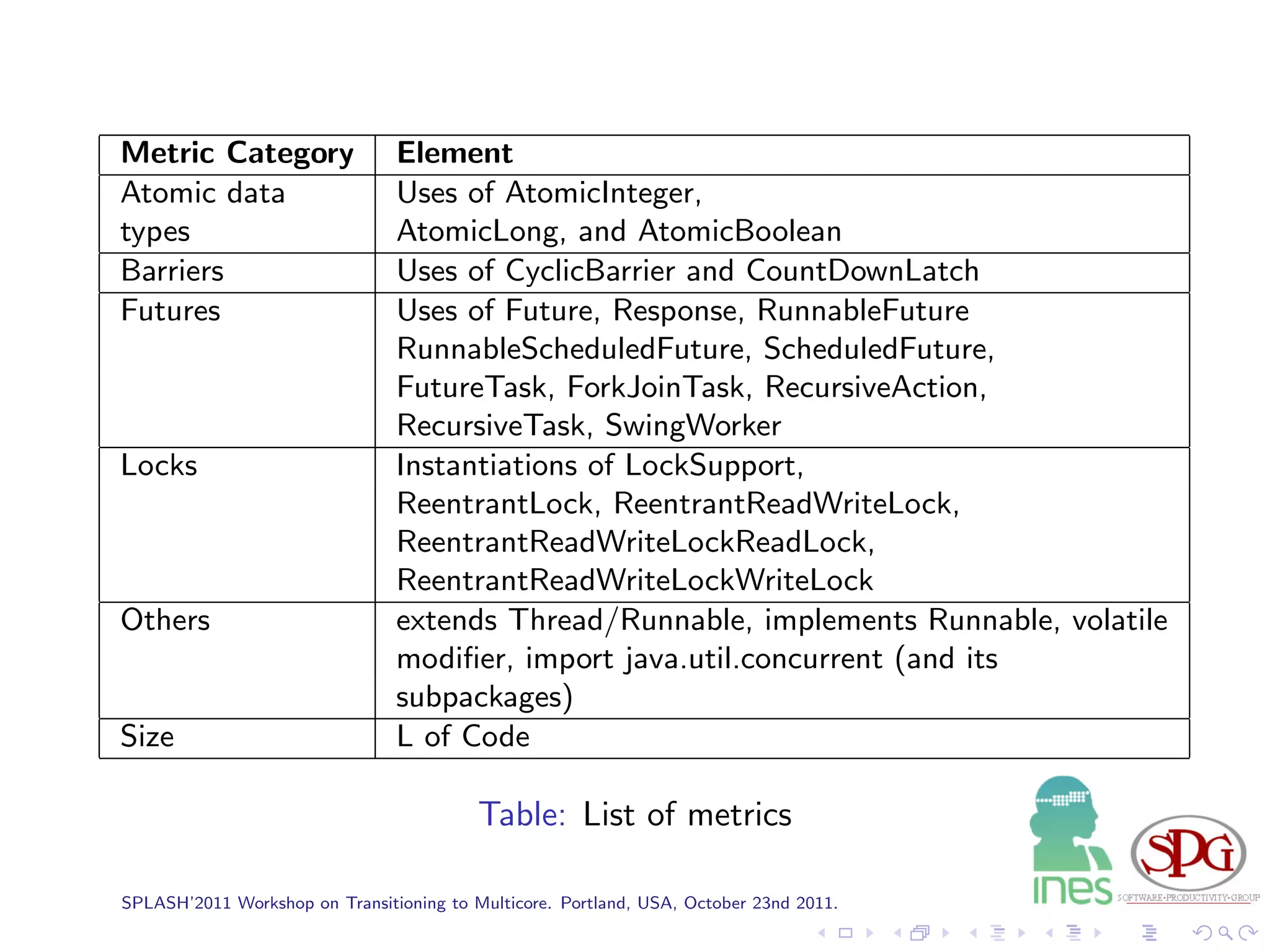
Metric Category                 Element
Atomic data                     Uses of AtomicInteger,
types                           AtomicLong, and AtomicBoolean
Barriers                        Uses of CyclicBarrier and CountDownLatch
Futures                         Uses of Future, Response, RunnableFuture
                                RunnableScheduledFuture, ScheduledFuture,
                                FutureTask, ForkJoinTask, RecursiveAction,
                                RecursiveTask, SwingWorker
Locks                           Instantiations of LockSupport,
                                ReentrantLock, ReentrantReadWriteLock,
                                ReentrantReadWriteLockReadLock,
                                ReentrantReadWriteLockWriteLock
Others                          extends Thread/Runnable, implements Runnable, volatile
                                modifier, import java.util.concurrent (and its
                                subpackages)
Size                            L of Code

                                          Table: List of metrics

SPLASH’2011 Workshop on Transitioning to Multicore. Portland, USA, October 23nd 2011.
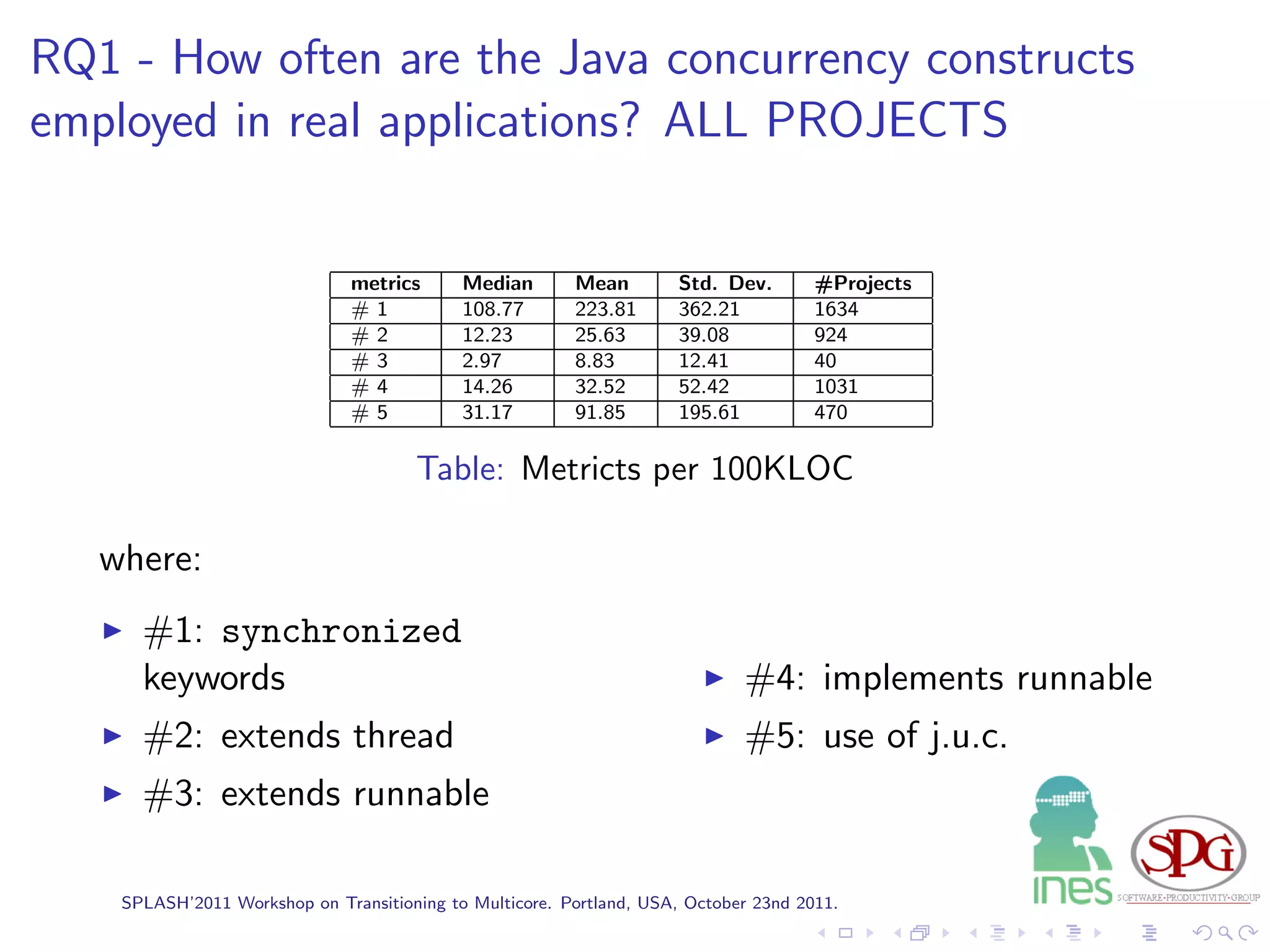
RQ1 - How often are the Java concurrency constructs
employed in real applications? ALL PROJECTS


                               metrics      Median       Mean         Std. Dev.       #Projects
                               #1           108.77       223.81       362.21          1634
                               #2           12.23        25.63        39.08           924
                               #3           2.97         8.83         12.41           40
                               #4           14.26        32.52        52.42           1031
                               #5           31.17        91.85        195.61          470

                                      Table: Metricts per 100KLOC

   where:
      #1: synchronized
      keywords                                                               #4: implements runnable
      #2: extends thread                                                     #5: use of j.u.c.
      #3: extends runnable

    SPLASH’2011 Workshop on Transitioning to Multicore. Portland, USA, October 23nd 2011.

Are Java Programmers Transitioning to Multicore?

  • 1.
    Are Java ProgrammersTransitioning to Multicore? A Large Scale Study of Java FLOSS Weslley Torres Gustavo Pinto Benito Fernandes Jo˜o Paulo Oliveira a Filipe Ximenes Fernando Castor Informatics Center - Federal University of Pernambuco October 23, 2011 SPLASH’2011 Workshop on Transitioning to Multicore. Portland, USA, October 23nd 2011.
  • 2.
    Introduction Problem 1. In spite of multicore and... 2. many languages providing constructs for concurrent programming... 3. we have no idea about how developers use these constructs in practice. SPLASH’2011 Workshop on Transitioning to Multicore. Portland, USA, October 23nd 2011.
  • 3.
    Introduction Problem 1. In spite of multicore and... 2. many languages providing constructs for concurrent programming... 3. we have no idea about how developers use these constructs in practice. Our Study 1. A study targeting a large-scale FLOSS repository 2. To discover what concurrency mechanisms programmers use. 3. The frequency of use and system evolution along time. SPLASH’2011 Workshop on Transitioning to Multicore. Portland, USA, October 23nd 2011.
  • 4.
    Introduction Implications for Research and Practice 1. Researchers 1.1 To design new mechanisms. 1.2 To improve existing ones, based on development practice. 2. Software Developers : Might lead to more efficient use of existing abstractions 3. It is important to know! SPLASH’2011 Workshop on Transitioning to Multicore. Portland, USA, October 23nd 2011.
  • 5.
    Introduction Implications for Research and Practice 1. Researchers 1.1 To design new mechanisms. 1.2 To improve existing ones, based on development practice. 2. Software Developers : Might lead to more efficient use of existing abstractions 3. It is important to know! Why Java? 1. Widely used object-oriented programming language. 2. Supports for multi-threading (low level and high level). 3. Programming language with more projects at SourceForge (46.665 rojects). SPLASH’2011 Workshop on Transitioning to Multicore. Portland, USA, October 23nd 2011.
  • 6.
    Research Questions Two dimensions: Spatial and Temporal RQ1 - How often are the Java concurrency constructs employed in real applications? RQ2 - Are programmers aware about the transition from singlecore to multicore? SPLASH’2011 Workshop on Transitioning to Multicore. Portland, USA, October 23nd 2011.
  • 7.
    RQ1 - Metrics Metric Category Element Concurrent Instantiations of BlockingQueue,ConcurrentMap, collections SynchronousQueue, ConcurrentHashMap, Synchronized Occurrences of synchronized methods and blocks. Atomic data Uses of AtomicInteger, types AtomicLong, and AtomicBoolean Barriers Uses of CyclicBarrier and CountDownLatch Locks Instantiations of LockSupport, ReentrantLock Others extends Thread/Runnable, implements Runnable import java.util.concurrent (and its subpackages) Size Lines of Code Table: Some Metrics SPLASH’2011 Workshop on Transitioning to Multicore. Portland, USA, October 23nd 2011.
  • 8.
    RQ2 - Areprogrammers aware about the transition from singlecore to multicore? We have broken this question into three more: RQ2.1 - Are developers employing more concurrent programming constructs? RQ2.2 - Are developers wasting opportunities to use j.u.c.? RQ2.3 - Have threads been used to improve concurrency or parallelism? SPLASH’2011 Workshop on Transitioning to Multicore. Portland, USA, October 23nd 2011.
  • 9.
    Intrastructure Only projects with some version released after 2004 Many projects were discarded SPLASH’2011 Workshop on Transitioning to Multicore. Portland, USA, October 23nd 2011.
  • 10.
    General information #Projects (subprojects included) 2.343 #Small concurrent projects 1.300 #Small non-concurrent projects 489 #Medium concurrent projects 635 #Medium non-concurrent projects 32 #Big concurrent projects 199 #Big non-concurrent projects 0 # of LoC of the last version of the biggest project 1.702.972 Size on disk (all versions of all projects) 124GB Table: General information about the projects. SPLASH’2011 Workshop on Transitioning to Multicore. Portland, USA, October 23nd 2011.
  • 11.
    RQ1 - Howoften are the Java concurrency constructs employed in real applications? Metrics Median Mean Std. Dev. #Projects #1 4 14 51 11.2 39.47 119.7 22.56 65.88 189.73 703 535 189 #2 6 24 90 12.6 50.53 152.3 20.07 74.02 188.66 941 586 196 #3 1.5 3 6 2.41 4.8 9.46 2.17 6.07 11.32 520 399 152 #4 2 3 6 2.71 6.38 13.04 3.02 10.3 17.8 596 416 168 #5 1 2 1 1.91 2.86 6.05 1.24 3.60 14.17 6 9 17 Table: Metricts by categories (small/medium/big projects, respectively) where: #1: synchronized blocks #4: implementing Runnable #2: synchronized methods #5: interfaces extending #3: classes extending Runnable Thread SPLASH’2011 Workshop on Transitioning to Multicore. Portland, USA, October 23nd 2011.
  • 12.
    RQ1 - Howoften are the Java concurrency constructs employed in real applications? metrics Median Mean Std. Dev. #Projects #1 2 3 6 3.07 9.05 16.02 2.71 16.16 21.63 39 70 47 #2 1 2 4 2.32 7.17 6.77 3.48 17.91 8.70 43 82 53 #3 2 2 2 3.80 3.61 2.88 3.83 3.79 2.26 31 42 26 #4 2 3 4 3.17 7.12 13.07 4.12 11.17 21.01 86 97 61 #5 2 2 3 2.25 6.44 5.8 1.81 26.35 8.07 71 92 60 Table: Metricts by categories (small/medium/big projects, respectively) where: #1: atomic data types #4: concurrent collections #2: locks #5: executors #3: futures SPLASH’2011 Workshop on Transitioning to Multicore. Portland, USA, October 23nd 2011.
  • 13.
    Some facts 49% of the big concurrent projects, 32.4% of the medium ones, and only 15.5% of the small ones employ java.util.concurrent For synchronized blocks, the percentages are 94.97%, 84.64%, and 54.07%, respectively SPLASH’2011 Workshop on Transitioning to Multicore. Portland, USA, October 23nd 2011.
  • 14.
    Some facts 49% of the big concurrent projects, 32.4% of the medium ones, and only 15.5% of the small ones employ java.util.concurrent For synchronized blocks, the percentages are 94.97%, 84.64%, and 54.07%, respectively 139 projects define threads but do not use synchronized Often worker threads in small (< 10KLoC) projects SPLASH’2011 Workshop on Transitioning to Multicore. Portland, USA, October 23nd 2011.
  • 15.
    Some facts 49% of the big concurrent projects, 32.4% of the medium ones, and only 15.5% of the small ones employ java.util.concurrent For synchronized blocks, the percentages are 94.97%, 84.64%, and 54.07%, respectively 139 projects define threads but do not use synchronized Often worker threads in small (< 10KLoC) projects 44 projects employ the java.util.concurrent library but not the synchronized keyword 10% of the analyzed projects employ concurrent collections, particularly ConcurrentHashMap SPLASH’2011 Workshop on Transitioning to Multicore. Portland, USA, October 23nd 2011.
  • 16.
    RQ2.1 – Usageof the synchronized keyword Per 100KLoC SPLASH’2011 Workshop on Transitioning to Multicore. Portland, USA, October 23nd 2011.
  • 17.
    RQ2.1 – Usageof atomic data types Per 100KLoC SPLASH’2011 Workshop on Transitioning to Multicore. Portland, USA, October 23nd 2011.
  • 18.
    RQ2.1 – Usageof concurrent collections Per 100KLoC – Mainly ConcurrentHashMap SPLASH’2011 Workshop on Transitioning to Multicore. Portland, USA, October 23nd 2011.
  • 19.
    RQ2.1 – Usageof executors Per 100KLoC – Mainly thread pools SPLASH’2011 Workshop on Transitioning to Multicore. Portland, USA, October 23nd 2011.
  • 20.
    Are developers wastingopportunities to use j.u.c.? Methodology 1. Randomly chosen 100 projects out of all the 1830 concurrent projects. 2. Randomly collected 1–3 examples of the use of the synchronized keyword in these projects. 3. Analyzed 276 examples of synchronized usage. Some systems had fewer than 3 occurrences of synchronized. SPLASH’2011 Workshop on Transitioning to Multicore. Portland, USA, October 23nd 2011.
  • 21.
    Are developers wastingopportunities to use j.u.c.? Results 1. We found 28 cases where the use of synchronized could be avoided in 25 projects. 2. 40% of these projects already use j.u.c. somehow. 3. In most cases, the synchronized keyword cannot be removed because of the complexity of the operations. SPLASH’2011 Workshop on Transitioning to Multicore. Portland, USA, October 23nd 2011.
  • 22.
    RQ2.3: Concurrency vs.Parallelism Still much work to do. Existing systems seem to be getting more concurrent But not much... Some (e.g., Lucene) are also getting more parallel SPLASH’2011 Workshop on Transitioning to Multicore. Portland, USA, October 23nd 2011.
  • 23.
    RQ2.3: Concurrency vs.Parallelism Still much work to do. Existing systems seem to be getting more concurrent But not much... Some (e.g., Lucene) are also getting more parallel How can we know for sure? SPLASH’2011 Workshop on Transitioning to Multicore. Portland, USA, October 23nd 2011.
  • 24.
    RQ2.3: Concurrency vs.Parallelism Still much work to do. Existing systems seem to be getting more concurrent But not much... Some (e.g., Lucene) are also getting more parallel How can we know for sure? Suggestions? SPLASH’2011 Workshop on Transitioning to Multicore. Portland, USA, October 23nd 2011.
  • 25.
    Future Work Threads for Concurrency vs. Threads for Parallelism SPLASH’2011 Workshop on Transitioning to Multicore. Portland, USA, October 23nd 2011.
  • 26.
    Future Work Threads for Concurrency vs. Threads for Parallelism Atomic Data Types for actual variables instead of specific pieces of code. SPLASH’2011 Workshop on Transitioning to Multicore. Portland, USA, October 23nd 2011.
  • 27.
    Future Work Threads for Concurrency vs. Threads for Parallelism Atomic Data Types for actual variables instead of specific pieces of code. To investigate the organization of concurrency code in the analyzed projects. SPLASH’2011 Workshop on Transitioning to Multicore. Portland, USA, October 23nd 2011.
  • 28.
    Thank you SPLASH’2011 Workshop on Transitioning to Multicore. Portland, USA, October 23nd 2011.
  • 29.
    Why the Weband not a version control system? SourceForge’s SVN repositories do not have a fixed structure It is difficult to know whether a given version is a release or a development version Difficult to know what is an actual version SourceForge projects employ more than one kind of repository On the other hand, SourceForge’s Web site organizes things somewhat SPLASH’2011 Workshop on Transitioning to Multicore. Portland, USA, October 23nd 2011.
  • 30.
    Metric Category Element Thread methods Calls to interrupt, join, run, setDaemon, sleep, yield, and getContextLoader Object methods Calls to wait, notify, notifyAll Concurrent Instantiations of BlockingQueue, collections ArrayBlockingQueue, ConcurrentMap, LinkedBlockingDeque, LinkedBlockingQueue, LinkedTransferQueue, PriorityBlockingQueue, SynchronousQueue, ConcurrentHashMap, DelayQueue, ConcurrentSkipListMap Synchronized Occurrences of synchronized methods and keyword blocks. Executors Uses of ExecutorService, ForkJoinPool, Executor, Executors, ScheduledExecutorService, AbstractExecutorService, ThreadPoolExecutor, ScheduledThreadPoolExecutor Table: List of metrics SPLASH’2011 Workshop on Transitioning to Multicore. Portland, USA, October 23nd 2011.
  • 31.
    Metric Category Element Atomic data Uses of AtomicInteger, types AtomicLong, and AtomicBoolean Barriers Uses of CyclicBarrier and CountDownLatch Futures Uses of Future, Response, RunnableFuture RunnableScheduledFuture, ScheduledFuture, FutureTask, ForkJoinTask, RecursiveAction, RecursiveTask, SwingWorker Locks Instantiations of LockSupport, ReentrantLock, ReentrantReadWriteLock, ReentrantReadWriteLockReadLock, ReentrantReadWriteLockWriteLock Others extends Thread/Runnable, implements Runnable, volatile modifier, import java.util.concurrent (and its subpackages) Size L of Code Table: List of metrics SPLASH’2011 Workshop on Transitioning to Multicore. Portland, USA, October 23nd 2011.
  • 32.
    RQ1 - Howoften are the Java concurrency constructs employed in real applications? ALL PROJECTS metrics Median Mean Std. Dev. #Projects #1 108.77 223.81 362.21 1634 #2 12.23 25.63 39.08 924 #3 2.97 8.83 12.41 40 #4 14.26 32.52 52.42 1031 #5 31.17 91.85 195.61 470 Table: Metricts per 100KLOC where: #1: synchronized keywords #4: implements runnable #2: extends thread #5: use of j.u.c. #3: extends runnable SPLASH’2011 Workshop on Transitioning to Multicore. Portland, USA, October 23nd 2011.