ARCHITECTURE OF
GOAN CATHOLICS
CHURCHES AND FORTS OF GOA DURING PORTUGUESE INVASION
ARCHITECTURE OF GOAN CATHOLICS GEORGE BEN, ABISHA
HISTORY AND PERIOD
 Developed over the long colonial Portuguese India era (1500s−1961).
 Arrival of many Roman Catholic missionaries, particularly the Portuguese Jesuits,
lead to building many churches in Goa.
 The Goan Catholic style of constructing churches thus came to be influenced by
the Portuguese style.
 Many of the 16th and 17th colonial Catholic churches were built in the
Portuguese Baroque style
 Notable are the Se Cathedral and Basilica of Bom Jesus.
ARCHITECTURE OF GOAN CATHOLICS GEORGE BEN, ABISHA
SE CATHEDRAL
Founded : 1619
Style: Portuguese-
Gothic
OUR LADY OF IMMACULATE
CONCEPTION CHURCH
Founded: 1541
Rebuilt: 1609
Style: Portuguese-Baroque
1600 1610 1620
CHURCH OF BOM
JESUS
Built: 1594-1605
Style: Baroque
St. AUGUSTINES
TOWER
Built: 1602
Style: Portuguese
ARCHITECTURE OF GOAN CATHOLICS GEORGE BEN, ABISHA
DEVELOPMENT OF GOAN CHURCH
ARCHITECTURE
 Various Christian denominations built monumental churches, basilicas, cathedrals,
chapels, convents and nunneries in Old Goa, in the styles developing in 16th-18th
century Europe—mannerist, baroque and rococo.
 The churches also reflect the Manueline style which was prevalent in early 16th-
century Portugal, named after King Manuel I
 The Manueline style exhibits elements of design and craftsmanship adapted from
medieval Portuguese and Islamic architecture, along with motifs from ships and
the sea-faring world.
 The churches of Goa are also significant for their collections of Christian art, sacred
relics and religious iconography.
ARCHITECTURE OF GOAN CATHOLICS GEORGE BEN, ABISHA
FEATURES OF GOAN CHURCH
ARCHITECTURE
 Constructed of laterite stones and lime plastered which displays the affluent
Architectural fusion of Renaissance and Baroque styles.
 Highly ornamental Alter, mostly golden in colour and massive in scale and has the
pulpit away from the alter.
 Structure is composed of cross shaped plan with a central nave and side aisles,
sloping roof.
 No clerestory provided over nave but on side walls of aisles itself.
 Has three external openings accessing the nave and aisles on the front façade
 Mostly symmetrical on elevation with towers on either sides holding the curfew bell.
ARCHITECTURE OF GOAN CATHOLICS GEORGE BEN, ABISHA
ST
AUGUSTINE’S
TOWER
ST. AUGUSTINE’S TOWER DELCIA, RENITA
INTRODUCTION
 Located : Goa (India)
 Founded :1597;421 years ago
 Completed :1602
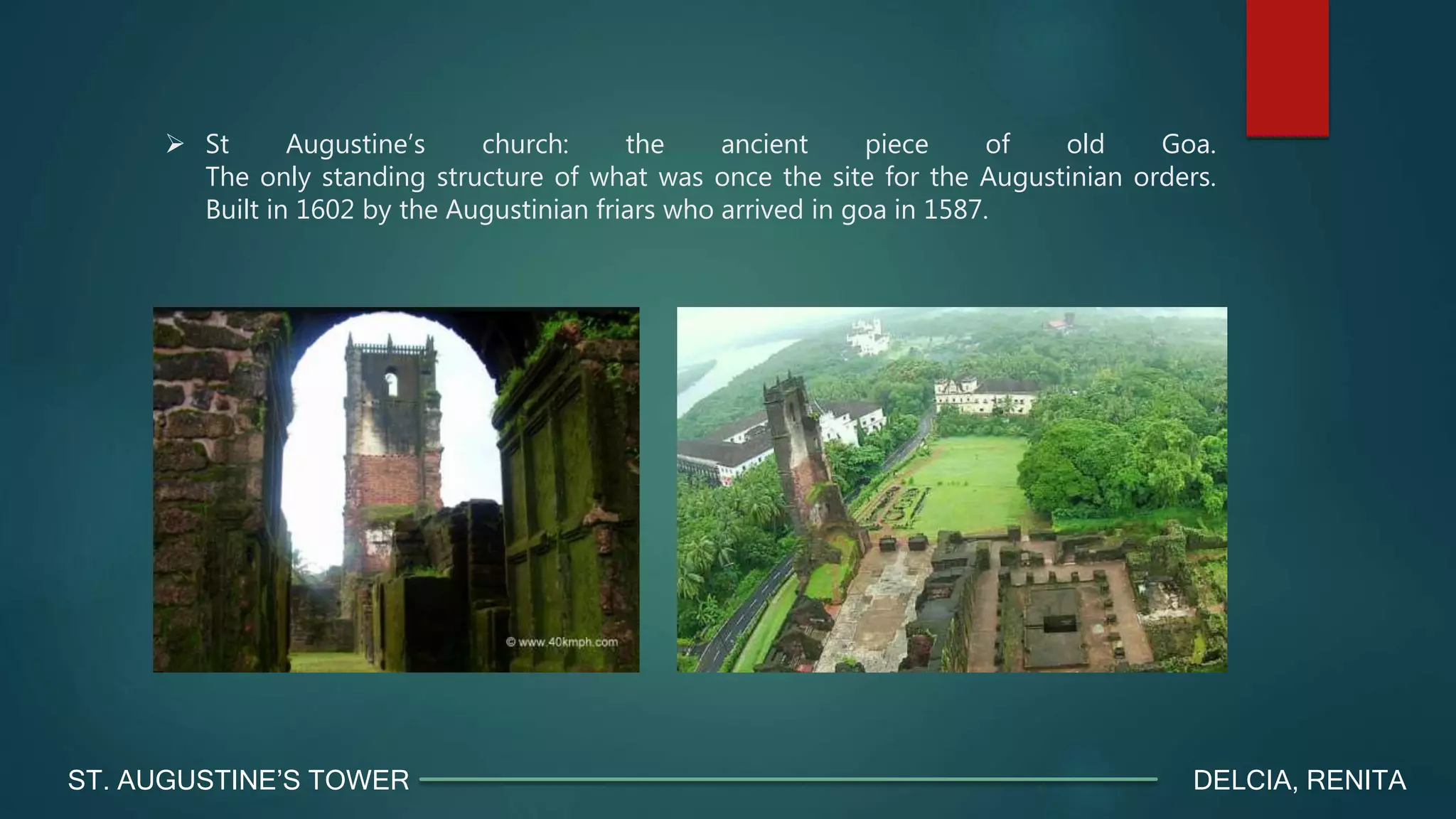
 The picture shows the ruins of
the only remaining tower.
Source: Wikipedia
ST. AUGUSTINE’S TOWER DELCIA, RENITA
 St Augustine’s church: the ancient piece of old Goa.
The only standing structure of what was once the site for the Augustinian orders.
Built in 1602 by the Augustinian friars who arrived in goa in 1587.
ST. AUGUSTINE’S TOWER DELCIA, RENITA
 The 46 meter- high imposing tower of
one of the seven churches located on
and between seven hills in and around
velha was one of the great features.
 It was abandoned in the year 1835 due
to the deserting of the old Goa because
of continual series of deadly epidemics
that plagued that area.
 In the first half of the twentieth century
in 1931, the façade and the half of the
bel tower fell down and few years later
in 1938, other section of the structure
fell down bringing down with them
significant sections of the structure.
Source: pic: google pictures
tour presentation reference
ST. AUGUSTINE’S TOWER DELCIA, RENITA
 The only remain standing is the one
tower of the five storey building that
it was.
 The area has now been cleared and
being conserved for posterity.
Source: Wikipedia
ST. AUGUSTINE’S TOWER DELCIA, RENITA
CATHEDRAL OF
BOM JESUS
Cathedral of Bom Jesus VINILA VINCENT
INTRODUCTION
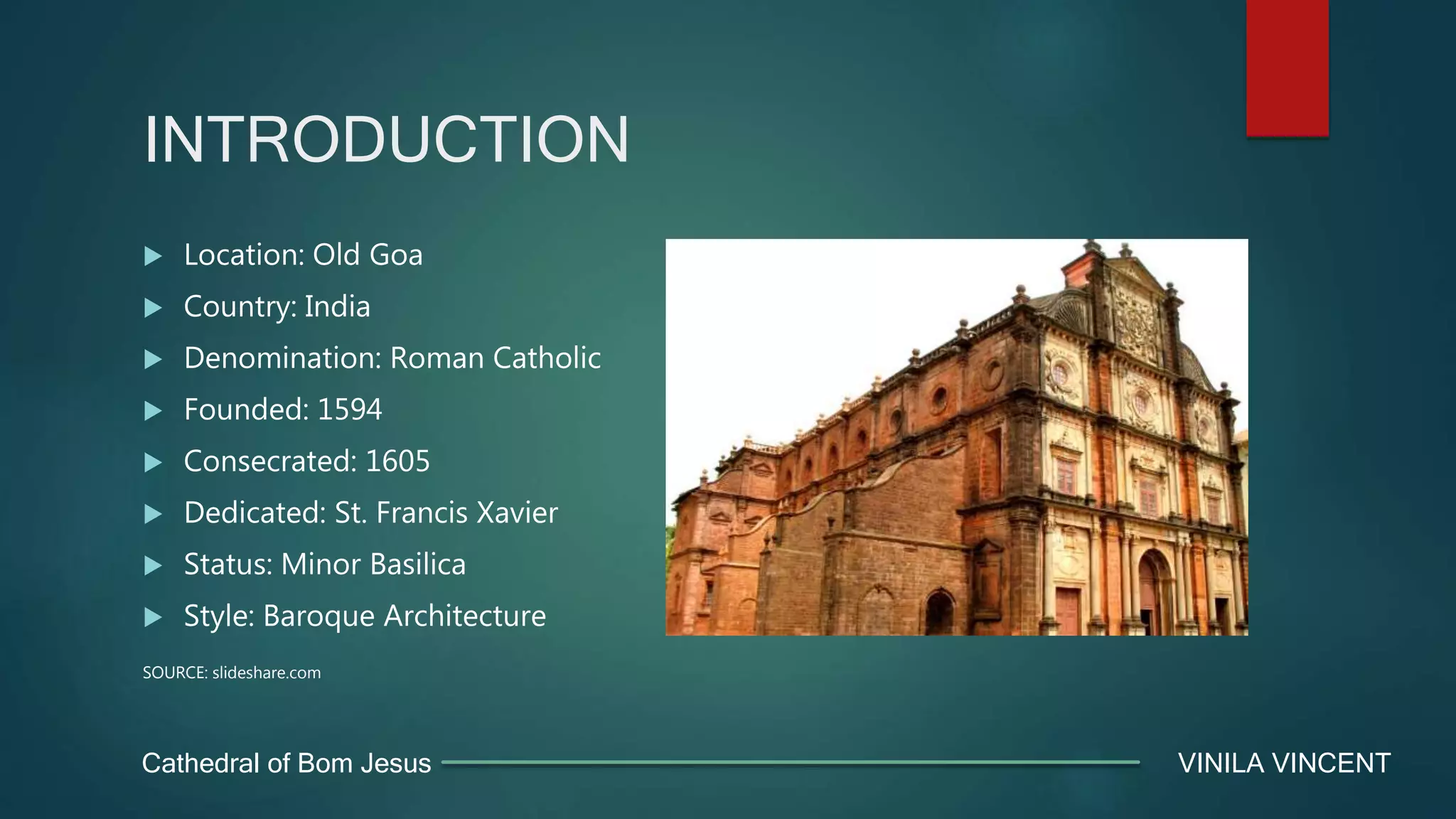
 Location: Old Goa
 Country: India
 Denomination: Roman Catholic
 Founded: 1594
 Consecrated: 1605
 Dedicated: St. Francis Xavier
 Status: Minor Basilica
 Style: Baroque Architecture
Cathedral of Bom Jesus VINILA VINCENT
SOURCE: slideshare.com
HISTORY
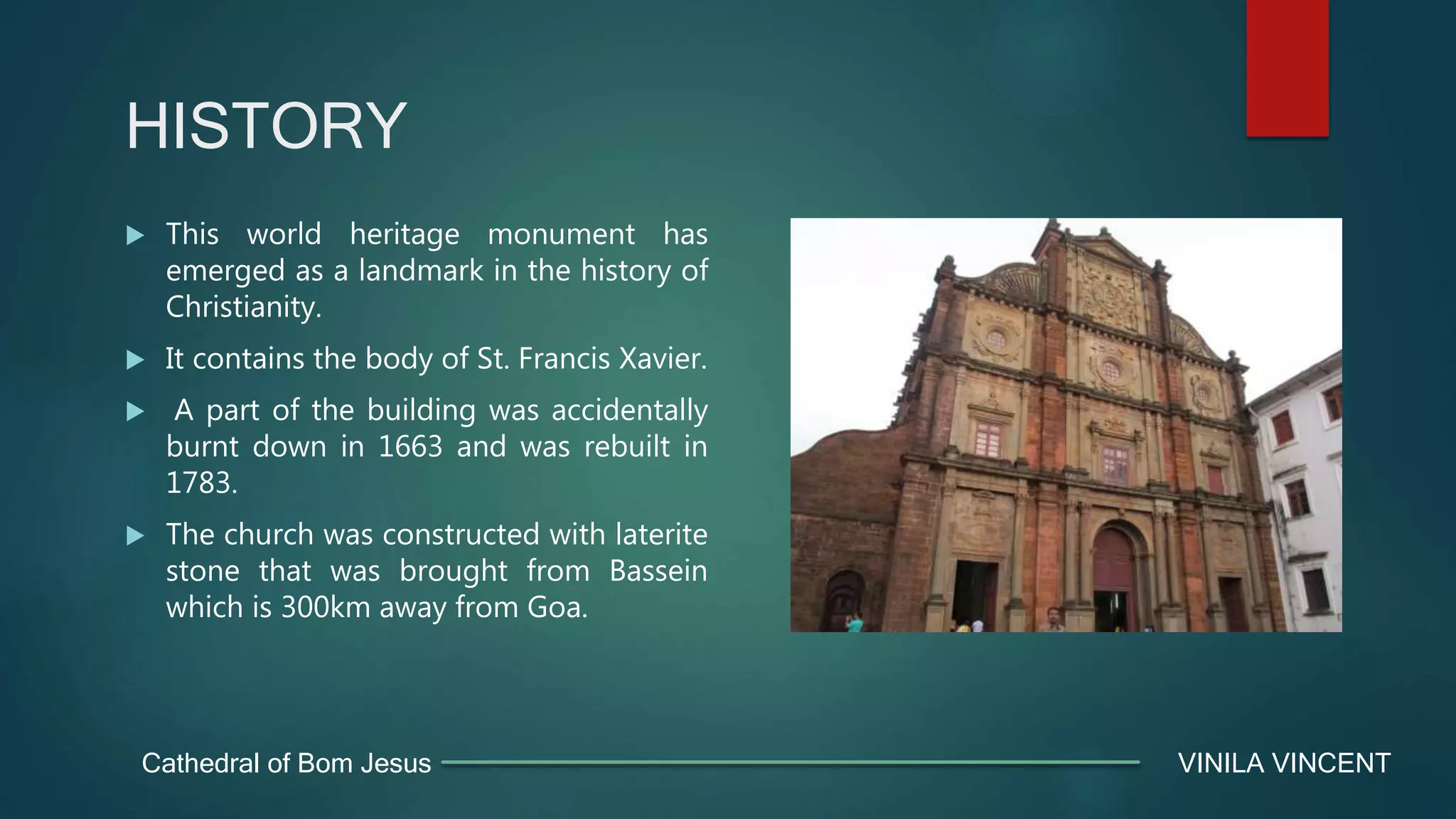
 This world heritage monument has
emerged as a landmark in the history of
Christianity.
 It contains the body of St. Francis Xavier.
 A part of the building was accidentally
burnt down in 1663 and was rebuilt in
1783.
 The church was constructed with laterite
stone that was brought from Bassein
which is 300km away from Goa.
Cathedral of Bom Jesus VINILA VINCENT
Mausoleum of Saint Francis Xavier
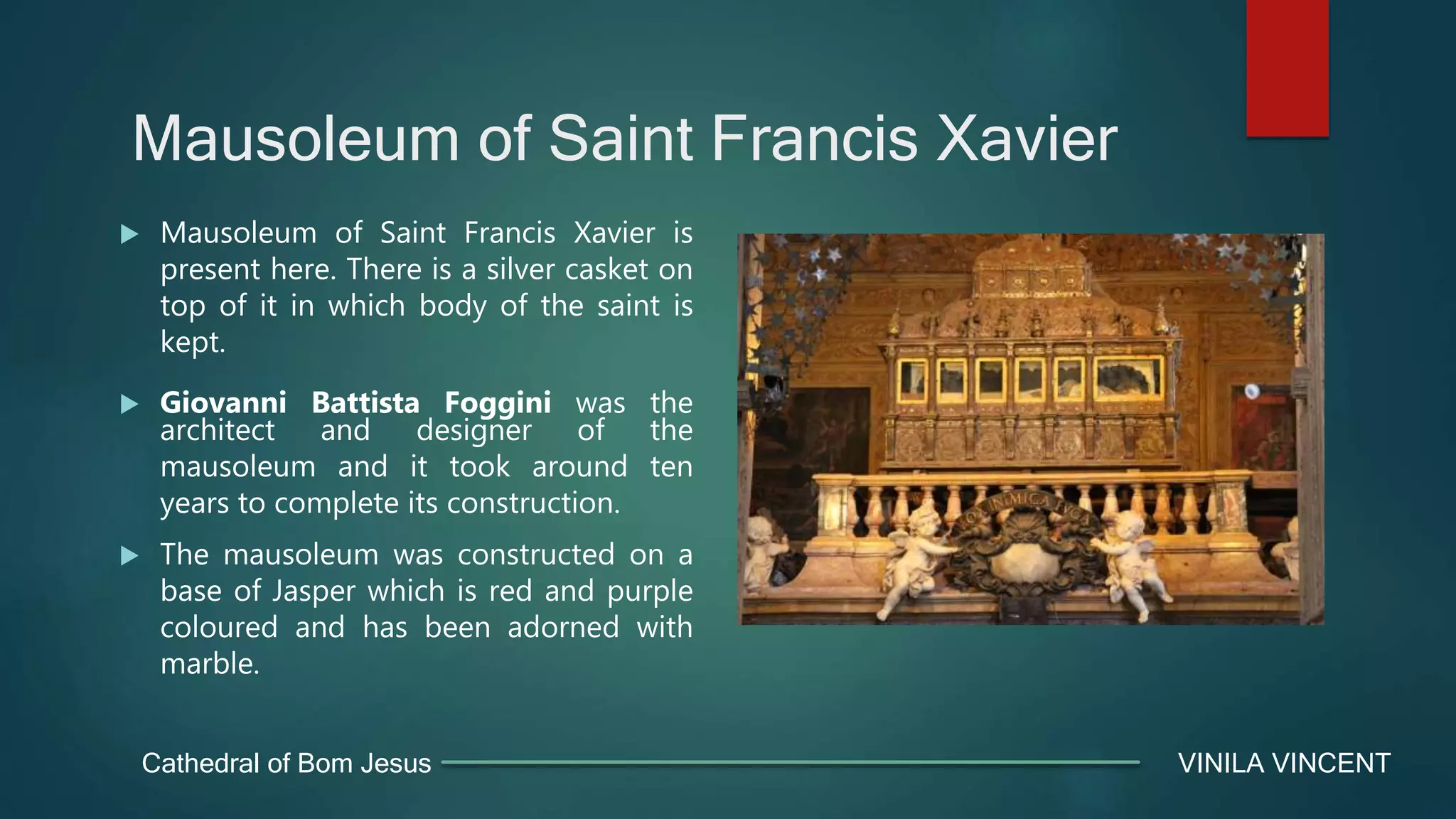
 Mausoleum of Saint Francis Xavier is
present here. There is a silver casket on
top of it in which body of the saint is
kept.
 Giovanni Battista Foggini was the
architect and designer of the
mausoleum and it took around ten
years to complete its construction.
 The mausoleum was constructed on a
base of Jasper which is red and purple
coloured and has been adorned with
marble.
Cathedral of Bom Jesus VINILA VINCENT
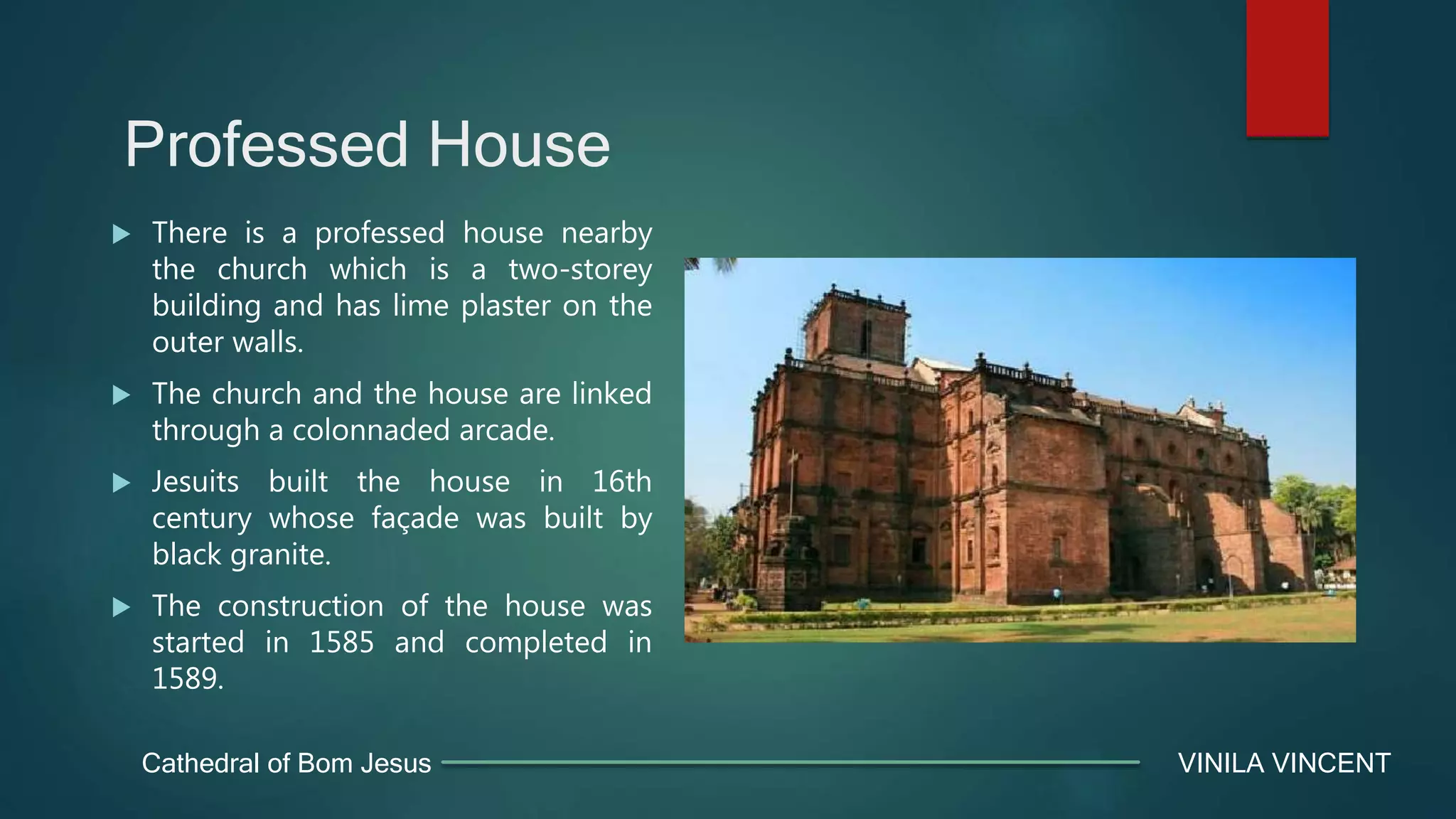
Professed House
 There is a professed house nearby
the church which is a two-storey
building and has lime plaster on the
outer walls.
 The church and the house are linked
through a colonnaded arcade.
 Jesuits built the house in 16th
century whose façade was built by
black granite.
 The construction of the house was
started in 1585 and completed in
1589.
Cathedral of Bom Jesus VINILA VINCENT
ARCHITECTURE
 The Basilica of Bom Jesus is a
monument typical of the classic forms
of plane architecture, introduced by the
Society of Jesus, otherwise known as
the Jesuits.
 The façade which is of granite,
represents features of five styles of
architecture: Roman, Ionic, Doric,
Corinthian and Composite.
 It measures 183 ft in length, 55 ft in
breadth and 61 ft in height. The main
alter is 54 ft high and 30 ft broad.
 The interior of the church is built in
Mosaico-Corinthian style and is
remarkable for its charming simplicity.
Cathedral of Bom Jesus VINILA VINCENT
SOURCE: wikipedia
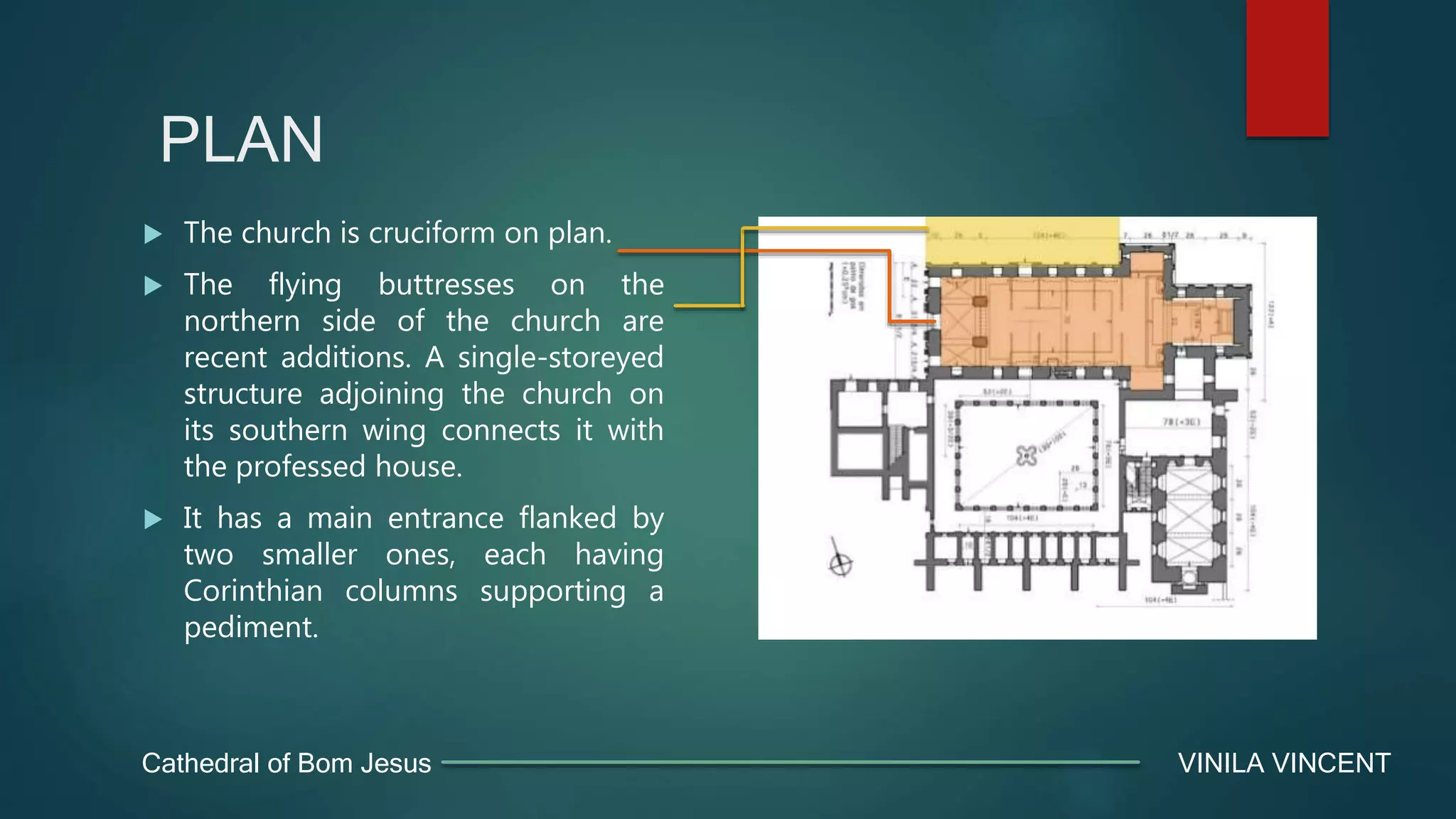
PLAN
 The church is cruciform on plan.
 The flying buttresses on the
northern side of the church are
recent additions. A single-storeyed
structure adjoining the church on
its southern wing connects it with
the professed house.
 It has a main entrance flanked by
two smaller ones, each having
Corinthian columns supporting a
pediment.
Cathedral of Bom Jesus VINILA VINCENT
PLAN
 As one enters, beneath the choir, to the right is an
alter of St. Antony.
 To the left is an exceedingly well-carved wooden
statue of St. Francis Xavier.
 A projecting gallery, which as intended for the use of
dignitaries on solemn occasions, runs along the two
longer sides of the church.
 The main altar at the end of the nave is flanked by
two decorated altars in the transept, one dedicated
to Our Lady of Hope and the other to St. Michael.
 In the transept on the northern side is the Chapel of
the Blessed Sacrament.
 In the southern side in the transept is a chapel where
the sacred relics of the body of St. Francis Xavier is
kept.
Cathedral of Bom Jesus VINILA VINCENT
SECTION
Cathedral of Bom Jesus VINILA VINCENT
SOURCE: wikipedia
THE SE
CATHEDRAL,VELHA
GOA
SE CATHEDRAL CHELSA JAMES
THE SE CATHEDRAL
 Name: se cathedral de santa catarina
 Location: old goa
 Country: india
 Denomination: roman catholic
 Founded: 1619
 Dedication: catherine of alexandraia
 Consecrated: 1640
 Status: cathedral
 Style: portugese gothic
SE CATHEDRAL CHELSA JAMES
HISTORY
1.Largest church in asia.
2.The se cathedral was built to commemorate the victory of the
portugese army over a muslim army leading to the capture of the city
of goa in 1510.
3.It was commissioned by governor george cabral to be enlarged in
1552 on the reamins of an earlier structure.
Construction of the church began in 1562.
4.The cathedral was completed in 1619 and was consecrated in 1640.
5.It had two towers,but one collapsed in1776 and was never rebuilt.
SE CATHEDRAL CHELSA JAMES
ARCHITECTURE
 Built in the portugese-manueline style.
 It combine elements of late gothic with spanish plateresque
style,mudejar,flemish architecture and italian urban design.
 The exterior is of tuscan order ,notable for its plainness and simplicity.
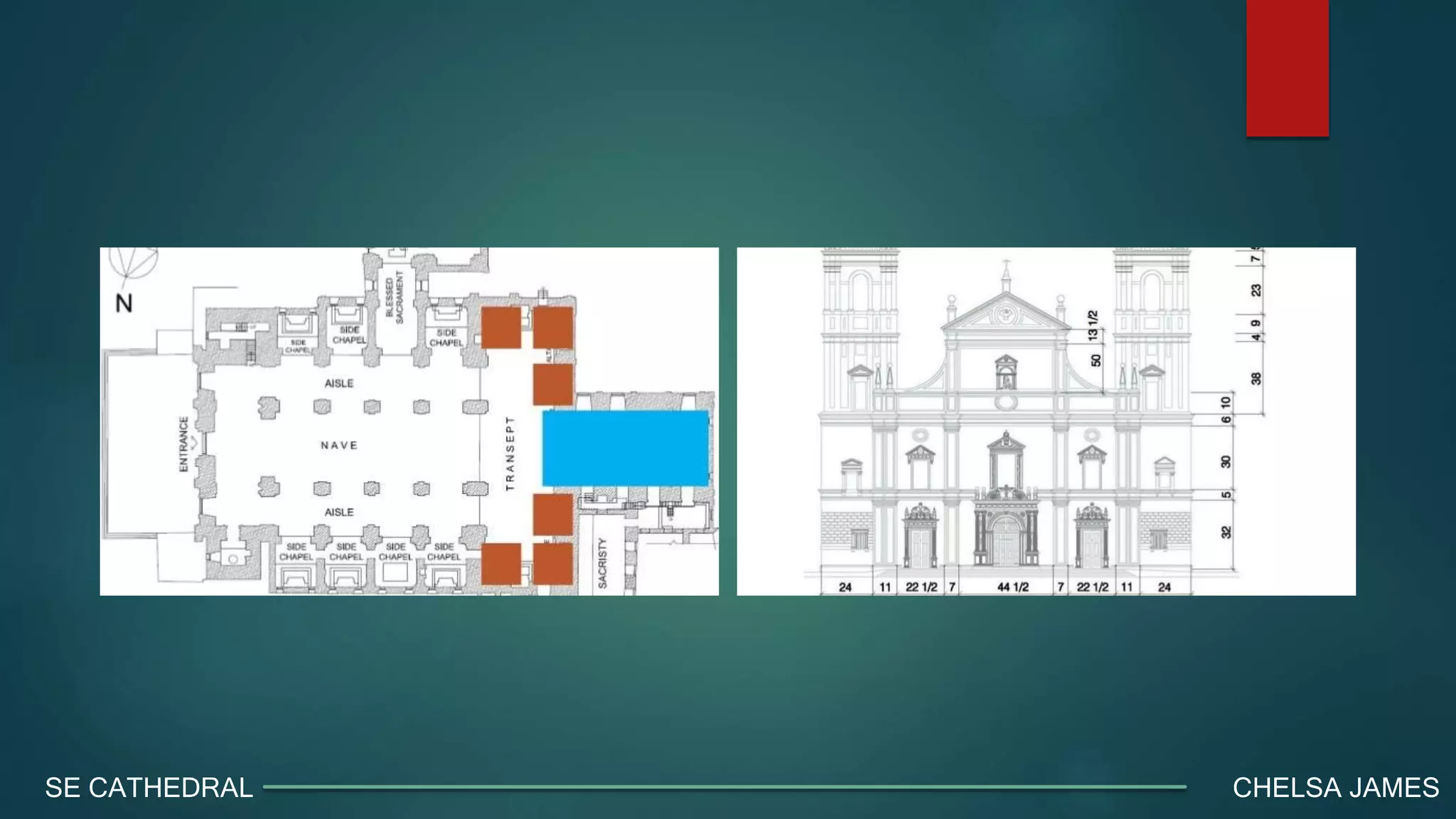
 The church is of 250 feet(76m) in length ,181 feet(55m) breadth.The
fontispiece stands 115 feet (35m) high.
 The church is of false basilica with nave two side aisles and side
chapels,transept and choir.
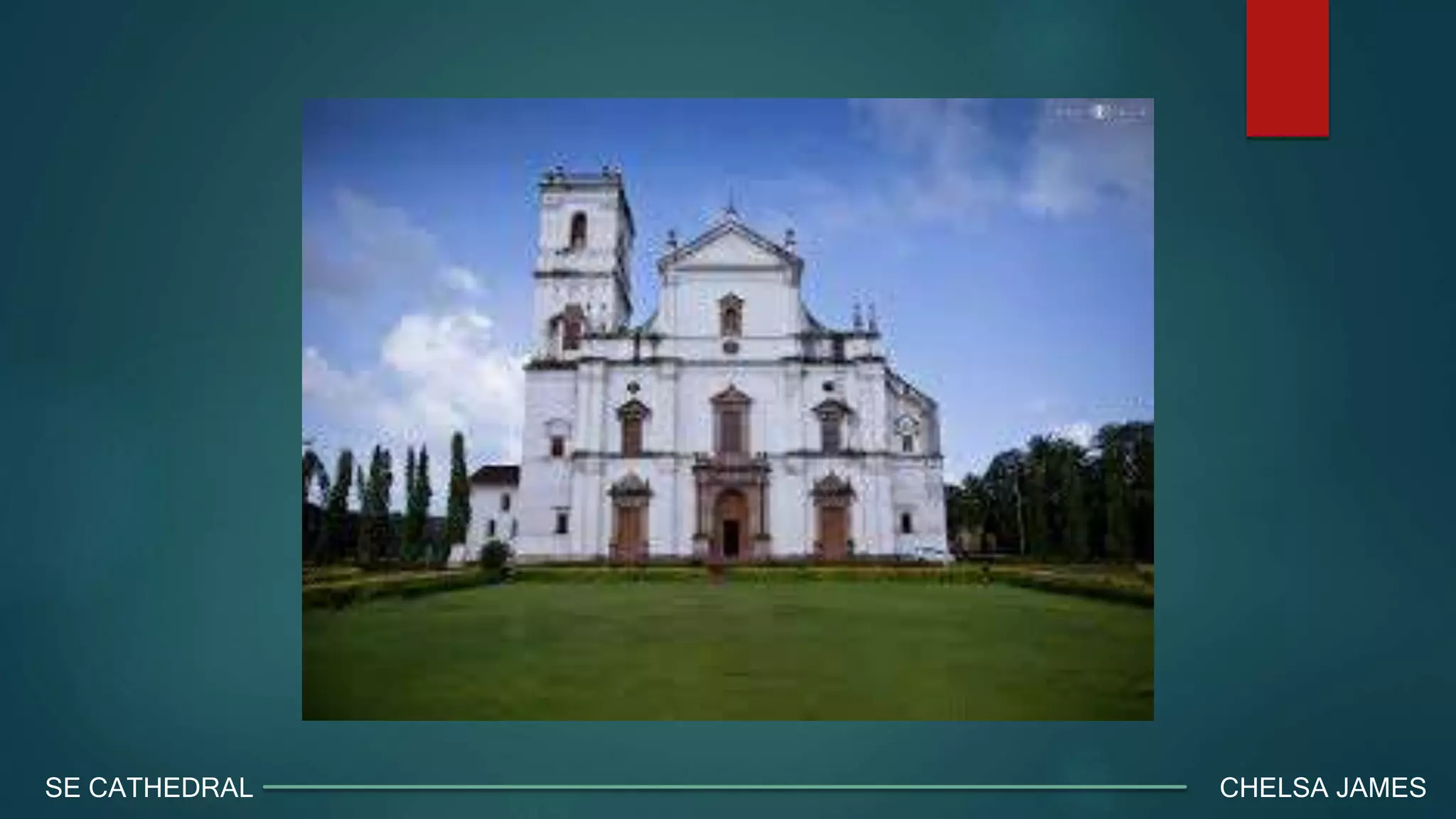
 The façade has three bays with portals in the first storey and rectangular
windows in the second.
 The additional central bay linked to its sides through curved walls resolves
the height difference between nave and aisles and hides the roof behind it.
SE CATHEDRAL CHELSA JAMES
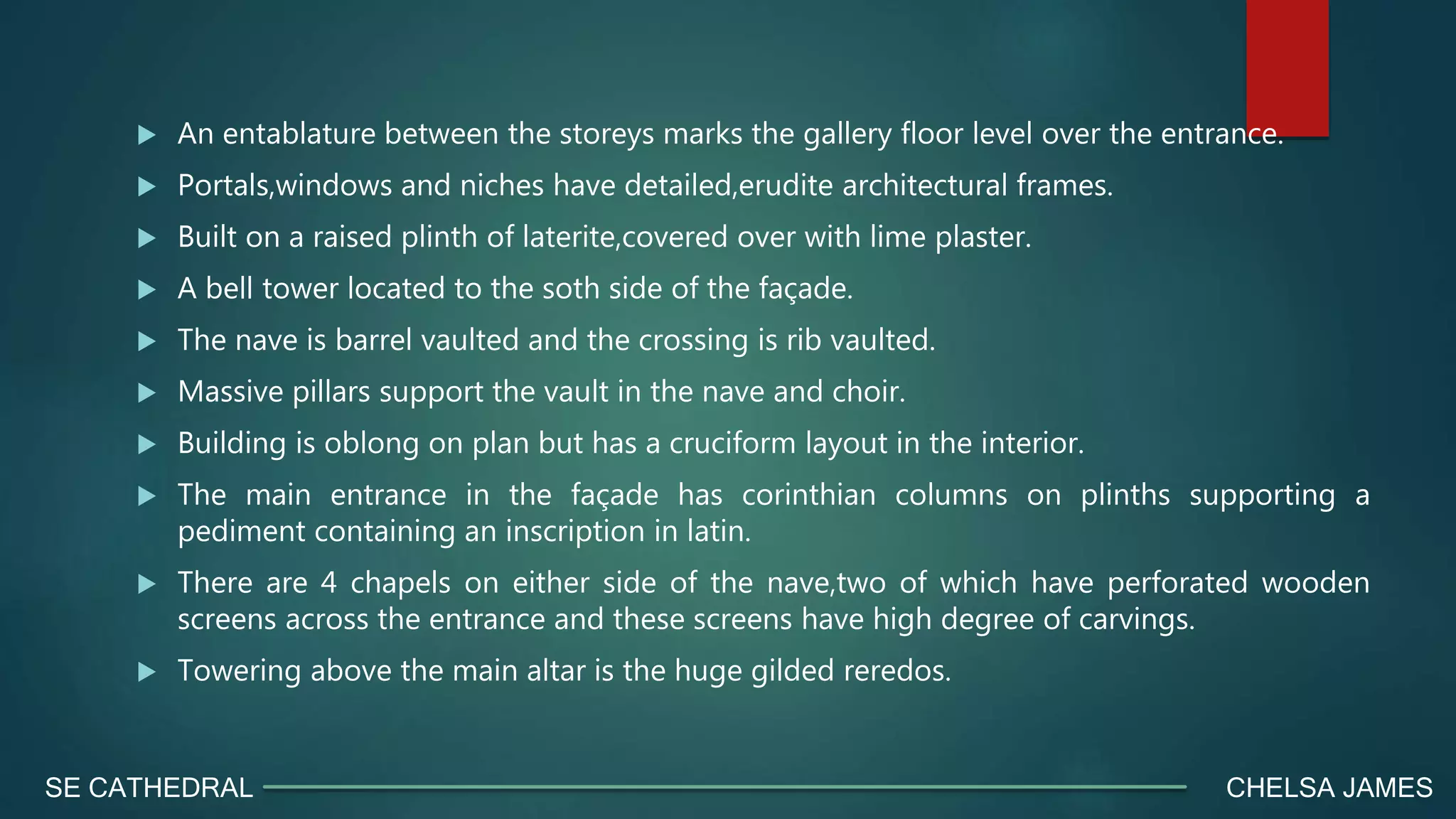
 An entablature between the storeys marks the gallery floor level over the entrance.
 Portals,windows and niches have detailed,erudite architectural frames.
 Built on a raised plinth of laterite,covered over with lime plaster.
 A bell tower located to the soth side of the façade.
 The nave is barrel vaulted and the crossing is rib vaulted.
 Massive pillars support the vault in the nave and choir.
 Building is oblong on plan but has a cruciform layout in the interior.
 The main entrance in the façade has corinthian columns on plinths supporting a
pediment containing an inscription in latin.
 There are 4 chapels on either side of the nave,two of which have perforated wooden
screens across the entrance and these screens have high degree of carvings.
 Towering above the main altar is the huge gilded reredos.
SE CATHEDRAL CHELSA JAMES
ARCHITECTURAL PROPOTIONS
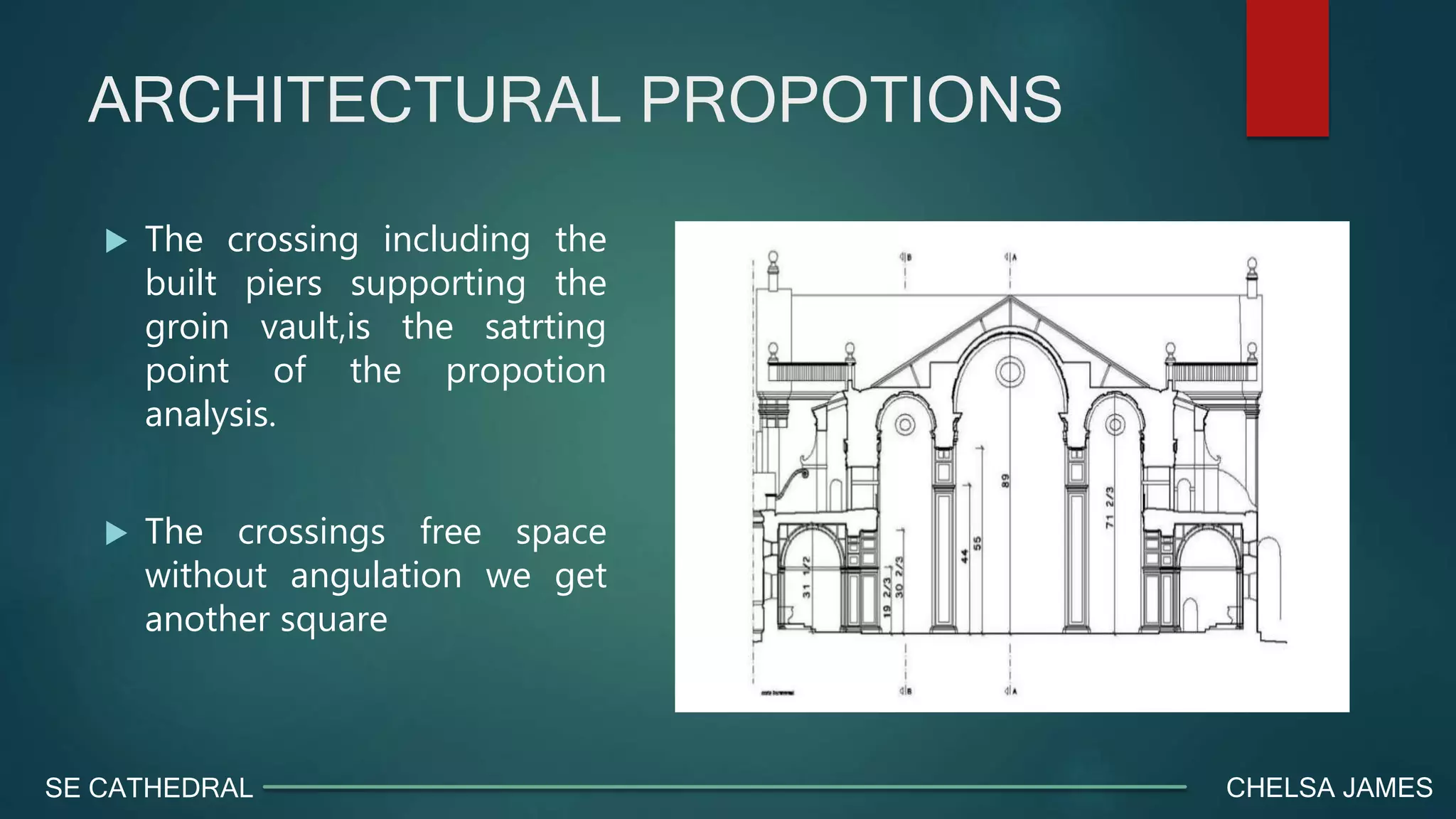
 The crossing including the
built piers supporting the
groin vault,is the satrting
point of the propotion
analysis.
 The crossings free space
without angulation we get
another square
SE CATHEDRAL CHELSA JAMES
OUR LADY OF IMMACULATE
CONCEPTION CHURCH,GOA
IMMACULATE CONCEPTION CHURCH PADMAJA JAYAKUMAR
 The colonial Portuguese Baroque style church was first built in 1541 as
a chapel on a hill side overlooking the city of Panjim.
 One of the oldest churches in Goa, located at the centre of Panaji.
 Originally built to welcome sailors home, the church is over 450 years old.
 This church houses the ancient bell that was removed from the Augustinian
ruins.
INTRODUCTION
IMMACULATE CONCEPTION CHURCH PADMAJA JAYAKUMAR
The church towers over the city with the statue of Mother Mary at the front
casting a watchful eye over its inhabitants.
IMMACULATE CONCEPTION CHURCH PADMAJA JAYAKUMAR
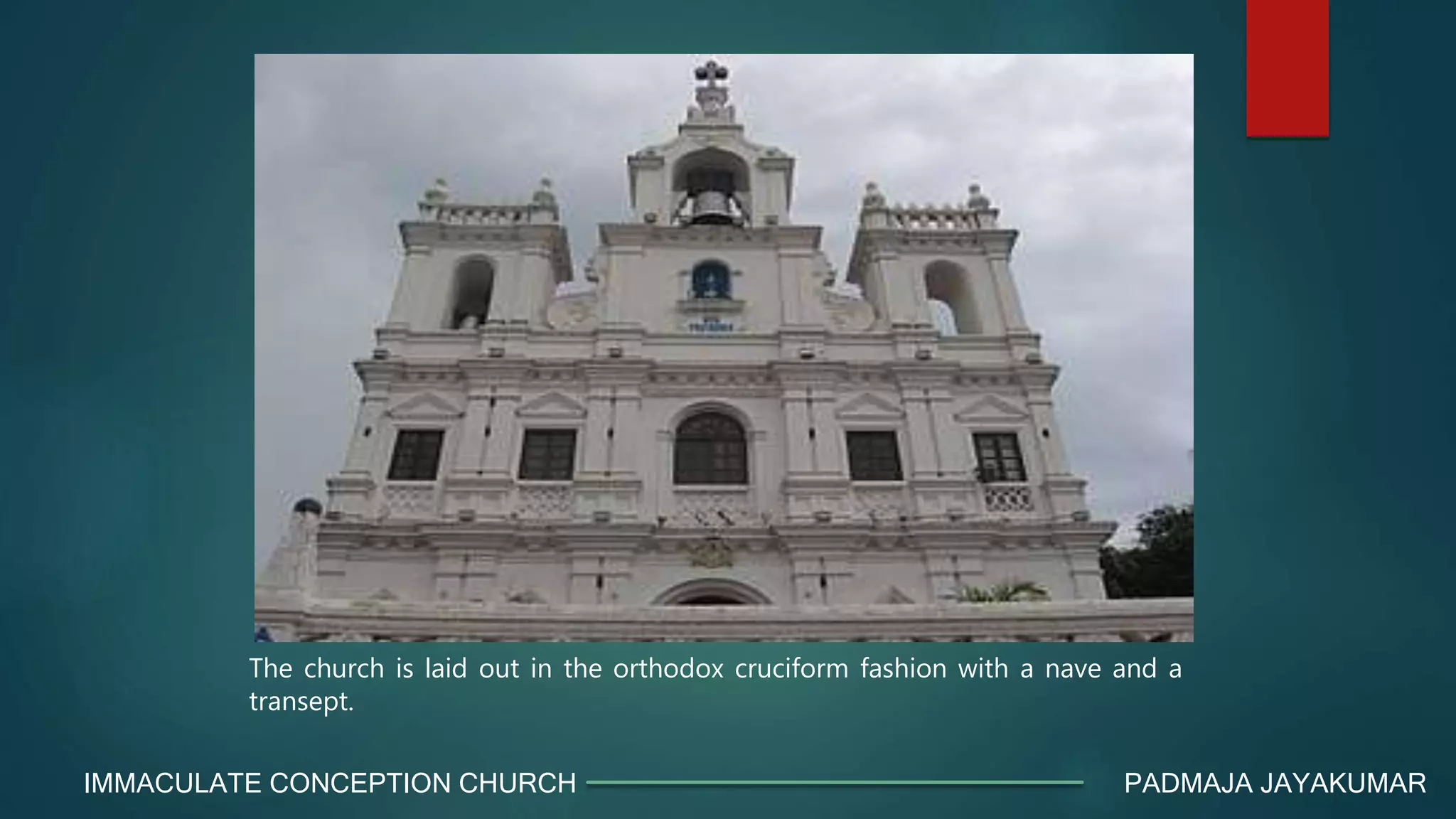
 The exterior facade of the church, rich with
Portuguese Baroque style architectural elements is painted a
bright white to signify the Immaculate virgin, Mary.
 The tall belfry atop of the façade houses the bell from
Augustinian monastery.
 The imposing façade is distinctive with its two towers and
centrally placed taller belfry.
FEATURES
IMMACULATE CONCEPTION CHURCH PADMAJA JAYAKUMAR
The church is laid out in the orthodox cruciform fashion with a nave and a
transept.
IMMACULATE CONCEPTION CHURCH PADMAJA JAYAKUMAR
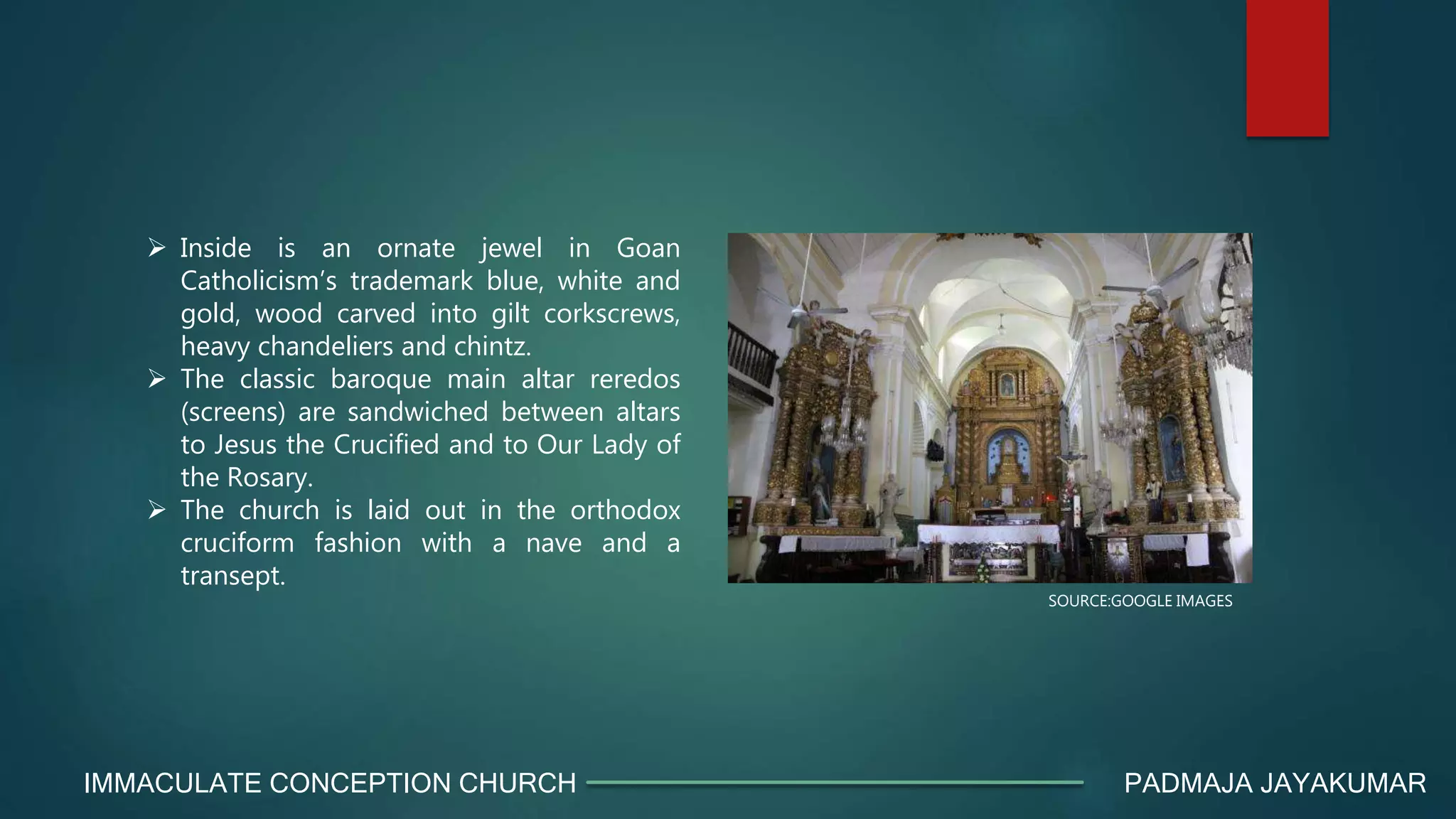
 Inside is an ornate jewel in Goan
Catholicism’s trademark blue, white and
gold, wood carved into gilt corkscrews,
heavy chandeliers and chintz.
 The classic baroque main altar reredos
(screens) are sandwiched between altars
to Jesus the Crucified and to Our Lady of
the Rosary.
 The church is laid out in the orthodox
cruciform fashion with a nave and a
transept.
SOURCE:GOOGLE IMAGES
IMMACULATE CONCEPTION CHURCH PADMAJA JAYAKUMAR
CHURCH OF
ST.FRANCIS OF
ASSISI
PADMAJA JAYAKUMARST. FRANCIS ASSISI CHURCH
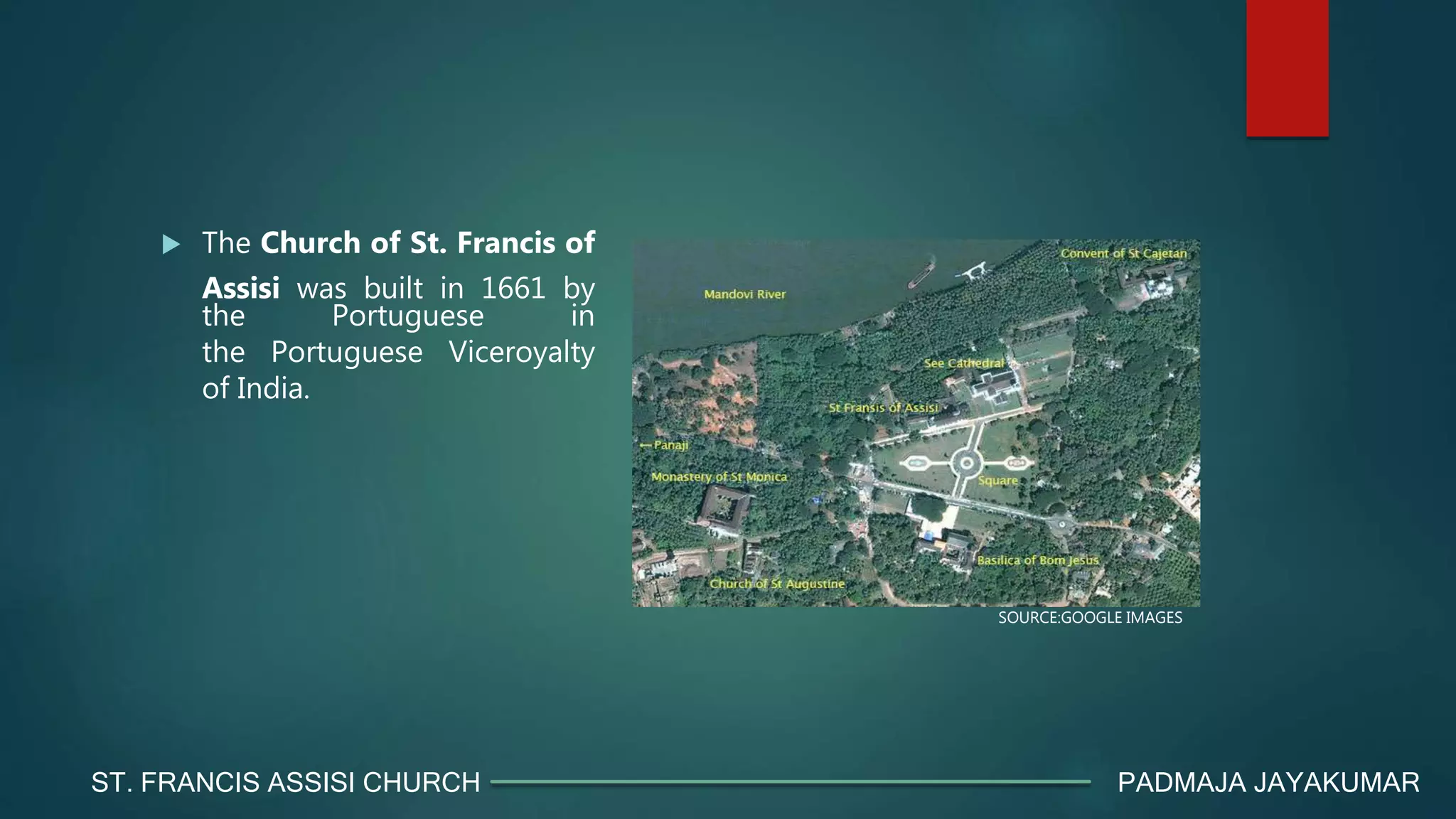
 The Church of St. Francis of
Assisi was built in 1661 by
the Portuguese in
the Portuguese Viceroyalty
of India.
SOURCE:GOOGLE IMAGES
ST. FRANCIS ASSISI CHURCH PADMAJA JAYAKUMAR
NOT TO SCALE
SOURCE: GOOGLE IMAGES
PADMAJA JAYAKUMARST. FRANCIS ASSISI CHURCH
 Structure is built with blocks and is lime plastered.
 To the north of the altar there ilaterite s a belfry.
 The exterior of the Church is of Tuscan order, while the main entrance is of
Manuline order.
 The main altar is Baroque with Corinthian features.
 There are no aisle, but only a nave which is rib vaulted.
PADMAJA JAYAKUMARST. FRANCIS ASSISI CHURCH
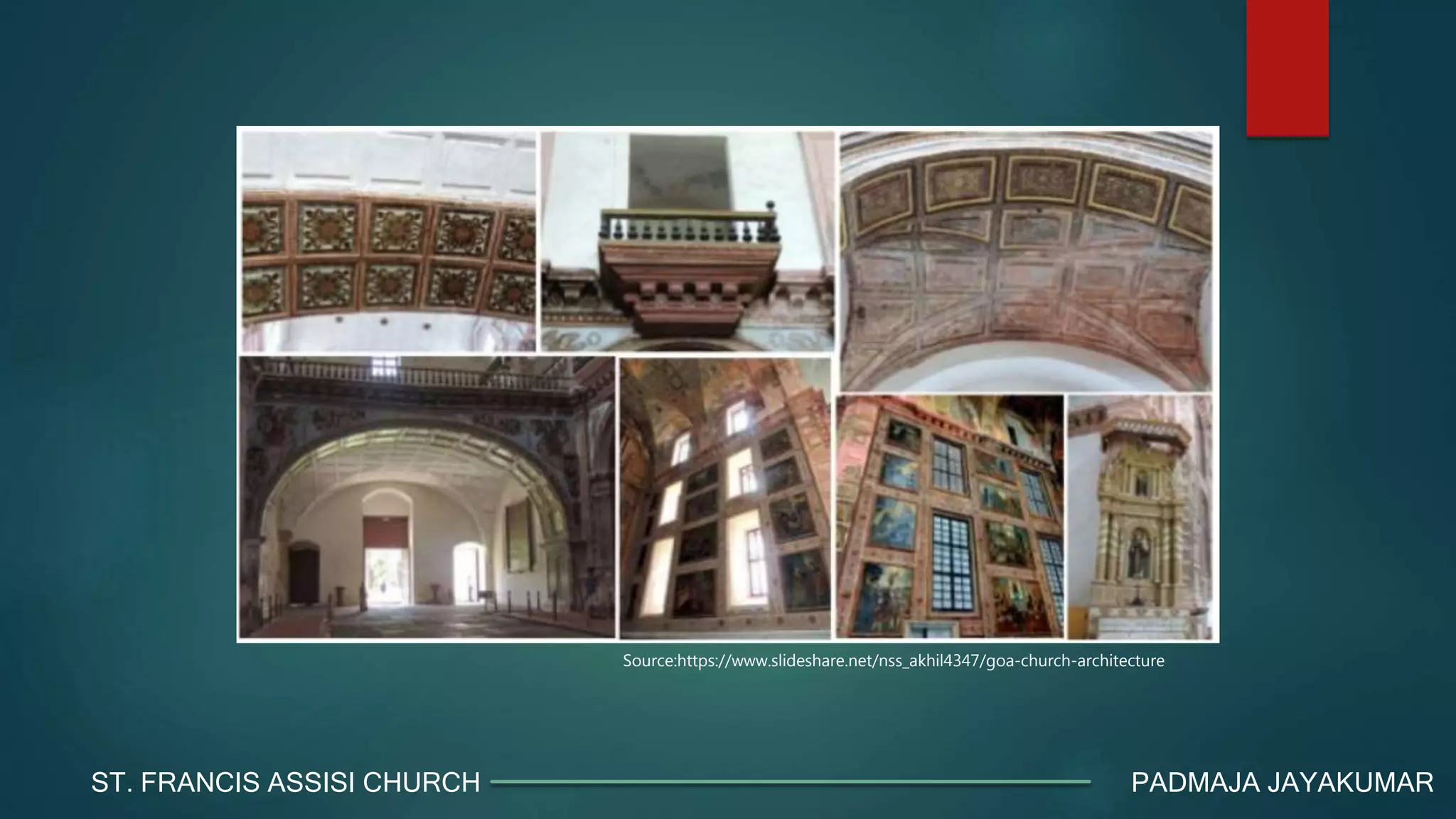
 The internal buttress walls,
separating the chapels and
supporting the gallery on top, have
frescoes showing intricate floral
designs.
PADMAJA JAYAKUMARST. FRANCIS ASSISI CHURCH
 Beneath a ribbed vault with frescoes showing
floral decorations, is the main altar which is
gilded and has a richly carved niche which has
a tabernacle supported by four evangelists.
PADMAJA JAYAKUMARST. FRANCIS ASSISI CHURCH
Source:https://www.slideshare.net/nss_akhil4347/goa-church-architecture
PADMAJA JAYAKUMARST. FRANCIS ASSISI CHURCH
AGUADA FORT,
GOA
AGUADA FORT GLADIS, SNEHA SARA
LOCATION
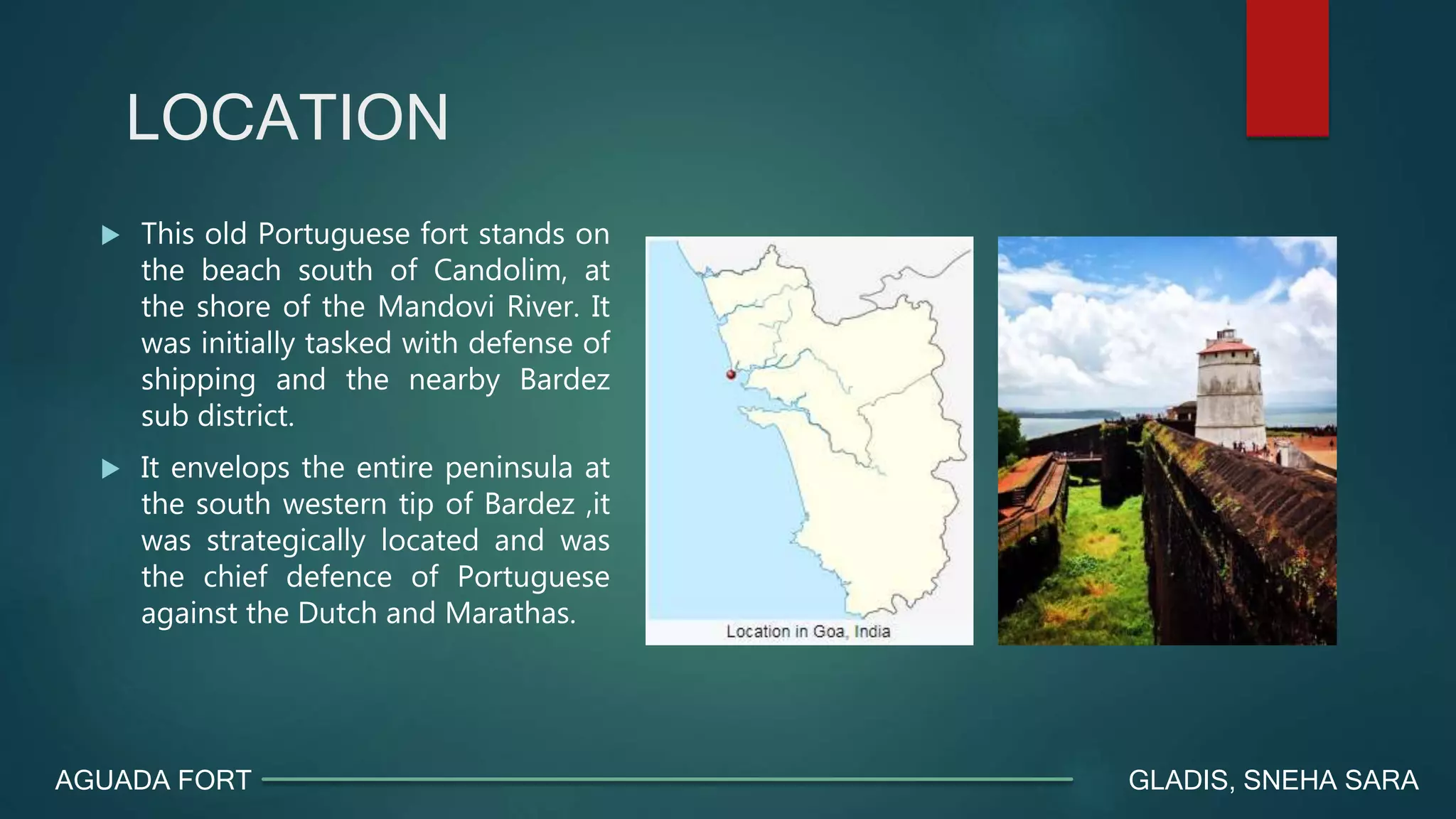
 This old Portuguese fort stands on
the beach south of Candolim, at
the shore of the Mandovi River. It
was initially tasked with defense of
shipping and the nearby Bardez
sub district.
 It envelops the entire peninsula at
the south western tip of Bardez ,it
was strategically located and was
the chief defence of Portuguese
against the Dutch and Marathas.
AGUADA FORT GLADIS, SNEHA SARA
HISTORY
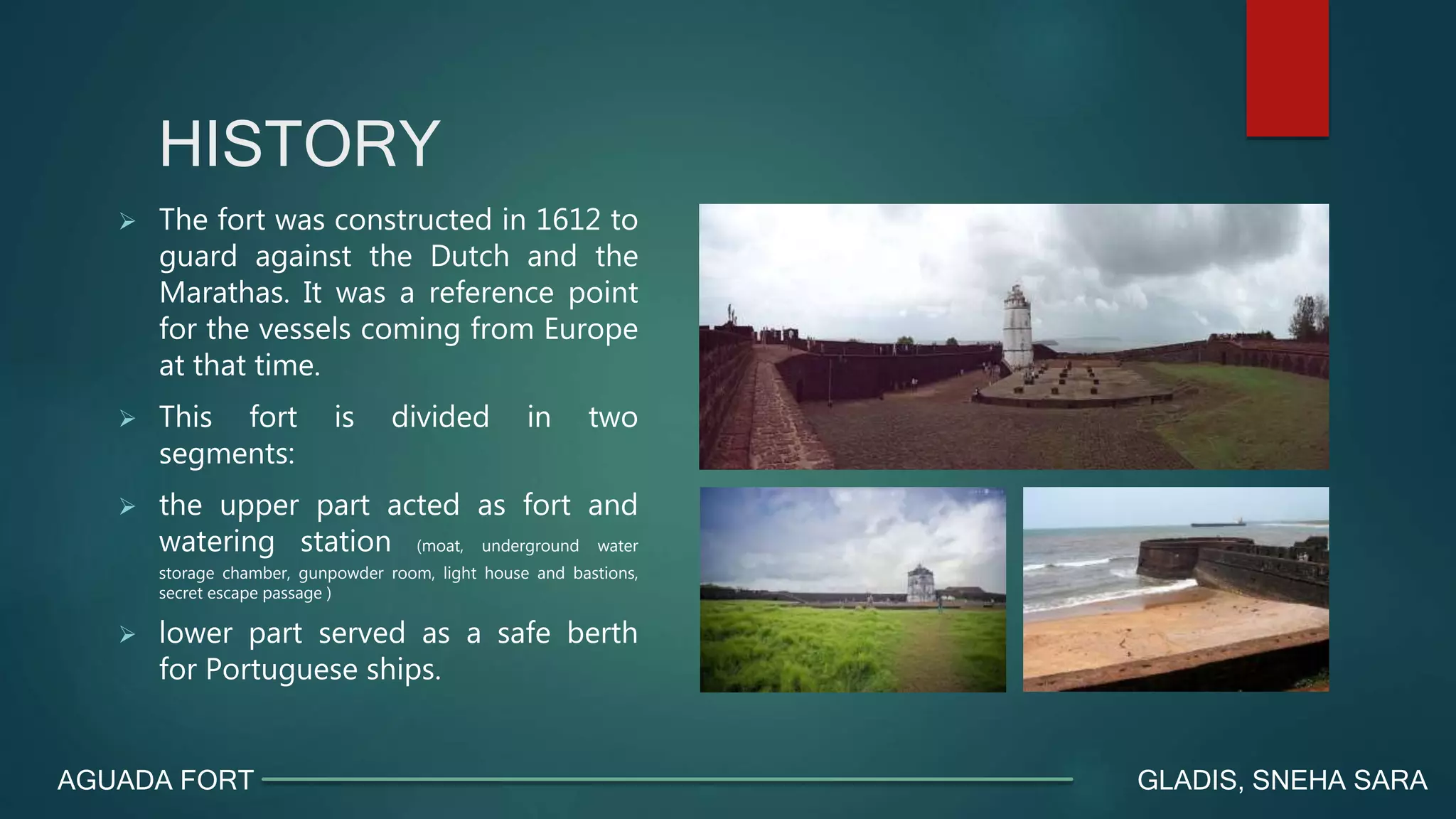
 The fort was constructed in 1612 to
guard against the Dutch and the
Marathas. It was a reference point
for the vessels coming from Europe
at that time.
 This fort is divided in two
segments:
 the upper part acted as fort and
watering station (moat, underground water
storage chamber, gunpowder room, light house and bastions,
secret escape passage )
 lower part served as a safe berth
for Portuguese ships.
AGUADA FORT GLADIS, SNEHA SARA
Interesting features
 A freshwater spring within the fort provided water
supply to the ships that used to stop by. This is
how the fort got its name: aguada, meaning water.
 It has the capacity of storing 2,376,000 gallons of
water
 Aguada lighthouse:
 This is one of oldest of its kinds in Asia as it was
built in 1864. It is a four storeyed structure
 Lighthouse was constructed ton guide ships into
safe harbour
aguada jail:
 During the Salazar administration, fort aguada was
repurposed for use as a prison primarily, some
claim, for Salazar's political opponents
 It is one of the largest jail in goa
AGUADA FORT GLADIS, SNEHA SARA
THANKYOU

Architecture of Goan Catholics

  • 1.
    ARCHITECTURE OF GOAN CATHOLICS CHURCHESAND FORTS OF GOA DURING PORTUGUESE INVASION ARCHITECTURE OF GOAN CATHOLICS GEORGE BEN, ABISHA
  • 2.
    HISTORY AND PERIOD Developed over the long colonial Portuguese India era (1500s−1961).  Arrival of many Roman Catholic missionaries, particularly the Portuguese Jesuits, lead to building many churches in Goa.  The Goan Catholic style of constructing churches thus came to be influenced by the Portuguese style.  Many of the 16th and 17th colonial Catholic churches were built in the Portuguese Baroque style  Notable are the Se Cathedral and Basilica of Bom Jesus. ARCHITECTURE OF GOAN CATHOLICS GEORGE BEN, ABISHA
  • 3.
    SE CATHEDRAL Founded :1619 Style: Portuguese- Gothic OUR LADY OF IMMACULATE CONCEPTION CHURCH Founded: 1541 Rebuilt: 1609 Style: Portuguese-Baroque 1600 1610 1620 CHURCH OF BOM JESUS Built: 1594-1605 Style: Baroque St. AUGUSTINES TOWER Built: 1602 Style: Portuguese ARCHITECTURE OF GOAN CATHOLICS GEORGE BEN, ABISHA
  • 4.
    DEVELOPMENT OF GOANCHURCH ARCHITECTURE  Various Christian denominations built monumental churches, basilicas, cathedrals, chapels, convents and nunneries in Old Goa, in the styles developing in 16th-18th century Europe—mannerist, baroque and rococo.  The churches also reflect the Manueline style which was prevalent in early 16th- century Portugal, named after King Manuel I  The Manueline style exhibits elements of design and craftsmanship adapted from medieval Portuguese and Islamic architecture, along with motifs from ships and the sea-faring world.  The churches of Goa are also significant for their collections of Christian art, sacred relics and religious iconography. ARCHITECTURE OF GOAN CATHOLICS GEORGE BEN, ABISHA
  • 5.
    FEATURES OF GOANCHURCH ARCHITECTURE  Constructed of laterite stones and lime plastered which displays the affluent Architectural fusion of Renaissance and Baroque styles.  Highly ornamental Alter, mostly golden in colour and massive in scale and has the pulpit away from the alter.  Structure is composed of cross shaped plan with a central nave and side aisles, sloping roof.  No clerestory provided over nave but on side walls of aisles itself.  Has three external openings accessing the nave and aisles on the front façade  Mostly symmetrical on elevation with towers on either sides holding the curfew bell. ARCHITECTURE OF GOAN CATHOLICS GEORGE BEN, ABISHA
  • 6.
  • 7.
    INTRODUCTION  Located :Goa (India)  Founded :1597;421 years ago  Completed :1602  The picture shows the ruins of the only remaining tower. Source: Wikipedia ST. AUGUSTINE’S TOWER DELCIA, RENITA
  • 8.
     St Augustine’schurch: the ancient piece of old Goa. The only standing structure of what was once the site for the Augustinian orders. Built in 1602 by the Augustinian friars who arrived in goa in 1587. ST. AUGUSTINE’S TOWER DELCIA, RENITA
  • 9.
     The 46meter- high imposing tower of one of the seven churches located on and between seven hills in and around velha was one of the great features.  It was abandoned in the year 1835 due to the deserting of the old Goa because of continual series of deadly epidemics that plagued that area.  In the first half of the twentieth century in 1931, the façade and the half of the bel tower fell down and few years later in 1938, other section of the structure fell down bringing down with them significant sections of the structure. Source: pic: google pictures tour presentation reference ST. AUGUSTINE’S TOWER DELCIA, RENITA
  • 10.
     The onlyremain standing is the one tower of the five storey building that it was.  The area has now been cleared and being conserved for posterity. Source: Wikipedia ST. AUGUSTINE’S TOWER DELCIA, RENITA
  • 11.
    CATHEDRAL OF BOM JESUS Cathedralof Bom Jesus VINILA VINCENT
  • 12.
    INTRODUCTION  Location: OldGoa  Country: India  Denomination: Roman Catholic  Founded: 1594  Consecrated: 1605  Dedicated: St. Francis Xavier  Status: Minor Basilica  Style: Baroque Architecture Cathedral of Bom Jesus VINILA VINCENT SOURCE: slideshare.com
  • 13.
    HISTORY  This worldheritage monument has emerged as a landmark in the history of Christianity.  It contains the body of St. Francis Xavier.  A part of the building was accidentally burnt down in 1663 and was rebuilt in 1783.  The church was constructed with laterite stone that was brought from Bassein which is 300km away from Goa. Cathedral of Bom Jesus VINILA VINCENT
  • 14.
    Mausoleum of SaintFrancis Xavier  Mausoleum of Saint Francis Xavier is present here. There is a silver casket on top of it in which body of the saint is kept.  Giovanni Battista Foggini was the architect and designer of the mausoleum and it took around ten years to complete its construction.  The mausoleum was constructed on a base of Jasper which is red and purple coloured and has been adorned with marble. Cathedral of Bom Jesus VINILA VINCENT
  • 15.
    Professed House  Thereis a professed house nearby the church which is a two-storey building and has lime plaster on the outer walls.  The church and the house are linked through a colonnaded arcade.  Jesuits built the house in 16th century whose façade was built by black granite.  The construction of the house was started in 1585 and completed in 1589. Cathedral of Bom Jesus VINILA VINCENT
  • 16.
    ARCHITECTURE  The Basilicaof Bom Jesus is a monument typical of the classic forms of plane architecture, introduced by the Society of Jesus, otherwise known as the Jesuits.  The façade which is of granite, represents features of five styles of architecture: Roman, Ionic, Doric, Corinthian and Composite.  It measures 183 ft in length, 55 ft in breadth and 61 ft in height. The main alter is 54 ft high and 30 ft broad.  The interior of the church is built in Mosaico-Corinthian style and is remarkable for its charming simplicity. Cathedral of Bom Jesus VINILA VINCENT SOURCE: wikipedia
  • 17.
    PLAN  The churchis cruciform on plan.  The flying buttresses on the northern side of the church are recent additions. A single-storeyed structure adjoining the church on its southern wing connects it with the professed house.  It has a main entrance flanked by two smaller ones, each having Corinthian columns supporting a pediment. Cathedral of Bom Jesus VINILA VINCENT
  • 18.
    PLAN  As oneenters, beneath the choir, to the right is an alter of St. Antony.  To the left is an exceedingly well-carved wooden statue of St. Francis Xavier.  A projecting gallery, which as intended for the use of dignitaries on solemn occasions, runs along the two longer sides of the church.  The main altar at the end of the nave is flanked by two decorated altars in the transept, one dedicated to Our Lady of Hope and the other to St. Michael.  In the transept on the northern side is the Chapel of the Blessed Sacrament.  In the southern side in the transept is a chapel where the sacred relics of the body of St. Francis Xavier is kept. Cathedral of Bom Jesus VINILA VINCENT
  • 19.
    SECTION Cathedral of BomJesus VINILA VINCENT SOURCE: wikipedia
  • 20.
  • 21.
  • 22.
    THE SE CATHEDRAL Name: se cathedral de santa catarina  Location: old goa  Country: india  Denomination: roman catholic  Founded: 1619  Dedication: catherine of alexandraia  Consecrated: 1640  Status: cathedral  Style: portugese gothic SE CATHEDRAL CHELSA JAMES
  • 23.
    HISTORY 1.Largest church inasia. 2.The se cathedral was built to commemorate the victory of the portugese army over a muslim army leading to the capture of the city of goa in 1510. 3.It was commissioned by governor george cabral to be enlarged in 1552 on the reamins of an earlier structure. Construction of the church began in 1562. 4.The cathedral was completed in 1619 and was consecrated in 1640. 5.It had two towers,but one collapsed in1776 and was never rebuilt. SE CATHEDRAL CHELSA JAMES
  • 24.
  • 25.
    ARCHITECTURE  Built inthe portugese-manueline style.  It combine elements of late gothic with spanish plateresque style,mudejar,flemish architecture and italian urban design.  The exterior is of tuscan order ,notable for its plainness and simplicity.  The church is of 250 feet(76m) in length ,181 feet(55m) breadth.The fontispiece stands 115 feet (35m) high.  The church is of false basilica with nave two side aisles and side chapels,transept and choir.  The façade has three bays with portals in the first storey and rectangular windows in the second.  The additional central bay linked to its sides through curved walls resolves the height difference between nave and aisles and hides the roof behind it. SE CATHEDRAL CHELSA JAMES
  • 26.
  • 27.
  • 28.
     An entablaturebetween the storeys marks the gallery floor level over the entrance.  Portals,windows and niches have detailed,erudite architectural frames.  Built on a raised plinth of laterite,covered over with lime plaster.  A bell tower located to the soth side of the façade.  The nave is barrel vaulted and the crossing is rib vaulted.  Massive pillars support the vault in the nave and choir.  Building is oblong on plan but has a cruciform layout in the interior.  The main entrance in the façade has corinthian columns on plinths supporting a pediment containing an inscription in latin.  There are 4 chapels on either side of the nave,two of which have perforated wooden screens across the entrance and these screens have high degree of carvings.  Towering above the main altar is the huge gilded reredos. SE CATHEDRAL CHELSA JAMES
  • 29.
  • 30.
    ARCHITECTURAL PROPOTIONS  Thecrossing including the built piers supporting the groin vault,is the satrting point of the propotion analysis.  The crossings free space without angulation we get another square SE CATHEDRAL CHELSA JAMES
  • 31.
    OUR LADY OFIMMACULATE CONCEPTION CHURCH,GOA IMMACULATE CONCEPTION CHURCH PADMAJA JAYAKUMAR
  • 32.
     The colonialPortuguese Baroque style church was first built in 1541 as a chapel on a hill side overlooking the city of Panjim.  One of the oldest churches in Goa, located at the centre of Panaji.  Originally built to welcome sailors home, the church is over 450 years old.  This church houses the ancient bell that was removed from the Augustinian ruins. INTRODUCTION IMMACULATE CONCEPTION CHURCH PADMAJA JAYAKUMAR
  • 33.
    The church towersover the city with the statue of Mother Mary at the front casting a watchful eye over its inhabitants. IMMACULATE CONCEPTION CHURCH PADMAJA JAYAKUMAR
  • 34.
     The exteriorfacade of the church, rich with Portuguese Baroque style architectural elements is painted a bright white to signify the Immaculate virgin, Mary.  The tall belfry atop of the façade houses the bell from Augustinian monastery.  The imposing façade is distinctive with its two towers and centrally placed taller belfry. FEATURES IMMACULATE CONCEPTION CHURCH PADMAJA JAYAKUMAR
  • 35.
    The church islaid out in the orthodox cruciform fashion with a nave and a transept. IMMACULATE CONCEPTION CHURCH PADMAJA JAYAKUMAR
  • 36.
     Inside isan ornate jewel in Goan Catholicism’s trademark blue, white and gold, wood carved into gilt corkscrews, heavy chandeliers and chintz.  The classic baroque main altar reredos (screens) are sandwiched between altars to Jesus the Crucified and to Our Lady of the Rosary.  The church is laid out in the orthodox cruciform fashion with a nave and a transept. SOURCE:GOOGLE IMAGES IMMACULATE CONCEPTION CHURCH PADMAJA JAYAKUMAR
  • 37.
    CHURCH OF ST.FRANCIS OF ASSISI PADMAJAJAYAKUMARST. FRANCIS ASSISI CHURCH
  • 38.
     The Churchof St. Francis of Assisi was built in 1661 by the Portuguese in the Portuguese Viceroyalty of India. SOURCE:GOOGLE IMAGES ST. FRANCIS ASSISI CHURCH PADMAJA JAYAKUMAR
  • 39.
    NOT TO SCALE SOURCE:GOOGLE IMAGES PADMAJA JAYAKUMARST. FRANCIS ASSISI CHURCH
  • 40.
     Structure isbuilt with blocks and is lime plastered.  To the north of the altar there ilaterite s a belfry.  The exterior of the Church is of Tuscan order, while the main entrance is of Manuline order.  The main altar is Baroque with Corinthian features.  There are no aisle, but only a nave which is rib vaulted. PADMAJA JAYAKUMARST. FRANCIS ASSISI CHURCH
  • 41.
     The internalbuttress walls, separating the chapels and supporting the gallery on top, have frescoes showing intricate floral designs. PADMAJA JAYAKUMARST. FRANCIS ASSISI CHURCH
  • 42.
     Beneath aribbed vault with frescoes showing floral decorations, is the main altar which is gilded and has a richly carved niche which has a tabernacle supported by four evangelists. PADMAJA JAYAKUMARST. FRANCIS ASSISI CHURCH
  • 43.
  • 44.
  • 45.
    AGUADA FORT, GOA AGUADA FORTGLADIS, SNEHA SARA
  • 46.
    LOCATION  This oldPortuguese fort stands on the beach south of Candolim, at the shore of the Mandovi River. It was initially tasked with defense of shipping and the nearby Bardez sub district.  It envelops the entire peninsula at the south western tip of Bardez ,it was strategically located and was the chief defence of Portuguese against the Dutch and Marathas. AGUADA FORT GLADIS, SNEHA SARA
  • 47.
    HISTORY  The fortwas constructed in 1612 to guard against the Dutch and the Marathas. It was a reference point for the vessels coming from Europe at that time.  This fort is divided in two segments:  the upper part acted as fort and watering station (moat, underground water storage chamber, gunpowder room, light house and bastions, secret escape passage )  lower part served as a safe berth for Portuguese ships. AGUADA FORT GLADIS, SNEHA SARA
  • 48.
    Interesting features  Afreshwater spring within the fort provided water supply to the ships that used to stop by. This is how the fort got its name: aguada, meaning water.  It has the capacity of storing 2,376,000 gallons of water  Aguada lighthouse:  This is one of oldest of its kinds in Asia as it was built in 1864. It is a four storeyed structure  Lighthouse was constructed ton guide ships into safe harbour aguada jail:  During the Salazar administration, fort aguada was repurposed for use as a prison primarily, some claim, for Salazar's political opponents  It is one of the largest jail in goa AGUADA FORT GLADIS, SNEHA SARA
  • 49.