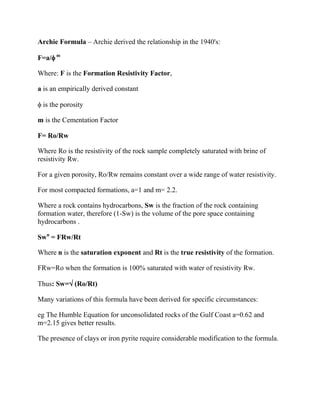
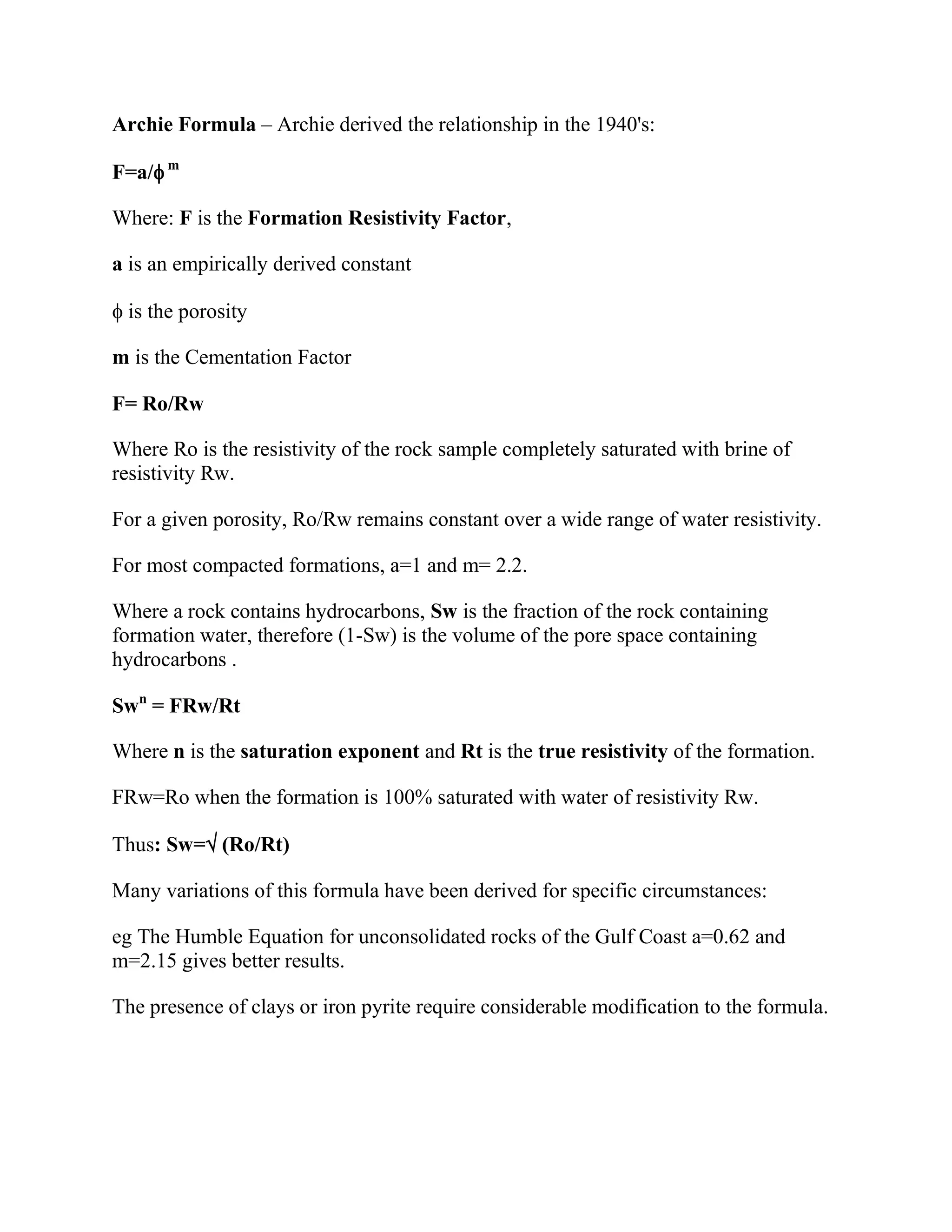
Archie Formula – Archie derived the relationship in the 1940's:

F=a/ m

Where: F is the Formation Resistivity Factor,

a is an empirically derived constant

 is the porosity

m is the Cementation Factor

F= Ro/Rw

Where Ro is the resistivity of the rock sample completely saturated with brine of
resistivity Rw.

For a given porosity, Ro/Rw remains constant over a wide range of water resistivity.

For most compacted formations, a=1 and m= 2.2.

Where a rock contains hydrocarbons, Sw is the fraction of the rock containing
formation water, therefore (1-Sw) is the volume of the pore space containing
hydrocarbons .

Swn = FRw/Rt

Where n is the saturation exponent and Rt is the true resistivity of the formation.

FRw=Ro when the formation is 100% saturated with water of resistivity Rw.

Thus: Sw= (Ro/Rt)

Many variations of this formula have been derived for specific circumstances:

eg The Humble Equation for unconsolidated rocks of the Gulf Coast a=0.62 and
m=2.15 gives better results.

The presence of clays or iron pyrite require considerable modification to the formula.

Archie formula

  • 1.
    Archie Formula –Archie derived the relationship in the 1940's: F=a/ m Where: F is the Formation Resistivity Factor, a is an empirically derived constant  is the porosity m is the Cementation Factor F= Ro/Rw Where Ro is the resistivity of the rock sample completely saturated with brine of resistivity Rw. For a given porosity, Ro/Rw remains constant over a wide range of water resistivity. For most compacted formations, a=1 and m= 2.2. Where a rock contains hydrocarbons, Sw is the fraction of the rock containing formation water, therefore (1-Sw) is the volume of the pore space containing hydrocarbons . Swn = FRw/Rt Where n is the saturation exponent and Rt is the true resistivity of the formation. FRw=Ro when the formation is 100% saturated with water of resistivity Rw. Thus: Sw= (Ro/Rt) Many variations of this formula have been derived for specific circumstances: eg The Humble Equation for unconsolidated rocks of the Gulf Coast a=0.62 and m=2.15 gives better results. The presence of clays or iron pyrite require considerable modification to the formula.