ARC 110
History of Architecture I
Module 4
Ancient Egyptian Architecture
Module Outline
• L
ecture 10
– Historical Background
• Location and period
• Social characteristics and beliefs
– Architecture of the Civilization
• Early Kingdom Tombs
• L
ecture 11
– Early kingdom Tombs continue
– Middle and New Kingdom Burial Chambers
• L
ecture 12
– Middle and New Kingdom Burial Chambers Continue
– New Kingdom Cult Temples
– Other Architectural Elements
• L
ecture 13
– Architectural Characteristics
• Buildings and other architectural elements
• Building materials, construction and technologies
• Architectural Organizing principles
Ancient Egyptian Civilization
Learning Outcomes
• What we expect to learn from the civilization:
– The influence of geographical location on social life
and architecture
– Architecture as a store of social history
– Architecture of pyramids, tombs and temples
– Evolution of architectural elements of column, beam,
obelisk, wall relief and clerestory lighting
– Architectural principles emphasizing mass rather than
space and linearity and axiality as organizing
principles
Module 4 Lecture 10
Ancient Egyptian Architecture
Outline of Lecture
• Lecture 10
– Historical Background
• Location and period
• Social characteristics and beliefs
– Architecture of the Civilization
• Early Kingdom Tombs
– Mastaba
– Stepped Pyramid
– Geometrical Pyramid
Historical
Background
Historical Background
Location
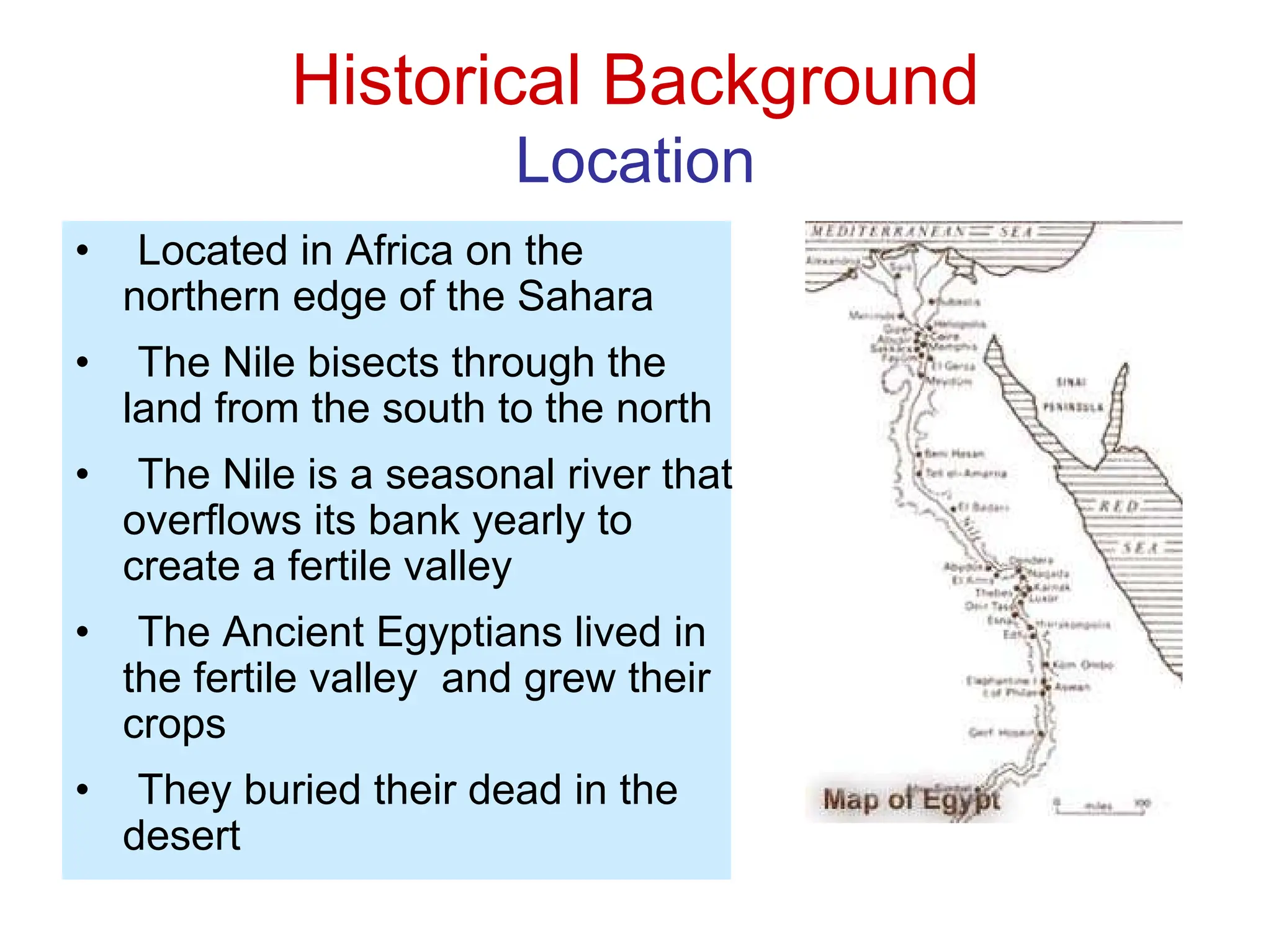
• Located in Africa on the
northern edge of the Sahara
• The Nile bisects through the
land from the south to the north
• The Nile is a seasonal river that
overflows its bank yearly to
create a fertile valley
• The Ancient Egyptians lived in
the fertile valley and grew their
crops
• They buried their dead in the
desert
Historical Background
Period
• The history of ancient Egypt started with the
land divided into upper and lower Egypt
• The two regions were frequently at war with
each other
• Around 3000 BC, King Menes united the two
into a single nation
• Unification brought about peace that led to the
development of ancient Egyptian Civilization
Historical Background
Period
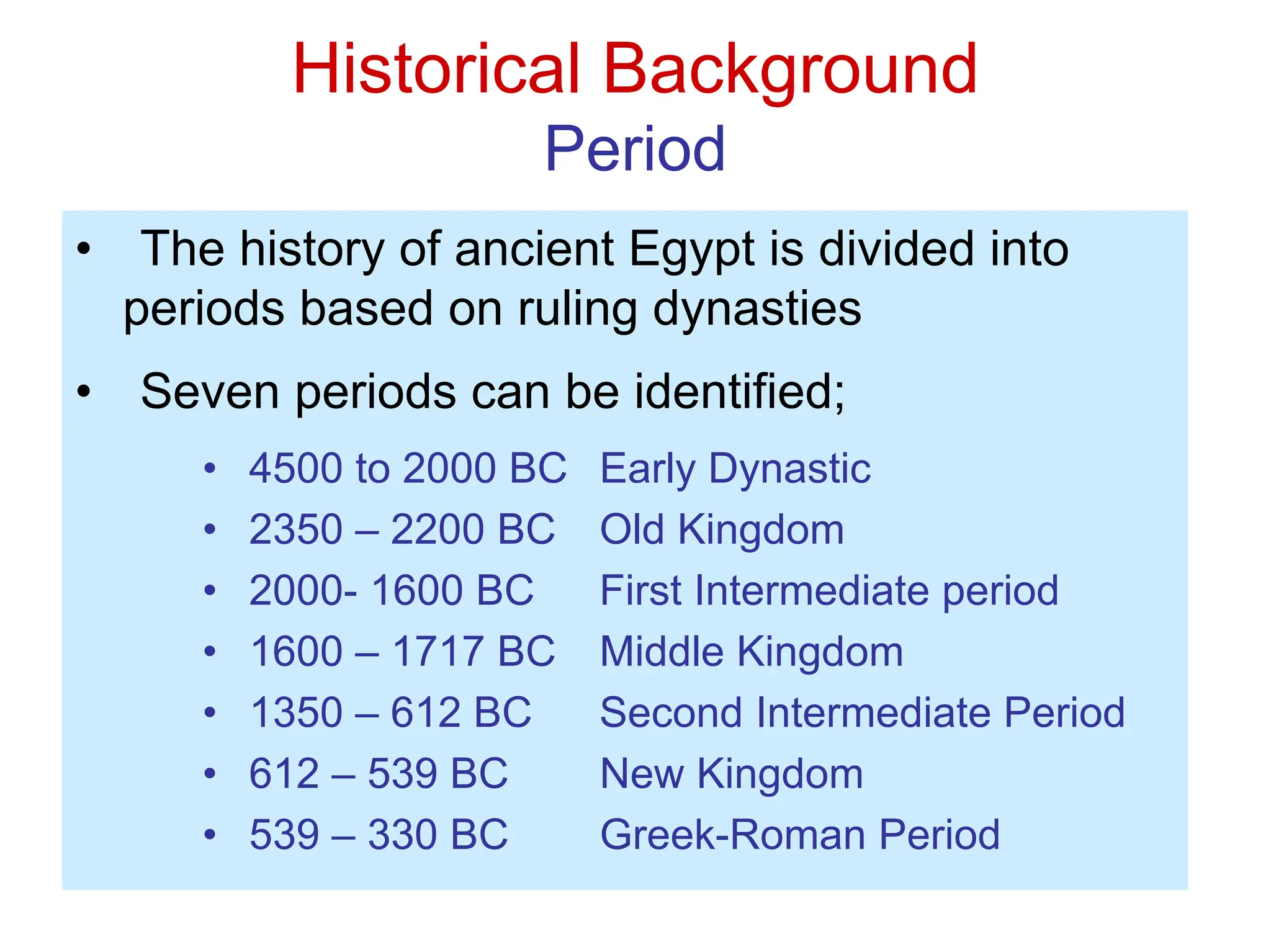
• The history of ancient Egypt is divided into
periods based on ruling dynasties
• Seven periods can be identified;
• 4500 to 2000 BC Early Dynastic
• 2350 – 2200 BC Old Kingdom
• 2000- 1600 BC First Intermediate period
• 1600 – 1717 BC Middle Kingdom
• 1350 – 612 BC Second Intermediate Period
• 612 – 539 BC New Kingdom
• 539 – 330 BC Greek-Roman Period
Historical Background
Social Characteristics & Beliefs
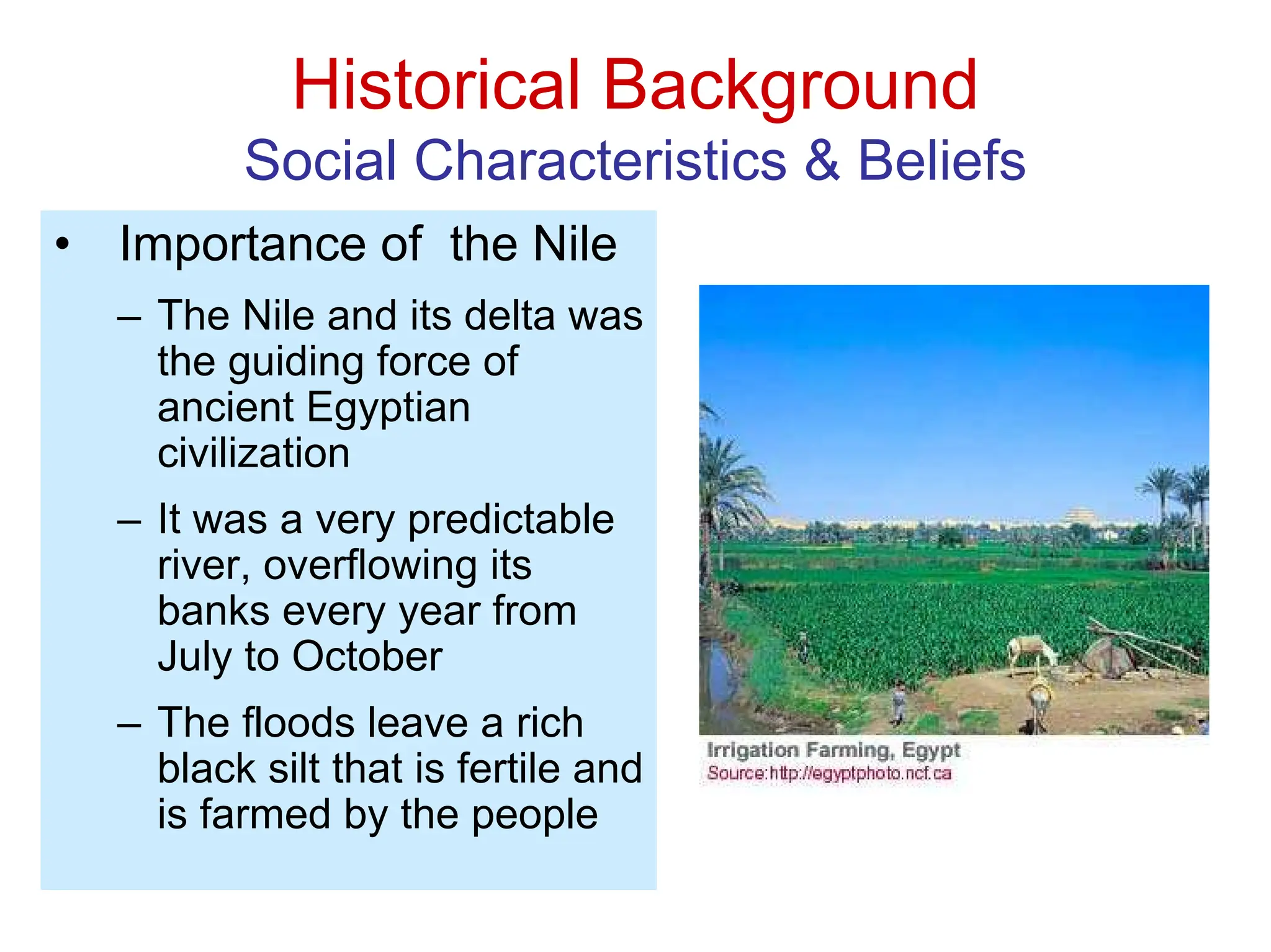
• Importance of the Nile
– The Nile and its delta was
the guiding force of
ancient Egyptian
civilization
– It was a very predictable
river, overflowing its
banks every year from
July to October
– The floods leave a rich
black silt that is fertile and
is farmed by the people
Historical Background
Social Characteristics & Beliefs
• Importance of the Nile
– During the floods, people were freed from farming to
engage in other activities including building work
– The Nile was also the highway of Egypt connecting
upper and lower Egypt
– The Nile also offered protection from Invasion by
outsiders
– The Nile offered a symbolic sense of direction to the
people, forming the primary principle in architectural
organization
Historical Background
Social Characteristics & Beliefs
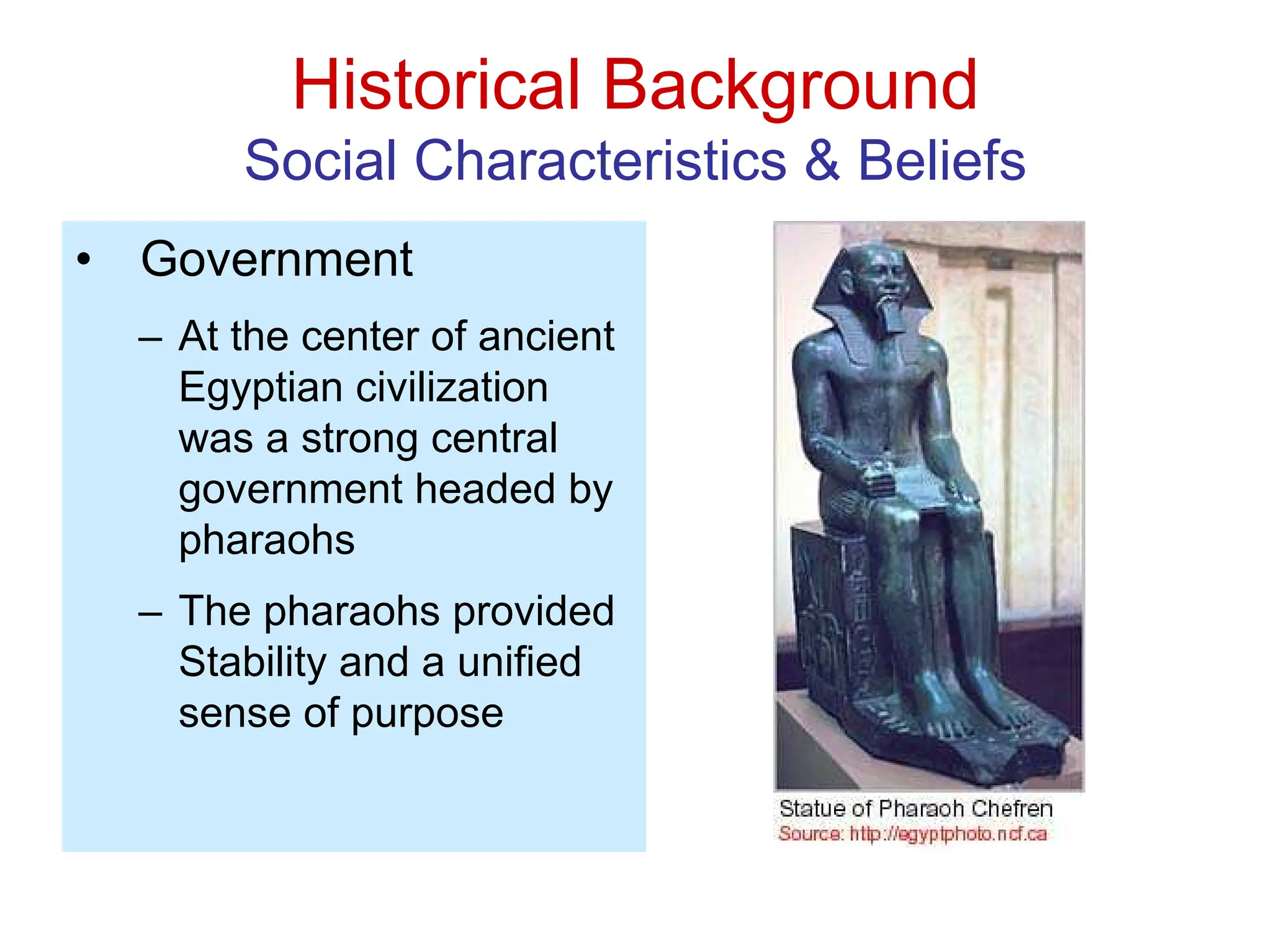
• Government
– At the center of ancient
Egyptian civilization
was a strong central
government headed by
pharaohs
– The pharaohs provided
Stability and a unified
sense of purpose
Historical Background
Social Characteristics & Beliefs
• R
eligion
– Ancient Egyptians were
a religious people
– They believed in many
Gods
– Different symbols were
used to represent the
Gods and temples were
built and dedicated to
them
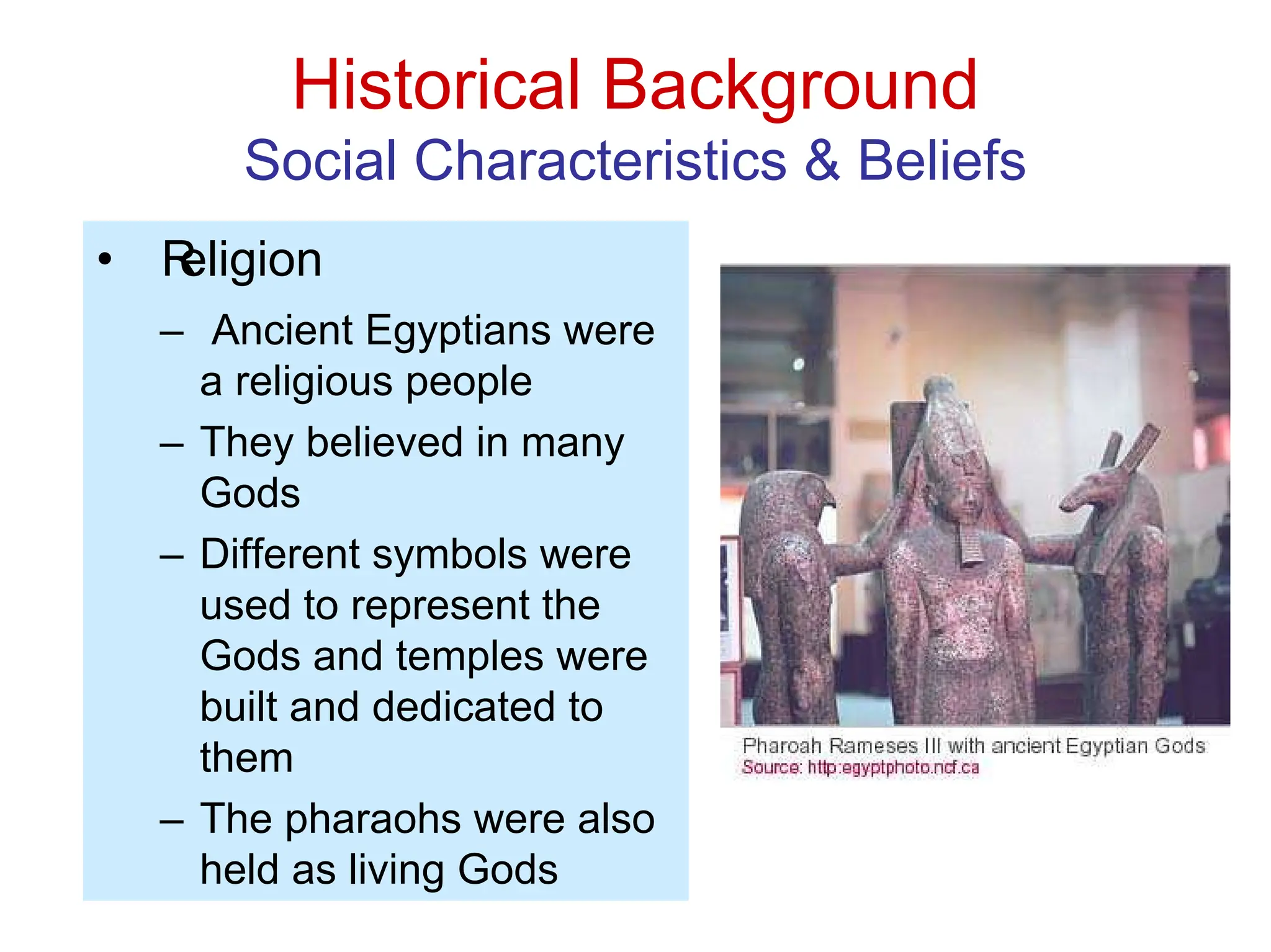
– The pharaohs were also
held as living Gods
Historical Background
Social Characteristics & Beliefs
• Religion
– Egyptians also believed in life after death
– They believed that when they die, their souls
called Ka would live in them for ever
– For the Ka to live, it needed either the body of
the dead person or a copy of it in the form a
statue
– The Ka will return each night to the body or
statue
– If both the body and statue are destroyed,
then the Ka would die
Historical Background
Social Characteristics & Beliefs
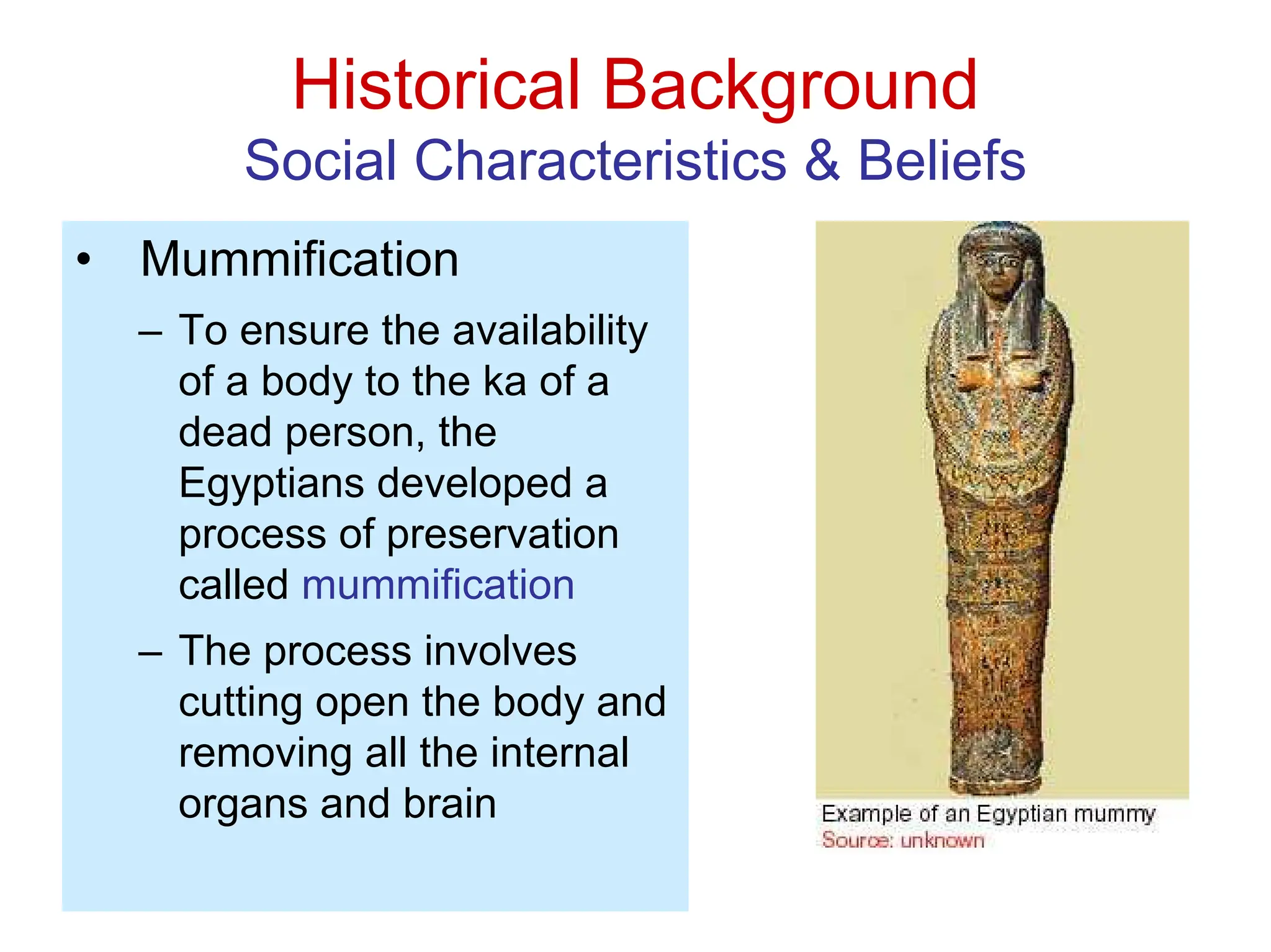
• Mummification
– To ensure the availability
of a body to the ka of a
dead person, the
Egyptians developed a
process of preservation
called mummification
– The process involves
cutting open the body and
removing all the internal
organs and brain
Historical Background
Social Characteristics & Beliefs
• Mummification
– The body is then packed in natron to dry it out
– It is then soaked in oil to preserve it
– Next it is wrapped in a special cloth called mummy
cloth
– The mummy is then coated with wax and a face
painted onto its wrapped head
– The mummification of a pharaoh took a period of 72
days
– Once mummification is finished, burial ceremonies
are performed and the body is ready for burial
Historical Background
Social Characteristics & Beliefs
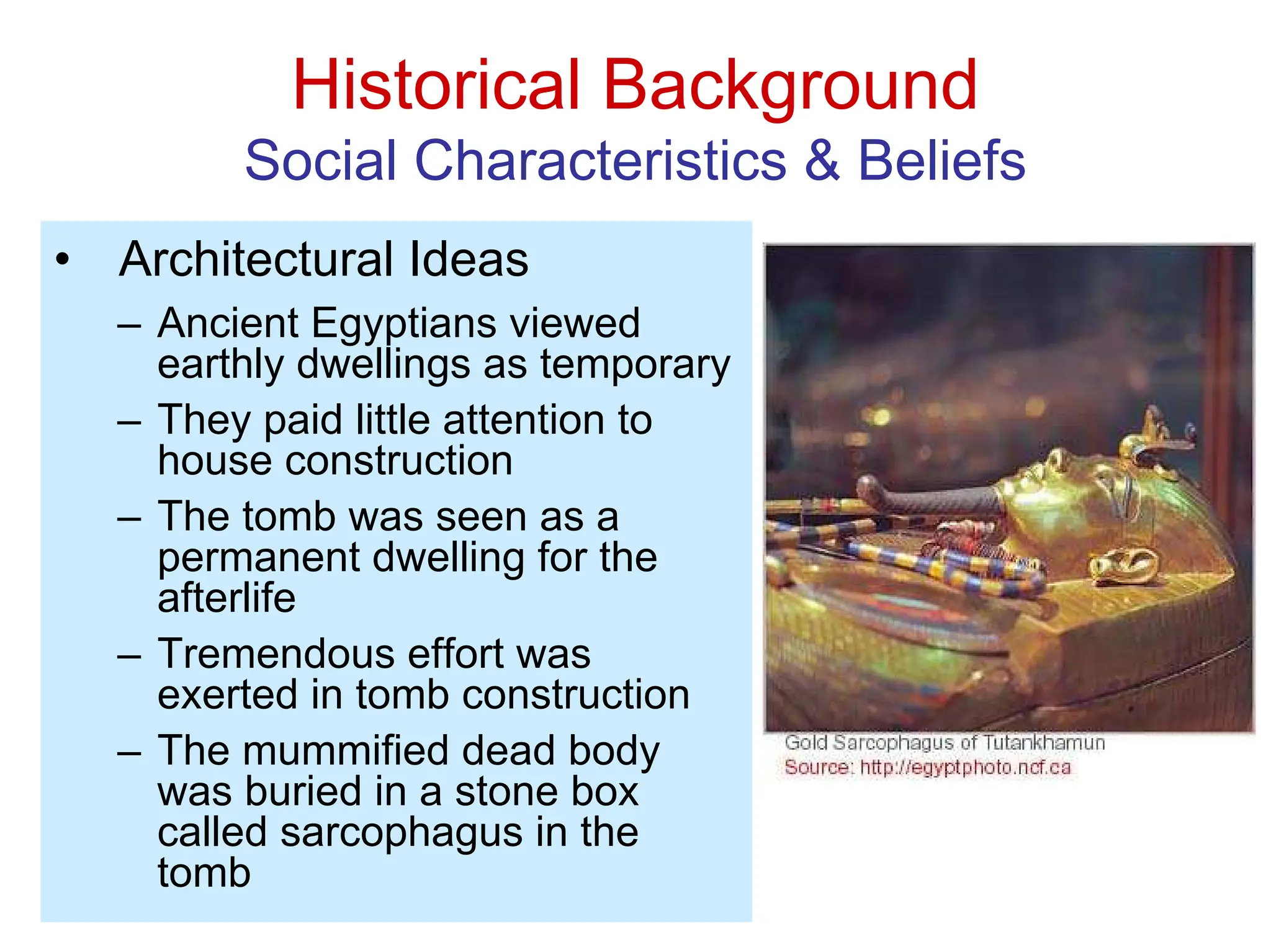
• Architectural Ideas
– Ancient Egyptians viewed
earthly dwellings as temporary
– They paid little attention to
house construction
– The tomb was seen as a
permanent dwelling for the
afterlife
– Tremendous effort was
exerted in tomb construction
– The mummified dead body
was buried in a stone box
called sarcophagus in the
tomb
Historical Background
Social Characteristics & Beliefs
• Architectural Ideas
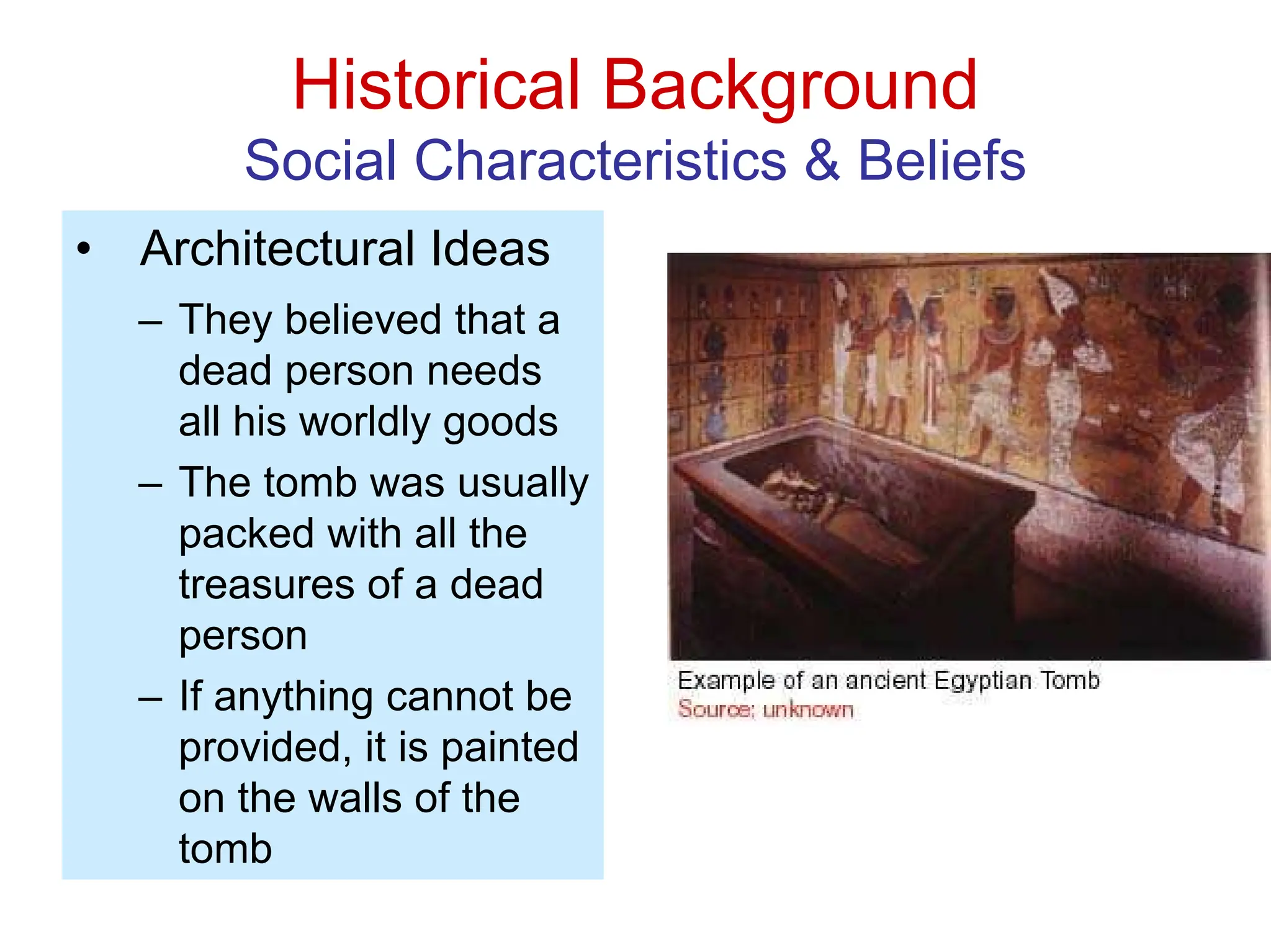
– They believed that a
dead person needs
all his worldly goods
– The tomb was usually
packed with all the
treasures of a dead
person
– If anything cannot be
provided, it is painted
on the walls of the
tomb
Historical Background
Social Characteristics & Beliefs
• Architectural Ideas
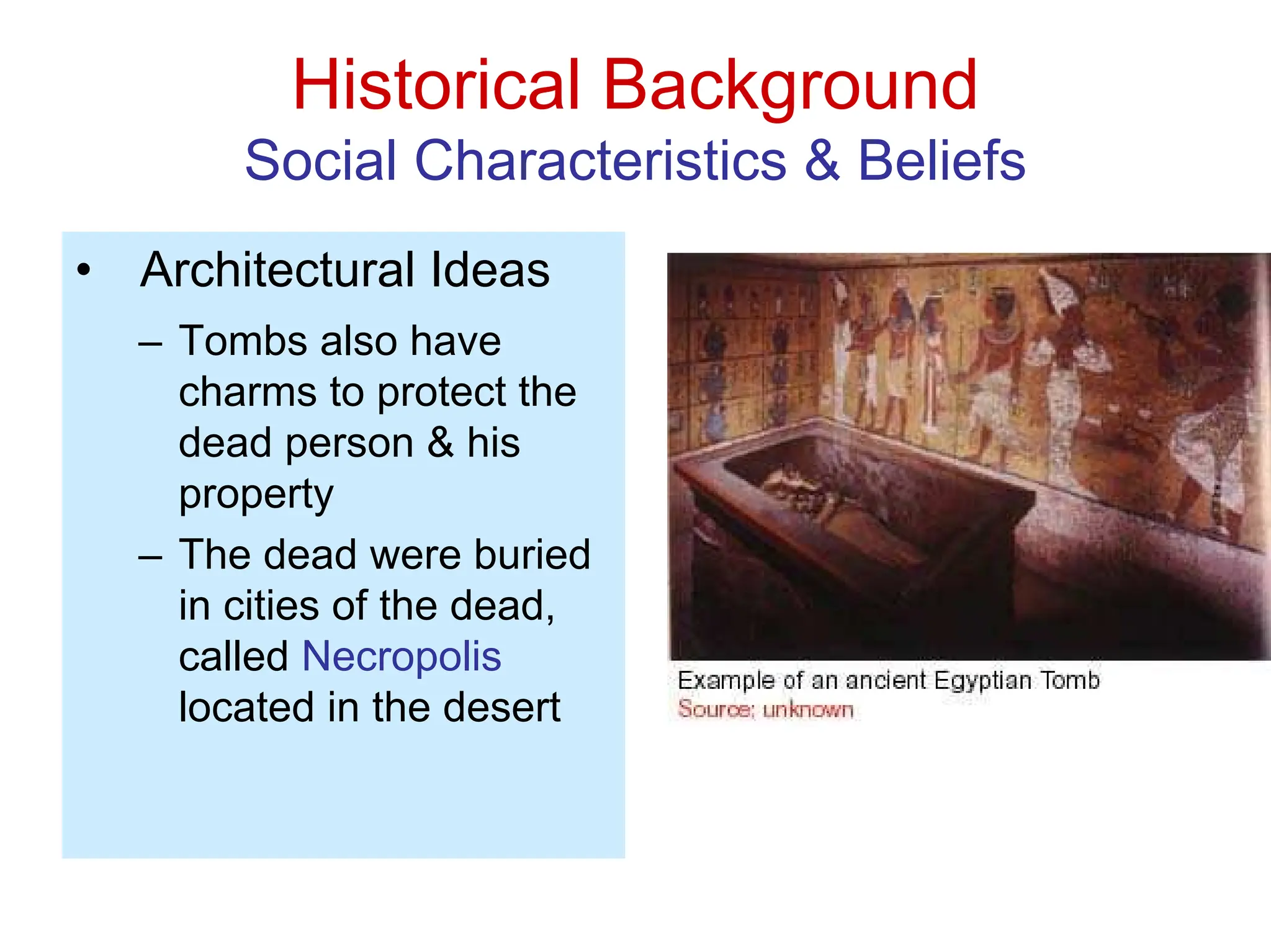
– Tombs also have
charms to protect the
dead person & his
property
– The dead were buried
in cities of the dead,
called Necropolis
located in the desert
Historical Background
Social Characteristics & Beliefs
• Achievements
– Ancient Egyptians had many achievements
– This included a developed system of government, a
belief system and art of mummification already
discussed
– They also left a legacy of tombs and temples that we
will study
– The Egyptians develop a system of irrigation to
improve agriculture
– The ancient Egyptians invented the hieroglyphics
systems of writing
– Historians were able to read hieroglyphics following
the discovery of the Rosetta stone
Architecture
of
the
Civilization
Architecture of the Civilization
Introduction
• During the old Kingdom, the pharaoh and his
court lived in Memphis
• When they died they were buried at the
Necropolis at Saqqara
• The earthly dwelling of the ancient Egyptians
was seen as temporary and the tomb as a
permanent dwelling
• Houses were built of temporary materials to last
for a life time
Architecture of the Civilization
Introduction
• Tombswere most outstanding architectural
element of the period
• Tombs also serve as thefocus for the worship
of the dead
• The Tomb evolved during the old kingdom
from the Mastaba, through the stepped
pyramid to the renown ancient Egyptian
pyramid
• We will examine each of these next
Early Kingdom Tombs
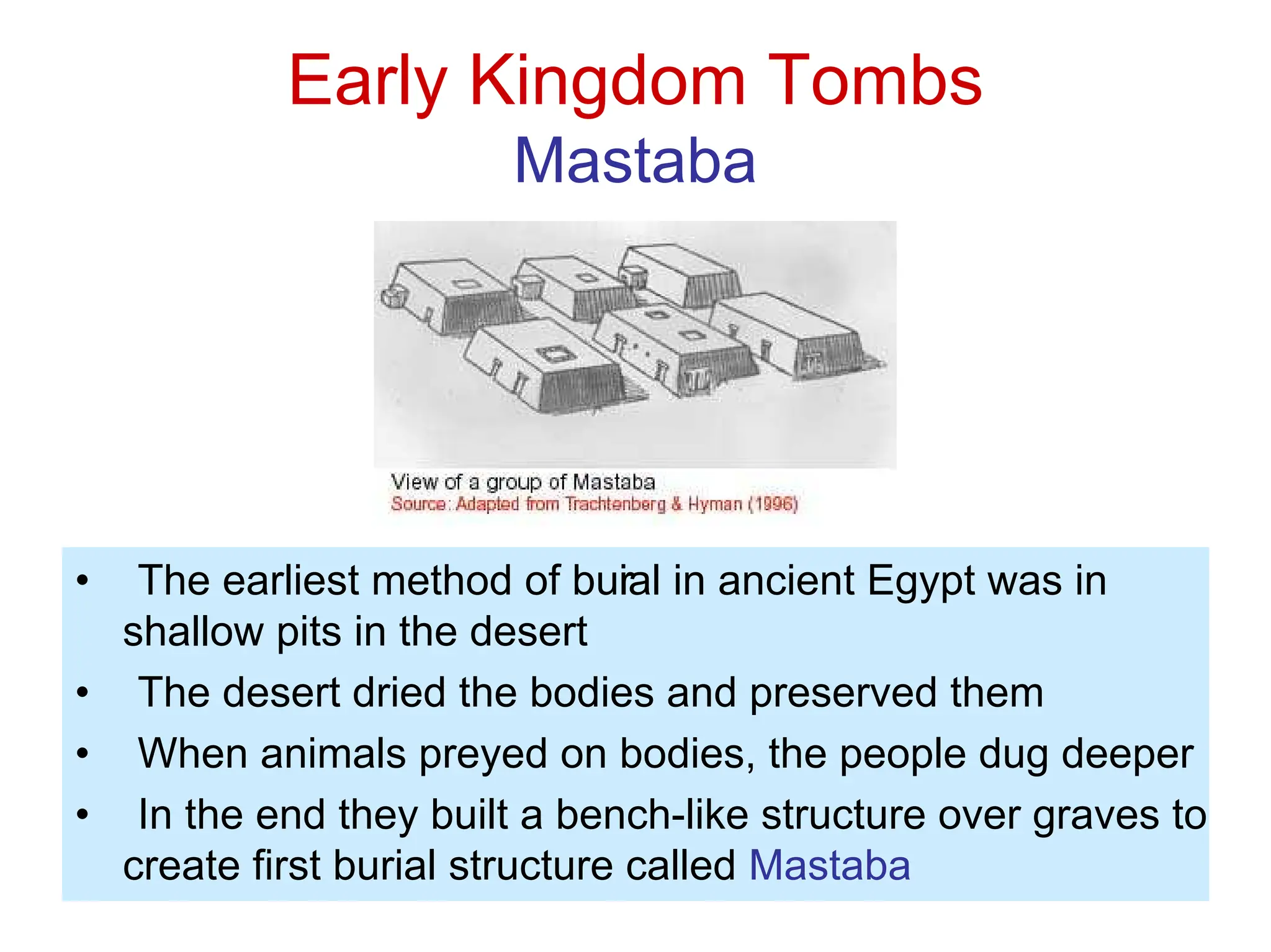
Mastaba
• The earliest method of bur
ial in ancient Egypt was in
shallow pits in the desert
• The desert dried the bodies and preserved them
• When animals preyed on bodies, the people dug deeper
• In the end they built a bench-like structure over graves to
create first burial structure called Mastaba
Early Kingdom Tombs
Mastaba
• The name mastaba is derived from podiums
found in the front of traditional houses
• In the Old Kingdom, rich and noble person built
mastaba for their burial in the city of the dead
• Above ground the Mastaba is a large bench of
sun-baked bricks rising 9 meters high
• It had a flat top and slanting walls
• The earliest royal tombs were decorated with
painted patterns in brilliant colors
Early Kingdom Tombs
Mastaba
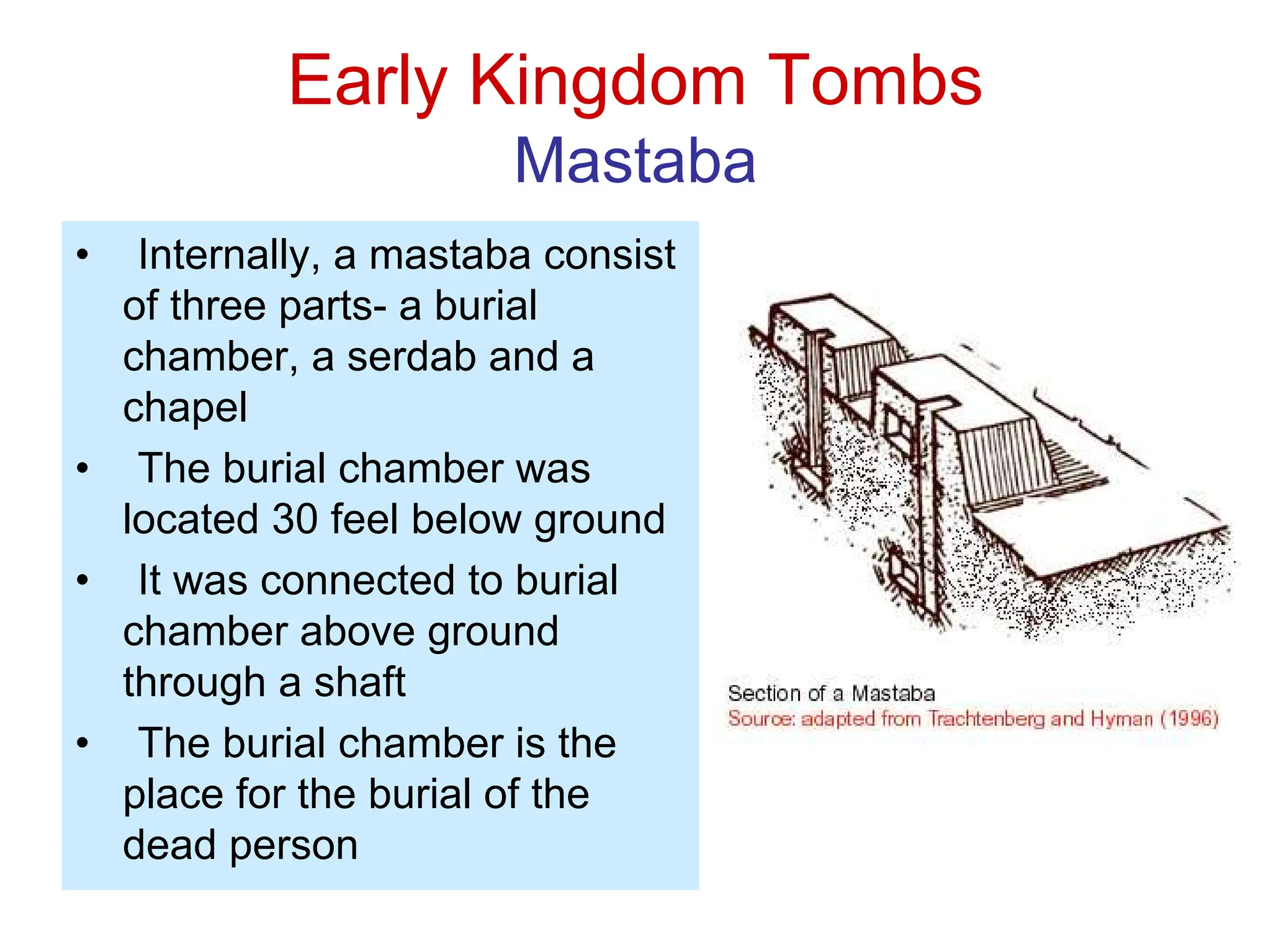
• Internally, a mastaba consist
of three parts- a burial
chamber, a serdab and a
chapel
• The burial chamber was
located 30 feel below ground
• It was connected to burial
chamber above ground
through a shaft
• The burial chamber is the
place for the burial of the
dead person
Early Kingdom Tombs
Mastaba
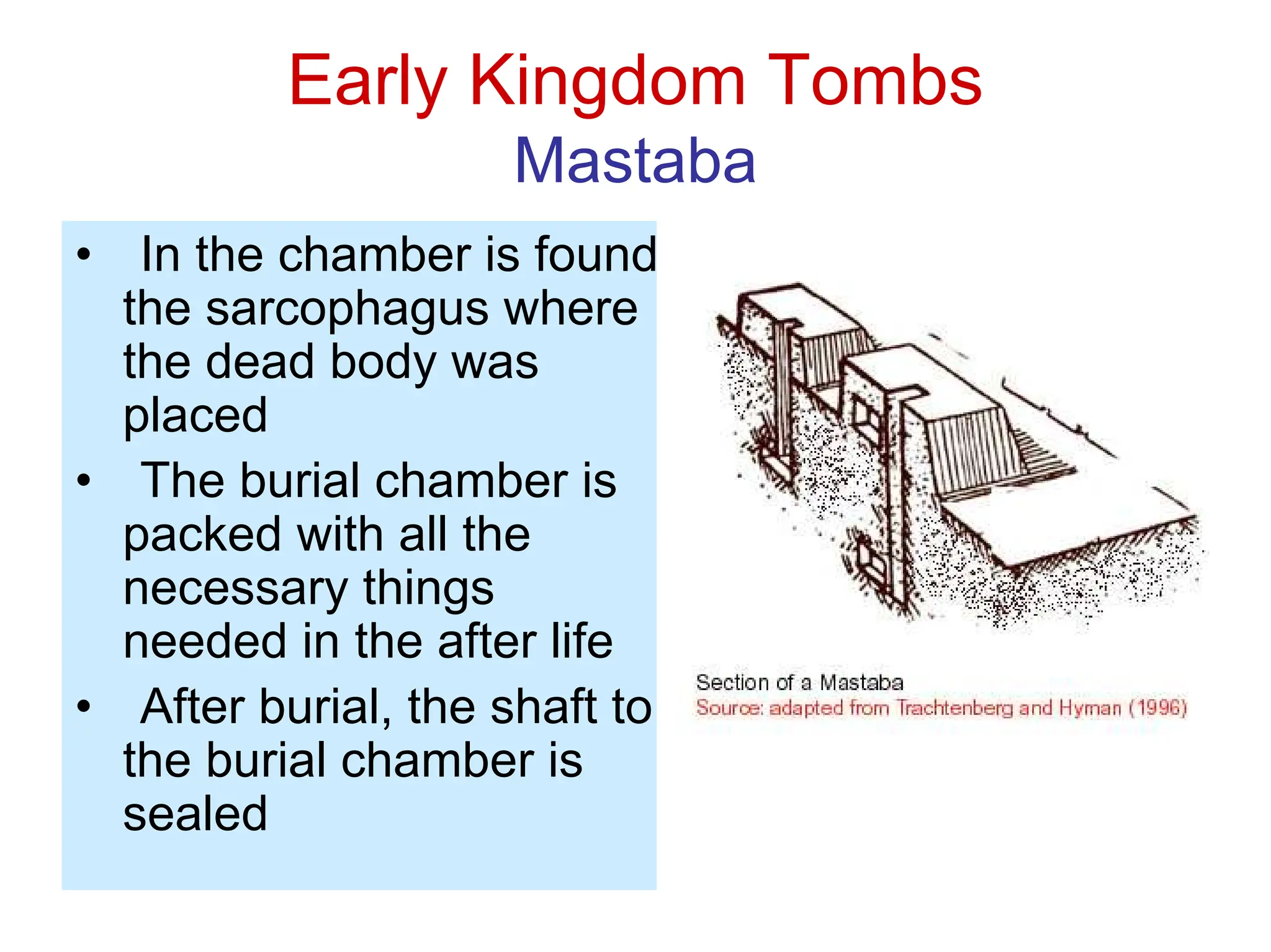
• In the chamber is found
the sarcophagus where
the dead body was
placed
• The burial chamber is
packed with all the
necessary things
needed in the after life
• After burial, the shaft to
the burial chamber is
sealed
Early Kingdom Tombs
Mastaba
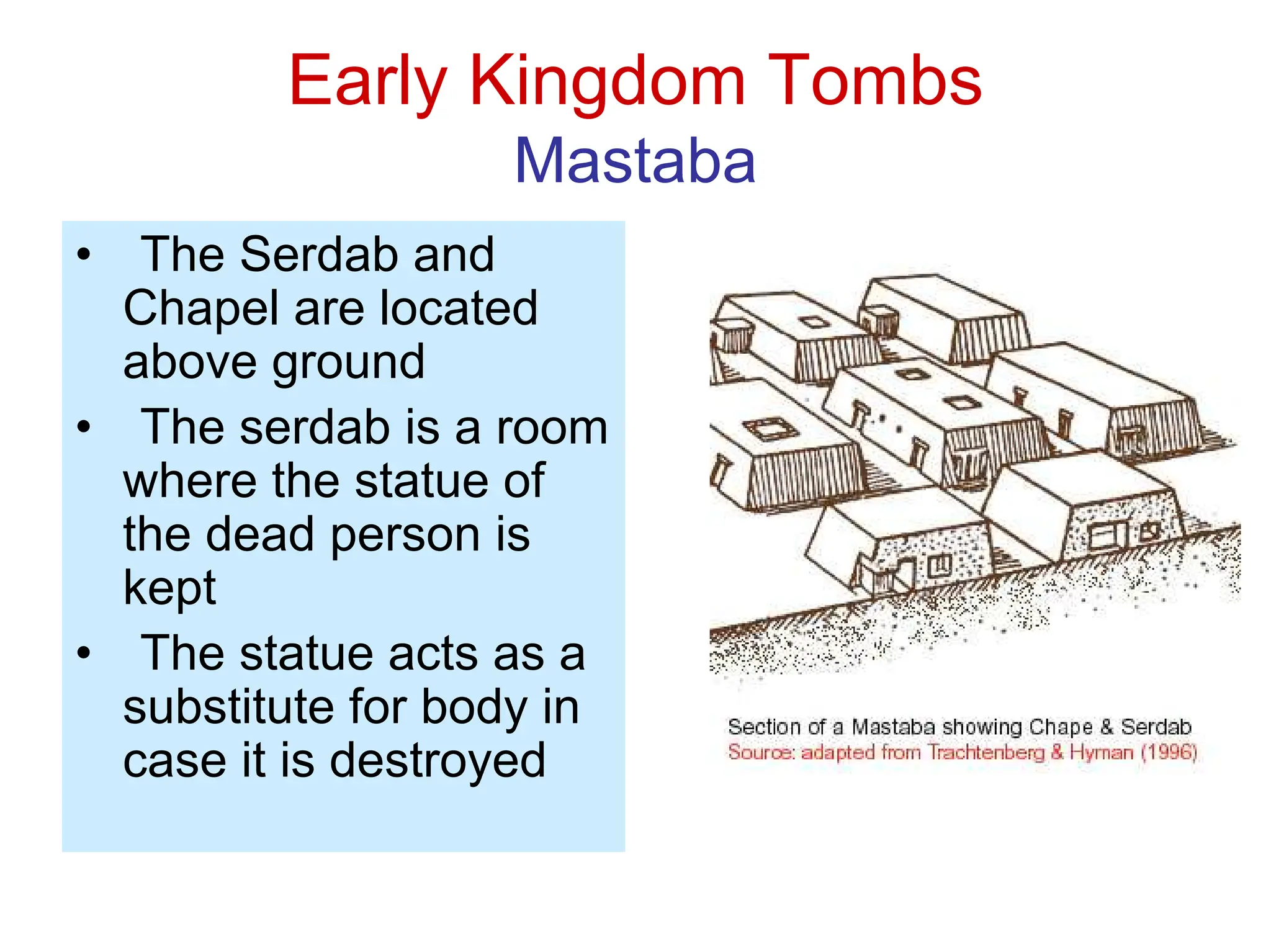
• The Serdab and
Chapel are located
above ground
• The serdab is a room
where the statue of
the dead person is
kept
• The statue acts as a
substitute for body in
case it is destroyed
Early Kingdom Tombs
Mastaba
• Egyptians believe that the Ka must return to
the body or a copy of it each night
• If both body and statue are destroyed, the ka
would die
• The chapel is where the ka is supposed to live
for ever
• It is a colorful room meant to deceive the gods
into letting the ka enter the next world
• Had a false door leading to the land of the
dead
Early Kingdom Tombs
Mastaba
• Some mastabas had fence walls, and
chambers for burial of servants
• Mastaba served as an embryo for the
evolution of the pyramid
End
of
Lecture
Module
4
Lecture
10
Module 4 Lecture 11
Ancient Egyptian Architecture
Outline of Lecture
• Lecture 11
– Early Kingdom Tombs Continue
• Stepped Pyramid
• Pyramid
– Middle and New Kingdom Burial Chambers
• Mortuary Temples
Architecture
of
the
Civilization
Early Kingdom Tombs
Stepped Pyramid
• King Zoser was the powerful pharaoh of
the third dynasty of the old kingdom
• The stepped pyramid was built for king
Zoser by Imhotep
• It was built as a funeral complex in the
necropolis at Saqqara
• Imhotep initially conceived of the tomb as
a large Mastaba of stone
Early Kingdom Tombs
Stepped Pyramid
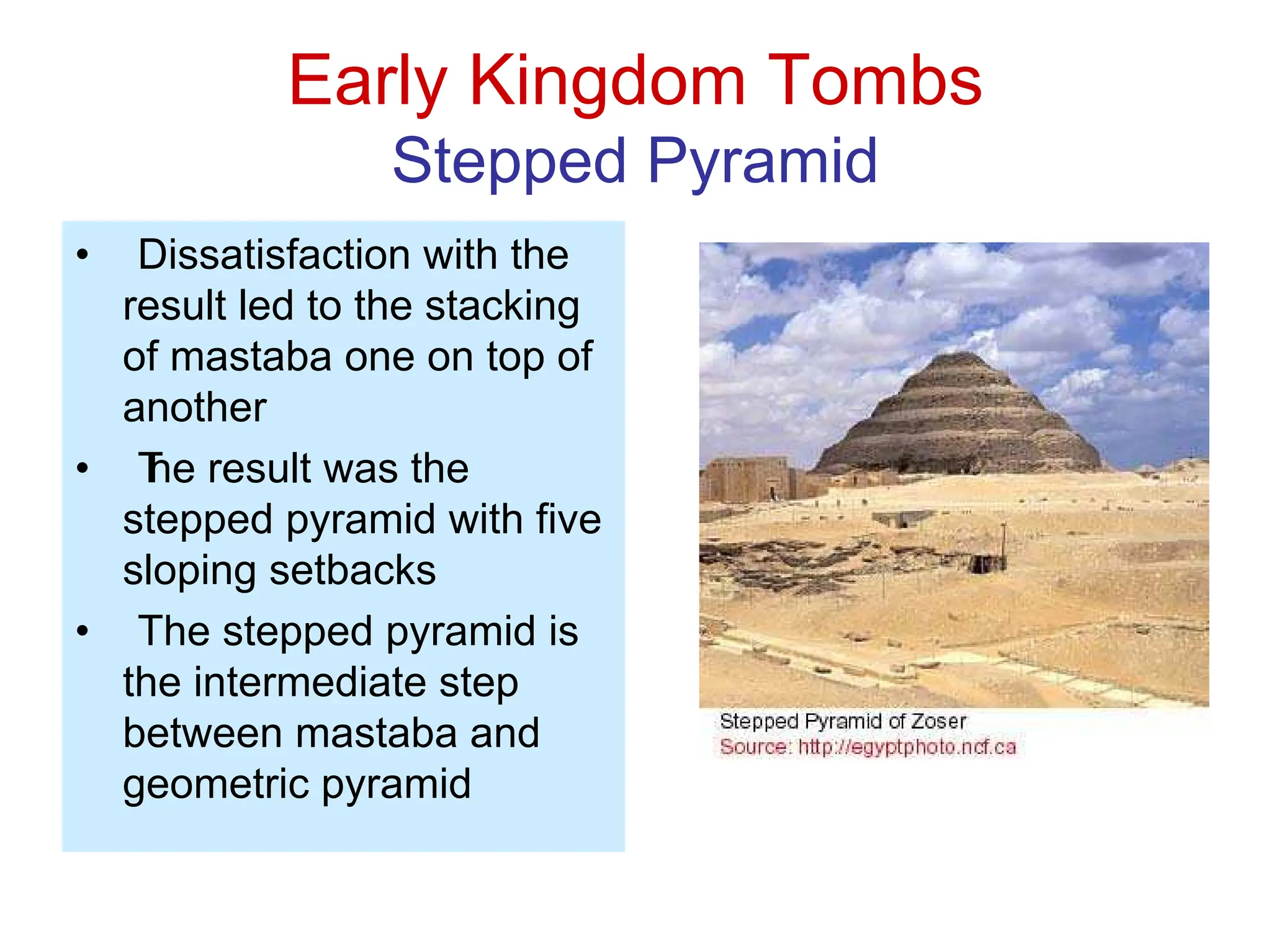
• Dissatisfaction with the
result led to the stacking
of mastaba one on top of
another
• T
he result was the
stepped pyramid with five
sloping setbacks
• The stepped pyramid is
the intermediate step
between mastaba and
geometric pyramid
Early Kingdom Tombs
Stepped Pyramid
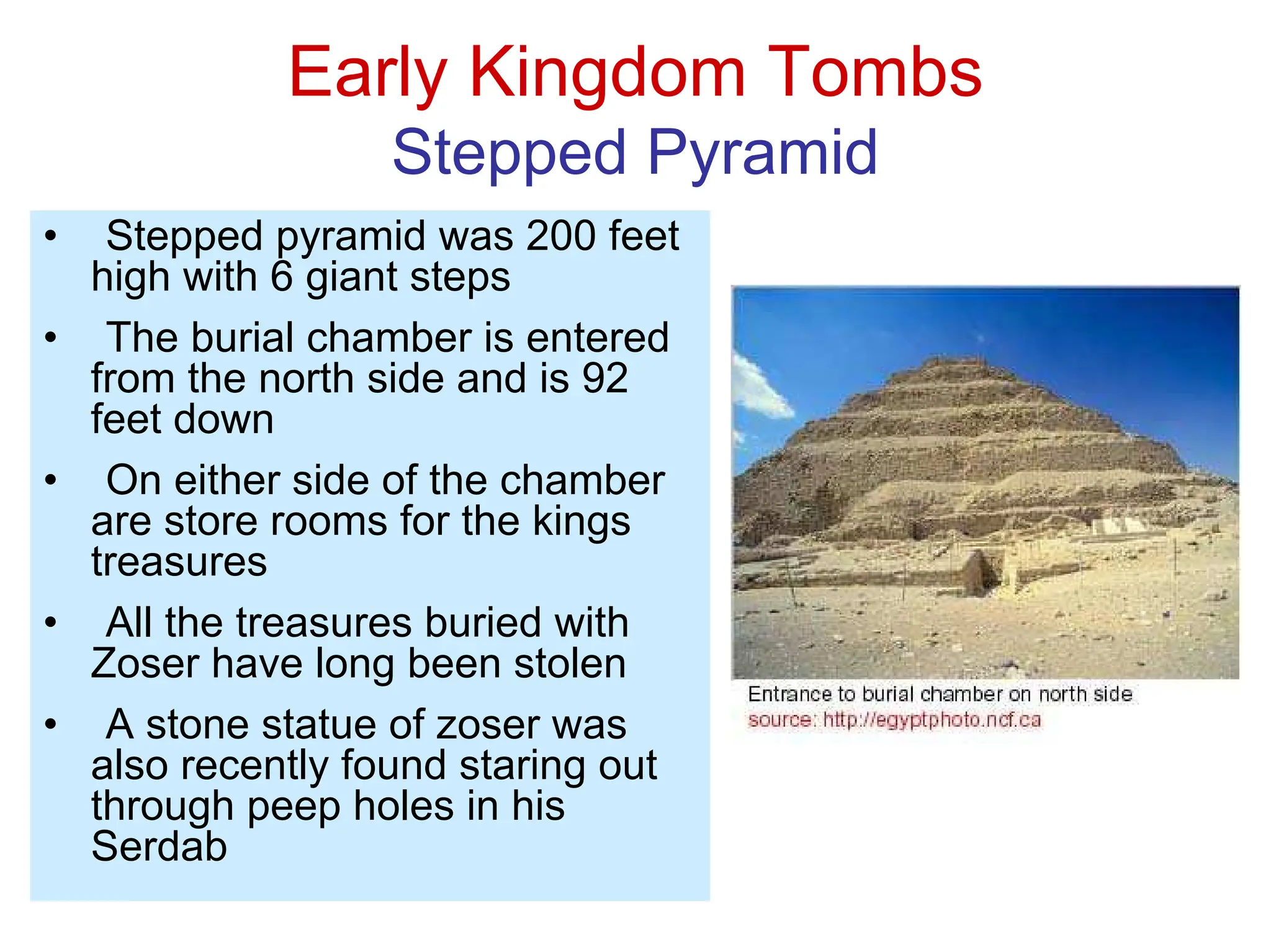
• Stepped pyramid was 200 feet
high with 6 giant steps
• The burial chamber is entered
from the north side and is 92
feet down
• On either side of the chamber
are store rooms for the kings
treasures
• All the treasures buried with
Zoser have long been stolen
• A stone statue of zoser was
also recently found staring out
through peep holes in his
Serdab
Early Kingdom Tombs
Stepped Pyramid
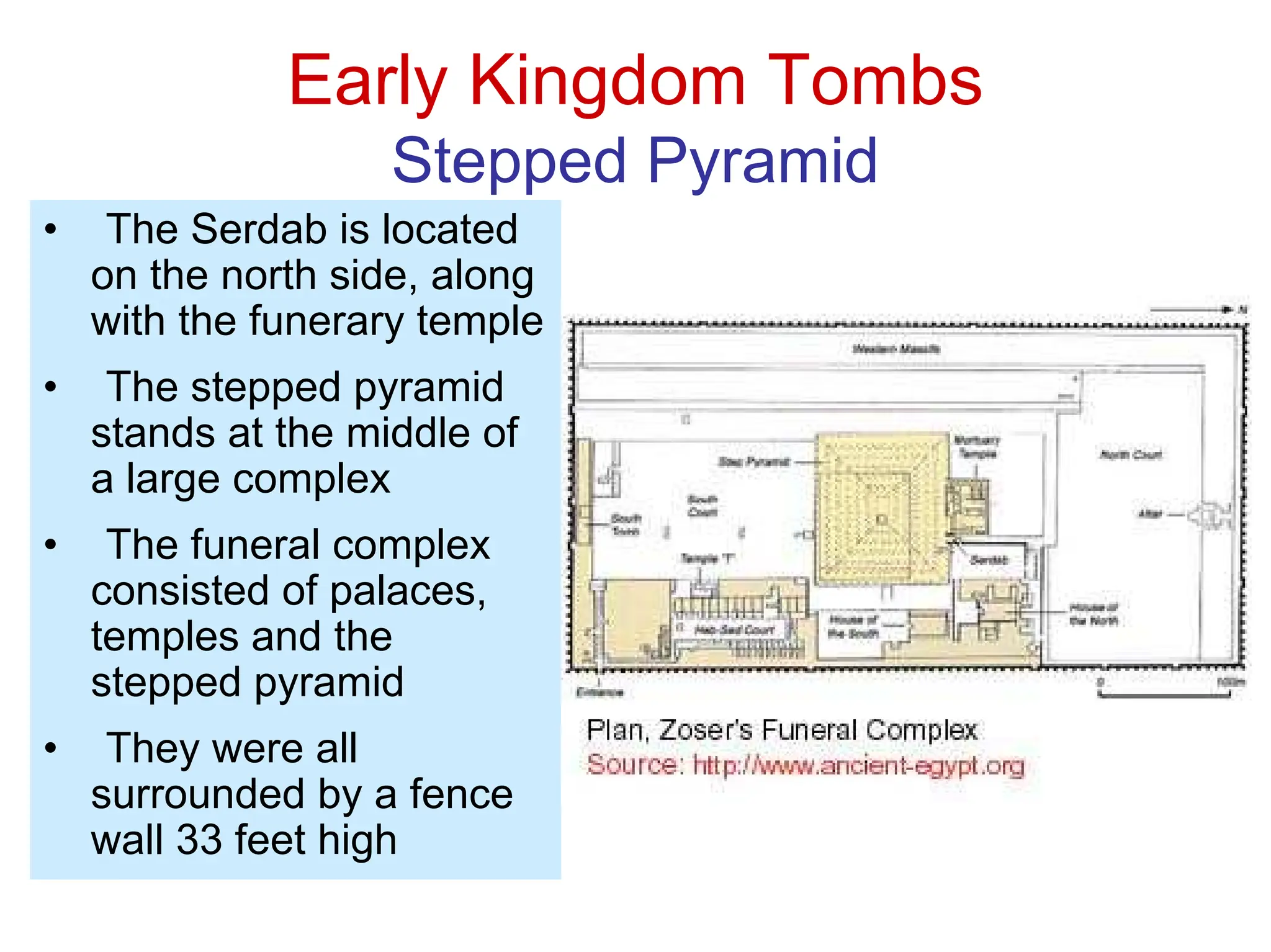
• The Serdab is located
on the north side, along
with the funerary temple
• The stepped pyramid
stands at the middle of
a large complex
• The funeral complex
consisted of palaces,
temples and the
stepped pyramid
• They were all
surrounded by a fence
wall 33 feet high
Early Kingdom Tombs
Stepped Pyramid
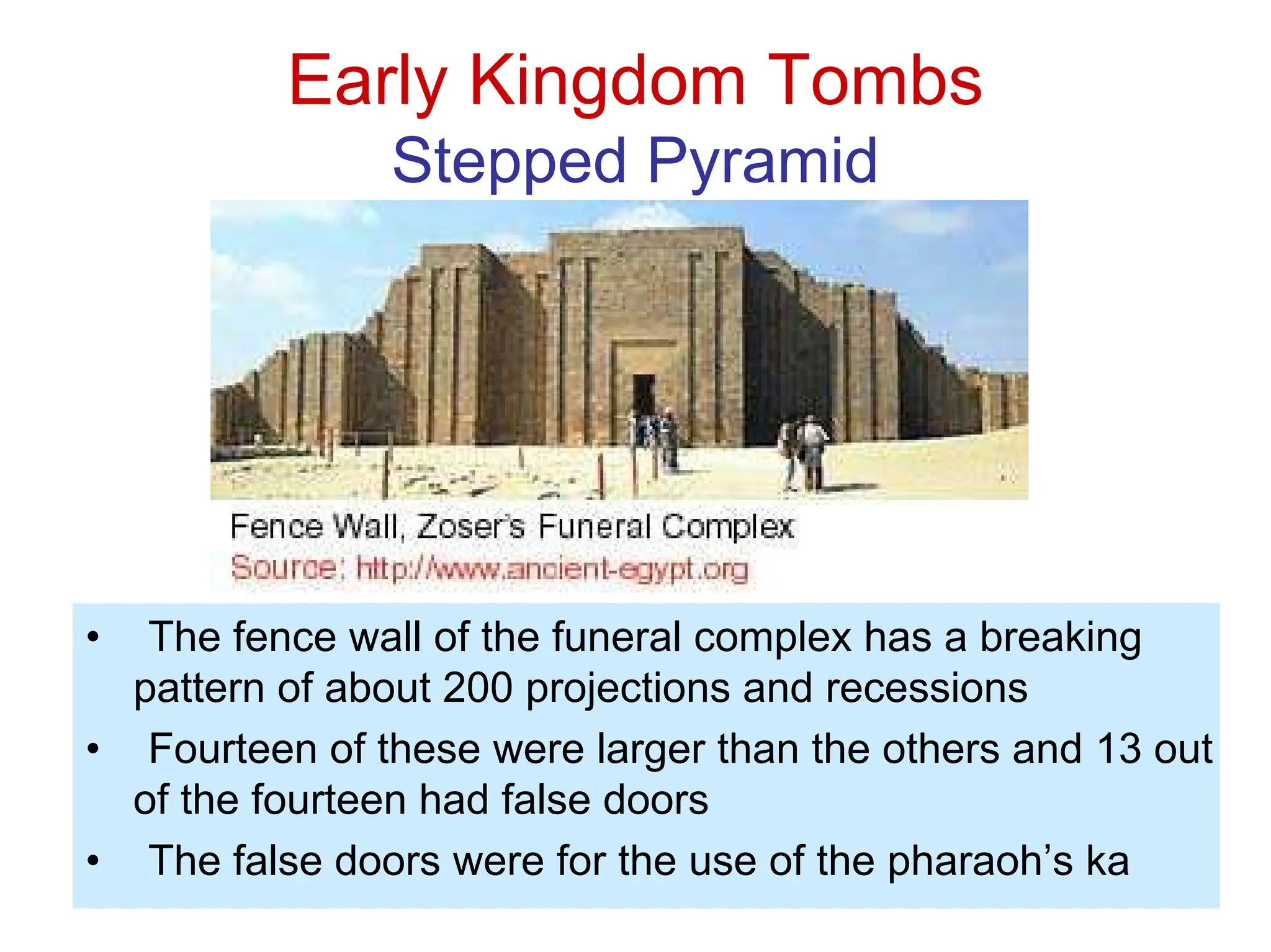
• The fence wall of the funeral complex has a breaking
pattern of about 200 projections and recessions
• Fourteen of these were larger than the others and 13 out
of the fourteen had false doors
• The false doors were for the use of the pharaoh’s ka
Early Kingdom Tombs
Stepped Pyramid
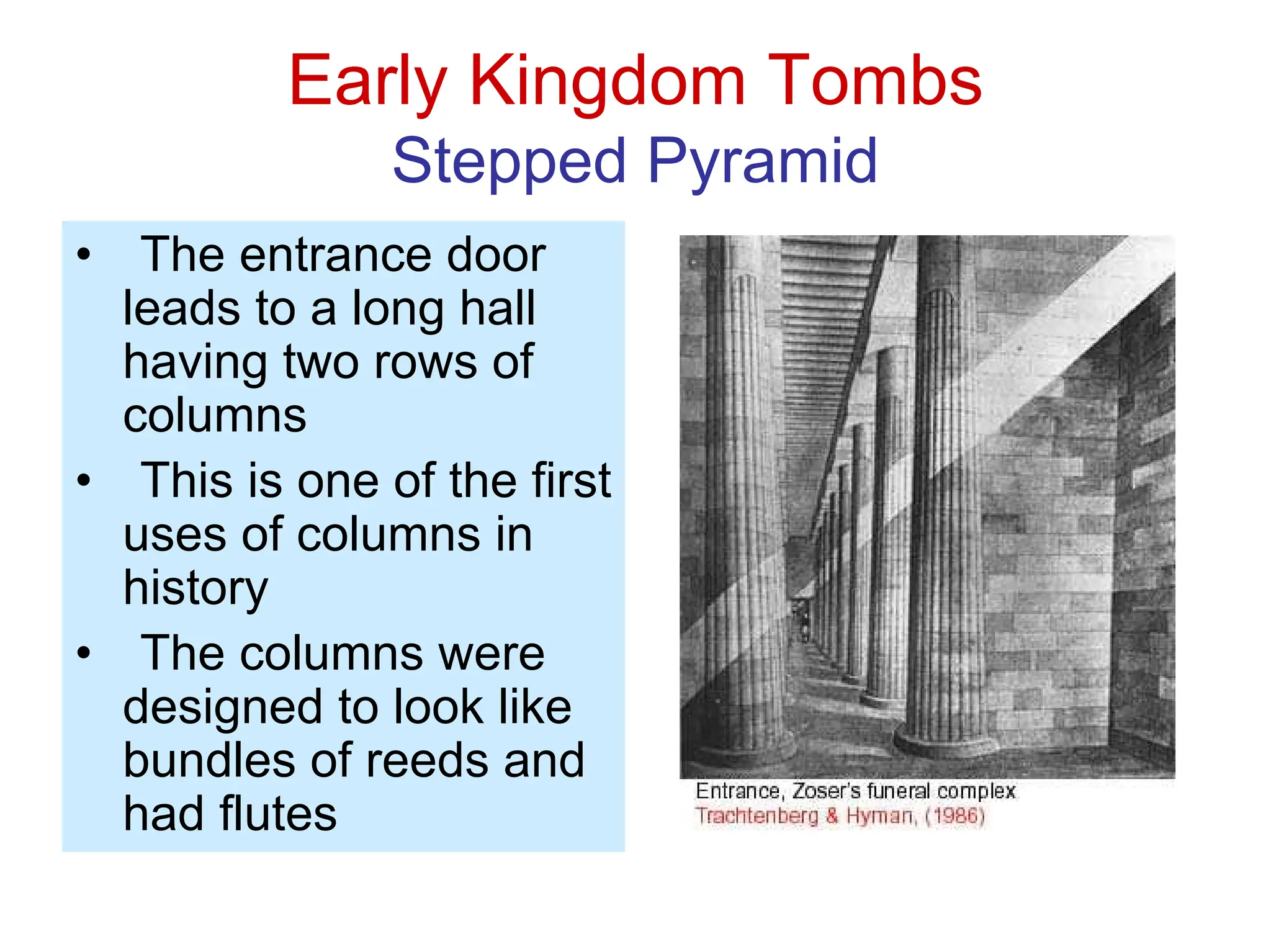
• The entrance door
leads to a long hall
having two rows of
columns
• This is one of the first
uses of columns in
history
• The columns were
designed to look like
bundles of reeds and
had flutes
Early Kingdom Tombs
Stepped Pyramid
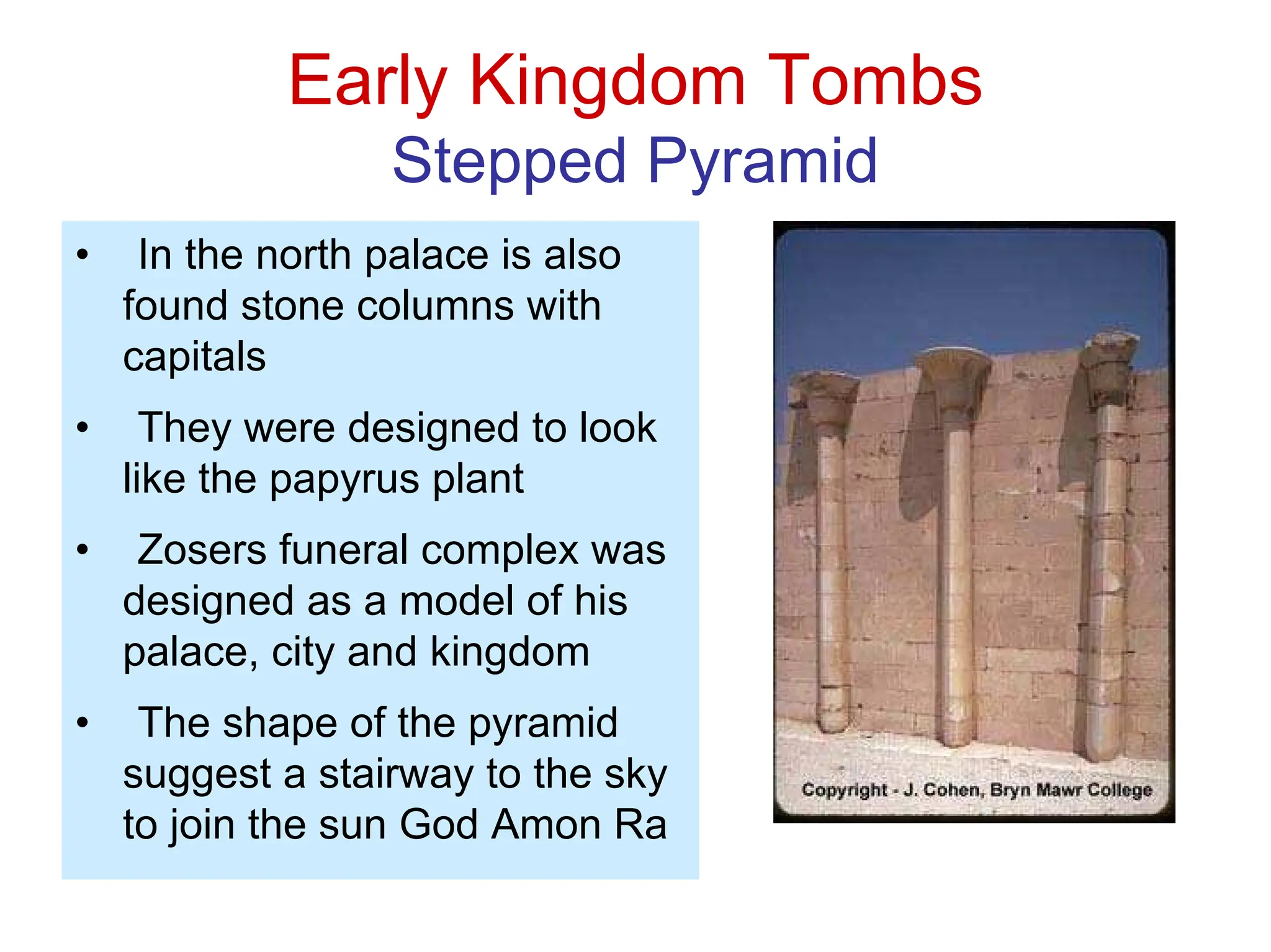
• In the north palace is also
found stone columns with
capitals
• They were designed to look
like the papyrus plant
• Zosers funeral complex was
designed as a model of his
palace, city and kingdom
• The shape of the pyramid
suggest a stairway to the sky
to join the sun God Amon Ra
Early Kingdom Tomb
Attempts at Pyramid Building
• After the stepped pyramids, there were
several attempt at building a pure
geometric pyramid
• Among the prominent attempts were the
pyramid at Medun and two pyramids built
by Snefru at Dashur
Early Kingdom Tomb
Attempts at Pyramid Building
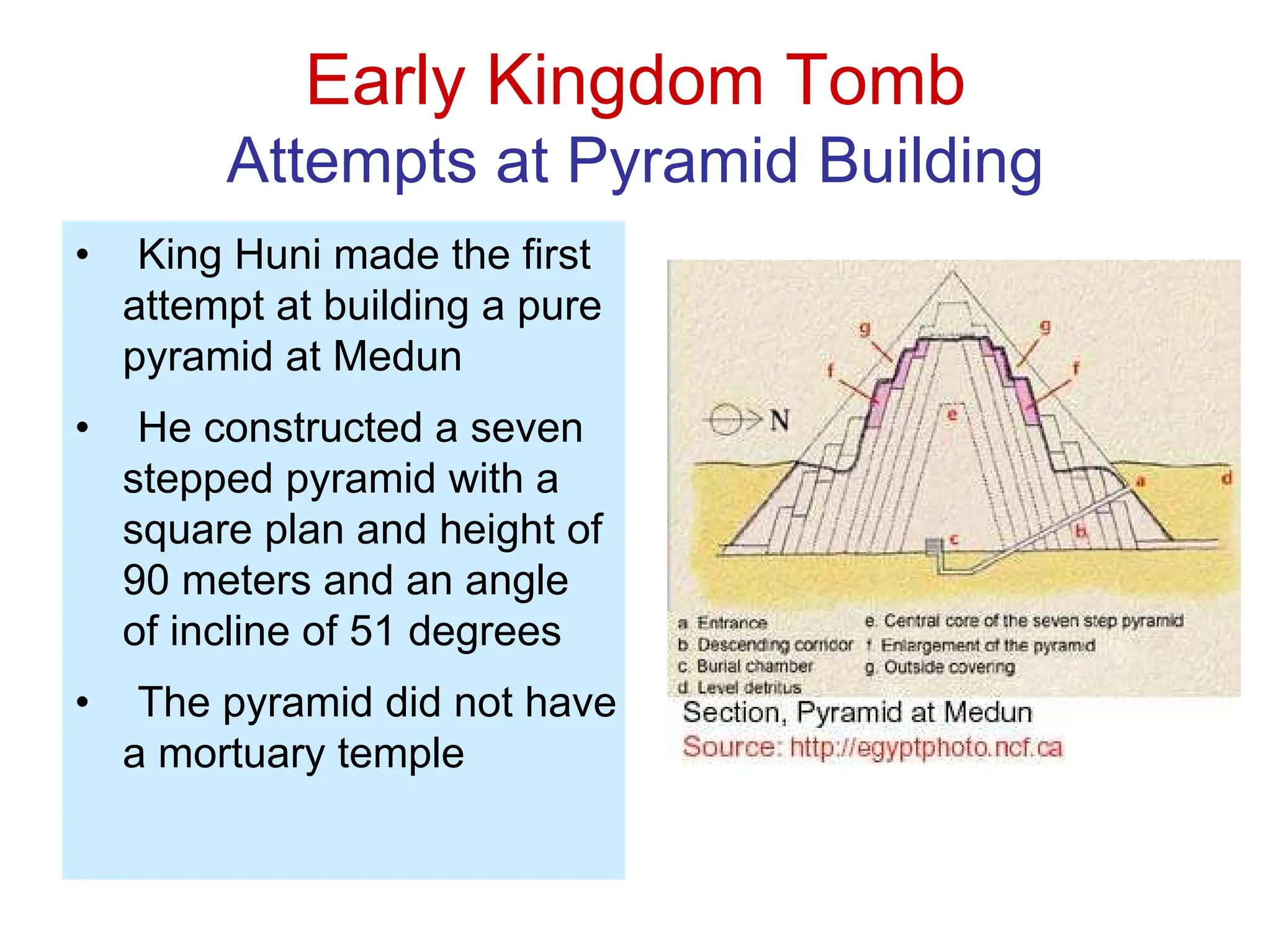
• King Huni made the first
attempt at building a pure
pyramid at Medun
• He constructed a seven
stepped pyramid with a
square plan and height of
90 meters and an angle
of incline of 51 degrees
• The pyramid did not have
a mortuary temple
Early Kingdom Tomb
Attempts at Pyramid Building
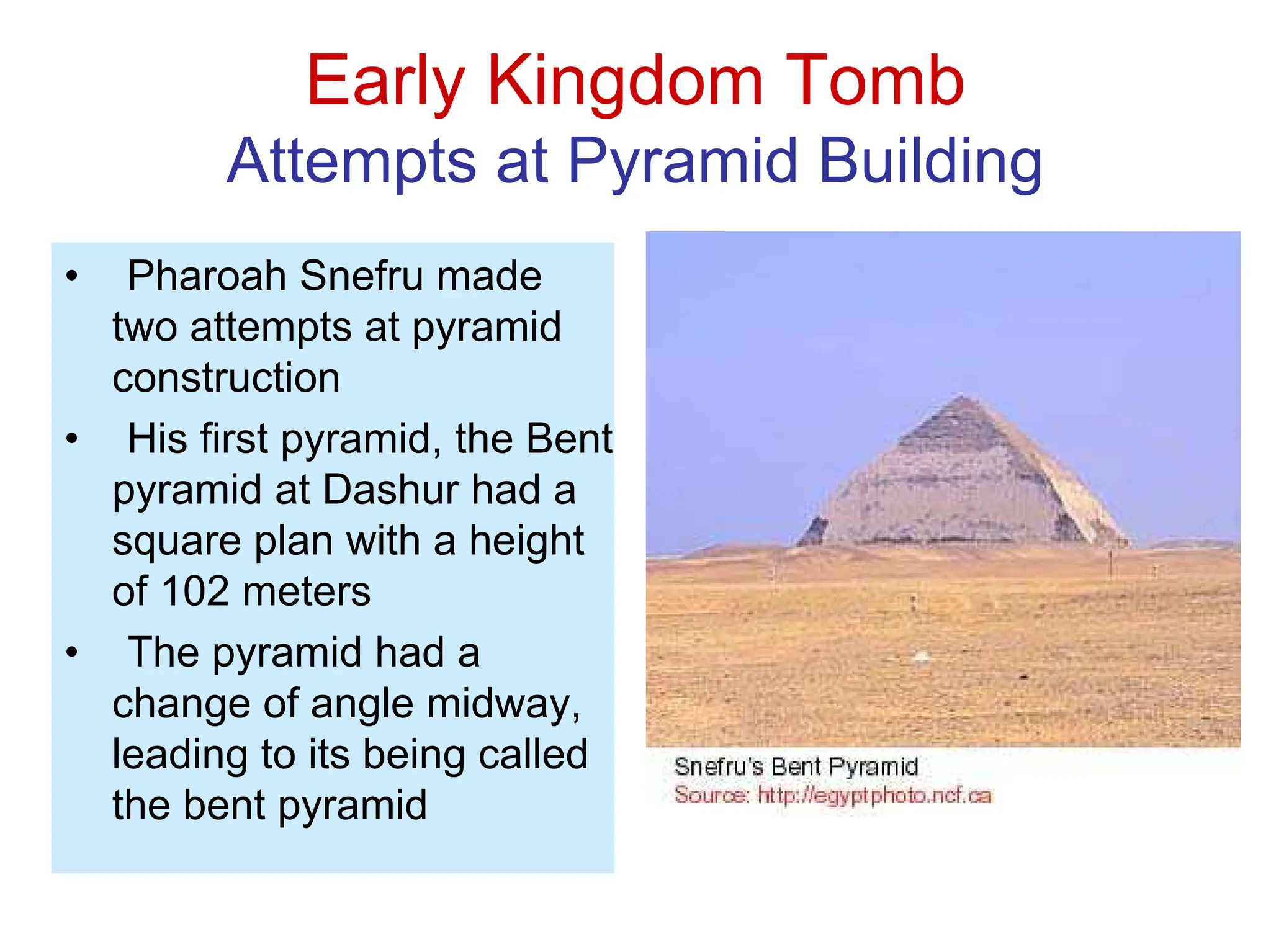
• Pharoah Snefru made
two attempts at pyramid
construction
• His first pyramid, the Bent
pyramid at Dashur had a
square plan with a height
of 102 meters
• The pyramid had a
change of angle midway,
leading to its being called
the bent pyramid
Early Kingdom Tomb
Attempts at Pyramid Building
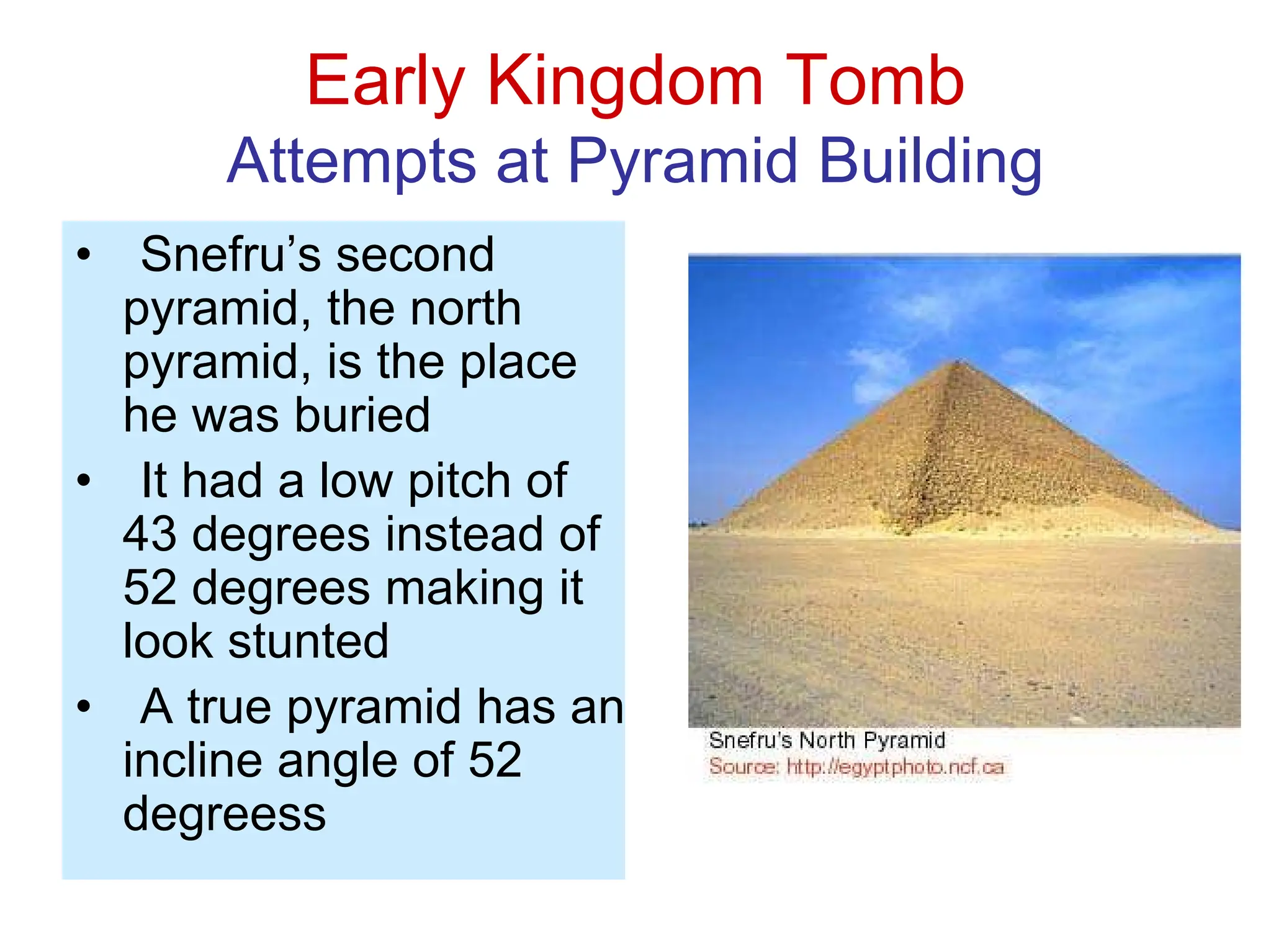
• Snefru’s second
pyramid, the north
pyramid, is the place
he was buried
• It had a low pitch of
43 degrees instead of
52 degrees making it
look stunted
• A true pyramid has an
incline angle of 52
degreess
Early Kingdom Tomb
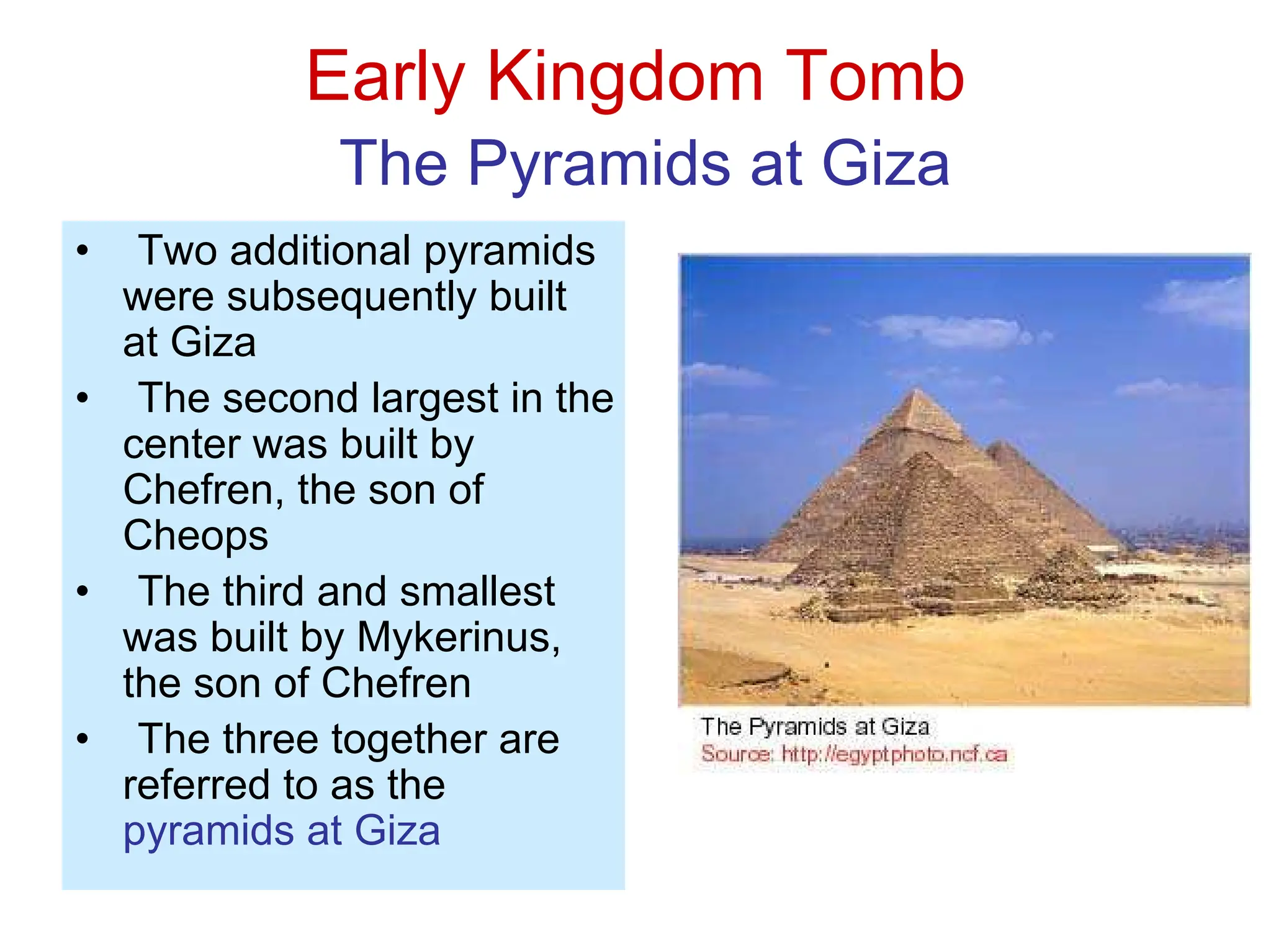
The Pyramids at Giza
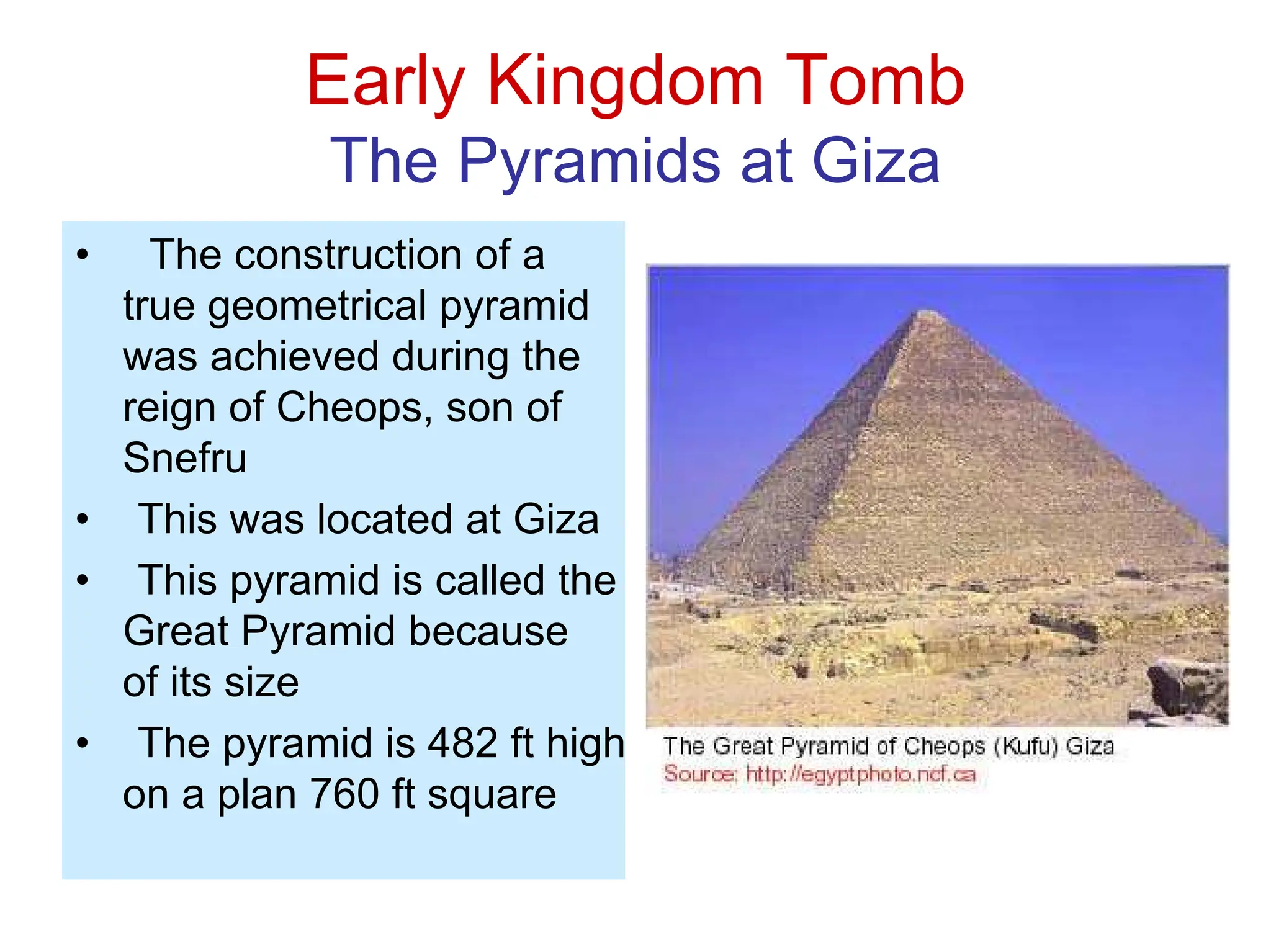
• The construction of a
true geometrical pyramid
was achieved during the
reign of Cheops, son of
Snefru
• This was located at Giza
• This pyramid is called the
Great Pyramid because
of its size
• The pyramid is 482 ft high
on a plan 760 ft square
Early Kingdom Tomb
The Pyramids at Giza
• Two additional pyramids
were subsequently built
at Giza
• The second largest in the
center was built by
Chefren, the son of
Cheops
• The third and smallest
was built by Mykerinus,
the son of Chefren
• The three together are
referred to as the
pyramids at Giza
Early Kingdom Tomb
The Pyramids at Giza
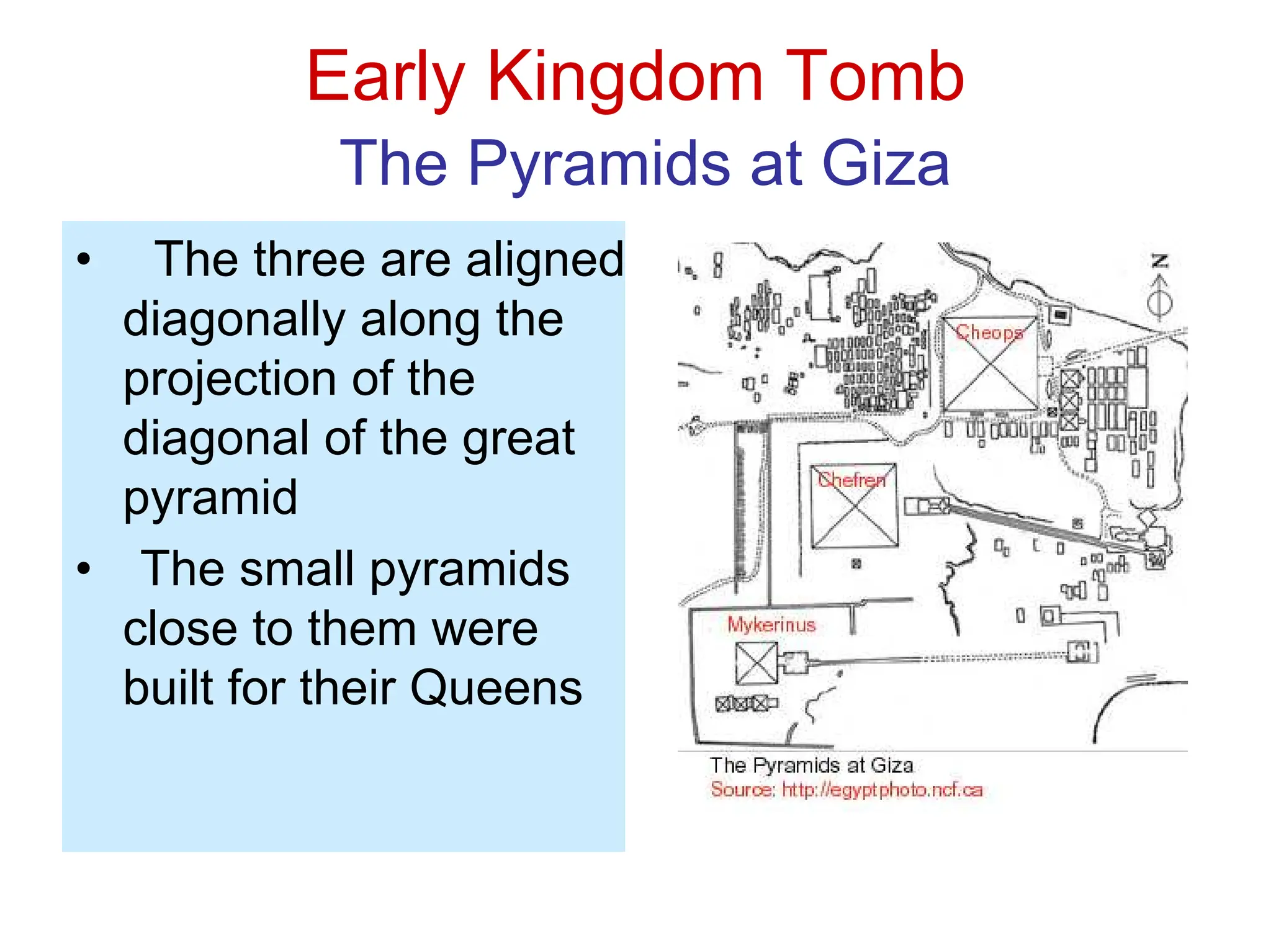
• The three are aligned
diagonally along the
projection of the
diagonal of the great
pyramid
• The small pyramids
close to them were
built for their Queens
Early Kingdom Tomb
The Great Pyramid Cheops
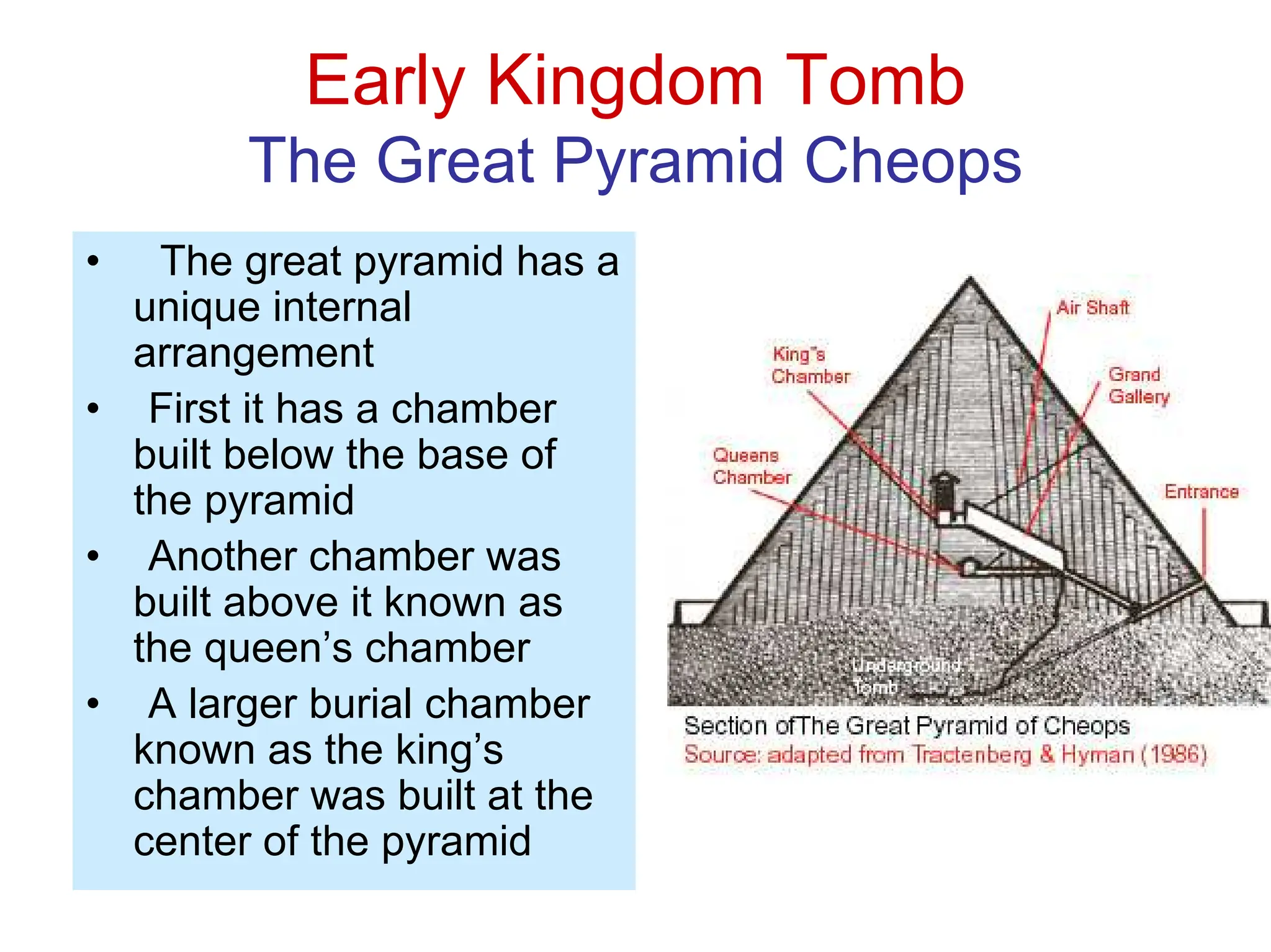
• The great pyramid has a
unique internal
arrangement
• First it has a chamber
built below the base of
the pyramid
• Another chamber was
built above it known as
the queen’s chamber
• A larger burial chamber
known as the king’s
chamber was built at the
center of the pyramid
Early Kingdom Tomb
The Great Pyramid Cheops
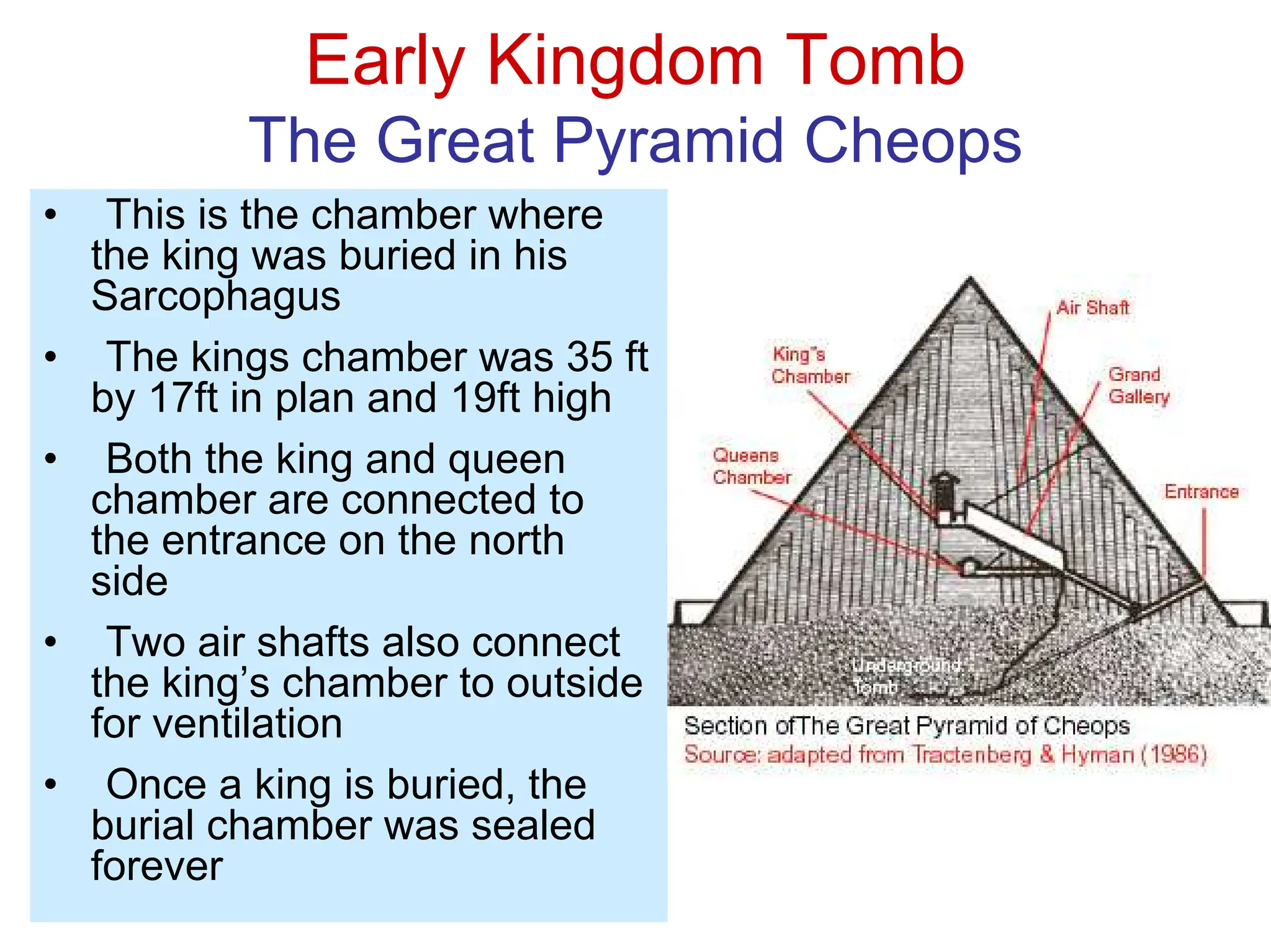
• This is the chamber where
the king was buried in his
Sarcophagus
• The kings chamber was 35 ft
by 17ft in plan and 19ft high
• Both the king and queen
chamber are connected to
the entrance on the north
side
• Two air shafts also connect
the king’s chamber to outside
for ventilation
• Once a king is buried, the
burial chamber was sealed
forever
Early Kingdom Tomb
Pyramid
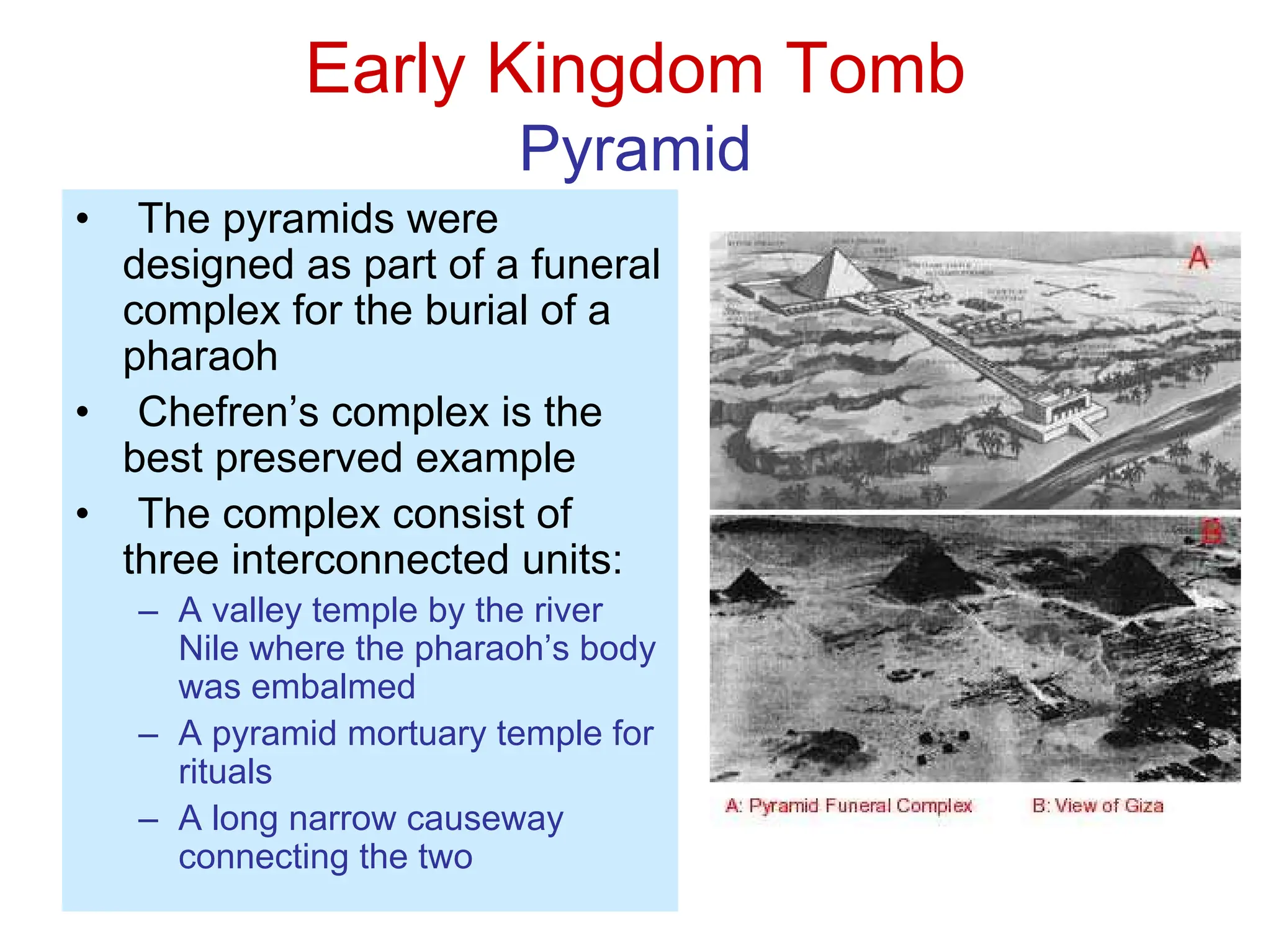
• The pyramids were
designed as part of a funeral
complex for the burial of a
pharaoh
• Chefren’s complex is the
best preserved example
• The complex consist of
three interconnected units:
– A valley temple by the river
Nile where the pharaoh’s body
was embalmed
– A pyramid mortuary temple for
rituals
– A long narrow causeway
connecting the two
Early Kingdom Tomb
Burial Ceremony
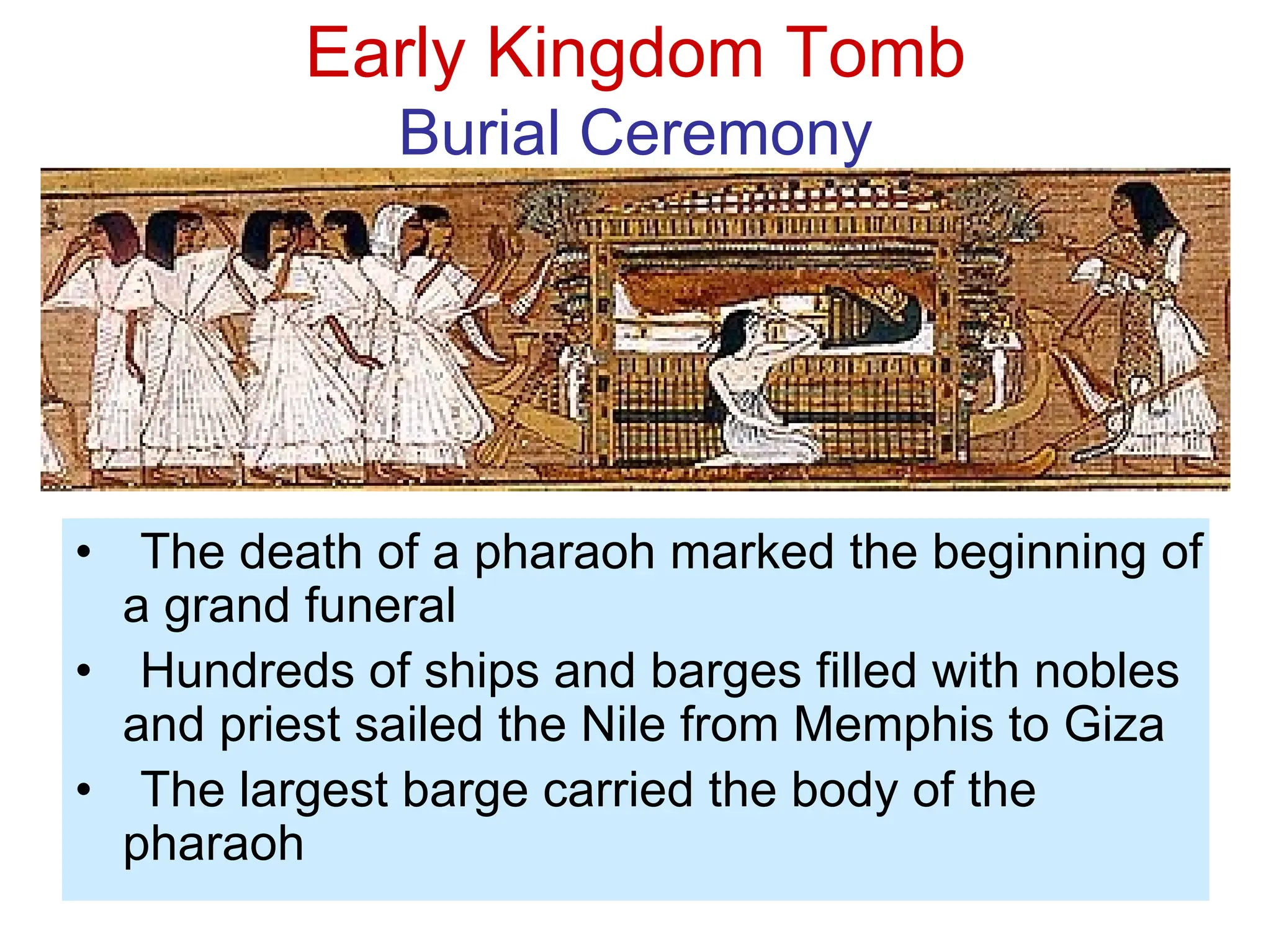
• The death of a pharaoh marked the beginning of
a grand funeral
• Hundreds of ships and barges filled with nobles
and priest sailed the Nile from Memphis to Giza
• The largest barge carried the body of the
pharaoh
Early Kingdom Tomb
Burial Ceremony
• The boats docked at the lower valley
temple where the body was carried to the
roof for mummification
• At the end of 72 days, an opening of the
mouth ceremony was performed
• A procession carried the pharaoh’s body
along the causeway to the pyramid
mortuary temple
Early Kingdom Tomb
Burial Ceremony
• This temple had many small chapels each
with false doors
• Many statues of the pharaoh were place in
the temple so that his ka could come back
each night
• After prayers to the God Osiris, the body
was lowered through the secret opening on
the north side to his burial chamber
• There he was laid in his stone
Sarcophagus
Early Kingdom Tomb
Burial Ceremony
• Rich treasure was heaped on him
• The passage was filled with rock and
sealed forever
• Now it was time for the pharaohs ka to
pass to the land of the dead
• The funeral complex shows the earliest
development of the components of the
new kingdom temple
Early Kingdom Tomb
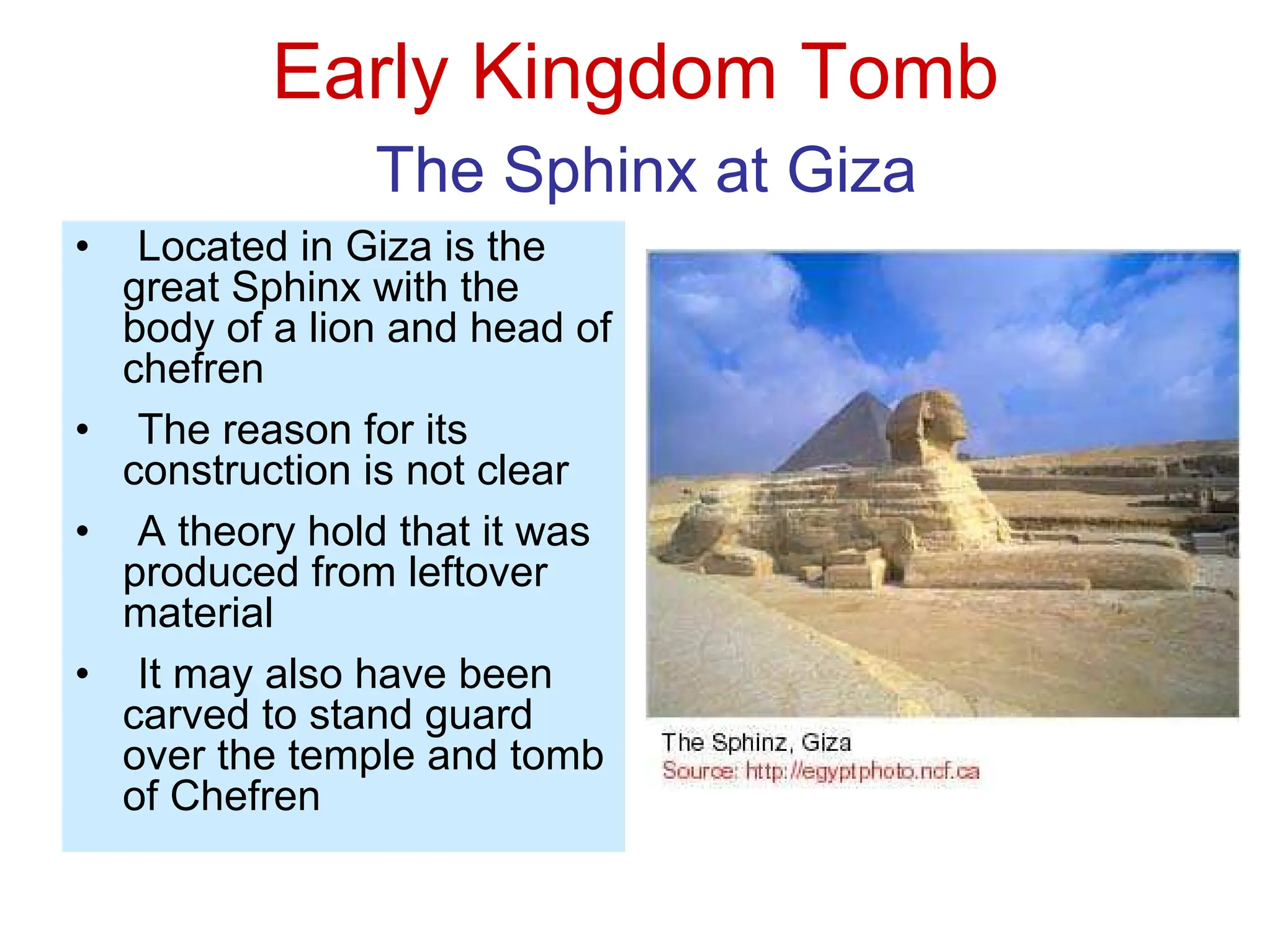
The Sphinx at Giza
• Located in Giza is the
great Sphinx with the
body of a lion and head of
chefren
• The reason for its
construction is not clear
• A theory hold that it was
produced from leftover
material
• It may also have been
carved to stand guard
over the temple and tomb
of Chefren
Early Kingdom Tomb
Pyramid Construction
• How were the pyramids constructed?
• There is no accurate knowledge about the
method of construction of the pyramids
• It is believed that 100,000 men worked 3
months each year for 30 years to build the
pyramids
• The lime stone used was quarried from nearby
and transported by lever action
• They were paid in food, clothing and drinks
Early Kingdom Tomb
Why did Egyptians Build Pyramids
• The pyramids were in
general a response to the
vast desert landscapes
• For structures to be visible
in the desert they have to
be of gargantuan size
• The pyramids were also a
product of the will to
achieve immortality by the
pharaohs
• The pyramids are the
everlasting home of the
pharaoh’s ka
Early Kingdom Tomb
End of Pyramid Construction
• After the Mykerinus period, the era of pyramid
construction ended
• More pyramids were built later but they were
smaller and less complex
• Later pharaohs could not also afford the cost of
huge pyramid construction
• Grave robbers also learned how to break into
and steal the goods buried with pharaohs
• The end of the Old Kingdom therefore marked
the end of the great era of Egyptian pyramid
construction.
Mid & New Kingdom Burial-Cham
Mortuary Temples Introduction
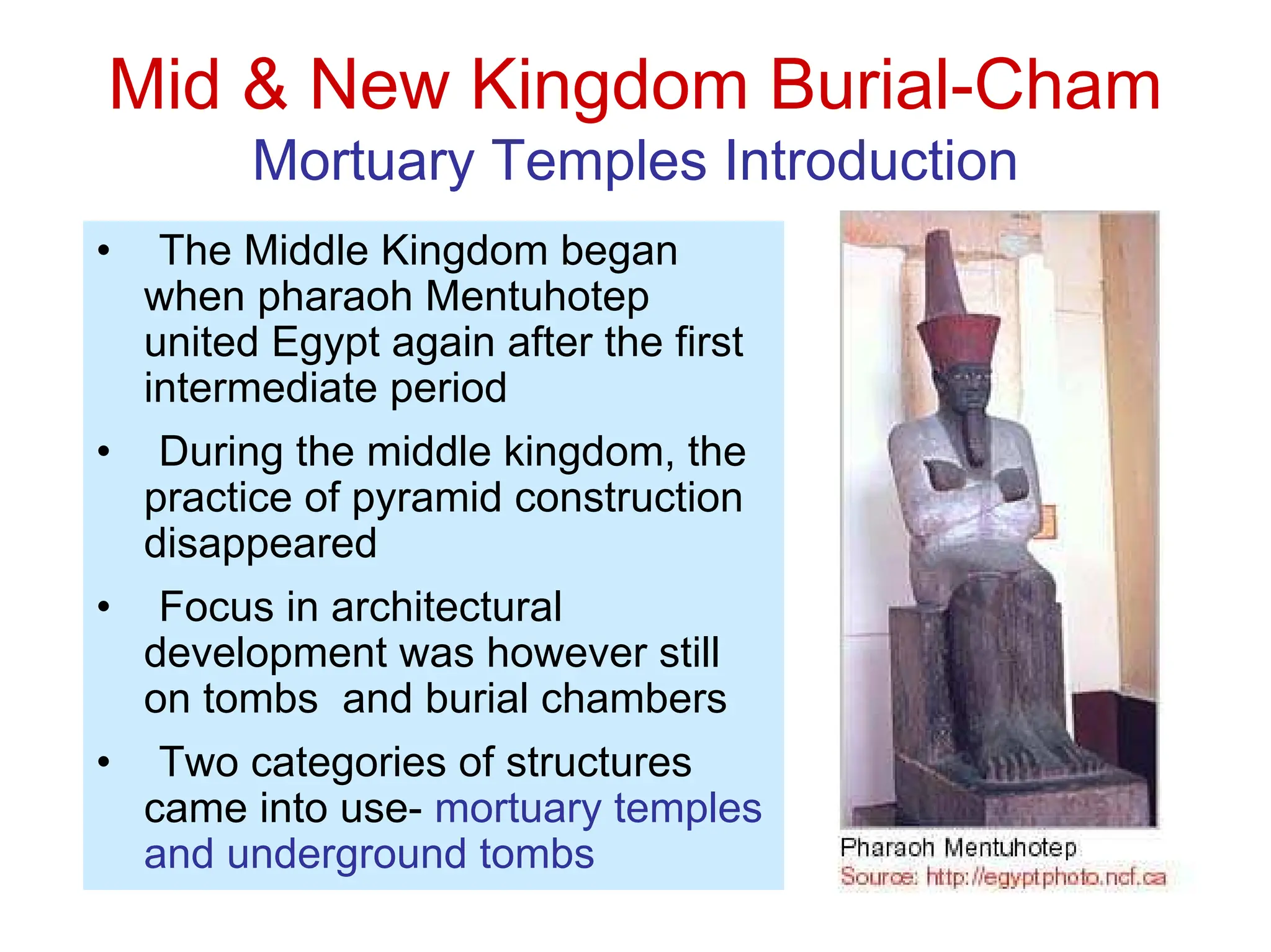
• The Middle Kingdom began
when pharaoh Mentuhotep
united Egypt again after the first
intermediate period
• During the middle kingdom, the
practice of pyramid construction
disappeared
• Focus in architectural
development was however still
on tombs and burial chambers
• Two categories of structures
came into use- mortuary temples
and underground tombs
Mid & New Kingdom Burial-Cham
Mortuary Temples Introduction
• Mortuary temples served as the place for the burial and
worship of pharaohs
• Temples dedicated to Gods were also located in them
• Mortuary temples owe their origin to the pyramid funeral
complex, particular the valley and pyramid temples
• Underground tombs became popular because of the
belief that they could not be robbed
• Many power and wealthy pharaohs and noblemen
carved their tombs directly into rock cliffs and
underground during the Middle and New kingdoms
• Most of the tomb and burial chamber construction was
carried out at Del Al Bahari
Mid & New Kingdom Burial-Cham
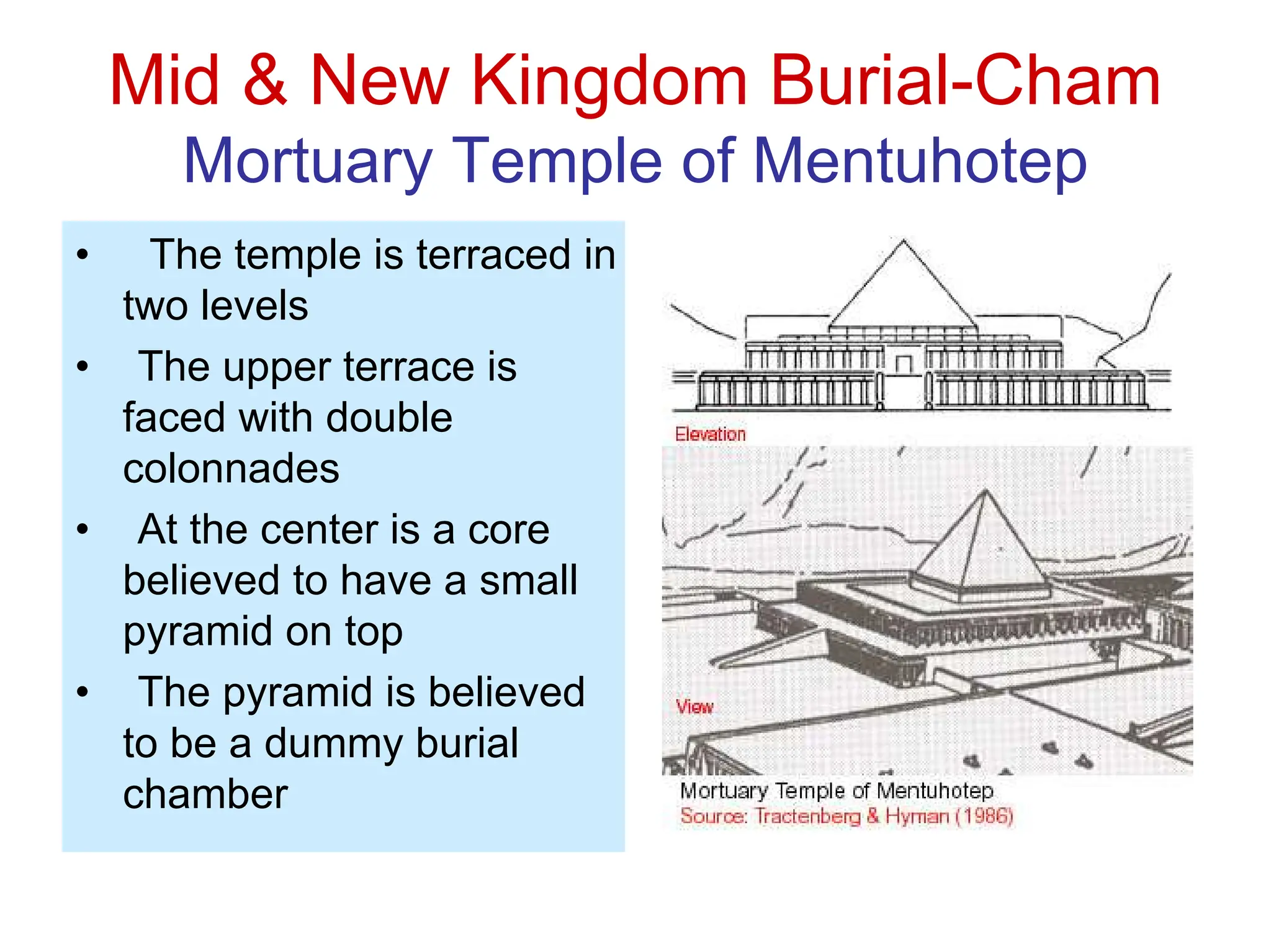
Mortuary Temple of Mentuhotep
• Two mortuary temples
were built at Del al
Bahari; mortuary temple
of Mentuhotep and
Hatshepsut
• Mentuhotep was the first
Pharaoh of the middle
kingdom
• He built the first mortuary
temple at Del-al Bahari
Mid & New Kingdom Burial-Cham
Mortuary Temple of Mentuhotep
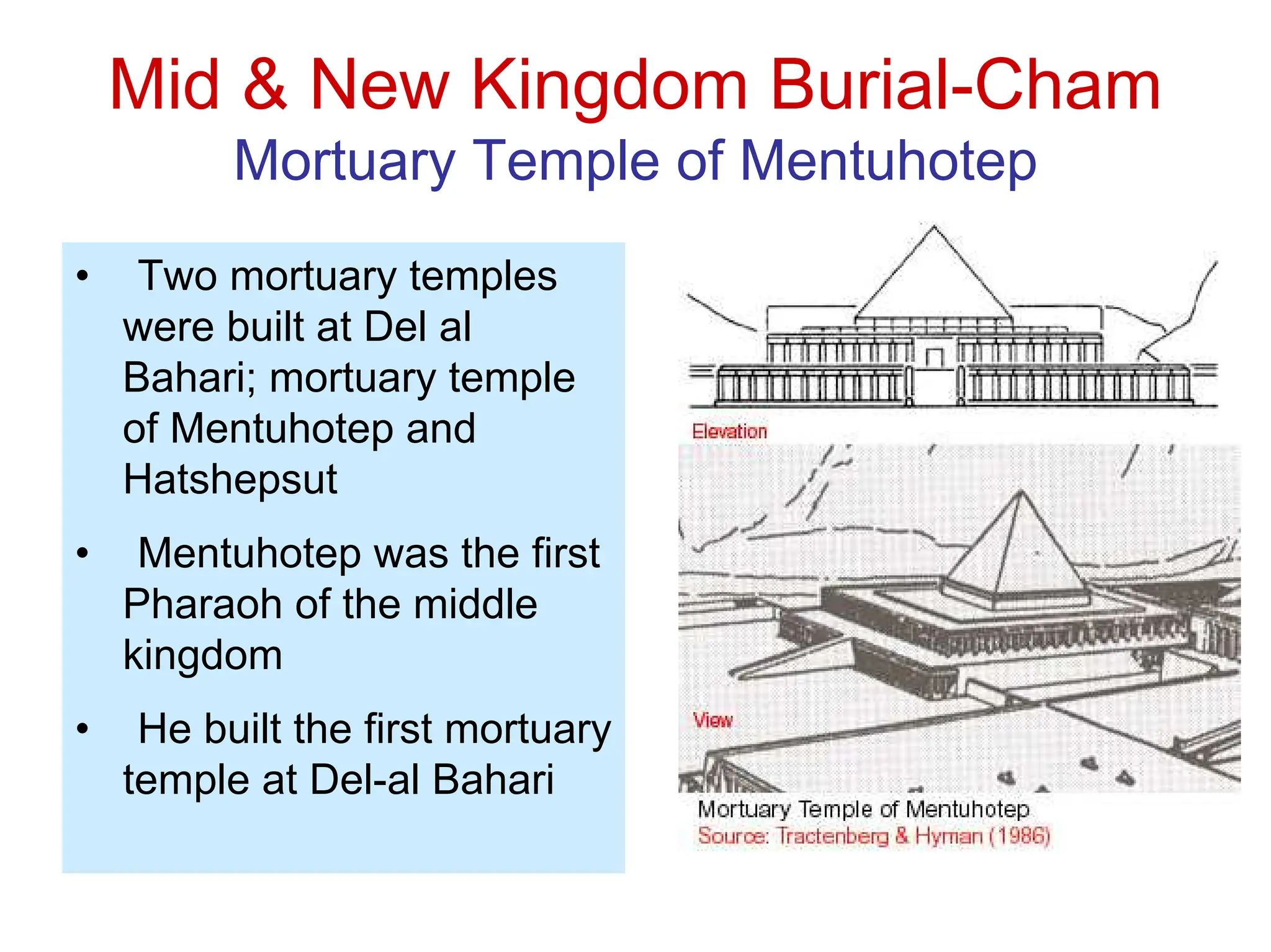
• The temple is terraced in
two levels
• The upper terrace is
faced with double
colonnades
• At the center is a core
believed to have a small
pyramid on top
• The pyramid is believed
to be a dummy burial
chamber
End
of
Lecture
Module
4
Lecture
11
Module
4
Lecture
12
Ancient
Egyptian
Architecture
Outline of Lecture
• Lecture 12
– Middle and New Kingdom Burial Chambers
• Rock Cut Tombs
• Shaft Tombs
– New Kingdom Cult Temples
• Temple of Khons, Karnak
• Temple of Amon
• Other Temples
– Other Architectural Elements
• Columns, Relief carving, Obelisk, & Sphinxes
Architecture
of
the
Civilization
Continue
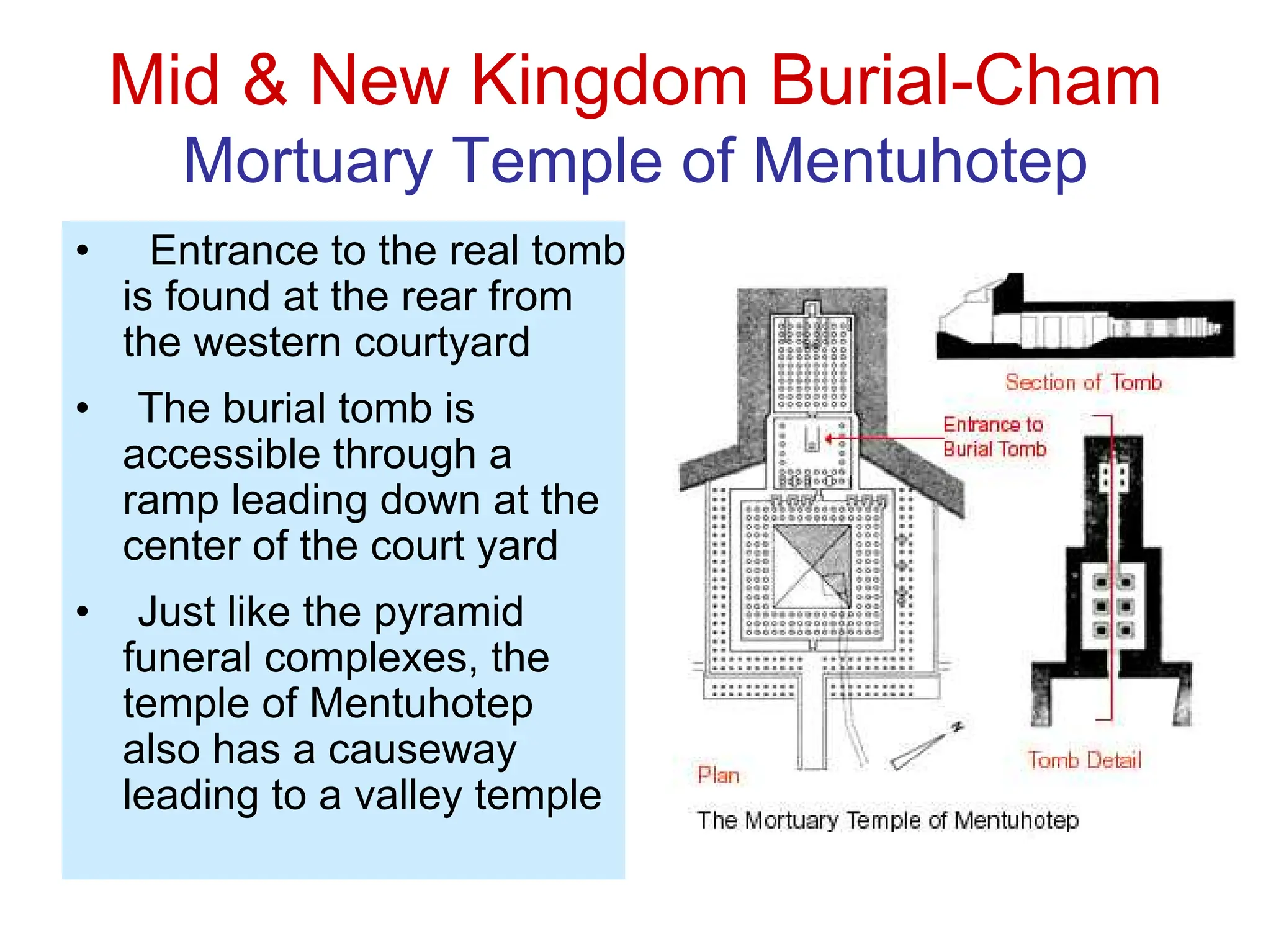
Mid & New Kingdom Burial-Cham
Mortuary Temple of Mentuhotep
• Entrance to the real tomb
is found at the rear from
the western courtyard
• The burial tomb is
accessible through a
ramp leading down at the
center of the court yard
• Just like the pyramid
funeral complexes, the
temple of Mentuhotep
also has a causeway
leading to a valley temple
Mid & New Kingdom Burial-Cham
Mortuary Temple of Hatshepsut
• Queen Hatshepsut’s temple was built 500 years
after that of Mentuhotep during the new kingdom
• Hatsheptsut was the only female pharaoh to rule
Egypt
• When Her husband Pharaoh Tutmosis died, her
step son was too young to rule
• She therefore became the ruler
• Even when he grew old, she would not allow him
to rule and crowned herself pharaoh
Mid & New Kingdom Burial-Cham
Mortuary Temple of Hatshepsut
• She dressed as a pharaoh, wearing men’s cloth
with a false beard attached to her chin
• The temple of Mentuhotep served as a model in
the design of her temple
• Her extraordinary funeral temple located at Del-
Al-Bahari, is set against the background of the
cliffs
• The architect of her temple is believed to be
Senmut who is also buried in the temple
Mid & New Kingdom Burial-Cham
Mortuary Temple of Hatshepsut
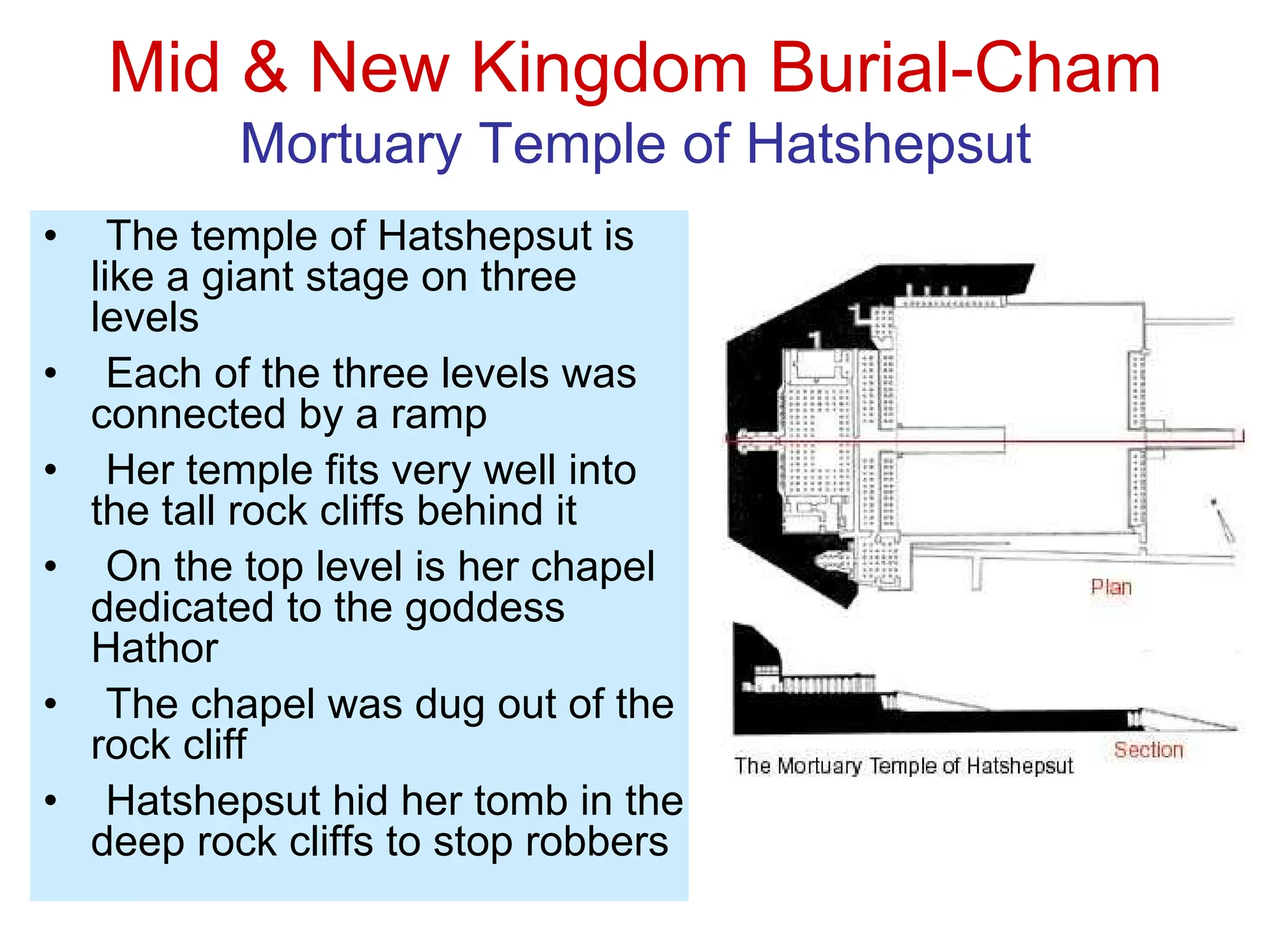
• The temple of Hatshepsut is
like a giant stage on three
levels
• Each of the three levels was
connected by a ramp
• Her temple fits very well into
the tall rock cliffs behind it
• On the top level is her chapel
dedicated to the goddess
Hathor
• The chapel was dug out of the
rock cliff
• Hatshepsut hid her tomb in the
deep rock cliffs to stop robbers
Mid & New Kingdom Burial-Cham
Mortuary Temple of Hatshepsut
• But her tomb was also
plundered and smashed into
a thousand pieces
• Archeologist believe that her
son Tutmosis III poisoned
her to death and wrecked her
tomb
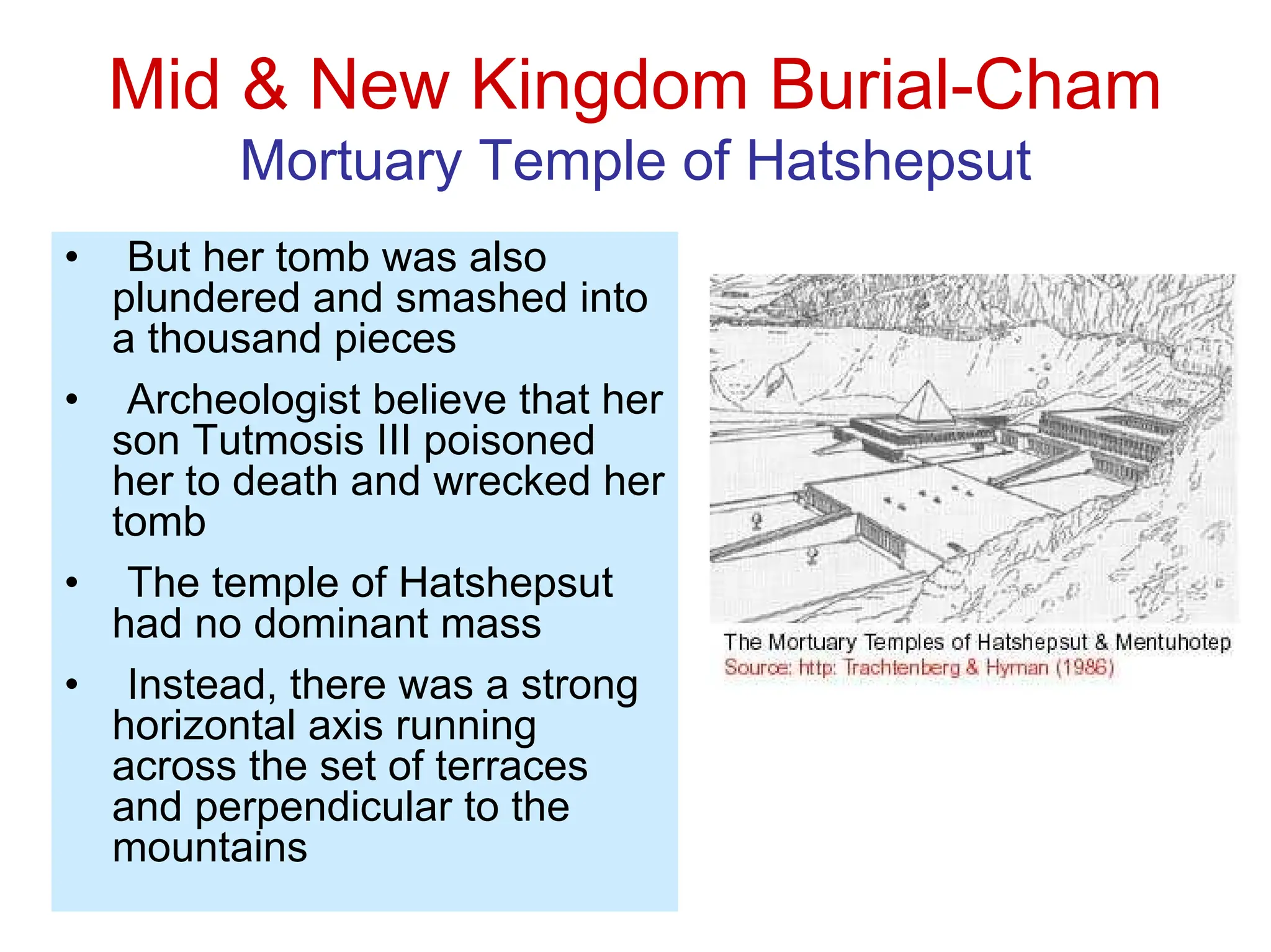
• The temple of Hatshepsut
had no dominant mass
• Instead, there was a strong
horizontal axis running
across the set of terraces
and perpendicular to the
mountains
Mid & New Kingdom Burial-Cham
Mortuary Temple of Hatshepsut
• Her temple was not a construction of stone
masses as in the pyramids
• It was rather a play of the emptiness of terraces,
ramps and courtyards against the busy
background of the cliffs
• Her temple captures the shift from the compact
geometry of the old kingdom pyramids to the
linear composition of the New Kingdom temples
Mid & New Kingdom Burial-Cham
Underground Tomb- Rock Cut Tomb
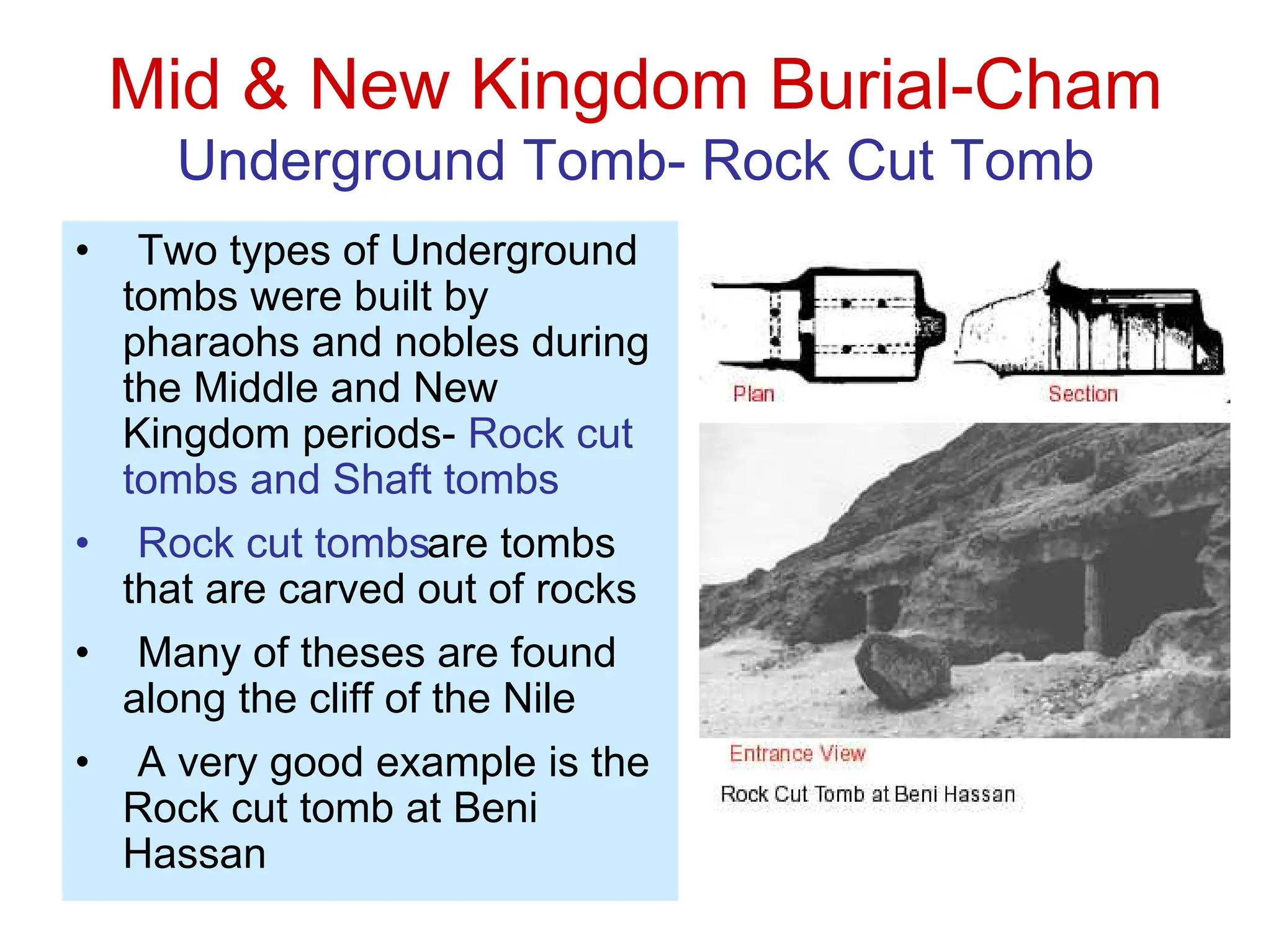
• Two types of Underground
tombs were built by
pharaohs and nobles during
the Middle and New
Kingdom periods- Rock cut
tombs and Shaft tombs
• Rock cut tombsare tombs
that are carved out of rocks
• Many of theses are found
along the cliff of the Nile
• A very good example is the
Rock cut tomb at Beni
Hassan
Mid & New Kingdom Burial-Cham
Underground Tomb- Rock Cut Tomb
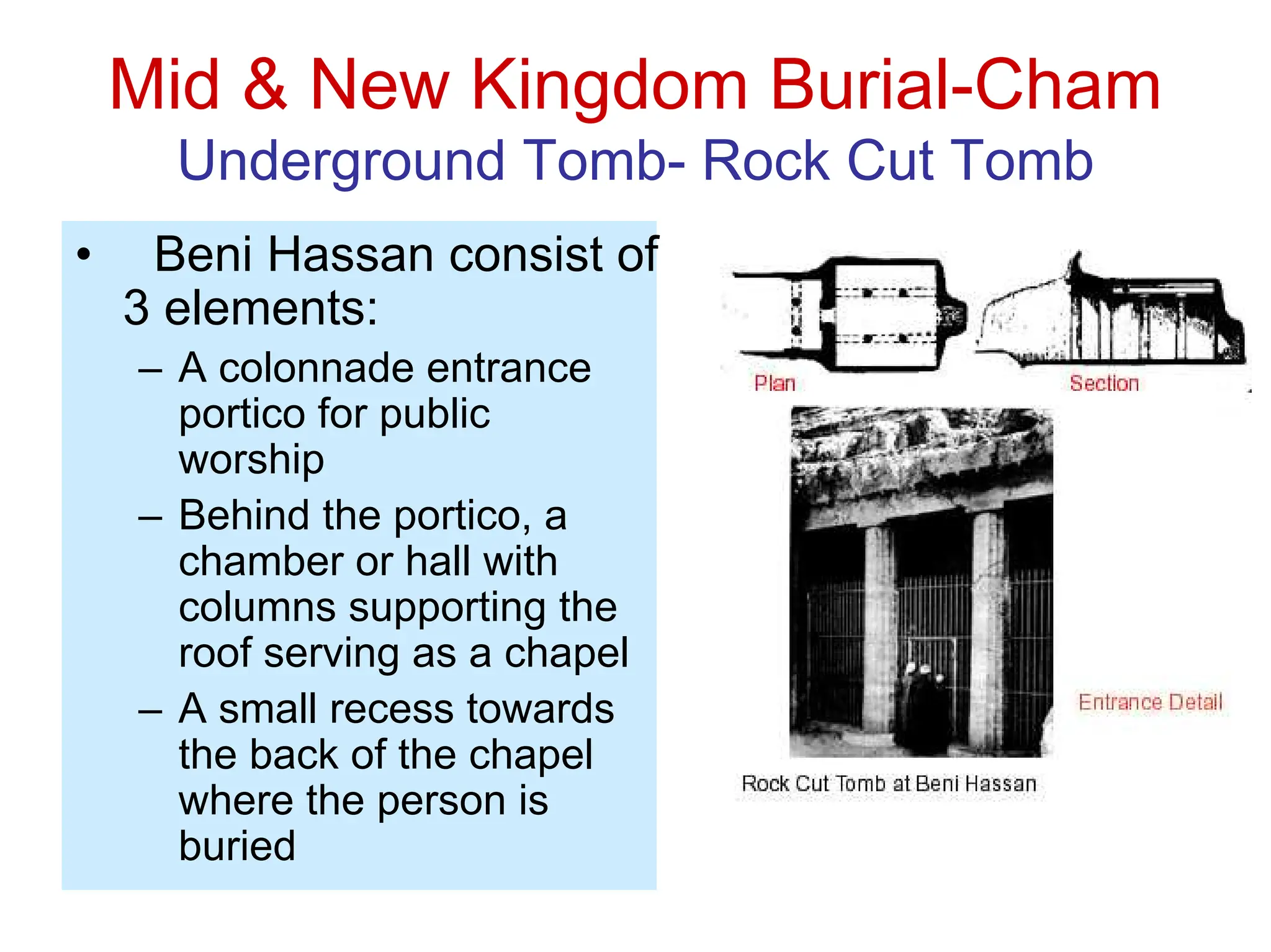
• Beni Hassan consist of
3 elements:
– A colonnade entrance
portico for public
worship
– Behind the portico, a
chamber or hall with
columns supporting the
roof serving as a chapel
– A small recess towards
the back of the chapel
where the person is
buried
Mid & New Kingdom Burial-Cham
Underground Tomb- Rock Cut Tomb
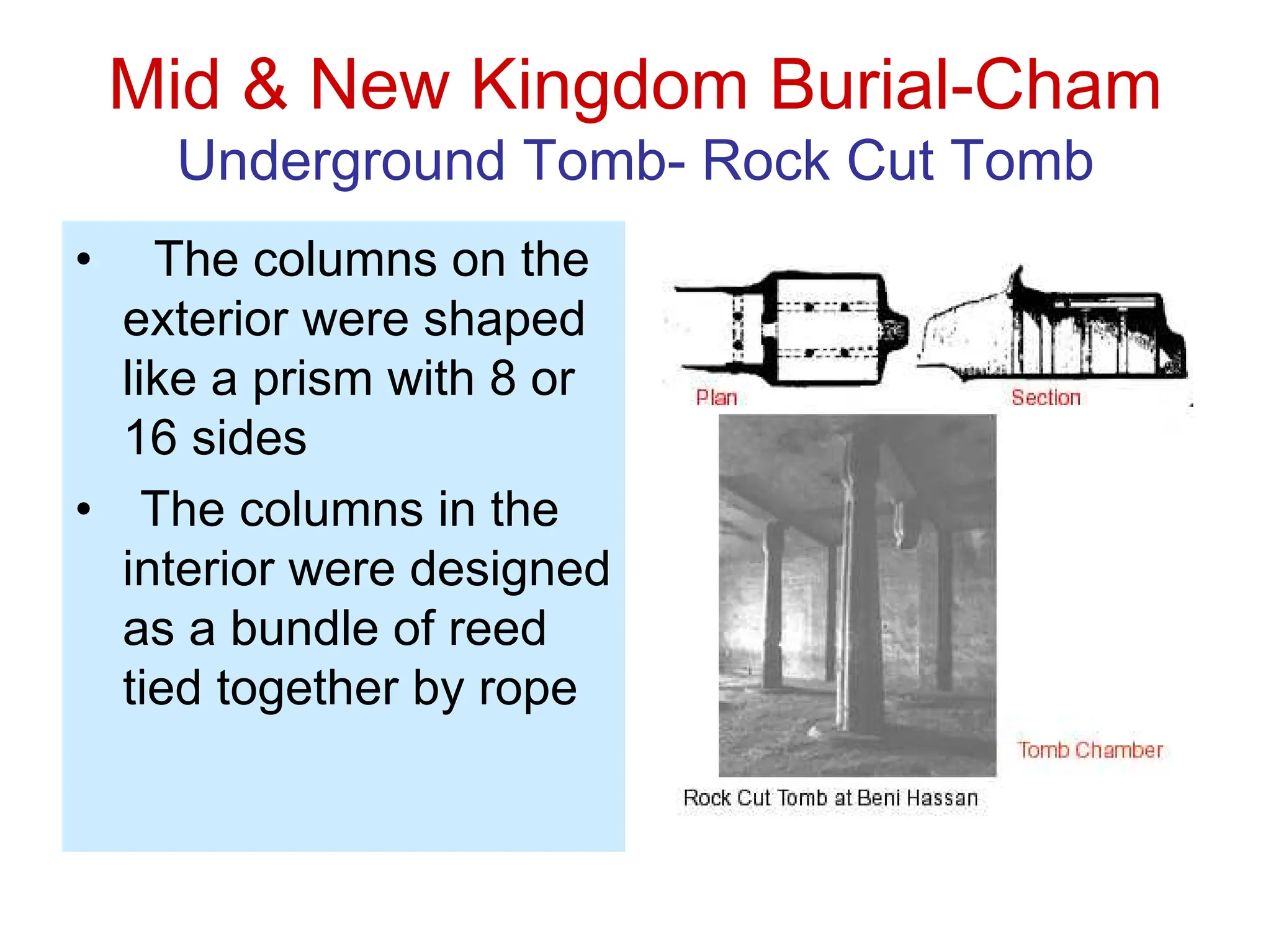
• The columns on the
exterior were shaped
like a prism with 8 or
16 sides
• The columns in the
interior were designed
as a bundle of reed
tied together by rope
Mid & New Kingdom Burial-Cham
Underground Tomb- Shaft Tombs
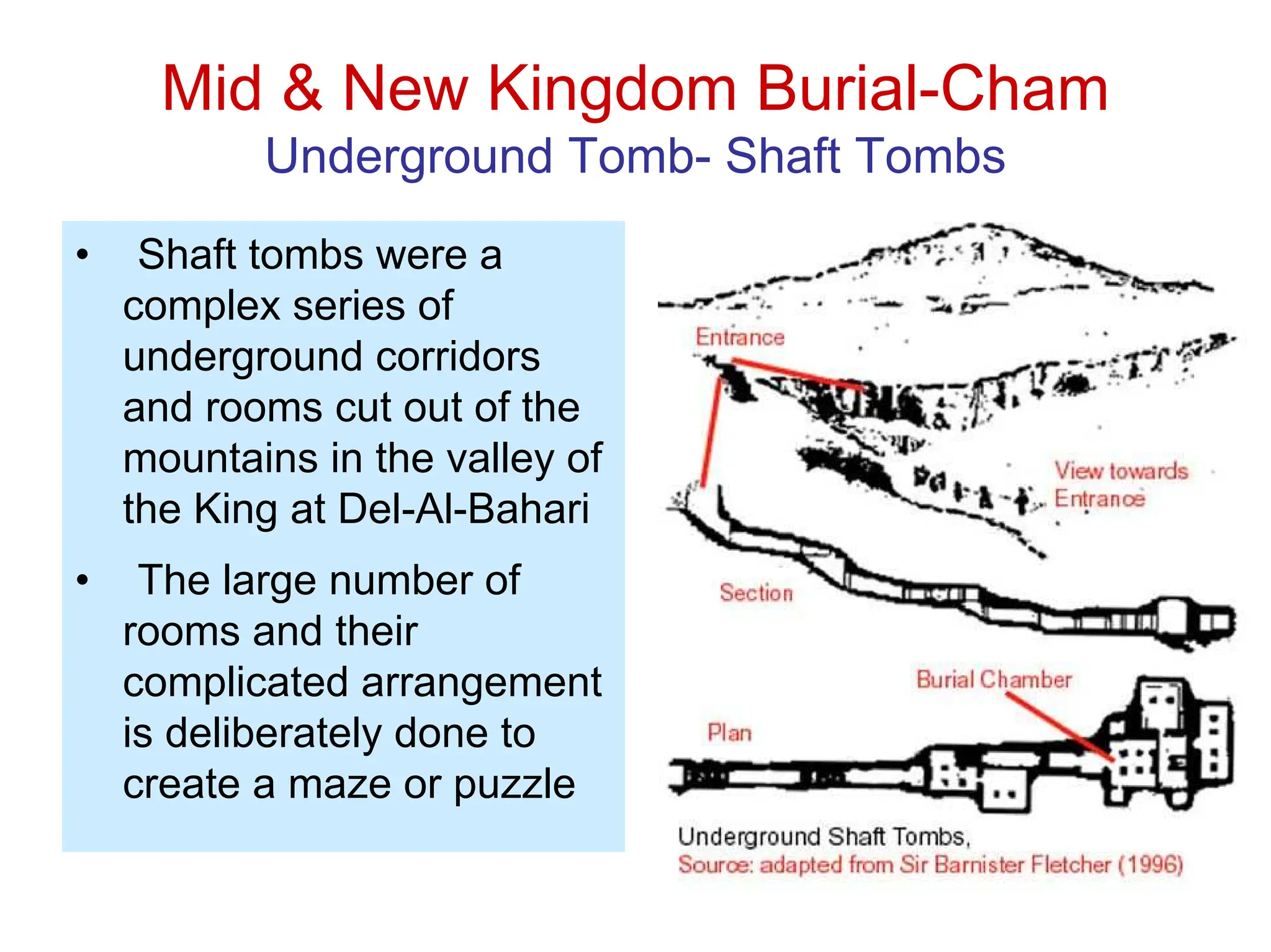
• Shaft tombs were a
complex series of
underground corridors
and rooms cut out of the
mountains in the valley of
the King at Del-Al-Bahari
• The large number of
rooms and their
complicated arrangement
is deliberately done to
create a maze or puzzle
Mid & New Kingdom Burial-Cham
Underground Tomb- Shaft Tombs
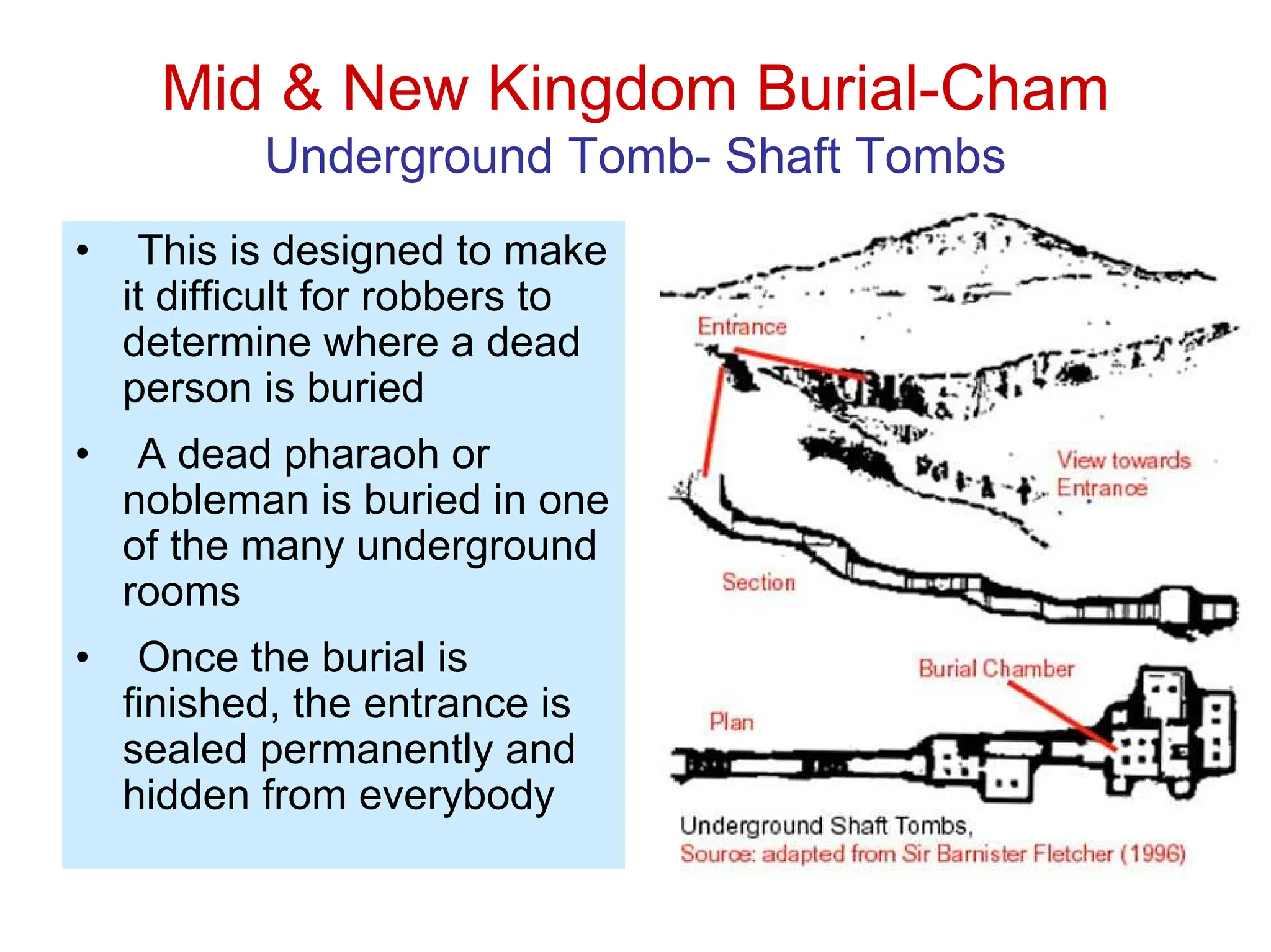
• This is designed to make
it difficult for robbers to
determine where a dead
person is buried
• A dead pharaoh or
nobleman is buried in one
of the many underground
rooms
• Once the burial is
finished, the entrance is
sealed permanently and
hidden from everybody
New Kingdom Cult Temples
Introduction
• The Middle Kingdom lasted
for 275 years
• The New Kingdom started
after the end of second
intermediate period
• The New Kingdom lasted
for 500 years
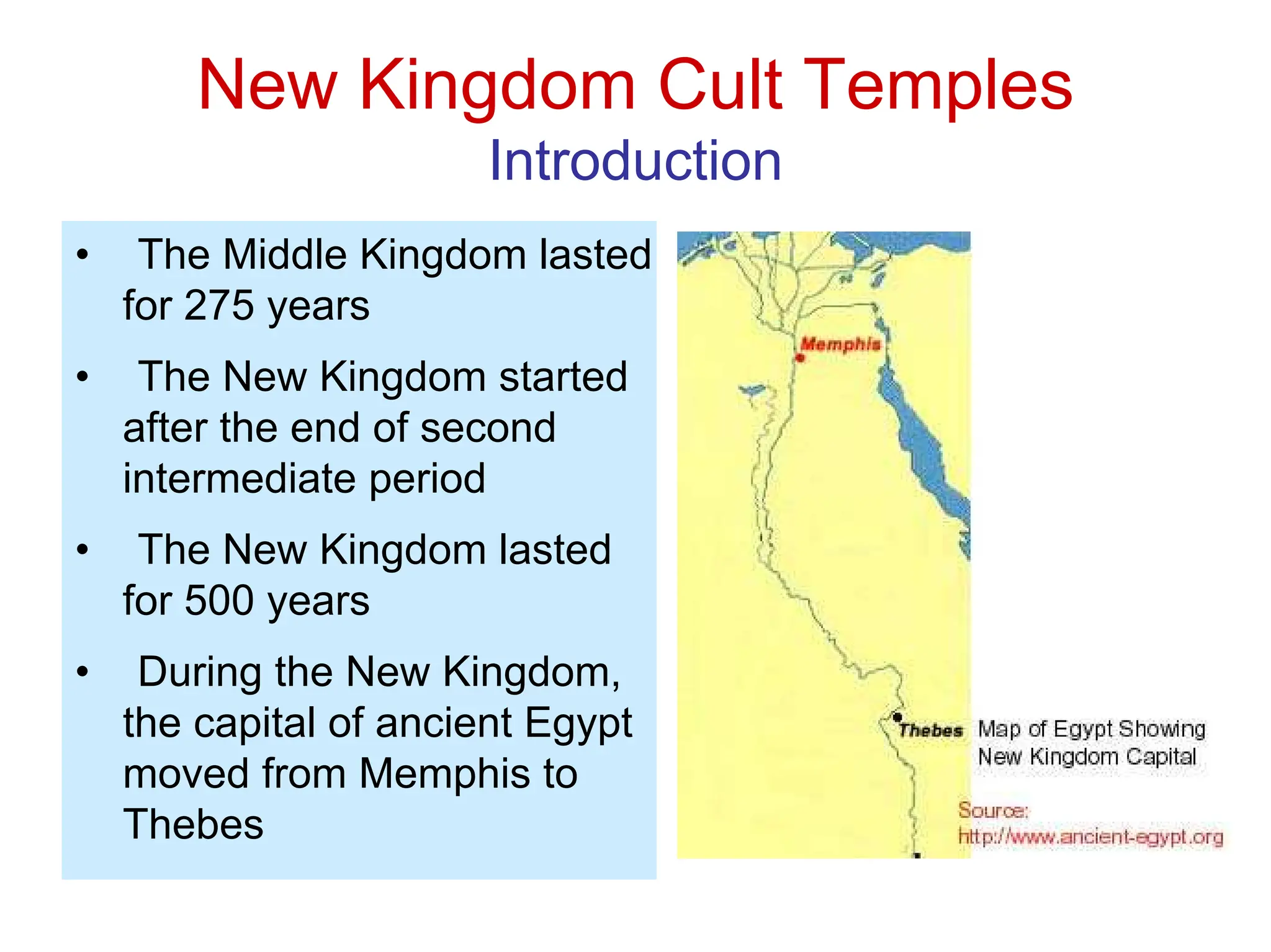
• During the New Kingdom,
the capital of ancient Egypt
moved from Memphis to
Thebes
New Kingdom Cult Temples
Introduction
• The most important and common
architectural elements of the New Kingdom
were temples
• Several temples were built dedicated to
Egyptian Gods
• The New Kingdom Temples borrowed a lot
of elements from the funeral complexes at
Giza
• They also borrowed elements from the
Mortuary temples at Del-Al-Bahari
New Kingdom Cult Temples
Introduction
• The borrowed elements include:
– Long approaches
– Guardian sphinxes
– Collonaded vestibules and inner courts
– Darkening shrines
– Intricate linear progression of constructed space
• The New Kingdom temples allow a series of
experiences passing in stages from openness
and light in the exterior to interior closure and
darkness
• This feeling was deliberate as only the Pharaoh
and priest were allowed into the inner part of
temples
New Kingdom Cult Temples
Introduction
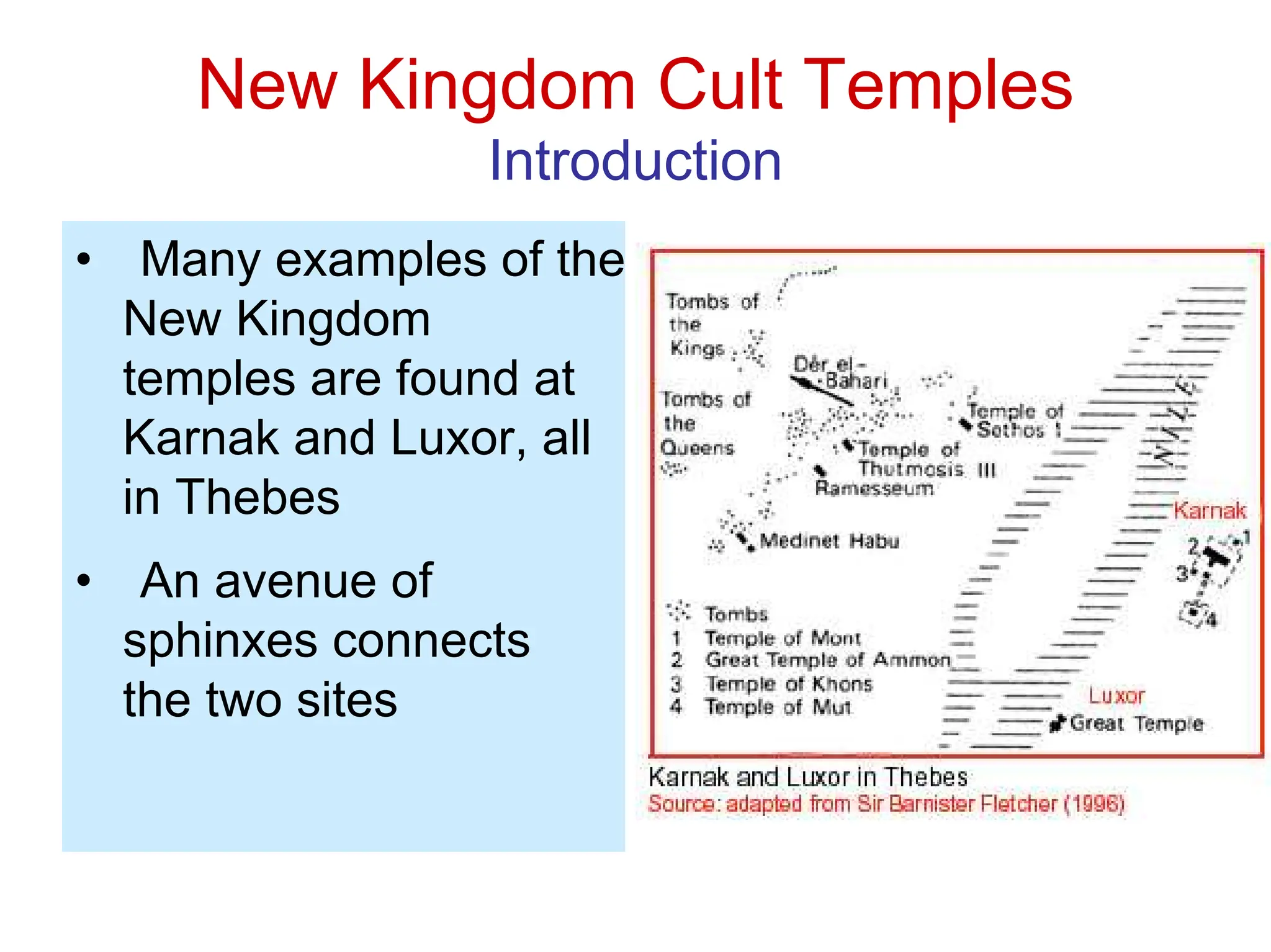
• Many examples of the
New Kingdom
temples are found at
Karnak and Luxor, all
in Thebes
• An avenue of
sphinxes connects
the two sites
New Kingdom Cult Temples
Temple of Khons, Karnak
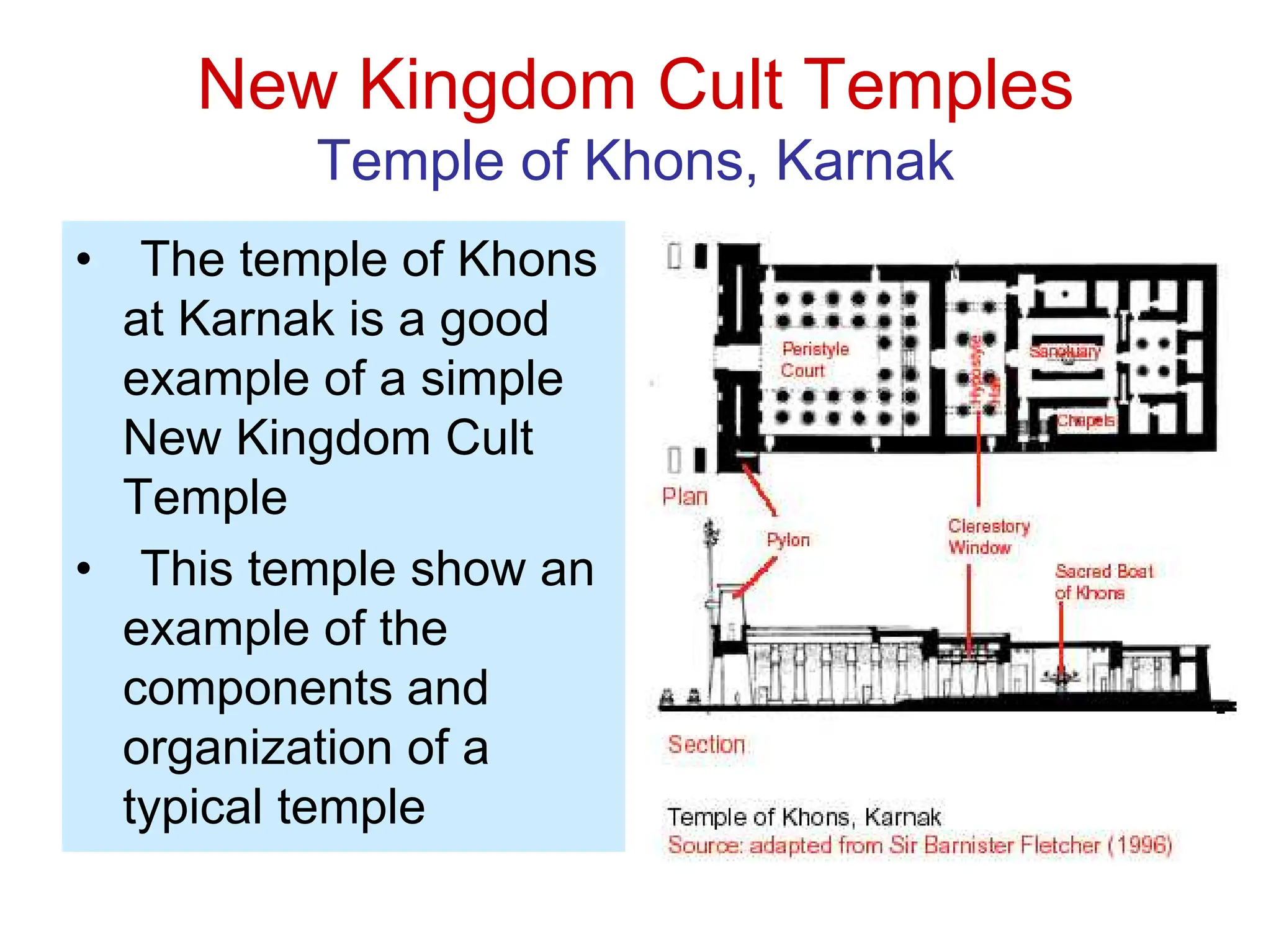
• The temple of Khons
at Karnak is a good
example of a simple
New Kingdom Cult
Temple
• This temple show an
example of the
components and
organization of a
typical temple
New Kingdom Cult Temples
Temple of Khons, Karnak
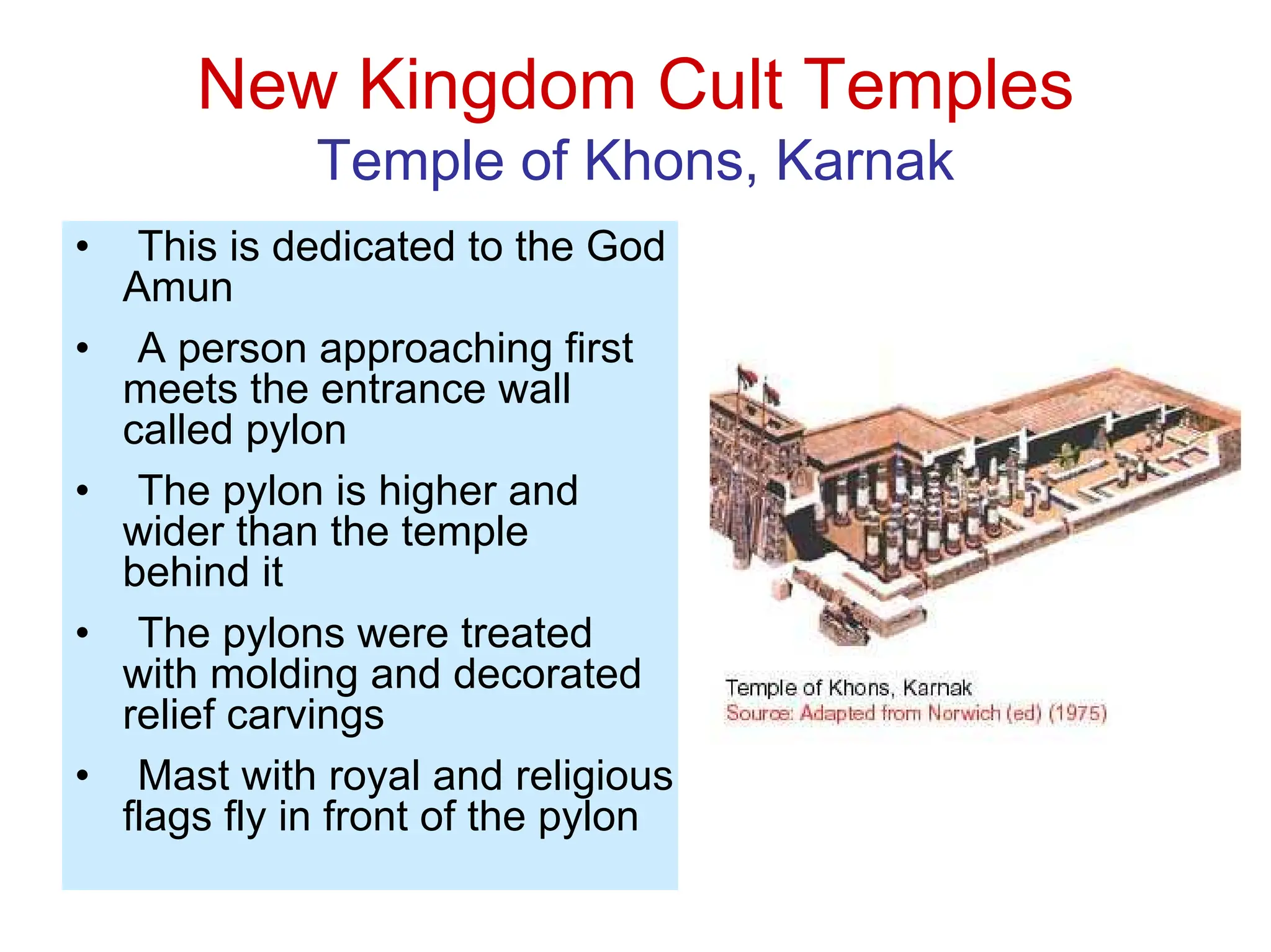
• This is dedicated to the God
Amun
• A person approaching first
meets the entrance wall
called pylon
• The pylon is higher and
wider than the temple
behind it
• The pylons were treated
with molding and decorated
relief carvings
• Mast with royal and religious
flags fly in front of the pylon
New Kingdom Cult Temples
Temple of Khons, Karnak
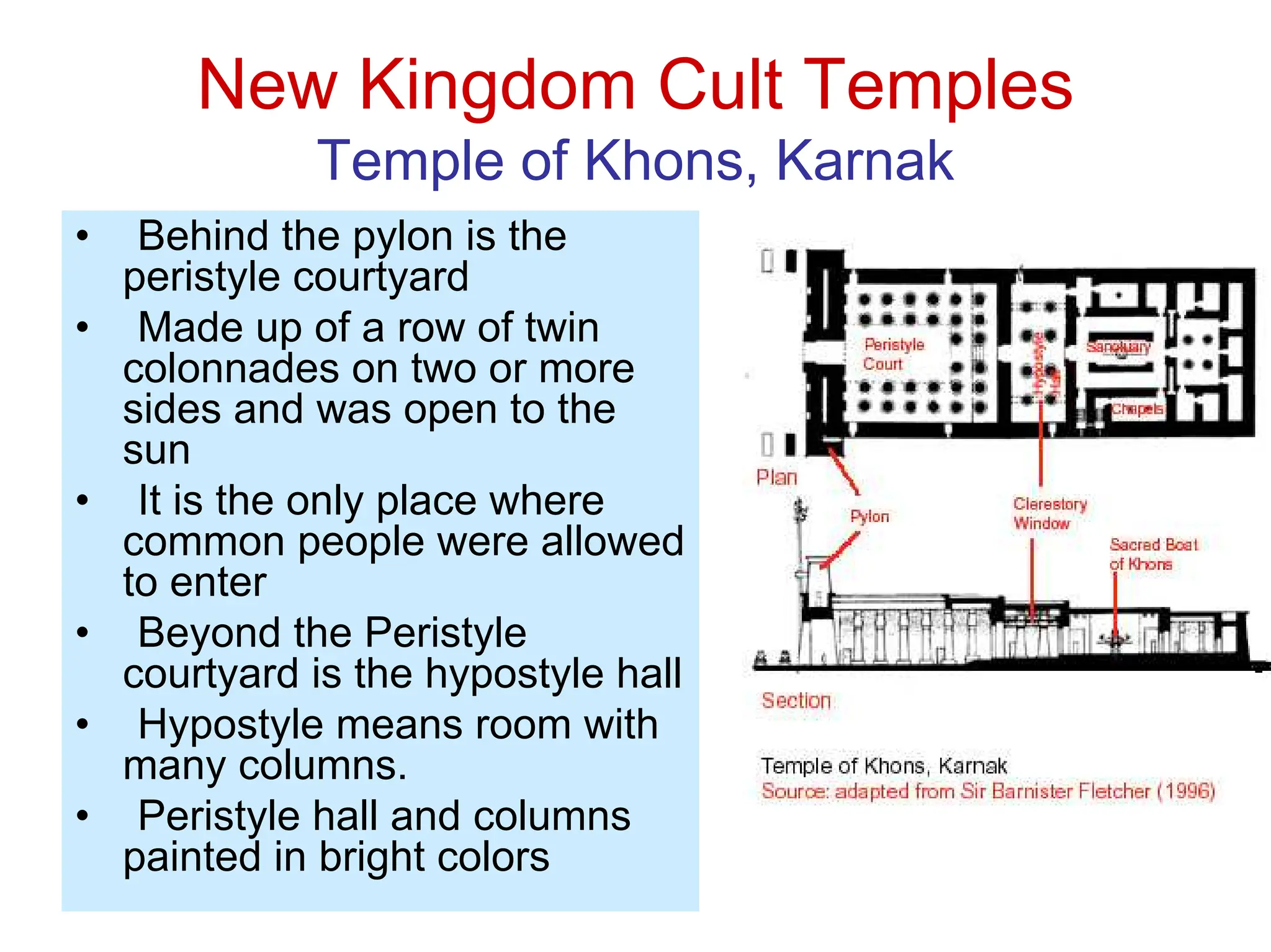
• Behind the pylon is the
peristyle courtyard
• Made up of a row of twin
colonnades on two or more
sides and was open to the
sun
• It is the only place where
common people were allowed
to enter
• Beyond the Peristyle
courtyard is the hypostyle hall
• Hypostyle means room with
many columns.
• Peristyle hall and columns
painted in bright colors
New Kingdom Cult Temples
Temple of Khons, Karnak
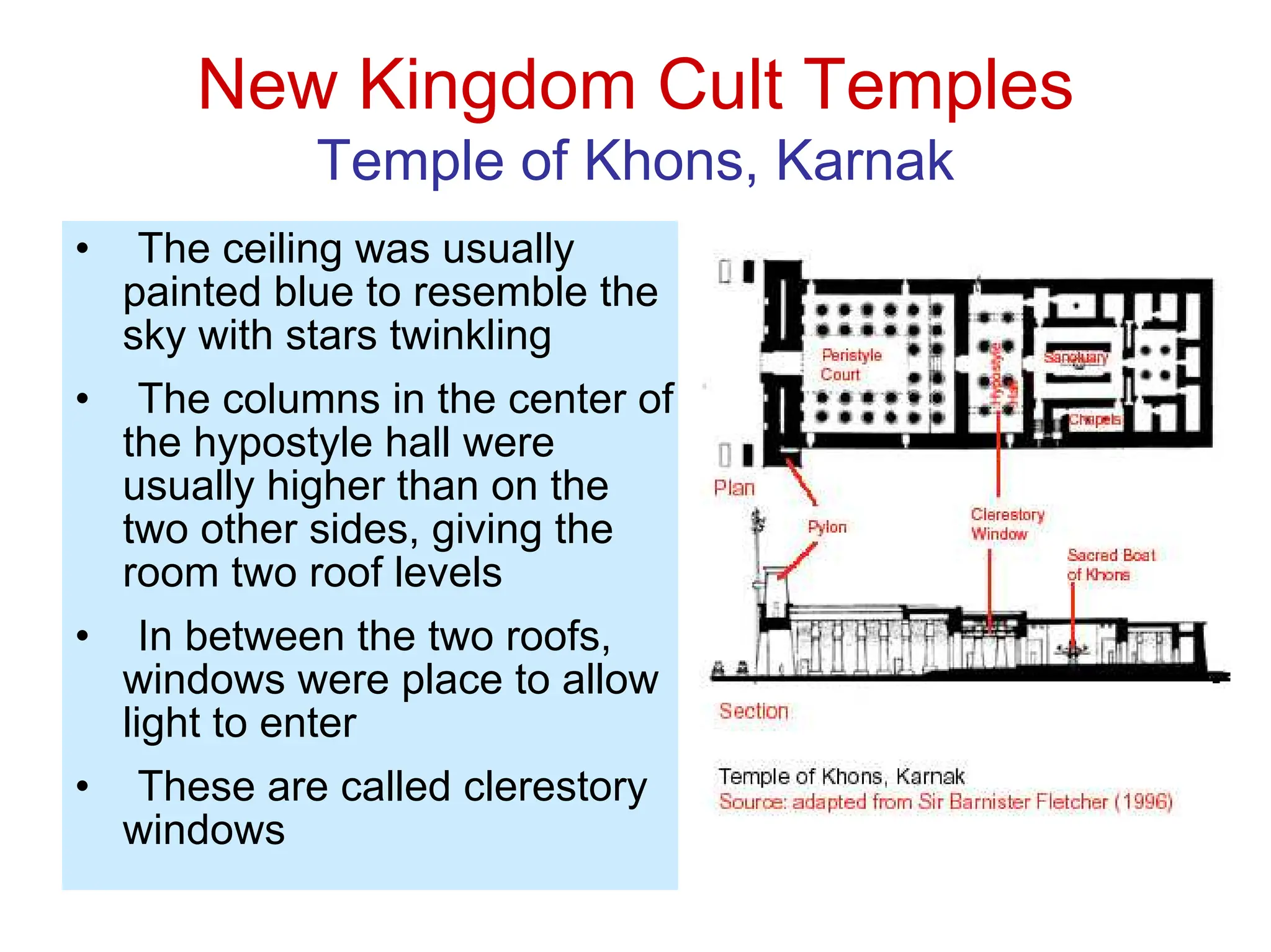
• The ceiling was usually
painted blue to resemble the
sky with stars twinkling
• The columns in the center of
the hypostyle hall were
usually higher than on the
two other sides, giving the
room two roof levels
• In between the two roofs,
windows were place to allow
light to enter
• These are called clerestory
windows
New Kingdom Cult Temples
Temple of Khons, Karnak
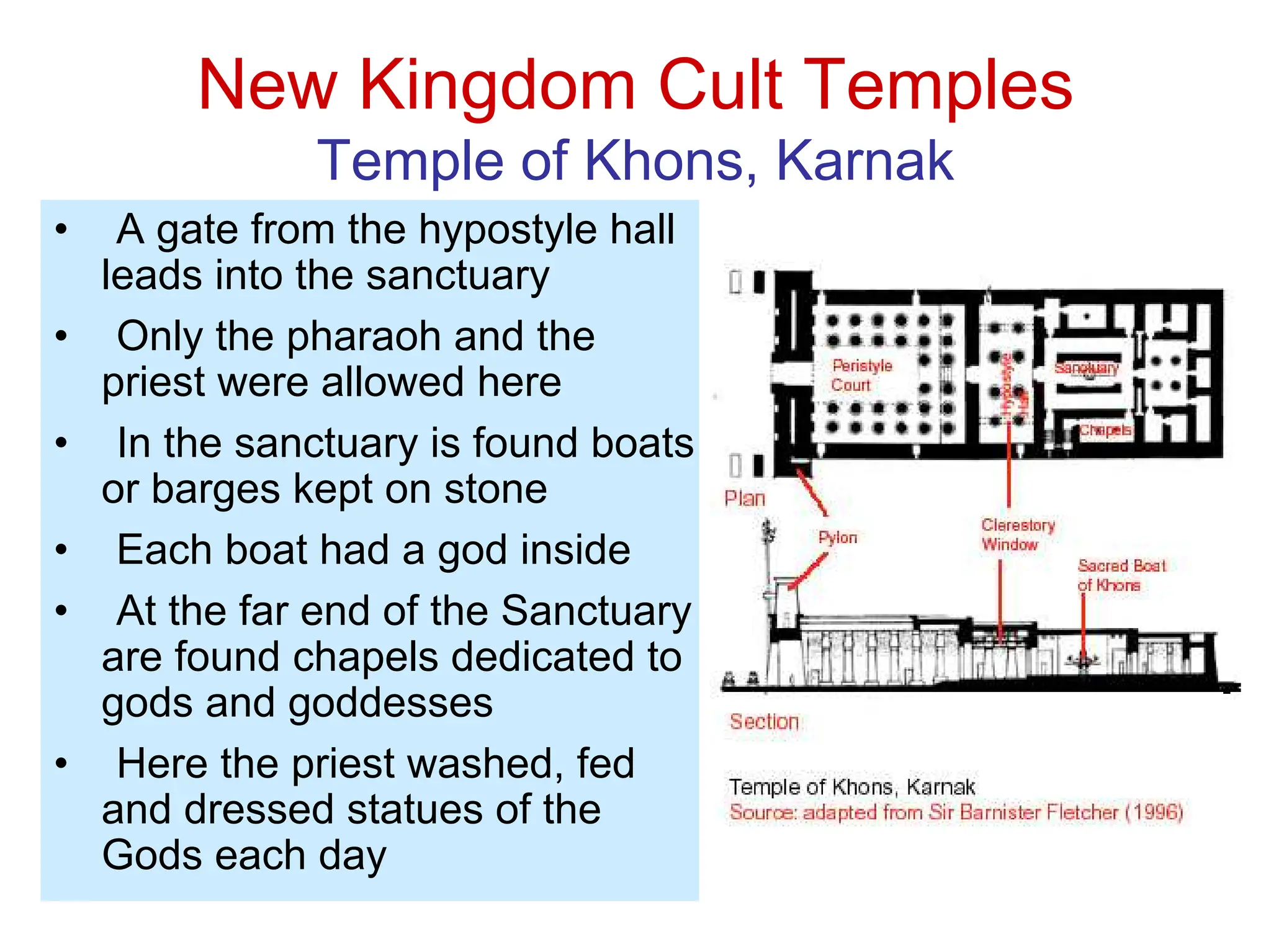
• A gate from the hypostyle hall
leads into the sanctuary
• Only the pharaoh and the
priest were allowed here
• In the sanctuary is found boats
or barges kept on stone
• Each boat had a god inside
• At the far end of the Sanctuary
are found chapels dedicated to
gods and goddesses
• Here the priest washed, fed
and dressed statues of the
Gods each day
New Kingdom Cult Temples
Temple of Khons, Karnak
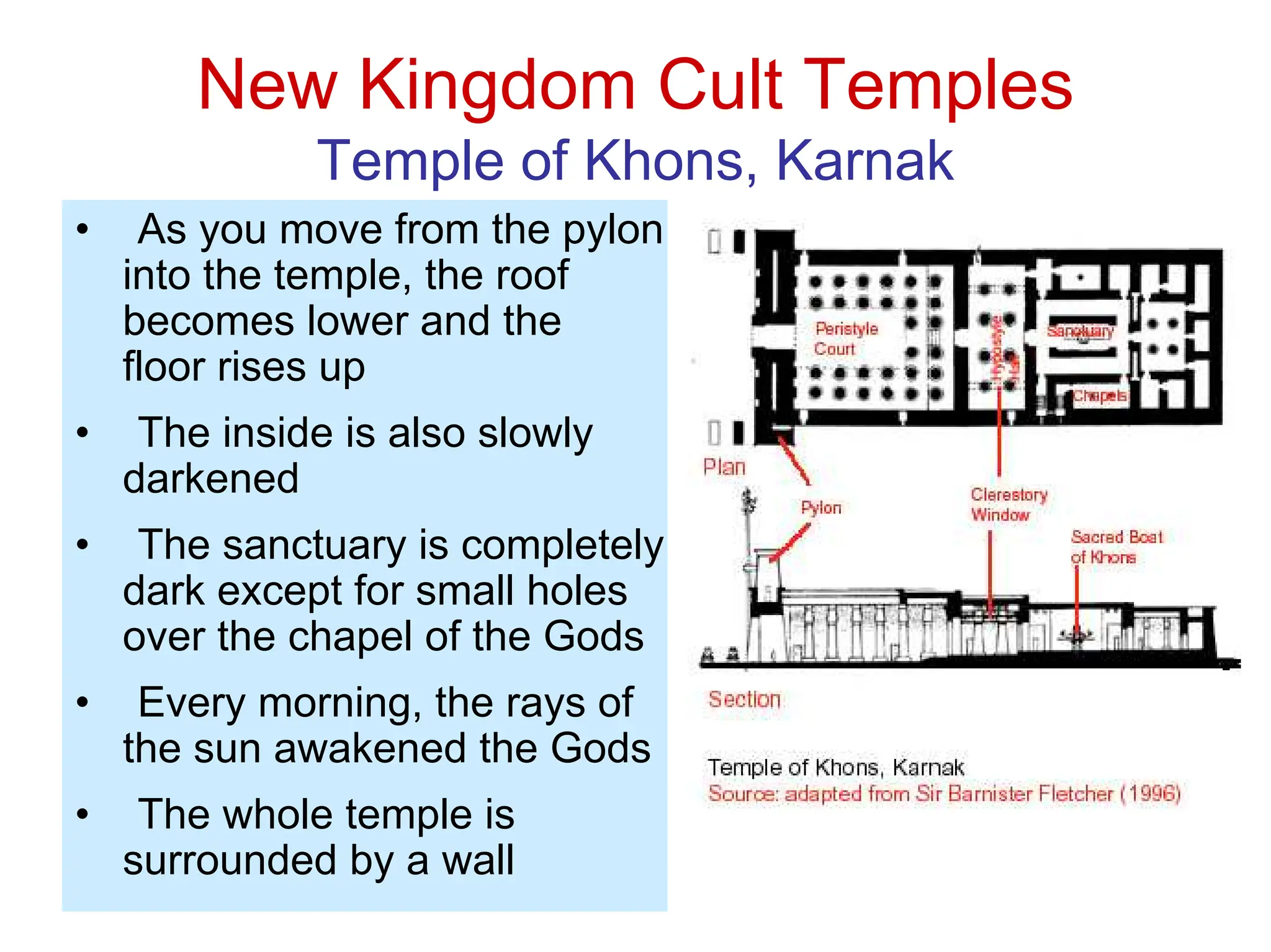
• As you move from the pylon
into the temple, the roof
becomes lower and the
floor rises up
• The inside is also slowly
darkened
• The sanctuary is completely
dark except for small holes
over the chapel of the Gods
• Every morning, the rays of
the sun awakened the Gods
• The whole temple is
surrounded by a wall
New Kingdom Cult Temples
Temple of Amon, Karnak
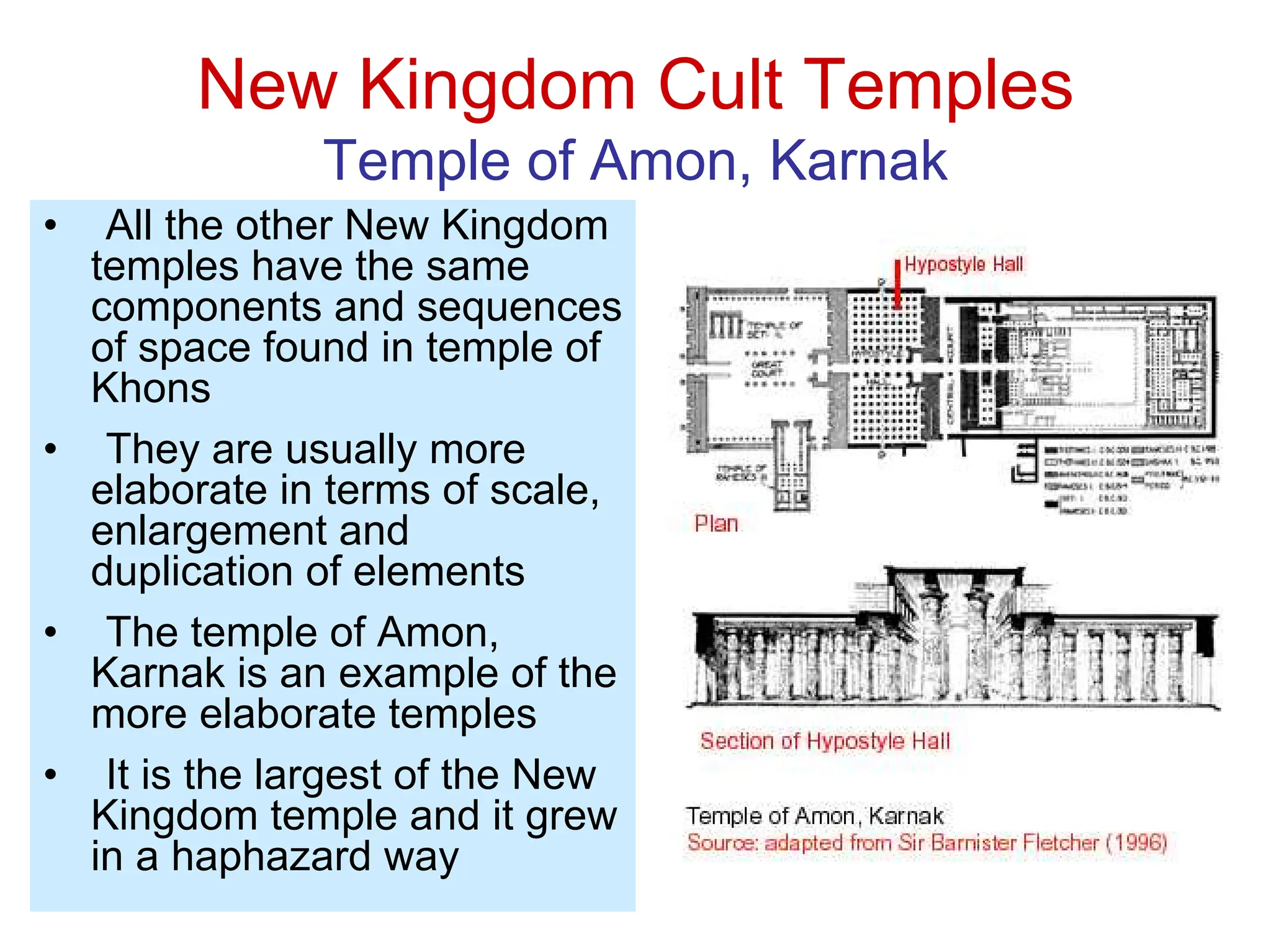
• All the other New Kingdom
temples have the same
components and sequences
of space found in temple of
Khons
• They are usually more
elaborate in terms of scale,
enlargement and
duplication of elements
• The temple of Amon,
Karnak is an example of the
more elaborate temples
• It is the largest of the New
Kingdom temple and it grew
in a haphazard way
New Kingdom Cult Temples
Temple of Amon, Karnak
• It is the largest of the New Kingdom temples and
it grew in a haphazard way
• Built by at least 16 pharaohs over a period 1700
years
• Each pharaoh added either a pylon, courtyard,
hypostyle hall or decorated on parts built by an
earlier pharaoh
• Queen Hatshepsut, Tutmosis II and Rameses II
all added to the temple
• The front pylon had two obelisk in front
• Apart from the front pylon, the temple had two
additional pylons
New Kingdom Cult Temples
Other Temples
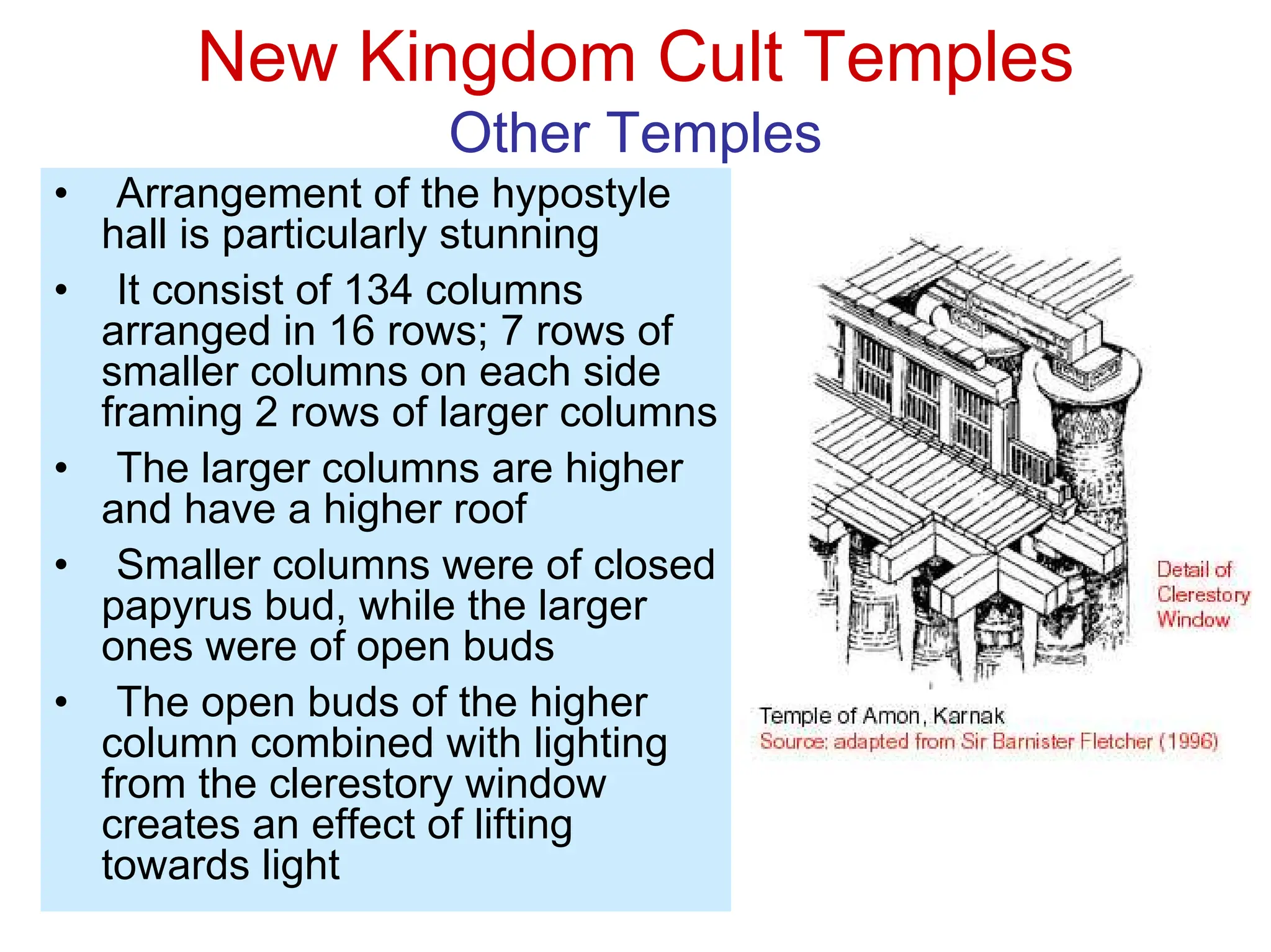
• Arrangement of the hypostyle
hall is particularly stunning
• It consist of 134 columns
arranged in 16 rows; 7 rows of
smaller columns on each side
framing 2 rows of larger columns
• The larger columns are higher
and have a higher roof
• Smaller columns were of closed
papyrus bud, while the larger
ones were of open buds
• The open buds of the higher
column combined with lighting
from the clerestory window
creates an effect of lifting
towards light
New Kingdom Cult Temples
Other Temples- Temple of Luxor
• There are several other
temples built during the
New kingdom
• We will not be able to
review all the others[339]
• Among the important
ones are:
• The temple of Luxor
(1408-1300 BC)
New Kingdom Cult Temples
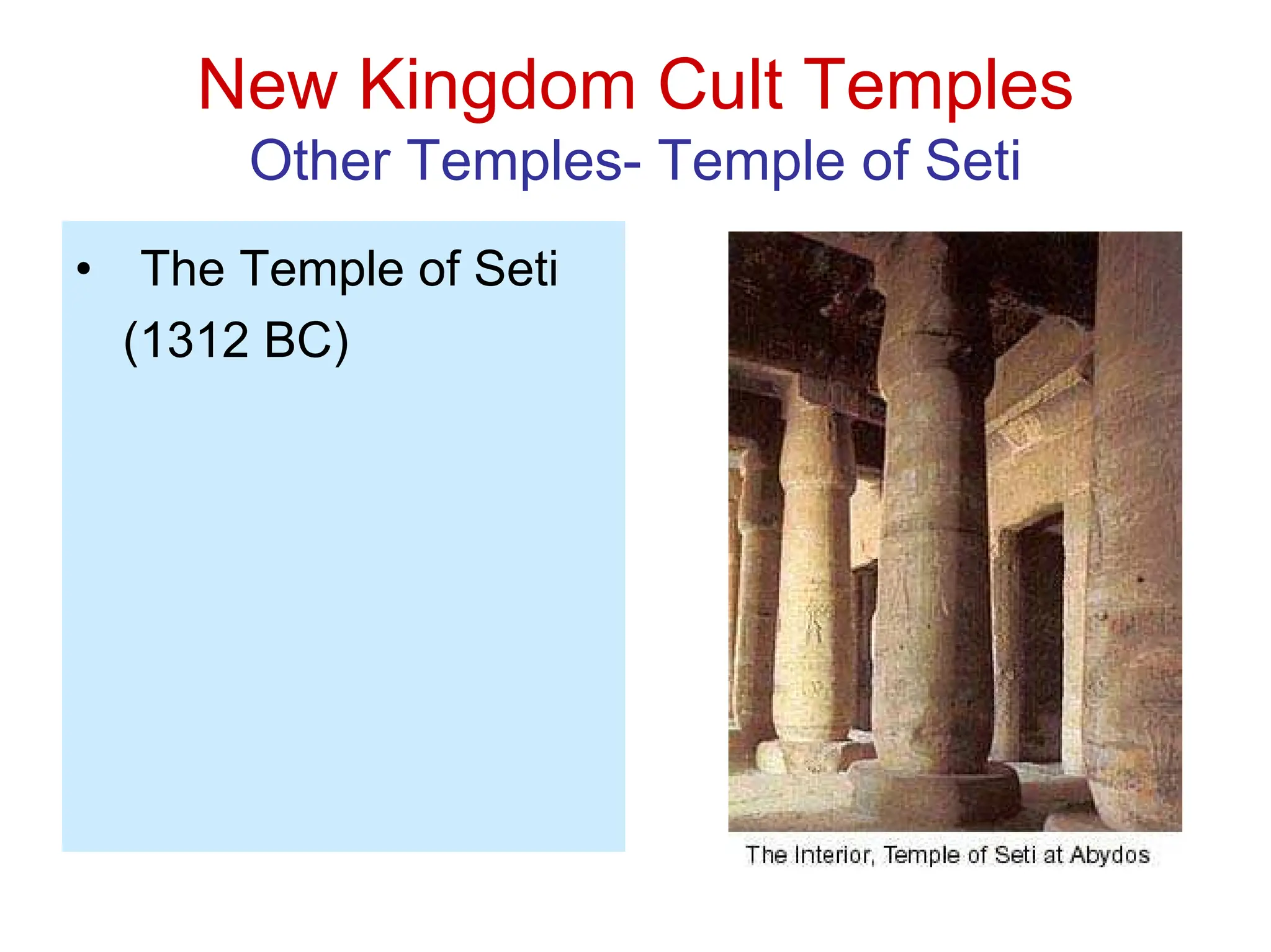
Other Temples- Temple of Seti
• The Temple of Seti
(1312 BC)
New Kingdom Cult Temples
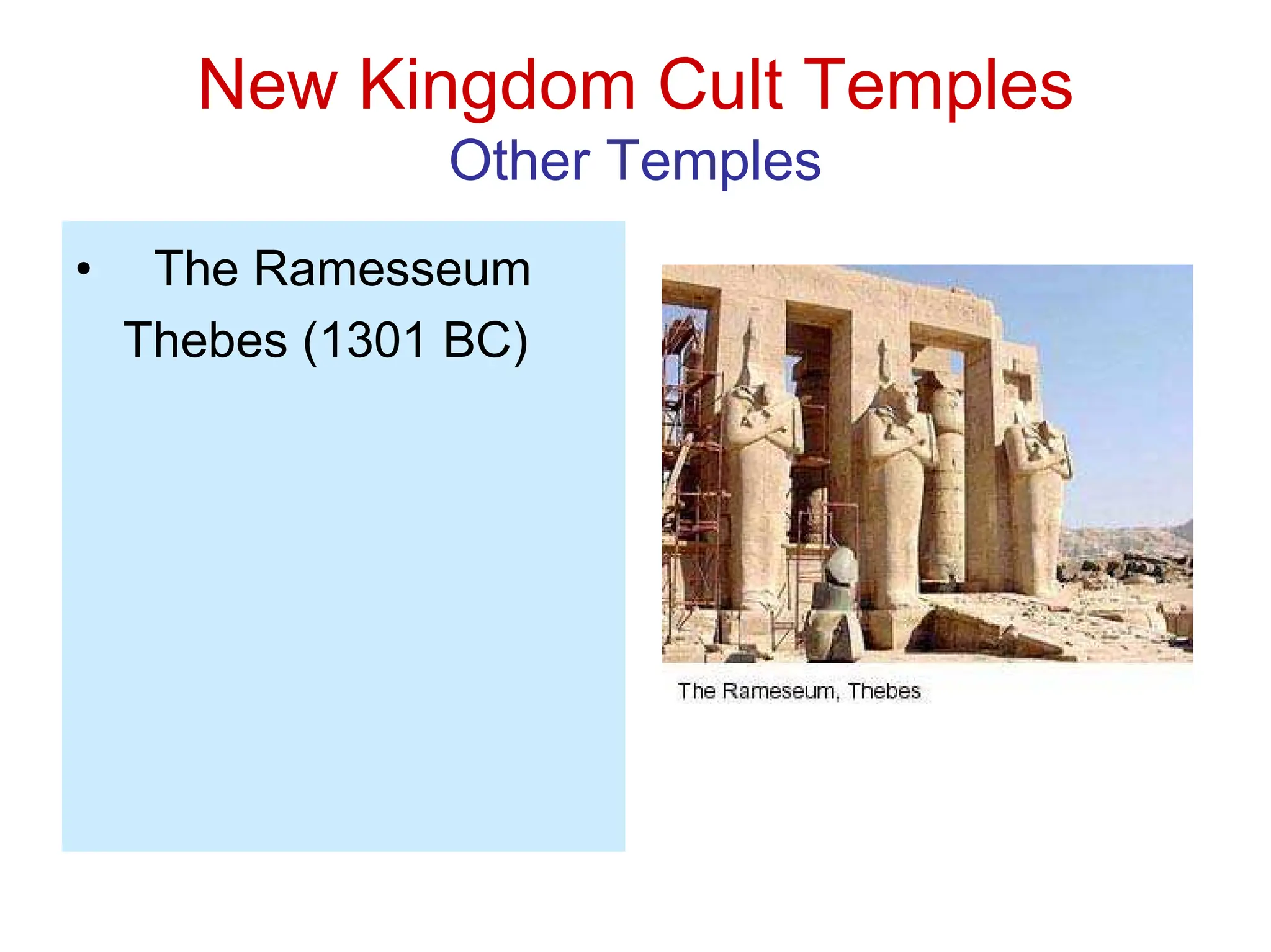
Other Temples
• The Ramesseum
Thebes (1301 BC)
New Kingdom Cult Temples
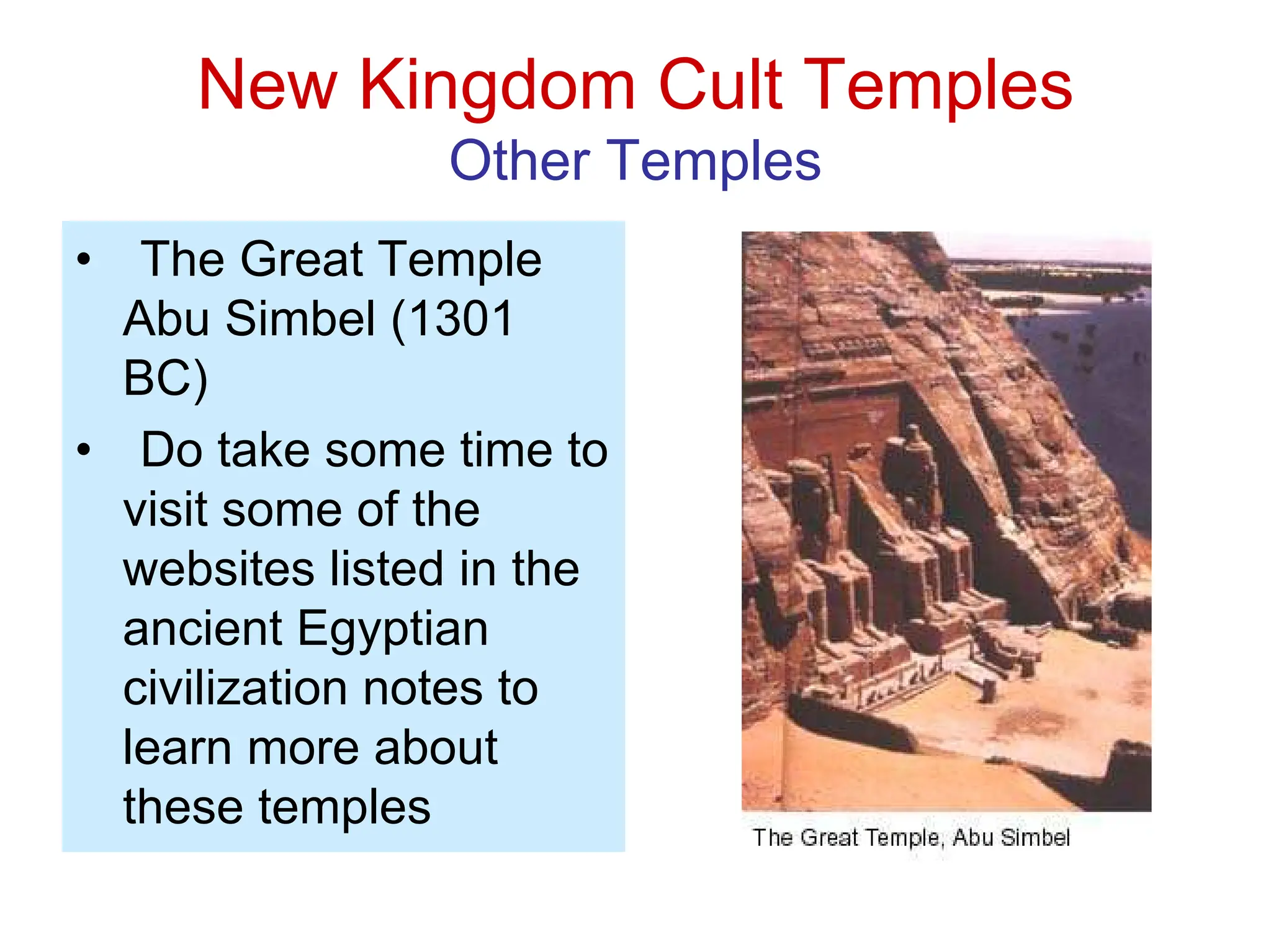
Other Temples
• The Great Temple
Abu Simbel (1301
BC)
• Do take some time to
visit some of the
websites listed in the
ancient Egyptian
civilization notes to
learn more about
these temples
Other Architectural Elements
Columns
• Egyptian architecture also
developed several unique
architectural elements
• Includes Columns, relief
carving, and writing, the
obelisk and sphinxes
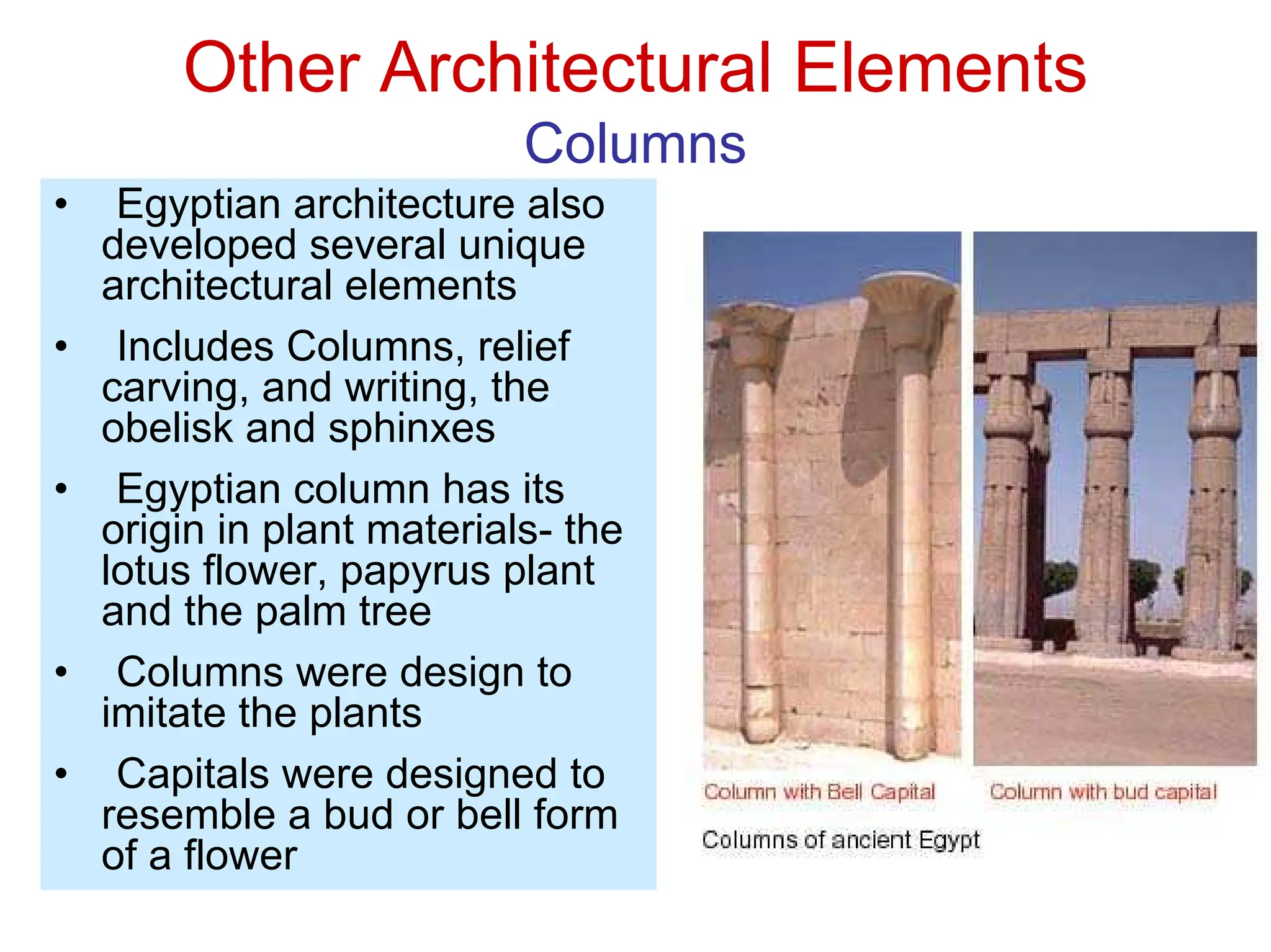
• Egyptian column has its
origin in plant materials- the
lotus flower, papyrus plant
and the palm tree
• Columns were design to
imitate the plants
• Capitals were designed to
resemble a bud or bell form
of a flower
Other Architectural Elements
Relief Carving and Painting
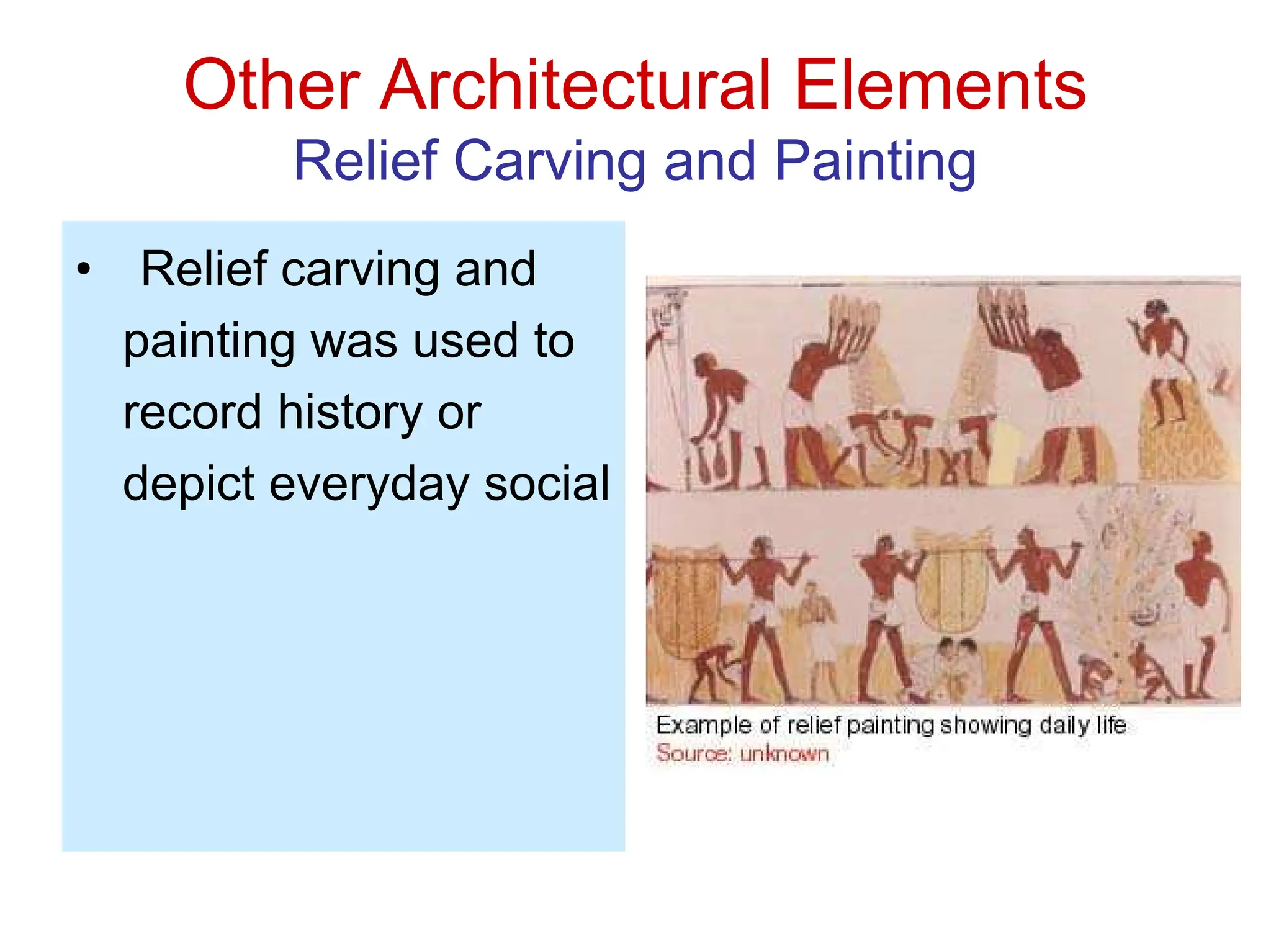
• Relief carving and
painting was used to
record history or
depict everyday social
Other Architectural Elements
Obelisk
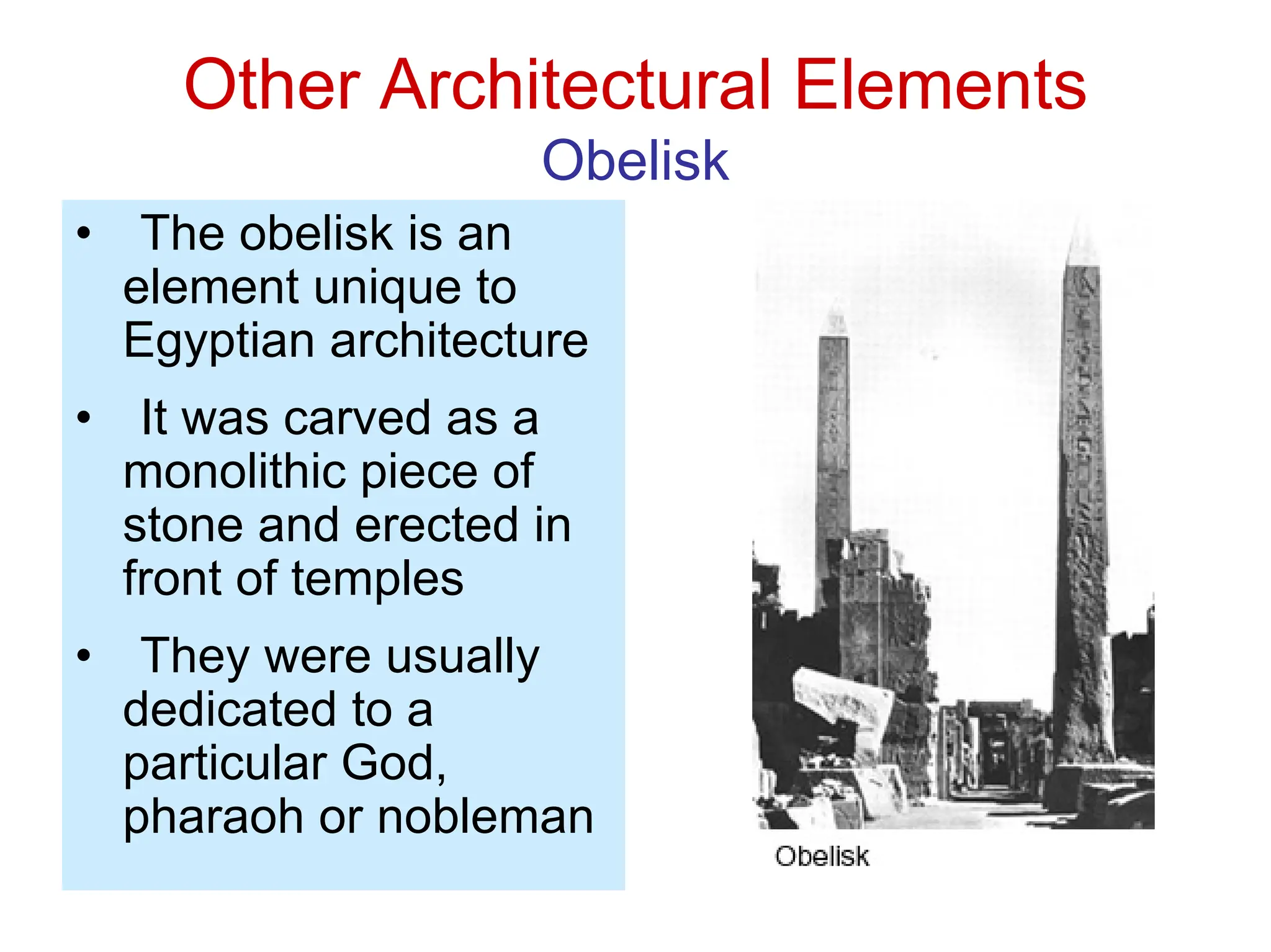
• The obelisk is an
element unique to
Egyptian architecture
• It was carved as a
monolithic piece of
stone and erected in
front of temples
• They were usually
dedicated to a
particular God,
pharaoh or nobleman
Other Architectural Elements
Sphinxes
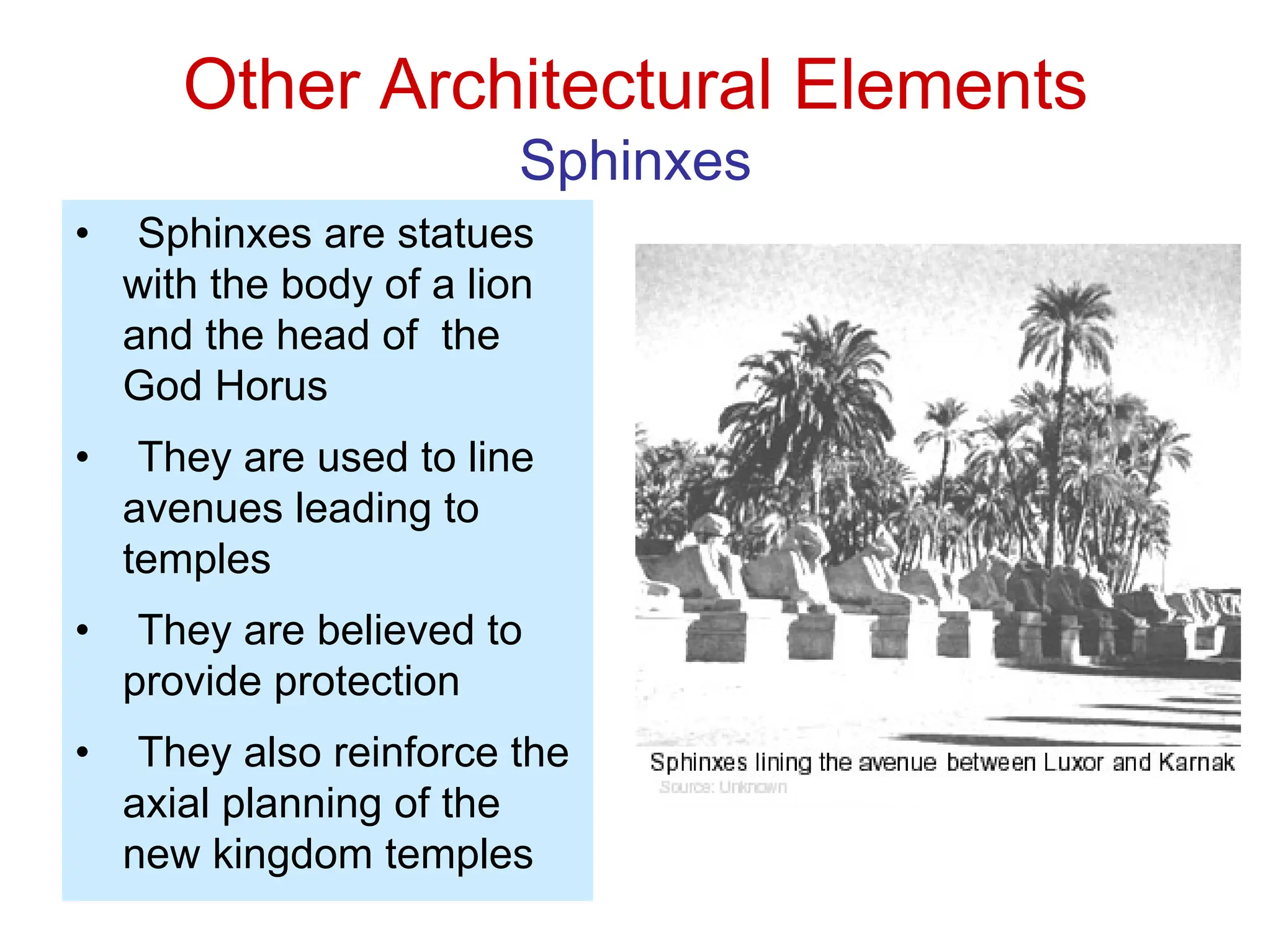
• Sphinxes are statues
with the body of a lion
and the head of the
God Horus
• They are used to line
avenues leading to
temples
• They are believed to
provide protection
• They also reinforce the
axial planning of the
new kingdom temples
End
of
Lecture
Module
4
Lecture
12
Module
4
Lecture
13
Ancient
Egyptian
Architecture
Outline of Lecture
• Lecture 13
– Architectural Characteristics
• Buildings and other architectural elements
• Building materials, construction and
technologies
• Architectural Organizing principles
Architectural
Characteristics
Bdgs and Other Arch. Elements
Buildings
• Two buildings types dominated ancient Egyptian
architecture; tombs and temples
• Minimal attention was paid to houses because
belief
• House were simple designed to last a life time
• Effort was on buildings associated with the
afterlife
• Tombs and temples were design to last forever
• Tomb construction varied with the various period
of Egyptian civilization
Bdgs and Other Arch. Elements
Buildings
• During the early Kingdom, tomb construction
evolved from the Mastaba through the Stepped
pyramid to the Geometric Pyramid
• At Giza, we see the ultimate development of the
Egyptian Pyramid
• In Middle and New Kingdoms, grave robbers
forced a change in tomb construction
• Pharaohs of the periods did not also have the
power of Early Kingdom pharaohs to undertake
pyramid construction
Bdgs and Other Arch. Elements
Buildings
• Pyramid construction disappeared and
underground tombs became popular
• Two types were examined-Rock cut tomb and
Shaft tomb
• Rock cut tombs were carved out of existing
mountains
• Shaft tombs were dug in the underground of
mountains
• The Middle and New Kingdom also saw the
introduction of Mortuary temples
Bdgs and Other Arch. Elements
Buildings
• Two Mortuary temples were examined-
Mentuhotep and Hatshepsut
• Mortuary temple of Mentuhotep was constructed
during the Middle kingdom
• Hatshepsut’s temple was constructed during the
New Kingdom
• The mortuary temples were a place to bury as
well as worship a dead person
• The mortuary temples owe their origin to
funerary buildings that were attached to the
Pyramids
Bdgs and Other Arch. Elements
Buildings
• During the New kingdom Focus in temple
construction shifted to Cult temples
• The cult temples were dedicated to the worship
of Egyptian Gods
• Two temples were examined all located at
Karnak
• The temple of Khons is a typical Egyptian cult
temple
• The temple of Amon shows how the temple can
become complicated through addition and
duplication of elements
Bdgs and Other Arch. Elements
Other Elements
• Also examined some unique architectural elements
• Includes columns, relief carving and painting,
obelisk and sphinxes
• Columns designed to mirror plant materials
• Evolved from attached columns in the Zoser’s
complex to the heavy columns of Egyptian cult
temples
• Relief carving and painting were used to capture
history
• Obelisk are free standing poles dedicated to Gods,
Pharaohs or nobles
• Sphinxes are used to line avenues to temples for
protection
Materials, Const. & Systems
Materials
• Three common materials of construction in Egypt
• Plant materials, clay and stone
• Plants consist of readily available material like
reeds, papyrus and palm ribs and shaft
• Timber was available in limited quantity; used for
roofing
• Clay was used for construction either as for
frame construction or as sun dried brick
• Stone was not much used during the early period
of ancient Egyptian civilization
• It became popular after the 3rd dynasty of the
Early Kingdom and was used for tombs and
temples
Materials, Const. & Systems
Construction System
• Construction system in ancient Egypt reflected
the availability of materials
• Two construction systems were predominant:
Adobe construction and post and beam
construction
• Adobe construction took the form of clay on
vegetable material or sun dried brick construction
• This construction was reserved for houses and
other buildings of daily life
• These buildings are supposed to last for only a
generation
Materials, Const. & Systems
Construction System
• Egyptian monumental construction is mainly of a
post and beam style
• This is expressed mainly in pyramids, tombs and
temples
• Columns are designed to look like plant material
• Their shaft resemble bundles of plant stems tied
together
• Their capitals are derived from the lotus bud or
the papyrus flower or the palm leave
• Great importance was attached to relief carving
and it was an integral part of the architecture
Materials, Const. & Systems
Construction System
• The true arch was not extensively used in
ancient Egypt
• The principle was however known
• Construction in Egypt took place during the
period of floods
• It took 20 years to build a pyramid with a
team of 20,000 men working three to four
months during the floods
Materials, Const. & Systems
Technologies
• Ancient Egyptians contributed to technologies in
the aspect of lighting
• Egyptians used courtyards extensively for
lighting
• Technology has existed since the ANE period
• The greatest contribution of the Ancient
Egyptians is in the aspect of Clerestory lighting
• In the hypostyle hall of Egyptian temples is found
one of the earliest application of the clerestory
method of lighting
• By making columns higher and creating two roof
levels, the ancient Egyptians were able to admit
light into halls
Principles of Arch. Organization
Principles
• Principles of Arch. Organization
– Emphasis on Building Massing
– Linear and Geometrical Organization
– Application of harmony and Contrast
• Forces shaping Arch Organization
– Influence of the desert environment
– Influence of religion and social symbolism
Principles of Arch. Organization
Emphasis on Building Masses
• The examination of ancient Egyptian architecture
shows more concerned with massing and limited
attention to space or function
• The Mastaba, Pyramids, Mortuary and Cult
temples all display a focus on massing and form
• There was limited consideration on functional
space
• Consideration of function in design was limited to
provision of spaces for ritual activities such as
chapels dedicated to Gods in Pyramid funeral
complexes and Mortuary and Cult temples
Principles of Arch. Organization
Application of Linear & Geometrical Org
• The Most important compositional principle in
ancient Egypt is linearity and axial organization
• Linearity means organization along a line, while
axial organization means that there is a defined
axis running through the whole composition
• Almost all the predominant monuments have a
linear and axial organization
• These include the pyramid funerary complexes
and the mortuary and cult temples
Principles of Arch. Organization
Application of Linear & Geometrical Org
• Egyptian architecture also displays an
understanding and application of geometry in
design
• This is noticeable in the pyramids at Giza
• All the three main pyramids are Geometrical
pyramids
• A geometric pyramid has a square base and a
52 degree inclination of its sides
• All the pyramids are also aligned in a straight line
along their axes
• This could only have been achieved with the
understanding of geometry
Principles of Arch. Organization
Application of Harmony & Contrast
• Architecture in ancient Egypt also displays
understanding of the principle of Harmony and
contrast
• Example of this is reflected in the pyramids at
Giza
• The color and material of the pyramid create a
harmony between the pyramids and the desert
• The form and shape of the pyramids however
contrast sharply with the smooth undulating
desert
Principles of Arch. Organization
Application of Harmony & Constrast
• This understanding is also displayed in the
temples of Mentuhotep and Hatshepsut
• A double row of columns used to front the lower
and upper terraces create a harmony with the
rugged background of the mountain cliffs
• The terraces of the temples are however in sharp
contrast with the mountainous nature of the
environment
• The temples appear like an island of peace in a
rugged and violent environment
Forces Shaping Arch. Organization
Influence of the Desert
• Ancient Egyptian architecture can only be
understood by also looking at the environment in
which it is located
• Egypt is essentially located in a desert and the
desert is nothing but empty space
• For anything to be visible and considered
monumental, it must match the scale of the
desert
• This understanding may have influence the
architects of ancient Egypt to focus on building
massing and creating the massive buildings that
we have studied
Forces Shaping Arch. Organization
Influence of the Nile
• The Nile had an important influence in the
linearity and axiality of ancient Egyptian
Architecture
• The Nile was a very straight river
• The straightness of the line provided the ancient
Egyptians with both a symbolic sense of direction
and a principle for application in the creation of
monumental buildings
Forces Shaping Arch. Organization
Religion and Social Symbolism
• A review of the forces shaping architecture in
ancient Egypt will be incomplete without
considering the role of religion and social
symbolism
• Religion, particularly the belief in life after death
was a strong factor in creating the monumental
architecture of ancient Egypt
• The tombs and the temples are all a factor of the
desire to achieve immortality or appease
Egyptian Gods
Forces Shaping Arch. Organization
Religion and Social Symbolism
• Social symbolism also played a part in shaping
ancient Egyptian architecture
• Egyptian society is segregated with pharaohs,
noblemen and commoners
• The desire to build massive tombs and temples
by pharaohs and noblemen is a way to express
their social standing in society
• Put in another way, the buildings are an
expression of the power, authority and social
standing of the nobles and pharaohs who built
them
End
of
Module
4

ARC_110_History_of_Architecture_I_Module.pdf

  • 1.
    ARC 110 History ofArchitecture I Module 4 Ancient Egyptian Architecture
  • 2.
    Module Outline • L ecture10 – Historical Background • Location and period • Social characteristics and beliefs – Architecture of the Civilization • Early Kingdom Tombs • L ecture 11 – Early kingdom Tombs continue – Middle and New Kingdom Burial Chambers • L ecture 12 – Middle and New Kingdom Burial Chambers Continue – New Kingdom Cult Temples – Other Architectural Elements • L ecture 13 – Architectural Characteristics • Buildings and other architectural elements • Building materials, construction and technologies • Architectural Organizing principles
  • 3.
    Ancient Egyptian Civilization LearningOutcomes • What we expect to learn from the civilization: – The influence of geographical location on social life and architecture – Architecture as a store of social history – Architecture of pyramids, tombs and temples – Evolution of architectural elements of column, beam, obelisk, wall relief and clerestory lighting – Architectural principles emphasizing mass rather than space and linearity and axiality as organizing principles
  • 4.
    Module 4 Lecture10 Ancient Egyptian Architecture
  • 5.
    Outline of Lecture •Lecture 10 – Historical Background • Location and period • Social characteristics and beliefs – Architecture of the Civilization • Early Kingdom Tombs – Mastaba – Stepped Pyramid – Geometrical Pyramid
  • 6.
  • 7.
    Historical Background Location • Locatedin Africa on the northern edge of the Sahara • The Nile bisects through the land from the south to the north • The Nile is a seasonal river that overflows its bank yearly to create a fertile valley • The Ancient Egyptians lived in the fertile valley and grew their crops • They buried their dead in the desert
  • 8.
    Historical Background Period • Thehistory of ancient Egypt started with the land divided into upper and lower Egypt • The two regions were frequently at war with each other • Around 3000 BC, King Menes united the two into a single nation • Unification brought about peace that led to the development of ancient Egyptian Civilization
  • 9.
    Historical Background Period • Thehistory of ancient Egypt is divided into periods based on ruling dynasties • Seven periods can be identified; • 4500 to 2000 BC Early Dynastic • 2350 – 2200 BC Old Kingdom • 2000- 1600 BC First Intermediate period • 1600 – 1717 BC Middle Kingdom • 1350 – 612 BC Second Intermediate Period • 612 – 539 BC New Kingdom • 539 – 330 BC Greek-Roman Period
  • 10.
    Historical Background Social Characteristics& Beliefs • Importance of the Nile – The Nile and its delta was the guiding force of ancient Egyptian civilization – It was a very predictable river, overflowing its banks every year from July to October – The floods leave a rich black silt that is fertile and is farmed by the people
  • 11.
    Historical Background Social Characteristics& Beliefs • Importance of the Nile – During the floods, people were freed from farming to engage in other activities including building work – The Nile was also the highway of Egypt connecting upper and lower Egypt – The Nile also offered protection from Invasion by outsiders – The Nile offered a symbolic sense of direction to the people, forming the primary principle in architectural organization
  • 12.
    Historical Background Social Characteristics& Beliefs • Government – At the center of ancient Egyptian civilization was a strong central government headed by pharaohs – The pharaohs provided Stability and a unified sense of purpose
  • 13.
    Historical Background Social Characteristics& Beliefs • R eligion – Ancient Egyptians were a religious people – They believed in many Gods – Different symbols were used to represent the Gods and temples were built and dedicated to them – The pharaohs were also held as living Gods
  • 14.
    Historical Background Social Characteristics& Beliefs • Religion – Egyptians also believed in life after death – They believed that when they die, their souls called Ka would live in them for ever – For the Ka to live, it needed either the body of the dead person or a copy of it in the form a statue – The Ka will return each night to the body or statue – If both the body and statue are destroyed, then the Ka would die
  • 15.
    Historical Background Social Characteristics& Beliefs • Mummification – To ensure the availability of a body to the ka of a dead person, the Egyptians developed a process of preservation called mummification – The process involves cutting open the body and removing all the internal organs and brain
  • 16.
    Historical Background Social Characteristics& Beliefs • Mummification – The body is then packed in natron to dry it out – It is then soaked in oil to preserve it – Next it is wrapped in a special cloth called mummy cloth – The mummy is then coated with wax and a face painted onto its wrapped head – The mummification of a pharaoh took a period of 72 days – Once mummification is finished, burial ceremonies are performed and the body is ready for burial
  • 17.
    Historical Background Social Characteristics& Beliefs • Architectural Ideas – Ancient Egyptians viewed earthly dwellings as temporary – They paid little attention to house construction – The tomb was seen as a permanent dwelling for the afterlife – Tremendous effort was exerted in tomb construction – The mummified dead body was buried in a stone box called sarcophagus in the tomb
  • 18.
    Historical Background Social Characteristics& Beliefs • Architectural Ideas – They believed that a dead person needs all his worldly goods – The tomb was usually packed with all the treasures of a dead person – If anything cannot be provided, it is painted on the walls of the tomb
  • 19.
    Historical Background Social Characteristics& Beliefs • Architectural Ideas – Tombs also have charms to protect the dead person & his property – The dead were buried in cities of the dead, called Necropolis located in the desert
  • 20.
    Historical Background Social Characteristics& Beliefs • Achievements – Ancient Egyptians had many achievements – This included a developed system of government, a belief system and art of mummification already discussed – They also left a legacy of tombs and temples that we will study – The Egyptians develop a system of irrigation to improve agriculture – The ancient Egyptians invented the hieroglyphics systems of writing – Historians were able to read hieroglyphics following the discovery of the Rosetta stone
  • 21.
  • 22.
    Architecture of theCivilization Introduction • During the old Kingdom, the pharaoh and his court lived in Memphis • When they died they were buried at the Necropolis at Saqqara • The earthly dwelling of the ancient Egyptians was seen as temporary and the tomb as a permanent dwelling • Houses were built of temporary materials to last for a life time
  • 23.
    Architecture of theCivilization Introduction • Tombswere most outstanding architectural element of the period • Tombs also serve as thefocus for the worship of the dead • The Tomb evolved during the old kingdom from the Mastaba, through the stepped pyramid to the renown ancient Egyptian pyramid • We will examine each of these next
  • 24.
    Early Kingdom Tombs Mastaba •The earliest method of bur ial in ancient Egypt was in shallow pits in the desert • The desert dried the bodies and preserved them • When animals preyed on bodies, the people dug deeper • In the end they built a bench-like structure over graves to create first burial structure called Mastaba
  • 25.
    Early Kingdom Tombs Mastaba •The name mastaba is derived from podiums found in the front of traditional houses • In the Old Kingdom, rich and noble person built mastaba for their burial in the city of the dead • Above ground the Mastaba is a large bench of sun-baked bricks rising 9 meters high • It had a flat top and slanting walls • The earliest royal tombs were decorated with painted patterns in brilliant colors
  • 26.
    Early Kingdom Tombs Mastaba •Internally, a mastaba consist of three parts- a burial chamber, a serdab and a chapel • The burial chamber was located 30 feel below ground • It was connected to burial chamber above ground through a shaft • The burial chamber is the place for the burial of the dead person
  • 27.
    Early Kingdom Tombs Mastaba •In the chamber is found the sarcophagus where the dead body was placed • The burial chamber is packed with all the necessary things needed in the after life • After burial, the shaft to the burial chamber is sealed
  • 28.
    Early Kingdom Tombs Mastaba •The Serdab and Chapel are located above ground • The serdab is a room where the statue of the dead person is kept • The statue acts as a substitute for body in case it is destroyed
  • 29.
    Early Kingdom Tombs Mastaba •Egyptians believe that the Ka must return to the body or a copy of it each night • If both body and statue are destroyed, the ka would die • The chapel is where the ka is supposed to live for ever • It is a colorful room meant to deceive the gods into letting the ka enter the next world • Had a false door leading to the land of the dead
  • 30.
    Early Kingdom Tombs Mastaba •Some mastabas had fence walls, and chambers for burial of servants • Mastaba served as an embryo for the evolution of the pyramid
  • 31.
  • 32.
    Module 4 Lecture11 Ancient Egyptian Architecture
  • 33.
    Outline of Lecture •Lecture 11 – Early Kingdom Tombs Continue • Stepped Pyramid • Pyramid – Middle and New Kingdom Burial Chambers • Mortuary Temples
  • 34.
  • 35.
    Early Kingdom Tombs SteppedPyramid • King Zoser was the powerful pharaoh of the third dynasty of the old kingdom • The stepped pyramid was built for king Zoser by Imhotep • It was built as a funeral complex in the necropolis at Saqqara • Imhotep initially conceived of the tomb as a large Mastaba of stone
  • 36.
    Early Kingdom Tombs SteppedPyramid • Dissatisfaction with the result led to the stacking of mastaba one on top of another • T he result was the stepped pyramid with five sloping setbacks • The stepped pyramid is the intermediate step between mastaba and geometric pyramid
  • 37.
    Early Kingdom Tombs SteppedPyramid • Stepped pyramid was 200 feet high with 6 giant steps • The burial chamber is entered from the north side and is 92 feet down • On either side of the chamber are store rooms for the kings treasures • All the treasures buried with Zoser have long been stolen • A stone statue of zoser was also recently found staring out through peep holes in his Serdab
  • 38.
    Early Kingdom Tombs SteppedPyramid • The Serdab is located on the north side, along with the funerary temple • The stepped pyramid stands at the middle of a large complex • The funeral complex consisted of palaces, temples and the stepped pyramid • They were all surrounded by a fence wall 33 feet high
  • 39.
    Early Kingdom Tombs SteppedPyramid • The fence wall of the funeral complex has a breaking pattern of about 200 projections and recessions • Fourteen of these were larger than the others and 13 out of the fourteen had false doors • The false doors were for the use of the pharaoh’s ka
  • 40.
    Early Kingdom Tombs SteppedPyramid • The entrance door leads to a long hall having two rows of columns • This is one of the first uses of columns in history • The columns were designed to look like bundles of reeds and had flutes
  • 41.
    Early Kingdom Tombs SteppedPyramid • In the north palace is also found stone columns with capitals • They were designed to look like the papyrus plant • Zosers funeral complex was designed as a model of his palace, city and kingdom • The shape of the pyramid suggest a stairway to the sky to join the sun God Amon Ra
  • 42.
    Early Kingdom Tomb Attemptsat Pyramid Building • After the stepped pyramids, there were several attempt at building a pure geometric pyramid • Among the prominent attempts were the pyramid at Medun and two pyramids built by Snefru at Dashur
  • 43.
    Early Kingdom Tomb Attemptsat Pyramid Building • King Huni made the first attempt at building a pure pyramid at Medun • He constructed a seven stepped pyramid with a square plan and height of 90 meters and an angle of incline of 51 degrees • The pyramid did not have a mortuary temple
  • 44.
    Early Kingdom Tomb Attemptsat Pyramid Building • Pharoah Snefru made two attempts at pyramid construction • His first pyramid, the Bent pyramid at Dashur had a square plan with a height of 102 meters • The pyramid had a change of angle midway, leading to its being called the bent pyramid
  • 45.
    Early Kingdom Tomb Attemptsat Pyramid Building • Snefru’s second pyramid, the north pyramid, is the place he was buried • It had a low pitch of 43 degrees instead of 52 degrees making it look stunted • A true pyramid has an incline angle of 52 degreess
  • 46.
    Early Kingdom Tomb ThePyramids at Giza • The construction of a true geometrical pyramid was achieved during the reign of Cheops, son of Snefru • This was located at Giza • This pyramid is called the Great Pyramid because of its size • The pyramid is 482 ft high on a plan 760 ft square
  • 47.
    Early Kingdom Tomb ThePyramids at Giza • Two additional pyramids were subsequently built at Giza • The second largest in the center was built by Chefren, the son of Cheops • The third and smallest was built by Mykerinus, the son of Chefren • The three together are referred to as the pyramids at Giza
  • 48.
    Early Kingdom Tomb ThePyramids at Giza • The three are aligned diagonally along the projection of the diagonal of the great pyramid • The small pyramids close to them were built for their Queens
  • 49.
    Early Kingdom Tomb TheGreat Pyramid Cheops • The great pyramid has a unique internal arrangement • First it has a chamber built below the base of the pyramid • Another chamber was built above it known as the queen’s chamber • A larger burial chamber known as the king’s chamber was built at the center of the pyramid
  • 50.
    Early Kingdom Tomb TheGreat Pyramid Cheops • This is the chamber where the king was buried in his Sarcophagus • The kings chamber was 35 ft by 17ft in plan and 19ft high • Both the king and queen chamber are connected to the entrance on the north side • Two air shafts also connect the king’s chamber to outside for ventilation • Once a king is buried, the burial chamber was sealed forever
  • 51.
    Early Kingdom Tomb Pyramid •The pyramids were designed as part of a funeral complex for the burial of a pharaoh • Chefren’s complex is the best preserved example • The complex consist of three interconnected units: – A valley temple by the river Nile where the pharaoh’s body was embalmed – A pyramid mortuary temple for rituals – A long narrow causeway connecting the two
  • 52.
    Early Kingdom Tomb BurialCeremony • The death of a pharaoh marked the beginning of a grand funeral • Hundreds of ships and barges filled with nobles and priest sailed the Nile from Memphis to Giza • The largest barge carried the body of the pharaoh
  • 53.
    Early Kingdom Tomb BurialCeremony • The boats docked at the lower valley temple where the body was carried to the roof for mummification • At the end of 72 days, an opening of the mouth ceremony was performed • A procession carried the pharaoh’s body along the causeway to the pyramid mortuary temple
  • 54.
    Early Kingdom Tomb BurialCeremony • This temple had many small chapels each with false doors • Many statues of the pharaoh were place in the temple so that his ka could come back each night • After prayers to the God Osiris, the body was lowered through the secret opening on the north side to his burial chamber • There he was laid in his stone Sarcophagus
  • 55.
    Early Kingdom Tomb BurialCeremony • Rich treasure was heaped on him • The passage was filled with rock and sealed forever • Now it was time for the pharaohs ka to pass to the land of the dead • The funeral complex shows the earliest development of the components of the new kingdom temple
  • 56.
    Early Kingdom Tomb TheSphinx at Giza • Located in Giza is the great Sphinx with the body of a lion and head of chefren • The reason for its construction is not clear • A theory hold that it was produced from leftover material • It may also have been carved to stand guard over the temple and tomb of Chefren
  • 57.
    Early Kingdom Tomb PyramidConstruction • How were the pyramids constructed? • There is no accurate knowledge about the method of construction of the pyramids • It is believed that 100,000 men worked 3 months each year for 30 years to build the pyramids • The lime stone used was quarried from nearby and transported by lever action • They were paid in food, clothing and drinks
  • 58.
    Early Kingdom Tomb Whydid Egyptians Build Pyramids • The pyramids were in general a response to the vast desert landscapes • For structures to be visible in the desert they have to be of gargantuan size • The pyramids were also a product of the will to achieve immortality by the pharaohs • The pyramids are the everlasting home of the pharaoh’s ka
  • 59.
    Early Kingdom Tomb Endof Pyramid Construction • After the Mykerinus period, the era of pyramid construction ended • More pyramids were built later but they were smaller and less complex • Later pharaohs could not also afford the cost of huge pyramid construction • Grave robbers also learned how to break into and steal the goods buried with pharaohs • The end of the Old Kingdom therefore marked the end of the great era of Egyptian pyramid construction.
  • 60.
    Mid & NewKingdom Burial-Cham Mortuary Temples Introduction • The Middle Kingdom began when pharaoh Mentuhotep united Egypt again after the first intermediate period • During the middle kingdom, the practice of pyramid construction disappeared • Focus in architectural development was however still on tombs and burial chambers • Two categories of structures came into use- mortuary temples and underground tombs
  • 61.
    Mid & NewKingdom Burial-Cham Mortuary Temples Introduction • Mortuary temples served as the place for the burial and worship of pharaohs • Temples dedicated to Gods were also located in them • Mortuary temples owe their origin to the pyramid funeral complex, particular the valley and pyramid temples • Underground tombs became popular because of the belief that they could not be robbed • Many power and wealthy pharaohs and noblemen carved their tombs directly into rock cliffs and underground during the Middle and New kingdoms • Most of the tomb and burial chamber construction was carried out at Del Al Bahari
  • 62.
    Mid & NewKingdom Burial-Cham Mortuary Temple of Mentuhotep • Two mortuary temples were built at Del al Bahari; mortuary temple of Mentuhotep and Hatshepsut • Mentuhotep was the first Pharaoh of the middle kingdom • He built the first mortuary temple at Del-al Bahari
  • 63.
    Mid & NewKingdom Burial-Cham Mortuary Temple of Mentuhotep • The temple is terraced in two levels • The upper terrace is faced with double colonnades • At the center is a core believed to have a small pyramid on top • The pyramid is believed to be a dummy burial chamber
  • 64.
  • 65.
  • 66.
    Outline of Lecture •Lecture 12 – Middle and New Kingdom Burial Chambers • Rock Cut Tombs • Shaft Tombs – New Kingdom Cult Temples • Temple of Khons, Karnak • Temple of Amon • Other Temples – Other Architectural Elements • Columns, Relief carving, Obelisk, & Sphinxes
  • 67.
  • 68.
    Mid & NewKingdom Burial-Cham Mortuary Temple of Mentuhotep • Entrance to the real tomb is found at the rear from the western courtyard • The burial tomb is accessible through a ramp leading down at the center of the court yard • Just like the pyramid funeral complexes, the temple of Mentuhotep also has a causeway leading to a valley temple
  • 69.
    Mid & NewKingdom Burial-Cham Mortuary Temple of Hatshepsut • Queen Hatshepsut’s temple was built 500 years after that of Mentuhotep during the new kingdom • Hatsheptsut was the only female pharaoh to rule Egypt • When Her husband Pharaoh Tutmosis died, her step son was too young to rule • She therefore became the ruler • Even when he grew old, she would not allow him to rule and crowned herself pharaoh
  • 70.
    Mid & NewKingdom Burial-Cham Mortuary Temple of Hatshepsut • She dressed as a pharaoh, wearing men’s cloth with a false beard attached to her chin • The temple of Mentuhotep served as a model in the design of her temple • Her extraordinary funeral temple located at Del- Al-Bahari, is set against the background of the cliffs • The architect of her temple is believed to be Senmut who is also buried in the temple
  • 71.
    Mid & NewKingdom Burial-Cham Mortuary Temple of Hatshepsut • The temple of Hatshepsut is like a giant stage on three levels • Each of the three levels was connected by a ramp • Her temple fits very well into the tall rock cliffs behind it • On the top level is her chapel dedicated to the goddess Hathor • The chapel was dug out of the rock cliff • Hatshepsut hid her tomb in the deep rock cliffs to stop robbers
  • 72.
    Mid & NewKingdom Burial-Cham Mortuary Temple of Hatshepsut • But her tomb was also plundered and smashed into a thousand pieces • Archeologist believe that her son Tutmosis III poisoned her to death and wrecked her tomb • The temple of Hatshepsut had no dominant mass • Instead, there was a strong horizontal axis running across the set of terraces and perpendicular to the mountains
  • 73.
    Mid & NewKingdom Burial-Cham Mortuary Temple of Hatshepsut • Her temple was not a construction of stone masses as in the pyramids • It was rather a play of the emptiness of terraces, ramps and courtyards against the busy background of the cliffs • Her temple captures the shift from the compact geometry of the old kingdom pyramids to the linear composition of the New Kingdom temples
  • 74.
    Mid & NewKingdom Burial-Cham Underground Tomb- Rock Cut Tomb • Two types of Underground tombs were built by pharaohs and nobles during the Middle and New Kingdom periods- Rock cut tombs and Shaft tombs • Rock cut tombsare tombs that are carved out of rocks • Many of theses are found along the cliff of the Nile • A very good example is the Rock cut tomb at Beni Hassan
  • 75.
    Mid & NewKingdom Burial-Cham Underground Tomb- Rock Cut Tomb • Beni Hassan consist of 3 elements: – A colonnade entrance portico for public worship – Behind the portico, a chamber or hall with columns supporting the roof serving as a chapel – A small recess towards the back of the chapel where the person is buried
  • 76.
    Mid & NewKingdom Burial-Cham Underground Tomb- Rock Cut Tomb • The columns on the exterior were shaped like a prism with 8 or 16 sides • The columns in the interior were designed as a bundle of reed tied together by rope
  • 77.
    Mid & NewKingdom Burial-Cham Underground Tomb- Shaft Tombs • Shaft tombs were a complex series of underground corridors and rooms cut out of the mountains in the valley of the King at Del-Al-Bahari • The large number of rooms and their complicated arrangement is deliberately done to create a maze or puzzle
  • 78.
    Mid & NewKingdom Burial-Cham Underground Tomb- Shaft Tombs • This is designed to make it difficult for robbers to determine where a dead person is buried • A dead pharaoh or nobleman is buried in one of the many underground rooms • Once the burial is finished, the entrance is sealed permanently and hidden from everybody
  • 79.
    New Kingdom CultTemples Introduction • The Middle Kingdom lasted for 275 years • The New Kingdom started after the end of second intermediate period • The New Kingdom lasted for 500 years • During the New Kingdom, the capital of ancient Egypt moved from Memphis to Thebes
  • 80.
    New Kingdom CultTemples Introduction • The most important and common architectural elements of the New Kingdom were temples • Several temples were built dedicated to Egyptian Gods • The New Kingdom Temples borrowed a lot of elements from the funeral complexes at Giza • They also borrowed elements from the Mortuary temples at Del-Al-Bahari
  • 81.
    New Kingdom CultTemples Introduction • The borrowed elements include: – Long approaches – Guardian sphinxes – Collonaded vestibules and inner courts – Darkening shrines – Intricate linear progression of constructed space • The New Kingdom temples allow a series of experiences passing in stages from openness and light in the exterior to interior closure and darkness • This feeling was deliberate as only the Pharaoh and priest were allowed into the inner part of temples
  • 82.
    New Kingdom CultTemples Introduction • Many examples of the New Kingdom temples are found at Karnak and Luxor, all in Thebes • An avenue of sphinxes connects the two sites
  • 83.
    New Kingdom CultTemples Temple of Khons, Karnak • The temple of Khons at Karnak is a good example of a simple New Kingdom Cult Temple • This temple show an example of the components and organization of a typical temple
  • 84.
    New Kingdom CultTemples Temple of Khons, Karnak • This is dedicated to the God Amun • A person approaching first meets the entrance wall called pylon • The pylon is higher and wider than the temple behind it • The pylons were treated with molding and decorated relief carvings • Mast with royal and religious flags fly in front of the pylon
  • 85.
    New Kingdom CultTemples Temple of Khons, Karnak • Behind the pylon is the peristyle courtyard • Made up of a row of twin colonnades on two or more sides and was open to the sun • It is the only place where common people were allowed to enter • Beyond the Peristyle courtyard is the hypostyle hall • Hypostyle means room with many columns. • Peristyle hall and columns painted in bright colors
  • 86.
    New Kingdom CultTemples Temple of Khons, Karnak • The ceiling was usually painted blue to resemble the sky with stars twinkling • The columns in the center of the hypostyle hall were usually higher than on the two other sides, giving the room two roof levels • In between the two roofs, windows were place to allow light to enter • These are called clerestory windows
  • 87.
    New Kingdom CultTemples Temple of Khons, Karnak • A gate from the hypostyle hall leads into the sanctuary • Only the pharaoh and the priest were allowed here • In the sanctuary is found boats or barges kept on stone • Each boat had a god inside • At the far end of the Sanctuary are found chapels dedicated to gods and goddesses • Here the priest washed, fed and dressed statues of the Gods each day
  • 88.
    New Kingdom CultTemples Temple of Khons, Karnak • As you move from the pylon into the temple, the roof becomes lower and the floor rises up • The inside is also slowly darkened • The sanctuary is completely dark except for small holes over the chapel of the Gods • Every morning, the rays of the sun awakened the Gods • The whole temple is surrounded by a wall
  • 89.
    New Kingdom CultTemples Temple of Amon, Karnak • All the other New Kingdom temples have the same components and sequences of space found in temple of Khons • They are usually more elaborate in terms of scale, enlargement and duplication of elements • The temple of Amon, Karnak is an example of the more elaborate temples • It is the largest of the New Kingdom temple and it grew in a haphazard way
  • 90.
    New Kingdom CultTemples Temple of Amon, Karnak • It is the largest of the New Kingdom temples and it grew in a haphazard way • Built by at least 16 pharaohs over a period 1700 years • Each pharaoh added either a pylon, courtyard, hypostyle hall or decorated on parts built by an earlier pharaoh • Queen Hatshepsut, Tutmosis II and Rameses II all added to the temple • The front pylon had two obelisk in front • Apart from the front pylon, the temple had two additional pylons
  • 91.
    New Kingdom CultTemples Other Temples • Arrangement of the hypostyle hall is particularly stunning • It consist of 134 columns arranged in 16 rows; 7 rows of smaller columns on each side framing 2 rows of larger columns • The larger columns are higher and have a higher roof • Smaller columns were of closed papyrus bud, while the larger ones were of open buds • The open buds of the higher column combined with lighting from the clerestory window creates an effect of lifting towards light
  • 92.
    New Kingdom CultTemples Other Temples- Temple of Luxor • There are several other temples built during the New kingdom • We will not be able to review all the others[339] • Among the important ones are: • The temple of Luxor (1408-1300 BC)
  • 93.
    New Kingdom CultTemples Other Temples- Temple of Seti • The Temple of Seti (1312 BC)
  • 94.
    New Kingdom CultTemples Other Temples • The Ramesseum Thebes (1301 BC)
  • 95.
    New Kingdom CultTemples Other Temples • The Great Temple Abu Simbel (1301 BC) • Do take some time to visit some of the websites listed in the ancient Egyptian civilization notes to learn more about these temples
  • 96.
    Other Architectural Elements Columns •Egyptian architecture also developed several unique architectural elements • Includes Columns, relief carving, and writing, the obelisk and sphinxes • Egyptian column has its origin in plant materials- the lotus flower, papyrus plant and the palm tree • Columns were design to imitate the plants • Capitals were designed to resemble a bud or bell form of a flower
  • 97.
    Other Architectural Elements ReliefCarving and Painting • Relief carving and painting was used to record history or depict everyday social
  • 98.
    Other Architectural Elements Obelisk •The obelisk is an element unique to Egyptian architecture • It was carved as a monolithic piece of stone and erected in front of temples • They were usually dedicated to a particular God, pharaoh or nobleman
  • 99.
    Other Architectural Elements Sphinxes •Sphinxes are statues with the body of a lion and the head of the God Horus • They are used to line avenues leading to temples • They are believed to provide protection • They also reinforce the axial planning of the new kingdom temples
  • 100.
  • 101.
  • 102.
    Outline of Lecture •Lecture 13 – Architectural Characteristics • Buildings and other architectural elements • Building materials, construction and technologies • Architectural Organizing principles
  • 103.
  • 104.
    Bdgs and OtherArch. Elements Buildings • Two buildings types dominated ancient Egyptian architecture; tombs and temples • Minimal attention was paid to houses because belief • House were simple designed to last a life time • Effort was on buildings associated with the afterlife • Tombs and temples were design to last forever • Tomb construction varied with the various period of Egyptian civilization
  • 105.
    Bdgs and OtherArch. Elements Buildings • During the early Kingdom, tomb construction evolved from the Mastaba through the Stepped pyramid to the Geometric Pyramid • At Giza, we see the ultimate development of the Egyptian Pyramid • In Middle and New Kingdoms, grave robbers forced a change in tomb construction • Pharaohs of the periods did not also have the power of Early Kingdom pharaohs to undertake pyramid construction
  • 106.
    Bdgs and OtherArch. Elements Buildings • Pyramid construction disappeared and underground tombs became popular • Two types were examined-Rock cut tomb and Shaft tomb • Rock cut tombs were carved out of existing mountains • Shaft tombs were dug in the underground of mountains • The Middle and New Kingdom also saw the introduction of Mortuary temples
  • 107.
    Bdgs and OtherArch. Elements Buildings • Two Mortuary temples were examined- Mentuhotep and Hatshepsut • Mortuary temple of Mentuhotep was constructed during the Middle kingdom • Hatshepsut’s temple was constructed during the New Kingdom • The mortuary temples were a place to bury as well as worship a dead person • The mortuary temples owe their origin to funerary buildings that were attached to the Pyramids
  • 108.
    Bdgs and OtherArch. Elements Buildings • During the New kingdom Focus in temple construction shifted to Cult temples • The cult temples were dedicated to the worship of Egyptian Gods • Two temples were examined all located at Karnak • The temple of Khons is a typical Egyptian cult temple • The temple of Amon shows how the temple can become complicated through addition and duplication of elements
  • 109.
    Bdgs and OtherArch. Elements Other Elements • Also examined some unique architectural elements • Includes columns, relief carving and painting, obelisk and sphinxes • Columns designed to mirror plant materials • Evolved from attached columns in the Zoser’s complex to the heavy columns of Egyptian cult temples • Relief carving and painting were used to capture history • Obelisk are free standing poles dedicated to Gods, Pharaohs or nobles • Sphinxes are used to line avenues to temples for protection
  • 110.
    Materials, Const. &Systems Materials • Three common materials of construction in Egypt • Plant materials, clay and stone • Plants consist of readily available material like reeds, papyrus and palm ribs and shaft • Timber was available in limited quantity; used for roofing • Clay was used for construction either as for frame construction or as sun dried brick • Stone was not much used during the early period of ancient Egyptian civilization • It became popular after the 3rd dynasty of the Early Kingdom and was used for tombs and temples
  • 111.
    Materials, Const. &Systems Construction System • Construction system in ancient Egypt reflected the availability of materials • Two construction systems were predominant: Adobe construction and post and beam construction • Adobe construction took the form of clay on vegetable material or sun dried brick construction • This construction was reserved for houses and other buildings of daily life • These buildings are supposed to last for only a generation
  • 112.
    Materials, Const. &Systems Construction System • Egyptian monumental construction is mainly of a post and beam style • This is expressed mainly in pyramids, tombs and temples • Columns are designed to look like plant material • Their shaft resemble bundles of plant stems tied together • Their capitals are derived from the lotus bud or the papyrus flower or the palm leave • Great importance was attached to relief carving and it was an integral part of the architecture
  • 113.
    Materials, Const. &Systems Construction System • The true arch was not extensively used in ancient Egypt • The principle was however known • Construction in Egypt took place during the period of floods • It took 20 years to build a pyramid with a team of 20,000 men working three to four months during the floods
  • 114.
    Materials, Const. &Systems Technologies • Ancient Egyptians contributed to technologies in the aspect of lighting • Egyptians used courtyards extensively for lighting • Technology has existed since the ANE period • The greatest contribution of the Ancient Egyptians is in the aspect of Clerestory lighting • In the hypostyle hall of Egyptian temples is found one of the earliest application of the clerestory method of lighting • By making columns higher and creating two roof levels, the ancient Egyptians were able to admit light into halls
  • 115.
    Principles of Arch.Organization Principles • Principles of Arch. Organization – Emphasis on Building Massing – Linear and Geometrical Organization – Application of harmony and Contrast • Forces shaping Arch Organization – Influence of the desert environment – Influence of religion and social symbolism
  • 116.
    Principles of Arch.Organization Emphasis on Building Masses • The examination of ancient Egyptian architecture shows more concerned with massing and limited attention to space or function • The Mastaba, Pyramids, Mortuary and Cult temples all display a focus on massing and form • There was limited consideration on functional space • Consideration of function in design was limited to provision of spaces for ritual activities such as chapels dedicated to Gods in Pyramid funeral complexes and Mortuary and Cult temples
  • 117.
    Principles of Arch.Organization Application of Linear & Geometrical Org • The Most important compositional principle in ancient Egypt is linearity and axial organization • Linearity means organization along a line, while axial organization means that there is a defined axis running through the whole composition • Almost all the predominant monuments have a linear and axial organization • These include the pyramid funerary complexes and the mortuary and cult temples
  • 118.
    Principles of Arch.Organization Application of Linear & Geometrical Org • Egyptian architecture also displays an understanding and application of geometry in design • This is noticeable in the pyramids at Giza • All the three main pyramids are Geometrical pyramids • A geometric pyramid has a square base and a 52 degree inclination of its sides • All the pyramids are also aligned in a straight line along their axes • This could only have been achieved with the understanding of geometry
  • 119.
    Principles of Arch.Organization Application of Harmony & Contrast • Architecture in ancient Egypt also displays understanding of the principle of Harmony and contrast • Example of this is reflected in the pyramids at Giza • The color and material of the pyramid create a harmony between the pyramids and the desert • The form and shape of the pyramids however contrast sharply with the smooth undulating desert
  • 120.
    Principles of Arch.Organization Application of Harmony & Constrast • This understanding is also displayed in the temples of Mentuhotep and Hatshepsut • A double row of columns used to front the lower and upper terraces create a harmony with the rugged background of the mountain cliffs • The terraces of the temples are however in sharp contrast with the mountainous nature of the environment • The temples appear like an island of peace in a rugged and violent environment
  • 121.
    Forces Shaping Arch.Organization Influence of the Desert • Ancient Egyptian architecture can only be understood by also looking at the environment in which it is located • Egypt is essentially located in a desert and the desert is nothing but empty space • For anything to be visible and considered monumental, it must match the scale of the desert • This understanding may have influence the architects of ancient Egypt to focus on building massing and creating the massive buildings that we have studied
  • 122.
    Forces Shaping Arch.Organization Influence of the Nile • The Nile had an important influence in the linearity and axiality of ancient Egyptian Architecture • The Nile was a very straight river • The straightness of the line provided the ancient Egyptians with both a symbolic sense of direction and a principle for application in the creation of monumental buildings
  • 123.
    Forces Shaping Arch.Organization Religion and Social Symbolism • A review of the forces shaping architecture in ancient Egypt will be incomplete without considering the role of religion and social symbolism • Religion, particularly the belief in life after death was a strong factor in creating the monumental architecture of ancient Egypt • The tombs and the temples are all a factor of the desire to achieve immortality or appease Egyptian Gods
  • 124.
    Forces Shaping Arch.Organization Religion and Social Symbolism • Social symbolism also played a part in shaping ancient Egyptian architecture • Egyptian society is segregated with pharaohs, noblemen and commoners • The desire to build massive tombs and temples by pharaohs and noblemen is a way to express their social standing in society • Put in another way, the buildings are an expression of the power, authority and social standing of the nobles and pharaohs who built them
  • 125.