1
Lucas Dohmen
@moonbeamlabs
!
the multi-purpose NoSQL Database
!
www.arangodb.org
Lucas Dohmen
‣ ArangoDB Core Team
‣ ArangoDB Foxx & Ruby Adapter
‣ Student on the master branch
‣ Open Source Developer & Podcaster
2
/
(~(
) ) /_/
( _-----_(@ @)
(  /
/|/--| V
" " " "
Why did we start ArangoDB?
How should an ideal multi-purpose database look like?
Is it already out there?
!
‣ Second Generation NoSQL DB
‣ Unique feature set
‣ Solves some problems of other NoSQL DBs
‣ Greenfield project
‣ Experienced team building NoSQL DBs for more than 10
years
3
Main Features
4
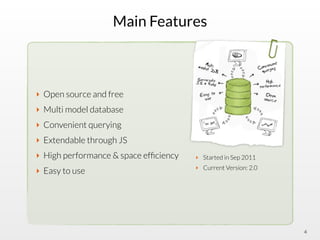
‣ Open source and free
‣ Multi model database
‣ Convenient querying
‣ Extendable through JS
‣ High performance & space efficiency
‣ Easy to use
‣ Started in Sep 2011
‣ Current Version: 2.0
Free and Open Source
‣ Apache 2 License
‣ On Github
‣ Do what you want with it
‣ ... and don‘t pay a dime!
5
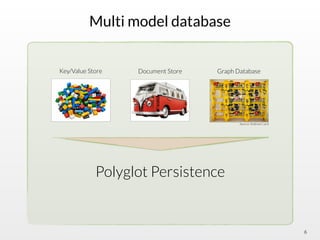
Multi model database
6
Key/Value Store Document Store Graph Database
Source: Andrew Carol
Polyglot Persistence
Key-Value Store
‣ Map value data to unique string keys (identifiers)
‣ Treat data as opaque (data has no structure)
‣ Can implement scaling and partitioning easily due to simplistic
data model
‣ Key-value can be seen as a special case of documents. For
many applications this is sufficient, but not for all cases.
!
ArangoDB
‣ It‘s currently supported as a key-value document.
‣ In the near future it supports special key-value collection.
‣ One of the optimization will be the elimination of JSON in
this case, so the value need not be parsed.
‣ Sharding capabilities of Key-Value Collections will differ
from Document Collections
7
Document Store
‣ Normally based on key-value stores (each document still has a
unique key)
‣ Allow to save documents with logical similarity in „collections“
‣ Treat data records as attribute-structured documents (data is
no longer opaque)
‣ Often allows querying and indexing document attributes
!
ArangoDB
‣ It supports both. A database can contain collections from
different types.
‣ For efficient memory handling we have an automatic schema
recognition.
‣ It has different ways to retrieve data. CRUD via RESTful
Interface, QueryByExample, JS for graph traversals and
AQL.
8
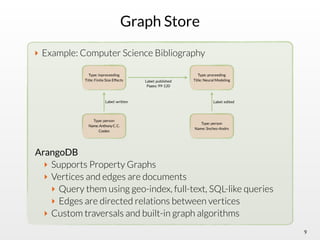
‣ Example: Computer Science Bibliography
!
!
!
!
!
ArangoDB
‣ Supports Property Graphs
‣ Vertices and edges are documents
‣ Query them using geo-index, full-text, SQL-like queries
‣ Edges are directed relations between vertices
‣ Custom traversals and built-in graph algorithms
Graph Store
9
Type: inproceeding
Title: Finite Size Effects
Type: proceeding
Title: Neural Modeling
Type: person
Name:AnthonyC.C.
Coolen
Label: written
Label: published
Pages: 99-120
Type: person
Name: Snchez-Andrs
Label: edited
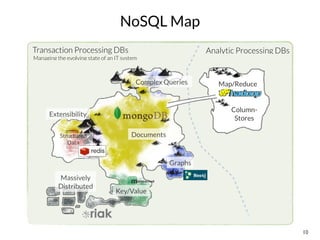
Analytic Processing DBsTransaction Processing DBs
Managing the evolving state of an IT system
Complex Queries Map/Reduce
Graphs
Extensibility
Key/Value
Column-

Stores
Documents
Massively
Distributed
Structured
Data
NoSQL Map
10
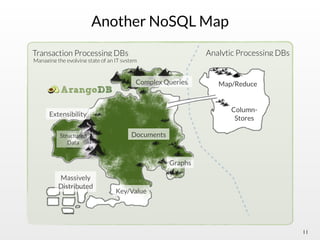
11
Transaction Processing DBs
Managing the evolving state of an IT system
Analytic Processing DBs
Map/Reduce
Graphs
Extensibility
Key/Value
Column-

Stores
Complex Queries
Documents
Massively
Distributed
Structured
Data
Another NoSQL Map
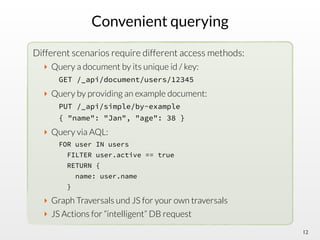
Convenient querying
Different scenarios require different access methods:
‣ Query a document by its unique id / key:
GET /_api/document/users/12345
‣ Query by providing an example document:
PUT /_api/simple/by-example
{ "name": "Jan", "age": 38 }
‣ Query via AQL:
FOR user IN users
FILTER user.active == true
RETURN {
name: user.name
}
‣ Graph Traversals und JS for your own traversals
‣ JS Actions for “intelligent” DB request
12
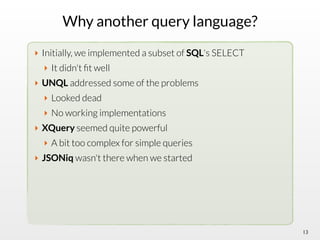
Why another query language?
13
‣ Initially, we implemented a subset of SQL's SELECT
‣ It didn't fit well
‣ UNQL addressed some of the problems
‣ Looked dead
‣ No working implementations
‣ XQuery seemed quite powerful
‣ A bit too complex for simple queries
‣ JSONiq wasn't there when we started
Other Document Stores
‣ MongoDB uses JSON/BSON as its “query language”
‣ Limited
‣ Hard to read & write for more complex queries
‣ Complex queries, joins and transactions not possible
‣ CouchDB uses Map/Reduces
‣ It‘s not a relational algebra, and therefore hard to generate
‣ Not easy to learn
‣ Complex queries, joins and transactions not possible
14
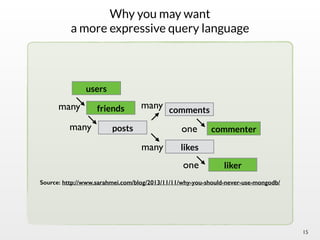
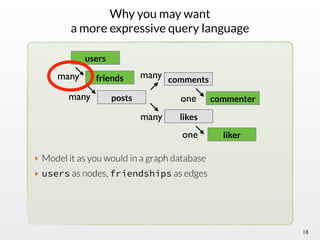
Why you may want
a more expressive query language
15
Source: http://www.sarahmei.com/blog/2013/11/11/why-you-should-never-use-mongodb/
users
friends
commenter
liker
many
many
many
many
one
one
posts
comments
likes
users
friends
commenter
liker
many
many
many
many
one
one
posts
comments
likes
Why you may want
a more expressive query language
16
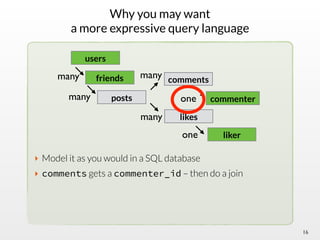
‣ Model it as you would in a SQL database
‣ comments gets a commenter_id – then do a join
users
friends
commenter
liker
many
many
many
many
one
one
posts
comments
likes
Why you may want
a more expressive query language
17
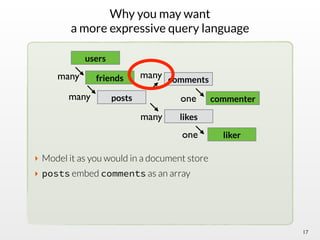
‣ Model it as you would in a document store
‣ posts embed comments as an array
users
friends
commenter
liker
many
many
many
many
one
one
posts
comments
likes
Why you may want
a more expressive query language
18
‣ Model it as you would in a graph database
‣ users as nodes, friendships as edges
ArangoDB Query Language (AQL)
19
‣ We came up with AQL mid-2012
‣ Declarative language, loosely based on the syntax of XQuery
‣ Other keywords than SQL so it's clear that the languages are
different
‣ Implemented in C and JavaScript
Example for Aggregation
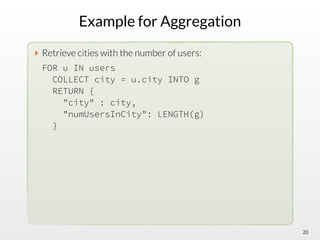
‣ Retrieve cities with the number of users:
FOR u IN users
COLLECT city = u.city INTO g
RETURN {
"city" : city,
"numUsersInCity": LENGTH(g)
}
20
Example for Graph Query
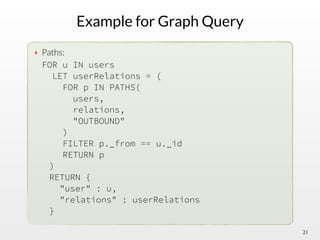
‣ Paths:
FOR u IN users
LET userRelations = (
FOR p IN PATHS(
users,
relations,
"OUTBOUND"
)
FILTER p._from == u._id
RETURN p
)
RETURN {
"user" : u,
"relations" : userRelations
}
21
Extendable through JS
‣ JavaScript enriches ArangoDB
‣ Multi Collection Transactions
‣ Building small and efficient Apps - Foxx App Framework
‣ Individually Graph Traversals
‣ Cascading deletes/updates
‣ Assign permissions to actions
‣ Aggregate data from multiple queries into a single response
‣ Carry out data-intensive operations
‣ Help to create efficient Push Services - in the near Future
22
ActionServer-alittleApplicationServer
‣ ArangoDB can answer arbitrary HTTP requests directly
‣ You can write your own JavaScript functions (“actions”) that
will be executed server-side
‣ Includes a permission system
!
➡ You can use it as a database or as a combined database/app
server
23
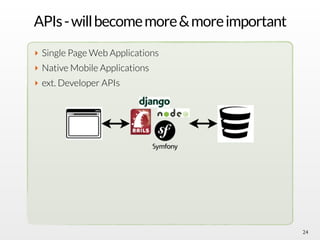
‣ Single Page Web Applications
‣ Native Mobile Applications
‣ ext. Developer APIs
APIs-willbecomemore&moreimportant
24
ArangoDB Foxx
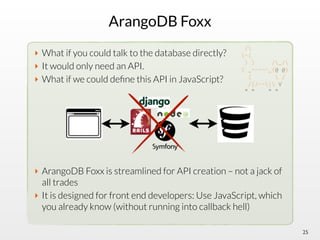
‣ What if you could talk to the database directly?
‣ It would only need an API.
‣ What if we could define this API in JavaScript?
!
!
!
!
!
!
‣ ArangoDB Foxx is streamlined for API creation – not a jack of
all trades
‣ It is designed for front end developers: Use JavaScript, which
you already know (without running into callback hell)
25
/
(~(
) ) /_/
( _-----_(@ @)
(  /
/|/--| V
" " " "
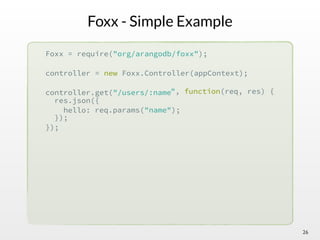
Foxx - Simple Example
26
Foxx = require("org/arangodb/foxx");
!
controller = new Foxx.Controller(appContext);
!
controller.get("/users ", function(req, res) {
res.json({
hello:
});
});
req.params("name");
/:name
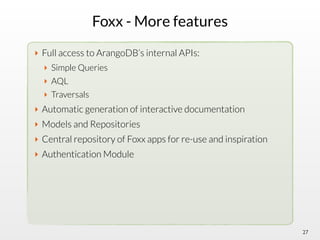
Foxx - More features
‣ Full access to ArangoDB‘s internal APIs:
‣ Simple Queries
‣ AQL
‣ Traversals
‣ Automatic generation of interactive documentation
‣ Models and Repositories
‣ Central repository of Foxx apps for re-use and inspiration
‣ Authentication Module
27
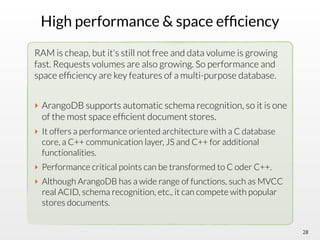
High performance & space efficiency
RAM is cheap, but it's still not free and data volume is growing
fast. Requests volumes are also growing. So performance and
space efficiency are key features of a multi-purpose database.
!
‣ ArangoDB supports automatic schema recognition, so it is one
of the most space efficient document stores.
‣ It offers a performance oriented architecture with a C database
core, a C++ communication layer, JS and C++ for additional
functionalities.
‣ Performance critical points can be transformed to C oder C++.
‣ Although ArangoDB has a wide range of functions, such as MVCC
real ACID, schema recognition, etc., it can compete with popular
stores documents.
28
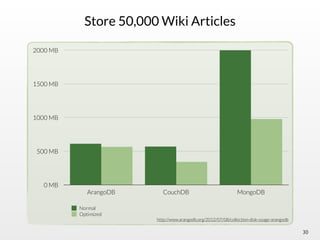
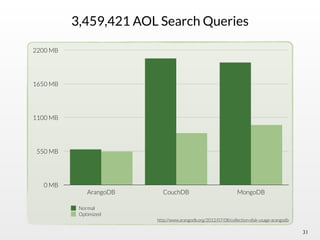
Space Efficiency
‣ Measure the space on disk of different data sets
‣ First in the standard config, then with some optimization
‣ We measured a bunch of different tasks
29
Store 50,000 Wiki Articles
30
0 MB
500 MB
1000 MB
1500 MB
2000 MB
ArangoDB CouchDB MongoDB
Normal
Optimized
http://www.arangodb.org/2012/07/08/collection-disk-usage-arangodb
3,459,421 AOL Search Queries
31
0 MB
550 MB
1100 MB
1650 MB
2200 MB
ArangoDB CouchDB MongoDB
Normal
Optimized
http://www.arangodb.org/2012/07/08/collection-disk-usage-arangodb
Performance: Disclaimer
‣ Always take performance tests with a grain of salt
‣ Performance is very dependent on a lot of factors including
the specific task at hand
‣ This is just to give you a glimpse at the performance
‣ Always do your own performance tests (and if you do, report
back to us :) )
‣ But now: Let‘s see some numbers
32
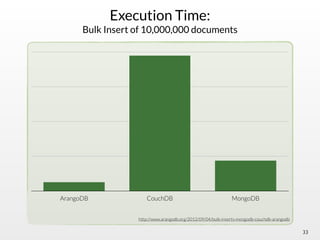
Execution Time:
Bulk Insert of 10,000,000 documents
33
ArangoDB CouchDB MongoDB
http://www.arangodb.org/2012/09/04/bulk-inserts-mongodb-couchdb-arangodb
Conclusion from Tests
‣ ArangoDB is really space efficient
‣ ArangoDB is “fast enough”
‣ Please test it for your own use case
34
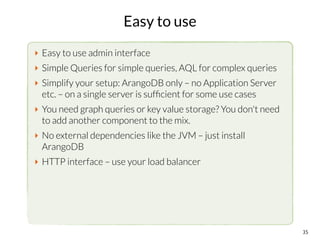
Easy to use
‣ Easy to use admin interface
‣ Simple Queries for simple queries, AQL for complex queries
‣ Simplify your setup: ArangoDB only – no Application Server
etc. – on a single server is sufficient for some use cases
‣ You need graph queries or key value storage? You don't need
to add another component to the mix.
‣ No external dependencies like the JVM – just install
ArangoDB
‣ HTTP interface – use your load balancer
35
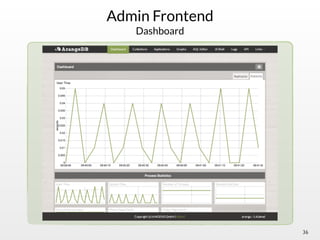
Admin Frontend
Dashboard
36
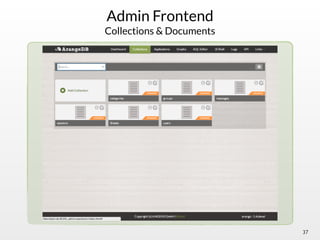
Admin Frontend
Collections & Documents
37
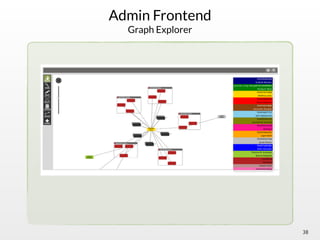
Admin Frontend
Graph Explorer
38
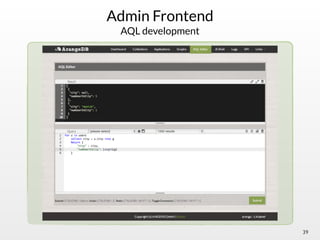
Admin Frontend
AQL development
39
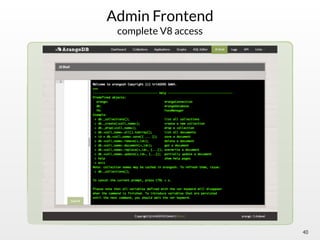
Admin Frontend
complete V8 access
40
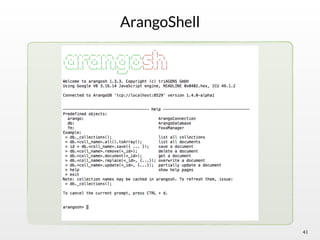
ArangoShell
41
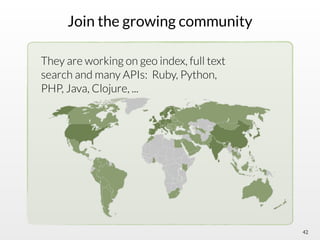
Join the growing community
42
They are working on geo index, full text
search and many APIs: Ruby, Python,
PHP, Java, Clojure, ...
ArangoDB.explain()
{
"type": "2nd generation NoSQL database",
"model": [ "document", "graph", "key-value" ],
"openSource": true,
"license“: "apache 2",
"version": [ "1.3 stable", "1.4 alpha" ],
"builtWith": [ "C", "C++", "JS" ],
"uses": [ "Google V8" ],
"mainFeatures": [
"Multi-Collection-Transaction",
"Foxx API Framework",
"ArangoDB Query Language",
"Various Indexes",
"API Server",
"Automatic Schema Recognition"
]
}
43

ArangoDB

  • 1.
    1 Lucas Dohmen @moonbeamlabs ! the multi-purposeNoSQL Database ! www.arangodb.org
  • 2.
    Lucas Dohmen ‣ ArangoDBCore Team ‣ ArangoDB Foxx & Ruby Adapter ‣ Student on the master branch ‣ Open Source Developer & Podcaster 2 / (~( ) ) /_/ ( _-----_(@ @) ( / /|/--| V " " " "
  • 3.
    Why did westart ArangoDB? How should an ideal multi-purpose database look like? Is it already out there? ! ‣ Second Generation NoSQL DB ‣ Unique feature set ‣ Solves some problems of other NoSQL DBs ‣ Greenfield project ‣ Experienced team building NoSQL DBs for more than 10 years 3
  • 4.
    Main Features 4 ‣ Opensource and free ‣ Multi model database ‣ Convenient querying ‣ Extendable through JS ‣ High performance & space efficiency ‣ Easy to use ‣ Started in Sep 2011 ‣ Current Version: 2.0
  • 5.
    Free and OpenSource ‣ Apache 2 License ‣ On Github ‣ Do what you want with it ‣ ... and don‘t pay a dime! 5
  • 6.
    Multi model database 6 Key/ValueStore Document Store Graph Database Source: Andrew Carol Polyglot Persistence
  • 7.
    Key-Value Store ‣ Mapvalue data to unique string keys (identifiers) ‣ Treat data as opaque (data has no structure) ‣ Can implement scaling and partitioning easily due to simplistic data model ‣ Key-value can be seen as a special case of documents. For many applications this is sufficient, but not for all cases. ! ArangoDB ‣ It‘s currently supported as a key-value document. ‣ In the near future it supports special key-value collection. ‣ One of the optimization will be the elimination of JSON in this case, so the value need not be parsed. ‣ Sharding capabilities of Key-Value Collections will differ from Document Collections 7
  • 8.
    Document Store ‣ Normallybased on key-value stores (each document still has a unique key) ‣ Allow to save documents with logical similarity in „collections“ ‣ Treat data records as attribute-structured documents (data is no longer opaque) ‣ Often allows querying and indexing document attributes ! ArangoDB ‣ It supports both. A database can contain collections from different types. ‣ For efficient memory handling we have an automatic schema recognition. ‣ It has different ways to retrieve data. CRUD via RESTful Interface, QueryByExample, JS for graph traversals and AQL. 8
  • 9.
    ‣ Example: ComputerScience Bibliography ! ! ! ! ! ArangoDB ‣ Supports Property Graphs ‣ Vertices and edges are documents ‣ Query them using geo-index, full-text, SQL-like queries ‣ Edges are directed relations between vertices ‣ Custom traversals and built-in graph algorithms Graph Store 9 Type: inproceeding Title: Finite Size Effects Type: proceeding Title: Neural Modeling Type: person Name:AnthonyC.C. Coolen Label: written Label: published Pages: 99-120 Type: person Name: Snchez-Andrs Label: edited
  • 10.
    Analytic Processing DBsTransactionProcessing DBs Managing the evolving state of an IT system Complex Queries Map/Reduce Graphs Extensibility Key/Value Column-
 Stores Documents Massively Distributed Structured Data NoSQL Map 10
  • 11.
    11 Transaction Processing DBs Managingthe evolving state of an IT system Analytic Processing DBs Map/Reduce Graphs Extensibility Key/Value Column-
 Stores Complex Queries Documents Massively Distributed Structured Data Another NoSQL Map
  • 12.
    Convenient querying Different scenariosrequire different access methods: ‣ Query a document by its unique id / key: GET /_api/document/users/12345 ‣ Query by providing an example document: PUT /_api/simple/by-example { "name": "Jan", "age": 38 } ‣ Query via AQL: FOR user IN users FILTER user.active == true RETURN { name: user.name } ‣ Graph Traversals und JS for your own traversals ‣ JS Actions for “intelligent” DB request 12
  • 13.
    Why another querylanguage? 13 ‣ Initially, we implemented a subset of SQL's SELECT ‣ It didn't fit well ‣ UNQL addressed some of the problems ‣ Looked dead ‣ No working implementations ‣ XQuery seemed quite powerful ‣ A bit too complex for simple queries ‣ JSONiq wasn't there when we started
  • 14.
    Other Document Stores ‣MongoDB uses JSON/BSON as its “query language” ‣ Limited ‣ Hard to read & write for more complex queries ‣ Complex queries, joins and transactions not possible ‣ CouchDB uses Map/Reduces ‣ It‘s not a relational algebra, and therefore hard to generate ‣ Not easy to learn ‣ Complex queries, joins and transactions not possible 14
  • 15.
    Why you maywant a more expressive query language 15 Source: http://www.sarahmei.com/blog/2013/11/11/why-you-should-never-use-mongodb/ users friends commenter liker many many many many one one posts comments likes
  • 16.
    users friends commenter liker many many many many one one posts comments likes Why you maywant a more expressive query language 16 ‣ Model it as you would in a SQL database ‣ comments gets a commenter_id – then do a join
  • 17.
    users friends commenter liker many many many many one one posts comments likes Why you maywant a more expressive query language 17 ‣ Model it as you would in a document store ‣ posts embed comments as an array
  • 18.
    users friends commenter liker many many many many one one posts comments likes Why you maywant a more expressive query language 18 ‣ Model it as you would in a graph database ‣ users as nodes, friendships as edges
  • 19.
    ArangoDB Query Language(AQL) 19 ‣ We came up with AQL mid-2012 ‣ Declarative language, loosely based on the syntax of XQuery ‣ Other keywords than SQL so it's clear that the languages are different ‣ Implemented in C and JavaScript
  • 20.
    Example for Aggregation ‣Retrieve cities with the number of users: FOR u IN users COLLECT city = u.city INTO g RETURN { "city" : city, "numUsersInCity": LENGTH(g) } 20
  • 21.
    Example for GraphQuery ‣ Paths: FOR u IN users LET userRelations = ( FOR p IN PATHS( users, relations, "OUTBOUND" ) FILTER p._from == u._id RETURN p ) RETURN { "user" : u, "relations" : userRelations } 21
  • 22.
    Extendable through JS ‣JavaScript enriches ArangoDB ‣ Multi Collection Transactions ‣ Building small and efficient Apps - Foxx App Framework ‣ Individually Graph Traversals ‣ Cascading deletes/updates ‣ Assign permissions to actions ‣ Aggregate data from multiple queries into a single response ‣ Carry out data-intensive operations ‣ Help to create efficient Push Services - in the near Future 22
  • 23.
    ActionServer-alittleApplicationServer ‣ ArangoDB cananswer arbitrary HTTP requests directly ‣ You can write your own JavaScript functions (“actions”) that will be executed server-side ‣ Includes a permission system ! ➡ You can use it as a database or as a combined database/app server 23
  • 24.
    ‣ Single PageWeb Applications ‣ Native Mobile Applications ‣ ext. Developer APIs APIs-willbecomemore&moreimportant 24
  • 25.
    ArangoDB Foxx ‣ Whatif you could talk to the database directly? ‣ It would only need an API. ‣ What if we could define this API in JavaScript? ! ! ! ! ! ! ‣ ArangoDB Foxx is streamlined for API creation – not a jack of all trades ‣ It is designed for front end developers: Use JavaScript, which you already know (without running into callback hell) 25 / (~( ) ) /_/ ( _-----_(@ @) ( / /|/--| V " " " "
  • 26.
    Foxx - SimpleExample 26 Foxx = require("org/arangodb/foxx"); ! controller = new Foxx.Controller(appContext); ! controller.get("/users ", function(req, res) { res.json({ hello: }); }); req.params("name"); /:name
  • 27.
    Foxx - Morefeatures ‣ Full access to ArangoDB‘s internal APIs: ‣ Simple Queries ‣ AQL ‣ Traversals ‣ Automatic generation of interactive documentation ‣ Models and Repositories ‣ Central repository of Foxx apps for re-use and inspiration ‣ Authentication Module 27
  • 28.
    High performance &space efficiency RAM is cheap, but it's still not free and data volume is growing fast. Requests volumes are also growing. So performance and space efficiency are key features of a multi-purpose database. ! ‣ ArangoDB supports automatic schema recognition, so it is one of the most space efficient document stores. ‣ It offers a performance oriented architecture with a C database core, a C++ communication layer, JS and C++ for additional functionalities. ‣ Performance critical points can be transformed to C oder C++. ‣ Although ArangoDB has a wide range of functions, such as MVCC real ACID, schema recognition, etc., it can compete with popular stores documents. 28
  • 29.
    Space Efficiency ‣ Measurethe space on disk of different data sets ‣ First in the standard config, then with some optimization ‣ We measured a bunch of different tasks 29
  • 30.
    Store 50,000 WikiArticles 30 0 MB 500 MB 1000 MB 1500 MB 2000 MB ArangoDB CouchDB MongoDB Normal Optimized http://www.arangodb.org/2012/07/08/collection-disk-usage-arangodb
  • 31.
    3,459,421 AOL SearchQueries 31 0 MB 550 MB 1100 MB 1650 MB 2200 MB ArangoDB CouchDB MongoDB Normal Optimized http://www.arangodb.org/2012/07/08/collection-disk-usage-arangodb
  • 32.
    Performance: Disclaimer ‣ Alwaystake performance tests with a grain of salt ‣ Performance is very dependent on a lot of factors including the specific task at hand ‣ This is just to give you a glimpse at the performance ‣ Always do your own performance tests (and if you do, report back to us :) ) ‣ But now: Let‘s see some numbers 32
  • 33.
    Execution Time: Bulk Insertof 10,000,000 documents 33 ArangoDB CouchDB MongoDB http://www.arangodb.org/2012/09/04/bulk-inserts-mongodb-couchdb-arangodb
  • 34.
    Conclusion from Tests ‣ArangoDB is really space efficient ‣ ArangoDB is “fast enough” ‣ Please test it for your own use case 34
  • 35.
    Easy to use ‣Easy to use admin interface ‣ Simple Queries for simple queries, AQL for complex queries ‣ Simplify your setup: ArangoDB only – no Application Server etc. – on a single server is sufficient for some use cases ‣ You need graph queries or key value storage? You don't need to add another component to the mix. ‣ No external dependencies like the JVM – just install ArangoDB ‣ HTTP interface – use your load balancer 35
  • 36.
  • 37.
  • 38.
  • 39.
  • 40.
  • 41.
  • 42.
    Join the growingcommunity 42 They are working on geo index, full text search and many APIs: Ruby, Python, PHP, Java, Clojure, ...
  • 43.
    ArangoDB.explain() { "type": "2nd generationNoSQL database", "model": [ "document", "graph", "key-value" ], "openSource": true, "license“: "apache 2", "version": [ "1.3 stable", "1.4 alpha" ], "builtWith": [ "C", "C++", "JS" ], "uses": [ "Google V8" ], "mainFeatures": [ "Multi-Collection-Transaction", "Foxx API Framework", "ArangoDB Query Language", "Various Indexes", "API Server", "Automatic Schema Recognition" ] } 43