Empowering Friends: Class-wide
Peer-Tutoring
Strategy in Teaching Practical
Research 2 Among G12 Learners
Dinah G. Oani - Noriel A. Tayag - Joseph C. Cabajes
Authors
• students dropping out of school are
specifically caused by the difficulty of
adjusting to the school curriculum.
• students who do not establish good
relationships with their friends,
teachers, and school administration,
• higher tendency to be absent from
school and drop out eventually.
• mastering written skills
can be a daunting task
for learners, this is
because it requires a lot of
careful thought, discipline,
and a good understanding
• only 5% of 12th graders
perform above the basic
writing proficiency level
mastering written skills can be a daunting task for
learners, this is because it requires a lot of careful
thought, discipline, and a good understanding
5% of 12th graders perform above the basic writing
proficiency level
• stressor of students is research writing
which requires knowledge and skills in
academic writing
• students are having difficulties
in spoken and written
language and some skills in
writing like outlining, word
choice, and other strategies
 traditional instructional
methods are no longer sufficient
to address the fast-paced
technological and environmental
changes.
 interventions in the
classroom have been
introduced as a low-cost and
effective way to mitigate
multiple risk factors and
promote protective factors
in the youth population
traditional instructional methods are no longer
sufficient to address the fast-paced technological and
environmental changes.
interventions in the classroom have been introduced
as a low-cost and effective way to mitigate multiple
risk factors and promote protective factors in the
youth population,
 peer tutoring is an effective teaching
strategy as an intervention, wherein
learners assist other learners and
learn while teaching others, improving
both academic skills and social
behavior.
 helps to improve students’
social skills and provides
emotional support. Peer tutoring
also improves students’ academic
performance, communication
skills, and enthusiasm to learn,
Proposed Intervention, Innovation, and Strategy
o Davao City National High School from November 25,
2023, to January 29, 2024.
o an orientation about the intervention
will be given to them beforehand
o tutors will be carefully selected, and a
comprehensive orientation will be given
to them regarding their role in the
teaching-learning process.
• a lesson plan will be developed for each
session.
• The lesson plan for each day will be
discussed and instructed to tutors by
the teacher, one day earlier, so that they
are prepared for the session
Proposed Intervention, Innovation, and Strategy
 ensure the effectiveness of the lesson plans, they will
be discussed with subject experts, Master Teachers,
and approved by the school principal
 fourteen lesson plans will be prepared
for the treatment period of seven
weeks
Proposed Intervention, Innovation, and Strategy
 tutors will also be guided on how to teach
various components of the plan and
satisfy their tutees
 enforce the rules
 seven weeks, the mean scores on the written
works, performance tasks, final grades, and
post-tests will be used to measure the
effectiveness of class-wide peer tutoring
strategies among the G12 learners.
Proposed Intervention, Innovation, and Strategy
Action Research Questions
The main purpose of this study is to investigate the
effect of class-wide peer-tutoring strategies as an
intervention in teaching Practical Research 2
among G12 learners.
1. What is the demographic profile of Grade 12
Students in terms of :
a. sex
b. strand
c. age
2. What are the mean achievement scores of
the Four groups ((Group1 (E1), Group2 (C1
), Group3 (E2) , Group4 (C2)) among of G12
learners in Practical Research 2 in terms of :
a.Written works
b.Performance Tasks
c.Final Grades
d.Post-test
3. Is there a significant difference among
the Four groups ((Group1 (E1), Group2
(C1) Group3 (E2) , Group4 (C2)) of the G12
learners in Practical Research 2 in terms
of :
a.Written works
b.Performance Tasks
c.Final Grades
d.Post-test
Participants and Other Sources of Data Information
• currently enrolled this school year
and taking Practical Research 2 as
one of their applied subjects in the
G12 curriculum
• four Grade 12 Classes under the STEM,
HUMSS, ABM, and TVL strand/track.
Participants and Other Sources of Data Information
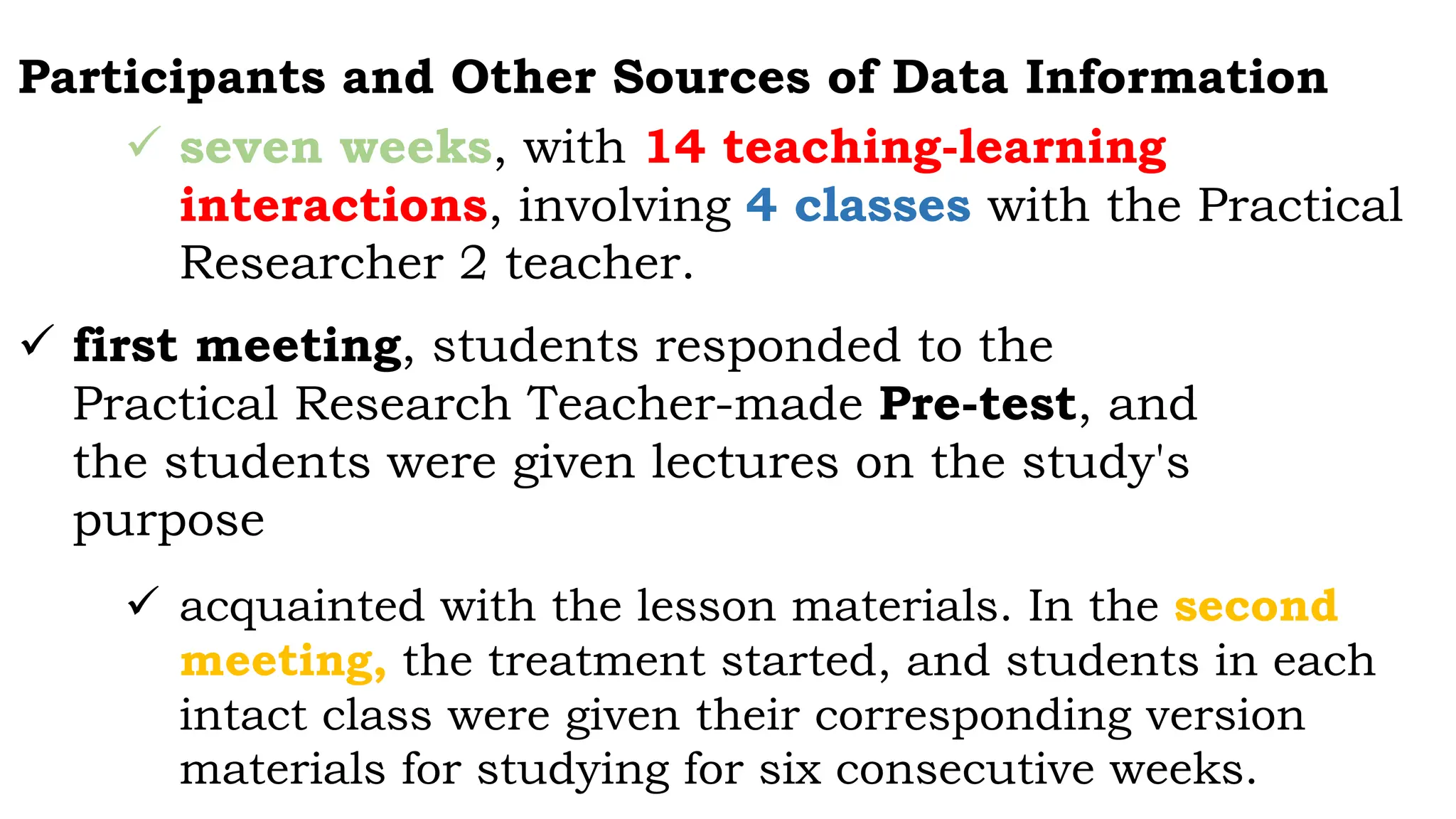
 seven weeks, with 14 teaching-learning
interactions, involving 4 classes with the Practical
Researcher 2 teacher.
 first meeting, students responded to the
Practical Research Teacher-made Pre-test, and
the students were given lectures on the study's
purpose
 acquainted with the lesson materials. In the second
meeting, the treatment started, and students in each
intact class were given their corresponding version
materials for studying for six consecutive weeks.
Participants and Other Sources of Data Information
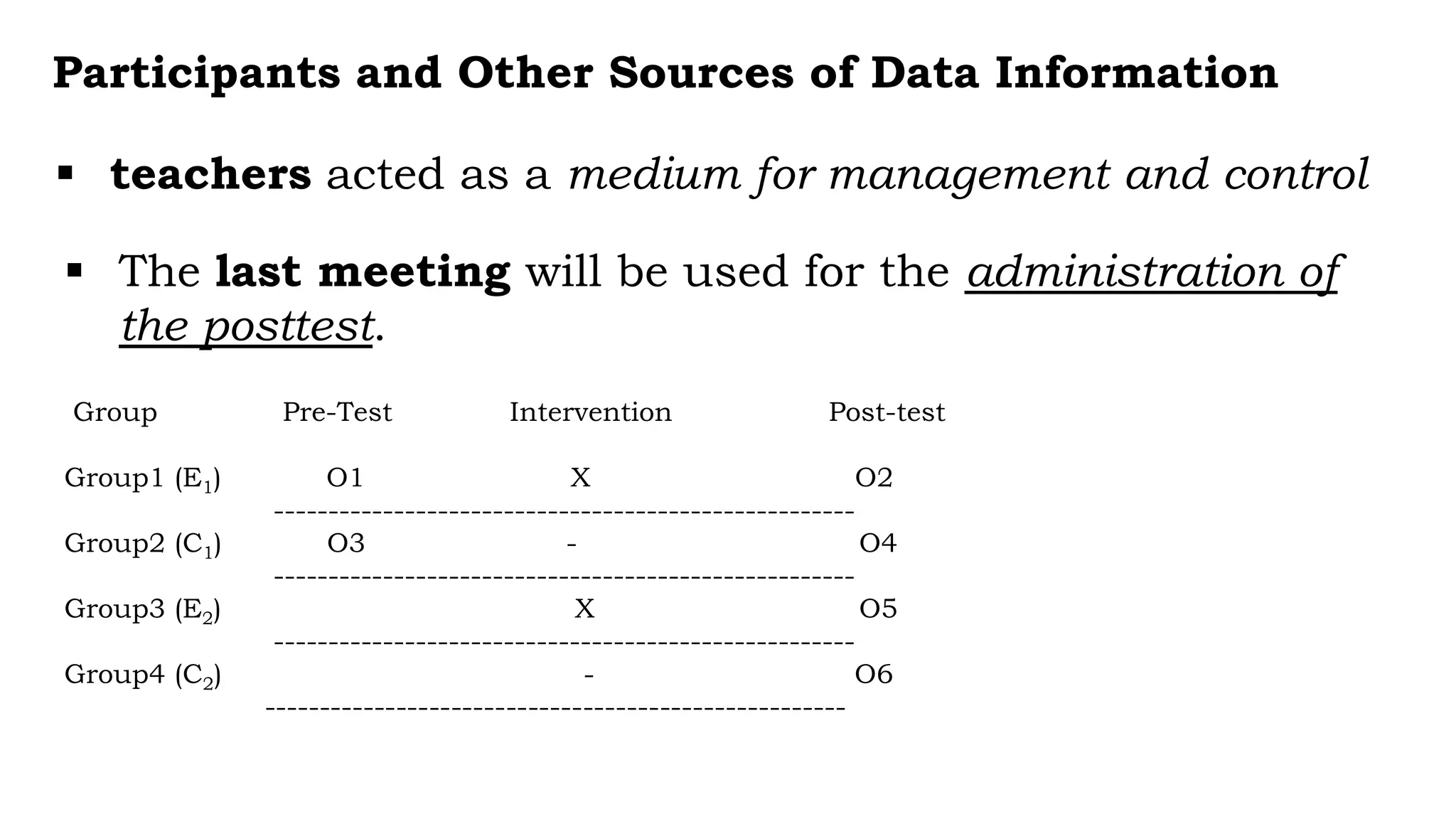
 teachers acted as a medium for management and control
 The last meeting will be used for the administration of
the posttest.
Group Pre-Test Intervention Post-test
Group1 (E1) O1 X O2
-----------------------------------------------------
Group2 (C1) O3 - O4
-----------------------------------------------------
Group3 (E2) X O5
-----------------------------------------------------
Group4 (C2) - O6
-----------------------------------------------------
 four groups will be based on the pretest-
post-test scores, written works,
performance tasks, and final grades to
determine the significance of the research
conducted.
Participants and Other Sources of Data Information
Construction and Use of Instructional Materials
 Daily Lesson Plan
 Pre-test and Post-test materials
 be used for 7 weeks
Construction and Use of Instructional Materials
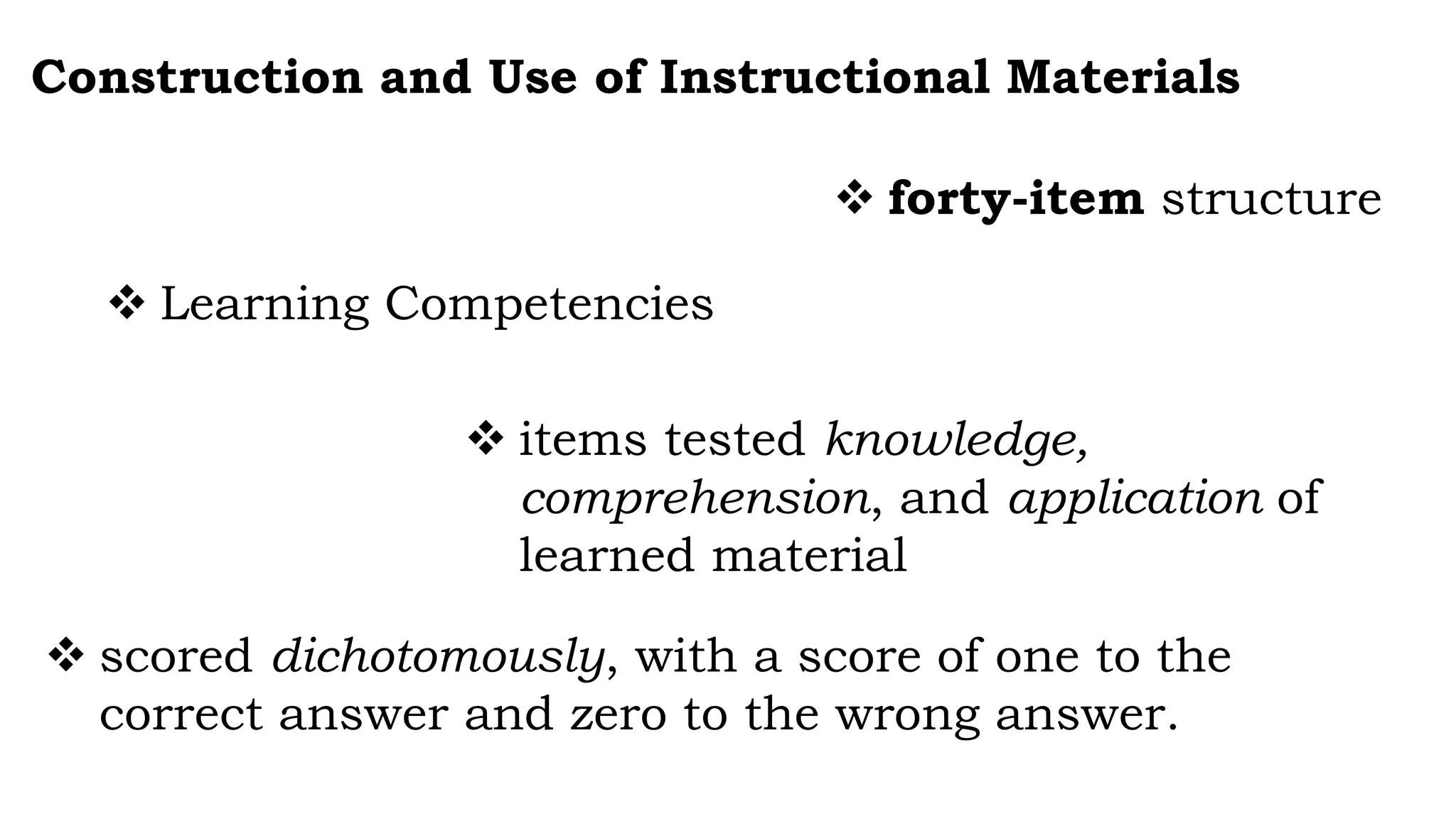
 forty-item structure
 Learning Competencies
 items tested knowledge,
comprehension, and application of
learned material
 scored dichotomously, with a score of one to the
correct answer and zero to the wrong answer.
Construction and Use of Instructional Materials
 one teacher
 experimental groups will be taught
using the class-wide peer tutoring
strategies as embedded in the Daily
Lesson Plan.
 control groups were taught
through the conventional
teaching methods
Construction and Use of Instructional Materials
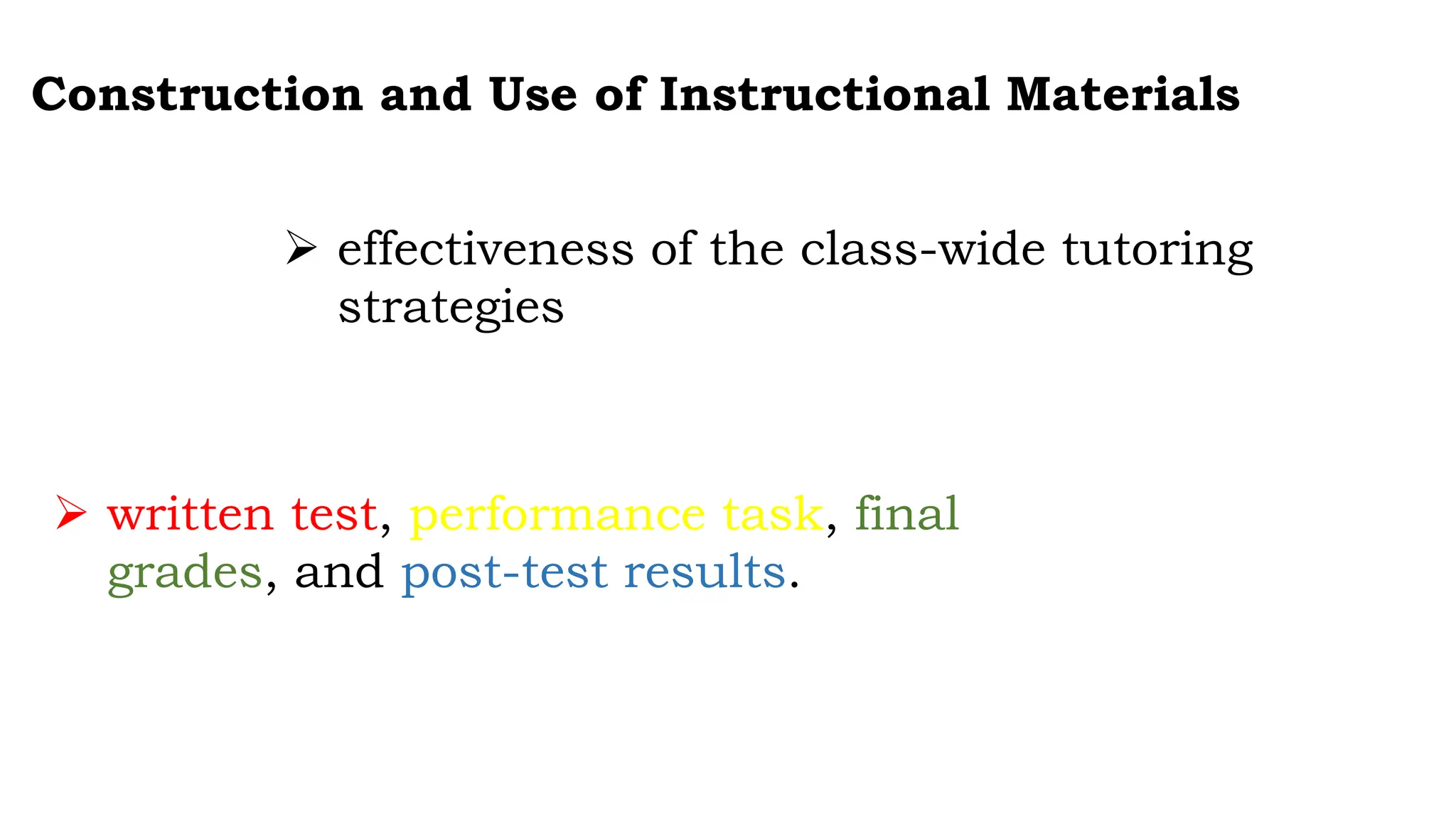
 effectiveness of the class-wide tutoring
strategies
 written test, performance task, final
grades, and post-test results.
AR- Research Presentation.pptx

AR- Research Presentation.pptx

  • 2.
    Empowering Friends: Class-wide Peer-Tutoring Strategyin Teaching Practical Research 2 Among G12 Learners Dinah G. Oani - Noriel A. Tayag - Joseph C. Cabajes Authors
  • 3.
    • students droppingout of school are specifically caused by the difficulty of adjusting to the school curriculum. • students who do not establish good relationships with their friends, teachers, and school administration, • higher tendency to be absent from school and drop out eventually.
  • 4.
    • mastering writtenskills can be a daunting task for learners, this is because it requires a lot of careful thought, discipline, and a good understanding • only 5% of 12th graders perform above the basic writing proficiency level
  • 5.
    mastering written skillscan be a daunting task for learners, this is because it requires a lot of careful thought, discipline, and a good understanding 5% of 12th graders perform above the basic writing proficiency level • stressor of students is research writing which requires knowledge and skills in academic writing • students are having difficulties in spoken and written language and some skills in writing like outlining, word choice, and other strategies
  • 6.
     traditional instructional methodsare no longer sufficient to address the fast-paced technological and environmental changes.  interventions in the classroom have been introduced as a low-cost and effective way to mitigate multiple risk factors and promote protective factors in the youth population
  • 7.
    traditional instructional methodsare no longer sufficient to address the fast-paced technological and environmental changes. interventions in the classroom have been introduced as a low-cost and effective way to mitigate multiple risk factors and promote protective factors in the youth population,  peer tutoring is an effective teaching strategy as an intervention, wherein learners assist other learners and learn while teaching others, improving both academic skills and social behavior.  helps to improve students’ social skills and provides emotional support. Peer tutoring also improves students’ academic performance, communication skills, and enthusiasm to learn,
  • 8.
    Proposed Intervention, Innovation,and Strategy o Davao City National High School from November 25, 2023, to January 29, 2024. o an orientation about the intervention will be given to them beforehand o tutors will be carefully selected, and a comprehensive orientation will be given to them regarding their role in the teaching-learning process.
  • 9.
    • a lessonplan will be developed for each session. • The lesson plan for each day will be discussed and instructed to tutors by the teacher, one day earlier, so that they are prepared for the session Proposed Intervention, Innovation, and Strategy
  • 10.
     ensure theeffectiveness of the lesson plans, they will be discussed with subject experts, Master Teachers, and approved by the school principal  fourteen lesson plans will be prepared for the treatment period of seven weeks Proposed Intervention, Innovation, and Strategy  tutors will also be guided on how to teach various components of the plan and satisfy their tutees
  • 11.
     enforce therules  seven weeks, the mean scores on the written works, performance tasks, final grades, and post-tests will be used to measure the effectiveness of class-wide peer tutoring strategies among the G12 learners. Proposed Intervention, Innovation, and Strategy
  • 12.
    Action Research Questions Themain purpose of this study is to investigate the effect of class-wide peer-tutoring strategies as an intervention in teaching Practical Research 2 among G12 learners. 1. What is the demographic profile of Grade 12 Students in terms of : a. sex b. strand c. age
  • 13.
    2. What arethe mean achievement scores of the Four groups ((Group1 (E1), Group2 (C1 ), Group3 (E2) , Group4 (C2)) among of G12 learners in Practical Research 2 in terms of : a.Written works b.Performance Tasks c.Final Grades d.Post-test
  • 14.
    3. Is therea significant difference among the Four groups ((Group1 (E1), Group2 (C1) Group3 (E2) , Group4 (C2)) of the G12 learners in Practical Research 2 in terms of : a.Written works b.Performance Tasks c.Final Grades d.Post-test
  • 15.
    Participants and OtherSources of Data Information • currently enrolled this school year and taking Practical Research 2 as one of their applied subjects in the G12 curriculum • four Grade 12 Classes under the STEM, HUMSS, ABM, and TVL strand/track.
  • 16.
    Participants and OtherSources of Data Information  seven weeks, with 14 teaching-learning interactions, involving 4 classes with the Practical Researcher 2 teacher.  first meeting, students responded to the Practical Research Teacher-made Pre-test, and the students were given lectures on the study's purpose  acquainted with the lesson materials. In the second meeting, the treatment started, and students in each intact class were given their corresponding version materials for studying for six consecutive weeks.
  • 17.
    Participants and OtherSources of Data Information  teachers acted as a medium for management and control  The last meeting will be used for the administration of the posttest. Group Pre-Test Intervention Post-test Group1 (E1) O1 X O2 ----------------------------------------------------- Group2 (C1) O3 - O4 ----------------------------------------------------- Group3 (E2) X O5 ----------------------------------------------------- Group4 (C2) - O6 -----------------------------------------------------
  • 18.
     four groupswill be based on the pretest- post-test scores, written works, performance tasks, and final grades to determine the significance of the research conducted. Participants and Other Sources of Data Information
  • 19.
    Construction and Useof Instructional Materials  Daily Lesson Plan  Pre-test and Post-test materials  be used for 7 weeks
  • 20.
    Construction and Useof Instructional Materials  forty-item structure  Learning Competencies  items tested knowledge, comprehension, and application of learned material  scored dichotomously, with a score of one to the correct answer and zero to the wrong answer.
  • 21.
    Construction and Useof Instructional Materials  one teacher  experimental groups will be taught using the class-wide peer tutoring strategies as embedded in the Daily Lesson Plan.  control groups were taught through the conventional teaching methods
  • 22.
    Construction and Useof Instructional Materials  effectiveness of the class-wide tutoring strategies  written test, performance task, final grades, and post-test results.