Gender bias
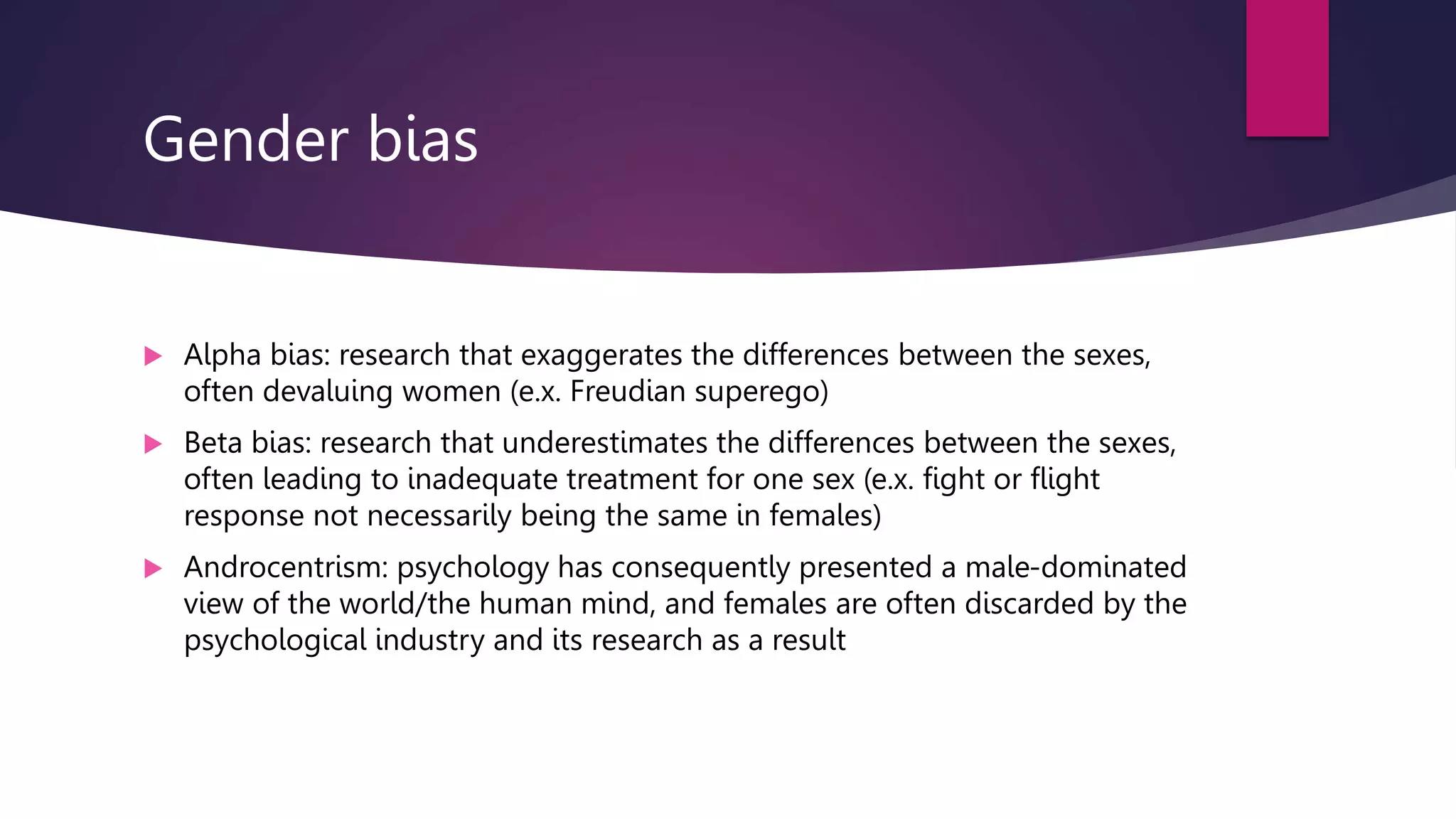
 Alpha bias: research that exaggerates the differences between the sexes,
often devaluing women (e.x. Freudian superego)
 Beta bias: research that underestimates the differences between the sexes,
often leading to inadequate treatment for one sex (e.x. fight or flight
response not necessarily being the same in females)
 Androcentrism: psychology has consequently presented a male-dominated
view of the world/the human mind, and females are often discarded by the
psychological industry and its research as a result
Gender bias – Eval
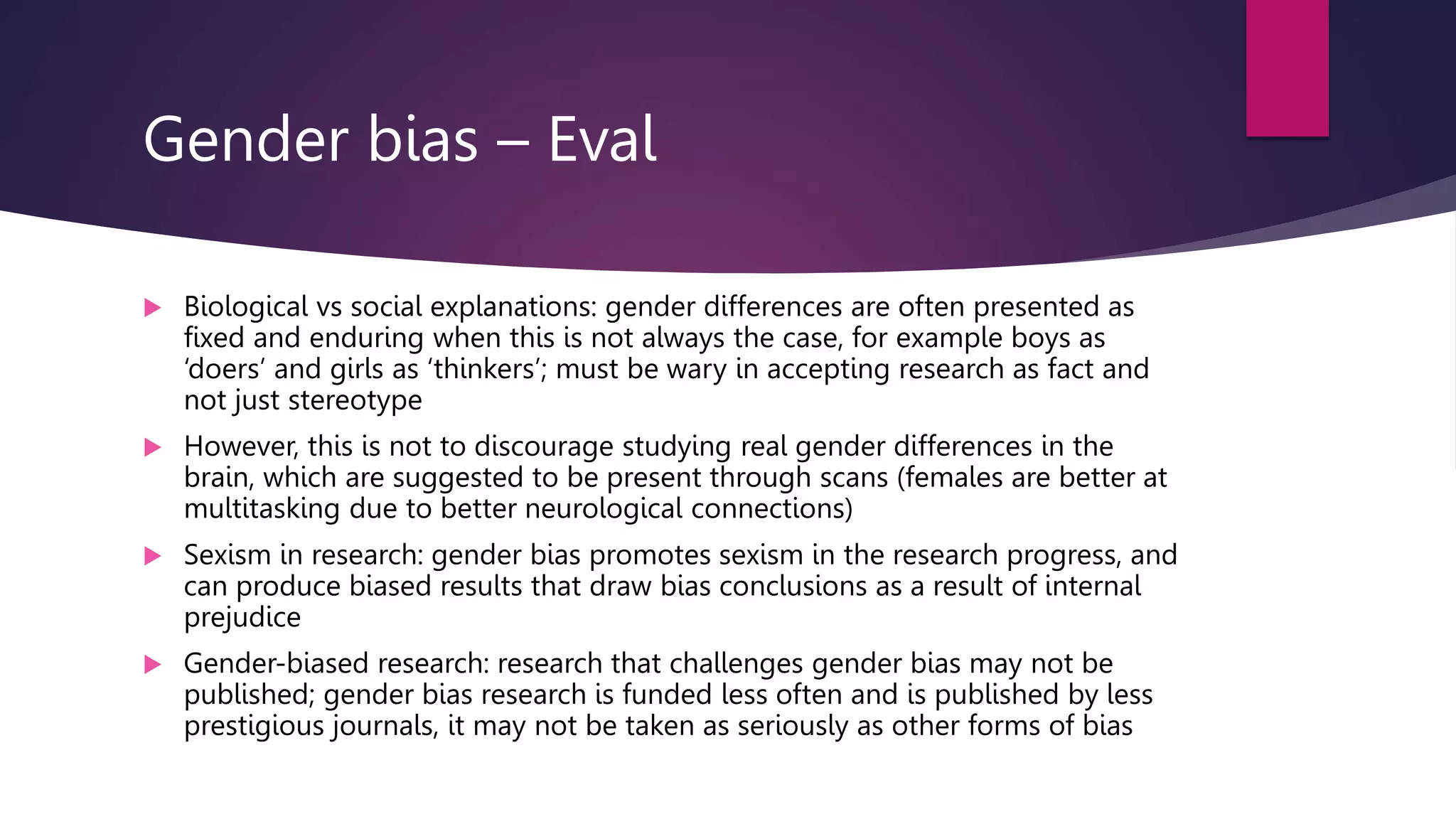
 Biological vs social explanations: gender differences are often presented as
fixed and enduring when this is not always the case, for example boys as
‘doers’ and girls as ‘thinkers’; must be wary in accepting research as fact and
not just stereotype
 However, this is not to discourage studying real gender differences in the
brain, which are suggested to be present through scans (females are better at
multitasking due to better neurological connections)
 Sexism in research: gender bias promotes sexism in the research progress, and
can produce biased results that draw bias conclusions as a result of internal
prejudice
 Gender-biased research: research that challenges gender bias may not be
published; gender bias research is funded less often and is published by less
prestigious journals, it may not be taken as seriously as other forms of bias
Cultural bias
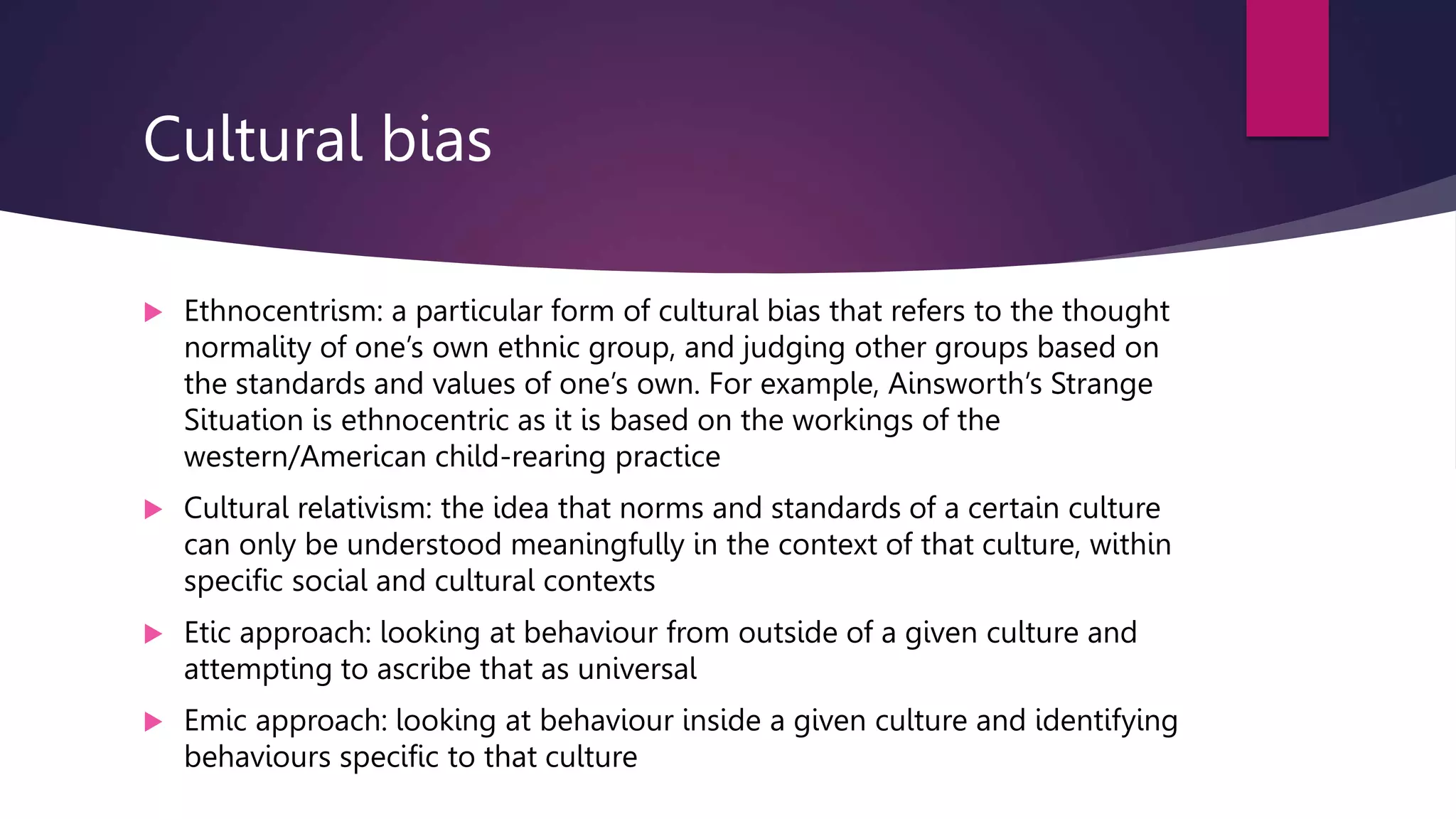
 Ethnocentrism: a particular form of cultural bias that refers to the thought
normality of one’s own ethnic group, and judging other groups based on
the standards and values of one’s own. For example, Ainsworth’s Strange
Situation is ethnocentric as it is based on the workings of the
western/American child-rearing practice
 Cultural relativism: the idea that norms and standards of a certain culture
can only be understood meaningfully in the context of that culture, within
specific social and cultural contexts
 Etic approach: looking at behaviour from outside of a given culture and
attempting to ascribe that as universal
 Emic approach: looking at behaviour inside a given culture and identifying
behaviours specific to that culture
Cultural bias – Eval
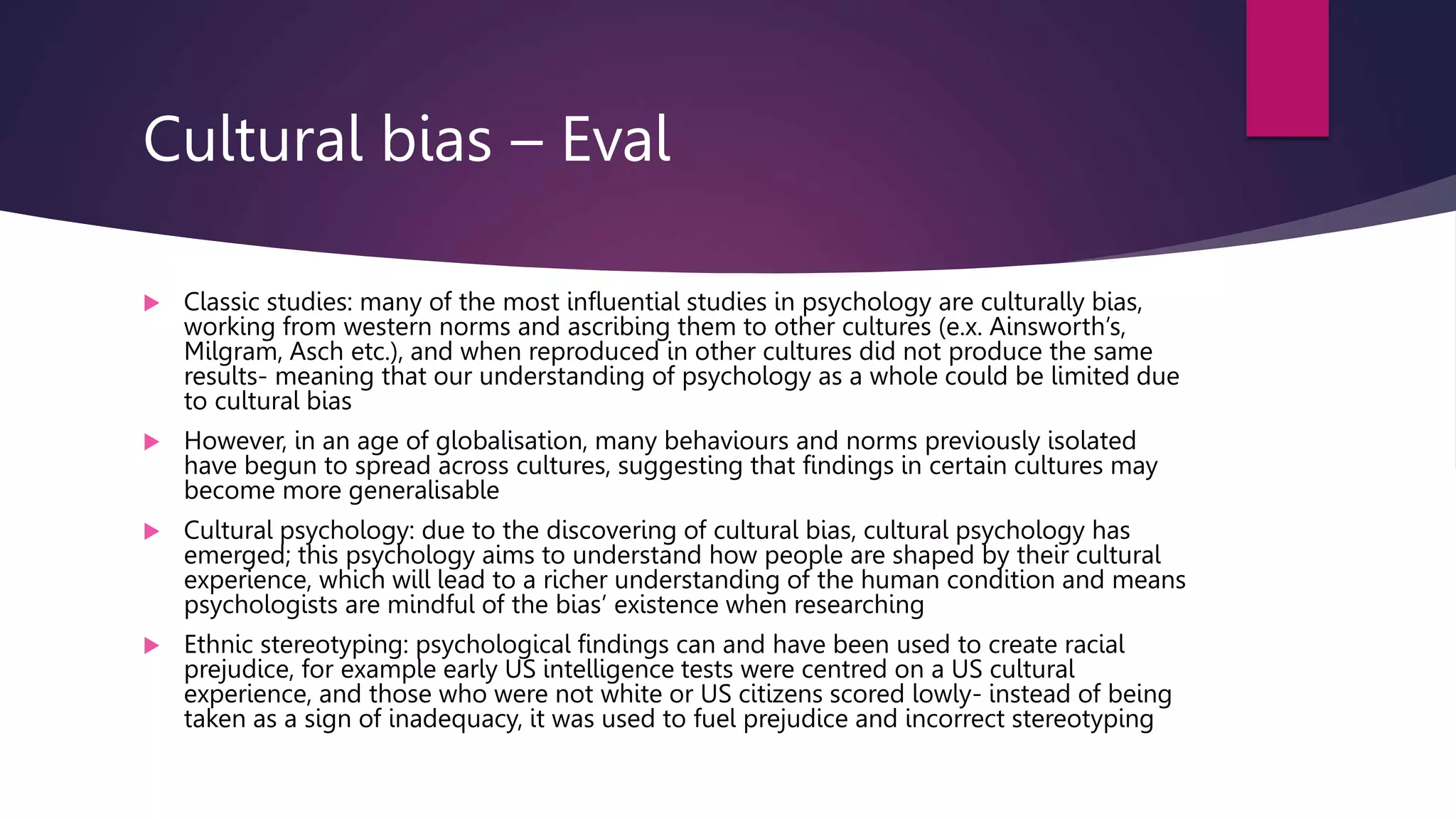
 Classic studies: many of the most influential studies in psychology are culturally bias,
working from western norms and ascribing them to other cultures (e.x. Ainsworth’s,
Milgram, Asch etc.), and when reproduced in other cultures did not produce the same
results- meaning that our understanding of psychology as a whole could be limited due
to cultural bias
 However, in an age of globalisation, many behaviours and norms previously isolated
have begun to spread across cultures, suggesting that findings in certain cultures may
become more generalisable
 Cultural psychology: due to the discovering of cultural bias, cultural psychology has
emerged; this psychology aims to understand how people are shaped by their cultural
experience, which will lead to a richer understanding of the human condition and means
psychologists are mindful of the bias’ existence when researching
 Ethnic stereotyping: psychological findings can and have been used to create racial
prejudice, for example early US intelligence tests were centred on a US cultural
experience, and those who were not white or US citizens scored lowly- instead of being
taken as a sign of inadequacy, it was used to fuel prejudice and incorrect stereotyping
Free will and determinism
 Free will: the notion that humans can make choices and their
behaviour/thoughts are not determined by biological or external forces
 Determinism: the view that an individual’s behaviour is shaped or controlled by
internal or external forces rather than individual will
 Hard determinism: all behaviour is caused by a discoverable something/free
will is an illusion
 Soft determinism: personal choice exists but behaviour is most often
predictable and influenced
 Types of determinism: biological (behaviour is influenced by biological
mechanisms), environmental (behaviour is influenced by uncontrollable factors
of environment), psychic (behaviour is influenced by unconscious
psychodynamic conflicts)
 Scientific approaches usually ascribe to hard determinism as science itself
states that there is a cause to everything, and so many lab studies in
psychology become determinist
Free will and determinism – Eval
 Practical value: free will has practical value as it appears as common sense
to the general public and therefore is more generalisable, and it improves
mental health to think such
 Research evidence: brain scans tend to support determinism, as in
experiments of ‘choosing’ to move, the brain had more unconscious motor
activity beforehand
 However, these experiments only show that the brain is involved in
decision-making, not that our decisions are determined
 The law: if determinism were to become the popular view, then there
would be a large question of criminal responsibility- if all actions are
determined, is it viable to punish an individual for committing crimes that
were ‘predetermined’ by some uncontrollable factor?
Nature-nurture
 Nature: refers to the idea that human characteristics are innate due to genetics and heredity
 Nurture: refers to the idea that human characteristics and behaviour are influences by our
environment and how we develop as children/adolescents
 Nature and nurture are often measured through twin studies using concordance rates
 The interactionist approach: nature and nurture are not seen as lone influences on all
behaviour and characteristics, most often in psychology it is studied what contribution each
makes to a certain trait or behaviour, for example how influential genetics or early
relationships are on mental health/disorders
 Diathesis-stress model: an extension of the interactionist approach, this states that to have a
certain trait (usually used in reference to mental illnesses) one will usually have a dormant
biological or environmental vulnerability that can be ‘triggered’ by an additional biological or
environmental influence
 Epigenetics: refers to a change in genetic activity without a change to the gene itself, through
environmental influences- for example, permanently lowered lung capacity after extended
smoking- that can affect an individual for the rest of their life and even pass to their children
Nature-nurture – Eval
 Adoption studies: adoption studies are useful in research into the nature-nurture debate
as they separate the competing influences, and can allow for detailed insight into each
potential influence on behaviour
 However, it is questionable whether nature and nurture can be truly separated, and
therefore whether any research trying to do such has any meaningful conclusions that
can be applied to life
 Epigenetics: there is support for epigenetics in that during the Dutch Hunger War of
1944, babies born were of low birth weights and were twice as likely to develop
schizophrenia in adulthood than average populations, showing that previous
generations’ life experiences can leave epigenetic ‘markers’ on offspring
 Real-world application: OCD is an extremely heritable disorder, and so the existence of
research into nature-nurture can allow individuals who carry the genetics for the
disorder to access advice about the likelihood of offspring and adequate treatment for
the disorder, showing the practicality of nature-nurture as not just a theoretical debate
Holism and reductionism
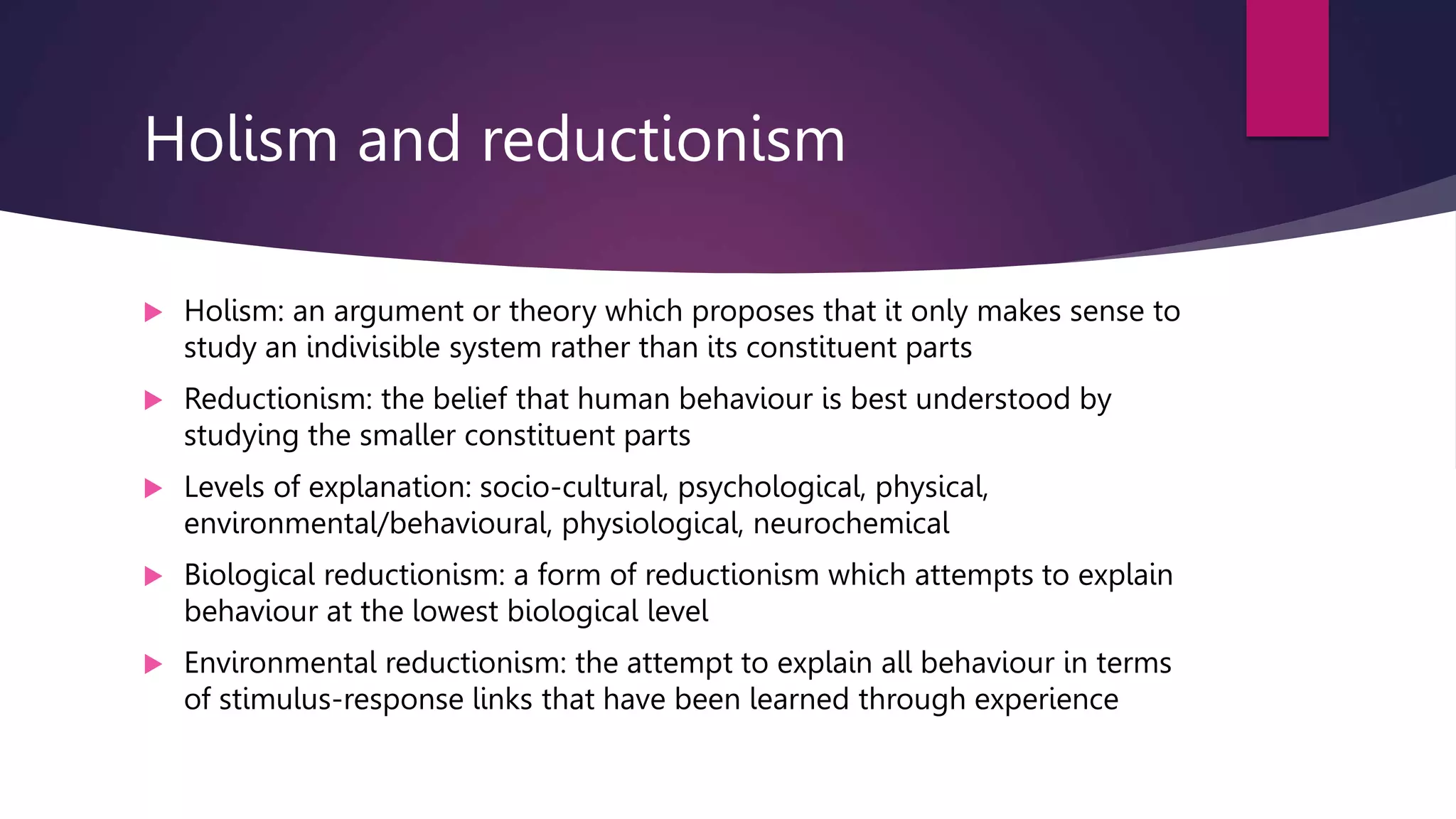
 Holism: an argument or theory which proposes that it only makes sense to
study an indivisible system rather than its constituent parts
 Reductionism: the belief that human behaviour is best understood by
studying the smaller constituent parts
 Levels of explanation: socio-cultural, psychological, physical,
environmental/behavioural, physiological, neurochemical
 Biological reductionism: a form of reductionism which attempts to explain
behaviour at the lowest biological level
 Environmental reductionism: the attempt to explain all behaviour in terms
of stimulus-response links that have been learned through experience
Holism and reductionism – Eval
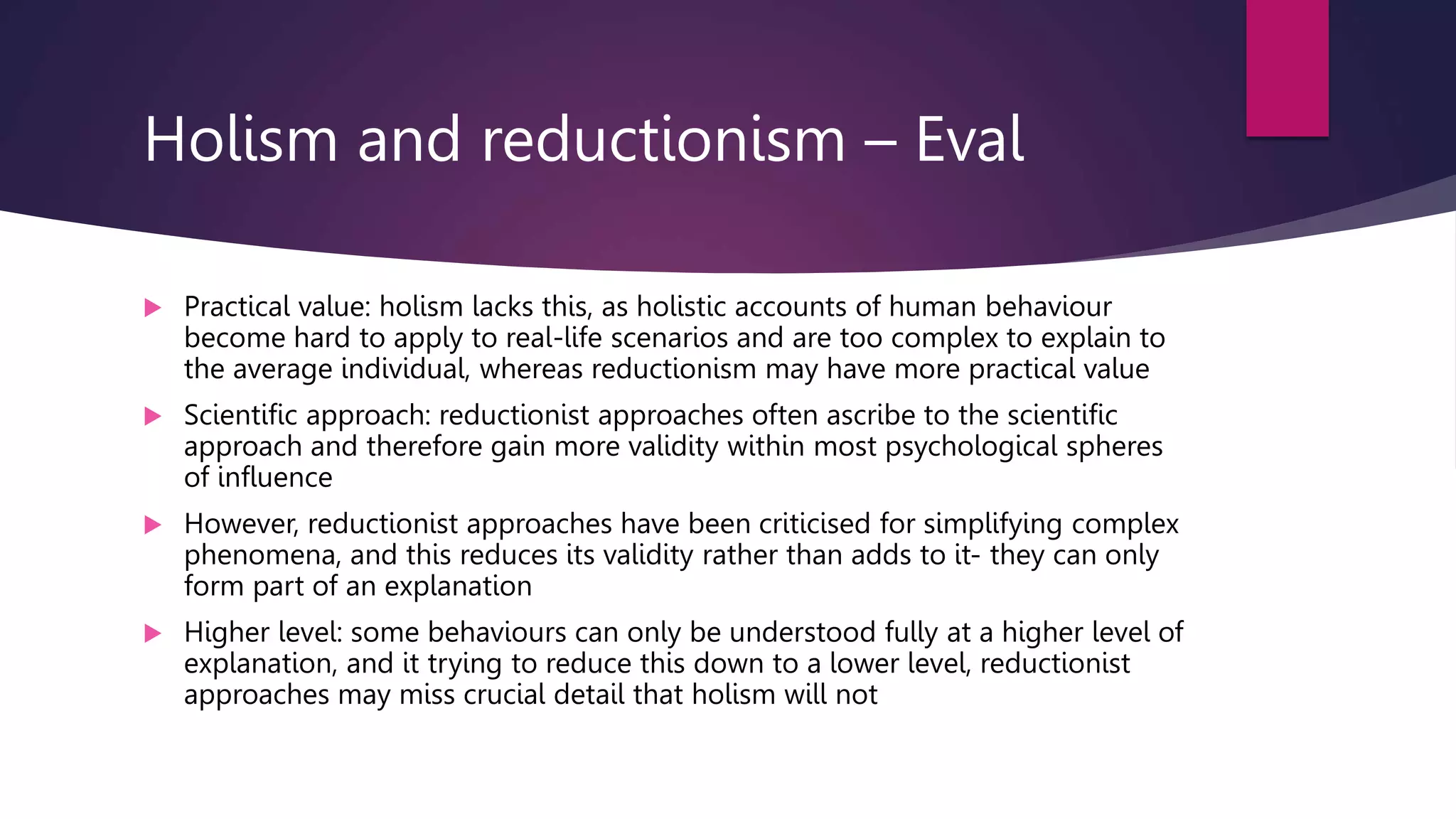
 Practical value: holism lacks this, as holistic accounts of human behaviour
become hard to apply to real-life scenarios and are too complex to explain to
the average individual, whereas reductionism may have more practical value
 Scientific approach: reductionist approaches often ascribe to the scientific
approach and therefore gain more validity within most psychological spheres
of influence
 However, reductionist approaches have been criticised for simplifying complex
phenomena, and this reduces its validity rather than adds to it- they can only
form part of an explanation
 Higher level: some behaviours can only be understood fully at a higher level of
explanation, and it trying to reduce this down to a lower level, reductionist
approaches may miss crucial detail that holism will not
Idiographic and nomothetic
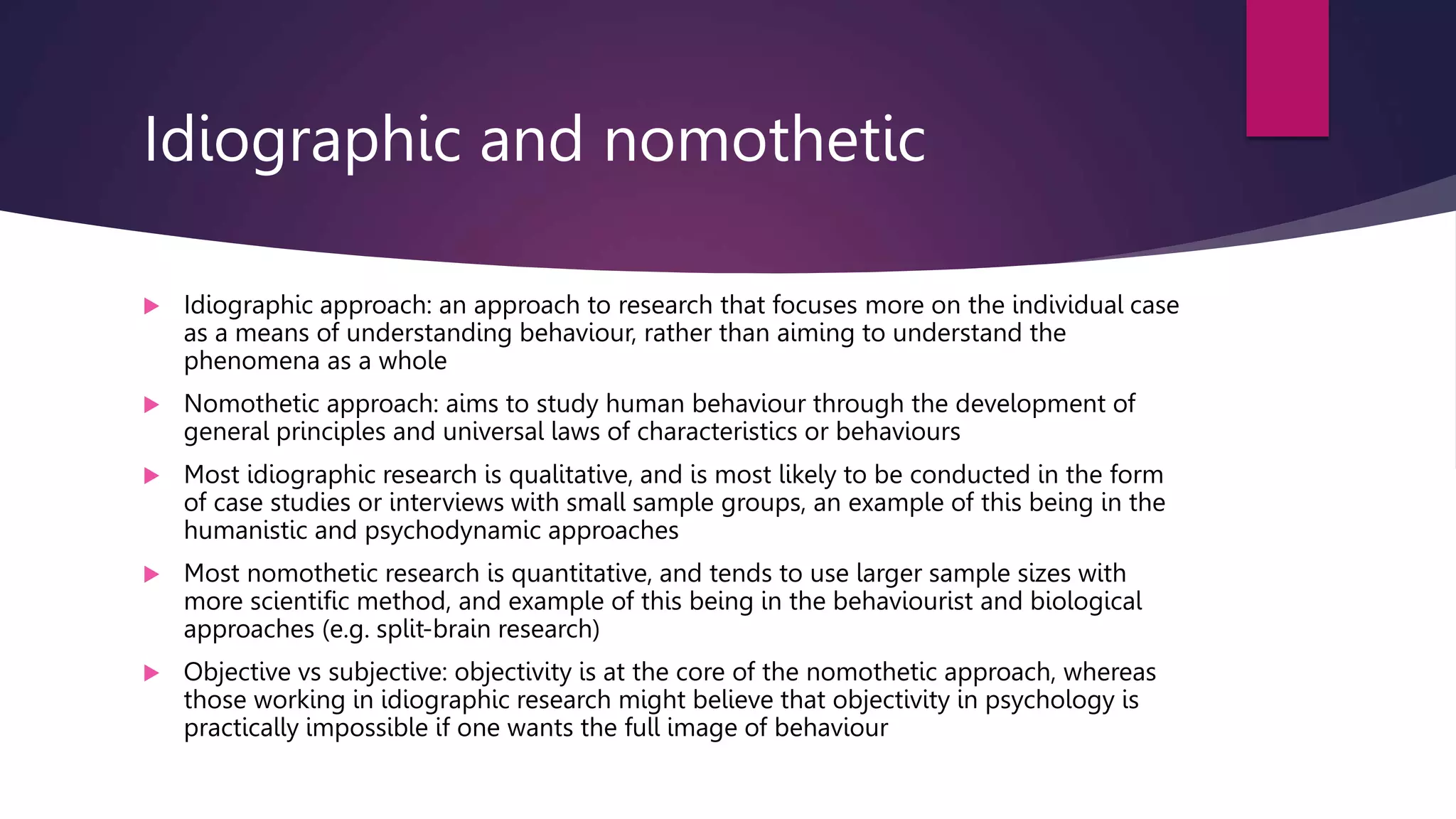
 Idiographic approach: an approach to research that focuses more on the individual case
as a means of understanding behaviour, rather than aiming to understand the
phenomena as a whole
 Nomothetic approach: aims to study human behaviour through the development of
general principles and universal laws of characteristics or behaviours
 Most idiographic research is qualitative, and is most likely to be conducted in the form
of case studies or interviews with small sample groups, an example of this being in the
humanistic and psychodynamic approaches
 Most nomothetic research is quantitative, and tends to use larger sample sizes with
more scientific method, and example of this being in the behaviourist and biological
approaches (e.g. split-brain research)
 Objective vs subjective: objectivity is at the core of the nomothetic approach, whereas
those working in idiographic research might believe that objectivity in psychology is
practically impossible if one wants the full image of behaviour
Idiographic and nomothetic – Eval
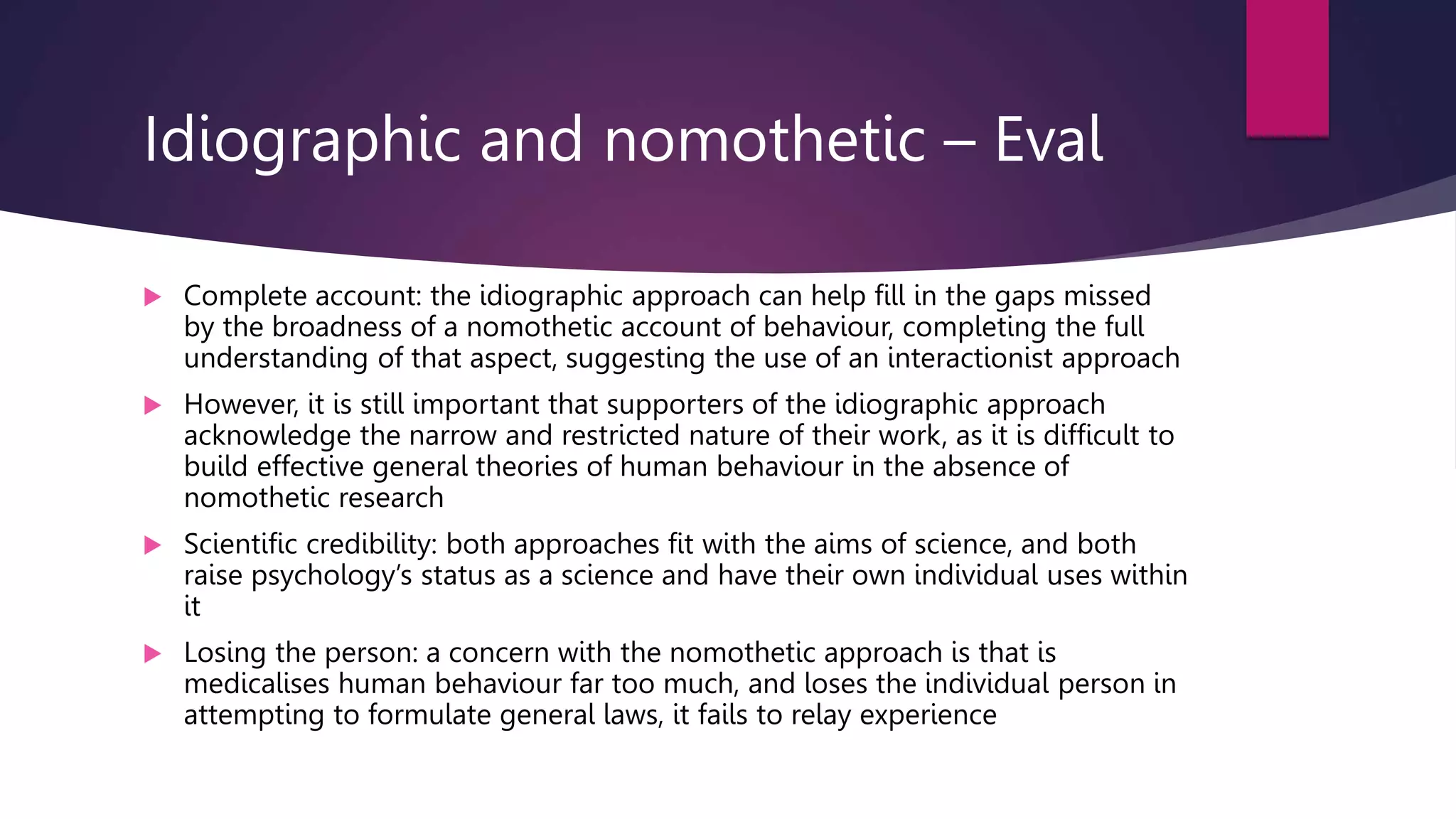
 Complete account: the idiographic approach can help fill in the gaps missed
by the broadness of a nomothetic account of behaviour, completing the full
understanding of that aspect, suggesting the use of an interactionist approach
 However, it is still important that supporters of the idiographic approach
acknowledge the narrow and restricted nature of their work, as it is difficult to
build effective general theories of human behaviour in the absence of
nomothetic research
 Scientific credibility: both approaches fit with the aims of science, and both
raise psychology’s status as a science and have their own individual uses within
it
 Losing the person: a concern with the nomothetic approach is that is
medicalises human behaviour far too much, and loses the individual person in
attempting to formulate general laws, it fails to relay experience
Ethical implications
 Ethical implications: the consequences of any research in terms of the effects on the individual
participants or on the way in which certain groups of people are subsequently regarded; there
may also be consequences on a wider societal level
 Social sensitivity: defined by Sieber and Stanley (1988) as studies in which there are potential
consequences or implications, either directly for the participants or for the class of individuals
represented by the research
 Implications for the research process: all stages of planning and conducting a study are
important when thinking of social sensitivity, as well as later in handling the findings
 Research question: the way in which research questions are phrased or worded can have an
effect on the way in which findings are interpreted
 Dealing with ppts: issues such as informed consent, confidentiality, psychological harm are
particularly important in SSR, as studies could reveal private information about individuals
that are not meant to be publicly known
 The way findings are used: researchers should consider in advance how they are going to use
these findings, as well as how they will be used in the wider world, whilst considering whether
or not to publish their work- conclusions with good intentions still have the potential to be
purposefully misinterpreted to fuel agendas
Ethical implications – Eval
 Benefits for groups: SSR can have benefits for marginalised groups, such as
anonymous interviews with gay individuals by Kinsey (1948) that eventually
had homosexuality removed from the DSM as a mental illness, illustrating the
importance of SSR
 However, it can also have the opposite effects, such as with the supposed
research on a ‘criminal gene’ that can lead to both class and race prejudices,
demonstrating the need for careful consideration in terms of SSR
 Real-world application: real world groups (e.g. policymakers) rely on SSR to
make adequate policy or rules related to investigated groups, demonstrating
the need for SSR to be conducted to high quality and its importance
 Poor research design: bad designs may lead to erroneous findings in SSR, and
this can have dire consequences for affected groups, for example the UK 11+
that is still used despite proof that it is an inadequate measure of a child’s
academic potential, showing the need for SSR to be very carefully planned

AQA Psychology A Level Revision Cards - Issues And Debates Topic

  • 1.
    Gender bias  Alphabias: research that exaggerates the differences between the sexes, often devaluing women (e.x. Freudian superego)  Beta bias: research that underestimates the differences between the sexes, often leading to inadequate treatment for one sex (e.x. fight or flight response not necessarily being the same in females)  Androcentrism: psychology has consequently presented a male-dominated view of the world/the human mind, and females are often discarded by the psychological industry and its research as a result
  • 2.
    Gender bias –Eval  Biological vs social explanations: gender differences are often presented as fixed and enduring when this is not always the case, for example boys as ‘doers’ and girls as ‘thinkers’; must be wary in accepting research as fact and not just stereotype  However, this is not to discourage studying real gender differences in the brain, which are suggested to be present through scans (females are better at multitasking due to better neurological connections)  Sexism in research: gender bias promotes sexism in the research progress, and can produce biased results that draw bias conclusions as a result of internal prejudice  Gender-biased research: research that challenges gender bias may not be published; gender bias research is funded less often and is published by less prestigious journals, it may not be taken as seriously as other forms of bias
  • 3.
    Cultural bias  Ethnocentrism:a particular form of cultural bias that refers to the thought normality of one’s own ethnic group, and judging other groups based on the standards and values of one’s own. For example, Ainsworth’s Strange Situation is ethnocentric as it is based on the workings of the western/American child-rearing practice  Cultural relativism: the idea that norms and standards of a certain culture can only be understood meaningfully in the context of that culture, within specific social and cultural contexts  Etic approach: looking at behaviour from outside of a given culture and attempting to ascribe that as universal  Emic approach: looking at behaviour inside a given culture and identifying behaviours specific to that culture
  • 4.
    Cultural bias –Eval  Classic studies: many of the most influential studies in psychology are culturally bias, working from western norms and ascribing them to other cultures (e.x. Ainsworth’s, Milgram, Asch etc.), and when reproduced in other cultures did not produce the same results- meaning that our understanding of psychology as a whole could be limited due to cultural bias  However, in an age of globalisation, many behaviours and norms previously isolated have begun to spread across cultures, suggesting that findings in certain cultures may become more generalisable  Cultural psychology: due to the discovering of cultural bias, cultural psychology has emerged; this psychology aims to understand how people are shaped by their cultural experience, which will lead to a richer understanding of the human condition and means psychologists are mindful of the bias’ existence when researching  Ethnic stereotyping: psychological findings can and have been used to create racial prejudice, for example early US intelligence tests were centred on a US cultural experience, and those who were not white or US citizens scored lowly- instead of being taken as a sign of inadequacy, it was used to fuel prejudice and incorrect stereotyping
  • 5.
    Free will anddeterminism  Free will: the notion that humans can make choices and their behaviour/thoughts are not determined by biological or external forces  Determinism: the view that an individual’s behaviour is shaped or controlled by internal or external forces rather than individual will  Hard determinism: all behaviour is caused by a discoverable something/free will is an illusion  Soft determinism: personal choice exists but behaviour is most often predictable and influenced  Types of determinism: biological (behaviour is influenced by biological mechanisms), environmental (behaviour is influenced by uncontrollable factors of environment), psychic (behaviour is influenced by unconscious psychodynamic conflicts)  Scientific approaches usually ascribe to hard determinism as science itself states that there is a cause to everything, and so many lab studies in psychology become determinist
  • 6.
    Free will anddeterminism – Eval  Practical value: free will has practical value as it appears as common sense to the general public and therefore is more generalisable, and it improves mental health to think such  Research evidence: brain scans tend to support determinism, as in experiments of ‘choosing’ to move, the brain had more unconscious motor activity beforehand  However, these experiments only show that the brain is involved in decision-making, not that our decisions are determined  The law: if determinism were to become the popular view, then there would be a large question of criminal responsibility- if all actions are determined, is it viable to punish an individual for committing crimes that were ‘predetermined’ by some uncontrollable factor?
  • 7.
    Nature-nurture  Nature: refersto the idea that human characteristics are innate due to genetics and heredity  Nurture: refers to the idea that human characteristics and behaviour are influences by our environment and how we develop as children/adolescents  Nature and nurture are often measured through twin studies using concordance rates  The interactionist approach: nature and nurture are not seen as lone influences on all behaviour and characteristics, most often in psychology it is studied what contribution each makes to a certain trait or behaviour, for example how influential genetics or early relationships are on mental health/disorders  Diathesis-stress model: an extension of the interactionist approach, this states that to have a certain trait (usually used in reference to mental illnesses) one will usually have a dormant biological or environmental vulnerability that can be ‘triggered’ by an additional biological or environmental influence  Epigenetics: refers to a change in genetic activity without a change to the gene itself, through environmental influences- for example, permanently lowered lung capacity after extended smoking- that can affect an individual for the rest of their life and even pass to their children
  • 8.
    Nature-nurture – Eval Adoption studies: adoption studies are useful in research into the nature-nurture debate as they separate the competing influences, and can allow for detailed insight into each potential influence on behaviour  However, it is questionable whether nature and nurture can be truly separated, and therefore whether any research trying to do such has any meaningful conclusions that can be applied to life  Epigenetics: there is support for epigenetics in that during the Dutch Hunger War of 1944, babies born were of low birth weights and were twice as likely to develop schizophrenia in adulthood than average populations, showing that previous generations’ life experiences can leave epigenetic ‘markers’ on offspring  Real-world application: OCD is an extremely heritable disorder, and so the existence of research into nature-nurture can allow individuals who carry the genetics for the disorder to access advice about the likelihood of offspring and adequate treatment for the disorder, showing the practicality of nature-nurture as not just a theoretical debate
  • 9.
    Holism and reductionism Holism: an argument or theory which proposes that it only makes sense to study an indivisible system rather than its constituent parts  Reductionism: the belief that human behaviour is best understood by studying the smaller constituent parts  Levels of explanation: socio-cultural, psychological, physical, environmental/behavioural, physiological, neurochemical  Biological reductionism: a form of reductionism which attempts to explain behaviour at the lowest biological level  Environmental reductionism: the attempt to explain all behaviour in terms of stimulus-response links that have been learned through experience
  • 10.
    Holism and reductionism– Eval  Practical value: holism lacks this, as holistic accounts of human behaviour become hard to apply to real-life scenarios and are too complex to explain to the average individual, whereas reductionism may have more practical value  Scientific approach: reductionist approaches often ascribe to the scientific approach and therefore gain more validity within most psychological spheres of influence  However, reductionist approaches have been criticised for simplifying complex phenomena, and this reduces its validity rather than adds to it- they can only form part of an explanation  Higher level: some behaviours can only be understood fully at a higher level of explanation, and it trying to reduce this down to a lower level, reductionist approaches may miss crucial detail that holism will not
  • 11.
    Idiographic and nomothetic Idiographic approach: an approach to research that focuses more on the individual case as a means of understanding behaviour, rather than aiming to understand the phenomena as a whole  Nomothetic approach: aims to study human behaviour through the development of general principles and universal laws of characteristics or behaviours  Most idiographic research is qualitative, and is most likely to be conducted in the form of case studies or interviews with small sample groups, an example of this being in the humanistic and psychodynamic approaches  Most nomothetic research is quantitative, and tends to use larger sample sizes with more scientific method, and example of this being in the behaviourist and biological approaches (e.g. split-brain research)  Objective vs subjective: objectivity is at the core of the nomothetic approach, whereas those working in idiographic research might believe that objectivity in psychology is practically impossible if one wants the full image of behaviour
  • 12.
    Idiographic and nomothetic– Eval  Complete account: the idiographic approach can help fill in the gaps missed by the broadness of a nomothetic account of behaviour, completing the full understanding of that aspect, suggesting the use of an interactionist approach  However, it is still important that supporters of the idiographic approach acknowledge the narrow and restricted nature of their work, as it is difficult to build effective general theories of human behaviour in the absence of nomothetic research  Scientific credibility: both approaches fit with the aims of science, and both raise psychology’s status as a science and have their own individual uses within it  Losing the person: a concern with the nomothetic approach is that is medicalises human behaviour far too much, and loses the individual person in attempting to formulate general laws, it fails to relay experience
  • 13.
    Ethical implications  Ethicalimplications: the consequences of any research in terms of the effects on the individual participants or on the way in which certain groups of people are subsequently regarded; there may also be consequences on a wider societal level  Social sensitivity: defined by Sieber and Stanley (1988) as studies in which there are potential consequences or implications, either directly for the participants or for the class of individuals represented by the research  Implications for the research process: all stages of planning and conducting a study are important when thinking of social sensitivity, as well as later in handling the findings  Research question: the way in which research questions are phrased or worded can have an effect on the way in which findings are interpreted  Dealing with ppts: issues such as informed consent, confidentiality, psychological harm are particularly important in SSR, as studies could reveal private information about individuals that are not meant to be publicly known  The way findings are used: researchers should consider in advance how they are going to use these findings, as well as how they will be used in the wider world, whilst considering whether or not to publish their work- conclusions with good intentions still have the potential to be purposefully misinterpreted to fuel agendas
  • 14.
    Ethical implications –Eval  Benefits for groups: SSR can have benefits for marginalised groups, such as anonymous interviews with gay individuals by Kinsey (1948) that eventually had homosexuality removed from the DSM as a mental illness, illustrating the importance of SSR  However, it can also have the opposite effects, such as with the supposed research on a ‘criminal gene’ that can lead to both class and race prejudices, demonstrating the need for careful consideration in terms of SSR  Real-world application: real world groups (e.g. policymakers) rely on SSR to make adequate policy or rules related to investigated groups, demonstrating the need for SSR to be conducted to high quality and its importance  Poor research design: bad designs may lead to erroneous findings in SSR, and this can have dire consequences for affected groups, for example the UK 11+ that is still used despite proof that it is an inadequate measure of a child’s academic potential, showing the need for SSR to be very carefully planned