Frog App
By
[Taiwo, Ciara, Jemma and Chris]
 Who will the App help?
 Students and teachers
 What is the situation behind the problem ?
 Students forget they have homework.
 When does the problem occur?
 Everyday
 Where does the problem occur?
 At home and at school.
 Why does the problem occur?
 Teachers don‟t have time or forget to mention the homework
 Students forget they have homework or loose their homework
diary.
Background Situation
 Many students forget they have homework or will forget,
check on frog and the homework is not up which will lead to
detention
 When they are mot reminded or the teacher doesn‟t put it on
frog, or loose their diary the students use these as excuses.
 Many teachers forget and have to wait until they are back
into the school‟s system.
Problem
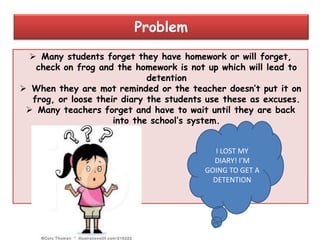
I LOST MY
DIARY! I’M
GOING TO GET A
DETENTION
 The key question our team is trying to answer is:
“How is the Frog App different from
Frog the website?”
Key Question
The answer to the key question is:
The frog website can only be used by computer or
laptop, even if you use the website version on your
phone its different. If you don‟t have internet it is
impossible to access frog, which can lead to detention.
The frog app is an easier way of avoiding detentions
and much simpler way of understanding the process
Key insight statements
“Our team, the A Team are developing a mobile app
for Frog. To help students access frog quicker, it is
also less hassle, as a student myself, I find it hard to
access frog, with this app its easy and you can access
it everywhere..”
Mini Elevator Pitch
After analysing the results of the surveys we sent out
to potential users, we found the following:
 Most students will use the app when it is made.
 Many are not willing to pay for the app and feel
that it should be free if they really want to help
the students.
 They are moderately likely to recommend the
product to others.
User Profiles- What we found out about
our users
 Having conducted some research into the current app
market, my team found out that there are no competitors.
 There is no other similar products.
 This is why we think producing the app is a good idea
because its one of a kind.
Competitors and alternative solutions
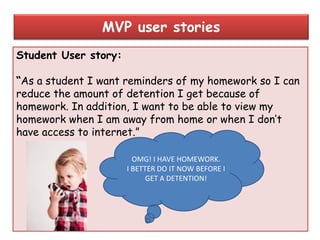
Student User story:
“As a student I want reminders of my homework so I can
reduce the amount of detention I get because of
homework. In addition, I want to be able to view my
homework when I am away from home or when I don‟t
have access to internet.”
MVP user stories
OMG! I HAVE HOMEWORK.
I BETTER DO IT NOW BEFORE I
GET A DETENTION!
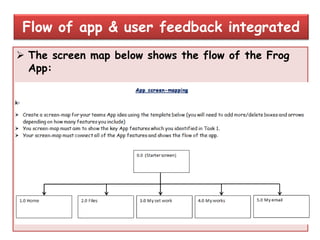
 The screen map below shows the flow of the Frog
App:
Flow of app & user feedback integrated
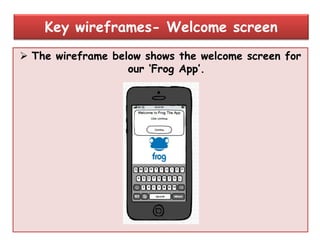
 The wireframe below shows the welcome screen for
our „Frog App‟.
Key wireframes- Welcome screen
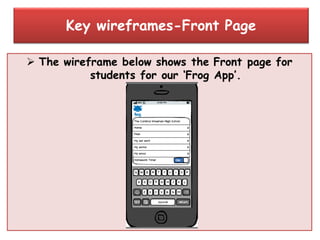
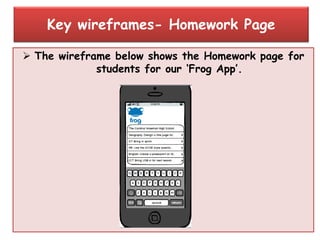
 The wireframe below shows the Homework page for
students for our „Frog App‟.
Key wireframes- Homework Page
 Data:
 The data that is required for this app is the notifications files
which will be stored.
 These notification files will allow the homework on the app to
give notifications and pop ups on when homework to due and
reminders, just like if you receive a message you have a pop up.
 We will need authorisation from the phone company to access
these notifications or for them to process the notifications
from the frog app to the phone.
 Technical Feasibility:
 Our solution is technically possible to build because it does
not require functions that do not exist on mobiles.
 A professional developer would be able to build our solution in
to the phone but do not have knowledge of how long it will
take.
Data and Technical Feasibility
Business case hypothesis:
“We think that and know that students and
teachers are not willing to pay for the Frog
App but maybe as time goes by we can start
adding a charge slowly. If not that‟s not all
important its about the education.”
Business model choice:
 Statement: My team‟s app, „Frog‟ will operate
on a business model.
Business Case & Customer pledges
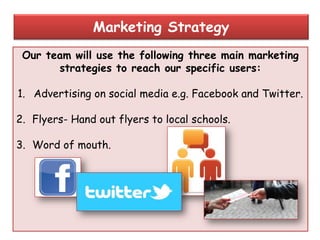
Our team will use the following three main marketing
strategies to reach our specific users:
1. Advertising on social media e.g. Facebook and Twitter.
2. Flyers- Hand out flyers to local schools.
3. Word of mouth.
Marketing Strategy

Apps for Good - The 'FROG' Pitch presentation

  • 1.
  • 2.
     Who willthe App help?  Students and teachers  What is the situation behind the problem ?  Students forget they have homework.  When does the problem occur?  Everyday  Where does the problem occur?  At home and at school.  Why does the problem occur?  Teachers don‟t have time or forget to mention the homework  Students forget they have homework or loose their homework diary. Background Situation
  • 3.
     Many studentsforget they have homework or will forget, check on frog and the homework is not up which will lead to detention  When they are mot reminded or the teacher doesn‟t put it on frog, or loose their diary the students use these as excuses.  Many teachers forget and have to wait until they are back into the school‟s system. Problem I LOST MY DIARY! I’M GOING TO GET A DETENTION
  • 4.
     The keyquestion our team is trying to answer is: “How is the Frog App different from Frog the website?” Key Question
  • 5.
    The answer tothe key question is: The frog website can only be used by computer or laptop, even if you use the website version on your phone its different. If you don‟t have internet it is impossible to access frog, which can lead to detention. The frog app is an easier way of avoiding detentions and much simpler way of understanding the process Key insight statements
  • 6.
    “Our team, theA Team are developing a mobile app for Frog. To help students access frog quicker, it is also less hassle, as a student myself, I find it hard to access frog, with this app its easy and you can access it everywhere..” Mini Elevator Pitch
  • 8.
    After analysing theresults of the surveys we sent out to potential users, we found the following:  Most students will use the app when it is made.  Many are not willing to pay for the app and feel that it should be free if they really want to help the students.  They are moderately likely to recommend the product to others. User Profiles- What we found out about our users
  • 9.
     Having conductedsome research into the current app market, my team found out that there are no competitors.  There is no other similar products.  This is why we think producing the app is a good idea because its one of a kind. Competitors and alternative solutions
  • 10.
    Student User story: “Asa student I want reminders of my homework so I can reduce the amount of detention I get because of homework. In addition, I want to be able to view my homework when I am away from home or when I don‟t have access to internet.” MVP user stories OMG! I HAVE HOMEWORK. I BETTER DO IT NOW BEFORE I GET A DETENTION!
  • 11.
     The screenmap below shows the flow of the Frog App: Flow of app & user feedback integrated
  • 12.
     The wireframebelow shows the welcome screen for our „Frog App‟. Key wireframes- Welcome screen
  • 14.
     The wireframebelow shows the Homework page for students for our „Frog App‟. Key wireframes- Homework Page
  • 15.
     Data:  Thedata that is required for this app is the notifications files which will be stored.  These notification files will allow the homework on the app to give notifications and pop ups on when homework to due and reminders, just like if you receive a message you have a pop up.  We will need authorisation from the phone company to access these notifications or for them to process the notifications from the frog app to the phone.  Technical Feasibility:  Our solution is technically possible to build because it does not require functions that do not exist on mobiles.  A professional developer would be able to build our solution in to the phone but do not have knowledge of how long it will take. Data and Technical Feasibility
  • 16.
    Business case hypothesis: “Wethink that and know that students and teachers are not willing to pay for the Frog App but maybe as time goes by we can start adding a charge slowly. If not that‟s not all important its about the education.” Business model choice:  Statement: My team‟s app, „Frog‟ will operate on a business model. Business Case & Customer pledges
  • 17.
    Our team willuse the following three main marketing strategies to reach our specific users: 1. Advertising on social media e.g. Facebook and Twitter. 2. Flyers- Hand out flyers to local schools. 3. Word of mouth. Marketing Strategy