


15
MUST-READS
from 2012
a collection of frog’s most
thought-provoking essays, timely interviews,
and recognized projects of the year


www.frogdesign.com
15
MUST-READS
from 2012
a collection of frog’s most thought-
provoking essays, timely interviews, and
recognized projects of the year


www.frogdesign.com
1 Why Conviction Drives                                page 9
                                                                                             Innovation More Than Creativity
                                                                                             By Doreen Lorenzo president, frog


                                                                                           2 10 Ways That Mobile Learning                         page 13
                                                                                             Will Revolutionize Education
                                                                                             By Fabio Sergio executive creative director, frog


                                                                                           3 2012 Awards                                          page 19

                                                                                           4 A Future Dominated by Voice,                         page 27
                                                                                             Not Indistinct Black Slabs
                                                                                             With Mark Rolston chief creative officer, frog


                                                                                           5 Mind the Gaps: The Challenges                        page 31
                                                                                             of Using Design to Scale Solutions
                                                                                             to Wicked Problems
                                                                                             By Robert Fabricant vice president, creative, frog


                                                                                           6 In Search of the Meaning of                          page 39
frog works with the world’s leading companies, helping them to design, engineer,             African Innovation
and bring to market meaningful products and services. With an interdisciplinary team
                                                                                             By Ravi Chhatpar executive strategy director, frog
of more than 1,000 designers, strategists, and software engineers, frog delivers con-
nected experiences that span multiple technologies, platforms, and media. frog works

                                                                                           7 Addicted to Data: How an
across a broad spectrum of industries, including consumer electronics, telecommunica-
tions, healthcare, energy, automotive, media, entertainment, education, finance, retail,
                                                                                                                                                  page 43
and fashion. Clients include Disney, GE, HP, Intel, Microsoft, MTV, Qualcomm, Siemens,
and many other Fortune 500 brands. Founded in 1969, frog is headquartered in San
                                                                                             Obsession With Measuring
Francisco, with locations in Amsterdam, Austin, Boston, Bangalore, Johannesburg, Kiev,       Can Hurt Businesses
Milan, Munich, New York, Seattle, Shanghai, and Vinnytsya. frog is a company of the
                                                                                             By Ben McAllister creative director, frog
Aricent Group, a global innovation and technology services firm.


frogdesign.com
8 TEDTalk: Fire                                                            page 47
                                                                                      Creative conviction,
                                                                                      smarter cities,
    By Jared Ficklin frog fellow, design technology


 9 Cities in the Digital Age                                                page 51
    By Scott Nazarian creative director, frog

                                                                                      inventive ideas,
10 Why Cities Will Soon Be
    “Smarter” Than We Are
    By Reena Jana executive editor, frog
                                                                            page 55
                                                                                      global impact.
11 How to Nurture Your                                                      page 59
    Company’s Rebels and Unlock                                                       Across sectors, from communi-
    Their Innovative Might
    By Tim Leberecht chief marketing officer, frog
                                                                                      cations technology to retail to
                                                                                      emergency response and educa-
12 Design Research:                                                         page 65
                                                                                      tion, frog has explored, analyzed,
    China’s Consumer Culture
    By Brandon Berry Edwards executive creative director, frog                        and brought to market concepts
13 Imperialist Tendencies                                                   page 69
                                                                                      with the goal of improving how
    By Jan Chipchase executive creative director of global insights, frog             we experience and share our
14 A New Era for Hardware                                                   page 83
                                                                                      worlds as human beings. Here,
    By Max Burton executive creative director, frog                                   we’ve curated some of the most
15 Design Is a Privilege: An Update                                         page 89
                                                                                      daring, and widely recognized,
    on frog’s Mobile Mandate and                                                      thoughts from frog in 2012.
    Social-Sector Impact
    By Robert Fabricant vice president, creative, frog
By Doreen Lorenzo


    1             Why
                  conviction
                  drives
                  innovation
                  more
                  than
                  creativity


8
Doreen Lorenzo is president of frog.          This essay first appeared on Fortune.com.       requires Googlers to devote one-fifth of their time in the office pursuing a project
                                                                                                   that they are personally interested in and therefore passionate about. This policy has
                                                                                                   famously resulted in products such as Gmail and Google Earth’s flight simulator soft-
                                                                                                   ware. But beyond the hype surrounding Google’s management style and how it leads
                                                                                                   to inventive thinking, it’s helpful to see how individual Googlers themselves think of this
                                                                                                   concept, as evident on their blogs and in their own words. Dave Burke, an engineer-
                                                                                                   ing director who works on Google’s Android phone operating system, described the
                                                                                                   policy in a Google blog post earlier this year as “my license to innovate.” Just working
     In business circles, “creativity” has become a buzzword to describe a desired trait           at a place like Google, with its free food, vast resources, ambitious managers, and tal-
     among employees. It’s widely believed that having creative thinkers on staff will boost       ented co-workers might not be enough to spark innovation. A culture where personal
     overall team levels of innovation. Yes, creativity can lead to a surplus of original ideas.   passions matter enough to fuel a corporate policy, more than the policy itself, is the
     But when it comes time to sell those concepts internally, and then later take those           management strategy to emulate.
     ideas to market, creativity is not enough. More important is conviction.                      	   Organizations of all sizes can encourage everyone, from C-level leaders to junior
     	   Look at the most-admired business leaders today. They tend to resist compromises,         hires, to pursue their convictions. And they don’t have to be of the cheerleading variety.
     even when faced with widespread skepticism or even complaints from customers.
     Mark Zuckerberg, Facebook’s young founder, is known for the exactness of his vision,
     which drives each design or software tweak of the social networking software that
                                                                                                                          A culture where
                                                                                                                        personal passions
     he created, despite the now-requisite uproar each change incites among Facebook’s
     1 billion-plus users (whose own convictions, it should be noted, help drive subsequent


                                                                                                                  matter enough to fuel a
     iterations and privacy policies of Facebook).
     	   Consider how Amazon founder Jeff Bezos asked the graduating class at Princeton
     University during his 2010 commencement speech there, “Will you wilt under criticism,
     or will you follow your convictions?” A powerful alternative to reading a corny list of                       corporate policy, more
     tips for success to an eager crowd hoping to follow in his footsteps, his tough ques-
     tion offered a glimpse into his own style of innovation, and what drove him to build                         than the policy itself, is
     Amazon from a start-up online bookseller to a retail juggernaut to a serious challenger
     to Apple’s top-selling iPad hardware and its iTunes service.
                                                                                                                         the management
     	   But it’s not just company founders and CEOs or Ivy League grads that can benefit
     from having a strong sense of conviction. New data suggest that when employees pur-
                                                                                                                      strategy to emulate.
     sue work that they feel strongly about, and can move their ideas forward within their
     organization, they are more enthusiastic and productive. Harvard Business School pro-         In fact, it can be helpful on many levels for managers to pay attention to employees’
     fessor Teresa Amabile and her colleague Steven Kramer collected 12,000 electronic             passionate responses to projects, products, or services that are not working. At frog,
     diary entries from 238 executives in seven different organizations. They analyzed what        for example, a lot of people were complaining about an internal tool we used for per-
     motivated these everyday individuals, who described their daily psychological well-           formance reviews—how cumbersome the software was, how time-consuming the
     being at work. Amabile and Kramer saw a trend emerge: “simply making progress in              process was to enter text. (Sound familiar?) So, managers paid attention to this heated
     meaningful work” [italics mine] was key for these workers to feel engaged, Amabile            chatter and embraced it. Clearly, if so many people had such strong opinions about
     and Framer wrote in a New York Times opinion essay in September. What Amabile’s               this tool, perhaps something was wrong with it. That’s when I suggested that if our
     research shows is that conviction is important. Work that appeals to employees’ firmly        employees felt that it wasn’t the right tool for us, why not propose an improvement?
     held beliefs, which has personal meaning to workers, is what drives them.                     One designer stepped up to the challenge, and created an alternative to the perfor-
     	   Conviction is the powerful force that Google channels with its 20% policy, which          mance review software in question.


10                                                                                                                                                                                               11
The exercise showed our teams that we are the kind of company that listens to
     employees, pays attention to the intensity of their interests, and is not afraid to take
     risks by channeling that intensity. So what we’ve learned at frog is that an employee-
     first management policy is about creating a culture that offers the opportunity for
     everyone to voice their opinions all the way to senior executives, at town-hall-style
     meetings in person, or on company-wide quarterly calls. This way we can also iden-            By Fabio Sergio
     tify employees who have something to say, who might be able to offer fresh ways to
     improve how we do business, and whose opinions are so formed that they are not


                                                                                                   2
     afraid to share them in a company-wide arena.


                                                                                                                     10 Ways
     	   Conviction-driven thinkers on all levels of an organization, from the C-suite to execu-
     tive assistants, want to share their specific visions more than they seek fame or power.
     They don’t just think they have a good idea, but they believe passionately that their


                                                                                                                     That Mobile
     concept is worth making real. The beauty of these types of thinkers (and doers) is that
     they can explain why they want to develop the products they’re developing, and why
     they want to launch initiatives that they’re launching—both internally and to the world.


                                                                                                                     Learning Will
     Even when their ideas might not be the most original (remember, the Kindle was not
     the first e-reader; the iPod was not the first MP3 player; Google was not the first search
     engine; Facebook was not the first social network), their passion and their vision on how


                                                                                                                     Revolutionize
     to improve the world or even the everyday quality of life in your company’s workspace are
     likely focused. They are likely engaged. As a result, they can be very persuasive. Such a
     mixture of focus, engagement, and persuasion, more than creativity alone, is what brings
     ideas to market, and also to the right audiences at the right time.

                                                                                                                     Education
                            The takeaway
                 *          A key quality that the most successful innovation
                            leaders have is conviction, because it signifies the
                            combination of passion and persistence needed to
                            bring adventurous ideas to market.


12
Fabio Sergio is an executive creative         This essay first appeared on Co.Design          	   Education is getting increasingly interspersed with our daily activities. On our
     director at frog.                             (published by Fast Company).
                                                                                                   phones, tablets, and PCs, we download and digest life or work-related articles with
                                                                                                   instructions on how to fix our appliances or how to use a new professional software
                                                                                                   program. Many people across age groups decide to take formal online courses in their
                                                                                                   spare time, including complex subjects such as artificial intelligence, computer science,
                                                                                                   and game theory—all real examples of free courses offered by Stanford University and
                                                                                                   taken by everyday people, including 11-year-old kids and retirees.
                                                                                                   	   Continuous learning will simply be a given for the generations of today’s young-
     Smartphones and tablet computers are radically transforming how we access our                 sters who are often literally born within reach of a connected personal device.
     shared knowledge sources by keeping us constantly connected to near-infinite volumes
     of raw data and information. We enjoy unprecedented instant access to expertise, from         2. Educational leapfrogging
     informal cooking lessons on YouTube to online university courses. Every day people            Continuous learning isn’t just happening in the developed world. With low-priced
     around the globe are absorbed in exciting new forms of learning, and yet traditional          computers, tablets, and cell phones in the hands of children in resource-challenged
     schools and university systems are still struggling to leverage the many opportunities        communities, many kids who are engaging in technological leapfrogging will have the
     for innovation in this area.                                                                  opportunity to skip past outdated formal school systems, too. This is especially rel-
     	   Recently frog has been researching how learning models are evolving—and how               evant in the case of children living in poverty, who may be denied an opportunity to
     they can be improved—via the influence of mobile technologies. We’ve found that the           improve their condition through education because they start working very early to
     education industry needs new models and fresh frameworks to avoid losing touch                help sustain their families or do not live near schools.
     with the radically evolving needs of its many current and potential new constituencies.       	   The ability to interstitially access educational content during pauses throughout
     These range from a generation of toddlers just as comfortable with touchscreens as            their daily routine, or at night, or even as a running “soundtrack” that accompanies
     they are with books, to college-aged men and women questioning the value of physical          them during their tasks are all novel opportunities offered by a classroom that can fol-
     campuses, to middle-aged and elderly professionals hoping to earn new skills in their         low you wherever you go.
     spare time to secure a new job in turbulent economic times.
     	   We have been focusing on the concept of mLearning—where “m” usually stands                3. A new crop of older, lifelong learners (and educators)
     for “mobile” but also just as easily for “me.” The near-ubiquity of handheld devices and      A by-product of the continuous learning phenomenon is the fact that the grandparents
     their constantly lowering costs will enable the idea of “education that you can hold in       of children growing up with a touchscreen in their hands—people in their 60s today—
     your hand,” so it becomes a widespread reality in so-called developed markets and             are being pulled into mLearning more than ever, motivated to adoption by the need to
     resource-challenged parts of the globe alike. Thanks to findings from a frogMob—an            stay in touch with their grandkids.
     open research tool that allows people to upload and contribute their own observations         	   The availability of tablets and other touch-enabled devices has radically reduced the
     from around the globe—along with additional research and other insights contributed           perceived complexity of computers, helping older users to more easily communicate
     by our partners at the World Economic Forum, we have arrived at 10 key themes that            with their middle-aged children and grandkids via email, Facebook, Twitter, and Skype.
     are likely to drive the development of mLearning initiatives in innovative directions.        	   This is a demographic group that often has the time availability to take online
     Here they are.                                                                                courses for fun, but at the same time, this ability also offers another untapped oppor-
                                                                                                   tunity: Retirees represent a huge potential talent pool of educators who could address
     1. Continuous learning                                                                        the scarcity of qualified teachers in many areas of the world—especially if they teach
     Up until now, most people relegated “education” to a finite time in their lives: entering     remotely, via mLearning.
     school at around five years old and attending school institutions all the way to univer-
     sity. Education had an expiration date, then working life began. This model, which has        4. Breaking gender boundaries, reducing physical burdens
     its roots in the industrial era, is quickly becoming less relevant or applicable to the way   In parts of the globe where, because of centuries of cultural practices, young women
     we live our lives in the connected age.                                                       may still not be allowed to access a formal education, mLearning promises to be able


14                                                                                                                                                                                             15
to put girls and women of all ages in contact with high-quality education privately and   and packaged as educational material. The recent TED-Ed initiative attests to the
     on their own time. Along similar lines, mLearning also helps bring educational material   opportunity offered by the clever repurposing of existing quality lessons.
     within the reach of people with extreme disabilities, who may not be physically able to   	   Others have leveraged the video-sharing social platforms to distribute educational
     get to a classroom or campus on a regular basis. In both of these cases, new freedoms     materials created in an ad hoc way. It’s a model made famous by Salman Khan, an MIT
     can be exposed. As a result, these groups can take control of their educational and       graduate who, with his eponymous academy, “flips” the traditional education model by
     professional destinies.                                                                   having pupils absorb lessons at home, and practice and discuss what they’ve learned
                                                                                               at school instead.
     5. A new literacy emerges: software literacy                                              	   The range of mLearning materials does not need to be limited to higher education
     MLearning could usher in a boom of interest in learning software programming lan-         but can easily encompass valuable, practical know-how, from grandmothers showing
     guages, which could very well become a new lingua franca. This is already happening:      how to prepare traditional recipes to companies demonstrating how to install solar
     Numerous startup web-based businesses today such as Codecademy teach people               panels on mud huts.
     via interactive lessons how to understand and write software programs. Not even a         	   The nature and complexity of educational materials can also vary greatly and not
     year old, Codacademy has more than a million “students” and has raised about $3           necessarily require a video-capable smartphone: Humanitarian organizations like MAMA
     million in venture-capital funds.                                                         have put to good use simple text messages to help mothers in developing economies learn
     	   This scenario is particularly relevant in emerging economies, where gaining soft-     about pregnancy, childbirth, and caring for their infants.
These examples illustrate how the
     ware development expertise can introduce new opportunities for economic growth, or        power of mLearning lies in its ability to offer solutions for numerous niche audiences.
     give communities what they need to address unmet local needs. Consider the boom of
                                                                                               7. Teachers and pupils trade roles
                                                                                               The same handheld-connected tools that enable children and adults to access exist-


     In the concept of
                                                                                               ing educational solutions also provide the opportunity for them to capture and share
                                                                                               knowledge in return. In other words, imagine kids who are raised with programming

     mLearning, “m” stands                                                                     and video-production knowledge from very early ages creating educational materials
                                                                                               for their peers, or even to teach adults, exposing them to very young people’s points of

     not only for “mobile,”                                                                    view of the world. Imagine a 12-year-old boy explaining how to effectively communicate
                                                                                               health information to him as a tutorial for nurses, physicians, and parents.

     but also just as                                                                          8. Synergies with mobile banking and mobile health initiatives

     easily for “me.”                                                                          Developers of emerging mLearning ecosystems can learn a lot from their predecessors
                                                                                               in mBanking and mHealth and such services as mobile money transfers or mobile health
                                                                                               monitoring. Beyond adapting some ideas—including using text messaging to deliver
     homegrown startups in Kenya that has been shaping mHealth solutions to solve some         short lessons, teacher feedback, and grades—mLearning, mHeatlh, and mFinance can
     of the many health care issues affecting the country, or the success of an organization   also be synergistically combined. After all, better education can easily improve people’s
     like Ushahidi, which has been financing a social high-tech accelerator called iHUB in     financial condition and in turn positively influence their health. These three factors can
     Nairobi precisely to promote software literacy and local entrepreneurship.                be combined in different orders without changing the result, which will always be more
                                                                                               than then sum of the individual components. Applied on a micro or macro scale, this
     6. Education’s long tail                                                                  virtuous cycle has the potential to become a very effective way to improve personal,
     MLearning solutions are poised to tap into the vast amount of existing educational        regional, and even national economies.
     materials that could be made accessible via mobile channels. This is especially true
     with YouTube, Vimeo, and other video-sharing services already providing a critical        9. New opportunities for traditional educational institutions
     mass of tips, tutorials, and full-fledged lessons that can be re-aggregated by theme      The mLearning phenomenon will not necessarily compete with well-established schools


16                                                                                                                                                                                            17
but actually complement and extend their current offerings. An intriguing new model
     was offered when Harvard and MIT announced that they have teamed up to offer free
     online courses via a joint nonprofit organization, edX. Both universities will observe how
     students respond to the courses to better understand distance learning.
     	   After a few missed opportunities in the early 2000s, established universities seem
     to be looking beyond turning a profit and are turning to mLearning as a means to find
     new promising students or research how people learn. Traditional institutions could
     also help mLearning solutions scale quickly by leveraging their vast and established


                                                                                                  3
     networks of students, faculty, and alumni. The business potential could also be big; a


                                                                                                                  2012
     report published in February by Global Industry Analysts projects the global market for
     online and other electronic distance learning to reach $107 billion by 2015.


                                                                                                                  awards
     10. A revolution leading to customized education
     The key for successfully channeling the mLearning revolution will not simply be about
     digitizing current educational systems. The real appeal will be allowing people to choose
     their own paths, leverage their talents, and follow their passions and callings. MLearning


                                                                                                  Strategy,
     has much business potential, but the most exciting and rewarding aspect of these
     solutions is that students of any age or background might have the chance to pursue
     knowledge that is meaningful, relevant, and realistic to achieve in their own lives.


                 *
                            The takeaway                                                          sustainability,
                            The promise of “M-Learning” lies in the development
                            of viable new business models and design opportuni-
                            ties that allow companies to create personalized                      storytelling,
                                                                                                  simplicity
                            teaching services for all ages, inspired by mHealth
                            and mbanking. Developers need to look beyond
                            merely digitizing current modes of learning
                            for use on mobile phones.


                                                                                                  Throughout the year, design-industry juries around
                                                                                                  the world awarded frog for its accomplishments in
                                                                                                  these key areas of innovation.


18
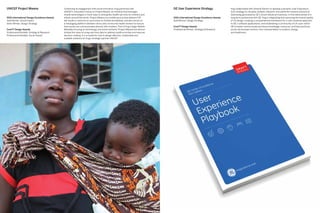
UNICEF Project Mwana                          Continuing its engagement with social innovation, frog partnered with                GE User Experience Strategy                   frog collaborated with General Electric to develop a dynamic User Experience
                                              UNICEF’s Innovation Group on Project Mwana, an initiative that leverages                                                           (UX) strategy to visualize, analyze, interpret, and utilize the massive amount of
                                              mobile technologies in fresh ways to strengthen health services for mothers and                                                    data being generated by GE’s smart industrial machines. In this latest phase of a
IDSA International Design Excellence Awards   infants around the world. Project Mwana is a mobile service that delivers HIV        IDSA International Design Excellence Awards   long term partnership with GE, frog is integrating and improving the overall quality
Gold Winner, Social Impact                    lab results in real time to rural clinics in Zambia and Malwai, and also serves as   Gold Winner, Design Strategy                  of UX design; creating a comprehensive framework for a user-centered approach
Silver Winner, Design Strategy                a messaging platform between clinics and community health workers to ensure                                                        to GE’s software applications; and establishing a community of UX users within
                                              that results are communicated directly with mothers. Part of frog’s larger Mobile    Core77 Design Awards                          GE to better communicate and share knowledge, resources, and best practices
Core77 Design Awards                          Mandate focusing on technology and social ventures, Project Mwana has demon-         Professional Winner, Strategy & Research      across all business sectors, from transportation to aviation, energy
Professional Notable, Strategy & Research     strated the value of using real-time data to address health priorities and improve                                                 and healthcare.
Professional Notable, Social Impact           decision-making. It is a model for how to design effective, sustainable and
                                              scalable solutions for frog’s strategic partner UNICEF.


20                                                                                                                                                                                                                                                      21
Revolver Personal Wind Turbine    The Revolver Personal Wind Turbine, a consumer-grade wind turbine capable       Bloomberg LP’s Corporate Website             frog designed Bloomberg’s first, one-page global corporate website around
                                  of generating 35 watts from a breeze, is a high performance solution to the                                                  the concept that nothing communicates data like data itself. The page’s live-
                                  growing demand for mobile “personal power” and true freedom from the grid.                                                   streaming tapestry gives equal footing to all of Bloomberg’s businesses and
BraunPrize Sustainability Award   Developed first as part of an internal frog competition, Revolver harnesses     Business Marketing Association’s ACE Award   visualizes every quantifiable aspect of the company’s sprawling business and
Professional Winner               wind power at an accessible scale and is easy to assemble, use and transport.   Winner, Best Corporate Website               financial market news operations. This data tells Bloomberg’s story in real time
                                  As a personal source of off-the-grid power for a mobile lifestyle, Revolver                                                  to many audiences, including the media, job seekers, and general business users,
                                  provides enough energy to light a lantern, power a radio or recharge                                                         while also highlighting the company’s prominent position in supplying up-to-
                                  phones, cameras, and other small electronic devices.                                                                         the minute information, news, and analytics across many diverse industries.


22                                                                                                                                                                                                                                  23
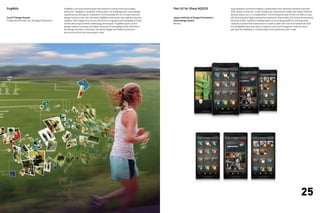
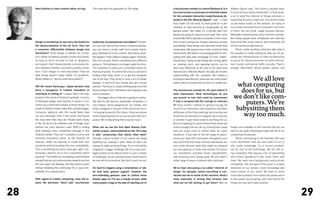
frogMob                                       frogMob is an experimental guerrilla research concept that encourages            Feel UX for Sharp AQUOS                 frog designers and technologists collaborated with Japanese handset manufac-
                                              everyone—designers, students, enthusiasts—to challenge their inner design                                                turer Sharp on Feel UX, a new mobile user-experience model that makes Android
                                              researcher by looking for inspiration from everyday life. As a crowd-sourced                                             devices stand out in a crowded field. The uncluttered look of Feel UX offers a visu-
Core77 Design Awards                          design research tool, the voluntary frogMob community has captured stories,      Japan Institute of Design Promotion’s   ally stunning and highly interactive experience that breaks out of the conventional
Professional Runner Up, Strategy & Research   insights, and images from across the world, bringing local knowledge to frog’s   Good Design Award                       Android model. Instead of adding layers to an existing platform, the frog team
                                              clients and projects while challenging stereotypes. frogMob opens up the         Winner                                  carefully curated that experience to create a sleek new line of smartphones that
                                              design research process and takes the pulse of emerging trends that inform                                               are straightforward and easy to organize and use for beginner Android users,
                                              the design process in the early, formative stages and leads to products                                                  yet have the flexibility in customization that advanced users seek.
                                              and services that improve people’s lives.


24                                                                                                                                                                                                                                            25
Interview with Mark Rolston (by Thomas Ricker)


     4              A Future
                    Dominated
                    By Voice, Not
                    Indistinct
                    Black Slabs


26
Mark Rolston is chief creative officer at frog.          This interview first appeared on The Verge.               a touchscreen monitor to control Windows 8. Is it         William Gibson said, “the future is already here,
                                                                                                                        too soon to draw a conclusion on what that means          it’s just not very evenly distributed.” In that sense,
                                                                                                                        for the computer interaction model famously de-           a lot of what the internet of things promises is
                                                                                                                        picted in the film Minority Report? (sigh...) I hate      happening around us right now. Our phones make
                                                                                                                        that model. On one hand, it’s been great for a user       us persistent nodes on the network. So many of
                                                                                                                        interface to have become so recognizable by the           our homes now have tens of computers, but most
                                                                                                                        general public. But really, it’s a terrible idea. Few     of them are are small, single purpose devices.
                                                                                                                        people are going to stand up and wave their arms          Wearable computing was once a fanciful concept.
                                                                                                                        around like that to operate a computer. In the movie,     But today people wear wristbands and watches
     Design is something we see every day thanks to           uniformity of smartphones and tablets? Certain-           Tom Cruise is doing a lot of object selection, sorting,   that track their body metrics and movement. All
     the democratization of the art form. How can             ly if you look back at the history of feature phones,     and editing. Those things work best with small hand       of this has becoming ordinary.
     a consumer differentiate between design and              you can trace a similar path from simple, black/          movements. We require more motor control for that         	   What’s really exciting is that the data-side to
     decoration? Good design is defined by a prod-            grey hardware to more colorful, decorative, jewel-        kind of work. But there is an emerging field of com-      the equation is really starting to step up. For ex-
     uct’s ability to address people’s wants and needs.       like designs. That’s likely to happen again. However,     puting that does take advantage of more “phatic”          ample, the infrastructures of cities are becoming
     As long as we’re focused on that as designers,           this time around, there’s something very different        interactions. Doing simple things like turning lights     a source for massive amounts of useful informa-
     we’re good. I don’t believe people consciously dis-      going on. The hardware is no longer really the story.     on, opening doors, and signaling yes/no can be            tion—social, commercial, traffic, security...There’s
     cern between whether a product’s quality comes           The hardware is really just a minimalist frame for        done very effectively at the kind of full body level      enough information about people, places, and
     from “true” design or mere decoration. How we            that touchscreen. It’s where the action is and we’re      that we saw in Minority Report. Actually, we’ve been
     label things doesn’t really matter. It’s academic.       finding what really works is to get the hardware          experimenting with this ourselves. We created a
     What matters is “did we solve the problem?”              out of the way. That tends to drive a lot of similar      prototype called RoomE, where we can control basic                  We all love
     Will the recent Samsung v. Apple decision help
                                                              designs, in terms of very simple and very similar
                                                              devices. The focus is simply shifting away from the
                                                                                                                        events with our bodies and our voice. It’s really cool.
                                                                                                                                                                                       what computing
     force a resurgence in creative innovation or
     contribute to stifling it? I expect that it will help,
                                                              physical object. But I still believe we’re going to see
                                                              a lot of variation.
                                                                                                                        The touchscreen existed for 20 years before it
                                                                                                                        went mainstream. What technologies do you
                                                                                                                                                                                        does for us, but
     at least in the world of Android handsets. In terms      	    The bigger story is that we’re going to eventu-      see around us now that could be mainstream                    we don’t like com-
     of hardware design, that industry is stuck in a rut.
     Check out a retail store display of those things. It’s
                                                              ally start to see devices, essentially computers, in
                                                              new shapes. Some designed for our bodies, and
                                                                                                                        if only a company had the courage to embrace
                                                                                                                        it? Voice control. I believe it’s going to be big. So
                                                                                                                                                                                          puters. We’re
     a wall of indistinct black slabs with rounded edges.     others designed to be part of the rooms we live in.       much of our interaction with computers has been               babysitting them
     Consumer patience with this would likely have
     run out eventually, even if the courts had forced
                                                              I’m looking forward to this future. I think we all love
                                                              what computing does for us, but we don’t like com-
                                                                                                                        with boxes. At first they were big, and now they are
                                                                                                                        small, but we still have to to tappity-tap in one way            way too much.
     the issue later than they did. People want variety       puters. We’re babysitting them way too much.              or another to get these boxes to do things for us.
     in life. As far as the software side of things, even                                                               But we’re getting to a point where those boxes are
     without the court decision, each OEM is finding          When will we see the first Mark Rolston Kick-             smart enough that we can try putting them away            things now available on the internet that we can
     itself needing more competitive leverage in the          starter project, unencumbered by the “let’s play          and just using voice to control them for many             start to do really interesting things with all of our
     Android market. They can’t compete on price and          it safe” compromise that clients often seek?              situations. If you look at the full range of experi-      computing horsepower.
     technical innovations alone. As the Android OS           Actually a good number of our clients are doing           ences you have with computers throughout your             	   What’s still lacking is the interface. We have
     matures, OEMs are learning to create their own           anything but “playing it safe.” Many of them are          day, you’ll find that many of those interactions are      more information than we have skills to turn it
     variations without breaking the core compatibility.      asking for really amazing things. So I’m not exactly      very small discreet tasks that might be replaced          into useful knowledge. It’s a human problem,
     This is something the press rarely gets right: Cus-      longing for a bigger challenge. We’re in a very privi-    by voice, gesture, or other new models. Of course,        not for lack of the technology. We are still us-
     tomizing a device’s OS is not a monolithic notion        leged position to be able to share in such a variety      our workstation activities, email, spreadsheets,          ing computers that require a ton of babysitting
     anymore. The platforms are getting sophisticated         of challenges. So any outside project would have to       web browsing aren’t going away. We just need a            and human guidance to get much done with
     enough that we can customize key aspects such as         be one hell of a moonshot. But don’t count me out.        wider range of ways to interact with machines.            them. We need more background, policy-driven
     the core apps, the desktop, and the unlock screen                                                                                                                            computing. The real goal of the vision is a deep
     without breaking the underlying OS or app com-           It’s hard to imagine using a smartphone or tab-           We’ve been discussing a so-called “internet of            extension of our senses—more knowledge and
     patibility. It’s a layered story.                        let that lacks gesture support. However, the              things” for decades, where everything is con-             more control of our world. We want to know
                                                              arm-extending gestures used to control home               nected and we’re inside of the machine. What’s            more about people, more about the places we’re
     With regard to mobile computing, what will re-           theater apps on TVs are a novelty at best, while          most important in driving that forward, and               in and where we are going, and more about the
     place the dominant “black slab” touchscreen              many people cringe at the idea of reaching out to         what are we still lacking to get there? Well, as          things we have and might acquire.


28                                                                                                                                                                                                                                         29
What will frog be focusing on in ten years? In       We’re already doing these things. The skills just
     2050? Ten years is nothing. We’ve been around        aren’t formalized yet. We’re making it up as we go.
     more than 40 years. If I look back ten years, we     But we’ve been here before. WiMP apps, websites,
     were pursuing primitive forms of some of the         touchscreen software—we were there in the be-
     same problems. What then was merely a concept,       ginning for each of these.
     today is a real development project. Ten years ago   	    Another trend that will play out in the next
     we were working with Motorola, Nextel, and oth-      40 years is in hardware design. We’ve seen the
     ers to create cellphones that had value beyond       evolution of many forms of hardware, from direct
                                                                                                                   By Robert Fabricant
     making phone calls. It was a struggle to do much     expressions of function to just being window-frames


                                                                                                                   5
     of anything. Today a project like our Feel UX for    for software. It might seem as if the importance of
     Sharp is easily possible. So I can imagine that in   hardware is fading, but ironically, hardware design is


                                                                                                                                  Mind the
     ten more years some of our latest concepts will      becoming more valuable to us. Industrial design is
     become real. Concepts such as RoomE might ac-        hot again. It turns out that as things become more
     tually be in the market. I can hope so.              software-driven, more ephemeral, our need to con-
     	   As for 2050, if you buy into the vision that     nect with the visceral, touchable stuff increases.


                                                                                                                                  Gaps: The
     computing is destined to disappear into the          	    If you think about it, 2050 is closer to today
     woodwork, then we’ll likely be adopting new skills   than when we started frog in 1969. So we’ve al-
     such as body choreography, voice dialog design,      ready seen what this kind of change looks like. We


                                                                                                                                  Challenges of
     and more artificial intelligence-oriented design.    thrive on it.


                   *
                                The takeaway                                                                                      Using Design
                                                                                                                                  to Scale
                                Smart companies will recognize that the future of
                                computing is moving away from the computer itself.
                                Simple gesture, voice, and other effortless com-


                                                                                                                                  Solutions
                                mands, paired with more beautiful, less-box-like
                                devices, will be the wave of the future.


                                                                                                                                  to Wicked
                                                                                                                                  Problems


30
Robert Fabricant is vice president             This piece first appeared in Rotman magazine.   adopted. The ‘iPods’ of poverty alleviation and literacy have likely been invented and
     of Creative at frog.
                                                                                                    put to use by small organizations in some corner of the globe, but there is no market
                                                                                                    for identifying these breakthrough ideas and ensuring widespread adoption.”
                                                                                                    	   Imagine a world where wicked problems were more easily tamed, allowing us to
                                                                                                    pull solutions off the shelf to meet the needs of under-resourced populations around
                                                                                                    the world. The good news is that, through a myriad of business model competitions
                                                                                                    and fellowship programs, social venture capitalists have become adept at identifying
                                                                                                    disruptive innovations with the potential to achieve scale—in theory. Yet due to some
     While problems of all shapes and sizes can benefit from creativity, it has become an           significant “design gaps,” very few have been able to achieve scale in practice.
     article of faith that “wicked problems,” in particular, require highly creative solutions
     that span boundaries and organizations. And as more of the critical issues facing our          Gaps to Achieving Scale
     society—from sustainability to chronic disease—are being classified as wicked (or at           Over the last six years, under an initiative called Mobile Mandate, my colleagues and
     least extremely stubborn), the prominence of design thinking continues to grow in the          I have committed significant time and resources to collaborations that leverage the
     public sphere, expanding into areas heretofore unexplored by designers.                        social impact of design, and along the way, we have gained a healthy respect for the
     	   I have watched this unfold first-hand in my work at frog, where we have seen a             value and limitations of design in this space. One thing we have noted is that it is easy
     rapid expansion of interest from organizations such as the United States Agency for            for designers to underestimate the gaps that exist between prototype and implemen-
     International Development and the State Department, both of which have embarked                tation, and in the case of wicked problems, these gaps are particularly daunting. What
     on initiatives to integrate design thinking into their programming. As a result of such        if there is something in the very nature of wicked problems that makes solutions harder
     partnerships, “social innovation” has moved into the lexicon, with programs popping            to normalize and replicate? And what if design thinking only makes matters worse?
     up simultaneously at business and design schools around the world, as well as collab-          	   This seems like a good moment for reflection, two years after Rotman’s first pub-
     orative projects such as Design for America.                                                   lication devoted to wicked problems. The following are four obstacles that often come
     	   Paul Polak—a pioneer of low cost irrigation technologies in Bangladesh and other           between creative approaches and large-scale implementations in our experience. While
     developing countries—first exposed me to the link between design methods and social            my examples come primarily from our work in the social sector, the observations and
     innovation in 2006. Paul has concluded that products that meet user needs are a signifi-       recommendations that follow are broadly applicable to wicked problems in any field.
     cant, underappreciated market for customers living on less than $1 a day. His organization,
     International Development Enterprises (IDE), has created products from treadle pumps to        1. The Systems Gap
     low-cost drip irrigation systems by using design methods, including direct observation of      Six years ago, Pop!Tech (an innovation accelerator) gathered a group of collaborators at
     user needs and then engaging in rapid cycles of iteration and prototyping in the field.        frog to tackle one of the most severe and intractable health issues in the world: HIV in
     	   The success and visibility of organizations like IDE has lead to a belief not only in      South Africa. A combination of cultural barriers and political neglect had created an epi-
     the power of human-centered, participatory approaches, but also a belief that these            demic of massive proportions in KwaZulu Natal, with infection rates estimated to be 40 per
     efforts will generate an expanding portfolio of solutions from which the best can be           cent and co-infection with TB and multi-drug resistant TB widespread. Often, by the time
     identified and scaled to solve a host of wicked problems. Treadle pumps and micro-             people reached the healthcare system, it was too late in the disease cycle for effective care.
     finance programs have become the design icons of social innovation, positively                 	   We had some great ideas to start with and a shared belief that we could change the
     impacting millions of lives. As Judith Rodin, president of the Rockefeller Foundation,         dynamics of the situation at scale. Together, we incubated an initiative called Project
     has pointed out, “solutions to many of the world’s most difficult social problems don’t        Masiluleke, which focused on solutions that sit largely outside the traditional health-
     need to be invented, they need only to be found, funded and scaled.”                           care infrastructure. Our first step was to sketch out a new model for reaching people at
     	   Unfortunately, very few social innovations have achieved comparable scale. Why?            every stage—from awareness to treatment and follow-up. Our discussion was guided
     As McKinsey’s Steve Davis writes (in the online journal What Matters):                         by the sort of design frameworks that we use for commercial clients like Disney and
     	   “Unlike in the private sector, where successful product innovations have a clear           GE. Within a few hours we had mapped out a systematic strategy and agreed upon the
     process for gaining market share, the best social innovations are not necessarily widely       problem space by hypothesizing potential solutions.


32                                                                                                                                                                                                   33
In the context of find-
     	      The first result was a mobile-messaging system that alerted people to get tested
     and follow up with treatment. Simple solutions like these are crucial to build the
     necessary credibility to catalyze system-wide change. Today, the Project Masiluleke
     messaging service touches between one and two million South Africans a day. It has                                  ing solutions to wicked
     encouraged more than three million people to reach out for help in the last three years.
     Without this simple, concrete result, we might not have remained so committed to the
                                                                                                                       problems, awareness and
     initiative. The mobile messaging service has already traveled far, and is now imple-
     mented in other African countries by our partner, Praekelt Foundation.
                                                                                                                             adoption can not be
     	      In today’s world, designers and investors often feel that the more systematic the
                                                                                                                          taken for granted; they
                                                                                                                              are integral to scale.
     approach, the more likely the solution is to succeed and scale. We often operate under
     the assumption that the system is the transportable part—but what we learned from
     this experience is that it is usually the discrete pieces that travel more easily and are
     crucial in building support in new communities on the path to scale.
     	      We are seeing the same thing in our work with UNICEF’s innovation team on Project                 neurs. Such approaches have proliferated over the last few years, making it the ideal ground
     Mwana. This initiative focuses on early infant diagnosis of HIV and has pioneered a                      to test Steve Davis’ hypothesis. That is, funders should be in a great position to pull the best
     system to return lab results to clinics via text messaging. This concept came out of                     mHealth innovations off the shelf and bring them to market at scale around the world. The
     several days of workshops that UNICEF’s innovation team lead in Zambia with key                          good news is that many of these organizations are funding similar, even redundant, efforts
     stakeholders. The creative process played a key role in the early inception as well as                   in areas like HIV and maternal and child health. The challenge is that they are often unaware
     the design and prototyping of the pilot solution. This simple solution is now going to                   of what each other is doing, and lack a fundamental language for describing and comparing
     scale in Zambia and will likely be exported by UNICEF to other countries.                                different solutions and implementations to figure out what really works.
                                                                                                              	   There is clearly a role for design here. Designers are particularly adept at drawing
     Summary of Contributing Factors                                                                          connections between different efforts and visualizing patterns. But finding solutions to
     •	     Designers love systems. Systems thinking can be a great tool for alignment and                    wicked problems is not as simple as merely mapping them out. Even with people who
            shared understanding in the space of wicked problems.
                                                                                                              share the same cultural reference points, it takes time to unpack different initiatives to
     •	     Systems are contextual and conditional; they are not as scalable or transportable as we
                                                                                                              identify both the common and unique components of even a simple solution like our
            would like to think.
     •	     The potential for impact is often greatest in the parts, not the sum. The discrete parts are      mobile messaging service. Most projects involve a much more diverse community of
            easiest to measure and are most replicable.                                                       participants with different cultural perspectives and local knowledge.
     •	     Simple solutions are crucial to build the necessary credibility to catalyze system-wide change.   	   The great strength of creative solutions is the willingness to prototype and iterate.
     •	     Systematic solutions often take too long to realize, bogging down smaller-scale innovators
                                                                                                              But for these very same reasons, it can be hard to retrace your steps, and the very skills
            and entrepreneurs in a single market or community and preventing more discrete
                                                                                                              that make creative thinking so effective can initially hold you back. Creative partners
            solutions from traveling to other locations.
                                                                                                              like to continually iterate, particularly in the space of wicked problems, making stable
     Recommendation #1 Decompose large systems into their component parts to look                             solutions hard to identify and document. Designers are not likely to take the time to
     for the individual pieces that are the most effective and efficient. Create a smaller set                capture and describe the components of a solution adequately so that others can fol-
     of discrete innovations that can be re-combined to suit the needs of different contexts                  low along and “steal” the best parts; and imaginative solutions are hard to describe
     at small scale to deliver widespread change.                                                             and normalize when many contextual variables are at play. Plus, the social knowledge
                                                                                                              and shared understanding that drives creative approaches is hard to capture for new
     2. The Discipline Gap                                                                                    stakeholders who didn’t participate directly in the process.
         This fall I was invited to a strategy planning session for the mHealth Alliance, an initiative       	   Compounding the situation is the fact that funders often look for validation and
     hosted by the UN Foundation. The session brought together a number of major funders who                  measurement before they will invest in documenting and scaling a solution, creating
     were investing in innovative approaches to public health with leading mobile tech entrepre-              a catch-22. Failures as well as successes need to be captured and disseminated, but


34                                                                                                                                                                                                               35
often they are not, preventing the best hybrid solutions from propagating, as Steve                 generation,” often seen as an afterthought in their programming—like a commercial
     Davis rightly points out.                                                                           company looking to “market” its products once development is complete. In the space
                                                                                                         of wicked problems engagement, awareness and adoption are not something you can
     Summary of Contributing Factors                                                                     afford to take for granted; they are integral to scale. Given the dynamic nature of these
     •	   Creative solutions are hard to describe and normalize, with many contextual variables.         problems and the complex social and behavioural dimensions to any solution, qualita-
     •	   The social knowledge and shared understanding that drives creative approaches is hard to
                                                                                                         tive feedback must be a continual part of the design process.
          capture for new stakeholders who didn’t personally participate in the process.
     •	   Creative partners like to continually iterate, particularly in the space of wicked problems,
          making stable solutions hard to identify and document.                                         Summary of Contributing Factors
     •	   Failures are not often documented. It is equally important to document failures as it is       •	   Design methods are good at gathering early feedback in problem definition and
          to document successes.                                                                              solution development.
                                                                                                         •	   Qualitative research methods can provide critical markers to build credibility before impact
                                                                                                              can be directly proven and correlated; but designers continue to iterate on the solution, mak-
     Recommendation #2 Too much learning is being lost as we tackle wicked problems.                          ing measurement and evaluation difficult, particularly when facing wicked problems that may
     Invest equally in the definition and documentation stage so that solutions can be nor-                   not have an obvious control group.
     malized and compared, even if the solution is a failure. This is another reason why it              •	   Information technologies that are core to many social innovation initiatives in areas like
                                                                                                              mobile health are a natural place to gather quantitative data around feedback and engage-
     pays to focus on smaller, more discrete solutions, as they are easier to describe and
                                                                                                              ment building credibility with funders to invest in scale efforts.
     compare (see Recommendation #1).
                                                                                                         •	   Scale is not just about the delivery model, it is about the demand model. Demand generation is a
                                                                                                              great weakness of many efforts, making qualitative research is essential throughout the process.
     3. The Evidence Gap
     One of the key achievements of design in the social sector has been to increase                     Recommendation #3 Develop a more agile model of M&E that takes better advantage
     appreciation for the value of direct engagement with end users to better understand                 of qualitative feedback as well as real-time measurements of engagement, awareness,
     needs and collaboratively shape solutions. Many design collaborations begin with just               and adoption through integration of information technologies. Look at these additional
     that, working on a small scale with local partners and social entrepreneurs to rapidly              forms of qualitative feedback not just as precursors to more formal M&E, but also as
     develop and test new approaches. But all too often, funders and policy makers in fields             critical components to the continued iteration and optimization of solutions to wicked
     like public health discount this sort of ‘qualitative’ and participatory research.                  problems in the social sector. And look for opportunities to better correlate qualitative
     	    In 2009, I was participating on a panel at Harvard Business School’s Social                    feedback with impact measures to better understand how the two interrelate.
     Entrepreneurship Conference, when a skeptical audience member raised the topic of mea-
     surement. The only designer on the panel, I was armed with some fairly detailed stats on            4. The Solution Gap
     our work in South Africa. Our Project Masiluleke data showed a tripling of volume into the          In the realm of wicked problems, we cannot and should not expect shrink-wrapped solu-
     National Aids Helpline that can be directly correlated and attributed to our service.               tions, even if the solutions emerge from a highly creative, collaborative, and iterative process.
     	    Information technologies that are central to many social innovation initiatives in             This can be difficult for organizations, which make high profile investments in creative col-
     areas like mobile health are a natural place to gather quantitative evidence around                 laborations with designers, and for senior stakeholders, with too much faith in the power of
     feedback and engagement, building credibility with funders to invest in scale efforts.              design thinking, to accept. One “failure,” and they will often scrap the whole endeavor.
     But while they are compelling, these stats generally reflect engagement and feed-                   	    The fact is, organizational engagement takes time. In working with organizations
     back—they have not been connected to any specific health outcomes, which can take                   like iTeach, our front-line partner in Project Masiluleke, we have witnessed an amazing
     years of study in an area like public health. While valuable, they do not fully address the         willingness to apply a creative approach to many different challenges. We have seen
     ‘evidence gap’ raised by funders and policy makers.                                                 first hand, for example, the ability of an organization with strong community outreach
     	    The Evidence Gap cuts two ways: many interventions that have demonstrated                      skills to adapt those skills very successfully to design activities such as observation
     measurable impact through traditional measurement and evaluation (M&E) studies,                     and concept testing. iTeach has set up an entire video-based usability lab in its lim-
     like mosquito nets, have hit barriers to scale due to lack of engagement and adoption.              ited facility to foster the design process, and we are now investigating whether we can
     Large scale NGOs like UNICEF generally classify this under the category of “demand                  achieve similar results in a much larger organization like UNICEF.


36                                                                                                                                                                                                               37
Ultimately, scale itself may be the wrong goal, particularly when it is used as an
     excuse not to engage locally and understand specific cultural needs. In the end, it
     might not be a product or solution that will scale the best, but the process of engage-
     ment itself with different participants in the ecosystem.


     Summary of Contributing Factors                                                                       By Ravi Chhatpar
     •	   Don’t assume that a solution can be imposed from the outside.
          Instead, involve and empower the community in shaping solutions to meet their needs.


                                                                                                           6
     •	   The design process remains mysterious to many and hence, can be intimidating. The fact is,
          much of design is common sense. Look to leverage existing capabilities such as community


                                                                                                                         In search
          outreach that can be expanded to support design activities.
     •	   Choosing the wrong partner. Take the time to pick the design partner that is best in tune
          with your organizational culture. Make sure you have partner within the organization who is


                                                                                                                         of the
          involved throughout the end-to-end process.
     •	   Set the right expectations with internal stakeholders and champions so that they do not expect
          immediate success and are willing to see failures and mistakes as integral to the process.
     •	   Insist that stakeholders participate directly in design activities to increase their level of


                                                                                                                         meaning
          commitment and appreciation for the messy aspects of the design process.
     •	   Understand / assess barriers to openness early in the process.


                                                                                                                         of African
     Recommendation #4 Focus on building a sustainable network of partners within the
     communities you seek to serve. Understand that the design process, even if it leads to
     ideas that might not immediately prove to be “successful,” can help to strengthen con-


                                                                                                                         innovation
     nections between various stakeholders and increase their buy-in on an ongoing basis.


     In Closing
     Design can play a critical role in opening up new ways of approaching wicked problems.
     But as we look at problems of scale, we must acknowledge that it is but one ingredient in an
     overall strategy. Organizations looking to integrate design into this solution space would do
     well to mind the gaps that exist between pilot and implementation, particularly in the social
     sector. Embracing the recommendations outlined here can serve to guide collaborations
     moving forward and increase the chances of achieving large-scale impact.


                                The takeaway
                   *            Design works well as one type of humanitarian solu-
                                tion for the world’s greatest challenges, but design
                                solutions can be difficult to scale. Breaking problems
                                down into smaller hurdles to tackle; documenting all
                                design work; paying attention to qualitative feedback;
                                and finding strong partners are all steps that design-
                                ers and collaborators can take to improve how they


38
                                approach solving wicked problems.
Ravi Chhatpar is an executive strategy         This essay first appeared in African             important source of competitive advantage than the product itself. It claims devalua-
     director at frog.                              Innovator magazine.
                                                                                                     tion of IP is not intrinsically bad, as it makes you a more forward-thinking, agile player
                                                                                                     if you learn how to plan 6 steps ahead. And in its ultimate form, it claims that reverse
                                                                                                     innovation is not incidental or opportunistic, but must be the way global companies
                                                                                                     think about innovation in all of their categories, as inspiration not from foreign and
                                                                                                     distant, but archetypal and analogous markets is just better inspiration.
                                                                                                     	   The provocation here is that Chinese innovation is a fundamental counterpoint to
                                                                                                     Western innovation. It sharpens it, refines it, scales it, and accelerates it, and is there-
     When you ask most people in the world about what comes to mind when the word “innova-           fore essential.
     tion” is mentioned, a rare few will have anything to say that has anything to do with Africa.
     	   The Western response is predictable—Apple is the easy answer. Google, Facebook,
     Microsoft, Intel, GE, P&G round out the list. Others will point to any number of hot start-
                                                                                                          What’s fascinating about
                                                                                                         Africa is that, compared to
     ups coming out of Silicon Valley just this very week. More nuanced answers may point
     to the contributions of fundamental R&D-heavy industries like pharmaceuticals and


                                                                                                          many places in the world,
     chemicals. A deeper probing may get to stories about the Western education system,
     its entrepreneurial and funding culture, or how innovations spread through social mes-
     saging and communication.
     	   I’ve spent much of the last 8.5 years in Asia, mainly in China, spending a lot of time              connectivity seems to
     thinking about the Asian innovation story. It’s easy to get caught in relativist posi-
     tions—Japan mobile and automotive brands used to be globally dominant through                         work in extremes and in
     their cutting-edge innovations, but have since dropped off; the big Korean consumer
     technology brands like Samsung and LG are fast-followers behind the true US innova-
                                                                                                                      contradictions.
     tors like Apple; and what about China? It’s the manufacturing center of the world, with
     true sophistication in the factory and in product development, but traditionally viewed
     condescendingly as a source of derivations, not innovations. Made in China, but not             	   What about African innovation? What is it, what does it mean for Africa, what does
     designed, invented, or innovated in China.                                                      it mean for the world? What is Africa’s innovation posture?
     	   What’s fascinating to me is that in recent years, this Chinese “innovation” story has       	   As a relative newcomer to Africa, I will not claim to know the answer, if there even is
     started to change—through both the deliberate and unconscious efforts and strategies            one. But I will attempt to offer some insights based on the experience of the company
     of domestic companies, multinationals, media, and governments. And what is begin-               I work for—frog, a global innovation consultancy.
     ning to emerge is not a rationalization of why Chinese innovation is behind Western             	   At frog, our job is to uncover opportunities for innovation for our clients, and turn
     innovation, or what has to change to make Chinese innovation more appreciated by                these opportunities into meaningful products, services, and businesses. Discovering
     the West, but a realization that Chinese innovation is something that is fundamentally          the innovation opportunities is the first step in our process. Sometimes we have a
     different. So different, in fact, that it may represent an alternate model of innovation        pretty good sense of where the opportunities are, and the real challenge is to come up
     altogether. And savvy parties are trying to take advantage of this posture.                     with ideas to take advantage of the opportunity. More often, we may have some initial
     	   And what is this posture exactly? It’s hard to describe it succinctly, but it involves      hypotheses, but it takes deep research into consumer needs and motivations, market
     a few things. It posits that smarter localization of an innovation can be as important,         dynamics, and technology trends to frame the right opportunities.
     if not more important, then the innovation itself, requiring a truly sophisticated under-       	   Although the diversity of our work makes it hard to generalize, there does seem to
     standing of unmet needs and a truly inspired manifestation of a solution. It holds that         be one major determinant of how rich and provocative the innovation opportunities
     highly accelerated product development—meaning orders of magnitude faster hard-                 may be. This determinant is connectivity—not just connectivity in the popular sense
     ware and software development than in the west (weeks vs years)—can be a more                   of internet access, but in its broadest possible sense: the connectivity between people,


40                                                                                                                                                                                                  41
brands, institutions, activities, and events, enabled by a variety of technologies the
     bring these players together, from roads to mobile phones to social media.
     	   The reason this connectivity—indeed, hyper-connectivity in many ways—is so impor-
     tant is that new meaning is created as connectivity increases. Think about the meaning
     that is created by a new road between two cities or a phone conversation between two
     parties who have never interacted. These new pockets of meaning are the foundations            By Ben McAllister
     for new relationships and new behaviors. And this is what innovation is ultimately trying
     to achieve: the creation of fundamentally new relationships and behaviors.


                                                                                                    7
     	   So what does this have to do with African innovation? A lot. Africa’s most nota-


                                                                                                                   Addicted
     ble innovations—those that have had the greatest impact on the lives of people and
     that have also been the most recognized globally—have emerged spectacularly from
     unique connectivity conditions.


                                                                                                                   to Data:
     	   M-Pesa is the obvious example. The original concept solved a very constrained
     connectivity problem—a burning need to send money home quickly and securely. It
     scaled due to particular connectivity enablers—a regulatory environment enabling


                                                                                                                   How an
     commercial bank backing and a broad distribution network.
     	   African mHealth innovations like mPedigree are impressive for similar reasons. In
     this case, the relationship between drug brands and consumers was not trusted due


                                                                                                                   Obsession
     to the prevalence of counterfeit drugs. This is another extreme connectivity problem,
     solved through mPedigree’s innovative verification system.
     	   What’s fascinating about Africa is that, compared to many places in the world, connec-
     tivity seems to work in extremes and in contradictions. Physical infrastructure may be poor,
     but mobile connectivity is high. Relationships with brands may be tenuous, but real-world
                                                                                                                   With
                                                                                                                   Measuring
     social networks are meticulously groomed. Trust in formal institutions may be decreasing,
     but trust in operators and the cloud and other technology abstractions is increasing.
     	   These connectivity conditions are both provocations and constraints, which are


                                                                                                                   Can Hurt
     often the best springboards for meaningful innovation. And I believe this represents
     the real posture for African innovation. A unique set of connectivity considerations that
     can create high impact, highly meaningful, game-changing innovations.


                            The takeaway                                                                           Businesses
                 *          The infrastructure challenges and other resource
                            constraints that make “invention” difficult in Africa
                            are the key factors that inspire the technological
                            and social-networking innovation that arises
                            across the continent.


42
Ben McAllister is a creative director at frog.   This essay first appeared on TheAtlantic.com   Measurement can impose a hidden cost on the customer
                                                                                                     In Physics, there’s a phenomenon called the Observer Effect. Often confused with the
                                                                                                     Heisenberg Uncertainty Principle, it refers to the idea that observing a phenomenon can
                                                                                                     change the phenomenon itself. This is also the case with market research. Consider the
                                                                                                     call to a customer service department that ends with the question: “Are you willing you
                                                                                                     take a brief survey?” As with junk mail, these questions add friction to the experience,
                                                                                                     imposing a cost (in this case, time) on the customer. I always wish that these phone
                                                                                                     surveys ended with a question like “On a scale of 1 to 5, how irritating do you find this
     Here’s one thing I love about plumbers: whenever I hire one, they stick to the plumbing.        survey?” As satisfying as it might be to answer that question, there is a much more sig-
     Not once has a plumber fixed my kitchen sink, only to follow up with a credit card offer.       nificant, systemic issues lurking inside the Church of Measurement.
     No teaser rates, no plumber points, no “convenience checks.” Not even a customer
     satisfaction survey. They simply do their job and collect their fee. It makes me wish
     dealing with larger companies were that simple.
     	   Take for example the pre-authorized credit card offers that incessantly arrive in                                       The fact that
     the mail. Every weekend, I spend a few minutes opening, shredding, and recycling
     the week’s accumulated offers. This routine is especially galling because many of the
                                                                                                                         something is hard to
     offers come from companies I have a relationship with. As with the plumber, I hire these
     companies to do a job for me (one that has nothing to do with credit cards). But unlike
                                                                                                                        measure doesn’t mean
     the plumber, these companies don’t seem to understand their role in my life.
     	   Most of us call these unsolicited offers “junk mail.” The industry prefers the euphe-
                                                                                                                              that it isn’t real.
     mism “direct mail.” Within marketing circles, this kind of tactic is known for being highly
     measurable. Outside of marketing, it is known for being highly annoying. (I’d suggest           Measurement culture tends to trade long-term value for short-term gains
     that these two attributes are not mutually exclusive.)                                          The online magazine Salon recently found itself in a situation I call the Measurement Trap.
     	   Complaining about junk mail is hardly novel. But “Junk Mail Thinking” is not limited        Amid the recession, it began moving away from original reporting, relying instead on news
     to credit card offers. Junk mail thinking is metric-oriented thinking, and it pervades          aggregation to generate traffic. Traffic is of course, the lifeblood of an online magazine. But,
     the business world, stemming from an almost religious devotion to measurement. An               as is often the case in the Church of Measurement, the short-term metric (traffic) ended
     entire generation of managers has been brought up in the Church of Measurement,                 up taking a toll on a harder-to-measure, but more important idea: brand value. As Salon
     whose catechism is: “If you can’t measure it, you can’t manage it.” It seems like an            editor-in-chief Kerry Lauerman recently told the Nieman Journalism Lab:
     innocent enough idea. But as uncontroversial as it sounds, a dogmatic devotion to               	   “I remember we had aggregated a Charlie Sheen story, and I saw it tweeted a lot. It
     measurement can create problems. Those problems begin with a few simple truths:                 wasn’t a really interesting essay, just the latest news breaking. I was watching all of our
                                                                                                     peers—either before or after us—tweet the exact same story. I thought, ‘This is how it
     Some things are easier to measure than others                                                   ends. This is grim. We’re all just sort of regurgitating the same thing over and over again.’”
     It is easy to measure how many people respond to a credit card offer. It is much harder         	   How did Salon escape the Measurement Trap? Tellingly, writes Lauerman, it hap-
     to measure the cumulative frustration that these tactics inspire among the thousands            pened when founder David Talbot, returned to the magazine as CEO, giving the staff
     who don’t respond. But the fact that something is hard to measure doesn’t mean that             free reign to “work longer on stories for greater impact, and publish fewer quick-takes
     it isn’t real. Unfortunately, we tend to fall back on things that are easy to measure over      that we know you can consume elsewhere.”
     taking on an initiative that might bring real value to users. And since nothing is easier       	   It often takes a charismatic leader to shepherd companies out of the Measurement
     to measure than income, it’s no wonder that customers of measurement-centric com-               Trap—or to prevent them from ending up there in the first place. By definition, those of
     panies end up feeling “nickel and dimed.” But financial focus isn’t the only flaw in the        us who question the Church of Measurement often lack the cold, hard facts to back up
     measurement mindset.                                                                            our case (they’re hard to measure.) Instead, we must rely on hypotheses and anecdotal


44                                                                                                                                                                                                      45
evidence. Luckily, these hypotheses are often hard to argue with, to the point of sound-
     ing banal. “Happy customers will be repeat customers” is one I’m fond of advocating.
     And while I may not always have the data to prove it, I think it explains why my plumber
     has never offered me a credit card.


                                                                                                By Jared Ficklin

                           The takeaway
                *
                                                                                                8
                           While today’s business culture relies on metrics to


                                                                                                                   tedtalk:
                           analyze the success of products and services, true
                           customer satisfaction is hard to measure—and may
                           be tainted by the act of measurement itself.


                                                                                                                   fire
                                                                                                “...sound
                                                                                                moves in all
                                                                                                directions, and
                                                                                                 so do ideas.”


46
Jared Ficklin is a frog fellow, design technology.                                           Excerpts from Jared Ficklin’s TEDTalk

                                                                                                  “So here, I’m using a rendering algorithm to
                                                                                                  paint the frequencies of the song ‘Smells Like
                                                                                                  Teen Spirit’ in a way that the eyes can take
                                                                                                  them in as a single visual impression, and the
                                                                                                  technique will also show the strengths of the
                                                                                                  visual cortex for pattern recognition.”

                                                                                                  “Even on the first view, your eyes will suc-
                                                                                                  cessfully pick out patterns, but on repeated
                                                                                                  views, your brain actually gets better at turn-
     In February, Jared Ficklin stepped onto the stage at the TED Conference in Long Beach,       ing these patterns into information. You can
     California. He gave a show-stopping talk on new ways of experiencing music, via color        get the tone and the timbre and the pace of
                                                                                                  the speech, things that you can’t get out
     and flames instead of sound. The goal: to analyze how we respond to aural experiences
                                                                                                  of closed captioning.”
     in fresh and highly visual ways, and how these experiences might offer new insight on the
     creative process. Jared was the first TED presenter to light actual fire on the TED stage.
     	   TED posted the video of Jared’s TEDTalk in July, and nearly 250,000 people had
     watched it by the end of 2012.


     “...eyes can hear, and
     this is interesting to me
     because technology allows
     us to present sound to the
     eyes in ways that accentu-
     ate the strength of the eyes
     for seeing sound, such as
     the removal of time.”


48                                                                                                                                    49
“That famous scene in horror movies
where someone is walking up from behind
is something you can see, and I believe this
information would be something that is
useful at times when the audio is turned off
or not heard at all, and I speculate that deaf
audiences might actually even be better at
seeing sound than hearing audiences…It’s
a theory right now. Actually, it’s all just an      By Scott Nazarian
idea…sound moves in all directions,
and so do ideas.”


                                                    9              Cities in
From Disaster Response
to Losing Control of Your Brand:
Two Other Popular TEDTalks


                                                                   the Digital
In May, TED posted the video of a TEDTalk
given by frog Principal Designer Michael
McDaniel at TEDxAustin, in which he presented
his Exo Reaction Housing System—a design


                                                                   Age
for inexpensive, ecologically friendly disaster-
relief shelter. The video has been watched nearly
170,000 times by the end of 2012. And frog’s
Chief Marketing Officer Tim Leberecht have a
TED University talk at TEDGlobal in Edinburgh,
Scotland, advising executives on three ways to
usefully lose control of their company’s brand.
TED posted the video of this TEDTalk online in
October, and by the end of 2012, nearly
270,000 people had viewed it.


50
Scott Nazarian is a creative director at frog.   This essay first appeared on Urban Times.        How do we account for novelty? Or the unexpected combination of elements? Or even
                                                                                                       basic preference? The depth and duration of ambiguity is prevalent here: a spectrum
                                                                                                       of mob behavior versus simple criteria for way-finding. A key sentiment for this frame
                                                                                                       might be, “If they can, they will.”


                                                                                                       Phatic

                                                                                                       Mastering the subtlety of gesture and body language is an overall exponent to greater
                                                                                                       or lesser degrees of expression. What are the “modifier keys” to primary environmental
                                                                                                       or digital interactions? How do voice and gesture contribute to the amplification of
     For many people, the draw of cities is their pulse and flow, the veer and crush of humans,
                                                                                                       other actions? Can whole environments communicate intent through the slightest of
     our shared machines, the vertical, the symmetrical, the seemingly impossible. We con-
                                                                                                       ambient cues? The vocabulary and choreography in this area will continue to emerge
     nect, go forward, are thrust. We revel in the contrasts of urban materials—steel, stone,
                                                                                                       in step with all other areas of spatial/temporal consideration.
     leaf, blade, glass, branch, Plexiglas, vinyl, flesh. The sheer matrix of it, the complexity of
     relationships and their potential outcomes, is almost a will unto itself, compelling us to


                                                                                                                         Cities challenge us
     be shaped, inviting us to form and move with it.
     	   This type of interconnected environment has evolved into an interface to computa-


                                                                                                                     to manage their many
     tion that is nowhere near as conversational as it might be, as philosopher-scientist Paul
     Dourish has noted. I’d argue that this makes interaction design evermore crucial in the
     world, as we work to support people and the technologies upon which they’ve come to
     rely within the built environment.                                                                              networks, all of which
     	   Whether social or self-defining, physical and digital interaction requires a certain vocab-
     ulary that frames perception and action at every turn. To employ a linguistic metaphor, the
                                                                                                                       must be managed or
     “tense” can be either reflective or progressively situational (i.e., move forward over time).
     The following terms suggest how human perception and interaction might be formulated:
                                                                                                                 facilitated by both people
     Performative

                                                                                                                   and automated systems.
     For the design of messaging and display contexts, how can architectural surfaces
     reflect interior intent? How are spaces designed to promote or mask human mobil-                  	   To what end does this language move us? When we talk about a vocabulary for the
     ity or emotive objectives? Not too long ago, the act of talking on a mobile phone in              built environment, the intent is to map its temporal and visceral, or behavioral, char-
     public was performance-centric. And to the extent that it still is, what affordances have         acter. In so doing, we can identify opportunities for interaction design to play a role in
     accrued in the interim? Networks? Graphics? Policy?                                               the transformation of the space. These terms allow for a more fluid co-existence with
                                                                                                       technology, where comprehending human needs and desires is paramount. A formal
     Pervasive
                                                                                        application of such behavioral frameworks has only just begun to emerge, and the
     For the design of visceral or digital immersions, how can the combination of multiple             space to explore new forms of physical-digital interplay and interface is wide open. By
     sensors and cooperative networks render holistically in space? Can there be contin-               applying their understanding of broader interaction frameworks to the built environ-
     uums of non-adjacent, location-based data? Must devices operate discretely, or might              ment, interaction designers can elegantly weave engineering and experience, masking
     they share their resources within meshed computing topologies? The more integrated                or exposing technology in the most relevant, meaningful ways.
     the sensate environment, the more interactive the infrastructure becomes.                         	   Cities challenge us to manage their many networks, all of which must be managed
                                                                                                       or facilitated by both people and automated systems. Each of these systems has a
     Emergent
                                                                                         certain timing, or a set of recurring and predictable flows that can enhance or dis-
     Designing for emergence is designing toward, or even with, nature and randomness.                 rupt people’s experiences. Therefore, designers need to thoughtfully and deliberately


52                                                                                                                                                                                                  53
consider each system’s components and composition. In particular, we must over-
     come the challenge of ascribing physical experiences to virtual agents. What if we
     thought of software in terms of atoms and people as made up of bits? This could lead
     to not only innovative systems, but new cultural paradigms.
     	   The goal, then, of a rational and coherent digital interaction scheme is an effi-
     cient, interconnected flow of resources. In the technologically enabled environment,
                                                                                             Interview with Wim Elfrink of Cisco (by Reena Jana)
     synchronicity between the urban and natural ecology becomes possible. When infra-
     structure becomes “inter-actable,” a measure of agency over the built environments


                                                                                             10
     becomes available. Change is possible. Over time, it unlocks the design potential in


                                                                                                             Why Cities
     humans and system behaviors.


                *
                           The takeaway
                                                                                                             Will Soon Be
                                                                                                             “Smarter”
                           Creating a new vocabulary for the built environment
                           that expresses contemporary urban experiences can
                           help identify specific opportunities for interaction
                           design to play a vital role in improving our cities.


                                                                                                             Than We Are


54
Reena Jana is executive editor at frog.                 This interview first appeared on PSFK.com.           Stan Gale near the site where General MacArthur           city. In India, the need in many big metropolitan
                                                                                                                  landed. The entire new city is designed from a            areas is to improve slums, to offer more access
                                                                                                                  sustainability point of view. There’s a waste man-        to electricity and clean water. In Detroit, it’s to
                                                                                                                  agement system underground. There is a central            spark innovation, to get investors to bring busi-
                                                                                                                  park that is walkable from all areas. The design of       nesses back to the area. It’s possible to revive a
                                                                                                                  this city reflects the idea that all vital parts should   city relatively quickly if there is a focused goal.
                                                                                                                  be reachable via foot in 10-15 minutes. There is          Think of how New York City turned itself around
                                                                                                                  passive water, electricity, gas. And ICT is, we be-       by focusing on its need for security twenty
                                                                                                                  lieve, the 4th utility.                                   years ago, and then again ten years ago.
     Speaking one-on-one with Wim Elfrink, the first         mortar safety, it is not about walls. Surveillance   	    The advantage of such an innovation and
     Chief Globalisation Officer to be appointed at          has changed that.                                    design project is to create an entire infrastruc-         But there must be some shared challenges
     software giant Cisco, is always a delight. I must       	    Cities offer more opportunities for people      ture that works together very well. It has a              that all cities can tackle immediately and ef-
     confess that I’ve only had conversations with           to improve their lives than in smaller towns, so     destiny and a purpose.                                    ficiently. Yes. Energy management is one of
     him via Cisco’s high-end telepresence system            even if they attract people who are challenged                                                                 them. Big buildings are so inefficient. The sta-
     at the corporation’s One Penn Plaza offices in          by a lack of resources, they have better chanc-      So what about older cities: New York, Lon-                tistics are striking: 75% of the world’s energy is
     Manhattan, when it’s been morning in New York           es of becoming more prosperous.                      don, Delhi? How can they benefit from the                 used in cities. Besides energy conservation, wa-
     and evening in Bangalore, where Elfrink often           	    Telepresence will also help the poor have       new smart-city technologies out there?                    ter conservation is another area that could be
     works. As he said the last time we spoke, “some-        access to cities, perhaps bring them the edu-        Older cities are reinventing themselves. They             improved. Singapore has reached water neutral-
     times it’s hard to remember if I meet people in         cation, work, and even healthcare possibilities      will succeed when they find a new destiny                 ity. They have a saying, “from toilet to tap”—I’m
     person or on telepresence,” and this is true about      that they didn’t have before, and in a way,          and purpose. There are two factors to keep                not sure it’s great for marketing, but the initiative
     our own meetings. Our chats have been so vi-            make them part of cities.                            in mind: We’re in a service economy, and sus-             proves that even a large city can remake itself by
     brant, so warm, and so engaging that we may as          	 Also, we must remember that great cit-             tainability is driving the agenda.                        focusing on an urgent environmental need.
     well have been talking at a dinner party. This is       ies have souls. Think of what they are known         	    Think about some European cities and how             	     Cities can do a lot to alleviate traffic prob-
     testament to Cisco’s telepresence equipment,            for: Paris, for art. New Orleans, for music. San     they have reinvented themselves: Barcelona                lems. For instance, in the U.S., a big irritation
     of course, but also more exemplary of Elfrink’s         Francisco, for high tech. What is so promising       and Amsterdam, for instance, have always been             is going to visit the DMV. Why not set up the
     dynamic mind and lively, affable personality. It        about social networking is that in the future,       very charming. And today, both of those old               process to renew drivers’ licenses so that it
     shines through, no matter what the forum.               we’ll be able to connect more people with each       cities attract artists and creative companies.            happens virtually? In Paris, the average citizen
     	    Recently, we talked about the future of cit-       other around these aspects of cities while we        Barcelona took old centers where manufactur-              spends four years of her life looking for park-
     ies: how they can best leverage exciting new            are in them—or away from them.                       ing once took place, and after 1992, it began to          ing. If there were parking reservations online
     technology possibilities in terms of becoming           	    Finally, we should consider that the future     transform these old sections into clusters of art-        or other such programs, it would have an
     “smarter,” via connecting people more quickly           of competition is between cities, whereas it         centered neighborhoods. The revitalization of             enormous effect on traffic and pollution. Not
     online or via mobile devices, and processing            used to be between nations. Many people to-          older cities comes in clusters. It brings together        to mention quality of life.
     real-time data from sensors and other equip-            day identify themselves as what city they are        people with common interests.
     ment. In other words, we explored how urban             from, versus what country. If cities do not work     	    Also, cities should consider that there are          So how can cities actually begin to address
     communities can better use social networking,           to become smarter, in all aspects of the word,       new patterns of work practiced around the                 these problems? One way is to create an inte-
     sensors, Big Data, and sophisticated informa-           they will lose the competition for visitors, in-     globe, and many workers are virtualized. The              grated operation system. All utilities could come
     tion technology infrastructures to evolve and           dustries, and revenues.                              effect of this virtualization is that people are          together. I have to say that this is not just an
     prosper. Here’s our edited conversation.                                                                     attracted to more iconic centers. It’s the oppo-          ICT issue. Another 50 billion devices will be con-
                                                             I know Cisco has been working on what is a           site of what was predicted. They work perhaps             nected to the Internet in the next decade, and we
     Why are cities such a focal point for anyone            start-up city, a city made from scratch, cur-        in the outskirts, but still live close enough to go       will be able to get massive amounts of data, from
     interested in inspired innovation today? Cities         rently being built in Songdo, South Korea. But       into the city for food, sports, music.                    sensors. Every gadget or appliance or auto you
     have always attracted people by offering three          sometimes people are skeptical about new                                                                       can connect to the Internet, will provide informa-
     things: security, prosperity, and quality of life.      cities. They wonder, will they lack personality,     Yes, many cities are finding new ways to re-              tion on people’s energy usage and other habits.
     Because of those three things, innovation takes         will they be built so quickly as to be unsafe?       vive their economies, but many large cities               Then we can create really targeted solutions.
     place in cities. There has long been a miscon-          So—what are the advantages of building a city        have urgent urban problems, from poverty to
     ception that cities aren’t safe, that they are filled   from scratch? In Korea, Cisco is the master ICT      crime. How should these communities tackle                So often, city planners and tech companies
     with poor people, that it is hard to live in cities.    (information and communication technology)           them? They should begin by asking what is the             alike think that such a plan, such a focus on
     	 But today, security is not about brick and            planner for this new city, which is being built by   most imminent need. It’s very specific to each            one big connected, data-driven urban sys-


56                                                                                                                                                                                                                                  57
tem would be about hardware, primarily. It              would you like to see? I’d advise for designers to
     seems like there’s a lot of room for creative           embrace technology in their concepts, just as ar-
     innovation, namely in new services. What’s              chitects and city planners should. They could ask,
     necessary to push people beyond idea that               how to include technology in design? It’s fascinat-
     ICT is not the end, but the start, right? People        ing to see how technology is integrated or not in
     need to realize the future of cities is not about       various products today. A big concern, I believe, is
     devices! We always say that one day, technol-           how to make new, smart technologies more ac-
     ogy will be built into cities, you’ll get ICT systems   cessible, warmer. Clean tech has a lot of design
                                                                                                                    By Tim Leberecht
     from the beginning, as in the city we talked            challenges, from an infrastructure point of view.
     about in South Korea.                                   	 But there is hope. A good precedent is


                                                                                                                    11
     	 But it’s really not about equipment—it’s              television; TVs in the past were ugly. Now, they


                                                                                                                                  How To
     about services.                                         are designed to be integrated beautifully into
     	    Still, cities need to understand that a com-       spaces. The emergence of the flat-screen TV
     mon tech infrastructure makes a city more               dramatically changed the experience of moni-
     competitive. For citizens: the quality of life is       tors in any kind of room.


                                                                                                                                  Nurture Your
     better. They can get online, make use of smart          	    I would love to see designers and engineers
     technologies, and enjoy their social network-           play with the whiteboard concept…imagine in-
     ing or other online services when they have an          teractive whiteboards set up in communities


                                                                                                                                  Company’s
     ICT system that works really well.                      around the world. We could see creative con-
     	 Urban planners so often get excited about             versations happening in real time between
     creating new, iconic buildings, and then worry          friends in San Francisco and Sao Paolo, and not


                                                                                                                                  Rebels And
     about bringing in the technology later. We sug-         just within offices. From a design point of view, it
     gest that architects and city officials think about     would be great to see an evolution beyond just
     the technology from the beginning. Embrace              a clean, cool screen, generally speaking.
     technology in your integrated urban or building         	    Also, I think sound is very important as we


                                                                                                                                  Unlock Their
     plan as just another utility. The network can only      move forward with new communication tech-
     do what the network can enable. How great will it       nologies. We learned this when we developed
     be when anyone can assume their iPad will work          our telepresence systems—any delay in sound


                                                                                                                                  Innovative
     anywhere and everywhere. Plus, there will be an         makes the experience unbelievable. If you can’t
     explosion of services that will come with the com-      interrupt in real time, or sing together, it’s not a
     ing deluge of big and open data.                        real enough experience. So I’d love to see de-
                                                             signers and architects keep sound quality, video


                                                                                                                                  Might
     What key concerns are emerging for industrial           quality in mind as they integrate communica-
     and interface designers and those in other cre-         tions tech in new cities, and think of the urban
     ative industries, specifically, as cities evolve?       environments they design as a work of art—in
     And what new types of devices and services              other words, a wonderful human experience.


                                 The takeaway
                   *             Architects, city officials, urban planners, real estate
                                 developers, and communities alike would be wise to
                                 consider how information and communication technol-
                                 ogies can be incorporated into new buildings from the
                                 earliest design and planning stages, rather than as
                                 an afterthought. Doing so will lead to more efficient
                                 “smart” services—and competitive advantages.


58
Tim Leberecht is chief marketing             This essay first appeared on Co.Design         product hacks (e.g., hackers of Ikea products and Microsoft’s Kinect) to Beck’s deci-
     officer at frog.                             (published by Fast Company).
                                                                                                 sion to release his new album only as “sheet music” to be recorded by his fans. The
                                                                                                 entire maker and crowdfunding movements, as well as “innovation communes” such
                                                                                                 as The Glint, the Rainbow Mansion, and the Memento Factories, can be seen as funda-
                                                                                                 mental acts of creative resistance to business as usual.
                                                                                                 	   All of these trends made me think about creative opposition within companies—
                                                                                                 about employee activities that are counter to the top-down policies without crossing
                                                                                                 the line into the unproductive and illegal. From passive disengagement, noncompli-
     “Choose your enemies carefully, ’cause they will define you
/ Make them interesting         ance, and disobedience to passive aggression, covert sabotage, and overt conflict,
     ’cause in some ways they will mind you
/ They’re not there in the beginning but when your   which tactics are appropriate, legitimate, and effective? How much resistance from its
     story ends
/ Gonna last with you longer than your friends.”
—U2, “Cedars of Lebanon”        fringes can an organization endure before it is threatened at its core—and stops being
                                                                                                 an organization altogether? And most important, why would fostering creative opposi-
     We know that opposition is an integral part of the creative process. But some-              tion even be beneficial to companies?
     times opposition itself can be a creative act. Beyond common tactics (listed on a           	   In his book The Opposable Mind, the management guru Roger Martin argued that
     Community Toolbox site as “deflect, delay, deny, discount, deceive, divide, dulcify,        the ability to hold opposing truths was a critical quality for business leaders. Or in the
     discredit, destroy, deal”), it can manifest itself as craftsmanship and art—whether         words of F. Scott Fitzgerald, “The mark of a first rate intelligence is the ability to hold two
     it be street art by Shepard Fairey or satire like these recent Mitt Romney campaign         contradictory thoughts in its mind at the same time and still retain the ability to func-
     spoofs of Venn diagrams.                                                                    tion.” If it is true that tension is a hallmark of our complex society and requires complex
                                                                                                 solutions, and that the “most enduring institutions” are contradictory, as David Brooks


     The people who ques-
                                                                                                 contends in a recent New York Times column about the Olympics, then creative opposi-
                                                                                                 tion inside companies is nothing but the tangible manifestation of it. With a strong and


     tion the status quo are
                                                                                                 self-organized in-house opposition, companies can cover the entire breadth of their cor-
                                                                                                 porate character. It allows them to acknowledge that they are complex and multipolar,

     huge assets. Those who                                                                      that they have multiple truths, and that, through this tension, they can become capable
                                                                                                 of stretching themselves, expanding, and realizing their full potential.

     disagree with the pres-                                                                     	   There are other, more practical benefits to cultivating internal opposition. Today’s
                                                                                                 Millennial employees value freedom (and opposition might well be the most obvious

     ent often see the future                                                                    act of freedom), and in that sense encouraging creative opposition among young
                                                                                                 employees, rather than squashing it, can serve as an important engagement (and

     more clearly.                                                                               retention) strategy. Moreover, companies that fail to allow internal opposition may
                                                                                                 be caught off guard and slow to respond when they face external opposition. Perhaps
                                                                                                 most important, resistance can serve as a catalyst for innovation. Alexa Clay and Kyra
                                                                                                 Maya Phillips, authors of the upcoming book The Misfit Economy, posit that the “black,
     	As Make Shift’s editor, Steve Daniels, observes in a recent issue, the nature of resis-    gray, and informal economies,” with their underground entrepreneurs (“pirates, terror-
     tance is changing. Case studies ranging from Occupy Wall Street to neighborhood             ists, computer hackers, and inner city gangs”), are underappreciated sources of new
     activism in Port-au-Prince illustrate that a combination of social technology and street-   business models and products.
     level ingenuity is producing new tools, techniques, practices, and skills for vocalizing    	   Similarly, I would argue, the contrarians and rebels, the people on the fringes of
     opposition. And these in turn drive boycotts, counter-movements, and insurgencies,          organizations who question and deviate from the status quo, which so often leads to
     as well as opposition at a more mundane level, in day-to-day interactions.                  inertia and inflexibility, are huge assets for any organization. Those who disagree with
     	   With regard to business, numerous acts of creative opposition abound, from              the present often see the future more clearly. This applies to hiring, too. Many business


60                                                                                                                                                                                                 61
leaders, at least those who are forward-looking, essentially seek to hire “change              3. Embrace passive and active opposition
     agents”—individuals who are both creative and persistent in bursting a straitjacket of         On the more passive (and sometimes passive-aggressive) side, employees increasingly
     outdated practices and processes.                                                              find creative ways to sidestep policies and protocol. Take the Bring Your Own Device
     	   Ashoka Changemakers, a global network of social innovators, and others have                (BYOD) phenomenon, propagated by professionals who simply bypass IT approvals
     adopted the term “social intrapreneurship” and aim to equip contrarian employees               to bring their own preferred mobile devices to the workplace. According to a recent
     with best practices and tools to self-organize more effectively. They also hope to             survey by Forrester Research for Trend Micro, 78% of businesses have implemented
     raise executive-suite awareness of the potential of empowering social intrapreneurs.           BYOD programs—and 70% of them cited increased productivity as the main reason.
     The Rebels at Work initiative has created a community hub for connecting corporate             	   Creative opposition, in this sense, means raising the accountability for each and
     renegades, identifying “good rebels” as those “who feel compelled to create ways to            every employee. Employees as innovators strive to find better ways of doing busi-
     improve, change, and innovate,” who ”stand against the prevailing mindset of the orga-         ness instead of just following the business-as-usual manual. This may result in the
     nization and argue for a better way.”
     	   Companies are beginning to realize that opposition is vital and a certain amount of


                                                                                                                              Companies are
     conflict healthy. Some have even launched internal disruption units that can drive radi-
     cal innovation from left field (e.g., Anheuser-Busch’s Beer Garage or Google X). As an
     alternative, companies may also bring in agencies and consultancies—hired opposi-
     tion—with the mandate to disrupt conventional thinking and overcome groupthink and                                beginning to realize
     organizational myopia. The caveat here is that these outside interventions can lead to
     changes that fail to become a part of a company’s cultural fabric for the long term.                            that opposition is vital
     	   So what else can companies do to make internal opposition productive? Here are a
     few possible actions to consider:
                                                                                                                      and a certain amount
     1. Create safe spaces
                                                                                                                          of conflict healthy.
     Safe space does not necessarily refer to a formal group like an employee council but
     rather a practice of tolerating contrarians and mitigating their fears of retaliation or       traditional corporate functions giving up authority and shifting from being owners to
     discrimination. It doesn’t mean that companies simply open-source all decision-mak-            enablers. It’s certainly not an easy transition, but one that pays off in the long term.
     ing, flatten hierarchies, and initiate only grassroots projects. In fact, it might be more     Companies could even go a step further and adopt and actively support formats such
     effective for companies to continue introducing new initiatives and policies from the          as House of Genius, a brainstorming session/idea incubator in which participants are
     top down but at the same time factor in enough space for oppositional voices. Every            anonymous. Why not institute an employee council with members whose identities
     company campaign, policy, and product that is developed functions as a wave that               are not disclosed? They could meet regularly to discuss important company matters
     generates undercurrents. And like every movement, it inevitably breeds a counter-              and make recommendations, maybe even directly to the board, bypassing the man-
     movement. It is often this counter-movement that holds the insight for the next stage          agement team. Or launch live-work communes that bring together employees and
     in the process.                                                                                customers to develop antitheses to the company’s vision and policies? Or conduct
                                                                                                    internal brand hijacks or product hacks that challenge top-down initiatives and may
     2. Make sure that internal opposition is constant                                              become powerful counter-movements that prompt a rethink or perhaps even a reset?
     Executives may be tempted to believe that inclusiveness (by way of crowdsourcing               	   It’s important to remember that incorporating creative opposition begins with
     and other participatory designs) eliminates, or at least minimizes, resistance. That is        asking the right questions. What is your company’s “black market”? What is its “under-
     certainly effective for the conceptual and rollout stages of a new initiative or policy, but   ground”? Who are your misfits, your hackers? Who are the people who might want to
     many companies then fall short of allowing resistance after the rollout, thereby threat-       “occupy” your company? Who is seeing the cracks in your organization and seeking
     ening to undermine the strength of the initial support they had garnered. Alignment is         to attack them? Invite them to do so before they invite themselves (and others along
     a moving target, and the window for resistance should always be open.                          with them). Make sure your internal opposition has ample safe space to self-organize,


62                                                                                                                                                                                             63
is always close, and utterly creative. Resist the temptation to squash resistance. Bring
     the renegades into the mix and not into the fold. And remind yourself that occasional
     disloyalty might be the strongest form of loyalty.


                           The takeaway                                                         By Brandon Berry Edwards (with Kaj Vatsa)


                *
                                                                                                12
                           By accepting and even encouraging that employees
                           challenge the status quo in terms of corporate


                                                                                                                DESIGN
                           policies, organizations can discover efficient
                           new solutions and programs.


                                                                                                                RESEARCH:
                                                                                                China’s
                                                                                                consumer
                                                                                                culture
                                                                                                Via design research, frog has been observing and
                                                                                                analyzing trends in China. We have peeked into the
                                                                                                hidden layers of China’s unique style of innovation
                                                                                                and its everyday business landscape—and in 2012,
                                                                                                we shared our key findings.


64
Brandon Berry Edwards is an executive                                                              Gaming
                            creative director at frog.                                                                         Gaming is an integral part of the Chinese
                                                                                                                               culture—as much for communication and
                                                                                                                               relationship building as for entertainment.
                                                                                                                               This is evident in the groups of young profes-
                                                                                                                               sionals playing games on weekends as much
                                                                                                                               as older folks enjoying mahjong. The educa-
                                                                                                                               tion industry has been able to leverage this
                                                                                                                               behavior for the youth, with the creation of
                                                                                                                               games that focus on the history of China.

                                                                                                                               Generations
                            In March, frog presented a talk, “China: Creators and Consumers of the Future,” at the             The dynamics of 3-generational households
                            South By Southwest Interactive conference in Austin, TX. frog’s Shanghai studio, which             are immensely relevant in modern-day China.
                                                                                                                               The question then arises: how can we keep all
                            created the presentation, then posted it on Slideshare. The deck was viewed more than
                                                                                                                               age groups engaged, and better enable interac-
                            50,000 times. Here, we offer some highlights.                                                      tion among the family members of different
                                                                                                                               generations?

Payment                                                                                                                        Safety Concerns
Regardless of what is being bought online,                                                                                     Given high congestion on most roads, it is
goods are usually paid for in cash on delivery.                                                                                extremely difficult to drive up to the speed
This “concierge” moment opens opportuni-                                                                                       limits (e.g., fast) within major cities in China.
ties for brands and services to create                                                                                         For this reason, experienced drivers are not
additional value.                                                                                                              too concerned with keeping passengers safe
                                                                                                                               by using a seatbelt. Given the trade off with
High Patient Throughput                                                                                                        personal comfort, they buy “belt buckles”
As doctors grow in seniority, the number                                                                                       that can be plugged into the seat belt holder
of patients they are likely to see also increases.                                                                             to stop the sound of the safety reminder.
In fact, the average amount of time a doctor
in China spends with his patient is just
ten minutes.


                                                              American vs Chinese patients


                                                                    USA                                  China (x8)


                                                         40 60 10
                                                         # of patients per day
                                                         for junior docs
                                                                                 # of patients per day
                                                                                 for senior docs
                                                                                                          # of minutes spent
                                                                                                          with patients


66                                                                                                                                                                  67
The Rise Of The Shopper
In Q1 of 2012, Chinese shoppers spent USD
$5.7 billion overseas.This is not only more
than any other country, it’s the highest
amount ever recorded. In parallel, sites such as
USzCN.com have become immensely popular
as Chinese look to purchase goods which
could otherwise not be found in their country.
                                                   By Jan Chipchase
Setting New Standards
Products like Weixin historically have been


                                                   13
viewed as Western copy-cats, but this reality
is shifting as they gain the ability to outpace


                                                                 imperialist
their Western counterparts in both time to
market as well as a desire to experiment with
interesting ideas before they’re seen in the
West. (Shown here: voice chat, shake to find


                                                                 tendencies
someone, and message in a bottle.)


68
Jan Chipchase is executive creative               This essay first appeared as a four-part   around us; and on what all this means for designers who are creating products, services,
                           director of global insights at frog.              series on Core77.
                                                                                                                        and systems in which consumption, use, and adoption is sometimes conscious, some-
                                                                                                                        times not. A central tenet of the talk was that as more of what we design is jacked into our
                                                                                                                        social network, the option of whether to use or opt-into a technology or service becomes
                                                                                                                        one of opting into or out of society.
                                                                                                                        	   On the surface, these questions are both a continuation of the design imperialism
                                                                                                                        discussion that has preoccupied some in the design community, and a rally against glo-
                                                                                                                        balization (there’s a related interview with Fast Company). In previous instances, when I’ve
                          I enjoyed going to the 2011 Pop!Tech conference—the combination of bright minds,              been asked questions along these lines, the motivation for asking was driven by an anger
                          warm hearts, and the Maine autumn is highly conducive to reflecting on what has been          against the all-trampling BigCorps and me as an agent of the BigCorp, a fear/recognition
                          and imagining on what will be next.                                                           of not being in sufficient control, and on occasion also guilt (where the person asking the
                          	    During the event, I gave a talk to the audience about my research work, and in the       question has trouble balancing his/her own consumption habits with the injustice of other
                          panel session at the end of my talk I took two questions from a member of the audience        people not having the same economic opportunities). Whereas the design imperialism
                          relating to personal motivations of doing this kind of research and whether anyone has        debate honed in on local interventions, this essay will focus on my experiences working
                          the moral right to extract knowledge from a community for corporate gain. Given the           with multinational corporations and organizations. I’m not suggesting that the lessons
                          asker’s frustrated-politeness, I’ll paraphrase what I (and a bunch of folks that came up      outlined here are the same as for more local initiatives, nor am I making a judgment on the
                          to me after the talk) took as the intent of his questions:                                    pros or cons of local or global design solutions—that would need to be visited on a case by
                          	                                                                                             case basis—and yes I recognize that the international aid/donor community has for many
                          What is it like working for BigCorps pillaging the intellect of people around the             years overlooked locally sustainable solutions, often at the detriment of communities that
                          world for commercial gain?                                                                    they were there to serve—this imbalance has been a personal driver to understand for
                                                                                                                        myself for much of my career. I do assume that the benefits of globalization in the short
                          How do you sleep at night as the corporations you work for pump their worthless               term (~20 years) outweigh the opportunity costs.
                          products into the world?                                                                      	   First, for those who aren’t familiar with the practice, I’ll start with a backgrounder
                                                                                                                        on the role of design research/ethnography that was referred to in the talk and some
1
  Give or take permaphuck, the onset of              Short answer is that I sleep just fine 1.                          of the nuances of the approach that I think make the process one that is rewarding for
altitude sickness, when there’s midnight
                                                                                                                        the individuals concerned, their communities, our teams that conduct the research,
interviews to run or data to synthesize, when
malarial mosquitos are biting, or it’s Saturday      Those with a desire to go beyond the 110 character headlines       our employer, and ultimately the client. After that I’ll tackle each question in turn.
night and we’re holed up next to drunken,            should draw a fresh mug of their favorite brew, find a comfy
arguing lovers in a Seoul love hotel.
                                                     armchair, and read on.                                             Research for Design
                          	    Before delving into a response, here’s some context: My Pop!Tech talk wasn’t touchy-     The basic premise of design research is that spending time in the contexts where
                          feely marketing fluff that corporate speakers tend to gravitate toward—consider Pepsico       people do the things that they do can inform and inspire the design process with a
                          CEO Indra Nooyi’s slick talk at the 2011 TED Conference, and the debate that followed.        nuanced understanding of what drives people’s behavior—which can then be used as
                          Nor was it focused on the work that frog has done in the social innovation space, which       a foundation for understanding and exploring the opportunities for new products and
                          would have no-doubt resonated with the Pop!Tech audience. My talk focused on the              services. More often than not, the process leads to innovating on what already exists.
                          social tension that occurs with the introduction of new technologies, including turn-of-      The practice is mostly associated with up-front research at the beginning of the design
                          the-second-to-last-century portable cameras, and could have applied equally to the            process. But in my experience, it is valuable to think of it as a state of mind that can
                          Walkman (remember them?) and mobile phones. It touched on technology use and                  infuse, inform, and inspire across and often beyond the project. Often, researchers
                          whether “adoption” is proactive, passive, or even conscious; the consequences of near-        get ahead of themselves and like to talk about the opportunities they perceived after
                          time facial recognition; how DNA testing reveals parental discrepancy and will for many       uncovering unmet needs. The fact is in many cases, needs are being met, just not par-
                          change the notion of “family,” how public displays are increasingly monitoring the world      ticularly well. The process assumes of course that the project is aligned to the client’s


70                                                                                                                                                                                                                     71
organization and goals, and that the team knows how to apply the right mix of meth-            	    All are valid concerns.
     ods, understands how to make sense of what they are collecting, and can articulate the         	    All can be mitigated.
     opportunities that come from this. Some people and/or agencies are good at parts of            	Mitigation is not always the smartest move.
     the process, but far fewer can carry off the whole. Just as there are many different ways
     to design, there are many ways to run design research. For my clients, design research         Many design research projects also include an element of what practitioners would
     is particularly effective when it explores the collision of people, technology, culture, and   broadly describe as participatory design—where participants are either brought in for
     business models to inform what, when, and how to make something and understand                 some or all of the ideation, evaluation, or design process. Using participatory design to
     how best to get there.                                                                         create products to sell in the global marketplace is very different from designing with
     	   Corporate research studies are often about a two-month sprint: a week or two               and for a specific community—something that I appreciate is important for some of you
     to ramp up; a week each in two or three research locations; two weeks of pure syn-             reading this—a good example of the latter is the approach espoused by fellow Pop!Tech
     thesis; and two weeks to write and deliver a report. Most projects have some form of           speaker Milenko Matanovic’s work at the Pomegranate Center. Participatory design for
     hand-over workshop with the client, and for a larger consultancy like frog this is usu-        corporate clients can lead to a moral and legal conundrum—ensuring that participants
     ally the bridge to a design phase—where the ideas/concepts are further explored and            are adequately rewarded for their intellectual contribution while balancing the needs of
     evaluated, before being refined with increasing levels of fidelity. A research and design      the client to legally be able to use the outcomes of the sessions. For this reason, the par-
     project can run for 6+ months, but I’ll focus on the research phase here since it is most      ticipatory design sessions that I run are guided by the following principles:
     relevant to the questions. The client often wants the research yesterday and it is com-
                                                                                                    •	   Be up-front about how participant’s contributions will be used
     mon for the team to be working 24/7 with only a couple of days break over the course
                                                                                                    •	   Be proactive about the issue of the ownership of an idea and devote as much time as is needed
     of the research—stepping back only after its all done and dusted.
                                                                                                         to discuss the issue—even if it eats into other planned activities. There’s nothing like a researcher
                                                                                                         trying to stick to the schedule to give a participant the sense they are being hoodwinked.


     As consumers, employ-
                                                                                                    •	   Advise participants not to share anything that they don’t want the team and/or the client to
                                                                                                         have the legal right to commercially exploit. The name of the client is often not revealed or is
                                                                                                         revealed under a Non-Disclosure Agreement, so trust can be an issue. It is common to reveal

     ers and employees I, you,                                                                      •	
                                                                                                         an abstraction of the client (e.g., “a top tier consumer goods company”)
                                                                                                         Reward the session participants with equitable compensation


     we are complicit in the                                                                        •	   Ensure that every member of the team understands these principles and how they play
                                                                                                         out in practice


     ethical debates around all                                                                     Defining “equitable compensation” can sometimes be tricky for the simplest of design

     of the products we make                                                                        research activities (e.g., a home interview), but is especially problematic when research-
                                                                                                    ing highly financially constrained communities where the gulf between the wealth/power

     and consume.                                                                                   of the participants and the researchers can be considerable. The decision about whether
                                                                                                    to join the study can come down to being one of whether there will be food on the table
                                                                                                    at the end of the day. Equitable compensation is even more significant in participatory
     	   Common criticisms of this format of corporate research include: The time on the            design—where the line between a participant’s “bright idea” contribution and a product/
     ground is so limited that the breadth and quality of the data is likely to be suspect;         service on the market appears to laypeople to be short—they assume it won’t take long
     that the incoming team is insensitive to how things are done locally; that the broad           before their idea will make the company billions. While it is not that common of an occur-
     range of locations and limited total time span doesn’t allow for building meaning rela-        rence, it is within this context that the ownership of ideas comes up. From my experience
     tionships with local partners; that the team suffers burn-out; that engagements with           this is more of a hot potato issue in some countries (e.g., India) than others. Anyone who
     participants and local partners is at best superficial and at worst disrespectful; and         has tried to drive a concept or idea through an organization will know how far removed
     that the opportunity areas/concepts/ideas that come out of this process bear little or         from reality a rapid from-idea-to-market is. Each idea is reinforced, challenged, and
     no resemblance to local needs.                                                                 shaped with input from many different sources, including the team’s gestalt knowledge.


72                                                                                                                                                                                                               73
Plus, it takes a significant investment of tens if not hundreds or thousands of workers to           •	   It builds a more tight-knit team. A highly immersive approach puts the team in situations
     turn an idea into a product or service that people are willing and able to buy.                           where they learn more about one another, motivations, family life, each other’s cultural per-
     	    At some point, the equitable compensation issue can create a relationship that                       spectives. The impact of this is especially effective when team members are arriving
                                                                                                               from very different cultural landscapes.
     is closer to “subcontractor-subcontractee” than “interviewer-interviewee” or “co-
                                                                                                          •	   Hiring a local team lays the groundwork for a meaningful, extended network of practitioners that
     participants” with everything that that entails. As full-time employees of a con-
                                                                                                               can be drawn on later. Every study I’ve done over the past decade has lead to a rich network of
     sultancy and, before that, a BigCorp, I and my colleagues are also bound by these                         fixers, guides, and practitioners that can be tapped on future studies—some of whom I’ve worked
     contracts—when we are paid to apply our knowledge to a particular issue, our output                       with for a number of years.
     belongs to our employer. Changing the relationship to be more transactional is not
     inherently a bad thing—except when the team doesn’t recognize the impact of that                     While everyone likes to focus on the tangible outcomes—things that were made as a result
     change. In communities and households with very low levels of income, the oppor-                     of the research, design research is also good at helping organizations understand the folly
     tunity to earn additional income is valued, as is having a customer base that, for the               of going in a particular direction at the expense of others. The opportunity cost of bringing
     time that they are on the ground, includes the research team.                                        product A to market is that products B, C, and D are less likely to get a look in.
     	    There are other ways to structure participatory design sessions so that the outcomes            	    In 2005, while at Nokia, I was asked whether the company should design a mobile
     are co-owned by the attendee stakeholders. These same BigCorps invest in events where                phone for illiterate consumers—many illiterate people were already buying Nokia’s prod-
     the attendees retain ownership of their ideas. For example, a discussion might come under            ucts that were designed for people who could read and write—and the current experience
     the Chatham House Rule, although these are normally not suited to achieving a focused                was recognized as being suboptimal. After a few rounds of design research, my answer was
     design. These events are also often run under the auspices of the marketing department,              that it was better to sell another half a billion phones of the models that were already being
     which tells you something about their perceived value and skills required internally.                sold to literate consumers (with a few subtle but important user interface tweaks) than
     	    As a side note, there are interesting issues related to international IP law, and what is       to develop something fully optimized but new. There are many reasons why a dedicated
     considered equitable compensation for employees who create IP that leads their employer              product for illiterate consumers was not appropriate at that time. The social stigma asso-
     to make billions (or trillions if we’re talking Japanese Yen). The inventor of the Blue LED or       ciated with buying a device that was seen as being for “disadvantaged” consumers would
     anyone whose patents make it into the global standards specifications are prime exam-                be a disincentive to purchase—they wanted a device like “everyone else” because they
     ples, although most patents are likely to sit on the shelf until the patent attorneys go to war.     aspired to be treated like “everyone else”; the cost of a new device, versus the economies
     	    The challenge for researchers in setting up a more transactional relationship with              of scale of selling a few hundred million more of those that were already on the market; the
     a participant is that setting the wrong level of compensation sets the wrong tone and                challenge of designing something that made a genuine difference to illiterate consumers
     can bias the responses. In my experience, too many researchers over-compensate—                      is non-trivial—I liked to think of illiterate consumers as “just like the rest of us, only more
     preferring to spend too much money rather than figure out what the right amount is.                  so”; and something I refer to as proximate literacy—that it is better for illiterate consumers
     Throwing money at a problem—any problem—leads to bigger headaches later on, and                      to be able to turn to their neighbor and ask them for help because they own the same or
     overpaying in communities where finances are tight creates significant distortions                   similar device, than to struggle with a new interface that needs to be learned (there are
     from which it can be difficult to recover.                                                           many types of illiteracy—the classic definition refers to textual illiteracy, but it might be
     	    There are numerous additional “soft” benefits to conducting design research, that               technical, mobile, financial, numerical—all of which impact use). Whilst the outcome sticks
     are often overlooked:                                                                                in the craw of the purists and ideologues—a notionally suboptimal device is better than
                                                                                                          good enough one that is engineered/designed better but misses the bigger picture. An
     •	   The research sets a more appropriate tone for the relation between the organization and its
                                                                                                          obvious example? I’m writing this on a suboptimal QWERTY keyboard, but benefit from
          existing or future customers. Ever walked into a group discussion where the gulf between
                                                                                                          the standardization of suboptimal QWERTY keyboards on many of the laptops I come in
          their assumptions and yours was so large that you felt like you were in a different world? In
          multinational organizations where there is both a cultural and physical gulf this happens all   contact with. My recommendation then was that a dedicated device for illiterate consum-
          the time, and it is acute in organizations that for the first time want to address markets of   ers was the suboptimal choice.
          very low income consumers.                                                                      	    It’s worth pointing out that my answer today could be different for a number of reasons.
     •	   The process generates rich, storied material that is excellent at raising awareness across an
                                                                                                          Many of these illiterate consumers are now on their 3rd, 4th, or 5th phone; connectivity is
          organization of the broader opportunity space. A well-run project will engage people in the
                                                                                                          both more reliable and faster—which makes the learning experience easier. The cost of
          topic well beyond the scope of the project.


74                                                                                                                                                                                                                75
devices is significantly lower. And because touchscreen technology—which Huawei and                to extend their offering to encompass more design and build. Also, many ad agencies
     Nokia are increasingly putting into the hands of lower income consumers in emerging mar-           and suit-and-tie consultancies are trying their hand at varying degrees of success. And
     kets—enables far more direct manipulation (something that makes more complex tasks                 of course, there are many, many more regional and local players. Local agencies/studios
     easier for an illiterate person to accomplish). My research on designing for illiteracy is a few   in countries such as India and China are evolving and becoming stronger (even if their
     years old, but the fundamentals are still sound.                                                   Web sites sometimes seem to cut and paste the offerings from the international players),
     	    You might think that conducting research in a country halfway around the world,               but are still a long way away from adequately and consistently serving multinational cli-
     in languages and dialects that the core team doesn’t speak, would present the big-                 ents—staff turnover is a bitch in high-growth economies and talent tends to gravitate to
     gest challenge. Or that pulling a project together with only a week’s notice, gathering            the better paid, and less frenetically paced multinationals. Of course, this is not the whole
     sufficiently meaningful data in the a few days the team is on the ground, or perhaps               picture, and yes, there are some stunning local agencies out there—but for now I’ll stick
     struggling with having a life outside work when you spend half the time on the road/in             with the thread of working with multinational clients on complex multinational projects.
     the skies/on high-altitude mountain trails are the biggest tests. But the real challenge           	   Can local design companies come up with ideas that are more relevant to their locale?
     is setting the right tone for the relationship between the team that is going in, and the          All things being equal, their nuanced understanding of the local market should give them
     people they are going to be interacting with.                                                      the edge. But all things are not equal. In the global marketplace it is rare for a single prod-
     	    There are four things that I’ve found consistently set the “right” tone for the research:     uct to be designed for only that one country. In needs to work across territories, and the
                                                                                                        agency needs an understanding of the big picture—the client’s corporate strategy, the cul-
     •	   Stay and spend local
                                                                                                        ture of the decision makers, how innovations are brought to market, and the multiple other
     •	   Build a trusted local team
                                                                                                        cogs in what is a massive machine. I’ve also seen time and again that bringing fresh eyes to
     •	   Recruit through extended networks, rather than through a recruiting agency
     •	   Provide participants with sufficient control of the research process                          a market helps reveal things that natives have long since taken for granted.
                                                                                                        	   For the sake of argument lets assume that the label of “design imperialism” doesn’t
     I could write a chapter on each of these (in fact I have, to be published in due course) but       fit if the solutions are proposed by a local design agency. There are multinationals that
     I’ll just give a quick example on the last point. Beyond getting the normal data consent, we       are looking for a combination of local insights and opportunities that leverage these
     encourage in-depth participants to review and delete any or all the data we have on them           insights, and help in building these out. Why would a multinational corporation agree
     before we leave. We also offer them a copy of their data—at least in a manner that is practi-      to pay a premium to a global (or regional non-local) design consultancy when a local
     cal for them to consume—which could be anything from a printed photo to a copy of every            company can do the “same” job for less? Because in most cases it’s a long way from
     digital file. I understand why someone reading this would get anxious about privacy issues         being the same. The premium comes from offering something unique, such as deep
     (it is a topic that has consumed a lot of my energy over the years), but I consider our teams      experience in analogous industries and a breadth of offering—from research to design to
     to be working toward finding workable solutions that meet our legal responsibilities as well       build to support. It also comes from the fact that multinationals are tapped into what is
     as our moral sense of doing the right thing—they are more informed than most.                      happening globally in this space. They also have a track record of delivering. The smart
     	    This does, of course, assume that the research is “done right,” when in many                  non-local agency doesn’t pitch for work where there is a strong local player that could do
     instances it isn’t. There are teams that take a “lets see what we can get away with”               the same (most likely more narrowly defined) project for considerably less—and takes a
     approach. Some are overly motivated by money than more experiential aspects of the                 medium- to long-term view of the agency-client relationship rather than short-term gain.
     project goals. Others don’t recognize that they are experiencing culture shock. Some               And yes, sometimes they pitch and are beaten by local agencies who are simply more
     teams subcontract out the most important relationships, which are primarily based on               focused and better in that particular niche. The challenge is that there are few products
     financial reward. And there are instances when the team hired to do the job doesn’t have           and services that are truly designed for a single market (basic localization aside).
     the necessary experience. After a decade of doing this research I continue to learn—but            	   This makes a decent enough segue to the globalization debate.
     the rudimentary mistakes that people make still surprise me.
     	    Aside from my employer, frog, there are a number of companies that operate in the             The Real Design Imperialism
     design + innovation space—IDEO is probably the most well known and is a strong competi-            It doesn’t take much effort to find something about globalization to be incensed
     tor on certain projects, Continuum has just opened a studio in Shanghai (welcome, hope             about: Starbucks pricing your favourite coffee shop out of the neighborhood; riots in
     you are enjoying the weather!), and Method has recently been bought and are seeking                Indonesia triggered by Asian financial crisis; Apple imposing its corporate values to the


76                                                                                                                                                                                                        77
2
  Humans do have a penchant for watching          worldwide availability of adult content on their application plat-     and learn from the intellect in the room. But on occasion, the assumptions behind the
other humans do things to one another and
                                                  form 2; Coke and Pepsi logos being painted onto remote pristine        questions miss the mark to the point where a step back is necessary—the questions
Apple takes the position that watching porn
through Apple-sanctioned apps will dilute         mountain ranges.                                                       from Pop!Tech were such an occasion. There are a number of misconceptions about
their platform. Their argument that any Web       	        Or perhaps you prefer to take the profit-at-any-cost          consumers in highly income-/resource-constrained (poor) communities that seem to
content can be viewed through their devices is
hollow given that any designer worth his/her      argument to the next level: Nestle’s aggressive sale of milk pow-      repeat themselves with a depressing regularity and are often directed from passionate
sweaty palms knows the experiential differ-       der in markets where doing so is likely to inhibit the lactation of    minds with a particular, accusatory venom:
ence between a dedicated app and a Web page
                                                  mothers; Facebook and Google endlessly exploring and redefin-
offering the same content (although, yes,
                                                                                                                         •	   Consumers with low levels of income are incapable of making rational or “right” choices
this distinction too is changing).                ing privacy in their race to monetize you through new services;
                                                                                                                              for themselves
                                                  Monsanto’s development and apparent halting of sterile seeds to
3
                                                                                                                         •	   These same consumers are duty bound only to make rational choices (“rational” as in
  If you wanted to push the argument,             force farmers to make repeat purchases every year; the very vis-            things that have an immediate benefit to their current socio-economic situation, as defined
the Chinese government funded building
of new apartment blocks in Lhasa is right         ible suicide rate of Foxconn factories in China (most likely some of        by the person making the argument)
there on the edge of the design imperialism       you will be reading this on a Foxconn-assembled device); compa-        •	   Any time a consumer makes an “irrational” choice the “fault” lies with the company
debate—combining both economic devel-                                                                                         providing the products
                                                  nies that are benefitting from the sale of monitoring equipment in
opment and “better” housing conditions,                                                                                  •	   Companies that target consumers in countries with very low levels of income are inherently evil
with the wholesale change, some would say,        countries like Syria and Egypt; and accusations of racism in the
destruction of more traditional communities       advertising of Unilever’s Fair & Lovely Skin Whitening creams—
as part of the broader issue of pacifying Tibet                                                                          Lets go through each in turn:
by encouraging mainland Chinese migration.        for a good background on the latter read this this paper. Make no
For many local Lhasan families the options are    mistake—governments 3, BigCorps, organisations, agencies need          •	   Consumers with low levels of income are incapable of making rational or “right” choices for
a modern apartment with indoor plumbing,
hot running water, stable electricity versus
                                                  watching, need to be held to account, and in many markets there             themselves
more traditional dwelling. I know which I         are players that hold a disproportionate amount of power.
prefer to experience as a visitor. I also have
                                                  	        But as consumers, employers, and employees, I, you,           I would argue that these are, through necessity, some of the world’s most critical con-
enough humility to know that my preference
is irrelevant compared to the families that are   we, and they are complicit in this relationship in the products we     sumers. Not having to think about every single thing you spend your money on, the
being asked to move, and the urban planners       make and consume; as well as the lifestyles we aspire to and the       trade-offs, the social debts you might be calling in, are a luxury that relatively few can afford.
that are tasked with supporting a growing
urban center. Not to skirt the broader issues     moment-to-moment decisions we make in how the products we              Consumers on very low levels of income are consistently pushed to make more rational
around Tibet and China, freedom of expres-        buy are used. Sure, we demand privacy, but we are willing to let       choices than their wealthier counterparts because the issue of how to spend their limited
sion, rural versus urban child malnutrition, or
                                                  personal ethics slide when a photo-worthy situation presents           income is consistently more present in their day-to-day decision-making processes. Like
geopolitical concerns, but the level of knee-
jerk naiveté around some of the conversations,    itself. We have grown used to free email, but (momentarily) rally      their wealthier counterparts, they also have rich strategies for coping with limited and vari-
especially by people that haven’t spent           against our email being read by an algorithm so that Google can        able formal and informal forms of income and credit—Portfolios of the Poor is a good read
time on the ground, still startles.
                                                  serve us more contextualized advertising. We roll up to a remote       to get started on this topic, and a minor contribution to this can be found in this research in
                          mountain village and mutter expletives at being woken by a ringtone—but get the                Afghanistan. Predictably Irrational, Freakonomics, and The Undercover Economist all do an
                          jitters at the mere thought of giving up our own connectivity. We complain of global           entertaining job of exploring the notion of “rationality” and “rational consumer behavior.”
                          warming and then jet off to another conference that espouses, among other things,              	    Consumer literacy (knowing what you are buying and its value, and understanding the
                          sustainable living. We are highly vocal about the price of new electronics but vote with       trade-offs in the choices you make) and the broader textual literacy/numeracy issue is a
                          our wallets when it comes to disposing of them in a slightly-more-costly-but-environ-          fascinating topic, and there are certainly consumers everywhere that don’t make what
                          mentally-less-impactful-manner. Or, to loop back to the asker of the original question,        most of us consider to be rational choices. Don’t worry, if you talk to very low income con-
                          we fly halfway around the world to conduct business but not track every source of              sumers they often consider the purchase decisions of relatively wealthier people to also
                          income that enables that business to occur, the many different players in the global           be irrational, it’s all relative. The people making the poor-must-behave-rationally argument
                          network that allow us to get there, stay there, and communicate with collaborators and         seem to mix up formal education levels and people’s ability to read and write with intel-
                          loved ones while we are there.                                                                 ligence and street smarts (most adult illiteracy is the result of a lack of opportunity to learn
                          	    I conduct a fair amount of community-facing activities—from spending time in uni-         or apply what is learned, not a lack of intelligence). I’m not trying to gloss over very real
                          versities to doing talks around the world—and I am grateful for the opportunity to share       issues of consumer literacy, and the Marketplace Literacy Project is a good place to start


78                                                                                                                                                                                                                              79
in understanding the benefits of education and training in this area. Financial literacy pres-     	    An example that leans the other way is something that the micro-finance indus-
     ents a particularly interesting challenge—and both the IMTFI and CGAP, or even my own              try is currently grappling with—the consequences of an oversupply of easy-credit
     research in this area are good starting points if you want to explore more.                        into markets where consumer financial literacy is relatively low, and where personal
                                                                                                        effects of that oversupply is medium- to long-term (lifetime) debt. What are the
     •	   These same consumers are duty bound only to make rational choices (“rational” as in
                                                                                                        acceptable costs of trying to service financially constrained consumers with some-
          things that have an immediate benefit to their current socio-economic situation, as defined
                                                                                                        thing that, if done right, can have a significant positive impact? For which real world
          by the person making the argument)
                                                                                                        products and services does precautionary principle kick in? And before you start to
                                                                                                        tut, pause a moment to reflect on your own situation and that of your community.
     Is saving three months’ salary and on occasion going without food to be able to afford
                                                                                                        How much of what you spend is on credit? What is your level of debt? When will that
     a basic Nokia branded mobile phone irrational? What if it’s used to enable a business?
                                                                                                        be repaid?
     Or play games? Or chat with loved ones? Or browse porn? Is spending one month’s
     salary on a unknown branded device any more rational? Just how rational was your
                                                                                                        •	   Companies that target consumers in countries with very low levels of income are inherently evil
     purchase of your iPhone? That pair of Nike sneakers? Those red high heels? Who is
     to define what is rational? What was the opportunity cost of your last large purchase?             There are companies out there that, given the opportunity, will exploit the communities in
     What is the opportunity cost of buying that branded phone versus one where the                     which they work and put financial profit seemingly before everything else—just as there
     manufacturer is unknown? And who is to decide what the viable opportunity costs                    are countries in which government/agency oversight is minimal and lobbyists hold sway.
     are? Or to loop it around to the design community—are low income consumers duty                    But to assume that every company is that way is putting passion before logic. My assump-
     bound to ignore aesthetics and superficial elements over more functional choices?                  tion is that, driven by necessity and constraints, these are the most critical consumers on
     And to loop once more—are designers duty bound to make products for these mar-                     the planet and that to create a commercially sustainable product or service that can meet
     kets aesthetically displeasing? That’s where this argument is heading.                             their needs at a price point they are willing to pay is quite simply a remarkable achievement,
                                                                                                        especially considering how nuanced local alternatives can be. Your and my appreciation
     •	   Any time a consumer makes an “irrational” choice, the “fault” lies with the company
                                                                                                        of whether those products or services are rational choices for those consumers is largely
          providing the products
                                                                                                        irrelevant—as irrelevant as your purchasing decisions are to them.

     In a country where lighter skin is commonly associated with not having to work in
     the field, and where people aspire to work in white-collar jobs, is it rational to want
                                                                                                                          Consumers on
                                                                                                               very low levels of income
     to lighten your skin? And if for some consumers the answer is yes, what are the local
     options for doing so? How safe, reliable, and effective are they? If a multinational


                                                                                                                      make more rational
     comes in and offers a product that lightens your skin, and is (by local metrics) con-
     sistently safe, reliable, and effective, are they a pariah or a savior? Is it the designers
     duty to work on such a product? Or their duty not to? If a multinational company
     aggressively markets their products by appealing to people’s aspiration to have                           choices than their wealth-
     lighter skin, does it inherently make them racist? What if a local company does the
     same thing? What if a local company does the same thing, but makes even more
                                                                                                                ier counterparts. How to
     outlandish claims? Race is understandably a polarizing issue, and some companies
     shoot themselves in the foot with poorly thought out marketing campaigns that jus-
                                                                                                             spend their limited income
     tifiably trigger a strong backlash. But I suspect some of you will have realized over the
                                                                                                                  is more present in their
                                                                                                                     day-to-day decision-
     course of this paragraph that the issue is more complex than you first thought. How
     can you listen and talk to people on the ground whose agenda you can understand


                                                                                                                       making processes.
     before reaching a conclusion? What do you need to do to move beyond headlines and
     trending topics?


80                                                                                                                                                                                                             81
To paraphrase something I wrote a few years ago that I think still stands: “Pushing
     technologies on society without thinking through their consequences is at the very
     least naive, and at worst dangerous, though typically it, and the people that do it, are
     just boring. This is a pause for reflection in our planet’s seemingly headlong rush to
     churn out more, faster, smaller, and cheaper. For me, my employer, and our clients,
     understanding what drives people, users, constituents, and consumers is the first step
                                                                                                    By Max Burton
     in creating meaningful products and services, and eventually creating a sustainable
     business. That a single financially constrained consumer gives up some of his/her very


                                                                                                    14
     limited income to purchase that product is quite possibly the highest accolade.


                                                                                                                    a New
     	   The poor can least afford to purchase poorly designed products and services, or
     to investment in those that fail to deliver. The real design imperialism comes from the
     people who assume that the world’s poor are not worthy of the attention.


     This essay started with a question from Pop!Tech, so it seems only fair to end it with
     something from the same event. It’s all good and well to want to think in terms of heroes                      Era for
                                                                                                                    Hardware
     and villains, if that’s your thing, or to buy into the media-amplified “debate” (yes, this
     includes many of the media organizations that have covered my research) and critique
     always has a role to play even if at times it appears endless, and occasionally self-serving
     (and me having just penned a 6,000-word essay on the topic). Far, far more interesting
     are people who peel themselves away from their screens, get off their butts, and put
     something of themselves on the line in order to change the world out there.
     	   There are three people I had the good fortune to understand a little better through
     the Pop!Tech fellows program, who I think exemplify innovative thinking with a per-
     sonal commitment to make a difference in the financially constrained communities
     covered in this essay: Sameer Kalwani of Sarvajal Water, Paul Needham of Simpa
     Networks, and Rose Goslinga of the Syngenta Foundation for Sustainable Agriculture.
     	   Find yourself, allow yourself to be inspired, and then create your own.


                            The takeaway
                 *          Acquiring a deep understanding of what motivates
                            people of all social or economic backgrounds to use
                            products and services is the first step in designing
                            more meaningful goods as well as maintaining long-
                            term, viable businesses. This applies across nations
                            and wildly divergent demographics—including WHEN
                            COMPANIES CONSIDER CREATING NEW PRODUCTS and ser-
                            vices for resource-constrained communities.


82
Max Burton is an executive creative              This essay first appeared on Co.Design            Meaning Has Supplanted Function
     director at frog.                                (published by Fast Company).
                                                                                                        Similarly, as tangible, real-world experiences increasingly become digital and virtual,
                                                                                                        industrial design, through the embodiment of meaning in concrete form, has re-emerged
                                                                                                        as a critical component of a company’s success. Now that digital experiences have entered
                                                                                                        the mainstream, many software companies have come to understand the incredible value
                                                                                                        of physical objects. Companies with vast digital ecosystems need simple, straightforward
                                                                                                        ways to express their brands, and it just so happens that physical devices, which serve
                                                                                                        both a functional and symbolic purpose, perform this task exceptionally well.
     The recent Samsung/Apple patent battle is a reflection of the renewed power of physi-              	   Apple was the first to understand that as the world becomes virtualized, there
     cal objects in the digital age. The significance of the battle is that it mostly centers           arises a parallel need for impeccably well-designed and masterfully engineered
     on design patents as opposed to technical innovations: specifically, for example, the              physical products. Fast on Apple’s heels, many other companies have followed suit,
     physical design of the iPad relative to the physical design of the Samsung Galaxy Tab.             especially in the Bay Area. Amazon’s Lab 126 has produced some great hardware,
     	   Physical objects in the digital age function as both vessels and symbols. These new            including commercially successful products like the Kindle Fire. Google has staked its
     kinds of physical objects are central to the digital ecosystems being developed. They              claim in the hardware space with the Nexus Q and the public unveiling of their ground-
     are vessels, windows, and portals for delivering immensely valuable digital content and            breaking Project Glass. In June 2012, BGC Partners Internet Analyst Colin Gillis told
     media—and they are also symbols or talismans that represent the ecosystems and the                 the New York Times: “Google is a hardware company now. Hardware is becoming the
     brands that deliver the services and content.                                                      doorway to products and services. If you’re going to use the Internet, you are going to
     	   These new types of products are very much like ships from the colonial days of                 have to use a device. Whoever makes that device controls what services and products
     the past. Then, the countries with the best merchant navies dominated the seas and                 are offered to you, and those nickels and dimes add up over time.”
     as a result became the richest and most powerful nations in the world. Today, we have              	   Microsoft, the world’s most successful “pure software” company, is now seeking to
     shifted from shipping physical goods to digitally transmitting services and media, and             develop equally enticing physical products such as the new Surface RT tablet, a move
     companies with the best vessels control the digital trade.                                         which threatens to permanently disrupt the conventional division between companies
     	   Yet smartphones, tablets and laptops are more than just vessels and delivery mecha-            that supply software and those that supply the hardware to run it on. If Microsoft pro-
     nisms for digital content. In the digital age, physical devices also serve as symbols or emblems   duces both the software and the hardware, what will that mean for Dell, HP, and the other
     of the complex, software-based goods and services they bring to life. In a world of inconstant,    hardware suppliers that have spent the past decade focusing on efficient engineering and
     ever-shifting software and application development, these emblems offer a sense of perma-          cost-reduction at the expense of innovation? In a New York Times article on October 25,
     nence and consistency. For many technology firms, iconic physical devices have replaced            2012, Steven Sinofsky, president of Microsoft Windows, is quoted saying, “We decided to
     corporate logos as the primary representations of brand identity. Familiar artifacts, like         do Surface because it is the ultimate expression of Windows. It’s a stage.”
     Apple’s iPhone, serve as functional, usable, three-dimensional trademarks, simultaneously          	   Even Nike (where I worked as a creative director of Tech Lab, from 2004 to 2009)
     expressing the ecosystem, content and brand values in one powerful statement.                      is moving into the realm of digital experience and ecosystem design. Arguably the
                                                                                                        most highly evolved and powerful brand in the world, Nike intimately understands the
     Form Follows Meaning                                                                               power of the physical object. For example, Nike Fuel could have simply been an app on
     Those with an understanding of history will know that the power of symbolic objects is             a smartphone, but the system is brought alive by the powerful symbolism of a single,
     not new. Complex ideas, such as religion, nationhood, and even love are often expressed            physical wearable piece.
     through the use of objects to help make complicated and abstract ideas simpler to relate
     to. A cross stands for Christianity, a flag conveys national identity, and a wedding band          From Product to Ecosystem Design
     represents a marriage. The scepter that divides the House of Commons in England                    As we move from designing isolated, single-function products toward a world domi-
     has at its origins the sword. The sword, once a fearsome weapon and means of exert-                nated by universal products, platforms, and ecosystems, the tools, processes, and
     ing power, has been transformed into an object that represents power. Its meaning thus             approaches to industrial design must evolve. In this regard, there are two main factors
     wields more power than it ever could through its mere function as a weapon.                        for industrial designers to consider:


84                                                                                                                                                                                                  85
First, ecosystem design is dynamic and expressive.                                           a radically expanded space to play within. When designing in a three-dimensional
     Design in this context becomes closer to movie making and theater than conven-               environment, we can take advantage of qualities like movement, gesture, gravity, and
     tional object design and engineering. We are, in effect, writing a script in which objects   inertia. In this context, industrial designers have a new and exciting role to play, one
     are the characters in a play. Most of the recent work I have done at frog focuses on         where our expertise in designing for the three-dimensional world can be fully applied.
     orchestrating an experience, with products and their functionality designed to fit that
     experience. frog’s creative leadership tackles these complex ecosystem programs like         A New Era for Hardware…
     a movie-making team with directors, producers, and animators. They work together to          Right now is an incredible time to be an industrial designer in the technology industry.
     shape the narrative and make the production come alive for the audience. The teams           To take advantage of this pivotal moment in history, it is critical that designers develop
     are interdisciplinary because the solutions to the new design challenges are rooted in       an awareness of the new paradigm that is emerging and adapt to the changes it will
     multiple perspectives. Our industry places a high value on the “T-shaped” designer,          impose. Designing products is more challenging and complex than ever before, but
     one with a core skill on the vertical-axis combined with a generalist understanding of a     it also promises to be far more rewarding. The shift to ecosystem design and the dis-
     series of contributing disciplines along the horizontal axis. This skill combination cre-    persal of technology into fullness of the human environment is creating a radical new
     ates an overlap among designers and allows for better collaboration as we understand         context within which designers will shape the future.
     and build upon each other’s strengths and capabilities.


     Designing ecosystems                                                                                                The takeaway
     is closer to movie making                                                                                *          Although it may seem counter-intuitive, as software


     than conventional engi-
                                                                                                                         and virtual experiences and their related product
                                                                                                                         ecosystems dominate our culture and businesses,
                                                                                                                         industrial designers now have a fresh and exciting

     neering. We are writing                                                                                             role to play. Hardware is the gateway to software
                                                                                                                         controlled by gesture, voice, and other new types of


     a script in which objects                                                                                           commands, and designers will need to redefine the
                                                                                                                         way people interact with the physical world.


     are the characters.
     Second, ecosystem design involves a multitude of physical devices existing
     within a diffused space.
     As technological advances have made devices more portable and personal, networks
     and connected environments are becoming more prevalent. These new developments
     create new possibilities for designers to engineer the three-dimensional world we live
     in as opposed to just three-dimensional objects. Technology is being dispersed into
     the environment as networks, sensors, and the cloud replace many of the functions
     of a traditional, standalone computer. Links to the network through radios, sensors,
     and transceivers connect people in such a way that the physical environment itself is
     taking on the role of a supercomputer. We now talk about interactions that go beyond
     the screen and conventional input devices such as a mouse and stylus.
     	   Taking the computer out of computing means physical product designers have


86                                                                                                                                                                                             87
By Robert Fabricant


     15             DESIGN IS
                    A PRIVILEGE:
                    an Update on
                    frog’s Mobile
                    Mandate and
                    Social -sector
                    Impact


88
Robert Fabricant is vice president           This article originally appeared on design mind.
     of Creative at frog.


     Five years ago, frog launched Project Masiluleke, an attempt to tackle the HIV epidemic         committed to a model in which our social innovation work is integrated into our overall
     in KwaZulu Natal, South Africa, with a mobile-technology solution (in this case, a sim-         design practice, and not a specialized track that is set aside for a specific team.
     ple text message that encouraged people to reach out for information on HIV testing             	   Our work with communities around the world, from Rwanda to Bangladesh, contin-
     and treatment). It was our first meaningful social impact collaboration, and the begin-         ues to amaze and inspire us, giving back to our teams as much or more than what we
     ning of frog’s mandate to create a series of initiatives that deploy mobile services in a       put in. We are constantly reminded that everyone has a meaningful perspective shaped
     humanitarian context and build support for scalable solutions that can have a positive          by his or her own experience. As designers, we have an important but relatively minor
     social and economic impact.                                                                     role to play in unlocking that experience and creating the necessary momentum towards
     	   Back in 2007, we had zero funding for Project Masiluleke and no idea how we                 broader social change. Yet, we have also seen—most strikingly with the adolescent girls
     might make any sort of dent in the AIDS crisis in South Africa. All we had was the              who were our collaborators on Nike’s Girl Effect program—that not that many individu-
     fairly tenuous belief that we could be a catalyst for the role of design and technology         als are given the opportunity to ask “why” their situation might be challenging or “how”
     in the social sector—that we could help bring together a diverse group of cross-                it might be changed. Too few people have the opportunity to contribute their ideas to a
     sector partners and address one of the most challenging public health problems in               collective process of reshaping their community and their world in a meaningful way.
     the world. One way or another we felt fairly sure that this endeavor would teach us
     new things about the role of design and renew our appreciation regarding the privi-
     lege of being a designer.                                                                       The following highlights from our Mobile Mandate
     	   In the last 12 months we have seen our commitment to deep learning through                  and social-sector work in 2012 illustrate our collaborations
     social-sector collaboration reach a new scale both within frog and across a broad               and their profound social and economic impact.
     ecosystem of industries and fields, from health to energy, finance, gender empower-
     ment, and disaster response. We have engaged teams from almost every frog studio,
                                                                                                                                                                             Taking Control of HIV
     from Shanghai to Kiev to Austin, Texas, in this work. And we have seen deep partner-
                                                                                                                                                                             iTeach, our lead partner in South Africa,
     ships with organizations such as UNICEF reach substantial scale. We are working on a                                                                                    has made huge strides in bringing HIV self-
     variety of solutions that include, but expand beyond, mobile technology. We have also                                                                                   testing to reality with continued design support
                                                                                                                                                                             from frog and approval from Massachusetts
     been able to attract a much more diverse set of funding from corporate foundations                                                                                      General Hospital and the Government of South
     (Nike Foundation, GE Foundation, Johnson & Johnson) to philanthropic organizations                                                                                      Africa. Key elements of the design have been
                                                                                                                                                                             tested and refined over the last two years with
     (Robert Woods Johnson) to NGOs (World Health Organization and UNICEF).                                                                                                  the involvement of hundreds of South Africans
                                                                                                                                                                             in preparation for a forthcoming formal study.
                                                                                                                                                                             In addition, frog helped create a framework for
     An Enormous Asset
                                                                                                                                                                             the use of mobile technology to prevent the
     Most important, we have seen how our social-sector work can be an enormous asset in                                                                                     transmission of HIV from mothers to infants
     strengthening our relationships with existing clients, such as GE, as well as attracting                                                                                around the world, in cooperation with UNICEF,
                                                                                                                                                                             Johnson & Johnson, Elizabeth Glaser Pediatric
     new ones. Clients will always expect frog to bring them insights and ideas from beyond                                                                                  AIDS Foundation, mHealth Alliance, Clinton
     their experience and horizon. The social sector provides an enormous opportunity                                                                                        Health Access Initiative, CDC, CARE,
                                                                                                                                                                             and Save the Children.
     to challenge our assumptions and provoke new thinking. For this reason, we remain


90                                                                                                                                                                                                              91
Harnessing the Girl Effect                        Measuring Impact
frog partnered with the Nike Foundation           The World Health Organization issued a
on its Girl Effect program, a broad initiative    report confirming the positive impact of
to increase opportunity and reduce isola-         Project Mwana, our first collaboration with
tion for young women. frog led a series of        UNICEF’s innovation team. The WHO study
workshops and co-design activities with girls     showed a dramatic reduction in the amount
in Kenya, Ethiopia, and Bangladesh, to look       of time it took for critical lab results to get
at how communication technologies might           to clinics and caregivers in the rural districts
unlock new ways to connect girls and build        where the mobile intervention was imple-
critical leadership skills.                       mented. Project Mwana is now in the process
                                                  of a national rollout in Zambia.
Spurring Collective Action Through Design
Our collaboration with the Girl Effect            Creating New Emergency
revealed a new purpose for design as an           Response Solutions
essential set of skills to help communities       UNICEF is one of the earliest responders to
to solve their own problems. Inspired by          humanitarian crises around the world. We
the Girl Effect, we created the Collective        partner with them to tackle the challenge of
Action Toolkit (CAT)—specifically for non-        increasing their ability to coordinate resources
designers. The CAT encourages problem             across the globe and prepare their teams to
solving as a form of skill development, and       make decisions under enormous presses with
connects change-makers with the appropri-         unreliable information. frog has been collabo-
ate digital tools and resources to meet their     rating with the UNICEF innovation team on a
activist goals. This move towards “commu-         game to simulate this decision-making envi-
nity-centered design” isn’t without its own       ronment for UNICEF staff and funders alike.
challenges, as groups by nature engage in
dialogues, often without enough “making”          Driving Collaboration Across Sectors
to help shared knowledge emerge and point         Design is increasingly seen as an ideal
to hypothetical solutions. “Making things”        partner to help drive cross-sector collabora-
forces groups to align, describe, and evolve      tions. frog has been asked to play a lead role
the solutions that fit their communities. This    in designing and facilitating collaborative ses-
concept led to our mantra “Groups MAKE            sions for diverse stakeholders at organizations
Change.” Thousands of people around the           like the Ford Foundation, Gates Foundation,
world downloaded the CAT in the first             Johnson & Johnson, Omidyar Network,
week of its release.                              Pop!Tech, World Health Organization,
                                                  mHealth Alliance, and UNICEF. In addition,
Expanding Access to Financial Services            GE Foundation has come on board as a
Building on frog’s past research on mobile        partner to help fund continued work with
money in Afghanistan, conducted with              frog and UNICEF on community health
partners like financial services company          system strengthening in East Africa.
Finmark and IMTFI, we continued to explore
the frontiers of financial inclusion in nations   A New Strategic Framework for mHealth
such as Rwanda, India, and South Africa. Our      As part of our partnership with UNICEF’s
immersive research approach allows us to          innovation team, we continue to tackle critical
identify emerging needs and behavior at the       issues in the development space. This year we
edges of formal economies and capture and         helped convene a rich set of partners, from
communicate new opportunities to address          Johnson & Johnson to the mHealth Alliance,
the financial needs of the poor through           to develop a strategic framework for the use of
mobile technologies and other channels.           mobile technologies to prevent the transmis-
                                                  sion of HIV to infants. We produced a detailed
                                                  report capturing the process. Findings from
                                                  this collaboration have been presented at mul-
                                                  tiple conferences, and the report continues our
                                                  series of joint UNICEF and frog publications
                                                  on topics like real-time data, mobile health,
                                                  and emergency response.


92                                                                                     93
Amsterdam                              Munich
                                               Van Diemenstraat 20-200                Leopoldstraße 55
                                               1013 NH Amsterdam                      80802, Munich
                                               The Netherlands                        Germany
                                               Tel. +31 (0)20 520 3600                Tel. +49 (0)89 232397 0
For inquiries, please contact
business@frogdesign.com                        Austin                                 New York
                                               101 W. 6th Street, Suite 200           325 Hudson Street, 7th Floor
                                               Austin, Texas 78701                    New York, New York 10013
                                               United States                          United States
                                               Tel. +1 512 477 3764                   Tel. +1 212 965 9700


                                               Bangalore                              San Francisco
                                               18/1, Outer Ring Road, Panathur Post   660 3rd Street, 4th Floor
                                               Bangalore 560 103                      San Francisco, California 94107
                                               India                                  United States
                                               Tel. +91 80 4106 7000                  Tel. +1 415 442 4804


                                               Boston                                 Seattle
                                               38 Cameron Avenue, 2nd Floor           413 Pine Street, 2nd Floor
                                               Cambridge, Massachusetts 02140         Seattle, Washington 98101
                                               United States                          United States
Publisher                                      Tel. +1 617 245 1811                   Tel. +1 206 876 3900
Tim Leberecht
                                               Johannesburg                           Shanghai
Editor                                         260 Surrey Avenue                      3F building 6, No. 800 Changde Road
Reena Jana                                     Ferndale, Randburg, 2194               Shanghai 200040
                                               South Africa                           China
Art Director                                   Tel. +27 11 348 3300                   Tel. +86 21 6157 7188
Megan Lynch
                                               Kyiv                                   Vinnytsya
Image credits                                  Vasylkivska 14, 3rd Floor              600-richchya Street, 15, 3rd Floor
James Duncan Davidson (pp. 49 and 50)          Kyiv 3040                              Vinnytsya 21021
                                               Ukraine                                Ukraine
                                               Tel. +38 044 494 26 00                 Tel. +38 0432 55 09 55


© 2012 Aricent Group.                          Milan
All rights reserved. All Aricent brand and     Via Ugo Bassi, 21
product names are service marks, trademarks,   20159 Milan
or registered marks of Aricent Inc. in the     Italy
United States and other countries.             Tel. +39 02 898 25900


                                                                                                                            95
End of year_book

End of year_book

  • 1.
    15 MUST-READS from 2012 a collectionof frog’s most thought-provoking essays, timely interviews, and recognized projects of the year www.frogdesign.com
  • 2.
    15 MUST-READS from 2012 a collectionof frog’s most thought- provoking essays, timely interviews, and recognized projects of the year www.frogdesign.com
  • 3.
    1 Why ConvictionDrives page 9 Innovation More Than Creativity By Doreen Lorenzo president, frog 2 10 Ways That Mobile Learning page 13 Will Revolutionize Education By Fabio Sergio executive creative director, frog 3 2012 Awards page 19 4 A Future Dominated by Voice, page 27 Not Indistinct Black Slabs With Mark Rolston chief creative officer, frog 5 Mind the Gaps: The Challenges page 31 of Using Design to Scale Solutions to Wicked Problems By Robert Fabricant vice president, creative, frog 6 In Search of the Meaning of page 39 frog works with the world’s leading companies, helping them to design, engineer, African Innovation and bring to market meaningful products and services. With an interdisciplinary team By Ravi Chhatpar executive strategy director, frog of more than 1,000 designers, strategists, and software engineers, frog delivers con- nected experiences that span multiple technologies, platforms, and media. frog works 7 Addicted to Data: How an across a broad spectrum of industries, including consumer electronics, telecommunica- tions, healthcare, energy, automotive, media, entertainment, education, finance, retail, page 43 and fashion. Clients include Disney, GE, HP, Intel, Microsoft, MTV, Qualcomm, Siemens, and many other Fortune 500 brands. Founded in 1969, frog is headquartered in San Obsession With Measuring Francisco, with locations in Amsterdam, Austin, Boston, Bangalore, Johannesburg, Kiev, Can Hurt Businesses Milan, Munich, New York, Seattle, Shanghai, and Vinnytsya. frog is a company of the By Ben McAllister creative director, frog Aricent Group, a global innovation and technology services firm. frogdesign.com
  • 4.
    8 TEDTalk: Fire page 47 Creative conviction, smarter cities, By Jared Ficklin frog fellow, design technology 9 Cities in the Digital Age page 51 By Scott Nazarian creative director, frog inventive ideas, 10 Why Cities Will Soon Be “Smarter” Than We Are By Reena Jana executive editor, frog page 55 global impact. 11 How to Nurture Your page 59 Company’s Rebels and Unlock Across sectors, from communi- Their Innovative Might By Tim Leberecht chief marketing officer, frog cations technology to retail to emergency response and educa- 12 Design Research: page 65 tion, frog has explored, analyzed, China’s Consumer Culture By Brandon Berry Edwards executive creative director, frog and brought to market concepts 13 Imperialist Tendencies page 69 with the goal of improving how By Jan Chipchase executive creative director of global insights, frog we experience and share our 14 A New Era for Hardware page 83 worlds as human beings. Here, By Max Burton executive creative director, frog we’ve curated some of the most 15 Design Is a Privilege: An Update page 89 daring, and widely recognized, on frog’s Mobile Mandate and thoughts from frog in 2012. Social-Sector Impact By Robert Fabricant vice president, creative, frog
  • 5.
    By Doreen Lorenzo 1 Why conviction drives innovation more than creativity 8
  • 6.
    Doreen Lorenzo ispresident of frog. This essay first appeared on Fortune.com. requires Googlers to devote one-fifth of their time in the office pursuing a project that they are personally interested in and therefore passionate about. This policy has famously resulted in products such as Gmail and Google Earth’s flight simulator soft- ware. But beyond the hype surrounding Google’s management style and how it leads to inventive thinking, it’s helpful to see how individual Googlers themselves think of this concept, as evident on their blogs and in their own words. Dave Burke, an engineer- ing director who works on Google’s Android phone operating system, described the policy in a Google blog post earlier this year as “my license to innovate.” Just working In business circles, “creativity” has become a buzzword to describe a desired trait at a place like Google, with its free food, vast resources, ambitious managers, and tal- among employees. It’s widely believed that having creative thinkers on staff will boost ented co-workers might not be enough to spark innovation. A culture where personal overall team levels of innovation. Yes, creativity can lead to a surplus of original ideas. passions matter enough to fuel a corporate policy, more than the policy itself, is the But when it comes time to sell those concepts internally, and then later take those management strategy to emulate. ideas to market, creativity is not enough. More important is conviction. Organizations of all sizes can encourage everyone, from C-level leaders to junior Look at the most-admired business leaders today. They tend to resist compromises, hires, to pursue their convictions. And they don’t have to be of the cheerleading variety. even when faced with widespread skepticism or even complaints from customers. Mark Zuckerberg, Facebook’s young founder, is known for the exactness of his vision, which drives each design or software tweak of the social networking software that A culture where personal passions he created, despite the now-requisite uproar each change incites among Facebook’s 1 billion-plus users (whose own convictions, it should be noted, help drive subsequent matter enough to fuel a iterations and privacy policies of Facebook). Consider how Amazon founder Jeff Bezos asked the graduating class at Princeton University during his 2010 commencement speech there, “Will you wilt under criticism, or will you follow your convictions?” A powerful alternative to reading a corny list of corporate policy, more tips for success to an eager crowd hoping to follow in his footsteps, his tough ques- tion offered a glimpse into his own style of innovation, and what drove him to build than the policy itself, is Amazon from a start-up online bookseller to a retail juggernaut to a serious challenger to Apple’s top-selling iPad hardware and its iTunes service. the management But it’s not just company founders and CEOs or Ivy League grads that can benefit from having a strong sense of conviction. New data suggest that when employees pur- strategy to emulate. sue work that they feel strongly about, and can move their ideas forward within their organization, they are more enthusiastic and productive. Harvard Business School pro- In fact, it can be helpful on many levels for managers to pay attention to employees’ fessor Teresa Amabile and her colleague Steven Kramer collected 12,000 electronic passionate responses to projects, products, or services that are not working. At frog, diary entries from 238 executives in seven different organizations. They analyzed what for example, a lot of people were complaining about an internal tool we used for per- motivated these everyday individuals, who described their daily psychological well- formance reviews—how cumbersome the software was, how time-consuming the being at work. Amabile and Kramer saw a trend emerge: “simply making progress in process was to enter text. (Sound familiar?) So, managers paid attention to this heated meaningful work” [italics mine] was key for these workers to feel engaged, Amabile chatter and embraced it. Clearly, if so many people had such strong opinions about and Framer wrote in a New York Times opinion essay in September. What Amabile’s this tool, perhaps something was wrong with it. That’s when I suggested that if our research shows is that conviction is important. Work that appeals to employees’ firmly employees felt that it wasn’t the right tool for us, why not propose an improvement? held beliefs, which has personal meaning to workers, is what drives them. One designer stepped up to the challenge, and created an alternative to the perfor- Conviction is the powerful force that Google channels with its 20% policy, which mance review software in question. 10 11
  • 7.
    The exercise showedour teams that we are the kind of company that listens to employees, pays attention to the intensity of their interests, and is not afraid to take risks by channeling that intensity. So what we’ve learned at frog is that an employee- first management policy is about creating a culture that offers the opportunity for everyone to voice their opinions all the way to senior executives, at town-hall-style meetings in person, or on company-wide quarterly calls. This way we can also iden- By Fabio Sergio tify employees who have something to say, who might be able to offer fresh ways to improve how we do business, and whose opinions are so formed that they are not 2 afraid to share them in a company-wide arena. 10 Ways Conviction-driven thinkers on all levels of an organization, from the C-suite to execu- tive assistants, want to share their specific visions more than they seek fame or power. They don’t just think they have a good idea, but they believe passionately that their That Mobile concept is worth making real. The beauty of these types of thinkers (and doers) is that they can explain why they want to develop the products they’re developing, and why they want to launch initiatives that they’re launching—both internally and to the world. Learning Will Even when their ideas might not be the most original (remember, the Kindle was not the first e-reader; the iPod was not the first MP3 player; Google was not the first search engine; Facebook was not the first social network), their passion and their vision on how Revolutionize to improve the world or even the everyday quality of life in your company’s workspace are likely focused. They are likely engaged. As a result, they can be very persuasive. Such a mixture of focus, engagement, and persuasion, more than creativity alone, is what brings ideas to market, and also to the right audiences at the right time. Education The takeaway * A key quality that the most successful innovation leaders have is conviction, because it signifies the combination of passion and persistence needed to bring adventurous ideas to market. 12
  • 8.
    Fabio Sergio isan executive creative This essay first appeared on Co.Design Education is getting increasingly interspersed with our daily activities. On our director at frog. (published by Fast Company). phones, tablets, and PCs, we download and digest life or work-related articles with instructions on how to fix our appliances or how to use a new professional software program. Many people across age groups decide to take formal online courses in their spare time, including complex subjects such as artificial intelligence, computer science, and game theory—all real examples of free courses offered by Stanford University and taken by everyday people, including 11-year-old kids and retirees. Continuous learning will simply be a given for the generations of today’s young- Smartphones and tablet computers are radically transforming how we access our sters who are often literally born within reach of a connected personal device. shared knowledge sources by keeping us constantly connected to near-infinite volumes of raw data and information. We enjoy unprecedented instant access to expertise, from 2. Educational leapfrogging informal cooking lessons on YouTube to online university courses. Every day people Continuous learning isn’t just happening in the developed world. With low-priced around the globe are absorbed in exciting new forms of learning, and yet traditional computers, tablets, and cell phones in the hands of children in resource-challenged schools and university systems are still struggling to leverage the many opportunities communities, many kids who are engaging in technological leapfrogging will have the for innovation in this area. opportunity to skip past outdated formal school systems, too. This is especially rel- Recently frog has been researching how learning models are evolving—and how evant in the case of children living in poverty, who may be denied an opportunity to they can be improved—via the influence of mobile technologies. We’ve found that the improve their condition through education because they start working very early to education industry needs new models and fresh frameworks to avoid losing touch help sustain their families or do not live near schools. with the radically evolving needs of its many current and potential new constituencies. The ability to interstitially access educational content during pauses throughout These range from a generation of toddlers just as comfortable with touchscreens as their daily routine, or at night, or even as a running “soundtrack” that accompanies they are with books, to college-aged men and women questioning the value of physical them during their tasks are all novel opportunities offered by a classroom that can fol- campuses, to middle-aged and elderly professionals hoping to earn new skills in their low you wherever you go. spare time to secure a new job in turbulent economic times. We have been focusing on the concept of mLearning—where “m” usually stands 3. A new crop of older, lifelong learners (and educators) for “mobile” but also just as easily for “me.” The near-ubiquity of handheld devices and A by-product of the continuous learning phenomenon is the fact that the grandparents their constantly lowering costs will enable the idea of “education that you can hold in of children growing up with a touchscreen in their hands—people in their 60s today— your hand,” so it becomes a widespread reality in so-called developed markets and are being pulled into mLearning more than ever, motivated to adoption by the need to resource-challenged parts of the globe alike. Thanks to findings from a frogMob—an stay in touch with their grandkids. open research tool that allows people to upload and contribute their own observations The availability of tablets and other touch-enabled devices has radically reduced the from around the globe—along with additional research and other insights contributed perceived complexity of computers, helping older users to more easily communicate by our partners at the World Economic Forum, we have arrived at 10 key themes that with their middle-aged children and grandkids via email, Facebook, Twitter, and Skype. are likely to drive the development of mLearning initiatives in innovative directions. This is a demographic group that often has the time availability to take online Here they are. courses for fun, but at the same time, this ability also offers another untapped oppor- tunity: Retirees represent a huge potential talent pool of educators who could address 1. Continuous learning the scarcity of qualified teachers in many areas of the world—especially if they teach Up until now, most people relegated “education” to a finite time in their lives: entering remotely, via mLearning. school at around five years old and attending school institutions all the way to univer- sity. Education had an expiration date, then working life began. This model, which has 4. Breaking gender boundaries, reducing physical burdens its roots in the industrial era, is quickly becoming less relevant or applicable to the way In parts of the globe where, because of centuries of cultural practices, young women we live our lives in the connected age. may still not be allowed to access a formal education, mLearning promises to be able 14 15
  • 9.
    to put girlsand women of all ages in contact with high-quality education privately and and packaged as educational material. The recent TED-Ed initiative attests to the on their own time. Along similar lines, mLearning also helps bring educational material opportunity offered by the clever repurposing of existing quality lessons. within the reach of people with extreme disabilities, who may not be physically able to Others have leveraged the video-sharing social platforms to distribute educational get to a classroom or campus on a regular basis. In both of these cases, new freedoms materials created in an ad hoc way. It’s a model made famous by Salman Khan, an MIT can be exposed. As a result, these groups can take control of their educational and graduate who, with his eponymous academy, “flips” the traditional education model by professional destinies. having pupils absorb lessons at home, and practice and discuss what they’ve learned at school instead. 5. A new literacy emerges: software literacy The range of mLearning materials does not need to be limited to higher education MLearning could usher in a boom of interest in learning software programming lan- but can easily encompass valuable, practical know-how, from grandmothers showing guages, which could very well become a new lingua franca. This is already happening: how to prepare traditional recipes to companies demonstrating how to install solar Numerous startup web-based businesses today such as Codecademy teach people panels on mud huts. via interactive lessons how to understand and write software programs. Not even a The nature and complexity of educational materials can also vary greatly and not year old, Codacademy has more than a million “students” and has raised about $3 necessarily require a video-capable smartphone: Humanitarian organizations like MAMA million in venture-capital funds. have put to good use simple text messages to help mothers in developing economies learn This scenario is particularly relevant in emerging economies, where gaining soft- about pregnancy, childbirth, and caring for their infants.
These examples illustrate how the ware development expertise can introduce new opportunities for economic growth, or power of mLearning lies in its ability to offer solutions for numerous niche audiences. give communities what they need to address unmet local needs. Consider the boom of 7. Teachers and pupils trade roles The same handheld-connected tools that enable children and adults to access exist- In the concept of ing educational solutions also provide the opportunity for them to capture and share knowledge in return. In other words, imagine kids who are raised with programming mLearning, “m” stands and video-production knowledge from very early ages creating educational materials for their peers, or even to teach adults, exposing them to very young people’s points of not only for “mobile,” view of the world. Imagine a 12-year-old boy explaining how to effectively communicate health information to him as a tutorial for nurses, physicians, and parents. but also just as 8. Synergies with mobile banking and mobile health initiatives easily for “me.” Developers of emerging mLearning ecosystems can learn a lot from their predecessors in mBanking and mHealth and such services as mobile money transfers or mobile health monitoring. Beyond adapting some ideas—including using text messaging to deliver homegrown startups in Kenya that has been shaping mHealth solutions to solve some short lessons, teacher feedback, and grades—mLearning, mHeatlh, and mFinance can of the many health care issues affecting the country, or the success of an organization also be synergistically combined. After all, better education can easily improve people’s like Ushahidi, which has been financing a social high-tech accelerator called iHUB in financial condition and in turn positively influence their health. These three factors can Nairobi precisely to promote software literacy and local entrepreneurship. be combined in different orders without changing the result, which will always be more than then sum of the individual components. Applied on a micro or macro scale, this 6. Education’s long tail virtuous cycle has the potential to become a very effective way to improve personal, MLearning solutions are poised to tap into the vast amount of existing educational regional, and even national economies. materials that could be made accessible via mobile channels. This is especially true with YouTube, Vimeo, and other video-sharing services already providing a critical 9. New opportunities for traditional educational institutions mass of tips, tutorials, and full-fledged lessons that can be re-aggregated by theme The mLearning phenomenon will not necessarily compete with well-established schools 16 17
  • 10.
    but actually complementand extend their current offerings. An intriguing new model was offered when Harvard and MIT announced that they have teamed up to offer free online courses via a joint nonprofit organization, edX. Both universities will observe how students respond to the courses to better understand distance learning. After a few missed opportunities in the early 2000s, established universities seem to be looking beyond turning a profit and are turning to mLearning as a means to find new promising students or research how people learn. Traditional institutions could also help mLearning solutions scale quickly by leveraging their vast and established 3 networks of students, faculty, and alumni. The business potential could also be big; a 2012 report published in February by Global Industry Analysts projects the global market for online and other electronic distance learning to reach $107 billion by 2015. awards 10. A revolution leading to customized education The key for successfully channeling the mLearning revolution will not simply be about digitizing current educational systems. The real appeal will be allowing people to choose their own paths, leverage their talents, and follow their passions and callings. MLearning Strategy, has much business potential, but the most exciting and rewarding aspect of these solutions is that students of any age or background might have the chance to pursue knowledge that is meaningful, relevant, and realistic to achieve in their own lives. * The takeaway sustainability, The promise of “M-Learning” lies in the development of viable new business models and design opportuni- ties that allow companies to create personalized storytelling, simplicity teaching services for all ages, inspired by mHealth and mbanking. Developers need to look beyond merely digitizing current modes of learning for use on mobile phones. Throughout the year, design-industry juries around the world awarded frog for its accomplishments in these key areas of innovation. 18
  • 11.
    UNICEF Project Mwana Continuing its engagement with social innovation, frog partnered with GE User Experience Strategy frog collaborated with General Electric to develop a dynamic User Experience UNICEF’s Innovation Group on Project Mwana, an initiative that leverages (UX) strategy to visualize, analyze, interpret, and utilize the massive amount of mobile technologies in fresh ways to strengthen health services for mothers and data being generated by GE’s smart industrial machines. In this latest phase of a IDSA International Design Excellence Awards infants around the world. Project Mwana is a mobile service that delivers HIV IDSA International Design Excellence Awards long term partnership with GE, frog is integrating and improving the overall quality Gold Winner, Social Impact lab results in real time to rural clinics in Zambia and Malwai, and also serves as Gold Winner, Design Strategy of UX design; creating a comprehensive framework for a user-centered approach Silver Winner, Design Strategy a messaging platform between clinics and community health workers to ensure to GE’s software applications; and establishing a community of UX users within that results are communicated directly with mothers. Part of frog’s larger Mobile Core77 Design Awards GE to better communicate and share knowledge, resources, and best practices Core77 Design Awards Mandate focusing on technology and social ventures, Project Mwana has demon- Professional Winner, Strategy & Research across all business sectors, from transportation to aviation, energy Professional Notable, Strategy & Research strated the value of using real-time data to address health priorities and improve and healthcare. Professional Notable, Social Impact decision-making. It is a model for how to design effective, sustainable and scalable solutions for frog’s strategic partner UNICEF. 20 21
  • 12.
    Revolver Personal WindTurbine The Revolver Personal Wind Turbine, a consumer-grade wind turbine capable Bloomberg LP’s Corporate Website frog designed Bloomberg’s first, one-page global corporate website around of generating 35 watts from a breeze, is a high performance solution to the the concept that nothing communicates data like data itself. The page’s live- growing demand for mobile “personal power” and true freedom from the grid. streaming tapestry gives equal footing to all of Bloomberg’s businesses and BraunPrize Sustainability Award Developed first as part of an internal frog competition, Revolver harnesses Business Marketing Association’s ACE Award visualizes every quantifiable aspect of the company’s sprawling business and Professional Winner wind power at an accessible scale and is easy to assemble, use and transport. Winner, Best Corporate Website financial market news operations. This data tells Bloomberg’s story in real time As a personal source of off-the-grid power for a mobile lifestyle, Revolver to many audiences, including the media, job seekers, and general business users, provides enough energy to light a lantern, power a radio or recharge while also highlighting the company’s prominent position in supplying up-to- phones, cameras, and other small electronic devices. the minute information, news, and analytics across many diverse industries. 22 23
  • 13.
    frogMob frogMob is an experimental guerrilla research concept that encourages Feel UX for Sharp AQUOS frog designers and technologists collaborated with Japanese handset manufac- everyone—designers, students, enthusiasts—to challenge their inner design turer Sharp on Feel UX, a new mobile user-experience model that makes Android researcher by looking for inspiration from everyday life. As a crowd-sourced devices stand out in a crowded field. The uncluttered look of Feel UX offers a visu- Core77 Design Awards design research tool, the voluntary frogMob community has captured stories, Japan Institute of Design Promotion’s ally stunning and highly interactive experience that breaks out of the conventional Professional Runner Up, Strategy & Research insights, and images from across the world, bringing local knowledge to frog’s Good Design Award Android model. Instead of adding layers to an existing platform, the frog team clients and projects while challenging stereotypes. frogMob opens up the Winner carefully curated that experience to create a sleek new line of smartphones that design research process and takes the pulse of emerging trends that inform are straightforward and easy to organize and use for beginner Android users, the design process in the early, formative stages and leads to products yet have the flexibility in customization that advanced users seek. and services that improve people’s lives. 24 25
  • 14.
    Interview with MarkRolston (by Thomas Ricker) 4 A Future Dominated By Voice, Not Indistinct Black Slabs 26
  • 15.
    Mark Rolston ischief creative officer at frog. This interview first appeared on The Verge. a touchscreen monitor to control Windows 8. Is it William Gibson said, “the future is already here, too soon to draw a conclusion on what that means it’s just not very evenly distributed.” In that sense, for the computer interaction model famously de- a lot of what the internet of things promises is picted in the film Minority Report? (sigh...) I hate happening around us right now. Our phones make that model. On one hand, it’s been great for a user us persistent nodes on the network. So many of interface to have become so recognizable by the our homes now have tens of computers, but most general public. But really, it’s a terrible idea. Few of them are are small, single purpose devices. people are going to stand up and wave their arms Wearable computing was once a fanciful concept. around like that to operate a computer. In the movie, But today people wear wristbands and watches Design is something we see every day thanks to uniformity of smartphones and tablets? Certain- Tom Cruise is doing a lot of object selection, sorting, that track their body metrics and movement. All the democratization of the art form. How can ly if you look back at the history of feature phones, and editing. Those things work best with small hand of this has becoming ordinary. a consumer differentiate between design and you can trace a similar path from simple, black/ movements. We require more motor control for that What’s really exciting is that the data-side to decoration? Good design is defined by a prod- grey hardware to more colorful, decorative, jewel- kind of work. But there is an emerging field of com- the equation is really starting to step up. For ex- uct’s ability to address people’s wants and needs. like designs. That’s likely to happen again. However, puting that does take advantage of more “phatic” ample, the infrastructures of cities are becoming As long as we’re focused on that as designers, this time around, there’s something very different interactions. Doing simple things like turning lights a source for massive amounts of useful informa- we’re good. I don’t believe people consciously dis- going on. The hardware is no longer really the story. on, opening doors, and signaling yes/no can be tion—social, commercial, traffic, security...There’s cern between whether a product’s quality comes The hardware is really just a minimalist frame for done very effectively at the kind of full body level enough information about people, places, and from “true” design or mere decoration. How we that touchscreen. It’s where the action is and we’re that we saw in Minority Report. Actually, we’ve been label things doesn’t really matter. It’s academic. finding what really works is to get the hardware experimenting with this ourselves. We created a What matters is “did we solve the problem?” out of the way. That tends to drive a lot of similar prototype called RoomE, where we can control basic We all love Will the recent Samsung v. Apple decision help designs, in terms of very simple and very similar devices. The focus is simply shifting away from the events with our bodies and our voice. It’s really cool. what computing force a resurgence in creative innovation or contribute to stifling it? I expect that it will help, physical object. But I still believe we’re going to see a lot of variation. The touchscreen existed for 20 years before it went mainstream. What technologies do you does for us, but at least in the world of Android handsets. In terms The bigger story is that we’re going to eventu- see around us now that could be mainstream we don’t like com- of hardware design, that industry is stuck in a rut. Check out a retail store display of those things. It’s ally start to see devices, essentially computers, in new shapes. Some designed for our bodies, and if only a company had the courage to embrace it? Voice control. I believe it’s going to be big. So puters. We’re a wall of indistinct black slabs with rounded edges. others designed to be part of the rooms we live in. much of our interaction with computers has been babysitting them Consumer patience with this would likely have run out eventually, even if the courts had forced I’m looking forward to this future. I think we all love what computing does for us, but we don’t like com- with boxes. At first they were big, and now they are small, but we still have to to tappity-tap in one way way too much. the issue later than they did. People want variety puters. We’re babysitting them way too much. or another to get these boxes to do things for us. in life. As far as the software side of things, even But we’re getting to a point where those boxes are without the court decision, each OEM is finding When will we see the first Mark Rolston Kick- smart enough that we can try putting them away things now available on the internet that we can itself needing more competitive leverage in the starter project, unencumbered by the “let’s play and just using voice to control them for many start to do really interesting things with all of our Android market. They can’t compete on price and it safe” compromise that clients often seek? situations. If you look at the full range of experi- computing horsepower. technical innovations alone. As the Android OS Actually a good number of our clients are doing ences you have with computers throughout your What’s still lacking is the interface. We have matures, OEMs are learning to create their own anything but “playing it safe.” Many of them are day, you’ll find that many of those interactions are more information than we have skills to turn it variations without breaking the core compatibility. asking for really amazing things. So I’m not exactly very small discreet tasks that might be replaced into useful knowledge. It’s a human problem, This is something the press rarely gets right: Cus- longing for a bigger challenge. We’re in a very privi- by voice, gesture, or other new models. Of course, not for lack of the technology. We are still us- tomizing a device’s OS is not a monolithic notion leged position to be able to share in such a variety our workstation activities, email, spreadsheets, ing computers that require a ton of babysitting anymore. The platforms are getting sophisticated of challenges. So any outside project would have to web browsing aren’t going away. We just need a and human guidance to get much done with enough that we can customize key aspects such as be one hell of a moonshot. But don’t count me out. wider range of ways to interact with machines. them. We need more background, policy-driven the core apps, the desktop, and the unlock screen computing. The real goal of the vision is a deep without breaking the underlying OS or app com- It’s hard to imagine using a smartphone or tab- We’ve been discussing a so-called “internet of extension of our senses—more knowledge and patibility. It’s a layered story. let that lacks gesture support. However, the things” for decades, where everything is con- more control of our world. We want to know arm-extending gestures used to control home nected and we’re inside of the machine. What’s more about people, more about the places we’re With regard to mobile computing, what will re- theater apps on TVs are a novelty at best, while most important in driving that forward, and in and where we are going, and more about the place the dominant “black slab” touchscreen many people cringe at the idea of reaching out to what are we still lacking to get there? Well, as things we have and might acquire. 28 29
  • 16.
    What will frogbe focusing on in ten years? In We’re already doing these things. The skills just 2050? Ten years is nothing. We’ve been around aren’t formalized yet. We’re making it up as we go. more than 40 years. If I look back ten years, we But we’ve been here before. WiMP apps, websites, were pursuing primitive forms of some of the touchscreen software—we were there in the be- same problems. What then was merely a concept, ginning for each of these. today is a real development project. Ten years ago Another trend that will play out in the next we were working with Motorola, Nextel, and oth- 40 years is in hardware design. We’ve seen the ers to create cellphones that had value beyond evolution of many forms of hardware, from direct By Robert Fabricant making phone calls. It was a struggle to do much expressions of function to just being window-frames 5 of anything. Today a project like our Feel UX for for software. It might seem as if the importance of Sharp is easily possible. So I can imagine that in hardware is fading, but ironically, hardware design is Mind the ten more years some of our latest concepts will becoming more valuable to us. Industrial design is become real. Concepts such as RoomE might ac- hot again. It turns out that as things become more tually be in the market. I can hope so. software-driven, more ephemeral, our need to con- As for 2050, if you buy into the vision that nect with the visceral, touchable stuff increases. Gaps: The computing is destined to disappear into the If you think about it, 2050 is closer to today woodwork, then we’ll likely be adopting new skills than when we started frog in 1969. So we’ve al- such as body choreography, voice dialog design, ready seen what this kind of change looks like. We Challenges of and more artificial intelligence-oriented design. thrive on it. * The takeaway Using Design to Scale Smart companies will recognize that the future of computing is moving away from the computer itself. Simple gesture, voice, and other effortless com- Solutions mands, paired with more beautiful, less-box-like devices, will be the wave of the future. to Wicked Problems 30
  • 17.
    Robert Fabricant isvice president This piece first appeared in Rotman magazine. adopted. The ‘iPods’ of poverty alleviation and literacy have likely been invented and of Creative at frog. put to use by small organizations in some corner of the globe, but there is no market for identifying these breakthrough ideas and ensuring widespread adoption.” Imagine a world where wicked problems were more easily tamed, allowing us to pull solutions off the shelf to meet the needs of under-resourced populations around the world. The good news is that, through a myriad of business model competitions and fellowship programs, social venture capitalists have become adept at identifying disruptive innovations with the potential to achieve scale—in theory. Yet due to some While problems of all shapes and sizes can benefit from creativity, it has become an significant “design gaps,” very few have been able to achieve scale in practice. article of faith that “wicked problems,” in particular, require highly creative solutions that span boundaries and organizations. And as more of the critical issues facing our Gaps to Achieving Scale society—from sustainability to chronic disease—are being classified as wicked (or at Over the last six years, under an initiative called Mobile Mandate, my colleagues and least extremely stubborn), the prominence of design thinking continues to grow in the I have committed significant time and resources to collaborations that leverage the public sphere, expanding into areas heretofore unexplored by designers. social impact of design, and along the way, we have gained a healthy respect for the I have watched this unfold first-hand in my work at frog, where we have seen a value and limitations of design in this space. One thing we have noted is that it is easy rapid expansion of interest from organizations such as the United States Agency for for designers to underestimate the gaps that exist between prototype and implemen- International Development and the State Department, both of which have embarked tation, and in the case of wicked problems, these gaps are particularly daunting. What on initiatives to integrate design thinking into their programming. As a result of such if there is something in the very nature of wicked problems that makes solutions harder partnerships, “social innovation” has moved into the lexicon, with programs popping to normalize and replicate? And what if design thinking only makes matters worse? up simultaneously at business and design schools around the world, as well as collab- This seems like a good moment for reflection, two years after Rotman’s first pub- orative projects such as Design for America. lication devoted to wicked problems. The following are four obstacles that often come Paul Polak—a pioneer of low cost irrigation technologies in Bangladesh and other between creative approaches and large-scale implementations in our experience. While developing countries—first exposed me to the link between design methods and social my examples come primarily from our work in the social sector, the observations and innovation in 2006. Paul has concluded that products that meet user needs are a signifi- recommendations that follow are broadly applicable to wicked problems in any field. cant, underappreciated market for customers living on less than $1 a day. His organization, International Development Enterprises (IDE), has created products from treadle pumps to 1. The Systems Gap low-cost drip irrigation systems by using design methods, including direct observation of Six years ago, Pop!Tech (an innovation accelerator) gathered a group of collaborators at user needs and then engaging in rapid cycles of iteration and prototyping in the field. frog to tackle one of the most severe and intractable health issues in the world: HIV in The success and visibility of organizations like IDE has lead to a belief not only in South Africa. A combination of cultural barriers and political neglect had created an epi- the power of human-centered, participatory approaches, but also a belief that these demic of massive proportions in KwaZulu Natal, with infection rates estimated to be 40 per efforts will generate an expanding portfolio of solutions from which the best can be cent and co-infection with TB and multi-drug resistant TB widespread. Often, by the time identified and scaled to solve a host of wicked problems. Treadle pumps and micro- people reached the healthcare system, it was too late in the disease cycle for effective care. finance programs have become the design icons of social innovation, positively We had some great ideas to start with and a shared belief that we could change the impacting millions of lives. As Judith Rodin, president of the Rockefeller Foundation, dynamics of the situation at scale. Together, we incubated an initiative called Project has pointed out, “solutions to many of the world’s most difficult social problems don’t Masiluleke, which focused on solutions that sit largely outside the traditional health- need to be invented, they need only to be found, funded and scaled.” care infrastructure. Our first step was to sketch out a new model for reaching people at Unfortunately, very few social innovations have achieved comparable scale. Why? every stage—from awareness to treatment and follow-up. Our discussion was guided As McKinsey’s Steve Davis writes (in the online journal What Matters): by the sort of design frameworks that we use for commercial clients like Disney and “Unlike in the private sector, where successful product innovations have a clear GE. Within a few hours we had mapped out a systematic strategy and agreed upon the process for gaining market share, the best social innovations are not necessarily widely problem space by hypothesizing potential solutions. 32 33
  • 18.
    In the contextof find- The first result was a mobile-messaging system that alerted people to get tested and follow up with treatment. Simple solutions like these are crucial to build the necessary credibility to catalyze system-wide change. Today, the Project Masiluleke messaging service touches between one and two million South Africans a day. It has ing solutions to wicked encouraged more than three million people to reach out for help in the last three years. Without this simple, concrete result, we might not have remained so committed to the problems, awareness and initiative. The mobile messaging service has already traveled far, and is now imple- mented in other African countries by our partner, Praekelt Foundation. adoption can not be In today’s world, designers and investors often feel that the more systematic the taken for granted; they are integral to scale. approach, the more likely the solution is to succeed and scale. We often operate under the assumption that the system is the transportable part—but what we learned from this experience is that it is usually the discrete pieces that travel more easily and are crucial in building support in new communities on the path to scale. We are seeing the same thing in our work with UNICEF’s innovation team on Project neurs. Such approaches have proliferated over the last few years, making it the ideal ground Mwana. This initiative focuses on early infant diagnosis of HIV and has pioneered a to test Steve Davis’ hypothesis. That is, funders should be in a great position to pull the best system to return lab results to clinics via text messaging. This concept came out of mHealth innovations off the shelf and bring them to market at scale around the world. The several days of workshops that UNICEF’s innovation team lead in Zambia with key good news is that many of these organizations are funding similar, even redundant, efforts stakeholders. The creative process played a key role in the early inception as well as in areas like HIV and maternal and child health. The challenge is that they are often unaware the design and prototyping of the pilot solution. This simple solution is now going to of what each other is doing, and lack a fundamental language for describing and comparing scale in Zambia and will likely be exported by UNICEF to other countries. different solutions and implementations to figure out what really works. There is clearly a role for design here. Designers are particularly adept at drawing Summary of Contributing Factors connections between different efforts and visualizing patterns. But finding solutions to • Designers love systems. Systems thinking can be a great tool for alignment and wicked problems is not as simple as merely mapping them out. Even with people who shared understanding in the space of wicked problems. share the same cultural reference points, it takes time to unpack different initiatives to • Systems are contextual and conditional; they are not as scalable or transportable as we identify both the common and unique components of even a simple solution like our would like to think. • The potential for impact is often greatest in the parts, not the sum. The discrete parts are mobile messaging service. Most projects involve a much more diverse community of easiest to measure and are most replicable. participants with different cultural perspectives and local knowledge. • Simple solutions are crucial to build the necessary credibility to catalyze system-wide change. The great strength of creative solutions is the willingness to prototype and iterate. • Systematic solutions often take too long to realize, bogging down smaller-scale innovators But for these very same reasons, it can be hard to retrace your steps, and the very skills and entrepreneurs in a single market or community and preventing more discrete that make creative thinking so effective can initially hold you back. Creative partners solutions from traveling to other locations. like to continually iterate, particularly in the space of wicked problems, making stable Recommendation #1 Decompose large systems into their component parts to look solutions hard to identify and document. Designers are not likely to take the time to for the individual pieces that are the most effective and efficient. Create a smaller set capture and describe the components of a solution adequately so that others can fol- of discrete innovations that can be re-combined to suit the needs of different contexts low along and “steal” the best parts; and imaginative solutions are hard to describe at small scale to deliver widespread change. and normalize when many contextual variables are at play. Plus, the social knowledge and shared understanding that drives creative approaches is hard to capture for new 2. The Discipline Gap stakeholders who didn’t participate directly in the process. This fall I was invited to a strategy planning session for the mHealth Alliance, an initiative Compounding the situation is the fact that funders often look for validation and hosted by the UN Foundation. The session brought together a number of major funders who measurement before they will invest in documenting and scaling a solution, creating were investing in innovative approaches to public health with leading mobile tech entrepre- a catch-22. Failures as well as successes need to be captured and disseminated, but 34 35
  • 19.
    often they arenot, preventing the best hybrid solutions from propagating, as Steve generation,” often seen as an afterthought in their programming—like a commercial Davis rightly points out. company looking to “market” its products once development is complete. In the space of wicked problems engagement, awareness and adoption are not something you can Summary of Contributing Factors afford to take for granted; they are integral to scale. Given the dynamic nature of these • Creative solutions are hard to describe and normalize, with many contextual variables. problems and the complex social and behavioural dimensions to any solution, qualita- • The social knowledge and shared understanding that drives creative approaches is hard to tive feedback must be a continual part of the design process. capture for new stakeholders who didn’t personally participate in the process. • Creative partners like to continually iterate, particularly in the space of wicked problems, making stable solutions hard to identify and document. Summary of Contributing Factors • Failures are not often documented. It is equally important to document failures as it is • Design methods are good at gathering early feedback in problem definition and to document successes. solution development. • Qualitative research methods can provide critical markers to build credibility before impact can be directly proven and correlated; but designers continue to iterate on the solution, mak- Recommendation #2 Too much learning is being lost as we tackle wicked problems. ing measurement and evaluation difficult, particularly when facing wicked problems that may Invest equally in the definition and documentation stage so that solutions can be nor- not have an obvious control group. malized and compared, even if the solution is a failure. This is another reason why it • Information technologies that are core to many social innovation initiatives in areas like mobile health are a natural place to gather quantitative data around feedback and engage- pays to focus on smaller, more discrete solutions, as they are easier to describe and ment building credibility with funders to invest in scale efforts. compare (see Recommendation #1). • Scale is not just about the delivery model, it is about the demand model. Demand generation is a great weakness of many efforts, making qualitative research is essential throughout the process. 3. The Evidence Gap One of the key achievements of design in the social sector has been to increase Recommendation #3 Develop a more agile model of M&E that takes better advantage appreciation for the value of direct engagement with end users to better understand of qualitative feedback as well as real-time measurements of engagement, awareness, needs and collaboratively shape solutions. Many design collaborations begin with just and adoption through integration of information technologies. Look at these additional that, working on a small scale with local partners and social entrepreneurs to rapidly forms of qualitative feedback not just as precursors to more formal M&E, but also as develop and test new approaches. But all too often, funders and policy makers in fields critical components to the continued iteration and optimization of solutions to wicked like public health discount this sort of ‘qualitative’ and participatory research. problems in the social sector. And look for opportunities to better correlate qualitative In 2009, I was participating on a panel at Harvard Business School’s Social feedback with impact measures to better understand how the two interrelate. Entrepreneurship Conference, when a skeptical audience member raised the topic of mea- surement. The only designer on the panel, I was armed with some fairly detailed stats on 4. The Solution Gap our work in South Africa. Our Project Masiluleke data showed a tripling of volume into the In the realm of wicked problems, we cannot and should not expect shrink-wrapped solu- National Aids Helpline that can be directly correlated and attributed to our service. tions, even if the solutions emerge from a highly creative, collaborative, and iterative process. Information technologies that are central to many social innovation initiatives in This can be difficult for organizations, which make high profile investments in creative col- areas like mobile health are a natural place to gather quantitative evidence around laborations with designers, and for senior stakeholders, with too much faith in the power of feedback and engagement, building credibility with funders to invest in scale efforts. design thinking, to accept. One “failure,” and they will often scrap the whole endeavor. But while they are compelling, these stats generally reflect engagement and feed- The fact is, organizational engagement takes time. In working with organizations back—they have not been connected to any specific health outcomes, which can take like iTeach, our front-line partner in Project Masiluleke, we have witnessed an amazing years of study in an area like public health. While valuable, they do not fully address the willingness to apply a creative approach to many different challenges. We have seen ‘evidence gap’ raised by funders and policy makers. first hand, for example, the ability of an organization with strong community outreach The Evidence Gap cuts two ways: many interventions that have demonstrated skills to adapt those skills very successfully to design activities such as observation measurable impact through traditional measurement and evaluation (M&E) studies, and concept testing. iTeach has set up an entire video-based usability lab in its lim- like mosquito nets, have hit barriers to scale due to lack of engagement and adoption. ited facility to foster the design process, and we are now investigating whether we can Large scale NGOs like UNICEF generally classify this under the category of “demand achieve similar results in a much larger organization like UNICEF. 36 37
  • 20.
    Ultimately, scale itselfmay be the wrong goal, particularly when it is used as an excuse not to engage locally and understand specific cultural needs. In the end, it might not be a product or solution that will scale the best, but the process of engage- ment itself with different participants in the ecosystem. Summary of Contributing Factors By Ravi Chhatpar • Don’t assume that a solution can be imposed from the outside. Instead, involve and empower the community in shaping solutions to meet their needs. 6 • The design process remains mysterious to many and hence, can be intimidating. The fact is, much of design is common sense. Look to leverage existing capabilities such as community In search outreach that can be expanded to support design activities. • Choosing the wrong partner. Take the time to pick the design partner that is best in tune with your organizational culture. Make sure you have partner within the organization who is of the involved throughout the end-to-end process. • Set the right expectations with internal stakeholders and champions so that they do not expect immediate success and are willing to see failures and mistakes as integral to the process. • Insist that stakeholders participate directly in design activities to increase their level of meaning commitment and appreciation for the messy aspects of the design process. • Understand / assess barriers to openness early in the process. of African Recommendation #4 Focus on building a sustainable network of partners within the communities you seek to serve. Understand that the design process, even if it leads to ideas that might not immediately prove to be “successful,” can help to strengthen con- innovation nections between various stakeholders and increase their buy-in on an ongoing basis. In Closing Design can play a critical role in opening up new ways of approaching wicked problems. But as we look at problems of scale, we must acknowledge that it is but one ingredient in an overall strategy. Organizations looking to integrate design into this solution space would do well to mind the gaps that exist between pilot and implementation, particularly in the social sector. Embracing the recommendations outlined here can serve to guide collaborations moving forward and increase the chances of achieving large-scale impact. The takeaway * Design works well as one type of humanitarian solu- tion for the world’s greatest challenges, but design solutions can be difficult to scale. Breaking problems down into smaller hurdles to tackle; documenting all design work; paying attention to qualitative feedback; and finding strong partners are all steps that design- ers and collaborators can take to improve how they 38 approach solving wicked problems.
  • 21.
    Ravi Chhatpar isan executive strategy This essay first appeared in African important source of competitive advantage than the product itself. It claims devalua- director at frog. Innovator magazine. tion of IP is not intrinsically bad, as it makes you a more forward-thinking, agile player if you learn how to plan 6 steps ahead. And in its ultimate form, it claims that reverse innovation is not incidental or opportunistic, but must be the way global companies think about innovation in all of their categories, as inspiration not from foreign and distant, but archetypal and analogous markets is just better inspiration. The provocation here is that Chinese innovation is a fundamental counterpoint to Western innovation. It sharpens it, refines it, scales it, and accelerates it, and is there- When you ask most people in the world about what comes to mind when the word “innova- fore essential. tion” is mentioned, a rare few will have anything to say that has anything to do with Africa. The Western response is predictable—Apple is the easy answer. Google, Facebook, Microsoft, Intel, GE, P&G round out the list. Others will point to any number of hot start- What’s fascinating about Africa is that, compared to ups coming out of Silicon Valley just this very week. More nuanced answers may point to the contributions of fundamental R&D-heavy industries like pharmaceuticals and many places in the world, chemicals. A deeper probing may get to stories about the Western education system, its entrepreneurial and funding culture, or how innovations spread through social mes- saging and communication. I’ve spent much of the last 8.5 years in Asia, mainly in China, spending a lot of time connectivity seems to thinking about the Asian innovation story. It’s easy to get caught in relativist posi- tions—Japan mobile and automotive brands used to be globally dominant through work in extremes and in their cutting-edge innovations, but have since dropped off; the big Korean consumer technology brands like Samsung and LG are fast-followers behind the true US innova- contradictions. tors like Apple; and what about China? It’s the manufacturing center of the world, with true sophistication in the factory and in product development, but traditionally viewed condescendingly as a source of derivations, not innovations. Made in China, but not What about African innovation? What is it, what does it mean for Africa, what does designed, invented, or innovated in China. it mean for the world? What is Africa’s innovation posture? What’s fascinating to me is that in recent years, this Chinese “innovation” story has As a relative newcomer to Africa, I will not claim to know the answer, if there even is started to change—through both the deliberate and unconscious efforts and strategies one. But I will attempt to offer some insights based on the experience of the company of domestic companies, multinationals, media, and governments. And what is begin- I work for—frog, a global innovation consultancy. ning to emerge is not a rationalization of why Chinese innovation is behind Western At frog, our job is to uncover opportunities for innovation for our clients, and turn innovation, or what has to change to make Chinese innovation more appreciated by these opportunities into meaningful products, services, and businesses. Discovering the West, but a realization that Chinese innovation is something that is fundamentally the innovation opportunities is the first step in our process. Sometimes we have a different. So different, in fact, that it may represent an alternate model of innovation pretty good sense of where the opportunities are, and the real challenge is to come up altogether. And savvy parties are trying to take advantage of this posture. with ideas to take advantage of the opportunity. More often, we may have some initial And what is this posture exactly? It’s hard to describe it succinctly, but it involves hypotheses, but it takes deep research into consumer needs and motivations, market a few things. It posits that smarter localization of an innovation can be as important, dynamics, and technology trends to frame the right opportunities. if not more important, then the innovation itself, requiring a truly sophisticated under- Although the diversity of our work makes it hard to generalize, there does seem to standing of unmet needs and a truly inspired manifestation of a solution. It holds that be one major determinant of how rich and provocative the innovation opportunities highly accelerated product development—meaning orders of magnitude faster hard- may be. This determinant is connectivity—not just connectivity in the popular sense ware and software development than in the west (weeks vs years)—can be a more of internet access, but in its broadest possible sense: the connectivity between people, 40 41
  • 22.
    brands, institutions, activities,and events, enabled by a variety of technologies the bring these players together, from roads to mobile phones to social media. The reason this connectivity—indeed, hyper-connectivity in many ways—is so impor- tant is that new meaning is created as connectivity increases. Think about the meaning that is created by a new road between two cities or a phone conversation between two parties who have never interacted. These new pockets of meaning are the foundations By Ben McAllister for new relationships and new behaviors. And this is what innovation is ultimately trying to achieve: the creation of fundamentally new relationships and behaviors. 7 So what does this have to do with African innovation? A lot. Africa’s most nota- Addicted ble innovations—those that have had the greatest impact on the lives of people and that have also been the most recognized globally—have emerged spectacularly from unique connectivity conditions. to Data: M-Pesa is the obvious example. The original concept solved a very constrained connectivity problem—a burning need to send money home quickly and securely. It scaled due to particular connectivity enablers—a regulatory environment enabling How an commercial bank backing and a broad distribution network. African mHealth innovations like mPedigree are impressive for similar reasons. In this case, the relationship between drug brands and consumers was not trusted due Obsession to the prevalence of counterfeit drugs. This is another extreme connectivity problem, solved through mPedigree’s innovative verification system. What’s fascinating about Africa is that, compared to many places in the world, connec- tivity seems to work in extremes and in contradictions. Physical infrastructure may be poor, but mobile connectivity is high. Relationships with brands may be tenuous, but real-world With Measuring social networks are meticulously groomed. Trust in formal institutions may be decreasing, but trust in operators and the cloud and other technology abstractions is increasing. These connectivity conditions are both provocations and constraints, which are Can Hurt often the best springboards for meaningful innovation. And I believe this represents the real posture for African innovation. A unique set of connectivity considerations that can create high impact, highly meaningful, game-changing innovations. The takeaway Businesses * The infrastructure challenges and other resource constraints that make “invention” difficult in Africa are the key factors that inspire the technological and social-networking innovation that arises across the continent. 42
  • 23.
    Ben McAllister isa creative director at frog. This essay first appeared on TheAtlantic.com Measurement can impose a hidden cost on the customer In Physics, there’s a phenomenon called the Observer Effect. Often confused with the Heisenberg Uncertainty Principle, it refers to the idea that observing a phenomenon can change the phenomenon itself. This is also the case with market research. Consider the call to a customer service department that ends with the question: “Are you willing you take a brief survey?” As with junk mail, these questions add friction to the experience, imposing a cost (in this case, time) on the customer. I always wish that these phone surveys ended with a question like “On a scale of 1 to 5, how irritating do you find this Here’s one thing I love about plumbers: whenever I hire one, they stick to the plumbing. survey?” As satisfying as it might be to answer that question, there is a much more sig- Not once has a plumber fixed my kitchen sink, only to follow up with a credit card offer. nificant, systemic issues lurking inside the Church of Measurement. No teaser rates, no plumber points, no “convenience checks.” Not even a customer satisfaction survey. They simply do their job and collect their fee. It makes me wish dealing with larger companies were that simple. Take for example the pre-authorized credit card offers that incessantly arrive in The fact that the mail. Every weekend, I spend a few minutes opening, shredding, and recycling the week’s accumulated offers. This routine is especially galling because many of the something is hard to offers come from companies I have a relationship with. As with the plumber, I hire these companies to do a job for me (one that has nothing to do with credit cards). But unlike measure doesn’t mean the plumber, these companies don’t seem to understand their role in my life. Most of us call these unsolicited offers “junk mail.” The industry prefers the euphe- that it isn’t real. mism “direct mail.” Within marketing circles, this kind of tactic is known for being highly measurable. Outside of marketing, it is known for being highly annoying. (I’d suggest Measurement culture tends to trade long-term value for short-term gains that these two attributes are not mutually exclusive.) The online magazine Salon recently found itself in a situation I call the Measurement Trap. Complaining about junk mail is hardly novel. But “Junk Mail Thinking” is not limited Amid the recession, it began moving away from original reporting, relying instead on news to credit card offers. Junk mail thinking is metric-oriented thinking, and it pervades aggregation to generate traffic. Traffic is of course, the lifeblood of an online magazine. But, the business world, stemming from an almost religious devotion to measurement. An as is often the case in the Church of Measurement, the short-term metric (traffic) ended entire generation of managers has been brought up in the Church of Measurement, up taking a toll on a harder-to-measure, but more important idea: brand value. As Salon whose catechism is: “If you can’t measure it, you can’t manage it.” It seems like an editor-in-chief Kerry Lauerman recently told the Nieman Journalism Lab: innocent enough idea. But as uncontroversial as it sounds, a dogmatic devotion to “I remember we had aggregated a Charlie Sheen story, and I saw it tweeted a lot. It measurement can create problems. Those problems begin with a few simple truths: wasn’t a really interesting essay, just the latest news breaking. I was watching all of our peers—either before or after us—tweet the exact same story. I thought, ‘This is how it Some things are easier to measure than others ends. This is grim. We’re all just sort of regurgitating the same thing over and over again.’” It is easy to measure how many people respond to a credit card offer. It is much harder How did Salon escape the Measurement Trap? Tellingly, writes Lauerman, it hap- to measure the cumulative frustration that these tactics inspire among the thousands pened when founder David Talbot, returned to the magazine as CEO, giving the staff who don’t respond. But the fact that something is hard to measure doesn’t mean that free reign to “work longer on stories for greater impact, and publish fewer quick-takes it isn’t real. Unfortunately, we tend to fall back on things that are easy to measure over that we know you can consume elsewhere.” taking on an initiative that might bring real value to users. And since nothing is easier It often takes a charismatic leader to shepherd companies out of the Measurement to measure than income, it’s no wonder that customers of measurement-centric com- Trap—or to prevent them from ending up there in the first place. By definition, those of panies end up feeling “nickel and dimed.” But financial focus isn’t the only flaw in the us who question the Church of Measurement often lack the cold, hard facts to back up measurement mindset. our case (they’re hard to measure.) Instead, we must rely on hypotheses and anecdotal 44 45
  • 24.
    evidence. Luckily, thesehypotheses are often hard to argue with, to the point of sound- ing banal. “Happy customers will be repeat customers” is one I’m fond of advocating. And while I may not always have the data to prove it, I think it explains why my plumber has never offered me a credit card. By Jared Ficklin The takeaway * 8 While today’s business culture relies on metrics to tedtalk: analyze the success of products and services, true customer satisfaction is hard to measure—and may be tainted by the act of measurement itself. fire “...sound moves in all directions, and so do ideas.” 46
  • 25.
    Jared Ficklin isa frog fellow, design technology. Excerpts from Jared Ficklin’s TEDTalk “So here, I’m using a rendering algorithm to paint the frequencies of the song ‘Smells Like Teen Spirit’ in a way that the eyes can take them in as a single visual impression, and the technique will also show the strengths of the visual cortex for pattern recognition.” “Even on the first view, your eyes will suc- cessfully pick out patterns, but on repeated views, your brain actually gets better at turn- In February, Jared Ficklin stepped onto the stage at the TED Conference in Long Beach, ing these patterns into information. You can California. He gave a show-stopping talk on new ways of experiencing music, via color get the tone and the timbre and the pace of the speech, things that you can’t get out and flames instead of sound. The goal: to analyze how we respond to aural experiences of closed captioning.” in fresh and highly visual ways, and how these experiences might offer new insight on the creative process. Jared was the first TED presenter to light actual fire on the TED stage. TED posted the video of Jared’s TEDTalk in July, and nearly 250,000 people had watched it by the end of 2012. “...eyes can hear, and this is interesting to me because technology allows us to present sound to the eyes in ways that accentu- ate the strength of the eyes for seeing sound, such as the removal of time.” 48 49
  • 26.
    “That famous scenein horror movies where someone is walking up from behind is something you can see, and I believe this information would be something that is useful at times when the audio is turned off or not heard at all, and I speculate that deaf audiences might actually even be better at seeing sound than hearing audiences…It’s a theory right now. Actually, it’s all just an By Scott Nazarian idea…sound moves in all directions, and so do ideas.” 9 Cities in From Disaster Response to Losing Control of Your Brand: Two Other Popular TEDTalks the Digital In May, TED posted the video of a TEDTalk given by frog Principal Designer Michael McDaniel at TEDxAustin, in which he presented his Exo Reaction Housing System—a design Age for inexpensive, ecologically friendly disaster- relief shelter. The video has been watched nearly 170,000 times by the end of 2012. And frog’s Chief Marketing Officer Tim Leberecht have a TED University talk at TEDGlobal in Edinburgh, Scotland, advising executives on three ways to usefully lose control of their company’s brand. TED posted the video of this TEDTalk online in October, and by the end of 2012, nearly 270,000 people had viewed it. 50
  • 27.
    Scott Nazarian isa creative director at frog. This essay first appeared on Urban Times. How do we account for novelty? Or the unexpected combination of elements? Or even basic preference? The depth and duration of ambiguity is prevalent here: a spectrum of mob behavior versus simple criteria for way-finding. A key sentiment for this frame might be, “If they can, they will.” Phatic
 Mastering the subtlety of gesture and body language is an overall exponent to greater or lesser degrees of expression. What are the “modifier keys” to primary environmental or digital interactions? How do voice and gesture contribute to the amplification of For many people, the draw of cities is their pulse and flow, the veer and crush of humans, other actions? Can whole environments communicate intent through the slightest of our shared machines, the vertical, the symmetrical, the seemingly impossible. We con- ambient cues? The vocabulary and choreography in this area will continue to emerge nect, go forward, are thrust. We revel in the contrasts of urban materials—steel, stone, in step with all other areas of spatial/temporal consideration. leaf, blade, glass, branch, Plexiglas, vinyl, flesh. The sheer matrix of it, the complexity of relationships and their potential outcomes, is almost a will unto itself, compelling us to Cities challenge us be shaped, inviting us to form and move with it. This type of interconnected environment has evolved into an interface to computa- to manage their many tion that is nowhere near as conversational as it might be, as philosopher-scientist Paul Dourish has noted. I’d argue that this makes interaction design evermore crucial in the world, as we work to support people and the technologies upon which they’ve come to rely within the built environment. networks, all of which Whether social or self-defining, physical and digital interaction requires a certain vocab- ulary that frames perception and action at every turn. To employ a linguistic metaphor, the must be managed or “tense” can be either reflective or progressively situational (i.e., move forward over time). The following terms suggest how human perception and interaction might be formulated: facilitated by both people Performative
 and automated systems. For the design of messaging and display contexts, how can architectural surfaces reflect interior intent? How are spaces designed to promote or mask human mobil- To what end does this language move us? When we talk about a vocabulary for the ity or emotive objectives? Not too long ago, the act of talking on a mobile phone in built environment, the intent is to map its temporal and visceral, or behavioral, char- public was performance-centric. And to the extent that it still is, what affordances have acter. In so doing, we can identify opportunities for interaction design to play a role in accrued in the interim? Networks? Graphics? Policy? the transformation of the space. These terms allow for a more fluid co-existence with technology, where comprehending human needs and desires is paramount. A formal Pervasive
 application of such behavioral frameworks has only just begun to emerge, and the For the design of visceral or digital immersions, how can the combination of multiple space to explore new forms of physical-digital interplay and interface is wide open. By sensors and cooperative networks render holistically in space? Can there be contin- applying their understanding of broader interaction frameworks to the built environ- uums of non-adjacent, location-based data? Must devices operate discretely, or might ment, interaction designers can elegantly weave engineering and experience, masking they share their resources within meshed computing topologies? The more integrated or exposing technology in the most relevant, meaningful ways. the sensate environment, the more interactive the infrastructure becomes. Cities challenge us to manage their many networks, all of which must be managed or facilitated by both people and automated systems. Each of these systems has a Emergent
 certain timing, or a set of recurring and predictable flows that can enhance or dis- Designing for emergence is designing toward, or even with, nature and randomness. rupt people’s experiences. Therefore, designers need to thoughtfully and deliberately 52 53
  • 28.
    consider each system’scomponents and composition. In particular, we must over- come the challenge of ascribing physical experiences to virtual agents. What if we thought of software in terms of atoms and people as made up of bits? This could lead to not only innovative systems, but new cultural paradigms. The goal, then, of a rational and coherent digital interaction scheme is an effi- cient, interconnected flow of resources. In the technologically enabled environment, Interview with Wim Elfrink of Cisco (by Reena Jana) synchronicity between the urban and natural ecology becomes possible. When infra- structure becomes “inter-actable,” a measure of agency over the built environments 10 becomes available. Change is possible. Over time, it unlocks the design potential in Why Cities humans and system behaviors. * The takeaway Will Soon Be “Smarter” Creating a new vocabulary for the built environment that expresses contemporary urban experiences can help identify specific opportunities for interaction design to play a vital role in improving our cities. Than We Are 54
  • 29.
    Reena Jana isexecutive editor at frog. This interview first appeared on PSFK.com. Stan Gale near the site where General MacArthur city. In India, the need in many big metropolitan landed. The entire new city is designed from a areas is to improve slums, to offer more access sustainability point of view. There’s a waste man- to electricity and clean water. In Detroit, it’s to agement system underground. There is a central spark innovation, to get investors to bring busi- park that is walkable from all areas. The design of nesses back to the area. It’s possible to revive a this city reflects the idea that all vital parts should city relatively quickly if there is a focused goal. be reachable via foot in 10-15 minutes. There is Think of how New York City turned itself around passive water, electricity, gas. And ICT is, we be- by focusing on its need for security twenty lieve, the 4th utility. years ago, and then again ten years ago. Speaking one-on-one with Wim Elfrink, the first mortar safety, it is not about walls. Surveillance The advantage of such an innovation and Chief Globalisation Officer to be appointed at has changed that. design project is to create an entire infrastruc- But there must be some shared challenges software giant Cisco, is always a delight. I must Cities offer more opportunities for people ture that works together very well. It has a that all cities can tackle immediately and ef- confess that I’ve only had conversations with to improve their lives than in smaller towns, so destiny and a purpose. ficiently. Yes. Energy management is one of him via Cisco’s high-end telepresence system even if they attract people who are challenged them. Big buildings are so inefficient. The sta- at the corporation’s One Penn Plaza offices in by a lack of resources, they have better chanc- So what about older cities: New York, Lon- tistics are striking: 75% of the world’s energy is Manhattan, when it’s been morning in New York es of becoming more prosperous. don, Delhi? How can they benefit from the used in cities. Besides energy conservation, wa- and evening in Bangalore, where Elfrink often Telepresence will also help the poor have new smart-city technologies out there? ter conservation is another area that could be works. As he said the last time we spoke, “some- access to cities, perhaps bring them the edu- Older cities are reinventing themselves. They improved. Singapore has reached water neutral- times it’s hard to remember if I meet people in cation, work, and even healthcare possibilities will succeed when they find a new destiny ity. They have a saying, “from toilet to tap”—I’m person or on telepresence,” and this is true about that they didn’t have before, and in a way, and purpose. There are two factors to keep not sure it’s great for marketing, but the initiative our own meetings. Our chats have been so vi- make them part of cities. in mind: We’re in a service economy, and sus- proves that even a large city can remake itself by brant, so warm, and so engaging that we may as Also, we must remember that great cit- tainability is driving the agenda. focusing on an urgent environmental need. well have been talking at a dinner party. This is ies have souls. Think of what they are known Think about some European cities and how Cities can do a lot to alleviate traffic prob- testament to Cisco’s telepresence equipment, for: Paris, for art. New Orleans, for music. San they have reinvented themselves: Barcelona lems. For instance, in the U.S., a big irritation of course, but also more exemplary of Elfrink’s Francisco, for high tech. What is so promising and Amsterdam, for instance, have always been is going to visit the DMV. Why not set up the dynamic mind and lively, affable personality. It about social networking is that in the future, very charming. And today, both of those old process to renew drivers’ licenses so that it shines through, no matter what the forum. we’ll be able to connect more people with each cities attract artists and creative companies. happens virtually? In Paris, the average citizen Recently, we talked about the future of cit- other around these aspects of cities while we Barcelona took old centers where manufactur- spends four years of her life looking for park- ies: how they can best leverage exciting new are in them—or away from them. ing once took place, and after 1992, it began to ing. If there were parking reservations online technology possibilities in terms of becoming Finally, we should consider that the future transform these old sections into clusters of art- or other such programs, it would have an “smarter,” via connecting people more quickly of competition is between cities, whereas it centered neighborhoods. The revitalization of enormous effect on traffic and pollution. Not online or via mobile devices, and processing used to be between nations. Many people to- older cities comes in clusters. It brings together to mention quality of life. real-time data from sensors and other equip- day identify themselves as what city they are people with common interests. ment. In other words, we explored how urban from, versus what country. If cities do not work Also, cities should consider that there are So how can cities actually begin to address communities can better use social networking, to become smarter, in all aspects of the word, new patterns of work practiced around the these problems? One way is to create an inte- sensors, Big Data, and sophisticated informa- they will lose the competition for visitors, in- globe, and many workers are virtualized. The grated operation system. All utilities could come tion technology infrastructures to evolve and dustries, and revenues. effect of this virtualization is that people are together. I have to say that this is not just an prosper. Here’s our edited conversation. attracted to more iconic centers. It’s the oppo- ICT issue. Another 50 billion devices will be con- I know Cisco has been working on what is a site of what was predicted. They work perhaps nected to the Internet in the next decade, and we Why are cities such a focal point for anyone start-up city, a city made from scratch, cur- in the outskirts, but still live close enough to go will be able to get massive amounts of data, from interested in inspired innovation today? Cities rently being built in Songdo, South Korea. But into the city for food, sports, music. sensors. Every gadget or appliance or auto you have always attracted people by offering three sometimes people are skeptical about new can connect to the Internet, will provide informa- things: security, prosperity, and quality of life. cities. They wonder, will they lack personality, Yes, many cities are finding new ways to re- tion on people’s energy usage and other habits. Because of those three things, innovation takes will they be built so quickly as to be unsafe? vive their economies, but many large cities Then we can create really targeted solutions. place in cities. There has long been a miscon- So—what are the advantages of building a city have urgent urban problems, from poverty to ception that cities aren’t safe, that they are filled from scratch? In Korea, Cisco is the master ICT crime. How should these communities tackle So often, city planners and tech companies with poor people, that it is hard to live in cities. (information and communication technology) them? They should begin by asking what is the alike think that such a plan, such a focus on But today, security is not about brick and planner for this new city, which is being built by most imminent need. It’s very specific to each one big connected, data-driven urban sys- 56 57
  • 30.
    tem would beabout hardware, primarily. It would you like to see? I’d advise for designers to seems like there’s a lot of room for creative embrace technology in their concepts, just as ar- innovation, namely in new services. What’s chitects and city planners should. They could ask, necessary to push people beyond idea that how to include technology in design? It’s fascinat- ICT is not the end, but the start, right? People ing to see how technology is integrated or not in need to realize the future of cities is not about various products today. A big concern, I believe, is devices! We always say that one day, technol- how to make new, smart technologies more ac- ogy will be built into cities, you’ll get ICT systems cessible, warmer. Clean tech has a lot of design By Tim Leberecht from the beginning, as in the city we talked challenges, from an infrastructure point of view. about in South Korea. But there is hope. A good precedent is 11 But it’s really not about equipment—it’s television; TVs in the past were ugly. Now, they How To about services. are designed to be integrated beautifully into Still, cities need to understand that a com- spaces. The emergence of the flat-screen TV mon tech infrastructure makes a city more dramatically changed the experience of moni- competitive. For citizens: the quality of life is tors in any kind of room. Nurture Your better. They can get online, make use of smart I would love to see designers and engineers technologies, and enjoy their social network- play with the whiteboard concept…imagine in- ing or other online services when they have an teractive whiteboards set up in communities Company’s ICT system that works really well. around the world. We could see creative con- Urban planners so often get excited about versations happening in real time between creating new, iconic buildings, and then worry friends in San Francisco and Sao Paolo, and not Rebels And about bringing in the technology later. We sug- just within offices. From a design point of view, it gest that architects and city officials think about would be great to see an evolution beyond just the technology from the beginning. Embrace a clean, cool screen, generally speaking. technology in your integrated urban or building Also, I think sound is very important as we Unlock Their plan as just another utility. The network can only move forward with new communication tech- do what the network can enable. How great will it nologies. We learned this when we developed be when anyone can assume their iPad will work our telepresence systems—any delay in sound Innovative anywhere and everywhere. Plus, there will be an makes the experience unbelievable. If you can’t explosion of services that will come with the com- interrupt in real time, or sing together, it’s not a ing deluge of big and open data. real enough experience. So I’d love to see de- signers and architects keep sound quality, video Might What key concerns are emerging for industrial quality in mind as they integrate communica- and interface designers and those in other cre- tions tech in new cities, and think of the urban ative industries, specifically, as cities evolve? environments they design as a work of art—in And what new types of devices and services other words, a wonderful human experience. The takeaway * Architects, city officials, urban planners, real estate developers, and communities alike would be wise to consider how information and communication technol- ogies can be incorporated into new buildings from the earliest design and planning stages, rather than as an afterthought. Doing so will lead to more efficient “smart” services—and competitive advantages. 58
  • 31.
    Tim Leberecht ischief marketing This essay first appeared on Co.Design product hacks (e.g., hackers of Ikea products and Microsoft’s Kinect) to Beck’s deci- officer at frog. (published by Fast Company). sion to release his new album only as “sheet music” to be recorded by his fans. The entire maker and crowdfunding movements, as well as “innovation communes” such as The Glint, the Rainbow Mansion, and the Memento Factories, can be seen as funda- mental acts of creative resistance to business as usual. All of these trends made me think about creative opposition within companies— about employee activities that are counter to the top-down policies without crossing the line into the unproductive and illegal. From passive disengagement, noncompli- “Choose your enemies carefully, ’cause they will define you
/ Make them interesting ance, and disobedience to passive aggression, covert sabotage, and overt conflict, ’cause in some ways they will mind you
/ They’re not there in the beginning but when your which tactics are appropriate, legitimate, and effective? How much resistance from its story ends
/ Gonna last with you longer than your friends.”
—U2, “Cedars of Lebanon” fringes can an organization endure before it is threatened at its core—and stops being an organization altogether? And most important, why would fostering creative opposi- We know that opposition is an integral part of the creative process. But some- tion even be beneficial to companies? times opposition itself can be a creative act. Beyond common tactics (listed on a In his book The Opposable Mind, the management guru Roger Martin argued that Community Toolbox site as “deflect, delay, deny, discount, deceive, divide, dulcify, the ability to hold opposing truths was a critical quality for business leaders. Or in the discredit, destroy, deal”), it can manifest itself as craftsmanship and art—whether words of F. Scott Fitzgerald, “The mark of a first rate intelligence is the ability to hold two it be street art by Shepard Fairey or satire like these recent Mitt Romney campaign contradictory thoughts in its mind at the same time and still retain the ability to func- spoofs of Venn diagrams. tion.” If it is true that tension is a hallmark of our complex society and requires complex solutions, and that the “most enduring institutions” are contradictory, as David Brooks The people who ques- contends in a recent New York Times column about the Olympics, then creative opposi- tion inside companies is nothing but the tangible manifestation of it. With a strong and tion the status quo are self-organized in-house opposition, companies can cover the entire breadth of their cor- porate character. It allows them to acknowledge that they are complex and multipolar, huge assets. Those who that they have multiple truths, and that, through this tension, they can become capable of stretching themselves, expanding, and realizing their full potential. disagree with the pres- There are other, more practical benefits to cultivating internal opposition. Today’s Millennial employees value freedom (and opposition might well be the most obvious ent often see the future act of freedom), and in that sense encouraging creative opposition among young employees, rather than squashing it, can serve as an important engagement (and more clearly.  retention) strategy. Moreover, companies that fail to allow internal opposition may be caught off guard and slow to respond when they face external opposition. Perhaps most important, resistance can serve as a catalyst for innovation. Alexa Clay and Kyra Maya Phillips, authors of the upcoming book The Misfit Economy, posit that the “black, As Make Shift’s editor, Steve Daniels, observes in a recent issue, the nature of resis- gray, and informal economies,” with their underground entrepreneurs (“pirates, terror- tance is changing. Case studies ranging from Occupy Wall Street to neighborhood ists, computer hackers, and inner city gangs”), are underappreciated sources of new activism in Port-au-Prince illustrate that a combination of social technology and street- business models and products. level ingenuity is producing new tools, techniques, practices, and skills for vocalizing Similarly, I would argue, the contrarians and rebels, the people on the fringes of opposition. And these in turn drive boycotts, counter-movements, and insurgencies, organizations who question and deviate from the status quo, which so often leads to as well as opposition at a more mundane level, in day-to-day interactions. inertia and inflexibility, are huge assets for any organization. Those who disagree with With regard to business, numerous acts of creative opposition abound, from the present often see the future more clearly. This applies to hiring, too. Many business 60 61
  • 32.
    leaders, at leastthose who are forward-looking, essentially seek to hire “change 3. Embrace passive and active opposition agents”—individuals who are both creative and persistent in bursting a straitjacket of On the more passive (and sometimes passive-aggressive) side, employees increasingly outdated practices and processes. find creative ways to sidestep policies and protocol. Take the Bring Your Own Device Ashoka Changemakers, a global network of social innovators, and others have (BYOD) phenomenon, propagated by professionals who simply bypass IT approvals adopted the term “social intrapreneurship” and aim to equip contrarian employees to bring their own preferred mobile devices to the workplace. According to a recent with best practices and tools to self-organize more effectively. They also hope to survey by Forrester Research for Trend Micro, 78% of businesses have implemented raise executive-suite awareness of the potential of empowering social intrapreneurs. BYOD programs—and 70% of them cited increased productivity as the main reason. The Rebels at Work initiative has created a community hub for connecting corporate Creative opposition, in this sense, means raising the accountability for each and renegades, identifying “good rebels” as those “who feel compelled to create ways to every employee. Employees as innovators strive to find better ways of doing busi- improve, change, and innovate,” who ”stand against the prevailing mindset of the orga- ness instead of just following the business-as-usual manual. This may result in the nization and argue for a better way.” Companies are beginning to realize that opposition is vital and a certain amount of Companies are conflict healthy. Some have even launched internal disruption units that can drive radi- cal innovation from left field (e.g., Anheuser-Busch’s Beer Garage or Google X). As an alternative, companies may also bring in agencies and consultancies—hired opposi- tion—with the mandate to disrupt conventional thinking and overcome groupthink and beginning to realize organizational myopia. The caveat here is that these outside interventions can lead to changes that fail to become a part of a company’s cultural fabric for the long term. that opposition is vital So what else can companies do to make internal opposition productive? Here are a few possible actions to consider: and a certain amount 1. Create safe spaces of conflict healthy. Safe space does not necessarily refer to a formal group like an employee council but rather a practice of tolerating contrarians and mitigating their fears of retaliation or traditional corporate functions giving up authority and shifting from being owners to discrimination. It doesn’t mean that companies simply open-source all decision-mak- enablers. It’s certainly not an easy transition, but one that pays off in the long term. ing, flatten hierarchies, and initiate only grassroots projects. In fact, it might be more Companies could even go a step further and adopt and actively support formats such effective for companies to continue introducing new initiatives and policies from the as House of Genius, a brainstorming session/idea incubator in which participants are top down but at the same time factor in enough space for oppositional voices. Every anonymous. Why not institute an employee council with members whose identities company campaign, policy, and product that is developed functions as a wave that are not disclosed? They could meet regularly to discuss important company matters generates undercurrents. And like every movement, it inevitably breeds a counter- and make recommendations, maybe even directly to the board, bypassing the man- movement. It is often this counter-movement that holds the insight for the next stage agement team. Or launch live-work communes that bring together employees and in the process. customers to develop antitheses to the company’s vision and policies? Or conduct internal brand hijacks or product hacks that challenge top-down initiatives and may 2. Make sure that internal opposition is constant become powerful counter-movements that prompt a rethink or perhaps even a reset? Executives may be tempted to believe that inclusiveness (by way of crowdsourcing It’s important to remember that incorporating creative opposition begins with and other participatory designs) eliminates, or at least minimizes, resistance. That is asking the right questions. What is your company’s “black market”? What is its “under- certainly effective for the conceptual and rollout stages of a new initiative or policy, but ground”? Who are your misfits, your hackers? Who are the people who might want to many companies then fall short of allowing resistance after the rollout, thereby threat- “occupy” your company? Who is seeing the cracks in your organization and seeking ening to undermine the strength of the initial support they had garnered. Alignment is to attack them? Invite them to do so before they invite themselves (and others along a moving target, and the window for resistance should always be open. with them). Make sure your internal opposition has ample safe space to self-organize, 62 63
  • 33.
    is always close,and utterly creative. Resist the temptation to squash resistance. Bring the renegades into the mix and not into the fold. And remind yourself that occasional disloyalty might be the strongest form of loyalty. The takeaway By Brandon Berry Edwards (with Kaj Vatsa) * 12 By accepting and even encouraging that employees challenge the status quo in terms of corporate DESIGN policies, organizations can discover efficient new solutions and programs. RESEARCH: China’s consumer culture Via design research, frog has been observing and analyzing trends in China. We have peeked into the hidden layers of China’s unique style of innovation and its everyday business landscape—and in 2012, we shared our key findings. 64
  • 34.
    Brandon Berry Edwardsis an executive Gaming creative director at frog. Gaming is an integral part of the Chinese culture—as much for communication and relationship building as for entertainment. This is evident in the groups of young profes- sionals playing games on weekends as much as older folks enjoying mahjong. The educa- tion industry has been able to leverage this behavior for the youth, with the creation of games that focus on the history of China. Generations In March, frog presented a talk, “China: Creators and Consumers of the Future,” at the The dynamics of 3-generational households South By Southwest Interactive conference in Austin, TX. frog’s Shanghai studio, which are immensely relevant in modern-day China. The question then arises: how can we keep all created the presentation, then posted it on Slideshare. The deck was viewed more than age groups engaged, and better enable interac- 50,000 times. Here, we offer some highlights. tion among the family members of different generations? Payment Safety Concerns Regardless of what is being bought online, Given high congestion on most roads, it is goods are usually paid for in cash on delivery. extremely difficult to drive up to the speed This “concierge” moment opens opportuni- limits (e.g., fast) within major cities in China. ties for brands and services to create For this reason, experienced drivers are not additional value. too concerned with keeping passengers safe by using a seatbelt. Given the trade off with High Patient Throughput personal comfort, they buy “belt buckles” As doctors grow in seniority, the number that can be plugged into the seat belt holder of patients they are likely to see also increases. to stop the sound of the safety reminder. In fact, the average amount of time a doctor in China spends with his patient is just ten minutes. American vs Chinese patients USA China (x8) 40 60 10 # of patients per day for junior docs # of patients per day for senior docs # of minutes spent with patients 66 67
  • 35.
    The Rise OfThe Shopper In Q1 of 2012, Chinese shoppers spent USD $5.7 billion overseas.This is not only more than any other country, it’s the highest amount ever recorded. In parallel, sites such as USzCN.com have become immensely popular as Chinese look to purchase goods which could otherwise not be found in their country. By Jan Chipchase Setting New Standards Products like Weixin historically have been 13 viewed as Western copy-cats, but this reality is shifting as they gain the ability to outpace imperialist their Western counterparts in both time to market as well as a desire to experiment with interesting ideas before they’re seen in the West. (Shown here: voice chat, shake to find tendencies someone, and message in a bottle.) 68
  • 36.
    Jan Chipchase isexecutive creative This essay first appeared as a four-part around us; and on what all this means for designers who are creating products, services, director of global insights at frog. series on Core77. and systems in which consumption, use, and adoption is sometimes conscious, some- times not. A central tenet of the talk was that as more of what we design is jacked into our social network, the option of whether to use or opt-into a technology or service becomes one of opting into or out of society. On the surface, these questions are both a continuation of the design imperialism discussion that has preoccupied some in the design community, and a rally against glo- balization (there’s a related interview with Fast Company). In previous instances, when I’ve I enjoyed going to the 2011 Pop!Tech conference—the combination of bright minds, been asked questions along these lines, the motivation for asking was driven by an anger warm hearts, and the Maine autumn is highly conducive to reflecting on what has been against the all-trampling BigCorps and me as an agent of the BigCorp, a fear/recognition and imagining on what will be next. of not being in sufficient control, and on occasion also guilt (where the person asking the During the event, I gave a talk to the audience about my research work, and in the question has trouble balancing his/her own consumption habits with the injustice of other panel session at the end of my talk I took two questions from a member of the audience people not having the same economic opportunities). Whereas the design imperialism relating to personal motivations of doing this kind of research and whether anyone has debate honed in on local interventions, this essay will focus on my experiences working the moral right to extract knowledge from a community for corporate gain. Given the with multinational corporations and organizations. I’m not suggesting that the lessons asker’s frustrated-politeness, I’ll paraphrase what I (and a bunch of folks that came up outlined here are the same as for more local initiatives, nor am I making a judgment on the to me after the talk) took as the intent of his questions: pros or cons of local or global design solutions—that would need to be visited on a case by case basis—and yes I recognize that the international aid/donor community has for many What is it like working for BigCorps pillaging the intellect of people around the years overlooked locally sustainable solutions, often at the detriment of communities that world for commercial gain? they were there to serve—this imbalance has been a personal driver to understand for myself for much of my career. I do assume that the benefits of globalization in the short How do you sleep at night as the corporations you work for pump their worthless term (~20 years) outweigh the opportunity costs. products into the world? First, for those who aren’t familiar with the practice, I’ll start with a backgrounder on the role of design research/ethnography that was referred to in the talk and some 1 Give or take permaphuck, the onset of Short answer is that I sleep just fine 1. of the nuances of the approach that I think make the process one that is rewarding for altitude sickness, when there’s midnight the individuals concerned, their communities, our teams that conduct the research, interviews to run or data to synthesize, when malarial mosquitos are biting, or it’s Saturday Those with a desire to go beyond the 110 character headlines our employer, and ultimately the client. After that I’ll tackle each question in turn. night and we’re holed up next to drunken, should draw a fresh mug of their favorite brew, find a comfy arguing lovers in a Seoul love hotel. armchair, and read on. Research for Design Before delving into a response, here’s some context: My Pop!Tech talk wasn’t touchy- The basic premise of design research is that spending time in the contexts where feely marketing fluff that corporate speakers tend to gravitate toward—consider Pepsico people do the things that they do can inform and inspire the design process with a CEO Indra Nooyi’s slick talk at the 2011 TED Conference, and the debate that followed. nuanced understanding of what drives people’s behavior—which can then be used as Nor was it focused on the work that frog has done in the social innovation space, which a foundation for understanding and exploring the opportunities for new products and would have no-doubt resonated with the Pop!Tech audience. My talk focused on the services. More often than not, the process leads to innovating on what already exists. social tension that occurs with the introduction of new technologies, including turn-of- The practice is mostly associated with up-front research at the beginning of the design the-second-to-last-century portable cameras, and could have applied equally to the process. But in my experience, it is valuable to think of it as a state of mind that can Walkman (remember them?) and mobile phones. It touched on technology use and infuse, inform, and inspire across and often beyond the project. Often, researchers whether “adoption” is proactive, passive, or even conscious; the consequences of near- get ahead of themselves and like to talk about the opportunities they perceived after time facial recognition; how DNA testing reveals parental discrepancy and will for many uncovering unmet needs. The fact is in many cases, needs are being met, just not par- change the notion of “family,” how public displays are increasingly monitoring the world ticularly well. The process assumes of course that the project is aligned to the client’s 70 71
  • 37.
    organization and goals,and that the team knows how to apply the right mix of meth- All are valid concerns. ods, understands how to make sense of what they are collecting, and can articulate the All can be mitigated. opportunities that come from this. Some people and/or agencies are good at parts of Mitigation is not always the smartest move. the process, but far fewer can carry off the whole. Just as there are many different ways to design, there are many ways to run design research. For my clients, design research Many design research projects also include an element of what practitioners would is particularly effective when it explores the collision of people, technology, culture, and broadly describe as participatory design—where participants are either brought in for business models to inform what, when, and how to make something and understand some or all of the ideation, evaluation, or design process. Using participatory design to how best to get there. create products to sell in the global marketplace is very different from designing with Corporate research studies are often about a two-month sprint: a week or two and for a specific community—something that I appreciate is important for some of you to ramp up; a week each in two or three research locations; two weeks of pure syn- reading this—a good example of the latter is the approach espoused by fellow Pop!Tech thesis; and two weeks to write and deliver a report. Most projects have some form of speaker Milenko Matanovic’s work at the Pomegranate Center. Participatory design for hand-over workshop with the client, and for a larger consultancy like frog this is usu- corporate clients can lead to a moral and legal conundrum—ensuring that participants ally the bridge to a design phase—where the ideas/concepts are further explored and are adequately rewarded for their intellectual contribution while balancing the needs of evaluated, before being refined with increasing levels of fidelity. A research and design the client to legally be able to use the outcomes of the sessions. For this reason, the par- project can run for 6+ months, but I’ll focus on the research phase here since it is most ticipatory design sessions that I run are guided by the following principles: relevant to the questions. The client often wants the research yesterday and it is com- • Be up-front about how participant’s contributions will be used mon for the team to be working 24/7 with only a couple of days break over the course • Be proactive about the issue of the ownership of an idea and devote as much time as is needed of the research—stepping back only after its all done and dusted. to discuss the issue—even if it eats into other planned activities. There’s nothing like a researcher trying to stick to the schedule to give a participant the sense they are being hoodwinked. As consumers, employ- • Advise participants not to share anything that they don’t want the team and/or the client to have the legal right to commercially exploit. The name of the client is often not revealed or is revealed under a Non-Disclosure Agreement, so trust can be an issue. It is common to reveal ers and employees I, you, • an abstraction of the client (e.g., “a top tier consumer goods company”) Reward the session participants with equitable compensation we are complicit in the • Ensure that every member of the team understands these principles and how they play out in practice ethical debates around all Defining “equitable compensation” can sometimes be tricky for the simplest of design of the products we make research activities (e.g., a home interview), but is especially problematic when research- ing highly financially constrained communities where the gulf between the wealth/power and consume. of the participants and the researchers can be considerable. The decision about whether to join the study can come down to being one of whether there will be food on the table at the end of the day. Equitable compensation is even more significant in participatory Common criticisms of this format of corporate research include: The time on the design—where the line between a participant’s “bright idea” contribution and a product/ ground is so limited that the breadth and quality of the data is likely to be suspect; service on the market appears to laypeople to be short—they assume it won’t take long that the incoming team is insensitive to how things are done locally; that the broad before their idea will make the company billions. While it is not that common of an occur- range of locations and limited total time span doesn’t allow for building meaning rela- rence, it is within this context that the ownership of ideas comes up. From my experience tionships with local partners; that the team suffers burn-out; that engagements with this is more of a hot potato issue in some countries (e.g., India) than others. Anyone who participants and local partners is at best superficial and at worst disrespectful; and has tried to drive a concept or idea through an organization will know how far removed that the opportunity areas/concepts/ideas that come out of this process bear little or from reality a rapid from-idea-to-market is. Each idea is reinforced, challenged, and no resemblance to local needs. shaped with input from many different sources, including the team’s gestalt knowledge. 72 73
  • 38.
    Plus, it takesa significant investment of tens if not hundreds or thousands of workers to • It builds a more tight-knit team. A highly immersive approach puts the team in situations turn an idea into a product or service that people are willing and able to buy. where they learn more about one another, motivations, family life, each other’s cultural per- At some point, the equitable compensation issue can create a relationship that spectives. The impact of this is especially effective when team members are arriving from very different cultural landscapes. is closer to “subcontractor-subcontractee” than “interviewer-interviewee” or “co- • Hiring a local team lays the groundwork for a meaningful, extended network of practitioners that participants” with everything that that entails. As full-time employees of a con- can be drawn on later. Every study I’ve done over the past decade has lead to a rich network of sultancy and, before that, a BigCorp, I and my colleagues are also bound by these fixers, guides, and practitioners that can be tapped on future studies—some of whom I’ve worked contracts—when we are paid to apply our knowledge to a particular issue, our output with for a number of years. belongs to our employer. Changing the relationship to be more transactional is not inherently a bad thing—except when the team doesn’t recognize the impact of that While everyone likes to focus on the tangible outcomes—things that were made as a result change. In communities and households with very low levels of income, the oppor- of the research, design research is also good at helping organizations understand the folly tunity to earn additional income is valued, as is having a customer base that, for the of going in a particular direction at the expense of others. The opportunity cost of bringing time that they are on the ground, includes the research team. product A to market is that products B, C, and D are less likely to get a look in. There are other ways to structure participatory design sessions so that the outcomes In 2005, while at Nokia, I was asked whether the company should design a mobile are co-owned by the attendee stakeholders. These same BigCorps invest in events where phone for illiterate consumers—many illiterate people were already buying Nokia’s prod- the attendees retain ownership of their ideas. For example, a discussion might come under ucts that were designed for people who could read and write—and the current experience the Chatham House Rule, although these are normally not suited to achieving a focused was recognized as being suboptimal. After a few rounds of design research, my answer was design. These events are also often run under the auspices of the marketing department, that it was better to sell another half a billion phones of the models that were already being which tells you something about their perceived value and skills required internally. sold to literate consumers (with a few subtle but important user interface tweaks) than As a side note, there are interesting issues related to international IP law, and what is to develop something fully optimized but new. There are many reasons why a dedicated considered equitable compensation for employees who create IP that leads their employer product for illiterate consumers was not appropriate at that time. The social stigma asso- to make billions (or trillions if we’re talking Japanese Yen). The inventor of the Blue LED or ciated with buying a device that was seen as being for “disadvantaged” consumers would anyone whose patents make it into the global standards specifications are prime exam- be a disincentive to purchase—they wanted a device like “everyone else” because they ples, although most patents are likely to sit on the shelf until the patent attorneys go to war. aspired to be treated like “everyone else”; the cost of a new device, versus the economies The challenge for researchers in setting up a more transactional relationship with of scale of selling a few hundred million more of those that were already on the market; the a participant is that setting the wrong level of compensation sets the wrong tone and challenge of designing something that made a genuine difference to illiterate consumers can bias the responses. In my experience, too many researchers over-compensate— is non-trivial—I liked to think of illiterate consumers as “just like the rest of us, only more preferring to spend too much money rather than figure out what the right amount is. so”; and something I refer to as proximate literacy—that it is better for illiterate consumers Throwing money at a problem—any problem—leads to bigger headaches later on, and to be able to turn to their neighbor and ask them for help because they own the same or overpaying in communities where finances are tight creates significant distortions similar device, than to struggle with a new interface that needs to be learned (there are from which it can be difficult to recover. many types of illiteracy—the classic definition refers to textual illiteracy, but it might be There are numerous additional “soft” benefits to conducting design research, that technical, mobile, financial, numerical—all of which impact use). Whilst the outcome sticks are often overlooked: in the craw of the purists and ideologues—a notionally suboptimal device is better than good enough one that is engineered/designed better but misses the bigger picture. An • The research sets a more appropriate tone for the relation between the organization and its obvious example? I’m writing this on a suboptimal QWERTY keyboard, but benefit from existing or future customers. Ever walked into a group discussion where the gulf between the standardization of suboptimal QWERTY keyboards on many of the laptops I come in their assumptions and yours was so large that you felt like you were in a different world? In multinational organizations where there is both a cultural and physical gulf this happens all contact with. My recommendation then was that a dedicated device for illiterate consum- the time, and it is acute in organizations that for the first time want to address markets of ers was the suboptimal choice. very low income consumers. It’s worth pointing out that my answer today could be different for a number of reasons. • The process generates rich, storied material that is excellent at raising awareness across an Many of these illiterate consumers are now on their 3rd, 4th, or 5th phone; connectivity is organization of the broader opportunity space. A well-run project will engage people in the both more reliable and faster—which makes the learning experience easier. The cost of topic well beyond the scope of the project. 74 75
  • 39.
    devices is significantlylower. And because touchscreen technology—which Huawei and to extend their offering to encompass more design and build. Also, many ad agencies Nokia are increasingly putting into the hands of lower income consumers in emerging mar- and suit-and-tie consultancies are trying their hand at varying degrees of success. And kets—enables far more direct manipulation (something that makes more complex tasks of course, there are many, many more regional and local players. Local agencies/studios easier for an illiterate person to accomplish). My research on designing for illiteracy is a few in countries such as India and China are evolving and becoming stronger (even if their years old, but the fundamentals are still sound. Web sites sometimes seem to cut and paste the offerings from the international players), You might think that conducting research in a country halfway around the world, but are still a long way away from adequately and consistently serving multinational cli- in languages and dialects that the core team doesn’t speak, would present the big- ents—staff turnover is a bitch in high-growth economies and talent tends to gravitate to gest challenge. Or that pulling a project together with only a week’s notice, gathering the better paid, and less frenetically paced multinationals. Of course, this is not the whole sufficiently meaningful data in the a few days the team is on the ground, or perhaps picture, and yes, there are some stunning local agencies out there—but for now I’ll stick struggling with having a life outside work when you spend half the time on the road/in with the thread of working with multinational clients on complex multinational projects. the skies/on high-altitude mountain trails are the biggest tests. But the real challenge Can local design companies come up with ideas that are more relevant to their locale? is setting the right tone for the relationship between the team that is going in, and the All things being equal, their nuanced understanding of the local market should give them people they are going to be interacting with. the edge. But all things are not equal. In the global marketplace it is rare for a single prod- There are four things that I’ve found consistently set the “right” tone for the research: uct to be designed for only that one country. In needs to work across territories, and the agency needs an understanding of the big picture—the client’s corporate strategy, the cul- • Stay and spend local ture of the decision makers, how innovations are brought to market, and the multiple other • Build a trusted local team cogs in what is a massive machine. I’ve also seen time and again that bringing fresh eyes to • Recruit through extended networks, rather than through a recruiting agency • Provide participants with sufficient control of the research process a market helps reveal things that natives have long since taken for granted. For the sake of argument lets assume that the label of “design imperialism” doesn’t I could write a chapter on each of these (in fact I have, to be published in due course) but fit if the solutions are proposed by a local design agency. There are multinationals that I’ll just give a quick example on the last point. Beyond getting the normal data consent, we are looking for a combination of local insights and opportunities that leverage these encourage in-depth participants to review and delete any or all the data we have on them insights, and help in building these out. Why would a multinational corporation agree before we leave. We also offer them a copy of their data—at least in a manner that is practi- to pay a premium to a global (or regional non-local) design consultancy when a local cal for them to consume—which could be anything from a printed photo to a copy of every company can do the “same” job for less? Because in most cases it’s a long way from digital file. I understand why someone reading this would get anxious about privacy issues being the same. The premium comes from offering something unique, such as deep (it is a topic that has consumed a lot of my energy over the years), but I consider our teams experience in analogous industries and a breadth of offering—from research to design to to be working toward finding workable solutions that meet our legal responsibilities as well build to support. It also comes from the fact that multinationals are tapped into what is as our moral sense of doing the right thing—they are more informed than most. happening globally in this space. They also have a track record of delivering. The smart This does, of course, assume that the research is “done right,” when in many non-local agency doesn’t pitch for work where there is a strong local player that could do instances it isn’t. There are teams that take a “lets see what we can get away with” the same (most likely more narrowly defined) project for considerably less—and takes a approach. Some are overly motivated by money than more experiential aspects of the medium- to long-term view of the agency-client relationship rather than short-term gain. project goals. Others don’t recognize that they are experiencing culture shock. Some And yes, sometimes they pitch and are beaten by local agencies who are simply more teams subcontract out the most important relationships, which are primarily based on focused and better in that particular niche. The challenge is that there are few products financial reward. And there are instances when the team hired to do the job doesn’t have and services that are truly designed for a single market (basic localization aside). the necessary experience. After a decade of doing this research I continue to learn—but This makes a decent enough segue to the globalization debate. the rudimentary mistakes that people make still surprise me. Aside from my employer, frog, there are a number of companies that operate in the The Real Design Imperialism design + innovation space—IDEO is probably the most well known and is a strong competi- It doesn’t take much effort to find something about globalization to be incensed tor on certain projects, Continuum has just opened a studio in Shanghai (welcome, hope about: Starbucks pricing your favourite coffee shop out of the neighborhood; riots in you are enjoying the weather!), and Method has recently been bought and are seeking Indonesia triggered by Asian financial crisis; Apple imposing its corporate values to the 76 77
  • 40.
    2 Humansdo have a penchant for watching worldwide availability of adult content on their application plat- and learn from the intellect in the room. But on occasion, the assumptions behind the other humans do things to one another and form 2; Coke and Pepsi logos being painted onto remote pristine questions miss the mark to the point where a step back is necessary—the questions Apple takes the position that watching porn through Apple-sanctioned apps will dilute mountain ranges. from Pop!Tech were such an occasion. There are a number of misconceptions about their platform. Their argument that any Web Or perhaps you prefer to take the profit-at-any-cost consumers in highly income-/resource-constrained (poor) communities that seem to content can be viewed through their devices is hollow given that any designer worth his/her argument to the next level: Nestle’s aggressive sale of milk pow- repeat themselves with a depressing regularity and are often directed from passionate sweaty palms knows the experiential differ- der in markets where doing so is likely to inhibit the lactation of minds with a particular, accusatory venom: ence between a dedicated app and a Web page mothers; Facebook and Google endlessly exploring and redefin- offering the same content (although, yes, • Consumers with low levels of income are incapable of making rational or “right” choices this distinction too is changing). ing privacy in their race to monetize you through new services; for themselves Monsanto’s development and apparent halting of sterile seeds to 3 • These same consumers are duty bound only to make rational choices (“rational” as in If you wanted to push the argument, force farmers to make repeat purchases every year; the very vis- things that have an immediate benefit to their current socio-economic situation, as defined the Chinese government funded building of new apartment blocks in Lhasa is right ible suicide rate of Foxconn factories in China (most likely some of by the person making the argument) there on the edge of the design imperialism you will be reading this on a Foxconn-assembled device); compa- • Any time a consumer makes an “irrational” choice the “fault” lies with the company debate—combining both economic devel- providing the products nies that are benefitting from the sale of monitoring equipment in opment and “better” housing conditions, • Companies that target consumers in countries with very low levels of income are inherently evil with the wholesale change, some would say, countries like Syria and Egypt; and accusations of racism in the destruction of more traditional communities advertising of Unilever’s Fair & Lovely Skin Whitening creams— as part of the broader issue of pacifying Tibet Lets go through each in turn: by encouraging mainland Chinese migration. for a good background on the latter read this this paper. Make no For many local Lhasan families the options are mistake—governments 3, BigCorps, organisations, agencies need • Consumers with low levels of income are incapable of making rational or “right” choices for a modern apartment with indoor plumbing, hot running water, stable electricity versus watching, need to be held to account, and in many markets there themselves more traditional dwelling. I know which I are players that hold a disproportionate amount of power. prefer to experience as a visitor. I also have But as consumers, employers, and employees, I, you, I would argue that these are, through necessity, some of the world’s most critical con- enough humility to know that my preference is irrelevant compared to the families that are we, and they are complicit in this relationship in the products we sumers. Not having to think about every single thing you spend your money on, the being asked to move, and the urban planners make and consume; as well as the lifestyles we aspire to and the trade-offs, the social debts you might be calling in, are a luxury that relatively few can afford. that are tasked with supporting a growing urban center. Not to skirt the broader issues moment-to-moment decisions we make in how the products we Consumers on very low levels of income are consistently pushed to make more rational around Tibet and China, freedom of expres- buy are used. Sure, we demand privacy, but we are willing to let choices than their wealthier counterparts because the issue of how to spend their limited sion, rural versus urban child malnutrition, or personal ethics slide when a photo-worthy situation presents income is consistently more present in their day-to-day decision-making processes. Like geopolitical concerns, but the level of knee- jerk naiveté around some of the conversations, itself. We have grown used to free email, but (momentarily) rally their wealthier counterparts, they also have rich strategies for coping with limited and vari- especially by people that haven’t spent against our email being read by an algorithm so that Google can able formal and informal forms of income and credit—Portfolios of the Poor is a good read time on the ground, still startles. serve us more contextualized advertising. We roll up to a remote to get started on this topic, and a minor contribution to this can be found in this research in mountain village and mutter expletives at being woken by a ringtone—but get the Afghanistan. Predictably Irrational, Freakonomics, and The Undercover Economist all do an jitters at the mere thought of giving up our own connectivity. We complain of global entertaining job of exploring the notion of “rationality” and “rational consumer behavior.” warming and then jet off to another conference that espouses, among other things, Consumer literacy (knowing what you are buying and its value, and understanding the sustainable living. We are highly vocal about the price of new electronics but vote with trade-offs in the choices you make) and the broader textual literacy/numeracy issue is a our wallets when it comes to disposing of them in a slightly-more-costly-but-environ- fascinating topic, and there are certainly consumers everywhere that don’t make what mentally-less-impactful-manner. Or, to loop back to the asker of the original question, most of us consider to be rational choices. Don’t worry, if you talk to very low income con- we fly halfway around the world to conduct business but not track every source of sumers they often consider the purchase decisions of relatively wealthier people to also income that enables that business to occur, the many different players in the global be irrational, it’s all relative. The people making the poor-must-behave-rationally argument network that allow us to get there, stay there, and communicate with collaborators and seem to mix up formal education levels and people’s ability to read and write with intel- loved ones while we are there. ligence and street smarts (most adult illiteracy is the result of a lack of opportunity to learn I conduct a fair amount of community-facing activities—from spending time in uni- or apply what is learned, not a lack of intelligence). I’m not trying to gloss over very real versities to doing talks around the world—and I am grateful for the opportunity to share issues of consumer literacy, and the Marketplace Literacy Project is a good place to start 78 79
  • 41.
    in understanding thebenefits of education and training in this area. Financial literacy pres- An example that leans the other way is something that the micro-finance indus- ents a particularly interesting challenge—and both the IMTFI and CGAP, or even my own try is currently grappling with—the consequences of an oversupply of easy-credit research in this area are good starting points if you want to explore more. into markets where consumer financial literacy is relatively low, and where personal effects of that oversupply is medium- to long-term (lifetime) debt. What are the • These same consumers are duty bound only to make rational choices (“rational” as in acceptable costs of trying to service financially constrained consumers with some- things that have an immediate benefit to their current socio-economic situation, as defined thing that, if done right, can have a significant positive impact? For which real world by the person making the argument) products and services does precautionary principle kick in? And before you start to tut, pause a moment to reflect on your own situation and that of your community. Is saving three months’ salary and on occasion going without food to be able to afford How much of what you spend is on credit? What is your level of debt? When will that a basic Nokia branded mobile phone irrational? What if it’s used to enable a business? be repaid? Or play games? Or chat with loved ones? Or browse porn? Is spending one month’s salary on a unknown branded device any more rational? Just how rational was your • Companies that target consumers in countries with very low levels of income are inherently evil purchase of your iPhone? That pair of Nike sneakers? Those red high heels? Who is to define what is rational? What was the opportunity cost of your last large purchase? There are companies out there that, given the opportunity, will exploit the communities in What is the opportunity cost of buying that branded phone versus one where the which they work and put financial profit seemingly before everything else—just as there manufacturer is unknown? And who is to decide what the viable opportunity costs are countries in which government/agency oversight is minimal and lobbyists hold sway. are? Or to loop it around to the design community—are low income consumers duty But to assume that every company is that way is putting passion before logic. My assump- bound to ignore aesthetics and superficial elements over more functional choices? tion is that, driven by necessity and constraints, these are the most critical consumers on And to loop once more—are designers duty bound to make products for these mar- the planet and that to create a commercially sustainable product or service that can meet kets aesthetically displeasing? That’s where this argument is heading. their needs at a price point they are willing to pay is quite simply a remarkable achievement, especially considering how nuanced local alternatives can be. Your and my appreciation • Any time a consumer makes an “irrational” choice, the “fault” lies with the company of whether those products or services are rational choices for those consumers is largely providing the products irrelevant—as irrelevant as your purchasing decisions are to them. In a country where lighter skin is commonly associated with not having to work in the field, and where people aspire to work in white-collar jobs, is it rational to want Consumers on very low levels of income to lighten your skin? And if for some consumers the answer is yes, what are the local options for doing so? How safe, reliable, and effective are they? If a multinational make more rational comes in and offers a product that lightens your skin, and is (by local metrics) con- sistently safe, reliable, and effective, are they a pariah or a savior? Is it the designers duty to work on such a product? Or their duty not to? If a multinational company aggressively markets their products by appealing to people’s aspiration to have choices than their wealth- lighter skin, does it inherently make them racist? What if a local company does the same thing? What if a local company does the same thing, but makes even more ier counterparts. How to outlandish claims? Race is understandably a polarizing issue, and some companies shoot themselves in the foot with poorly thought out marketing campaigns that jus- spend their limited income tifiably trigger a strong backlash. But I suspect some of you will have realized over the is more present in their day-to-day decision- course of this paragraph that the issue is more complex than you first thought. How can you listen and talk to people on the ground whose agenda you can understand making processes. before reaching a conclusion? What do you need to do to move beyond headlines and trending topics? 80 81
  • 42.
    To paraphrase somethingI wrote a few years ago that I think still stands: “Pushing technologies on society without thinking through their consequences is at the very least naive, and at worst dangerous, though typically it, and the people that do it, are just boring. This is a pause for reflection in our planet’s seemingly headlong rush to churn out more, faster, smaller, and cheaper. For me, my employer, and our clients, understanding what drives people, users, constituents, and consumers is the first step By Max Burton in creating meaningful products and services, and eventually creating a sustainable business. That a single financially constrained consumer gives up some of his/her very 14 limited income to purchase that product is quite possibly the highest accolade. a New The poor can least afford to purchase poorly designed products and services, or to investment in those that fail to deliver. The real design imperialism comes from the people who assume that the world’s poor are not worthy of the attention. This essay started with a question from Pop!Tech, so it seems only fair to end it with something from the same event. It’s all good and well to want to think in terms of heroes Era for Hardware and villains, if that’s your thing, or to buy into the media-amplified “debate” (yes, this includes many of the media organizations that have covered my research) and critique always has a role to play even if at times it appears endless, and occasionally self-serving (and me having just penned a 6,000-word essay on the topic). Far, far more interesting are people who peel themselves away from their screens, get off their butts, and put something of themselves on the line in order to change the world out there. There are three people I had the good fortune to understand a little better through the Pop!Tech fellows program, who I think exemplify innovative thinking with a per- sonal commitment to make a difference in the financially constrained communities covered in this essay: Sameer Kalwani of Sarvajal Water, Paul Needham of Simpa Networks, and Rose Goslinga of the Syngenta Foundation for Sustainable Agriculture. Find yourself, allow yourself to be inspired, and then create your own. The takeaway * Acquiring a deep understanding of what motivates people of all social or economic backgrounds to use products and services is the first step in designing more meaningful goods as well as maintaining long- term, viable businesses. This applies across nations and wildly divergent demographics—including WHEN COMPANIES CONSIDER CREATING NEW PRODUCTS and ser- vices for resource-constrained communities. 82
  • 43.
    Max Burton isan executive creative This essay first appeared on Co.Design Meaning Has Supplanted Function director at frog. (published by Fast Company). Similarly, as tangible, real-world experiences increasingly become digital and virtual, industrial design, through the embodiment of meaning in concrete form, has re-emerged as a critical component of a company’s success. Now that digital experiences have entered the mainstream, many software companies have come to understand the incredible value of physical objects. Companies with vast digital ecosystems need simple, straightforward ways to express their brands, and it just so happens that physical devices, which serve both a functional and symbolic purpose, perform this task exceptionally well. The recent Samsung/Apple patent battle is a reflection of the renewed power of physi- Apple was the first to understand that as the world becomes virtualized, there cal objects in the digital age. The significance of the battle is that it mostly centers arises a parallel need for impeccably well-designed and masterfully engineered on design patents as opposed to technical innovations: specifically, for example, the physical products. Fast on Apple’s heels, many other companies have followed suit, physical design of the iPad relative to the physical design of the Samsung Galaxy Tab. especially in the Bay Area. Amazon’s Lab 126 has produced some great hardware, Physical objects in the digital age function as both vessels and symbols. These new including commercially successful products like the Kindle Fire. Google has staked its kinds of physical objects are central to the digital ecosystems being developed. They claim in the hardware space with the Nexus Q and the public unveiling of their ground- are vessels, windows, and portals for delivering immensely valuable digital content and breaking Project Glass. In June 2012, BGC Partners Internet Analyst Colin Gillis told media—and they are also symbols or talismans that represent the ecosystems and the the New York Times: “Google is a hardware company now. Hardware is becoming the brands that deliver the services and content. doorway to products and services. If you’re going to use the Internet, you are going to These new types of products are very much like ships from the colonial days of have to use a device. Whoever makes that device controls what services and products the past. Then, the countries with the best merchant navies dominated the seas and are offered to you, and those nickels and dimes add up over time.” as a result became the richest and most powerful nations in the world. Today, we have Microsoft, the world’s most successful “pure software” company, is now seeking to shifted from shipping physical goods to digitally transmitting services and media, and develop equally enticing physical products such as the new Surface RT tablet, a move companies with the best vessels control the digital trade. which threatens to permanently disrupt the conventional division between companies Yet smartphones, tablets and laptops are more than just vessels and delivery mecha- that supply software and those that supply the hardware to run it on. If Microsoft pro- nisms for digital content. In the digital age, physical devices also serve as symbols or emblems duces both the software and the hardware, what will that mean for Dell, HP, and the other of the complex, software-based goods and services they bring to life. In a world of inconstant, hardware suppliers that have spent the past decade focusing on efficient engineering and ever-shifting software and application development, these emblems offer a sense of perma- cost-reduction at the expense of innovation? In a New York Times article on October 25, nence and consistency. For many technology firms, iconic physical devices have replaced 2012, Steven Sinofsky, president of Microsoft Windows, is quoted saying, “We decided to corporate logos as the primary representations of brand identity. Familiar artifacts, like do Surface because it is the ultimate expression of Windows. It’s a stage.” Apple’s iPhone, serve as functional, usable, three-dimensional trademarks, simultaneously Even Nike (where I worked as a creative director of Tech Lab, from 2004 to 2009) expressing the ecosystem, content and brand values in one powerful statement. is moving into the realm of digital experience and ecosystem design. Arguably the most highly evolved and powerful brand in the world, Nike intimately understands the Form Follows Meaning power of the physical object. For example, Nike Fuel could have simply been an app on Those with an understanding of history will know that the power of symbolic objects is a smartphone, but the system is brought alive by the powerful symbolism of a single, not new. Complex ideas, such as religion, nationhood, and even love are often expressed physical wearable piece. through the use of objects to help make complicated and abstract ideas simpler to relate to. A cross stands for Christianity, a flag conveys national identity, and a wedding band From Product to Ecosystem Design represents a marriage. The scepter that divides the House of Commons in England As we move from designing isolated, single-function products toward a world domi- has at its origins the sword. The sword, once a fearsome weapon and means of exert- nated by universal products, platforms, and ecosystems, the tools, processes, and ing power, has been transformed into an object that represents power. Its meaning thus approaches to industrial design must evolve. In this regard, there are two main factors wields more power than it ever could through its mere function as a weapon. for industrial designers to consider: 84 85
  • 44.
    First, ecosystem designis dynamic and expressive. a radically expanded space to play within. When designing in a three-dimensional Design in this context becomes closer to movie making and theater than conven- environment, we can take advantage of qualities like movement, gesture, gravity, and tional object design and engineering. We are, in effect, writing a script in which objects inertia. In this context, industrial designers have a new and exciting role to play, one are the characters in a play. Most of the recent work I have done at frog focuses on where our expertise in designing for the three-dimensional world can be fully applied. orchestrating an experience, with products and their functionality designed to fit that experience. frog’s creative leadership tackles these complex ecosystem programs like A New Era for Hardware… a movie-making team with directors, producers, and animators. They work together to Right now is an incredible time to be an industrial designer in the technology industry. shape the narrative and make the production come alive for the audience. The teams To take advantage of this pivotal moment in history, it is critical that designers develop are interdisciplinary because the solutions to the new design challenges are rooted in an awareness of the new paradigm that is emerging and adapt to the changes it will multiple perspectives. Our industry places a high value on the “T-shaped” designer, impose. Designing products is more challenging and complex than ever before, but one with a core skill on the vertical-axis combined with a generalist understanding of a it also promises to be far more rewarding. The shift to ecosystem design and the dis- series of contributing disciplines along the horizontal axis. This skill combination cre- persal of technology into fullness of the human environment is creating a radical new ates an overlap among designers and allows for better collaboration as we understand context within which designers will shape the future. and build upon each other’s strengths and capabilities. Designing ecosystems The takeaway is closer to movie making * Although it may seem counter-intuitive, as software than conventional engi- and virtual experiences and their related product ecosystems dominate our culture and businesses, industrial designers now have a fresh and exciting neering. We are writing role to play. Hardware is the gateway to software controlled by gesture, voice, and other new types of a script in which objects commands, and designers will need to redefine the way people interact with the physical world. are the characters. Second, ecosystem design involves a multitude of physical devices existing within a diffused space. As technological advances have made devices more portable and personal, networks and connected environments are becoming more prevalent. These new developments create new possibilities for designers to engineer the three-dimensional world we live in as opposed to just three-dimensional objects. Technology is being dispersed into the environment as networks, sensors, and the cloud replace many of the functions of a traditional, standalone computer. Links to the network through radios, sensors, and transceivers connect people in such a way that the physical environment itself is taking on the role of a supercomputer. We now talk about interactions that go beyond the screen and conventional input devices such as a mouse and stylus. Taking the computer out of computing means physical product designers have 86 87
  • 45.
    By Robert Fabricant 15 DESIGN IS A PRIVILEGE: an Update on frog’s Mobile Mandate and Social -sector Impact 88
  • 46.
    Robert Fabricant isvice president This article originally appeared on design mind. of Creative at frog. Five years ago, frog launched Project Masiluleke, an attempt to tackle the HIV epidemic committed to a model in which our social innovation work is integrated into our overall in KwaZulu Natal, South Africa, with a mobile-technology solution (in this case, a sim- design practice, and not a specialized track that is set aside for a specific team. ple text message that encouraged people to reach out for information on HIV testing Our work with communities around the world, from Rwanda to Bangladesh, contin- and treatment). It was our first meaningful social impact collaboration, and the begin- ues to amaze and inspire us, giving back to our teams as much or more than what we ning of frog’s mandate to create a series of initiatives that deploy mobile services in a put in. We are constantly reminded that everyone has a meaningful perspective shaped humanitarian context and build support for scalable solutions that can have a positive by his or her own experience. As designers, we have an important but relatively minor social and economic impact. role to play in unlocking that experience and creating the necessary momentum towards Back in 2007, we had zero funding for Project Masiluleke and no idea how we broader social change. Yet, we have also seen—most strikingly with the adolescent girls might make any sort of dent in the AIDS crisis in South Africa. All we had was the who were our collaborators on Nike’s Girl Effect program—that not that many individu- fairly tenuous belief that we could be a catalyst for the role of design and technology als are given the opportunity to ask “why” their situation might be challenging or “how” in the social sector—that we could help bring together a diverse group of cross- it might be changed. Too few people have the opportunity to contribute their ideas to a sector partners and address one of the most challenging public health problems in collective process of reshaping their community and their world in a meaningful way. the world. One way or another we felt fairly sure that this endeavor would teach us new things about the role of design and renew our appreciation regarding the privi- lege of being a designer. The following highlights from our Mobile Mandate In the last 12 months we have seen our commitment to deep learning through and social-sector work in 2012 illustrate our collaborations social-sector collaboration reach a new scale both within frog and across a broad and their profound social and economic impact. ecosystem of industries and fields, from health to energy, finance, gender empower- ment, and disaster response. We have engaged teams from almost every frog studio, Taking Control of HIV from Shanghai to Kiev to Austin, Texas, in this work. And we have seen deep partner- iTeach, our lead partner in South Africa, ships with organizations such as UNICEF reach substantial scale. We are working on a has made huge strides in bringing HIV self- variety of solutions that include, but expand beyond, mobile technology. We have also testing to reality with continued design support from frog and approval from Massachusetts been able to attract a much more diverse set of funding from corporate foundations General Hospital and the Government of South (Nike Foundation, GE Foundation, Johnson & Johnson) to philanthropic organizations Africa. Key elements of the design have been tested and refined over the last two years with (Robert Woods Johnson) to NGOs (World Health Organization and UNICEF). the involvement of hundreds of South Africans in preparation for a forthcoming formal study. In addition, frog helped create a framework for An Enormous Asset the use of mobile technology to prevent the Most important, we have seen how our social-sector work can be an enormous asset in transmission of HIV from mothers to infants strengthening our relationships with existing clients, such as GE, as well as attracting around the world, in cooperation with UNICEF, Johnson & Johnson, Elizabeth Glaser Pediatric new ones. Clients will always expect frog to bring them insights and ideas from beyond AIDS Foundation, mHealth Alliance, Clinton their experience and horizon. The social sector provides an enormous opportunity Health Access Initiative, CDC, CARE, and Save the Children. to challenge our assumptions and provoke new thinking. For this reason, we remain 90 91
  • 47.
    Harnessing the GirlEffect Measuring Impact frog partnered with the Nike Foundation The World Health Organization issued a on its Girl Effect program, a broad initiative report confirming the positive impact of to increase opportunity and reduce isola- Project Mwana, our first collaboration with tion for young women. frog led a series of UNICEF’s innovation team. The WHO study workshops and co-design activities with girls showed a dramatic reduction in the amount in Kenya, Ethiopia, and Bangladesh, to look of time it took for critical lab results to get at how communication technologies might to clinics and caregivers in the rural districts unlock new ways to connect girls and build where the mobile intervention was imple- critical leadership skills. mented. Project Mwana is now in the process of a national rollout in Zambia. Spurring Collective Action Through Design Our collaboration with the Girl Effect Creating New Emergency revealed a new purpose for design as an Response Solutions essential set of skills to help communities UNICEF is one of the earliest responders to to solve their own problems. Inspired by humanitarian crises around the world. We the Girl Effect, we created the Collective partner with them to tackle the challenge of Action Toolkit (CAT)—specifically for non- increasing their ability to coordinate resources designers. The CAT encourages problem across the globe and prepare their teams to solving as a form of skill development, and make decisions under enormous presses with connects change-makers with the appropri- unreliable information. frog has been collabo- ate digital tools and resources to meet their rating with the UNICEF innovation team on a activist goals. This move towards “commu- game to simulate this decision-making envi- nity-centered design” isn’t without its own ronment for UNICEF staff and funders alike. challenges, as groups by nature engage in dialogues, often without enough “making” Driving Collaboration Across Sectors to help shared knowledge emerge and point Design is increasingly seen as an ideal to hypothetical solutions. “Making things” partner to help drive cross-sector collabora- forces groups to align, describe, and evolve tions. frog has been asked to play a lead role the solutions that fit their communities. This in designing and facilitating collaborative ses- concept led to our mantra “Groups MAKE sions for diverse stakeholders at organizations Change.” Thousands of people around the like the Ford Foundation, Gates Foundation, world downloaded the CAT in the first Johnson & Johnson, Omidyar Network, week of its release. Pop!Tech, World Health Organization, mHealth Alliance, and UNICEF. In addition, Expanding Access to Financial Services GE Foundation has come on board as a Building on frog’s past research on mobile partner to help fund continued work with money in Afghanistan, conducted with frog and UNICEF on community health partners like financial services company system strengthening in East Africa. Finmark and IMTFI, we continued to explore the frontiers of financial inclusion in nations A New Strategic Framework for mHealth such as Rwanda, India, and South Africa. Our As part of our partnership with UNICEF’s immersive research approach allows us to innovation team, we continue to tackle critical identify emerging needs and behavior at the issues in the development space. This year we edges of formal economies and capture and helped convene a rich set of partners, from communicate new opportunities to address Johnson & Johnson to the mHealth Alliance, the financial needs of the poor through to develop a strategic framework for the use of mobile technologies and other channels. mobile technologies to prevent the transmis- sion of HIV to infants. We produced a detailed report capturing the process. Findings from this collaboration have been presented at mul- tiple conferences, and the report continues our series of joint UNICEF and frog publications on topics like real-time data, mobile health, and emergency response. 92 93
  • 48.
    Amsterdam Munich Van Diemenstraat 20-200 Leopoldstraße 55 1013 NH Amsterdam 80802, Munich The Netherlands Germany Tel. +31 (0)20 520 3600 Tel. +49 (0)89 232397 0 For inquiries, please contact business@frogdesign.com Austin New York 101 W. 6th Street, Suite 200 325 Hudson Street, 7th Floor Austin, Texas 78701 New York, New York 10013 United States United States Tel. +1 512 477 3764 Tel. +1 212 965 9700 Bangalore San Francisco 18/1, Outer Ring Road, Panathur Post 660 3rd Street, 4th Floor Bangalore 560 103 San Francisco, California 94107 India United States Tel. +91 80 4106 7000 Tel. +1 415 442 4804 Boston Seattle 38 Cameron Avenue, 2nd Floor 413 Pine Street, 2nd Floor Cambridge, Massachusetts 02140 Seattle, Washington 98101 United States United States Publisher Tel. +1 617 245 1811 Tel. +1 206 876 3900 Tim Leberecht Johannesburg Shanghai Editor 260 Surrey Avenue 3F building 6, No. 800 Changde Road Reena Jana Ferndale, Randburg, 2194 Shanghai 200040 South Africa China Art Director Tel. +27 11 348 3300 Tel. +86 21 6157 7188 Megan Lynch Kyiv Vinnytsya Image credits Vasylkivska 14, 3rd Floor 600-richchya Street, 15, 3rd Floor James Duncan Davidson (pp. 49 and 50) Kyiv 3040 Vinnytsya 21021 Ukraine Ukraine Tel. +38 044 494 26 00 Tel. +38 0432 55 09 55 © 2012 Aricent Group. Milan All rights reserved. All Aricent brand and Via Ugo Bassi, 21 product names are service marks, trademarks, 20159 Milan or registered marks of Aricent Inc. in the Italy United States and other countries. Tel. +39 02 898 25900 95