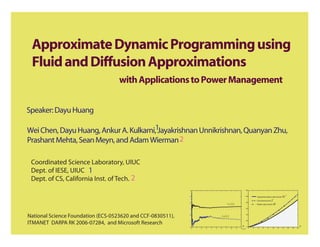
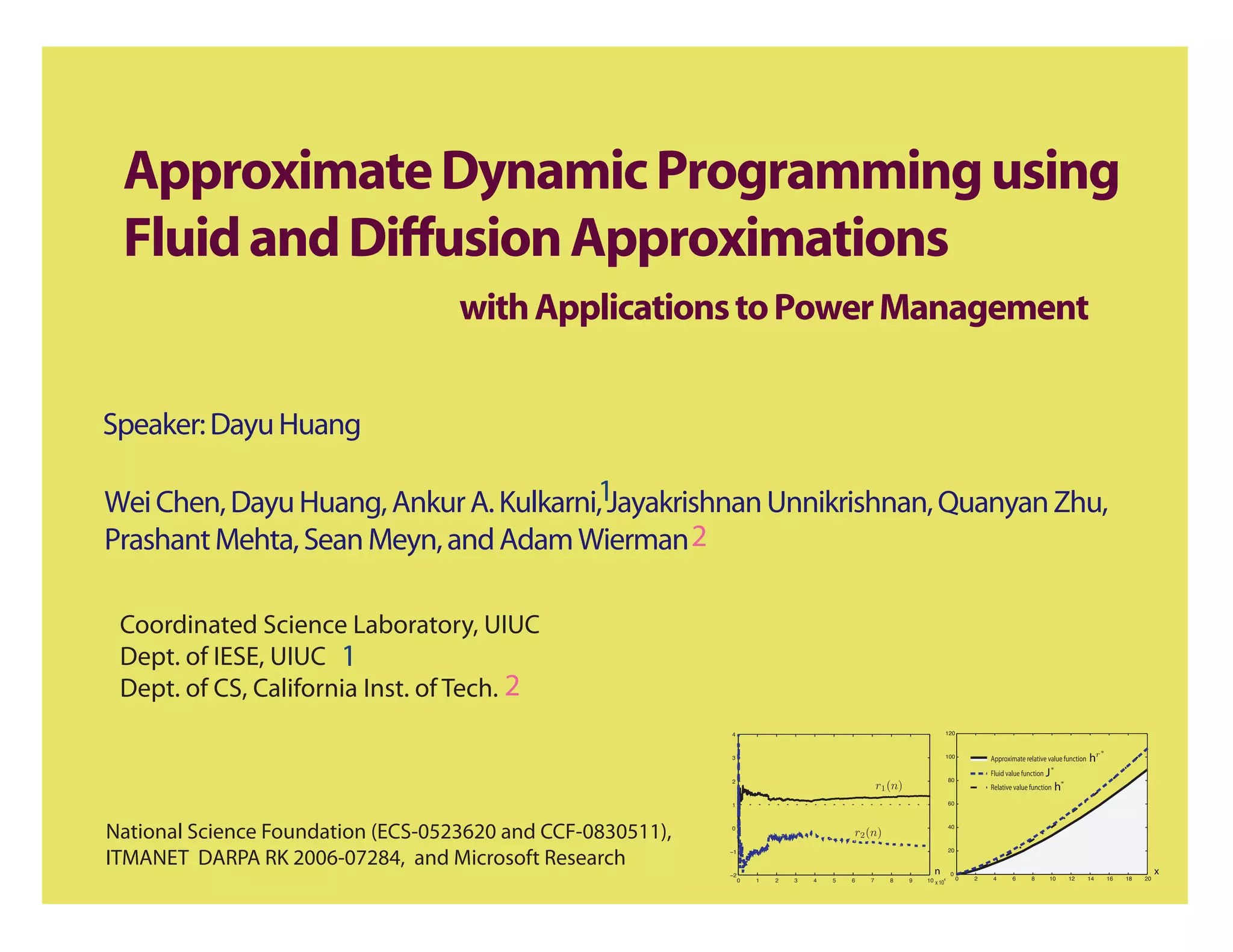
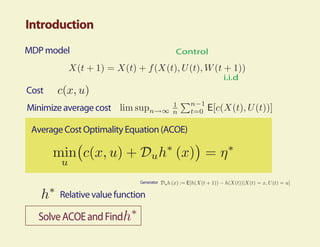
Approximate Dynamic Programming using
 Fluid and Diffusion Approximations
                                    with Applications to Power Management


Speaker: Dayu Huang

Wei Chen, Dayu Huang, Ankur A. Kulkarni,1Jayakrishnan Unnikrishnan, Quanyan Zhu,
Prashant Mehta, Sean Meyn, and Adam Wierman 2

 Coordinated Science Laboratory, UIUC
 Dept. of IESE, UIUC 1
 Dept. of CS, California Inst. of Tech. 2
                                                             4                                                   120


                                                             3                                                   100


                                                                                                                     80
                                                                                                                                              J
                                                             2


                                                             1                                                       60


National Science Foundation (ECS-0523620 and CCF-0830511),   0                                                       40


ITMANET DARPA RK 2006-07284, and Microsoft Research
                                                             −1                                                      20


                                                             −2                                              n       0                                                      x
                                                                  0   1   2   3   4   5   6   7   8   9   10 x 104        0   2   4   6   8   10   12   14   16   18   20
Introduction
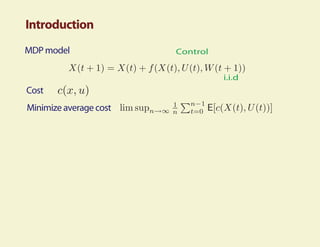
MDP model               Control


                                  i.i.d
Cost
Minimize average cost
Introduction
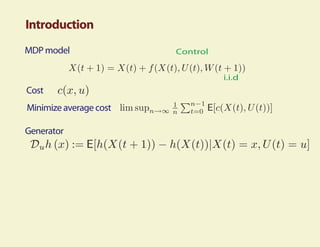
MDP model               Control


                                  i.i.d
Cost
Minimize average cost

Generator
Introduction
MDP model                                Control


                                                   i.i.d
Cost
Minimize average cost

 Average Cost Optimality Equation (ACOE)


                             Generator


        Relative value function

  Solve ACOE and Find
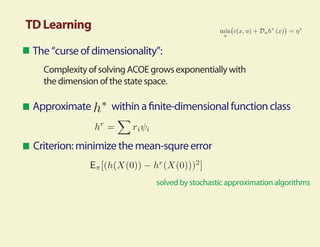
TD Learning
 The “curse of dimensionality”:
   Complexity of solving ACOE grows exponentially with
   the dimension of the state space.

 Approximate        within a nite-dimensional function class


 Criterion: minimize the mean-squre error


                               solved by stochastic approximation algorithms
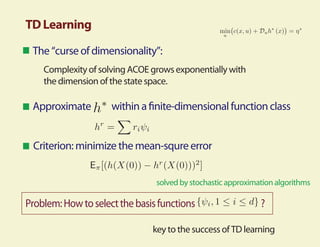
TD Learning
 The “curse of dimensionality”:
    Complexity of solving ACOE grows exponentially with
    the dimension of the state space.

 Approximate         within a nite-dimensional function class


 Criterion: minimize the mean-squre error


                                solved by stochastic approximation algorithms

Problem: How to select the basis functions                    ?

                               key to the success of TD learning
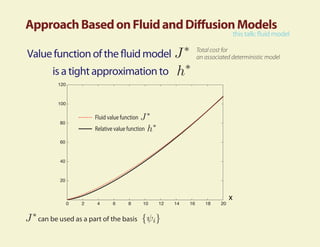
Total cost for
                                                               an associated deterministic model

    is a tight approximation to
      120


      100


                    Fluid value function
       80
                    Relative value function
       60


       40


       20


            0   2    4      6      8       10   12   14   16      18    20


can be used as a part of the basis
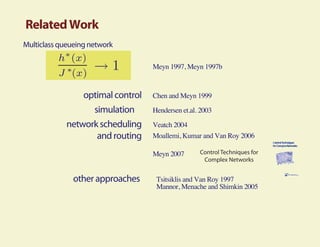
Related Work
Multiclass queueing network

                                   Meyn 1997, Meyn 1997b


                 optimal control   Chen and Meyn 1999

                   simulation      Hendersen et.al. 2003

             network scheduling    Veatch 2004
                    and routing    Moallemi, Kumar and Van Roy 2006

                                   Meyn 2007       Control Techniques for
                                                    Complex Networks


               other approaches     Tsitsiklis and Van Roy 1997
                                    Mannor, Menache and Shimkin 2005
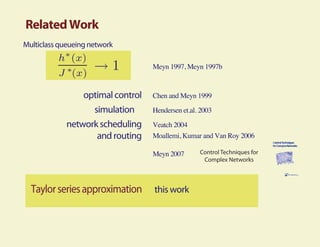
Related Work
Multiclass queueing network

                                   Meyn 1997, Meyn 1997b


                 optimal control   Chen and Meyn 1999

                   simulation      Hendersen et.al. 2003

             network scheduling    Veatch 2004
                    and routing    Moallemi, Kumar and Van Roy 2006

                                   Meyn 2007       Control Techniques for
                                                    Complex Networks


               other approaches     Tsitsiklis and Van Roy 1997
                                    Mannor, Menache and Shimkin 2005
  Taylor series approximation      this work
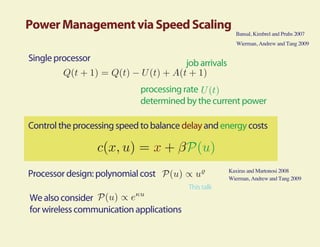
Power Management via Speed Scaling
                                                           Bansal, Kimbrel and Pruhs 2007
                                                            Wierman, Andrew and Tang 2009

Single processor
                                          job arrivals

                             processing rate
                             determined by the current power

Control the processing speed to balance delay and energy costs


                                                         Kaxiras and Martonosi 2008
Processor design: polynomial cost                        Wierman, Andrew and Tang 2009
                                          This talk
We also consider
for wireless communication applications
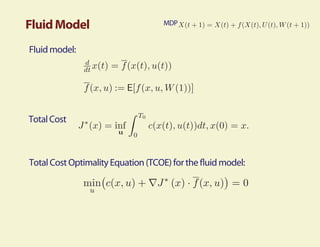
Fluid Model                       MDP


Fluid model:


Total Cost


Total Cost Optimality Equation (TCOE) for the uid model:
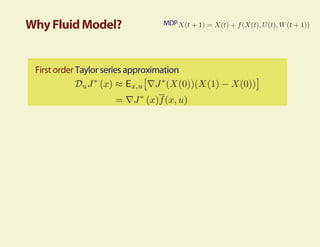
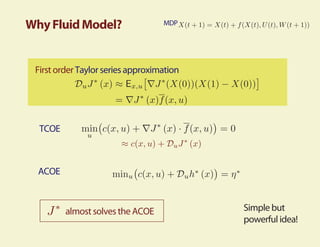
Why Fluid Model?                   MDP


 First order Taylor series approximation
Why Fluid Model?                   MDP


 First order Taylor series approximation


  TCOE


  ACOE


         almost solves the ACOE            Simple but
                                           powerful idea!
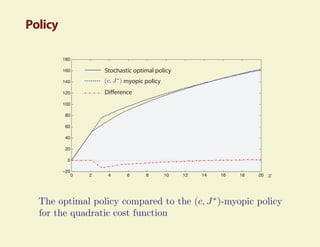
Policy

         180

         160           Stochastic optimal policy
         140                  myopic policy
         120           Di erence
         100

          80

          60

          40

          20

           0

         −20
               0   2    4      6      8       10   12   14   16   18   20   x
Value Iteration

     250


     200


     150               Initialization:   V0     0
                       Initialization:   V0 =
     100


      50


      0
              5   10                15                  20   n


                                                    (See also [Chen and Meyn 1999])
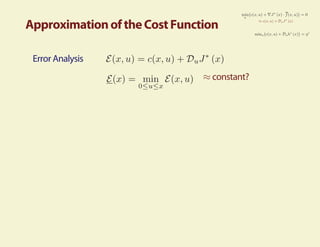
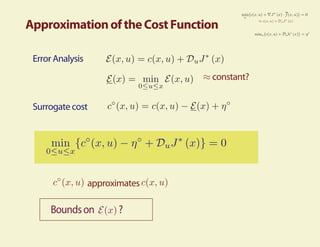
Approximation of the Cost Function

 Error Analysis
                                constant?
Approximation of the Cost Function

 Error Analysis
                                 constant?


 Surrogate cost


                  approximates

     Bounds on           ?
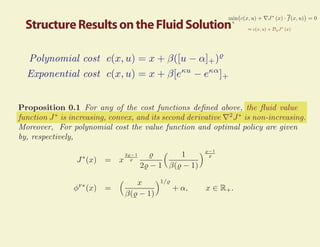
Structure Results on the Fluid Solution
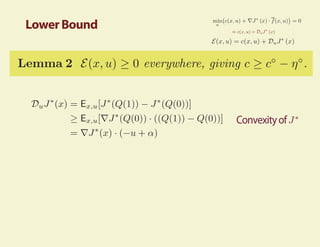
Lower Bound


              Convexity of
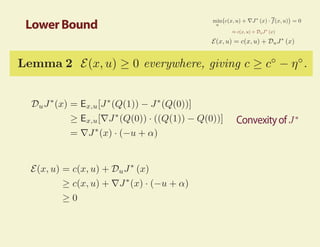
Lower Bound


              Convexity of
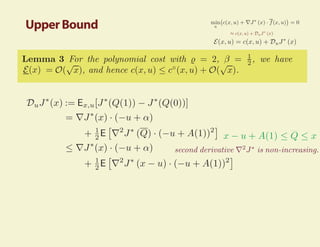
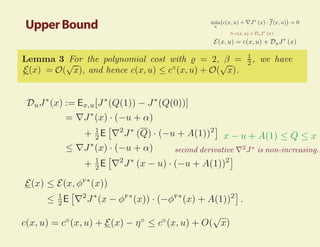
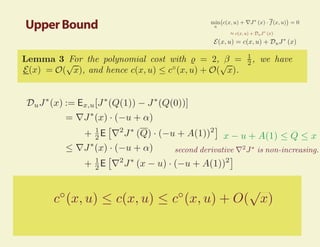
Upper Bound
Upper Bound
Upper Bound
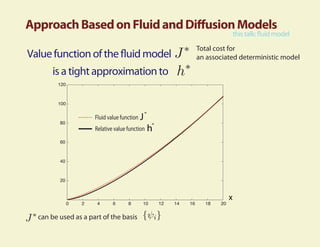
Approach Based on Fluid and Di usion Models
                                                                             this talk: uid model

                                                                 Total cost for
Value function of the uid model                                  an associated deterministic model

      is a tight approximation to
        120


        100


                      Fluid value function
         80
                      Relative value function
         60


         40


         20


              0   2    4      6      8       10   12   14   16     18   20


  can be used as a part of the basis
TD Learning Experiment


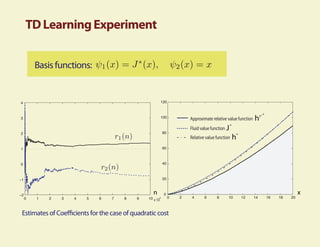
         Basis functions:


4                                                     120


3                                                     100              Approximate relative value function
                                                                       Fluid value function
2                                                         80
                                                                       Relative value function

1                                                         60


0                                                         40


−1                                                        20


−2                                                        0
     0   1   2   3   4   5   6    7   8    9   10 x 104        0   2    4      6      8       10   12        14   16   18   20


 Estimates of Coe cients for the case of quadratic cost
TD Learning with Policy Improvement


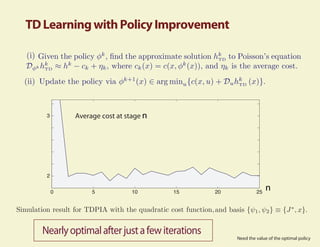
   3       Average cost at stage


   2


       0        5            10     15         20            25


  Nearly optimal after just a few iterations
                                                    Need the value of the optimal policy
Conclusions

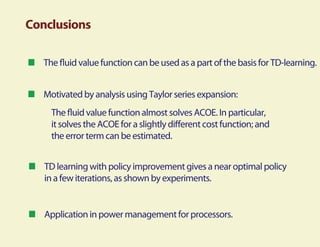
   The uid value function can be used as a part of the basis for TD-learning.


   Motivated by analysis using Taylor series expansion:
     The uid value function almost solves ACOE. In particular,
     it solves the ACOE for a slightly di erent cost function; and
     the error term can be estimated.


   TD learning with policy improvement gives a near optimal policy
   in a few iterations, as shown by experiments.


   Application in power management for processors.
References

  [1] W. Chen, D. Huang, A. Kulkarni, J. Unnikrishnan, Q. Zhu, P. Mehta, S. Meyn, and A. Wierman.
      Approximate dynamic programming using fluid and diffusion approximations with applications to power
      management. Accepted for inclusion in the 48th IEEE Conference on Decision and Control, December
      16-18 2009.

  [1] P. Mehta and S. Meyn. Q-learning and Pontryagin’s Minimum Principle. To appear in Proceedings of
      the 48th IEEE Conference on Decision and Control, December 16-18 2009.

  [1] R.-R. Chen and S. P. Meyn. Value iteration and optimization of multiclass queueing networks. Queueing
      Syst. Theory Appl., 32(1-3):65–97, 1999.

  [1] S. G. Henderson, S. P. Meyn, and V. B. Tadi´. Performance evaluation and policy selection in multiclass
                                                   c
      networks. Discrete Event Dynamic Systems: Theory and Applications, 13(1-2):149–189, 2003. Special
      issue on learning, optimization and decision making (invited).

  [1] S. P. Meyn. The policy iteration algorithm for average reward Markov decision processes with general
      state space. IEEE Trans. Automat. Control, 42(12):1663–1680, 1997.

  [1] S. P. Meyn. Control Techniques for Complex Networks. Cambridge University Press, Cambridge, 2007.

  [1] C. Moallemi, S. Kumar, and B. Van Roy. Approximate and data-driven dynamic programming for
      queueing networks. Preprint available at http://moallemi.com/ciamac/research-interests.php, 2008.

Approximate dynamic programming using fluid and diffusion approximations with applications to power management

  • 1.
    Approximate Dynamic Programmingusing Fluid and Diffusion Approximations with Applications to Power Management Speaker: Dayu Huang Wei Chen, Dayu Huang, Ankur A. Kulkarni,1Jayakrishnan Unnikrishnan, Quanyan Zhu, Prashant Mehta, Sean Meyn, and Adam Wierman 2 Coordinated Science Laboratory, UIUC Dept. of IESE, UIUC 1 Dept. of CS, California Inst. of Tech. 2 4 120 3 100 80 J 2 1 60 National Science Foundation (ECS-0523620 and CCF-0830511), 0 40 ITMANET DARPA RK 2006-07284, and Microsoft Research −1 20 −2 n 0 x 0 1 2 3 4 5 6 7 8 9 10 x 104 0 2 4 6 8 10 12 14 16 18 20
  • 2.
    Introduction MDP model Control i.i.d Cost Minimize average cost
  • 3.
    Introduction MDP model Control i.i.d Cost Minimize average cost Generator
  • 4.
    Introduction MDP model Control i.i.d Cost Minimize average cost Average Cost Optimality Equation (ACOE) Generator Relative value function Solve ACOE and Find
  • 5.
    TD Learning The“curse of dimensionality”: Complexity of solving ACOE grows exponentially with the dimension of the state space. Approximate within a nite-dimensional function class Criterion: minimize the mean-squre error solved by stochastic approximation algorithms
  • 6.
    TD Learning The“curse of dimensionality”: Complexity of solving ACOE grows exponentially with the dimension of the state space. Approximate within a nite-dimensional function class Criterion: minimize the mean-squre error solved by stochastic approximation algorithms Problem: How to select the basis functions ? key to the success of TD learning
  • 7.
    Total cost for an associated deterministic model is a tight approximation to 120 100 Fluid value function 80 Relative value function 60 40 20 0 2 4 6 8 10 12 14 16 18 20 can be used as a part of the basis
  • 8.
    Related Work Multiclass queueingnetwork Meyn 1997, Meyn 1997b optimal control Chen and Meyn 1999 simulation Hendersen et.al. 2003 network scheduling Veatch 2004 and routing Moallemi, Kumar and Van Roy 2006 Meyn 2007 Control Techniques for Complex Networks other approaches Tsitsiklis and Van Roy 1997 Mannor, Menache and Shimkin 2005
  • 9.
    Related Work Multiclass queueingnetwork Meyn 1997, Meyn 1997b optimal control Chen and Meyn 1999 simulation Hendersen et.al. 2003 network scheduling Veatch 2004 and routing Moallemi, Kumar and Van Roy 2006 Meyn 2007 Control Techniques for Complex Networks other approaches Tsitsiklis and Van Roy 1997 Mannor, Menache and Shimkin 2005 Taylor series approximation this work
  • 10.
    Power Management viaSpeed Scaling Bansal, Kimbrel and Pruhs 2007 Wierman, Andrew and Tang 2009 Single processor job arrivals processing rate determined by the current power Control the processing speed to balance delay and energy costs Kaxiras and Martonosi 2008 Processor design: polynomial cost Wierman, Andrew and Tang 2009 This talk We also consider for wireless communication applications
  • 11.
    Fluid Model MDP Fluid model: Total Cost Total Cost Optimality Equation (TCOE) for the uid model:
  • 12.
    Why Fluid Model? MDP First order Taylor series approximation
  • 13.
    Why Fluid Model? MDP First order Taylor series approximation TCOE ACOE almost solves the ACOE Simple but powerful idea!
  • 14.
    Policy 180 160 Stochastic optimal policy 140 myopic policy 120 Di erence 100 80 60 40 20 0 −20 0 2 4 6 8 10 12 14 16 18 20 x
  • 15.
    Value Iteration 250 200 150 Initialization: V0 0 Initialization: V0 = 100 50 0 5 10 15 20 n (See also [Chen and Meyn 1999])
  • 16.
    Approximation of theCost Function Error Analysis constant?
  • 17.
    Approximation of theCost Function Error Analysis constant? Surrogate cost approximates Bounds on ?
  • 18.
    Structure Results onthe Fluid Solution
  • 19.
    Lower Bound Convexity of
  • 20.
    Lower Bound Convexity of
  • 21.
  • 22.
  • 23.
  • 24.
    Approach Based onFluid and Di usion Models this talk: uid model Total cost for Value function of the uid model an associated deterministic model is a tight approximation to 120 100 Fluid value function 80 Relative value function 60 40 20 0 2 4 6 8 10 12 14 16 18 20 can be used as a part of the basis
  • 25.
    TD Learning Experiment Basis functions: 4 120 3 100 Approximate relative value function Fluid value function 2 80 Relative value function 1 60 0 40 −1 20 −2 0 0 1 2 3 4 5 6 7 8 9 10 x 104 0 2 4 6 8 10 12 14 16 18 20 Estimates of Coe cients for the case of quadratic cost
  • 26.
    TD Learning withPolicy Improvement 3 Average cost at stage 2 0 5 10 15 20 25 Nearly optimal after just a few iterations Need the value of the optimal policy
  • 27.
    Conclusions The uid value function can be used as a part of the basis for TD-learning. Motivated by analysis using Taylor series expansion: The uid value function almost solves ACOE. In particular, it solves the ACOE for a slightly di erent cost function; and the error term can be estimated. TD learning with policy improvement gives a near optimal policy in a few iterations, as shown by experiments. Application in power management for processors.
  • 28.
    References [1]W. Chen, D. Huang, A. Kulkarni, J. Unnikrishnan, Q. Zhu, P. Mehta, S. Meyn, and A. Wierman. Approximate dynamic programming using fluid and diffusion approximations with applications to power management. Accepted for inclusion in the 48th IEEE Conference on Decision and Control, December 16-18 2009. [1] P. Mehta and S. Meyn. Q-learning and Pontryagin’s Minimum Principle. To appear in Proceedings of the 48th IEEE Conference on Decision and Control, December 16-18 2009. [1] R.-R. Chen and S. P. Meyn. Value iteration and optimization of multiclass queueing networks. Queueing Syst. Theory Appl., 32(1-3):65–97, 1999. [1] S. G. Henderson, S. P. Meyn, and V. B. Tadi´. Performance evaluation and policy selection in multiclass c networks. Discrete Event Dynamic Systems: Theory and Applications, 13(1-2):149–189, 2003. Special issue on learning, optimization and decision making (invited). [1] S. P. Meyn. The policy iteration algorithm for average reward Markov decision processes with general state space. IEEE Trans. Automat. Control, 42(12):1663–1680, 1997. [1] S. P. Meyn. Control Techniques for Complex Networks. Cambridge University Press, Cambridge, 2007. [1] C. Moallemi, S. Kumar, and B. Van Roy. Approximate and data-driven dynamic programming for queueing networks. Preprint available at http://moallemi.com/ciamac/research-interests.php, 2008.