Approaching
ATDD/BDD
Compiled By Dhaval Dalal
https://dhavaldalal.wordpress.com
@softwareartisan
Note
• To bring all this material in one place, I have
compiled it from various sources and work
done by many people.
• References are either explicitly mentioned
on the slide and/or in the References
section.
• This is presented as a journey.
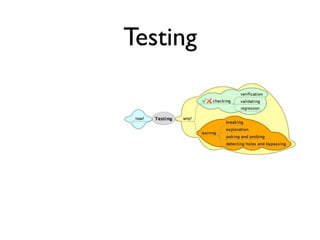
Testing
Testing
Testing
Testing
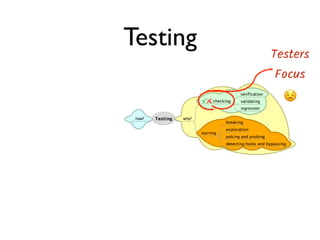
Testing Testers
Focus
😟
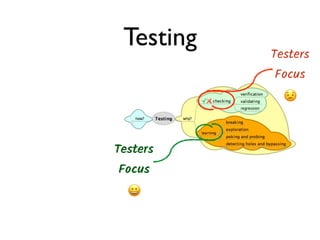
Testing Testers
Focus
😟
Testers
Focus
😀
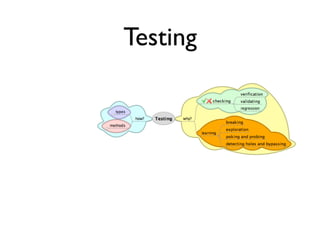
Testing
Testing
Testing
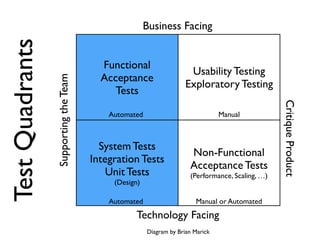
TestQuadrants
Functional
Acceptance
Tests
Usability Testing
Exploratory Testing
System Tests
Integration Tests
Unit Tests
(Design)
Non-Functional
Acceptance Tests
(Performance, Scaling, …)
Technology Facing
Business Facing
CritiqueProduct
SupportingtheTeam
Automated Manual or Automated
ManualAutomated
Diagram by Brian Marick
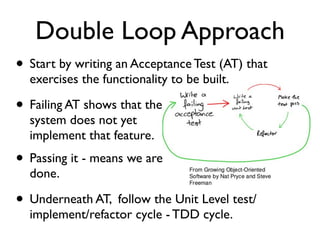
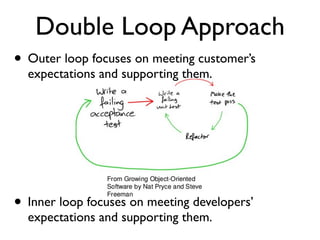
Double Loop Approach
• Underneath AT, follow the Unit Level test/
implement/refactor cycle - TDD cycle.
• Start by writing an Acceptance Test (AT) that
exercises the functionality to be built.
• Failing AT shows that the
system does not yet
implement that feature.
• Passing it - means we are
done.
• Outer loop focuses on meeting customer’s
expectations and supporting them.
Double Loop Approach
• Inner loop focuses on meeting developers’
expectations and supporting them.
Is BDD == TDD?
• TDD captures behaviours and intention - So with
BDD.
• TDD specs start their journey as a guide and
subsequently continue as a sentry preventing
regression - So with BDD.
• TDD is for low-level requirements (at class/model
level), BDD is for high-level requirements (at UI/
Services level)
• TDD vocabulary is test-based, BDD vocabulary is
English-like.
http://neelnarayan.blogspot.in/2010/07/bdd-is-more-than-tdd-done-right.html
Is BDD == TDD?
• TDD captures behaviours and intention - So with
BDD.
• TDD specs start their journey as a guide and
subsequently continue as a sentry preventing
regression - So with BDD.
• TDD is for low-level requirements (at class/model
level), BDD is for high-level requirements (at UI/
Services level)
• TDD vocabulary is test-based, BDD vocabulary is
English-like.
http://neelnarayan.blogspot.in/2010/07/bdd-is-more-than-tdd-done-right.html
But, BDD != TDD
• BDD is mainly about…
• Conversation
• Collaboration
• Devs and QAs collaborating changes the game from
finding defects to preventing defects
• Devs, BAs and QAs collaborating together helps define
executable, verifiable and unambiguous requirements
• And With Examples!
• Leverage BDD and TDD using the double
loop approach
• Business facing nature demands use of natural
language to express intentions.
• Express requirements as user stories using the BDD
(grammar & structure) collaboratively with the three amigos
- BAs, Devs and Testers.
• Write user stories (features & scenarios).
• Implementation demands use of a general purpose
programming language to express test mechanics.
• Write code (fixtures) that maps the stories to specs.
• Write production code, use TDD to make the specs pass.
RSpec
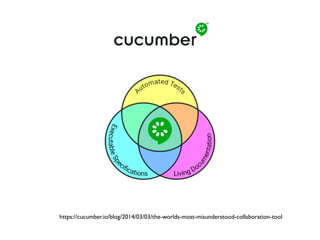
https://cucumber.io/blog/2014/03/03/the-worlds-most-misunderstood-collaboration-tool
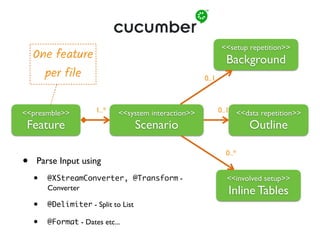
<<preamble>>
Feature
<<system interaction>>
Scenario
<<setup repetition>>
Background
<<data repetition>>
Outline
<<involved setup>>
Inline Tables
One feature
per file
1..*
0..1
0..1
0..*
• Parse Input using
• @XStreamConverter, @Transform -
Converter
• @Delimiter - Split to List
• @Format - Dates etc...
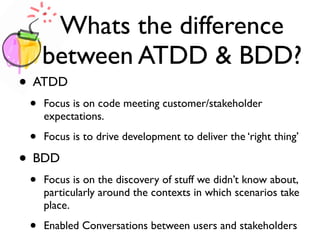
Whats the difference
between ATDD & BDD?
• ATDD
• Focus is on code meeting customer/stakeholder
expectations.
• Focus is to drive development to deliver the ‘right thing’
• BDD
• Focus is on the discovery of stuff we didn’t know about,
particularly around the contexts in which scenarios take
place.
• Enabled Conversations between users and stakeholders
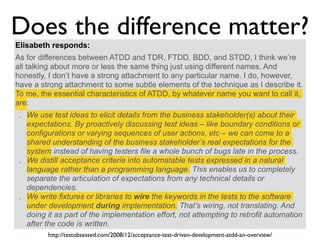
Does the difference matter?
https://lizkeogh.com/2011/06/27/atdd-vs-bdd-and-a-potted-history-of-some-related-stuff/
Elisabeth responds:
As for differences between ATDD and TDR, FTDD, BDD, and STDD, I think we’re
all talking about more or less the same thing just using different names. And
honestly, I don’t have a strong attachment to any particular name. I do, however,
have a strong attachment to some subtle elements of the technique as I describe it.
To me, the essential characteristics of ATDD, by whatever name you want to call it,
are:
. We use test ideas to elicit details from the business stakeholder(s) about their
expectations. By proactively discussing test ideas – like boundary conditions or
configurations or varying sequences of user actions, etc – we can come to a
shared understanding of the business stakeholder’s real expectations for the
system instead of having testers file a whole bunch of bugs late in the process.
. We distill acceptance criteria into automatable tests expressed in a natural
language rather than a programming language. This enables us to completely
separate the articulation of expectations from any technical details or
dependencies.
. We write fixtures or libraries to wire the keywords in the tests to the software
under development during implementation. That’s wiring, not translating. And
doing it as part of the implementation effort, not attempting to retrofit automation
after the code is written.
Does the difference matter?
http://testobsessed.com/2008/12/acceptance-test-driven-development-atdd-an-overview/
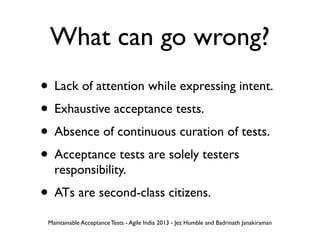
What can go wrong?
• Lack of attention while expressing intent.
• Exhaustive acceptance tests.
• Absence of continuous curation of tests.
• Acceptance tests are solely testers
responsibility.
• ATs are second-class citizens.
Maintainable Acceptance Tests - Agile India 2013 - Jez Humble and Badrinath Janakiraman
Inverted Pyramid
UI
Tests
Unit
Tests
Acceptance
Tests
Sustenance
Value
Effort
Low Value
High Effort
High Value
High Effort
Low Value
Low Effort
High Value
Low Effort
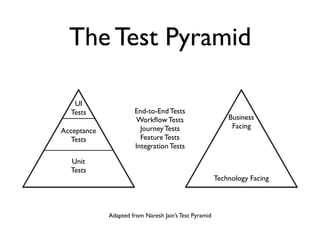
The Test Pyramid
Technology Facing
Business
Facing
Unit
Tests
UI
Tests
Acceptance
Tests
End-to-End Tests
Workflow Tests
Journey Tests
Feature Tests
Integration Tests
Adapted from Naresh Jain’s Test Pyramid
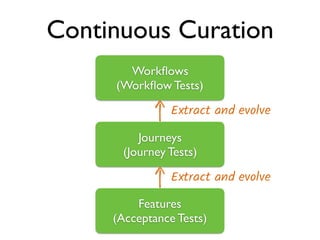
Continuous Curation
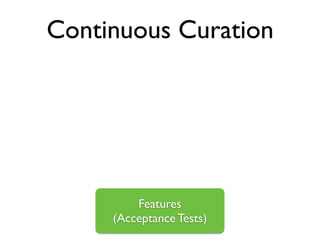
Continuous Curation
Features
(Acceptance Tests)
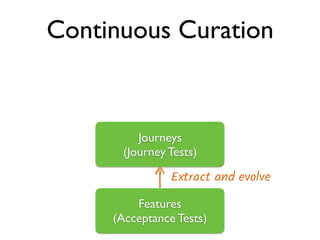
Continuous Curation
Features
(Acceptance Tests)
Journeys
(Journey Tests)
Extract and evolve
Continuous Curation
Features
(Acceptance Tests)
Journeys
(Journey Tests)
Workflows
(Workflow Tests)
Extract and evolve
Extract and evolve
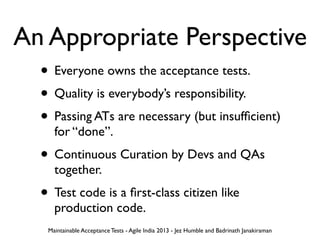
An Appropriate Perspective
• Everyone owns the acceptance tests.
• Quality is everybody’s responsibility.
• Passing ATs are necessary (but insufficient)
for “done”.
• Continuous Curation by Devs and QAs
together.
• Test code is a first-class citizen like
production code.
Maintainable Acceptance Tests - Agile India 2013 - Jez Humble and Badrinath Janakiraman
Breaking Test Quadrants
https://gojko.net/2013/10/21/lets-break-the-agile-testing-quadrants/
References
• Growing Object-Oriented Software - Steve Freeman and Nat Pryce
• Maintainable Acceptance Tests - Agile India 2013 - Jez Humble & Badrinath Janakiraman
• BDD in Java and Groovy -Venkat Subramaniam
• Inverted Test Pyramid and Test Pyramid - Naresh Jain
• http://neelnarayan.blogspot.in/2010/07/bdd-is-more-than-tdd-done-right.html
• https://lizkeogh.com/2011/06/27/atdd-vs-bdd-and-a-potted-history-of-some-related-
stuff/
• https://www.infoq.com/news/2011/02/BDD-ATDD
• http://testobsessed.com/2008/12/acceptance-test-driven-development-atdd-an-
overview/
• https://cucumber.io/blog/2015/12/08/example-mapping-introduction
• https://cucumber.io/blog/2014/03/03/the-worlds-most-misunderstood-collaboration-
tool

Approaching ATDD/BDD

  • 1.
    Approaching ATDD/BDD Compiled By DhavalDalal https://dhavaldalal.wordpress.com @softwareartisan
  • 2.
    Note • To bringall this material in one place, I have compiled it from various sources and work done by many people. • References are either explicitly mentioned on the slide and/or in the References section. • This is presented as a journey.
  • 3.
  • 4.
  • 5.
  • 6.
  • 7.
  • 8.
  • 9.
  • 10.
  • 11.
  • 12.
    TestQuadrants Functional Acceptance Tests Usability Testing Exploratory Testing SystemTests Integration Tests Unit Tests (Design) Non-Functional Acceptance Tests (Performance, Scaling, …) Technology Facing Business Facing CritiqueProduct SupportingtheTeam Automated Manual or Automated ManualAutomated Diagram by Brian Marick
  • 13.
    Double Loop Approach •Underneath AT, follow the Unit Level test/ implement/refactor cycle - TDD cycle. • Start by writing an Acceptance Test (AT) that exercises the functionality to be built. • Failing AT shows that the system does not yet implement that feature. • Passing it - means we are done.
  • 14.
    • Outer loopfocuses on meeting customer’s expectations and supporting them. Double Loop Approach • Inner loop focuses on meeting developers’ expectations and supporting them.
  • 15.
    Is BDD ==TDD? • TDD captures behaviours and intention - So with BDD. • TDD specs start their journey as a guide and subsequently continue as a sentry preventing regression - So with BDD. • TDD is for low-level requirements (at class/model level), BDD is for high-level requirements (at UI/ Services level) • TDD vocabulary is test-based, BDD vocabulary is English-like. http://neelnarayan.blogspot.in/2010/07/bdd-is-more-than-tdd-done-right.html
  • 16.
    Is BDD ==TDD? • TDD captures behaviours and intention - So with BDD. • TDD specs start their journey as a guide and subsequently continue as a sentry preventing regression - So with BDD. • TDD is for low-level requirements (at class/model level), BDD is for high-level requirements (at UI/ Services level) • TDD vocabulary is test-based, BDD vocabulary is English-like. http://neelnarayan.blogspot.in/2010/07/bdd-is-more-than-tdd-done-right.html
  • 17.
    But, BDD !=TDD • BDD is mainly about… • Conversation • Collaboration • Devs and QAs collaborating changes the game from finding defects to preventing defects • Devs, BAs and QAs collaborating together helps define executable, verifiable and unambiguous requirements • And With Examples! • Leverage BDD and TDD using the double loop approach
  • 18.
    • Business facingnature demands use of natural language to express intentions. • Express requirements as user stories using the BDD (grammar & structure) collaboratively with the three amigos - BAs, Devs and Testers. • Write user stories (features & scenarios). • Implementation demands use of a general purpose programming language to express test mechanics. • Write code (fixtures) that maps the stories to specs. • Write production code, use TDD to make the specs pass. RSpec
  • 19.
  • 20.
    <<preamble>> Feature <<system interaction>> Scenario <<setup repetition>> Background <<datarepetition>> Outline <<involved setup>> Inline Tables One feature per file 1..* 0..1 0..1 0..* • Parse Input using • @XStreamConverter, @Transform - Converter • @Delimiter - Split to List • @Format - Dates etc...
  • 21.
    Whats the difference betweenATDD & BDD? • ATDD • Focus is on code meeting customer/stakeholder expectations. • Focus is to drive development to deliver the ‘right thing’ • BDD • Focus is on the discovery of stuff we didn’t know about, particularly around the contexts in which scenarios take place. • Enabled Conversations between users and stakeholders
  • 22.
    Does the differencematter? https://lizkeogh.com/2011/06/27/atdd-vs-bdd-and-a-potted-history-of-some-related-stuff/
  • 23.
    Elisabeth responds: As fordifferences between ATDD and TDR, FTDD, BDD, and STDD, I think we’re all talking about more or less the same thing just using different names. And honestly, I don’t have a strong attachment to any particular name. I do, however, have a strong attachment to some subtle elements of the technique as I describe it. To me, the essential characteristics of ATDD, by whatever name you want to call it, are: . We use test ideas to elicit details from the business stakeholder(s) about their expectations. By proactively discussing test ideas – like boundary conditions or configurations or varying sequences of user actions, etc – we can come to a shared understanding of the business stakeholder’s real expectations for the system instead of having testers file a whole bunch of bugs late in the process. . We distill acceptance criteria into automatable tests expressed in a natural language rather than a programming language. This enables us to completely separate the articulation of expectations from any technical details or dependencies. . We write fixtures or libraries to wire the keywords in the tests to the software under development during implementation. That’s wiring, not translating. And doing it as part of the implementation effort, not attempting to retrofit automation after the code is written. Does the difference matter? http://testobsessed.com/2008/12/acceptance-test-driven-development-atdd-an-overview/
  • 24.
    What can gowrong? • Lack of attention while expressing intent. • Exhaustive acceptance tests. • Absence of continuous curation of tests. • Acceptance tests are solely testers responsibility. • ATs are second-class citizens. Maintainable Acceptance Tests - Agile India 2013 - Jez Humble and Badrinath Janakiraman
  • 25.
  • 26.
    Sustenance Value Effort Low Value High Effort HighValue High Effort Low Value Low Effort High Value Low Effort
  • 27.
    The Test Pyramid TechnologyFacing Business Facing Unit Tests UI Tests Acceptance Tests End-to-End Tests Workflow Tests Journey Tests Feature Tests Integration Tests Adapted from Naresh Jain’s Test Pyramid
  • 28.
  • 29.
  • 30.
  • 31.
    Continuous Curation Features (Acceptance Tests) Journeys (JourneyTests) Workflows (Workflow Tests) Extract and evolve Extract and evolve
  • 32.
    An Appropriate Perspective •Everyone owns the acceptance tests. • Quality is everybody’s responsibility. • Passing ATs are necessary (but insufficient) for “done”. • Continuous Curation by Devs and QAs together. • Test code is a first-class citizen like production code. Maintainable Acceptance Tests - Agile India 2013 - Jez Humble and Badrinath Janakiraman
  • 33.
  • 34.
    References • Growing Object-OrientedSoftware - Steve Freeman and Nat Pryce • Maintainable Acceptance Tests - Agile India 2013 - Jez Humble & Badrinath Janakiraman • BDD in Java and Groovy -Venkat Subramaniam • Inverted Test Pyramid and Test Pyramid - Naresh Jain • http://neelnarayan.blogspot.in/2010/07/bdd-is-more-than-tdd-done-right.html • https://lizkeogh.com/2011/06/27/atdd-vs-bdd-and-a-potted-history-of-some-related- stuff/ • https://www.infoq.com/news/2011/02/BDD-ATDD • http://testobsessed.com/2008/12/acceptance-test-driven-development-atdd-an- overview/ • https://cucumber.io/blog/2015/12/08/example-mapping-introduction • https://cucumber.io/blog/2014/03/03/the-worlds-most-misunderstood-collaboration- tool