
Morten Berg and Jakub Holy present:


          From user stories to
           acceptance tests
     What we learned about Specification by
                   example


                                      Iterate :: 1/2012
Quick fly-through
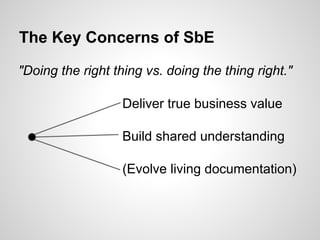
The Key Concerns of SbE

"Doing the right thing vs. doing the thing right."

                   Deliver true business value

                   Build shared understanding

                   (Evolve living documentation)
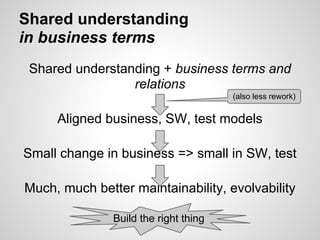
Shared understanding
in business terms
 Shared understanding + business terms and
                 relations
                                       (also less rework)


     Aligned business, SW, test models

Small change in business => small in SW, test

Much, much better maintainability, evolvability

               Build the right thing
Specify
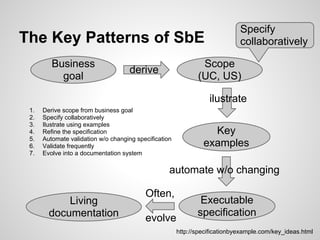
The Key Patterns of SbE                                                      collaboratively

         Business                                              Scope
                                     derive
           goal                                               (UC, US)

                                                                  ilustrate
 1.   Derive scope from business goal
 2.   Specify collaboratively
 3.   Ilustrate using examples
 4.   Refine the specification                                    Key
 5.   Automate validation w/o changing specification
 6.   Validate frequently                                       examples
 7.   Evolve into a documentation system

                                                   automate w/o changing

                                          Often,
            Living                                             Executable
        documentation                                         specification
                                          evolve
                                                       http://specificationbyexample.com/key_ideas.html
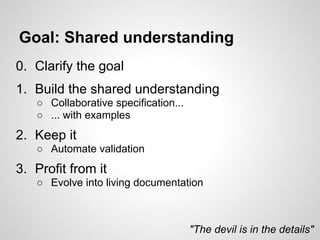
Goal: Shared understanding
0. Clarify the goal
1. Build the shared understanding
   ○ Collaborative specification...
   ○ ... with examples
2. Keep it
   ○ Automate validation
3. Profit from it
   ○ Evolve into living documentation


                                      "The devil is in the details"
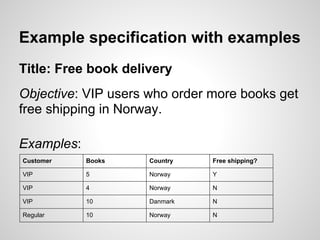
Example specification with examples
Title: Free book delivery
Objective: VIP users who order more books get
free shipping in Norway.

Examples:
Customer    Books    Country   Free shipping?

VIP         5        Norway    Y

VIP         4        Norway    N

VIP         10       Danmark   N

Regular     10       Norway    N
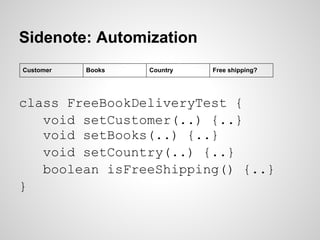
Sidenote: Automization
Customer   Books   Country   Free shipping?


class FreeBookDeliveryTest {
   void setCustomer(..) {..}
   void setBooks(..) {..}
   void setCountry(..) {..}
   boolean isFreeShipping() {..}
}
Showtime: Some real-world
specifications with example
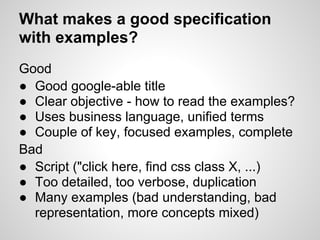
What makes a good specification
with examples?
Good
● Good google-able title
● Clear objective - how to read the examples?
● Uses business language, unified terms
● Couple of key, focused examples, complete
Bad
● Script ("click here, find css class X, ...)
● Too detailed, too verbose, duplication
● Many examples (bad understanding, bad
  representation, more concepts mixed)
Show the poster!
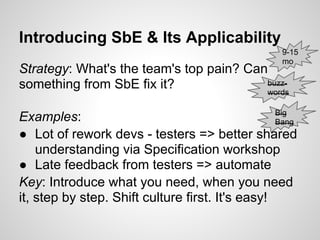
Introducing SbE & Its Applicability
                                              9-15
                                              mo
Strategy: What's the team's top pain? Can
something from SbE fix it?               buzz-
                                         words

                                             Big
Examples:                                    Bang
● Lot of rework devs - testers => better shared
    understanding via Specification workshop
● Late feedback from testers => automate
Key: Introduce what you need, when you need
it, step by step. Shift culture first. It's easy!
Why to specify collaboratively?
can become
Examples                    Tests
  ela


                           rify
   bo


                           ve
    rat
        e


            Requirements
Single source of truth
Devs: Truth in code
Testers: Truth in test cases
Business analyst: Truth in documents

Use a single source of truth, avoid translation!

=> Start with business analyst
  Extend with examples from devs
  Extend with examples from testers
Random highlights
How to Make Acceptance Tests
Maintainable

1. Aligned business, software, and test models
   ○ => small change in one is small in the other too

2. Test under the surface level, if possible
   ○ Service > Servlet > UI - decide by risk vs. cost

3. Isolate tests from implementation by layers of
   test abstraction (What>Instrumentation>DSL)

See The Holy Java: How to Create Maintainable
Acceptance Tests (http://wp.me/pTHiC-tl)
Why Are We Doing This?
The Effect Maps Technique
Simple mind-mapping technique that incredibly
facilitates agile product design, planning,
prioritisation, and scoping.
                                          demo


Levels:
1. Why - the measurable business goal
2. Who can help/hinder achievel of the goal?
3. How can they do it?
4. What are the SW features or business
   activities that support it?
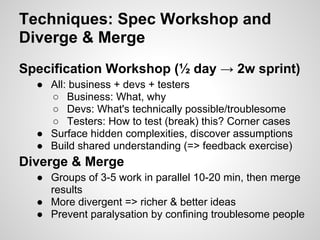
Techniques: Spec Workshop and
Diverge & Merge
Specification Workshop (½ day → 2w sprint)
  ● All: business + devs + testers
    ○ Business: What, why
    ○ Devs: What's technically possible/troublesome
    ○ Testers: How to test (break) this? Corner cases
  ● Surface hidden complexities, discover assumptions
  ● Build shared understanding (=> feedback exercise)
Diverge & Merge
  ● Groups of 3-5 work in parallel 10-20 min, then merge
    results
  ● More divergent => richer & better ideas
  ● Prevent paralysation by confining troublesome people
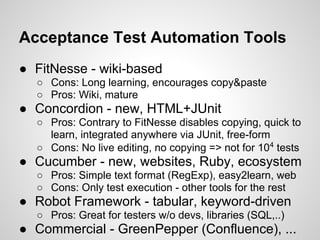
Acceptance Test Automation Tools
● FitNesse - wiki-based
  ○ Cons: Long learning, encourages copy&paste
  ○ Pros: Wiki, mature
● Concordion - new, HTML+JUnit
  ○ Pros: Contrary to FitNesse disables copying, quick to
    learn, integrated anywhere via JUnit, free-form
  ○ Cons: No live editing, no copying => not for 104 tests
● Cucumber - new, websites, Ruby, ecosystem
  ○ Pros: Simple text format (RegExp), easy2learn, web
  ○ Cons: Only test execution - other tools for the rest
● Robot Framework - tabular, keyword-driven
  ○ Pros: Great for testers w/o devs, libraries (SQL,..)
● Commercial - GreenPepper (Confluence), ...
The end is coming, run for your life!
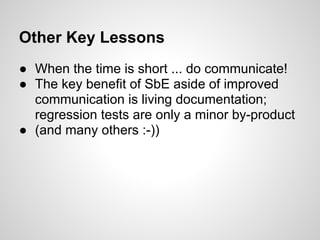
Other Key Lessons
● When the time is short ... do communicate!
● The key benefit of SbE aside of improved
  communication is living documentation;
  regression tests are only a minor by-product
● (and many others :-))
Quiz
What have we learned today?
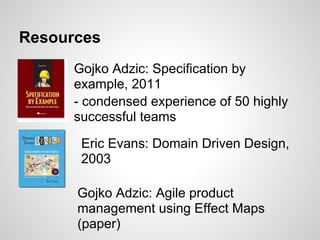
Resources
      Gojko Adzic: Specification by
      example, 2011
      - condensed experience of 50 highly
      successful teams

       Eric Evans: Domain Driven Design,
       2003

      Gojko Adzic: Agile product
      management using Effect Maps
      (paper)

Specification by example - course summary

  • 1.
    Morten Berg andJakub Holy present: From user stories to acceptance tests What we learned about Specification by example Iterate :: 1/2012
  • 2.
  • 3.
    The Key Concernsof SbE "Doing the right thing vs. doing the thing right." Deliver true business value Build shared understanding (Evolve living documentation)
  • 4.
    Shared understanding in businessterms Shared understanding + business terms and relations (also less rework) Aligned business, SW, test models Small change in business => small in SW, test Much, much better maintainability, evolvability Build the right thing
  • 5.
    Specify The Key Patternsof SbE collaboratively Business Scope derive goal (UC, US) ilustrate 1. Derive scope from business goal 2. Specify collaboratively 3. Ilustrate using examples 4. Refine the specification Key 5. Automate validation w/o changing specification 6. Validate frequently examples 7. Evolve into a documentation system automate w/o changing Often, Living Executable documentation specification evolve http://specificationbyexample.com/key_ideas.html
  • 6.
    Goal: Shared understanding 0.Clarify the goal 1. Build the shared understanding ○ Collaborative specification... ○ ... with examples 2. Keep it ○ Automate validation 3. Profit from it ○ Evolve into living documentation "The devil is in the details"
  • 7.
    Example specification withexamples Title: Free book delivery Objective: VIP users who order more books get free shipping in Norway. Examples: Customer Books Country Free shipping? VIP 5 Norway Y VIP 4 Norway N VIP 10 Danmark N Regular 10 Norway N
  • 8.
    Sidenote: Automization Customer Books Country Free shipping? class FreeBookDeliveryTest { void setCustomer(..) {..} void setBooks(..) {..} void setCountry(..) {..} boolean isFreeShipping() {..} }
  • 9.
  • 10.
    What makes agood specification with examples? Good ● Good google-able title ● Clear objective - how to read the examples? ● Uses business language, unified terms ● Couple of key, focused examples, complete Bad ● Script ("click here, find css class X, ...) ● Too detailed, too verbose, duplication ● Many examples (bad understanding, bad representation, more concepts mixed)
  • 11.
  • 12.
    Introducing SbE &Its Applicability 9-15 mo Strategy: What's the team's top pain? Can something from SbE fix it? buzz- words Big Examples: Bang ● Lot of rework devs - testers => better shared understanding via Specification workshop ● Late feedback from testers => automate Key: Introduce what you need, when you need it, step by step. Shift culture first. It's easy!
  • 13.
    Why to specifycollaboratively?
  • 14.
    can become Examples Tests ela rify bo ve rat e Requirements
  • 15.
    Single source oftruth Devs: Truth in code Testers: Truth in test cases Business analyst: Truth in documents Use a single source of truth, avoid translation! => Start with business analyst Extend with examples from devs Extend with examples from testers
  • 17.
  • 18.
    How to MakeAcceptance Tests Maintainable 1. Aligned business, software, and test models ○ => small change in one is small in the other too 2. Test under the surface level, if possible ○ Service > Servlet > UI - decide by risk vs. cost 3. Isolate tests from implementation by layers of test abstraction (What>Instrumentation>DSL) See The Holy Java: How to Create Maintainable Acceptance Tests (http://wp.me/pTHiC-tl)
  • 19.
    Why Are WeDoing This? The Effect Maps Technique Simple mind-mapping technique that incredibly facilitates agile product design, planning, prioritisation, and scoping. demo Levels: 1. Why - the measurable business goal 2. Who can help/hinder achievel of the goal? 3. How can they do it? 4. What are the SW features or business activities that support it?
  • 20.
    Techniques: Spec Workshopand Diverge & Merge Specification Workshop (½ day → 2w sprint) ● All: business + devs + testers ○ Business: What, why ○ Devs: What's technically possible/troublesome ○ Testers: How to test (break) this? Corner cases ● Surface hidden complexities, discover assumptions ● Build shared understanding (=> feedback exercise) Diverge & Merge ● Groups of 3-5 work in parallel 10-20 min, then merge results ● More divergent => richer & better ideas ● Prevent paralysation by confining troublesome people
  • 21.
    Acceptance Test AutomationTools ● FitNesse - wiki-based ○ Cons: Long learning, encourages copy&paste ○ Pros: Wiki, mature ● Concordion - new, HTML+JUnit ○ Pros: Contrary to FitNesse disables copying, quick to learn, integrated anywhere via JUnit, free-form ○ Cons: No live editing, no copying => not for 104 tests ● Cucumber - new, websites, Ruby, ecosystem ○ Pros: Simple text format (RegExp), easy2learn, web ○ Cons: Only test execution - other tools for the rest ● Robot Framework - tabular, keyword-driven ○ Pros: Great for testers w/o devs, libraries (SQL,..) ● Commercial - GreenPepper (Confluence), ...
  • 22.
    The end iscoming, run for your life!
  • 23.
    Other Key Lessons ●When the time is short ... do communicate! ● The key benefit of SbE aside of improved communication is living documentation; regression tests are only a minor by-product ● (and many others :-))
  • 24.
    Quiz What have welearned today?
  • 25.
    Resources Gojko Adzic: Specification by example, 2011 - condensed experience of 50 highly successful teams Eric Evans: Domain Driven Design, 2003 Gojko Adzic: Agile product management using Effect Maps (paper)