Booting into FP
Dhaval Dalal
@softwareartisan
https://dhavaldalal.wordpress.com
14th Nov 2019
Our Tour
• Functions, everywhere!

• Understanding Referential Transparency

• What is a Lambda?

• Modularization

• Building Abstractions with Higher-Order Functions

• Lazy Evaluation

• Tackling Complexity using Function Composition

• Streams (Lazy Lists)

• De-structuring and Pattern Matching

• Currying

• Sequence/Chain Operations together using Monads - Dealing with absence of Values

• Overview of Upcoming Sessions
Touted Advantages
Touted Advantages
• Less number of lines of code as compared to imperative code.
• Hence, Functional Programmers are more “productive”
Touted Advantages
• Less number of lines of code as compared to imperative code.
• Hence, Functional Programmers are more “productive”
• Declarative
• Describes “what to do”, rather than imperative - “how to do”
Touted Advantages
• Less number of lines of code as compared to imperative code.
• Hence, Functional Programmers are more “productive”
• Declarative
• Describes “what to do”, rather than imperative - “how to do”
• Immutability
• No assignment statements, a variable value never changes.
Touted Advantages
• Less number of lines of code as compared to imperative code.
• Hence, Functional Programmers are more “productive”
• Declarative
• Describes “what to do”, rather than imperative - “how to do”
• Immutability
• No assignment statements, a variable value never changes.
• No side-effects
• Eliminates major source of bugs, order of evaluation does not matter.
Touted Advantages
• Less number of lines of code as compared to imperative code.
• Hence, Functional Programmers are more “productive”
• Declarative
• Describes “what to do”, rather than imperative - “how to do”
• Immutability
• No assignment statements, a variable value never changes.
• No side-effects
• Eliminates major source of bugs, order of evaluation does not matter.
• Referential Transparency
• Enables equational reasoning
Source: Why Functional Programming Matters - John Hughes
Why FP ^ matters?
really
Why FP ^ matters?
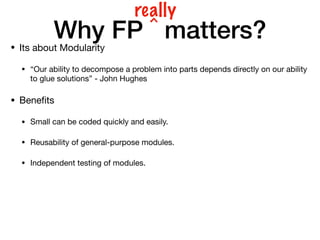
• Its about Modularity
• “Our ability to decompose a problem into parts depends directly on our ability
to glue solutions” - John Hughes
really
Why FP ^ matters?
• Its about Modularity
• “Our ability to decompose a problem into parts depends directly on our ability
to glue solutions” - John Hughes
• Benefits
• Small can be coded quickly and easily.
• Reusability of general-purpose modules.
• Independent testing of modules.
really
Why FP ^ matters?
• Its about Modularity
• “Our ability to decompose a problem into parts depends directly on our ability
to glue solutions” - John Hughes
• Benefits
• Small can be coded quickly and easily.
• Reusability of general-purpose modules.
• Independent testing of modules.
• The Glue
• Lazy Evaluation.
• Higher-Order Functions.
Source: Why Functional Programming Matters - John Hughes
really
Functions Everywhere!
• Function is a smallest unit of computation.
Functions Everywhere!
• Function is a smallest unit of computation.
Functions Everywhere!
f : x ↦ x2OR
f(x) = x2
• Function is a smallest unit of computation.
Functions Everywhere!
f : x ↦ x2OR
f(x) = x2
• Domain, Co-Domain and Range of a function.
• Domain {-3, -2, -1, 0, 1, 2, 3}
• Co-Domain {0, 1, 2, 3, 4, 5, 6, 7, 8, 9}
• Function is a smallest unit of computation.
Functions Everywhere!
f : x ↦ x2OR
f(x) = x2
• Domain, Co-Domain and Range of a function.
• Domain {-3, -2, -1, 0, 1, 2, 3}
• Co-Domain {0, 1, 2, 3, 4, 5, 6, 7, 8, 9}
• Range {0, 1, 4, 9}
• Function is a smallest unit of computation.
Functions Everywhere!
f : x ↦ x2OR
f(x) = x2
• Domain, Co-Domain and Range of a function.
• Domain {-3, -2, -1, 0, 1, 2, 3}
• Co-Domain {0, 1, 2, 3, 4, 5, 6, 7, 8, 9}
• Range {0, 1, 4, 9}
• Function is a relation that maps the domain into co-domain such
that there is exactly one input maps to a output (1:1, can be m:1
but not 1:n).
• Function is a smallest unit of computation.
Functions Everywhere!
f : x ↦ x2OR
f(x) = x2
• Domain, Co-Domain and Range of a function.
• Domain {-3, -2, -1, 0, 1, 2, 3}
• Co-Domain {0, 1, 2, 3, 4, 5, 6, 7, 8, 9}
• Range {0, 1, 4, 9}
• Function is a relation that maps the domain into co-domain such
that there is exactly one input maps to a output (1:1, can be m:1
but not 1:n).
• Type of the function is int ↦ int
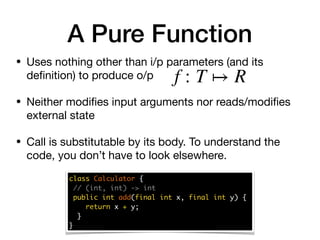
• Uses nothing other than i/p parameters (and its
definition) to produce o/p 

• Neither modifies input arguments nor reads/modifies
external state

• Call is substitutable by its body. To understand the
code, you don’t have to look elsewhere.
class Calculator {
// (int, int) -> int
public int add(final int x, final int y) {
return x + y;
}
}
A Pure Function
f : T ↦ R
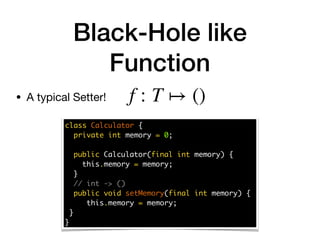
Black-Hole like
Function
• A typical Setter!
class Calculator {
private int memory = 0;
public Calculator(final int memory) {
this.memory = memory;
}
// int -> ()
public void setMemory(final int memory) {
this.memory = memory;
}
}
f : T ↦ ()
Mother’s Love like
Function
• A typical Getter!
class Calculator {
private int memory = 0;
public Calculator(final int memory) {
this.memory = memory;
}
// () -> int
public int recallMemory() {
return memory;
}
}
f : () ↦ R
Politician like
Function
• a Printer!

• Neither consume anything, nor I return anything,
because I do everything under the table.
class Calculator {
private int memory = 0;
public Calculator(final int memory) {
this.memory = memory;
}
public void printMemory() {
System.out.println(memory);
}
}
f : () ↦ ()
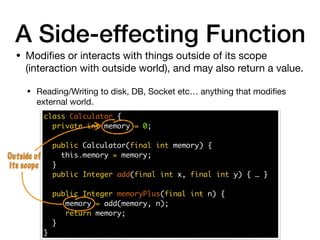
• Modifies or interacts with things outside of its scope
(interaction with outside world), and may also return a value.

• Reading/Writing to disk, DB, Socket etc… anything that modifies
external world.
A Side-effecting Function
class Calculator {
private int memory = 0;
public Calculator(final int memory) {
this.memory = memory;
}
public Integer add(final int x, final int y) { … }
public Integer memoryPlus(final int n) {
memory = add(memory, n);
return memory;
}
}
Outside of
its scope
• Write Side-effect…a typical Setter!
Black-Hole like
Side-effecting Function
class Calculator {
private int memory = 0;
public Calculator(final int memory) {
this.memory = memory;
}
// int -> ()
public void setMemory(final int memory) {
this.memory = memory;
}
}
f : T ↦ ()
Mother’s Love like
Side-Effecting Function
• Read Side-effect!
class Calculator {
private Random rnd = new Random();
// () -> int
public int random() {
return rnd.nextInt();
}
}
f : () ↦ R
Politician like
Side-effecting Function
• a Printer!

• Neither consume anything, nor I return anything,
because I do everything under the table.
class Calculator {
private int memory = 0;
public Calculator(final int memory) {
this.memory = memory;
}
public void printMemory() {
System.out.println(memory);
}
}
f : () ↦ ()
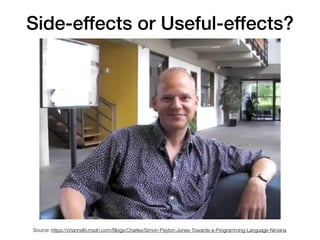
Side-effects or Useful-effects?
Source: https://channel9.msdn.com/Blogs/Charles/Simon-Peyton-Jones-Towards-a-Programming-Language-Nirvana
Side-effects or Useful-effects?
Source: https://channel9.msdn.com/Blogs/Charles/Simon-Peyton-Jones-Towards-a-Programming-Language-Nirvana
Understanding
Referential Transparency
class Calculator {
private int memory;
public Calculator(final int memory) {
this.memory = memory;
}
public Integer add(final int x, final int y) {
return x + y;
}
public Integer memoryPlus(final int n) {
memory = add(memory, n);
return memory;
}
}
Understanding
Referential Transparency
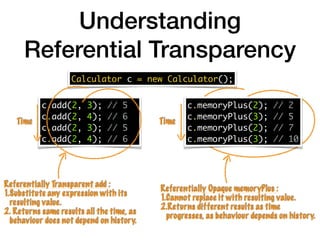
c.add(2, 3); // 5
c.add(2, 4); // 6
c.add(2, 3); // 5
c.add(2, 4); // 6
Calculator c = new Calculator();
Referentially Opaque memoryPlus :
1.Cannot replace it with resulting value.
2.Returns different results as time
progresses, as behaviour depends on history.
c.memoryPlus(2); // 2
c.memoryPlus(3); // 5
c.memoryPlus(2); // 7
c.memoryPlus(3); // 10
Time Time
Referentially Transparent add :
1.Substitute any expression with its
resulting value.
2. Returns same results all the time, as
behaviour does not depend on history.
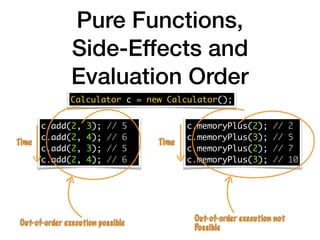
c.memoryPlus(2); // 2
c.memoryPlus(3); // 5
c.memoryPlus(2); // 7
c.memoryPlus(3); // 10
Pure Functions,
Side-Effects and
Evaluation Order
c.add(2, 3); // 5
c.add(2, 4); // 6
c.add(2, 3); // 5
c.add(2, 4); // 6
Calculator c = new Calculator();
Out-of-order execution not
Possible
Time Time
Out-of-order execution possible
How can we make
memoryPlus
Referentially
Transparent?
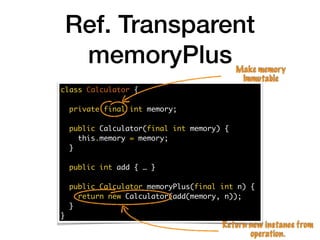
Ref. Transparent
memoryPlus
class Calculator {
private final int memory;
public Calculator(final int memory) {
this.memory = memory;
}
public int add { … }
public Calculator memoryPlus(final int n) {
return new Calculator(add(memory, n));
}
}
Make memory
Immutable
Return new instance from
operation.
Reflections
• Referential Transparency is about replacing any expression
(or function) with its resulting value.

• To be referentially transparent, function will require to work
with immutable data.

• To be referentially transparent, a function will require to be
pure.

• To be referentially transparent, a function will require to be
deterministic.

• Referentially transparent functions are context-free and the
context is time.
https://github.com/CodeJugalbandi/FunctionalProgramming/tree/master/melodies/referentialTransparency
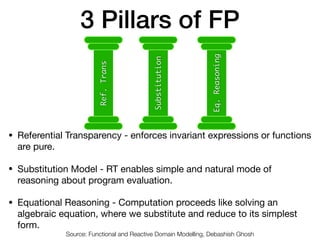
3 Pillars of FP
• Referential Transparency - enforces invariant expressions or functions
are pure. 

• Substitution Model - RT enables simple and natural mode of
reasoning about program evaluation. 

• Equational Reasoning - Computation proceeds like solving an
algebraic equation, where we substitute and reduce to its simplest
form.
Source: Functional and Reactive Domain Modelling, Debashish Ghosh
Ref.Trans
Substitution
Eq.Reasoning
Good Deeds Happen Anonymously
• Naming is one of the hardest problem in software.

• Alleviate using an anonymous function - Lambda 𝝺.
public int add(final int x, final int y) {
return x + y;
}
public int add(final int x, final int y) {
return x + y;
}
(final int x, final int y) -> { x + y; }
(x, y) -> x + y;
Drop all
inessentials
what remains
are essentials,
parameters and
body
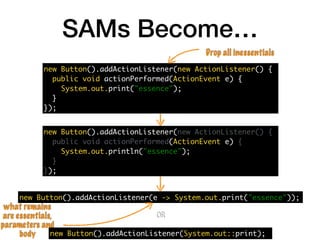
SAMs Become…
new Button().addActionListener(new ActionListener() {
public void actionPerformed(ActionEvent e) {
System.out.print("essence");
}
});
new Button().addActionListener(new ActionListener() {
public void actionPerformed(ActionEvent e) {
System.out.println("essence");
}
});
new Button().addActionListener(e -> System.out.print("essence"));
Drop all inessentials
what remains
are essentials,
parameters and
body new Button().addActionListener(System.out::print);
OR
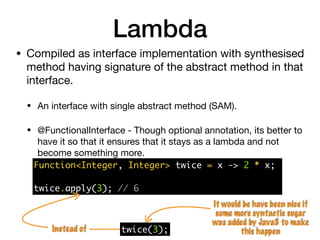
Lambda
Function<Integer, Integer> twice = x -> 2 * x;
twice.apply(3); // 6
It would be have been nice if
some more syntactic sugar
was added by Java8 to make
this happentwice(3);Instead of
• Compiled as interface implementation with synthesised
method having signature of the abstract method in that
interface.

• An interface with single abstract method (SAM).

• @FunctionalInterface - Though optional annotation, its better to
have it so that it ensures that it stays as a lambda and not
become something more.
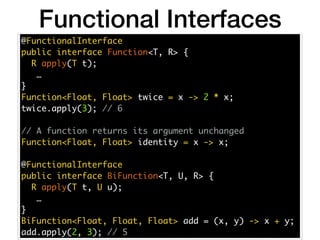
@FunctionalInterface
public interface Function<T, R> {
R apply(T t);
…
}
Function<Float, Float> twice = x -> 2 * x;
twice.apply(3); // 6
// A function returns its argument unchanged
Function<Float, Float> identity = x -> x;
@FunctionalInterface
public interface BiFunction<T, U, R> {
R apply(T t, U u);
…
}
BiFunction<Float, Float, Float> add = (x, y) -> x + y;
add.apply(2, 3); // 5
Functional Interfaces
A Black-Hole like
Functional Interface
@FunctionalInterface
public interface Consumer<T> {
void accept(T t);
…
}
corrupt.accept(100.34);
@FunctionalInterface
public interface BiConsumer<T, U> {
void accept(T t, U u);
…
}
BiConsumer<Celestial, Celestial> blackHole =
(planet, asteroid) -> { }
blackHole.accept(planet, asteriod);
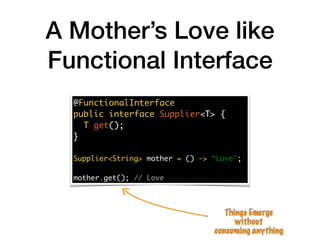
A Mother’s Love like
Functional Interface
@FunctionalInterface
public interface Supplier<T> {
T get();
}
Supplier<String> mother = () -> “Love";
mother.get(); // Love
Things Emerge
without
consuming anything
@FunctionalInterface
public interface Predicate<T> {
boolean test(T t);
…
}
Predicate<T> affirmative = x -> true;
affirmative.test(1); // true
Predicate<T> negative = x -> false;
negative.test(1); // false
Predicate<Integer> isEven = x -> x % 2 == 0;
isEven.test(2); // true
isEven.test(3); // false
Mr. Spock like
Functional Interface
Politician like
Functional Interface
@FunctionalInterface
public interface Runnable {
void run();
}
• Neither consume anything, nor I return anything,
because I do everything under the table.
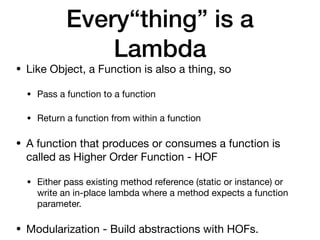
Every“thing” is a
Lambda
• Like Object, a Function is also a thing, so

• Pass a function to a function

• Return a function from within a function

• A function that produces or consumes a function is
called as Higher Order Function - HOF

• Either pass existing method reference (static or instance) or
write an in-place lambda where a method expects a function
parameter.

• Modularization - Build abstractions with HOFs.
Pass a function
to a function
• Subsumed ‘for’ loop.

• Repetitive behaviour using Recursion.
void iterate(int times, Runnable body) {
if (times <= 0) {
return;
}
body.run();
iterate(times - 1, body);
}
iterate(2, () -> System.out.println("Hello"));
// Hello
// Hello
No need for
explicit looping
constructs!
Just a function!
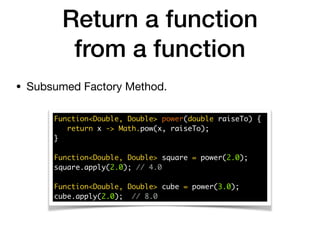
Return a function
from a function
• Subsumed Factory Method.
Function<Double, Double> power(double raiseTo) {
return x -> Math.pow(x, raiseTo);
}
Function<Double, Double> square = power(2.0);
square.apply(2.0); // 4.0
Function<Double, Double> cube = power(3.0);
cube.apply(2.0); // 8.0
Subsumed Aspect
public<T, R> Function<T, R> time(Function<T, R> fn) {
return t -> {
long startTime = System.currentTimeMillis();
R result = fn.apply(t);
long timeTaken = System.currentTimeMillis() - startTime;
System.out.println("Time: " + timeTaken + " ms");
return result;
}
}
• AOP - Around style
Composition Pipeline
• Compose a function from other functions by aligning
types.
• Function composition is not commutative.

• f ∘ g ≠ g ∘ f
// T -> U
Function<T, U> f;
// U -> R
Function<U, R> g;
// T -> U . U -> R = T -> R
Function<T, R> h = f . g;
Why Composition?
• Tackle complexity by composing behaviors.

• Compose larger functions from smaller ones. 

• Smaller functions can be tested independently.

• If the parts are correct, we can then trust the
correctness of the whole.

• Every part of the larger function can be reasoned about
easily.
Composing Functions
• Using compose & andThen
Function<Integer, Integer> square = x -> x * x;
Function<Integer, Integer> twice = x -> 2 * x;
square.compose(twice).apply(2); // 16
square.andThen(twice).apply(2); // 8
Read Left to Right
Think Right to Left
Read Left to Right
Think Left to Right
• For languages that support function composition, look for a way
to go with the grain of thought. In Java, prefer using andThen
Circle of Purity
• Compose behaviours using
pure Functions.

• Data flows through
composed pipes.

• Interact with outside world
using Side-effecting
functions.
Outside
World
Side
Effecting
Functions
Pure
Functions
Courtesy: Venkat
Consumer Supplier
Reflections
• Enforce order of evaluation.

• In imperative programming, statements enforce order of evaluation.

• In FP, the order of composition determines the order of evaluation.

• Function composition (and not function application) is the
default way to build sub-routines in Concatenative
Programming Style, a.k.a Point Free Style.

• Functions neither contain argument types nor names, they
are just laid out as computation pipeline.

• Lot of our domain code is just trying to do this!

• Makes code more succinct and readable.
https://github.com/CodeJugalbandi/FunctionalProgramming/tree/master/melodies/sequencing
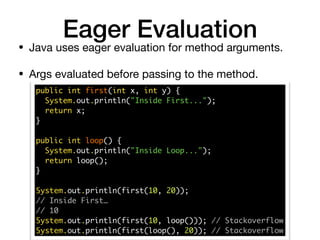
Eager Evaluation
• Java uses eager evaluation for method arguments. 

• Args evaluated before passing to the method.
public int first(int x, int y) {

System.out.println("Inside First...");

return x;

}
public int loop() {

System.out.println("Inside Loop...");

return loop();

}

System.out.println(first(10, 20));
// Inside First…
// 10

System.out.println(first(10, loop())); // Stackoverflow

System.out.println(first(loop(), 20)); // Stackoverflow
Lazy Evaluation
• Lazy means don’t compute until there exists a demand.

• Haskell OTOH is lazy by default. 

• Args not evaluated before passing to the method,
instead evaluated upon use.
loop = loop


first x y = x


main :: IO ()

main = do

print $ first 10 20 -- 10

print $ first 10 loop -- 10

print $ first loop 10 -- Infinite Loop
Lazy Evaluation
• Scala is eager by default like Java, and provides a
“lazy” switch.
def loop: Int = loop


def first(x: Int, y: Int) = x


first(10, 20) // 10

first(loop, 20) // Non-termination

first(10, loop) // Non-termination
scala> lazy val x = loop

x: Int = <lazy>

scala> x // Non-termination
public static int first(Supplier<Integer> x, Supplier<Integer> y) {

System.out.println("Inside First...");

return x.get();

}

public static int loop() {

System.out.println("Inside Loop...");

return loop();

}

System.out.println(first(10, 20)); // 10

System.out.println(first(() -> 10, () -> loop())); // 10

System.out.println(first(() -> loop(), () -> 20)); // Stackoverflow
Simulating Lazy Evaluation
Representation of
computation and
not the
computation itself.
• To delay the evaluation of args (lazy), wrap them in lambda.

• Call the lambda when we need to evaluate.

• Immutability and Purity makes lazy evaluation possible.
Imperative Filtering and
Collecting
String sentence = "all mimsy were the borogoves and the momeraths";
String [] words = sentence.split(" ");
StringBuilder caps = new StringBuilder();
for (var word : words) {
if (word.length() < 4) {
caps.append(word.toUpperCase());
caps.append(" ");
}
}
String capitalized = caps.toString().trim();
System.out.println(capitalized); // ALL THE AND THE
Enumeration
and
Filtering
interleaved
Collector
• One of the motivations of Streams is to make
parallelism more accessible to developers.
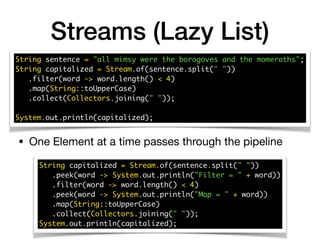
Streams (Lazy List)
String sentence = "all mimsy were the borogoves and the momeraths";

String capitalized = Stream.of(sentence.split(" "))

.filter(word -> word.length() < 4)

.map(String::toUpperCase)

.collect(Collectors.joining(" "));


System.out.println(capitalized);
String capitalized = Stream.of(sentence.split(" "))

.peek(word -> System.out.println("Filter = " + word))

.filter(word -> word.length() < 4)

.peek(word -> System.out.println("Map = " + word))

.map(String::toUpperCase)

.collect(Collectors.joining(" "));

System.out.println(capitalized);
• One Element at a time passes through the pipeline
public static String capitalize(String s) {

try {

Thread.sleep(2000);

} catch (Exception e) {

}

return s.toUpperCase();

}

String sentence = "all mimsy were the borogoves and the momeraths";

long startTime = System.currentTimeMillis();

String capitalized = Stream.of(sentence.split(" "))

.filter(word -> word.length() < 4)

.map(word -> capitalize(word))

.collect(Collectors.joining(" "));

long timeTaken = System.currentTimeMillis() - startTime;

System.out.println(String.format("%s, Took %d(ms)", capitalized, timeTaken));
// ALL THE AND THE, Took 8043(ms)
How can we improve this?
Parallelizing
public static String capitalize(String s) {

try {

Thread.sleep(2000);

} catch (Exception e) {

}

return s.toUpperCase();

}

String sentence = "all mimsy were the borogoves and the momeraths";

long startTime = System.currentTimeMillis();

String capitalized = Stream.of(sentence.split(" “))
.parallel()
.filter(word -> word.length() < 4)

.map(word -> capitalize(word))

.collect(Collectors.joining(" "));

long timeTaken = System.currentTimeMillis() - startTime;

System.out.println(String.format("%s, Took %d(ms)", capitalized, timeTaken));
// ALL THE AND THE, Took 2027(ms)
• One of the motivations of Streams is to make
parallelism more accessible to developers.
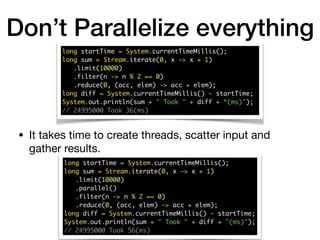
Don’t Parallelize everything
• It takes time to create threads, scatter input and
gather results.
long startTime = System.currentTimeMillis();

long sum = Stream.iterate(0, x -> x + 1)

.limit(10000)

.filter(n -> n % 2 == 0)

.reduce(0, (acc, elem) -> acc + elem);

long diff = System.currentTimeMillis() - startTime;

System.out.println(sum + " Took " + diff + “(ms)");
// 24995000 Took 36(ms)
long startTime = System.currentTimeMillis();

long sum = Stream.iterate(0, x -> x + 1)

.limit(10000)

.parallel()

.filter(n -> n % 2 == 0)

.reduce(0, (acc, elem) -> acc + elem);

long diff = System.currentTimeMillis() - startTime;

System.out.println(sum + " Took " + diff + "(ms)");

// 24995000 Took 56(ms)
Streams - Infinitely Lazy
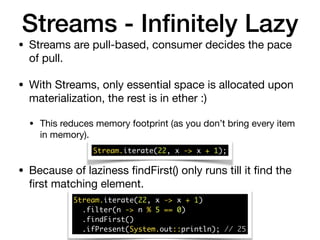
• Streams are pull-based, consumer decides the pace
of pull.

• With Streams, only essential space is allocated upon
materialization, the rest is in ether :)

• This reduces memory footprint (as you don’t bring every item
in memory).
Stream.iterate(22, x -> x + 1)

.filter(n -> n % 5 == 0)

.findFirst()

.ifPresent(System.out::println); // 25
• Because of laziness findFirst() only runs till it find the
first matching element.
Stream.iterate(22, x -> x + 1);
De-structuring
• It is about extracting data from the innards of the
Data-Structure.

• Gives us a short-hand way of naming parts of the
data-structure.
val list = 1 :: 2 :: 3 :: 4 :: Nil

val first :: second :: rest = list

println(first) // 1

println(second) // 2

println(rest) // List(3, 4)


case class Name(first: String, last: String, salutation: String)


val dd = Name("Dhaval", "Dalal", "Mr.")

val Name(fName, lName, s) = dd

println(fName) // Dhaval

println(lName) // Dalal
Pattern Matching
• In Pattern Matching, we are not only matching on relative
positions of elements in the data-structure, but also trying to
dispatch to different definitions based on the value inside the
data structure.

• This dispatch is a kind of conditional construct. So, it’s about
associating a definition with a particular set of i/ps.
val dd = Name("Dhaval", "Dalal", "Mr.")

val nancy = Name("Nancy", "Drew", "Ms.")

def greet(name: Name) = name match {

case Name("Nancy", "Drew", _) => s"Hello Ms. Drew"

case Name(f@"Dhaval", l, s) => s"Hey $f"

case name => s"Hi ${name.first.toUpperCase}"

}


println(greet(dd)) // Hey Dhaval

println(greet(nancy)) // Hello Ms. Drew

println(greet(Name("Peter", "Shmo", "Mr."))) // Hi PETER
Implementing Recursion
Using Pattern Matching
In Erlang
sum(Acc, []) -> Acc;

sum(Acc, [X|XS]) -> sum(Acc + X, XS).


sum(List) -> sum(0, List).


main(_) ->

io:format("~p~n", [sum([])]),

io:format("~p~n", [sum([1, 2, 3, 4])]).

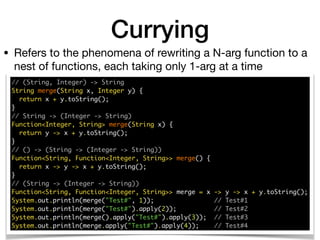
// (String, Integer) -> String

String merge(String x, Integer y) {

return x + y.toString();

}

// String -> (Integer -> String)

Function<Integer, String> merge(String x) {

return y -> x + y.toString();

}

// () -> (String -> (Integer -> String))

Function<String, Function<Integer, String>> merge() {

return x -> y -> x + y.toString();

}
// (String -> (Integer -> String))

Function<String, Function<Integer, String>> merge = x -> y -> x + y.toString();

System.out.println(merge("Test#", 1)); // Test#1

System.out.println(merge("Test#").apply(2)); // Test#2

System.out.println(merge().apply("Test#").apply(3)); // Test#3
System.out.println(merge.apply("Test#").apply(4)); // Test#4
• Refers to the phenomena of rewriting a N-arg function to a
nest of functions, each taking only 1-arg at a time
Currying
Currying
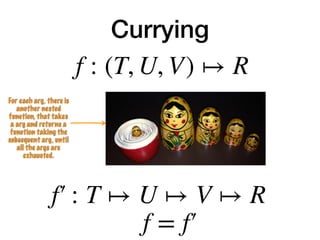
For each arg, there is
another nested
function, that takes
a arg and returns a
function taking the
subsequent arg, until
all the args are
exhausted.
f : (T, U, V) ↦ R
f′ : T ↦ U ↦ V ↦ R
f = f′
Make Absence Explicit
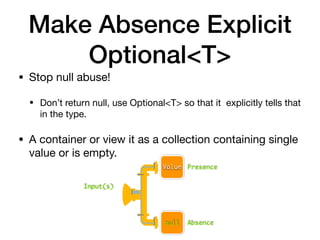
Optional<T>
• Stop null abuse!

• Don’t return null, use Optional<T> so that it explicitly tells that
in the type.

• A container or view it as a collection containing single
value or is empty.
Presence
Absence
Input(s)
Value
null
Before
String frequentFlyerId = "123456789";

UserRepository userRepository = new UserRepository();

User user = userRepository.findBy(frequentFlyerId);

String targetPage = null;

int miles = 7000;

if (user != null) {

int newPoints = user.addPointsUsing(miles);

targetPage = "http://tierPage";

} else {

targetPage = "http://loginPage";

}

System.out.println(targetPage);
String frequentFlyerId = "123456789";

int miles = 7000;

UserRepository userRepository = new UserRepository();

String targetPage = userRepository.findBy(frequentFlyerId)

.map(user -> {

int newPoints = user.addPointsUsing(miles);

return "http://tierPage";

})

.orElse("http://loginPage");


System.out.println(targetPage);
After
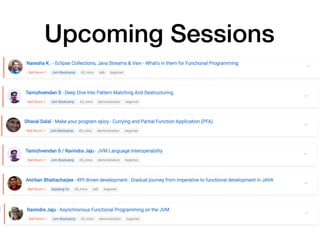
Upcoming Sessions
Thank - You!
https://github.com/DhavalDalal/FunctionalConference-2019-Booting-Into-FP-Demo

Booting into functional programming

  • 1.
    Booting into FP DhavalDalal @softwareartisan https://dhavaldalal.wordpress.com 14th Nov 2019
  • 2.
    Our Tour • Functions,everywhere! • Understanding Referential Transparency • What is a Lambda? • Modularization • Building Abstractions with Higher-Order Functions • Lazy Evaluation • Tackling Complexity using Function Composition • Streams (Lazy Lists) • De-structuring and Pattern Matching • Currying • Sequence/Chain Operations together using Monads - Dealing with absence of Values • Overview of Upcoming Sessions
  • 3.
  • 4.
    Touted Advantages • Lessnumber of lines of code as compared to imperative code. • Hence, Functional Programmers are more “productive”
  • 5.
    Touted Advantages • Lessnumber of lines of code as compared to imperative code. • Hence, Functional Programmers are more “productive” • Declarative • Describes “what to do”, rather than imperative - “how to do”
  • 6.
    Touted Advantages • Lessnumber of lines of code as compared to imperative code. • Hence, Functional Programmers are more “productive” • Declarative • Describes “what to do”, rather than imperative - “how to do” • Immutability • No assignment statements, a variable value never changes.
  • 7.
    Touted Advantages • Lessnumber of lines of code as compared to imperative code. • Hence, Functional Programmers are more “productive” • Declarative • Describes “what to do”, rather than imperative - “how to do” • Immutability • No assignment statements, a variable value never changes. • No side-effects • Eliminates major source of bugs, order of evaluation does not matter.
  • 8.
    Touted Advantages • Lessnumber of lines of code as compared to imperative code. • Hence, Functional Programmers are more “productive” • Declarative • Describes “what to do”, rather than imperative - “how to do” • Immutability • No assignment statements, a variable value never changes. • No side-effects • Eliminates major source of bugs, order of evaluation does not matter. • Referential Transparency • Enables equational reasoning Source: Why Functional Programming Matters - John Hughes
  • 9.
    Why FP ^matters? really
  • 10.
    Why FP ^matters? • Its about Modularity • “Our ability to decompose a problem into parts depends directly on our ability to glue solutions” - John Hughes really
  • 11.
    Why FP ^matters? • Its about Modularity • “Our ability to decompose a problem into parts depends directly on our ability to glue solutions” - John Hughes • Benefits • Small can be coded quickly and easily. • Reusability of general-purpose modules. • Independent testing of modules. really
  • 12.
    Why FP ^matters? • Its about Modularity • “Our ability to decompose a problem into parts depends directly on our ability to glue solutions” - John Hughes • Benefits • Small can be coded quickly and easily. • Reusability of general-purpose modules. • Independent testing of modules. • The Glue • Lazy Evaluation. • Higher-Order Functions. Source: Why Functional Programming Matters - John Hughes really
  • 13.
  • 14.
    • Function isa smallest unit of computation. Functions Everywhere!
  • 15.
    • Function isa smallest unit of computation. Functions Everywhere! f : x ↦ x2OR f(x) = x2
  • 16.
    • Function isa smallest unit of computation. Functions Everywhere! f : x ↦ x2OR f(x) = x2 • Domain, Co-Domain and Range of a function. • Domain {-3, -2, -1, 0, 1, 2, 3} • Co-Domain {0, 1, 2, 3, 4, 5, 6, 7, 8, 9}
  • 17.
    • Function isa smallest unit of computation. Functions Everywhere! f : x ↦ x2OR f(x) = x2 • Domain, Co-Domain and Range of a function. • Domain {-3, -2, -1, 0, 1, 2, 3} • Co-Domain {0, 1, 2, 3, 4, 5, 6, 7, 8, 9} • Range {0, 1, 4, 9}
  • 18.
    • Function isa smallest unit of computation. Functions Everywhere! f : x ↦ x2OR f(x) = x2 • Domain, Co-Domain and Range of a function. • Domain {-3, -2, -1, 0, 1, 2, 3} • Co-Domain {0, 1, 2, 3, 4, 5, 6, 7, 8, 9} • Range {0, 1, 4, 9} • Function is a relation that maps the domain into co-domain such that there is exactly one input maps to a output (1:1, can be m:1 but not 1:n).
  • 19.
    • Function isa smallest unit of computation. Functions Everywhere! f : x ↦ x2OR f(x) = x2 • Domain, Co-Domain and Range of a function. • Domain {-3, -2, -1, 0, 1, 2, 3} • Co-Domain {0, 1, 2, 3, 4, 5, 6, 7, 8, 9} • Range {0, 1, 4, 9} • Function is a relation that maps the domain into co-domain such that there is exactly one input maps to a output (1:1, can be m:1 but not 1:n). • Type of the function is int ↦ int
  • 20.
    • Uses nothingother than i/p parameters (and its definition) to produce o/p • Neither modifies input arguments nor reads/modifies external state • Call is substitutable by its body. To understand the code, you don’t have to look elsewhere. class Calculator { // (int, int) -> int public int add(final int x, final int y) { return x + y; } } A Pure Function f : T ↦ R
  • 21.
    Black-Hole like Function • Atypical Setter! class Calculator { private int memory = 0; public Calculator(final int memory) { this.memory = memory; } // int -> () public void setMemory(final int memory) { this.memory = memory; } } f : T ↦ ()
  • 22.
    Mother’s Love like Function •A typical Getter! class Calculator { private int memory = 0; public Calculator(final int memory) { this.memory = memory; } // () -> int public int recallMemory() { return memory; } } f : () ↦ R
  • 23.
    Politician like Function • aPrinter! • Neither consume anything, nor I return anything, because I do everything under the table. class Calculator { private int memory = 0; public Calculator(final int memory) { this.memory = memory; } public void printMemory() { System.out.println(memory); } } f : () ↦ ()
  • 24.
    • Modifies orinteracts with things outside of its scope (interaction with outside world), and may also return a value. • Reading/Writing to disk, DB, Socket etc… anything that modifies external world. A Side-effecting Function class Calculator { private int memory = 0; public Calculator(final int memory) { this.memory = memory; } public Integer add(final int x, final int y) { … } public Integer memoryPlus(final int n) { memory = add(memory, n); return memory; } } Outside of its scope
  • 25.
    • Write Side-effect…atypical Setter! Black-Hole like Side-effecting Function class Calculator { private int memory = 0; public Calculator(final int memory) { this.memory = memory; } // int -> () public void setMemory(final int memory) { this.memory = memory; } } f : T ↦ ()
  • 26.
    Mother’s Love like Side-EffectingFunction • Read Side-effect! class Calculator { private Random rnd = new Random(); // () -> int public int random() { return rnd.nextInt(); } } f : () ↦ R
  • 27.
    Politician like Side-effecting Function •a Printer! • Neither consume anything, nor I return anything, because I do everything under the table. class Calculator { private int memory = 0; public Calculator(final int memory) { this.memory = memory; } public void printMemory() { System.out.println(memory); } } f : () ↦ ()
  • 28.
    Side-effects or Useful-effects? Source:https://channel9.msdn.com/Blogs/Charles/Simon-Peyton-Jones-Towards-a-Programming-Language-Nirvana
  • 29.
    Side-effects or Useful-effects? Source:https://channel9.msdn.com/Blogs/Charles/Simon-Peyton-Jones-Towards-a-Programming-Language-Nirvana
  • 30.
    Understanding Referential Transparency class Calculator{ private int memory; public Calculator(final int memory) { this.memory = memory; } public Integer add(final int x, final int y) { return x + y; } public Integer memoryPlus(final int n) { memory = add(memory, n); return memory; } }
  • 31.
    Understanding Referential Transparency c.add(2, 3);// 5 c.add(2, 4); // 6 c.add(2, 3); // 5 c.add(2, 4); // 6 Calculator c = new Calculator(); Referentially Opaque memoryPlus : 1.Cannot replace it with resulting value. 2.Returns different results as time progresses, as behaviour depends on history. c.memoryPlus(2); // 2 c.memoryPlus(3); // 5 c.memoryPlus(2); // 7 c.memoryPlus(3); // 10 Time Time Referentially Transparent add : 1.Substitute any expression with its resulting value. 2. Returns same results all the time, as behaviour does not depend on history.
  • 32.
    c.memoryPlus(2); // 2 c.memoryPlus(3);// 5 c.memoryPlus(2); // 7 c.memoryPlus(3); // 10 Pure Functions, Side-Effects and Evaluation Order c.add(2, 3); // 5 c.add(2, 4); // 6 c.add(2, 3); // 5 c.add(2, 4); // 6 Calculator c = new Calculator(); Out-of-order execution not Possible Time Time Out-of-order execution possible
  • 33.
    How can wemake memoryPlus Referentially Transparent?
  • 34.
    Ref. Transparent memoryPlus class Calculator{ private final int memory; public Calculator(final int memory) { this.memory = memory; } public int add { … } public Calculator memoryPlus(final int n) { return new Calculator(add(memory, n)); } } Make memory Immutable Return new instance from operation.
  • 35.
    Reflections • Referential Transparencyis about replacing any expression (or function) with its resulting value. • To be referentially transparent, function will require to work with immutable data. • To be referentially transparent, a function will require to be pure. • To be referentially transparent, a function will require to be deterministic. • Referentially transparent functions are context-free and the context is time. https://github.com/CodeJugalbandi/FunctionalProgramming/tree/master/melodies/referentialTransparency
  • 36.
    3 Pillars ofFP • Referential Transparency - enforces invariant expressions or functions are pure. • Substitution Model - RT enables simple and natural mode of reasoning about program evaluation. • Equational Reasoning - Computation proceeds like solving an algebraic equation, where we substitute and reduce to its simplest form. Source: Functional and Reactive Domain Modelling, Debashish Ghosh Ref.Trans Substitution Eq.Reasoning
  • 37.
    Good Deeds HappenAnonymously • Naming is one of the hardest problem in software. • Alleviate using an anonymous function - Lambda 𝝺. public int add(final int x, final int y) { return x + y; } public int add(final int x, final int y) { return x + y; } (final int x, final int y) -> { x + y; } (x, y) -> x + y; Drop all inessentials what remains are essentials, parameters and body
  • 38.
    SAMs Become… new Button().addActionListener(newActionListener() { public void actionPerformed(ActionEvent e) { System.out.print("essence"); } }); new Button().addActionListener(new ActionListener() { public void actionPerformed(ActionEvent e) { System.out.println("essence"); } }); new Button().addActionListener(e -> System.out.print("essence")); Drop all inessentials what remains are essentials, parameters and body new Button().addActionListener(System.out::print); OR
  • 39.
    Lambda Function<Integer, Integer> twice= x -> 2 * x; twice.apply(3); // 6 It would be have been nice if some more syntactic sugar was added by Java8 to make this happentwice(3);Instead of • Compiled as interface implementation with synthesised method having signature of the abstract method in that interface. • An interface with single abstract method (SAM). • @FunctionalInterface - Though optional annotation, its better to have it so that it ensures that it stays as a lambda and not become something more.
  • 40.
    @FunctionalInterface public interface Function<T,R> { R apply(T t); … } Function<Float, Float> twice = x -> 2 * x; twice.apply(3); // 6 // A function returns its argument unchanged Function<Float, Float> identity = x -> x; @FunctionalInterface public interface BiFunction<T, U, R> { R apply(T t, U u); … } BiFunction<Float, Float, Float> add = (x, y) -> x + y; add.apply(2, 3); // 5 Functional Interfaces
  • 41.
    A Black-Hole like FunctionalInterface @FunctionalInterface public interface Consumer<T> { void accept(T t); … } corrupt.accept(100.34); @FunctionalInterface public interface BiConsumer<T, U> { void accept(T t, U u); … } BiConsumer<Celestial, Celestial> blackHole = (planet, asteroid) -> { } blackHole.accept(planet, asteriod);
  • 42.
    A Mother’s Lovelike Functional Interface @FunctionalInterface public interface Supplier<T> { T get(); } Supplier<String> mother = () -> “Love"; mother.get(); // Love Things Emerge without consuming anything
  • 43.
    @FunctionalInterface public interface Predicate<T>{ boolean test(T t); … } Predicate<T> affirmative = x -> true; affirmative.test(1); // true Predicate<T> negative = x -> false; negative.test(1); // false Predicate<Integer> isEven = x -> x % 2 == 0; isEven.test(2); // true isEven.test(3); // false Mr. Spock like Functional Interface
  • 44.
    Politician like Functional Interface @FunctionalInterface publicinterface Runnable { void run(); } • Neither consume anything, nor I return anything, because I do everything under the table.
  • 45.
    Every“thing” is a Lambda •Like Object, a Function is also a thing, so • Pass a function to a function • Return a function from within a function • A function that produces or consumes a function is called as Higher Order Function - HOF • Either pass existing method reference (static or instance) or write an in-place lambda where a method expects a function parameter. • Modularization - Build abstractions with HOFs.
  • 46.
    Pass a function toa function • Subsumed ‘for’ loop. • Repetitive behaviour using Recursion. void iterate(int times, Runnable body) { if (times <= 0) { return; } body.run(); iterate(times - 1, body); } iterate(2, () -> System.out.println("Hello")); // Hello // Hello No need for explicit looping constructs! Just a function!
  • 47.
    Return a function froma function • Subsumed Factory Method. Function<Double, Double> power(double raiseTo) { return x -> Math.pow(x, raiseTo); } Function<Double, Double> square = power(2.0); square.apply(2.0); // 4.0 Function<Double, Double> cube = power(3.0); cube.apply(2.0); // 8.0
  • 48.
    Subsumed Aspect public<T, R>Function<T, R> time(Function<T, R> fn) { return t -> { long startTime = System.currentTimeMillis(); R result = fn.apply(t); long timeTaken = System.currentTimeMillis() - startTime; System.out.println("Time: " + timeTaken + " ms"); return result; } } • AOP - Around style
  • 49.
    Composition Pipeline • Composea function from other functions by aligning types. • Function composition is not commutative. • f ∘ g ≠ g ∘ f // T -> U Function<T, U> f; // U -> R Function<U, R> g; // T -> U . U -> R = T -> R Function<T, R> h = f . g;
  • 50.
    Why Composition? • Tacklecomplexity by composing behaviors. • Compose larger functions from smaller ones. • Smaller functions can be tested independently. • If the parts are correct, we can then trust the correctness of the whole. • Every part of the larger function can be reasoned about easily.
  • 51.
    Composing Functions • Usingcompose & andThen Function<Integer, Integer> square = x -> x * x; Function<Integer, Integer> twice = x -> 2 * x; square.compose(twice).apply(2); // 16 square.andThen(twice).apply(2); // 8 Read Left to Right Think Right to Left Read Left to Right Think Left to Right • For languages that support function composition, look for a way to go with the grain of thought. In Java, prefer using andThen
  • 52.
    Circle of Purity •Compose behaviours using pure Functions. • Data flows through composed pipes. • Interact with outside world using Side-effecting functions. Outside World Side Effecting Functions Pure Functions Courtesy: Venkat Consumer Supplier
  • 53.
    Reflections • Enforce orderof evaluation. • In imperative programming, statements enforce order of evaluation. • In FP, the order of composition determines the order of evaluation. • Function composition (and not function application) is the default way to build sub-routines in Concatenative Programming Style, a.k.a Point Free Style. • Functions neither contain argument types nor names, they are just laid out as computation pipeline. • Lot of our domain code is just trying to do this! • Makes code more succinct and readable. https://github.com/CodeJugalbandi/FunctionalProgramming/tree/master/melodies/sequencing
  • 54.
    Eager Evaluation • Javauses eager evaluation for method arguments. • Args evaluated before passing to the method. public int first(int x, int y) {
 System.out.println("Inside First...");
 return x;
 } public int loop() {
 System.out.println("Inside Loop...");
 return loop();
 }
 System.out.println(first(10, 20)); // Inside First… // 10
 System.out.println(first(10, loop())); // Stackoverflow
 System.out.println(first(loop(), 20)); // Stackoverflow
  • 55.
    Lazy Evaluation • Lazymeans don’t compute until there exists a demand. • Haskell OTOH is lazy by default. • Args not evaluated before passing to the method, instead evaluated upon use. loop = loop
 
 first x y = x
 
 main :: IO ()
 main = do
 print $ first 10 20 -- 10
 print $ first 10 loop -- 10
 print $ first loop 10 -- Infinite Loop
  • 56.
    Lazy Evaluation • Scalais eager by default like Java, and provides a “lazy” switch. def loop: Int = loop
 
 def first(x: Int, y: Int) = x
 
 first(10, 20) // 10
 first(loop, 20) // Non-termination
 first(10, loop) // Non-termination scala> lazy val x = loop
 x: Int = <lazy>
 scala> x // Non-termination
  • 57.
    public static intfirst(Supplier<Integer> x, Supplier<Integer> y) {
 System.out.println("Inside First...");
 return x.get();
 }
 public static int loop() {
 System.out.println("Inside Loop...");
 return loop();
 }
 System.out.println(first(10, 20)); // 10
 System.out.println(first(() -> 10, () -> loop())); // 10
 System.out.println(first(() -> loop(), () -> 20)); // Stackoverflow Simulating Lazy Evaluation Representation of computation and not the computation itself. • To delay the evaluation of args (lazy), wrap them in lambda. • Call the lambda when we need to evaluate. • Immutability and Purity makes lazy evaluation possible.
  • 58.
    Imperative Filtering and Collecting Stringsentence = "all mimsy were the borogoves and the momeraths"; String [] words = sentence.split(" "); StringBuilder caps = new StringBuilder(); for (var word : words) { if (word.length() < 4) { caps.append(word.toUpperCase()); caps.append(" "); } } String capitalized = caps.toString().trim(); System.out.println(capitalized); // ALL THE AND THE Enumeration and Filtering interleaved Collector • One of the motivations of Streams is to make parallelism more accessible to developers.
  • 59.
    Streams (Lazy List) Stringsentence = "all mimsy were the borogoves and the momeraths";
 String capitalized = Stream.of(sentence.split(" "))
 .filter(word -> word.length() < 4)
 .map(String::toUpperCase)
 .collect(Collectors.joining(" "));
 
 System.out.println(capitalized); String capitalized = Stream.of(sentence.split(" "))
 .peek(word -> System.out.println("Filter = " + word))
 .filter(word -> word.length() < 4)
 .peek(word -> System.out.println("Map = " + word))
 .map(String::toUpperCase)
 .collect(Collectors.joining(" "));
 System.out.println(capitalized); • One Element at a time passes through the pipeline
  • 60.
    public static Stringcapitalize(String s) {
 try {
 Thread.sleep(2000);
 } catch (Exception e) {
 }
 return s.toUpperCase();
 }
 String sentence = "all mimsy were the borogoves and the momeraths";
 long startTime = System.currentTimeMillis();
 String capitalized = Stream.of(sentence.split(" "))
 .filter(word -> word.length() < 4)
 .map(word -> capitalize(word))
 .collect(Collectors.joining(" "));
 long timeTaken = System.currentTimeMillis() - startTime;
 System.out.println(String.format("%s, Took %d(ms)", capitalized, timeTaken)); // ALL THE AND THE, Took 8043(ms) How can we improve this?
  • 61.
    Parallelizing public static Stringcapitalize(String s) {
 try {
 Thread.sleep(2000);
 } catch (Exception e) {
 }
 return s.toUpperCase();
 }
 String sentence = "all mimsy were the borogoves and the momeraths";
 long startTime = System.currentTimeMillis();
 String capitalized = Stream.of(sentence.split(" “)) .parallel() .filter(word -> word.length() < 4)
 .map(word -> capitalize(word))
 .collect(Collectors.joining(" "));
 long timeTaken = System.currentTimeMillis() - startTime;
 System.out.println(String.format("%s, Took %d(ms)", capitalized, timeTaken)); // ALL THE AND THE, Took 2027(ms) • One of the motivations of Streams is to make parallelism more accessible to developers.
  • 62.
    Don’t Parallelize everything •It takes time to create threads, scatter input and gather results. long startTime = System.currentTimeMillis();
 long sum = Stream.iterate(0, x -> x + 1)
 .limit(10000)
 .filter(n -> n % 2 == 0)
 .reduce(0, (acc, elem) -> acc + elem);
 long diff = System.currentTimeMillis() - startTime;
 System.out.println(sum + " Took " + diff + “(ms)"); // 24995000 Took 36(ms) long startTime = System.currentTimeMillis();
 long sum = Stream.iterate(0, x -> x + 1)
 .limit(10000)
 .parallel()
 .filter(n -> n % 2 == 0)
 .reduce(0, (acc, elem) -> acc + elem);
 long diff = System.currentTimeMillis() - startTime;
 System.out.println(sum + " Took " + diff + "(ms)");
 // 24995000 Took 56(ms)
  • 63.
    Streams - InfinitelyLazy • Streams are pull-based, consumer decides the pace of pull. • With Streams, only essential space is allocated upon materialization, the rest is in ether :) • This reduces memory footprint (as you don’t bring every item in memory). Stream.iterate(22, x -> x + 1)
 .filter(n -> n % 5 == 0)
 .findFirst()
 .ifPresent(System.out::println); // 25 • Because of laziness findFirst() only runs till it find the first matching element. Stream.iterate(22, x -> x + 1);
  • 64.
    De-structuring • It isabout extracting data from the innards of the Data-Structure. • Gives us a short-hand way of naming parts of the data-structure. val list = 1 :: 2 :: 3 :: 4 :: Nil
 val first :: second :: rest = list
 println(first) // 1
 println(second) // 2
 println(rest) // List(3, 4)
 
 case class Name(first: String, last: String, salutation: String)
 
 val dd = Name("Dhaval", "Dalal", "Mr.")
 val Name(fName, lName, s) = dd
 println(fName) // Dhaval
 println(lName) // Dalal
  • 65.
    Pattern Matching • InPattern Matching, we are not only matching on relative positions of elements in the data-structure, but also trying to dispatch to different definitions based on the value inside the data structure. • This dispatch is a kind of conditional construct. So, it’s about associating a definition with a particular set of i/ps. val dd = Name("Dhaval", "Dalal", "Mr.")
 val nancy = Name("Nancy", "Drew", "Ms.")
 def greet(name: Name) = name match {
 case Name("Nancy", "Drew", _) => s"Hello Ms. Drew"
 case Name(f@"Dhaval", l, s) => s"Hey $f"
 case name => s"Hi ${name.first.toUpperCase}"
 }
 
 println(greet(dd)) // Hey Dhaval
 println(greet(nancy)) // Hello Ms. Drew
 println(greet(Name("Peter", "Shmo", "Mr."))) // Hi PETER
  • 66.
    Implementing Recursion Using PatternMatching In Erlang sum(Acc, []) -> Acc;
 sum(Acc, [X|XS]) -> sum(Acc + X, XS).
 
 sum(List) -> sum(0, List).
 
 main(_) ->
 io:format("~p~n", [sum([])]),
 io:format("~p~n", [sum([1, 2, 3, 4])]).

  • 67.
    // (String, Integer)-> String
 String merge(String x, Integer y) {
 return x + y.toString();
 }
 // String -> (Integer -> String)
 Function<Integer, String> merge(String x) {
 return y -> x + y.toString();
 }
 // () -> (String -> (Integer -> String))
 Function<String, Function<Integer, String>> merge() {
 return x -> y -> x + y.toString();
 } // (String -> (Integer -> String))
 Function<String, Function<Integer, String>> merge = x -> y -> x + y.toString();
 System.out.println(merge("Test#", 1)); // Test#1
 System.out.println(merge("Test#").apply(2)); // Test#2
 System.out.println(merge().apply("Test#").apply(3)); // Test#3 System.out.println(merge.apply("Test#").apply(4)); // Test#4 • Refers to the phenomena of rewriting a N-arg function to a nest of functions, each taking only 1-arg at a time Currying
  • 68.
    Currying For each arg,there is another nested function, that takes a arg and returns a function taking the subsequent arg, until all the args are exhausted. f : (T, U, V) ↦ R f′ : T ↦ U ↦ V ↦ R f = f′
  • 69.
    Make Absence Explicit Optional<T> •Stop null abuse! • Don’t return null, use Optional<T> so that it explicitly tells that in the type. • A container or view it as a collection containing single value or is empty. Presence Absence Input(s) Value null
  • 70.
    Before String frequentFlyerId ="123456789";
 UserRepository userRepository = new UserRepository();
 User user = userRepository.findBy(frequentFlyerId);
 String targetPage = null;
 int miles = 7000;
 if (user != null) {
 int newPoints = user.addPointsUsing(miles);
 targetPage = "http://tierPage";
 } else {
 targetPage = "http://loginPage";
 }
 System.out.println(targetPage); String frequentFlyerId = "123456789";
 int miles = 7000;
 UserRepository userRepository = new UserRepository();
 String targetPage = userRepository.findBy(frequentFlyerId)
 .map(user -> {
 int newPoints = user.addPointsUsing(miles);
 return "http://tierPage";
 })
 .orElse("http://loginPage");
 
 System.out.println(targetPage); After
  • 71.
  • 72.