Healthy Code
February - 2015
12
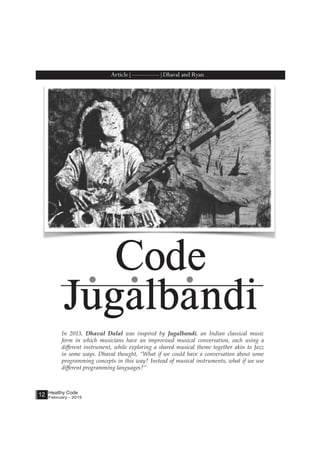
In 2013, Dhaval Dalal was inspired by Jugalbandi, an Indian classical music
form in which musicians have an improvised musical conversation, each using a
different instrument, while exploring a shared musical theme together akin to Jazz
in some ways. Dhaval thought, “What if we could have a conversation about some
programming concepts in this way? Instead of musical instruments, what if we use
different programming languages?”
Article|-------------|Dhaval and Ryan
Code
Jugalbandi
Healthy Code
February - 2015
13
This led to the first Code Jugalbandi between us. Code
Jugalbandi inspired and fuelled our learning by focussing
on dialogue and exploration. More languages in the room
meant more perspectives too. Exploring a paradigm through
many languages gave us a better map of the territory than
any single language could. Above all, Code Jugalbandi was
a playful way to learn together!
Creator and Listener
We met regularly with over a period of several months,
exploring some key issues related to Functional
Programming(FP).ThisculminatedinaliveCodeJugalbandi
at the Functional Conference in Bengaluru, 2014. During
the FP Code Jugalbandi, we explored nine themes, which
became melodies. Similar to the musical Jugalbandi, there
are two roles: creator and listener. We called the creator of
the melody Bramha and the one who listens and responds
with a different instrument, Krishna. + In the last Code
Jugalbandi Article, we looked at the melody, the expression
problem. This time we will look at Sequencing.
The Sequencing Problem
Lets say we have a sentence and we want to capitalise words
that have size less than or equal to 3.
Sequencing - Ruby
Bramha: In Ruby, in an imperative style, with mutation of
variables, it would look like this
words = “all mimsy were the borogoves”
split_words = words.split(“s”)
caps_words = []
split_words.each do |w|
;; enumeration and filtering
cap-words.push(w.capitalize) if (w.size < 3)
end
words_s = caps_words.join(“n”)
Bramha: In the above code, enumeration and filtering are
interleaved. Let’s try and separate enumeration and filtering.
words = “all mimsy were the borogoves”
words.split(“s”).map do |w|
w.capitalize
end.filter do |w|
(w.size < 3)
end.join (“n”)
Bramha: This feels a bit more structured, we’re chaining
operations, one after the other. This style is called sequencing,
where we’re moving data down processing pipelines.
Sequencing - Clojure
Bramha: In Clojure, we could chain functions together
through function nesting.
(def words “all mimsy were the borogoves”)
(def using-nesting
(join “n”
(filter (fn [s] (< 3 (count s)))
(map capitalize
(split words #”s”)))))
(println using-nesting)
Bramha: This is hard to understand. Deep nesting leads to
many parentheses in Clojure that is considered a code smell
in Clojure. Let’s try and lose a few parenthesis through
function composition.
(def using-composition
(let [f (comp
(partial join “n”)
(partial filter (fn [s] (< 3 (count s))))
(partial map capitalize)
(fn [s] (split s #”s”)))]
(f words)))
(println using-composition)
Bramha: The awkward thing about these styles of coding
is that the order of functions seem back to front. The arrow
syntax sidesteps composition in lieu of a threading-macro.
(def using-arrow
(->> (split words #”s”)
(map capitalize)
(filter (fn [s] (< 3 (count s))))
(join “n”)))
(println using-arrow)
Krishna: BTW, why is it called a threading-macro in Clojure?
The threading word in there makes me think of process
threads.
Brahma: The word threading is used in the sense of threading
a needle through cloth, not to be confused with process
threads! Since it is implemented as a macro, is is called a
threading-macro.
Sequencing - Scala
Krishna: Lets see that how can we achieve the same in Scala.
Healthy Code
February - 2015
14
Krishna: Now, I’ll define a few function types.
val split = (s: String) => s.split(“ “)
val capitalize = (ws: Array[String]) => ws.map(_.
toUpperCase)
val filter = (ws: Array[String]) => ws.filter(_.size
<= 3)
val join = (ws: Array[String]) => ws mkString “n”
val seqCapitalized = join compose filter compose
capitalize compose split
seqCapitalized (words)
Krishna: Just like in Clojure nesting and composition
examples, this is flowing against the grain of thought.
Let me have the cake and eat it too. I can make use of
Scala’s andThen.
val seqAndThened = split andThen capitalize andThen
filter
andThen join
seqAndThened (words)
Sequencing - Groovy
Krishna: In Groovy too, one can quickly define closures like
this.
def split = { s -> s.split(‘ ‘) as List }
def capitalize = { ws -> ws.collect
{ it.toUpperCase() } }
def filter = { ws -> ws.findAll
{ it.length() <= 3 } }
def join = { ws -> ws.join(‘n’) }
def seqComposed = join << filter << capitalize << split
println (seqComposed(sentence))
def seqAndThened = split >> capitalize >> filter >> join
println (seqAndThened(sentence))
Sequencing - Racket
Brahma: In Racket, one can achieve this using Rackjure (a
Clojure inspired ideas in Racket by Greg Hendershott,http://
www.greghendershott.com/rackjure).
(require racket/string)
(define s “All mimsy were the borogoves”)
(define (capitalize s) (map (λ (w) (string-upcase
w)) s))
(define (words<=3 s) (filter (λ (w) (<= (string-length
w) 3)) s)) (define (sentence->words s) (string-split
s))
(define (join-words ws) (string-join ws))
Ryan is a software developer,
coach and advisor, based in Cape
Town. He has been working with
code for more than 15 years. Ryan
assists individuals and teams
to manage the evolution and
complexity of their software
systems. Ryan is a passionate
learner and enjoys facilitating
learning in others.
Dhavalahands-ondeveloperand
mentor, believes that software
development is first an art and
then a craft. For him writing
software brings his creativity
to the fore. His interests are in
architecting applications ground
up, estabilishing environments,
transitioning and orienting
teams to Agile way of working
by embedding himself within
teams.
You can follow them on Twitter @
CodeJugalbandi
I’ll first show using chaining.
val words = “all mimsy were the borogoves”
println(words
.split(“ “)
.map(w => w.toUpperCase)
.filter(w => w.length <= 3)
.mkString(“n”))
Healthy Code
February - 2015
15
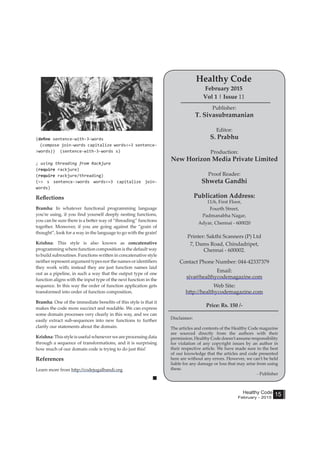
(define sentence-with-3-words
(compose join-words capitalize words<=3 sentence-
>words)) (sentence-with-3-words s)
; using threading from Rackjure
(require rackjure)
(require rackjure/threading)
(~> s sentence->words words<=3 capitalize join-
words)
Reflections
Bramha: In whatever functional programming language
you’re using, if you find yourself deeply nesting functions,
you can be sure there is a better way of “threading” functions
together. Moreover, if you are going against the “grain of
thought”, look for a way in the language to go with the grain!
Krishna: This style is also known as concatenative
programming where function composition is the default way
to build subroutines. Functions written in concatenative style
neither represent argument types nor the names or identifiers
they work with; instead they are just function names laid
out as a pipeline, in such a way that the output type of one
function aligns with the input type of the next function in the
sequence. In this way the order of function application gets
transformed into order of function composition.
Bramha: One of the immediate benefits of this style is that it
makes the code more succinct and readable. We can express
some domain processes very clearly in this way, and we can
easily extract sub-sequences into new functions to further
clarify our statements about the domain.
Krishna:Thisstyle is useful wheneverwe areprocessingdata
through a sequence of transformations, and it is surprising
how much of our domain code is trying to do just this!
References
Learn more from http://codejugalbandi.org
Publisher:
T. Sivasubramanian
Editor:
S. Prabhu
Production:
New Horizon Media Private Limited
Proof Reader:
Shweta Gandhi
Publication Address:
11/6, First Floor,
Fourth Street,
Padmanabha Nagar,
Adyar, Chennai - 600020
Printer: Sakthi Scanners (P) Ltd
7, Dams Road, Chindadripet,
Chennai - 600002.
Contact Phone Number: 044-42337379
Email:
siva@healthycodemagazine.com
Web Site:
http://healthycodemagazine.com
Price: Rs. 150 /-
Healthy Code
February 2015
Vol 1 | Issue 11
Disclaimer:
The articles and contents of the Healthy Code magazine
are sourced directly from the authors with their
permission. Healthy Code doesn’t assume responsibility
for violation of any copyright issues by an author in
their respective article. We have made sure to the best
of our knowledge that the articles and code presented
here are without any errors. However, we can’t be held
liable for any damage or loss that may arise from using
these.
- Publisher

CodeJugalbandi-Sequencing-HealthyCode-Magazine-Feb-2015

  • 1.
    Healthy Code February -2015 12 In 2013, Dhaval Dalal was inspired by Jugalbandi, an Indian classical music form in which musicians have an improvised musical conversation, each using a different instrument, while exploring a shared musical theme together akin to Jazz in some ways. Dhaval thought, “What if we could have a conversation about some programming concepts in this way? Instead of musical instruments, what if we use different programming languages?” Article|-------------|Dhaval and Ryan Code Jugalbandi
  • 2.
    Healthy Code February -2015 13 This led to the first Code Jugalbandi between us. Code Jugalbandi inspired and fuelled our learning by focussing on dialogue and exploration. More languages in the room meant more perspectives too. Exploring a paradigm through many languages gave us a better map of the territory than any single language could. Above all, Code Jugalbandi was a playful way to learn together! Creator and Listener We met regularly with over a period of several months, exploring some key issues related to Functional Programming(FP).ThisculminatedinaliveCodeJugalbandi at the Functional Conference in Bengaluru, 2014. During the FP Code Jugalbandi, we explored nine themes, which became melodies. Similar to the musical Jugalbandi, there are two roles: creator and listener. We called the creator of the melody Bramha and the one who listens and responds with a different instrument, Krishna. + In the last Code Jugalbandi Article, we looked at the melody, the expression problem. This time we will look at Sequencing. The Sequencing Problem Lets say we have a sentence and we want to capitalise words that have size less than or equal to 3. Sequencing - Ruby Bramha: In Ruby, in an imperative style, with mutation of variables, it would look like this words = “all mimsy were the borogoves” split_words = words.split(“s”) caps_words = [] split_words.each do |w| ;; enumeration and filtering cap-words.push(w.capitalize) if (w.size < 3) end words_s = caps_words.join(“n”) Bramha: In the above code, enumeration and filtering are interleaved. Let’s try and separate enumeration and filtering. words = “all mimsy were the borogoves” words.split(“s”).map do |w| w.capitalize end.filter do |w| (w.size < 3) end.join (“n”) Bramha: This feels a bit more structured, we’re chaining operations, one after the other. This style is called sequencing, where we’re moving data down processing pipelines. Sequencing - Clojure Bramha: In Clojure, we could chain functions together through function nesting. (def words “all mimsy were the borogoves”) (def using-nesting (join “n” (filter (fn [s] (< 3 (count s))) (map capitalize (split words #”s”))))) (println using-nesting) Bramha: This is hard to understand. Deep nesting leads to many parentheses in Clojure that is considered a code smell in Clojure. Let’s try and lose a few parenthesis through function composition. (def using-composition (let [f (comp (partial join “n”) (partial filter (fn [s] (< 3 (count s)))) (partial map capitalize) (fn [s] (split s #”s”)))] (f words))) (println using-composition) Bramha: The awkward thing about these styles of coding is that the order of functions seem back to front. The arrow syntax sidesteps composition in lieu of a threading-macro. (def using-arrow (->> (split words #”s”) (map capitalize) (filter (fn [s] (< 3 (count s)))) (join “n”))) (println using-arrow) Krishna: BTW, why is it called a threading-macro in Clojure? The threading word in there makes me think of process threads. Brahma: The word threading is used in the sense of threading a needle through cloth, not to be confused with process threads! Since it is implemented as a macro, is is called a threading-macro. Sequencing - Scala Krishna: Lets see that how can we achieve the same in Scala.
  • 3.
    Healthy Code February -2015 14 Krishna: Now, I’ll define a few function types. val split = (s: String) => s.split(“ “) val capitalize = (ws: Array[String]) => ws.map(_. toUpperCase) val filter = (ws: Array[String]) => ws.filter(_.size <= 3) val join = (ws: Array[String]) => ws mkString “n” val seqCapitalized = join compose filter compose capitalize compose split seqCapitalized (words) Krishna: Just like in Clojure nesting and composition examples, this is flowing against the grain of thought. Let me have the cake and eat it too. I can make use of Scala’s andThen. val seqAndThened = split andThen capitalize andThen filter andThen join seqAndThened (words) Sequencing - Groovy Krishna: In Groovy too, one can quickly define closures like this. def split = { s -> s.split(‘ ‘) as List } def capitalize = { ws -> ws.collect { it.toUpperCase() } } def filter = { ws -> ws.findAll { it.length() <= 3 } } def join = { ws -> ws.join(‘n’) } def seqComposed = join << filter << capitalize << split println (seqComposed(sentence)) def seqAndThened = split >> capitalize >> filter >> join println (seqAndThened(sentence)) Sequencing - Racket Brahma: In Racket, one can achieve this using Rackjure (a Clojure inspired ideas in Racket by Greg Hendershott,http:// www.greghendershott.com/rackjure). (require racket/string) (define s “All mimsy were the borogoves”) (define (capitalize s) (map (λ (w) (string-upcase w)) s)) (define (words<=3 s) (filter (λ (w) (<= (string-length w) 3)) s)) (define (sentence->words s) (string-split s)) (define (join-words ws) (string-join ws)) Ryan is a software developer, coach and advisor, based in Cape Town. He has been working with code for more than 15 years. Ryan assists individuals and teams to manage the evolution and complexity of their software systems. Ryan is a passionate learner and enjoys facilitating learning in others. Dhavalahands-ondeveloperand mentor, believes that software development is first an art and then a craft. For him writing software brings his creativity to the fore. His interests are in architecting applications ground up, estabilishing environments, transitioning and orienting teams to Agile way of working by embedding himself within teams. You can follow them on Twitter @ CodeJugalbandi I’ll first show using chaining. val words = “all mimsy were the borogoves” println(words .split(“ “) .map(w => w.toUpperCase) .filter(w => w.length <= 3) .mkString(“n”))
  • 4.
    Healthy Code February -2015 15 (define sentence-with-3-words (compose join-words capitalize words<=3 sentence- >words)) (sentence-with-3-words s) ; using threading from Rackjure (require rackjure) (require rackjure/threading) (~> s sentence->words words<=3 capitalize join- words) Reflections Bramha: In whatever functional programming language you’re using, if you find yourself deeply nesting functions, you can be sure there is a better way of “threading” functions together. Moreover, if you are going against the “grain of thought”, look for a way in the language to go with the grain! Krishna: This style is also known as concatenative programming where function composition is the default way to build subroutines. Functions written in concatenative style neither represent argument types nor the names or identifiers they work with; instead they are just function names laid out as a pipeline, in such a way that the output type of one function aligns with the input type of the next function in the sequence. In this way the order of function application gets transformed into order of function composition. Bramha: One of the immediate benefits of this style is that it makes the code more succinct and readable. We can express some domain processes very clearly in this way, and we can easily extract sub-sequences into new functions to further clarify our statements about the domain. Krishna:Thisstyle is useful wheneverwe areprocessingdata through a sequence of transformations, and it is surprising how much of our domain code is trying to do just this! References Learn more from http://codejugalbandi.org Publisher: T. Sivasubramanian Editor: S. Prabhu Production: New Horizon Media Private Limited Proof Reader: Shweta Gandhi Publication Address: 11/6, First Floor, Fourth Street, Padmanabha Nagar, Adyar, Chennai - 600020 Printer: Sakthi Scanners (P) Ltd 7, Dams Road, Chindadripet, Chennai - 600002. Contact Phone Number: 044-42337379 Email: siva@healthycodemagazine.com Web Site: http://healthycodemagazine.com Price: Rs. 150 /- Healthy Code February 2015 Vol 1 | Issue 11 Disclaimer: The articles and contents of the Healthy Code magazine are sourced directly from the authors with their permission. Healthy Code doesn’t assume responsibility for violation of any copyright issues by an author in their respective article. We have made sure to the best of our knowledge that the articles and code presented here are without any errors. However, we can’t be held liable for any damage or loss that may arise from using these. - Publisher