Approaches to Writing
A Division of Graduate Education Seminar
Graduate Writing Tutor
Mission: to improve the quality of graduate writing that leaves
Montana State University
The “Writing Process”
 Brainstorming
 Organizing
 Outlining
 Drafting
 Revising
 Polishing
Brainstorming
“He is the greatest artist who has embodied, in the sum of his
works, the greatest number of the greatest ideas.”
-- John Ruskin
This is your Brain, on Paper
 A way to quickly generate
ideas.
 Ideas may or may not be
related to your thesis topic.
 A good approach to
generate your actual thesis
statement.
 A way to get “unstuck”
when you’re stalled.
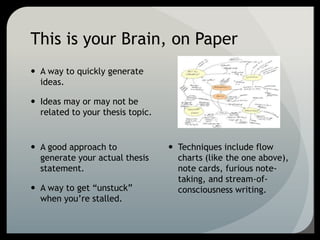
 Techniques include flow
charts (like the one above),
note cards, furious note-
taking, and stream-of-
consciousness writing.
Organization
“Remember, America, organization will set you free.”
-- Alton Brown
Laying a Foundation
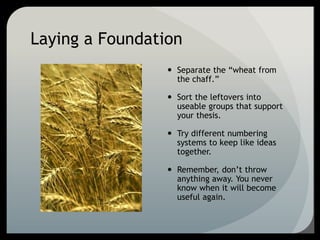
 Separate the “wheat from
the chaff.”
 Sort the leftovers into
useable groups that support
your thesis.
 Try different numbering
systems to keep like ideas
together.
 Remember, don’t throw
anything away. You never
know when it will become
useful again.
Outlining
“The beginning of an acquaintance whether with persons or
things is to get a definite outline of our ignorance.”
-- George Eliot
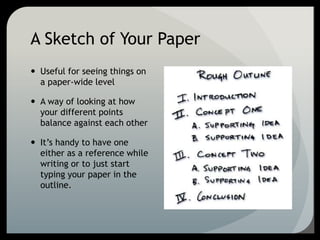
A Sketch of Your Paper
 Useful for seeing things on
a paper-wide level
 A way of looking at how
your different points
balance against each other
 It’s handy to have one
either as a reference while
writing or to just start
typing your paper in the
outline.
Drafting
“One of the few things I know about writing is this: spend it all,
shoot it, play it, lose it, all, right away, every time. Do not
hoard what seems like a good idea for a later place … give it,
give it all, give it now.”
-- Annie Dillard
The “Easiest” Part
 Let all your ideas flow onto the page.
 DON’T WORRY ABOUT GRAMMAR, PUNCTUATION,
MECHANICS, AND STYLE. (not in this stage, anyhow).
 Remember, drafting can be a form of thought or
research. It can take you in directions you never
imagined or lead you to new discoveries.
Revision
“No single bad writing habit is so powerful as the habit of typing
an essay only when you are ready to turn it in.”
-- Richard Lanham
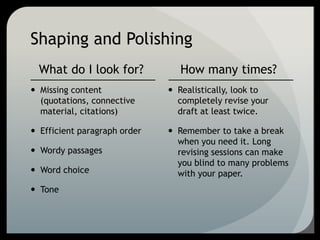
Shaping and Polishing
What do I look for?
 Missing content
(quotations, connective
material, citations)
 Efficient paragraph order
 Wordy passages
 Word choice
 Tone
How many times?
 Realistically, look to
completely revise your
draft at least twice.
 Remember to take a break
when you need it. Long
revising sessions can make
you blind to many problems
with your paper.
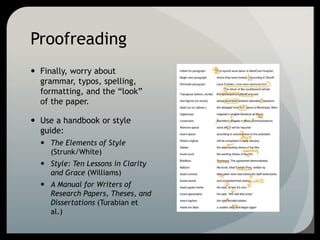
Proofreading
 Finally, worry about
grammar, typos, spelling,
formatting, and the “look”
of the paper.
 Use a handbook or style
guide:
 The Elements of Style
(Strunk/White)
 Style: Ten Lessons in Clarity
and Grace (Williams)
 A Manual for Writers of
Research Papers, Theses, and
Dissertations (Turabian et
al.)
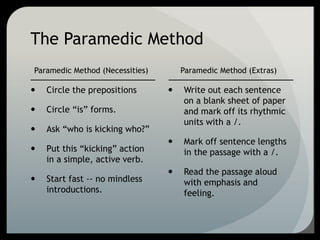
The Paramedic Method
Paramedic Method (Necessities)
 Circle the prepositions
 Circle “is” forms.
 Ask “who is kicking who?”
 Put this “kicking” action
in a simple, active verb.
 Start fast -- no mindless
introductions.
Paramedic Method (Extras)
 Write out each sentence
on a blank sheet of paper
and mark off its rhythmic
units with a /.
 Mark off sentence lengths
in the passage with a /.
 Read the passage aloud
with emphasis and
feeling.
Final Quick Tips
 Write from a process. When you’re stalled, it’s something to
fall back on.
 Work on your project a little bit every day.
 Meet with your committee early and often. Better small
changes along the way than major revisions at the end.
 Read aloud, or have someone read your paper to you.
 Cut down on “to be” verbs, prepositions, and jargon. Don’t
use a five dollar word where a five cent word will do.
 Make an appointment with the Graduate Writing Tutor!
Appointments
 Call 994-5315 to make an appointment.
 Appointments are available Tuesdays, Wednesdays, and
Thursdays from 9 a.m. to 3 p.m.
 E-mail consultations are also available. Write to
tutoring@hypercrit.net for more info.
 This is a FREE service offered by the DGE.
 Thanks for coming!

Approaches to writing

  • 1.
    Approaches to Writing ADivision of Graduate Education Seminar
  • 2.
    Graduate Writing Tutor Mission:to improve the quality of graduate writing that leaves Montana State University
  • 3.
    The “Writing Process” Brainstorming  Organizing  Outlining  Drafting  Revising  Polishing
  • 4.
    Brainstorming “He is thegreatest artist who has embodied, in the sum of his works, the greatest number of the greatest ideas.” -- John Ruskin
  • 5.
    This is yourBrain, on Paper  A way to quickly generate ideas.  Ideas may or may not be related to your thesis topic.  A good approach to generate your actual thesis statement.  A way to get “unstuck” when you’re stalled.  Techniques include flow charts (like the one above), note cards, furious note- taking, and stream-of- consciousness writing.
  • 6.
    Organization “Remember, America, organizationwill set you free.” -- Alton Brown
  • 7.
    Laying a Foundation Separate the “wheat from the chaff.”  Sort the leftovers into useable groups that support your thesis.  Try different numbering systems to keep like ideas together.  Remember, don’t throw anything away. You never know when it will become useful again.
  • 8.
    Outlining “The beginning ofan acquaintance whether with persons or things is to get a definite outline of our ignorance.” -- George Eliot
  • 9.
    A Sketch ofYour Paper  Useful for seeing things on a paper-wide level  A way of looking at how your different points balance against each other  It’s handy to have one either as a reference while writing or to just start typing your paper in the outline.
  • 10.
    Drafting “One of thefew things I know about writing is this: spend it all, shoot it, play it, lose it, all, right away, every time. Do not hoard what seems like a good idea for a later place … give it, give it all, give it now.” -- Annie Dillard
  • 11.
    The “Easiest” Part Let all your ideas flow onto the page.  DON’T WORRY ABOUT GRAMMAR, PUNCTUATION, MECHANICS, AND STYLE. (not in this stage, anyhow).  Remember, drafting can be a form of thought or research. It can take you in directions you never imagined or lead you to new discoveries.
  • 12.
    Revision “No single badwriting habit is so powerful as the habit of typing an essay only when you are ready to turn it in.” -- Richard Lanham
  • 13.
    Shaping and Polishing Whatdo I look for?  Missing content (quotations, connective material, citations)  Efficient paragraph order  Wordy passages  Word choice  Tone How many times?  Realistically, look to completely revise your draft at least twice.  Remember to take a break when you need it. Long revising sessions can make you blind to many problems with your paper.
  • 14.
    Proofreading  Finally, worryabout grammar, typos, spelling, formatting, and the “look” of the paper.  Use a handbook or style guide:  The Elements of Style (Strunk/White)  Style: Ten Lessons in Clarity and Grace (Williams)  A Manual for Writers of Research Papers, Theses, and Dissertations (Turabian et al.)
  • 15.
    The Paramedic Method ParamedicMethod (Necessities)  Circle the prepositions  Circle “is” forms.  Ask “who is kicking who?”  Put this “kicking” action in a simple, active verb.  Start fast -- no mindless introductions. Paramedic Method (Extras)  Write out each sentence on a blank sheet of paper and mark off its rhythmic units with a /.  Mark off sentence lengths in the passage with a /.  Read the passage aloud with emphasis and feeling.
  • 16.
    Final Quick Tips Write from a process. When you’re stalled, it’s something to fall back on.  Work on your project a little bit every day.  Meet with your committee early and often. Better small changes along the way than major revisions at the end.  Read aloud, or have someone read your paper to you.  Cut down on “to be” verbs, prepositions, and jargon. Don’t use a five dollar word where a five cent word will do.  Make an appointment with the Graduate Writing Tutor!
  • 17.
    Appointments  Call 994-5315to make an appointment.  Appointments are available Tuesdays, Wednesdays, and Thursdays from 9 a.m. to 3 p.m.  E-mail consultations are also available. Write to tutoring@hypercrit.net for more info.  This is a FREE service offered by the DGE.  Thanks for coming!

Editor's Notes

  • #3 A quick plug for the service.