

The role of Health Technology
Assessment (HTA) and current
developments in Ireland
Dr. Michael BarryDr. Michael Barry
November 25th
2010
The role of Health Technology Assessment
““ensuring the best health outcomes for Irishensuring the best health outcomes for Irish
patients while securing value for money”patients while securing value for money”
Health Strategy 2001
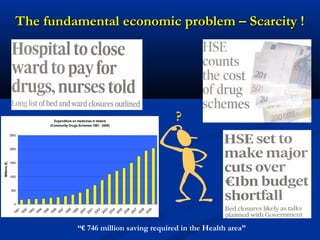
The fundamental economic problem – Scarcity !The fundamental economic problem – Scarcity !
Expenditure on medicines in Ireland
(Community Drugs Schemes 1991 - 2009)
0
500
1000
1500
2000
2500
1991
1992
1993
1994
1995
1996
1997
1998
1999
2000
2001
2002
2003
2004
2005
2006
2007
2008
2009
Millions(€)
?
“€ 746 million saving required in the Health area”
For decision makers when considering
reimbursement of a pharmaceutical
product there are two questions
(a) Is it value for money ?
(b) Can we afford it ?
Health Technology
Assessment
““studies the medical, social, ethical, andstudies the medical, social, ethical, and
economic implications of development,economic implications of development,
diffusion and use of health technology”diffusion and use of health technology”
INAHTA: 1998INAHTA: 1998
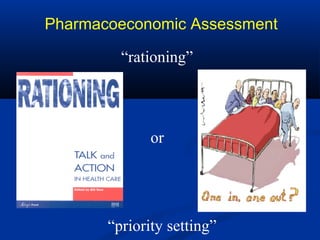
“rationing”
or
“priority setting”
Pharmacoeconomic Assessment
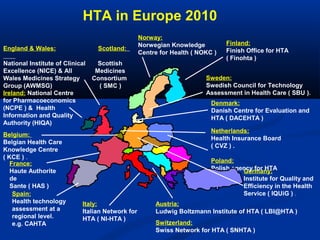
HTA in Europe 2010
Norway:
Norwegian Knowledge
Centre for Health ( NOKC )
Finland:
Finish Office for HTA
( Finohta )
Sweden:
Swedish Council for Technology
Assessment in Health Care ( SBU ).
Denmark:
Danish Centre for Evaluation and
HTA ( DACEHTA )
England & Wales: Scotland:
National Institute of Clinical Scottish
Excellence (NICE) & All Medicines
Wales Medicines Strategy Consortium
Group (AWMSG) ( SMC )
Germany:
Institute for Quality and
Efficiency in the Health
Service ( IQUiG ) .
France:
Haute Authorite
de
Sante ( HAS )
Spain:
Health technology
assessment at a
regional level.
e.g. CAHTA
Italy:
Italian Network for
HTA ( NI-HTA )
Austria;
Ludwig Boltzmann Institute of HTA ( LBI@HTA )
Switzerland:
Swiss Network for HTA ( SNHTA )
Belgium:
Belgian Health Care
Knowledge Centre
( KCE ) .
Netherlands:
Health Insurance Board
( CVZ ) .
Poland:
Polish agency for HTA
Ireland: National Centre
for Pharmacoeconomics
(NCPE ) & Health
Information and Quality
Authority (HIQA)
Pharmacoeconomic assessment prior to
reimbursement
“The HSE reserves the right to assess new and existing
technologies (pharmaceuticals, diagnostics and devices)
that may be high cost or have a significant budget impact on
the Irish healthcare system.”
IPHA/HSE agreement 2006
Recent developments in HTA in IrelandRecent developments in HTA in Ireland
 The cost-effectiveness of all new products is consideredThe cost-effectiveness of all new products is considered
prior to reimbursement under the Community Drugsprior to reimbursement under the Community Drugs
SchemesSchemes
 The ‘Rapid Review’ processThe ‘Rapid Review’ process
 Incremental cost-effectiveness ratio (ICER) and theIncremental cost-effectiveness ratio (ICER) and the
reimbursement recommendationreimbursement recommendation
 Probability of being cost effective at different thresholdsProbability of being cost effective at different thresholds
 Methodological developmentsMethodological developments
 Recent decisions and the use of PEA resultsRecent decisions and the use of PEA results
 Updated HTA & Budget Impact guidelinesUpdated HTA & Budget Impact guidelines
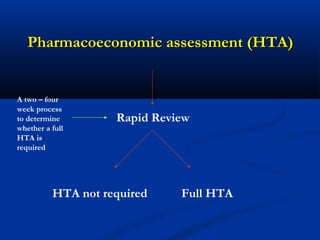
Pharmacoeconomic assessment (HTA)Pharmacoeconomic assessment (HTA)
HTA not required Full HTA
Rapid Review
A two – four
week process
to determine
whether a full
HTA is
required
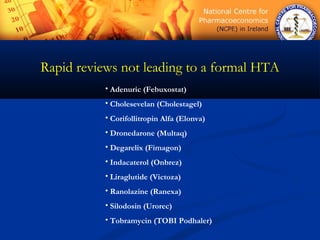
Rapid reviews not leading to a formal HTA
• Adenuric (Febuxostat)
• Cholesevelan (Cholestagel)
• Corifollitropin Alfa (Elonva)
• Dronedarone (Multaq)
• Degarelix (Fimagon)
• Indacaterol (Onbrez)
• Liraglutide (Victoza)
• Ranolazine (Ranexa)
• Silodosin (Urorec)
• Tobramycin (TOBI Podhaler)
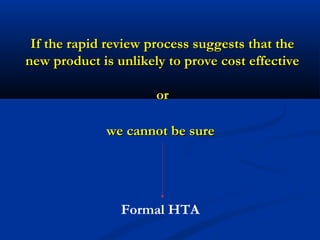
If the rapid review process suggests that theIf the rapid review process suggests that the
new product is unlikely to prove cost effectivenew product is unlikely to prove cost effective
oror
we cannot be surewe cannot be sure
Formal HTA
Incremental cost-effectiveness ratio (ICER)
and the reimbursement recommendation
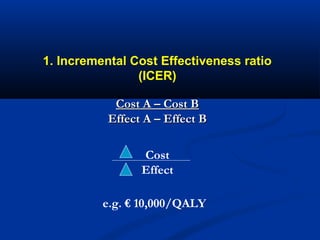
1. Incremental Cost Effectiveness ratio
(ICER)
Cost A – Cost BCost A – Cost B
Effect A – Effect BEffect A – Effect B
Cost
Effect
e.g. € 10,000/QALY
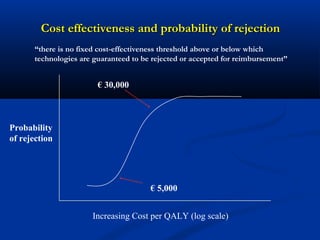
Cost effectiveness and probability of rejectionCost effectiveness and probability of rejection
Probability
of rejection
Increasing Cost per QALY (log scale)
€ 5,000
€ 30,000
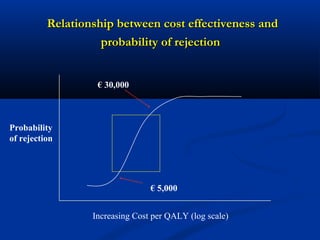
“there is no fixed cost-effectiveness threshold above or below which
technologies are guaranteed to be rejected or accepted for reimbursement”
Relationship between cost effectiveness andRelationship between cost effectiveness and
probability of rejectionprobability of rejection
Probability
of rejection
Increasing Cost per QALY (log scale)
€ 5,000
€ 30,000
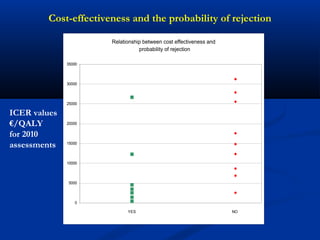
Cost-effectiveness and the probability of rejection
Relationship between cost effectiveness and
probability of rejection
0
5000
10000
15000
20000
25000
30000
35000
YES NO
ICER values
€/QALY
for 2010
assessments
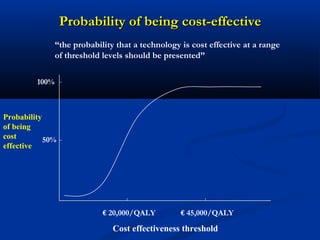
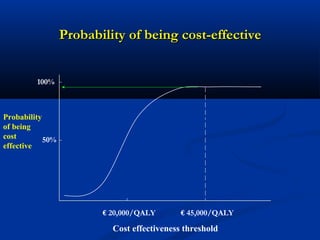
Probability of being cost-effectiveProbability of being cost-effective
Probability
of being
cost
effective
Cost effectiveness threshold
100%
50%
€ 20,000/QALY € 45,000/QALY
“the probability that a technology is cost effective at a range
of threshold levels should be presented”
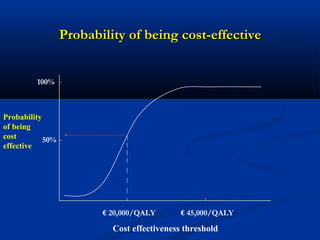
Probability of being cost-effectiveProbability of being cost-effective
Probability
of being
cost
effective
Cost effectiveness threshold
100%
50%
€ 20,000/QALY € 45,000/QALY
Probability of being cost-effectiveProbability of being cost-effective
Probability
of being
cost
effective
Cost effectiveness threshold
100%
50%
€ 20,000/QALY € 45,000/QALY
Methodological developments inMethodological developments in
pharmacoeconomic assessment (PEA) atpharmacoeconomic assessment (PEA) at
the NCPEthe NCPE
 Mixed treatment comparisonsMixed treatment comparisons
– a Bayesian approach– a Bayesian approach
 The expected value of perfectThe expected value of perfect
information (EVPI)information (EVPI)
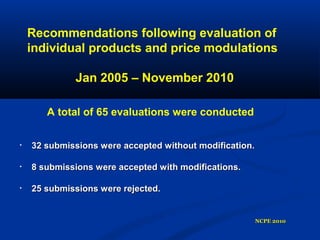
Recommendations following evaluation of
individual products and price modulations
Jan 2005 – November 2010
• 32 submissions were accepted without modification.32 submissions were accepted without modification.
• 8 submissions were accepted with modifications.8 submissions were accepted with modifications.
• 25 submissions were rejected.25 submissions were rejected.
NCPE 2010NCPE 2010
A total of 65 evaluations were conducted
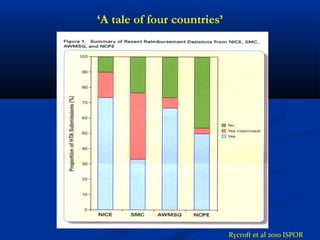
‘A tale of four countries’
Rycroft et al 2010 ISPOR
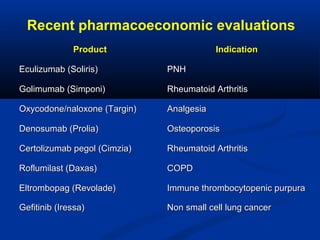
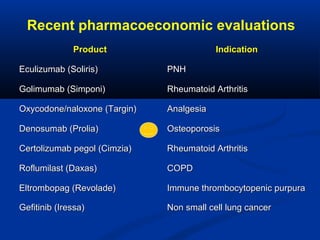
Recent pharmacoeconomic evaluations
ProductProduct IndicationIndication
Eculizumab (Soliris)Eculizumab (Soliris) PNHPNH
Golimumab (Simponi)Golimumab (Simponi) Rheumatoid ArthritisRheumatoid Arthritis
Oxycodone/naloxone (Targin)Oxycodone/naloxone (Targin) AnalgesiaAnalgesia
Denosumab (Prolia)Denosumab (Prolia) OsteoporosisOsteoporosis
Certolizumab pegol (Cimzia)Certolizumab pegol (Cimzia) Rheumatoid ArthritisRheumatoid Arthritis
Roflumilast (Daxas)Roflumilast (Daxas) COPDCOPD
Eltrombopag (Revolade)Eltrombopag (Revolade) Immune thrombocytopenic purpuraImmune thrombocytopenic purpura
Gefitinib (Iressa)Gefitinib (Iressa) Non small cell lung cancerNon small cell lung cancer
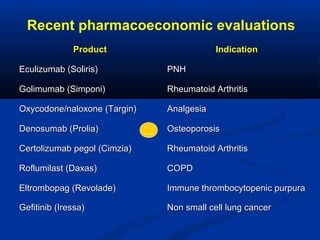
Recent pharmacoeconomic evaluations
ProductProduct IndicationIndication
Eculizumab (Soliris)Eculizumab (Soliris) PNHPNH
Golimumab (Simponi)Golimumab (Simponi) Rheumatoid ArthritisRheumatoid Arthritis
Oxycodone/naloxone (Targin)Oxycodone/naloxone (Targin) AnalgesiaAnalgesia
Denosumab (Prolia)Denosumab (Prolia) OsteoporosisOsteoporosis
Certolizumab pegol (Cimzia)Certolizumab pegol (Cimzia) Rheumatoid ArthritisRheumatoid Arthritis
Roflumilast (Daxas)Roflumilast (Daxas) COPDCOPD
Eltrombopag (Revolade)Eltrombopag (Revolade) Immune thrombocytopenic purpuraImmune thrombocytopenic purpura
Gefitinib (Iressa)Gefitinib (Iressa) Non small cell lung cancerNon small cell lung cancer
Negative PEA – what next ?
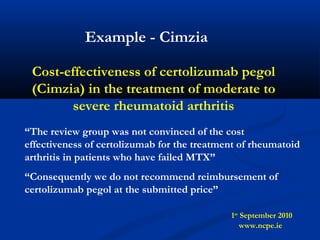
Cost-effectiveness of certolizumab pegol
(Cimzia) in the treatment of moderate to
severe rheumatoid arthritis
“The review group was not convinced of the cost
effectiveness of certolizumab for the treatment of rheumatoid
arthritis in patients who have failed MTX”
“Consequently we do not recommend reimbursement of
certolizumab pegol at the submitted price”
1st
September 2010
www.ncpe.ie
Example - Cimzia
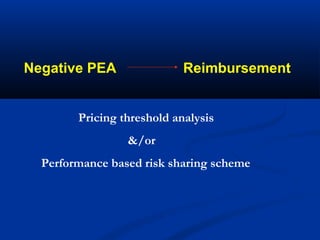
Negative PEA Reimbursement
Pricing threshold analysis
&/or
Performance based risk sharing scheme
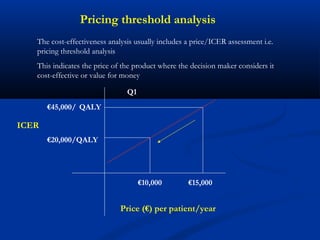
ICER
The cost-effectiveness analysis usually includes a price/ICER assessment i.e.
pricing threshold analysis
This indicates the price of the product where the decision maker considers it
cost-effective or value for money
Pricing threshold analysis
Price (€) per patient/year
€45,000/ QALY
€20,000/QALY
€15,000€10,000
Q1
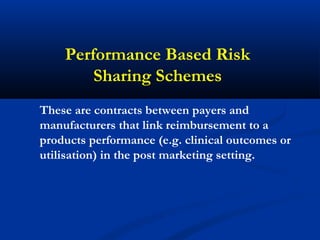
Performance Based Risk
Sharing Schemes
These are contracts between payers and
manufacturers that link reimbursement to a
products performance (e.g. clinical outcomes or
utilisation) in the post marketing setting.
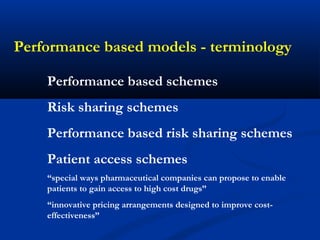
Performance based models - terminology
Performance based schemes
Risk sharing schemes
Performance based risk sharing schemes
Patient access schemes
“special ways pharmaceutical companies can propose to enable
patients to gain access to high cost drugs”
“innovative pricing arrangements designed to improve cost-
effectiveness”
Performance based models - terminology
DEAL !
Typical DealTypical Deal
• The payer (HSE) funds the drug for aThe payer (HSE) funds the drug for a
defined period of time, withdefined period of time, with
manufacturers refunding the cost of themanufacturers refunding the cost of the
drug in patients who did not achieve thedrug in patients who did not achieve the
targeted health outcome (e.g.targeted health outcome (e.g.
bortezomib for MM)bortezomib for MM)
• The HSE would purchase the drug atThe HSE would purchase the drug at
50% of the regular price for the first50% of the regular price for the first
treatment cycle and then purchase attreatment cycle and then purchase at
the full price for those who achieved thethe full price for those who achieved the
targeted outcome and continued ontargeted outcome and continued on
therapy (e.g. sorafenib for mRCC)therapy (e.g. sorafenib for mRCC)
Barry & Tilson IMJ 2010;103(5):133
Recent pharmacoeconomic evaluations
ProductProduct IndicationIndication
Eculizumab (Soliris)Eculizumab (Soliris) PNHPNH
Golimumab (Simponi)Golimumab (Simponi) Rheumatoid ArthritisRheumatoid Arthritis
Oxycodone/naloxone (Targin)Oxycodone/naloxone (Targin) AnalgesiaAnalgesia
Denosumab (Prolia)Denosumab (Prolia) OsteoporosisOsteoporosis
Certolizumab pegol (Cimzia)Certolizumab pegol (Cimzia) Rheumatoid ArthritisRheumatoid Arthritis
Roflumilast (Daxas)Roflumilast (Daxas) COPDCOPD
Eltrombopag (Revolade)Eltrombopag (Revolade) Immune thrombocytopenic purpuraImmune thrombocytopenic purpura
Gefitinib (Iressa)Gefitinib (Iressa) Non small cell lung cancerNon small cell lung cancer
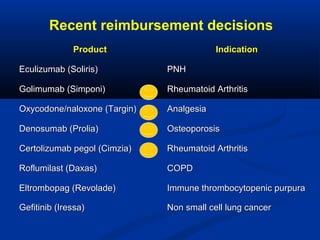
Recent reimbursement decisions
ProductProduct IndicationIndication
Eculizumab (Soliris)Eculizumab (Soliris) PNHPNH
Golimumab (Simponi)Golimumab (Simponi) Rheumatoid ArthritisRheumatoid Arthritis
Oxycodone/naloxone (Targin)Oxycodone/naloxone (Targin) AnalgesiaAnalgesia
Denosumab (Prolia)Denosumab (Prolia) OsteoporosisOsteoporosis
Certolizumab pegol (Cimzia)Certolizumab pegol (Cimzia) Rheumatoid ArthritisRheumatoid Arthritis
Roflumilast (Daxas)Roflumilast (Daxas) COPDCOPD
Eltrombopag (Revolade)Eltrombopag (Revolade) Immune thrombocytopenic purpuraImmune thrombocytopenic purpura
Gefitinib (Iressa)Gefitinib (Iressa) Non small cell lung cancerNon small cell lung cancer
Recent NCPE website developments
for PEA submissions
Pharmacoeconomic guidelines (www.ncpe.ie)
• Template for rapid review assessment submissions from manufacturers
• Recommendations on the reporting format and layout of PEA
submissions
• Guidelines for inclusion of drug costs in pharmacoeconomic evaluations
• Critical assessment of economic evaluations
• Irish Healthcare Technology Assessment Guidelines
• Guidelines for the Budget Impact Analysis of Health Technologies in
Ireland
Irish healthcare technology assessment (HTA)
guidelines
‘methodological guidance on the conduct of economic evaluation’
8th
November 2010 www.hiqa.ie
Guidelines for Budget Impact Analysis
‘methodological guidance on the conduct of budget impact analysis’
23rd
November 2010 www.hiqa.ie
The HTA future ?The HTA future ?
• Increased scrutiny of expenditure onIncreased scrutiny of expenditure on
medicines as decision makersmedicines as decision makers
become more risk aversebecome more risk averse
• All new products considered for HTAAll new products considered for HTA
with HTA submissions becomingwith HTA submissions becoming
increasingly sophisticated e.g.increasingly sophisticated e.g.
probabilistic sensitivity analysis, EVPI.probabilistic sensitivity analysis, EVPI.
• An increased use of HTA in priceAn increased use of HTA in price
negotiation & guiding performancenegotiation & guiding performance
based risk sharing schemes for highbased risk sharing schemes for high
cost drugscost drugs
• In addition to single technologyIn addition to single technology
assessment it is likely that multipleassessment it is likely that multiple
technology assessment will betechnology assessment will be
consideredconsidered
• Hospital HTAHospital HTA
• HTA guided disinvestmentHTA guided disinvestment
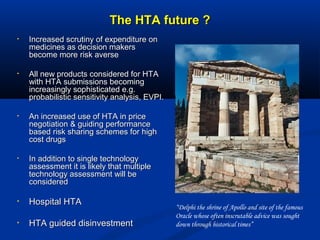
“Delphi the shrine of Apollo and site of the famous
Oracle whose often inscrutable advice was sought
down through historical times”
“to date assessments in Ireland have been
conducted in a pragmatic, timely, transparent
and flexible manner and it is important that
these features continue to characterise the
conduct of future assessments”
Thank you
NCPE www.ncpe.ie

The role of Health Technology Assessment and current developments in Ireland

  • 1.
    The role ofHealth Technology Assessment (HTA) and current developments in Ireland Dr. Michael BarryDr. Michael Barry November 25th 2010
  • 2.
    The role ofHealth Technology Assessment ““ensuring the best health outcomes for Irishensuring the best health outcomes for Irish patients while securing value for money”patients while securing value for money” Health Strategy 2001
  • 3.
    The fundamental economicproblem – Scarcity !The fundamental economic problem – Scarcity ! Expenditure on medicines in Ireland (Community Drugs Schemes 1991 - 2009) 0 500 1000 1500 2000 2500 1991 1992 1993 1994 1995 1996 1997 1998 1999 2000 2001 2002 2003 2004 2005 2006 2007 2008 2009 Millions(€) ? “€ 746 million saving required in the Health area”
  • 4.
    For decision makerswhen considering reimbursement of a pharmaceutical product there are two questions (a) Is it value for money ? (b) Can we afford it ?
  • 5.
    Health Technology Assessment ““studies themedical, social, ethical, andstudies the medical, social, ethical, and economic implications of development,economic implications of development, diffusion and use of health technology”diffusion and use of health technology” INAHTA: 1998INAHTA: 1998
  • 6.
  • 7.
    HTA in Europe2010 Norway: Norwegian Knowledge Centre for Health ( NOKC ) Finland: Finish Office for HTA ( Finohta ) Sweden: Swedish Council for Technology Assessment in Health Care ( SBU ). Denmark: Danish Centre for Evaluation and HTA ( DACEHTA ) England & Wales: Scotland: National Institute of Clinical Scottish Excellence (NICE) & All Medicines Wales Medicines Strategy Consortium Group (AWMSG) ( SMC ) Germany: Institute for Quality and Efficiency in the Health Service ( IQUiG ) . France: Haute Authorite de Sante ( HAS ) Spain: Health technology assessment at a regional level. e.g. CAHTA Italy: Italian Network for HTA ( NI-HTA ) Austria; Ludwig Boltzmann Institute of HTA ( LBI@HTA ) Switzerland: Swiss Network for HTA ( SNHTA ) Belgium: Belgian Health Care Knowledge Centre ( KCE ) . Netherlands: Health Insurance Board ( CVZ ) . Poland: Polish agency for HTA Ireland: National Centre for Pharmacoeconomics (NCPE ) & Health Information and Quality Authority (HIQA)
  • 8.
    Pharmacoeconomic assessment priorto reimbursement “The HSE reserves the right to assess new and existing technologies (pharmaceuticals, diagnostics and devices) that may be high cost or have a significant budget impact on the Irish healthcare system.” IPHA/HSE agreement 2006
  • 9.
    Recent developments inHTA in IrelandRecent developments in HTA in Ireland  The cost-effectiveness of all new products is consideredThe cost-effectiveness of all new products is considered prior to reimbursement under the Community Drugsprior to reimbursement under the Community Drugs SchemesSchemes  The ‘Rapid Review’ processThe ‘Rapid Review’ process  Incremental cost-effectiveness ratio (ICER) and theIncremental cost-effectiveness ratio (ICER) and the reimbursement recommendationreimbursement recommendation  Probability of being cost effective at different thresholdsProbability of being cost effective at different thresholds  Methodological developmentsMethodological developments  Recent decisions and the use of PEA resultsRecent decisions and the use of PEA results  Updated HTA & Budget Impact guidelinesUpdated HTA & Budget Impact guidelines
  • 10.
    Pharmacoeconomic assessment (HTA)Pharmacoeconomicassessment (HTA) HTA not required Full HTA Rapid Review A two – four week process to determine whether a full HTA is required
  • 11.
    Rapid reviews notleading to a formal HTA • Adenuric (Febuxostat) • Cholesevelan (Cholestagel) • Corifollitropin Alfa (Elonva) • Dronedarone (Multaq) • Degarelix (Fimagon) • Indacaterol (Onbrez) • Liraglutide (Victoza) • Ranolazine (Ranexa) • Silodosin (Urorec) • Tobramycin (TOBI Podhaler)
  • 12.
    If the rapidreview process suggests that theIf the rapid review process suggests that the new product is unlikely to prove cost effectivenew product is unlikely to prove cost effective oror we cannot be surewe cannot be sure Formal HTA
  • 13.
    Incremental cost-effectiveness ratio(ICER) and the reimbursement recommendation
  • 14.
    1. Incremental CostEffectiveness ratio (ICER) Cost A – Cost BCost A – Cost B Effect A – Effect BEffect A – Effect B Cost Effect e.g. € 10,000/QALY
  • 15.
    Cost effectiveness andprobability of rejectionCost effectiveness and probability of rejection Probability of rejection Increasing Cost per QALY (log scale) € 5,000 € 30,000 “there is no fixed cost-effectiveness threshold above or below which technologies are guaranteed to be rejected or accepted for reimbursement”
  • 16.
    Relationship between costeffectiveness andRelationship between cost effectiveness and probability of rejectionprobability of rejection Probability of rejection Increasing Cost per QALY (log scale) € 5,000 € 30,000
  • 17.
    Cost-effectiveness and theprobability of rejection Relationship between cost effectiveness and probability of rejection 0 5000 10000 15000 20000 25000 30000 35000 YES NO ICER values €/QALY for 2010 assessments
  • 18.
    Probability of beingcost-effectiveProbability of being cost-effective Probability of being cost effective Cost effectiveness threshold 100% 50% € 20,000/QALY € 45,000/QALY “the probability that a technology is cost effective at a range of threshold levels should be presented”
  • 19.
    Probability of beingcost-effectiveProbability of being cost-effective Probability of being cost effective Cost effectiveness threshold 100% 50% € 20,000/QALY € 45,000/QALY
  • 20.
    Probability of beingcost-effectiveProbability of being cost-effective Probability of being cost effective Cost effectiveness threshold 100% 50% € 20,000/QALY € 45,000/QALY
  • 21.
    Methodological developments inMethodologicaldevelopments in pharmacoeconomic assessment (PEA) atpharmacoeconomic assessment (PEA) at the NCPEthe NCPE  Mixed treatment comparisonsMixed treatment comparisons – a Bayesian approach– a Bayesian approach  The expected value of perfectThe expected value of perfect information (EVPI)information (EVPI)
  • 22.
    Recommendations following evaluationof individual products and price modulations Jan 2005 – November 2010 • 32 submissions were accepted without modification.32 submissions were accepted without modification. • 8 submissions were accepted with modifications.8 submissions were accepted with modifications. • 25 submissions were rejected.25 submissions were rejected. NCPE 2010NCPE 2010 A total of 65 evaluations were conducted
  • 23.
    ‘A tale offour countries’ Rycroft et al 2010 ISPOR
  • 24.
    Recent pharmacoeconomic evaluations ProductProductIndicationIndication Eculizumab (Soliris)Eculizumab (Soliris) PNHPNH Golimumab (Simponi)Golimumab (Simponi) Rheumatoid ArthritisRheumatoid Arthritis Oxycodone/naloxone (Targin)Oxycodone/naloxone (Targin) AnalgesiaAnalgesia Denosumab (Prolia)Denosumab (Prolia) OsteoporosisOsteoporosis Certolizumab pegol (Cimzia)Certolizumab pegol (Cimzia) Rheumatoid ArthritisRheumatoid Arthritis Roflumilast (Daxas)Roflumilast (Daxas) COPDCOPD Eltrombopag (Revolade)Eltrombopag (Revolade) Immune thrombocytopenic purpuraImmune thrombocytopenic purpura Gefitinib (Iressa)Gefitinib (Iressa) Non small cell lung cancerNon small cell lung cancer
  • 25.
    Recent pharmacoeconomic evaluations ProductProductIndicationIndication Eculizumab (Soliris)Eculizumab (Soliris) PNHPNH Golimumab (Simponi)Golimumab (Simponi) Rheumatoid ArthritisRheumatoid Arthritis Oxycodone/naloxone (Targin)Oxycodone/naloxone (Targin) AnalgesiaAnalgesia Denosumab (Prolia)Denosumab (Prolia) OsteoporosisOsteoporosis Certolizumab pegol (Cimzia)Certolizumab pegol (Cimzia) Rheumatoid ArthritisRheumatoid Arthritis Roflumilast (Daxas)Roflumilast (Daxas) COPDCOPD Eltrombopag (Revolade)Eltrombopag (Revolade) Immune thrombocytopenic purpuraImmune thrombocytopenic purpura Gefitinib (Iressa)Gefitinib (Iressa) Non small cell lung cancerNon small cell lung cancer
  • 26.
    Negative PEA –what next ?
  • 27.
    Cost-effectiveness of certolizumabpegol (Cimzia) in the treatment of moderate to severe rheumatoid arthritis “The review group was not convinced of the cost effectiveness of certolizumab for the treatment of rheumatoid arthritis in patients who have failed MTX” “Consequently we do not recommend reimbursement of certolizumab pegol at the submitted price” 1st September 2010 www.ncpe.ie Example - Cimzia
  • 28.
    Negative PEA Reimbursement Pricingthreshold analysis &/or Performance based risk sharing scheme
  • 29.
    ICER The cost-effectiveness analysisusually includes a price/ICER assessment i.e. pricing threshold analysis This indicates the price of the product where the decision maker considers it cost-effective or value for money Pricing threshold analysis Price (€) per patient/year €45,000/ QALY €20,000/QALY €15,000€10,000 Q1
  • 30.
    Performance Based Risk SharingSchemes These are contracts between payers and manufacturers that link reimbursement to a products performance (e.g. clinical outcomes or utilisation) in the post marketing setting.
  • 31.
    Performance based models- terminology Performance based schemes Risk sharing schemes Performance based risk sharing schemes Patient access schemes “special ways pharmaceutical companies can propose to enable patients to gain access to high cost drugs” “innovative pricing arrangements designed to improve cost- effectiveness”
  • 32.
    Performance based models- terminology DEAL !
  • 33.
    Typical DealTypical Deal •The payer (HSE) funds the drug for aThe payer (HSE) funds the drug for a defined period of time, withdefined period of time, with manufacturers refunding the cost of themanufacturers refunding the cost of the drug in patients who did not achieve thedrug in patients who did not achieve the targeted health outcome (e.g.targeted health outcome (e.g. bortezomib for MM)bortezomib for MM) • The HSE would purchase the drug atThe HSE would purchase the drug at 50% of the regular price for the first50% of the regular price for the first treatment cycle and then purchase attreatment cycle and then purchase at the full price for those who achieved thethe full price for those who achieved the targeted outcome and continued ontargeted outcome and continued on therapy (e.g. sorafenib for mRCC)therapy (e.g. sorafenib for mRCC) Barry & Tilson IMJ 2010;103(5):133
  • 34.
    Recent pharmacoeconomic evaluations ProductProductIndicationIndication Eculizumab (Soliris)Eculizumab (Soliris) PNHPNH Golimumab (Simponi)Golimumab (Simponi) Rheumatoid ArthritisRheumatoid Arthritis Oxycodone/naloxone (Targin)Oxycodone/naloxone (Targin) AnalgesiaAnalgesia Denosumab (Prolia)Denosumab (Prolia) OsteoporosisOsteoporosis Certolizumab pegol (Cimzia)Certolizumab pegol (Cimzia) Rheumatoid ArthritisRheumatoid Arthritis Roflumilast (Daxas)Roflumilast (Daxas) COPDCOPD Eltrombopag (Revolade)Eltrombopag (Revolade) Immune thrombocytopenic purpuraImmune thrombocytopenic purpura Gefitinib (Iressa)Gefitinib (Iressa) Non small cell lung cancerNon small cell lung cancer
  • 35.
    Recent reimbursement decisions ProductProductIndicationIndication Eculizumab (Soliris)Eculizumab (Soliris) PNHPNH Golimumab (Simponi)Golimumab (Simponi) Rheumatoid ArthritisRheumatoid Arthritis Oxycodone/naloxone (Targin)Oxycodone/naloxone (Targin) AnalgesiaAnalgesia Denosumab (Prolia)Denosumab (Prolia) OsteoporosisOsteoporosis Certolizumab pegol (Cimzia)Certolizumab pegol (Cimzia) Rheumatoid ArthritisRheumatoid Arthritis Roflumilast (Daxas)Roflumilast (Daxas) COPDCOPD Eltrombopag (Revolade)Eltrombopag (Revolade) Immune thrombocytopenic purpuraImmune thrombocytopenic purpura Gefitinib (Iressa)Gefitinib (Iressa) Non small cell lung cancerNon small cell lung cancer
  • 36.
    Recent NCPE websitedevelopments for PEA submissions
  • 37.
    Pharmacoeconomic guidelines (www.ncpe.ie) •Template for rapid review assessment submissions from manufacturers • Recommendations on the reporting format and layout of PEA submissions • Guidelines for inclusion of drug costs in pharmacoeconomic evaluations • Critical assessment of economic evaluations • Irish Healthcare Technology Assessment Guidelines • Guidelines for the Budget Impact Analysis of Health Technologies in Ireland
  • 38.
    Irish healthcare technologyassessment (HTA) guidelines ‘methodological guidance on the conduct of economic evaluation’ 8th November 2010 www.hiqa.ie
  • 39.
    Guidelines for BudgetImpact Analysis ‘methodological guidance on the conduct of budget impact analysis’ 23rd November 2010 www.hiqa.ie
  • 40.
    The HTA future?The HTA future ? • Increased scrutiny of expenditure onIncreased scrutiny of expenditure on medicines as decision makersmedicines as decision makers become more risk aversebecome more risk averse • All new products considered for HTAAll new products considered for HTA with HTA submissions becomingwith HTA submissions becoming increasingly sophisticated e.g.increasingly sophisticated e.g. probabilistic sensitivity analysis, EVPI.probabilistic sensitivity analysis, EVPI. • An increased use of HTA in priceAn increased use of HTA in price negotiation & guiding performancenegotiation & guiding performance based risk sharing schemes for highbased risk sharing schemes for high cost drugscost drugs • In addition to single technologyIn addition to single technology assessment it is likely that multipleassessment it is likely that multiple technology assessment will betechnology assessment will be consideredconsidered • Hospital HTAHospital HTA • HTA guided disinvestmentHTA guided disinvestment “Delphi the shrine of Apollo and site of the famous Oracle whose often inscrutable advice was sought down through historical times”
  • 41.
    “to date assessmentsin Ireland have been conducted in a pragmatic, timely, transparent and flexible manner and it is important that these features continue to characterise the conduct of future assessments”
  • 42.