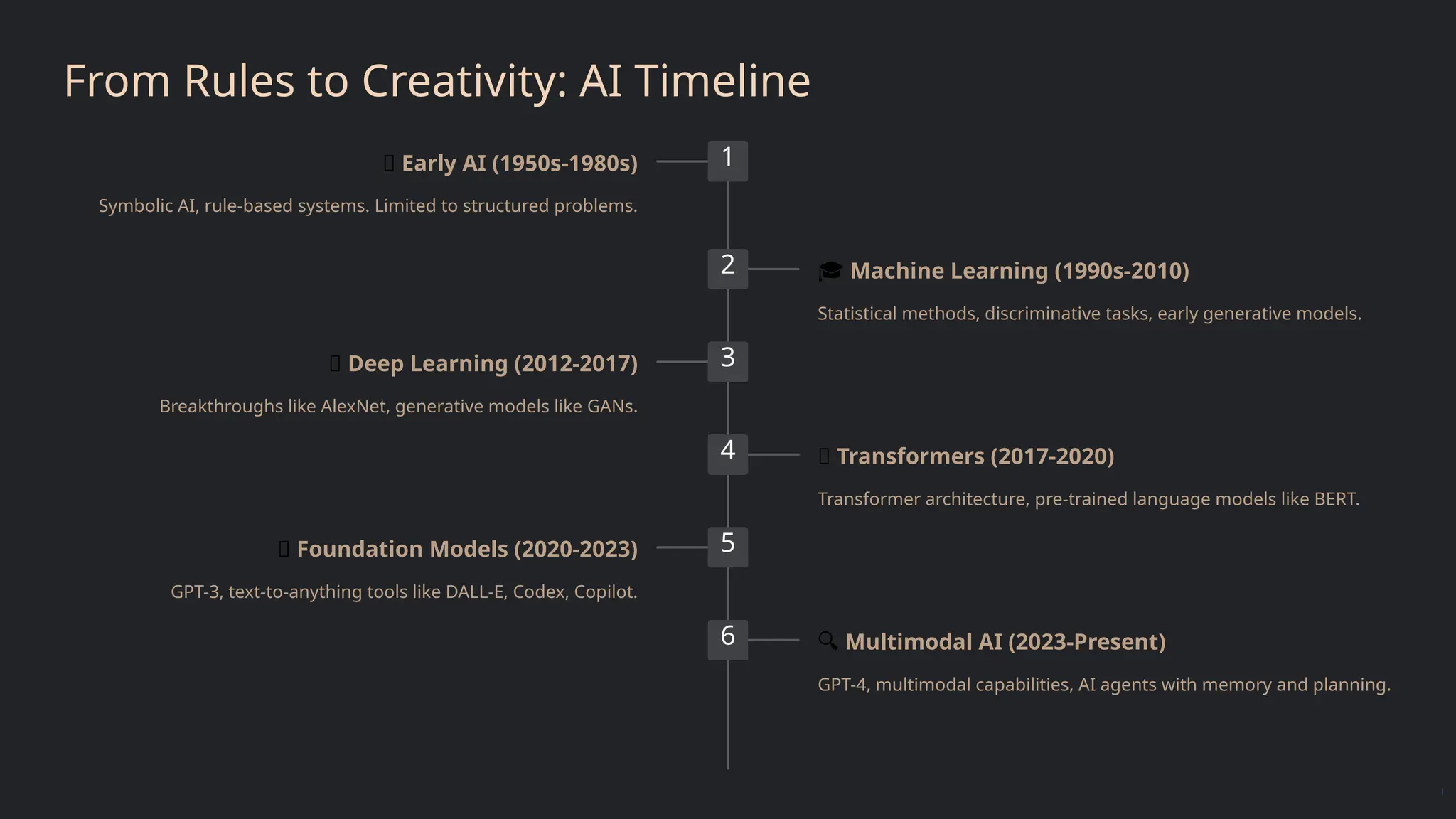
From Rules toCreativity: AI Timeline
1
🧠 Early AI (1950s-1980s)
Symbolic AI, rule-based systems. Limited to structured problems.
2 🎓 Machine Learning (1990s-2010)
Statistical methods, discriminative tasks, early generative models.
3
🤖 Deep Learning (2012-2017)
Breakthroughs like AlexNet, generative models like GANs.
4 🔮 Transformers (2017-2020)
Transformer architecture, pre-trained language models like BERT.
5
🌟 Foundation Models (2020-2023)
GPT-3, text-to-anything tools like DALL-E, Codex, Copilot.
6 🔍 Multimodal AI (2023-Present)
GPT-4, multimodal capabilities, AI agents with memory and planning.
3.
What is MachineLearning?
Machine Learning (ML) is a captivating subfield of Artificial Intelligence.
What is Machine Learning?
ML is a method of teaching
computers to learn from data
without explicit programming.
Arthur Samuel's Definition
"Machine learning is the science of
getting computers to learn from data
without being explicitly
programmed."
Tom Michell's Definition
"A computer program is said to learn from Experience E with respect to some Task
T and some Performance measure P; if performance on T, as measured by P,
improves with experience E."
4.
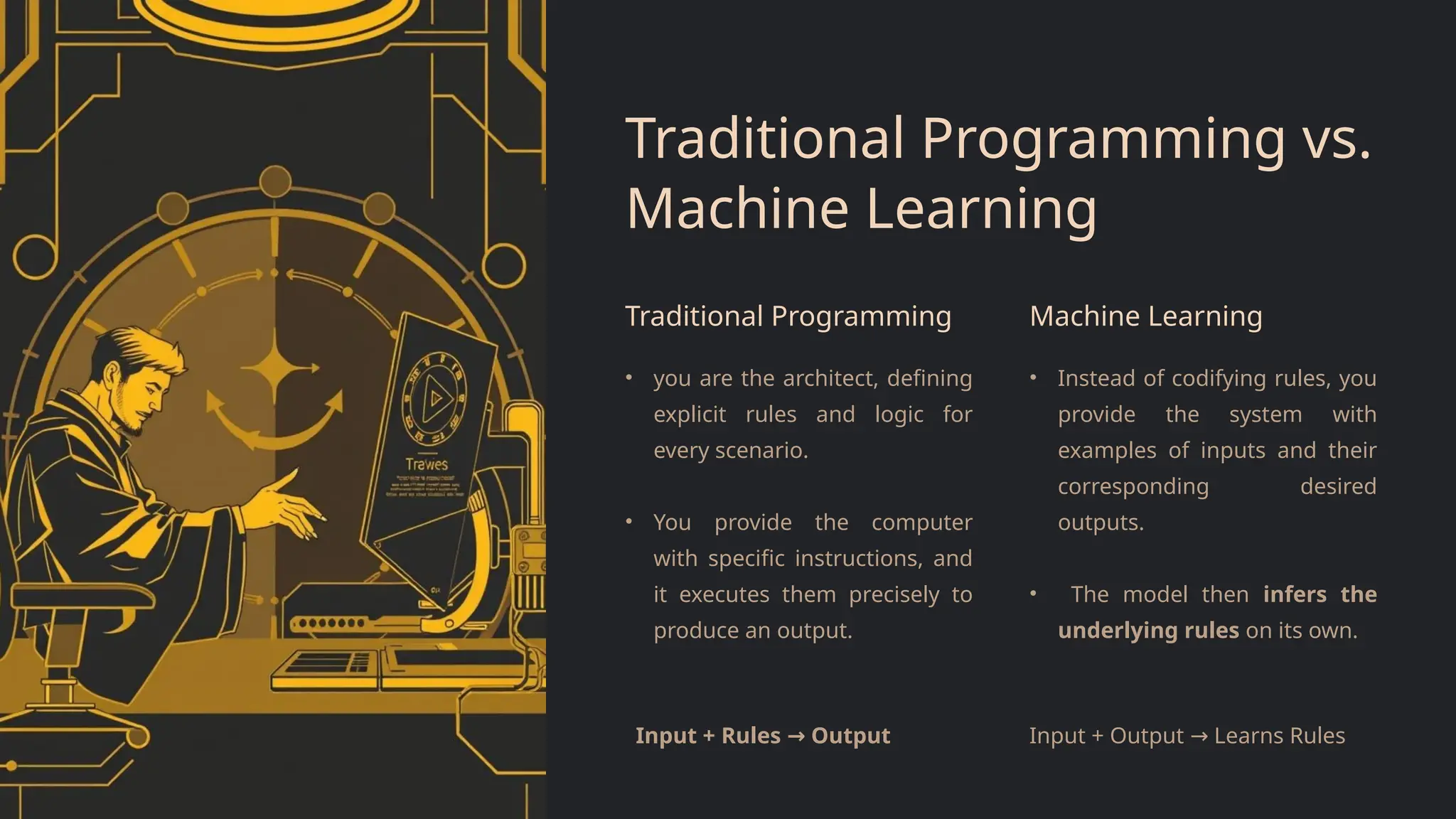
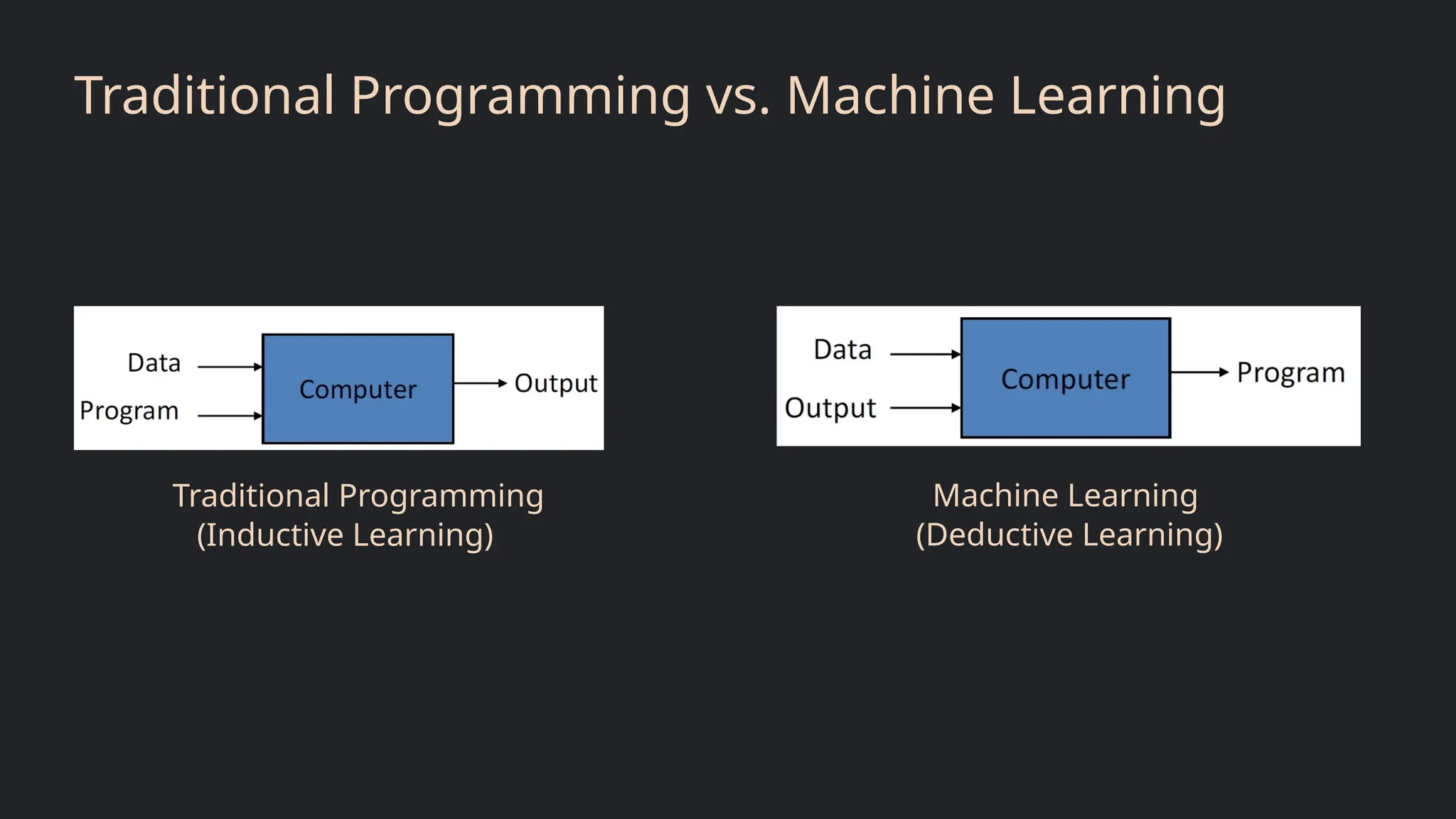
Traditional Programming vs.
MachineLearning
Traditional Programming
• you are the architect, defining
explicit rules and logic for
every scenario.
• You provide the computer
with specific instructions, and
it executes them precisely to
produce an output.
Input + Rules Output
→
Machine Learning
• Instead of codifying rules, you
provide the system with
examples of inputs and their
corresponding desired
outputs.
• The model then infers the
underlying rules on its own.
Input + Output Learns Rules
→
5.
Traditional Programming vs.Machine Learning
Traditional Programming
(Inductive Learning)
Machine Learning
(Deductive Learning)
6.
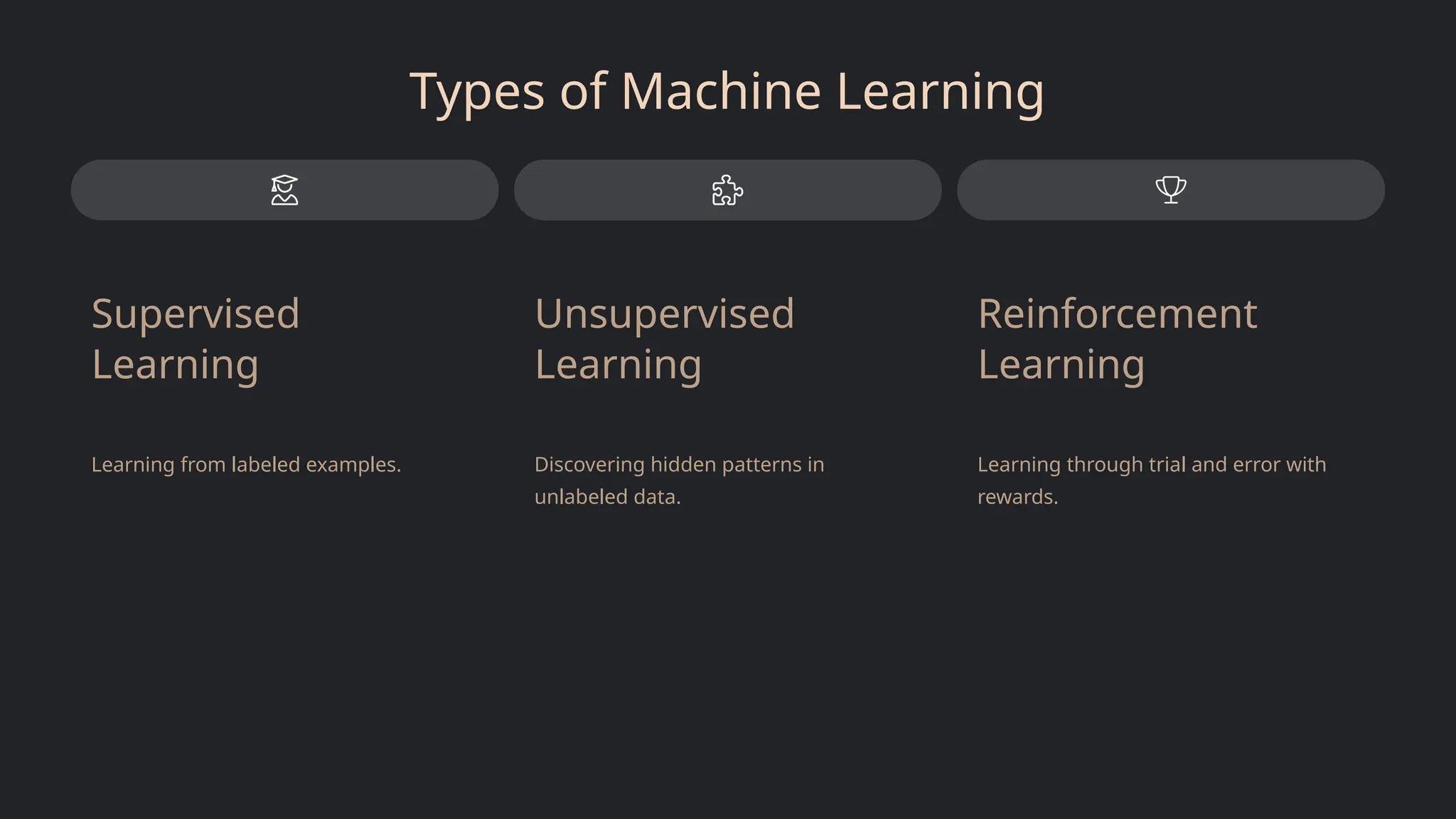
Types of MachineLearning
Supervised
Learning
Learning from labeled examples.
Unsupervised
Learning
Discovering hidden patterns in
unlabeled data.
Reinforcement
Learning
Learning through trial and error with
rewards.
7.
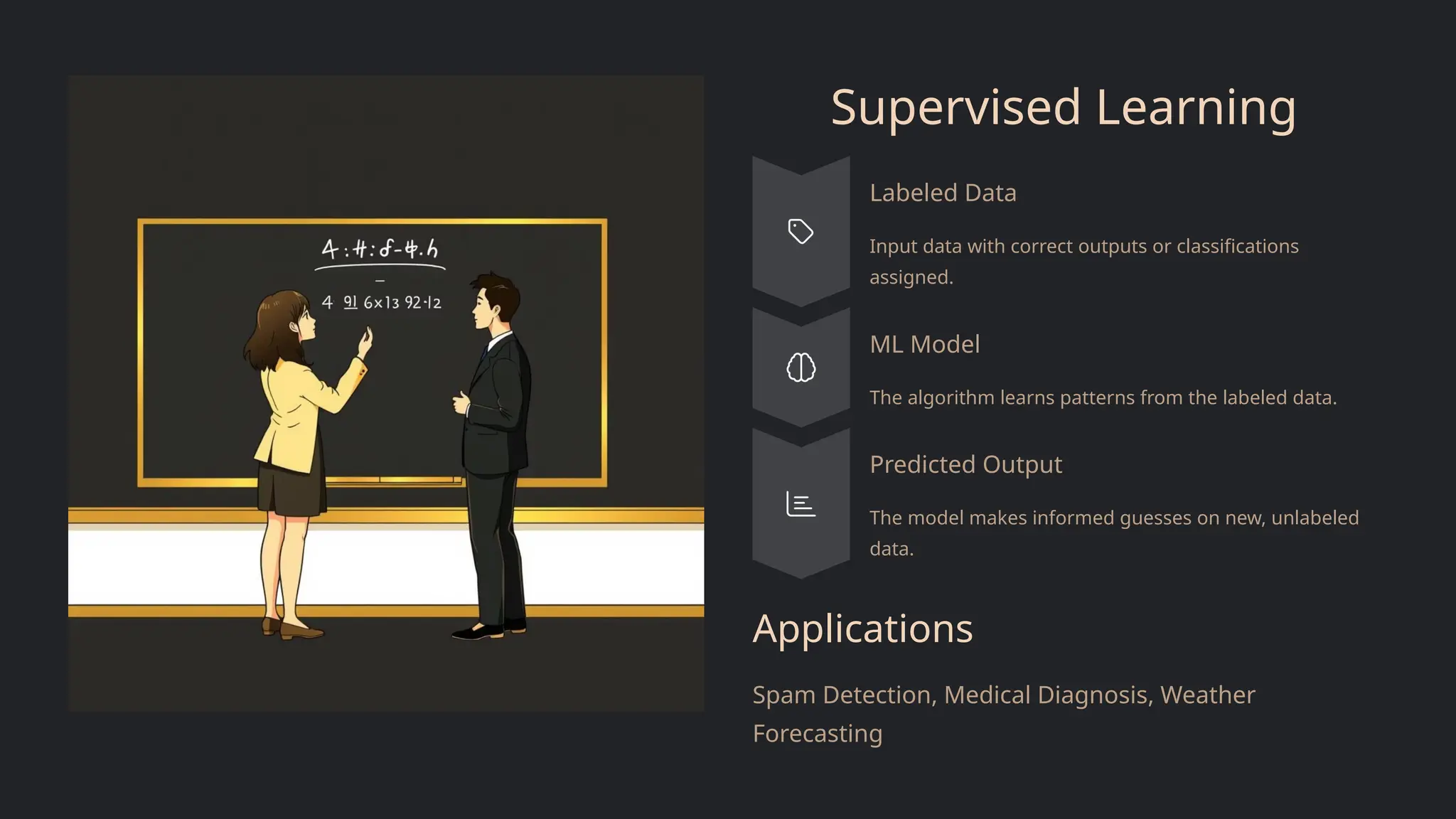
Supervised Learning
Labeled Data
Inputdata with correct outputs or classifications
assigned.
ML Model
The algorithm learns patterns from the labeled data.
Predicted Output
The model makes informed guesses on new, unlabeled
data.
Applications
Spam Detection, Medical Diagnosis, Weather
Forecasting
8.
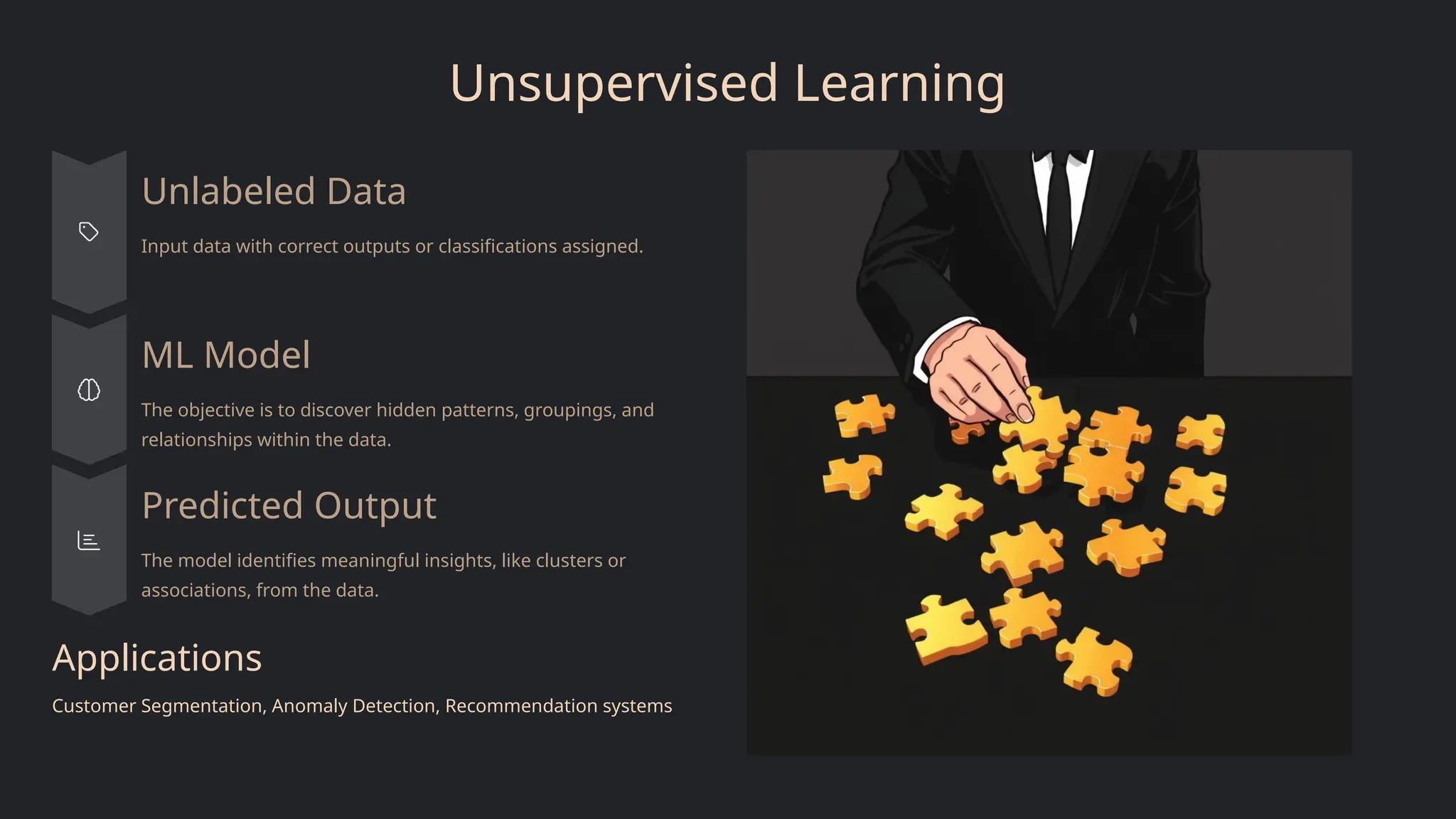
Unsupervised Learning
Unlabeled Data
Inputdata with correct outputs or classifications assigned.
ML Model
The objective is to discover hidden patterns, groupings, and
relationships within the data.
Predicted Output
The model identifies meaningful insights, like clusters or
associations, from the data.
Applications
Customer Segmentation, Anomaly Detection, Recommendation systems
9.
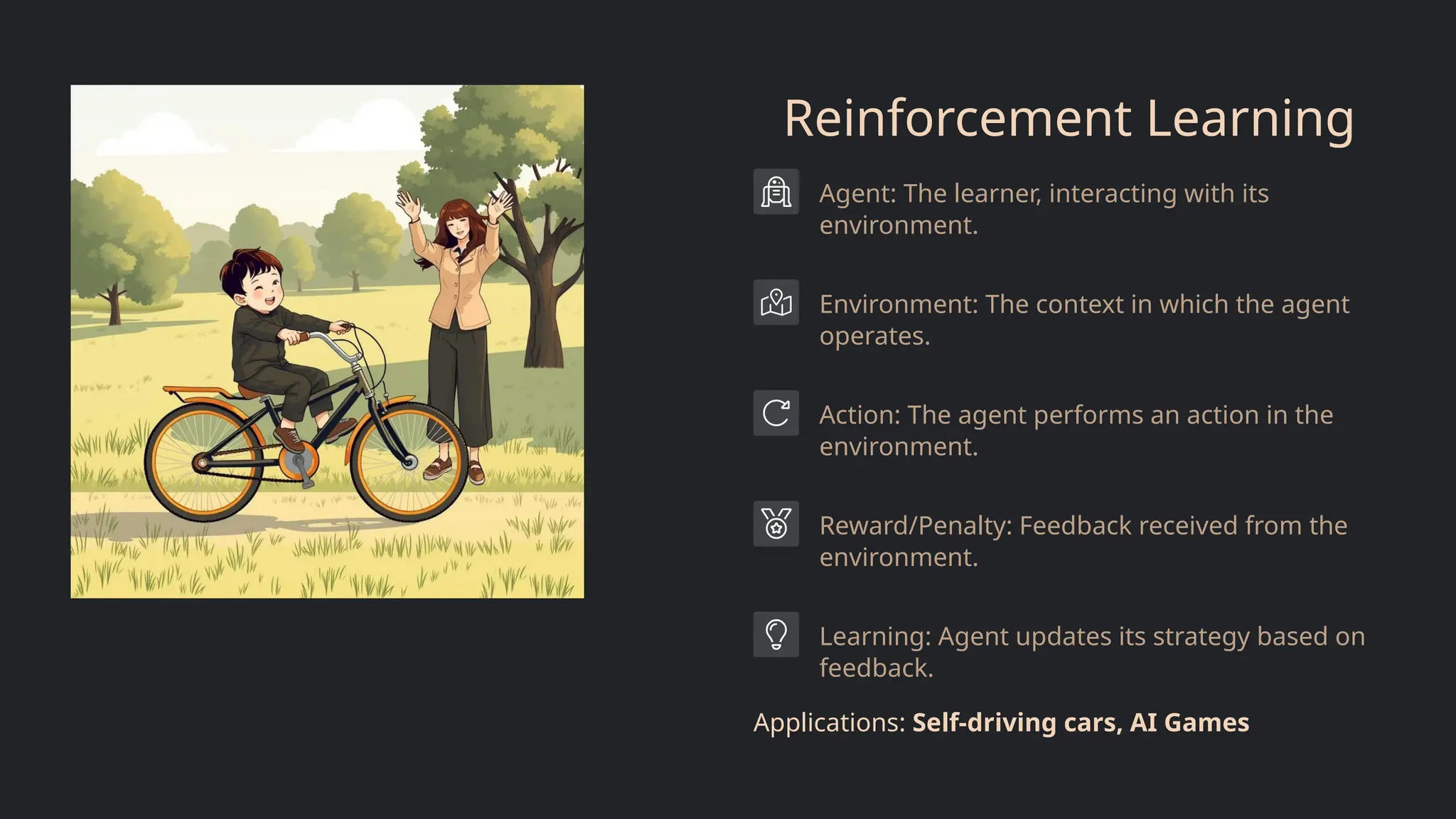
Reinforcement Learning
Agent: Thelearner, interacting with its
environment.
Environment: The context in which the agent
operates.
Action: The agent performs an action in the
environment.
Reward/Penalty: Feedback received from the
environment.
Learning: Agent updates its strategy based on
feedback.
Applications: Self-driving cars, AI Games
10.
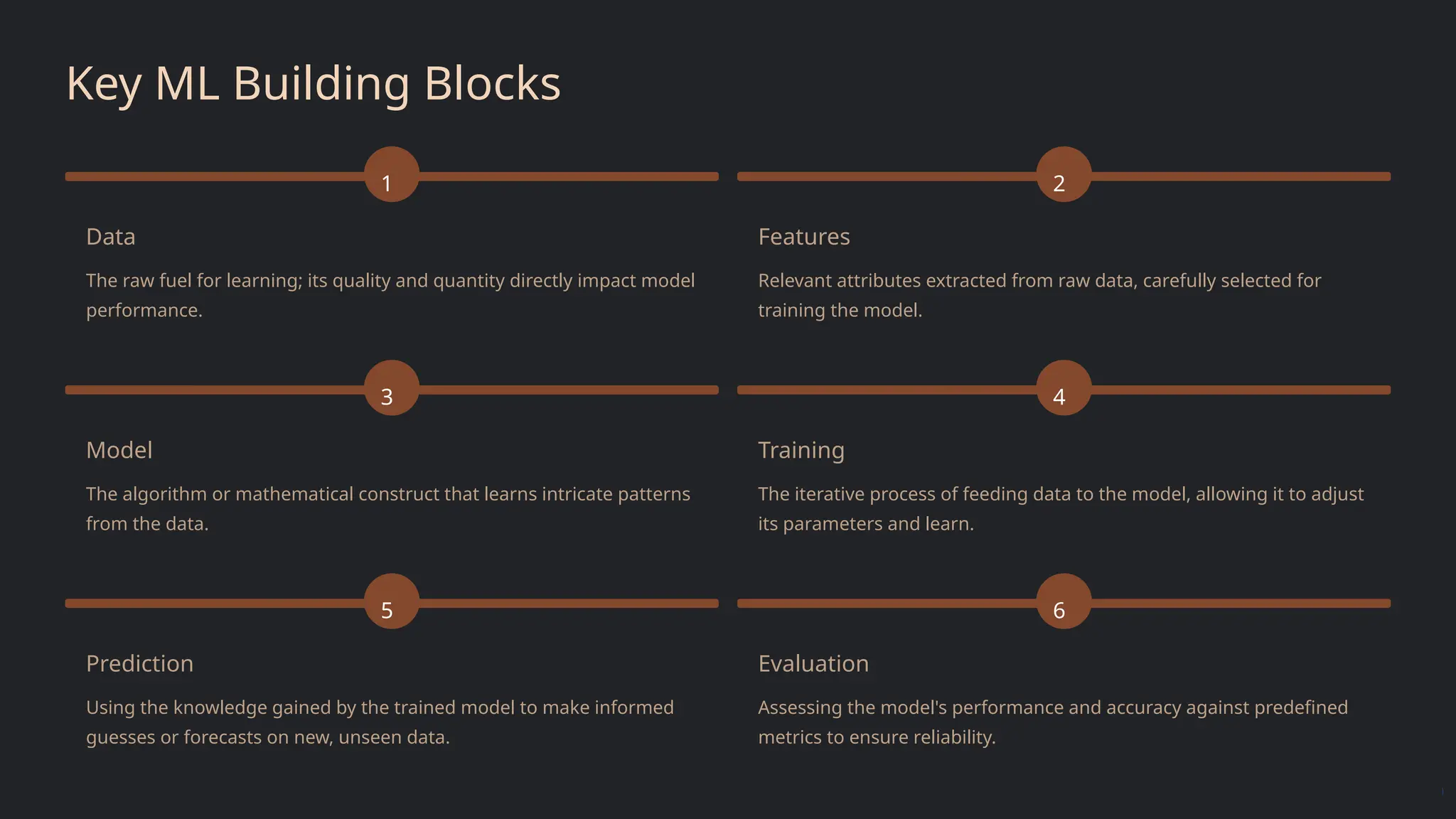
Key ML BuildingBlocks
1
Data
The raw fuel for learning; its quality and quantity directly impact model
performance.
2
Features
Relevant attributes extracted from raw data, carefully selected for
training the model.
3
Model
The algorithm or mathematical construct that learns intricate patterns
from the data.
4
Training
The iterative process of feeding data to the model, allowing it to adjust
its parameters and learn.
5
Prediction
Using the knowledge gained by the trained model to make informed
guesses or forecasts on new, unseen data.
6
Evaluation
Assessing the model's performance and accuracy against predefined
metrics to ensure reliability.
11.
Where is MLUsed Today?
Machine Learning has permeated nearly every industry, transforming how we live, work, and interact. Its applications are
vast and continue to expand, driving innovation across diverse sectors.
Healthcare
From aiding in early disease diagnosis to accelerating drug
discovery.
Finance
Powering algorithmic trading, fraud detection, and risk
assessment.
E-commerce
Delivering personalized product recommendations and
optimizing inventory.
Social Media
Enabling facial recognition, content moderation, and
personalized feeds.
Editor's Notes
#2 The journey began with rule-based systems, where everything had to be hard-coded. These systems could only follow pre-defined logic — no learning, no creativity.
Then came traditional machine learning models. These could learn patterns from data, but they still couldn’t create anything new. Their role was mostly predictive — such as identifying spam emails or recommending products.
The real shift happened with the rise of deep learning and especially with Generative models like GANs — Generative Adversarial Networks. These were among the first models that could actually generate new data — like fake faces that look incredibly real.
But the breakthrough that made GenAI mainstream was the invention of transformer architecture — starting with models like BERT and evolving into large-scale models like GPT, DALL·E, Gemini, and others.
These models could not only generate coherent text or images but also do so contextually — based on prompts or questions.
And now, we’re entering a phase where multi-modal models like Sora can generate video from text, and others can work across text, image, and audio all at once.
So, Generative AI has evolved from static logic-based systems to dynamic, creative tools that can assist — or even inspire — human imagination."


![1_Introduction to Machine Learning [Autosaved].pptx](https://cdn.slidesharecdn.com/ss_thumbnails/1introductiontomachinelearningautosaved-250910004933-3913b711-thumbnail.jpg?width=640&height=640&fit=bounds)


![Coded Agents – with UiPath SDK + LangGraph [Virtual Hands-on Workshop]](https://cdn.slidesharecdn.com/ss_thumbnails/codedagentsdeck-251215155422-5497c599-thumbnail.jpg?width=640&height=640&fit=bounds)


