BASIC PHYSICS FOR THE
ANAESTHESIOLOGISTS
RATHER APPLIED PHYSICS
WE HATE PHYSICS…
THAT’S WHY WE JOINED
MEDICINE….
ISA
2/78
BUT… THERE IS A LITTLE BIT OF
PHYSICS IN ALLACTIVITIES OF
OUR DAY TO DAY LIFE….
3/78
JUST NOW I’VE FITTED THE MACHINE
WITH A NEW N2O CYLINDER….
HOW LONG WILL IT LAST…?
CAN I TAKE A CASE WHICH MAY LAST
FOR 6 HOURS….?
How the physics knowledge helps the Anaesthesiologists?
4/78
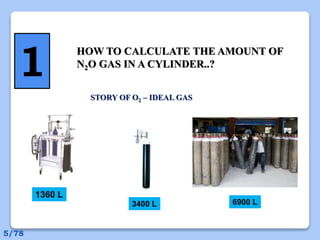
HOW TO CALCULATE THE AMOUNT OF
N2O GAS IN A CYLINDER..?
STORY OF O2 – IDEAL GAS
1360 L
3400 L 6900 L
1
5/78
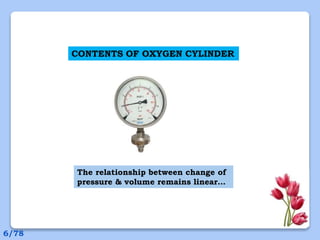
CONTENTS OF OXYGEN CYLINDER
The relationship between change of
pressure & volume remains linear…
6/78
++
+
+
+
+
+
+
+
+
+
+
+
+
+
+
+
+
+
+
+
+
+
+
+
+
+
+
+
+
++
+
+
+
+
+
+
+
+
+
+
+
+
+
+
+
+
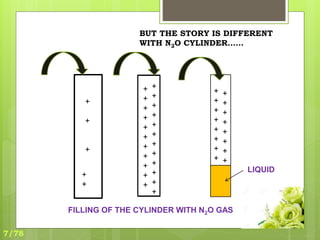
FILLING OF THE CYLINDER WITH N2O GAS
LIQUID
BUT THE STORY IS DIFFERENT
WITH N2O CYLINDER……
7/78
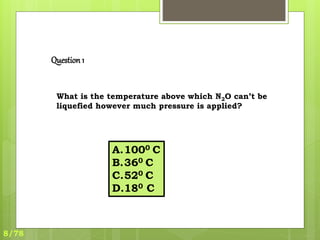
Question 1
What is the temperature above which N2O can’t be
liquefied however much pressure is applied?
A.1000 C
B.360 C
C.520 C
D.180 C
8/78
*******
*******
*******
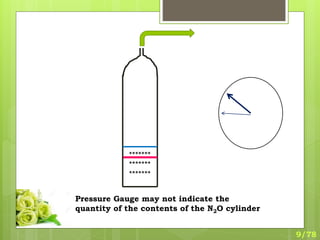
Pressure Gauge may not indicate the
quantity of the contents of the N2O cylinder
9/78
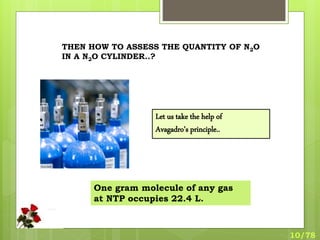
THEN HOW TO ASSESS THE QUANTITY OF N2O
IN A N2O CYLINDER..?
Let us take the help of
Avagadro’s principle..
One gram molecule of any gas
at NTP occupies 22.4 L.
10/78
MOLECULAR WEIGHT=ADDITION OF ATOMIC WEIGHT
ATOMIC WEIGHT OF NITROGEN – 14, OXYGEN – 16
MOLECULAR WEIGHT OF N2O – 14+14+16 = 44
One gram molecule of any gas
at NTP occupies 22.4 L.
One gram molecule = Gram molecular weight = molecular weight
expressed in grams
11/78
AVAGADRO HYPOTHESIS:
ONE GRAM MOLECULAR WEIGHT OF ALL GASES WILL CONTAIN THE
SAME NUMBER OF MOLECULES AND OCCUPY THE SAME VOLUME ( 22.4 L)
AT S.T.P
32 g OF O2 = 44 g OF N2O = 28 g OF N2 =22.4 LITERS
12/78
AMOUNT OF N2O GAS IN A CYLINDER
TARE WEIGHT OF THE CYLINDER = 12.5 K.G
CYLINDER WEIGHT WITH N2O = 15 K.G
SO.. WEIGHT OF THE N2O = 2.5 K.G = 2500G
44G OF N2O = 22.4 L
THEREFORE 2500 G = 22.4/44 x 2500 = 1272 L
13/78
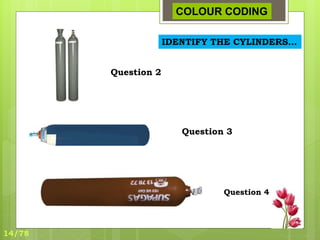
COLOUR CODING
IDENTIFY THE CYLINDERS...
Question 2
Question 3
Question 4
14/78
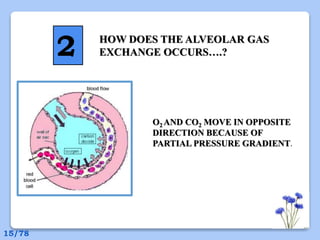
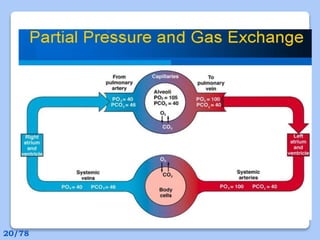
HOW DOES THE ALVEOLAR GAS
EXCHANGE OCCURS….?
O2 AND CO2 MOVE IN OPPOSITE
DIRECTION BECAUSE OF
PARTIAL PRESSURE GRADIENT.
2
15/78
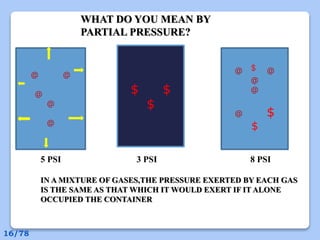
WHAT DO YOU MEAN BY
PARTIAL PRESSURE?
@ @
@
@
@
$ $
$
@ @
@
@
@ $
$
IN A MIXTURE OF GASES,THE PRESSURE EXERTED BY EACH GAS
IS THE SAME AS THAT WHICH IT WOULD EXERT IF IT ALONE
OCCUPIED THE CONTAINER
$
5 PSI 3 PSI 8 PSI
16/78
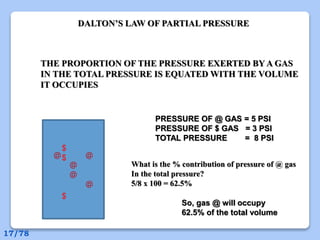
DALTON’S LAW OF PARTIAL PRESSURE
THE PROPORTION OF THE PRESSURE EXERTED BY A GAS
IN THE TOTAL PRESSURE IS EQUATED WITH THE VOLUME
IT OCCUPIES
@ @
@
@
@
$
$
$
PRESSURE OF @ GAS = 5 PSI
PRESSURE OF $ GAS = 3 PSI
TOTAL PRESSURE = 8 PSI
What is the % contribution of pressure of @ gas
In the total pressure?
5/8 x 100 = 62.5%
So, gas @ will occupy
62.5% of the total volume
17/78
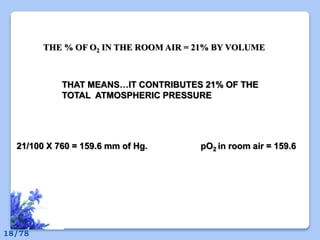
THE % OF O2 IN THE ROOM AIR = 21% BY VOLUME
THAT MEANS…IT CONTRIBUTES 21% OF THE
TOTAL ATMOSPHERIC PRESSURE
21/100 X 760 = 159.6 mm of Hg. pO2 in room air = 159.6
18/78
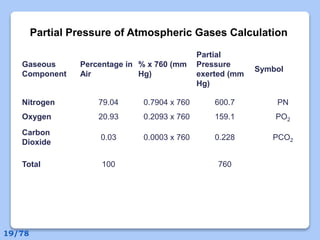
Gaseous
Component
Percentage in
Air
% x 760 (mm
Hg)
Partial
Pressure
exerted (mm
Hg)
Symbol
Nitrogen 79.04 0.7904 x 760 600.7 PN
Oxygen 20.93 0.2093 x 760 159.1 PO2
Carbon
Dioxide
0.03 0.0003 x 760 0.228 PCO2
Total 100 760
Partial Pressure of Atmospheric Gases Calculation
19/78
20/78
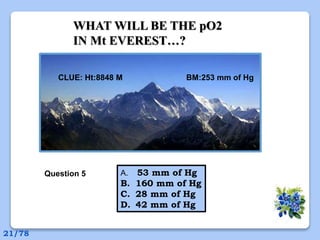
WHAT WILL BE THE pO2
IN Mt EVEREST…?
A. 53 mm of Hg
B. 160 mm of Hg
C. 28 mm of Hg
D. 42 mm of Hg
Question 5
CLUE: Ht:8848 M BM:253 mm of Hg
21/78
* *
**
**
*** ** ***
* * *
* * * **
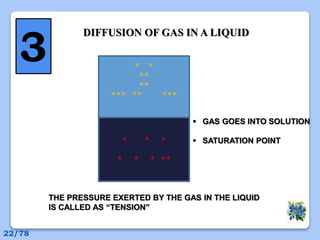
DIFFUSION OF GAS IN A LIQUID
 GAS GOES INTO SOLUTION
 SATURATION POINT
THE PRESSURE EXERTED BY THE GAS IN THE LIQUID
IS CALLED AS “TENSION”
3
22/78
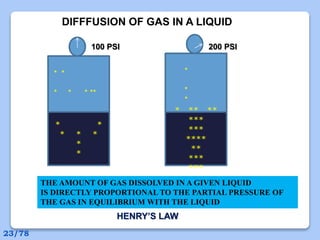
DIFFFUSION OF GAS IN A LIQUID
100 PSI 200 PSI
* *
* * *
*
*
* *
* * * **
* ** **
***
***
****
**
***
***
*
*
*
THE AMOUNT OF GAS DISSOLVED IN A GIVEN LIQUID
IS DIRECTLY PROPORTIONAL TO THE PARTIAL PRESSURE OF
THE GAS IN EQUILIBRIUM WITH THE LIQUID
HENRY’S LAW
23/78
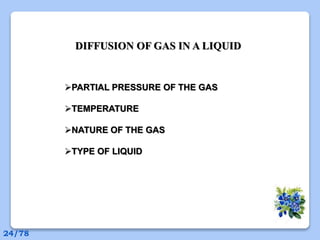
DIFFUSION OF GAS IN A LIQUID
PARTIAL PRESSURE OF THE GAS
TEMPERATURE
NATURE OF THE GAS
TYPE OF LIQUID
24/78
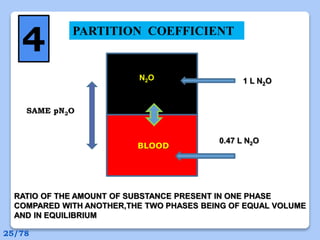
PARTITION COEFFICIENT
BLOOD
N2O
0.47 L N2O
RATIO OF THE AMOUNT OF SUBSTANCE PRESENT IN ONE PHASE
COMPARED WITH ANOTHER,THE TWO PHASES BEING OF EQUAL VOLUME
AND IN EQUILIBRIUM
4
1 L N2O
SAME pN2O
25/78
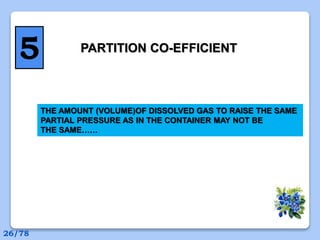
PARTITION CO-EFFICIENT
THE AMOUNT (VOLUME)OF DISSOLVED GAS TO RAISE THE SAME
PARTIAL PRESSURE AS IN THE CONTAINER MAY NOT BE
THE SAME……
5
26/78
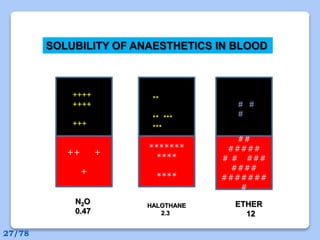
++++
++++
+++
**
** ***
***
# #
#
++ +
+
*******
****
****
##
#####
# # ###
####
#######
#
N2O
0.47
HALOTHANE
2.3
ETHER
12
SOLUBILITY OF ANAESTHETICS IN BLOOD
27/78
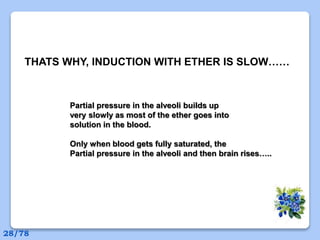
THATS WHY, INDUCTION WITH ETHER IS SLOW……
Partial pressure in the alveoli builds up
very slowly as most of the ether goes into
solution in the blood.
Only when blood gets fully saturated, the
Partial pressure in the alveoli and then brain rises…..
28/78
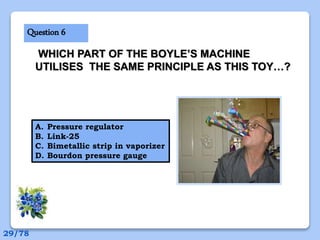
WHICH PART OF THE BOYLE’S MACHINE
UTILISES THE SAME PRINCIPLE AS THIS TOY…?
Question 6
A. Pressure regulator
B. Link-25
C. Bimetallic strip in vaporizer
D. Bourdon pressure gauge
29/78
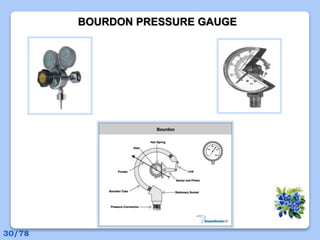
BOURDON PRESSURE GAUGE
30/78
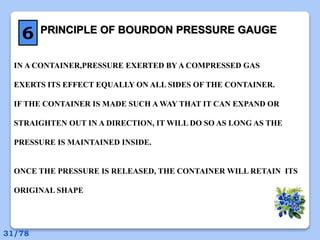
IN A CONTAINER,PRESSURE EXERTED BY A COMPRESSED GAS
EXERTS ITS EFFECT EQUALLY ON ALL SIDES OF THE CONTAINER.
IF THE CONTAINER IS MADE SUCH A WAY THAT IT CAN EXPAND OR
STRAIGHTEN OUT IN A DIRECTION, IT WILL DO SO AS LONG AS THE
PRESSURE IS MAINTAINED INSIDE.
ONCE THE PRESSURE IS RELEASED, THE CONTAINER WILL RETAIN ITS
ORIGINAL SHAPE
PRINCIPLE OF BOURDON PRESSURE GAUGE
6
31/78
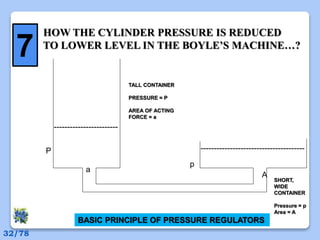
------------------------
---------------------------------------
BASIC PRINCIPLE OF PRESSURE REGULATORS
TALL CONTAINER
PRESSURE = P
AREA OF ACTING
FORCE = a
SHORT,
WIDE
CONTAINER
Pressure = p
Area = A
P
a
p
A
HOW THE CYLINDER PRESSURE IS REDUCED
TO LOWER LEVEL IN THE BOYLE’S MACHINE…?
7
32/78
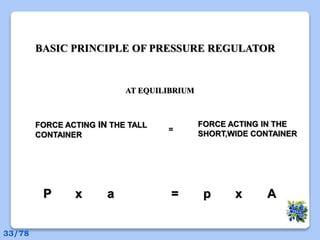
BASIC PRINCIPLE OF PRESSURE REGULATOR
AT EQUILIBRIUM
FORCE ACTING IN THE TALL
CONTAINER
=
FORCE ACTING IN THE
SHORT,WIDE CONTAINER
P x a = p x A
33/78
A LARGE FORCE ACTING ON A SMALL SURFACE AREA
CAN BE BALANCED BY
A SMALL FORCE ACTING ON A LARGE SURFACE AREA
BASIC PRINCIPLE OF
PRESSURE REGULATORS
34/78
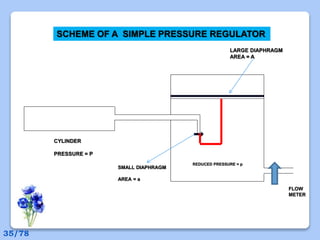
CYLINDER
PRESSURE = P
SMALL DIAPHRAGM
AREA = a
LARGE DIAPHRAGM
AREA = A
REDUCED PRESSURE = p
FLOW
METER
SCHEME OF A SIMPLE PRESSURE REGULATOR
35/78
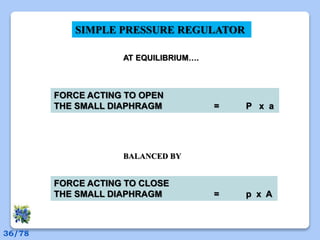
SIMPLE PRESSURE REGULATOR
FORCE ACTING TO OPEN
THE SMALL DIAPHRAGM = P x a
AT EQUILIBRIUM….
FORCE ACTING TO CLOSE
THE SMALL DIAPHRAGM = p x A
BALANCED BY
36/78
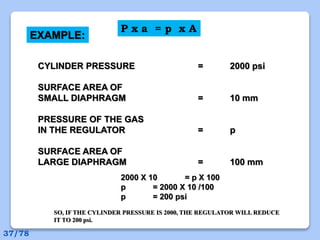
EXAMPLE:
CYLINDER PRESSURE = 2000 psi
SURFACE AREA OF
SMALL DIAPHRAGM = 10 mm
PRESSURE OF THE GAS
IN THE REGULATOR = p
SURFACE AREA OF
LARGE DIAPHRAGM = 100 mm
2000 X 10 = p X 100
p = 2000 X 10 /100
p = 200 psi
SO, IF THE CYLINDER PRESSURE IS 2000, THE REGULATOR WILL REDUCE
IT TO 200 psi.
P x a = p x A
37/78
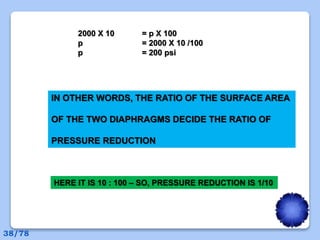
2000 X 10 = p X 100
p = 2000 X 10 /100
p = 200 psi
IN OTHER WORDS, THE RATIO OF THE SURFACE AREA
OF THE TWO DIAPHRAGMS DECIDE THE RATIO OF
PRESSURE REDUCTION
HERE IT IS 10 : 100 – SO, PRESSURE REDUCTION IS 1/10
38/78
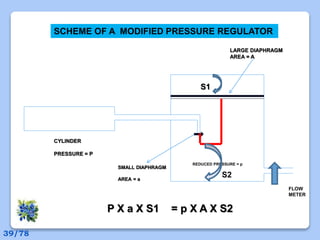
CYLINDER
PRESSURE = P
SMALL DIAPHRAGM
AREA = a
LARGE DIAPHRAGM
AREA = A
REDUCED PRESSURE = p
FLOW
METER
SCHEME OF A MODIFIED PRESSURE REGULATOR
S1
S2
P X a X S1 = p X A X S2
39/78
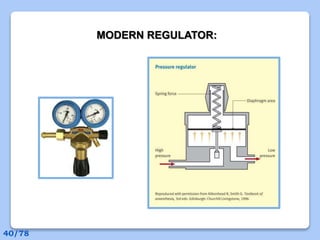
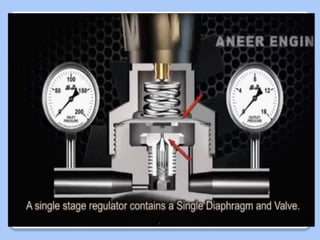
MODERN REGULATOR:
40/78
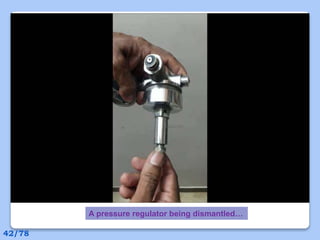
A pressure regulator being dismantled…
42/78
Oil or grease application in any part of the
Boyle’s apparatus is not advised…
Why…?
8
43/78
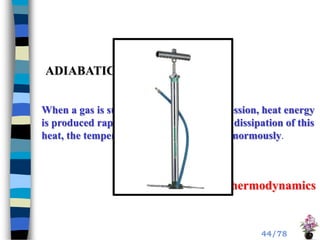
ADIABATIC COMPRESSION:
When a gas is subjected to sudden compression, heat energy
is produced rapidly. If there is no time for dissipation of this
heat, the temperature of the system rises enormously.
First law of thermodynamics
44/78
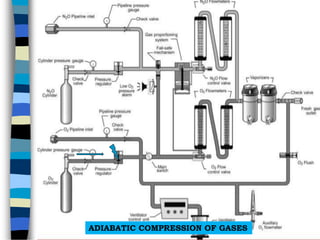
ADIABATIC COMPRESSION OF GASES
Have you seen ice crystal formation over a cylinder valve
if N2O leaks through it?
Joule-Thomson effect
9
46/78
Joule-Thomson effect:
When a compressed gas is allowed free expansion
through a narrow opening, the temperature of the
surrounding falls rapidly.
47/78
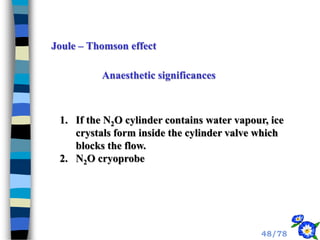
Joule – Thomson effect
Anaesthetic significances
1. If the N2O cylinder contains water vapour, ice
crystals form inside the cylinder valve which
blocks the flow.
2. N2O cryoprobe
48/78
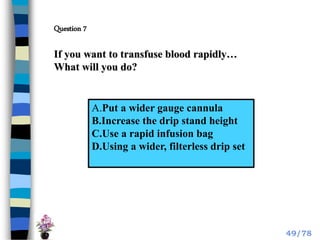
If you want to transfuse blood rapidly…
What will you do?
A.Put a wider gauge cannula
B.Increase the drip stand height
C.Use a rapid infusion bag
D.Using a wider, filterless drip set
Question 7
49/78
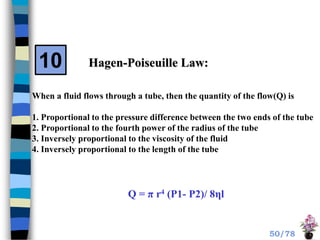
Hagen-Poiseuille Law:
When a fluid flows through a tube, then the quantity of the flow(Q) is
1. Proportional to the pressure difference between the two ends of the tube
2. Proportional to the fourth power of the radius of the tube
3. Inversely proportional to the viscosity of the fluid
4. Inversely proportional to the length of the tube
Q = π r4 (P1- P2)/ 8ηl
10
50/78
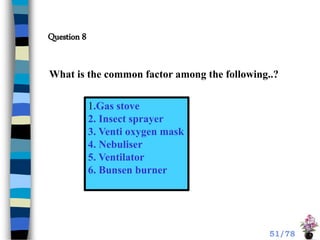
What is the common factor among the following..?
1.Gas stove
2. Insect sprayer
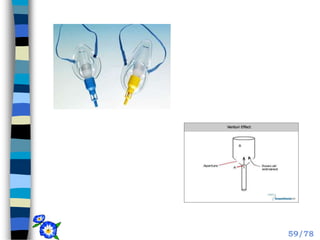
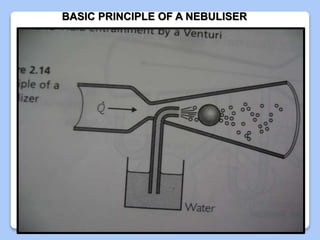
3. Venti oxygen mask
4. Nebuliser
5. Ventilator
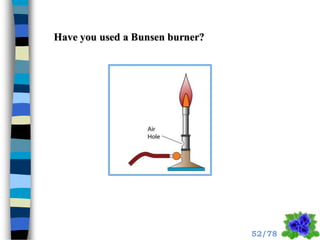
6. Bunsen burner
Question 8
51/78
52/78
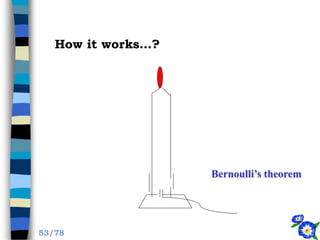
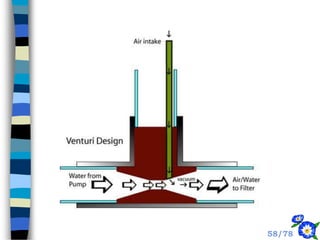
Bernoulli’s theorem
How it works…?
53/78
Question 9
What is the stoichiometric concentration
of ether in air?
A.8.6%
B.12.2%
C.3.4%
D.1.5%
54/78
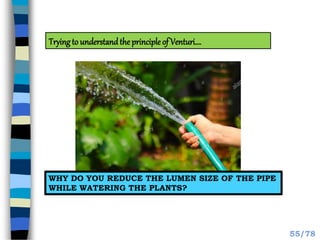
WHY DO YOU REDUCE THE LUMEN SIZE OF THE PIPE
WHILE WATERING THE PLANTS?
Trying to understandthe principle of Venturi….
55/78
0
0
0
+
-
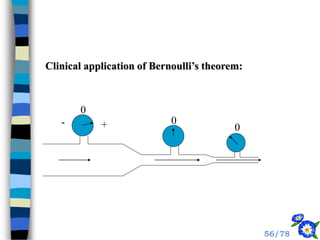
Clinical application of Bernoulli’s theorem:
56/78
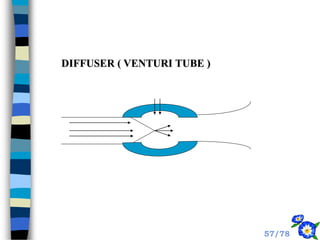
DIFFUSER ( VENTURI TUBE )
57/78
58/78
59/78
BASIC PRINCIPLE OF A NEBULISER
HOW ARE THE LUNG ALVEOLI ARE
KEPT INTACT WITHOUT GETTING
BURST / COLLAPSED?
11
61/78
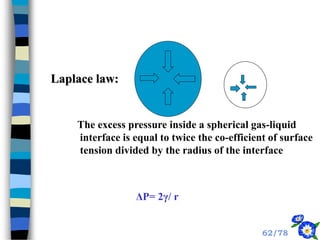
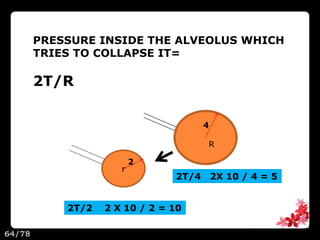
Laplace law:
The excess pressure inside a spherical gas-liquid
interface is equal to twice the co-efficient of surface
tension divided by the radius of the interface
ΔP= 2γ/ r
62/78
63/78
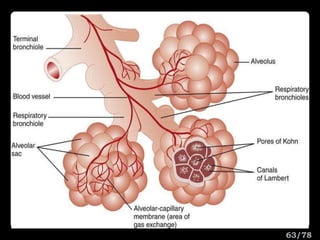
PRESSURE INSIDE THE ALVEOLUS WHICH
TRIES TO COLLAPSE IT=
2T/R
r
R
2T/2 2 X 10 / 2 = 10
2T/4 2X 10 / 4 = 5
4
2
64/78
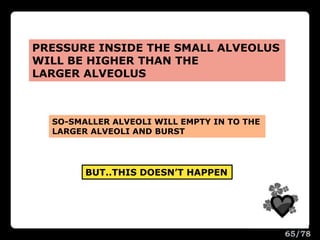
PRESSURE INSIDE THE SMALL ALVEOLUS
WILL BE HIGHER THAN THE
LARGER ALVEOLUS
SO-SMALLER ALVEOLI WILL EMPTY IN TO THE
LARGER ALVEOLI AND BURST
BUT..THIS DOESN’T HAPPEN
65/78
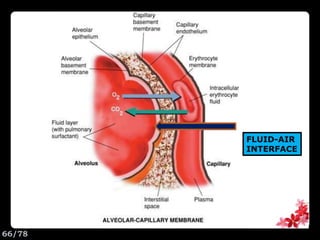
FLUID-AIR
INTERFACE
66/78
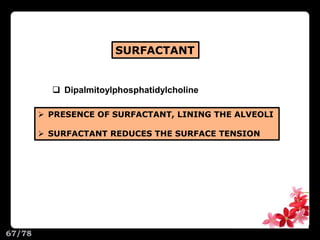
SURFACTANT
 PRESENCE OF SURFACTANT, LINING THE ALVEOLI
 SURFACTANT REDUCES THE SURFACE TENSION
 Dipalmitoylphosphatidylcholine
67/78
r
R
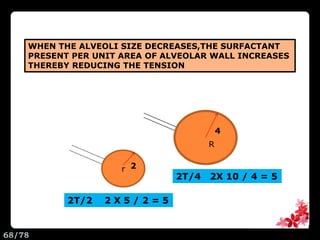
2T/2 2 X 5 / 2 = 5
2T/4 2X 10 / 4 = 5
4
2
WHEN THE ALVEOLI SIZE DECREASES,THE SURFACTANT
PRESENT PER UNIT AREA OF ALVEOLAR WALL INCREASES
THEREBY REDUCING THE TENSION
68/78
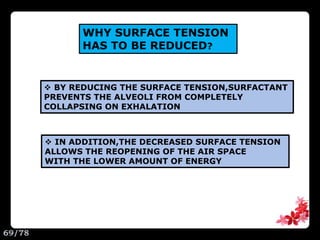
 BY REDUCING THE SURFACE TENSION,SURFACTANT
PREVENTS THE ALVEOLI FROM COMPLETELY
COLLAPSING ON EXHALATION
 IN ADDITION,THE DECREASED SURFACE TENSION
ALLOWS THE REOPENING OF THE AIR SPACE
WITH THE LOWER AMOUNT OF ENERGY
WHY SURFACE TENSION
HAS TO BE REDUCED?
69/78
RECAP:
1.The contents of N2O cylinders can be arrived by weighing
it and using Avagadros’s law.
2. Pressure regulators work with a simple principle.
The ratio of the size of the diaphragm decide the extent of pressure
reduction.
3. Partial pressure gradient of gases decide the direction
Of gas diffusion. Not the volume % of gases.
4. Oil or Grease should not to be applied over the cylinder valve
To loosen it as it may cause explosion.
5. Venturi effect plays an important role in many gadgets
of anaesthesia.
5. Alveolar collapse is prevented by the presence of surfactant.
70/78
Before I wind up….
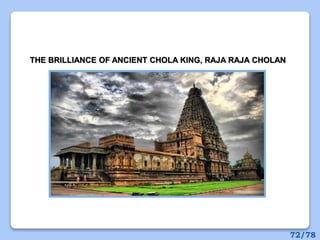
THE BRILLIANCE OF ANCIENT CHOLA KING, RAJA RAJA CHOLAN
72/78
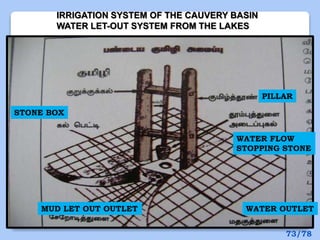
IRRIGATION SYSTEM OF THE CAUVERY BASIN
WATER LET-OUT SYSTEM FROM THE LAKES
PILLAR
STONE BOX
WATER FLOW
STOPPING STONE
WATER OUTLET
MUD LET OUT OUTLET
73/78
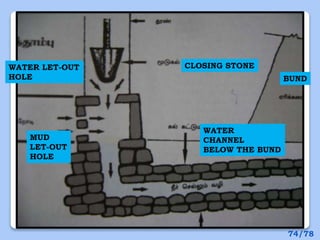
CLOSING STONE
MUD
LET-OUT
HOLE
WATER LET-OUT
HOLE
WATER
CHANNEL
BELOW THE BUND
BUND
74/78
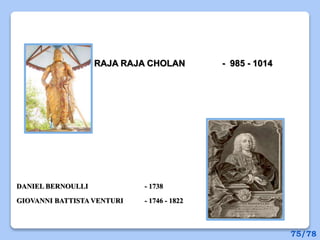
DANIEL BERNOULLI - 1738
GIOVANNI BATTISTA VENTURI - 1746 - 1822
RAJA RAJA CHOLAN - 985 - 1014
75/78
THANK YOU
dr.r.selvakumar. m.d.d.a.dnb
professor of anaesthesiology,
k.a.p.viswanatham govt. medical college,
trichy
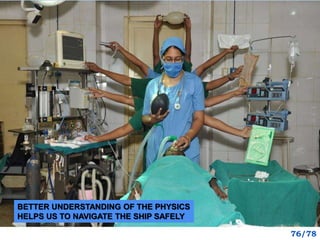
BETTER UNDERSTANDING OF THE PHYSICS
HELPS US TO NAVIGATE THE SHIP SAFELY
76/78
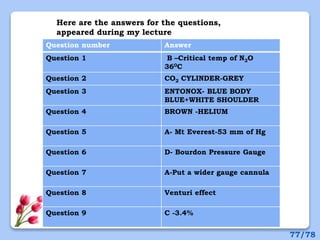
Here are the answers for the questions,
appeared during my lecture
Question number Answer
Question 1 B –Critical temp of N2O
360C
Question 2 CO2 CYLINDER-GREY
Question 3 ENTONOX- BLUE BODY
BLUE+WHITE SHOULDER
Question 4 BROWN -HELIUM
Question 5 A- Mt Everest-53 mm of Hg
Question 6 D- Bourdon Pressure Gauge
Question 7 A-Put a wider gauge cannula
Question 8 Venturi effect
Question 9 C -3.4%
77/78
thank you
dr.r.selvakumar.M.D.DA.DNB
professor & head,
institute of anaesthesiology,
madurai medical college,
madurai.
The end

Applied physics for Anaesthesiologists

  • 1.
    BASIC PHYSICS FORTHE ANAESTHESIOLOGISTS RATHER APPLIED PHYSICS
  • 2.
    WE HATE PHYSICS… THAT’SWHY WE JOINED MEDICINE…. ISA 2/78
  • 3.
    BUT… THERE ISA LITTLE BIT OF PHYSICS IN ALLACTIVITIES OF OUR DAY TO DAY LIFE…. 3/78
  • 4.
    JUST NOW I’VEFITTED THE MACHINE WITH A NEW N2O CYLINDER…. HOW LONG WILL IT LAST…? CAN I TAKE A CASE WHICH MAY LAST FOR 6 HOURS….? How the physics knowledge helps the Anaesthesiologists? 4/78
  • 5.
    HOW TO CALCULATETHE AMOUNT OF N2O GAS IN A CYLINDER..? STORY OF O2 – IDEAL GAS 1360 L 3400 L 6900 L 1 5/78
  • 6.
    CONTENTS OF OXYGENCYLINDER The relationship between change of pressure & volume remains linear… 6/78
  • 7.
    ++ + + + + + + + + + + + + + + + + + + + + + + + + + + + + ++ + + + + + + + + + + + + + + + + FILLING OF THECYLINDER WITH N2O GAS LIQUID BUT THE STORY IS DIFFERENT WITH N2O CYLINDER…… 7/78
  • 8.
    Question 1 What isthe temperature above which N2O can’t be liquefied however much pressure is applied? A.1000 C B.360 C C.520 C D.180 C 8/78
  • 9.
    ******* ******* ******* Pressure Gauge maynot indicate the quantity of the contents of the N2O cylinder 9/78
  • 10.
    THEN HOW TOASSESS THE QUANTITY OF N2O IN A N2O CYLINDER..? Let us take the help of Avagadro’s principle.. One gram molecule of any gas at NTP occupies 22.4 L. 10/78
  • 11.
    MOLECULAR WEIGHT=ADDITION OFATOMIC WEIGHT ATOMIC WEIGHT OF NITROGEN – 14, OXYGEN – 16 MOLECULAR WEIGHT OF N2O – 14+14+16 = 44 One gram molecule of any gas at NTP occupies 22.4 L. One gram molecule = Gram molecular weight = molecular weight expressed in grams 11/78
  • 12.
    AVAGADRO HYPOTHESIS: ONE GRAMMOLECULAR WEIGHT OF ALL GASES WILL CONTAIN THE SAME NUMBER OF MOLECULES AND OCCUPY THE SAME VOLUME ( 22.4 L) AT S.T.P 32 g OF O2 = 44 g OF N2O = 28 g OF N2 =22.4 LITERS 12/78
  • 13.
    AMOUNT OF N2OGAS IN A CYLINDER TARE WEIGHT OF THE CYLINDER = 12.5 K.G CYLINDER WEIGHT WITH N2O = 15 K.G SO.. WEIGHT OF THE N2O = 2.5 K.G = 2500G 44G OF N2O = 22.4 L THEREFORE 2500 G = 22.4/44 x 2500 = 1272 L 13/78
  • 14.
    COLOUR CODING IDENTIFY THECYLINDERS... Question 2 Question 3 Question 4 14/78
  • 15.
    HOW DOES THEALVEOLAR GAS EXCHANGE OCCURS….? O2 AND CO2 MOVE IN OPPOSITE DIRECTION BECAUSE OF PARTIAL PRESSURE GRADIENT. 2 15/78
  • 16.
    WHAT DO YOUMEAN BY PARTIAL PRESSURE? @ @ @ @ @ $ $ $ @ @ @ @ @ $ $ IN A MIXTURE OF GASES,THE PRESSURE EXERTED BY EACH GAS IS THE SAME AS THAT WHICH IT WOULD EXERT IF IT ALONE OCCUPIED THE CONTAINER $ 5 PSI 3 PSI 8 PSI 16/78
  • 17.
    DALTON’S LAW OFPARTIAL PRESSURE THE PROPORTION OF THE PRESSURE EXERTED BY A GAS IN THE TOTAL PRESSURE IS EQUATED WITH THE VOLUME IT OCCUPIES @ @ @ @ @ $ $ $ PRESSURE OF @ GAS = 5 PSI PRESSURE OF $ GAS = 3 PSI TOTAL PRESSURE = 8 PSI What is the % contribution of pressure of @ gas In the total pressure? 5/8 x 100 = 62.5% So, gas @ will occupy 62.5% of the total volume 17/78
  • 18.
    THE % OFO2 IN THE ROOM AIR = 21% BY VOLUME THAT MEANS…IT CONTRIBUTES 21% OF THE TOTAL ATMOSPHERIC PRESSURE 21/100 X 760 = 159.6 mm of Hg. pO2 in room air = 159.6 18/78
  • 19.
    Gaseous Component Percentage in Air % x760 (mm Hg) Partial Pressure exerted (mm Hg) Symbol Nitrogen 79.04 0.7904 x 760 600.7 PN Oxygen 20.93 0.2093 x 760 159.1 PO2 Carbon Dioxide 0.03 0.0003 x 760 0.228 PCO2 Total 100 760 Partial Pressure of Atmospheric Gases Calculation 19/78
  • 20.
  • 21.
    WHAT WILL BETHE pO2 IN Mt EVEREST…? A. 53 mm of Hg B. 160 mm of Hg C. 28 mm of Hg D. 42 mm of Hg Question 5 CLUE: Ht:8848 M BM:253 mm of Hg 21/78
  • 22.
    * * ** ** *** ***** * * * * * * ** DIFFUSION OF GAS IN A LIQUID  GAS GOES INTO SOLUTION  SATURATION POINT THE PRESSURE EXERTED BY THE GAS IN THE LIQUID IS CALLED AS “TENSION” 3 22/78
  • 23.
    DIFFFUSION OF GASIN A LIQUID 100 PSI 200 PSI * * * * * * * * * * * * ** * ** ** *** *** **** ** *** *** * * * THE AMOUNT OF GAS DISSOLVED IN A GIVEN LIQUID IS DIRECTLY PROPORTIONAL TO THE PARTIAL PRESSURE OF THE GAS IN EQUILIBRIUM WITH THE LIQUID HENRY’S LAW 23/78
  • 24.
    DIFFUSION OF GASIN A LIQUID PARTIAL PRESSURE OF THE GAS TEMPERATURE NATURE OF THE GAS TYPE OF LIQUID 24/78
  • 25.
    PARTITION COEFFICIENT BLOOD N2O 0.47 LN2O RATIO OF THE AMOUNT OF SUBSTANCE PRESENT IN ONE PHASE COMPARED WITH ANOTHER,THE TWO PHASES BEING OF EQUAL VOLUME AND IN EQUILIBRIUM 4 1 L N2O SAME pN2O 25/78
  • 26.
    PARTITION CO-EFFICIENT THE AMOUNT(VOLUME)OF DISSOLVED GAS TO RAISE THE SAME PARTIAL PRESSURE AS IN THE CONTAINER MAY NOT BE THE SAME…… 5 26/78
  • 27.
    ++++ ++++ +++ ** ** *** *** # # # +++ + ******* **** **** ## ##### # # ### #### ####### # N2O 0.47 HALOTHANE 2.3 ETHER 12 SOLUBILITY OF ANAESTHETICS IN BLOOD 27/78
  • 28.
    THATS WHY, INDUCTIONWITH ETHER IS SLOW…… Partial pressure in the alveoli builds up very slowly as most of the ether goes into solution in the blood. Only when blood gets fully saturated, the Partial pressure in the alveoli and then brain rises….. 28/78
  • 29.
    WHICH PART OFTHE BOYLE’S MACHINE UTILISES THE SAME PRINCIPLE AS THIS TOY…? Question 6 A. Pressure regulator B. Link-25 C. Bimetallic strip in vaporizer D. Bourdon pressure gauge 29/78
  • 30.
  • 31.
    IN A CONTAINER,PRESSUREEXERTED BY A COMPRESSED GAS EXERTS ITS EFFECT EQUALLY ON ALL SIDES OF THE CONTAINER. IF THE CONTAINER IS MADE SUCH A WAY THAT IT CAN EXPAND OR STRAIGHTEN OUT IN A DIRECTION, IT WILL DO SO AS LONG AS THE PRESSURE IS MAINTAINED INSIDE. ONCE THE PRESSURE IS RELEASED, THE CONTAINER WILL RETAIN ITS ORIGINAL SHAPE PRINCIPLE OF BOURDON PRESSURE GAUGE 6 31/78
  • 32.
    ------------------------ --------------------------------------- BASIC PRINCIPLE OFPRESSURE REGULATORS TALL CONTAINER PRESSURE = P AREA OF ACTING FORCE = a SHORT, WIDE CONTAINER Pressure = p Area = A P a p A HOW THE CYLINDER PRESSURE IS REDUCED TO LOWER LEVEL IN THE BOYLE’S MACHINE…? 7 32/78
  • 33.
    BASIC PRINCIPLE OFPRESSURE REGULATOR AT EQUILIBRIUM FORCE ACTING IN THE TALL CONTAINER = FORCE ACTING IN THE SHORT,WIDE CONTAINER P x a = p x A 33/78
  • 34.
    A LARGE FORCEACTING ON A SMALL SURFACE AREA CAN BE BALANCED BY A SMALL FORCE ACTING ON A LARGE SURFACE AREA BASIC PRINCIPLE OF PRESSURE REGULATORS 34/78
  • 35.
    CYLINDER PRESSURE = P SMALLDIAPHRAGM AREA = a LARGE DIAPHRAGM AREA = A REDUCED PRESSURE = p FLOW METER SCHEME OF A SIMPLE PRESSURE REGULATOR 35/78
  • 36.
    SIMPLE PRESSURE REGULATOR FORCEACTING TO OPEN THE SMALL DIAPHRAGM = P x a AT EQUILIBRIUM…. FORCE ACTING TO CLOSE THE SMALL DIAPHRAGM = p x A BALANCED BY 36/78
  • 37.
    EXAMPLE: CYLINDER PRESSURE =2000 psi SURFACE AREA OF SMALL DIAPHRAGM = 10 mm PRESSURE OF THE GAS IN THE REGULATOR = p SURFACE AREA OF LARGE DIAPHRAGM = 100 mm 2000 X 10 = p X 100 p = 2000 X 10 /100 p = 200 psi SO, IF THE CYLINDER PRESSURE IS 2000, THE REGULATOR WILL REDUCE IT TO 200 psi. P x a = p x A 37/78
  • 38.
    2000 X 10= p X 100 p = 2000 X 10 /100 p = 200 psi IN OTHER WORDS, THE RATIO OF THE SURFACE AREA OF THE TWO DIAPHRAGMS DECIDE THE RATIO OF PRESSURE REDUCTION HERE IT IS 10 : 100 – SO, PRESSURE REDUCTION IS 1/10 38/78
  • 39.
    CYLINDER PRESSURE = P SMALLDIAPHRAGM AREA = a LARGE DIAPHRAGM AREA = A REDUCED PRESSURE = p FLOW METER SCHEME OF A MODIFIED PRESSURE REGULATOR S1 S2 P X a X S1 = p X A X S2 39/78
  • 40.
  • 42.
    A pressure regulatorbeing dismantled… 42/78
  • 43.
    Oil or greaseapplication in any part of the Boyle’s apparatus is not advised… Why…? 8 43/78
  • 44.
    ADIABATIC COMPRESSION: When agas is subjected to sudden compression, heat energy is produced rapidly. If there is no time for dissipation of this heat, the temperature of the system rises enormously. First law of thermodynamics 44/78
  • 45.
  • 46.
    Have you seenice crystal formation over a cylinder valve if N2O leaks through it? Joule-Thomson effect 9 46/78
  • 47.
    Joule-Thomson effect: When acompressed gas is allowed free expansion through a narrow opening, the temperature of the surrounding falls rapidly. 47/78
  • 48.
    Joule – Thomsoneffect Anaesthetic significances 1. If the N2O cylinder contains water vapour, ice crystals form inside the cylinder valve which blocks the flow. 2. N2O cryoprobe 48/78
  • 49.
    If you wantto transfuse blood rapidly… What will you do? A.Put a wider gauge cannula B.Increase the drip stand height C.Use a rapid infusion bag D.Using a wider, filterless drip set Question 7 49/78
  • 50.
    Hagen-Poiseuille Law: When afluid flows through a tube, then the quantity of the flow(Q) is 1. Proportional to the pressure difference between the two ends of the tube 2. Proportional to the fourth power of the radius of the tube 3. Inversely proportional to the viscosity of the fluid 4. Inversely proportional to the length of the tube Q = π r4 (P1- P2)/ 8ηl 10 50/78
  • 51.
    What is thecommon factor among the following..? 1.Gas stove 2. Insect sprayer 3. Venti oxygen mask 4. Nebuliser 5. Ventilator 6. Bunsen burner Question 8 51/78
  • 52.
  • 53.
  • 54.
    Question 9 What isthe stoichiometric concentration of ether in air? A.8.6% B.12.2% C.3.4% D.1.5% 54/78
  • 55.
    WHY DO YOUREDUCE THE LUMEN SIZE OF THE PIPE WHILE WATERING THE PLANTS? Trying to understandthe principle of Venturi…. 55/78
  • 56.
    0 0 0 + - Clinical application ofBernoulli’s theorem: 56/78
  • 57.
    DIFFUSER ( VENTURITUBE ) 57/78
  • 58.
  • 59.
  • 60.
    BASIC PRINCIPLE OFA NEBULISER
  • 61.
    HOW ARE THELUNG ALVEOLI ARE KEPT INTACT WITHOUT GETTING BURST / COLLAPSED? 11 61/78
  • 62.
    Laplace law: The excesspressure inside a spherical gas-liquid interface is equal to twice the co-efficient of surface tension divided by the radius of the interface ΔP= 2γ/ r 62/78
  • 63.
  • 64.
    PRESSURE INSIDE THEALVEOLUS WHICH TRIES TO COLLAPSE IT= 2T/R r R 2T/2 2 X 10 / 2 = 10 2T/4 2X 10 / 4 = 5 4 2 64/78
  • 65.
    PRESSURE INSIDE THESMALL ALVEOLUS WILL BE HIGHER THAN THE LARGER ALVEOLUS SO-SMALLER ALVEOLI WILL EMPTY IN TO THE LARGER ALVEOLI AND BURST BUT..THIS DOESN’T HAPPEN 65/78
  • 66.
  • 67.
    SURFACTANT  PRESENCE OFSURFACTANT, LINING THE ALVEOLI  SURFACTANT REDUCES THE SURFACE TENSION  Dipalmitoylphosphatidylcholine 67/78
  • 68.
    r R 2T/2 2 X5 / 2 = 5 2T/4 2X 10 / 4 = 5 4 2 WHEN THE ALVEOLI SIZE DECREASES,THE SURFACTANT PRESENT PER UNIT AREA OF ALVEOLAR WALL INCREASES THEREBY REDUCING THE TENSION 68/78
  • 69.
     BY REDUCINGTHE SURFACE TENSION,SURFACTANT PREVENTS THE ALVEOLI FROM COMPLETELY COLLAPSING ON EXHALATION  IN ADDITION,THE DECREASED SURFACE TENSION ALLOWS THE REOPENING OF THE AIR SPACE WITH THE LOWER AMOUNT OF ENERGY WHY SURFACE TENSION HAS TO BE REDUCED? 69/78
  • 70.
    RECAP: 1.The contents ofN2O cylinders can be arrived by weighing it and using Avagadros’s law. 2. Pressure regulators work with a simple principle. The ratio of the size of the diaphragm decide the extent of pressure reduction. 3. Partial pressure gradient of gases decide the direction Of gas diffusion. Not the volume % of gases. 4. Oil or Grease should not to be applied over the cylinder valve To loosen it as it may cause explosion. 5. Venturi effect plays an important role in many gadgets of anaesthesia. 5. Alveolar collapse is prevented by the presence of surfactant. 70/78
  • 71.
  • 72.
    THE BRILLIANCE OFANCIENT CHOLA KING, RAJA RAJA CHOLAN 72/78
  • 73.
    IRRIGATION SYSTEM OFTHE CAUVERY BASIN WATER LET-OUT SYSTEM FROM THE LAKES PILLAR STONE BOX WATER FLOW STOPPING STONE WATER OUTLET MUD LET OUT OUTLET 73/78
  • 74.
  • 75.
    DANIEL BERNOULLI -1738 GIOVANNI BATTISTA VENTURI - 1746 - 1822 RAJA RAJA CHOLAN - 985 - 1014 75/78
  • 76.
    THANK YOU dr.r.selvakumar. m.d.d.a.dnb professorof anaesthesiology, k.a.p.viswanatham govt. medical college, trichy BETTER UNDERSTANDING OF THE PHYSICS HELPS US TO NAVIGATE THE SHIP SAFELY 76/78
  • 77.
    Here are theanswers for the questions, appeared during my lecture Question number Answer Question 1 B –Critical temp of N2O 360C Question 2 CO2 CYLINDER-GREY Question 3 ENTONOX- BLUE BODY BLUE+WHITE SHOULDER Question 4 BROWN -HELIUM Question 5 A- Mt Everest-53 mm of Hg Question 6 D- Bourdon Pressure Gauge Question 7 A-Put a wider gauge cannula Question 8 Venturi effect Question 9 C -3.4% 77/78
  • 78.
    thank you dr.r.selvakumar.M.D.DA.DNB professor &head, institute of anaesthesiology, madurai medical college, madurai. The end