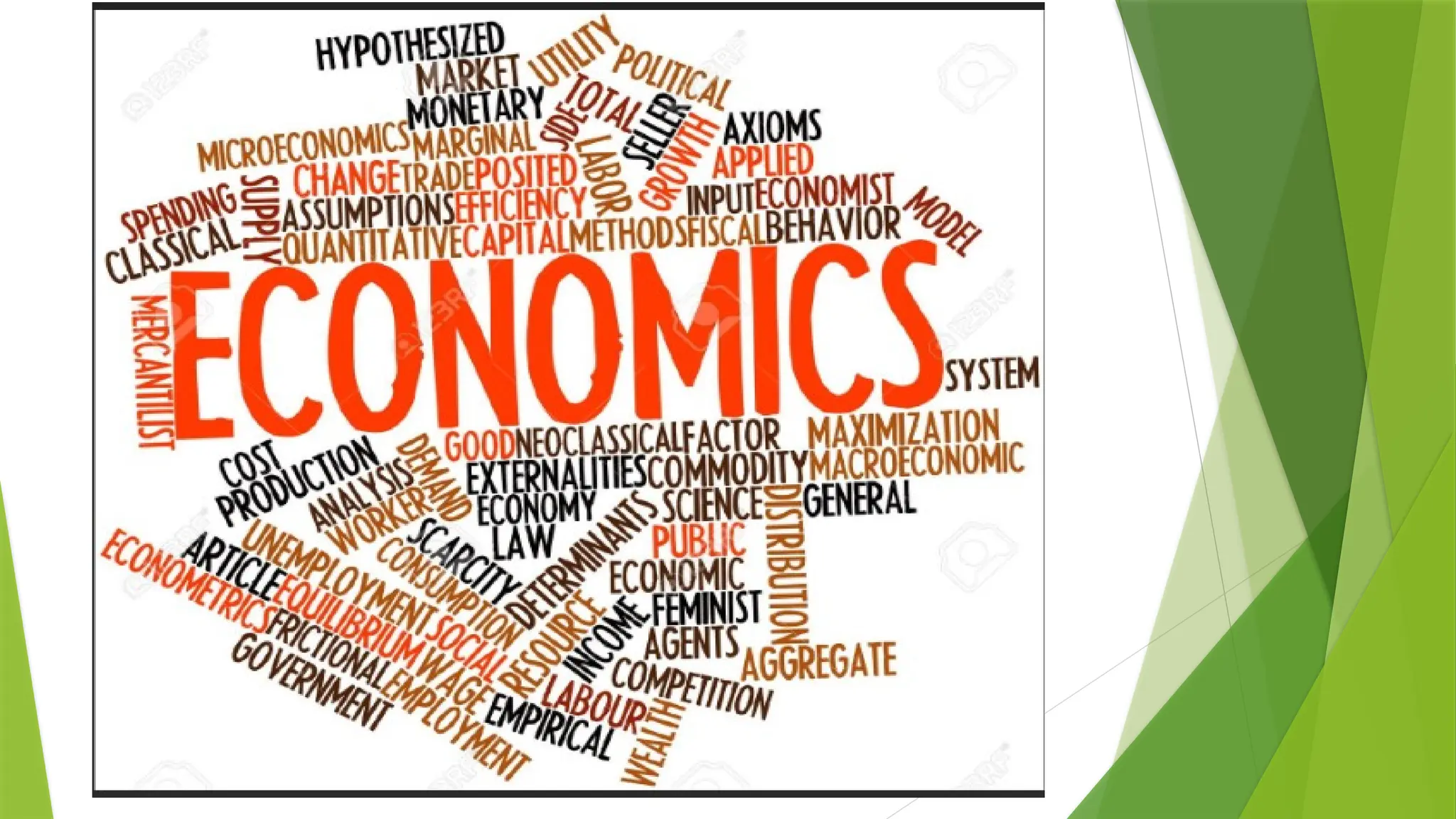
APPLIED ECONOMICS
Applied Economics is about the concepts
and principles central to the discipline of
economic and how they are used to
understand the world around us.
Terms to remember:
Economics
Scarcity
Social Science
Opportunity Cost
Economic Resources
Land
Labor
Capital
DEFINITION
Economics is the study of all
phenomena relating to wealth and
value. It is one of the social sciences
that deals with economic goods, the
creation of wealth through the
satisfaction of human wants, the
explanation of wealth , value and
price, the distribution of income and
the mechanism of exchange and
markets of an economy.
Economics as a study is the social science
that involves the use of scarce resources
to satisfy unlimited wants. Part of the
human behavior is the tendency of man to
want to have as many goods and services
as he can. However, his ability to buy
goods and services is limited by his income
and purchasing power. It is therefore in
this context that man has to practice
economics.
Scarcity
Scarcity is the reason why people
have to practice economics.
Scarcity is a condition where there
are insufficient resources to satisfy
all the needs and wants of a
population.
CONT.
Scarcity may be relative or absolute.
• Relative scarcity is when a good is
scarce compared to its demand.
Sample product: coconut , banana
• Absolute scarcity is when supply is
limited.
Sample product: petroleum, cherries
Choice and Decision Making
Because of the presence of scarcity ,
there is a need for man to make decisions
in choosing how to maximize the use of the
scarce resources to satisfy as many wants
as possible.
Opportunity Cost refers to the value of the best
foregone alternative.
Sample:
• Cultivation of rice rather than bananas
• Leather shoes rather than bags
• A licensed teacher who works in a bank,and quit
her /his job to work as a professional teacher.
• Buying a PE uniform in school rather than to
watch a new movie
• Leave without pay , for the chance to have a
vacation in Boracay.
* Withdrawal of savings in bank to try a new
business
Economic Resources, also
known as factors of
production , are the
resources use to produce
goods and services. These
resources are, by nature,
limited and therefore
command a payment that
becomes the income of the
resource owner.
1.Land- soil and natural
resources that are found in
nature and are not man
made.
2.Labor- physical and human effort exerted in
production. Ex. Workers , health professionals
etc.
3.Capital-man made resources used in
the production of goods and services
which include machineries and
equipment. The owner of capital earns
an income called interest.
Mahatma Ghandi
“The world has enough for
everyone's need but not for
everyones greed”.
ASSIGNMENT:
Search and cut pictures related to
the economic problems of the
Philippines. Explain in your own words on
how can it be resolved. (min. of 50
words)

APPLIED-ECONOMICS-PPT GRADE 12 FIRST SEMESTER

  • 1.
  • 3.
    Applied Economics isabout the concepts and principles central to the discipline of economic and how they are used to understand the world around us.
  • 4.
    Terms to remember: Economics Scarcity SocialScience Opportunity Cost Economic Resources Land Labor Capital
  • 5.
    DEFINITION Economics is thestudy of all phenomena relating to wealth and value. It is one of the social sciences that deals with economic goods, the creation of wealth through the satisfaction of human wants, the explanation of wealth , value and price, the distribution of income and the mechanism of exchange and markets of an economy.
  • 6.
    Economics as astudy is the social science that involves the use of scarce resources to satisfy unlimited wants. Part of the human behavior is the tendency of man to want to have as many goods and services as he can. However, his ability to buy goods and services is limited by his income and purchasing power. It is therefore in this context that man has to practice economics.
  • 7.
  • 8.
    Scarcity is thereason why people have to practice economics. Scarcity is a condition where there are insufficient resources to satisfy all the needs and wants of a population.
  • 9.
    CONT. Scarcity may berelative or absolute. • Relative scarcity is when a good is scarce compared to its demand. Sample product: coconut , banana • Absolute scarcity is when supply is limited. Sample product: petroleum, cherries
  • 10.
    Choice and DecisionMaking Because of the presence of scarcity , there is a need for man to make decisions in choosing how to maximize the use of the scarce resources to satisfy as many wants as possible.
  • 14.
    Opportunity Cost refersto the value of the best foregone alternative. Sample: • Cultivation of rice rather than bananas • Leather shoes rather than bags • A licensed teacher who works in a bank,and quit her /his job to work as a professional teacher. • Buying a PE uniform in school rather than to watch a new movie • Leave without pay , for the chance to have a vacation in Boracay. * Withdrawal of savings in bank to try a new business
  • 15.
    Economic Resources, also knownas factors of production , are the resources use to produce goods and services. These resources are, by nature, limited and therefore command a payment that becomes the income of the resource owner. 1.Land- soil and natural resources that are found in nature and are not man made.
  • 16.
    2.Labor- physical andhuman effort exerted in production. Ex. Workers , health professionals etc.
  • 17.
    3.Capital-man made resourcesused in the production of goods and services which include machineries and equipment. The owner of capital earns an income called interest.
  • 18.
    Mahatma Ghandi “The worldhas enough for everyone's need but not for everyones greed”.
  • 19.
    ASSIGNMENT: Search and cutpictures related to the economic problems of the Philippines. Explain in your own words on how can it be resolved. (min. of 50 words)