APPLIED CLINICAL
MINDFULNESS
We become what we think;
from thought, to cell, to soul.
Nancy Anderson Dolan
A WiseHeart Wellness Program
- Engage - Explore - Evolve -
PRE - SESSION
Preparation
A WiseHeart Wellness Program - Engage - Explore - Evolve -
2
“
The greater awareness you acquire, the greater
range of choices you also possess.
”Donald Altman
• Pretests: Please bring completed tests to live group or
email to WiseHeartWellness@gmail.com
Five Facet Mindfulness Questionnaire (FFMQ)
Self Compassion Scale
• Target Issue: When developing skills like these it is most
useful to focus on a specific issue or area of growth. We
encourage you to choose yours prior to starting. Some
examples are: a problem, relationship, mental or physical
health issue or specific situation, present or historical.
I will use Applied Clinical Mindfulness to work on:
________________________________________
There will be numerous times during the course we will suggest that
you write down specific intentions. This focuses attention and
keeps desires, intentions and useful actions in top of mind.
S1-1
We invite you to complete the follow preparations to get
the most out of the WiseHeart Wellness Applied Clinical
Mindfulness Course.
APPLIED CLINICAL MINDFULNESS
SESSION 1 INTENTION
Operational Definitions
A WiseHeart Wellness Program - Engage - Explore - Evolve - S1-2
9 Breath Centering Practice
Before you start any new activity it is useful to center yourself. Try the following now:
We are going to take 9 deep breaths to get your brain ready for what follows
1st
take 3 deep breaths to leave behind the rest of the day, negative thoughts, fears
2nd
take 3 deep breaths to let go of future plans, responsibilities, grasping at outcomes
3rd
take 3 deep breaths to just get centered in this moment with an open mind and heart
Applied Clinical Mindfulness – using mindfulness ideas, approaches and
practices from as tools to address clinical issues such as depression, pain or
eating disorders. Observing and labeling experience, deconstructing
sensations, moderating emotion and attending to alternate cues are all ways
of incorporating mindfulness into mental health treatments that actually
change the structure and function of the brain. See video here
Intention – a conscious decision, an aim to think or act in a specific way.
Psychotherapist, former Buddhist monk and university professor, Donald
Altman uses the encouraging acronym of I. C.A.N. to remind clients to apply
mindfulness to develop stability, resilience and happiness.
I. C. A. N.
I - Intentionally C - Center A - Awareness N – Now
APPLIED CLINICAL MINDFULNESS
Mindfulness – the quality or state of being conscious or
aware of something, in the present moment, regarding
with kindness and openness what is arising.
SESSION 1 INTENTION
Intention and Attention
A WiseHeart Wellness Program - Engage - Explore - Evolve -
4
“
Nothing happens without intention and attention.
”
S1-3
APPLIED CLINICAL MINDFULNESS
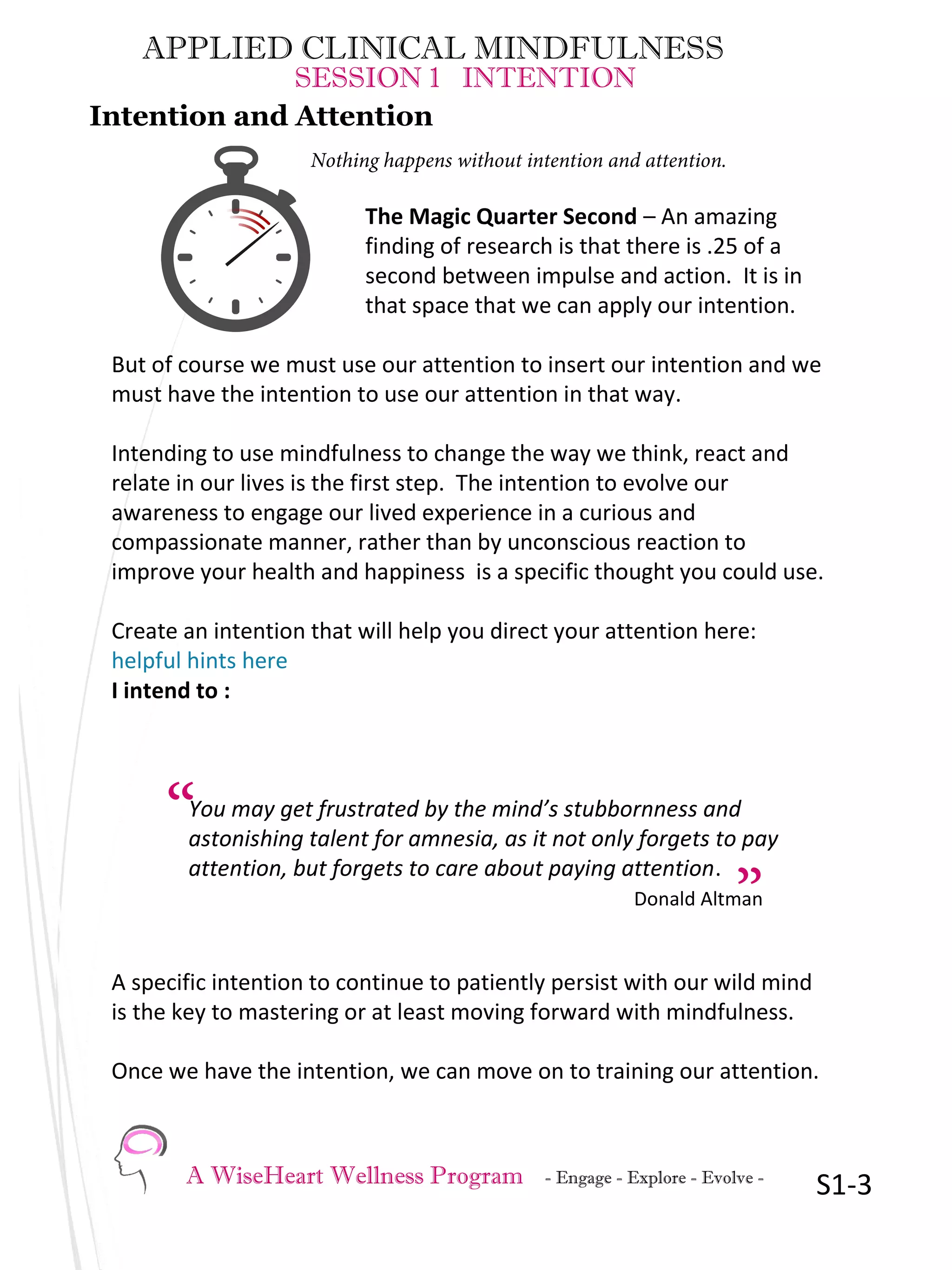
The Magic Quarter Second – An amazing
finding of research is that there is .25 of a
second between impulse and action. It is in
that space that we can apply our intention.
But of course we must use our attention to insert our intention and we
must have the intention to use our attention in that way.
Intending to use mindfulness to change the way we think, react and
relate in our lives is the first step. The intention to evolve our
awareness to engage our lived experience in a curious and
compassionate manner, rather than by unconscious reaction to
improve your health and happiness is a specific thought you could use.
Create an intention that will help you direct your attention here:
helpful hints here
I intend to :
You may get frustrated by the mind’s stubbornness and
astonishing talent for amnesia, as it not only forgets to pay
attention, but forgets to care about paying attention.
Donald Altman
A specific intention to continue to patiently persist with our wild mind
is the key to mastering or at least moving forward with mindfulness.
Once we have the intention, we can move on to training our attention.
SESSION 1 INTENTION
Training Attention
A WiseHeart Wellness Program - Engage - Explore - Evolve -
5
Breath Counting Practice
Breath counting has been used for thousands of years and is
the traditional starting place of mindfulness.
Breath Counting 1 to 10 (audio)
APPLIED CLINICAL MINDFULNESS
Learn from this, that your attention may need help
to focus and accommodate it creatively. If you get
stuck or struggle, simply explore and evolve the
practice in a way that works for you.
Bead Counting Practice
If you didn’t make 10 breaths, don’t worry,
you are not alone! Bead counting has
been used for hundreds of years, as sages
found this simple tool to help train their
wandering attention to focus on breath.
Breath and count as in regular breath
counting, but let your hands count too,
moving bead by bead through a bracelet,
Catholic rosary, Buddhist Juzu or a string of
simple beads to mark your 10 conscious
breaths. When you master 10, try more to
counting to 10 again or picking another
number.
S1-4
SESSION 1 INTENTION
Applying Attention to Unhealthy Thoughts
A WiseHeart Wellness Program - Engage - Explore - Evolve -
6
Negative Thought Inventory
To use your attention for intervening with health issues,
you need to give it a task or target to observe.
Try right now for 5 to 15 minutes to use your attention to
discover what repetitive negative thoughts may be creating
unwellness in your mind and body
You can either pause and write them down as you clearly
see them, or you can observe for a period of time and write
after the allotted time of your mindful practice.
Many people find that just the act of paying attention to
there negative thoughts, brings some relief.
APPLIED CLINICAL MINDFULNESS
Top Ten Negative Thoughts:
S1-5
SESSION 1 INTENTION
Using Attention to Discover Intention
A WiseHeart Wellness Program - Engage - Explore - Evolve -
7
Unconscious, Automatic and Obsolete Intentions
Beneath our negative thoughts are underlying intentions.
Most often they are simply unconscious and automatic ways
of thinking about and relating to life. However, some can
lead to ill health and unhappiness without us knowing!
These often have been unconsciously taken in from family,
culture or unfortunate early experience. Addicts often
operate on an intention to not feel bad, so they ignore,
avoid and cover over uncomfortable feelings to their own
detriment.
These unconscious obsolete intentions can be discovered by
the process of compassionate curiosity, looking and
listening and imagining what intention is behind different
thoughts and behaviors we observe in our selves.
For this practice, open up to the underlying intention,
behind a negative thought, feeling it’s quality, emotion and
perhaps purpose.
Try right now for 5 to 15 minutes to use your attention to
illuminate the intention beneath or behind your repetitive
negative thoughts. Then see if you can bring your intention
to simply be mindful to whatever the negative thought has
been attached to. Just use your intention to open up to
whatever is there.
APPLIED CLINICAL MINDFULNESS
S1-6
SESSION 1 INTENTION
Developing Wise Intention
A WiseHeart Wellness Program - Engage - Explore - Evolve -
8
Wise vs Obsolete Intention Carla Brennan Audio 37 -47
“ ”
Wise Intention : Choosing that which leads to freedom.
Mindfulness can create a wise view that observes not just
intention, but also the outcome of our intention. Observing the
thoughts and feeling in our bodies that accompany different
intentions creates motivation to sustain our practice intention.
Practicing Conscious Wise Intention
This week, continue to mindfully explore your operating
intentions and begin to celebrate the opportunity to
remember and choose a Wise Intention. Choose one that
leads you back to a practice of presence when you discover
you have been living through an unconscious obsolete
intention of figuring or fixing life instead of experiencing it.
APPLIED CLINICAL MINDFULNESS
The most important thing, is to
remember the most important thing.
Buddhist teacher, Suzuki Roshi
S1-7
SESSION 1 INTENTION
Developing Your Mindfulness Practice
A WiseHeart Wellness Program - Engage - Explore - Evolve -
9
What will you take from this session?
How will you continue to develop a clear, compassionate
intention to direct the observation of your experience?
Remember it is vitally important to work with yourself where you are
today. You may need to have written reminders, an alarm set on your
phone to remind you to check your intentions, be creative!
Suggested Tasks/Practices: When ? Where?
1.Practice counting breaths
2.List your top ten negative thoughts.
3.List your top ten obsolete/unskillful intentions
Clarifying and committing help your mind be mindful!
Please share your plans email to ysheart@shaw.ca
APPLIED CLINICAL MINDFULNESS
S1-8
SESSION 1 INTENTION
A WiseHeart Wellness Program - Engage - Explore - Evolve -
10
Audios:
Breath Counting 1 to 10 Dr. P. Kelly 12:19
Breathing Meditation M.A.R.C. UCLA 5:20Author
APPLIED CLINICAL MINDFULNESS
Videos:
How Mindfulness Effects the Brain Zindel Segal 3:15
Mindfulness – On Our Mind UCTV 14:11
Healing your self doubt Tara Brach 27:23
Readings:
What Is Mindfulness Wildmind Blog
How to Practice Mindfulness Meditation Dr. Kissel Wegela
ADDITIONAL RESOURCES
Other:
Five Facet Mindfulness Questionnaire (FFMQ)
Self Compassion Scale Kristen Neff
S1-9

Applied clinical mindfulness 2015 session 1

  • 1.
    APPLIED CLINICAL MINDFULNESS We becomewhat we think; from thought, to cell, to soul. Nancy Anderson Dolan A WiseHeart Wellness Program - Engage - Explore - Evolve -
  • 2.
    PRE - SESSION Preparation AWiseHeart Wellness Program - Engage - Explore - Evolve - 2 “ The greater awareness you acquire, the greater range of choices you also possess. ”Donald Altman • Pretests: Please bring completed tests to live group or email to WiseHeartWellness@gmail.com Five Facet Mindfulness Questionnaire (FFMQ) Self Compassion Scale • Target Issue: When developing skills like these it is most useful to focus on a specific issue or area of growth. We encourage you to choose yours prior to starting. Some examples are: a problem, relationship, mental or physical health issue or specific situation, present or historical. I will use Applied Clinical Mindfulness to work on: ________________________________________ There will be numerous times during the course we will suggest that you write down specific intentions. This focuses attention and keeps desires, intentions and useful actions in top of mind. S1-1 We invite you to complete the follow preparations to get the most out of the WiseHeart Wellness Applied Clinical Mindfulness Course. APPLIED CLINICAL MINDFULNESS
  • 3.
    SESSION 1 INTENTION OperationalDefinitions A WiseHeart Wellness Program - Engage - Explore - Evolve - S1-2 9 Breath Centering Practice Before you start any new activity it is useful to center yourself. Try the following now: We are going to take 9 deep breaths to get your brain ready for what follows 1st take 3 deep breaths to leave behind the rest of the day, negative thoughts, fears 2nd take 3 deep breaths to let go of future plans, responsibilities, grasping at outcomes 3rd take 3 deep breaths to just get centered in this moment with an open mind and heart Applied Clinical Mindfulness – using mindfulness ideas, approaches and practices from as tools to address clinical issues such as depression, pain or eating disorders. Observing and labeling experience, deconstructing sensations, moderating emotion and attending to alternate cues are all ways of incorporating mindfulness into mental health treatments that actually change the structure and function of the brain. See video here Intention – a conscious decision, an aim to think or act in a specific way. Psychotherapist, former Buddhist monk and university professor, Donald Altman uses the encouraging acronym of I. C.A.N. to remind clients to apply mindfulness to develop stability, resilience and happiness. I. C. A. N. I - Intentionally C - Center A - Awareness N – Now APPLIED CLINICAL MINDFULNESS Mindfulness – the quality or state of being conscious or aware of something, in the present moment, regarding with kindness and openness what is arising.
  • 4.
    SESSION 1 INTENTION Intentionand Attention A WiseHeart Wellness Program - Engage - Explore - Evolve - 4 “ Nothing happens without intention and attention. ” S1-3 APPLIED CLINICAL MINDFULNESS The Magic Quarter Second – An amazing finding of research is that there is .25 of a second between impulse and action. It is in that space that we can apply our intention. But of course we must use our attention to insert our intention and we must have the intention to use our attention in that way. Intending to use mindfulness to change the way we think, react and relate in our lives is the first step. The intention to evolve our awareness to engage our lived experience in a curious and compassionate manner, rather than by unconscious reaction to improve your health and happiness is a specific thought you could use. Create an intention that will help you direct your attention here: helpful hints here I intend to : You may get frustrated by the mind’s stubbornness and astonishing talent for amnesia, as it not only forgets to pay attention, but forgets to care about paying attention. Donald Altman A specific intention to continue to patiently persist with our wild mind is the key to mastering or at least moving forward with mindfulness. Once we have the intention, we can move on to training our attention.
  • 5.
    SESSION 1 INTENTION TrainingAttention A WiseHeart Wellness Program - Engage - Explore - Evolve - 5 Breath Counting Practice Breath counting has been used for thousands of years and is the traditional starting place of mindfulness. Breath Counting 1 to 10 (audio) APPLIED CLINICAL MINDFULNESS Learn from this, that your attention may need help to focus and accommodate it creatively. If you get stuck or struggle, simply explore and evolve the practice in a way that works for you. Bead Counting Practice If you didn’t make 10 breaths, don’t worry, you are not alone! Bead counting has been used for hundreds of years, as sages found this simple tool to help train their wandering attention to focus on breath. Breath and count as in regular breath counting, but let your hands count too, moving bead by bead through a bracelet, Catholic rosary, Buddhist Juzu or a string of simple beads to mark your 10 conscious breaths. When you master 10, try more to counting to 10 again or picking another number. S1-4
  • 6.
    SESSION 1 INTENTION ApplyingAttention to Unhealthy Thoughts A WiseHeart Wellness Program - Engage - Explore - Evolve - 6 Negative Thought Inventory To use your attention for intervening with health issues, you need to give it a task or target to observe. Try right now for 5 to 15 minutes to use your attention to discover what repetitive negative thoughts may be creating unwellness in your mind and body You can either pause and write them down as you clearly see them, or you can observe for a period of time and write after the allotted time of your mindful practice. Many people find that just the act of paying attention to there negative thoughts, brings some relief. APPLIED CLINICAL MINDFULNESS Top Ten Negative Thoughts: S1-5
  • 7.
    SESSION 1 INTENTION UsingAttention to Discover Intention A WiseHeart Wellness Program - Engage - Explore - Evolve - 7 Unconscious, Automatic and Obsolete Intentions Beneath our negative thoughts are underlying intentions. Most often they are simply unconscious and automatic ways of thinking about and relating to life. However, some can lead to ill health and unhappiness without us knowing! These often have been unconsciously taken in from family, culture or unfortunate early experience. Addicts often operate on an intention to not feel bad, so they ignore, avoid and cover over uncomfortable feelings to their own detriment. These unconscious obsolete intentions can be discovered by the process of compassionate curiosity, looking and listening and imagining what intention is behind different thoughts and behaviors we observe in our selves. For this practice, open up to the underlying intention, behind a negative thought, feeling it’s quality, emotion and perhaps purpose. Try right now for 5 to 15 minutes to use your attention to illuminate the intention beneath or behind your repetitive negative thoughts. Then see if you can bring your intention to simply be mindful to whatever the negative thought has been attached to. Just use your intention to open up to whatever is there. APPLIED CLINICAL MINDFULNESS S1-6
  • 8.
    SESSION 1 INTENTION DevelopingWise Intention A WiseHeart Wellness Program - Engage - Explore - Evolve - 8 Wise vs Obsolete Intention Carla Brennan Audio 37 -47 “ ” Wise Intention : Choosing that which leads to freedom. Mindfulness can create a wise view that observes not just intention, but also the outcome of our intention. Observing the thoughts and feeling in our bodies that accompany different intentions creates motivation to sustain our practice intention. Practicing Conscious Wise Intention This week, continue to mindfully explore your operating intentions and begin to celebrate the opportunity to remember and choose a Wise Intention. Choose one that leads you back to a practice of presence when you discover you have been living through an unconscious obsolete intention of figuring or fixing life instead of experiencing it. APPLIED CLINICAL MINDFULNESS The most important thing, is to remember the most important thing. Buddhist teacher, Suzuki Roshi S1-7
  • 9.
    SESSION 1 INTENTION DevelopingYour Mindfulness Practice A WiseHeart Wellness Program - Engage - Explore - Evolve - 9 What will you take from this session? How will you continue to develop a clear, compassionate intention to direct the observation of your experience? Remember it is vitally important to work with yourself where you are today. You may need to have written reminders, an alarm set on your phone to remind you to check your intentions, be creative! Suggested Tasks/Practices: When ? Where? 1.Practice counting breaths 2.List your top ten negative thoughts. 3.List your top ten obsolete/unskillful intentions Clarifying and committing help your mind be mindful! Please share your plans email to ysheart@shaw.ca APPLIED CLINICAL MINDFULNESS S1-8
  • 10.
    SESSION 1 INTENTION AWiseHeart Wellness Program - Engage - Explore - Evolve - 10 Audios: Breath Counting 1 to 10 Dr. P. Kelly 12:19 Breathing Meditation M.A.R.C. UCLA 5:20Author APPLIED CLINICAL MINDFULNESS Videos: How Mindfulness Effects the Brain Zindel Segal 3:15 Mindfulness – On Our Mind UCTV 14:11 Healing your self doubt Tara Brach 27:23 Readings: What Is Mindfulness Wildmind Blog How to Practice Mindfulness Meditation Dr. Kissel Wegela ADDITIONAL RESOURCES Other: Five Facet Mindfulness Questionnaire (FFMQ) Self Compassion Scale Kristen Neff S1-9