GRAMMAR SCHOOL
RAWALPINDI
Mindfulness and Resilience Building
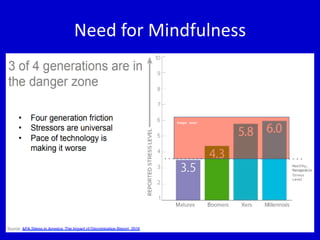
Need for Mindfulness
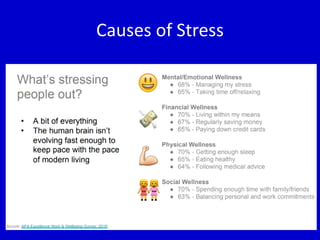
Causes of Stress
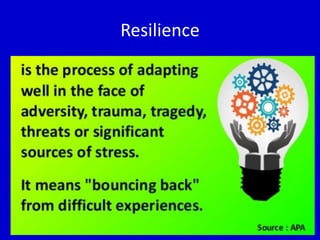
Resilience
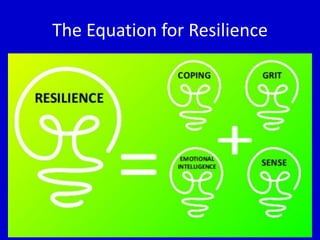
The Equation for Resilience
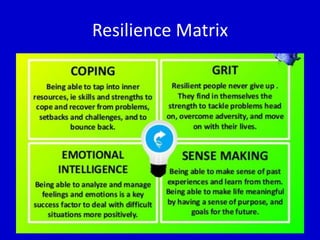
Resilience Matrix
• What does mindfulness mean?
• Being conscious or aware of something
• According to Jon Kabat (teacher of mindful
meditation)
– Mindfulness means paying attention in a
particular way, on purpose in the present moment
and non judgmentally
• Life is becoming more stressful, demanding
and frantic
• Have you ever had the feeling that you
operate your life in an auto pilot mode
• We do chores out of habit and necessity
• Information overload
• Energy is sapped
• Productivity declines
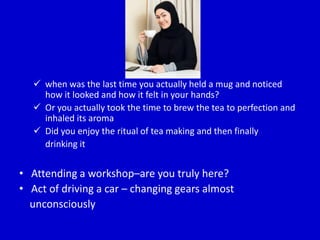
 when was the last time you actually held a mug and noticed
how it looked and how it felt in your hands?
 Or you actually took the time to brew the tea to perfection and
inhaled its aroma
 Did you enjoy the ritual of tea making and then finally
drinking it
• Attending a workshop–are you truly here?
• Act of driving a car – changing gears almost
unconsciously
o Knowing that you are eating is not the same as eating
mindfully
o In theory, awareness of the act maybe there
o But we are thinking/doing about 101 things at the
same time
o Very small part of our awareness is absorbed in eating
o Awareness of the bodily sensations and our thoughts
and emotions is non existent
o Thoughts wander in an unrestricted way because we
are dimly aware of them
o There is no conscious attempt to bring our thoughts
back to eating
Coming back to Mindfulness
“Mindfulness means paying attention in a particular
way, on purpose, in the present moment and non
judgmentally”
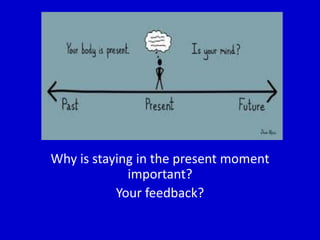
• Dilemma with the human brain
– left to its own devices, the mind wanders between the
past and the future
– oscillates between feelings of anger, resentment,
depression , memories and anxieties
So what exactly is mindfulness?
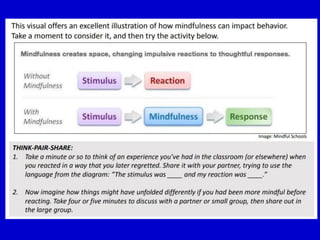
1. Developing purpose
– To stay with present moment whether that is
a breath, an emotion or an act (eating) means you are
actively shaping your mind
– The brain actually rewires (changes) with mindfulness
2. Paying attention (non judgmentally)
– Its an emotionally non reactive state
– We don’t judge an experience being good or bad
– We simply accept what arises mindfully
– We observe it rising, passing and ceasing to exist
Mindful meditation exercises
• Focused breathing exercise
– Mindfulness meditation is practiced sitting with eyes closed, cross
legged on a cushion, or on a chair with the back straight.
– Attention is put on the abdomen when breathing in and out or
on the awareness of the breath as it goes in to and out of the nostrils
– As thoughts come up, one returns to focusing on breathing and keeps
repeating a word of gratitude to the creator
– One passively notice, ones mind has wandered but in an accepting
non judgmental way
– Meditation starts with 5 minutes a day or even 3 minutes
– With time it becomes easier to keep focused on breathing
– Eventually awareness can be extended to awareness of being
in the present
• Raisin tasting exercise (by Kabat)
– Raisin is tasted and eaten mindfully
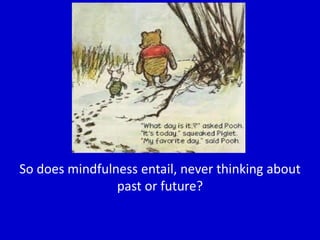
So does mindfulness entail, never thinking about
past or future?
• Mindfulness entails being concerned with
what's going on right now
• That doesn’t mean that we can’t think of the
past or future
• When we do so, we do it mindfully
• So we are aware that right now, we are
thinking about the past or future
• So lets try mindfulness meditation exercise for
a few minutes?
• Feedback?
• Keep at it 
Video 1 play
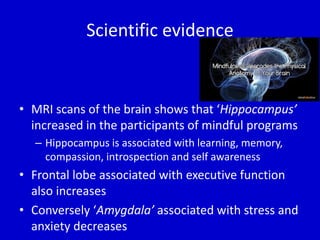
Scientific evidence
• MRI scans of the brain shows that ‘Hippocampus’
increased in the participants of mindful programs
– Hippocampus is associated with learning, memory,
compassion, introspection and self awareness
• Frontal lobe associated with executive function
also increases
• Conversely ‘Amygdala’ associated with stress and
anxiety decreases
Why is staying in the present moment
important?
Your feedback?
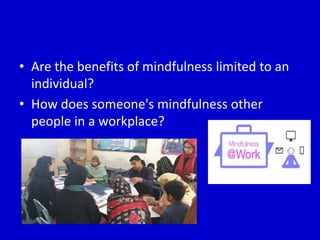
• Are the benefits of mindfulness limited to an
individual?
• How does someone's mindfulness other
people in a workplace?
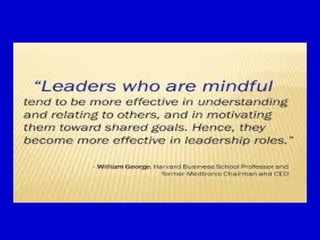
A mindful leader means happier employees
• A leader’s mindfulness has positive effect on
others
– Mindfulness trains to accept feelings without
judgment
• Studies suggest the same
– 96 supervisors and subordinates took part in a
study
– Research confirmed that the more mindful the
leader , the lower the emotional exhaustion,
better will be job performance, work life balance
and good citizenship
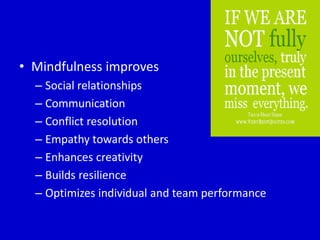
• Mindfulness improves
– Social relationships
– Communication
– Conflict resolution
– Empathy towards others
– Enhances creativity
– Builds resilience
– Optimizes individual and team performance
• Organizations such as Mckinsey, Deutshe
bank, P & G, Apple, Google and Yahoo are a
testimony to the effectiveness of mindfulness
at work
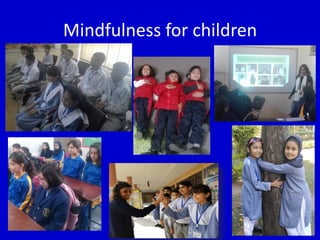
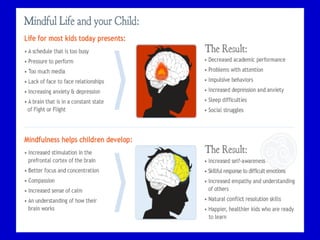
Mindfulness for children
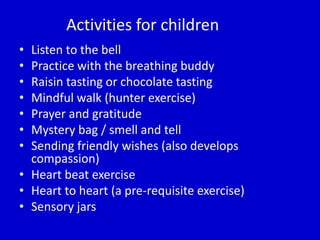
Activities for children
• Listen to the bell
• Practice with the breathing buddy
• Raisin tasting or chocolate tasting
• Mindful walk (hunter exercise)
• Prayer and gratitude
• Mystery bag / smell and tell
• Sending friendly wishes (also develops
compassion)
• Heart beat exercise
• Heart to heart (a pre-requisite exercise)
• Sensory jars
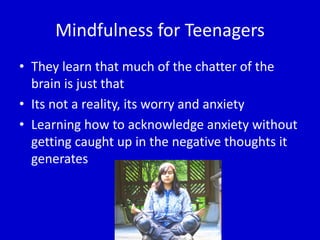
Mindfulness for Teenagers
• They learn that much of the chatter of the
brain is just that
• Its not a reality, its worry and anxiety
• Learning how to acknowledge anxiety without
getting caught up in the negative thoughts it
generates
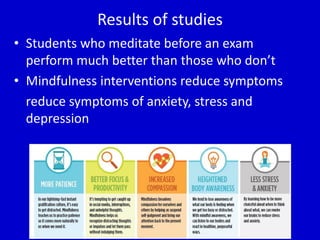
Results of studies
• Students who meditate before an exam
perform much better than those who don’t
• Mindfulness interventions reduce symptoms
reduce symptoms of anxiety, stress and
depression
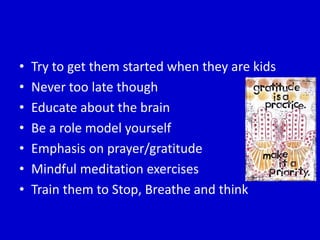
• Try to get them started when they are kids
• Never too late though
• Educate about the brain
• Be a role model yourself
• Emphasis on prayer/gratitude
• Mindful meditation exercises
• Train them to Stop, Breathe and think
• Now comes the easy part!!!!
• Internalizing mindfulness
• Integrating it in the ethos of the school and
daily lives.
Shukria
Meherbani

Resilience building

  • 1.
  • 2.
  • 3.
  • 4.
  • 5.
    The Equation forResilience
  • 6.
  • 8.
    • What doesmindfulness mean? • Being conscious or aware of something • According to Jon Kabat (teacher of mindful meditation) – Mindfulness means paying attention in a particular way, on purpose in the present moment and non judgmentally
  • 9.
    • Life isbecoming more stressful, demanding and frantic • Have you ever had the feeling that you operate your life in an auto pilot mode • We do chores out of habit and necessity • Information overload • Energy is sapped • Productivity declines
  • 10.
     when wasthe last time you actually held a mug and noticed how it looked and how it felt in your hands?  Or you actually took the time to brew the tea to perfection and inhaled its aroma  Did you enjoy the ritual of tea making and then finally drinking it • Attending a workshop–are you truly here? • Act of driving a car – changing gears almost unconsciously
  • 11.
    o Knowing thatyou are eating is not the same as eating mindfully o In theory, awareness of the act maybe there o But we are thinking/doing about 101 things at the same time o Very small part of our awareness is absorbed in eating o Awareness of the bodily sensations and our thoughts and emotions is non existent o Thoughts wander in an unrestricted way because we are dimly aware of them o There is no conscious attempt to bring our thoughts back to eating
  • 12.
    Coming back toMindfulness “Mindfulness means paying attention in a particular way, on purpose, in the present moment and non judgmentally” • Dilemma with the human brain – left to its own devices, the mind wanders between the past and the future – oscillates between feelings of anger, resentment, depression , memories and anxieties
  • 13.
    So what exactlyis mindfulness? 1. Developing purpose – To stay with present moment whether that is a breath, an emotion or an act (eating) means you are actively shaping your mind – The brain actually rewires (changes) with mindfulness 2. Paying attention (non judgmentally) – Its an emotionally non reactive state – We don’t judge an experience being good or bad – We simply accept what arises mindfully – We observe it rising, passing and ceasing to exist
  • 14.
    Mindful meditation exercises •Focused breathing exercise – Mindfulness meditation is practiced sitting with eyes closed, cross legged on a cushion, or on a chair with the back straight. – Attention is put on the abdomen when breathing in and out or on the awareness of the breath as it goes in to and out of the nostrils – As thoughts come up, one returns to focusing on breathing and keeps repeating a word of gratitude to the creator – One passively notice, ones mind has wandered but in an accepting non judgmental way – Meditation starts with 5 minutes a day or even 3 minutes – With time it becomes easier to keep focused on breathing – Eventually awareness can be extended to awareness of being in the present • Raisin tasting exercise (by Kabat) – Raisin is tasted and eaten mindfully
  • 15.
    So does mindfulnessentail, never thinking about past or future?
  • 16.
    • Mindfulness entailsbeing concerned with what's going on right now • That doesn’t mean that we can’t think of the past or future • When we do so, we do it mindfully • So we are aware that right now, we are thinking about the past or future
  • 17.
    • So letstry mindfulness meditation exercise for a few minutes? • Feedback? • Keep at it 
  • 18.
  • 20.
    Scientific evidence • MRIscans of the brain shows that ‘Hippocampus’ increased in the participants of mindful programs – Hippocampus is associated with learning, memory, compassion, introspection and self awareness • Frontal lobe associated with executive function also increases • Conversely ‘Amygdala’ associated with stress and anxiety decreases
  • 21.
    Why is stayingin the present moment important? Your feedback?
  • 22.
    • Are thebenefits of mindfulness limited to an individual? • How does someone's mindfulness other people in a workplace?
  • 23.
    A mindful leadermeans happier employees • A leader’s mindfulness has positive effect on others – Mindfulness trains to accept feelings without judgment • Studies suggest the same – 96 supervisors and subordinates took part in a study – Research confirmed that the more mindful the leader , the lower the emotional exhaustion, better will be job performance, work life balance and good citizenship
  • 26.
    • Mindfulness improves –Social relationships – Communication – Conflict resolution – Empathy towards others – Enhances creativity – Builds resilience – Optimizes individual and team performance
  • 27.
    • Organizations suchas Mckinsey, Deutshe bank, P & G, Apple, Google and Yahoo are a testimony to the effectiveness of mindfulness at work
  • 28.
  • 29.
    Activities for children •Listen to the bell • Practice with the breathing buddy • Raisin tasting or chocolate tasting • Mindful walk (hunter exercise) • Prayer and gratitude • Mystery bag / smell and tell • Sending friendly wishes (also develops compassion) • Heart beat exercise • Heart to heart (a pre-requisite exercise) • Sensory jars
  • 31.
    Mindfulness for Teenagers •They learn that much of the chatter of the brain is just that • Its not a reality, its worry and anxiety • Learning how to acknowledge anxiety without getting caught up in the negative thoughts it generates
  • 32.
    Results of studies •Students who meditate before an exam perform much better than those who don’t • Mindfulness interventions reduce symptoms reduce symptoms of anxiety, stress and depression
  • 33.
    • Try toget them started when they are kids • Never too late though • Educate about the brain • Be a role model yourself • Emphasis on prayer/gratitude • Mindful meditation exercises • Train them to Stop, Breathe and think
  • 37.
    • Now comesthe easy part!!!!
  • 38.
    • Internalizing mindfulness •Integrating it in the ethos of the school and daily lives.
  • 39.