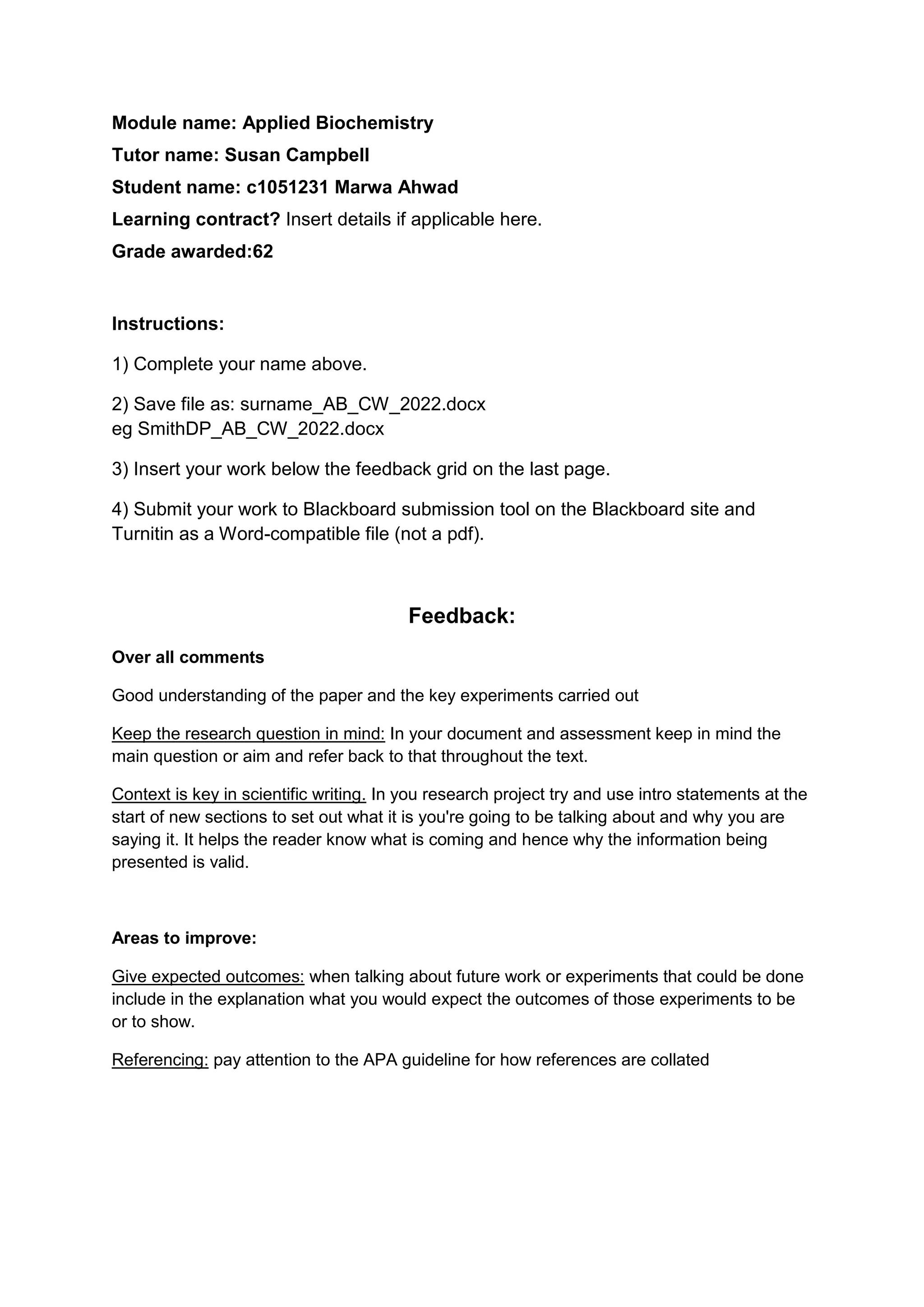
Module name: Applied Biochemistry
Tutor name: Susan Campbell
Student name: c1051231 Marwa Ahwad
Learning contract? Insert details if applicable here.
Grade awarded:62
Instructions:
1) Complete your name above.
2) Save file as: surname_AB_CW_2022.docx
eg SmithDP_AB_CW_2022.docx
3) Insert your work below the feedback grid on the last page.
4) Submit your work to Blackboard submission tool on the Blackboard site and
Turnitin as a Word-compatible file (not a pdf).
Feedback:
Over all comments
Good understanding of the paper and the key experiments carried out
Keep the research question in mind: In your document and assessment keep in mind the
main question or aim and refer back to that throughout the text.
Context is key in scientific writing. In you research project try and use intro statements at the
start of new sections to set out what it is you're going to be talking about and why you are
saying it. It helps the reader know what is coming and hence why the information being
presented is valid.
Areas to improve:
Give expected outcomes: when talking about future work or experiments that could be done
include in the explanation what you would expect the outcomes of those experiments to be
or to show.
Referencing: pay attention to the APA guideline for how references are collated
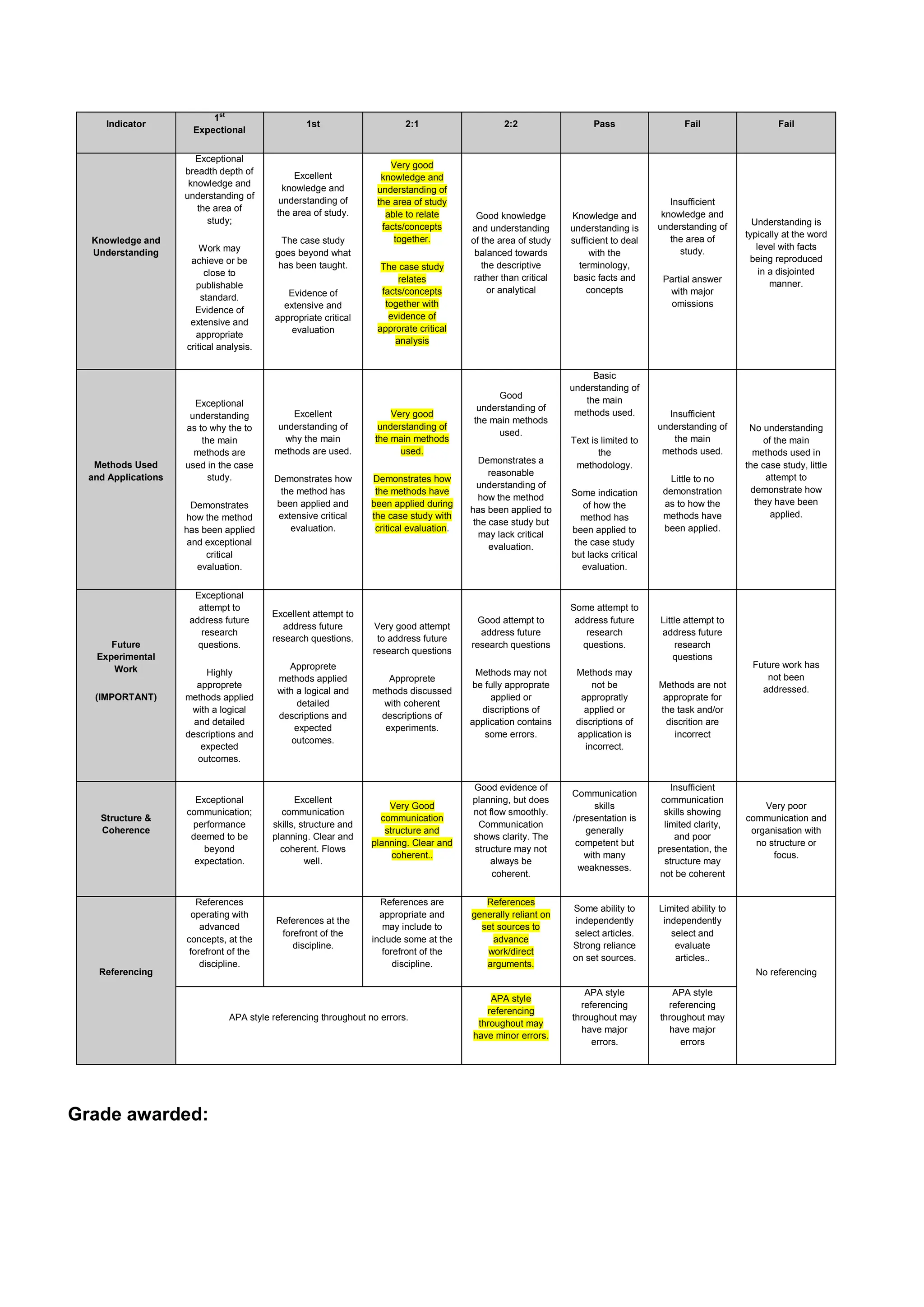
Indicator
1st
Expectional
1st 2:1 2:2 Pass Fail Fail
Knowledge and
Understanding
Exceptional
breadth depth of
knowledge and
understanding of
the area of
study;
Work may
achieve or be
close to
publishable
standard.
Evidence of
extensive and
appropriate
critical analysis.
Excellent
knowledge and
understanding of
the area of study.
The case study
goes beyond what
has been taught.
Evidence of
extensive and
appropriate critical
evaluation
Very good
knowledge and
understanding of
the area of study
able to relate
facts/concepts
together.
The case study
relates
facts/concepts
together with
evidence of
approrate critical
analysis
Good knowledge
and understanding
of the area of study
balanced towards
the descriptive
rather than critical
or analytical
Knowledge and
understanding is
sufficient to deal
with the
terminology,
basic facts and
concepts
Insufficient
knowledge and
understanding of
the area of
study.
Partial answer
with major
omissions
Understanding is
typically at the word
level with facts
being reproduced
in a disjointed
manner.
Methods Used
and Applications
Exceptional
understanding
as to why the to
the main
methods are
used in the case
study.
Demonstrates
how the method
has been applied
and exceptional
critical
evaluation.
Excellent
understanding of
why the main
methods are used.
Demonstrates how
the method has
been applied and
extensive critical
evaluation.
Very good
understanding of
the main methods
used.
Demonstrates how
the methods have
been applied during
the case study with
critical evaluation.
Good
understanding of
the main methods
used.
Demonstrates a
reasonable
understanding of
how the method
has been applied to
the case study but
may lack critical
evaluation.
Basic
understanding of
the main
methods used.
Text is limited to
the
methodology.
Some indication
of how the
method has
been applied to
the case study
but lacks critical
evaluation.
Insufficient
understanding of
the main
methods used.
Little to no
demonstration
as to how the
methods have
been applied.
No understanding
of the main
methods used in
the case study, little
attempt to
demonstrate how
they have been
applied.
Future
Experimental
Work
(IMPORTANT)
Exceptional
attempt to
address future
research
questions.
Highly
approprete
methods applied
with a logical
and detailed
descriptions and
expected
outcomes.
Excellent attempt to
address future
research questions.
Approprete
methods applied
with a logical and
detailed
descriptions and
expected
outcomes.
Very good attempt
to address future
research questions
Approprete
methods discussed
with coherent
descriptions of
experiments.
Good attempt to
address future
research questions
Methods may not
be fully approprate
applied or
discriptions of
application contains
some errors.
Some attempt to
address future
research
questions.
Methods may
not be
appropratly
applied or
discriptions of
application is
incorrect.
Little attempt to
address future
research
questions
Methods are not
approprate for
the task and/or
discrition are
incorrect
Future work has
not been
addressed.
Structure &
Coherence
Exceptional
communication;
performance
deemed to be
beyond
expectation.
Excellent
communication
skills, structure and
planning. Clear and
coherent. Flows
well.
Very Good
communication
structure and
planning. Clear and
coherent..
Good evidence of
planning, but does
not flow smoothly.
Communication
shows clarity. The
structure may not
always be
coherent.
Communication
skills
/presentation is
generally
competent but
with many
weaknesses.
Insufficient
communication
skills showing
limited clarity,
and poor
presentation, the
structure may
not be coherent
Very poor
communication and
organisation with
no structure or
focus.
Referencing
References
operating with
advanced
concepts, at the
forefront of the
discipline.
References at the
forefront of the
discipline.
References are
appropriate and
may include to
include some at the
forefront of the
discipline.
References
generally reliant on
set sources to
advance
work/direct
arguments.
Some ability to
independently
select articles.
Strong reliance
on set sources.
Limited ability to
independently
select and
evaluate
articles..
No referencing
APA style referencing throughout no errors.
APA style
referencing
throughout may
have minor errors.
APA style
referencing
throughout may
have major
errors.
APA style
referencing
throughout may
have major
errors
Grade awarded:
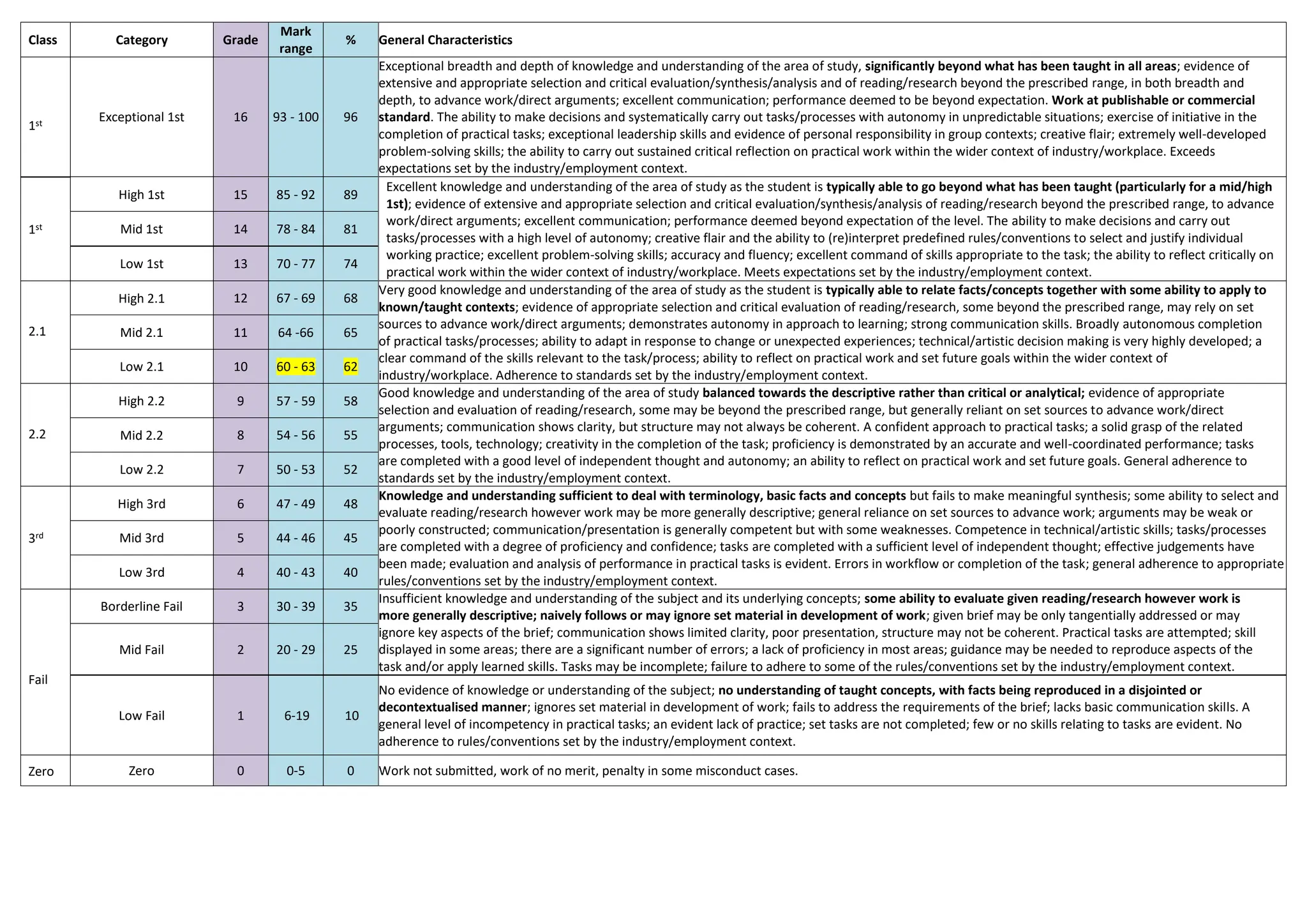
Class Category Grade
Mark
range
% General Characteristics
1st
Exceptional 1st 16 93 - 100 96
Exceptional breadth and depth of knowledge and understanding of the area of study, significantly beyond what has been taught in all areas; evidence of
extensive and appropriate selection and critical evaluation/synthesis/analysis and of reading/research beyond the prescribed range, in both breadth and
depth, to advance work/direct arguments; excellent communication; performance deemed to be beyond expectation. Work at publishable or commercial
standard. The ability to make decisions and systematically carry out tasks/processes with autonomy in unpredictable situations; exercise of initiative in the
completion of practical tasks; exceptional leadership skills and evidence of personal responsibility in group contexts; creative flair; extremely well-developed
problem-solving skills; the ability to carry out sustained critical reflection on practical work within the wider context of industry/workplace. Exceeds
expectations set by the industry/employment context.
1st
High 1st 15 85 - 92 89
Excellent knowledge and understanding of the area of study as the student is typically able to go beyond what has been taught (particularly for a mid/high
1st); evidence of extensive and appropriate selection and critical evaluation/synthesis/analysis of reading/research beyond the prescribed range, to advance
work/direct arguments; excellent communication; performance deemed beyond expectation of the level. The ability to make decisions and carry out
tasks/processes with a high level of autonomy; creative flair and the ability to (re)interpret predefined rules/conventions to select and justify individual
working practice; excellent problem-solving skills; accuracy and fluency; excellent command of skills appropriate to the task; the ability to reflect critically on
practical work within the wider context of industry/workplace. Meets expectations set by the industry/employment context.
Mid 1st 14 78 - 84 81
Low 1st 13 70 - 77 74
2.1
High 2.1 12 67 - 69 68
Very good knowledge and understanding of the area of study as the student is typically able to relate facts/concepts together with some ability to apply to
known/taught contexts; evidence of appropriate selection and critical evaluation of reading/research, some beyond the prescribed range, may rely on set
sources to advance work/direct arguments; demonstrates autonomy in approach to learning; strong communication skills. Broadly autonomous completion
of practical tasks/processes; ability to adapt in response to change or unexpected experiences; technical/artistic decision making is very highly developed; a
clear command of the skills relevant to the task/process; ability to reflect on practical work and set future goals within the wider context of
industry/workplace. Adherence to standards set by the industry/employment context.
Mid 2.1 11 64 -66 65
Low 2.1 10 60 - 63 62
2.2
High 2.2 9 57 - 59 58
Good knowledge and understanding of the area of study balanced towards the descriptive rather than critical or analytical; evidence of appropriate
selection and evaluation of reading/research, some may be beyond the prescribed range, but generally reliant on set sources to advance work/direct
arguments; communication shows clarity, but structure may not always be coherent. A confident approach to practical tasks; a solid grasp of the related
processes, tools, technology; creativity in the completion of the task; proficiency is demonstrated by an accurate and well-coordinated performance; tasks
are completed with a good level of independent thought and autonomy; an ability to reflect on practical work and set future goals. General adherence to
standards set by the industry/employment context.
Mid 2.2 8 54 - 56 55
Low 2.2 7 50 - 53 52
3rd
High 3rd 6 47 - 49 48
Knowledge and understanding sufficient to deal with terminology, basic facts and concepts but fails to make meaningful synthesis; some ability to select and
evaluate reading/research however work may be more generally descriptive; general reliance on set sources to advance work; arguments may be weak or
poorly constructed; communication/presentation is generally competent but with some weaknesses. Competence in technical/artistic skills; tasks/processes
are completed with a degree of proficiency and confidence; tasks are completed with a sufficient level of independent thought; effective judgements have
been made; evaluation and analysis of performance in practical tasks is evident. Errors in workflow or completion of the task; general adherence to appropriate
rules/conventions set by the industry/employment context.
Mid 3rd 5 44 - 46 45
Low 3rd 4 40 - 43 40
Fail
Borderline Fail 3 30 - 39 35
Insufficient knowledge and understanding of the subject and its underlying concepts; some ability to evaluate given reading/research however work is
more generally descriptive; naively follows or may ignore set material in development of work; given brief may be only tangentially addressed or may
ignore key aspects of the brief; communication shows limited clarity, poor presentation, structure may not be coherent. Practical tasks are attempted; skill
displayed in some areas; there are a significant number of errors; a lack of proficiency in most areas; guidance may be needed to reproduce aspects of the
task and/or apply learned skills. Tasks may be incomplete; failure to adhere to some of the rules/conventions set by the industry/employment context.
Mid Fail 2 20 - 29 25
Low Fail 1 6-19 10
No evidence of knowledge or understanding of the subject; no understanding of taught concepts, with facts being reproduced in a disjointed or
decontextualised manner; ignores set material in development of work; fails to address the requirements of the brief; lacks basic communication skills. A
general level of incompetency in practical tasks; an evident lack of practice; set tasks are not completed; few or no skills relating to tasks are evident. No
adherence to rules/conventions set by the industry/employment context.
Zero Zero 0 0-5 0 Work not submitted, work of no merit, penalty in some misconduct cases.
Please insert your case study here.

Applied Biochemistry feedback_M Ahwad 2023.docx

  • 1.
    Module name: AppliedBiochemistry Tutor name: Susan Campbell Student name: c1051231 Marwa Ahwad Learning contract? Insert details if applicable here. Grade awarded:62 Instructions: 1) Complete your name above. 2) Save file as: surname_AB_CW_2022.docx eg SmithDP_AB_CW_2022.docx 3) Insert your work below the feedback grid on the last page. 4) Submit your work to Blackboard submission tool on the Blackboard site and Turnitin as a Word-compatible file (not a pdf). Feedback: Over all comments Good understanding of the paper and the key experiments carried out Keep the research question in mind: In your document and assessment keep in mind the main question or aim and refer back to that throughout the text. Context is key in scientific writing. In you research project try and use intro statements at the start of new sections to set out what it is you're going to be talking about and why you are saying it. It helps the reader know what is coming and hence why the information being presented is valid. Areas to improve: Give expected outcomes: when talking about future work or experiments that could be done include in the explanation what you would expect the outcomes of those experiments to be or to show. Referencing: pay attention to the APA guideline for how references are collated
  • 2.
    Indicator 1st Expectional 1st 2:1 2:2Pass Fail Fail Knowledge and Understanding Exceptional breadth depth of knowledge and understanding of the area of study; Work may achieve or be close to publishable standard. Evidence of extensive and appropriate critical analysis. Excellent knowledge and understanding of the area of study. The case study goes beyond what has been taught. Evidence of extensive and appropriate critical evaluation Very good knowledge and understanding of the area of study able to relate facts/concepts together. The case study relates facts/concepts together with evidence of approrate critical analysis Good knowledge and understanding of the area of study balanced towards the descriptive rather than critical or analytical Knowledge and understanding is sufficient to deal with the terminology, basic facts and concepts Insufficient knowledge and understanding of the area of study. Partial answer with major omissions Understanding is typically at the word level with facts being reproduced in a disjointed manner. Methods Used and Applications Exceptional understanding as to why the to the main methods are used in the case study. Demonstrates how the method has been applied and exceptional critical evaluation. Excellent understanding of why the main methods are used. Demonstrates how the method has been applied and extensive critical evaluation. Very good understanding of the main methods used. Demonstrates how the methods have been applied during the case study with critical evaluation. Good understanding of the main methods used. Demonstrates a reasonable understanding of how the method has been applied to the case study but may lack critical evaluation. Basic understanding of the main methods used. Text is limited to the methodology. Some indication of how the method has been applied to the case study but lacks critical evaluation. Insufficient understanding of the main methods used. Little to no demonstration as to how the methods have been applied. No understanding of the main methods used in the case study, little attempt to demonstrate how they have been applied. Future Experimental Work (IMPORTANT) Exceptional attempt to address future research questions. Highly approprete methods applied with a logical and detailed descriptions and expected outcomes. Excellent attempt to address future research questions. Approprete methods applied with a logical and detailed descriptions and expected outcomes. Very good attempt to address future research questions Approprete methods discussed with coherent descriptions of experiments. Good attempt to address future research questions Methods may not be fully approprate applied or discriptions of application contains some errors. Some attempt to address future research questions. Methods may not be appropratly applied or discriptions of application is incorrect. Little attempt to address future research questions Methods are not approprate for the task and/or discrition are incorrect Future work has not been addressed. Structure & Coherence Exceptional communication; performance deemed to be beyond expectation. Excellent communication skills, structure and planning. Clear and coherent. Flows well. Very Good communication structure and planning. Clear and coherent.. Good evidence of planning, but does not flow smoothly. Communication shows clarity. The structure may not always be coherent. Communication skills /presentation is generally competent but with many weaknesses. Insufficient communication skills showing limited clarity, and poor presentation, the structure may not be coherent Very poor communication and organisation with no structure or focus. Referencing References operating with advanced concepts, at the forefront of the discipline. References at the forefront of the discipline. References are appropriate and may include to include some at the forefront of the discipline. References generally reliant on set sources to advance work/direct arguments. Some ability to independently select articles. Strong reliance on set sources. Limited ability to independently select and evaluate articles.. No referencing APA style referencing throughout no errors. APA style referencing throughout may have minor errors. APA style referencing throughout may have major errors. APA style referencing throughout may have major errors Grade awarded:
  • 3.
    Class Category Grade Mark range %General Characteristics 1st Exceptional 1st 16 93 - 100 96 Exceptional breadth and depth of knowledge and understanding of the area of study, significantly beyond what has been taught in all areas; evidence of extensive and appropriate selection and critical evaluation/synthesis/analysis and of reading/research beyond the prescribed range, in both breadth and depth, to advance work/direct arguments; excellent communication; performance deemed to be beyond expectation. Work at publishable or commercial standard. The ability to make decisions and systematically carry out tasks/processes with autonomy in unpredictable situations; exercise of initiative in the completion of practical tasks; exceptional leadership skills and evidence of personal responsibility in group contexts; creative flair; extremely well-developed problem-solving skills; the ability to carry out sustained critical reflection on practical work within the wider context of industry/workplace. Exceeds expectations set by the industry/employment context. 1st High 1st 15 85 - 92 89 Excellent knowledge and understanding of the area of study as the student is typically able to go beyond what has been taught (particularly for a mid/high 1st); evidence of extensive and appropriate selection and critical evaluation/synthesis/analysis of reading/research beyond the prescribed range, to advance work/direct arguments; excellent communication; performance deemed beyond expectation of the level. The ability to make decisions and carry out tasks/processes with a high level of autonomy; creative flair and the ability to (re)interpret predefined rules/conventions to select and justify individual working practice; excellent problem-solving skills; accuracy and fluency; excellent command of skills appropriate to the task; the ability to reflect critically on practical work within the wider context of industry/workplace. Meets expectations set by the industry/employment context. Mid 1st 14 78 - 84 81 Low 1st 13 70 - 77 74 2.1 High 2.1 12 67 - 69 68 Very good knowledge and understanding of the area of study as the student is typically able to relate facts/concepts together with some ability to apply to known/taught contexts; evidence of appropriate selection and critical evaluation of reading/research, some beyond the prescribed range, may rely on set sources to advance work/direct arguments; demonstrates autonomy in approach to learning; strong communication skills. Broadly autonomous completion of practical tasks/processes; ability to adapt in response to change or unexpected experiences; technical/artistic decision making is very highly developed; a clear command of the skills relevant to the task/process; ability to reflect on practical work and set future goals within the wider context of industry/workplace. Adherence to standards set by the industry/employment context. Mid 2.1 11 64 -66 65 Low 2.1 10 60 - 63 62 2.2 High 2.2 9 57 - 59 58 Good knowledge and understanding of the area of study balanced towards the descriptive rather than critical or analytical; evidence of appropriate selection and evaluation of reading/research, some may be beyond the prescribed range, but generally reliant on set sources to advance work/direct arguments; communication shows clarity, but structure may not always be coherent. A confident approach to practical tasks; a solid grasp of the related processes, tools, technology; creativity in the completion of the task; proficiency is demonstrated by an accurate and well-coordinated performance; tasks are completed with a good level of independent thought and autonomy; an ability to reflect on practical work and set future goals. General adherence to standards set by the industry/employment context. Mid 2.2 8 54 - 56 55 Low 2.2 7 50 - 53 52 3rd High 3rd 6 47 - 49 48 Knowledge and understanding sufficient to deal with terminology, basic facts and concepts but fails to make meaningful synthesis; some ability to select and evaluate reading/research however work may be more generally descriptive; general reliance on set sources to advance work; arguments may be weak or poorly constructed; communication/presentation is generally competent but with some weaknesses. Competence in technical/artistic skills; tasks/processes are completed with a degree of proficiency and confidence; tasks are completed with a sufficient level of independent thought; effective judgements have been made; evaluation and analysis of performance in practical tasks is evident. Errors in workflow or completion of the task; general adherence to appropriate rules/conventions set by the industry/employment context. Mid 3rd 5 44 - 46 45 Low 3rd 4 40 - 43 40 Fail Borderline Fail 3 30 - 39 35 Insufficient knowledge and understanding of the subject and its underlying concepts; some ability to evaluate given reading/research however work is more generally descriptive; naively follows or may ignore set material in development of work; given brief may be only tangentially addressed or may ignore key aspects of the brief; communication shows limited clarity, poor presentation, structure may not be coherent. Practical tasks are attempted; skill displayed in some areas; there are a significant number of errors; a lack of proficiency in most areas; guidance may be needed to reproduce aspects of the task and/or apply learned skills. Tasks may be incomplete; failure to adhere to some of the rules/conventions set by the industry/employment context. Mid Fail 2 20 - 29 25 Low Fail 1 6-19 10 No evidence of knowledge or understanding of the subject; no understanding of taught concepts, with facts being reproduced in a disjointed or decontextualised manner; ignores set material in development of work; fails to address the requirements of the brief; lacks basic communication skills. A general level of incompetency in practical tasks; an evident lack of practice; set tasks are not completed; few or no skills relating to tasks are evident. No adherence to rules/conventions set by the industry/employment context. Zero Zero 0 0-5 0 Work not submitted, work of no merit, penalty in some misconduct cases.
  • 4.
    Please insert yourcase study here.