Apical Periodontitis
Dr SoumyaAnandan
SRDC
Diseases of microbial origin
Synopsis
Diseases of periapical tissues
Apical Periodontitis (AP)
Types of AP
Introduction, Clinical Features, Radiological Features
Histological features, Treatment and Prognosis of Acute AP
Introduction, Clinical Features, Radiological Features
Histological features, Treatment and Prognosis of Acute CP
Apical Periodontitis
Dr SoumyaAnandan
SRDC
Diseases of microbial origin
• Apical periodontitis is the inflammation of the periodontal ligament
around the root apex.
• The inflammatory process here is similar to that occurring elsewhere,
there may be resorption of the periapical bone and sometimes the
root apex.
• This process may be acute or chronic depending upon the virulence
of the microorganisms involved, the type and severity of the
physical or chemical irritants, and host resistance.
4.
Apical Periodontitis: Causes
DrSoumya Anandan
SRDC
Diseases of microbial origin
Pulp necrosis
Occlusal
Chemical irritation
5.
Acute Periodontitis: ClinicalFeatures
Dr Soumya Anandan
SRDC
Diseases of microbial origin
Give the history of previous pulpitis.
Thermal change does not induce pain as in pulpitis.
tooth is slightly elevated in its socket (due to inflammatory edema)
Tenderness while biting or even to mere touch.
Severe pain (The external pressure on the tooth forces the edema
fluid against already sensitized nerve endings)
6.
Acute Periodontitis: RadiologicalFindings
Dr Soumya Anandan
SRDC
Diseases of microbial origin
Radiographic appearance is
essentially normal at this stage except
for a slight widening of periodontal
ligament space
7.
Acute Periodontitis: HistopathologicalFindings
Dr Soumya Anandan
SRDC
Diseases of microbial origin
Characterized by vascular dilatation and infiltration with
polymorphonuclear leukocytes. (Periodontal Inflammation)
The inflammation is transient if it is caused by acute trauma.
If the irritant is not removed, it progresses with resorption of the
surrounding bone.
Abscess formation may occur if it is associated with bacterial
infection and is known as acute periapical abscess or alveolar
abscess.
8.
Acute Periodontitis: HistopathologicalFindings
Dr Soumya Anandan
SRDC
Diseases of microbial origin
Characterized by vascular dilatation and infiltration with
polymorphonuclear leukocytes. (Periodontal Inflammation)
The inflammation is transient if it is caused by acute trauma.
If the irritant is not removed, it progresses with resorption of the
surrounding bone.
Abscess formation may occur if it is associated with bacterial
infection and is known as acute periapical abscess or alveolar
abscess.
9.
Acute Periodontitis: Treatmentand Prognosis
Dr Soumya Anandan
SRDC
Diseases of microbial origin
If the inflammation is caused by occlusal trauma, it should be
relieved by selective occlusal grinding.
If the periapical periodontitis occurs due to the spread of pulpal
infection, the tooth should be extracted or endodontic treatment be
initiated to drain the exudate.
10.
Chronic Periodontitis: Causes
DrSoumya Anandan
SRDC
Diseases of microbial origin
Other name: Periapical granuloma
It is a low-grade infection
One of the most common of all sequelae of pulpitis or acute
periapical periodontitis.
If the acute process is left untreated, it is incompletely resolved
and becomes chronic.
The acute inflammatory process is an exudative response whereas
the chronic one is proliferative.
11.
Chronic Periodontitis: Causes
DrSoumya Anandan
SRDC
Diseases of microbial origin
Periapical granuloma is essentially a localized mass of chronic
granulation tissue formed in response to the infection.
The presence of lateral or accessory root canals opening on the
lateral surface of the root at any level is a well-recognized
anatomic deviation along which the infection may spread. This
would give rise to a ‘lateral’ granuloma or related inflammatory
lesion
Chronic Periodontitis: ClinicalFeatures
Dr Soumya Anandan
SRDC
Diseases of microbial origin
• The involved tooth is usually nonvital and may be slightly tender to
percussion,
• Percussion may produce a dull sound instead of a normal metallic
sound because of the presence of granulation tissue around the root
apex.
• Patients may complain of mild pain on biting or chewing on solid
food.
14.
Chronic Periodontitis: Causes
DrSoumya Anandan
SRDC
Diseases of microbial origin
• The sensitivity is due to hyperemia, edema, and inflammation of the
apical periodontal ligament.
• Actually, many cases are entirely asymptomatic.
• There is usually no perforation of overlying bone and oral mucosa
with the formation of a fistulous tract unless the lesion undergoes an
acute exacerbation.
15.
Chronic Periodontitis: Causes
DrSoumya Anandan
SRDC
Diseases of microbial origin
• The sensitivity is due to hyperemia, edema, and inflammation of the
apical periodontal ligament.
• Actually, many cases are entirely asymptomatic.
• There is usually no perforation of overlying bone and oral mucosa
with the formation of a fistulous tract unless the lesion undergoes an
acute exacerbation.
16.
Chronic Periodontitis: RadiographicFeatures
Dr Soumya Anandan
SRDC
Diseases of microbial origin
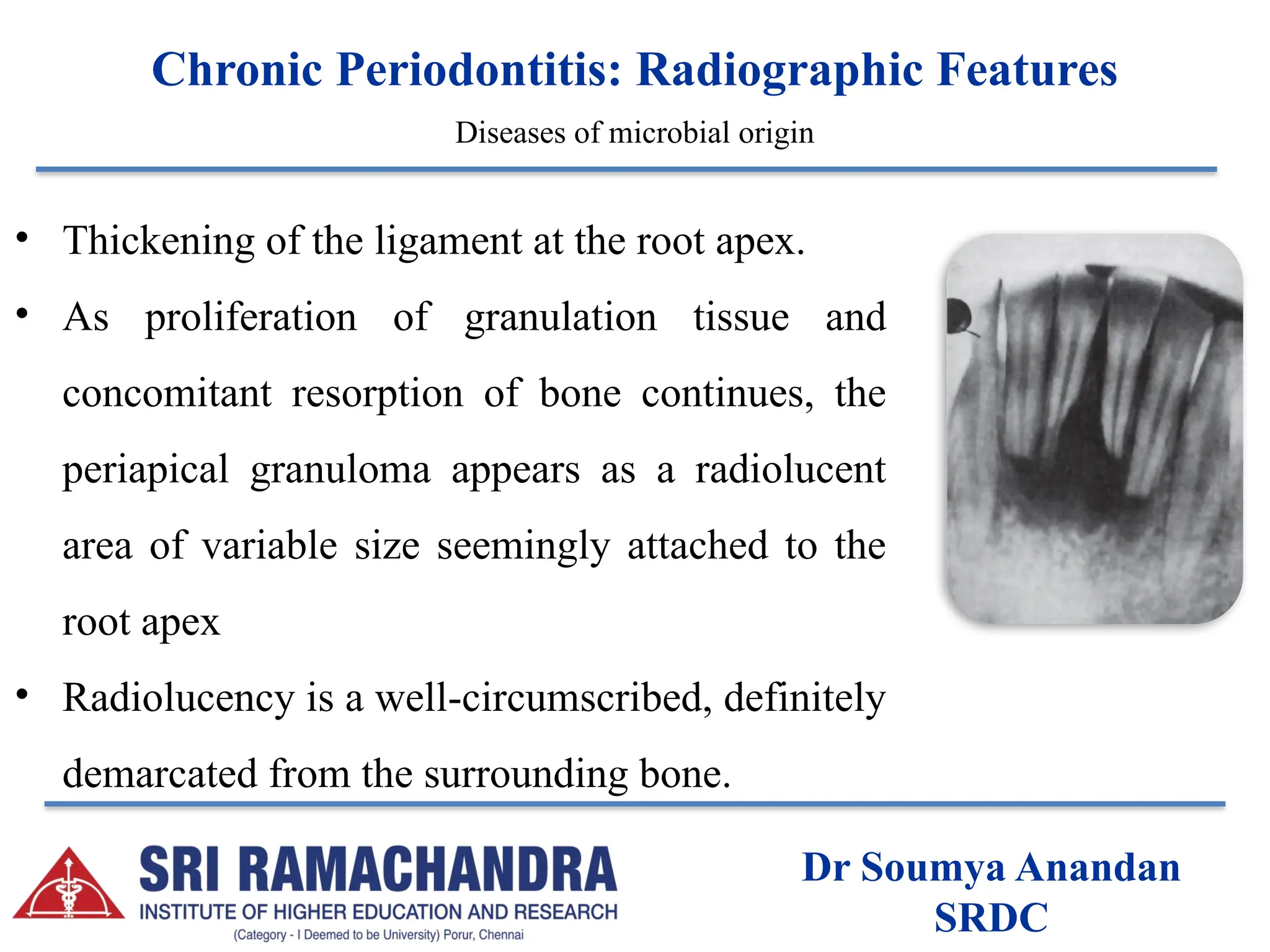
• Thickening of the ligament at the root apex.
• As proliferation of granulation tissue and
concomitant resorption of bone continues, the
periapical granuloma appears as a radiolucent
area of variable size seemingly attached to the
root apex
• Radiolucency is a well-circumscribed, definitely
demarcated from the surrounding bone.
Chronic Periodontitis: TreatmentFeatures
Dr Soumya Anandan
SRDC
Diseases of microbial origin
• The treatment of the periapical granuloma consists in extraction of
the involved teeth, or under certain conditions, root canal therapy
with or without subsequent apicoectomy.
• If left untreated, the periapical granuloma may ultimately undergo
transformation into an apical periodontal cyst.




![Presentation1 [Autosaved].pdf diagnosiss](https://cdn.slidesharecdn.com/ss_thumbnails/presentation1autosaved-250812162634-6365894a-thumbnail.jpg?width=640&height=640&fit=bounds)


