Putting API Design First with
Swagger
Tony Tam
@fehguy
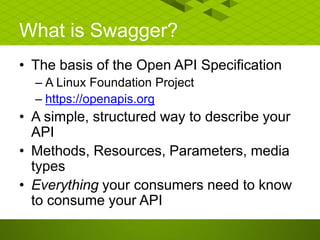
What is Swagger?
• The basis of the Open API Specification
– A Linux Foundation Project
– https://openapis.org
• A simple, structured way to describe your
API
• Methods, Resources, Parameters, media
types
• Everything your consumers need to know
to consume your API
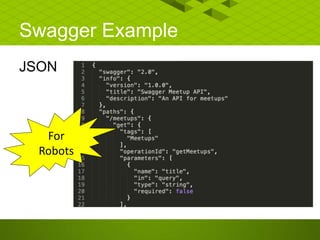
Swagger Example
JSON
For
Robots
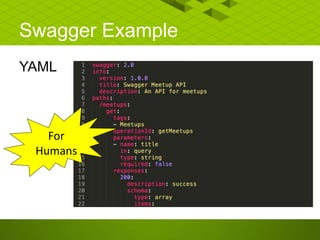
Swagger Example
YAML
For
Humans
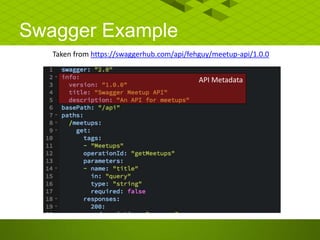
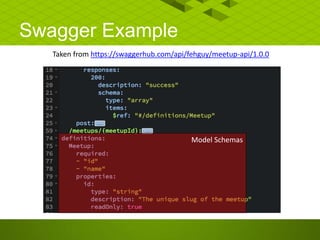
Swagger Example
Taken from https://swaggerhub.com/api/fehguy/meetup-api/1.0.0
API Metadata
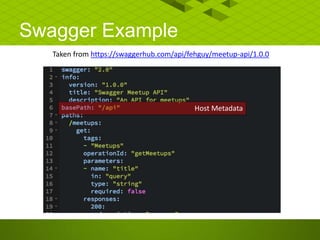
Swagger Example
Taken from https://swaggerhub.com/api/fehguy/meetup-api/1.0.0
Host Metadata
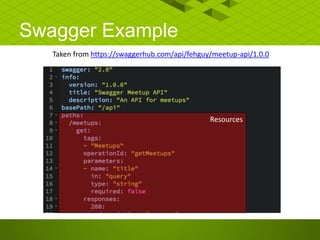
Swagger Example
Taken from https://swaggerhub.com/api/fehguy/meetup-api/1.0.0
Resources
Swagger Example
Taken from https://swaggerhub.com/api/fehguy/meetup-api/1.0.0
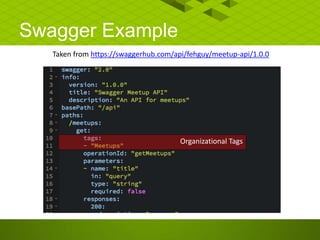
Organizational Tags
Swagger Example
Taken from https://swaggerhub.com/api/fehguy/meetup-api/1.0.0
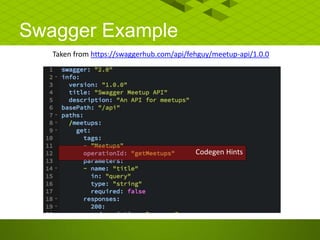
Codegen Hints
Swagger Example
Taken from https://swaggerhub.com/api/fehguy/meetup-api/1.0.0
Parameters
Swagger Example
Taken from https://swaggerhub.com/api/fehguy/meetup-api/1.0.0
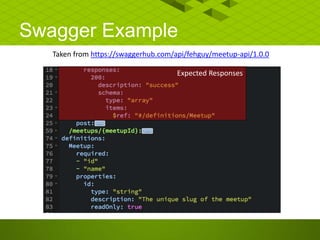
Expected Responses
Swagger Example
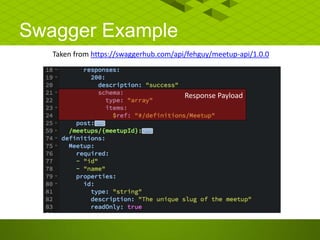
Taken from https://swaggerhub.com/api/fehguy/meetup-api/1.0.0
Response Payload
Swagger Example
Taken from https://swaggerhub.com/api/fehguy/meetup-api/1.0.0
Model Schemas
Swagger Example
Taken from https://swaggerhub.com/api/fehguy/meetup-api/1.0.0
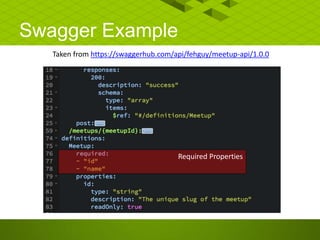
Required Properties
Swagger Example
Taken from https://swaggerhub.com/api/fehguy/meetup-api/1.0.0
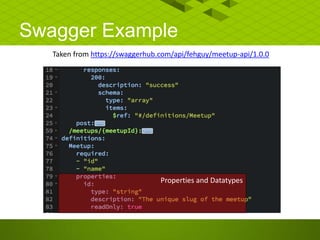
Properties and Datatypes
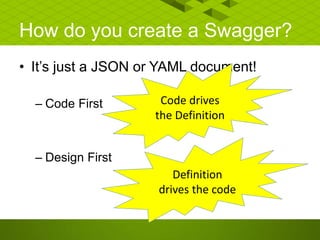
How do you create a Swagger?
• It’s just a JSON or YAML document!
– Code First
– Design First
Code drives
the Definition
Definition
drives the code
Code First
• Code Annotations, comments for
embedded documentation
– Processed at compile-time, post-compile,
runtime
– Docs are always right! (code is the
documentation)
• Like Javadocs for REST APIs (but tons better)
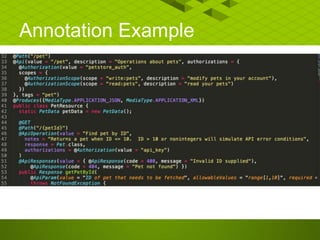
Annotation Example
Design First
• Start with the Swagger Definition as a
blueprint for the implementation
– Code from the definition
• Manual! Swagger Definition is just the
implementation guideline
• Automated with swagger-codegen
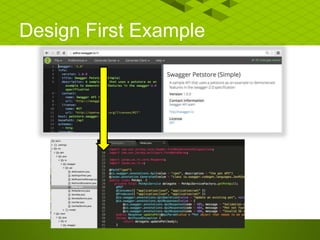
Design First Example
Architecting for Maintainability
Whoever
thought of
this was an
*#&&!
Let’s go with
a dramatic,
50 pitch roof
Removing the Cruft
• Keep documentation outside your code
• Don’t clutter up your code!
– Use the Swagger Definition to drive your API,
not just document it
• You have a DSL, use it!
Introducing Swagger Inflector
• Use Swagger as the Source of Truth for
the API
– Automatically route to controllers
– Automatically map models
– Generate Sample Data when controllers not
implemented
https://github.com/swagger-api/swagger-inflector
How does it work?
• Inflector loads a Swagger Definition at startup
• Parses routes, parameters, models
• Uses configuration / extensions to find
controllers by method signature
– If a controller doesn’t exist, produces mock data
• Routes requests to the Right Place
• No Magic™ Software
– Jersey 2.x
– Jackson 2.x
Example project
https://github.com/fehguy/javaone-inflector-demo
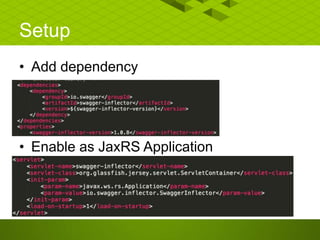
Setup
• Add dependency
• Enable as JaxRS Application
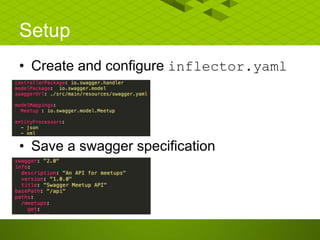
Setup
• Create and configure inflector.yaml
• Save a swagger specification
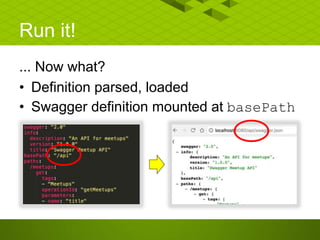
Run it!
... Now what?
• Definition parsed, loaded
• Swagger definition mounted at basePath
Finding Controllers
• Default location from inflector.yaml
• Class name from Tag convention
– controllerPackage + tag[0].name
• Explicitly set as operation extension
– x-swagger-router-controller: org.your.Controller
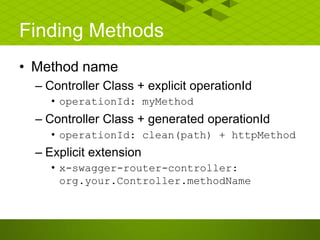
Finding Methods
• Method name
– Controller Class + explicit operationId
• operationId: myMethod
– Controller Class + generated operationId
• operationId: clean(path) + httpMethod
– Explicit extension
• x-swagger-router-controller:
org.your.Controller.methodName
Finding Methods
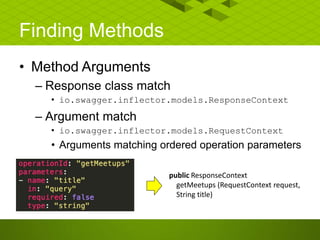
• Method Arguments
– Response class match
• io.swagger.inflector.models.ResponseContext
– Argument match
• io.swagger.inflector.models.RequestContext
• Arguments matching ordered operation parameters
public ResponseContext
getMeetups (RequestContext request,
String title)
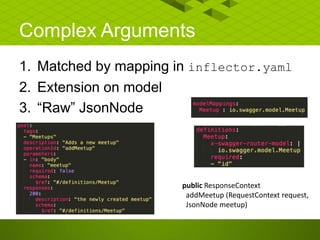
Complex Arguments
1. Matched by mapping in inflector.yaml
2. Extension on model
3. “Raw” JsonNode
public ResponseContext
addMeetup (RequestContext request,
JsonNode meetup)
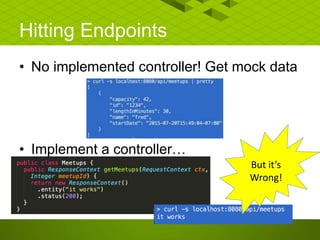
Hitting Endpoints
• No implemented controller! Get mock data
• Implement a controller…
But it’s
Wrong!
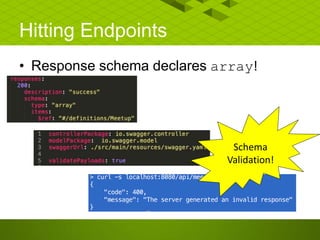
Hitting Endpoints
• Response schema declares array!
Schema
Validation!
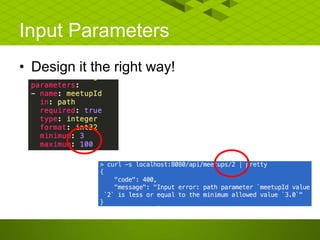
Input Parameters
• Design it the right way!
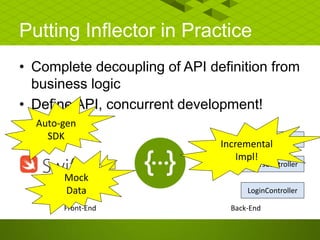
Putting Inflector in Practice
• Complete decoupling of API definition from
business logic
• Define API, concurrent development!
Back-EndFront-End
Auto-gen
SDK
Mock
Data
AdminController
UsersController
LoginController
Incremental
Impl!
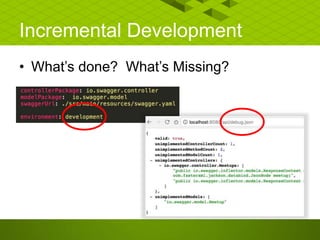
Incremental Development
• What’s done? What’s Missing?
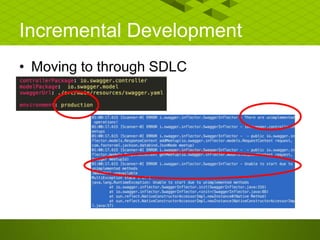
Incremental Development
• Moving to through SDLC
Extend it as needed
• Security?
– Use the RequestContext!
• Content Types?
– Implement an EntityProcessor
• Type Conversion?
– Implement a Converter
• Custom Input Validation?
– Implement a Validator
Swagger Connected
• Swagger is FOSS
• Specification + Tools at http://swagger.io
• All source at https://github.com/swagger-api
• Real-time support at irc.freenode.net
#swagger
Thank you!

API Design first with Swagger

  • 1.
    Putting API DesignFirst with Swagger Tony Tam @fehguy
  • 2.
    What is Swagger? •The basis of the Open API Specification – A Linux Foundation Project – https://openapis.org • A simple, structured way to describe your API • Methods, Resources, Parameters, media types • Everything your consumers need to know to consume your API
  • 3.
  • 4.
  • 5.
    Swagger Example Taken fromhttps://swaggerhub.com/api/fehguy/meetup-api/1.0.0 API Metadata
  • 6.
    Swagger Example Taken fromhttps://swaggerhub.com/api/fehguy/meetup-api/1.0.0 Host Metadata
  • 7.
    Swagger Example Taken fromhttps://swaggerhub.com/api/fehguy/meetup-api/1.0.0 Resources
  • 8.
    Swagger Example Taken fromhttps://swaggerhub.com/api/fehguy/meetup-api/1.0.0 Organizational Tags
  • 9.
    Swagger Example Taken fromhttps://swaggerhub.com/api/fehguy/meetup-api/1.0.0 Codegen Hints
  • 10.
    Swagger Example Taken fromhttps://swaggerhub.com/api/fehguy/meetup-api/1.0.0 Parameters
  • 11.
    Swagger Example Taken fromhttps://swaggerhub.com/api/fehguy/meetup-api/1.0.0 Expected Responses
  • 12.
    Swagger Example Taken fromhttps://swaggerhub.com/api/fehguy/meetup-api/1.0.0 Response Payload
  • 13.
    Swagger Example Taken fromhttps://swaggerhub.com/api/fehguy/meetup-api/1.0.0 Model Schemas
  • 14.
    Swagger Example Taken fromhttps://swaggerhub.com/api/fehguy/meetup-api/1.0.0 Required Properties
  • 15.
    Swagger Example Taken fromhttps://swaggerhub.com/api/fehguy/meetup-api/1.0.0 Properties and Datatypes
  • 16.
    How do youcreate a Swagger? • It’s just a JSON or YAML document! – Code First – Design First Code drives the Definition Definition drives the code
  • 17.
    Code First • CodeAnnotations, comments for embedded documentation – Processed at compile-time, post-compile, runtime – Docs are always right! (code is the documentation) • Like Javadocs for REST APIs (but tons better)
  • 18.
  • 19.
    Design First • Startwith the Swagger Definition as a blueprint for the implementation – Code from the definition • Manual! Swagger Definition is just the implementation guideline • Automated with swagger-codegen
  • 20.
  • 21.
    Architecting for Maintainability Whoever thoughtof this was an *#&&! Let’s go with a dramatic, 50 pitch roof
  • 22.
    Removing the Cruft •Keep documentation outside your code • Don’t clutter up your code! – Use the Swagger Definition to drive your API, not just document it • You have a DSL, use it!
  • 23.
    Introducing Swagger Inflector •Use Swagger as the Source of Truth for the API – Automatically route to controllers – Automatically map models – Generate Sample Data when controllers not implemented https://github.com/swagger-api/swagger-inflector
  • 24.
    How does itwork? • Inflector loads a Swagger Definition at startup • Parses routes, parameters, models • Uses configuration / extensions to find controllers by method signature – If a controller doesn’t exist, produces mock data • Routes requests to the Right Place • No Magic™ Software – Jersey 2.x – Jackson 2.x
  • 25.
  • 26.
    Setup • Add dependency •Enable as JaxRS Application
  • 27.
    Setup • Create andconfigure inflector.yaml • Save a swagger specification
  • 28.
    Run it! ... Nowwhat? • Definition parsed, loaded • Swagger definition mounted at basePath
  • 29.
    Finding Controllers • Defaultlocation from inflector.yaml • Class name from Tag convention – controllerPackage + tag[0].name • Explicitly set as operation extension – x-swagger-router-controller: org.your.Controller
  • 30.
    Finding Methods • Methodname – Controller Class + explicit operationId • operationId: myMethod – Controller Class + generated operationId • operationId: clean(path) + httpMethod – Explicit extension • x-swagger-router-controller: org.your.Controller.methodName
  • 31.
    Finding Methods • MethodArguments – Response class match • io.swagger.inflector.models.ResponseContext – Argument match • io.swagger.inflector.models.RequestContext • Arguments matching ordered operation parameters public ResponseContext getMeetups (RequestContext request, String title)
  • 32.
    Complex Arguments 1. Matchedby mapping in inflector.yaml 2. Extension on model 3. “Raw” JsonNode public ResponseContext addMeetup (RequestContext request, JsonNode meetup)
  • 33.
    Hitting Endpoints • Noimplemented controller! Get mock data • Implement a controller… But it’s Wrong!
  • 34.
    Hitting Endpoints • Responseschema declares array! Schema Validation!
  • 35.
    Input Parameters • Designit the right way!
  • 36.
    Putting Inflector inPractice • Complete decoupling of API definition from business logic • Define API, concurrent development! Back-EndFront-End Auto-gen SDK Mock Data AdminController UsersController LoginController Incremental Impl!
  • 37.
    Incremental Development • What’sdone? What’s Missing?
  • 38.
  • 39.
    Extend it asneeded • Security? – Use the RequestContext! • Content Types? – Implement an EntityProcessor • Type Conversion? – Implement a Converter • Custom Input Validation? – Implement a Validator
  • 40.
    Swagger Connected • Swaggeris FOSS • Specification + Tools at http://swagger.io • All source at https://github.com/swagger-api • Real-time support at irc.freenode.net #swagger
  • 41.