Consuming RESTFul APIs using
Swagger v2.0
Pece Nikolovski
My Story
Can you please provide API Specification for
your existing Web Service?
THE Web Service specification
● Some .txt or .doc or email containing this...
https://my.company.api/v1/login
https://my.company.api/v1/user
https://my.company.api/v1/cards
https://my.company.api/v1/phones
https://my.company.api/v1/addresses
https://my.company.api/v1/addresses/1
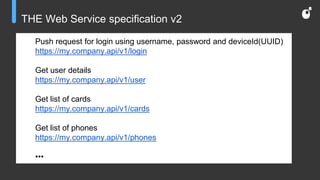
THE Web Service specification v2
Push request for login using username, password and deviceId(UUID)
https://my.company.api/v1/login
Get user details
https://my.company.api/v1/user
Get list of cards
https://my.company.api/v1/cards
Get list of phones
https://my.company.api/v1/phones
•••
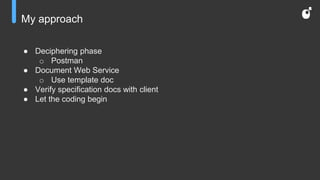
My approach
● Deciphering phase
o Postman
● Document Web Service
o Use template doc
● Verify specification docs with client
● Let the coding begin
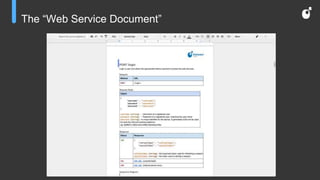
The “Web Service Document”
Common issues
● Developers “LOVE” documentation
o new api calls
o modification of existing
o maintenance of Web Service Docs
● Consistency between platforms
o iOS, Android and IS
● Etc.
What is Swagger?
Swagger
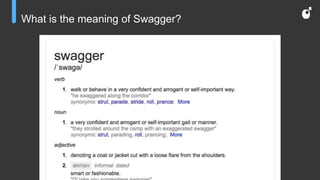
What is the meaning of Swagger?
What is Swagger?
● Simple representation of your RESTful
API
● Group of projects
o several main
o over 50 community
● http://swagger.io
Swagger Spec & Core
● Swagger syntax - Json or Yaml
o I prefer Yaml
● Models using JSON Schema draft v4
● https://github.com/swagger-api/swagger-spec
● https://github.com/swagger-api/swagger-core
How to create the Spec?
● Two approaches
o Automatic
o Manual
Our approach
Outware’s approach
● Why v2.0?
o Why not v1.2 or v1.0
● Lots of reasons…
o Java vs Scala
● Works in both cases
o building API and client
o only client
Manually build the Specs
● How to check specs validity?
o JSON, YAML, blah blah blah...
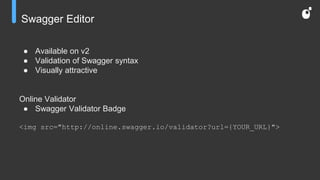
Swagger Editor
● Available on v2
● Validation of Swagger syntax
● Visually attractive
Online Validator
● Swagger Validator Badge
<img src="http://online.swagger.io/validator?url={YOUR_URL}">
Swagger UI
● Web Service documentation
o Interactive
● Directly test API calls and observe the results
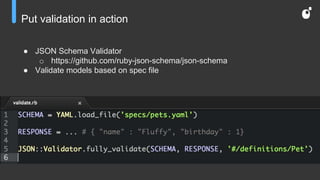
Put validation in action
● JSON Schema Validator
o https://github.com/ruby-json-schema/json-schema
● Validate models based on spec file
What about mobile dev?
Swagger Codegen
● Generate client code based on spec
● Java / Maven project
● Output is auto generated ( & “documented code”)
● Multiple languages support
o Language client class
o Mustache template files
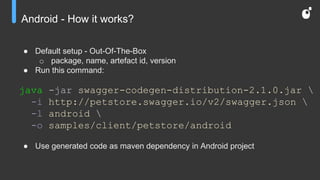
Android - How it works?
● Default setup - Out-Of-The-Box
o package, name, artefact id, version
● Run this command:
java -jar swagger-codegen-distribution-2.1.0.jar 
-i http://petstore.swagger.io/v2/swagger.json 
-l android 
-o samples/client/petstore/android
● Use generated code as maven dependency in Android project
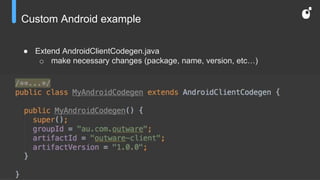
Custom Android example
● Extend AndroidClientCodegen.java
o make necessary changes (package, name, version, etc…)
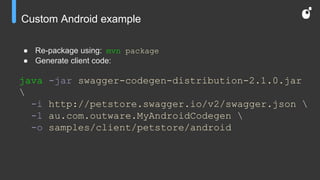
Custom Android example
● Re-package using: mvn package
● Generate client code:
java -jar swagger-codegen-distribution-2.1.0.jar

-i http://petstore.swagger.io/v2/swagger.json 
-l au.com.outware.MyAndroidCodegen 
-o samples/client/petstore/android
What is the quality of generated code?
● Code as good as your template
o Treat as “Black Box”
● Using HTTPRequest
● Errors returned as string instead models
● Minor bugs
o array http params
o form params
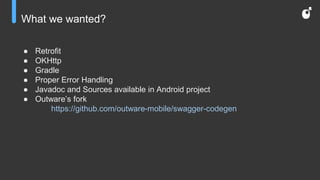
What we wanted?
● Retrofit
● OKHttp
● Gradle
● Proper Error Handling
● Javadoc and Sources available in Android project
● Outware’s fork
https://github.com/outware-mobile/swagger-codegen
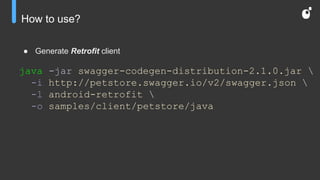
How to use?
● Generate Retrofit client
java -jar swagger-codegen-distribution-2.1.0.jar 
-i http://petstore.swagger.io/v2/swagger.json 
-l android-retrofit 
-o samples/client/petstore/java
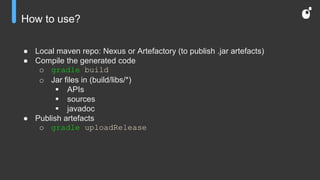
How to use?
● Local maven repo: Nexus or Artefactory (to publish .jar artefacts)
● Compile the generated code
o gradle build
o Jar files in (build/libs/*)
 APIs
 sources
 javadoc
● Publish artefacts
o gradle uploadRelease
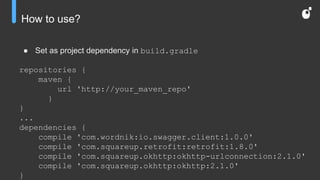
How to use?
● Set as project dependency in build.gradle
repositories {
maven {
url 'http://your_maven_repo'
}
}
...
dependencies {
compile 'com.wordnik:io.swagger.client:1.0.0'
compile 'com.squareup.retrofit:retrofit:1.8.0'
compile 'com.squareup.okhttp:okhttp-urlconnection:2.1.0'
compile 'com.squareup.okhttp:okhttp:2.1.0'
}
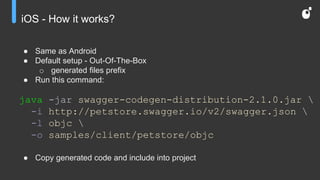
iOS - How it works?
● Same as Android
● Default setup - Out-Of-The-Box
o generated files prefix
● Run this command:
java -jar swagger-codegen-distribution-2.1.0.jar 
-i http://petstore.swagger.io/v2/swagger.json 
-l objc 
-o samples/client/petstore/objc
● Copy generated code and include into project
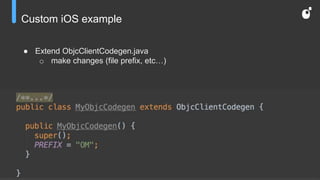
Custom iOS example
● Extend ObjcClientCodegen.java
o make changes (file prefix, etc…)
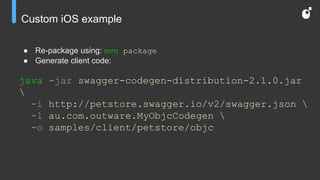
Custom iOS example
● Re-package using: mvn package
● Generate client code:
java -jar swagger-codegen-distribution-2.1.0.jar

-i http://petstore.swagger.io/v2/swagger.json 
-l au.com.outware.MyObjcCodegen 
-o samples/client/petstore/objc
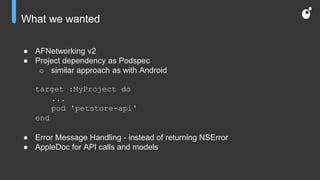
What we wanted
● AFNetworking v2
● Project dependency as Podspec
o similar approach as with Android
target :MyProject do
...
pod 'petstore-api'
end
● Error Message Handling - instead of returning NSError
● AppleDoc for API calls and models
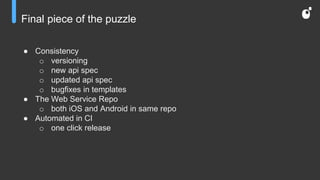
Final piece of the puzzle
● Consistency
o versioning
o new api spec
o updated api spec
o bugfixes in templates
● The Web Service Repo
o both iOS and Android in same repo
● Automated in CI
o one click release
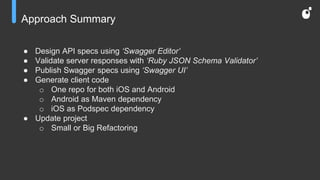
Approach Summary
● Design API specs using ‘Swagger Editor’
● Validate server responses with ‘Ruby JSON Schema Validator’
● Publish Swagger specs using ‘Swagger UI’
● Generate client code
o One repo for both iOS and Android
o Android as Maven dependency
o iOS as Podspec dependency
● Update project
o Small or Big Refactoring
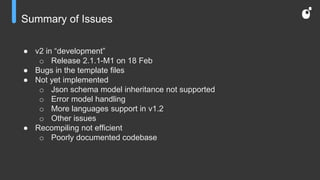
Summary of Issues
● v2 in “development”
o Release 2.1.1-M1 on 18 Feb
● Bugs in the template files
● Not yet implemented
o Json schema model inheritance not supported
o Error model handling
o More languages support in v1.2
o Other issues
● Recompiling not efficient
o Poorly documented codebase
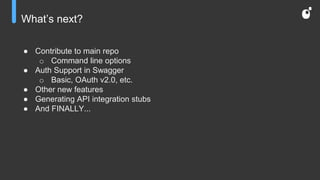
What’s next?
● Contribute to main repo
o Command line options
● Auth Support in Swagger
o Basic, OAuth v2.0, etc.
● Other new features
● Generating API integration stubs
● And FINALLY...
Join the Crew
Thank You
Pece Nikolovski
Outware Mobile - www.outware.com.au
The OMPodcast - All about the Mobile Industry

Consuming Restful APIs using Swagger v2.0

  • 1.
    Consuming RESTFul APIsusing Swagger v2.0 Pece Nikolovski
  • 2.
    My Story Can youplease provide API Specification for your existing Web Service?
  • 3.
    THE Web Servicespecification ● Some .txt or .doc or email containing this... https://my.company.api/v1/login https://my.company.api/v1/user https://my.company.api/v1/cards https://my.company.api/v1/phones https://my.company.api/v1/addresses https://my.company.api/v1/addresses/1
  • 4.
    THE Web Servicespecification v2 Push request for login using username, password and deviceId(UUID) https://my.company.api/v1/login Get user details https://my.company.api/v1/user Get list of cards https://my.company.api/v1/cards Get list of phones https://my.company.api/v1/phones •••
  • 5.
    My approach ● Decipheringphase o Postman ● Document Web Service o Use template doc ● Verify specification docs with client ● Let the coding begin
  • 6.
    The “Web ServiceDocument”
  • 7.
    Common issues ● Developers“LOVE” documentation o new api calls o modification of existing o maintenance of Web Service Docs ● Consistency between platforms o iOS, Android and IS ● Etc.
  • 8.
  • 9.
  • 10.
    What is themeaning of Swagger?
  • 11.
    What is Swagger? ●Simple representation of your RESTful API ● Group of projects o several main o over 50 community ● http://swagger.io
  • 12.
    Swagger Spec &Core ● Swagger syntax - Json or Yaml o I prefer Yaml ● Models using JSON Schema draft v4 ● https://github.com/swagger-api/swagger-spec ● https://github.com/swagger-api/swagger-core
  • 13.
    How to createthe Spec? ● Two approaches o Automatic o Manual
  • 14.
  • 15.
    Outware’s approach ● Whyv2.0? o Why not v1.2 or v1.0 ● Lots of reasons… o Java vs Scala ● Works in both cases o building API and client o only client
  • 16.
    Manually build theSpecs ● How to check specs validity? o JSON, YAML, blah blah blah...
  • 17.
    Swagger Editor ● Availableon v2 ● Validation of Swagger syntax ● Visually attractive Online Validator ● Swagger Validator Badge <img src="http://online.swagger.io/validator?url={YOUR_URL}">
  • 18.
    Swagger UI ● WebService documentation o Interactive ● Directly test API calls and observe the results
  • 19.
    Put validation inaction ● JSON Schema Validator o https://github.com/ruby-json-schema/json-schema ● Validate models based on spec file
  • 20.
  • 21.
    Swagger Codegen ● Generateclient code based on spec ● Java / Maven project ● Output is auto generated ( & “documented code”) ● Multiple languages support o Language client class o Mustache template files
  • 22.
    Android - Howit works? ● Default setup - Out-Of-The-Box o package, name, artefact id, version ● Run this command: java -jar swagger-codegen-distribution-2.1.0.jar -i http://petstore.swagger.io/v2/swagger.json -l android -o samples/client/petstore/android ● Use generated code as maven dependency in Android project
  • 23.
    Custom Android example ●Extend AndroidClientCodegen.java o make necessary changes (package, name, version, etc…)
  • 24.
    Custom Android example ●Re-package using: mvn package ● Generate client code: java -jar swagger-codegen-distribution-2.1.0.jar -i http://petstore.swagger.io/v2/swagger.json -l au.com.outware.MyAndroidCodegen -o samples/client/petstore/android
  • 25.
    What is thequality of generated code? ● Code as good as your template o Treat as “Black Box” ● Using HTTPRequest ● Errors returned as string instead models ● Minor bugs o array http params o form params
  • 26.
    What we wanted? ●Retrofit ● OKHttp ● Gradle ● Proper Error Handling ● Javadoc and Sources available in Android project ● Outware’s fork https://github.com/outware-mobile/swagger-codegen
  • 27.
    How to use? ●Generate Retrofit client java -jar swagger-codegen-distribution-2.1.0.jar -i http://petstore.swagger.io/v2/swagger.json -l android-retrofit -o samples/client/petstore/java
  • 28.
    How to use? ●Local maven repo: Nexus or Artefactory (to publish .jar artefacts) ● Compile the generated code o gradle build o Jar files in (build/libs/*)  APIs  sources  javadoc ● Publish artefacts o gradle uploadRelease
  • 29.
    How to use? ●Set as project dependency in build.gradle repositories { maven { url 'http://your_maven_repo' } } ... dependencies { compile 'com.wordnik:io.swagger.client:1.0.0' compile 'com.squareup.retrofit:retrofit:1.8.0' compile 'com.squareup.okhttp:okhttp-urlconnection:2.1.0' compile 'com.squareup.okhttp:okhttp:2.1.0' }
  • 30.
    iOS - Howit works? ● Same as Android ● Default setup - Out-Of-The-Box o generated files prefix ● Run this command: java -jar swagger-codegen-distribution-2.1.0.jar -i http://petstore.swagger.io/v2/swagger.json -l objc -o samples/client/petstore/objc ● Copy generated code and include into project
  • 31.
    Custom iOS example ●Extend ObjcClientCodegen.java o make changes (file prefix, etc…)
  • 32.
    Custom iOS example ●Re-package using: mvn package ● Generate client code: java -jar swagger-codegen-distribution-2.1.0.jar -i http://petstore.swagger.io/v2/swagger.json -l au.com.outware.MyObjcCodegen -o samples/client/petstore/objc
  • 33.
    What we wanted ●AFNetworking v2 ● Project dependency as Podspec o similar approach as with Android target :MyProject do ... pod 'petstore-api' end ● Error Message Handling - instead of returning NSError ● AppleDoc for API calls and models
  • 34.
    Final piece ofthe puzzle ● Consistency o versioning o new api spec o updated api spec o bugfixes in templates ● The Web Service Repo o both iOS and Android in same repo ● Automated in CI o one click release
  • 35.
    Approach Summary ● DesignAPI specs using ‘Swagger Editor’ ● Validate server responses with ‘Ruby JSON Schema Validator’ ● Publish Swagger specs using ‘Swagger UI’ ● Generate client code o One repo for both iOS and Android o Android as Maven dependency o iOS as Podspec dependency ● Update project o Small or Big Refactoring
  • 36.
    Summary of Issues ●v2 in “development” o Release 2.1.1-M1 on 18 Feb ● Bugs in the template files ● Not yet implemented o Json schema model inheritance not supported o Error model handling o More languages support in v1.2 o Other issues ● Recompiling not efficient o Poorly documented codebase
  • 37.
    What’s next? ● Contributeto main repo o Command line options ● Auth Support in Swagger o Basic, OAuth v2.0, etc. ● Other new features ● Generating API integration stubs ● And FINALLY...
  • 38.
  • 39.
    Thank You Pece Nikolovski OutwareMobile - www.outware.com.au The OMPodcast - All about the Mobile Industry

Editor's Notes

  • #2 I’m going to talk about a magical way to approach web service APIs
  • #3 My Story All apps consume some way of a web services Clients have existing web service and want an app This is one of the first questions..
  • #4 This is what we get... TXT or WORD or even EMAIL More details about the requests?
  • #5 OK now I know more It’s not their fault So what do I do?
  • #6 Decipher using Postman - manually hit the endpoints We created a template for documenting APIs Send to client to verify
  • #7 Here is an example of that doc Great, well documented, devs are happy… But there are issues with this approach… And that is… as you can see, the right alignment of the second table is wrong… I’m joking, here are the common issues with this approach.
  • #8 Devs LOVE documentation - that is a lie Since we build both iOS and Android consistency is a problem. Changes are not communicated to the other team. So that’s why today I’ll talk about Swagger...
  • #9  Question is… WHAT IS SWAGGER ---------------------> This is Swagger
  • #10 Any questions? Thank you all see ya next time
  • #11 I was not familiar with the meaning of swagger so I’ve looked up in dictionary. Going back to original question...
  • #12 Simple yet powerful representation of your RESTful API Group of projects with main focus on API documentation (7 main & over 50 community) Impossible to cover all I’ll focus on the ones we use To begin the explanation I want to start with the CORE
  • #13 It’s a file JSON or YAML Core is parser/generator/validator for the SPEC file Request and response models are represented using JSON Schema V4 Here is an example how the api specs file looks like <show json and explain>
  • #14 How to create the spec, two main approaches automatic & manual Automatic: Annotate code with swagger documentation to auto generate SPECS Manual: Manually create SPEC using JSON or YAML There are other approaches, dependent on how you build stuff, and which tools you use BUT today I’m going to talk about our approach and what did work for us
  • #16 First thing to mention is we are focusing only on V2 One reason is that before v2 the tools were build using Scala The project did not get much love and contribution from the community (no one needs another language) The creators came to decision to create V2 in Java Based on my experience so far In most cases we build both Web Service and client mobile app But this approach works even if building just client mobile app Now let’s look at our approach
  • #17 First thing is to manually create the specification YES, writing json or yaml is not cool at all How is this supposed to help with better understanding of the Web Service It’s more confusion than benefit… That’s why we use tool…
  • #18 Swagger Editor only available for V2 Offers validation and Visual representation of the spec <Show it in action in browser> Also there is online swagger syntax validator, If you are paranoid about publishing your api, all tools can be hosted locally Setup and deploy in less than 30min
  • #19 Using the Editor we can make changes but What if you Want to provide UI tool for devs/qa to review and not make changes to the file Interactive web service documentation where you can test and observe the API calls and responses <Show it in action in browser>
  • #20 Now that we have documentation How do we benefit even more from this specification? What about if we can write tests to validate the server responses if they confirm the specs? Here is how to do that: Since we focus building IS mainly in Ruby... We use Ruby Json Schema validator <explain steps> Load swagger YAML or JSON spec file Grab the response from the server Validate the returned json is compliant to the schema definition
  • #21 So far we covered how to document and validate the responses We have not mentioned anything about Android or iOS benefits. Well there is more… If we have all API specs why can’t we just generate the code and save time? I present you Swagger Codegen
  • #22 <Show Android Studio with SwaggerCodegen>
  • #23 <show example> To start with I’ll cover Android Default package name Default version But what if I want to customize the parameters Maven library from generated code
  • #24 <show sample java>
  • #26 Put it this way Treat as black box but devs not happy with code quality and implementation
  • #31 <show example>
  • #33 <show sample java>
  • #39 Join the gang and become a Swagger