Apache Velocity A Java Template Engine Nathan Bubna [email_address] , Henning P. Schmiedehausen [email_address] OSCON 2007, July 25th 2007  Portland, Oregon http://people.apache.org/~nbubna/oscon2007(.zip)
Template Engine? Defines a simple language (VTL – Velocity Template Language) Templates are text containing active elements Active elements are replaced with values from the model No “industry standard” template language Templates are processed, not compiled
Velocity Background Velocity was started in 2000 One of the first Jakarta projects ASF-licensed alternative to WebMacro Language syntax is similar and still very stable 100% Pure Java (runs on Java 1.3 or better) Velocity became an Apache TLP in 2006 Current release is 1.5 (as of March ’07)
Velocity Spotting Velocity is integrated with many other projects (Turbine, Struts 2, Maven…) and others  ( http:// wiki .apache.org/velocity/ PoweredByVelocity ) Support for IDEs and Editors available (e.g. Eclipse, IntelliJ IDEA, emacs…)  ( http:// wiki .apache.org/velocity/ VelocityEditors ) Response content in webapp frameworks (e.g. Struts, Turbine) Code generation (e.g. Torque, MyEclipse) Documentation (e.g. Maven, Anakia) Email (e.g. Spring)
Velocity vs JSP Easier to test No servlet container required Better separation of code and design No compilation into Java code Few, easy to learn language elements No embedded Java code! Easy on the eyes
Real Template Engines perl:  HTML-Template, Mason php:  Smarty, SmartTemplate,  TinyButStrong Ruby:  Galena, LiquidRuby Python:  QuickSilver, Cheetah,  TurboGears, Airspeed Java: WebMacro, FreeMarker,    Apache Velocity
Velocity Template Language Simple constructs # directive()  (line directives) #directive() … #end  (block directives) $ reference  or ${ reference } Embedded directly into template files (no open / close tags like JSP or PHP) References are “loosely typed” VTL can be learned in minutes
Assignments - #set() #set is used to create or update a reference #set( $foo = “text” )  String value #set( $foo = 100 ) Numeric value #set( $foo = [ 1, 2, 3 ] ) Array #set( $foo = { 1 : 2, 3 : 4 } ) Map #set( $foo = $bar ) Reference #set( $foo = $bar.foo )  Bean Property #set( $foo = $bar.doFoo() )  Method Result
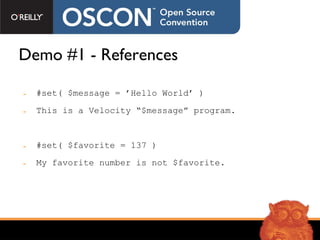
Demo #1 - References #set( $message = ’Hello World’ ) This is a Velocity “$message” program. #set( $favorite = 137 ) My favorite number is not $favorite.
Display Control Elements Loop #foreach( $foo in $bars ) ... #end Conditional #if ( ) … #elseif ( ) … #else … #end Inclusion of external elements #include( ) Load external file #parse( ) Load and parse file
Demo #2 - Loops #set( $list =  [  ‘ a ’ ,  ‘ b ’ ,  ‘ c ’ ,  ‘ d ’  ]  ) #foreach(   $ alpha  in  $list  ) The current letter is $ alpha #end Let’s count  #foreach(   $i in [ 1..10 ]   )$i   #end
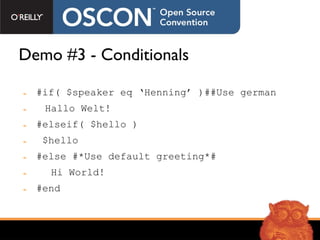
Demo #3 - Conditionals #if( $speaker eq ‘Henning’ )##Use german   Hallo Welt! #elseif( $hello ) $hello #else #*Use default greeting*#   Hi World! #end
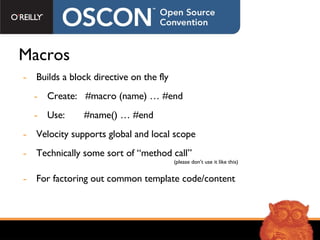
Macros Builds a block directive on the fly Create:  #macro (name) … #end Use:  #name() … #end Velocity supports global and local scope Technically some sort of “method call”    (please don’t use it like this) For factoring out common template code/content
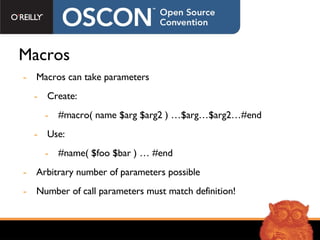
Macros Macros can take parameters Create:  #macro( name $arg $arg2 ) …$arg…$arg2…#end Use:  #name( $foo $bar ) … #end Arbitrary number of parameters possible Number of call parameters must match definition!
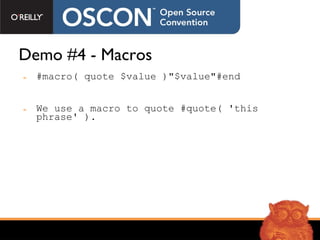
Demo #4 - Macros #macro( quote $value )"$value"#end We use a macro to quote #quote( 'this phrase' ).
Reference Syntax & Evaluation A  $ reference  represents a Java object Use a${ formalReference }to avoid parsing ambiguities $! ref or $!{ref}  means “be quiet when null”     (do not confuse with !$reference) Evaluation  always  invokes  toString() method
Velocity Miscellany A range operator exists #set ($foo = [ 1..100 ]) List of integers 1 to 100  Arithmetic (both integer  and floating point ) #set ($foo =  1.5  + 2 )  $foo is now 3.5 +, -, /, *, % Boolean operators for conditionals !, &&, ||, ==, <=, <, >, >= not, and, or, eq, ne, gt, ge, lt, le For == and !=, if the operands are not of the same class, their  toString()  values are compared String interpolation for #set(), macro args and method args #set( $foo = “foo was $foo” ) $foo is now “foo was 3.5”
Velocity Context The Context is the means of importing values into the template It is essentially a map of reference identifiers (i.e. the “foo” in ${foo}) to Java objects All access to data in the template comes this way There is no “natural” or “native” way to access or create Java objects
Demo – Using A Context public static void main(String [] args) throws Exception { VelocityEngine engine = new VelocityEngine(); VelocityContext context = new VelocityContext(); context.put(“speaker&quot;, “Nathan”); context.put(&quot;hello&quot;, &quot;Hello World!&quot;); Template template = engine.getTemplate(args[0]); StringWriter out = new StringWriter(); template.merge(context, out); System.out.println(out.toString()); }
Interacting With Context Objects The real power of Velocity All public methods in public classes are available All works via runtime reflection Shortcut notation for property access ($a.b vs $a.getB()) Type promotion as Java does Method parameters can not be omitted!   (this is not perl!)
VelocityTools A “tool” is just a context object that is “useful”  in a template Collection of useful Java classes. Comes in three flavors: GenericTools All-purpose tools VelocityView   Tools and more for webapps VelocityStruts Velocity as Struts View layer Other “tools” out there on the web
VelocityView VelocityViewServlet renders arbitrary Templates through web.xml mapping Configuration of tools with an XML based configuration file Different tool scopes/lifecycles possible ( application ,  session ,  request ) Request, Session, Response and ServletContext objects and their attributes are available automatically
Advanced Velocity Custom directives possible  (org.apache.velocity.runtime.directive.Directive) Multiple Resource loaders to load templates from different sources (files, classpath, jars, database, remote URLs) Event Handlers for Exception handling,  XML escaping , etc Custom Introspector for method and property access possible
Advanced Velocity Velocity Template Language (VTL) is defined in JavaCC grammar VTL itself can be changed or extended (needs recompilation of velocity.jar) More “Advanced Velocity“ at  http://wiki.apache.org/velocity/HackingVelocity   including the excellent ApacheCon 2004 session slides by Will Glass-Husain
Demo #5 - VelocityView Uses VelocityTools 2.0 (only alpha release available) VelocityViewServlet does the work Uses LinkTool, ParameterTool, EscapeTool  (aka $link, $params, and $esc) One custom tool: AddressBook is a ~30 line POJO One template: index.vm is just ~50 lines ~20 lines of config (including web.xml)
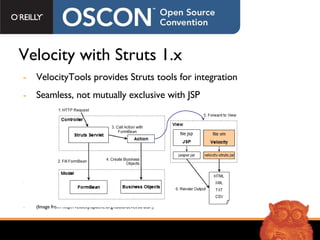
Velocity with Struts 1.x VelocityTools provides Struts tools for integration Seamless, not mutually exclusive with JSP (Image from http://velocity.apache.org/tools/devel/struts/!)
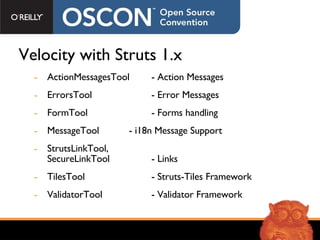
Velocity with Struts 1.x ActionMessagesTool - Action Messages ErrorsTool - Error Messages FormTool - Forms handling MessageTool - i18n Message Support StrutsLinkTool, SecureLinkTool - Links TilesTool - Struts-Tiles Framework ValidatorTool   - Validator Framework
Velocity with Turbine Preferred View Layer of Turbine No separate Servlet Turbine fully integrates Velocity Turbine provides infrastructure Tools Template Loaders Configuration and Logging
Velocity with… Velocity is supported as a first-class view layer in Struts 2.x (uses custom directives instead of tools) Spring MVC (also supports VelocityTools 1.x well) Click ( http://click.sourceforge.net/ ) Restlet ( http://www.restlet.org/ ) Mentawai (http://www.mentaframework.org/) And at least a dozen others… (http://wiki.apache.org/velocity/PoweredByVelocity)
Other Velocity Uses Texen  for generic text generation Anakia  for XML to documentation Torque – generate Java and SQL code VelocityViewTag – Easily embed Velocity in JSP  (Part of the upcoming VelocityTools 2.0) Velosurf – Tool for abstracting database interaction
Any questions?
Where to go from here? Velocity Homepage http://velocity.apache.org/ Velocity Mailing Lists http://velocity.apache.org/contact.html Velocity Wiki http://wiki.apache.org/velocity/ These Slides and Demo Code http://people.apache.org/~nbubna/oscon2007 Velocity 1.5 Release Notes http://wiki.apache.org/jakarta-velocity/Velocity15ReleaseNotes
Thanks for your attention!

Apache Velocity

  • 1.
    Apache Velocity AJava Template Engine Nathan Bubna [email_address] , Henning P. Schmiedehausen [email_address] OSCON 2007, July 25th 2007 Portland, Oregon http://people.apache.org/~nbubna/oscon2007(.zip)
  • 2.
    Template Engine? Definesa simple language (VTL – Velocity Template Language) Templates are text containing active elements Active elements are replaced with values from the model No “industry standard” template language Templates are processed, not compiled
  • 3.
    Velocity Background Velocitywas started in 2000 One of the first Jakarta projects ASF-licensed alternative to WebMacro Language syntax is similar and still very stable 100% Pure Java (runs on Java 1.3 or better) Velocity became an Apache TLP in 2006 Current release is 1.5 (as of March ’07)
  • 4.
    Velocity Spotting Velocityis integrated with many other projects (Turbine, Struts 2, Maven…) and others ( http:// wiki .apache.org/velocity/ PoweredByVelocity ) Support for IDEs and Editors available (e.g. Eclipse, IntelliJ IDEA, emacs…) ( http:// wiki .apache.org/velocity/ VelocityEditors ) Response content in webapp frameworks (e.g. Struts, Turbine) Code generation (e.g. Torque, MyEclipse) Documentation (e.g. Maven, Anakia) Email (e.g. Spring)
  • 5.
    Velocity vs JSPEasier to test No servlet container required Better separation of code and design No compilation into Java code Few, easy to learn language elements No embedded Java code! Easy on the eyes
  • 6.
    Real Template Enginesperl: HTML-Template, Mason php: Smarty, SmartTemplate, TinyButStrong Ruby: Galena, LiquidRuby Python: QuickSilver, Cheetah, TurboGears, Airspeed Java: WebMacro, FreeMarker, Apache Velocity
  • 7.
    Velocity Template LanguageSimple constructs # directive() (line directives) #directive() … #end (block directives) $ reference or ${ reference } Embedded directly into template files (no open / close tags like JSP or PHP) References are “loosely typed” VTL can be learned in minutes
  • 8.
    Assignments - #set()#set is used to create or update a reference #set( $foo = “text” ) String value #set( $foo = 100 ) Numeric value #set( $foo = [ 1, 2, 3 ] ) Array #set( $foo = { 1 : 2, 3 : 4 } ) Map #set( $foo = $bar ) Reference #set( $foo = $bar.foo ) Bean Property #set( $foo = $bar.doFoo() ) Method Result
  • 9.
    Demo #1 -References #set( $message = ’Hello World’ ) This is a Velocity “$message” program. #set( $favorite = 137 ) My favorite number is not $favorite.
  • 10.
    Display Control ElementsLoop #foreach( $foo in $bars ) ... #end Conditional #if ( ) … #elseif ( ) … #else … #end Inclusion of external elements #include( ) Load external file #parse( ) Load and parse file
  • 11.
    Demo #2 -Loops #set( $list = [ ‘ a ’ , ‘ b ’ , ‘ c ’ , ‘ d ’ ] ) #foreach( $ alpha in $list ) The current letter is $ alpha #end Let’s count #foreach( $i in [ 1..10 ] )$i #end
  • 12.
    Demo #3 -Conditionals #if( $speaker eq ‘Henning’ )##Use german Hallo Welt! #elseif( $hello ) $hello #else #*Use default greeting*# Hi World! #end
  • 13.
    Macros Builds ablock directive on the fly Create: #macro (name) … #end Use: #name() … #end Velocity supports global and local scope Technically some sort of “method call” (please don’t use it like this) For factoring out common template code/content
  • 14.
    Macros Macros cantake parameters Create: #macro( name $arg $arg2 ) …$arg…$arg2…#end Use: #name( $foo $bar ) … #end Arbitrary number of parameters possible Number of call parameters must match definition!
  • 15.
    Demo #4 -Macros #macro( quote $value )&quot;$value&quot;#end We use a macro to quote #quote( 'this phrase' ).
  • 16.
    Reference Syntax &Evaluation A $ reference represents a Java object Use a${ formalReference }to avoid parsing ambiguities $! ref or $!{ref} means “be quiet when null” (do not confuse with !$reference) Evaluation always invokes toString() method
  • 17.
    Velocity Miscellany Arange operator exists #set ($foo = [ 1..100 ]) List of integers 1 to 100 Arithmetic (both integer and floating point ) #set ($foo = 1.5 + 2 ) $foo is now 3.5 +, -, /, *, % Boolean operators for conditionals !, &&, ||, ==, <=, <, >, >= not, and, or, eq, ne, gt, ge, lt, le For == and !=, if the operands are not of the same class, their toString() values are compared String interpolation for #set(), macro args and method args #set( $foo = “foo was $foo” ) $foo is now “foo was 3.5”
  • 18.
    Velocity Context TheContext is the means of importing values into the template It is essentially a map of reference identifiers (i.e. the “foo” in ${foo}) to Java objects All access to data in the template comes this way There is no “natural” or “native” way to access or create Java objects
  • 19.
    Demo – UsingA Context public static void main(String [] args) throws Exception { VelocityEngine engine = new VelocityEngine(); VelocityContext context = new VelocityContext(); context.put(“speaker&quot;, “Nathan”); context.put(&quot;hello&quot;, &quot;Hello World!&quot;); Template template = engine.getTemplate(args[0]); StringWriter out = new StringWriter(); template.merge(context, out); System.out.println(out.toString()); }
  • 20.
    Interacting With ContextObjects The real power of Velocity All public methods in public classes are available All works via runtime reflection Shortcut notation for property access ($a.b vs $a.getB()) Type promotion as Java does Method parameters can not be omitted! (this is not perl!)
  • 21.
    VelocityTools A “tool”is just a context object that is “useful” in a template Collection of useful Java classes. Comes in three flavors: GenericTools All-purpose tools VelocityView Tools and more for webapps VelocityStruts Velocity as Struts View layer Other “tools” out there on the web
  • 22.
    VelocityView VelocityViewServlet rendersarbitrary Templates through web.xml mapping Configuration of tools with an XML based configuration file Different tool scopes/lifecycles possible ( application , session , request ) Request, Session, Response and ServletContext objects and their attributes are available automatically
  • 23.
    Advanced Velocity Customdirectives possible (org.apache.velocity.runtime.directive.Directive) Multiple Resource loaders to load templates from different sources (files, classpath, jars, database, remote URLs) Event Handlers for Exception handling, XML escaping , etc Custom Introspector for method and property access possible
  • 24.
    Advanced Velocity VelocityTemplate Language (VTL) is defined in JavaCC grammar VTL itself can be changed or extended (needs recompilation of velocity.jar) More “Advanced Velocity“ at http://wiki.apache.org/velocity/HackingVelocity including the excellent ApacheCon 2004 session slides by Will Glass-Husain
  • 25.
    Demo #5 -VelocityView Uses VelocityTools 2.0 (only alpha release available) VelocityViewServlet does the work Uses LinkTool, ParameterTool, EscapeTool (aka $link, $params, and $esc) One custom tool: AddressBook is a ~30 line POJO One template: index.vm is just ~50 lines ~20 lines of config (including web.xml)
  • 26.
    Velocity with Struts1.x VelocityTools provides Struts tools for integration Seamless, not mutually exclusive with JSP (Image from http://velocity.apache.org/tools/devel/struts/!)
  • 27.
    Velocity with Struts1.x ActionMessagesTool - Action Messages ErrorsTool - Error Messages FormTool - Forms handling MessageTool - i18n Message Support StrutsLinkTool, SecureLinkTool - Links TilesTool - Struts-Tiles Framework ValidatorTool - Validator Framework
  • 28.
    Velocity with TurbinePreferred View Layer of Turbine No separate Servlet Turbine fully integrates Velocity Turbine provides infrastructure Tools Template Loaders Configuration and Logging
  • 29.
    Velocity with… Velocityis supported as a first-class view layer in Struts 2.x (uses custom directives instead of tools) Spring MVC (also supports VelocityTools 1.x well) Click ( http://click.sourceforge.net/ ) Restlet ( http://www.restlet.org/ ) Mentawai (http://www.mentaframework.org/) And at least a dozen others… (http://wiki.apache.org/velocity/PoweredByVelocity)
  • 30.
    Other Velocity UsesTexen for generic text generation Anakia for XML to documentation Torque – generate Java and SQL code VelocityViewTag – Easily embed Velocity in JSP (Part of the upcoming VelocityTools 2.0) Velosurf – Tool for abstracting database interaction
  • 31.
  • 32.
    Where to gofrom here? Velocity Homepage http://velocity.apache.org/ Velocity Mailing Lists http://velocity.apache.org/contact.html Velocity Wiki http://wiki.apache.org/velocity/ These Slides and Demo Code http://people.apache.org/~nbubna/oscon2007 Velocity 1.5 Release Notes http://wiki.apache.org/jakarta-velocity/Velocity15ReleaseNotes
  • 33.
    Thanks for yourattention!