Jonathan Abrams SDForum Java SIG December 4, 2007 Building High-Traffic Java-Based Web Applications
Popular Languages for Web Apps Ruby/RoR Hot & trendy! Many small web 2.0 startups Unknown scalability (Twitter) PHP Facebook, Friendster, Yahoo Proven and very popular No connection pooling? Page-oriented, not usually MVC? Maintainability? Python Has its fans (Yelp, YouTube?), somewhat similar to Ruby? Less common than Ruby or PHP
Java Misconceptions Overly complicated No longer relevant Doesn’t scale as well as PHP Strongly typed is bad/hard vs. Ruby/PHP Takes more code and more time Cannot rapidly prototype
Tim Bray - Nov 2006 “Comparing Frameworks” “ For Web apps, I’ve given PHP the edge, because I think building scalable PHP is a little  easier . By default, PHP gives you a “shared-nothing” (or at least “shared very little”) architecture, which means you’re going to scale out pretty well until your database hits the wall. Java is a much richer system and assumes you’re smart enough to know whether a shared-nothing architecture is appropriate or not. The effect is, you have to be smarter to get the same kind of scaling out of Java.”
Java Realities Very mature and proven Excellent performance (fast JVM/JIT) Scales fine unless you use it wrong (sessions, large heaps) Powerful and flexible Cross-platform Server, client, desktop, mobile, etc.
Java Realities Strong typing can actually be a big help  (plus JSP/EL handles type conversions and you can also use Object or polymorphism) You can write quick spaghetti code in JSP! JSP is great for rapid prototyping, modified JSPs are automatically recompiled in development J2EE and breadth of Java technologies and frameworks IS complicated!
Ruby on Rails vs. Java? Groovy/Grails JRuby Object/relational mapping  (Hibernate?) Code by convention (servlet mapping via servlet filter, instead of controller servlet or web.xml?)
Who is using Java? Social Networks (Friendster) Bebo Hi5 Tagged Tickle Classmates.com   Events eVite MeetUp  Socializr Involver
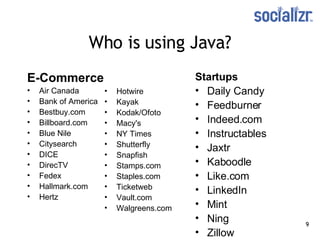
Who is using Java? E-Commerce Air Canada Bank of America Bestbuy.com Billboard.com Blue Nile Citysearch DICE DirecTV Fedex Hallmark.com Hertz Startups Daily Candy Feedburner Indeed.com Instructables Jaxtr Kaboodle Like.com LinkedIn Mint Ning Zillow Hotwire Kayak Kodak/Ofoto Macy's NY Times Shutterfly Snapfish Stamps.com Staples.com Ticketweb Vault.com Walgreens.com
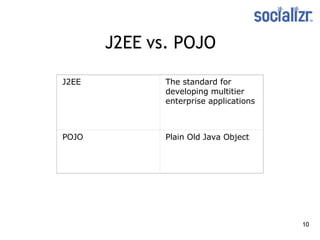
J2EE vs. POJO J2EE The standard for developing multitier enterprise applications POJO Plain Old Java Object
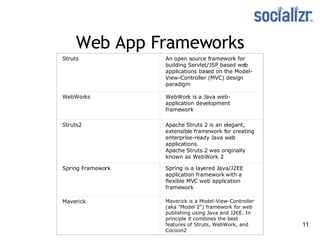
Web App Frameworks Struts An open source framework for building Servlet/JSP based web applications based on the Model-View-Controller (MVC) design paradigm WebWorks WebWork is a Java web-application development framework Struts2 Apache Struts 2 is an elegant, extensible framework for creating enterprise-ready Java web applications. Apache Struts 2 was originally known as WebWork 2 Spring Framework Spring is a layered Java/J2EE application framework with a flexible MVC web application framework Maverick Maverick is a Model-View-Controller (aka "Model 2") framework for web publishing using Java and J2EE. In principle it combines the best features of Struts, WebWork, and Cocoon2
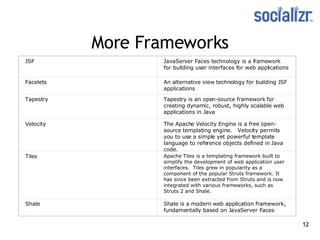
More Frameworks JSF JavaServer Faces technology is a framework for building user interfaces for web applications Facelets An alternative view technology for building JSF applications Tapestry Tapestry is an open-source framework for creating dynamic, robust, highly scalable web applications in Java Velocity The Apache Velocity Engine is a free open-source templating engine.  Velocity permits you to use a simple yet powerful template language to reference objects defined in Java code. Tiles Apache Tiles is a templating framework built to simplify the development of web application user interfaces.  Tiles grew in popularity as a component of the popular Struts framework. It has since been extracted from Struts and is now integrated with various frameworks, such as Struts 2 and Shale. Shale Shale is a modern web application framework, fundamentally based on JavaServer Faces
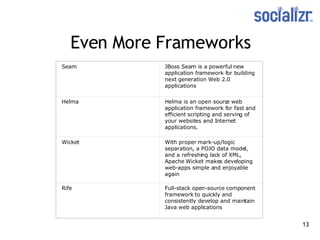
Even More Frameworks Seam JBoss Seam is a powerful new application framework for building next generation Web 2.0 applications Helma Helma is an open source web application framework for fast and efficient scripting and serving of your websites and Internet applications. Wicket With proper mark-up/logic separation, a POJO data model, and a refreshing lack of XML, Apache Wicket makes developing web-apps simple and enjoyable again Rife Full-stack open-source component framework to quickly and consistently develop and maintain Java web applications
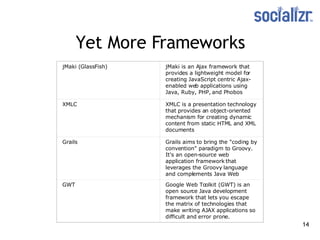
Yet More Frameworks jMaki (GlassFish) jMaki is an Ajax framework that provides a lightweight model for creating JavaScript centric Ajax-enabled web applications using Java, Ruby, PHP, and Phobos XMLC XMLC is a presentation technology that provides an object-oriented mechanism for creating dynamic content from static HTML and XML documents Grails Grails aims to bring the "coding by convention" paradigm to Groovy. It's an open-source web application framework that leverages the Groovy language and complements Java Web GWT Google Web Toolkit (GWT) is an open source Java development framework that lets you escape the matrix of technologies that make writing AJAX applications so difficult and error prone.
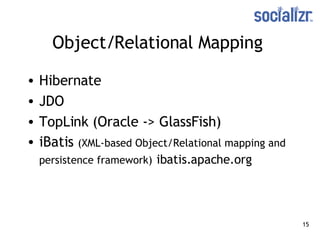
Object/Relational Mapping   Hibernate JDO TopLink (Oracle -> GlassFish) iBatis  ( XML-based Object/Relational mapping and persistence framework)   ibatis.apache.org
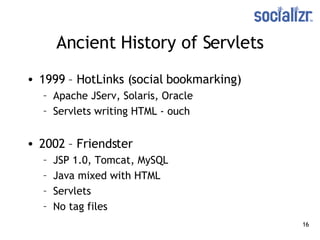
Ancient History of Servlets 1999 – HotLinks (social bookmarking) Apache JServ, Solaris, Oracle Servlets writing HTML - ouch 2002 – Friendster JSP 1.0, Tomcat, MySQL Java mixed with HTML Servlets No tag files
JSP/Servlets Today 2006 – Socializr JSP 2.0 JSTL/EL Tag files written in JSP, SimpleTagSupport, functions, beans Servlets Documentation and support of JSP 2.0/JSTL/tag files poor compared to PHP/ruby/etc. Scriptlets required to access Java constants from JSPs
Servlet/JSP Technologies JSP pages JSP fragments EL JSTL .tag files Tag classes functions servlets beans Complicated but powerful/flexible
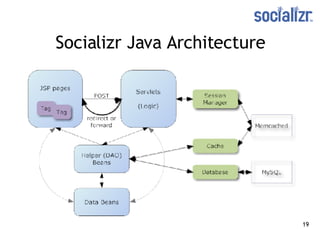
Socializr Java Architecture
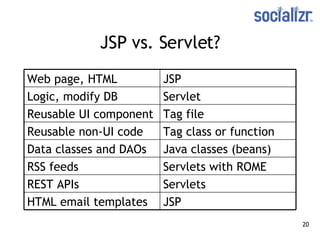
JSP vs. Servlet? Tag class or function Reusable non-UI code JSP HTML email templates Servlets REST APIs Servlets with ROME RSS feeds Java classes (beans) Data classes and DAOs Tag file Reusable UI component Servlet Logic, modify DB JSP Web page, HTML
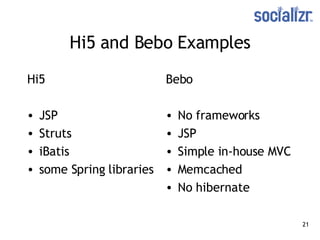
Hi5 and Bebo Examples Hi5 JSP Struts iBatis some Spring libraries Bebo No frameworks JSP Simple in-house MVC Memcached No hibernate
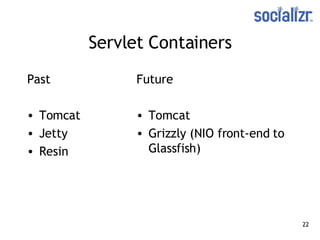
Servlet Containers Past Tomcat Jetty Resin Future Tomcat Grizzly (NIO front-end to Glassfish)
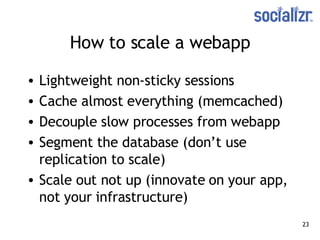
How to scale a webapp Lightweight non-sticky sessions Cache almost everything (memcached) Decouple slow processes from webapp Segment the database (don’t use replication to scale) Scale out not up (innovate on your app, not your infrastructure)
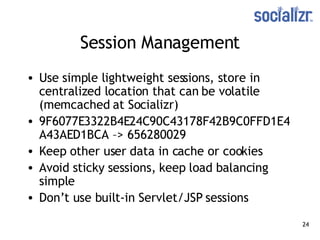
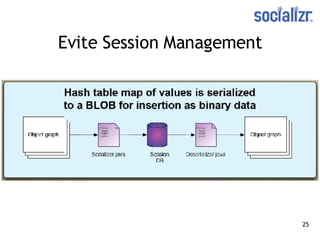
Session Management Use simple lightweight sessions, store in centralized location that can be volatile (memcached at Socializr) 9F6077E3322B4E24C90C43178F42B9C0FFD1E4A43AED1BCA –> 656280029 Keep other user data in cache or cookies Avoid sticky sessions, keep load balancing simple Don’t use built-in Servlet/JSP sessions
Evite Session Management
Caching Use memcached, don’t invent your own Put a large memcached instance on every webapp node Don’t cache inside JVM Cache almost everything but think of your expiration strategy and invalidation rules
Performance Tuning JRat -  jrat.sourceforge.net Example: JSTL FormatDate Other cool tools: Lambda Probe, FindBugs
Java Technologies Apache commons: DBCP (Connection Pooling), HttpClient, File Upload  Connector/J (MySQL JDBC driver) Memcached Java client JMagick (poorly documented) (not JAI) JDOM (for APIs) and StAX (for SolrJ) (XML parsing) ROME (RSS) JavaMail (SMTP and POP) Quartz (scheduling) Apache XML-RPC SolrJ JMS
Thank You [email_address] www.socializr.com/jobs

December 4 SDForum Java Sig Presentation

  • 1.
    Jonathan Abrams SDForumJava SIG December 4, 2007 Building High-Traffic Java-Based Web Applications
  • 2.
    Popular Languages forWeb Apps Ruby/RoR Hot & trendy! Many small web 2.0 startups Unknown scalability (Twitter) PHP Facebook, Friendster, Yahoo Proven and very popular No connection pooling? Page-oriented, not usually MVC? Maintainability? Python Has its fans (Yelp, YouTube?), somewhat similar to Ruby? Less common than Ruby or PHP
  • 3.
    Java Misconceptions Overlycomplicated No longer relevant Doesn’t scale as well as PHP Strongly typed is bad/hard vs. Ruby/PHP Takes more code and more time Cannot rapidly prototype
  • 4.
    Tim Bray -Nov 2006 “Comparing Frameworks” “ For Web apps, I’ve given PHP the edge, because I think building scalable PHP is a little easier . By default, PHP gives you a “shared-nothing” (or at least “shared very little”) architecture, which means you’re going to scale out pretty well until your database hits the wall. Java is a much richer system and assumes you’re smart enough to know whether a shared-nothing architecture is appropriate or not. The effect is, you have to be smarter to get the same kind of scaling out of Java.”
  • 5.
    Java Realities Verymature and proven Excellent performance (fast JVM/JIT) Scales fine unless you use it wrong (sessions, large heaps) Powerful and flexible Cross-platform Server, client, desktop, mobile, etc.
  • 6.
    Java Realities Strongtyping can actually be a big help (plus JSP/EL handles type conversions and you can also use Object or polymorphism) You can write quick spaghetti code in JSP! JSP is great for rapid prototyping, modified JSPs are automatically recompiled in development J2EE and breadth of Java technologies and frameworks IS complicated!
  • 7.
    Ruby on Railsvs. Java? Groovy/Grails JRuby Object/relational mapping (Hibernate?) Code by convention (servlet mapping via servlet filter, instead of controller servlet or web.xml?)
  • 8.
    Who is usingJava? Social Networks (Friendster) Bebo Hi5 Tagged Tickle Classmates.com Events eVite MeetUp Socializr Involver
  • 9.
    Who is usingJava? E-Commerce Air Canada Bank of America Bestbuy.com Billboard.com Blue Nile Citysearch DICE DirecTV Fedex Hallmark.com Hertz Startups Daily Candy Feedburner Indeed.com Instructables Jaxtr Kaboodle Like.com LinkedIn Mint Ning Zillow Hotwire Kayak Kodak/Ofoto Macy's NY Times Shutterfly Snapfish Stamps.com Staples.com Ticketweb Vault.com Walgreens.com
  • 10.
    J2EE vs. POJOJ2EE The standard for developing multitier enterprise applications POJO Plain Old Java Object
  • 11.
    Web App FrameworksStruts An open source framework for building Servlet/JSP based web applications based on the Model-View-Controller (MVC) design paradigm WebWorks WebWork is a Java web-application development framework Struts2 Apache Struts 2 is an elegant, extensible framework for creating enterprise-ready Java web applications. Apache Struts 2 was originally known as WebWork 2 Spring Framework Spring is a layered Java/J2EE application framework with a flexible MVC web application framework Maverick Maverick is a Model-View-Controller (aka "Model 2") framework for web publishing using Java and J2EE. In principle it combines the best features of Struts, WebWork, and Cocoon2
  • 12.
    More Frameworks JSFJavaServer Faces technology is a framework for building user interfaces for web applications Facelets An alternative view technology for building JSF applications Tapestry Tapestry is an open-source framework for creating dynamic, robust, highly scalable web applications in Java Velocity The Apache Velocity Engine is a free open-source templating engine. Velocity permits you to use a simple yet powerful template language to reference objects defined in Java code. Tiles Apache Tiles is a templating framework built to simplify the development of web application user interfaces. Tiles grew in popularity as a component of the popular Struts framework. It has since been extracted from Struts and is now integrated with various frameworks, such as Struts 2 and Shale. Shale Shale is a modern web application framework, fundamentally based on JavaServer Faces
  • 13.
    Even More FrameworksSeam JBoss Seam is a powerful new application framework for building next generation Web 2.0 applications Helma Helma is an open source web application framework for fast and efficient scripting and serving of your websites and Internet applications. Wicket With proper mark-up/logic separation, a POJO data model, and a refreshing lack of XML, Apache Wicket makes developing web-apps simple and enjoyable again Rife Full-stack open-source component framework to quickly and consistently develop and maintain Java web applications
  • 14.
    Yet More FrameworksjMaki (GlassFish) jMaki is an Ajax framework that provides a lightweight model for creating JavaScript centric Ajax-enabled web applications using Java, Ruby, PHP, and Phobos XMLC XMLC is a presentation technology that provides an object-oriented mechanism for creating dynamic content from static HTML and XML documents Grails Grails aims to bring the "coding by convention" paradigm to Groovy. It's an open-source web application framework that leverages the Groovy language and complements Java Web GWT Google Web Toolkit (GWT) is an open source Java development framework that lets you escape the matrix of technologies that make writing AJAX applications so difficult and error prone.
  • 15.
    Object/Relational Mapping Hibernate JDO TopLink (Oracle -> GlassFish) iBatis ( XML-based Object/Relational mapping and persistence framework) ibatis.apache.org
  • 16.
    Ancient History ofServlets 1999 – HotLinks (social bookmarking) Apache JServ, Solaris, Oracle Servlets writing HTML - ouch 2002 – Friendster JSP 1.0, Tomcat, MySQL Java mixed with HTML Servlets No tag files
  • 17.
    JSP/Servlets Today 2006– Socializr JSP 2.0 JSTL/EL Tag files written in JSP, SimpleTagSupport, functions, beans Servlets Documentation and support of JSP 2.0/JSTL/tag files poor compared to PHP/ruby/etc. Scriptlets required to access Java constants from JSPs
  • 18.
    Servlet/JSP Technologies JSPpages JSP fragments EL JSTL .tag files Tag classes functions servlets beans Complicated but powerful/flexible
  • 19.
  • 20.
    JSP vs. Servlet?Tag class or function Reusable non-UI code JSP HTML email templates Servlets REST APIs Servlets with ROME RSS feeds Java classes (beans) Data classes and DAOs Tag file Reusable UI component Servlet Logic, modify DB JSP Web page, HTML
  • 21.
    Hi5 and BeboExamples Hi5 JSP Struts iBatis some Spring libraries Bebo No frameworks JSP Simple in-house MVC Memcached No hibernate
  • 22.
    Servlet Containers PastTomcat Jetty Resin Future Tomcat Grizzly (NIO front-end to Glassfish)
  • 23.
    How to scalea webapp Lightweight non-sticky sessions Cache almost everything (memcached) Decouple slow processes from webapp Segment the database (don’t use replication to scale) Scale out not up (innovate on your app, not your infrastructure)
  • 24.
    Session Management Usesimple lightweight sessions, store in centralized location that can be volatile (memcached at Socializr) 9F6077E3322B4E24C90C43178F42B9C0FFD1E4A43AED1BCA –> 656280029 Keep other user data in cache or cookies Avoid sticky sessions, keep load balancing simple Don’t use built-in Servlet/JSP sessions
  • 25.
  • 26.
    Caching Use memcached,don’t invent your own Put a large memcached instance on every webapp node Don’t cache inside JVM Cache almost everything but think of your expiration strategy and invalidation rules
  • 27.
    Performance Tuning JRat- jrat.sourceforge.net Example: JSTL FormatDate Other cool tools: Lambda Probe, FindBugs
  • 28.
    Java Technologies Apachecommons: DBCP (Connection Pooling), HttpClient, File Upload Connector/J (MySQL JDBC driver) Memcached Java client JMagick (poorly documented) (not JAI) JDOM (for APIs) and StAX (for SolrJ) (XML parsing) ROME (RSS) JavaMail (SMTP and POP) Quartz (scheduling) Apache XML-RPC SolrJ JMS
  • 29.
    Thank You [email_address]www.socializr.com/jobs