Big Data Processing with Apache Spark 
 
What is Spark ?  
 
- Apache Spark is a fast and general engine for large-scale data processing  
 
- Apache Spark is an open source big data processing framework built around speed, ease of 
use, and sophisticated analytics. It was originally developed in 2009 in UC Berkeley’s 
AMPLab, and open sourced in 2010 as an Apache project. 
 
- Spark enables applications in Hadoop clusters to run up to 100 times faster in memory and 
10 times faster even when running on disk. 
 
- Speed  
- Run program up to 100x faster than Hadoop MapReduce in memory, or 10x faster 
on disk  
- Spark has an advanced DAG (Directed Acyclic Graph) execution engine that 
supports cyclic data flow and in-memory computing  
- Ease of use  
- Write application quickly in Java, Python, Scala, R 
- Spark offers over 80 high-level operators that make it easy to build parallel apps. 
And you can use it ​interactively​ from the Scala, Python and R shells. 
- Generality  
- Combine SQL, streaming, and complex analytics. 
- Spark powers a stack of high-level tools including Spark SQL, MLlib for machine 
learning, GraphX, and Spark Streaming. You can combine these libraries seamlessly 
in the same application. 
- Runs Everywhere  
- Spark runs on Hadoop YARN, Mesos, standalone, or in the cloud. It can access 
diverse data sources including HDFS, Cassandra, HBase, Hive and S3. 
- Spark runs on top of existing Hadoop Distributed File System (HDFS) infrastructure to 
provide enhanced and additional functionality. It provides support for deploying Spark 
applications in an existing Hadoop v1 cluster (with SIMR – Spark-Inside-MapReduce) or 
Hadoop v2 YARN cluster or even Apache Mesos. 
 
 
Spark Features  
- Spark takes MapReduce to the next level with less expensive shuffles in the data processing 
- Spark holds intermediate results in memory rather than writing them to disk  
- It’s designed to be an execution engine that works both in-memory and on-disk.  
 
- Spark will attempt to store as much as data in memory and then will spill to disk. It can store 
part of a data set in memory and the remaining data on the disk. You have to look at your 
data and use cases to assess the memory requirements. With this in-memory data storage, 
Spark comes with performance advantage. 
 
- Supports more than just Map and Reduce functions. 
- Optimizes arbitrary operator graphs. 
- Lazy evaluation of big data queries which helps with the optimization of the overall data 
processing workflow. 
- Provides concise and consistent APIs in Scala, Java and Python. 
- Offers interactive shell for Scala and Python. This is not available in Java yet. 
- Spark is written in Scala Programming Language and runs on Java Virtual Machine (JVM) 
environment. 
- Languages support  
- Java  
- Python  
- Scala  
- Clojure  
- R 
 
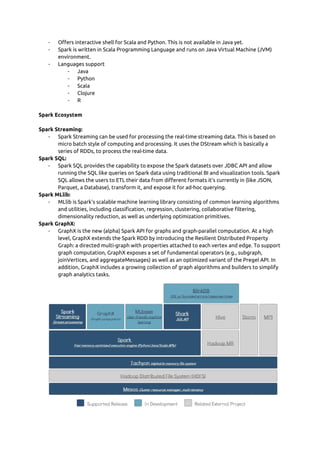
Spark Ecosystem  
 
Spark Streaming: 
- Spark Streaming can be used for processing the real-time streaming data. This is based on 
micro batch style of computing and processing. It uses the DStream which is basically a 
series of RDDs, to process the real-time data. 
Spark SQL: 
- Spark SQL provides the capability to expose the Spark datasets over JDBC API and allow 
running the SQL like queries on Spark data using traditional BI and visualization tools. Spark 
SQL allows the users to ETL their data from different formats it’s currently in (like JSON, 
Parquet, a Database), transform it, and expose it for ad-hoc querying. 
Spark MLlib: 
- MLlib is Spark’s scalable machine learning library consisting of common learning algorithms 
and utilities, including classification, regression, clustering, collaborative filtering, 
dimensionality reduction, as well as underlying optimization primitives. 
Spark GraphX: 
- GraphX is the new (alpha) Spark API for graphs and graph-parallel computation. At a high 
level, GraphX extends the Spark RDD by introducing the Resilient Distributed Property 
Graph: a directed multi-graph with properties attached to each vertex and edge. To support 
graph computation, GraphX exposes a set of fundamental operators (e.g., subgraph, 
joinVertices, and aggregateMessages) as well as an optimized variant of the Pregel API. In 
addition, GraphX includes a growing collection of graph algorithms and builders to simplify 
graph analytics tasks. 
 
Spark Architecture  
 
- 3 main components  
- Data Storage  
Spark uses HDFS file system for data storage purposes. It works with any Hadoop 
compatible data source including HDFS, HBase, Cassandra, etc. 
- API  
The API provides the application developers to create Spark based applications 
using a standard API interface. Spark provides API for Scala, Java, and Python 
programming languages. 
 
- Resource Management  
Spark can be deployed as a Stand-alone server or it can be on a distributed 
computing framework like Mesos or YARN. 
 
Resilient Distributed Datasets 
 
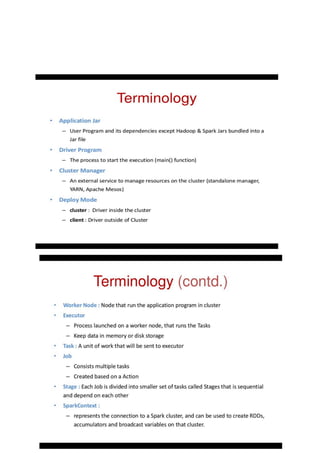
- Resilient Distributed Dataset (based on Matei’s research paper) or RDD is the core 
concept in Spark framework. Think about RDD as a table in a database. It can hold 
any type of data. Spark stores data in RDD on different partitions. 
- They are also fault tolerance because an RDD know how to recreate and recompute 
the datasets. 
- RDDs are immutable. You can modify an RDD with a transformation but the 
transformation returns you a new RDD whereas the original RDD remains the same. 
- RDD supports two types of operations: 
- Transformation 
- Action 
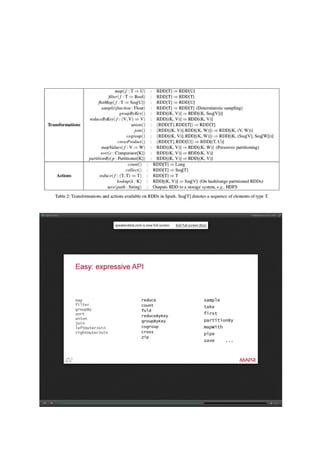
Transformation:​ Transformations don't return a single value, they return a new RDD. 
Nothing gets evaluated when you call a Transformation function, it just takes an RDD and 
return a new RDD. 
 
Some of the Transformation functions are ​map, filter, flatMap, groupByKey, 
reduceByKey, aggregateByKey, pipe, and coalesce. 
 
Action:​ Action operation evaluates and returns a new value. When an Action function is 
called on a RDD object, all the data processing queries are computed at that time and the 
result value is returned. 
 
Some of the Action operations are ​reduce, collect, count, first, take, countByKey, and 
foreach. 


Spark SQL  
Spark SQL, part of Apache Spark big data framework, is used for structured data processing 
and allows running SQL like queries on Spark data. We can perform ETL on the data from different 
formats like JSON, Parquet, Database) and then run ad-hoc querying. 
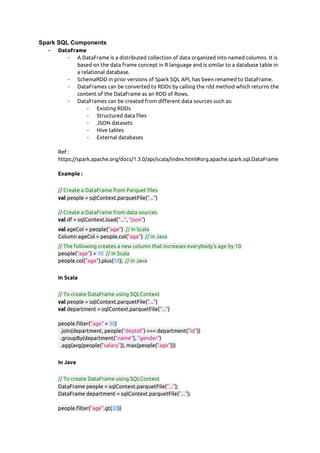
Spark SQL Components
- DataFrame  
- A DataFrame is a distributed collection of data organized into named columns. It is 
based on the data frame concept in R language and is similar to a database table in 
a relational database. 
- SchemaRDD in prior versions of Spark SQL API, has been renamed to DataFrame. 
- DataFrames can be converted to RDDs by calling the rdd method which returns the 
content of the DataFrame as an RDD of Rows. 
- DataFrames can be created from different data sources such as: 
- Existing RDDs 
- Structured data files 
- JSON datasets 
- Hive tables 
- External databases 
 
Ref : 
https://spark.apache.org/docs/1.3.0/api/scala/index.html#org.apache.spark.sql.DataFrame 
 
Example :  
 
// Create a DataFrame from Parquet files 
val​ people = sqlContext.parquetFile(​"..."​) 
 
// Create a DataFrame from data sources 
val​ df = sqlContext.load(​"..."​, ​"json"​) 
val​ ageCol = people(​"age"​)  ​// in Scala 
Column ageCol = people.col(​"age"​)  ​// in Java 
// The following creates a new column that increases everybody's age by 10. 
people(​"age"​) + ​10​  ​// in Scala 
people.col(​"age"​).plus(​10​);  ​// in Java 
 
In Scala  
 
// To create DataFrame using SQLContext 
val​ people = sqlContext.parquetFile(​"..."​) 
val​ department = sqlContext.parquetFile(​"..."​) 
 
people.filter(​"age"​ > ​30​) 
  .join(department, people(​"deptId"​) === department(​"id"​)) 
  .groupBy(department(​"name"​), ​"gender"​) 
  .agg(avg(people(​"salary"​)), max(people(​"age"​))) 
 
In Java  
 
// To create DataFrame using SQLContext 
DataFrame people = sqlContext.parquetFile(​"..."​); 
DataFrame department = sqlContext.parquetFile(​"..."​); 
 
people.filter(​"age"​.gt(​30​)) 
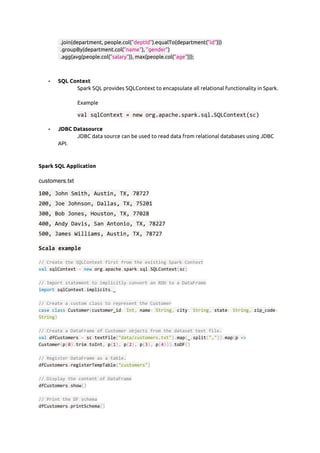
  .join(department, people.col(​"deptId"​).equalTo(department(​"id"​))) 
  .groupBy(department.col(​"name"​), ​"gender"​) 
  .agg(avg(people.col(​"salary"​)), max(people.col(​"age"​))); 
 
 
- SQL Context  
Spark SQL provides SQLContext to encapsulate all relational functionality in Spark.  
 
Example  
val sqlContext = new org.apache.spark.sql.SQLContext(sc)
- JDBC Datasource  
JDBC data source can be used to read data from relational databases using JDBC 
API. 
 
Spark SQL Application  
 
customers.txt
100, John Smith, Austin, TX, 78727
200, Joe Johnson, Dallas, TX, 75201
300, Bob Jones, Houston, TX, 77028
400, Andy Davis, San Antonio, TX, 78227
500, James Williams, Austin, TX, 78727
Scala example
// Create the SQLContext first from the existing Spark Context
val​ sqlContext ​=​ ​new​ org​.​apache​.​spark​.​sql​.​SQLContext​(​sc​)
// Import statement to implicitly convert an RDD to a DataFrame
import​ sqlContext​.​implicits​.​_
// Create a custom class to represent the Customer
case​ ​class​ Customer​(​customer_id​:​ ​Int​,​ name​:​ ​String​,​ city​:​ ​String​,​ state​:​ ​String​,​ zip_code​:
String​)
// Create a DataFrame of Customer objects from the dataset text file.
val​ dfCustomers ​=​ sc​.​textFile​(​"data/customers.txt"​).​map​(​_​.​split​(​","​)).​map​(​p ​=>
Customer​(​p​(​0​).​trim​.​toInt​,​ p​(​1​),​ p​(​2​),​ p​(​3​),​ p​(​4​))).​toDF​()
// Register DataFrame as a table.
dfCustomers​.​registerTempTable​(​"customers"​)
// Display the content of DataFrame
dfCustomers​.​show​()
// Print the DF schema
dfCustomers​.​printSchema​()
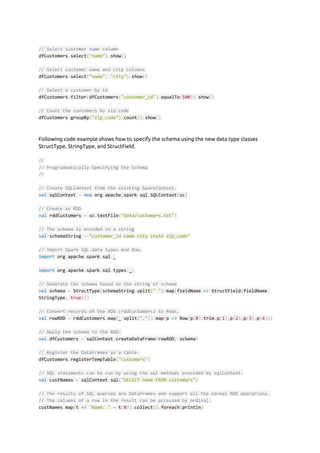
// Select customer name column
dfCustomers​.​select​(​"name"​).​show​()
// Select customer name and city columns
dfCustomers​.​select​(​"name"​,​ ​"city"​).​show​()
// Select a customer by id
dfCustomers​.​filter​(​dfCustomers​(​"customer_id"​).​equalTo​(​500​)).​show​()
// Count the customers by zip code
dfCustomers​.​groupBy​(​"zip_code"​).​count​().​show​()
 
 
Following code example shows how to specify the schema using the new data type classes 
StructType, StringType, and StructField. 
 
//
// Programmatically Specifying the Schema
//
// Create SQLContext from the existing SparkContext.
val​ sqlContext ​=​ ​new​ org​.​apache​.​spark​.​sql​.​SQLContext​(​sc​)
// Create an RDD
val​ rddCustomers ​=​ sc​.​textFile​(​"data/customers.txt"​)
// The schema is encoded in a string
val​ schemaString ​=​ ​"customer_id name city state zip_code"
// Import Spark SQL data types and Row.
import​ org​.​apache​.​spark​.​sql​.​_
import​ org​.​apache​.​spark​.​sql​.​types​.​_​;
// Generate the schema based on the string of schema
val​ schema ​=​ StructType​(​schemaString​.​split​(​" "​).​map​(​fieldName ​=>​ StructField​(​fieldName​,
StringType​,​ ​true​)))
// Convert records of the RDD (rddCustomers) to Rows.
val​ rowRDD ​=​ rddCustomers​.​map​(​_​.​split​(​","​)).​map​(​p ​=>​ Row​(​p​(​0​).​trim​,​p​(​1​),​p​(​2​),​p​(​3​),​p​(​4​)))
// Apply the schema to the RDD.
val​ dfCustomers ​=​ sqlContext​.​createDataFrame​(​rowRDD​,​ schema​)
// Register the DataFrames as a table.
dfCustomers​.​registerTempTable​(​"customers"​)
// SQL statements can be run by using the sql methods provided by sqlContext.
val​ custNames ​=​ sqlContext​.​sql​(​"SELECT name FROM customers"​)
// The results of SQL queries are DataFrames and support all the normal RDD operations.
// The columns of a row in the result can be accessed by ordinal.
custNames​.​map​(​t ​=>​ ​"Name: "​ ​+​ t​(​0​)).​collect​().​foreach​(​println​)
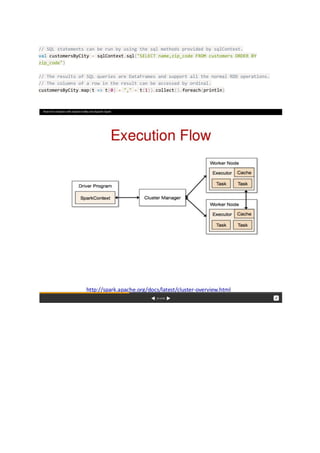
// SQL statements can be run by using the sql methods provided by sqlContext.
val​ customersByCity ​=​ sqlContext​.​sql​(​"SELECT name,zip_code FROM customers ORDER BY
zip_code"​)
// The results of SQL queries are DataFrames and support all the normal RDD operations.
// The columns of a row in the result can be accessed by ordinal.
customersByCity​.​map​(​t ​=>​ t​(​0​)​ ​+​ ​","​ ​+​ t​(​1​)).​collect​().​foreach​(​println​) 


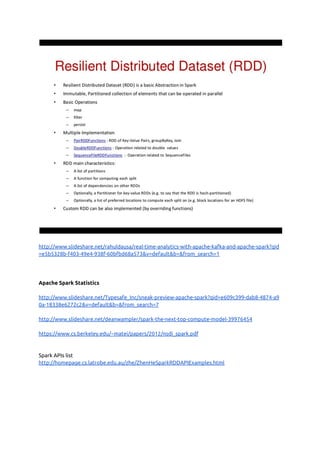
http://www.slideshare.net/rahuldausa/real-time-analytics-with-apache-kafka-and-apache-spark?qid
=e5b5328b-f403-49e4-938f-60bfbd68a573&v=default&b=&from_search=1 


Apache Spark Statistics  
 
http://www.slideshare.net/Typesafe_Inc/sneak-preview-apache-spark?qid=e609c399-dab8-4874-a9
0a-18338e6272c2&v=default&b=&from_search=7 
 
http://www.slideshare.net/deanwampler/spark-the-next-top-compute-model-39976454 
 
https://www.cs.berkeley.edu/~matei/papers/2012/nsdi_spark.pdf 
 
 
Spark APIs list  
http://homepage.cs.latrobe.edu.au/zhe/ZhenHeSparkRDDAPIExamples.html 


Resilient Distributed Datasets: A Fault-Tolerant Abstraction for In-Memory Cluster Computing 
 
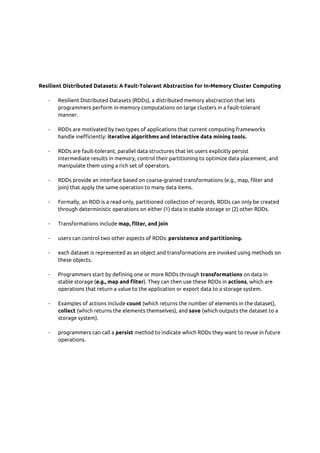
- Resilient Distributed Datasets (RDDs), a distributed memory abstraction that lets 
programmers perform in-memory computations on large clusters in a fault-tolerant 
manner. 
 
- RDDs are motivated by two types of applications that current computing frameworks 
handle inefficiently: ​iterative algorithms and interactive data mining tools. 
 
- RDDs are fault-tolerant, parallel data structures that let users explicitly persist 
intermediate results in memory, control their partitioning to optimize data placement, and 
manipulate them using a rich set of operators. 
 
- RDDs provide an interface based on coarse-grained transformations (e.g., map, filter and 
join) that apply the same operation to many data items. 
 
- Formally, an RDD is a read-only, partitioned collection of records. RDDs can only be created 
through deterministic operations on either (1) data in stable storage or (2) other RDDs. 
 
- Transformations include ​map, filter, and join 
 
- users can control two other aspects of RDDs: ​persistence and partitioning. 
 
- each dataset is represented as an object and transformations are invoked using methods on 
these objects. 
 
- Programmers start by defining one or more RDDs through ​transformations​ on data in 
stable storage (​e.g., map and filter​). They can then use these RDDs in ​actions​, which are 
operations that return a value to the application or export data to a storage system.  
 
- Examples of actions include ​count​ (which returns the number of elements in the dataset), 
collect​ (which returns the elements themselves), and ​save ​(which outputs the dataset to a 
storage system). 
 
- programmers can call a ​persist​ method to indicate which RDDs they want to reuse in future 
operations. 


- Need to learn Scala  
- More Spark examples such as Spark Streaming , Spark SQL  
- Apache Kafka + Apache Spark Integration  
- Scala + Spark Interview Questions  
- Lambda Architecture --- done  
- Go through existing frameworks such as Hadoop, YARN, Hive, Pig, HBase, etc.,  
- Hive UDF 
- Pig  
 
https://www.mapr.com/developercentral/lambda-architecture 


Apache Spark Notes

  • 1.
    Big Data Processing with Apache Spark    What is Spark ?     - Apache Spark is a fast and general engine for large-scale data processing     - Apache Spark is an open source big data processing framework built around speed, ease of  use, and sophisticated analytics. It was originally developed in 2009 in UC Berkeley’s  AMPLab, and open sourced in 2010 as an Apache project.    -Spark enables applications in Hadoop clusters to run up to 100 times faster in memory and  10 times faster even when running on disk.    - Speed   - Run program up to 100x faster than Hadoop MapReduce in memory, or 10x faster  on disk   - Spark has an advanced DAG (Directed Acyclic Graph) execution engine that  supports cyclic data flow and in-memory computing   - Ease of use   - Write application quickly in Java, Python, Scala, R  - Spark offers over 80 high-level operators that make it easy to build parallel apps.  And you can use it ​interactively​ from the Scala, Python and R shells.  - Generality   - Combine SQL, streaming, and complex analytics.  - Spark powers a stack of high-level tools including Spark SQL, MLlib for machine  learning, GraphX, and Spark Streaming. You can combine these libraries seamlessly  in the same application.  - Runs Everywhere   - Spark runs on Hadoop YARN, Mesos, standalone, or in the cloud. It can access  diverse data sources including HDFS, Cassandra, HBase, Hive and S3.  - Spark runs on top of existing Hadoop Distributed File System (HDFS) infrastructure to  provide enhanced and additional functionality. It provides support for deploying Spark  applications in an existing Hadoop v1 cluster (with SIMR – Spark-Inside-MapReduce) or  Hadoop v2 YARN cluster or even Apache Mesos.      Spark Features   - Spark takes MapReduce to the next level with less expensive shuffles in the data processing  - Spark holds intermediate results in memory rather than writing them to disk   - It’s designed to be an execution engine that works both in-memory and on-disk.     - Spark will attempt to store as much as data in memory and then will spill to disk. It can store  part of a data set in memory and the remaining data on the disk. You have to look at your  data and use cases to assess the memory requirements. With this in-memory data storage,  Spark comes with performance advantage.    - Supports more than just Map and Reduce functions.  - Optimizes arbitrary operator graphs.  - Lazy evaluation of big data queries which helps with the optimization of the overall data  processing workflow.  - Provides concise and consistent APIs in Scala, Java and Python. 
  • 2.
    - Offers interactive shell for Scala and Python. This is not available in Java yet.  - Spark is written in Scala Programming Language and runs on Java Virtual Machine (JVM)  environment.  -Languages support   - Java   - Python   - Scala   - Clojure   - R    Spark Ecosystem     Spark Streaming:  - Spark Streaming can be used for processing the real-time streaming data. This is based on  micro batch style of computing and processing. It uses the DStream which is basically a  series of RDDs, to process the real-time data.  Spark SQL:  - Spark SQL provides the capability to expose the Spark datasets over JDBC API and allow  running the SQL like queries on Spark data using traditional BI and visualization tools. Spark  SQL allows the users to ETL their data from different formats it’s currently in (like JSON,  Parquet, a Database), transform it, and expose it for ad-hoc querying.  Spark MLlib:  - MLlib is Spark’s scalable machine learning library consisting of common learning algorithms  and utilities, including classification, regression, clustering, collaborative filtering,  dimensionality reduction, as well as underlying optimization primitives.  Spark GraphX:  - GraphX is the new (alpha) Spark API for graphs and graph-parallel computation. At a high  level, GraphX extends the Spark RDD by introducing the Resilient Distributed Property  Graph: a directed multi-graph with properties attached to each vertex and edge. To support  graph computation, GraphX exposes a set of fundamental operators (e.g., subgraph,  joinVertices, and aggregateMessages) as well as an optimized variant of the Pregel API. In  addition, GraphX includes a growing collection of graph algorithms and builders to simplify  graph analytics tasks.   
  • 3.
    Spark Architecture     - 3 main components   - Data Storage   Spark uses HDFS file system for data storage purposes. It works with any Hadoop  compatible data source including HDFS, HBase, Cassandra, etc.  -API   The API provides the application developers to create Spark based applications  using a standard API interface. Spark provides API for Scala, Java, and Python  programming languages.    - Resource Management   Spark can be deployed as a Stand-alone server or it can be on a distributed  computing framework like Mesos or YARN.    Resilient Distributed Datasets    - Resilient Distributed Dataset (based on Matei’s research paper) or RDD is the core  concept in Spark framework. Think about RDD as a table in a database. It can hold  any type of data. Spark stores data in RDD on different partitions.  - They are also fault tolerance because an RDD know how to recreate and recompute  the datasets.  - RDDs are immutable. You can modify an RDD with a transformation but the  transformation returns you a new RDD whereas the original RDD remains the same.  - RDD supports two types of operations:  - Transformation  - Action  Transformation:​ Transformations don't return a single value, they return a new RDD.  Nothing gets evaluated when you call a Transformation function, it just takes an RDD and  return a new RDD.    Some of the Transformation functions are ​map, filter, flatMap, groupByKey,  reduceByKey, aggregateByKey, pipe, and coalesce.    Action:​ Action operation evaluates and returns a new value. When an Action function is  called on a RDD object, all the data processing queries are computed at that time and the  result value is returned.    Some of the Action operations are ​reduce, collect, count, first, take, countByKey, and  foreach.        Spark SQL   Spark SQL, part of Apache Spark big data framework, is used for structured data processing  and allows running SQL like queries on Spark data. We can perform ETL on the data from different  formats like JSON, Parquet, Database) and then run ad-hoc querying. 
  • 4.
    Spark SQL Components -DataFrame   - A DataFrame is a distributed collection of data organized into named columns. It is  based on the data frame concept in R language and is similar to a database table in  a relational database.  - SchemaRDD in prior versions of Spark SQL API, has been renamed to DataFrame.  - DataFrames can be converted to RDDs by calling the rdd method which returns the  content of the DataFrame as an RDD of Rows.  - DataFrames can be created from different data sources such as:  - Existing RDDs  - Structured data files  - JSON datasets  - Hive tables  - External databases    Ref :  https://spark.apache.org/docs/1.3.0/api/scala/index.html#org.apache.spark.sql.DataFrame    Example :     // Create a DataFrame from Parquet files  val​ people = sqlContext.parquetFile(​"..."​)    // Create a DataFrame from data sources  val​ df = sqlContext.load(​"..."​, ​"json"​)  val​ ageCol = people(​"age"​)  ​// in Scala  Column ageCol = people.col(​"age"​)  ​// in Java  // The following creates a new column that increases everybody's age by 10.  people(​"age"​) + ​10​  ​// in Scala  people.col(​"age"​).plus(​10​);  ​// in Java    In Scala     // To create DataFrame using SQLContext  val​ people = sqlContext.parquetFile(​"..."​)  val​ department = sqlContext.parquetFile(​"..."​)    people.filter(​"age"​ > ​30​)    .join(department, people(​"deptId"​) === department(​"id"​))    .groupBy(department(​"name"​), ​"gender"​)    .agg(avg(people(​"salary"​)), max(people(​"age"​)))    In Java     // To create DataFrame using SQLContext  DataFrame people = sqlContext.parquetFile(​"..."​);  DataFrame department = sqlContext.parquetFile(​"..."​);    people.filter(​"age"​.gt(​30​)) 
  • 5.
      .join(department, people.col(​"deptId"​).equalTo(department(​"id"​)))    .groupBy(department.col(​"name"​), ​"gender"​)    .agg(avg(people.col(​"salary"​)), max(people.col(​"age"​)));      - SQL Context   Spark SQL provides SQLContext to encapsulate all relational functionality in Spark.     Example   val sqlContext= new org.apache.spark.sql.SQLContext(sc) - JDBC Datasource   JDBC data source can be used to read data from relational databases using JDBC  API.    Spark SQL Application     customers.txt 100, John Smith, Austin, TX, 78727 200, Joe Johnson, Dallas, TX, 75201 300, Bob Jones, Houston, TX, 77028 400, Andy Davis, San Antonio, TX, 78227 500, James Williams, Austin, TX, 78727 Scala example // Create the SQLContext first from the existing Spark Context val​ sqlContext ​=​ ​new​ org​.​apache​.​spark​.​sql​.​SQLContext​(​sc​) // Import statement to implicitly convert an RDD to a DataFrame import​ sqlContext​.​implicits​.​_ // Create a custom class to represent the Customer case​ ​class​ Customer​(​customer_id​:​ ​Int​,​ name​:​ ​String​,​ city​:​ ​String​,​ state​:​ ​String​,​ zip_code​: String​) // Create a DataFrame of Customer objects from the dataset text file. val​ dfCustomers ​=​ sc​.​textFile​(​"data/customers.txt"​).​map​(​_​.​split​(​","​)).​map​(​p ​=> Customer​(​p​(​0​).​trim​.​toInt​,​ p​(​1​),​ p​(​2​),​ p​(​3​),​ p​(​4​))).​toDF​() // Register DataFrame as a table. dfCustomers​.​registerTempTable​(​"customers"​) // Display the content of DataFrame dfCustomers​.​show​() // Print the DF schema dfCustomers​.​printSchema​()
  • 6.
    // Select customername column dfCustomers​.​select​(​"name"​).​show​() // Select customer name and city columns dfCustomers​.​select​(​"name"​,​ ​"city"​).​show​() // Select a customer by id dfCustomers​.​filter​(​dfCustomers​(​"customer_id"​).​equalTo​(​500​)).​show​() // Count the customers by zip code dfCustomers​.​groupBy​(​"zip_code"​).​count​().​show​()     Following code example shows how to specify the schema using the new data type classes  StructType, StringType, and StructField.    // // Programmatically Specifying the Schema // // Create SQLContext from the existing SparkContext. val​ sqlContext ​=​ ​new​ org​.​apache​.​spark​.​sql​.​SQLContext​(​sc​) // Create an RDD val​ rddCustomers ​=​ sc​.​textFile​(​"data/customers.txt"​) // The schema is encoded in a string val​ schemaString ​=​ ​"customer_id name city state zip_code" // Import Spark SQL data types and Row. import​ org​.​apache​.​spark​.​sql​.​_ import​ org​.​apache​.​spark​.​sql​.​types​.​_​; // Generate the schema based on the string of schema val​ schema ​=​ StructType​(​schemaString​.​split​(​" "​).​map​(​fieldName ​=>​ StructField​(​fieldName​, StringType​,​ ​true​))) // Convert records of the RDD (rddCustomers) to Rows. val​ rowRDD ​=​ rddCustomers​.​map​(​_​.​split​(​","​)).​map​(​p ​=>​ Row​(​p​(​0​).​trim​,​p​(​1​),​p​(​2​),​p​(​3​),​p​(​4​))) // Apply the schema to the RDD. val​ dfCustomers ​=​ sqlContext​.​createDataFrame​(​rowRDD​,​ schema​) // Register the DataFrames as a table. dfCustomers​.​registerTempTable​(​"customers"​) // SQL statements can be run by using the sql methods provided by sqlContext. val​ custNames ​=​ sqlContext​.​sql​(​"SELECT name FROM customers"​) // The results of SQL queries are DataFrames and support all the normal RDD operations. // The columns of a row in the result can be accessed by ordinal. custNames​.​map​(​t ​=>​ ​"Name: "​ ​+​ t​(​0​)).​collect​().​foreach​(​println​)
  • 7.
    // SQL statementscan be run by using the sql methods provided by sqlContext. val​ customersByCity ​=​ sqlContext​.​sql​(​"SELECT name,zip_code FROM customers ORDER BY zip_code"​) // The results of SQL queries are DataFrames and support all the normal RDD operations. // The columns of a row in the result can be accessed by ordinal. customersByCity​.​map​(​t ​=>​ t​(​0​)​ ​+​ ​","​ ​+​ t​(​1​)).​collect​().​foreach​(​println​)         
  • 8.
  • 9.
  • 10.
                Resilient Distributed Datasets: A Fault-Tolerant Abstraction for In-Memory Cluster Computing    - Resilient Distributed Datasets (RDDs), a distributed memory abstraction that lets  programmers perform in-memory computations on large clusters in a fault-tolerant  manner.    - RDDs are motivated by two types of applications that current computing frameworks  handle inefficiently: ​iterative algorithms and interactive data mining tools.    -RDDs are fault-tolerant, parallel data structures that let users explicitly persist  intermediate results in memory, control their partitioning to optimize data placement, and  manipulate them using a rich set of operators.    - RDDs provide an interface based on coarse-grained transformations (e.g., map, filter and  join) that apply the same operation to many data items.    - Formally, an RDD is a read-only, partitioned collection of records. RDDs can only be created  through deterministic operations on either (1) data in stable storage or (2) other RDDs.    - Transformations include ​map, filter, and join    - users can control two other aspects of RDDs: ​persistence and partitioning.    - each dataset is represented as an object and transformations are invoked using methods on  these objects.    - Programmers start by defining one or more RDDs through ​transformations​ on data in  stable storage (​e.g., map and filter​). They can then use these RDDs in ​actions​, which are  operations that return a value to the application or export data to a storage system.     - Examples of actions include ​count​ (which returns the number of elements in the dataset),  collect​ (which returns the elements themselves), and ​save ​(which outputs the dataset to a  storage system).    - programmers can call a ​persist​ method to indicate which RDDs they want to reuse in future  operations.                   
  • 11.
  • 12.
          - Need to learn Scala   - More Spark examples such as Spark Streaming , Spark SQL   -Apache Kafka + Apache Spark Integration   - Scala + Spark Interview Questions   - Lambda Architecture --- done   - Go through existing frameworks such as Hadoop, YARN, Hive, Pig, HBase, etc.,   - Hive UDF  - Pig     https://www.mapr.com/developercentral/lambda-architecture