Apache Camel
Stephane Kay
Ville de Lausanne
Scope
 IS

Integration
 EIP
 Routing
 Mediation
 Camel Container
 Unit testing
 Hands-on
 Real Use Case

JMS

/ Active MQ
JBI / NMR
OSGI / ServiceMix
Scala
Table of contents
IS Integration heuristics

I.

◦
◦

Common issues
Paradigms

Camel’s bleat

II.

◦
◦

Concepts responding to integration needs
Getting started

What’s under the humps?

III.

◦
◦

Camel architecture
Distribution

Camel in Action

IV.

◦
◦

Persistence, transactions, concurrency, failover
Aggregation

A Real Use-Case

V.

◦

Description, issues & achievement
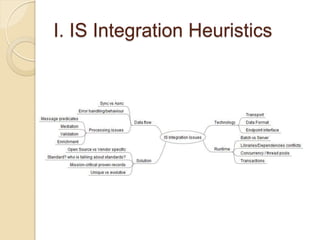
I. IS Integration Heuristics
I. IS Integration heuristics

Just do it !


Just coding simple things might be just not so simple …
public class FileCopier {

public static void main(String args[]) throws Exception {
File inboxDirectory = new File("data/inbox");
File outboxDirectory = new File("data/outbox");
outboxDirectory.mkdir();
File[] files = inboxDirectory.listFiles();
for (File source : files) {
if (source.isFile()) {
File dest = new File(
outboxDirectory.getPath()
+ File.separator
+ source.getName());
copyFile(source, dest);
}
}
}
private static void copyFile(File source, File dest)
throws IOException {

OutputStream out = new FileOutputStream(dest);
byte[] buffer = new byte[(int) source.length()];
FileInputStream in = new FileInputStream(source);
in.read(buffer);
try {
out.write(buffer);
} finally {
out.close();
in.close();

}
}
}
I. IS Integration heuristics

A Framework?


The bad :

◦ Learning effort consumes time.
◦ Adds anarchical dependencies.
◦ Risk of coming with a new need / not
implemented



The good :

◦ Gain value after a training period
◦ Leverage your code to a higher abstraction
◦ Potentially a future standard ?
 Indicator : community commits & posts curve.



The plus-value
◦ Not obvious
I. IS Integration heuristics

Separation of concerns


IS Integration involves
1. Endpoints
 A common endpoint interface abstraction

2. Data Processing
 Using Message / exchange abstraction and
conversion tool

3. Routing
 A common vocabulary / pattern as DSL
foundation.
I. IS Integration | endpoint

Message Endpoint pattern




Routes should refer to a common abstract
Message Endpoint rather than directly using their
technical interface
A good Endpoint abstraction is a URI description
II. Camel’s bleat | data

Uniformed Exchange


Message’s container during routing
I. IS Integration | data

Data Transformation


Data Format Transformation
◦ Message body is transformed from one
format to another.
 CSV -> XML



Data Type Transformation
◦ Java Type of message body is
transformed/casted into another.
 java.lang.String -> java.jms.TextMessage
 java.io.File -> java.lang.String
I. IS Integration | routing

Use case : Filtering Route
◦ How can a component avoid receiving
uninteresting messages ?

◦ …coming from a different system
I. IS Integration | routing

EIP?


A Catalog of Design patterns for common IS
integration issues



http://camel.apache.org/enterprise-integration-patterns.html
I. IS Integration | routing

EIPs Samples…


Filter
◦



Splitter
◦



How can a component avoid receiving uninteresting messages?

How can we process a message if it contains multiple elements, each of which may have to be
processed in a different way?

Router
◦ How can you decouple individual processing steps so that messages can be
passed to different filters depending on a set of conditions?



Aggregator
◦ How do we combine the results of individual, but related messages so that
they can be processed as a whole?
I. IS Integration heuristics

Putting all needs together


Route definition attributes :
◦ Endpoints

 Producer / Consumer(s)

◦ Processor(s)

 Uniformed exchange processing interface

◦ Predicate(s)


A route language should provide those
key abstractions
Endpoint A = endpoint(“activemq:queue:quote”);
Endpoint B = endpoint(“mq:quote”);
Predicate isWidget = xpath(“/quote/product =
„widget‟”);
from(A).filter(isWidget).to(B);
I. IS Integration heuristics

I. Review


IS Integration paradigms
◦ Endpoint abstraction -> URIs?
◦ Data Tx -> Functions // Java beans ?
◦ Routing -> EIPs
II. Camel’s bleat
Apache Camel is a Powerful Open
Source Integration Framework based
on known Enterprise Integration
Patterns
*
 Mission Statement :
Making integration easier and more
accessible to developers
II. Camel’s bleat | endpoint

Endpoint URI


A camel endpoint URI consists of
three parts :
ftp://riders.com/orders?username=rider&password=secret
Scheme
Context path

Options
II. Camel’s bleat | routing

Java DSL : Builder pattern


The Builder Pattern (GOF) is central to the Camel Java DSL

public class FileCopierWithCamel {
public static void main(String args[]) throws Exception {
// create CamelContext
CamelContext context = new DefaultCamelContext();
// add our route to the CamelContext
context.addRoutes(new RouteBuilder() {
public void configure() {

from("file:data/inbox?noop=true").to("file:data/outbox");
}
});
// start the route and let it do its work
context.start();
Thread.sleep(10000);
// stop the CamelContext
context.stop();
}
}
II. Camel’s bleat | data

Data Format transformations


Marshal / unmarshal
from("activemq:QueueWithJavaObjects”)
.marshal().jaxb()
.to("mq:QueueWithXmlMessages");

from("activemq:queue:MY_QUEUE").unmarshal().zip().proce
ss(new UnZippedMessageProcessor());
http://camel.apache.org/data-format.html
II. Camel’s bleat | data

Message Translator EIP


Aka Adapter (GOF)



Using a Processor
from("direct:start").process(new Processor() {
public void process(Exchange exchange) {
exchange.getIn().setBody(in.getBody(String.class) + " World!"); }
}).to("mock:result");



Using Bean binding
from("direct:start") .bean(MyBean.class, "hello(String,String)") .to("mock:result");



Using transform() DSL
from("direct:start").transform(body().regexReplaceAll(“n”,”<br/>”))
.to("mock:result");
II. Camel’s bleat | first ride

Getting started : IDE
Eclipse
 Maven integration (m2eclipse)


◦ http://m2eclipse.sonatype.org/sites/m2e
◦ Check your eclipse.ini : locate your JDK
-vm C:/dev/java/jdk1.6.0_18/bin



Optional : Fuse Camel plugin for
Eclipse
◦ http://repo.fusesource.com/beta/eclipse/u
pdate/
II. Camel’s bleat | first ride

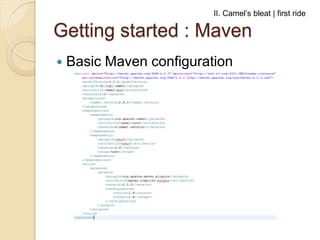
Getting started : Maven


Basic Maven configuration
II. Camel’s bleat | first ride

First Ride
Copy contents from one folder to
another, control final name / dir
 JUnit


◦
◦
◦
◦


Startup context
Route definition : File component
Processor / Exchange
Simple Language (File Component)

Delegate JUnit test to Main class
II. Camel’s bleat | first ride

Second Ride


Add some features to JUnit Class
◦
◦
◦
◦



Log
Add failure if file already exist
Predicate : Simple Language
Error handling

Router EIP (Choice)
II. Camel’s bleat | spring

Spring XML : content-based router
<camelContext>
<route>
<from uri="activemq:NewOrders"/>
<choice>
<when>
<xpath>/order/product = 'widget'</xpath>
<to uri="activemq:Orders.Widgets"/>
</when>
<otherwise>
<to uri="activemq:Orders.Gadgets"/>
</otherwise>
</choice>
</route>

</camelContext>
II. Camel’s bleat

II. Review
Endpoint / Component URIs
 Java DSL
 How to start / process exchanges
 Log, error handling / routing

III. What’s under the humps?


High-level architecture
◦ Container & Services

Toolkit provided out-of-the box
 Distribution

III. What’s under the humps?

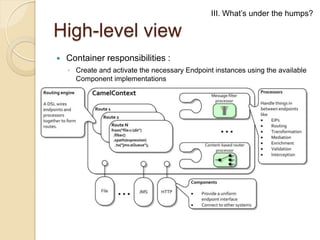
High-level view


Container responsibilities :
◦ Create and activate the necessary Endpoint instances using the available
Component implementations
III. What’s under the humps?

Camel Context Services


Components
◦



Endpoints
◦



Contains the loaded data formats.

Registry
◦



Contains the loaded type converters. Camel has a mechanism that allows you to manually
or automatically convert from one type to another.

Data formats
◦



Contains the routes that have been added.

Type converters
◦



Contains the endpoints that have been created.

Routes
◦



Loads components on the fly either by autodiscovery on the classpath or when a new
bundle is activated in an OSGi container.

Contains a registry that allows you to look up beans. By default, this will be a JNDI registry.
If you’re using Camel from Spring, this will be the Spring ApplicationContext. It can also be
an OSGi registry if you use Camel in an OSGi container.

Languages
◦

Contains the loaded languages. Camel defines 3 different DSLs (Java, XML/Spring, and
Scala) and allows you to use many different languages to create expressions.
III. What’s under the humps?

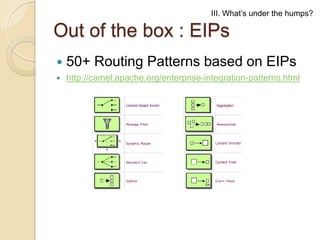
Out of the box : EIPs


50+ Routing Patterns based on EIPs



http://camel.apache.org/enterprise-integration-patterns.html
III. What’s under the humps?

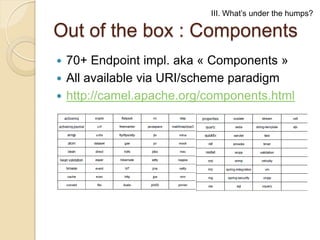
Out of the box : Components
70+ Endpoint impl. aka « Components »
 All available via URI/scheme paradigm
 http://camel.apache.org/components.html

III. What’s under the humps?

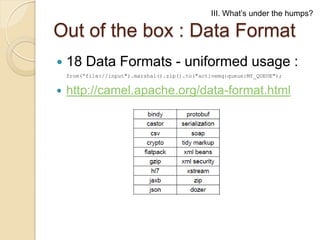
Out of the box : Data Format


18 Data Formats - uniformed usage :
from(“file://input").marshal().zip().to("activemq:queue:MY_QUEUE");



http://camel.apache.org/data-format.html
III. What’s under the humps?

Out of the box : Languages


Predicates & Expressions



http://camel.apache.org/languages.html
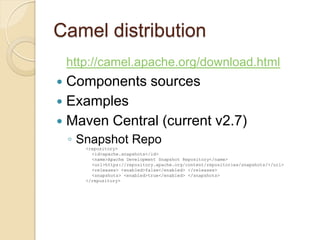
Camel distribution
http://camel.apache.org/download.html

Components sources
 Examples
 Maven Central (current v2.7)


◦ Snapshot Repo
<repository>
<id>apache.snapshots</id>
<name>Apache Development Snapshot Repository</name>
<url>https://repository.apache.org/content/repositories/snapshots/</url>
<releases> <enabled>false</enabled> </releases>
<snapshots> <enabled>true</enabled> </snapshots>
</repository>
III. Review
Camel is an integration framework
 Based on Enterprise Integration Patterns
 Routing and mediation
 Easy to use DSL to define routes
 No heavy specification
 No container dependency
 Payload agnostic
 Connectivity to a great wealth of
transports

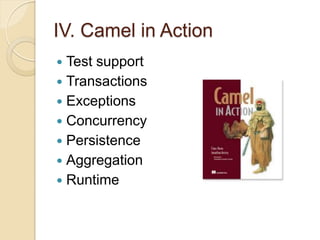
IV. Camel in Action
Test support
 Transactions
 Exceptions
 Concurrency
 Persistence
 Aggregation
 Runtime

IV. Camel in Action| test

Camel Test Support


Provides context/registry support



MockEndpoint assertions
resultEndpoint.expectedBodiesReceived(expectedBody);
template.sendBodyAndHeader(expectedBody, "foo",
"bar");
resultEndpoint.assertIsSatisfied();
IV. Camel in Action| test

Using test support
CamelTestSupport Junit
 @EndpointInject
 @Produce
 Filter Pattern

IV. Camel in Action | tx

Transactions


Component level
◦ Polling strategy
public interface PollingConsumerPollStrategy {
boolean begin(Consumer consumer, Endpoint endpoint);
void commit(Consumer consumer, Endpoint endpoint, int polledMessages);
boolean rollback(Consumer consumer, Endpoint endpoint, int retryCounter, Exception cause) throws
Exception;

}



Routing level
◦ Transactional Client EIP
 http://camel.apache.org/transactional-client.html

◦ Transacted DSL
from("jetty:http://localhost/myservice/order").transacted()
.to("bean:validateOrder").to("jms:queue:order");
IV. Camel in Action | tx

Propagation


Define transaction behaviour
<bean id="PROPAGATION_REQUIRED"
class="org.apache.camel.spring.spi.SpringTransactionPoli
cy">
<property name="transactionManager" ref="txManager"/>
<property name="propagationBehaviorName"
value="PROPAGATION_REQUIRED"/>

</bean>
<bean id="PROPAGATION_REQUIRES_NEW"
class="org.apache.camel.spring.spi.SpringTransactionPolicy">
<property name="transactionManager" ref="txManager"/> <property
name="propagationBehaviorName" value="PROPAGATION_REQUIRES_NEW"/>
</bean>



Use transacted DSL
from("direct:mixed")
.transacted("PROPAGATION_REQUIRED“)
.setBody(constant("Tiger in Action"))
.beanRef("bookService")
.setBody(constant("Elephant in Action"))
.beanRef("bookService“).to("direct:mixed2");
IV. Camel in Action | errors

Exceptions


onException clause
new RouteBuilder() {
public void configure() {
onException(IOException.class).maximumRedeliveries(3);
from("direct:start") .process("processor1")
.process("processor2") // <--- throws a ConnectException
.to("mock:theEnd");
}

◦ Note : By default, a producer will not redeliver



Handle
onException(ValidationException.class)
.handled(true).transform(body(constant("INVALID ORDER")));
from("jetty:http://localhost/myservice/order").transacted()
.to("bean:validateOrder").to("jms:queue:order");
IV. Camel in Action | errors

Dead Letter EIP
The Error Handler propagates error back to the client.
 Dead Letter Channel will always moved failed
exchanges to this queue.




useOriginalMessage is used for routing the original
input message instead of the current message that
potentially is modified during routing.
from("jms:queue:order:input").to("bean:validateOrder")
.to("bean:transformOrder").to("bean:handleOrder");
errorHandler(deadLetterChannel("jms:queue:dead")
.useOriginalMessage().mamimumRedeliveries(5)
.redeliverDelay(5000);
IV. Camel in Action | toolkit

Concurency


Dealing with data flows means mastering
concurency
◦ Seda Component :
from("seda:bar?concurrentConsumers=5").to("file://output");

◦ Thread DSL
 How do we avoid the messages that does not
expect a reply to block ?
from("jms:queue:order") // do some sanity check validation
.to("bean:validateOrder") .to("mock:validate").threads(20)
// do some CPU heavy processing of the message (we simulate and delay)
.unmarshal(mySecureDataFormat).delay(1000)
.to("bean:handleOrder").to("mock:order");
IV. Camel in Action | toolkit

Sync to Async


toAsync Processor
from("direct:start").to("mock:a").toAsync("direct:bar", 5).to("mock:result");
from("direct:bar").to("mock:b").transform(constant("Bye World"));



How does this work?
void process(Exchange exchange, AsyncCallback callback) throws Exception;

◦ With AsyncCallback interface :
void onTaskCompleted(Exchange exchange);



Http Async Producer
public class JettyHttpProducer extends DefaultProducer implements AsyncProcessor

◦ Then invoke the callback when reply is ready on the Exchange.

◦ Routing with Spring DSL
<route> <!-- we route from a direct endpoint -->
<from uri="direct:start"/> <!-- log the request -->
<to uri="log:+++ request +++"/> <!-- then doing a non blocking async request/reply to the http server with a pool of 10 threads
-->
<to uri="jetty://http://0.0.0.0:9123/myapp" async="true" poolSize="10"/>
<!-- the reply from the server is logged -->
<to uri="log:+++ reply +++"/> <!-- and to our mock so we can assert we got all responses -->
<to ref="result"/>
</route>
IV. Camel in Action | toolkit

Persistence



SQL, JDBC and JPA components provided out-of the box
File idempotent consumer with pluggable repository
from("file://inbox?idempotent=true").to("...");
<bean id="fileStore"
class="org.apache.camel.processor.idempotent.FileIdempotentRepository">
<!-- the filename for the store -->
<property name="fileStore" value="target/fileidempotent/.filestore.dat"/>
<!-- the max filesize in bytes for the file. Camel will trunk and flush the
cache if the file gets bigger -->
<property name="maxFileStoreSize" value="512000"/>
<!-- the number of elements in our store -->
<property name="cacheSize" value="250"/> </bean>
<camelContext xmlns="http://camel.apache.org/schema/spring">
<route>
<from
uri="file://target/fileidempotent/?idempotent=true&amp;idempotentRepository=
#fileStore&amp;move=done/${file:name}"/>
<to uri="mock:result"/>
</route>



Stateful EIP : Aggregator
IV. Camel in Action | toolkit

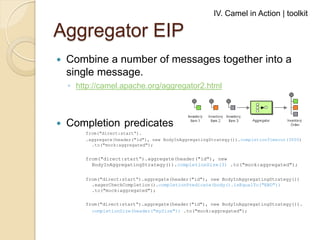
Aggregator EIP


Combine a number of messages together into a
single message.
◦ http://camel.apache.org/aggregator2.html



Completion predicates
from("direct:start“).
.aggregate(header("id"), new BodyInAggregatingStrategy()).completionTimeout(3000)
.to("mock:aggregated");

from("direct:start“).aggregate(header("id"), new
BodyInAggregatingStrategy()).completionSize(3) .to("mock:aggregated");
from("direct:start“).aggregate(header("id"), new BodyInAggregatingStrategy())
.eagerCheckCompletion().completionPredicate(body().isEqualTo("END"))
.to("mock:aggregated");
from("direct:start“).aggregate(header("id"), new BodyInAggregatingStrategy()).
completionSize(header("mySize")) .to("mock:aggregated");
IV. Camel in Action | toolkit

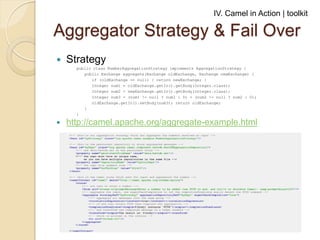
Aggregator Strategy & Fail Over


Strategy
public class NumberAggregationStrategy implements AggregationStrategy {
public Exchange aggregate(Exchange oldExchange, Exchange newExchange) {
if (oldExchange == null) { return newExchange; }
Integer num1 = oldExchange.getIn().getBody(Integer.class);
Integer num2 = newExchange.getIn().getBody(Integer.class);
Integer num3 = (num1 != null ? num1 : 0) + (num2 != null ? num2 : 0);
oldExchange.getIn().setBody(num3); return oldExchange;
}
}



http://camel.apache.org/aggregate-example.html
IV. Camel in Action | runtime

Running Camel


Known Deployment Options
◦
◦
◦
◦
◦
◦
◦
◦

Standalone Java Application
Java Web Start
Spring Application
Web Application
Google App Engine
J2EE Application
JBI
OSGi
IV. Riding Camel | runtime

Running inside App Server
Servlet component
camel-example-servlet-tomcat
 CXF Component
camel-example-cxf-tomcat
 Camel Web console
actually « Web Component »

IV. Review
Camel is not a server
 Camel is lightweight and embeddable
 Camel supports Enterprise Integration
paradigms from the JEE/Spring world.
 Camel is not an ESB though it
implements EIPs.
 Camel doesn’t need but supports any
messaging infrastructure (JMS / MQ)
 Camel supports messaging at JBI
abstraction level

V. A real Use-Case


Multiple source FTP import to a centralized repository
◦ Collect files (0-5 x 2-20 Megs) from N different FTP endpoints, every
hours on a 24/7 basis
◦ End-user configuration
◦ Logs : technical + business
◦ Monitor failures

FTP

SAN

OPCON
Constraints









Big binary files : maybe JMS would not fit
Implementation should fit some common
corporate approach to entreprise intergation.
Currently only SAN @ client. Do not need App
Server yet.
Client is technical-oriented : would like hands-on.
Keep intact current logs / traces, but must be
possible to connect on JDBC.
Would be interested in indexing meta –infos
within Alfresco (JSR-170).
Central schedule/alerting infrastructure must be
connected.
Nagios could be an option at mid-term.
Real issues


Multiple source endpoints pattern :
◦ not found (!!!).

FTP component is an active poller; no
easy way to stop polling after having
consuming all files.
 No easy way to put into configuration
the context path of Endpoint URIs

Other applications…
Camel as an ETL : Excel sources
 PeopleSoft to ActiveDirectory
 Bidirectional Federal <-> City
Entreprises DB official data
 Reconcilliation of mutations streams

Conclusions


Open-Source
◦ Help yourself through debug mode on sources



Maven-based development
◦ « Real » modularity



Real Standards
◦ EIPs
◦ Maven, Spring, Java6.
◦ JBI (Glassfish)



Gateway to the future
◦ OSGI (Fuse ESB)



Camel. What else?
More information needed?


Camel website:

◦ http://camel.apache.org



Camel article:

◦ http://architects.dzone.com/articles/apachecamel-integration



FuseSource website:
◦ http://fusesource.com



Camel in Action book:

◦ http://manning.com/ibsen



Camel in Action Source code:

◦ http://code.google.com/p/camelinaction/
Questions

Apache Camel - Stéphane Kay - April 2011

  • 1.
  • 2.
    Scope  IS Integration  EIP Routing  Mediation  Camel Container  Unit testing  Hands-on  Real Use Case JMS / Active MQ JBI / NMR OSGI / ServiceMix Scala
  • 3.
    Table of contents ISIntegration heuristics I. ◦ ◦ Common issues Paradigms Camel’s bleat II. ◦ ◦ Concepts responding to integration needs Getting started What’s under the humps? III. ◦ ◦ Camel architecture Distribution Camel in Action IV. ◦ ◦ Persistence, transactions, concurrency, failover Aggregation A Real Use-Case V. ◦ Description, issues & achievement
  • 4.
  • 5.
    I. IS Integrationheuristics Just do it !  Just coding simple things might be just not so simple … public class FileCopier { public static void main(String args[]) throws Exception { File inboxDirectory = new File("data/inbox"); File outboxDirectory = new File("data/outbox"); outboxDirectory.mkdir(); File[] files = inboxDirectory.listFiles(); for (File source : files) { if (source.isFile()) { File dest = new File( outboxDirectory.getPath() + File.separator + source.getName()); copyFile(source, dest); } } } private static void copyFile(File source, File dest) throws IOException { OutputStream out = new FileOutputStream(dest); byte[] buffer = new byte[(int) source.length()]; FileInputStream in = new FileInputStream(source); in.read(buffer); try { out.write(buffer); } finally { out.close(); in.close(); } } }
  • 6.
    I. IS Integrationheuristics A Framework?  The bad : ◦ Learning effort consumes time. ◦ Adds anarchical dependencies. ◦ Risk of coming with a new need / not implemented  The good : ◦ Gain value after a training period ◦ Leverage your code to a higher abstraction ◦ Potentially a future standard ?  Indicator : community commits & posts curve.  The plus-value ◦ Not obvious
  • 7.
    I. IS Integrationheuristics Separation of concerns  IS Integration involves 1. Endpoints  A common endpoint interface abstraction 2. Data Processing  Using Message / exchange abstraction and conversion tool 3. Routing  A common vocabulary / pattern as DSL foundation.
  • 8.
    I. IS Integration| endpoint Message Endpoint pattern   Routes should refer to a common abstract Message Endpoint rather than directly using their technical interface A good Endpoint abstraction is a URI description
  • 9.
    II. Camel’s bleat| data Uniformed Exchange  Message’s container during routing
  • 10.
    I. IS Integration| data Data Transformation  Data Format Transformation ◦ Message body is transformed from one format to another.  CSV -> XML  Data Type Transformation ◦ Java Type of message body is transformed/casted into another.  java.lang.String -> java.jms.TextMessage  java.io.File -> java.lang.String
  • 11.
    I. IS Integration| routing Use case : Filtering Route ◦ How can a component avoid receiving uninteresting messages ? ◦ …coming from a different system
  • 12.
    I. IS Integration| routing EIP?  A Catalog of Design patterns for common IS integration issues  http://camel.apache.org/enterprise-integration-patterns.html
  • 13.
    I. IS Integration| routing EIPs Samples…  Filter ◦  Splitter ◦  How can a component avoid receiving uninteresting messages? How can we process a message if it contains multiple elements, each of which may have to be processed in a different way? Router ◦ How can you decouple individual processing steps so that messages can be passed to different filters depending on a set of conditions?  Aggregator ◦ How do we combine the results of individual, but related messages so that they can be processed as a whole?
  • 14.
    I. IS Integrationheuristics Putting all needs together  Route definition attributes : ◦ Endpoints  Producer / Consumer(s) ◦ Processor(s)  Uniformed exchange processing interface ◦ Predicate(s)  A route language should provide those key abstractions Endpoint A = endpoint(“activemq:queue:quote”); Endpoint B = endpoint(“mq:quote”); Predicate isWidget = xpath(“/quote/product = „widget‟”); from(A).filter(isWidget).to(B);
  • 15.
    I. IS Integrationheuristics I. Review  IS Integration paradigms ◦ Endpoint abstraction -> URIs? ◦ Data Tx -> Functions // Java beans ? ◦ Routing -> EIPs
  • 16.
    II. Camel’s bleat ApacheCamel is a Powerful Open Source Integration Framework based on known Enterprise Integration Patterns *  Mission Statement : Making integration easier and more accessible to developers
  • 17.
    II. Camel’s bleat| endpoint Endpoint URI  A camel endpoint URI consists of three parts : ftp://riders.com/orders?username=rider&password=secret Scheme Context path Options
  • 18.
    II. Camel’s bleat| routing Java DSL : Builder pattern  The Builder Pattern (GOF) is central to the Camel Java DSL public class FileCopierWithCamel { public static void main(String args[]) throws Exception { // create CamelContext CamelContext context = new DefaultCamelContext(); // add our route to the CamelContext context.addRoutes(new RouteBuilder() { public void configure() { from("file:data/inbox?noop=true").to("file:data/outbox"); } }); // start the route and let it do its work context.start(); Thread.sleep(10000); // stop the CamelContext context.stop(); } }
  • 19.
    II. Camel’s bleat| data Data Format transformations  Marshal / unmarshal from("activemq:QueueWithJavaObjects”) .marshal().jaxb() .to("mq:QueueWithXmlMessages"); from("activemq:queue:MY_QUEUE").unmarshal().zip().proce ss(new UnZippedMessageProcessor()); http://camel.apache.org/data-format.html
  • 20.
    II. Camel’s bleat| data Message Translator EIP  Aka Adapter (GOF)  Using a Processor from("direct:start").process(new Processor() { public void process(Exchange exchange) { exchange.getIn().setBody(in.getBody(String.class) + " World!"); } }).to("mock:result");  Using Bean binding from("direct:start") .bean(MyBean.class, "hello(String,String)") .to("mock:result");  Using transform() DSL from("direct:start").transform(body().regexReplaceAll(“n”,”<br/>”)) .to("mock:result");
  • 21.
    II. Camel’s bleat| first ride Getting started : IDE Eclipse  Maven integration (m2eclipse)  ◦ http://m2eclipse.sonatype.org/sites/m2e ◦ Check your eclipse.ini : locate your JDK -vm C:/dev/java/jdk1.6.0_18/bin  Optional : Fuse Camel plugin for Eclipse ◦ http://repo.fusesource.com/beta/eclipse/u pdate/
  • 22.
    II. Camel’s bleat| first ride Getting started : Maven  Basic Maven configuration
  • 23.
    II. Camel’s bleat| first ride First Ride Copy contents from one folder to another, control final name / dir  JUnit  ◦ ◦ ◦ ◦  Startup context Route definition : File component Processor / Exchange Simple Language (File Component) Delegate JUnit test to Main class
  • 24.
    II. Camel’s bleat| first ride Second Ride  Add some features to JUnit Class ◦ ◦ ◦ ◦  Log Add failure if file already exist Predicate : Simple Language Error handling Router EIP (Choice)
  • 25.
    II. Camel’s bleat| spring Spring XML : content-based router <camelContext> <route> <from uri="activemq:NewOrders"/> <choice> <when> <xpath>/order/product = 'widget'</xpath> <to uri="activemq:Orders.Widgets"/> </when> <otherwise> <to uri="activemq:Orders.Gadgets"/> </otherwise> </choice> </route> </camelContext>
  • 26.
    II. Camel’s bleat II.Review Endpoint / Component URIs  Java DSL  How to start / process exchanges  Log, error handling / routing 
  • 27.
    III. What’s underthe humps?  High-level architecture ◦ Container & Services Toolkit provided out-of-the box  Distribution 
  • 28.
    III. What’s underthe humps? High-level view  Container responsibilities : ◦ Create and activate the necessary Endpoint instances using the available Component implementations
  • 29.
    III. What’s underthe humps? Camel Context Services  Components ◦  Endpoints ◦  Contains the loaded data formats. Registry ◦  Contains the loaded type converters. Camel has a mechanism that allows you to manually or automatically convert from one type to another. Data formats ◦  Contains the routes that have been added. Type converters ◦  Contains the endpoints that have been created. Routes ◦  Loads components on the fly either by autodiscovery on the classpath or when a new bundle is activated in an OSGi container. Contains a registry that allows you to look up beans. By default, this will be a JNDI registry. If you’re using Camel from Spring, this will be the Spring ApplicationContext. It can also be an OSGi registry if you use Camel in an OSGi container. Languages ◦ Contains the loaded languages. Camel defines 3 different DSLs (Java, XML/Spring, and Scala) and allows you to use many different languages to create expressions.
  • 30.
    III. What’s underthe humps? Out of the box : EIPs  50+ Routing Patterns based on EIPs  http://camel.apache.org/enterprise-integration-patterns.html
  • 31.
    III. What’s underthe humps? Out of the box : Components 70+ Endpoint impl. aka « Components »  All available via URI/scheme paradigm  http://camel.apache.org/components.html 
  • 32.
    III. What’s underthe humps? Out of the box : Data Format  18 Data Formats - uniformed usage : from(“file://input").marshal().zip().to("activemq:queue:MY_QUEUE");  http://camel.apache.org/data-format.html
  • 33.
    III. What’s underthe humps? Out of the box : Languages  Predicates & Expressions  http://camel.apache.org/languages.html
  • 34.
    Camel distribution http://camel.apache.org/download.html Components sources Examples  Maven Central (current v2.7)  ◦ Snapshot Repo <repository> <id>apache.snapshots</id> <name>Apache Development Snapshot Repository</name> <url>https://repository.apache.org/content/repositories/snapshots/</url> <releases> <enabled>false</enabled> </releases> <snapshots> <enabled>true</enabled> </snapshots> </repository>
  • 35.
    III. Review Camel isan integration framework  Based on Enterprise Integration Patterns  Routing and mediation  Easy to use DSL to define routes  No heavy specification  No container dependency  Payload agnostic  Connectivity to a great wealth of transports 
  • 36.
    IV. Camel inAction Test support  Transactions  Exceptions  Concurrency  Persistence  Aggregation  Runtime 
  • 37.
    IV. Camel inAction| test Camel Test Support  Provides context/registry support  MockEndpoint assertions resultEndpoint.expectedBodiesReceived(expectedBody); template.sendBodyAndHeader(expectedBody, "foo", "bar"); resultEndpoint.assertIsSatisfied();
  • 38.
    IV. Camel inAction| test Using test support CamelTestSupport Junit  @EndpointInject  @Produce  Filter Pattern 
  • 39.
    IV. Camel inAction | tx Transactions  Component level ◦ Polling strategy public interface PollingConsumerPollStrategy { boolean begin(Consumer consumer, Endpoint endpoint); void commit(Consumer consumer, Endpoint endpoint, int polledMessages); boolean rollback(Consumer consumer, Endpoint endpoint, int retryCounter, Exception cause) throws Exception; }  Routing level ◦ Transactional Client EIP  http://camel.apache.org/transactional-client.html ◦ Transacted DSL from("jetty:http://localhost/myservice/order").transacted() .to("bean:validateOrder").to("jms:queue:order");
  • 40.
    IV. Camel inAction | tx Propagation  Define transaction behaviour <bean id="PROPAGATION_REQUIRED" class="org.apache.camel.spring.spi.SpringTransactionPoli cy"> <property name="transactionManager" ref="txManager"/> <property name="propagationBehaviorName" value="PROPAGATION_REQUIRED"/> </bean> <bean id="PROPAGATION_REQUIRES_NEW" class="org.apache.camel.spring.spi.SpringTransactionPolicy"> <property name="transactionManager" ref="txManager"/> <property name="propagationBehaviorName" value="PROPAGATION_REQUIRES_NEW"/> </bean>  Use transacted DSL from("direct:mixed") .transacted("PROPAGATION_REQUIRED“) .setBody(constant("Tiger in Action")) .beanRef("bookService") .setBody(constant("Elephant in Action")) .beanRef("bookService“).to("direct:mixed2");
  • 41.
    IV. Camel inAction | errors Exceptions  onException clause new RouteBuilder() { public void configure() { onException(IOException.class).maximumRedeliveries(3); from("direct:start") .process("processor1") .process("processor2") // <--- throws a ConnectException .to("mock:theEnd"); } ◦ Note : By default, a producer will not redeliver  Handle onException(ValidationException.class) .handled(true).transform(body(constant("INVALID ORDER"))); from("jetty:http://localhost/myservice/order").transacted() .to("bean:validateOrder").to("jms:queue:order");
  • 42.
    IV. Camel inAction | errors Dead Letter EIP The Error Handler propagates error back to the client.  Dead Letter Channel will always moved failed exchanges to this queue.   useOriginalMessage is used for routing the original input message instead of the current message that potentially is modified during routing. from("jms:queue:order:input").to("bean:validateOrder") .to("bean:transformOrder").to("bean:handleOrder"); errorHandler(deadLetterChannel("jms:queue:dead") .useOriginalMessage().mamimumRedeliveries(5) .redeliverDelay(5000);
  • 43.
    IV. Camel inAction | toolkit Concurency  Dealing with data flows means mastering concurency ◦ Seda Component : from("seda:bar?concurrentConsumers=5").to("file://output"); ◦ Thread DSL  How do we avoid the messages that does not expect a reply to block ? from("jms:queue:order") // do some sanity check validation .to("bean:validateOrder") .to("mock:validate").threads(20) // do some CPU heavy processing of the message (we simulate and delay) .unmarshal(mySecureDataFormat).delay(1000) .to("bean:handleOrder").to("mock:order");
  • 44.
    IV. Camel inAction | toolkit Sync to Async  toAsync Processor from("direct:start").to("mock:a").toAsync("direct:bar", 5).to("mock:result"); from("direct:bar").to("mock:b").transform(constant("Bye World"));  How does this work? void process(Exchange exchange, AsyncCallback callback) throws Exception; ◦ With AsyncCallback interface : void onTaskCompleted(Exchange exchange);  Http Async Producer public class JettyHttpProducer extends DefaultProducer implements AsyncProcessor ◦ Then invoke the callback when reply is ready on the Exchange. ◦ Routing with Spring DSL <route> <!-- we route from a direct endpoint --> <from uri="direct:start"/> <!-- log the request --> <to uri="log:+++ request +++"/> <!-- then doing a non blocking async request/reply to the http server with a pool of 10 threads --> <to uri="jetty://http://0.0.0.0:9123/myapp" async="true" poolSize="10"/> <!-- the reply from the server is logged --> <to uri="log:+++ reply +++"/> <!-- and to our mock so we can assert we got all responses --> <to ref="result"/> </route>
  • 45.
    IV. Camel inAction | toolkit Persistence   SQL, JDBC and JPA components provided out-of the box File idempotent consumer with pluggable repository from("file://inbox?idempotent=true").to("..."); <bean id="fileStore" class="org.apache.camel.processor.idempotent.FileIdempotentRepository"> <!-- the filename for the store --> <property name="fileStore" value="target/fileidempotent/.filestore.dat"/> <!-- the max filesize in bytes for the file. Camel will trunk and flush the cache if the file gets bigger --> <property name="maxFileStoreSize" value="512000"/> <!-- the number of elements in our store --> <property name="cacheSize" value="250"/> </bean> <camelContext xmlns="http://camel.apache.org/schema/spring"> <route> <from uri="file://target/fileidempotent/?idempotent=true&amp;idempotentRepository= #fileStore&amp;move=done/${file:name}"/> <to uri="mock:result"/> </route>  Stateful EIP : Aggregator
  • 46.
    IV. Camel inAction | toolkit Aggregator EIP  Combine a number of messages together into a single message. ◦ http://camel.apache.org/aggregator2.html  Completion predicates from("direct:start“). .aggregate(header("id"), new BodyInAggregatingStrategy()).completionTimeout(3000) .to("mock:aggregated"); from("direct:start“).aggregate(header("id"), new BodyInAggregatingStrategy()).completionSize(3) .to("mock:aggregated"); from("direct:start“).aggregate(header("id"), new BodyInAggregatingStrategy()) .eagerCheckCompletion().completionPredicate(body().isEqualTo("END")) .to("mock:aggregated"); from("direct:start“).aggregate(header("id"), new BodyInAggregatingStrategy()). completionSize(header("mySize")) .to("mock:aggregated");
  • 47.
    IV. Camel inAction | toolkit Aggregator Strategy & Fail Over  Strategy public class NumberAggregationStrategy implements AggregationStrategy { public Exchange aggregate(Exchange oldExchange, Exchange newExchange) { if (oldExchange == null) { return newExchange; } Integer num1 = oldExchange.getIn().getBody(Integer.class); Integer num2 = newExchange.getIn().getBody(Integer.class); Integer num3 = (num1 != null ? num1 : 0) + (num2 != null ? num2 : 0); oldExchange.getIn().setBody(num3); return oldExchange; } }  http://camel.apache.org/aggregate-example.html
  • 48.
    IV. Camel inAction | runtime Running Camel  Known Deployment Options ◦ ◦ ◦ ◦ ◦ ◦ ◦ ◦ Standalone Java Application Java Web Start Spring Application Web Application Google App Engine J2EE Application JBI OSGi
  • 49.
    IV. Riding Camel| runtime Running inside App Server Servlet component camel-example-servlet-tomcat  CXF Component camel-example-cxf-tomcat  Camel Web console actually « Web Component » 
  • 50.
    IV. Review Camel isnot a server  Camel is lightweight and embeddable  Camel supports Enterprise Integration paradigms from the JEE/Spring world.  Camel is not an ESB though it implements EIPs.  Camel doesn’t need but supports any messaging infrastructure (JMS / MQ)  Camel supports messaging at JBI abstraction level 
  • 51.
    V. A realUse-Case  Multiple source FTP import to a centralized repository ◦ Collect files (0-5 x 2-20 Megs) from N different FTP endpoints, every hours on a 24/7 basis ◦ End-user configuration ◦ Logs : technical + business ◦ Monitor failures FTP SAN OPCON
  • 52.
    Constraints         Big binary files: maybe JMS would not fit Implementation should fit some common corporate approach to entreprise intergation. Currently only SAN @ client. Do not need App Server yet. Client is technical-oriented : would like hands-on. Keep intact current logs / traces, but must be possible to connect on JDBC. Would be interested in indexing meta –infos within Alfresco (JSR-170). Central schedule/alerting infrastructure must be connected. Nagios could be an option at mid-term.
  • 53.
    Real issues  Multiple sourceendpoints pattern : ◦ not found (!!!). FTP component is an active poller; no easy way to stop polling after having consuming all files.  No easy way to put into configuration the context path of Endpoint URIs 
  • 54.
    Other applications… Camel asan ETL : Excel sources  PeopleSoft to ActiveDirectory  Bidirectional Federal <-> City Entreprises DB official data  Reconcilliation of mutations streams 
  • 55.
    Conclusions  Open-Source ◦ Help yourselfthrough debug mode on sources  Maven-based development ◦ « Real » modularity  Real Standards ◦ EIPs ◦ Maven, Spring, Java6. ◦ JBI (Glassfish)  Gateway to the future ◦ OSGI (Fuse ESB)  Camel. What else?
  • 56.
    More information needed?  Camelwebsite: ◦ http://camel.apache.org  Camel article: ◦ http://architects.dzone.com/articles/apachecamel-integration  FuseSource website: ◦ http://fusesource.com  Camel in Action book: ◦ http://manning.com/ibsen  Camel in Action Source code: ◦ http://code.google.com/p/camelinaction/
  • 57.