SISTEM INFORMASI KEKAYAAN NEGARA

                | Pertemuan 1 |
SISTEM INFORMASI DAN MODEL PENGEMBANGANNYA

                          Dr. Tb. Maulana Kusuma
     mkusuma@staff.gunadarma.ac.id | http://mkusuma.staff.gunadarma.ac.id


                 Program Magister Manajemen | Akuntansi Pemerintahan
KONSEP INFORMASI:
            DATA vs INFORMASI
 Data: raw facts
  – Alphanumeric, image, audio, and video
 Information
  – Organized collection of facts
  – Have value beyond the facts themselves


                                             2
DATA vs INFORMASI (lanjutan)
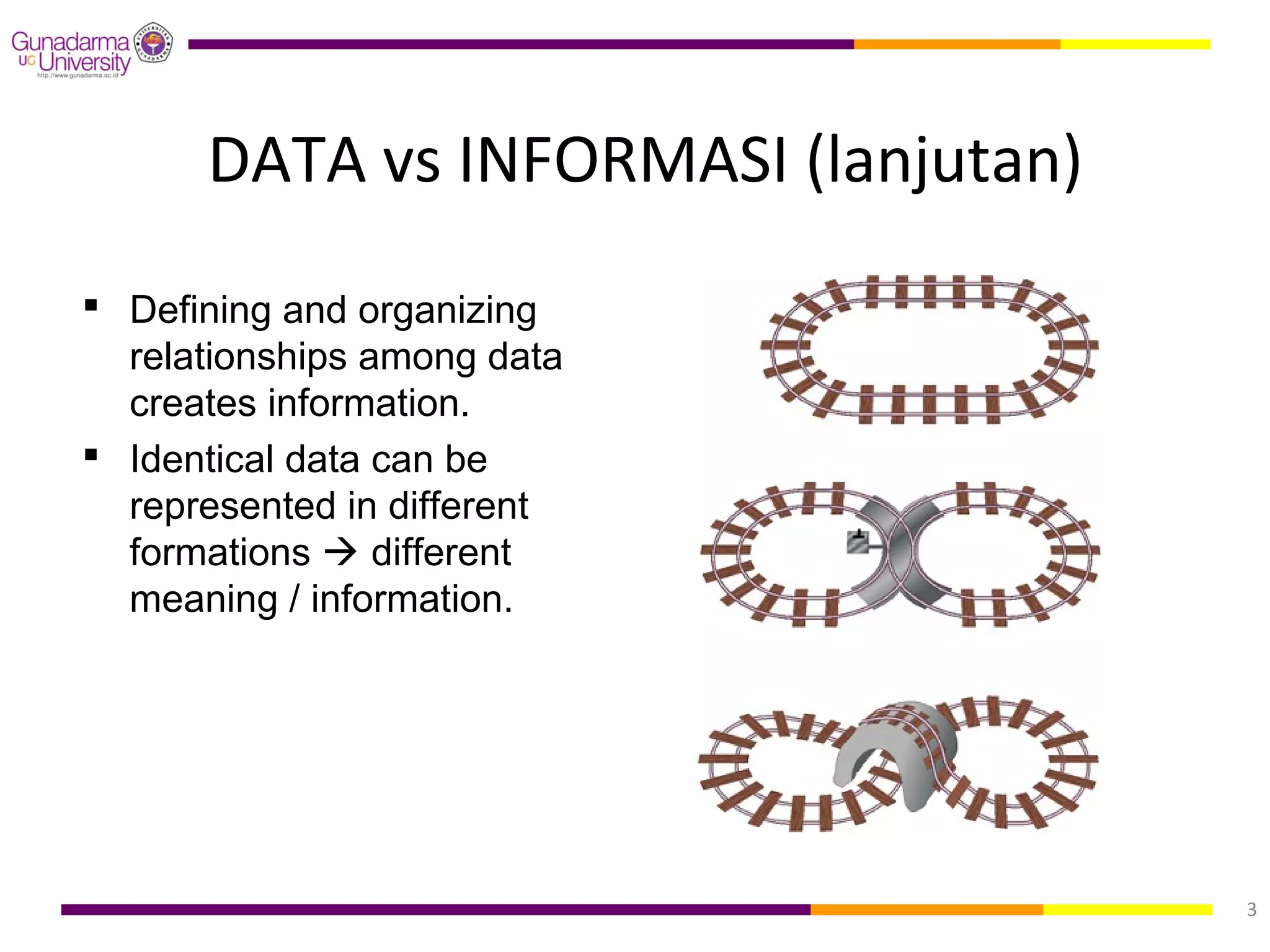
 Defining and organizing
  relationships among data
  creates information.
 Identical data can be
  represented in different
  formations  different
  meaning / information.


                                     3
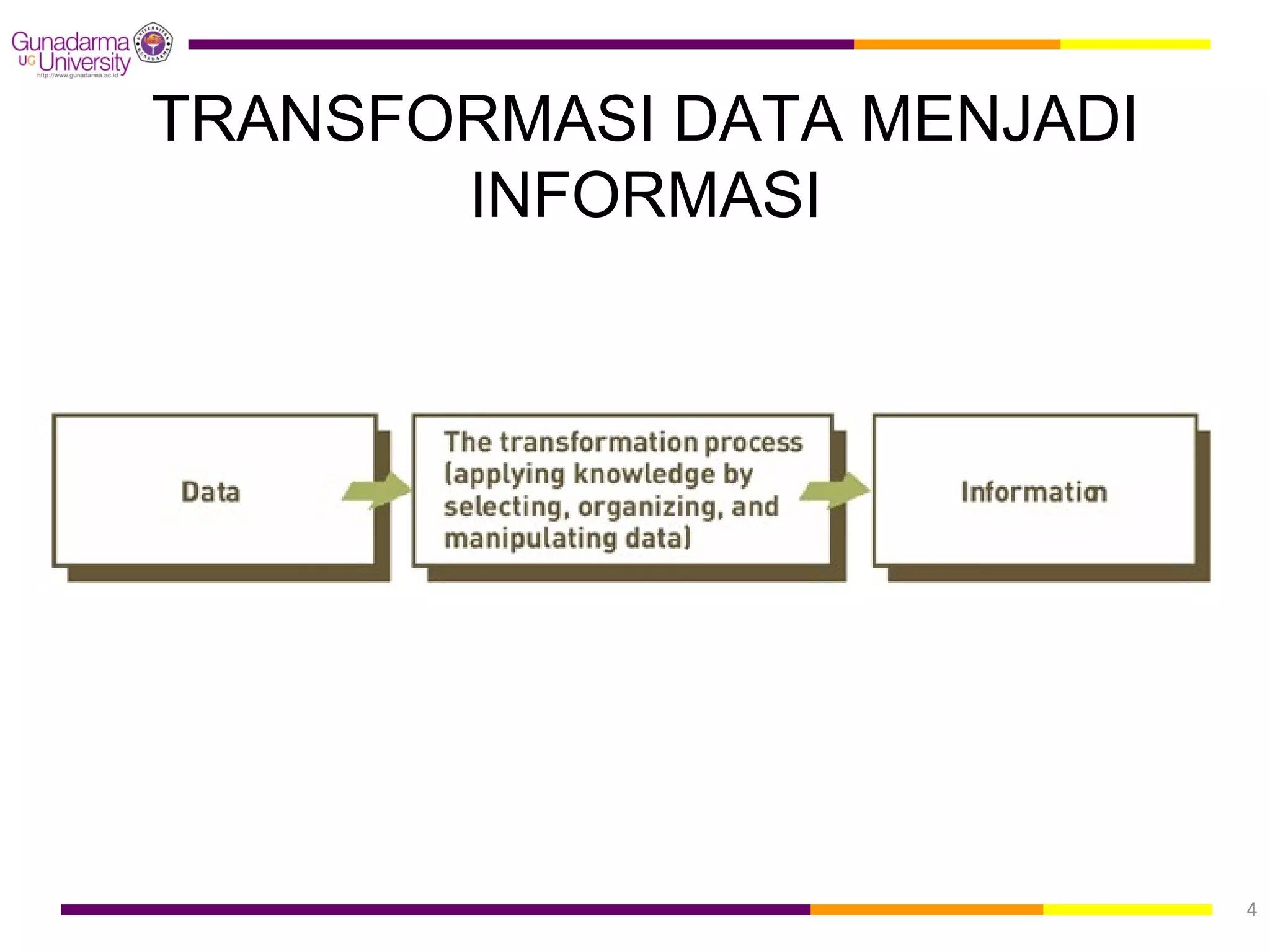
TRANSFORMASI DATA MENJADI
       INFORMASI


                            4
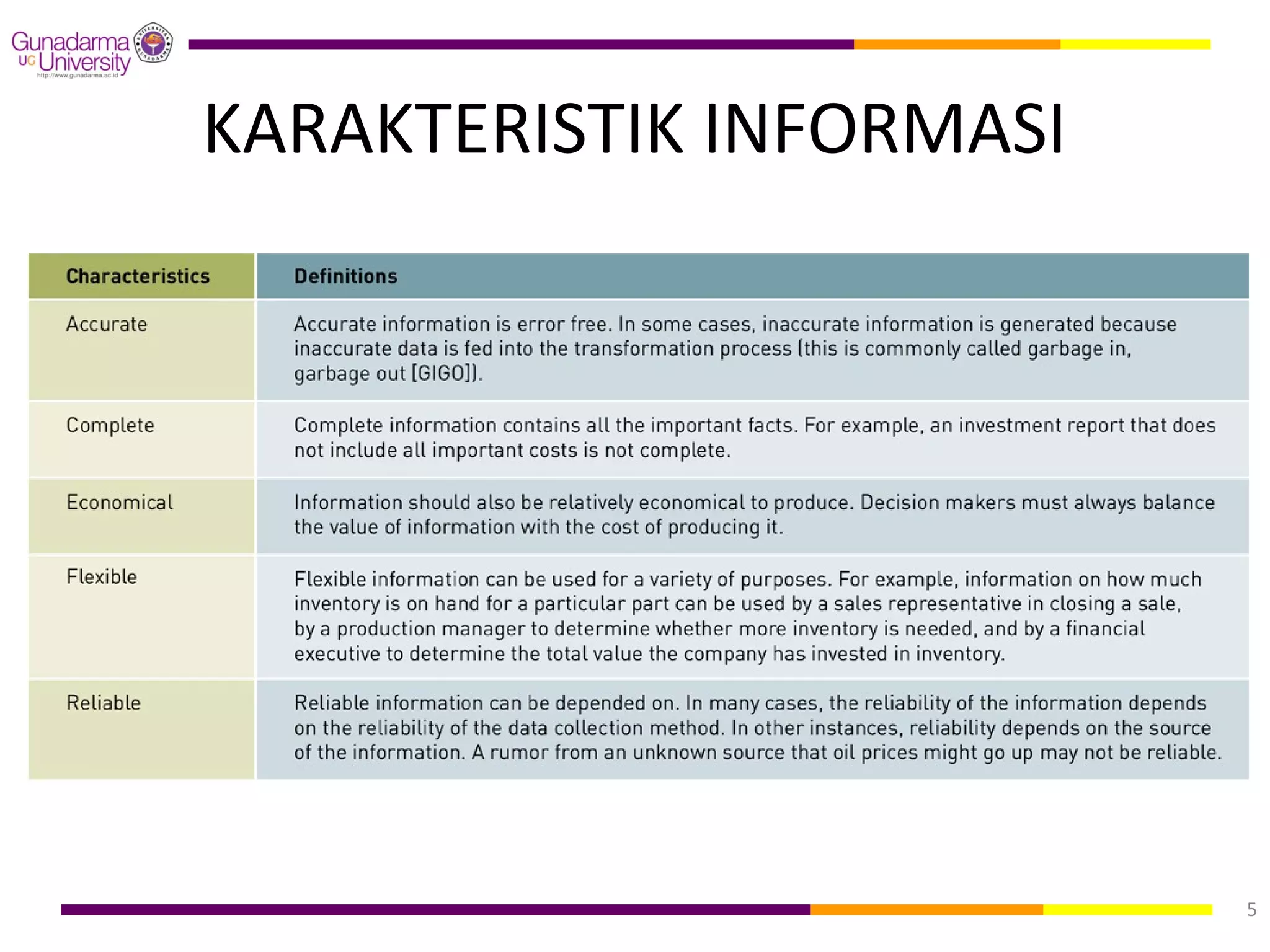
KARAKTERISTIK INFORMASI


                          5
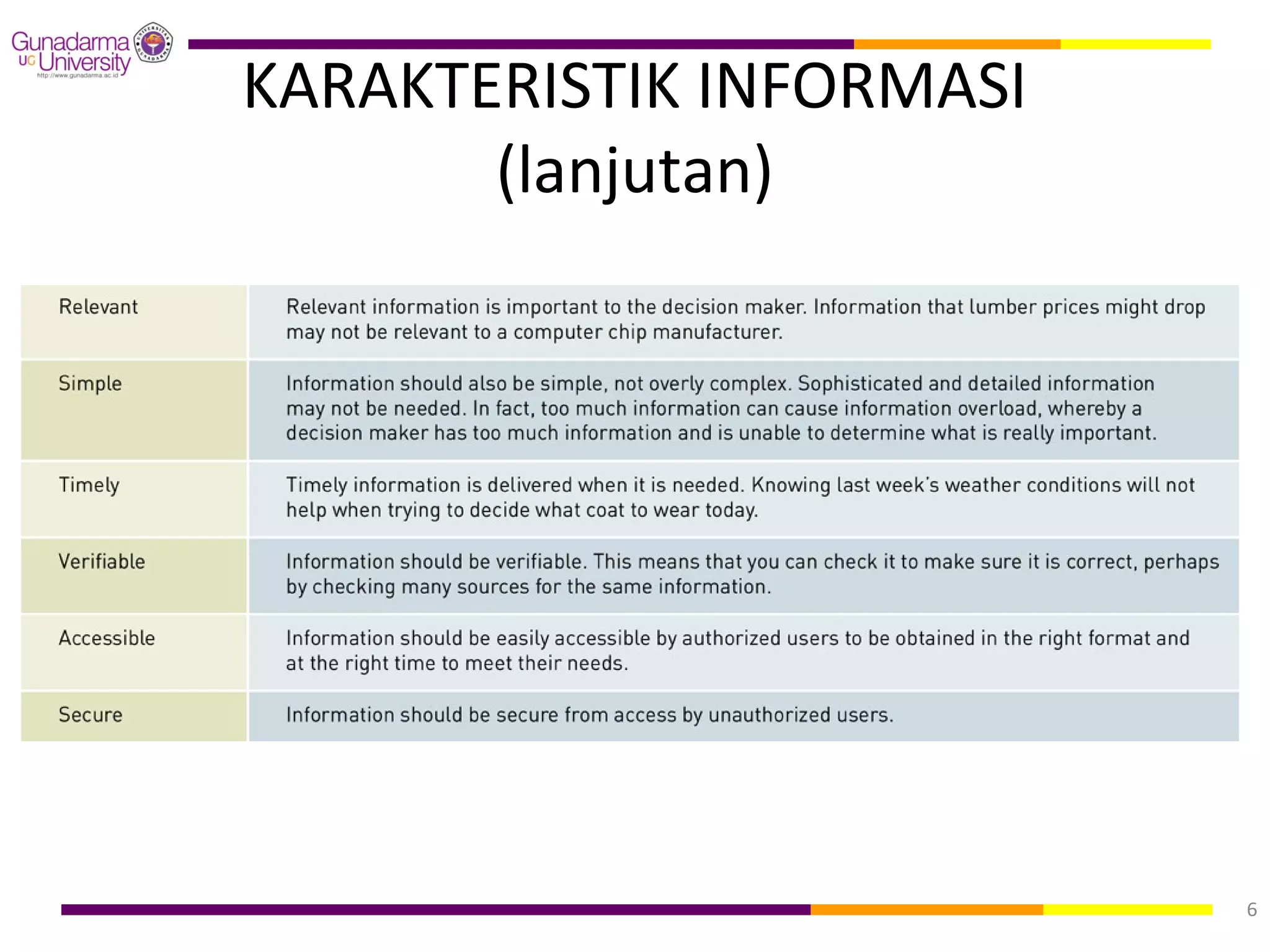
KARAKTERISTIK INFORMASI
       (lanjutan)


                          6
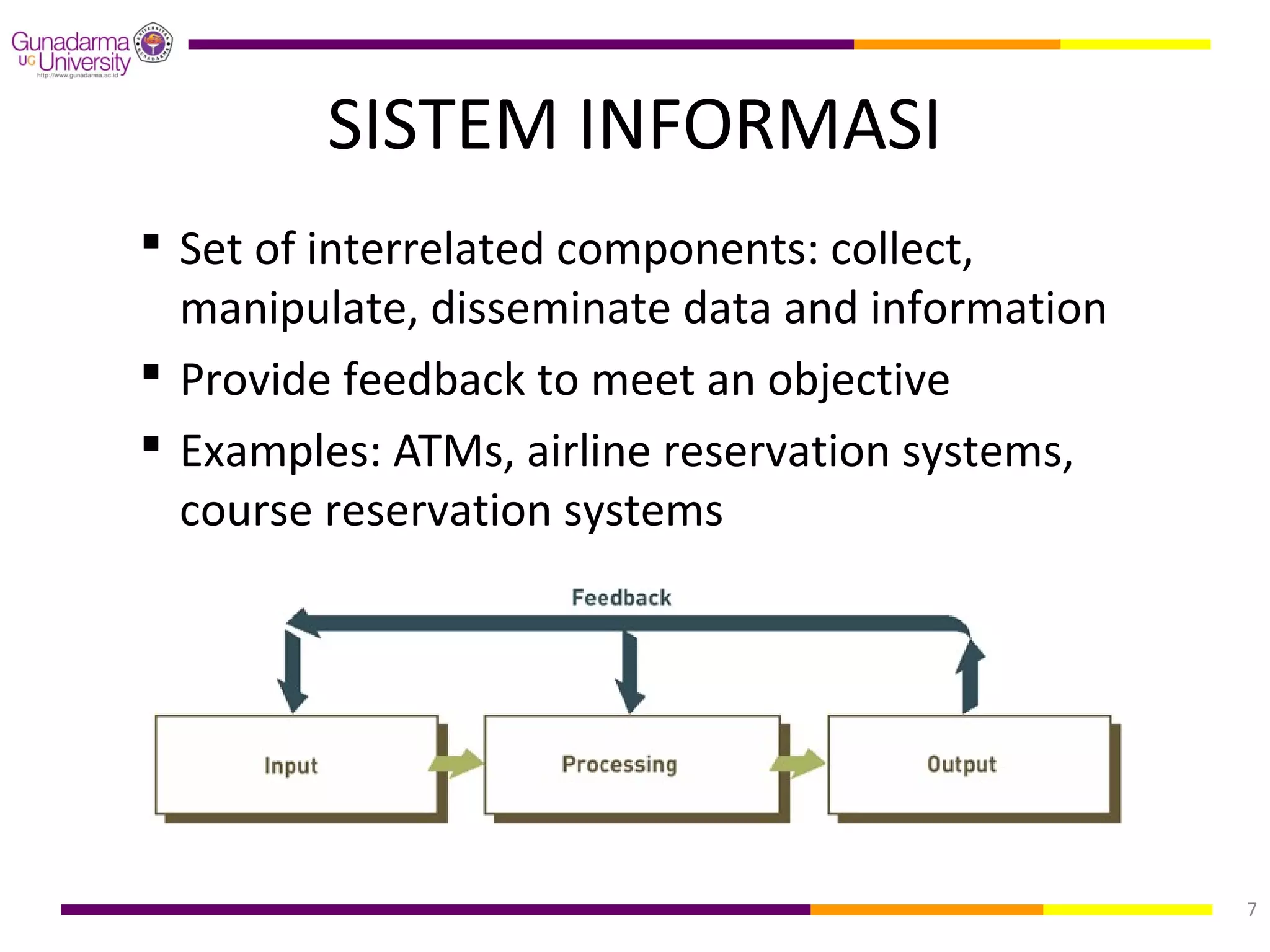
SISTEM INFORMASI
 Set of interrelated components: collect,
  manipulate, disseminate data and information
 Provide feedback to meet an objective
 Examples: ATMs, airline reservation systems,
  course reservation systems


                                                 7
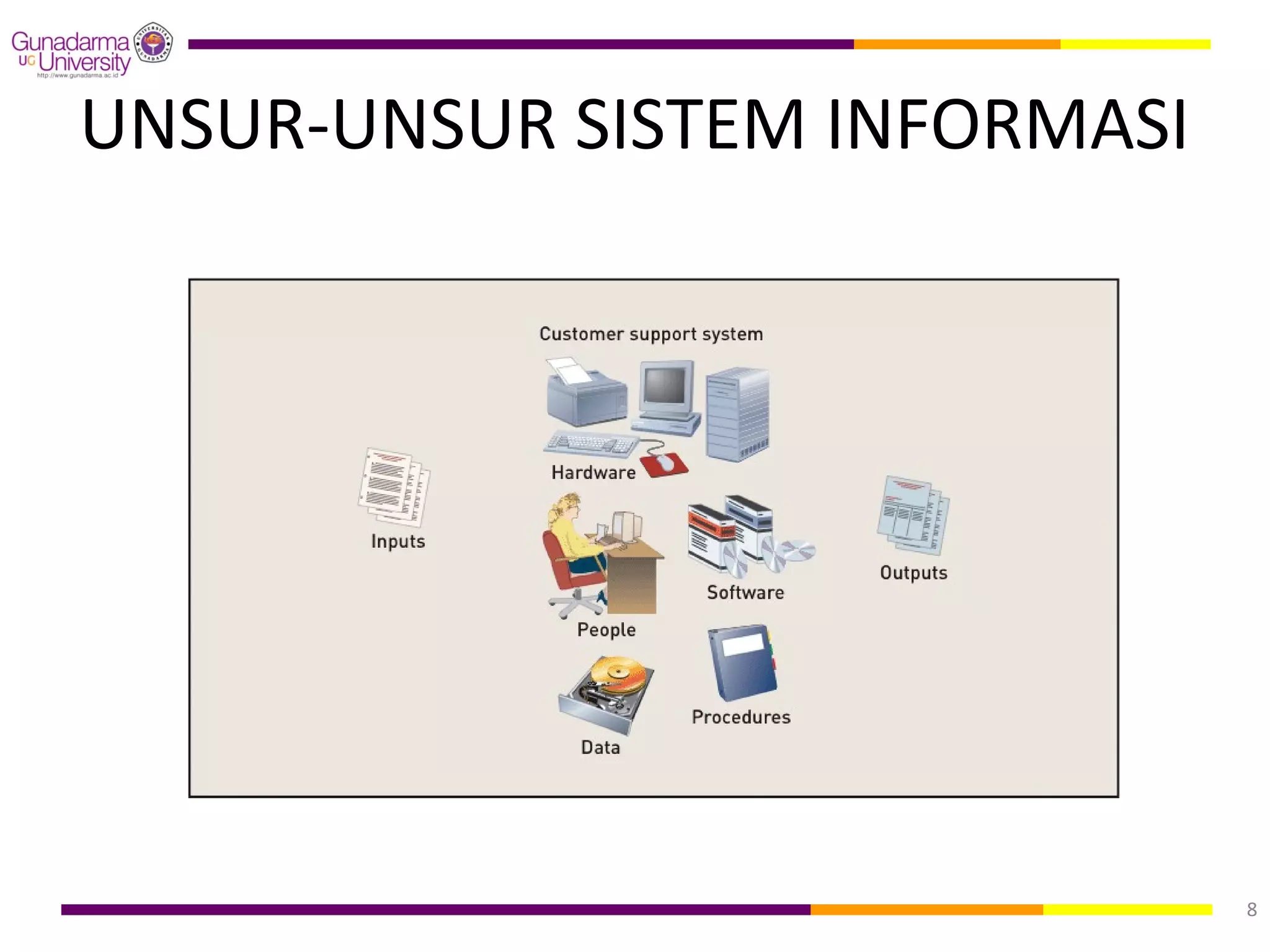
UNSUR-UNSUR SISTEM INFORMASI


                               8
SISTEM INFORMASI
            BERBASIS KOMPUTER
 Manual vs Computerized information systems
 Computer-based information system (CBIS)
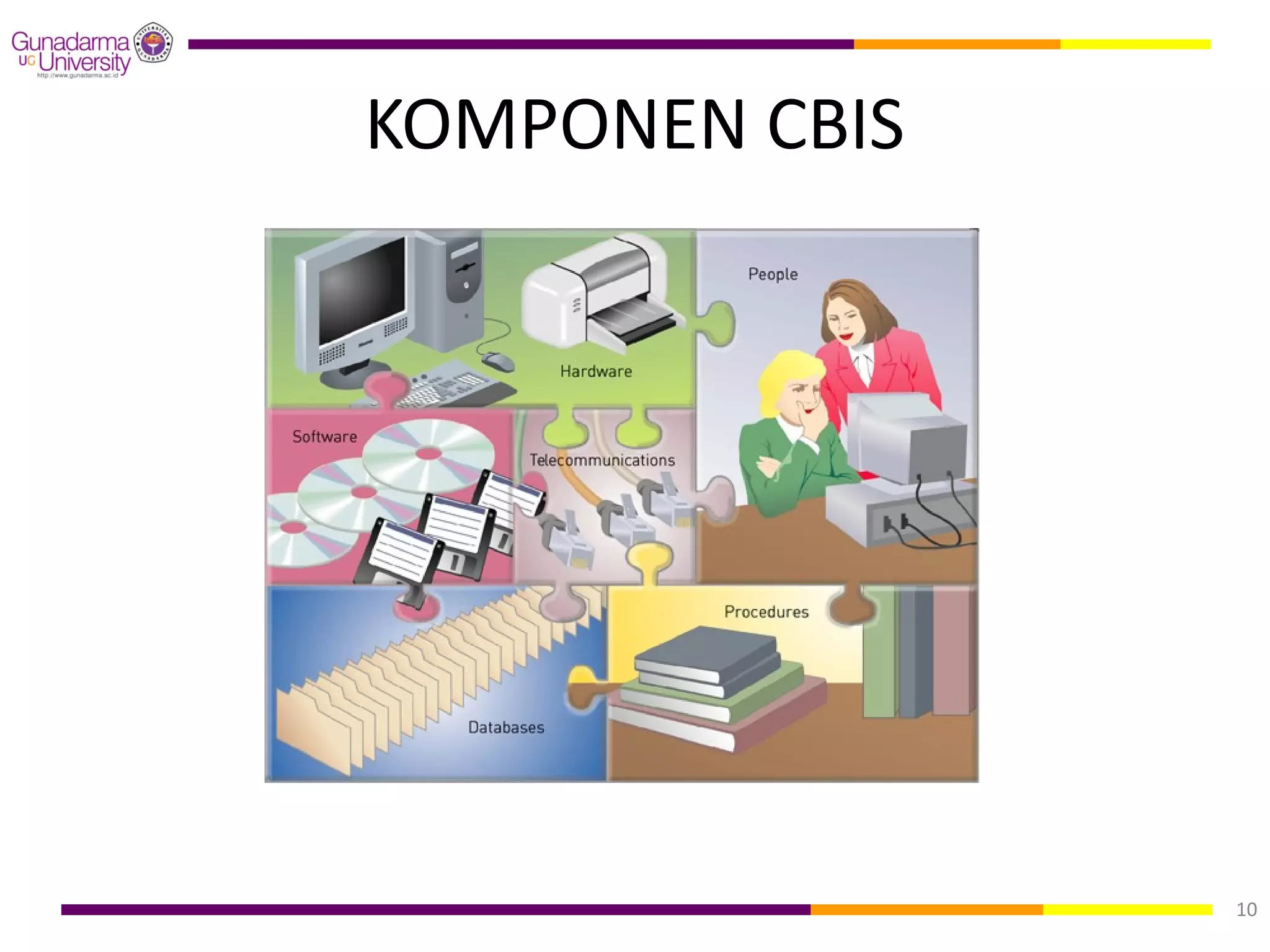
  – Hardware, software, databases,
    telecommunications, people, and procedures
  – Collect, manipulate, store, and process data into
    information


                                                        9
KOMPONEN CBIS


                10
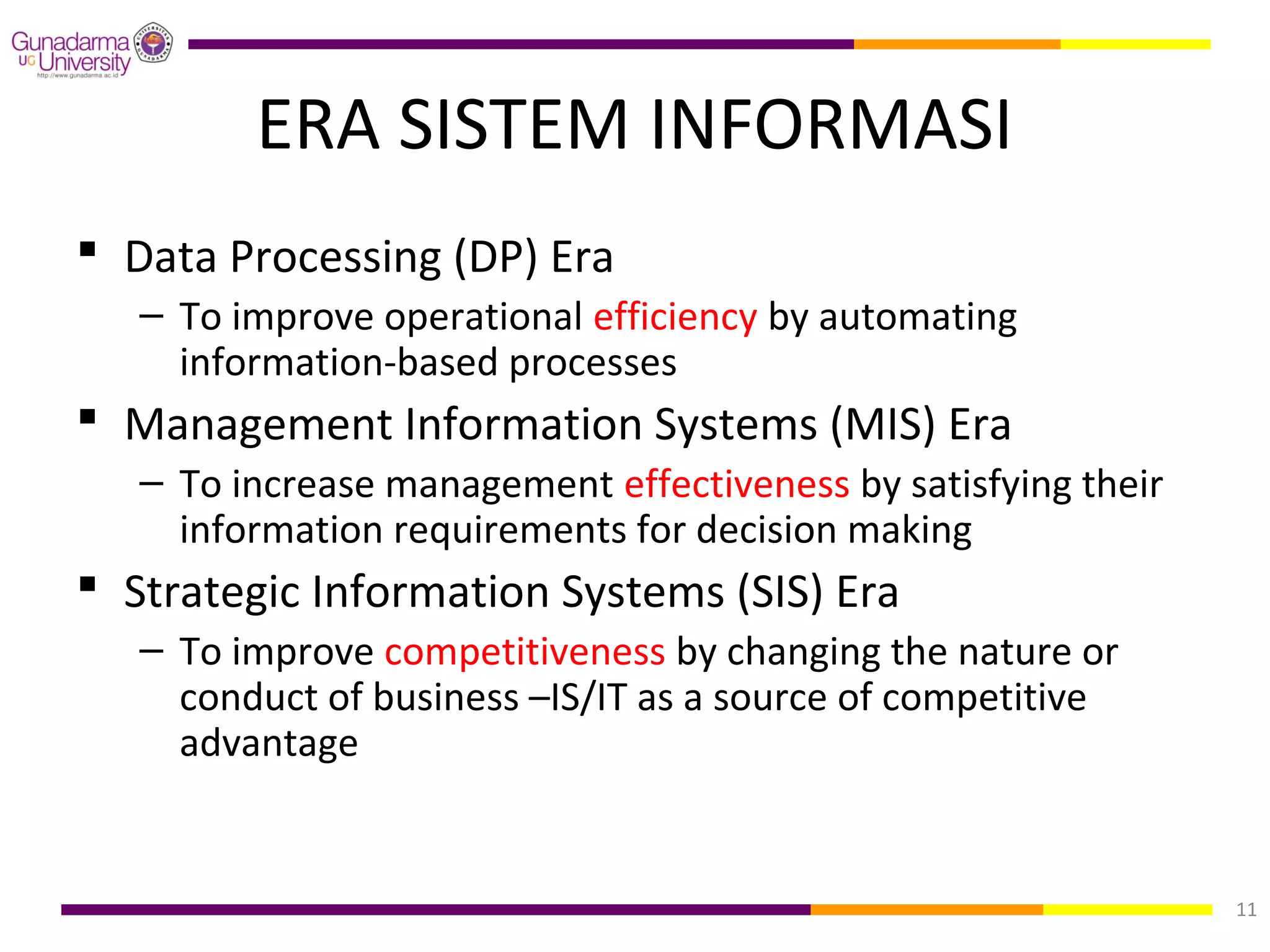
ERA SISTEM INFORMASI
 Data Processing (DP) Era
   – To improve operational efficiency by automating
     information-based processes
 Management Information Systems (MIS) Era
   – To increase management effectiveness by satisfying their
     information requirements for decision making
 Strategic Information Systems (SIS) Era
   – To improve competitiveness by changing the nature or
     conduct of business –IS/IT as a source of competitive
     advantage


                                                                11
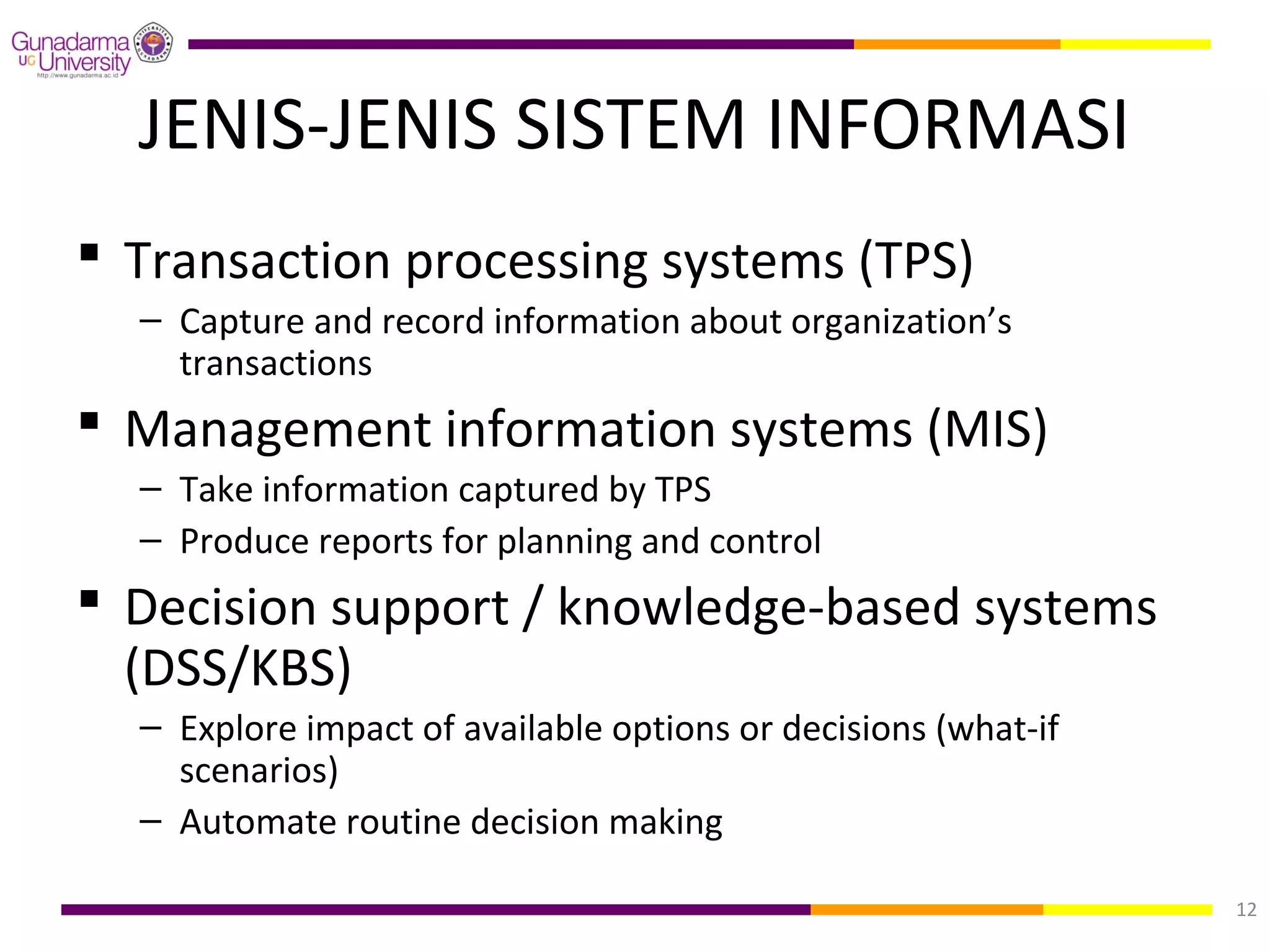
JENIS-JENIS SISTEM INFORMASI
 Transaction processing systems (TPS)
  – Capture and record information about organization’s
    transactions
 Management information systems (MIS)
  – Take information captured by TPS
  – Produce reports for planning and control
 Decision support / knowledge-based systems
  (DSS/KBS)
  – Explore impact of available options or decisions (what-if
    scenarios)
  – Automate routine decision making

                                                                12
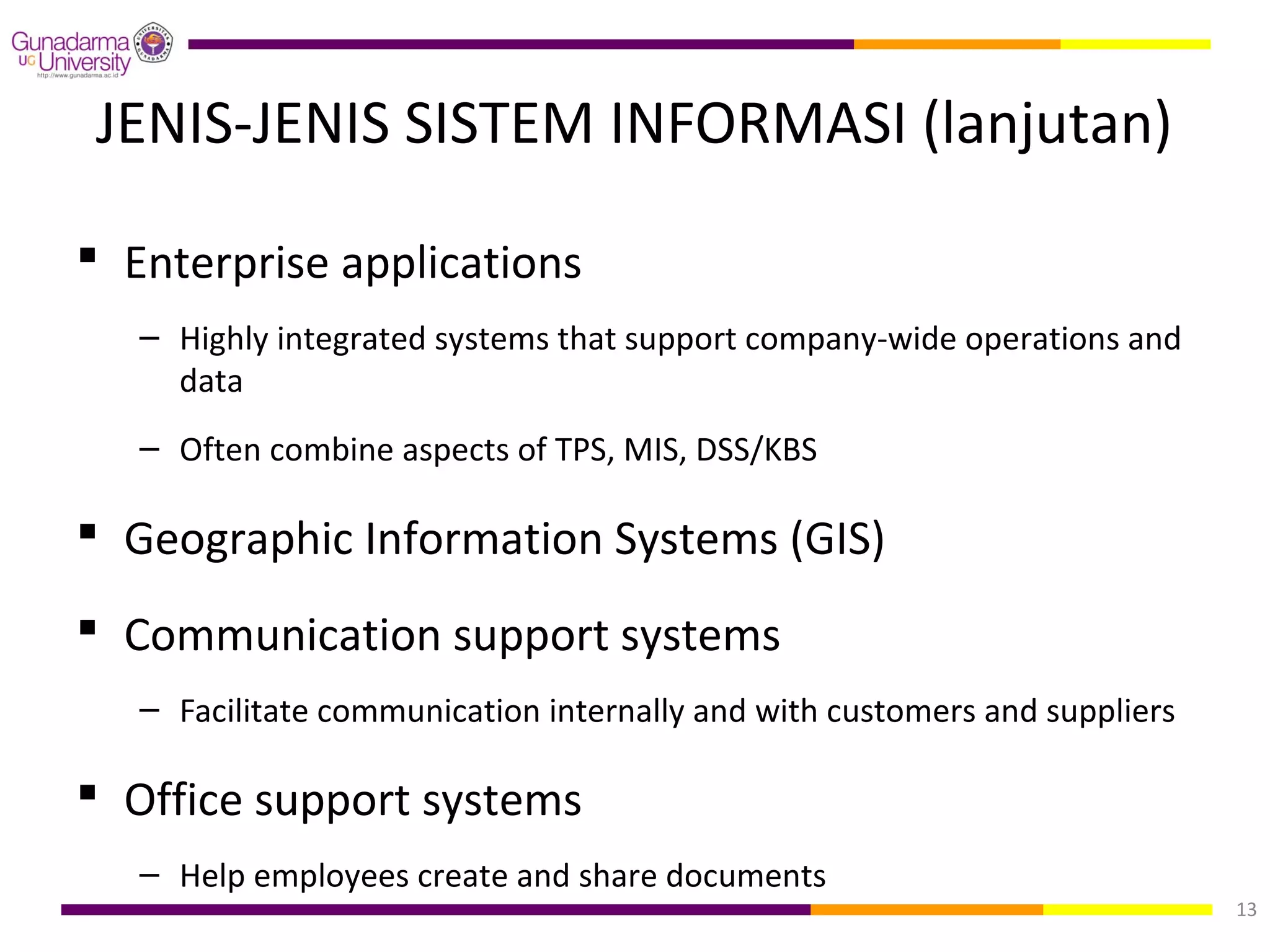
JENIS-JENIS SISTEM INFORMASI (lanjutan)

 Enterprise applications
   – Highly integrated systems that support company-wide operations and
     data
   – Often combine aspects of TPS, MIS, DSS/KBS

 Geographic Information Systems (GIS)
 Communication support systems
   – Facilitate communication internally and with customers and suppliers

 Office support systems
   – Help employees create and share documents
                                                                            13
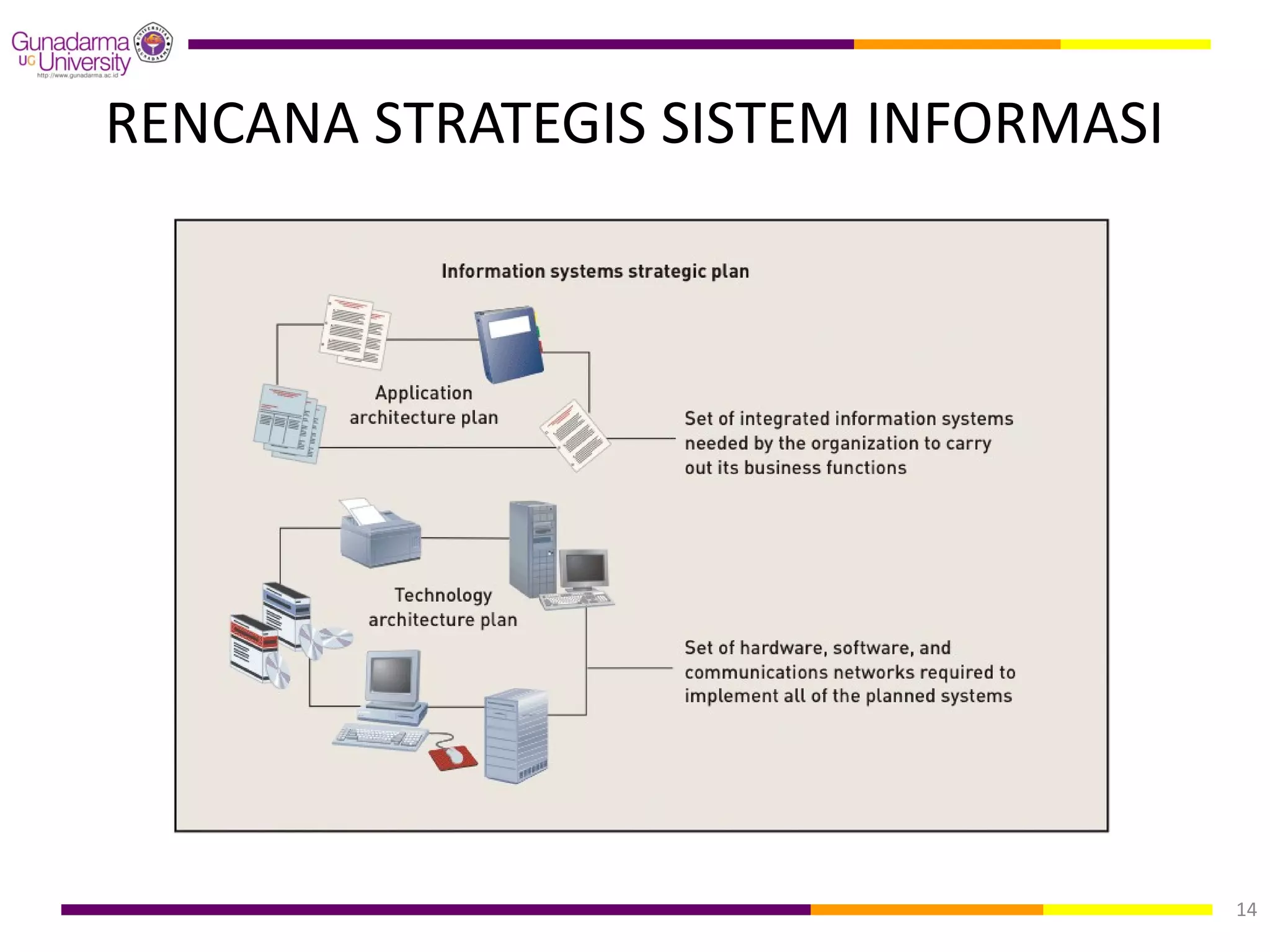
RENCANA STRATEGIS SISTEM INFORMASI


                                     14
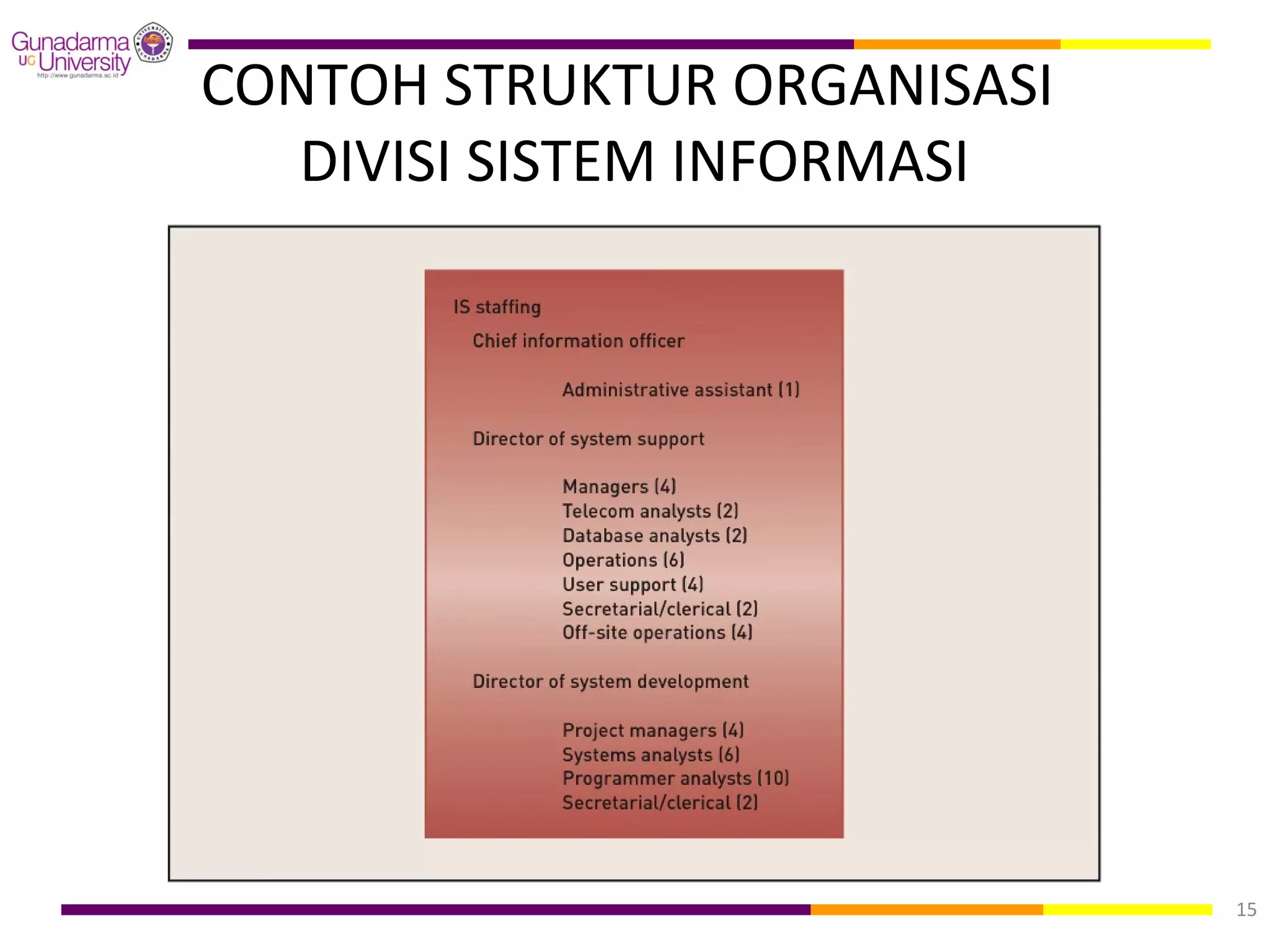
CONTOH STRUKTUR ORGANISASI
   DIVISI SISTEM INFORMASI


                             15
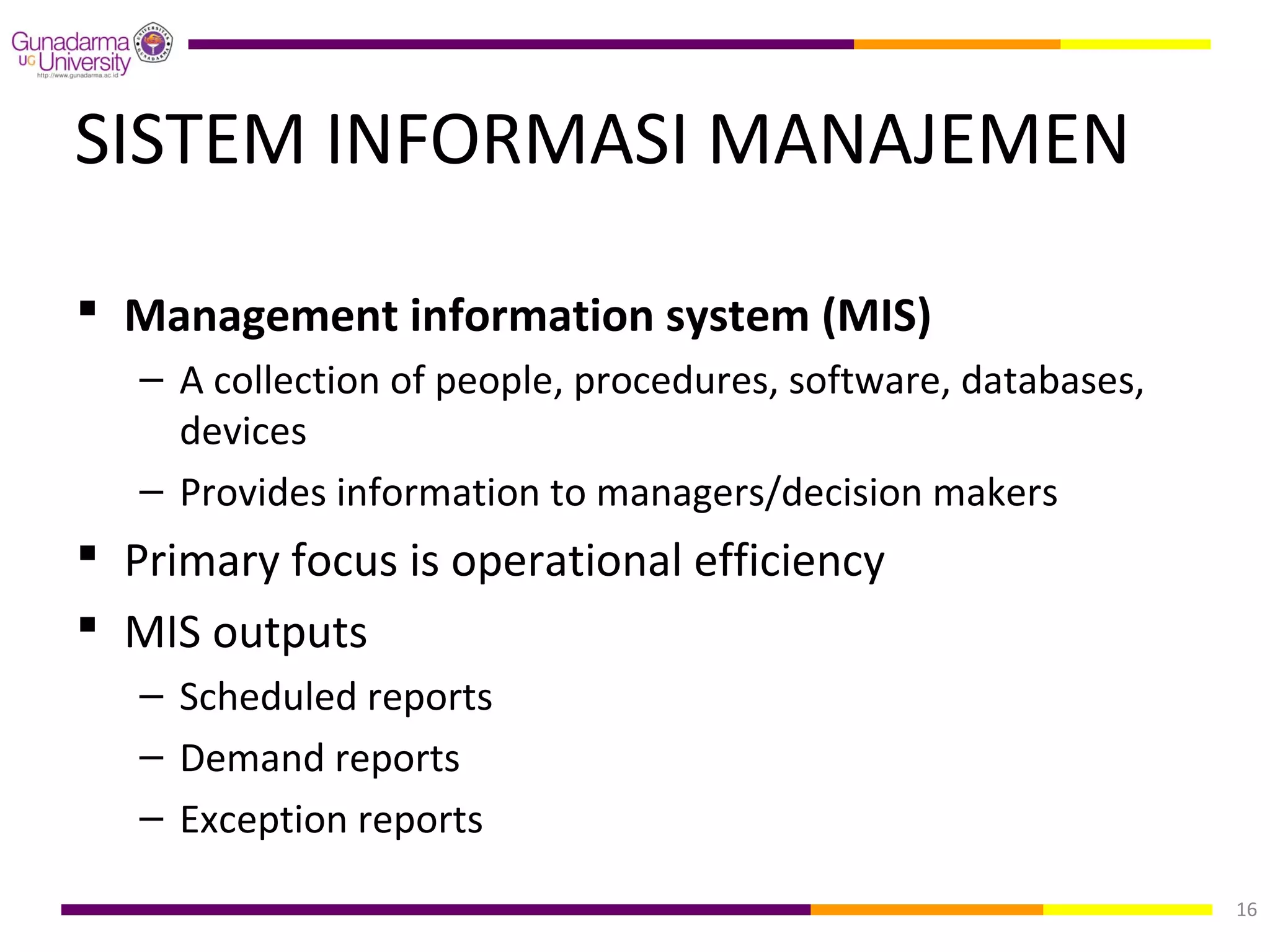
SISTEM INFORMASI MANAJEMEN

 Management information system (MIS)
   – A collection of people, procedures, software, databases,
     devices
   – Provides information to managers/decision makers
 Primary focus is operational efficiency
 MIS outputs
   – Scheduled reports
   – Demand reports
   – Exception reports

                                                                16
SISTEM PENUNJANG KEPUTUSAN
 Decision support system (DSS)
  – A collection of people, procedures, software,
    databases, devices
  – Supports problem-specific decision making
 Focus is on decision-making effectiveness


                                                    17
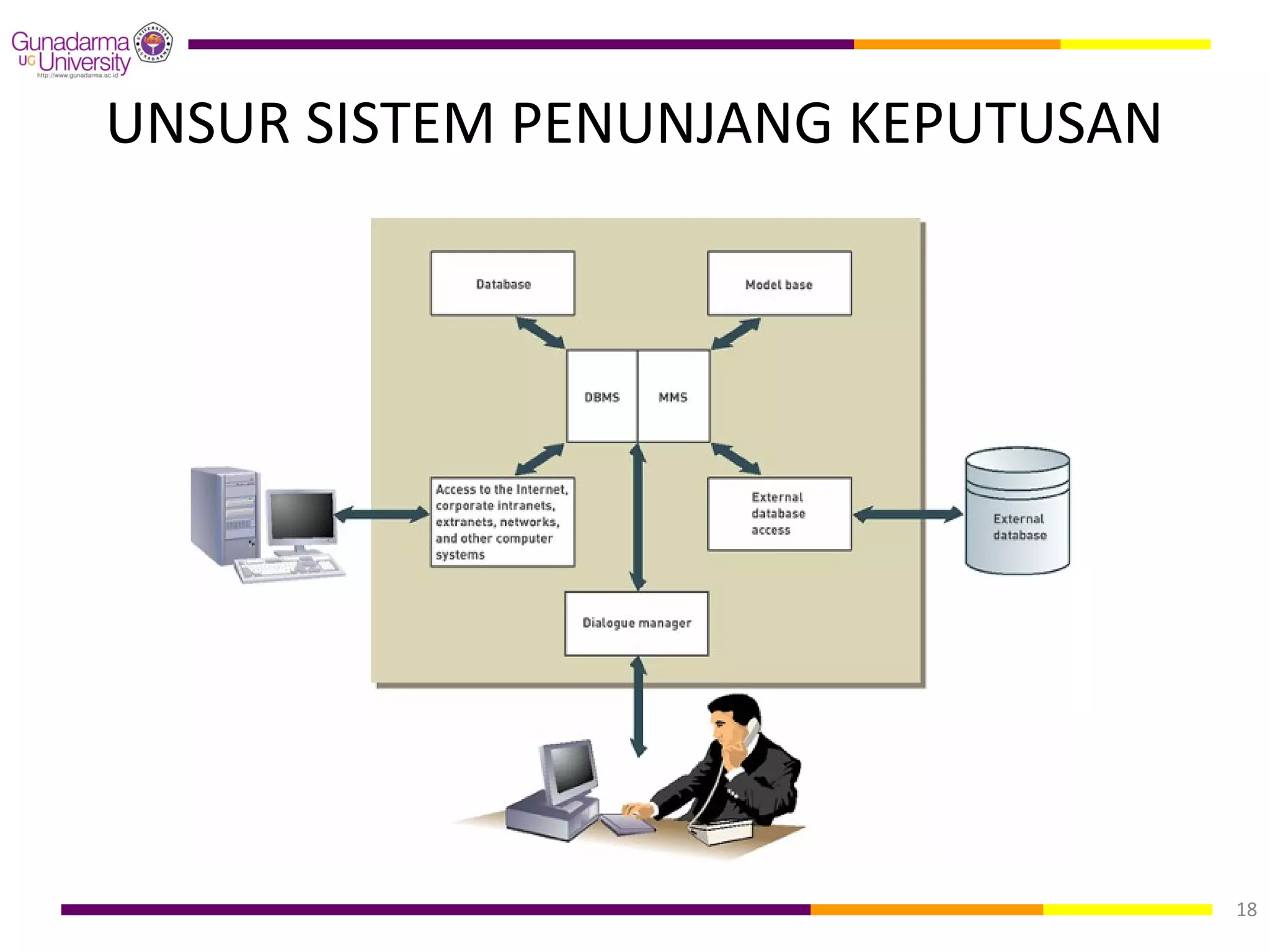
UNSUR SISTEM PENUNJANG KEPUTUSAN


                                   18
UNSUR SISTEM PENUNJANG KEPUTUSAN
              (lanjutan)
 Model base: provides decision makers access to a
  variety of models and assists them in decision
  making
 Database
 External database access
 Access to the Internet and corporate intranet,
  networks, and other computer systems
 Dialogue manager: allows decision makers to easily
  access and manipulate the DSS and to use common
  business terms and phrases
                                                       19
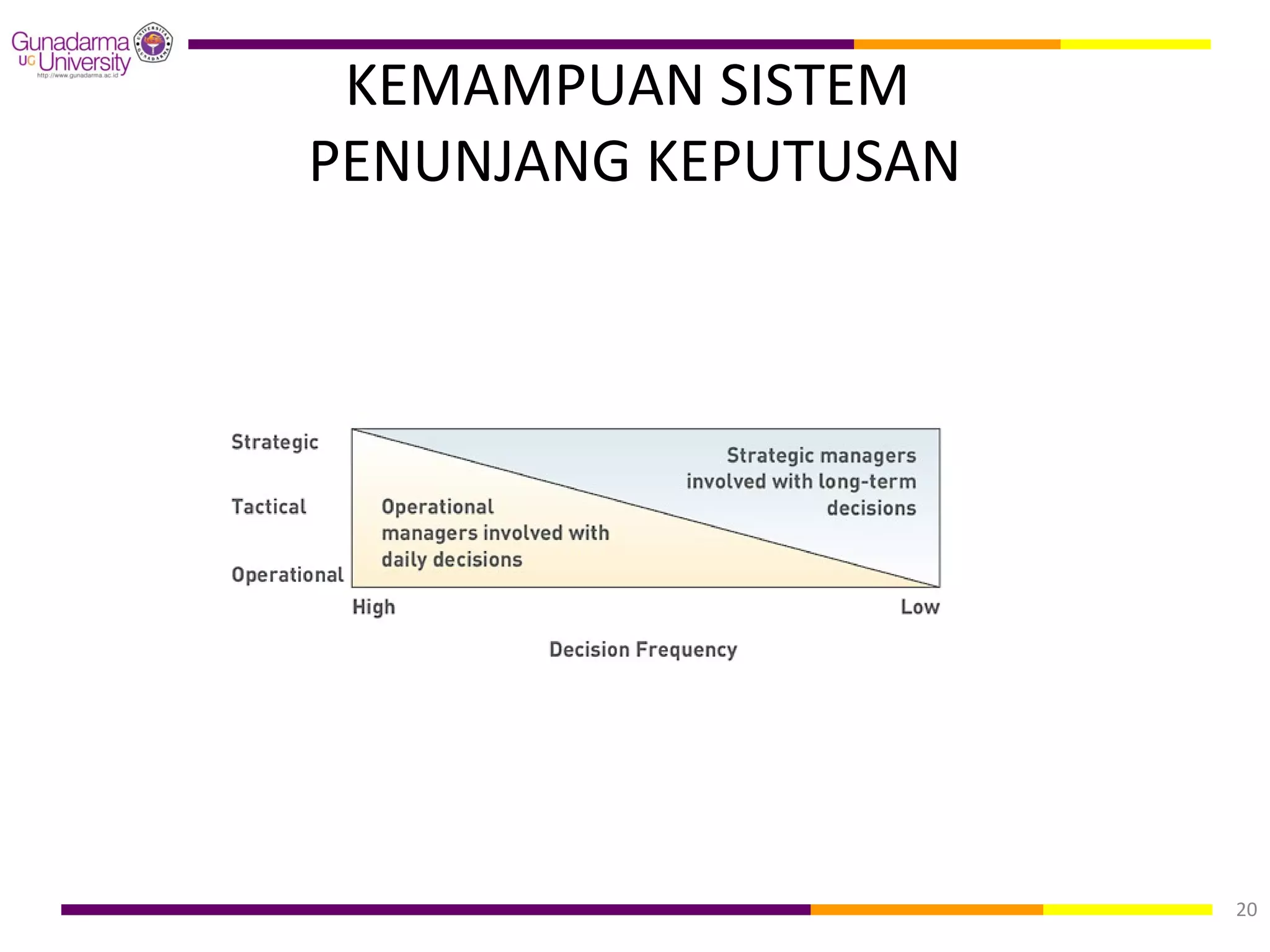
KEMAMPUAN SISTEM
PENUNJANG KEPUTUSAN


                      20
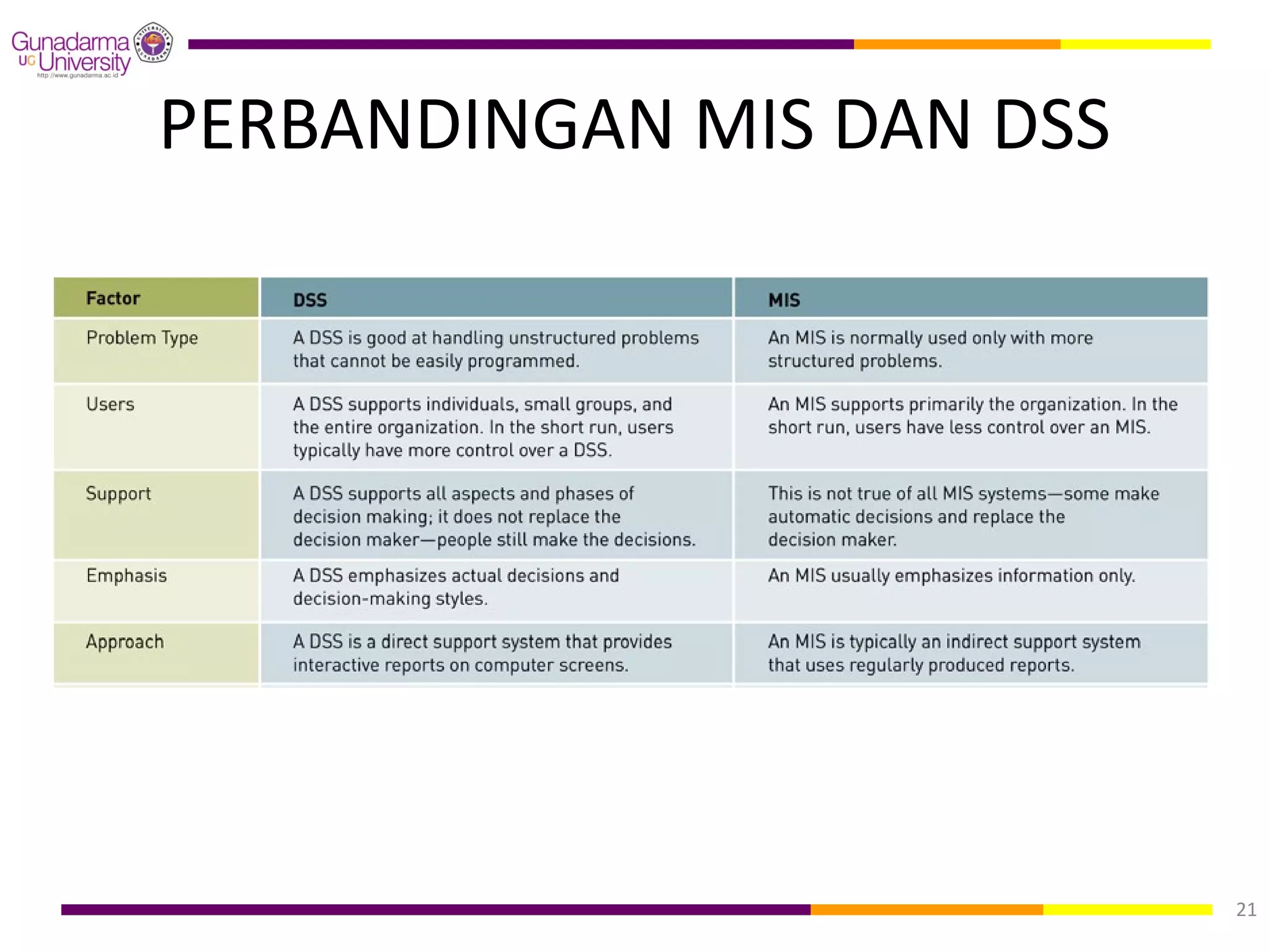
PERBANDINGAN MIS DAN DSS


                           21
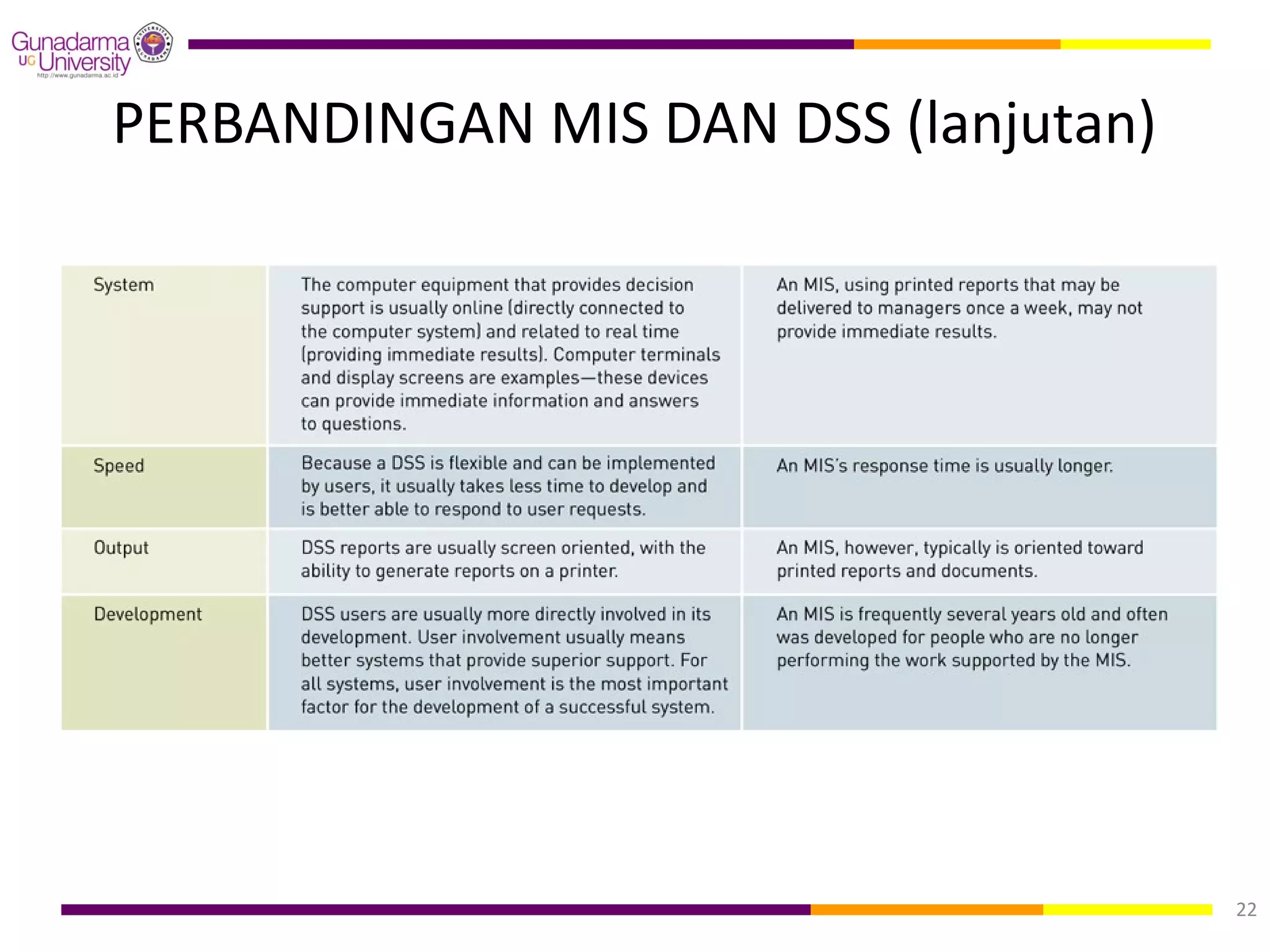
PERBANDINGAN MIS DAN DSS (lanjutan)


                                      22
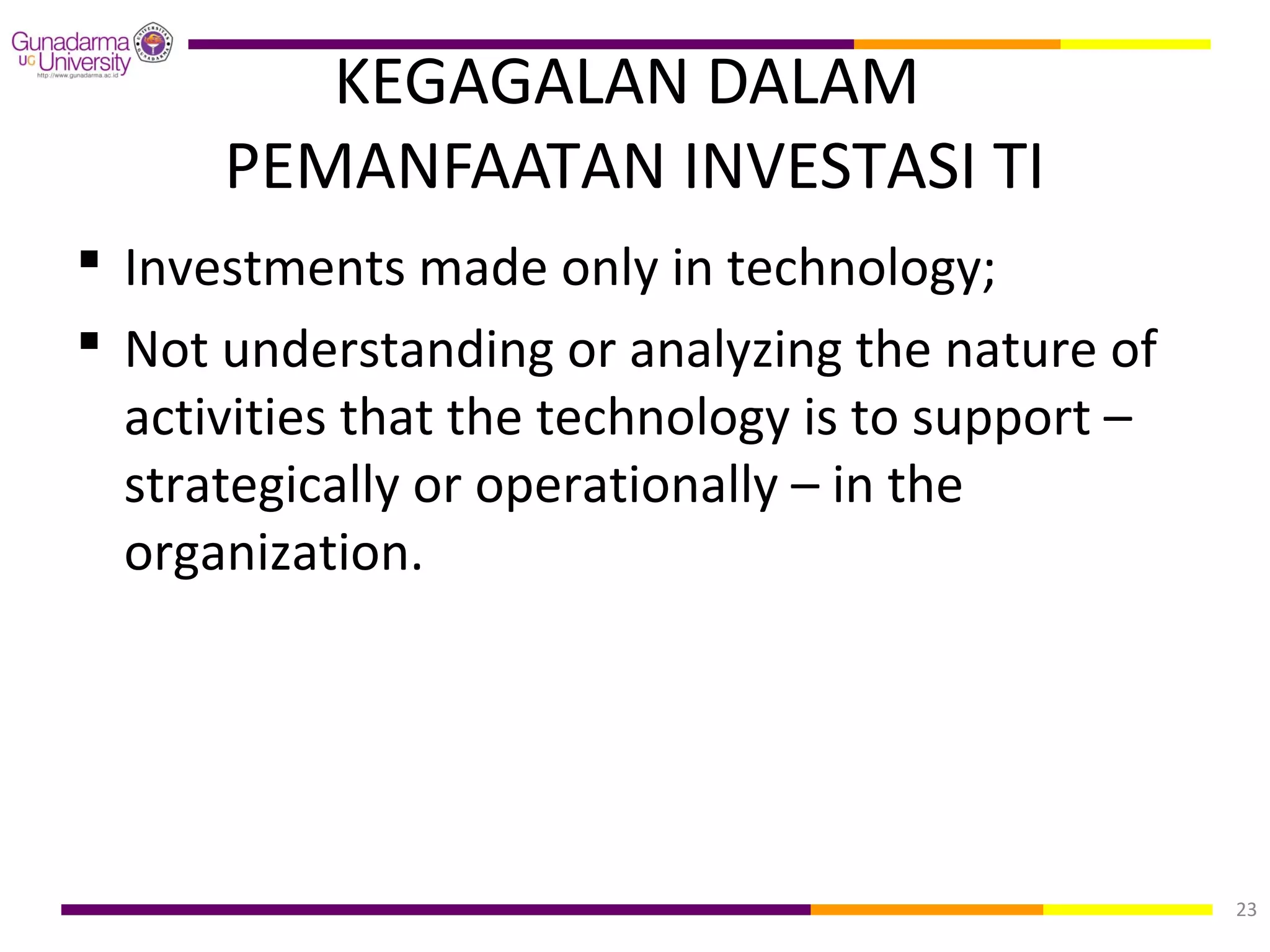
KEGAGALAN DALAM
      PEMANFAATAN INVESTASI TI
 Investments made only in technology;
 Not understanding or analyzing the nature of
  activities that the technology is to support –
  strategically or operationally – in the
  organization.


                                                   23
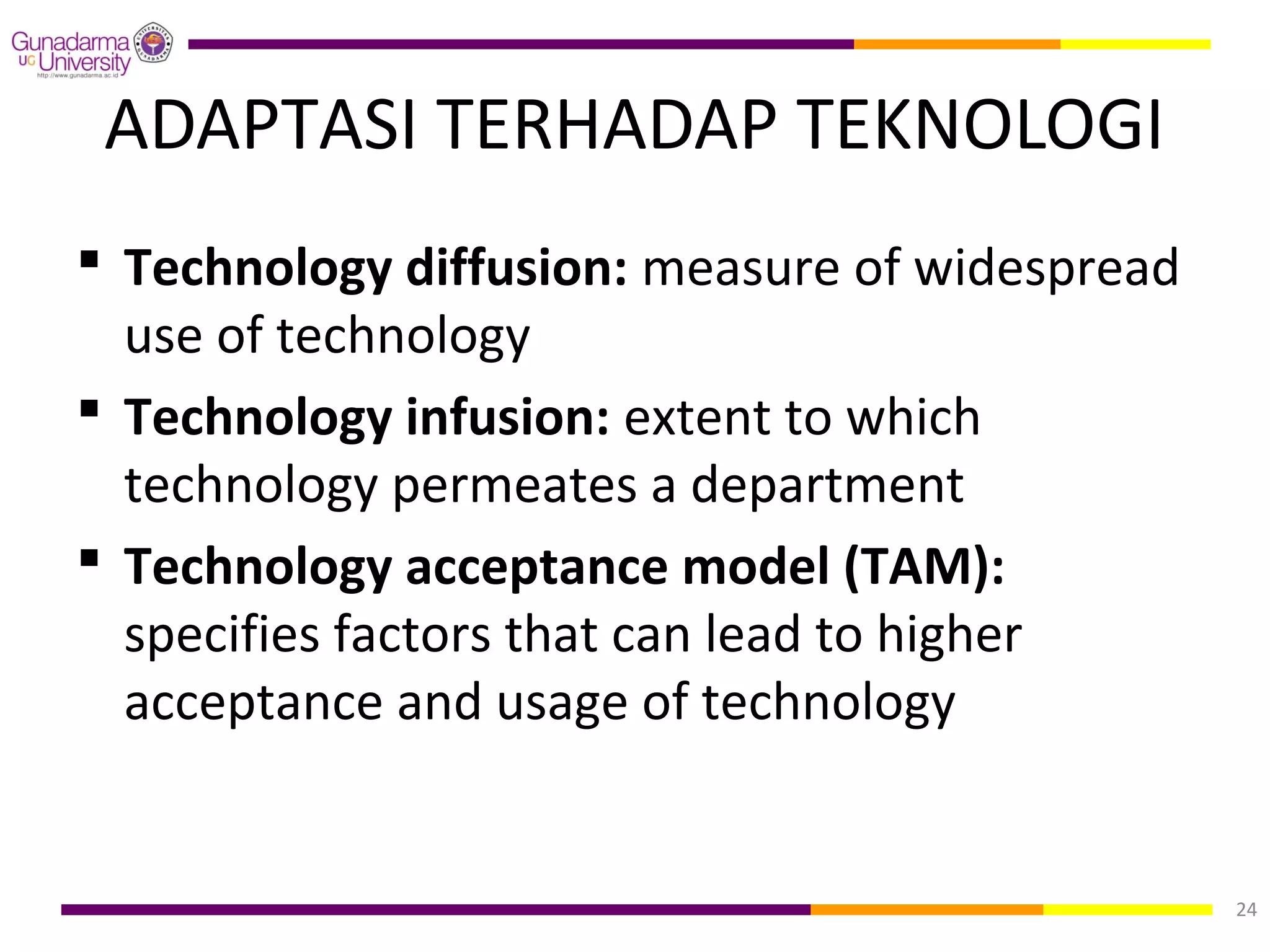
ADAPTASI TERHADAP TEKNOLOGI
 Technology diffusion: measure of widespread
  use of technology
 Technology infusion: extent to which
  technology permeates a department
 Technology acceptance model (TAM):
  specifies factors that can lead to higher
  acceptance and usage of technology


                                                24
SISTEM INFORMASI KEKAYAAN NEGARA

 Sistem yang digunakan untuk inventarisasi
  dan pengelolaan kekayaan negara berbantuan
  komputer.
 Perancangan, pembuatan dan pengelolaan
  sistem dibawah kendali Direktorat Jenderal
  Kekayaan Negara (DJKN).
 DJKN dibentuk sesuai Perpres No. 66 / 2006.


                                                25
DIREKTORAT JENDERAL KEKAYAAN
            NEGARA
Direktorat Jenderal yang mempunyai tugas
merumuskan serta melaksanakan kebijakan
dan standarisasi teknis di bidang kekayaan
negara, piutang negara dan lelang sesuai
dengan kebijakan yang ditetapkan oleh
Menteri Keuangan, dan berdasarkan
peraturan perundang-undangan yang berlaku.


                           Sumber: http://www.djkn.depkeu.go.id
                                                                  26
DIREKTORAT JENDERAL KEKAYAAN
              NEGARA (lanjutan)
VISI
   "Menjadi Pengelola kekayaan Negara, Piutang Negara dan Lelang yang
   Bertanggung Jawab untuk Sebesar-besar Kemakmuran Rakyat".
MISI
 Mewujudkan optimalisasi penerimaan, efisiensi pengeluaran dan
   efektifitas pengelolaan kekayaan negara;
 Mengamankan kekayaan negara melalui pembangunan database serta
   penyajian jumlah dan nilai eksisting kekayaan negara;
 Mewujudkan nilai kekayaan negara yang wajar dan dapat dijadikan
   sebagai acuan dalam berbagai keperluan penilaian;
 Melaksanakan pengurusan piutang negara yang efisien, efektif,
   transparan dan akuntabel;
 Mewujudkan lelang sebagai instrumen jual beli yang mampu
   mengakomodasikan kepentingan masyarakat. Sumber: http://www.djkn.depkeu.go.id
                                                                                   27
DIREKTORAT HUKUM DAN INFORMATIKA
TUGAS DAN FUNGSI
Di bidang hukum, bertugas melaksanakan pengharmonisasian dan
penyusunan peraturan perundangan dan petunjuk teknis dibidang
pengelolaan kekayaan negara, penilaian, pengurusan piutang negara, dan
pelaksanaan lelang, termasuk di dalamnya kegiatan koordinasi
penyusunan rancangan peraturan, evaluasi terhadap pelaksanaan
peraturan, publikasi dan pengelolaan dokumen hukum, penyiapan
petunjuk pelaksanaan pemberian bantuan hukum, dan pelaksanaan
bantuan hukum.
Di bidang informatika, bertugas melaksanakan penyiapan bahan
pengembangan sistem informasi di bidang kekayaan negara, penilaian,
piutang negara dan lelang; pengolahan data, layanan informasi dan
pengelolaan pusat informasi, pelaksanaan bimbingan teknis sistem
informasi, penyusunan manual sistem dan dokumentasi program
aplikasi, dan pembinaan jabatan fungsional Pranata Komputer.
                                             Sumber: http://www.djkn.depkeu.go.id
                                                                                    28
STRUKTUR ORGANISASI
DIREKTORAT HUKUM DAN INFORMATIKA


                     Sumber: http://www.djkn.depkeu.go.id
                                                            29
SMIPT-KN
 Sistem Manajemen Informasi Pelayanan
  Terpadu – Kekayaan Negara.
 Sistem yang digunakan untuk
  inventarisasi kekayaan negara.
 Pengelolanya adalah Direktorat Hukum
  dan Informasi, Direktorat Jenderal
  Kekayaan Negara.
                         Sumber: http://www.djkn.depkeu.go.id
                                                                30
PENGELOLAAN SMIPT-KN
 DJKN memiliki 19.000 Satuan Kerja (Satker)
  untuk menangani Sistem Akuntansi Barang
  Milik Negara (SABMN).
 Dari 19.000 Satker, 7000 Satker telah
  menggunakan komputer.
 SMIPT-KN didukung oleh 87 Unit Kerja
  diseluruh Indonesia, dimana setiap Unit Kerja
  memiliki 50-400 orang karyawan.
                                  Sumber: DJKN melalui wawancara
                                                                   31
PENGELOLAAN SMIPT-KN (lanjutan)
 SMIPT-KN menggunakan Oracle sebagai basis
  data-nya dan dilengkapi fitur geographic
  information system (GIS), serat mampu
  melakukan scanning dokumen penunjang.
 Sumber daya manusia di kantor pusat terdiri
  dari 11 orang yang dibantu oleh pihak lain
  melalui outsourcing.


                                                32
PENGELOLAAN SMIPT-KN (lanjutan)
 Menyiapkan cetak biru (blue print) dan
  aplikasi SMIPT-KN yang dimulai pada tahun
  2008 selama 3 tahun.
 Dalam jangka waktu 5 tahun ke depan (tahun
  2013), seluruh kekayaan negara sudah
  didokumentasikan didalam SMIPT-KN.
 Saat ini sistem belum tersedia dan proses
  perancangan masih belum bisa diakses oleh
  publik.                          Sumber: DJKN melalui wawancara
                                                                    33
PENGHAPUSAN BARANG MILIK NEGARA SELAIN
      TANAH DAN/ATAU BANGUNAN


                         Sumber: http://www.djkn.depkeu.go.id
                                                                34
PEMINDAHTANGANAN BARANG MILIK NEGARA


                       Sumber: http://www.djkn.depkeu.go.id
                                                              35
GAMBARAN UMUM
           PENGEMBANGAN SISTEM
 System development project
  – Planned undertaking with fixed beginning and end
  – Produces desired result or product
  – Can be a large job with thousands of hours of effort or a
    small one-month project
 Successful development project
  – Provides a detailed plan to follow
  – Organized, methodical sequence of tasks and activities
  – Produces reliable, robust, and efficient system


                                                                36
SIKLUS PEMBANGUNAN SISTEM
 Systems development life cycle (SDLC)
  – Provides overall framework for managing systems
    development process
 Two main approaches to SDLC
  – Predictive approach – assumes project can be
    planned out in advance
  – Adaptive approach – more flexible, assumes
    project cannot be planned out in advance
 All projects use some variation of SDLC
                                                      37
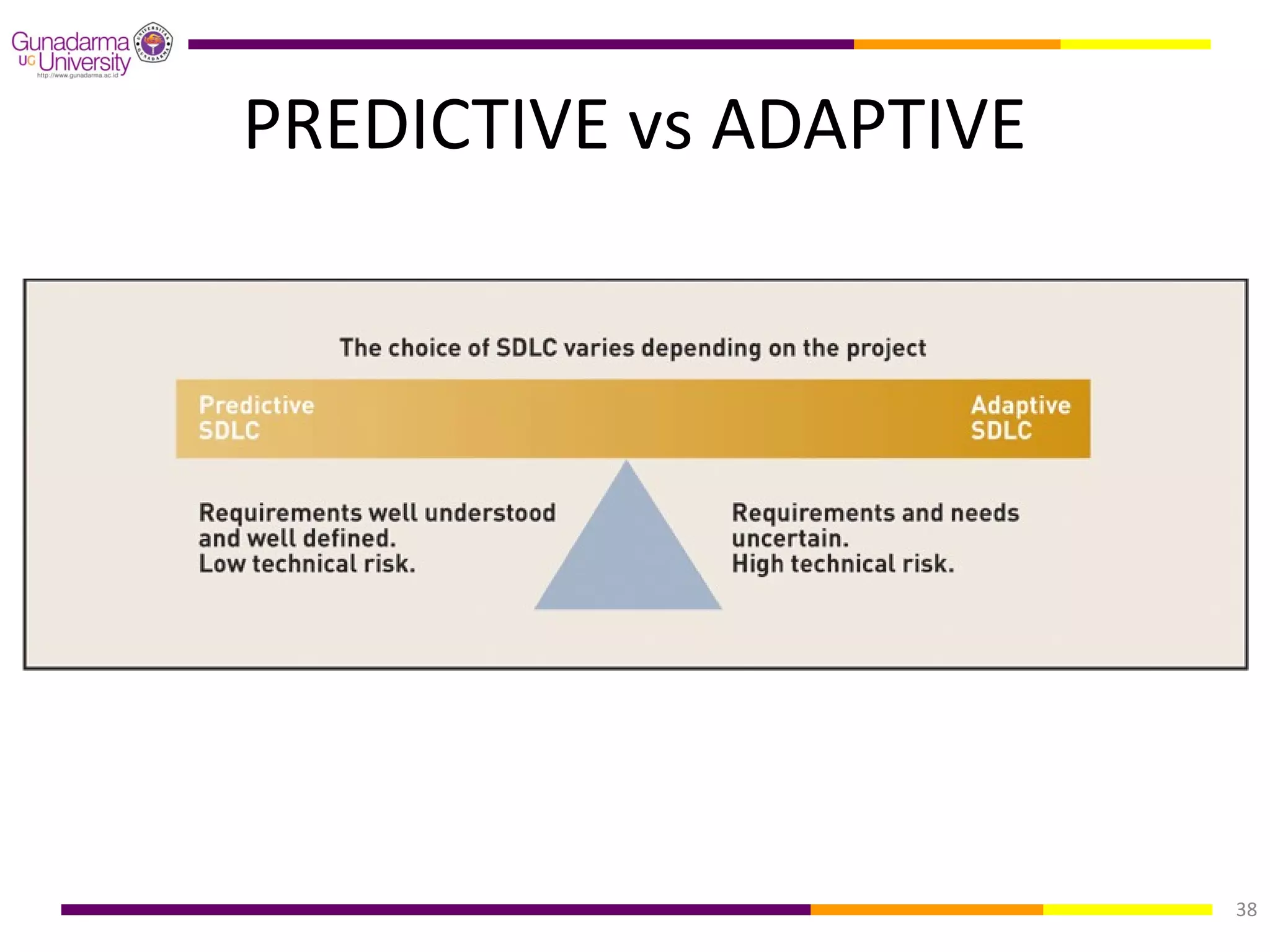
PREDICTIVE vs ADAPTIVE


                         38
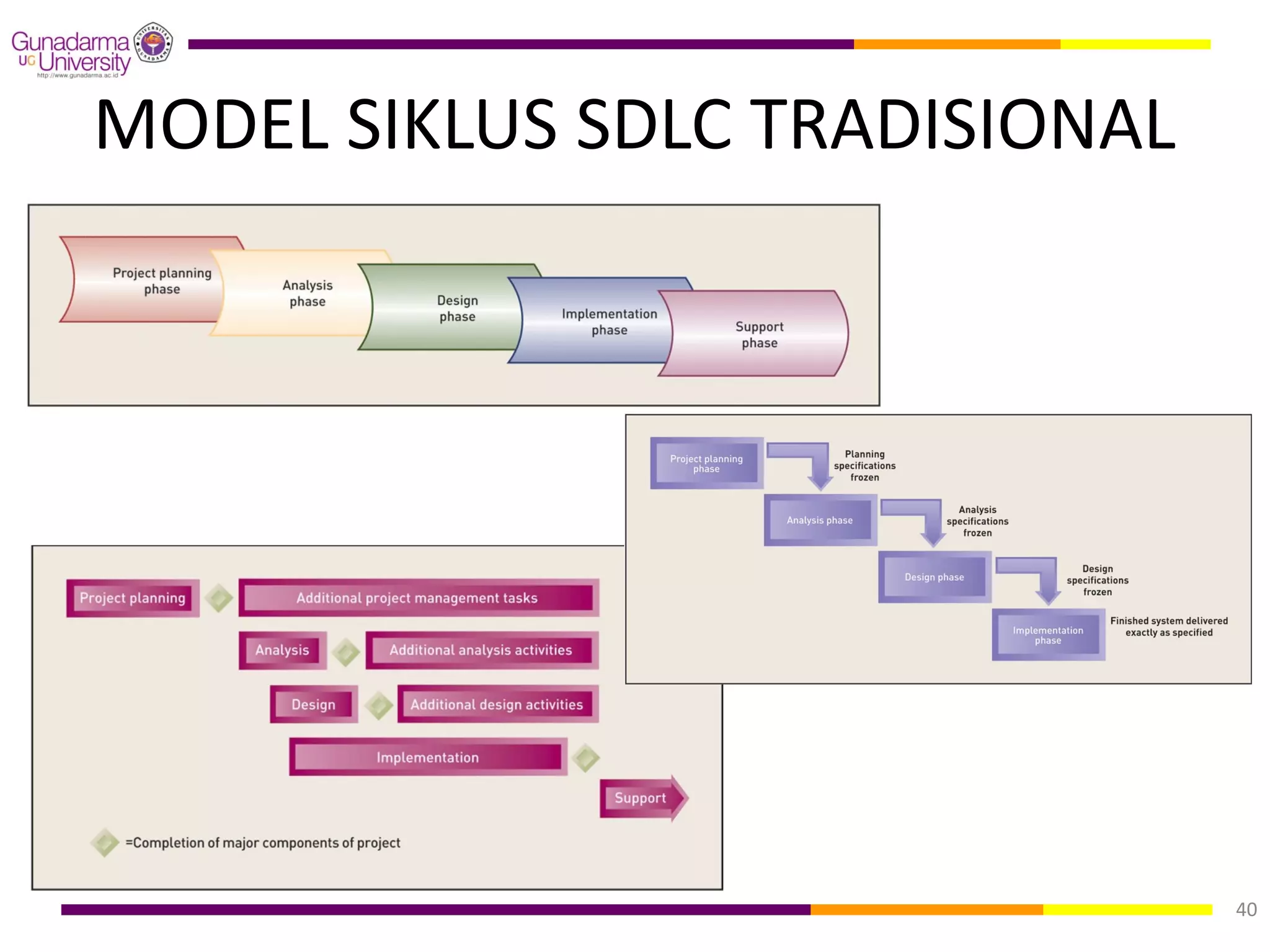
PENDEKATAN SDLC TRADISIONAL
 Project planning – initiate, ensure feasibility,
  plan schedule, obtain approval for project
 Analysis – understand business needs and
  processing requirements
 Design – define solution system based on
  requirements and analysis decisions
 Implementation – construct, test, train users,
  and install new system
 Support – keep system running and improve
                                                     39
MODEL SIKLUS SDLC TRADISIONAL


                                40
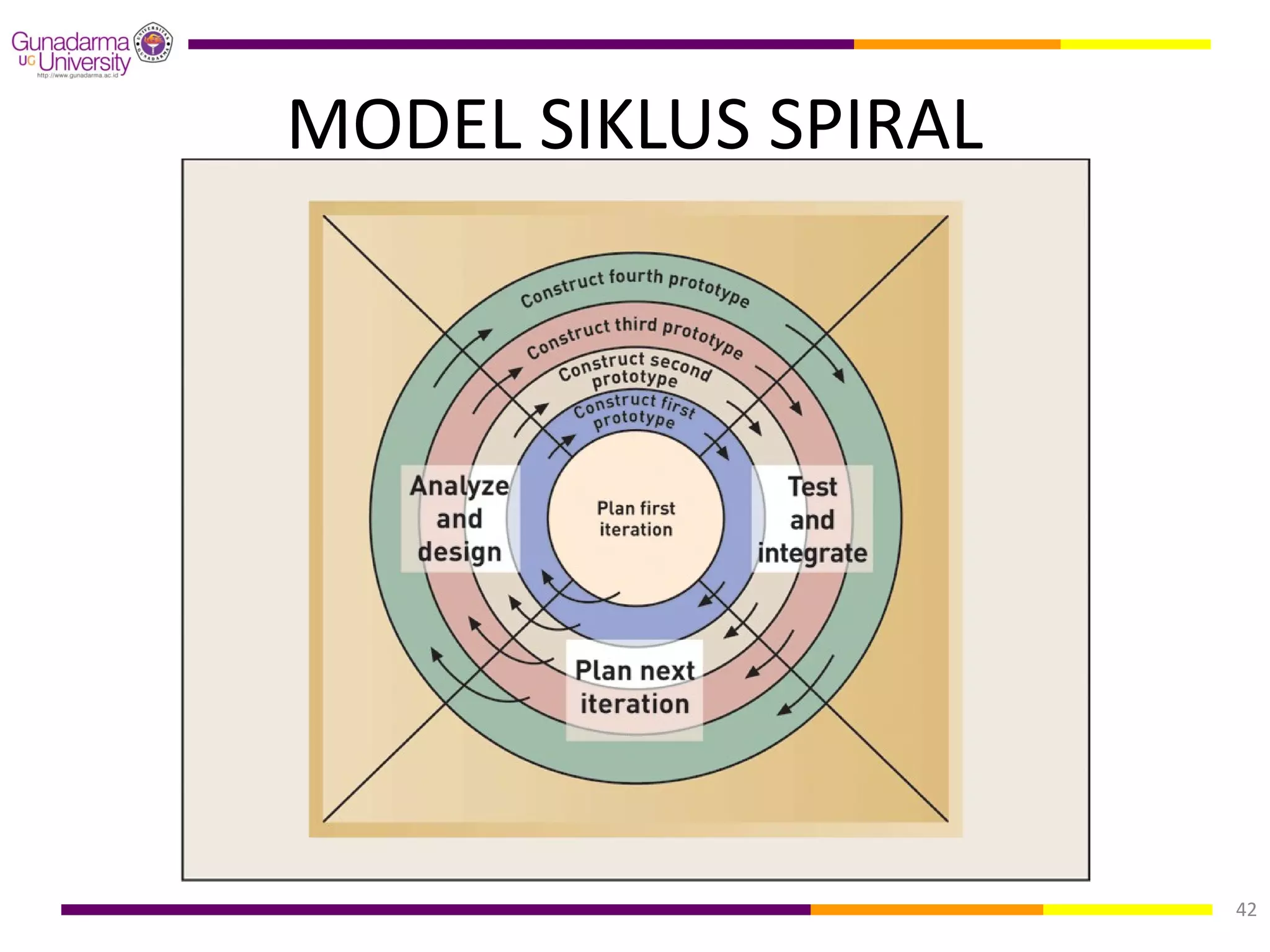
PENDEKATAN SDLC ADAPTIF
 Based on spiral model
   – Project cycles through development activities over and over
     until project is complete
   – Prototype created by end of each cycle
   – Focuses on mitigating risk

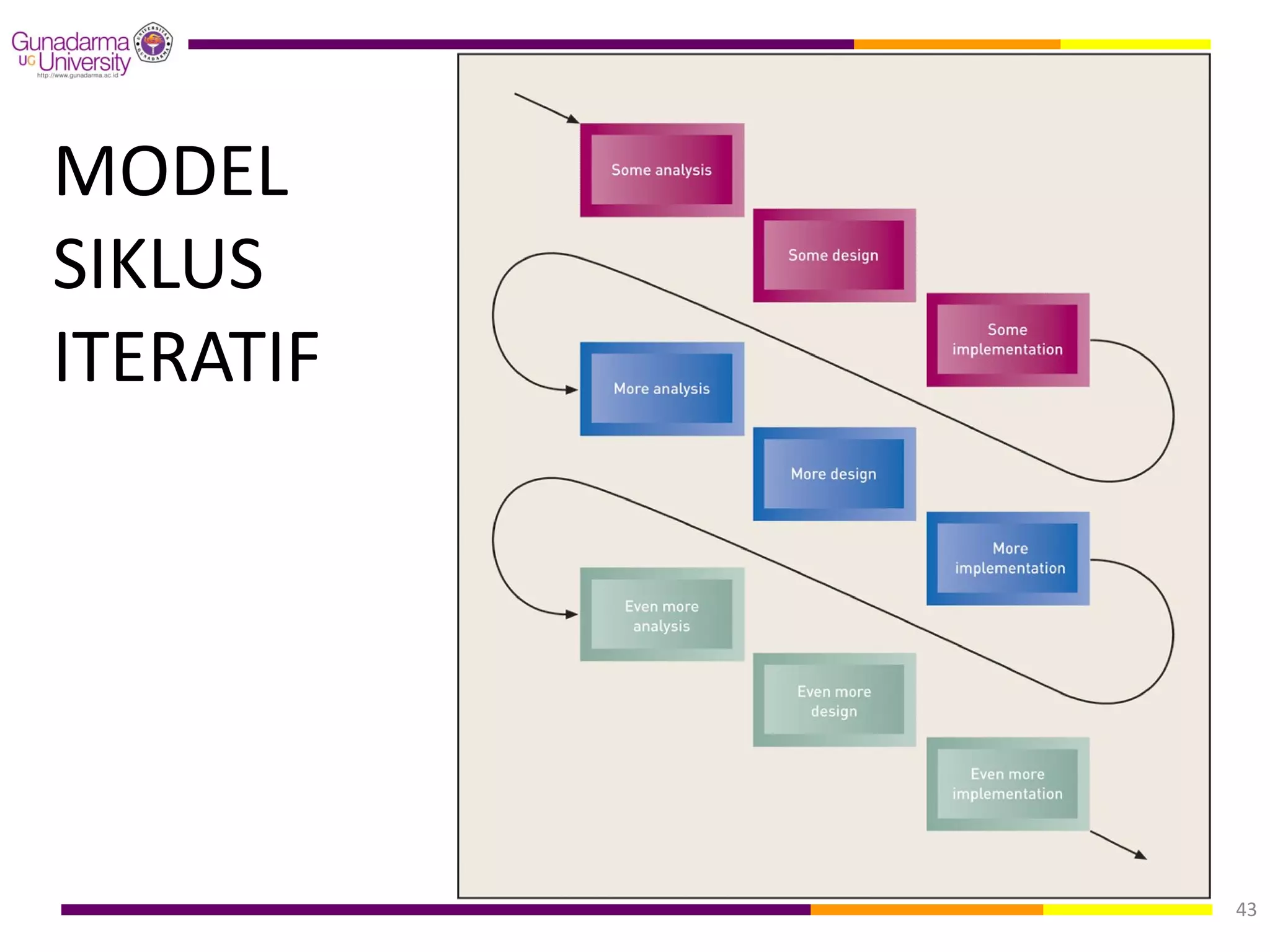
 Iteration – Work activities are repeated
   – Each iteration refines previous result

   – Approach assumes no one gets it right the first time

   – There are a series of mini projects for each iteration

                                                                   41
MODEL SIKLUS SPIRAL


                      42
MODEL
SIKLUS
ITERATIF


           43
KEGIATAN PADA TAHAP
            PERENCANAAN
 Define business problem and scope.
 Produce detailed project schedule.
 Confirm project feasibility
  – Economic, organizational, technical, resource, and
    schedule.
 Staff the project (resource management).
 Launch project  official announcement.


                                                         44
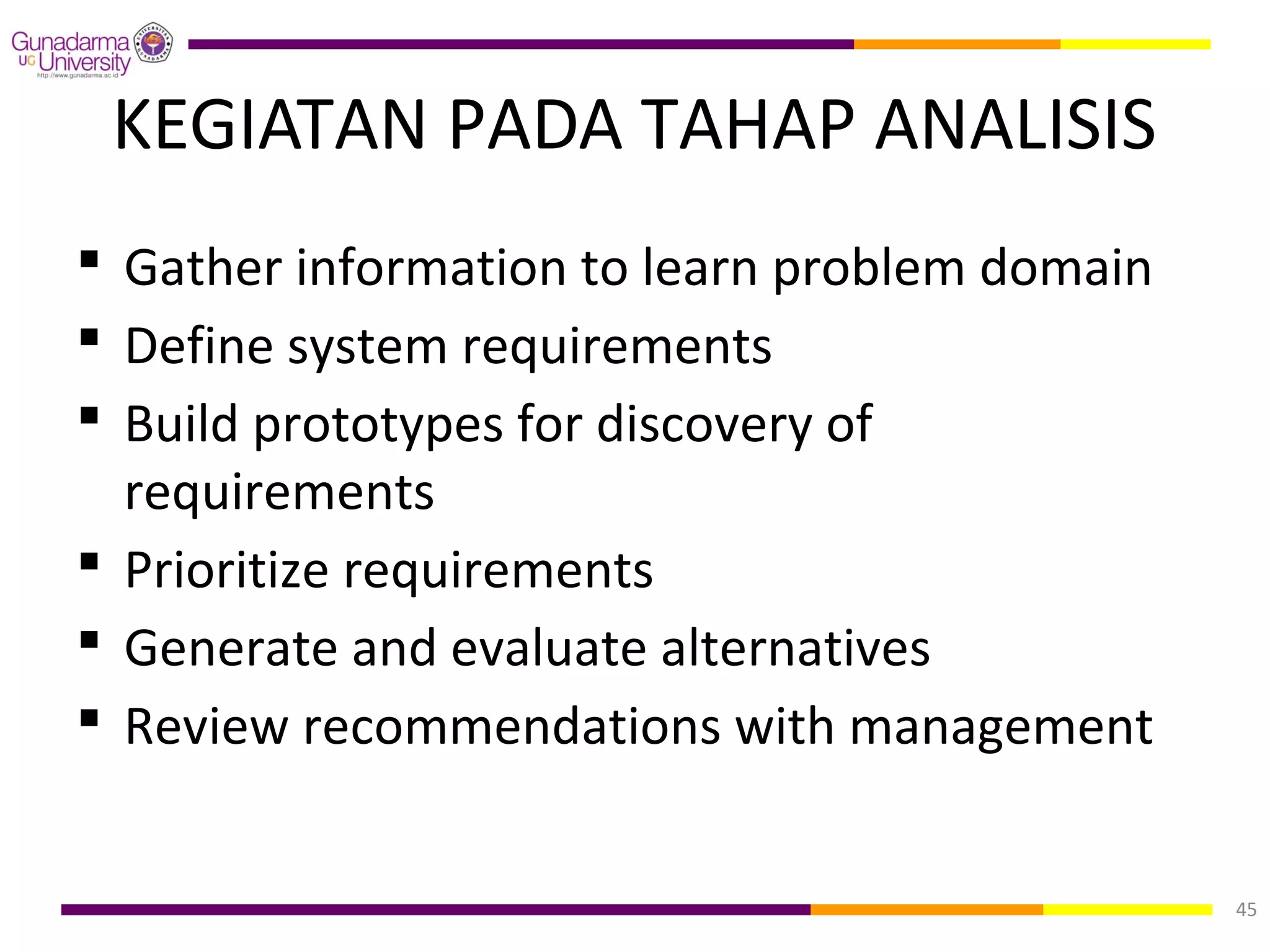
KEGIATAN PADA TAHAP ANALISIS
 Gather information to learn problem domain
 Define system requirements
 Build prototypes for discovery of
  requirements
 Prioritize requirements
 Generate and evaluate alternatives
 Review recommendations with management


                                               45
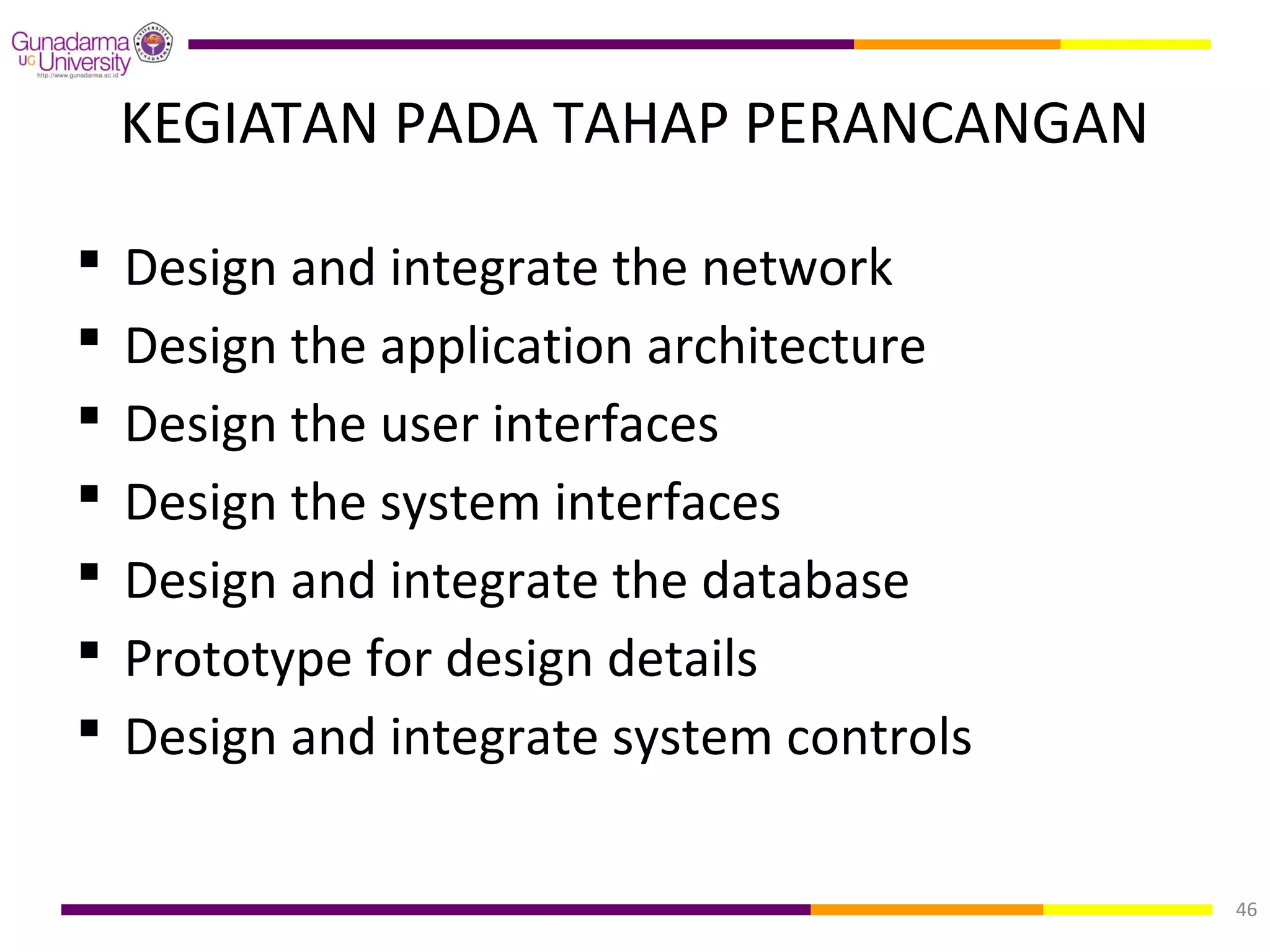
KEGIATAN PADA TAHAP PERANCANGAN

   Design and integrate the network
   Design the application architecture
   Design the user interfaces
   Design the system interfaces
   Design and integrate the database
   Prototype for design details
   Design and integrate system controls

                                           46
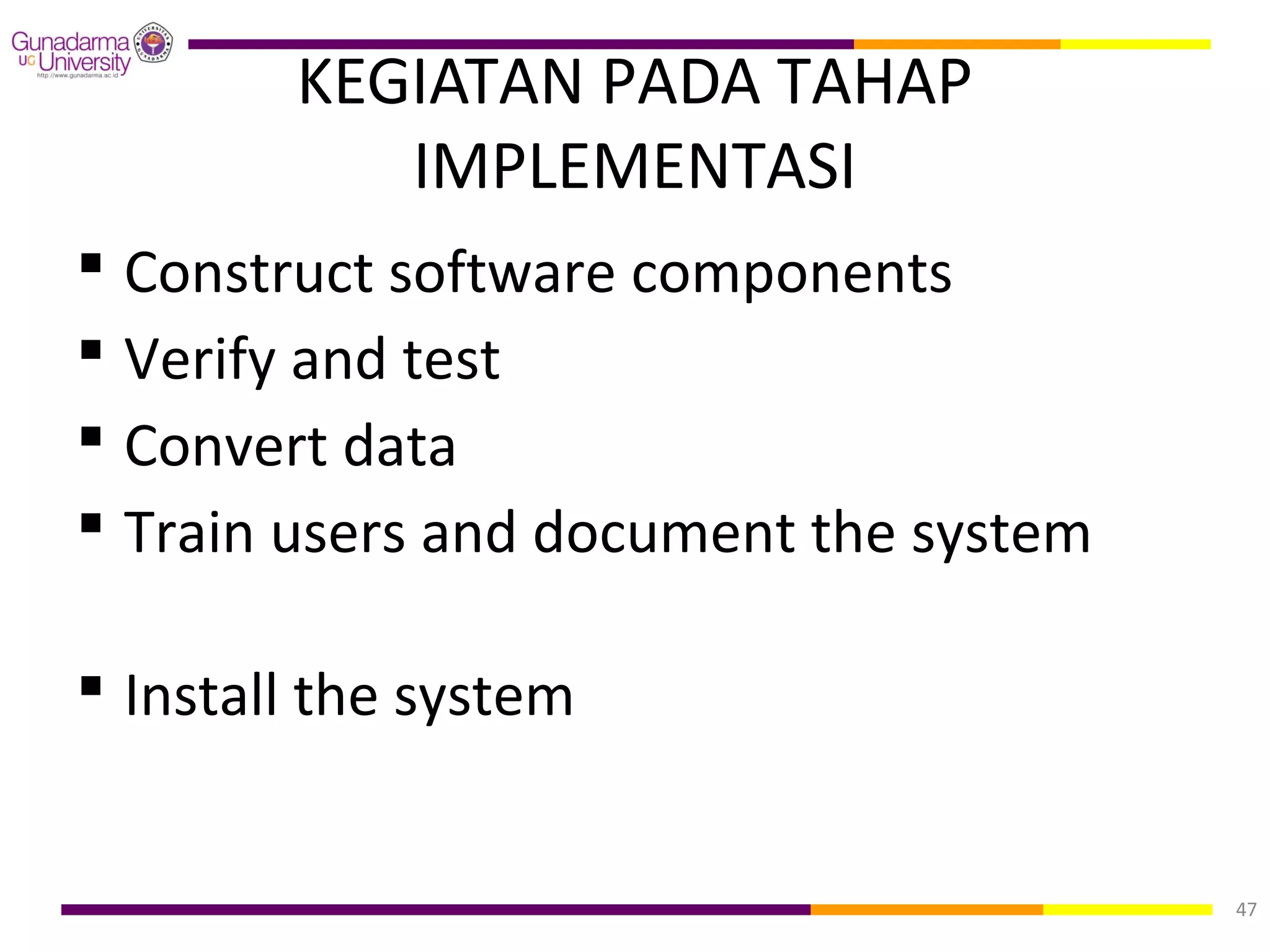
KEGIATAN PADA TAHAP
           IMPLEMENTASI
 Construct software components
 Verify and test
 Convert data
 Train users and document the system

 Install the system


                                        47
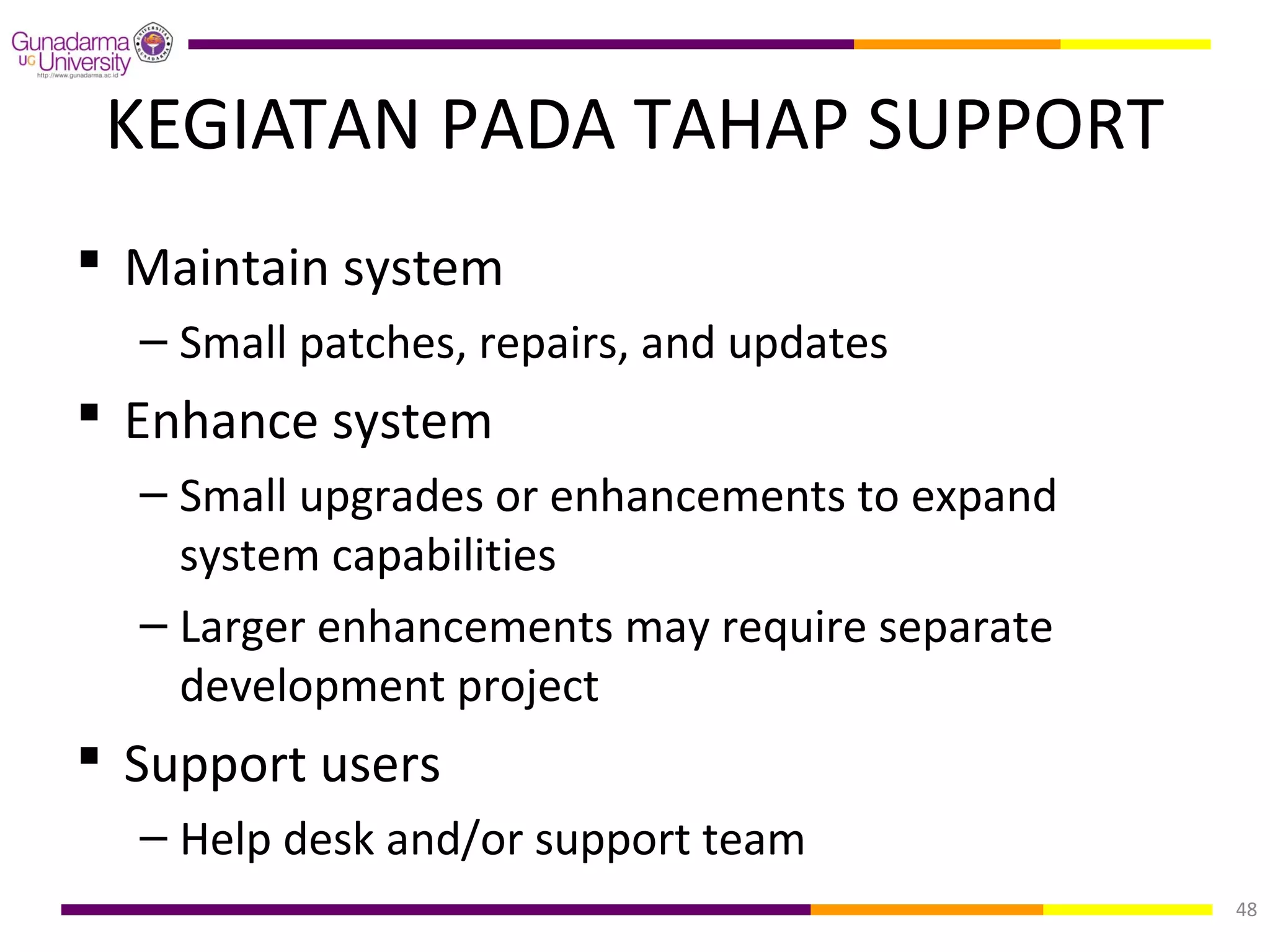
KEGIATAN PADA TAHAP SUPPORT
 Maintain system
  – Small patches, repairs, and updates
 Enhance system
  – Small upgrades or enhancements to expand
    system capabilities
  – Larger enhancements may require separate
    development project
 Support users
  – Help desk and/or support team
                                               48
TREND PENGEMBANGAN SISTEM
Mengutamakan pendekatan adaptif, seperti:
 The Unified Process (UP) – iterative and incremental
  software development process framework.
 Extreme Programming (XP) – a development process
  that is more responsive to customer needs than
  traditional methods, while creating software of
  better quality.
 Agile Modeling – hybrid of UP and XP.
 Scrum – an iterative incremental process of software
  development.
                                                         49
DAFTAR PUSTAKA
 Ralph Stair and George Reynolds,
  Fundamentals of Information Systems,
 John Satzinger, Systems Analysis and Design in
  a Changing World, 4th Edition, Thomson
  Learning, 2006.
 Situs Direktorat Jenderal Kekayaan Negara
  <http://www.djkn.depkeu.go.id>


                                                   50

Ap sistem informasi kekayaan negara p1

  • 1.
    SISTEM INFORMASI KEKAYAANNEGARA | Pertemuan 1 | SISTEM INFORMASI DAN MODEL PENGEMBANGANNYA Dr. Tb. Maulana Kusuma mkusuma@staff.gunadarma.ac.id | http://mkusuma.staff.gunadarma.ac.id Program Magister Manajemen | Akuntansi Pemerintahan
  • 2.
    KONSEP INFORMASI: DATA vs INFORMASI  Data: raw facts – Alphanumeric, image, audio, and video  Information – Organized collection of facts – Have value beyond the facts themselves 2
  • 3.
    DATA vs INFORMASI(lanjutan)  Defining and organizing relationships among data creates information.  Identical data can be represented in different formations  different meaning / information. 3
  • 4.
  • 5.
  • 6.
  • 7.
    SISTEM INFORMASI  Setof interrelated components: collect, manipulate, disseminate data and information  Provide feedback to meet an objective  Examples: ATMs, airline reservation systems, course reservation systems 7
  • 8.
  • 9.
    SISTEM INFORMASI BERBASIS KOMPUTER  Manual vs Computerized information systems  Computer-based information system (CBIS) – Hardware, software, databases, telecommunications, people, and procedures – Collect, manipulate, store, and process data into information 9
  • 10.
  • 11.
    ERA SISTEM INFORMASI Data Processing (DP) Era – To improve operational efficiency by automating information-based processes  Management Information Systems (MIS) Era – To increase management effectiveness by satisfying their information requirements for decision making  Strategic Information Systems (SIS) Era – To improve competitiveness by changing the nature or conduct of business –IS/IT as a source of competitive advantage 11
  • 12.
    JENIS-JENIS SISTEM INFORMASI Transaction processing systems (TPS) – Capture and record information about organization’s transactions  Management information systems (MIS) – Take information captured by TPS – Produce reports for planning and control  Decision support / knowledge-based systems (DSS/KBS) – Explore impact of available options or decisions (what-if scenarios) – Automate routine decision making 12
  • 13.
    JENIS-JENIS SISTEM INFORMASI(lanjutan)  Enterprise applications – Highly integrated systems that support company-wide operations and data – Often combine aspects of TPS, MIS, DSS/KBS  Geographic Information Systems (GIS)  Communication support systems – Facilitate communication internally and with customers and suppliers  Office support systems – Help employees create and share documents 13
  • 14.
  • 15.
    CONTOH STRUKTUR ORGANISASI DIVISI SISTEM INFORMASI 15
  • 16.
    SISTEM INFORMASI MANAJEMEN Management information system (MIS) – A collection of people, procedures, software, databases, devices – Provides information to managers/decision makers  Primary focus is operational efficiency  MIS outputs – Scheduled reports – Demand reports – Exception reports 16
  • 17.
    SISTEM PENUNJANG KEPUTUSAN Decision support system (DSS) – A collection of people, procedures, software, databases, devices – Supports problem-specific decision making  Focus is on decision-making effectiveness 17
  • 18.
  • 19.
    UNSUR SISTEM PENUNJANGKEPUTUSAN (lanjutan)  Model base: provides decision makers access to a variety of models and assists them in decision making  Database  External database access  Access to the Internet and corporate intranet, networks, and other computer systems  Dialogue manager: allows decision makers to easily access and manipulate the DSS and to use common business terms and phrases 19
  • 20.
  • 21.
  • 22.
    PERBANDINGAN MIS DANDSS (lanjutan) 22
  • 23.
    KEGAGALAN DALAM PEMANFAATAN INVESTASI TI  Investments made only in technology;  Not understanding or analyzing the nature of activities that the technology is to support – strategically or operationally – in the organization. 23
  • 24.
    ADAPTASI TERHADAP TEKNOLOGI Technology diffusion: measure of widespread use of technology  Technology infusion: extent to which technology permeates a department  Technology acceptance model (TAM): specifies factors that can lead to higher acceptance and usage of technology 24
  • 25.
    SISTEM INFORMASI KEKAYAANNEGARA  Sistem yang digunakan untuk inventarisasi dan pengelolaan kekayaan negara berbantuan komputer.  Perancangan, pembuatan dan pengelolaan sistem dibawah kendali Direktorat Jenderal Kekayaan Negara (DJKN).  DJKN dibentuk sesuai Perpres No. 66 / 2006. 25
  • 26.
    DIREKTORAT JENDERAL KEKAYAAN NEGARA Direktorat Jenderal yang mempunyai tugas merumuskan serta melaksanakan kebijakan dan standarisasi teknis di bidang kekayaan negara, piutang negara dan lelang sesuai dengan kebijakan yang ditetapkan oleh Menteri Keuangan, dan berdasarkan peraturan perundang-undangan yang berlaku. Sumber: http://www.djkn.depkeu.go.id 26
  • 27.
    DIREKTORAT JENDERAL KEKAYAAN NEGARA (lanjutan) VISI "Menjadi Pengelola kekayaan Negara, Piutang Negara dan Lelang yang Bertanggung Jawab untuk Sebesar-besar Kemakmuran Rakyat". MISI  Mewujudkan optimalisasi penerimaan, efisiensi pengeluaran dan efektifitas pengelolaan kekayaan negara;  Mengamankan kekayaan negara melalui pembangunan database serta penyajian jumlah dan nilai eksisting kekayaan negara;  Mewujudkan nilai kekayaan negara yang wajar dan dapat dijadikan sebagai acuan dalam berbagai keperluan penilaian;  Melaksanakan pengurusan piutang negara yang efisien, efektif, transparan dan akuntabel;  Mewujudkan lelang sebagai instrumen jual beli yang mampu mengakomodasikan kepentingan masyarakat. Sumber: http://www.djkn.depkeu.go.id 27
  • 28.
    DIREKTORAT HUKUM DANINFORMATIKA TUGAS DAN FUNGSI Di bidang hukum, bertugas melaksanakan pengharmonisasian dan penyusunan peraturan perundangan dan petunjuk teknis dibidang pengelolaan kekayaan negara, penilaian, pengurusan piutang negara, dan pelaksanaan lelang, termasuk di dalamnya kegiatan koordinasi penyusunan rancangan peraturan, evaluasi terhadap pelaksanaan peraturan, publikasi dan pengelolaan dokumen hukum, penyiapan petunjuk pelaksanaan pemberian bantuan hukum, dan pelaksanaan bantuan hukum. Di bidang informatika, bertugas melaksanakan penyiapan bahan pengembangan sistem informasi di bidang kekayaan negara, penilaian, piutang negara dan lelang; pengolahan data, layanan informasi dan pengelolaan pusat informasi, pelaksanaan bimbingan teknis sistem informasi, penyusunan manual sistem dan dokumentasi program aplikasi, dan pembinaan jabatan fungsional Pranata Komputer. Sumber: http://www.djkn.depkeu.go.id 28
  • 29.
    STRUKTUR ORGANISASI DIREKTORAT HUKUMDAN INFORMATIKA Sumber: http://www.djkn.depkeu.go.id 29
  • 30.
    SMIPT-KN  Sistem ManajemenInformasi Pelayanan Terpadu – Kekayaan Negara.  Sistem yang digunakan untuk inventarisasi kekayaan negara.  Pengelolanya adalah Direktorat Hukum dan Informasi, Direktorat Jenderal Kekayaan Negara. Sumber: http://www.djkn.depkeu.go.id 30
  • 31.
    PENGELOLAAN SMIPT-KN  DJKNmemiliki 19.000 Satuan Kerja (Satker) untuk menangani Sistem Akuntansi Barang Milik Negara (SABMN).  Dari 19.000 Satker, 7000 Satker telah menggunakan komputer.  SMIPT-KN didukung oleh 87 Unit Kerja diseluruh Indonesia, dimana setiap Unit Kerja memiliki 50-400 orang karyawan. Sumber: DJKN melalui wawancara 31
  • 32.
    PENGELOLAAN SMIPT-KN (lanjutan) SMIPT-KN menggunakan Oracle sebagai basis data-nya dan dilengkapi fitur geographic information system (GIS), serat mampu melakukan scanning dokumen penunjang.  Sumber daya manusia di kantor pusat terdiri dari 11 orang yang dibantu oleh pihak lain melalui outsourcing. 32
  • 33.
    PENGELOLAAN SMIPT-KN (lanjutan) Menyiapkan cetak biru (blue print) dan aplikasi SMIPT-KN yang dimulai pada tahun 2008 selama 3 tahun.  Dalam jangka waktu 5 tahun ke depan (tahun 2013), seluruh kekayaan negara sudah didokumentasikan didalam SMIPT-KN.  Saat ini sistem belum tersedia dan proses perancangan masih belum bisa diakses oleh publik. Sumber: DJKN melalui wawancara 33
  • 34.
    PENGHAPUSAN BARANG MILIKNEGARA SELAIN TANAH DAN/ATAU BANGUNAN Sumber: http://www.djkn.depkeu.go.id 34
  • 35.
    PEMINDAHTANGANAN BARANG MILIKNEGARA Sumber: http://www.djkn.depkeu.go.id 35
  • 36.
    GAMBARAN UMUM PENGEMBANGAN SISTEM  System development project – Planned undertaking with fixed beginning and end – Produces desired result or product – Can be a large job with thousands of hours of effort or a small one-month project  Successful development project – Provides a detailed plan to follow – Organized, methodical sequence of tasks and activities – Produces reliable, robust, and efficient system 36
  • 37.
    SIKLUS PEMBANGUNAN SISTEM Systems development life cycle (SDLC) – Provides overall framework for managing systems development process  Two main approaches to SDLC – Predictive approach – assumes project can be planned out in advance – Adaptive approach – more flexible, assumes project cannot be planned out in advance  All projects use some variation of SDLC 37
  • 38.
  • 39.
    PENDEKATAN SDLC TRADISIONAL Project planning – initiate, ensure feasibility, plan schedule, obtain approval for project  Analysis – understand business needs and processing requirements  Design – define solution system based on requirements and analysis decisions  Implementation – construct, test, train users, and install new system  Support – keep system running and improve 39
  • 40.
    MODEL SIKLUS SDLCTRADISIONAL 40
  • 41.
    PENDEKATAN SDLC ADAPTIF Based on spiral model – Project cycles through development activities over and over until project is complete – Prototype created by end of each cycle – Focuses on mitigating risk  Iteration – Work activities are repeated – Each iteration refines previous result – Approach assumes no one gets it right the first time – There are a series of mini projects for each iteration 41
  • 42.
  • 43.
  • 44.
    KEGIATAN PADA TAHAP PERENCANAAN  Define business problem and scope.  Produce detailed project schedule.  Confirm project feasibility – Economic, organizational, technical, resource, and schedule.  Staff the project (resource management).  Launch project  official announcement. 44
  • 45.
    KEGIATAN PADA TAHAPANALISIS  Gather information to learn problem domain  Define system requirements  Build prototypes for discovery of requirements  Prioritize requirements  Generate and evaluate alternatives  Review recommendations with management 45
  • 46.
    KEGIATAN PADA TAHAPPERANCANGAN  Design and integrate the network  Design the application architecture  Design the user interfaces  Design the system interfaces  Design and integrate the database  Prototype for design details  Design and integrate system controls 46
  • 47.
    KEGIATAN PADA TAHAP IMPLEMENTASI  Construct software components  Verify and test  Convert data  Train users and document the system  Install the system 47
  • 48.
    KEGIATAN PADA TAHAPSUPPORT  Maintain system – Small patches, repairs, and updates  Enhance system – Small upgrades or enhancements to expand system capabilities – Larger enhancements may require separate development project  Support users – Help desk and/or support team 48
  • 49.
    TREND PENGEMBANGAN SISTEM Mengutamakanpendekatan adaptif, seperti:  The Unified Process (UP) – iterative and incremental software development process framework.  Extreme Programming (XP) – a development process that is more responsive to customer needs than traditional methods, while creating software of better quality.  Agile Modeling – hybrid of UP and XP.  Scrum – an iterative incremental process of software development. 49
  • 50.
    DAFTAR PUSTAKA  RalphStair and George Reynolds, Fundamentals of Information Systems,  John Satzinger, Systems Analysis and Design in a Changing World, 4th Edition, Thomson Learning, 2006.  Situs Direktorat Jenderal Kekayaan Negara <http://www.djkn.depkeu.go.id> 50