

THE A-G REQUIREMENTS:
A COLLEGE READINESS
PRIMER
Dr. Rebecca Joseph
rjoseph@calstatela.edu
TO LEARN MORE












Email
 rjoseph@calstatela.edu
Phone
 323-646-5759
Facebook
 Getmetocollege Freeadvice
Iphone,iPad,Google application
 All College Application Essays
Twitter
 @getmetocollege
Website
 getmetocollege.org/hs (focus on first
generation and under-represented students)
WHAT COLLEGES
LOOK FOR IN MATCH STUDENTS
 Grades

 Academic

Rigor (including senior

year)
 Standardized Test Scores
 Strong applications
 Great essays
 Counselor Reports
 Extracurricular Activities
 Teacher Letters of Recommendation
 Other Unique Features
GRADES
Grades are the best predictor of how well a
student will do in college.
 Colleges look for students who
demonstrate


Continuous strong performance
 Upward progression in performance
 Particular academic strengths
 Exceeding basic admissions requirements.
For example, in California, going beyond
the A-G requirements required by the UC
and CSU systems.
For top privates, taking advanced classes
in and out of high school.

What Are the A-G Requirements






The A-G Requirements are a sequence of 15
high school courses, GPAs, and grades that
students must complete to qualify for the Cal
State and UC campuses.
Starting with the freshman (9th graders) class of
2013, LAUSD will now use the A-G requirements
as their graduation requirements.
Older classes will be held to LAUSD’s former
requirements.
A-G Requirements
A. History/Social Science – 2 years required
Two years of history/social science, including
one year of world history, cultures and geography, one year of
U.S. history, or one-half year of U.S. history and one-half year
of civics or American government.

B. English – 4 years required

Four years of college-preparatory English. No more than one
year of high ESL-type courses can be used to meet this
requirement.

C. Mathematics – 3 years required, 4 years
recommended.
Algebra 2 is minimum for Cal States and UCs.

Three years of college-preparatory mathematics that include the
topics covered in elementary and advanced algebra and twoand three-dimensional geometry. Approved integrated math
courses may be used to fulfill part or all of this requirement, as
may math courses taken in the seventh and eighth grades that
your high school accepts as equivalent to its own math courses.
MORE A-G REQUIREMENTS
D. Laboratory Science – 2 years required, 3 years
recommended
Two years of laboratory science providing fundamental
knowledge in at least two of these three foundational subjects:
biology, chemistry and physics. Advanced laboratory science
classes that have biology, chemistry or physics as
prerequisites and offer substantial additional material may be
used to fulfill this requirement, as may the final two years of an
approved three-year integrated science program that provides
rigorous coverage of at least two of the three foundational
subjects.

E. Language Other than English – 2 years required, 3
years recommended

Two years of the same language other than English. Courses
should emphasize speaking and understanding, and include
instruction in grammar, vocabulary, reading, composition and
culture. Courses in languages other than English taken in the
seventh and eighth grades may be used to fulfill part of this
requirement if your high school accepts them as equivalent to
its own courses. Foreign students who receive 800 on SAT II
foreign language or approved AP score can test out of
language requirement. One year of sign language at a
community college also can count.
MORE A-G REQUIREMENTS
F.

Visual and Performing Arts (VPA) – 1 year required
A single yearlong approved arts course from a single VPA
discipline: dance, drama/theater, music or visual art.
dance, drama/theater, music or visual art.

G.

College-Preparatory Electives – 1 year required

One year (two semesters), in addition to those required in "a-f"
above, chosen from the following areas:
engineering, technology, visual and performing arts (nonintroductory level courses), history, social
science, English, advanced mathematics, laboratory science
and language other than English (a third year in the language
used for the "e" requirement or two years of another
language).
A-G Requirements









15 minimum courses to be eligible to go to a
four year university right after high school and
review the following points:
Students must receive a C or better in order for
those courses to count. THIS MEANS Ds DO
NOT COUNT.
ELLS must pass four years of high school
English. ESL 4 counts as 9th grade English.
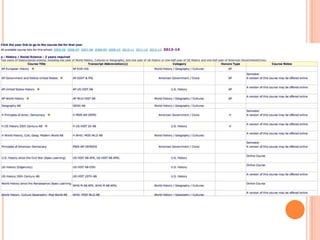
Each school has a school specific list of A-G
classes.
Here is official list for your school
https://doorways.ucop.edu/list/app/home;jsessi
onid=278FA72B91F799DA86B1553A219B51F
5?execution=e1s7
Turning A-G Into
CSU/UC Readiness
• GPA requirement for UC (3.0) and
CSU (2.0)
• AP/Honors/CC courses give an
extra GPA point
• For UC, students must complete
11 out of the required A-G 15
courses must be completed by the
end of their junior year (really time
your application is submitted)
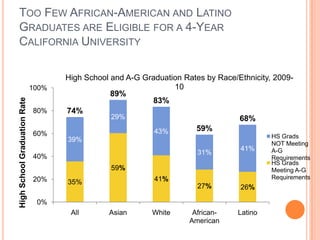
TOO FEW AFRICAN-AMERICAN AND LATINO
GRADUATES ARE ELIGIBLE FOR A 4-YEAR
CALIFORNIA UNIVERSITY

High School Graduation Rate

100%
80%
60%

High School and A-G Graduation Rates by Race/Ethnicity, 200910
89%
83%
74%
29%
68%
59%
43%
39%
31%

40%

41%

59%
20%

41%

35%

27%

26%

AfricanAmerican

Latino

0%
All

Asian

White

HS Grads
NOT Meeting
A-G
Requirements
HS Grads
Meeting A-G
Requirements
ACADEMIC RIGOR
ACADEMIC RIGOR
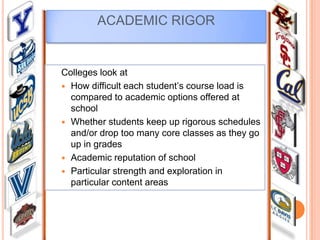
Colleges look at
 How difficult each student’s course load is
compared to academic options offered at
school
 Whether students keep up rigorous schedules
and/or drop too many core classes as they go
up in grades
 Academic reputation of school
 Particular strength and exploration in
particular content areas
SO…











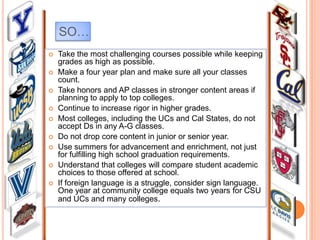
Take the most challenging courses possible while keeping
grades as high as possible.
Make a four year plan and make sure all your classes
count.
Take honors and AP classes in stronger content areas if
planning to apply to top colleges.
Continue to increase rigor in higher grades.
Most colleges, including the UCs and Cal States, do not
accept Ds in any A-G classes.
Do not drop core content in junior or senior year.
Use summers for advancement and enrichment, not just
for fulfilling high school graduation requirements.
Understand that colleges will compare student academic
choices to those offered at school.
If foreign language is a struggle, consider sign language.
One year at community college equals two years for CSU
and UCs and many colleges.
NEW UC Admissions
policies…
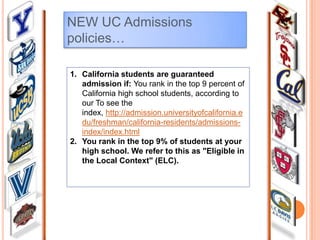
1. California students are guaranteed
admission if: You rank in the top 9 percent of
California high school students, according to
our To see the
index, http://admission.universityofcalifornia.e
du/freshman/california-residents/admissionsindex/index.html
2. You rank in the top 9% of students at your
high school. We refer to this as "Eligible in
the Local Context" (ELC).
Academic Advancement
If you run out of classes at your high school, take classes
at your local community colleges. High school students
get AP credit for these classes. Taking advanced
classes impresses colleges, and they are free (except for
fees and books). If you have time, also take community
college or state university classes in areas that interest
you such as Psychology or Art History. Consider taking
English 101 to enhance your reading and writing skills.
 Note community colleges are cutting back so sign up as
early as you can or look to take classes at local four year
university.
 Find other academic programs, such the California State
Summer School for the Arts or Otis’s Summer Art Progra
http://www.csssa.org/
http://www.otis.edu/summer-art
Free online classes through MIT and Stanford.
 If you need to retake a class because of a low
grade, consider Brigham Young online or National Virtual
University High School Please clear low grades early.
Don't wait until your senior year. Get this approved from
your school first.
http://ce.byu.edu/is/site/courses/highschool.cfm
http://www.nuvhs.org/

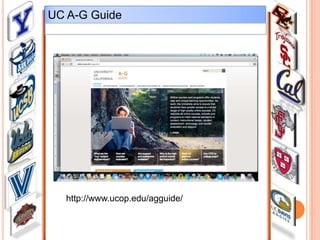
UC A-G Guide

http://www.ucop.edu/agguide/
Making Up Classes








Take classes through adult schools.
Take classes through summer school.
Take classes by adding another class to school year
schedule.
Take classes online.
Some free or very low cost providers of online classesCheck at your high school.
Validation



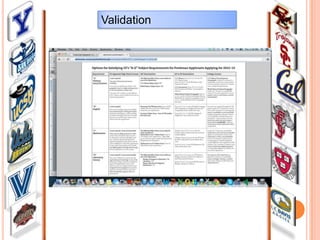
Validation occurs to help with certain math and foreign
language issues.



If you’re not sure, check this website.
http://admission.universityofcalifornia.edu/counselors/qand-a/validation/
http://admission.universityofcalifornia.edu/counselors/files/
CC11_SatisfyingA-G_final.pdf



Validation
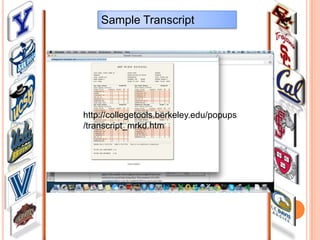
Sample Transcript

http://collegetools.berkeley.edu/popups
/transcript_mrkd.htm
SO WHERE DO WE GO FROM
HERE?
1. UC admissions fact sheets

http://www.ucop.edu/news/studstaff.html
2. College Board-SAT
http://www.collegeboard.com
3. ACT
http://www.actstudent.org
4. My Website
http://www.getmetocollege.org/hs
5. National Association of College Admissions Counselors
(NACAC)
http://www.nacacnet.org/StudentResources/CollegePrep/Page
s/default.aspx
COLLEGE READINESS
IS
NOT A GAME!
TO LEARN MORE












Email
 rjoseph@calstatela.edu
Phone
 323-646-5759
Facebook
 Getmetocollege Freeadvice
Iphone/Ipad/Google application
 All College Application Essays
Twitter
 @getmetocollege
Website
 getmetocollege.org/hs (focus on first generation
and under-represented students)

Rising to Your Highest Potential: The A-G Requirements

  • 1.
    THE A-G REQUIREMENTS: ACOLLEGE READINESS PRIMER Dr. Rebecca Joseph rjoseph@calstatela.edu
  • 2.
    TO LEARN MORE       Email rjoseph@calstatela.edu Phone  323-646-5759 Facebook  Getmetocollege Freeadvice Iphone,iPad,Google application  All College Application Essays Twitter  @getmetocollege Website  getmetocollege.org/hs (focus on first generation and under-represented students)
  • 3.
    WHAT COLLEGES LOOK FORIN MATCH STUDENTS  Grades  Academic Rigor (including senior year)  Standardized Test Scores  Strong applications  Great essays  Counselor Reports  Extracurricular Activities  Teacher Letters of Recommendation  Other Unique Features
  • 4.
    GRADES Grades are thebest predictor of how well a student will do in college.  Colleges look for students who demonstrate  Continuous strong performance  Upward progression in performance  Particular academic strengths  Exceeding basic admissions requirements. For example, in California, going beyond the A-G requirements required by the UC and CSU systems. For top privates, taking advanced classes in and out of high school. 
  • 5.
    What Are theA-G Requirements    The A-G Requirements are a sequence of 15 high school courses, GPAs, and grades that students must complete to qualify for the Cal State and UC campuses. Starting with the freshman (9th graders) class of 2013, LAUSD will now use the A-G requirements as their graduation requirements. Older classes will be held to LAUSD’s former requirements.
  • 6.
    A-G Requirements A. History/SocialScience – 2 years required Two years of history/social science, including one year of world history, cultures and geography, one year of U.S. history, or one-half year of U.S. history and one-half year of civics or American government. B. English – 4 years required Four years of college-preparatory English. No more than one year of high ESL-type courses can be used to meet this requirement. C. Mathematics – 3 years required, 4 years recommended. Algebra 2 is minimum for Cal States and UCs. Three years of college-preparatory mathematics that include the topics covered in elementary and advanced algebra and twoand three-dimensional geometry. Approved integrated math courses may be used to fulfill part or all of this requirement, as may math courses taken in the seventh and eighth grades that your high school accepts as equivalent to its own math courses.
  • 7.
    MORE A-G REQUIREMENTS D.Laboratory Science – 2 years required, 3 years recommended Two years of laboratory science providing fundamental knowledge in at least two of these three foundational subjects: biology, chemistry and physics. Advanced laboratory science classes that have biology, chemistry or physics as prerequisites and offer substantial additional material may be used to fulfill this requirement, as may the final two years of an approved three-year integrated science program that provides rigorous coverage of at least two of the three foundational subjects. E. Language Other than English – 2 years required, 3 years recommended Two years of the same language other than English. Courses should emphasize speaking and understanding, and include instruction in grammar, vocabulary, reading, composition and culture. Courses in languages other than English taken in the seventh and eighth grades may be used to fulfill part of this requirement if your high school accepts them as equivalent to its own courses. Foreign students who receive 800 on SAT II foreign language or approved AP score can test out of language requirement. One year of sign language at a community college also can count.
  • 8.
    MORE A-G REQUIREMENTS F. Visualand Performing Arts (VPA) – 1 year required A single yearlong approved arts course from a single VPA discipline: dance, drama/theater, music or visual art. dance, drama/theater, music or visual art. G. College-Preparatory Electives – 1 year required One year (two semesters), in addition to those required in "a-f" above, chosen from the following areas: engineering, technology, visual and performing arts (nonintroductory level courses), history, social science, English, advanced mathematics, laboratory science and language other than English (a third year in the language used for the "e" requirement or two years of another language).
  • 9.
    A-G Requirements       15 minimumcourses to be eligible to go to a four year university right after high school and review the following points: Students must receive a C or better in order for those courses to count. THIS MEANS Ds DO NOT COUNT. ELLS must pass four years of high school English. ESL 4 counts as 9th grade English. Each school has a school specific list of A-G classes. Here is official list for your school https://doorways.ucop.edu/list/app/home;jsessi onid=278FA72B91F799DA86B1553A219B51F 5?execution=e1s7
  • 11.
    Turning A-G Into CSU/UCReadiness • GPA requirement for UC (3.0) and CSU (2.0) • AP/Honors/CC courses give an extra GPA point • For UC, students must complete 11 out of the required A-G 15 courses must be completed by the end of their junior year (really time your application is submitted)
  • 12.
    TOO FEW AFRICAN-AMERICANAND LATINO GRADUATES ARE ELIGIBLE FOR A 4-YEAR CALIFORNIA UNIVERSITY High School Graduation Rate 100% 80% 60% High School and A-G Graduation Rates by Race/Ethnicity, 200910 89% 83% 74% 29% 68% 59% 43% 39% 31% 40% 41% 59% 20% 41% 35% 27% 26% AfricanAmerican Latino 0% All Asian White HS Grads NOT Meeting A-G Requirements HS Grads Meeting A-G Requirements
  • 13.
    ACADEMIC RIGOR ACADEMIC RIGOR Collegeslook at  How difficult each student’s course load is compared to academic options offered at school  Whether students keep up rigorous schedules and/or drop too many core classes as they go up in grades  Academic reputation of school  Particular strength and exploration in particular content areas
  • 14.
    SO…          Take the mostchallenging courses possible while keeping grades as high as possible. Make a four year plan and make sure all your classes count. Take honors and AP classes in stronger content areas if planning to apply to top colleges. Continue to increase rigor in higher grades. Most colleges, including the UCs and Cal States, do not accept Ds in any A-G classes. Do not drop core content in junior or senior year. Use summers for advancement and enrichment, not just for fulfilling high school graduation requirements. Understand that colleges will compare student academic choices to those offered at school. If foreign language is a struggle, consider sign language. One year at community college equals two years for CSU and UCs and many colleges.
  • 15.
    NEW UC Admissions policies… 1.California students are guaranteed admission if: You rank in the top 9 percent of California high school students, according to our To see the index, http://admission.universityofcalifornia.e du/freshman/california-residents/admissionsindex/index.html 2. You rank in the top 9% of students at your high school. We refer to this as "Eligible in the Local Context" (ELC).
  • 16.
    Academic Advancement If yourun out of classes at your high school, take classes at your local community colleges. High school students get AP credit for these classes. Taking advanced classes impresses colleges, and they are free (except for fees and books). If you have time, also take community college or state university classes in areas that interest you such as Psychology or Art History. Consider taking English 101 to enhance your reading and writing skills.  Note community colleges are cutting back so sign up as early as you can or look to take classes at local four year university.  Find other academic programs, such the California State Summer School for the Arts or Otis’s Summer Art Progra http://www.csssa.org/ http://www.otis.edu/summer-art Free online classes through MIT and Stanford.  If you need to retake a class because of a low grade, consider Brigham Young online or National Virtual University High School Please clear low grades early. Don't wait until your senior year. Get this approved from your school first. http://ce.byu.edu/is/site/courses/highschool.cfm http://www.nuvhs.org/ 
  • 17.
  • 18.
    Making Up Classes      Takeclasses through adult schools. Take classes through summer school. Take classes by adding another class to school year schedule. Take classes online. Some free or very low cost providers of online classesCheck at your high school.
  • 19.
    Validation  Validation occurs tohelp with certain math and foreign language issues.  If you’re not sure, check this website. http://admission.universityofcalifornia.edu/counselors/qand-a/validation/ http://admission.universityofcalifornia.edu/counselors/files/ CC11_SatisfyingA-G_final.pdf  
  • 20.
  • 21.
  • 22.
    SO WHERE DOWE GO FROM HERE? 1. UC admissions fact sheets http://www.ucop.edu/news/studstaff.html 2. College Board-SAT http://www.collegeboard.com 3. ACT http://www.actstudent.org 4. My Website http://www.getmetocollege.org/hs 5. National Association of College Admissions Counselors (NACAC) http://www.nacacnet.org/StudentResources/CollegePrep/Page s/default.aspx
  • 23.
  • 24.
    TO LEARN MORE       Email rjoseph@calstatela.edu Phone  323-646-5759 Facebook  Getmetocollege Freeadvice Iphone/Ipad/Google application  All College Application Essays Twitter  @getmetocollege Website  getmetocollege.org/hs (focus on first generation and under-represented students)