BARRIE COOK 
B00269412
Content 
• A definition of Corporate Social Responsibility 
• What is Corporate Social Responsibility? 
• Why should businesses be socially responsible? 
• How can businesses make money from Corporate 
Social Responsibility?
A Definition Of Corporate Social 
Responsibility 
A situation where the firm goes beyond compliance and 
engages in actions that appear to further some social 
good beyond the interests of the firm and that which is 
required by law (McWilliams et al., 2006)
What is Corporate Social 
Responsibility(CSR)? 
• The practical application of business ethics by the firm and a 
wider commitment to building a better society 
• CSR is concerned primarily with the firm and it’s relationships 
with its various stakeholders 
• Stakeholders include shareholders, employees, customers, 
suppliers, the community and society and government 
• There is also a responsibility towards the sustainability of the 
environment 
(Needle, 2010, p.300)
Why Should Businesses Be Socially 
Responsible? 
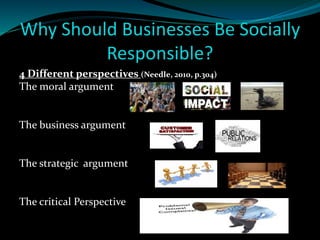
4 Different perspectives (Needle, 2010, p.304) 
The moral argument 
The business argument 
The strategic argument 
The critical Perspective
How Can Businesses Make Money 
From CSR? 
• A survey has shown that 80% of investors questioned 
would be prepared to pay a premium for shares in well-governed 
companies (Hawkins, 2006, p.191) 
• Companies that have a responsible approach should be 
better placed to win contracts or development 
permission in enviromentally sensitive industries 
(Hawkins, 2006, p.192) 
• Customers who have developed trust in a company due 
to its CSR activities are more likely to resist criticisms 
of its products and/or activities (Swaen and Chumpitaz, 2008, 
p.28)
References 
ď‚— Hawkins, D. (2006). Corporate Social Responsibility: 
Balancing tomorrows sustainability and today's 
profitability. United Kingdom: Palgrave Macmillan 
ď‚— Needle, D,.(2010). Business in context: An introduction to 
business and its environment. 5th ed. United Kingdom: 
Cengage 
ď‚— Swaen, V & Chumpitaz, R. (2008) Impact of corporate 
social responsibility on consumer trust. Reserche et 
application en marketing(english edition). [online]. Vol23. 
(n-4). p28. Available from 
http://rme.sagepub.com/content/23/4/7 . [Accessed : 22 
October 2014]

A&P Individual Presentation- Corporate Social Responsibility

  • 1.
  • 2.
    Content • Adefinition of Corporate Social Responsibility • What is Corporate Social Responsibility? • Why should businesses be socially responsible? • How can businesses make money from Corporate Social Responsibility?
  • 3.
    A Definition OfCorporate Social Responsibility A situation where the firm goes beyond compliance and engages in actions that appear to further some social good beyond the interests of the firm and that which is required by law (McWilliams et al., 2006)
  • 4.
    What is CorporateSocial Responsibility(CSR)? • The practical application of business ethics by the firm and a wider commitment to building a better society • CSR is concerned primarily with the firm and it’s relationships with its various stakeholders • Stakeholders include shareholders, employees, customers, suppliers, the community and society and government • There is also a responsibility towards the sustainability of the environment (Needle, 2010, p.300)
  • 5.
    Why Should BusinessesBe Socially Responsible? 4 Different perspectives (Needle, 2010, p.304) The moral argument The business argument The strategic argument The critical Perspective
  • 6.
    How Can BusinessesMake Money From CSR? • A survey has shown that 80% of investors questioned would be prepared to pay a premium for shares in well-governed companies (Hawkins, 2006, p.191) • Companies that have a responsible approach should be better placed to win contracts or development permission in enviromentally sensitive industries (Hawkins, 2006, p.192) • Customers who have developed trust in a company due to its CSR activities are more likely to resist criticisms of its products and/or activities (Swaen and Chumpitaz, 2008, p.28)
  • 7.
    References ď‚— Hawkins,D. (2006). Corporate Social Responsibility: Balancing tomorrows sustainability and today's profitability. United Kingdom: Palgrave Macmillan ď‚— Needle, D,.(2010). Business in context: An introduction to business and its environment. 5th ed. United Kingdom: Cengage ď‚— Swaen, V & Chumpitaz, R. (2008) Impact of corporate social responsibility on consumer trust. Reserche et application en marketing(english edition). [online]. Vol23. (n-4). p28. Available from http://rme.sagepub.com/content/23/4/7 . [Accessed : 22 October 2014]