Broadband for the Bush


Presenter: John Huigen, CEO, Desert Knowledge Australia
Desert Syndrome
UNPREDICTABLE CLIMATE:                                     LIMITED LIVELIHOODS:
Variability and extremes in primary                      Lack of diverse small business
  drivers (rainfall, other weather)                          and livelihood options


    SCARCE RESOURCES:                                          SCARCE CAPITAL:
   Patchy natural resources and                         Low levels of financial, physical
    widespread low soil fertility                           and human investment


                               SPARSE POPULATION:                                           Poverty
                               Sparse, mobile and patchy
                                   human population


                                                                                                           Indigenous
                                      REMOTENESS:
                               Distant markets, business,
                            political centres, mental models


      LOCAL KNOWLEDGE:                                 CULTURAL DIFFERENCES:
                                                                                             Policy
     Limited research, local/tradit -
   ional knowledge more important
                                                          Particular types of people,
                                                           cultures and institutions
                                                                                             variability     & uncertainty


                              SOCIAL UNCERTAINTY:
                          Unpredictability in or lack of control
                             over markets, labour, policy
                                                                                                           Stafford Smith & Huigen (2009)
                                                                                                               [Desert Knowledge CRC
                                                                                                           Science of Desert Living project]
The value of connectivity
in a digital era
• Participation in the digital economy
   – Productivity gains
   – Cost Benefits
• Social inclusion
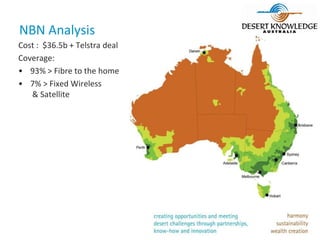
NBN Analysis
Cost : $36.5b + Telstra deal
Coverage:
• 93% > Fibre to the home
• 7% > Fixed Wireless
   & Satellite
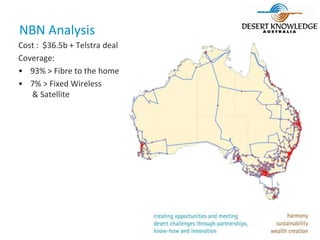
NBN Analysis
Cost : $36.5b + Telstra deal
Coverage:
• 93% > Fibre to the home
• 7% > Fixed Wireless
   & Satellite
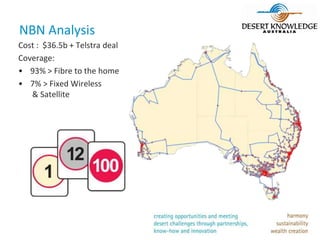
NBN Analysis
Cost : $36.5b + Telstra deal
Coverage:
• 93% > Fibre to the home
• 7% > Fixed Wireless
   & Satellite
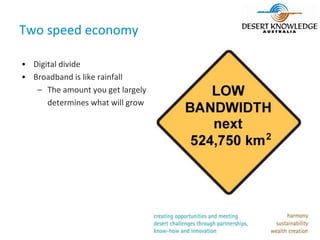
Two speed economy

• Digital divide
• Broadband is like rainfall
   – The amount you get largely
      determines what will grow
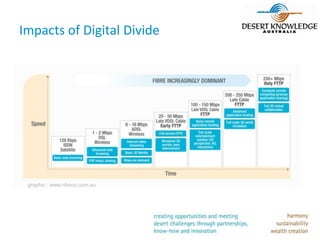
Impacts of Digital Divide


 graphic : www.nbnco.com.au
Impacts of Digital Divide

• Digital divide will exacerbate
  existing poverty cycle
• Opportunity cost to
  producers & community
Impacts of Digital Divide

Examples…
• Limited capacity to embrace
   eHealth, e Learning, eGov

• Limited capacity to embrace
  eCommerce & Smart Technology
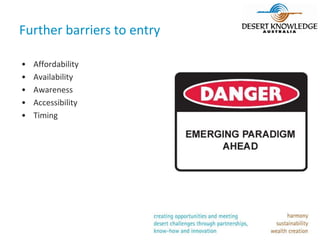
Further barriers to entry

•   Affordability
•   Availability
•   Awareness
•   Accessibility
•   Timing
What can be done?

• Making the case
• Use existing technologies
• Support emerging technology
Making the Case

• Remote Telecommunications Review
• ACCAN Review
• NBN rollout blueprint
Existing Technologies
Addressing small settlements


• Link communities to hub sites via
  fibre or microwave
• Use infrastructure as backhaul for
  mobile / fixed telephony & network
• Last mile options
    –   ADSL
    –   Shared wifi or Wimax
    –   3G (& 4G...) mobile telephony
    –   Community access ICT facilities
Emerging Technologies

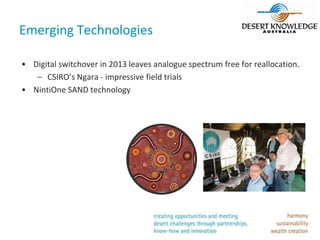
• Digital switchover in 2013 leaves analogue spectrum free for reallocation.
   – CSIRO’s Ngara - impressive field trials
• NintiOne SAND technology
Conclusions

• The bush would particularly benefit from superfast broadband
• Lack of certainty is damaging
• Opportunity to pressure for a better deal
• Opportunity for emerging technologies
  to significantly improve bandwidth &
  accessibility
• Digital literacy & other barriers need to be
  addressed
Questions?

• Next steps……..

Broadband for the Bush

  • 1.
    Broadband for theBush Presenter: John Huigen, CEO, Desert Knowledge Australia
  • 5.
    Desert Syndrome UNPREDICTABLE CLIMATE: LIMITED LIVELIHOODS: Variability and extremes in primary Lack of diverse small business drivers (rainfall, other weather) and livelihood options SCARCE RESOURCES: SCARCE CAPITAL: Patchy natural resources and Low levels of financial, physical widespread low soil fertility and human investment SPARSE POPULATION: Poverty Sparse, mobile and patchy human population Indigenous REMOTENESS: Distant markets, business, political centres, mental models LOCAL KNOWLEDGE: CULTURAL DIFFERENCES: Policy Limited research, local/tradit - ional knowledge more important Particular types of people, cultures and institutions variability & uncertainty SOCIAL UNCERTAINTY: Unpredictability in or lack of control over markets, labour, policy Stafford Smith & Huigen (2009) [Desert Knowledge CRC Science of Desert Living project]
  • 6.
    The value ofconnectivity in a digital era • Participation in the digital economy – Productivity gains – Cost Benefits • Social inclusion
  • 7.
    NBN Analysis Cost :$36.5b + Telstra deal Coverage: • 93% > Fibre to the home • 7% > Fixed Wireless & Satellite
  • 8.
    NBN Analysis Cost :$36.5b + Telstra deal Coverage: • 93% > Fibre to the home • 7% > Fixed Wireless & Satellite
  • 9.
    NBN Analysis Cost :$36.5b + Telstra deal Coverage: • 93% > Fibre to the home • 7% > Fixed Wireless & Satellite
  • 10.
    Two speed economy •Digital divide • Broadband is like rainfall – The amount you get largely determines what will grow
  • 11.
    Impacts of DigitalDivide graphic : www.nbnco.com.au
  • 12.
    Impacts of DigitalDivide • Digital divide will exacerbate existing poverty cycle • Opportunity cost to producers & community
  • 13.
    Impacts of DigitalDivide Examples… • Limited capacity to embrace eHealth, e Learning, eGov • Limited capacity to embrace eCommerce & Smart Technology
  • 14.
    Further barriers toentry • Affordability • Availability • Awareness • Accessibility • Timing
  • 15.
    What can bedone? • Making the case • Use existing technologies • Support emerging technology
  • 16.
    Making the Case •Remote Telecommunications Review • ACCAN Review • NBN rollout blueprint
  • 17.
    Existing Technologies Addressing smallsettlements • Link communities to hub sites via fibre or microwave • Use infrastructure as backhaul for mobile / fixed telephony & network • Last mile options – ADSL – Shared wifi or Wimax – 3G (& 4G...) mobile telephony – Community access ICT facilities
  • 18.
    Emerging Technologies • Digitalswitchover in 2013 leaves analogue spectrum free for reallocation. – CSIRO’s Ngara - impressive field trials • NintiOne SAND technology
  • 19.
    Conclusions • The bushwould particularly benefit from superfast broadband • Lack of certainty is damaging • Opportunity to pressure for a better deal • Opportunity for emerging technologies to significantly improve bandwidth & accessibility • Digital literacy & other barriers need to be addressed
  • 20.

Editor's Notes

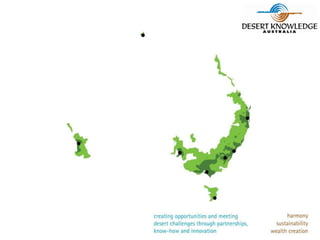
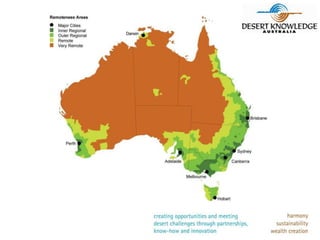
  • #5 And this is our unified country – unified by remote and very remote Australia that makes up 85% of the landmass.Remote Australia is undoubtedly very different to that experienced by the majority of Australians on a day-to-day basis.
  • #6 It matters more in the desert and remote Australia
  • #7 a. Productivity gains :Ericsson has released findings from a study across 33 OECD economies, including Australia, thatfound that a doubling of broadband speed produced a 0.3 percent increase in the GDP of that economy - $A3.9b in the case of Australia.b. Cost benefits : example eHealth > more digitally monitored home care = fewer patients in hospital beds (up to 25%) = cost savingexample eLearning: revolutionise learning across australia + deliver education to overseas studentsc. Social inclusion > connectivity transcends distance reducing isolation. This is not specific to remote areas : urban populations love their mobile phones equally. smartphones are giving mobility and portability to the internet – increasing demand for bandwidth.Governments moving toward ‘digital by default’ > danger of digital exclusion (high cost of maintaining physical presence… even more costly in remote areas)> 65% of preschool kids will work in jobs/ careers that don’t yet exist
  • #8 NBN is a once-off opportunity to 'get it right‘ Projected capex of the NBN is $36.5 billion according to NBNCo corporate plan but to this must be added the cost of the deal with Telstra – another 11 billion dollars
  • #9 a. Fibre to the home up to 100mbps symmetrical for 93% of Australians, less bandwidth, less speed for the remaining 7%b. Fixed wireless an acceptable economic compromise perhaps but satellite has significant constraints : latency, download costs, higher maintenance, difficulty trouble shooting, effect of cloudsc.NBN should also lead to improvements in mobile coverage > fibre to carry traffic between mobile sights. This improvement will depend on how willing NBNCo is to provide break-out transmission systems to mobile carriers.
  • #10 Upload speeds are the key to a region’s productivity > in the digital economy, producing & processing data is where the value is.Projected download speeds OK for consuming media – (rich media as its produced today – who knows what’s next) but we don’t want remote Australia to be just consumers. Consuming content is not a job > making it and putting it out there in realtime is fundamental to prosperity in the knowledge economy.
  • #11 Digital divide already exists. Availability is the biggest issue resulting in relatively low adoption. Digital literacy – the skills required to engage with the Digital Economy - is low.Broadband is like rainfall > the amount you get largely determines what will grow Broadband enables innovation so if you want rural, regional & remote Australia to flourish, provide a network that enables a sparse, patchy and mobile population. ‘super wifi everywhere net’
  • #12 Graph show correlation of bandwidth with potential applications
  • #14 Bandwidth poverty > Remote area download speed of 12mbps allows users to consumer content but 1mbps upload inhibits sharingUnreliable mobile coverage in areas constrains economic activityAsymmetry is not a constraint for emailing & browsing but its insufficient for the emerging paradigm of cloud computing, video conferencing, and the ‘internet of things’b. Limited capacity to embrace eHealth, eLearning, eGovEmergency services? Remote sensing equipment allows for monitoring of weather conditions (think fires)
  • #15 Affordability – cost of data + personal device vs. low income/high cost of living in remote areas. b. Availability – cost of ICT + getting a technician when you need one. Phone> Issues that farmers face don’t fit the call centre manual. Large effort required to resolve issues > opportunity cost to the clientc. Awareness – Remote area >Low english literacy compounded by low digital literacy. (internet currently lots of text that excludes people who can't read)The need to educate businesses regarding opportunities to leverage fast broadband to improve productivity, access new markets and information initiatives. d. Accessibility - NotForProfit sector teaching digital literacy is under resourcede. Timing : remote areas look likely to be last to benefit compounding factors above
  • #16 a. Making the caseb. use existing technologiesc. support emerging technology
  • #17 The need for critical mass : rally rural, regional & remote areas to form a chorus of unified viewsRemote Telecommunications Review to visit Symposiumb. ACCAN review (Aust Communication Consumer Action Network) > remote perspective project officerc. NBN > Uncertainty of rollout sequence creating unproductive exercise of second guessing NBN Co. > make forward information more accessible & provide us a map of the next 10 years
  • #18 (IRCA preferred model)• link communities to hub sites via fibre or microwave• low latency, robust infrastructure, more reliable, low maintenance• capacity for two way streaming• more affordable services and download• can use infrastructure as backhaul for mobile telephony, fixed telephony & network extension
  • #19 Digital switchover in 2013 leaves analogue spectrum free for reallocation. CSIRO’s Ngara impressive field trialsNintiOne SAND technologyOthers?
  • #20 The bush would particularly benefit from superfast broadbandLack of certainty is damagingOpportunity to pressure for a better dealOpportunity for emerging technologiesto significantly improvebandwidth &accessibilityDigital literacy & other barriers need to be addressed