Anxiety Disorders:
How to Cope
Carlo Carandang, MD
Department of Psychiatry
Maine Medical Center &
Spring Harbor Hospital
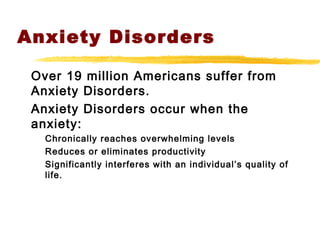
Anxiety Disorders
Over 19 million Americans suffer from
Anxiety Disorders.
Anxiety Disorders occur when the
anxiety:
Chronically reaches overwhelming levels
Reduces or eliminates productivity
Significantly interferes with an individual’s quality of
life.
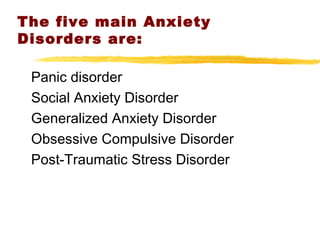
The five main Anxiety
Disorders are:
Panic disorder
Social Anxiety Disorder
Generalized Anxiety Disorder
Obsessive Compulsive Disorder
Post-Traumatic Stress Disorder
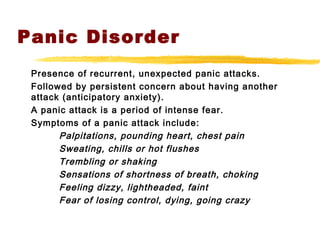
Panic Disorder
Presence of recurrent, unexpected panic attacks.
Followed by persistent concern about having another
attack (anticipatory anxiety).
A panic attack is a period of intense fear.
Symptoms of a panic attack include:
Palpitations, pounding heart, chest pain
Sweating, chills or hot flushes
Trembling or shaking
Sensations of shortness of breath, choking
Feeling dizzy, lightheaded, faint
Fear of losing control, dying, going crazy
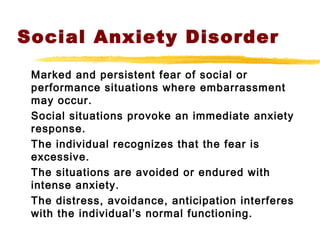
Social Anxiety Disorder
Marked and persistent fear of social or
performance situations where embarrassment
may occur.
Social situations provoke an immediate anxiety
response.
The individual recognizes that the fear is
excessive.
The situations are avoided or endured with
intense anxiety.
The distress, avoidance, anticipation interferes
with the individual’s normal functioning.
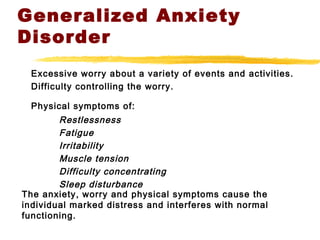
Generalized Anxiety
Disorder
Excessive worry about a variety of events and activities.
Difficulty controlling the worry.
Physical symptoms of:
Restlessness
Fatigue
Irritability
Muscle tension
Difficulty concentrating
Sleep disturbance
The anxiety, worry and physical symptoms cause the
individual marked distress and interferes with normal
functioning.
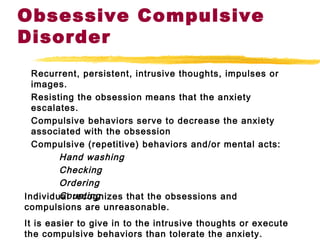
Obsessive Compulsive
Disorder
Recurrent, persistent, intrusive thoughts, impulses or
images.
Resisting the obsession means that the anxiety
escalates.
Compulsive behaviors serve to decrease the anxiety
associated with the obsession
Compulsive (repetitive) behaviors and/or mental acts:
Hand washing
Checking
Ordering
CountingIndividual recognizes that the obsessions and
compulsions are unreasonable.
It is easier to give in to the intrusive thoughts or execute
the compulsive behaviors than tolerate the anxiety.
Post Traumatic Stress
Disorder
Individual is exposed to a traumatic event (witnessed or
experienced) that involved actual or threatened serious
injury or death.
The experience produced intense fear and helplessness.
Later, the individual may experience:
Recurrent intrusive recollections of the event
(flashbacks, nightmares)
Feelings of detachment
Guilt feelings
Sleep problems and other somatic symptoms
Avoidant behaviors
Hypervigilance (heightened awareness, easily
startled)
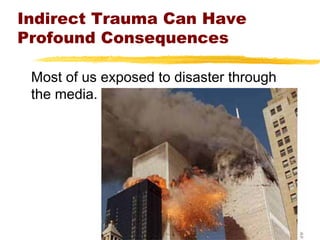
Indirect Trauma Can Have
Profound Consequences
Most of us exposed to disaster through
the media.
Children’s Response to
Oklahoma City Bombing
69 elementary school children surveyed 2
years after Oklahoma City Bombing.
The children lived 100 miles away and
knew no one who was killed or injured.
Children’s Response to
Oklahoma City Bombing
Almost 50% exhibited moderate post-
traumatic stress symptoms.
44% of the kids had symptoms of Post-
Traumatic Stress Disorder.
Disturbing finding: 44% of the kids
developed PTSD after exposure to
indirect trauma.
Caregiver, Heal Thyself
When an adult is emotionally unstable, or
has not worked-through their emotions,
risks losing their CONNECTION with their
kids.
Often, adults focus on their kids, while
ignoring their own emotional needs during
crisis.
Kids can sense anxiety in adults, and may
feel they are a burden to adults.
Common Reactions Of Kids to
Traumatic Events
Feelings of anxiety, anger, and sadness
Feeling helpless
Sleep problems
Concentration problems
Regression
Thinking the event is their fault (younger
than 7 or 8 years)
Helping Kids Cope
A strong CONNECTION with your kids is
the most important factor.
Foster CONNECTION with other adults:
extended family, neighbors, teachers,
clergy.
Helping Kids Cope
Adults can talk about their own emotions
with kids.
Allow kids to express their feelings.
If talking is difficult, then do ‘action talk.’
Help kids take action to decrease their
sense of helplessness.
When To Seek Further Help
For Kids
Recurring nightmares and persistently
disrupted sleep
Social withdrawal
Extreme agitation/aggression
Pervasively declining school performance
Excessive fears
Depression
Over 19 million Americans suffer from Depressive
Illnesses
Depression is more than a temporary “blue” mood or
periods of grief after a loss
Symptoms of depression:
Loss of interest or pleasure
Feeling overwhelmingly sad
Change in appetite, weight and sleep
Increase in fatigue
Decrease in energy
Poor concentration
Feelings of worthlessness and guilt
Suicidal thoughts
Treatment for Anxiety
& Depressive Disorders
Anxiety and depressive disorders are treatable
medical illnesses that respond to:
Psychotherapy/Counseling
Medication
A combination of Psychotherapy &
Medication
Treatment Works
The Surgeon General’s Report
on Mental Health states:
“The efficacy of mental health treatment is well
documented. Moreover, there exists a range of
treatments from which people may choose a
particular approach to suit their needs and
preferences. Based on this finding, the report’s
principal recommendation to the American people is
to seek help if you have a mental health problem or
think you have symptoms of mental illness.” (p. 13)
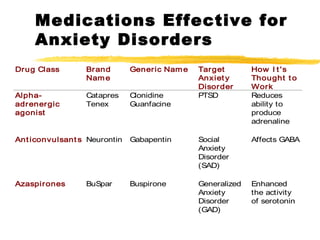
Drug Class Brand
Name
Generic Name Target
Anxiet y
Disorder
How I t 's
Thought t o
Work
Alpha-
adrenergic
agonist
Catapres
Tenex
Clonidine
Guanfacine
PTSD Reduces
ability to
produce
adrenaline
Anticonvulsant s Neurontin Gabapentin Social
Anxiety
Disorder
(SAD)
Affects GABA
Azaspirones BuSpar Buspirone Generalized
Anxiety
Disorder
(GAD)
Enhanced
the activity
of serotonin
Medications Effective for
Anxiety Disorders
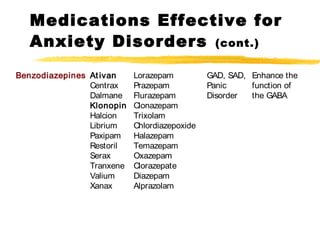
Benzodiazepines Ativan
Centrax
Dalmane
Klonopin
Halcion
Librium
Paxipam
Restoril
Serax
Tranxene
Valium
Xanax
Lorazepam
Prazepam
Flurazepam
Clonazepam
Trixolam
Chlordiazepoxide
Halazepam
Temazepam
Oxazepam
Clorazepate
Diazepam
Alprazolam
GAD, SAD,
Panic
Disorder
Enhance the
function of
the GABA
Medications Effective for
Anxiety Disorders (cont.)
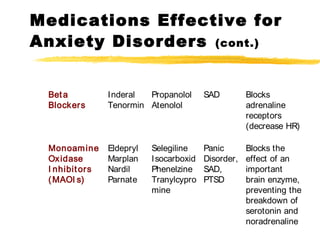
Beta
Blockers
Inderal
Tenormin
Propanolol
Atenolol
SAD Blocks
adrenaline
receptors
(decrease HR)
Monoamine
Oxidase
I nhibitors
(MAOI s)
Eldepryl
Marplan
Nardil
Parnate
Selegiline
Isocarboxid
Phenelzine
Tranylcypro
mine
Panic
Disorder,
SAD,
PTSD
Blocks the
effect of an
important
brain enzyme,
preventing the
breakdown of
serotonin and
noradrenaline
Medications Effective for
Anxiety Disorders (cont.)
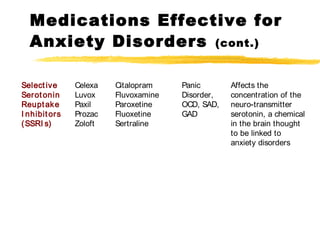
Selective
Serotonin
Reuptake
I nhibitors
(SSRI s)
Celexa
Luvox
Paxil
Prozac
Zoloft
Citalopram
Fluvoxamine
Paroxetine
Fluoxetine
Sertraline
Panic
Disorder,
OCD, SAD,
GAD
Affects the
concentration of the
neuro-transmitter
serotonin, a chemical
in the brain thought
to be linked to
anxiety disorders
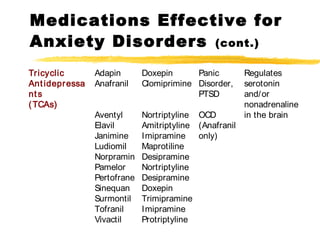
Medications Effective for
Anxiety Disorders (cont.)
Tricyclic
Antidepressa
nts
(TCAs)
Adapin
Anafranil
Aventyl
Elavil
Janimine
Ludiomil
Norpramin
Pamelor
Pertofrane
Sinequan
Surmontil
Tofranil
Vivactil
Doxepin
Clomiprimine
Nortriptyline
Amitriptyline
Imipramine
Maprotiline
Desipramine
Nortriptyline
Desipramine
Doxepin
Trimipramine
Imipramine
Protriptyline
Panic
Disorder,
PTSD
OCD
(Anafranil
only)
Regulates
serotonin
and/or
nonadrenaline
in the brain
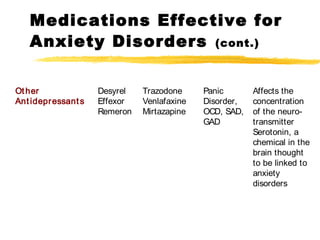
Medications Effective for
Anxiety Disorders (cont.)
Other
Antidepressants
Desyrel
Effexor
Remeron
Trazodone
Venlafaxine
Mirtazapine
Panic
Disorder,
OCD, SAD,
GAD
Affects the
concentration
of the neuro-
transmitter
Serotonin, a
chemical in the
brain thought
to be linked to
anxiety
disorders
Medications Effective for
Anxiety Disorders (cont.)

Anxiety Disorders