Anxiety Disorders
Presented by Mudebo Emmmanuel+
1. Generalized Anxiety Disorder (GAD)
2. Anxiety due to medical condition
3. Substance Induced Anxiety Disorder
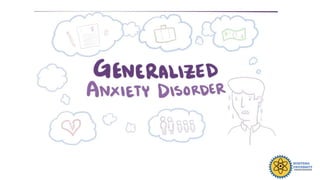
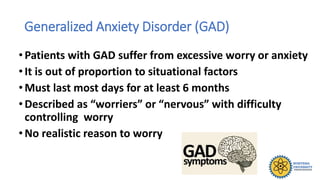
Generalized Anxiety Disorder (GAD)
• Patients with GAD suffer from excessive worry or anxiety
• It is out of proportion to situational factors
• Must last most days for at least 6 months
• Described as “worriers” or “nervous” with difficulty
controlling worry
• No realistic reason to worry
GAD Diagnostic Criteria
• Excessive anxiety and worry that
occurs more days than not for 6
months
• Difficult to control the worry
• 3 out of 6 symptoms
• Anxiety caused significant
distress or impairment in
function
• Not attributed to another
organic cause
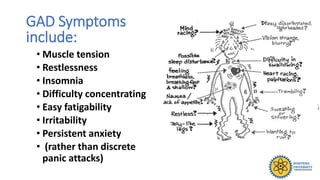
• Muscle tension
• Restlessness
• Insomnia
• Difficulty concentrating
• Easy fatigability
• Irritability
• Persistent anxiety
• (rather than discrete
panic attacks)
GAD Symptoms
include:
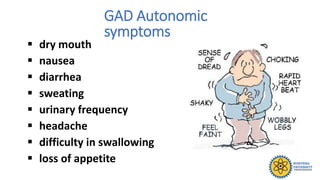
GAD Autonomic
symptoms
 dry mouth
 nausea
 diarrhea
 sweating
 urinary frequency
 headache
 difficulty in swallowing
 loss of appetite
GAD Epidemiology
•5% prevalence in community samples
• 2:1 female/male ratio
• Age of onset is frequently in childhood
or adolescence
• Chronic but fluctuating course of
illness (worsened during stressful
periods)
• More in developed countries
• Least among European descent
GAD Treatment
•Cognitive Behavioral
Therapy
•Other Psychotherapies
•Pharmacotherapy
•Antidepressants
•Benzodiazepines
•Buspirone
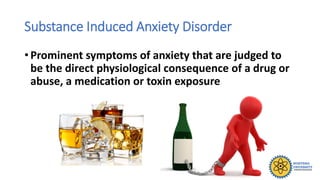
Substance Induced Anxiety Disorder
• Prominent symptoms of anxiety that are judged to
be the direct physiological consequence of a drug or
abuse, a medication or toxin exposure
Diagnostic criteria of substace induced anxiety
disorder
• A. Panic attacks or anxiety is predominant in the clinical
picture.
• B. There is evidence from the history, physical examination,
or laboratory findings of bot (1)and (2):
• 1. The symptoms in Criterion A developed during or soon after
substance intoxication or withdrawal or after exposure to a
medication.
• 2. The involved substance/medication is capable of producing
the symptoms in Criterion A.
Cont’d
•C. The disturbance is not better explained by an
anxiety disorder that is not substance/ medication-
induced, recurrent, The disturbance does not occur
exclusively during the course of a delirium.
•E. The disturbance causes clinically significant
distress or impairment in social, occupational, or
other important areas of functioning.
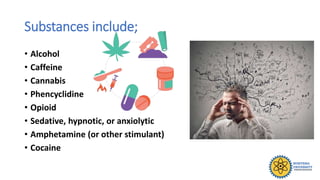
Substances include;
• Alcohol
• Caffeine
• Cannabis
• Phencyclidine
• Opioid
• Sedative, hypnotic, or anxiolytic
• Amphetamine (or other stimulant)
• Cocaine
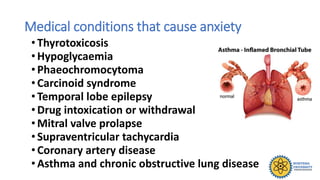
Medical conditions that cause anxiety
•Thyrotoxicosis
•Hypoglycaemia
•Phaeochromocytoma
•Carcinoid syndrome
•Temporal lobe epilepsy
•Drug intoxication or withdrawal
•Mitral valve prolapse
•Supraventricular tachycardia
•Coronary artery disease
•Asthma and chronic obstructive lung disease
Treatment of Anxiety Disorders
•Pharmacologic approach:
- Benzodiazepines (diazepam, lorazepam,
alprazolam)
- Antidepressant medications:
 SSRIs (Citalopram, paroxetine, sertraline)
 Tricyclic compounds (Imipramine, Amitriptyline,
Clomipramine)
 MAOIs (Phenelzine, Tranylcypromine)
•Pharmacologic approach (cont..):
- Beta blockers
- Buspirone
•Psychologic approach:
• Psychotherapy
• Behaviour therapy
• Cognitive therapy
• Group therapy
CONCLUSION
Philippians 4:6
Don't worry about
anything, but in all
your prayers ask God
for what you need,
always asking him
with a thankful
heart.

Anxiety disorders

  • 1.
  • 2.
    1. Generalized AnxietyDisorder (GAD) 2. Anxiety due to medical condition 3. Substance Induced Anxiety Disorder
  • 4.
    Generalized Anxiety Disorder(GAD) • Patients with GAD suffer from excessive worry or anxiety • It is out of proportion to situational factors • Must last most days for at least 6 months • Described as “worriers” or “nervous” with difficulty controlling worry • No realistic reason to worry
  • 5.
    GAD Diagnostic Criteria •Excessive anxiety and worry that occurs more days than not for 6 months • Difficult to control the worry • 3 out of 6 symptoms • Anxiety caused significant distress or impairment in function • Not attributed to another organic cause
  • 6.
    • Muscle tension •Restlessness • Insomnia • Difficulty concentrating • Easy fatigability • Irritability • Persistent anxiety • (rather than discrete panic attacks) GAD Symptoms include:
  • 7.
    GAD Autonomic symptoms  drymouth  nausea  diarrhea  sweating  urinary frequency  headache  difficulty in swallowing  loss of appetite
  • 8.
    GAD Epidemiology •5% prevalencein community samples • 2:1 female/male ratio • Age of onset is frequently in childhood or adolescence • Chronic but fluctuating course of illness (worsened during stressful periods) • More in developed countries • Least among European descent
  • 9.
    GAD Treatment •Cognitive Behavioral Therapy •OtherPsychotherapies •Pharmacotherapy •Antidepressants •Benzodiazepines •Buspirone
  • 10.
    Substance Induced AnxietyDisorder • Prominent symptoms of anxiety that are judged to be the direct physiological consequence of a drug or abuse, a medication or toxin exposure
  • 11.
    Diagnostic criteria ofsubstace induced anxiety disorder • A. Panic attacks or anxiety is predominant in the clinical picture. • B. There is evidence from the history, physical examination, or laboratory findings of bot (1)and (2): • 1. The symptoms in Criterion A developed during or soon after substance intoxication or withdrawal or after exposure to a medication. • 2. The involved substance/medication is capable of producing the symptoms in Criterion A.
  • 12.
    Cont’d •C. The disturbanceis not better explained by an anxiety disorder that is not substance/ medication- induced, recurrent, The disturbance does not occur exclusively during the course of a delirium. •E. The disturbance causes clinically significant distress or impairment in social, occupational, or other important areas of functioning.
  • 13.
    Substances include; • Alcohol •Caffeine • Cannabis • Phencyclidine • Opioid • Sedative, hypnotic, or anxiolytic • Amphetamine (or other stimulant) • Cocaine
  • 14.
    Medical conditions thatcause anxiety •Thyrotoxicosis •Hypoglycaemia •Phaeochromocytoma •Carcinoid syndrome •Temporal lobe epilepsy •Drug intoxication or withdrawal •Mitral valve prolapse •Supraventricular tachycardia •Coronary artery disease •Asthma and chronic obstructive lung disease
  • 15.
    Treatment of AnxietyDisorders •Pharmacologic approach: - Benzodiazepines (diazepam, lorazepam, alprazolam) - Antidepressant medications:  SSRIs (Citalopram, paroxetine, sertraline)  Tricyclic compounds (Imipramine, Amitriptyline, Clomipramine)  MAOIs (Phenelzine, Tranylcypromine)
  • 16.
    •Pharmacologic approach (cont..): -Beta blockers - Buspirone •Psychologic approach: • Psychotherapy • Behaviour therapy • Cognitive therapy • Group therapy
  • 17.
    CONCLUSION Philippians 4:6 Don't worryabout anything, but in all your prayers ask God for what you need, always asking him with a thankful heart.