ANTITUSSIVES
REVIEW I
J COMPONENT
PHARMACEUTICAL BIOTECHNOLOGY
SUBMITTED TO:
Dr VINO S
ASSOCIATE PROFESSOR
SBST
VIT
SUBMITTED BY:
TEJASWINI – 18MSM0074
SANDIP HAZRA – 18MSM0090
TANIA CHATTERJEE – 18MSM0094
MRUNAL PALSOKAR – 18MSM0095
 Heterogeneous class of compounds that inhibit cough through
either a central or peripheral mechanism; or a mixture of two
 Antitussives are thought to work by inhibiting a coordinating
region for coughing located in the brain stem, deterring the
cough reflex arc
 Cough is normally produced through the stimulation of
sensory receptors glossopharyngeal and vagus nerves,
innervating the mucous membrane of the lower pharynx,
larynx, trachea and smaller airways of respiratory system
 Receptors then transmit the signal to the cough center in the
brain
 This then triggers a reflex motor response that results in
contraction of the muscles to close the glottis and contraction
of the muscles of expiration
INTRODUCTION
 The result is sudden increase in intrathoracic pressure followed
by relaxation of vocal cords, resulting in rapid expulsion of air
 Centrally acting agents work by inhibiting the cough center in the
brain, elevating the threshold for coughing (though the exact
mechanism is still poorly understood)
 Peripheral acting agents work either by anesthetizing the local
nerve endings or acting as demulcents (agents having soothing
effect on throat)
 Examples:
 Centrally acting: dextromethorphan, opiates (codeine)
 Peripheral acting: camphor, menthol
 Antitussives doesn't have any major side-effects but may cause
sleepiness, irritability and dizziness
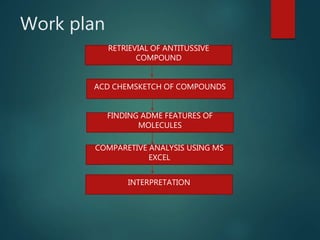
Work plan
RETRIEVIAL OF ANTITUSSIVE
COMPOUND
ACD CHEMSKETCH OF COMPOUNDS
FINDING ADME FEATURES OF
MOLECULES
INTERPRETATION
COMPARETIVE ANALYSIS USING MS
EXCEL
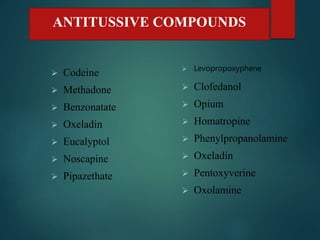
 Codeine
 Methadone
 Benzonatate
 Oxeladin
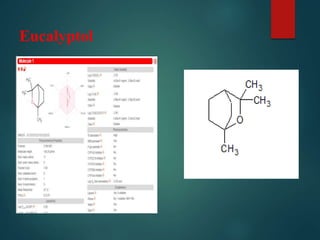
 Eucalyptol
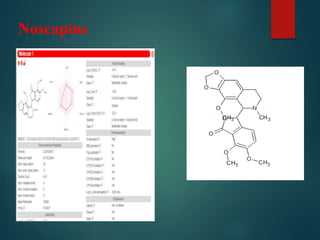
 Noscapine
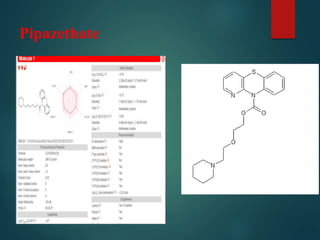
 Pipazethate
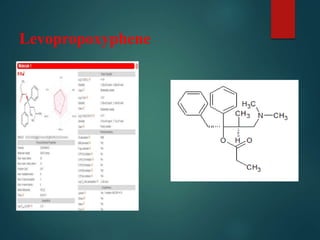
 Levopropoxyphene
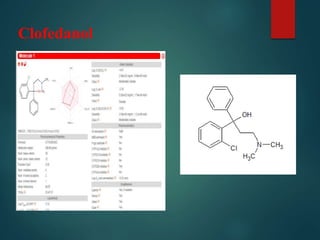
 Clofedanol
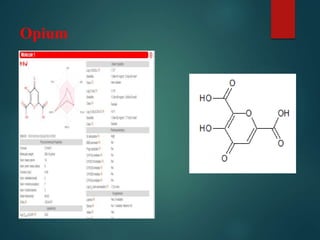
 Opium
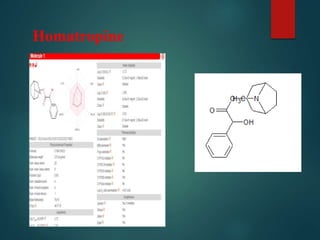
 Homatropine
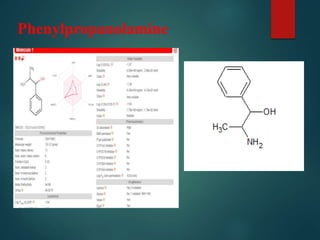
 Phenylpropanolamine
 Oxeladin
 Pentoxyverine
 Oxolamine
ANTITUSSIVE COMPOUNDS
COMPOUNDS WITH THEIR RESPECTIVE SMILE
COMPOUND SMILES
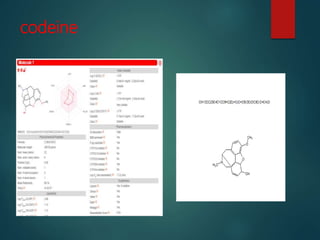
Codeine CN1CCC23C4C1CC5=C2C(=C(C=C5)OC)OC3C(C=C4)O
Methadone CCC(=O)C(CC(C)N(C)C)(C1=CC=CC=C1)C2=CC=CC=C2
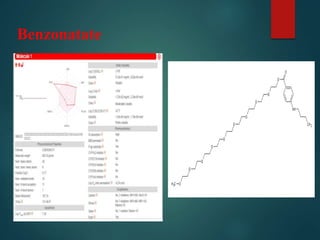
Benzonatate CCCCNC1=CC=C(C=C1)C(=O)OCCOCCOCCOCCOCCOCCOCCOCCOCCOC
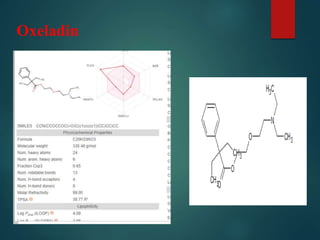
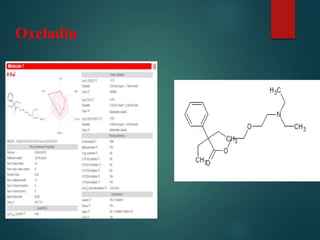
Oxeladin CCC(CC)(C1=CC=CC=C1)C(=O)OCCOCCN(CC)CC
Eucalyptol CC1(C2CCC(O1)(CC2)C)C
Noscapine CN1CCC2=CC3=C(C(=C2C1C4C5=C(C(=C(C=C5)OC)OC)C(=O)O4)OC)OCO3
Pipazethate C1CCN(CC1)CCOCCOC(=O)N2C3=CC=CC=C3SC4=C2N=CC=C4
Levopropoxyphene CCC(=O)O[C@@](CC1=CC=CC=C1)(C2=CC=CC=C2)[C@@H](C)CN(C)C
Clofedanol CN(C)CCC(C1=CC=CC=C1)(C2=CC=CC=C2Cl)O
Opium C1=C(OC(=C(C1=O)O)C(=O)O)C(=O)O
Homatropine CN1C2CCC1CC(C2)OC(=O)C(C3=CC=CC=C3)O
Phenylpropanolamine CC(C(C1=CC=CC=C1)O)N
Oxeladin CCC(CC)(C1=CC=CC=C1)C(=O)OCCOCCN(CC)CC
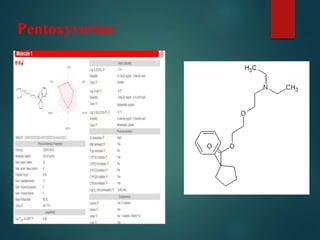
Pentoxyverine CCN(CC)CCOCCOC(=O)C1(CCCC1)C2=CC=CC=C2
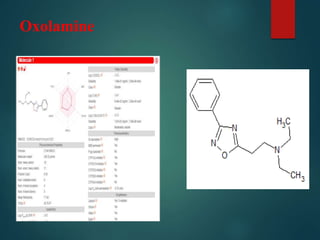
Oxolamine CCN(CC)CCC1=NC(=NO1)C2=CC=CC=C2
codeine
Methadone
Benzonatate
Oxeladin
Eucalyptol
Noscapine
Pipazethate
Levopropoxyphene
Clofedanol
Opium
Homatropine
Phenylpropanolamine
Oxeladin
Pentoxyverine
Oxolamine
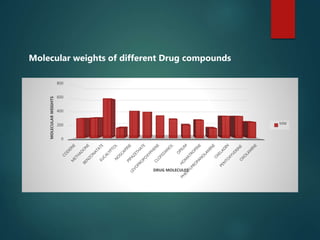
Molecular weights of different Drug compounds
0
200
400
600
800
MOLECULARWEIGHTS
DRUG MOLECULES
MW
0
2
4
6
8
10
12
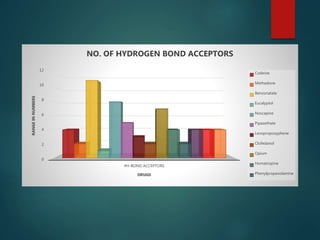
#H-BOND ACCEPTORS
RANGEINNUMBERS
DRUGS
NO. OF HYDROGEN BOND ACCEPTORS
Codeine
Methadone
Benzonatate
Eucalyptol
Noscapine
Pipazethate
Levopropoxyphene
Clofedanol
Opium
Homatropine
Phenylpropanolamine
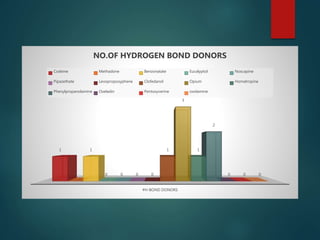
#H-BOND DONORS
1
0
1
0 0 0 0
1
3
1
2
0 0 0
NO.OF HYDROGEN BOND DONORS
Codeine Methadone Benzonatate Eucalyptol Noscapine
Pipazethate Levopropoxyphene Clofedanol Opium Homatropine
Phenylpropanolamine Oxeladin Pentoxyverine oxolamine
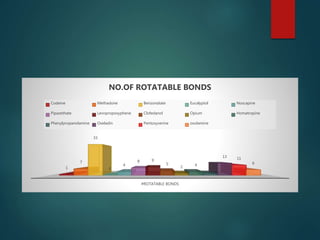
#ROTATABLE BONDS
1
7
33
0
4
8 9
5
2 4 2
13 11
6
NO.OF ROTATABLE BONDS
Codeine Methadone Benzonatate Eucalyptol Noscapine
Pipazethate Levopropoxyphene Clofedanol Opium Homatropine
Phenylpropanolamine Oxeladin Pentoxyverine oxolamine
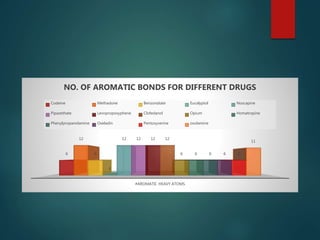
#AROMATIC HEAVY ATOMS
6
12
6
0
12 12 12 12
6 6 6 6 6
11
NO. OF AROMATIC BONDS FOR DIFFERENT DRUGS
Codeine Methadone Benzonatate Eucalyptol Noscapine
Pipazethate Levopropoxyphene Clofedanol Opium Homatropine
Phenylpropanolamine Oxeladin Pentoxyverine oxolamine
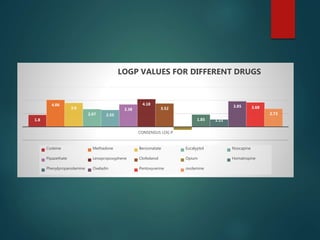
1.8
4.06
3.6
2.67 2.55
3.38
4.18
3.52
-0.46
1.85 1.11
3.85 3.68
2.73
CONSENSUS LOG P
LOGP VALUES FOR DIFFERENT DRUGS
Codeine Methadone Benzonatate Eucalyptol Noscapine
Pipazethate Levopropoxyphene Clofedanol Opium Homatropine
Phenylpropanolamine Oxeladin Pentoxyverine oxolamine
INTRENSIC WATER SOLUBILITY[LOGSW] VALUES FOR DIFFERENT
DRUGS
-10
-8
-6
-4
-2
0
SILICOS-IT LOGSW
-2.76
-6.64
-8.77
-2.45
-5.23
-5.68
-6.77
-5.92
-0.11
-2.53
-1.93
-5.97 -5.71
-5.12
Codeine Methadone Benzonatate Eucalyptol Noscapine
Pipazethate Levopropoxyphene Clofedanol Opium Homatropine
Phenylpropanolamine Oxeladin Pentoxyverine oxolamine
Molecule Lipinski
#violations
Codeine 0
Methadone
0
Benzonatate
2
Eucalyptol
0
Noscapine
0
Pipazethate 0
Levopropoxyphene
1
Clofedanol
0
Opium
0
Homatropine
0
Phenylpropanolamine
0
Oxeladin 0
Pentoxyverine
0
oxolamine 0
0 0
2
0 0 0
1
0 0 0 0 0 0 0
0
0.5
1
1.5
2
2.5
Codeine
Methadone
Benzonatate
Eucalyptol
Noscapine
Pipazethate
Levopropoxyphene
Clofedanol
Opium
Homatropine
Phenylpropanolamine
Oxeladin
Pentoxyverine
oxolamine
LIPINSKI #VIOLATIONS
Lipinski #violations
Molecule log Kp (cm/s)
Codeine -7.32
Methadone
-5.4
Benzonatate
-8.24
Eucalyptol
-5.3
Noscapine
-6.9
Pipazethate -6.33
Levopropoxyphe
ne
-5.4
Clofedanol
-5.53
Opium
-7.52
Homatropine
-6.61
Phenylpropanol
amine
-6.63
Oxeladin -5.52
Pentoxyverine
-5.66
oxolamine -5.76
log Kp (cm/s), -5.76
-9
-8
-7
-6
-5
-4
-3
-2
-1
0
AxisTitle
Axis Title
Liphophilicity
Molecule Bioavailability
Score
Codeine 0.55
Methadone
0.55
Benzonatate
0.17
Eucalyptol
0.55
Noscapine
0.55
Pipazethate 0.55
Levopropoxyp
hene
0.55
Clofedanol
0.55
Opium
0.56
Homatropine
0.55
Phenylpropan
olamine
0.55
Oxeladin 0.55
Pentoxyverine
0.55
oxolamine 0.55
0
0.1
0.2
0.3
0.4
0.5
0.6
Bioavailability Score
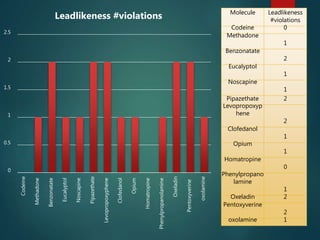
Molecule Leadlikeness
#violations
Codeine 0
Methadone
1
Benzonatate
2
Eucalyptol
1
Noscapine
1
Pipazethate 2
Levopropoxyp
hene
2
Clofedanol
1
Opium
1
Homatropine
0
Phenylpropano
lamine
1
Oxeladin 2
Pentoxyverine
2
oxolamine 1
0
0.5
1
1.5
2
2.5
Codeine
Methadone
Benzonatate
Eucalyptol
Noscapine
Pipazethate
Levopropoxyphene
Clofedanol
Opium
Homatropine
Phenylpropanolamine
Oxeladin
Pentoxyverine
oxolamine
Leadlikeness #violations
Molecule
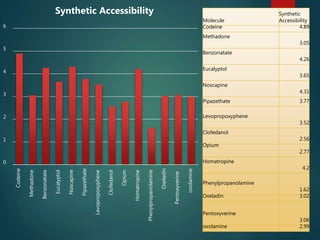
Synthetic
Accessibility
Codeine 4.89
Methadone
3.05
Benzonatate
4.26
Eucalyptol
3.65
Noscapine
4.31
Pipazethate 3.77
Levopropoxyphene
3.52
Clofedanol
2.56
Opium
2.77
Homatropine
4.2
Phenylpropanolamine
1.62
Oxeladin 3.02
Pentoxyverine
3.06
oxolamine 2.99
0
1
2
3
4
5
6
Codeine
Methadone
Benzonatate
Eucalyptol
Noscapine
Pipazethate
Levopropoxyphene
Clofedanol
Opium
Homatropine
Phenylpropanolamine
Oxeladin
Pentoxyverine
oxolamine
Synthetic Accessibility
INTERPRETATION
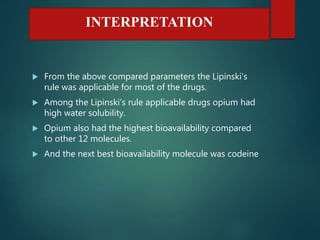
 From the above compared parameters the Lipinski’s
rule was applicable for most of the drugs.
 Among the Lipinski’s rule applicable drugs opium had
high water solubility.
 Opium also had the highest bioavailability compared
to other 12 molecules.
 And the next best bioavailability molecule was codeine
Antitussives drug molecules

Antitussives drug molecules

  • 1.
    ANTITUSSIVES REVIEW I J COMPONENT PHARMACEUTICALBIOTECHNOLOGY SUBMITTED TO: Dr VINO S ASSOCIATE PROFESSOR SBST VIT SUBMITTED BY: TEJASWINI – 18MSM0074 SANDIP HAZRA – 18MSM0090 TANIA CHATTERJEE – 18MSM0094 MRUNAL PALSOKAR – 18MSM0095
  • 2.
     Heterogeneous classof compounds that inhibit cough through either a central or peripheral mechanism; or a mixture of two  Antitussives are thought to work by inhibiting a coordinating region for coughing located in the brain stem, deterring the cough reflex arc  Cough is normally produced through the stimulation of sensory receptors glossopharyngeal and vagus nerves, innervating the mucous membrane of the lower pharynx, larynx, trachea and smaller airways of respiratory system  Receptors then transmit the signal to the cough center in the brain  This then triggers a reflex motor response that results in contraction of the muscles to close the glottis and contraction of the muscles of expiration INTRODUCTION
  • 3.
     The resultis sudden increase in intrathoracic pressure followed by relaxation of vocal cords, resulting in rapid expulsion of air  Centrally acting agents work by inhibiting the cough center in the brain, elevating the threshold for coughing (though the exact mechanism is still poorly understood)  Peripheral acting agents work either by anesthetizing the local nerve endings or acting as demulcents (agents having soothing effect on throat)  Examples:  Centrally acting: dextromethorphan, opiates (codeine)  Peripheral acting: camphor, menthol  Antitussives doesn't have any major side-effects but may cause sleepiness, irritability and dizziness
  • 4.
    Work plan RETRIEVIAL OFANTITUSSIVE COMPOUND ACD CHEMSKETCH OF COMPOUNDS FINDING ADME FEATURES OF MOLECULES INTERPRETATION COMPARETIVE ANALYSIS USING MS EXCEL
  • 5.
     Codeine  Methadone Benzonatate  Oxeladin  Eucalyptol  Noscapine  Pipazethate  Levopropoxyphene  Clofedanol  Opium  Homatropine  Phenylpropanolamine  Oxeladin  Pentoxyverine  Oxolamine ANTITUSSIVE COMPOUNDS
  • 6.
    COMPOUNDS WITH THEIRRESPECTIVE SMILE COMPOUND SMILES Codeine CN1CCC23C4C1CC5=C2C(=C(C=C5)OC)OC3C(C=C4)O Methadone CCC(=O)C(CC(C)N(C)C)(C1=CC=CC=C1)C2=CC=CC=C2 Benzonatate CCCCNC1=CC=C(C=C1)C(=O)OCCOCCOCCOCCOCCOCCOCCOCCOCCOC Oxeladin CCC(CC)(C1=CC=CC=C1)C(=O)OCCOCCN(CC)CC Eucalyptol CC1(C2CCC(O1)(CC2)C)C Noscapine CN1CCC2=CC3=C(C(=C2C1C4C5=C(C(=C(C=C5)OC)OC)C(=O)O4)OC)OCO3 Pipazethate C1CCN(CC1)CCOCCOC(=O)N2C3=CC=CC=C3SC4=C2N=CC=C4 Levopropoxyphene CCC(=O)O[C@@](CC1=CC=CC=C1)(C2=CC=CC=C2)[C@@H](C)CN(C)C Clofedanol CN(C)CCC(C1=CC=CC=C1)(C2=CC=CC=C2Cl)O Opium C1=C(OC(=C(C1=O)O)C(=O)O)C(=O)O Homatropine CN1C2CCC1CC(C2)OC(=O)C(C3=CC=CC=C3)O Phenylpropanolamine CC(C(C1=CC=CC=C1)O)N Oxeladin CCC(CC)(C1=CC=CC=C1)C(=O)OCCOCCN(CC)CC Pentoxyverine CCN(CC)CCOCCOC(=O)C1(CCCC1)C2=CC=CC=C2 Oxolamine CCN(CC)CCC1=NC(=NO1)C2=CC=CC=C2
  • 7.
  • 8.
  • 9.
  • 10.
  • 11.
  • 12.
  • 13.
  • 14.
  • 15.
  • 16.
  • 17.
  • 18.
  • 19.
  • 20.
  • 21.
  • 22.
    Molecular weights ofdifferent Drug compounds 0 200 400 600 800 MOLECULARWEIGHTS DRUG MOLECULES MW
  • 23.
    0 2 4 6 8 10 12 #H-BOND ACCEPTORS RANGEINNUMBERS DRUGS NO. OFHYDROGEN BOND ACCEPTORS Codeine Methadone Benzonatate Eucalyptol Noscapine Pipazethate Levopropoxyphene Clofedanol Opium Homatropine Phenylpropanolamine
  • 24.
    #H-BOND DONORS 1 0 1 0 00 0 1 3 1 2 0 0 0 NO.OF HYDROGEN BOND DONORS Codeine Methadone Benzonatate Eucalyptol Noscapine Pipazethate Levopropoxyphene Clofedanol Opium Homatropine Phenylpropanolamine Oxeladin Pentoxyverine oxolamine
  • 25.
    #ROTATABLE BONDS 1 7 33 0 4 8 9 5 24 2 13 11 6 NO.OF ROTATABLE BONDS Codeine Methadone Benzonatate Eucalyptol Noscapine Pipazethate Levopropoxyphene Clofedanol Opium Homatropine Phenylpropanolamine Oxeladin Pentoxyverine oxolamine
  • 26.
    #AROMATIC HEAVY ATOMS 6 12 6 0 1212 12 12 6 6 6 6 6 11 NO. OF AROMATIC BONDS FOR DIFFERENT DRUGS Codeine Methadone Benzonatate Eucalyptol Noscapine Pipazethate Levopropoxyphene Clofedanol Opium Homatropine Phenylpropanolamine Oxeladin Pentoxyverine oxolamine
  • 27.
    1.8 4.06 3.6 2.67 2.55 3.38 4.18 3.52 -0.46 1.85 1.11 3.853.68 2.73 CONSENSUS LOG P LOGP VALUES FOR DIFFERENT DRUGS Codeine Methadone Benzonatate Eucalyptol Noscapine Pipazethate Levopropoxyphene Clofedanol Opium Homatropine Phenylpropanolamine Oxeladin Pentoxyverine oxolamine
  • 28.
    INTRENSIC WATER SOLUBILITY[LOGSW]VALUES FOR DIFFERENT DRUGS -10 -8 -6 -4 -2 0 SILICOS-IT LOGSW -2.76 -6.64 -8.77 -2.45 -5.23 -5.68 -6.77 -5.92 -0.11 -2.53 -1.93 -5.97 -5.71 -5.12 Codeine Methadone Benzonatate Eucalyptol Noscapine Pipazethate Levopropoxyphene Clofedanol Opium Homatropine Phenylpropanolamine Oxeladin Pentoxyverine oxolamine
  • 29.
    Molecule Lipinski #violations Codeine 0 Methadone 0 Benzonatate 2 Eucalyptol 0 Noscapine 0 Pipazethate0 Levopropoxyphene 1 Clofedanol 0 Opium 0 Homatropine 0 Phenylpropanolamine 0 Oxeladin 0 Pentoxyverine 0 oxolamine 0 0 0 2 0 0 0 1 0 0 0 0 0 0 0 0 0.5 1 1.5 2 2.5 Codeine Methadone Benzonatate Eucalyptol Noscapine Pipazethate Levopropoxyphene Clofedanol Opium Homatropine Phenylpropanolamine Oxeladin Pentoxyverine oxolamine LIPINSKI #VIOLATIONS Lipinski #violations
  • 30.
    Molecule log Kp(cm/s) Codeine -7.32 Methadone -5.4 Benzonatate -8.24 Eucalyptol -5.3 Noscapine -6.9 Pipazethate -6.33 Levopropoxyphe ne -5.4 Clofedanol -5.53 Opium -7.52 Homatropine -6.61 Phenylpropanol amine -6.63 Oxeladin -5.52 Pentoxyverine -5.66 oxolamine -5.76 log Kp (cm/s), -5.76 -9 -8 -7 -6 -5 -4 -3 -2 -1 0 AxisTitle Axis Title Liphophilicity
  • 31.
    Molecule Bioavailability Score Codeine 0.55 Methadone 0.55 Benzonatate 0.17 Eucalyptol 0.55 Noscapine 0.55 Pipazethate0.55 Levopropoxyp hene 0.55 Clofedanol 0.55 Opium 0.56 Homatropine 0.55 Phenylpropan olamine 0.55 Oxeladin 0.55 Pentoxyverine 0.55 oxolamine 0.55 0 0.1 0.2 0.3 0.4 0.5 0.6 Bioavailability Score
  • 32.
    Molecule Leadlikeness #violations Codeine 0 Methadone 1 Benzonatate 2 Eucalyptol 1 Noscapine 1 Pipazethate2 Levopropoxyp hene 2 Clofedanol 1 Opium 1 Homatropine 0 Phenylpropano lamine 1 Oxeladin 2 Pentoxyverine 2 oxolamine 1 0 0.5 1 1.5 2 2.5 Codeine Methadone Benzonatate Eucalyptol Noscapine Pipazethate Levopropoxyphene Clofedanol Opium Homatropine Phenylpropanolamine Oxeladin Pentoxyverine oxolamine Leadlikeness #violations
  • 33.
    Molecule Synthetic Accessibility Codeine 4.89 Methadone 3.05 Benzonatate 4.26 Eucalyptol 3.65 Noscapine 4.31 Pipazethate 3.77 Levopropoxyphene 3.52 Clofedanol 2.56 Opium 2.77 Homatropine 4.2 Phenylpropanolamine 1.62 Oxeladin3.02 Pentoxyverine 3.06 oxolamine 2.99 0 1 2 3 4 5 6 Codeine Methadone Benzonatate Eucalyptol Noscapine Pipazethate Levopropoxyphene Clofedanol Opium Homatropine Phenylpropanolamine Oxeladin Pentoxyverine oxolamine Synthetic Accessibility
  • 34.
    INTERPRETATION  From theabove compared parameters the Lipinski’s rule was applicable for most of the drugs.  Among the Lipinski’s rule applicable drugs opium had high water solubility.  Opium also had the highest bioavailability compared to other 12 molecules.  And the next best bioavailability molecule was codeine