ANTICONVULSANTDRUGS
BY ZEENATHALI
SHAHULA HUSSAIN
IKRAAM ADNAN
Pharmacology
May2020 diploma nursing
OBJECTIVES
◦ INTRODUCTION
◦ DISEASE SPOTLIGHT
◦ CLASSIFICATION OF CONVULSION
◦ MACHANISM OF ANTICONVULSANT
◦ CLASSIFICATION OF ANTICONVULSANT DRUGS
◦ CONTRAINDICATIONS
◦ ADVERSE EFFECTS OF CONVULSTANTS
◦ DOSAGE AND DILUTION
◦ NURSES PRECAUTION AND RESPONSIBILITIES
◦ CONCLUSION
INTRODUCTION
◦ Anticonvulsants (also known as antiepileptic or as antiseizure) are
drugs used to manage epilepsy, the most prevalent neurological
disorder.
◦ Anticonvulsant agents of choice depends on the type of
convulsion, age of the patient, patient tolerance, and specific
patient characteristics
DISEASE SPOTLIGHT: CONVULSION
◦ CONVULSION is a collection of different syndromes, all of which is characterized
by sudden discharge of excessive electrical energy from nerve cells located
within the brain.
◦ Nature of convulsion depend on the location of the cells that initiate the
electrical discharge as well as the neutral pathways which were stimulated.
◦ Convulsion can be PRIMARY (No underlying cause) or SECONDARY (brought
about by external factors like head injury)
DISEASE SPOTLIGHT: Epilepsy
◦ Epileptic Seizure is paroxysmal discharge of cereberal neurons associated with a
clinical event apparent to an observer or, as an abnormal sensation perceived
bythe patient.
◦ Epilepsy affects 0.5% of the population
◦ It is characterized by recurrent seizures
CLASSIFICATION OF CONVULSION
Primary generalized seizure the abnormal
electrical discharges originate from the
diencephalic activating system and spread
simultaneously to all areas of brain
Partial seizure originates from a
paroxysmal discharge in a focal area
of cerebral cortex (temporal lobe)
CLASSIFICATION OF CONVULSION
GENERARIZED CONVULSION
◦ Tonic - clonic convulsion – it involves involuntary muscle
contraction (tonic) followed by relaxation appearing as an
aggressive spasm (clonic)
◦ Absence convulsion – it is an abrupt and brief period of loss of
consciousness.
◦ Myoclonic convulsion- it is short, sporadic period of muscle
contractions that last for several minutes.
◦ Febrile convulsion-self limited related to high grade fever
◦ Jacksonian convulsion –begin in one area of the brain and
involve only one part of the body but this later on spread to
other parts until a generalized tonic clonic convulsion has
developed.
PARTIAL (FOCAL) CONVULSION
◦ Simple partial convulsion- It occurs in a single
area of the brain and may involve a single
muscle movement or sensory alteration.
◦ Complex partial convulsion- it is a type which
occurs by late teenage years and involves a
series of reactions or emotional changes and
complex sensory changes.
MACHANISM OF ANTICONVULSANTS
◦ Drugs used for treatment of convulsion exert their therapeutic
effects by blocking channels in the cell membrane or by altering
their receptor sites.
◦ As a result, nerve membrane become stabilized
◦ Their work involves the entire nervous system
◦ So sedation is an expected result
Classification of anticonvulsant drugs
◦ 1. HYDANTOINS
It is used to treat partial and generalized tonic – clonic seizures and
prevention of seizers during neurosurgery.
◦ E.g: fosoline (fosphenytoin ),phenytoin (epsolin.eptoin)
◦ Route – Oral or IV
◦ Metabolism in liver and excrete through the kidney (urine)
Classification of anticonvulsant drugs
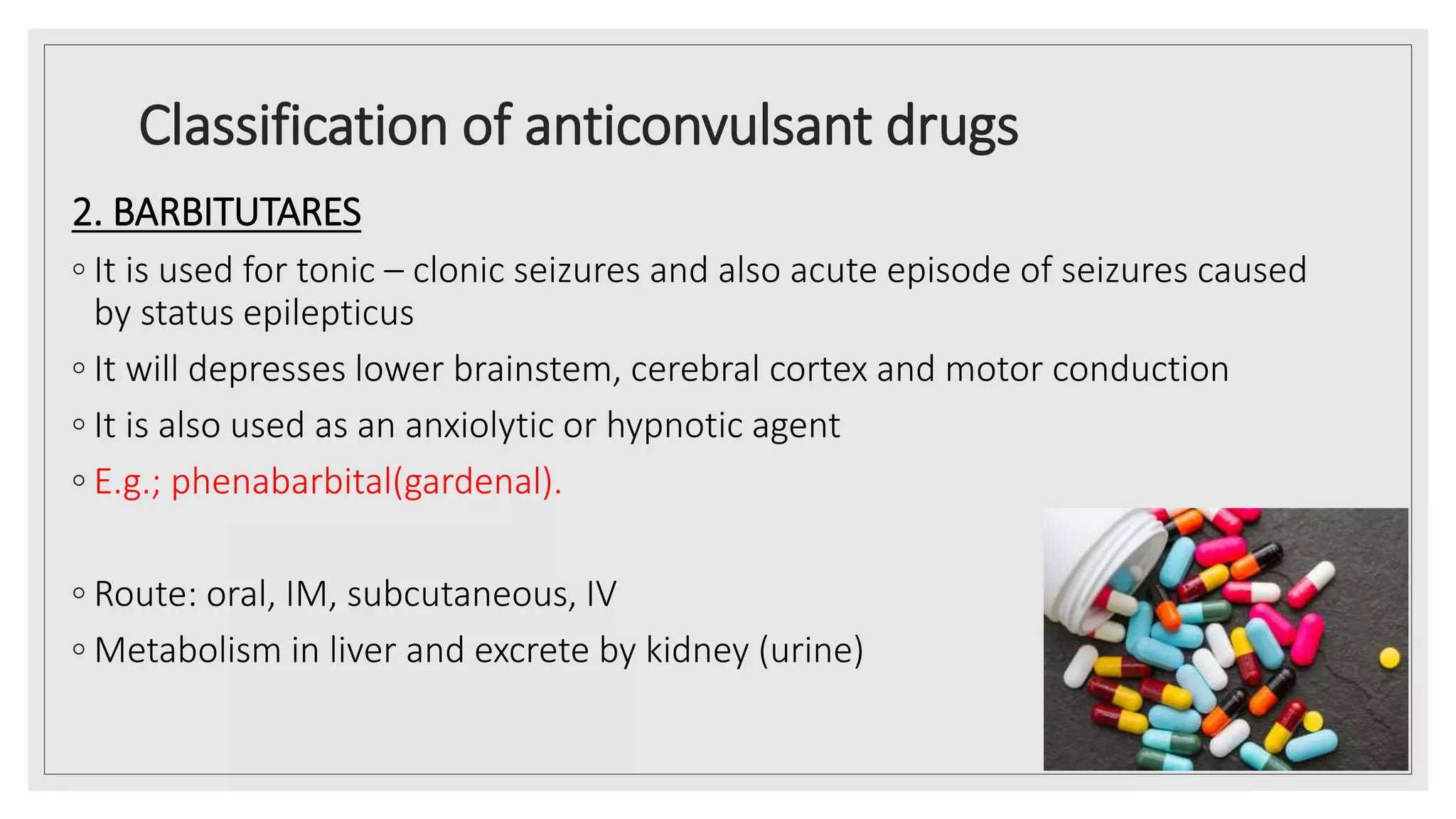
2. BARBITUTARES
◦ It is used for tonic – clonic seizures and also acute episode of seizures caused
by status epilepticus
◦ It will depresses lower brainstem, cerebral cortex and motor conduction
◦ It is also used as an anxiolytic or hypnotic agent
◦ E.g.; phenabarbital(gardenal).
◦ Route: oral, IM, subcutaneous, IV
◦ Metabolism in liver and excrete by kidney (urine)
Classification of anticonvulsant drugs
3. BENZODIAZEPINES
◦ It is used to treat myoclonic seizures and status epilepticus
◦ It can be used as agent to relieve anxiety before operative interventions
◦ E.g.; lorazepam ,diazepam
◦ route: oral, IM, IV, rectal
◦ Metabolism in liver and excrete by kidney (urine)
Classification of anticonvulsant drugs
4. SUCCINIMIDES
Used to treat absence seizers and reduction of frequency of attacks
Eg: phensuximide, paramethadione
Route: oral
Metabolism in liver and excrete through the kidney (urine) and liver (bile)
CONTRAINDICATIONS
◦ Anticonvulsant medication should be used with
caution for those patients who is on treatment of
anticoagulant like aspirin and those who are
hypersensitivity reaction to drugs.
ADVERSE EFFECTS OF CONVULSTANTS
◦ CNS: depression, confusion, drowsiness, lethargy, fatigue
◦ CV: arrythmias, changes in blood pressure
◦ GI: constipation, dry mouth, anorexia
◦ GU: urinary retention, loss of ilibido
◦ Gum hypertrophy
◦ Hirsutism
◦ Hypersensitivity reactions
◦ Hyper glycemia
DOSAGE AND DILUTION
◦ Dose 20-30mg per kilogram
◦ Anticonvulsant medication must dilute in
100ml normal saline or ringer lactate (RL) OR
5% DEXTROSE
◦ Anticonvulsant medication must be given
over 15-20 minutes .
Nurses precautions and responsibilities
◦ Follow ten rights of medication(what are they?
◦ Monitor for side effects
◦ Initiate seizures
◦ Monitor urine out put
◦ Monitor vital signs and record it accordingly
◦ Monitor renal and liver functions
◦ Watch for side effects
◦ Protect patient environment from hazards and surroundings
◦ Listen to the patient carefully and take extra precaution if required
Nurses responsibilities cont…
◦ When administering phenytoin iv dilute in Normal saline because dextrose causes the medication precipitation
◦ Monitor drug toxicity
◦ Administer phenytoin by intravenously very slowly between 25-30mg/minutes
◦ Advice patient to take medication with milk to prevent gastrointestinal irritation
◦ Advice to wear medic alert bracelet
◦ Watch for adverse drug reactions.
CONCLUSION
◦ Choice of drug and dose according to type of convulsion and need of individual patients
◦ Initiate treatment early starting with low dose and gradually increase it.
◦ Withdrawal can cause increased seiuzre frequency and severity
◦ In general, barbiturate and benzodiazepines are the most difficult to discontinue
◦ If a patient is convulsion free for 3-4 years, gradual discontinuance might be considered
References
S., B., M.,2019. Anti-Convulsant Drugs. [online]
Available at: https://www.webmd.com/bipolar-disorder/guide/anticonvulsant-medication
[accessed 28 February 2021].
https://www.slideshare.net/johnywilbert/anticonvulsive-
medication
Anticonvulsant drugs

Anticonvulsant drugs

  • 1.
    ANTICONVULSANTDRUGS BY ZEENATHALI SHAHULA HUSSAIN IKRAAMADNAN Pharmacology May2020 diploma nursing
  • 2.
    OBJECTIVES ◦ INTRODUCTION ◦ DISEASESPOTLIGHT ◦ CLASSIFICATION OF CONVULSION ◦ MACHANISM OF ANTICONVULSANT ◦ CLASSIFICATION OF ANTICONVULSANT DRUGS ◦ CONTRAINDICATIONS ◦ ADVERSE EFFECTS OF CONVULSTANTS ◦ DOSAGE AND DILUTION ◦ NURSES PRECAUTION AND RESPONSIBILITIES ◦ CONCLUSION
  • 3.
    INTRODUCTION ◦ Anticonvulsants (alsoknown as antiepileptic or as antiseizure) are drugs used to manage epilepsy, the most prevalent neurological disorder. ◦ Anticonvulsant agents of choice depends on the type of convulsion, age of the patient, patient tolerance, and specific patient characteristics
  • 4.
    DISEASE SPOTLIGHT: CONVULSION ◦CONVULSION is a collection of different syndromes, all of which is characterized by sudden discharge of excessive electrical energy from nerve cells located within the brain. ◦ Nature of convulsion depend on the location of the cells that initiate the electrical discharge as well as the neutral pathways which were stimulated. ◦ Convulsion can be PRIMARY (No underlying cause) or SECONDARY (brought about by external factors like head injury)
  • 5.
    DISEASE SPOTLIGHT: Epilepsy ◦Epileptic Seizure is paroxysmal discharge of cereberal neurons associated with a clinical event apparent to an observer or, as an abnormal sensation perceived bythe patient. ◦ Epilepsy affects 0.5% of the population ◦ It is characterized by recurrent seizures
  • 6.
    CLASSIFICATION OF CONVULSION Primarygeneralized seizure the abnormal electrical discharges originate from the diencephalic activating system and spread simultaneously to all areas of brain Partial seizure originates from a paroxysmal discharge in a focal area of cerebral cortex (temporal lobe)
  • 7.
    CLASSIFICATION OF CONVULSION GENERARIZEDCONVULSION ◦ Tonic - clonic convulsion – it involves involuntary muscle contraction (tonic) followed by relaxation appearing as an aggressive spasm (clonic) ◦ Absence convulsion – it is an abrupt and brief period of loss of consciousness. ◦ Myoclonic convulsion- it is short, sporadic period of muscle contractions that last for several minutes. ◦ Febrile convulsion-self limited related to high grade fever ◦ Jacksonian convulsion –begin in one area of the brain and involve only one part of the body but this later on spread to other parts until a generalized tonic clonic convulsion has developed. PARTIAL (FOCAL) CONVULSION ◦ Simple partial convulsion- It occurs in a single area of the brain and may involve a single muscle movement or sensory alteration. ◦ Complex partial convulsion- it is a type which occurs by late teenage years and involves a series of reactions or emotional changes and complex sensory changes.
  • 8.
    MACHANISM OF ANTICONVULSANTS ◦Drugs used for treatment of convulsion exert their therapeutic effects by blocking channels in the cell membrane or by altering their receptor sites. ◦ As a result, nerve membrane become stabilized ◦ Their work involves the entire nervous system ◦ So sedation is an expected result
  • 9.
    Classification of anticonvulsantdrugs ◦ 1. HYDANTOINS It is used to treat partial and generalized tonic – clonic seizures and prevention of seizers during neurosurgery. ◦ E.g: fosoline (fosphenytoin ),phenytoin (epsolin.eptoin) ◦ Route – Oral or IV ◦ Metabolism in liver and excrete through the kidney (urine)
  • 10.
    Classification of anticonvulsantdrugs 2. BARBITUTARES ◦ It is used for tonic – clonic seizures and also acute episode of seizures caused by status epilepticus ◦ It will depresses lower brainstem, cerebral cortex and motor conduction ◦ It is also used as an anxiolytic or hypnotic agent ◦ E.g.; phenabarbital(gardenal). ◦ Route: oral, IM, subcutaneous, IV ◦ Metabolism in liver and excrete by kidney (urine)
  • 11.
    Classification of anticonvulsantdrugs 3. BENZODIAZEPINES ◦ It is used to treat myoclonic seizures and status epilepticus ◦ It can be used as agent to relieve anxiety before operative interventions ◦ E.g.; lorazepam ,diazepam ◦ route: oral, IM, IV, rectal ◦ Metabolism in liver and excrete by kidney (urine)
  • 12.
    Classification of anticonvulsantdrugs 4. SUCCINIMIDES Used to treat absence seizers and reduction of frequency of attacks Eg: phensuximide, paramethadione Route: oral Metabolism in liver and excrete through the kidney (urine) and liver (bile)
  • 13.
    CONTRAINDICATIONS ◦ Anticonvulsant medicationshould be used with caution for those patients who is on treatment of anticoagulant like aspirin and those who are hypersensitivity reaction to drugs.
  • 14.
    ADVERSE EFFECTS OFCONVULSTANTS ◦ CNS: depression, confusion, drowsiness, lethargy, fatigue ◦ CV: arrythmias, changes in blood pressure ◦ GI: constipation, dry mouth, anorexia ◦ GU: urinary retention, loss of ilibido ◦ Gum hypertrophy ◦ Hirsutism ◦ Hypersensitivity reactions ◦ Hyper glycemia
  • 15.
    DOSAGE AND DILUTION ◦Dose 20-30mg per kilogram ◦ Anticonvulsant medication must dilute in 100ml normal saline or ringer lactate (RL) OR 5% DEXTROSE ◦ Anticonvulsant medication must be given over 15-20 minutes .
  • 16.
    Nurses precautions andresponsibilities ◦ Follow ten rights of medication(what are they? ◦ Monitor for side effects ◦ Initiate seizures ◦ Monitor urine out put ◦ Monitor vital signs and record it accordingly ◦ Monitor renal and liver functions ◦ Watch for side effects ◦ Protect patient environment from hazards and surroundings ◦ Listen to the patient carefully and take extra precaution if required
  • 17.
    Nurses responsibilities cont… ◦When administering phenytoin iv dilute in Normal saline because dextrose causes the medication precipitation ◦ Monitor drug toxicity ◦ Administer phenytoin by intravenously very slowly between 25-30mg/minutes ◦ Advice patient to take medication with milk to prevent gastrointestinal irritation ◦ Advice to wear medic alert bracelet ◦ Watch for adverse drug reactions.
  • 18.
    CONCLUSION ◦ Choice ofdrug and dose according to type of convulsion and need of individual patients ◦ Initiate treatment early starting with low dose and gradually increase it. ◦ Withdrawal can cause increased seiuzre frequency and severity ◦ In general, barbiturate and benzodiazepines are the most difficult to discontinue ◦ If a patient is convulsion free for 3-4 years, gradual discontinuance might be considered
  • 19.
    References S., B., M.,2019.Anti-Convulsant Drugs. [online] Available at: https://www.webmd.com/bipolar-disorder/guide/anticonvulsant-medication [accessed 28 February 2021]. https://www.slideshare.net/johnywilbert/anticonvulsive- medication