Anticoagulant and
Thrombolytic Drugs
Presented by
Rph/ Sara Saber
Clinical pharmacy diploma
Slide Title
• Hemostasis and thrombosis.
• Discuss the uses, general drug actions, adverse reactions, contraindications,
precautions, and interactions of warfarin, heparin preparations,
and the thrombolytic drugs.
• Preadministration and ongoing assessment activities the nurse should perform on
the patient taking an anticoagulant or thrombolytic drug.
• Ways to promote an optimal response to therapy
• Management common adverse reactions, and important points to keep in
mind when educating patients about the use of an anticoagulant or
thrombolytic drug.
HEMOSTASIS
• Is the process that stops bleeding in a
blood vessel.
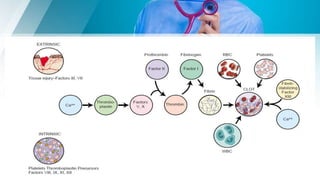
• Normal hemostasis involves a complex
process of extrinsic and intrinsic factors.
THROMBOSIS
• Is the formation of a clot.
• A thrombus may form in any vessel, artery, or vein when blood
flow is impeded. For example, a venous thrombus can develop as
the result of venous stasis (decreased blood flow), injury to the
vessel wall, or altered blood coagulation.
• Arterial thrombosis can occur because of atherosclerosis or
arrhythmias, such as atrial fibrillation.
• Deep vein thrombosis (DVT) occurs in the lower extremities and
is the most common type of venous thrombosis.
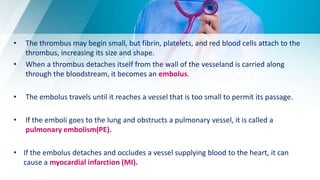
• The thrombus may begin small, but fibrin, platelets, and red blood cells attach to the
thrombus, increasing its size and shape.
• When a thrombus detaches itself from the wall of the vesseland is carried along
through the bloodstream, it becomes an embolus.
• The embolus travels until it reaches a vessel that is too small to permit its passage.
• If the emboli goes to the lung and obstructs a pulmonary vessel, it is called a
pulmonary embolism(PE).
• If the embolus detaches and occludes a vessel supplying blood to the heart, it can
cause a myocardial infarction (MI).
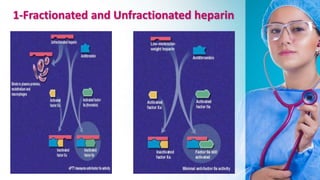
1-Fractionated and Unfractionated heparin
Actions
• Heparin inhibits the formation of fibrin clots, inhibits the conversion of fibrinogen to
fibrin, and inactivates several of the factors necessary for the clotting of blood.
• Heparin cannot be taken orally because it is inactivated by gastric acid in the stomach;
therefore, it must be given by injection.
• The LMWHs act to inhibit clotting reactions by binding to antithrombin III, which
inhibits the synthesis of factor Xa and the formation of thrombin.
Uses
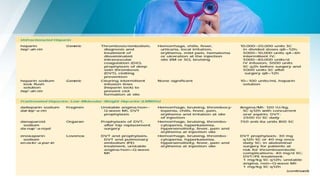
Heparin is used for:
• Prevention and treatment of venous thrombosis, PE.
• Atrial fibrillation with embolus formation.
• Prevention of postoperative venous thrombosis(DVT) and PE in certain patients
undergoing surgical procedures, such as major abdominal surgery Prevention of clotting in
arterial and heart surgery, in blood transfusions and dialysis procedures, and in blood
samples for laboratory purposes
• Prevention of a repeat cerebral thrombosis in some patients who have experienced a
stroke
• Treatment of coronary occlusion, acute MI, and peripheral arterial embolism
• Prevention of clotting in equipment used for extracorporeal(occurring outside the body)
circulation
• Maintenance of patency of IV catheters (very lowdoses of 10 to 100 units [U]).
Adverse reactions
• Hemorrhage is the chief complication of heparin administration.
Hemorrhage can range from minor local bruising to major hemorrhaging from
any organ.
• Thrombocytopenia (low levels of platelets in the blood)
• Hypersensitivity reactions include an asthma-like reaction and an anaphylactoid
reaction.
• The LMWHs cause fewer adverse reactions than heparin.
• Bleeding related to the LMWHs is possible but has generally been low.
Contraindications
• Patients with known hypersensitivity to the drug, active bleeding
• hemorrhagic disorders, severe thrombocytopenia, or recent surgery (except for the
LMWHs used after certain surgical procedures to prevent thromboembolic
complications)
• During pregnancy (Pregnancy Category C).
• The LMWHs are contraindicated in patients with a Hypersensitivity to the drug,
heparin, or pork products and inpatients with active bleeding or thrombocytopenia
Precautions
LMWHs are used with caution in patients who are at increased risk of hemorrhage, such
as those with severer uncontrolled hypertension, diabetic retinopathy, bacterial
endocarditis, congenital or acquired bleeding disorders, GI disease, or hemorrhagic stroke
and shortly after brain, spinal, or ophthalmological surgery.
N U R S I N G P R O C E S S
ASSESSMENT
Preadministration Assessment
Before administering the first dose of heparin, the nurseobtains the patient’s
vital signs.
• The most commonly used test to monitor heparin is activated partial
thromboplastin time (APTT).
Ongoing Assessment
• The ongoing assessment of a patient receiving heparin requires close
observation and careful monitoring.
• The dosage of heparin is adjusted according to daily APTT monitoring.
• A therapeutic dosage is attained when the APTT is 1.5 to 2.5 times the
normal.
• The LMWHs have little or no effect on the APTT values.
• Periodic platelet counts, hematocrit, and tests for occult blood in the stool
should be performed throughout the entire course of heparin therapy
Promoting an Optimal Response to Therapy
• Heparin preparations, unlike warfarin, must be given by the parenteral route, preferably SC or IV
Intramuscular administration is avoided because of the possibility of the development of local
irritation, pain, or hematoma (a collection of blood in the tissue).
• The onset of anticoagulation is almost immediate after a single dose. Maximum effects occur
within 10 minutes of administration.
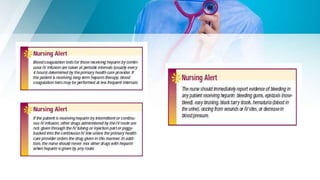
• Clotting time will return to normal within 4 hours unless subsequent doses are given
• Blood coagulation tests are usually ordered before and during heparin therapy, and the dose of
heparin is adjusted to the test results
Administering the low-molecular-weight heparin.
• The LMWHs are administered by the SC route only
• The first dose of enoxaparin is administered via the SC route within the first 12 to 24 hours after
surgery and continued for 7 to 10 days.
• When enoxaparin is administered in patients having abdominal surgery, the first dose is via the
SC route 2 hours before surgery and as long as 12 days after surgery.
• The nurse gives these drugs deep into the SC tissue in the abdomen (avoiding the navel) with
the site rotated at the time of each injection
1-Coumadin derivatives
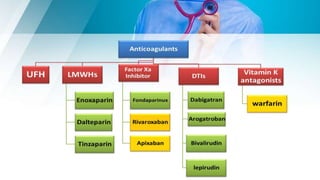
• Warfarin a coumarin derivative, is the oral
anticoagulant most commonly prescribed
• It is the drug of choice for patients requiring long-term
• therapy with an anticoagulant. Peak activity is reached
1.5 to 3 days after therapy is initiated.
• All anticoagulants interfere with the clotting
mechanism of the blood.
• Warfarin interfere with the manufacturing of vitamin K-
dependent clotting factors.
USES
Warfarin is used for:
• Prevention (prophylaxis) and treatment of DVT
• Prevention and treatment of atrial fibrillation with embolization
• Prevention and treatment of PE
• As part of the treatment of MI
• Prevention of thrombus formation after valve replacement
Adverse reactions
• The principal adverse reaction associated with warfarin is bleeding, which may range
from very mild to severe.
• Bleeding may be seen in many areas of the body, such as the bladder, bowel, stomach,
uterus, and mucous membranes.
• Other adverse reactions are rare but may include nausea, vomiting, alopecia (loss
of hair), urticaria (severe skin rash), abdominal cramping, diarrhea, rash, hepatitis
(inflammation of the liver), jaundice (yellowish discoloration of the skin
and mucous membranes
Interactions
The effects of warfarin may increase when administered with
acetaminophen, NSAIDs, beta blockers, disulfiram, isoniazid, chloral hydrate, loop diuretics,
aminoglycosides, cimetidine, tetracyclines, and cephalosporins.
Oral contraceptives, ascorbic acid, barbiturates, diuretics, and vitamin K decrease the
effects of warfarin.
Because the effects of warfarin are influenced by many drugs, the patient must notify the
nurse or the primary health care provider when taking a new drug or discontinuing
Precautions
Warfarin is used cautiously in patients with fever, heart failure, diarrhea, malignancy,
hypertension, renal or hepatic disease, psychoses, or depression.
Women of childbearing age must use a reliable contraceptive to prevent pregnancy.
N U R S I N G P R O C E S S
ASSESSMENT
Preadministration Assessment
• Before administering the first dose of warfarin, the nurse questions the patient
about all drugs taken during
the previous 2 to 3 weeks (if the patient was recently admitted to the
hospital).
• If the patient took any drugs before admission, the nurse notifies the primary
health care provider before the first dose is
administered.
• Usually, the prothrombin time (PT) is ordered and the international normalized
ratio (INR) determined before therapy is started.
• The first dose of warfarin is not given until blood for a baseline PT/INR is
drawn.
• The dosage is individualized based on the results of the PT or the INR.
N U R S I N G P R O C E S S
Ongoing Assessment
• During the course of therapy, the nurse continually
assesses the patient for any signs of bleeding and hemorrhage.
Areas of assessment include the gums, nose, stools, urine, or
nasogastric drainage.
• Patients receiving warfarin for the first time often
require daily adjustment of the dose, which is based on
the daily PT/INR results. The nurse withholds the drug
and notifies the primary health care provider if the PT
exceeds 1.2 to 1.5 times the control value or the INR
ratio exceeds 3.
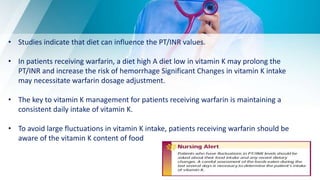
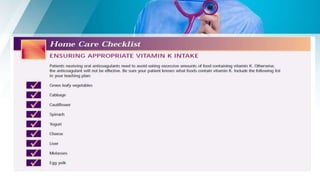
• Studies indicate that diet can influence the PT/INR values.
• In patients receiving warfarin, a diet high A diet low in vitamin K may prolong the
PT/INR and increase the risk of hemorrhage Significant Changes in vitamin K intake
may necessitate warfarin dosage adjustment.
• The key to vitamin K management for patients receiving warfarin is maintaining a
consistent daily intake of vitamin K.
• To avoid large fluctuations in vitamin K intake, patients receiving warfarin should be
aware of the vitamin K content of food
Monitoring and Managing Adverse Drug Reactions
1-inspect the urine for a pink to red color and the stool for signs of GI bleeding
(bright red to black stools).
2-Visuallycheck the nasogastric suction unit
3-Skin, mucous membranes—Inspect the patient’s skin daily for evidence of easy
bruising or bleeding.
Be alert for bleeding from minor cuts and scratches, nosebleeds, or excessive
bleeding after intramuscular(IM), subcutaneous (SC), or intravenous (IV) injections or
after a venipuncture. After oral care, check the toothbrush and gums for signs of
bleeding
Educating the Patient and Family
The nurse should include the following points in a patient
and family teaching plan:
• Follow the dosage schedule prescribed by the primary health
care provider.
• The PT or INR will be monitored periodically.
• Do not take or stop taking other drugs except on the advice
of the primary health care provider.
• Inform the dentist or other primary health care providers of
therapy with this drug before any treatment or procedure is
started or drugs are
• prescribed.
• Take the drug at the same time each day.
• Do not change brands of anticoagulants withoutc onsulting a
physician or pharmacist.
• Avoid alcohol unless use has been approved by the primary health
care provider.
• Advise the patient to limit foods high in vitamin K, such as leafy green
vegetables, beans, broccoli, cabbage, cauliflower.
• If evidence of bleeding should occur, such as unusual bleeding or
bruising, bleeding gums, blooding the urine or stool, black stool, or
diarrhea, omit
the next dose of the drug and contact the primary health care
provider immediately.
• Use a soft toothbrush and consult a dentist regarding routine oral
hygiene, including the use of dental floss.
• Use an electric razor when possible to avoid small skin cuts.
• Women of childbearing age must use a reliable contraceptive to
prevent pregnancy
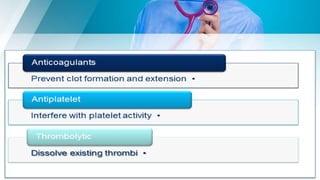
Thrombolytic drugs
• Thrombolytics are a group of drugs used to
dissolve certain types of blood clots and reopen
blood vessels after they have been occluded.
• Examples of thrombolytics include alteplase*
recombinant (Activase), reteplaserecombinant
(Retavase), streptokinase (Streptase),
tenecteplase (TNKase), and urokinase
(Abbokinase).
ACTIONS
These drugs break down fibrin clots by converting plasminogen to plasmin
(fibrinolysin).
Plasmin is an enzyme that breaks down the fibrin of a blood clot.
USES
• Treat an acute MI by lysing (dissolving) a blood clot in a coronary artery.
• Effective in lysing clots causing PE and DVT.
ADVERSE REACTIONS
Thrombolytic drugs are contraindicated in patients with known hypersensitivity, active
bleeding, history of stroke, aneurysm, and recent intracranial surgery.
N U R S I N G P R O C E S S
Preadministration Assessment
• Identifies any history of bleeding tendencies, heart disease,
or allergic reactions to any drugs.
• history of any drugs currently being taken is obtained.
• Initial patient assessments include vital signs and a review of
the diagnostic tests performed to establish a diagnosis.
• Most of these patients are admitted or transferred to an
intensive care unit because close monitoring.
Ongoing Assessment
• The most important aspect of the ongoing assessment is the
possibility of bleeding.
• The nurse must assess the patient for bleeding every 15 minutes
during the first 60 minutes of therapy, every 15 to 30 minutes for
the next 8 hours, and at least every 4 hours until therapy is
completed.
• The nurse must continually assess the patient for anaphylactic
reactions (difficulty breathing, wheezing, fever, swelling around
the eyes, hives, or itching) particularly with anistreplase or
streptokinase.
• Keep the resuscitation equipment is immediately available.
Promoting an Optimal Response to Therapy
For optimal therapeutic effect the thrombolytic drugs are used as soon as possible after the formation of a
thrombus,
preferably within 4 to 6 hours or as soon as possible after the symptoms are identified
The greatest benefit in mortality is seen when the drugs are administered
within 4 hours.
These drugs are available in powder form and must be reconstituted
according to the directions in the package insert.
Tenecteplase (TNKase) is the first thrombolytic drug that can be administered during a period of 5 seconds
in a single dose.
The drug is administered intravenously only and offers the fastest administration of a thrombolytic
in the treatment of an acute MI.
Specific instructions
for reconstitution come with the drug. The drug is
reconstituted immediately before use because it contains
no antibacterial preservatives
Anticoaglant

Anticoaglant

  • 1.
    Anticoagulant and Thrombolytic Drugs Presentedby Rph/ Sara Saber Clinical pharmacy diploma
  • 2.
    Slide Title • Hemostasisand thrombosis. • Discuss the uses, general drug actions, adverse reactions, contraindications, precautions, and interactions of warfarin, heparin preparations, and the thrombolytic drugs. • Preadministration and ongoing assessment activities the nurse should perform on the patient taking an anticoagulant or thrombolytic drug. • Ways to promote an optimal response to therapy • Management common adverse reactions, and important points to keep in mind when educating patients about the use of an anticoagulant or thrombolytic drug.
  • 3.
    HEMOSTASIS • Is theprocess that stops bleeding in a blood vessel. • Normal hemostasis involves a complex process of extrinsic and intrinsic factors.
  • 5.
    THROMBOSIS • Is theformation of a clot. • A thrombus may form in any vessel, artery, or vein when blood flow is impeded. For example, a venous thrombus can develop as the result of venous stasis (decreased blood flow), injury to the vessel wall, or altered blood coagulation. • Arterial thrombosis can occur because of atherosclerosis or arrhythmias, such as atrial fibrillation. • Deep vein thrombosis (DVT) occurs in the lower extremities and is the most common type of venous thrombosis.
  • 6.
    • The thrombusmay begin small, but fibrin, platelets, and red blood cells attach to the thrombus, increasing its size and shape. • When a thrombus detaches itself from the wall of the vesseland is carried along through the bloodstream, it becomes an embolus. • The embolus travels until it reaches a vessel that is too small to permit its passage. • If the emboli goes to the lung and obstructs a pulmonary vessel, it is called a pulmonary embolism(PE). • If the embolus detaches and occludes a vessel supplying blood to the heart, it can cause a myocardial infarction (MI).
  • 10.
  • 11.
    Actions • Heparin inhibitsthe formation of fibrin clots, inhibits the conversion of fibrinogen to fibrin, and inactivates several of the factors necessary for the clotting of blood. • Heparin cannot be taken orally because it is inactivated by gastric acid in the stomach; therefore, it must be given by injection. • The LMWHs act to inhibit clotting reactions by binding to antithrombin III, which inhibits the synthesis of factor Xa and the formation of thrombin.
  • 12.
    Uses Heparin is usedfor: • Prevention and treatment of venous thrombosis, PE. • Atrial fibrillation with embolus formation. • Prevention of postoperative venous thrombosis(DVT) and PE in certain patients undergoing surgical procedures, such as major abdominal surgery Prevention of clotting in arterial and heart surgery, in blood transfusions and dialysis procedures, and in blood samples for laboratory purposes • Prevention of a repeat cerebral thrombosis in some patients who have experienced a stroke • Treatment of coronary occlusion, acute MI, and peripheral arterial embolism • Prevention of clotting in equipment used for extracorporeal(occurring outside the body) circulation • Maintenance of patency of IV catheters (very lowdoses of 10 to 100 units [U]).
  • 14.
    Adverse reactions • Hemorrhageis the chief complication of heparin administration. Hemorrhage can range from minor local bruising to major hemorrhaging from any organ. • Thrombocytopenia (low levels of platelets in the blood) • Hypersensitivity reactions include an asthma-like reaction and an anaphylactoid reaction. • The LMWHs cause fewer adverse reactions than heparin. • Bleeding related to the LMWHs is possible but has generally been low.
  • 15.
    Contraindications • Patients withknown hypersensitivity to the drug, active bleeding • hemorrhagic disorders, severe thrombocytopenia, or recent surgery (except for the LMWHs used after certain surgical procedures to prevent thromboembolic complications) • During pregnancy (Pregnancy Category C). • The LMWHs are contraindicated in patients with a Hypersensitivity to the drug, heparin, or pork products and inpatients with active bleeding or thrombocytopenia Precautions LMWHs are used with caution in patients who are at increased risk of hemorrhage, such as those with severer uncontrolled hypertension, diabetic retinopathy, bacterial endocarditis, congenital or acquired bleeding disorders, GI disease, or hemorrhagic stroke and shortly after brain, spinal, or ophthalmological surgery.
  • 16.
    N U RS I N G P R O C E S S ASSESSMENT Preadministration Assessment Before administering the first dose of heparin, the nurseobtains the patient’s vital signs. • The most commonly used test to monitor heparin is activated partial thromboplastin time (APTT). Ongoing Assessment • The ongoing assessment of a patient receiving heparin requires close observation and careful monitoring. • The dosage of heparin is adjusted according to daily APTT monitoring. • A therapeutic dosage is attained when the APTT is 1.5 to 2.5 times the normal. • The LMWHs have little or no effect on the APTT values. • Periodic platelet counts, hematocrit, and tests for occult blood in the stool should be performed throughout the entire course of heparin therapy
  • 17.
    Promoting an OptimalResponse to Therapy • Heparin preparations, unlike warfarin, must be given by the parenteral route, preferably SC or IV Intramuscular administration is avoided because of the possibility of the development of local irritation, pain, or hematoma (a collection of blood in the tissue). • The onset of anticoagulation is almost immediate after a single dose. Maximum effects occur within 10 minutes of administration. • Clotting time will return to normal within 4 hours unless subsequent doses are given • Blood coagulation tests are usually ordered before and during heparin therapy, and the dose of heparin is adjusted to the test results
  • 19.
    Administering the low-molecular-weightheparin. • The LMWHs are administered by the SC route only • The first dose of enoxaparin is administered via the SC route within the first 12 to 24 hours after surgery and continued for 7 to 10 days. • When enoxaparin is administered in patients having abdominal surgery, the first dose is via the SC route 2 hours before surgery and as long as 12 days after surgery. • The nurse gives these drugs deep into the SC tissue in the abdomen (avoiding the navel) with the site rotated at the time of each injection
  • 20.
    1-Coumadin derivatives • Warfarina coumarin derivative, is the oral anticoagulant most commonly prescribed • It is the drug of choice for patients requiring long-term • therapy with an anticoagulant. Peak activity is reached 1.5 to 3 days after therapy is initiated. • All anticoagulants interfere with the clotting mechanism of the blood. • Warfarin interfere with the manufacturing of vitamin K- dependent clotting factors.
  • 21.
    USES Warfarin is usedfor: • Prevention (prophylaxis) and treatment of DVT • Prevention and treatment of atrial fibrillation with embolization • Prevention and treatment of PE • As part of the treatment of MI • Prevention of thrombus formation after valve replacement
  • 22.
    Adverse reactions • Theprincipal adverse reaction associated with warfarin is bleeding, which may range from very mild to severe. • Bleeding may be seen in many areas of the body, such as the bladder, bowel, stomach, uterus, and mucous membranes. • Other adverse reactions are rare but may include nausea, vomiting, alopecia (loss of hair), urticaria (severe skin rash), abdominal cramping, diarrhea, rash, hepatitis (inflammation of the liver), jaundice (yellowish discoloration of the skin and mucous membranes
  • 23.
    Interactions The effects ofwarfarin may increase when administered with acetaminophen, NSAIDs, beta blockers, disulfiram, isoniazid, chloral hydrate, loop diuretics, aminoglycosides, cimetidine, tetracyclines, and cephalosporins. Oral contraceptives, ascorbic acid, barbiturates, diuretics, and vitamin K decrease the effects of warfarin. Because the effects of warfarin are influenced by many drugs, the patient must notify the nurse or the primary health care provider when taking a new drug or discontinuing
  • 24.
    Precautions Warfarin is usedcautiously in patients with fever, heart failure, diarrhea, malignancy, hypertension, renal or hepatic disease, psychoses, or depression. Women of childbearing age must use a reliable contraceptive to prevent pregnancy.
  • 25.
    N U RS I N G P R O C E S S ASSESSMENT Preadministration Assessment • Before administering the first dose of warfarin, the nurse questions the patient about all drugs taken during the previous 2 to 3 weeks (if the patient was recently admitted to the hospital). • If the patient took any drugs before admission, the nurse notifies the primary health care provider before the first dose is administered. • Usually, the prothrombin time (PT) is ordered and the international normalized ratio (INR) determined before therapy is started. • The first dose of warfarin is not given until blood for a baseline PT/INR is drawn. • The dosage is individualized based on the results of the PT or the INR.
  • 26.
    N U RS I N G P R O C E S S Ongoing Assessment • During the course of therapy, the nurse continually assesses the patient for any signs of bleeding and hemorrhage. Areas of assessment include the gums, nose, stools, urine, or nasogastric drainage. • Patients receiving warfarin for the first time often require daily adjustment of the dose, which is based on the daily PT/INR results. The nurse withholds the drug and notifies the primary health care provider if the PT exceeds 1.2 to 1.5 times the control value or the INR ratio exceeds 3.
  • 27.
    • Studies indicatethat diet can influence the PT/INR values. • In patients receiving warfarin, a diet high A diet low in vitamin K may prolong the PT/INR and increase the risk of hemorrhage Significant Changes in vitamin K intake may necessitate warfarin dosage adjustment. • The key to vitamin K management for patients receiving warfarin is maintaining a consistent daily intake of vitamin K. • To avoid large fluctuations in vitamin K intake, patients receiving warfarin should be aware of the vitamin K content of food
  • 28.
    Monitoring and ManagingAdverse Drug Reactions 1-inspect the urine for a pink to red color and the stool for signs of GI bleeding (bright red to black stools). 2-Visuallycheck the nasogastric suction unit 3-Skin, mucous membranes—Inspect the patient’s skin daily for evidence of easy bruising or bleeding. Be alert for bleeding from minor cuts and scratches, nosebleeds, or excessive bleeding after intramuscular(IM), subcutaneous (SC), or intravenous (IV) injections or after a venipuncture. After oral care, check the toothbrush and gums for signs of bleeding
  • 29.
    Educating the Patientand Family The nurse should include the following points in a patient and family teaching plan: • Follow the dosage schedule prescribed by the primary health care provider. • The PT or INR will be monitored periodically. • Do not take or stop taking other drugs except on the advice of the primary health care provider. • Inform the dentist or other primary health care providers of therapy with this drug before any treatment or procedure is started or drugs are • prescribed. • Take the drug at the same time each day. • Do not change brands of anticoagulants withoutc onsulting a physician or pharmacist.
  • 30.
    • Avoid alcoholunless use has been approved by the primary health care provider. • Advise the patient to limit foods high in vitamin K, such as leafy green vegetables, beans, broccoli, cabbage, cauliflower. • If evidence of bleeding should occur, such as unusual bleeding or bruising, bleeding gums, blooding the urine or stool, black stool, or diarrhea, omit the next dose of the drug and contact the primary health care provider immediately. • Use a soft toothbrush and consult a dentist regarding routine oral hygiene, including the use of dental floss. • Use an electric razor when possible to avoid small skin cuts. • Women of childbearing age must use a reliable contraceptive to prevent pregnancy
  • 32.
    Thrombolytic drugs • Thrombolyticsare a group of drugs used to dissolve certain types of blood clots and reopen blood vessels after they have been occluded. • Examples of thrombolytics include alteplase* recombinant (Activase), reteplaserecombinant (Retavase), streptokinase (Streptase), tenecteplase (TNKase), and urokinase (Abbokinase).
  • 33.
    ACTIONS These drugs breakdown fibrin clots by converting plasminogen to plasmin (fibrinolysin). Plasmin is an enzyme that breaks down the fibrin of a blood clot. USES • Treat an acute MI by lysing (dissolving) a blood clot in a coronary artery. • Effective in lysing clots causing PE and DVT. ADVERSE REACTIONS Thrombolytic drugs are contraindicated in patients with known hypersensitivity, active bleeding, history of stroke, aneurysm, and recent intracranial surgery.
  • 34.
    N U RS I N G P R O C E S S Preadministration Assessment • Identifies any history of bleeding tendencies, heart disease, or allergic reactions to any drugs. • history of any drugs currently being taken is obtained. • Initial patient assessments include vital signs and a review of the diagnostic tests performed to establish a diagnosis. • Most of these patients are admitted or transferred to an intensive care unit because close monitoring.
  • 35.
    Ongoing Assessment • Themost important aspect of the ongoing assessment is the possibility of bleeding. • The nurse must assess the patient for bleeding every 15 minutes during the first 60 minutes of therapy, every 15 to 30 minutes for the next 8 hours, and at least every 4 hours until therapy is completed. • The nurse must continually assess the patient for anaphylactic reactions (difficulty breathing, wheezing, fever, swelling around the eyes, hives, or itching) particularly with anistreplase or streptokinase. • Keep the resuscitation equipment is immediately available.
  • 36.
    Promoting an OptimalResponse to Therapy For optimal therapeutic effect the thrombolytic drugs are used as soon as possible after the formation of a thrombus, preferably within 4 to 6 hours or as soon as possible after the symptoms are identified The greatest benefit in mortality is seen when the drugs are administered within 4 hours. These drugs are available in powder form and must be reconstituted according to the directions in the package insert. Tenecteplase (TNKase) is the first thrombolytic drug that can be administered during a period of 5 seconds in a single dose. The drug is administered intravenously only and offers the fastest administration of a thrombolytic in the treatment of an acute MI. Specific instructions for reconstitution come with the drug. The drug is reconstituted immediately before use because it contains no antibacterial preservatives