Antimicrobial agents
Principles and Definitions
•    Antimicrobial drugs frequently play a role in the treatment of
     both purulent and mucosal infection in the head and neck
     region
•    Antimicrobial agents may also be used prophylactically for
     example in the prevention of infective endocarditis among
     susceptible patients receiving dental treatment.
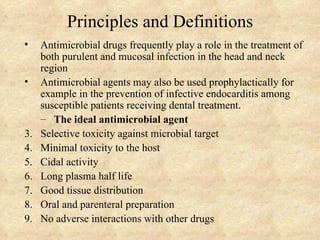
     – The ideal antimicrobial agent
3.   Selective toxicity against microbial target
4.   Minimal toxicity to the host
5.   Cidal activity
6.   Long plasma half life
7.   Good tissue distribution
8.   Oral and parenteral preparation
9.   No adverse interactions with other drugs
Principles and Definitions
•   Antibiotic are natural product of bact. or fungi which kill or inhibit the
    growth of other micro-orginisms
•   Most of antimicrobial drugs in current use have been chemically
    modified.

     •    classification
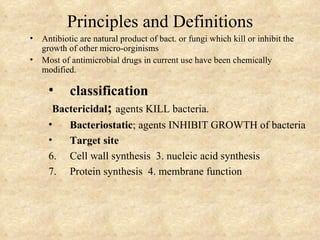
       Bactericidal; agents KILL bacteria.
     •      Bacteriostatic; agents INHIBIT GROWTH of bacteria
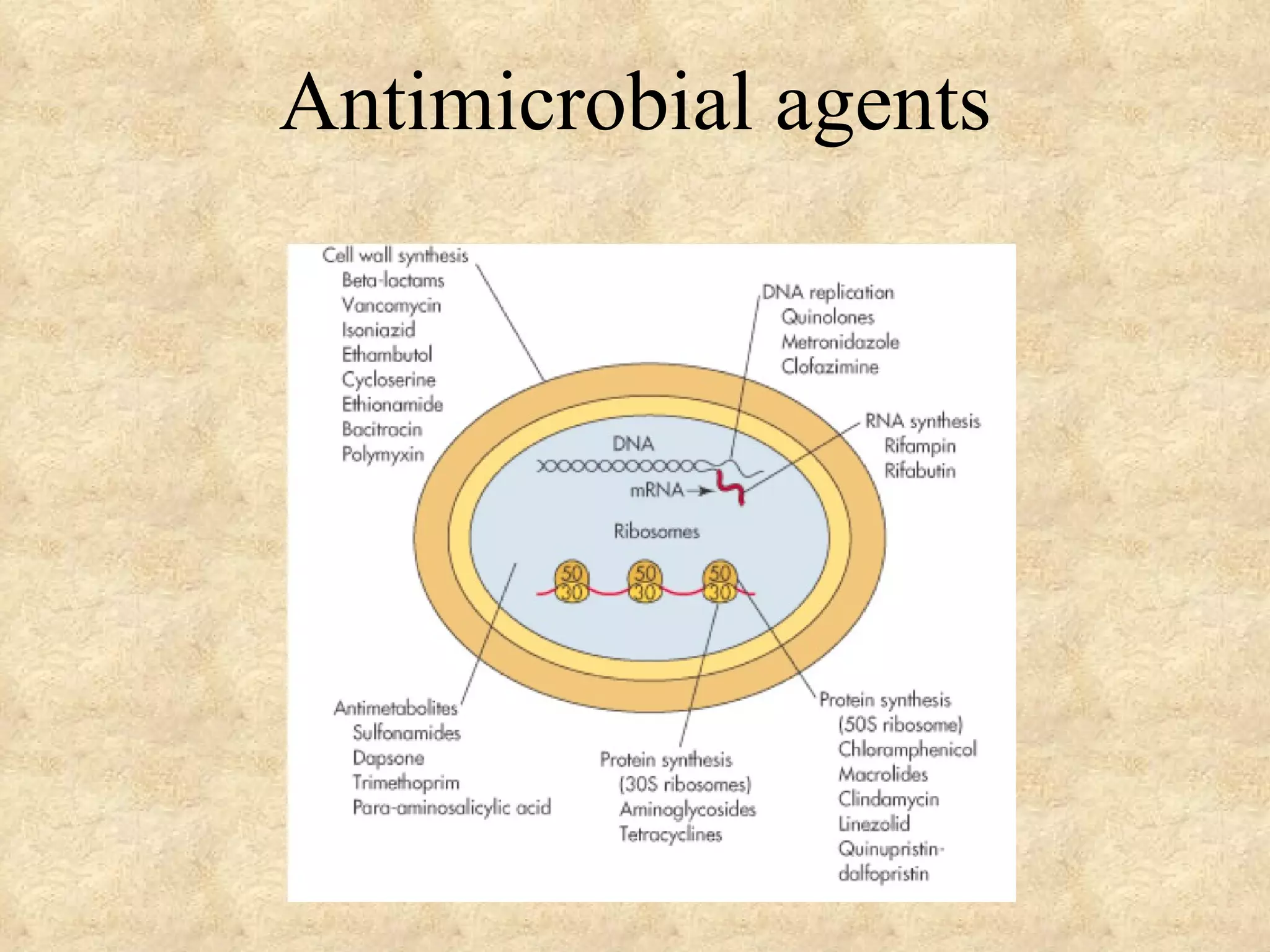
     •      Target site
     6.     Cell wall synthesis 3. nucleic acid synthesis
     7.     Protein synthesis 4. membrane function
Principles and Definitions
• Combination therapy
  – Prevent emergence of resistant strains
  – Take advantage of antibiotic synergism
     • Penicillins and aminoglycosides inhibit cell wall
       synthesis and allow aminoglycosides to enter the
       bacterium and inhibit protein synthesis.
     • CAUTION: Antibiotic antagonism
         – Penicillins and bacteriostatic antibiotics. Cell wall
           synthesis is not occurring in cells that are not growing.
         – Susceptibility tests are a valuable aid to antibiotic
           management of infection. There are tow main types;
           diffusion tests and dilution tests.
Antibiotic that inhibit cell-wall
                synthesis
• BETA-LACTAMS
Includes the penicillins and cephalosporins
Structurally these agents all contain the beta-lactam ring
• Mode of action
• They prevent cell wall synthesis by binding to the enzyme
   known as penicillin binding proteins which are responsible
   for the final stages of cross-linking of the cell wall during
   growth and division.
• Many are active against G+ve bacteria.
• New beta-lactum with activity against G-ve bacteria.
• Some patients are allergic to beta-lactum antibiotic
Antibiotic that inhibit cell-wall
                synthesis
• GLYCOPEPTIDS
• Include vancomycin and teicoplanin
Mode of action
• Interfere with cell wall synthesis by binding to terminal D-
  ala-D-ala residue at the end of pentapeptide chains.
• This prevents the subsequent incorporation of new
  subunits into growing cell wall.
• They are active against G+ve bacteria.
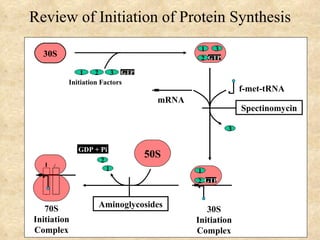
Review of Initiation of Protein Synthesis
                                         1 3
  30S                                    2 GTP

             1    2    3 GTP
         Initiation Factors
                                                     f-met-tRNA
                                 mRNA
                                                     Spectinomycin

                                                 3

             GDP + Pi
                   2
                               50S
   P A
                       1                1
                                        2 GTP


   70S            Aminoglycosides
                                           30S
Initiation                              Initiation
Complex                                 Complex
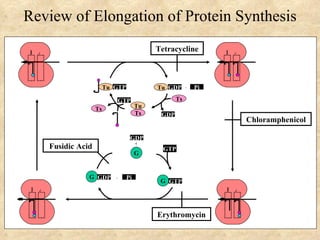
Review of Elongation of Protein Synthesis

P A                                       Tetracycline   P A


                           Tu GTP         Tu GDP + Pi

                              GTP                Ts
                      Ts            Tu
                                    Ts     GDP
                                                               Chloramphenicol

                                    GDP
       Fusidic Acid                  +
                                            GTP
                                    G


                  G GDP + Pi
                                           G GTP
 P A                                                     P A


                                          Erythromycin
QuickTime™ and a
TIFF (Uncompressed) decompressor
   are needed to see this picture.


                                             Inhibitor of protein synthesis
                                                   Aminoglycosides
                                     (only bactericidal protein synthesis inhibitor)
                        streptomycin, kanamycin, gentamicin, tobramycin,
                             amikacin, netilmicin, neomycin (topical)
                 • Modes of action -
                   – Irreversibly bind to the 30S initiation complex (30S-mRNA-
                     tRNA) and prevents initiation of translation.
                   – must be given I.V or I.M.
                   – Their main indication is for treatment for serious G-ve
                     infection.
                   – They are potentially nephrotoxic & ototoxic.
                   – They are not indicated for the treatment of oral and dental
                     infection.
QuickTime™ and a
TIFF (Uncompressed) decompressor


                                     Tetracyclines (bacteriostatic)
   are needed to see this picture.


                                     tetracycline, minocycline and doxycycline

                  • Mode of action - The tetracyclines reversibly bind to the 30S
                    ribosome and inhibit binding of aminoacyl-t-RNA to the acceptor site
                    on the 70S ribosome.
                  • Spectrum of activity - Broad spectrum; Useful against intracellular
                    bacteria (chlamydiae)
                  •    Resistance – Common
                  • Tetracycline mouthwashes sometimes used for treatment of oral
                    ulceration
                  • Adverse effects - Destruction of normal intestinal flora resulting in
                    increased secondary infections (Candida spp.); staining and
                    impairment of the structure of bone and teeth. Not used in children.
QuickTime™ and a
TIFF (Uncompressed) decompressor
   are needed to see this picture.
                                        Chloramphenicol,
                                     Lincomycin, Clindamycin
                                            (bacteriostatic)
                  • Mode of action - These antimicrobials bind to the 50S ribosome and
                    inhibit peptidyl transferase activity. No new peptide bonds formed.

                  • Spectrum of activity - Chloramphenicol - Broad range;
                                              Lincomycin and clindamycin - Restricted
                      range
                  It used for the prophylaxis of infective endocarditic in patients who are
                      allergic to penicillin.

                  • Resistance - Common

                  • Adverse effects - Chloramphenicol is toxic (bone marrow
                    suppression) but is used in life threatening situations such as the
                    treatment of bacterial meningitis.
QuickTime™ and a
TIFF (Uncompressed) decompressor
   are needed to see this picture.


                                     Macrolides (bacteriostatic)
                            erythromycin, clarithromycin, azithromycin, spiramycin

                     • Mode of action - The macrolides inhibit translocation of
                       the ribosome.

                     • Spectrum of activity - Gram-positive bacteria,
                       Mycoplasma, Legionella

                     • Resistance - Common
QuickTime™ and a
TIFF (Uncompressed) decompressor
   are needed to see this picture.


                                     Fusidic acid (bacteriostatic)
                • Mode of action - Fusidic acid binds to elongation factor G (EF-G) and
                  inhibits release of EF-GDP from the EF-G/GDP complex. Can’t
                  reload EF-G with GTP.
                • Spectrum of activity - Gram-positive cocci
                • Topical preparation including an ointment for treatment of angular
                  cheilitis.
                • Main use is in the treatment of staphylococcal infection resistant to
                  beta-lactum or in penicillin-allergic patients
QuickTime™ and a
TIFF (Uncompressed) decompressor
                                      inhibitor of nucleic acid
                                       Rifampin, Rifamycin,
   are needed to see this picture.


                                       Rifampicin, Rifabutin
                                           (bactericidal)


                 Mode of action - These antimicrobials bind to RNA polymerase and
                   inhibit of mRNA synthesis.

                 •     Spectrum of activity - Broad spectrum but is used most commonly in
                       the treatment of tuberculosis.

                 •     Resistance - Common. Develops rapidly (RNA polymerase
                       mutations)

                 •     Combination therapy - Since resistance is common, rifampin is
                       usually used in combination therapy to treat tuberculosis.
Quinolones (bactericidal)
          QuickTime™ and a
TIFF (Uncompressed) decompressor
                                     nalidixic acid, ciprofloxacin, ofloxacin,
   are needed to see this picture.
                                     norfloxacin, levofloxacin, lomefloxacin,
                                                   sparfloxacin
              • Mode of action - These antimicrobials inhibit an enzyme called DNA
                gyrase and prevent supercoiling of DNA, thereby inhibiting DNA
                synthesis.
              • Spectrum of activity - Gram-positive cocci and urinary tract
                infections
              • The commonest side-effects are gastrointestinal.


              • METRONIDAZOLE; the active intermediates of the drug
                interact with and break the bacterial DNA
              • It is active against anaerobic bacteria
              • It is widely used by dentists.
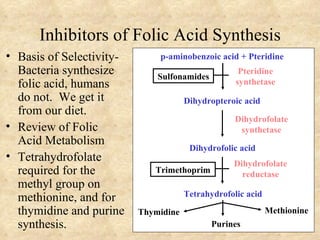
Inhibitors of Folic Acid Synthesis
• Basis of Selectivity-       p-aminobenzoic acid + Pteridine
  Bacteria synthesize         Sulfonamides
                                                    Pteridine
  folic acid, humans                               synthetase
  do not. We get it                   Dihydropteroic acid
  from our diet.
                                                   Dihydrofolate
• Review of Folic                                   synthetase
  Acid Metabolism
                                       Dihydrofolic acid
• Tetrahydrofolate
                                                  Dihydrofolate
  required for the           Trimethoprim           reductase
  methyl group on
  methionine, and for                 Tetrahydrofolic acid

  thymidine and purine    Thymidine                          Methionine
  synthesis.                                 Purines
QuickTime™ and a
TIFF (Uncompressed) decompressor
   are needed to see this picture.
                                          Sulfonamides,
                                            Sulfones
                                              (bacteriostatic)
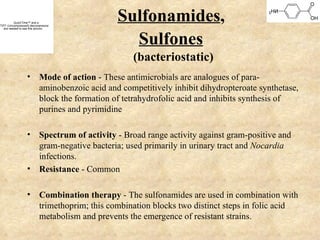
                  • Mode of action - These antimicrobials are analogues of para-
                    aminobenzoic acid and competitively inhibit dihydropteroate synthetase,
                    block the formation of tetrahydrofolic acid and inhibits synthesis of
                    purines and pyrimidine

                  • Spectrum of activity - Broad range activity against gram-positive and
                    gram-negative bacteria; used primarily in urinary tract and Nocardia
                    infections.
                  • Resistance - Common

                  • Combination therapy - The sulfonamides are used in combination with
                    trimethoprim; this combination blocks two distinct steps in folic acid
                    metabolism and prevents the emergence of resistant strains.
QuickTime™ and a
TIFF (Uncompressed) decompressor
   are needed to see this picture.
                                               QuickTime™ and a
                                     TIFF (Uncompressed) decompressor
                                        are needed to see this picture.
                                                                          Trimethoprim,
                                                                           Methotrexate,
                                                                          Pyrimethamine
                                                                            (bacteriostatic)
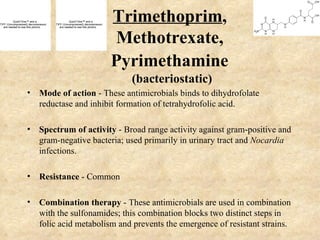
                   • Mode of action - These antimicrobials binds to dihydrofolate
                     reductase and inhibit formation of tetrahydrofolic acid.

                   • Spectrum of activity - Broad range activity against gram-positive and
                     gram-negative bacteria; used primarily in urinary tract and Nocardia
                     infections.

                   • Resistance - Common

                   • Combination therapy - These antimicrobials are used in combination
                     with the sulfonamides; this combination blocks two distinct steps in
                     folic acid metabolism and prevents the emergence of resistant strains.
Antifungal agents
Most act on synthesis or function of the fungal cell membrane.
• POLYENES
Includes nystatin & amphotericin B
Mode of action; bind to sterol in eukaryotic cell membranes resulting in
   impairment of barrier function.
Spectrum of activity- amphotericin B;broad spectrum but is very toxic.
   Used in treatment of systemic mycosis.
New formalation of amphotericin B (AmBisome) is better tolerated. Used
   for treatment of oral candidosis
Nystatin; prescribed for topical use.
Antifungal agents
• AZOLES
Includes fluconazole, itraconazol and miconazole
• Mode of action- bind to cytochrome P450 which lead to
   inhibition of lanosterol C14-demethylase resulting in
   inhibition of ergosterol synthesis
• Spectrum activity- fluconazole ; oropharyngeal
   candidosis
   Resistance- common
                    Itraconazole; broad spectrum
Antiviral agents
• ACICLOVIR- is the only one likely to be prescribed by
    dental surgeons
• Mode of action- inhibition of herpesvirus DNA
    polymerase, and lead to DNA chain termination
It is an analogue of guanosine
• Spectrum activity- herpes simplex virus
It is valuable in the mangement of orofacial herpes simplex
    infections (herpetic gingivostomatitis, herpes labialis)

• INTERFERONS- are naturally produced protein with
  potent antiviral activity
• Spectrum activity- hepatitis B & C virus
• Adverse effect- flu-like symptom.
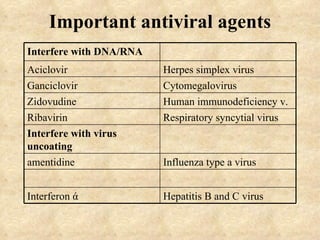
Important antiviral agents
Interfere with DNA/RNA
Aciclovir                Herpes simplex virus
Ganciclovir              Cytomegalovirus
Zidovudine               Human immunodeficiency v.
Ribavirin                Respiratory syncytial virus
Interfere with virus
uncoating
amentidine               Influenza type a virus


Interferon ά             Hepatitis B and C virus
Antimicrobial Drug Resistance
              Principles and Definitions
• Some species of bacteria are innately resist to certain
  antibiotic.
• Some strains may develop or acquire resistance to
  particular antibiotics.
• Acquired resistance may arise by a single, spontaneous
  chromosome mutation .
• Bacteria can acquire resistance genes via plasmids
• An individual plasmid may code for resistance to several
  types of antibiotics
Antimicrobial Drug Resistance
             Mechanisms
• Altered target- target enzyme may change perhaps by
  mutation.( penicillin binding protein)
   – Alteration in access to the target site (altered uptake)- through
     change permeability or by actively pumping the drug out of the cell
     (tetracycline)
   – Drug inactivation- enzyme may produced that inactivate the
     antibacterial agent. beta lactamase)

Antibiotics2008

  • 1.
  • 2.
    Principles and Definitions • Antimicrobial drugs frequently play a role in the treatment of both purulent and mucosal infection in the head and neck region • Antimicrobial agents may also be used prophylactically for example in the prevention of infective endocarditis among susceptible patients receiving dental treatment. – The ideal antimicrobial agent 3. Selective toxicity against microbial target 4. Minimal toxicity to the host 5. Cidal activity 6. Long plasma half life 7. Good tissue distribution 8. Oral and parenteral preparation 9. No adverse interactions with other drugs
  • 3.
    Principles and Definitions • Antibiotic are natural product of bact. or fungi which kill or inhibit the growth of other micro-orginisms • Most of antimicrobial drugs in current use have been chemically modified. • classification Bactericidal; agents KILL bacteria. • Bacteriostatic; agents INHIBIT GROWTH of bacteria • Target site 6. Cell wall synthesis 3. nucleic acid synthesis 7. Protein synthesis 4. membrane function
  • 4.
    Principles and Definitions •Combination therapy – Prevent emergence of resistant strains – Take advantage of antibiotic synergism • Penicillins and aminoglycosides inhibit cell wall synthesis and allow aminoglycosides to enter the bacterium and inhibit protein synthesis. • CAUTION: Antibiotic antagonism – Penicillins and bacteriostatic antibiotics. Cell wall synthesis is not occurring in cells that are not growing. – Susceptibility tests are a valuable aid to antibiotic management of infection. There are tow main types; diffusion tests and dilution tests.
  • 5.
    Antibiotic that inhibitcell-wall synthesis • BETA-LACTAMS Includes the penicillins and cephalosporins Structurally these agents all contain the beta-lactam ring • Mode of action • They prevent cell wall synthesis by binding to the enzyme known as penicillin binding proteins which are responsible for the final stages of cross-linking of the cell wall during growth and division. • Many are active against G+ve bacteria. • New beta-lactum with activity against G-ve bacteria. • Some patients are allergic to beta-lactum antibiotic
  • 6.
    Antibiotic that inhibitcell-wall synthesis • GLYCOPEPTIDS • Include vancomycin and teicoplanin Mode of action • Interfere with cell wall synthesis by binding to terminal D- ala-D-ala residue at the end of pentapeptide chains. • This prevents the subsequent incorporation of new subunits into growing cell wall. • They are active against G+ve bacteria.
  • 7.
    Review of Initiationof Protein Synthesis 1 3 30S 2 GTP 1 2 3 GTP Initiation Factors f-met-tRNA mRNA Spectinomycin 3 GDP + Pi 2 50S P A 1 1 2 GTP 70S Aminoglycosides 30S Initiation Initiation Complex Complex
  • 8.
    Review of Elongationof Protein Synthesis P A Tetracycline P A Tu GTP Tu GDP + Pi GTP Ts Ts Tu Ts GDP Chloramphenicol GDP Fusidic Acid + GTP G G GDP + Pi G GTP P A P A Erythromycin
  • 9.
    QuickTime™ and a TIFF(Uncompressed) decompressor are needed to see this picture. Inhibitor of protein synthesis Aminoglycosides (only bactericidal protein synthesis inhibitor) streptomycin, kanamycin, gentamicin, tobramycin, amikacin, netilmicin, neomycin (topical) • Modes of action - – Irreversibly bind to the 30S initiation complex (30S-mRNA- tRNA) and prevents initiation of translation. – must be given I.V or I.M. – Their main indication is for treatment for serious G-ve infection. – They are potentially nephrotoxic & ototoxic. – They are not indicated for the treatment of oral and dental infection.
  • 10.
    QuickTime™ and a TIFF(Uncompressed) decompressor Tetracyclines (bacteriostatic) are needed to see this picture. tetracycline, minocycline and doxycycline • Mode of action - The tetracyclines reversibly bind to the 30S ribosome and inhibit binding of aminoacyl-t-RNA to the acceptor site on the 70S ribosome. • Spectrum of activity - Broad spectrum; Useful against intracellular bacteria (chlamydiae) • Resistance – Common • Tetracycline mouthwashes sometimes used for treatment of oral ulceration • Adverse effects - Destruction of normal intestinal flora resulting in increased secondary infections (Candida spp.); staining and impairment of the structure of bone and teeth. Not used in children.
  • 11.
    QuickTime™ and a TIFF(Uncompressed) decompressor are needed to see this picture. Chloramphenicol, Lincomycin, Clindamycin (bacteriostatic) • Mode of action - These antimicrobials bind to the 50S ribosome and inhibit peptidyl transferase activity. No new peptide bonds formed. • Spectrum of activity - Chloramphenicol - Broad range; Lincomycin and clindamycin - Restricted range It used for the prophylaxis of infective endocarditic in patients who are allergic to penicillin. • Resistance - Common • Adverse effects - Chloramphenicol is toxic (bone marrow suppression) but is used in life threatening situations such as the treatment of bacterial meningitis.
  • 12.
    QuickTime™ and a TIFF(Uncompressed) decompressor are needed to see this picture. Macrolides (bacteriostatic) erythromycin, clarithromycin, azithromycin, spiramycin • Mode of action - The macrolides inhibit translocation of the ribosome. • Spectrum of activity - Gram-positive bacteria, Mycoplasma, Legionella • Resistance - Common
  • 13.
    QuickTime™ and a TIFF(Uncompressed) decompressor are needed to see this picture. Fusidic acid (bacteriostatic) • Mode of action - Fusidic acid binds to elongation factor G (EF-G) and inhibits release of EF-GDP from the EF-G/GDP complex. Can’t reload EF-G with GTP. • Spectrum of activity - Gram-positive cocci • Topical preparation including an ointment for treatment of angular cheilitis. • Main use is in the treatment of staphylococcal infection resistant to beta-lactum or in penicillin-allergic patients
  • 14.
    QuickTime™ and a TIFF(Uncompressed) decompressor inhibitor of nucleic acid Rifampin, Rifamycin, are needed to see this picture. Rifampicin, Rifabutin (bactericidal) Mode of action - These antimicrobials bind to RNA polymerase and inhibit of mRNA synthesis. • Spectrum of activity - Broad spectrum but is used most commonly in the treatment of tuberculosis. • Resistance - Common. Develops rapidly (RNA polymerase mutations) • Combination therapy - Since resistance is common, rifampin is usually used in combination therapy to treat tuberculosis.
  • 15.
    Quinolones (bactericidal) QuickTime™ and a TIFF (Uncompressed) decompressor nalidixic acid, ciprofloxacin, ofloxacin, are needed to see this picture. norfloxacin, levofloxacin, lomefloxacin, sparfloxacin • Mode of action - These antimicrobials inhibit an enzyme called DNA gyrase and prevent supercoiling of DNA, thereby inhibiting DNA synthesis. • Spectrum of activity - Gram-positive cocci and urinary tract infections • The commonest side-effects are gastrointestinal. • METRONIDAZOLE; the active intermediates of the drug interact with and break the bacterial DNA • It is active against anaerobic bacteria • It is widely used by dentists.
  • 16.
    Inhibitors of FolicAcid Synthesis • Basis of Selectivity- p-aminobenzoic acid + Pteridine Bacteria synthesize Sulfonamides Pteridine folic acid, humans synthetase do not. We get it Dihydropteroic acid from our diet. Dihydrofolate • Review of Folic synthetase Acid Metabolism Dihydrofolic acid • Tetrahydrofolate Dihydrofolate required for the Trimethoprim reductase methyl group on methionine, and for Tetrahydrofolic acid thymidine and purine Thymidine Methionine synthesis. Purines
  • 17.
    QuickTime™ and a TIFF(Uncompressed) decompressor are needed to see this picture. Sulfonamides, Sulfones (bacteriostatic) • Mode of action - These antimicrobials are analogues of para- aminobenzoic acid and competitively inhibit dihydropteroate synthetase, block the formation of tetrahydrofolic acid and inhibits synthesis of purines and pyrimidine • Spectrum of activity - Broad range activity against gram-positive and gram-negative bacteria; used primarily in urinary tract and Nocardia infections. • Resistance - Common • Combination therapy - The sulfonamides are used in combination with trimethoprim; this combination blocks two distinct steps in folic acid metabolism and prevents the emergence of resistant strains.
  • 18.
    QuickTime™ and a TIFF(Uncompressed) decompressor are needed to see this picture. QuickTime™ and a TIFF (Uncompressed) decompressor are needed to see this picture. Trimethoprim, Methotrexate, Pyrimethamine (bacteriostatic) • Mode of action - These antimicrobials binds to dihydrofolate reductase and inhibit formation of tetrahydrofolic acid. • Spectrum of activity - Broad range activity against gram-positive and gram-negative bacteria; used primarily in urinary tract and Nocardia infections. • Resistance - Common • Combination therapy - These antimicrobials are used in combination with the sulfonamides; this combination blocks two distinct steps in folic acid metabolism and prevents the emergence of resistant strains.
  • 19.
    Antifungal agents Most acton synthesis or function of the fungal cell membrane. • POLYENES Includes nystatin & amphotericin B Mode of action; bind to sterol in eukaryotic cell membranes resulting in impairment of barrier function. Spectrum of activity- amphotericin B;broad spectrum but is very toxic. Used in treatment of systemic mycosis. New formalation of amphotericin B (AmBisome) is better tolerated. Used for treatment of oral candidosis Nystatin; prescribed for topical use.
  • 20.
    Antifungal agents • AZOLES Includesfluconazole, itraconazol and miconazole • Mode of action- bind to cytochrome P450 which lead to inhibition of lanosterol C14-demethylase resulting in inhibition of ergosterol synthesis • Spectrum activity- fluconazole ; oropharyngeal candidosis Resistance- common Itraconazole; broad spectrum
  • 21.
    Antiviral agents • ACICLOVIR-is the only one likely to be prescribed by dental surgeons • Mode of action- inhibition of herpesvirus DNA polymerase, and lead to DNA chain termination It is an analogue of guanosine • Spectrum activity- herpes simplex virus It is valuable in the mangement of orofacial herpes simplex infections (herpetic gingivostomatitis, herpes labialis) • INTERFERONS- are naturally produced protein with potent antiviral activity • Spectrum activity- hepatitis B & C virus • Adverse effect- flu-like symptom.
  • 22.
    Important antiviral agents Interferewith DNA/RNA Aciclovir Herpes simplex virus Ganciclovir Cytomegalovirus Zidovudine Human immunodeficiency v. Ribavirin Respiratory syncytial virus Interfere with virus uncoating amentidine Influenza type a virus Interferon ά Hepatitis B and C virus
  • 23.
    Antimicrobial Drug Resistance Principles and Definitions • Some species of bacteria are innately resist to certain antibiotic. • Some strains may develop or acquire resistance to particular antibiotics. • Acquired resistance may arise by a single, spontaneous chromosome mutation . • Bacteria can acquire resistance genes via plasmids • An individual plasmid may code for resistance to several types of antibiotics
  • 24.
    Antimicrobial Drug Resistance Mechanisms • Altered target- target enzyme may change perhaps by mutation.( penicillin binding protein) – Alteration in access to the target site (altered uptake)- through change permeability or by actively pumping the drug out of the cell (tetracycline) – Drug inactivation- enzyme may produced that inactivate the antibacterial agent. beta lactamase)