ANTIARRHYTHMIC DRUGS
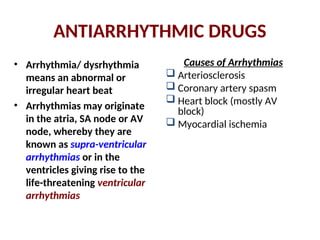
• Arrhythmia/ dysrhythmia
means an abnormal or
irregular heart beat
• Arrhythmias may originate
in the atria, SA node or AV
node, whereby they are
known as supra-ventricular
arrhythmias or in the
ventricles giving rise to the
life-threatening ventricular
arrhythmias
Causes of Arrhythmias
 Arteriosclerosis
 Coronary artery spasm
 Heart block (mostly AV
block)
 Myocardial ischemia
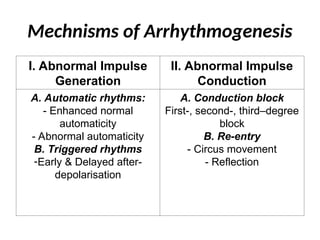
Mechnisms of Arrhythmogenesis
I. Abnormal Impulse
Generation
II. Abnormal Impulse
Conduction
A. Automatic rhythms:
- Enhanced normal
automaticity
- Abnormal automaticity
B. Triggered rhythms
-Early & Delayed after-
depolarisation
A. Conduction block
First-, second-, third–degree
block
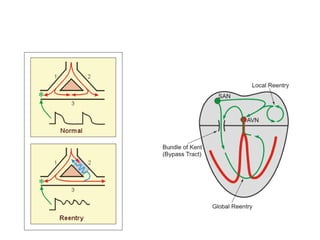
B. Re-entry
- Circus movement
- Reflection
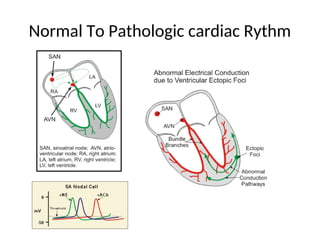
Normal To Pathologic cardiac Rythm
Specific Arrhythmias
 Supraventricular Arrhythmias
 Sinus tachycardia - high sinus rate of 100-180 beats/min
as occurs during exercise or other conditions that lead to
increased SA nodal firing rate
 Atrial tachycardia - a series of 3 or more consecutive
atrial premature beats occurring at a frequency
>100/min;
 Paroxysmal atrial tachycardia (PAT) of sudden onset,
disappearance
 Atrial flutter - sinus rate of 250-350 beats/min.
 Atrial fibrillation - uncoordinated atrial depolarizations.
 AV blocks - a conduction block within the AV node (or
occasionally in the bundle of His) that impairs impulse
conduction from the atria to the ventricles
 Ventricular premature beats (VPBs) - caused by
ectopic ventricular foci; characterized by widened QRS.
 Ventricular tachycardia (VT) - high ventricular rate
caused by aberrant ventricular automaticity or by
intraventricular reentry; can be sustained or non-
sustained (paroxysmal); characterized by widened QRS;
rates of 100 to 200 beats/min; life-threatening.
 Ventricular flutter - ventricular depolarizations
>200/min.
 Ventricular fibrillation - uncoordinated ventricular
depolarizations
Pharmacologic Rationale & Goals
The ultimate goal of antiarrhythmic drug therapy:
o Restore normal sinus rhythm and conduction
o Prevent more serious and possibly lethal
arrhythmias from occurring.
 Antiarrhythmic drugs are used to:
decrease conduction velocity
alter the excitability of cardiac cells by changing
the duration of the effective refractory period
suppress abnormal automaticity
Pharmacologic Rationale
 Some drugs block fast sodium channels that determine how fast the
membrane depolarizes (slope of phase 0, Vmax) & conduction velocity
 Sodium channel blockers (Group I) reduce conduction velocity to
abolish tachyarrhythmias caused by reentry circuits
 Antiarrhythmic drugs affect cardiac refractoriness by changing
ERP/APD via potassium channels and delay repolarization of action
potentials (phase 3)
 This would inhibit reentry tachycardias
 Slow inward Ca channel blockers reduce SAnodal firing rate by
slowing the rate of rise of depolarizing pacemaker potentials (phase
4 depolarization)
 These drugs also reduce conduction velocity Ca-dependant tissue
including the AV & SA nodal cells
 Blockers of beta1-adrenoceptors can indirectly alter membrane ion
conductance, particularly calcium and potassium conductance
ANTIARRHYTHMIC DRUGS
• Most antiarrhythmic
drugs are pro-
arrhythmic
• Only ß-blockers are
proved to reduce
mortality in post-
myocardial infarction
patients
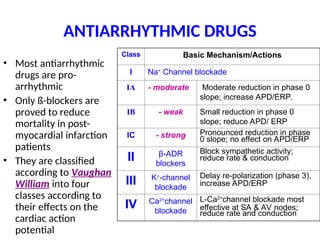
• They are classified
according to Vaughan
William into four
classes according to
their effects on the
cardiac action
potential
Class Basic Mechanism/Actions
I Na+
Channel blockade
IA - moderate Moderate reduction in phase 0
slope; increase APD/ERP.
IB - weak Small reduction in phase 0
slope; reduce APD/ ERP
IC - strong Pronounced reduction in phase
0 slope; no effect on APD/ERP
II β-ADR
blockers
Block sympathetic activity;
reduce rate & conduction
III K+
-channel
blockade
Delay re-polarization (phase 3),
increase APD/ERP
IV Ca2+
channel
blockade
L-Ca2+
channel blockade most
effective at SA & AV nodes;
reduce rate and conduction
1
.
Class I ANTIARRHYTHMIC DRUGS
Na+
-Channels Blockers
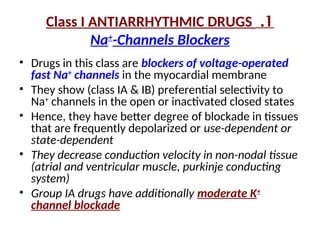
• Drugs in this class are blockers of voltage-operated
fast Na+
channels in the myocardial membrane
• They show (class IA & IB) preferential selectivity to
Na+
channels in the open or inactivated closed states
• Hence, they have better degree of blockade in tissues
that are frequently depolarized or use-dependent or
state-dependent
• They decrease conduction velocity in non-nodal tissue
(atrial and ventricular muscle, purkinje conducting
system)
• Group IA drugs have additionally moderate K+
channel blockade
Class IA Drugs
Quinidine, Procainamide, Disopyramide
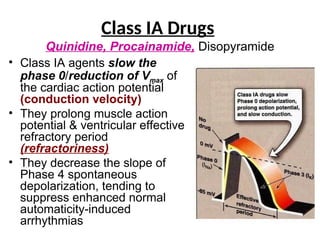
• Class IA agents slow the
phase 0/reduction of Vmax of
the cardiac action potential
(conduction velocity)
• They prolong muscle action
potential & ventricular effective
refractory period
(refractoriness)
• They decrease the slope of
Phase 4 spontaneous
depolarization, tending to
suppress enhanced normal
automaticity-induced
arrhythmias
Class IA Drugs
• They possess intermediate rate of association and
dissociation with sodium channels
• Pharmacokinetics:
• Procainamide has good oral bioavailability
• Procainamide is frequently used as IV slow route to
avoid hypotension
• Procainamide is metabolized into N-acetylprocainamide
(NAPA), an active class III meatbolite mailnly cleared via
the kidney, (dose adjustment in kidney failure)
• Quinidine has good oral bioavailability & metabolized
mainly in liver
Class IA Drugs Uses
• Class IA drugs are effective in treatment of both
supraventricular and ventricular arrhythmias
• Quinidine rarely used for supraventricular arrhythmias
• Oral quinidine/procainamide are used with class III
drugs in refractory ventricular tachycardia patients with
implantable defibrillator
• IV procainamide used for hemodynamically stable
ventricular tachycardia
• IV procainamide used for acute conversion of atrial
fibrillation including WPW syndrome
Class IA Drugs Toxicity
Quinidine
• A-V block at higher plasma levels
• At toxic levels, ventricular tachycardia
and torsade de pointes ventricular
arrhythmia
• Increasing digoxin plasma
concentration by displacing digoxin
from binding sites in addition to
decreased digoxin renal clearance
• Cinchonism occurs at large dose levels
(blurred vision, tinnitus, headache,
psychosis and gastrointestinal upset)
• Digoxin is administered before
quinidine to prevent the conversion of
atrial fibrillation or flutter into
paradoxical ventricular tachycardia.
Quinidine shortens of A-V nodal
refractoriness by atropine-like effects
Procainamide
 At high levels, asystole or induction of
ventricular arrhythmias
 Hypersensitivity reactions including drug fever
and rarely agranulocytosis.
 Systemic lupus erythromatosus (SLE)-like
(arthralgia, fever & pleural-pericardial
inflammation)
 The SLE is dose- and time-dependent, and
usually disappears upon drug stop
 It is most common in patients with slow hepatic
acetylation resulting in higher plasma level of
the parent drug
Disopyramide
• 1. Anticholinergic side-effects
• 2. Induction of ventricular arrhythmias in
patients with prolonged QT interval
• 3. Similar to quinidine, disopyramide may induce
ventricular arrhythmia if used alone in the
treatment of fibrillation
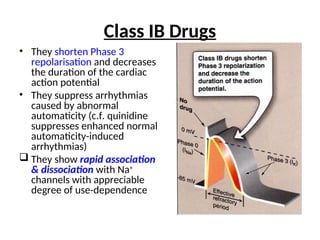
Class IB Drugs
• They shorten Phase 3
repolarisation and decreases
the duration of the cardiac
action potential
• They suppress arrhythmias
caused by abnormal
automaticity (c.f. quinidine
suppresses enhanced normal
automaticity-induced
arrhythmias)
 They show rapid association
& dissociation with Na+
channels with appreciable
degree of use-dependence
Agents of Class IB
Lidocaine
• It should be used by intravenous
route because of its extensive
first-pass metabolism
• Lidocaine is the drug of choice in
emergency treatment of
ventricular arrhythmias
Mexiletine and tocainide
• These are the oral analogs of
lidocaine
• Mexiletine is used for chronic
treatment of ventricular
arrhythmias associated with
previous myocardial infarction
• Tocainide is used for ventricular
tachyarrhythmias but its use is
limited by its pulmonary toxicity
that may lead to pulmonary
fibrosis
Uses
They are used in the treatment of ventricular arrhythmias arising during
myocardial ischemia or due to digoxin toxicity
They have little effect on atrial or AV junction arrhythmias
Class IC Drugs
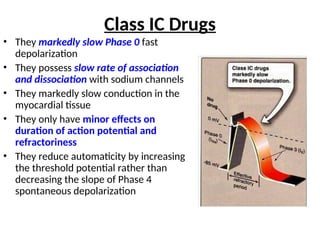
• They markedly slow Phase 0 fast
depolarization
• They possess slow rate of association
and dissociation with sodium channels
• They markedly slow conduction in the
myocardial tissue
• They only have minor effects on
duration of action potential and
refractoriness
• They reduce automaticity by increasing
the threshold potential rather than
decreasing the slope of Phase 4
spontaneous depolarization
Class IC Drugs
• Agents of Class IC: Flecainide & propafenone
• Uses:
 They are broad-spectrum but only approved for refractory
ventricular arrhythmias
 Flecainide is a particularly potent suppressant of premature
ventricular contractions
• Toxicity and Cautions for Class IC Drugs:
 They are severe proarrhythmic drugs causing severe worsening
of a preexisting arrhythmia or de novo occurrence of life-
threatening ventricular tachycardia
 In patients with frequent PVCs following MI, flecainide increased
mortality compared to placebo
Notice: Class 1C drugs are particularly of low safety and have
shown even to increase mortality when used chronically after
MI
Class II ANTIARRHYTHMIC DRUGS
(β-adrenergic blockers)
β-Adrenergic blockers
produce both negative
inotropic & chronotropic
effects
• They diminish phase 4
spontaneous
depolarization suppressing
automaticity and
prolonging AV conduction
Uses
• They are used in treatment
of increased sympathetic
activity-induced
arrhythmias such as stress-
and exercise-induced
arrhythmias
• Treatment of atrial flutter
and fibrillation
• AV nodal tachycardia
Class II ANTIARRHYTHMIC DRUGS
• Propranolol: was proved to reduce the incidence of
sudden arrhythmatic death after myocardial infarction
• Metoprolol & Pindolol
 Metoprolol and other selective β1-adrenergic blockers
reduce the risk of bronchospasm
 Pidolol, having additional partial agonistic activity, may
decrease the frequency of cardiac failure
• Esmolol:
 Esmolol is a very short-acting β1-adrenergic blocker
that is used in the by intravenous route in acute
arrhythmias occurring during surgery or emergencies
Class III ANTIARRHYTHMIC DRUGS
• Class III antiarrhythmic drugs prolong phase 3
depolarization, without altering phase 0
upstroke or the resting membrane potential
• They prolong both the duration of the action
potential and the effective refractory period
(ERP)
• Their mechanism of action is still not clear but
it is thought that they block potassium
channels
Class III ANTIARRHYTHMIC DRUGS
• Drugs of Class III:
Sotalol, bretylium, amiodarone, ibulitide
• Uses:
They are used in the treatment of ventricular
arrhythmias, especially ventricular fibrillation or
tachycardia
Supra-ventricular tachycardia
Amiodarone usage is limited by its wide range
of side effects
Class III ANTIARRHYTHMIC DRUGS
Sotalol (Sotacor)
• Sotalol is a β-adrenergic blocker that also prolongs the duration of
action potential and refractoriness in all cardiac tissues
• Sotalol suppresses Phase 4 spontaneous depolarization and possibly
producing severe sinus bradycardia
• The β-adrenergic blockade combined with prolonged action
potential duration may of special efficacy in prevention of sustained
ventricular tachycardia
• It may induce the polymorphic torsade de pointes ventricular
tachycardia
Bretylium
• It is generally administered parenteraly because of poor GIT
absorption
• Long-term oral use is associated with painful parotid enlargement
as well as severe postural hypotension
Class III ANTIARRHYTHMIC DRUGS
Amiodarone (Cordarone)
• Amiodarone is a drug of multiple actions and not well understood
• It is extensively taken up by tissues, especially fatty tissues, and has a half-life of up
to 60 days
• Amiodarone antiarrhythmic effect is complex comprising class I, II, III, and IV
actions
• Prolongation of action potential duration and refractoriness is the main
• It slows cardiac conduction, works as Ca2+
channel blocker, and as a weak β-
adrenergic blocker
• Amiodarone Toxicity
 Amiodarone has wide-spectrum toxicity
 Most common include GI intolerance, tremors, ataxia, dizziness, hyper-or
hypothyrodism
 Corneal microdeposits may be accompanied with disturbed night vision
 Other common side effects include liver toxicity, photosensitivity, gray facial
discoloration, neuropathy, muscle weakness, and weight loss
 The most dangerous side effect is pulmonary fibrosis which occurs in 2-5% of the
patients
Class IV ANTIARRHYTHMIC DRUGS
(Calcium Channel Blockers)
• Calcium channel blockers decrease inward Ca2+
currents resulting in a decrease of phase 4
spontaneous depolarization
• They slow conduction in Ca2+
current-
dependent tissues like AV node
• Verapamil and diltiazem, but not nifedipine (or
the other dihydropyridine Ca2+
antagonists), are
representative of this class being more effective
on the heart than blood vessels
Class IV ANTIARRHYTHMIC DRUGS
• Verapamil and diltiazem bind only to open
depolarized voltage-operated Ca2+
channels, and
hence preventing re-polarization until the drug
dissociates from the channels.
• Therefore, they are use-dependent blocking rapidly
beating heart since in a normally-paced heart, Ca2+
channels have enough time to repolarize and the
drug to dissociate from the channel before the next
conduction cycle
• Verapamil and diltiazem slow conduction and
prolong effective refractory period in Ca2+
current-
dependent tissues like AV node
Class IV ANTIARRHYTHMIC DRUGS
Verapamil & diltiazem are more effective in treatment
of atrial than ventricular arrhythmias.
They are used in treatment of supra-ventricular
tachycardia preventing the occurrence of ventricular
arrhythmias
They are used in treatment of atrial flutter and
fibrillation
Both drugs are contraindicated patients with pre-
existing depressed heart function because of their
negative inotropic activity
Both drugs may cause bradycardia, and asystole
especially when given in combination with β-adrenergic
blockers
Miscellaneous Antiarrhythmic Drugs
Adenosine
o Adenosine activates A1-purinergic receptors
decreasing the SA nodal firing and automaticity,
reducing conduction velocity, prolonging effective
refractory period, and depressing AV nodal
conductivity
o It is the drug of choice in treatment of paroxysmal
supra-ventricular tachycardia
o It is used only by slow intravenous bolus
o It has only low-profile toxicity being ultra-short
acting of 15 seconds duration
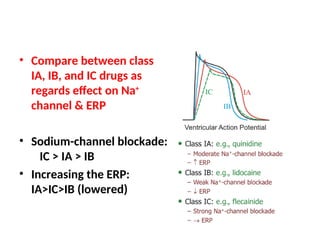
• Compare between class
IA, IB, and IC drugs as
regards effect on Na+
channel & ERP
• Sodium-channel blockade:
IC > IA > IB
• Increasing the ERP:
IA>IC>IB (lowered)